



Abstract
This paper compares and contrasts pre-service teachers’ (PSTs) beliefs about democracy in Argentina and Australia. While there are many important studies of how school students understand democracy and democratic participation, few have studied what teachers, and especially pre-service teachers, think about democracy. This paper uses a mixed methods approach to present quantitative and qualitative responses to the contrasting understandings of democracy from an established and a newly emerging democracy. Determining the linkage between education and democracy is important as it has implications for how our children will relate to democracy both in the classroom and in society as future citizens.
Introduction
Democracy is an unfinished project … [it is] not only about a better form of government, more transparent and participatory governance, and more fair and equitable policies. It is also an ongoing process of community building, of healthier relations with other community members and with nature. (Schugurensky, 2013: xi)
This paper compares and contrasts recent research into pre-service teachers’ (PSTs) beliefs about democracy in three locations across two continents: the first is a state institute of teacher education in Argentina in the Greater Metropolitan Area of Buenos Aires; the second is a training college on the campus of a private school in Buenos Aires; and the third is the largest teacher education faculty in Melbourne, Australia.
While there are many important studies of how school students understand democracy (Hahn, 1998; Malik, 1979) and democratic participation, for example as part of the IEA-CIVED study 2 (Kennedy, 2012; Torney-Purta and Amadeo, 2013), few have studied what teachers, and especially pre-service teachers, think about democracy (Busher et al., 2012; Cashman, 2007; Kubow, 2007; Myers, 2007). Systematic study of what teachers and especially pre-service teachers believe about democracy has not previously been attempted. 3
This article discusses how a representative sample of Australian and Argentine pre-service teachers perceive, experience and understand democracy. Using data from the two countries (N=+500), this article presents quantitative and qualitative responses to contrasting understandings of democracy from an established and newly emerging democracy. We analyse the data collected from pre-service teachers in Australia and Argentina and seek to understand how those involved in school education comprehend, experience, perceive and implement democracy in education. Attempting to determine the linkage between education and democracy at educator level is important, as we believe that it may have far-reaching implications for the delivery of teaching and learning that subsequently influence how students relate to, and perhaps do, democracy (Lund and Carr, 2008; Westheimer and Kahne, 2004b) within the classroom, within the school and, more broadly, at the societal level. The need to critically understand the perspectives and experiences of educators in relation to education for democracy (Carr, 2007, 2008) as civic engagement is critically important to the ‘health’ of a democracy (Mellor and Seddon, 2013), and the ‘modelling of participatory behaviours, in and out of classrooms, across all the elements represented in the whole school culture figure, by other members of school is also useful to learners’ (Mellor and Seddon, 2013, p.11).
Discussions on democracy often result in platitudinous affirmations that it is naturally desirable; as a corollary, anything that is not democratic is considered virtually irrelevant. Kahne and Westheimer (2003: 36) found that schools and teachers largely teach a thin democracy which ‘emphasiz[es] individual character and behaviour [but] obscures the need for collective and often public-sector initiatives’. In their research, they conclude that each vision of citizenship reflects a relatively distinct set of theoretical and curricular goals. Significantly, they claim that these visions, as delivered in programmes, are not cumulative. The core assumptions behind each of the different perspectives reflect a particular approach to problems and solutions in society: the personally responsible citizen solves social problems and improves society by having a good character; they must be honest, responsible and law-abiding members of the community. The participatory citizen solves social problems and improves society through active participation and leadership within established systems and community structures. Finally, the justice-oriented citizen solves social problems and improves society by questioning, challenging and changing established systems and structures when they reproduce patterns of injustice over time.
Through the notion of thin versus thick democracy, we conceptualise the visible tension between the superficial features often associated with teaching about democracy and the fundamental scaffolding which permits people to appropriate the deeper meaning of teaching for democracy. Bolstering efforts to teach through the academic disciplines – whether pursued through high-stakes exams or well-crafted curriculum frameworks – is insufficient to further the goals of teaching for democracy (Davies and Issitt, 2005).
Carr (2010) has further developed the notion of (thick) democracy, infusing critical pedagogy and the notion of how knowledge is constructed into a spectrum of possibilities, potential, experiences and realities in relation to how we can consider and conceptualise democracy in education.
This article builds on research from the Global Doing Democracy Research Project (GDDRP), 4 which currently has some 50 scholars in over 25 countries examining the perspectives and perceptions of democracy among pre- and in-service teachers, teacher education academics and community activists. It is also part of research funded by the Social Sciences and Humanities Research Council of Canada and the Australian Research Council. These studies use a collaboratively developed and locally contextualised on-line survey tool to collect both quantitative and qualitative data from diverse groups of educators, 5 comparing and contrasting findings and implications from a significant number of participants from diverse political contexts 6 in order to determine how democracy is perceived, experienced and undertaken in and through education. This will enable the future elaboration of specific tools, measures and practices at the local, national and international levels.
The need to understand the perspectives and perceptions of teachers
Reducing the notion of citizenship to a set of dispositions, skills, practices, and ideals that can be ‘delivered’ and then performed by purely conscious rational subjects in institutions that are often not even organised democratically, not only ignores the tensions of governmentality but also disregards the importance of automatic, non-conscious learning in human cognition. (Fischman and Haas, 2012: 185)
The origin of peoples’ beliefs is largely the result of a combination of family and culture, religion, socio-economic background and education. We cannot – more importantly, we should not – try to interfere with the former. While there have been many efforts by regimes both past and present to impose their will on the way people should think, they have never lasted very long. On the other hand, there is much research evidence – as well as our own experience – to show that education can and does have a much deeper and longer lasting impact on beliefs, but – unlike religion and family – education is formative and not prescriptive. Educators in general, and pre-service teachers in particular, are therefore an important target group for this research because of their obvious role and impact in educating young people; we do note however that other disciplines, such as law, medicine, social work, engineering, etc., would also be interesting and important to study. The focus on education however provides a more distinct linkage into how democracy may be constructed within schools and the broader education field.
Studying the perspectives, experiences and perceptions of educators, and how they are understood to cultivate and anchor democracy within the educational experience, has not been attempted before, with the exception of some small case studies (Osler, 1997). This is considered to be an important part of the equation in the development of a more participatory, empowered and engaged citizenry, thereby safeguarding democratic society. Contemporary debates about citizenship are not just about who is and who is not a citizen, but rather ask: is citizenship a status or a practice? Does citizenship liberate or control populations? Is citizenship only national or could it also be cosmopolitan and transnational (Fischman and Haas, 2012: 171)?
Research into school students’ attitudes to democratic values and participation in society (Kennedy, 2012) concludes that while students may have a well-developed set of democratic values, they adopt a passive rather than an active style of engaging in citizenship activities and do not see themselves exercising an effective presence in the formal political system (Mellor and Kennedy, 2003). Pre-service teachers are therefore important because of teachers’ acknowledged role and impact in educating young people, and their views on democracy need to be studied and understood as integral to the understanding of what has been deemed a democratic deficit among young people today.
School education can and does contribute to the production of citizens’ identities, as the IEA-CIVED studies indicate, but such contribution cannot be controlled or measured in the same way that systems assess how much a student has learned about mathematics or literacy in any given year. Citizenship education suggests that, resulting from its programme, a ‘new identity will emerge’, but it is
[a]lways an educationally unfinished project, an unsolvable tension, that cannot be learned and understood through conscious rationality alone and thus not solved through the delivery of explicit instruction on what democracy is and how a good citizen should act. (Fischman and Haas, 2012: 174)
Hahn’s study (1998) shows schools are implicated in promoting civic education through certain types of political experiences. Schools and classrooms can play a part in the education of democratic citizens through the way they are organised. However, the opposite is also true—if schools and classrooms are not democratically organised, they are also helping to shape a more authoritarian classroom environment. What students experience in schools – what topics they discuss and how they are discussed – and their attitudes and beliefs concerning a particular range of political issues are of fundamental importance in their civic development. This highlights the discrepancy between what the CIVED data show and what is possible in schools that establish effective practices, including debating of controversial issues, lobbying politicians, raising money for charities, interviewing community figures and volunteering in community organisations and international agencies.
The debate over democracy in education (Lund and Carr, 2008) has been dominated by neo-liberal discourses focused on teaching about democracy, highlighting electoral processes and institutional functions as intrinsic to democracy. This paper raises questions about the meaning, relevancy and reality of democracy and focuses on teaching for democracy – on critical engagement and social justice or thick democracy to shape a more democratically literate, engaged and inclusive society (Cook and Westheimer, 2006; Solomon and Portelli, 2001) – rather than teaching about democracy.
The research of the author and associates over the past several years has raised the pivotal concern of the role of education in forming, buttressing, cultivating and sustaining a meaningful, critical democratic experience for all sectors of society (Banks, 2001; Lund and Carr, 2008; Westheimer and Kahne, 2004b). The shift toward and acceptance of market-based neo-liberalism in education has had a wide range of effects and consequences on society which are well documented and accepted (Porfilio and Carr, 2010).
The challenge is to educate future teachers to be committed to democratic participation and democracy at school, even though their own school biographies may have failed to foster such experiences. Those who participate in our teacher education classes today will soon be leading groups of students and running educational institutions; they will be children’s referents and role models. This paper therefore focuses on whether our teacher education programmes are teaching PSTs to be capable of undertaking critical revision of internalised patterns and structures in inequitable power.
Country context
Argentina and Australia share similar histories, both having been founded by European colonial powers with disastrous impacts on their Indigenous populations. Both have a federal government and dependent states or provinces with limited autonomy and both are recognised as middle-ranking powers 7 with a very high rating on the Human Development Index. 8 Australia and Argentina are considered countries of multi-cultural migration with the majority of the population identifying as Christian and European. Both countries are also highly urbanised, with a very strong agricultural and mining base and an obsession with food, coffee and sports of all kinds.
Universal, secret and mandatory suffrage for male citizens over 18 years of age was granted to Argentines in 1912. Women were granted full suffrage in 1947 and a new constitution in 1949 included women’s votes as a constitutional right. After the military coup that deposed Perón in 1955, democratic government suffered continuous upheavals, with governments ruled either by a military junta or by representatives of the military. Many opposition members of parliament, trade unions and social movements were imprisoned and tortured and 30,000 “disappeared”. In 1983 Argentina was restored to constitutional rule.
Discriminatory policies toward these Indigenous minorities officially ended in 1988 with the enactment of the Antidiscrimination Law. While Argentina has ratified numerous international treaties and covenants related to rights of Indigenous peoples, it has failed to fulfil these international obligations (Colli, 2012). According to the Minister of the Supreme Court of Justice of Argentina, genocide through omission was occurring in Argentina (Carrasco and colleagues, 2012).
Australia has experienced continuous stable parliamentary democracy 9 since 1900, when it became a constitutional monarchy independent of England as its previous colonial ruler, with regular and free elections and women obtaining the right to vote in 1903. It was not until 1983 that Indigenous Australians had equivalent voting rights to other Australians – that is, compulsory voting at all Commonwealth and state elections. As in Argentina, Indigenous Australians’ health and education outcomes are still far behind those of ‘mainstream society’, with life expectancy 20 years lower that that of non-Indigenous people, while they make up more than 25% of the prison population. 10 There is still no recognition of Indigenous Australians as First Peoples in the constitution, despite a 2008 public apology by the Prime Minister for the forced abduction of many thousands of children – a policy that continued into the 1970s.
Conceptual framework
Democracy means many things to many people. The research project on which this paper reports seeks a more robust, critical or thicker interpretation of what democracy is, what it should be and, significantly, how it can be beneficial to all peoples (Carr, 2010). The traditional approach in civics and citizenship education (CCE) in schools focuses on understanding formal political structures and is often, problematically, isolated to a single unit of study on government in both primary (elementary) and secondary (high) school education (Brophy and Alleman, 2009). It focuses on teaching about democracy, not for democracy.
Critical pedagogy (CP) underpins the analytical approach to understanding how democracy is perceived, as it privileges how education can provide individuals with the tools not only to better themselves but also to strengthen democracy in order to create a more egalitarian, equitable and socially just society. Using this framework of analysis signals how questions of audience, voice, power and evaluation actively work to construct particular relations between teachers and students and classrooms and communities, illuminating the relationships among knowledge, authority and power.
Critical pedagogy thus offers a framework to understand political literacy and social transformation, in which static representations of power, identity and contextual realities are rejected (Darder and Miron, 2006; Denzin, 2009; McLaren and Kincheloe, 2007). This is not about providing a checklist against which one can determine the level of democracy within a given society (Carr, 2008); rather, it is concerned with oppression and marginalisation at all levels, and seeks to interrogate, problematise and critique power and inequitable power relations.
Discourses of democracy: From thin to thick democracy
Authentic citizenship is the ‘power to act’ in a certain capacity, in particular contexts, in ways which can enhance the individual and society. Authentic citizenship is motivated primarily by a sense of the ‘common good’, mediated variably according to the person’s civic values. … The power to act will only be taken up by those with civic competence who are dispositionally inclined to do so, and this disposition to engage as a citizen is also born of civic learning and experience in the broadest sense. (Mellor and Seddon, 2006: 191)
The discourses over democracy have been variously characterised in terms of representative versus participatory democracy, 11 with the former highlighting thin electoral processes and the latter focusing on thick critical engagement and social justice. The notions of thick and thin democracy (Gandin and Apple, 2002) build on the seminal work of Barber (1984, 2004), who raised pivotal questions on the saliency of liberal democracy, including the tension between individualism and the rights of all citizens framed by concepts of shallow and deep democracy (Furman and Shields, 2005), suggesting that participatory citizenship demands every member of the community participate in self-governance, which ultimately could lead to the building of a strong(er) democracy. What Furman and Shields (2005) call ‘deep democracy’ attaches ‘significant value to such goods as participation, civic friendship, inclusiveness and solidarity’ (p. 128). Deep democracy espouses a number of principles that champion individual rights and responsibilities within diverse cultural communities in the interests of the common good.
This tension has been problematic and even disenfranchising for many citizens. In Australia today, as in many western old democracies, the media decries the lack of engagement of citizens in democracy – what they term a democratic deficit.
In practice, thin democracy is exemplified in activities such as students contributing to a food drive, whereas thick democracy would explore why people are hungry and take action to eliminate it (Westheimer and Kahne, 2004b). Through the notion of thin versus thick democracy, we conceptualise the visible tension between the superficial features often associated with schools teaching about democracy and the fundamental scaffolding which permits people to appropriate the deeper meaning of the term teaching for democracy (Davies and Issitt, 2005). Democracy, it has been suggested, is essentially ‘fragile’, and depends on the active involvement of citizens beyond voting and obeying laws (Garcia, 2012; Velez, 2012). Therefore citizenship education not just about but for democracy is an important issue for promoting committed citizens with those democratic values that help us learn to coexist and cooperate with others (Osler, 2011). Banks et al. (2005) argue that values such as human rights, justice and equality are the foundation for genuine democracy.
Thick democracy must be about ‘voice, agency, inclusiveness and collective problem solving’ that is ‘rooted in the capacity to see oneself reflected in the cultures of society’ (Howard and Patten, 2006, pp. 462–463), and not just in the freedom to pursue one’s own individual self-interest. Howard and Patten explain that, despite the common rhetoric of active citizenship, there are two perceptible trends within civics education: the thin neo-liberal and the thick(er) radical democratic trends. They suggest that the latter is motivated by egalitarian commitments and “the desire to extend democracy while enhancing the political agency of once marginalised citizens” (p. 459). Being active in this sense means being ‘socially engaged and committed to collective problems solving at all levels of the political community’ (Howard and Patten, 2006: 460). Democracy, then, should be about more than elections, and includes all power-structured social relationships. However, this requires people to have the ability to ‘navigate and influence the power-structured social relations that characterize the politics of civil society’ (Howard and Patten, 2006: 460).
Thick democracy actively challenges the view that ‘unregulated markets are by definition realms of freedom that produce equality of opportunity’ with ‘extensive social and cultural citizenship rights’ (Howard and Patten, 2006: 461) and is associated with a politicised empowerment in the social processes that shape society, where all are visible and heard despite their social status. Therefore thick democratic teaching will be concerned with a recognitive, not just redistributive, social justice (Gale and Densmore, 2003).
For example, a thin perspective of the role of democracy in society would include cultivating voting, explaining the mechanics and the virtues of election as the focus; linkages to the community are not undertaken with a view to addressing problems and when there is service-learning, there is no real connection to the curriculum and the educational experience. Concern about ‘taking sides’, being ‘biased’, ‘indoctrination’, ‘being political’ would be evident, and lead to omitting, avoiding and/or downplaying controversial issues. A thicker understanding would acknowledge that knowledge is constructed, reject the ‘banking model’ of education and make an effort to have students engage with diverse groups, problems, realities, etc., outside of the mainstream media lens of society; service-learning, for example, would link to the educational experience, and not simply be an add-on with little pedagogical and epistemological value. In this case to assume neutrality is to de facto side with hegemonic powers, while discussing controversial issues does not equate to indoctrination. Teachers avoiding critical discussions with their students can lead to the passive acceptance of injustice, war, and hatred, and also cultivate compliance and docility among students.
Civics education as thin democracy
In school education, this tension has played out in the Civics and Citizenship Education (CCE) program. The rhetoric of active participation found in these programmes is usually ‘not achieved in the activities that are provided for school students’ (Davies and Issitt, 2005: 404). Dejaeghere and Tudball (2007: 41) conclude that most recent assessments of the CCE programme suggest ‘further work is required to promote depth and breadth’. Giroux (2006) boldly states that
Democracy cannot work if citizens are not autonomous, self-judging, and independent—qualities that are indispensable for students if they are going to make vital judgments and choices about participating in and shaping decisions that affect everyday life, institutional reform, and governmental policy. (p. 73)
Schwille and Amadeo (2002), in their analysis of the Civic Education Study (CIVED, 1999), argue that ‘as long as parts of the political system aspire to foster active, informed and supportive citizens, schools will be considered a possible means to this end’ (p. 105). Schools which model democratic practices in classrooms, by creating an open climate for discussing issues, are most effective in promoting civic knowledge and civic engagement in thick ways; however, this is rarely found in schools (Kahne and Westheimer, 2003).
The CCE project places a ‘growing emphasis on the promotion of civic awareness and individuals’ rights and responsibilities embedded in discourses of citizenship’ (Garratt and Piper, 2008), highlighting the conflicting discourses in approaches to citizenship education (Criddle et al. 2004) which ‘permeate both policy production and policy practices across all levels’ (p. 32).
The CCE project emphasises a passive consumption of knowledge about citizenship with a strong historical focus (Stoddard, 2010) – thin democracy – whereas thick democracy would suggest a more critical and active participation 12 in change, often labelled as ‘active citizenship’.
These thin conceptions of citizenship ‘privilege, education markets and individual choice at the expense of public and democratic purposes for education’ (Reid and Thomson, 2003: xi). Thin conceptions of democracy ‘endorse hierarchy, elite agency and mass passivity’ (Seddon, 2004: 173). Davies and Issitt argue that CCE ‘seems in the eyes of policy-makers to be the instrument by which societies can find a way still to cohere in the face of new challenges’ and compensate for ‘civic deficit’ (Davies and Issitt, 2005: 393). They conclude that this form of thin democracy has promoted a pragmatic conservatism. This is confirmed by Hahn (1998), who suggests that higher levels of political interest appear to be connected to higher expectations for these students to know about political life (pp. 241–242). Students nearing the end of secondary school are approaching the age to vote and may be anticipating a more active life in political realms.
Our previous research (Carr et al., 2012) found that:
Teachers had a predisposition to understand democracy and politics in a thin way;
While not without challenges, it was indeed possible to ‘do democracy’ in education, although most did not experience a robust democratic educational experience; and
It was important to understand ‘power’ and ‘difference’ in relation to democracy.
This research seeks to understand the style, form and level of democratic engagement of pre-service education students during their educational process, as well as the extent to which neo-liberal influences have marginalised issues of ‘democracy’ and ‘social justice’ in education.
Neo-liberalism considers school as part of the market and the educational system as a product-based enterprise. In this way education becomes based on competition and efficiency (Coraggio, 1997), with an emphasis on minimising costs, not on maximising the social benefits of education. This has led to a consequent loss of the pedagogical relationship during the learning processes. We argue that what is truly required in the face of neo-liberalism, if one is to truly advance an authentic democratic agenda, is for education to be considered part of a broader political, not economic, project.
A particular focus here is the CP of democracy (Freire, 1973, 1993, 1997, 2002, 1998; Kincheloe, 2008a, 2008b), and how teacher–student identities are enmeshed with their own democratic experiences as the views of pre-service teachers may play a key role in perpetuating the social inequalities inside and outside their classrooms.
A challenge for teacher education
Teachers come to interpret, understand and enact teaching mediated through their schooling experiences:
[There are] several processes or phases of professional socialization. The first professional experience undergone by teachers—which is certainly crucial—is the long period during their professional training in which they are pupils in schools, before they choose to be teachers. The phase of initial teacher education is, as a matter of fact, the second process of professional socialization, where rules of behaviour acquired as pupils can be consolidated or modified. (Alliaud and Duschatzky, 1998: 24)
Those who participate in our teacher education classes today will soon be leading groups of students and may eventually be responsible for running schools; they will be significant referents and role models for children. It is therefore critical to understand not only what our future teachers might understand by democracy but how they also intend to implement democracy in practice in their classrooms, as Hahn (1998) explains is so important. The challenge is to educate future teachers committed to democratic participation and democracy at school, even though their own school biographies may have failed to foster experiences in that sense. For that reason, we need to focus on teaching our PSTs to empower their critical revision of internalised patterns and structures in inequitable power. Giroux (1993) states that teachers must create
Pre-conditions so that the student acquires critical skills, both personal and social, in terms of what they teach, the way in which they teach it and the means by which they can make the knowledge they convey to be worth it and interesting. It is crucial, in both cases, that power is associated with knowledge. (p. 163)
A 2014 national survey in Australia found that young Australians are ambivalent toward the democratic system of government and have lost faith in Australia’s democracy. The problem is not mere apathy but genuine misgivings about Australian democracy, with 33% believing that ‘in some circumstances, a non-democratic government can be preferable’ because ‘democracy only serves the interests of a few and not the majority’ and a further 19% saying the type of government in place does not matter. Of concern was the fact that 21% believe ‘a more authoritarian system where leaders can make decisions without the processes of democracy achieves better results’. Only 42% believe that ‘democracy is preferable to any other kind of government’ (Oliver, 2014).
Attempting to determine the salience of a linkage between education and democracy beyond the civics classroom is important, as it may have implications for the conceptualisation and delivery of teaching and learning in relation to democracy (Westheimer and Kahne, 2004) both in the classroom and in the education academy. Indeed, the mantra ‘every teacher is a teacher of literacy and numeracy’ has spread through education systems worldwide, followed by ‘every teacher is a teacher of ICTs’; however, it is also critical that ‘every teacher become a teacher of and for democracy’. The need to critically interrogate and understand the perspectives, experiences and perceptions of teachers in relation to democracy in education informs the context for this study (Carr, 2007, 2008).
Neo-liberalism and democracy
The 1990s saw the implementation of neo-liberal policies in Argentina and Australia, as elsewhere, in the guise of privatisation of state concerns, the selling of public resources and deregulation of private companies and their business practices. This resulted in the accelerated privatisation of education in both countries. The market-driven imperatives of neo-liberalism penetrate all aspects of life, including education.
Within this context, teacher education has found it extremely difficult to prepare qualified teachers who can meet the needs of society – the needs of these newly produced ‘precarious workers’ of neo-liberalism (Filmus, 1997: 52). This de-skilling of workers – and de-skilling of society – also leads to an implicit ‘de-democratisation’, or the loss of a democratic impulse in the society at large and in education specifically – despite the recent gains in Argentina, in particular, in terms of some formal, or thin (yet important), democratic reforms that had been made in that country.
In Australia, public discussion about citizenship, democracy and education is over 20 years old, having begun with a Senate inquiry in 1988. This resulted in recommendations for improvement in school curricula, pedagogy and teacher preparation. While the federal government had no direct responsibility for these issues (as they are constitutionally devolved to the states), it formed a Civic Experts Group that prepared a strategic plan for a national programme, resulting in the development and implementation of the Discovering Democracy 13 curriculum programme.
In Argentina, for much of the twentieth century – with more formal democratic institutions restored in 1983 – voting has been seen as synonymous with the struggle for democracy. But it is suggested that formalised systems of voting and representative democracy are no longer sufficient, especially as educators attempt to move their pre-service students toward deeper ways of understanding and enacting democracy.
After decades, democratic struggle in Argentina began to occupy visible public space after 1983, as the previous homogeneous vision of society was supplanted by more heterogeneous and libertarian perspectives. This was reflected in curricular guidelines and school textbooks. Concepts such as diversity, pluralism, coexistence, tolerance and the value of open/public opinion appeared, although, as one might imagine, not without conflict or contradiction. Popular resistance to authoritarian rule began to be chronicled publicly in newspapers, articles and school texts; strikes, violence and violations of human rights were becoming open topics for study, discussion and debate. Coexistence and pluralism replaced homogeneity. This was motivated by an educational transformative process, by the inner evolution of the historic discipline and by the incorporation of new editorial, ministerial and educational staffs (de Privitellio et al., 2001).
Democratic and social advances begun in the early 1980s in both Argentina and Australia are now under attack again with the rising influence of neo-liberalism. When the state began to slow and then reverse its commitment to a civil society that was increasingly embracing human rights, civil rights, diversity and equality, it began also to reverse its support for public education begun in the early 1980s and to move more toward support for market-driven imperatives in society and education. Discipline areas in both countries were collapsed and consolidated and teachers were only allowed to teach in narrowly defined areas. The well-documented struggle in both countries over the development of suitable content for history and civic education curricula, for example, is part of this neo-liberal influence.
Methodology
A previously validated instrument (Carr, 2008) was contextualised for the Australian and Argentine education contexts, 14 while ensuring that the questions were not altered to ensure international comparability in future analysis, and then administered anonymously on-line to pre-service teachers (PSTs) to identify their beliefs about democracy. It contained approximately 30 open and closed questions in three sections: (a) an introductory section requesting demographic information; (b) questions on democracy and education; (c) questions on citizenship, social justice and education. 15 . The surveys were conducted in 2011. We did not define such terms as democracy, citizenship and social justice to participants, but rather asked them to do so. In addition to providing a quantitative score based on a Likert scale of 1 to 5, the survey instrument invited respondents to expand on their answers in narrative form through open-ended text boxes. These comments were then coded for key words in relation to democracy and education and then analysed using critical pedagogy for thick and thin democracy concepts. The research reported here has Human Research Ethics Committee and Department of Education approval.
A mixed methods approach was selected for the purpose of eliciting a deeper and more accurate understanding of teachers’ beliefs than might be possible through qualitative belief lists alone. The predominant mode of analysis is through the use of an innovative coding instrument. The Continuum of Democracy (Figure 1 below) problematises the crude binary of thick and thin democracy, rejecting categorisation as one or the other, good or bad – recognising the importance of a balance between knowledge of systems and structures plus the capacity and willingness to act.
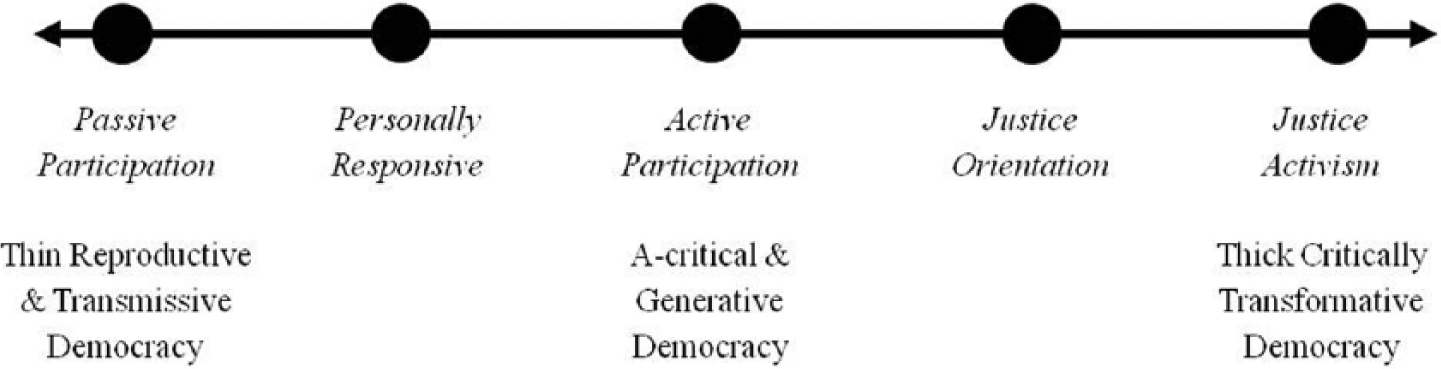
The Continuum of Democracy. Based on ideas proposed by Kahne and Westheimer (2003) and Westheimer and Kahne (2004a, b).
The participants
Argentina
The Argentinian PSTs (N=220) are a part of the teacher preparation programme in Buenos Aires. A majority of the participants had attended public primary and secondary schools (69% and 74%, respectively). The highest level of paternal education was 47% primary and 37% secondary; the figures for maternal completion of secondary school were 41%. However, the tertiary studies completion rate for mothers was 15.5% and for fathers only 4.5%.
Paternal employment percentages were: civil servants (25%); commercial employees (23%); shop-owners (15.5%); independent and professionals with employee status (8% and 10%); teachers (2%); unemployed (11%); on social assistance (4.7%). Maternal employment percentages were: unemployed (37%); public and commercial employees (12% and 10%); on social assistance (8%); independent and professionals with employee status (9% and 4%).
Although most parents were born in the province of Buenos Aires, 40% came from other Argentine provinces and 8.3% came from bordering countries. Most of the participants were born or brought up in the province of Buenos Aires (75%) or in the Federal District (20%). These percentages indicate that half of students’ parents came from other areas to settle in Buenos Aires; most were probably looking for better working and enhanced economic conditions. We can conclude that they are typically ‘middle class’ in the Argentine context.
Almost half the PSTs completed public primary school, while 60% attended secondary private schools. Nearly 95% of the participants were female and 31% were under 22 years of age; 20% were aged 22–25; 19% were aged 26–30; 26% were aged 31–40; and 4% were aged 40–50. This age diversity indicates heterogeneous school histories, as the different age groups correspond to different historical periods. Participants in the larger group grew up during the Renovated Disciplinary Code 16 era post-1983, studying democratic values and the return to democracy in an unstable social and economic environment (Cuesta Fernández, 1997).
Australia
The Australian PSTs (N=252) are from the faculty of one of the largest and most research-intensive universities in Australia. The PSTs are part of an initial teacher education (ITE) course, predominantly female (80%) and relatively young, with 66% under the age of 30, 15% between 30 and 40 and 17% aged 41 years and over; 44% were undertaking undergraduate studies, 18% a double degree, and 38% a graduate diploma or master of teaching qualification. 17 One third of the respondents were in their first year of study, with the rest evenly spread between the second to fourth years of study; 25% were studying early childhood education, 30% primary education, 40% secondary education and 5% sport and outdoor education.
Typical of the Australian demographic profile, 74% were born in Australia, but 48% of their parents were born elsewhere and 22% spoke a language other than English at home when they were growing up; 74% identified as White/Caucasian, 17% as Asian and 0.5% as Aboriginal or First Nations. 18 Almost one third of their fathers worked as manual labourers or skilled tradesmen and 31% of their mothers worked either in clerical, service or trades-related employment, with 20% being home-workers. Reflecting the significance of teaching as a pathway for upwardly mobile and aspirational working and lower middle-class families in Australia, almost 25% of respondents’ fathers and 34% of their mothers had not completed 12 years of school. Significantly, 44% of the respondents were the first in their family (O’Shea, 2012) to undertake tertiary education.
Australians are sometimes thought of as very relaxed and apolitical, with the exception of
membership of a trade union or professional organisation – albeit that these have suffered heavy declines in recent years under neo-liberal political and media attack. Australians do not join political parties as a matter of course, and this is reflected in the respondents’ perceptions of their parents: most of the PSTs’ (86%) parents were not politically active beyond engagement in compulsory voting. There was no significant correlation between education level and employment type of parents and their involvement in politics.
Findings
This paper reports on only two of the questions relating to democracy: what do you understand by democracy and is your country democratic? Other questions will be covered in future papers.
Understanding democracy
Argentina. 19
In the Argentine sample (Murriello, Ledwith & Naddeo, 2012; Treverso, 2012), ‘democracy’ was typically described, in descending order of frequency, as: freedom of speech, thought, expression, participation, sovereignty; electing representatives; casting a vote; a popular governmental system with the participation of the people, and constitutional rights of equality under the law; participation in public affairs by all citizens; respect for human rights, equality, dignity and the right to vote; equality under the law; access to a decent life (including work, health, housing, food, education and political participation); and respect for different political ideologies.
The data indicate that the themes of ‘democracy as a form of government’ and the idea of ‘citizenship’ barely appeared at all. Moreover, in some cases, sarcasm or scepticism pervade the data. The following comment, for example, is telling about democracy:
A country that is a democracy, [is one where] citizens have rights and obligations… they have the opportunity to choose… and I think that the best for a country is a well administered democracy, without corruption. That is not the case in our country. I believe this is never going to change and there is no other response other than indignation.
This was the only respondent who referred to Argentine history, and in particular the last period of dictatorship (1976–1983). Most comments reflected a fragmented and somewhat anecdotal concept of democracy or thin democracy. They referred to values such as tolerance, acceptance of diversity, dialogue, respect and freedom of expression, but lacked a critical understanding of the connection between social justice and daily economic life.
Australia
Participants from Australia (Zyngier, 2012b) related democracy to voting as the voice of the people and espoused a thin understanding of democratic principles, suggesting that active engagement in democracy is about staying current with political issues through watching TV news or reading the papers. However, respondents were also critical of the lack of power the average person has over decisions made by government in their name.
The majority of respondents stated that democracy was about personal freedom of opinion and free and fair elections in which governments are chosen by the majority of people, with 87% stating that elections are very important to democracy. Overall, the vast majority (85%) had a thin conception of democracy, where voting and elections are central, where individual rights are of equal value to majority or national interests and there is narrow or non-existent engagement with alternatives to mainstream political parties; 25% nominated voting as the most significant aspect of democracy and 65% highlighted ‘freedom and [the] right to choose’ as the essence of democracy, while 30% raised issues of equality and fairness. Diversity, when mentioned, was understood in very narrow terms, in generally essentialised ways, with ‘limited linkages to … inequitable power relations’ (Carr, 2010).
Yet there were also differences. A very limited number (5%) indicated a justice orientation (Westheimer and Kahne, 2004a, 2004b) through an understanding that democracy was also about recognition of difference and social justice, highlighting concepts such as ‘recognition of universal human rights and laws against discrimination; fairness and working towards equality for the people; power vested in the people; a government powered by the people that promotes equality and social justice’. Only 10% raised the concept of ‘power’ that needed to be controlled by the people. They typically commented that democracy is ‘a system of government where the power is in the hands of the people. Their political rights, needs and wants are demonstrated through elected representatives’. More critically, another student commented that:
Democracy is intended to provide equality for all citizens of a country. Formal equality in terms of access to public systems of health, education, employment etc.; informal equality in terms of social systems, within the community.
It was notable that a number highlighted the requirement to be able to speak freely without fear of retribution or punishment, where ‘everyone has a say … when people listen and value your opinion’.
Only three respondents (out of a total 252) raised issues of social justice as being intrinsic to democracy, ‘where members of society are treated as equal or [there is] social equality’. These indicated an understanding that there is an unequal distribution of power in society and highlighted an ‘equal participatory role’ where ‘all citizens have equal input’. One cynically defined democracy as ‘hegemony of the ruling and elite class’. Another defined democracy as follows:
A political and social system based on social equality. It works on the basis that every citizen is equal and their vote carries the exact same weight as any other citizen, regardless of social, economic or cultural status. Key concepts of democracy include freedom of rights, civil liberties and political freedom.
Do you believe your country is a democratic one?
Argentina
Similar ideas re-emerged when students were asked if they believe Argentina is a democratic country, with a mean of 3. 20 Most answered in the negative, or assumed an ambivalent or neutral stance.
When asked about the degree of satisfaction toward issues addressed by election candidates, 53% responded they were ‘not satisfied’ and only 8% were satisfied or very satisfied. The respondents explained: ‘They make promises that they cannot keep’ and ‘They fail to discuss in depth what really matters’.
Almost 50% of PSTs said they were not satisfied with the candidates running for election, while only 10% of the students showed a relatively high degree of satisfaction. The most common reasons given were that politicians ‘are all liars’, ‘only think about themselves and their interests’, ‘always talk, but do nothing’, and ‘are always the same’. As regards the electoral issues that were most present within the media, 74% said they were not satisfied. Distrust toward the mass media was also a theme, because they pursue ‘economic goals’ or ‘are not neutral toward the candidates’.
We find this analysis of the media very interesting, because we believe it is crucial to the critical stance of being a citizen. What is more, we believe there is no possibility to be a ‘critical citizen’ without an analytical attitude toward what the media offers and presents.
Levels of dissatisfaction were expressed on a wide range of issues related to democracy in Argentina: the promises candidates make during elections (mean 2.26); confidence in the candidates who run for office (mean 1); the quality of governors (mean 1.92); and the quality of the election of candidates (mean 1.95). Just over 30% reported satisfaction with how electoral issues are covered in the mass media and only 3.8% of the participants reported being a member of a political party. The mean for the question ‘Do you feel encouraged to participate in society as citizens?’ was 2.26.
There was a chasm between their unspecified ideal of democracy and the perception and experience of the reality of democracy in Argentina. The difference between ‘politics’ and ‘politicians’ that we have already mentioned becomes very important and it is easy to see the weight of ‘facts’ (whether actual or perceptions and beliefs built by media or school) on the PSTs. We can assume that critical reflection on these matters has been limited; this is probably due to Argentine history, the characteristics of its educational system and the way in which teachers have been educated (trained).
Many answers showed clear dissatisfaction, indicating that PSTs feel democracy fails to be reflected in the rights and the freedoms of all people. However, references to critical factors that may explain these difficulties for democracy in Argentina were rare. Most of the students thought that there was some connection between discrimination and democracy, though; in general, their responses pointed out that they saw discrimination as something tangible and specific. This concern seems to be very important for young people in Argentina today. They commented that ‘discrimination should not exist’ and ‘a good citizen should be tolerant and there should be a law against intolerance’. Others saw an historical and unavoidable relationship:
Extremes have always existed. I don’t agree with racism, but it is impossible to eradicate; racism is part of the people; discrimination against social class is something that happens every day. It is not going to change easily; it is quite marked, especially in young people; and the poor always work so that the rich can get richer.
These responses demonstrate that equality of the citizen before the law is seen to be relative, due to the presence of social and economic inequities. This challenges the central relationship noted above regarding citizenship and democracy.
Almost 80% of the students thought elections were of utmost importance for democracy, reflecting a strong understanding of democracy based on being able to choose and express oneself, as well as the formal mechanism of voting – a naturalisation of the vote that sees it as equal to democracy, as voting is compulsory in Argentina. Also interesting was the recurrent fear of electoral fraud, as if it were something usual to and unavoidable in the election process. Given the choice, almost 90% of the students declared that they would vote. This underlines the identification they establish between democracy and its formal mechanism. When they were asked to explain their reasons, most said it was a right or a duty that must be exercised – a way to commit themselves.
Australia
While a range of views were raised regarding how democratic Australia is, some issues need to be highlighted. About one third of the PSTs indicated that they had serious concerns about the degree of democracy that they experienced in the country, with only 20% believing that Australia is very democratic.
PSTs who felt that Australia is very democratic adopted a very uncritical acceptance of their previous thin definition of democracy, explaining their decision on the basis of thin conceptions such as equality of rights, freedom of speech and voting rights. Typical comments often made comparison to other countries, including: ‘we are free to vote and speak out on issues that concern us without fear’, ‘Australia is a fair country’, ‘we have choice, rights and options in nearly every aspect of the community’, ‘the government listens to what the majority of people want’; ‘Everybody is able to have a voice here and there is an equality of opportunity’ and ‘processes are equal, just and fair for all citizens’.
Other respondents uncritically stressed the importance of elections: ‘We vote in a fair electoral process’; ‘Anyone can run for a government position, regardless of policy platform and personal background. Education, information, and legal system are accessible to everyone regardless of personal background, sex, age, wealth’; ‘nearly everyone can vote. Voter participation is up around 95%, elections are fair’. One summarised this view:
When you compare Australia’s system to the rest of the world we are probably one of the top democratic countries. We are free and liberated to do almost everything that we want. More importantly we can cast our vote without being watched by guards with weapons who will force us to vote one way or another. We are incredibly lucky.
Many, however, raised issues in relation to minority groups, especially the treatment of Australian Indigenous (First Nations) people, with over 75% believing that Indigenous Australians are not fully part of Australian democracy. One PST who considered Australia very democratic still added that:
Australia has a long way to go in changing narrow-minded, racist, bigoted thinking. I am amazed at how many Australians continue to harbour negative thoughts on new [migrant] Australians [and] Indigenous Australians based on information gained through print and television media.
On the other hand, another student, who was also of the view that Australia is very democratic, added that we need to ‘amend the constitution to ban implementing Sharia law’ and stated:
Aboriginal people have no relevance to modern Australian society. Every country was once occupied by some race of people that no longer exists. Such is the case here. Other minorities: they can vote like the rest of us. However, the fact is, most minorities want to change Australian democracy to be more like where they came from, which is their right to try, but I think does not have mainstream support.
A significant minority (10%) were prepared to call Australia not democratic, highlighting that while ‘we flaunt that we have freedom of speech, equal rights and are fair to all, you will be thrown in jail before you actually get the chance to speak [and] what you believe is wrong or should be changed’. Many of these mentioned the ‘class-based distribution of power’ leading to reduced democracy. These reflected a thicker democratic analysis of class and social hegemony. The following is typical of their comments:
We live in a pseudo democracy – even though we get to vote and have a say it does not go far and is not really taken on board by politicians as they have their own agenda. Underlying our society is still inequality based on the colour of your skin, gender and disability; until this is rectified we cannot have a true democracy.
Another respondent stated that ‘there are very narrow ideas about education, ways of life, and languages dominating school systems … people don’t have full freedom because of their economic or social status’. Significantly, these respondents were typically older; they often spoke another language at home, their parents typically had more education and worked in the professions to a larger degree than the other respondents, and they were more likely to study on a campus where a number of academic faculty shared a critical pedagogical epistemology.
Other respondents highlighted issues of racism and classism: ‘as a country by and large we fail to cater for the needs of and often ignore the rights of our Indigenous peoples and those groups of people with limited access to the instruments of power (social, cultural and economic capital) such as refugees and migrants’; ‘consciously or not, racism and indirect discrimination is inherent in our societies structures, schooling, workforce’. One highlighted issues of class, gender and social justice and stated:
I have difficulty labelling it a true democracy [because] one particular type of citizen (high-status, White, Christian, high economic capital etc.) is being more valued (and more likely to have their wants and needs represented) than other citizens, including those who are vulnerable or disadvantaged. With institutionalised racism and discrimination common in Australia, many citizens are considered ‘second-rate’, including migrants and their descendants, refugees, Indigenous Australians, women, those of low socio-economic status and those with little cultural, social or financial capital, and it would be inaccurate to state that Australia values every citizen or considers every citizen to be of equal worth.
These respondents, while in a minority, were able to differentiate between thin conceptions of democracy that emphasise elections and superficial equality of rights and a thicker democracy, beyond voting, to establish a clear connection with social justice. Typical comments from these respondents included that ‘the rich can push their views more (too much)’; ‘underlying our (Australian) society is still inequality based on the colour of your skin, gender and disability. Until this is rectified we cannot have a true democracy’; ‘There are many disenfranchised people … some groups in society are disadvantaged in this system … many voices are silenced, including the many Indigenous languages … we still need a lot of work when it comes to our own Indigenous people’. A very small number of PSTs also referred to power imbalances between social and economic groups because ‘the minority holds the power and the voice in major decisions’.
The most critical of the PSTs who were negative about Australia’s democracy made comments such as ‘full participation is often dependent on who you are and where you live’, reflecting awareness of the privileges presented through social class and living in middle-class neighbourhoods. They referred to the rhetoric of democracy being ‘strictly reduced to majority vote via a political system which serves to turn the majority off from politics. Our representative system does not include enough public fora or encouragement to be involved in political matters of a public nature’.
Others wrote critically about the unequal distribution of power in Australia: ‘The top 1% of population has a disproportionate influence and power over government’; ‘some people have equal opportunities but many do not – Indigenous people and refugees do not have the same opportunities or support so it is not equal and therefore not democratic’; ‘some groups of society are not treated equally, as evidenced by policies such as the Northern Territory intervention’. 21 Another added that ‘Australian people do not have decision-making power in proportion to how much they are affected by the decisions … the wealthy have disproportionate power’. Highlighting the superficiality of the choices available within the system, one wrote that ‘in reality we are dictated by the mainstream –White, middle-class and male – and the assumption that everyone can access the things that make us powerful, and must necessarily want to, underpins our education and political systems’.
These respondents were also able to highlight the lack of a thicker democracy, suggesting that ‘I don’t think we have a very active democracy but only when citizens take a stand against government action… it is not very democratic in its “norms” and values’.
A number also volunteered that they felt there is a strong link between education and democracy. They suggested that ‘some minority groups such as Indigenous people can sometimes not have their opinions heard due to a lack of education many people may also lack the knowledge of the working of this system failing to be beneficial for them … it provides a great way of life for those that are educated’. Again, this reflects an understanding that power can come with, and from, education.
Discussion: A neo-liberal agenda and the rhetoric of active participation: Learning about but not for democracy
As we compare the cross-national data between the Australian and Argentine groups, we find both similarities and differences. How are we to understand and contextualise the contrasting and sometimes contradictory views presented here?
Missing was a thorough understanding of what it means to be a good citizen. The civics versus citizenship debate can be seen in terms of the struggle between thin and thick democracy: as Giroux (2000) suggests, there has been a shift from the responsibility for creating a democracy of citizens to producing a democracy of consumers:
Public education becomes a venue for making a profit, delivering a product, or constructing consuming subjects, education reneges on its responsibilities for creating a democracy of citizens by shifting its focus to producing a democracy of consumers. (p. 173)
Producing better curriculum materials (Tin-Yau Lo, 2010) will not in itself deliver the results expected or intended. Prior (2006) concludes that the existence of stand-alone unlinked or de-contextualised one-off programmes do not provide the lasting effects planned for, while the schools were accused by students of ‘talking the talk but not walking the walk’ because teachers were not able to model good citizenship in their practices.
Thick democracy must go beyond the championing of electoral and legislative processes, rule of law and basic civil rights (Howard and Patten, 2006). It encourages and facilitates the legitimacy of collective citizen and civil action. Thick democracy envisages a ‘social citizen’ – an individual always in relationship with others – capable of reflexive agency (Giddens, 1994). Paradoxically, many of the ‘democracy-exporting countries’ are those experiencing crises of democracy at home. 22
In contradistinction, the active citizen of neo-liberalism is conceived as an entrepreneur and a ‘can-do achiever’ seeking to benefit the individual. While schools are expected to prepare students to live in diverse democratic societies (Furman and Shields, 2005), many of the PSTs in this research at least indicate that their school practices may be largely undemocratic.
Thick democracy will not be easily achieved in society generally or in schools in particular. As the agents of society in which they exist, teachers (rightly) can claim they are therefore restricted in what they alone can achieve, as the national agendas and budgets are nationally and state controlled.
The test for teacher educators, teachers and education students is to ask questions of, rather than to accept, neo-liberal received wisdom. Armstrong (2006) suggests that the definition of teaching as the uncritical transmission of knowledge raises the question of ‘what and how knowledge is constituted as a social and political stance towards the truth’ (Armstrong, 2006: 10). Armstrong argues that, as participation and dissent are central to democratic life, these too should be central to school systems that are fundamental to the contestation between a thin and thick democracy.
But can this be done without ‘education in and for democracy’ (Dobozy, 2007: 116)? School students cannot acquire the knowledge, attitudes and skills to successfully become agentic citizens without the simultaneous democratisation of pedagogy, schools and school systems. The role-playing of democracy and pretend parliaments recommended in civics education and reflected by the majority of respondents means too often that students are involved in decision-making on ‘an abstract and often detached level’ (Dobozy, 2007: 118). Programmes associated with thin democracy are unable to take the ‘social organisation of specific schools and the everyday life of individual students into consideration’ (p. 118). The responses detailed here indicate that a change in educational practice at all levels is required to ‘inspire political empowerment’ beyond the implementation of off-the-shelf products or programmes.
Like the Australian group, the Argentine group also noted the importance of the concepts ‘sovereignty’ and ‘freedom of speech’. Dissatisfaction with public officials, political candidates and the national political context appears in both cases. This reality seems to demoralise participants instead of encouraging participation in efforts to change these shortcomings. The Argentine students’ notion of ‘the people’ (la gente) is similar to the conception of ‘the majority’ among Australian participants. It is necessary to deepen such concepts with students – to build on these similarities, to explore how human, social and political rights are held, how they operate and to what ends they are exercised.
There were also a number of points of convergence between the Australian and Argentine samples. While ‘social rights’ and ‘freedom of speech’ were important in both contexts, they held special meaning in the Argentine context due to the history of military dictatorship that is connected to the ‘Never again’ ethos. Similarly, ‘voting’, while important in both countries’ samples, held special significance in the Argentine context due to the many years during which that right was denied.
In Argentina and Australia, the relationship between democracy and racism appeared to be problematic. For example, issues of immigration and refugees, while different in Buenos Aires, are still troublesome, and the flows of population between provinces and neighbouring countries generate daily discrimination problems. In some cases, immigrants, or children of families from neighbouring countries, felt they could connect with the term ‘racism’ (as recipients). ‘Social justice’ issues were understood in both countries in terms of political, social and economic rights, but the closed relationship between ‘democracy’ and ‘social justice’ in educational work needs to be deepened. Based on these findings, diversity of population, inclusion of minorities and opportunities for everybody must also be at the centre of democracy education, so as to include the social sectors that are not yet integrated (those who are excluded from production), decent work and all the duties and rights that democracy implies. All Argentine ethnic groups, especially the Indigenous people, require enhanced understanding of their concerns within schools through democracy education, thus addressing the fact that heterogeneity was not considered by the national Disciplinary Code over a century in Argentina (Cuesta Fernández, 1997).
This seems also to be the case in Australia, where the issue of racism in relation to refugees, immigrants and in particular Indigenous Australians was often highlighted as problematic for democracy. This matter indicates both Australia and Argentina present an aura of appearing to be an open country in the eyes of their own people, but this might not be the case in the view of neighbouring countries. It is important to reflect on these realities in our teacher preparation contexts, to reflect on the role immigration and racism plays in both countries and in our students’ lives. This would be a step in the right direction in terms of beginning the resolution of xenophobic and discriminatory problems in schools.
The majority of PSTs in both countries reflected a reified approach (Freire, 1973) to complex ways of understanding democracy, echoing how it has been presented to them in schooling, in popular culture or in political movements. Their lack of trust in officials, political candidates and political parties encourages cynicism, sceptical attitudes and indifference. The danger of such attitudes – something we need to problematise in the pedagogy and content of our democracy teaching – is that they might lead teachers to think that if structural democracy does not produce improvements, it is better to return to a past situation (in the Argentine case, to authoritarianism, silence and inertia; in Australia self-disenfranchisement). 23 This is a potentially dangerous form of cynicism.
Conclusion
This comparison of pre-service teachers in Buenos Aires and Melbourne, and the findings generated from it, offers a rich space for reflection and action on educational issues connected to the theory and context of democracy education.
Argentina returned to formal democracy 30 years ago, while Australia has matured into an independent formal democracy over 100 years. Civics-related knowledge is necessary but not sufficient for ‘becoming a competent democratic citizen’ (Schwille and Amadeo, 2002). However, thick democracy has the potential to become the site of struggle for social justice and equity (Taylor, 1996). While neo-liberalism seemingly has a stranglehold on education in both countries today, it is potentially vulnerable at least, and educators have an opportunity to construct a transformative curriculum that includes possibilities for advancing education for democracy through:
A revised curriculum based on social justice as part of the democratic process.
A move away from viewing students as insecure ‘objects’ to agentive ‘subjects’.
Understanding and promoting democracy at both super-structural and micro-structural levels.
Centralising the participation of ‘critical citizens’ in the process of becoming more democratic.
Working for both conceptual and practical understandings of democracy in schools.
Furthering the awareness of the power of ‘reflection-action’ and praxis.
The generation of contextual teaching spaces.
Analysis of mass media as part of political/democratic literacy.
Teachers have a choice between a thicker democracy that is reflective, critical, participatory, tolerant and non-hierarchical and a thinner, authoritarian democracy, based on uncritical knowledge, standards and competencies as the measure of the ‘good citizen’. A thick democracy focuses on ‘how citizens understand themselves as members of a public with an obligation to promote the public good’ (Howard and Patten, 2006: 472) and the competencies required of civic citizenship that encompass informed and active citizens participating in political debate and action on equal terms (Reid, 2002).
Ongoing research will not only enable the development of a framework for conceptualising democracy in education, highlighting in particular what educators can do to become more critically aware and engaged in democracy within their teaching, but will also be able to better understand any correspondence between teacher habitus, their cultural and social capital and their perceptions and beliefs.
Instead of education reproducing the current thin democracy that leads to disengaged citizens (Dejaeghere and Tudball, 2007), examples of excellent teacher practice would enable the development of an educational framework of teaching for thick democracy leading to a more participatory, empowered and engaged citizenry and more inclusive participation in, and therefore safeguarding of, democratic society.
Schooling can and does contribute to the production of citizens’ identities, but such contribution cannot be controlled or measured in the same way that systems assess how much a student has learned about mathematics or literacy in any given year. Citizenship education (Lapayese, 2003) suggests that, resulting from its programme, a ‘new identity will emerge’, but it is ‘always an educationally unfinished project, an unsolvable tension, that cannot be learned and understood through conscious rationality alone and thus not solved through the delivery of explicit instruction on what democracy is and how a good citizen should act’ (Fischman and Haas, 2012: 174).
Education, including the use of citizenship education within schools, cannot overcome the lived experiences of students’ lives. On the contrary, school experience too often challenges ‘the notion of self and identities of large groups of students[,] especially among minorities … refugees, stateless migrants, and others who do not easily fit the traditional definitions of citizens within the nation-state’ (Fischman and Haas, 2012: 177).
There have been detailed international studies of students’ attitudes to democratic values and participation in society, but there has not been any such commensurate study on their teachers and, significantly, on pre-service teachers and their educators. This research demonstrates that ‘teacher habitus’, how educators experience, perceive and engage with democracy, can impact on their classroom pedagogy. This has serious implications for how future citizens will themselves perceive, understand and engage with democracy (Banks et al., 2005; Carr, 2010). This paper has drawn renewed attention to social justice and democracy, and how these should be central parts of the teacher education curriculum. It is hoped that this study, and the larger International Project, will generate a broader, more inclusive discussion among teachers and teacher educators in our countries as well as in and among other countries.
Footnotes
Appendix: Survey questions in relation to democracy and education
Funding
This research received no specific grant from any funding agency in the public, commercial, or not-for-profit sectors.
1.
Schugurensky, 2013: ix–xii.