



Abstract
Using the Developmental Niche for Emergent Participatory Citizenship (Torney-Purta and Amadeo, 2011) as a framework, we examined differences between immigrant and native-born youth’s civic knowledge and support for women’s rights in Sweden and the United States, and explored whether experiences with peers and parents, and in formal and informal educational contexts, could account for such differences. Using data from the IEA Civic Education Study of 1999, we found that immigrants had lower civic knowledge and less support for women’s rights than their native-born peers in both countries. Differences in civic knowledge were partially explained in both countries by the lower likelihood of immigrants speaking the tested language at home, and remaining gaps were moderated by differences in the association of school activities with knowledge between the two groups. Gaps in support for women’s rights were partially explained by differences in language spoken at home (a possible proxy for cultural dissimilarity) in the United States, but not in Sweden. Experiences in various social or educational contexts, including perceptions of supportive classroom and school climates, were predictive of civic outcomes overall, but did little to account for differences in attitudes between the two groups in either country.
As a response to increases in migration internationally, there has been a volatile debate in many countries about immigrants’ preparation for life in democratic societies. Such preparation is expected to begin during early adolescence, a developmental period with both challenges and opportunities (Hahn, 1998). The challenging aspects of adolescence are multiplied for immigrant youth, who face conflicting values of two cultures, in the home and at school (Cooper et al., 1999; Khuwaja et al., 2013; Ko and Perreira, 2010) and in society more generally (Berry, 2010). Such conflicts shape their integration of multiple national and ethnic identities (Phinney et al., 2001) and contribute to their experiences of discrimination (Tummala-Narra and Claudius, 2013). Taken together, this suggests both that immigrant youth experience pressure as they develop capacities as citizens and that the contexts where these capacities develop differ from those of native-born peers.
The Developmental Niche for Emergent Participatory Citizenship, proposed by Torney-Purta and colleagues, extends more general sociocultural models to provide a framework for considering how social settings and cultural norms (i.e., ‘developmental niches’) may shape immigrant youths’ civic development (Torney-Purta and Amadeo, 2011; Torney-Purta and Barber, 2011). According to these researchers and based on extensive analyses of international studies, early adolescents’ participation in civic and political life can be described as ‘emergent participatory citizenship’, in that they are developing the knowledge, skills and dispositions necessary for future engagement as full-fledged adult citizens. The context in which young people develop participatory capacities is shaped by their daily life routines and settings (i.e., proximal social contexts), the historically-rooted beliefs of their cultures, and the beliefs and expectations of the adults around them. Such a framework has potential for conceptualizing the supports for (and barriers to) the development of civic competency among immigrant youth, given its explicit focus on the ‘daily life settings’ in which acculturation occurs as well as the role of culture-driven customs and beliefs.
In this article we first examine whether first-generation immigrant adolescents do indeed differ from their native-born peers in their knowledge and attitudes about the democratic systems in their new countries. We further examine the extent to which differences between immigrant and native-born students’ experiences at home, with peers, and in curricular and extracurricular school activities can explain group differences in these dimensions of emergent participatory citizenship. We adopt a comparative perspective by examining two immigrant-receiving countries – the United States and Sweden. These two countries have much in common, including sizeable proportions of immigrants, ongoing and sometimes contentious policy discussions about immigration, achievement and civic participation gaps, and education systems in which immigrant youth tend to be taught by native-born teachers (Suárez-Orozco et al., 2013). At the same time, these countries differ in their histories of and policies on immigration, and in the cultural and ethnic makeup of their native and immigrant populations (Berry et al., 2006). This allows us to compare and contrast how two different national contexts, each with particular customs and beliefs, can encourage emergent participatory citizenship in this subgroup of students.
Emergent participatory citizenship outcomes by immigrant status
‘Emergent participatory citizenship’ is a multidimensional construct, consisting of a number of skills, attitudes and behaviors that support young people as they develop toward full citizenship. Torney-Purta and Amadeo (2011) highlighted competencies and attitudes likely to be fostered in youth’s everyday settings (in contrast to the typical focus on electoral activity, which excludes those who are not eligible to vote). We focus on civic knowledge and cognitive skills, and on attitudes toward gender equality (specifically, the political rights of women). We present explanations for choosing these two outcomes in the sections that follow.
Knowledge and cognitive skills
Although Torney-Purta and Amadeo (2011) focused on attitudes toward participation in their initial description of emergent participatory citizenship, content-area knowledge/skill is important as well. They described ‘the capacity to understand… potentially controversial issues’ as a competency of emergent participatory citizenship nurtured in adolescents’ everyday life settings (Torney-Purta and Amadeo, 2011: 12). Moreover, in considering students’ ‘everyday contexts’, Torney-Purta and Richardson (2004) argued that rigorous teaching of civic content knowledge and skills in schools fosters civic engagement.
The gaps between immigrants and non-immigrants in civic content knowledge and skills are also interesting from a policy perspective since they relate to academic achievement more generally. Researchers have examined multiple years of Programme for International Student Assessment (PISA) results to compare immigrant and non-immigrant students’ performance. In 2003, reading achievement gaps between native-born students and first-generation immigrants were large in some countries (including Sweden and the United States as well as Denmark and Germany) and small in others (Australia, Canada, and New Zealand; see PISA, 2006). Explanations for cross-national variation in achievement have focused on differences in language proficiency (Schleicher, 2006; Song and Róbert, 2010), on the lower average socioeconomic status of immigrant families and/or the segregation of immigrants in separate schools in some countries (e.g., Entorf and Lauk, 2008; Schleicher, 2006), or on the degree of cultural dissimilarity between immigrant and native groups (Song and Róbert, 2010).
The above explanations for differential performance on literacy tests may also apply to domain-specific knowledge gaps. There are many explanations for this, including the possibility that language proficiency affects students’ ability to acquire skills in the classroom setting (Goldenberg, 2008) and the confounding of reading ability with domain content knowledge in determining test performance (Zhang et al., in press), particularly in high-stakes testing situations (Suárez-Orozco et al., 2013). There is also some descriptive and cross-national research specifically on civic knowledge. In an analysis of data from the International Citizenship and Civics Education Study of 2009 (ICCS:2009), Friedman et al. (2013) compared the civic knowledge of two generations of immigrant youth (those born in another country and those with immigrant parents) to those without an immigrant background in 13 countries with sizeable immigrant samples. Sweden had one of the largest observed immigrant gaps, along with Austria, Greece, and Luxembourg. New Zealand and England had the smallest gaps. Data were not collected from the United States in ICCS:2009. However, sizeable gaps between students who were and were not born in the United States were observed ten years earlier, in the IEA Civic Education Study of 1999 (Torney-Purta et al., 2006). Thus, there is substantial evidence to suggest that achievement gaps are common in the domain of civic education.
Attitudes toward gender equality
The literature on emergent participatory citizenship places considerable emphasis on civic attitudes. Torney-Purta and Amadeo (2011) described patterns of attitudes toward citizenship and the political rights of diverse groups across several regions of the world to illustrate differences in the acquisitions of emergent participatory citizenship, while Torney-Purta and Barber (2011) identified attitudinal profiles among youth across ten European countries. Respect for the rights of ethnic minorities and of women is given special attention in these analyses because of the importance of human rights issues in political participation.
Support for gender equality is especially meaningful when discussing immigrant youth, given cross-cultural differences in gender norms. In the United States, for example, machismo could frame Latino immigrants’ responses to women’s rights. In a US sample of adolescent Mexican immigrants and their parents, Alvarez (2007) found no difference in levels of endorsement of machismo between youth and their parents. Increased acculturation did not diminish the endorsement of machismo in immigrant youth. Perceptions of gender rights may be primarily influenced by the cultural context and experiences within the family rather than the larger social environment. In Sweden, gender equality has been described as an ‘ethnic marker’ dividing native- and non-native Swedes (Bredström, 2005; Towns, 2002). Although social concerns pertaining to specific immigrant populations have sparked political debate on the differences between native-born and non-native Swedes (e.g., Hellgren and Hobson, 2008; Kvist and Peterson, 2010), there is little empirical evidence documenting gaps in such attitudes among adults, and still less on their developmental roots in adolescence (Amnå and Ekman, 2015).
In studies on young adults, grown children of native Swedes were compared with grown children of immigrants from Poland and Turkey on several dimensions, including their beliefs about gender equality (Bernhardt et al., 2007).Young adults of Polish origin appeared quite similar to native Swedish young adults. Approximately 60% believed in societal gender equality, while 44% of young adults of Turkish origin reported such support. Nearly 80% of young adults of Polish or Swedish origin believed there should be an egalitarian (rather than traditional) work–family balance between parents, compared with 62% of young adults of Turkish origin (Bernhardt et al., 2007). The respondents in this study were several years older than the adolescents considered here, however.
Looking at 14-year-olds in analyses of data from the IEA Civic Education Study of 1999, Janmaat (2008) found that youth who identified as Swedish had higher support for women’s rights than did youth who identified primarily with other ethnic and cultural groups. Janmaat found that these differences disappeared once language, resources, education, and civic knowledge were controlled. Similar gaps were also observed between majority-culture and minority-culture group members in French Belgium, Germany, and Switzerland, but were not observed in England. Prokic and Dronkers (2010) similarly analyzed CIVED data but focused on subgroups of immigrant youth defined by language spoken at home and number of years in the country, controlling for other background factors. In Sweden, the largest gaps between immigrant and native-born (and Swedish speaking) youth were found between native-born youth and those who spoke a language other than Swedish at home and who came to Sweden before the age of six. In the United States, the largest gaps were found between native-born, English-speaking youth and immigrants who came to the United States after the age of six and who spoke a language other than English at home. Studies by both Janmaat (2008) and Prokic and Dronkers (2010) differ from the analysis conducted in this study in several ways. Notably, they defined groups in terms of their ethnicity or language rather than solely on first-generation immigrant status, and they did not focus on experiential explanations for such gaps.
Although limited research exists that explicitly asks young people about attitudes toward gender equality, gendered patterns of social action can suggest the presence of differences in such attitudes between immigrant-born and native populations. Gavray et al. (2015) adopted such an approach with data from the Processes Influencing Democratic Ownership and Participation (PIDOP) project, conducted in nine European countries. They speculated that gender differences observed in political engagement in Belgium could be due to young women, especially those from Turkish immigrant groups, feeling socially vulnerable in taking individual action, with their futures controlled by male relatives. They also noted that, within the Turkish immigrant group females were more likely than males to want ‘the right to be distanced from strict traditions’ (Gavray et al., 2015: 302). Gender differences in attitudes were smaller in a Moroccan immigrant group in Belgium.
The developmental niches of immigrant and non-immigrant youth
Adolescents’ civic knowledge of and attitudes toward gender equality, as indicators of their emerging participatory citizenship, appear to develop in a particular ‘niche’, shaped by the qualities of their everyday settings, by the expectations from adults and by the norms and beliefs of appropriate participation held by both their culture of origin and their host culture (Torney-Purta and Amadeo, 2011; Torney-Purta and Barber, 2011). In this analysis, we consider young people’s experiences in family, peer and formal and informal school contexts (their ‘everyday social settings’) as related to their knowledge and attitudes. Differences between immigrant and native-born youth experiences in these contexts can help explain why gaps in emerging citizenship outcomes are observed. Many of these settings are shaped by the expectations that adults have for adolescents. All are shaped by a constellation of norms, beliefs, and values within the cultures in a particular immigrant-receiving society.
Outside of school
Parents and peers influence adolescents’ civic knowledge and attitudes through modeling and discourse. In the United States, for example, young people from homes with frequent political discussion have higher levels of civic involvement (Andolina et al., 2003; Flanagan, 2013; McCleod et al., 2010) and civic knowledge (McIntosh et al., 2007). Social practices within peer groups also influence adolescents’ civic outcomes. In Belgium and Canada, more frequent discussion of politics or public issues with friends predicted higher participation in civic activities (Harell et al., 2008). However, not all interactions with peers are positive in relation to civic values: adolescents with limited adult supervision who spend after-school and evening time with friends had higher rates of aggression, delinquency, and substance abuse (Flannery et al., 1999). In Sweden, more dense and reciprocated peer networks were also predictive of illegal political protest activity among native-born youth (Dahl and van Zalk, 2014).
Considering specific contexts among immigrant youth, Jensen (2008) found that Indian and Salvadorean immigrant adolescents and their parents from the Washington, DC area reported that civic engagement was motivated by their cultural identities and desire to build communities. At the same time, work obligations, ethnic exclusion, and not having citizenship were identified as barriers to such participation. Moreover, Bloemraad and Trost (2008) and Wong and Tseng (2008) argued that political learning is especially likely to be bidirectional in immigrant families, with young people having greater access to political information than parents.
In-school curricular and extracurricular contexts
Using data from the 1988 National Assessment of Educational Progress (NAEP) civics assessment in the United States, Niemi and Junn (1998) found that civic knowledge was positively associated with the amount and recency of civics coursework, as well as the variety of civics topics covered. Other studies also found that taking civics courses (McIntosh et al., 2007) and studying political topics predicted civic outcomes (Torney-Purta et al., 2007; Zhang et al., 2012). Additional analyses using the CIVED data have suggested many commonalities across countries in the process by which the school context influences students’ civic outcomes (Torney-Purta and Richardson, 2004). Furthermore, ethnographies of schools from England, France, Germany and the Netherlands showed that textbooks influenced how the country’s dominant civic culture was ‘inculcated and propagated’ (Schiffauer et al., 2004: 13).
More specifically, Callahan, Muller, and colleagues showed that the number of civics and social studies courses taken is particularly beneficial for US immigrant adolescents in predicting later civic engagement (Callahan and Muller, 2013; Callahan et al., 2008). Callahan and Muller (2013) emphasized the role of the school as an influential social space and pointed out that immigrant students take home material about political and civic engagement from school to discuss with their parents (again speaking to the bidirectional nature of political socialization in immigrant families).
Considering more informal aspects of students’ educational experiences, a positive or negative school climate has an impact on all students (Battistich et al., 1995). In relation to civic outcomes, an open climate is a consistent predictor of students’ knowledge, political discourse in and outside of school, support for democratic values, and future voting intentions (Torney-Purta et al., 2007; Vieno et al., 2005); these patterns are also observed across nations (Isac et al., 2014; Torney et al., 1975; Torney-Purta et al., 2001; Torney-Purta et al., 2008). A supportive school climate includes caring relationships in classrooms and throughout the school, as well as students feeling that their contributions are valued in discourse, decision making, and norm setting. There is evidence from qualitative research that immigrant youth (and the children of immigrants) may experience less supportive climates (Abu El-Haj, 2007; Rubin, 2007). This may explain some differences in the outcomes of immigrant and non-immigrant youth.
Student experiences outside of the classroom are also important. Participation in structured extracurricular or leisure activities can contribute to acquiring social and intellectual skills, forming positive support networks of peers and adults, and reducing the risk of involvement in risky behavior (Hart et al., 2007). Coatsworth and colleagues (Coatsworth et al., 2005) found that activities that had high levels of involvement but low levels of direction toward a goal had a particular role in adolescents’ identity development in three samples of youth from Miami (United States), Santiago (Chile) and Milan (Italy). Looking more broadly, policy-oriented discussions have focused on the role of afterschool extracurricular activities as ‘intermediate spaces’ (Noam and Miller, 2002: 14), characterized by a participatory nature that can foster democratic ideals.
Callahan and Muller (2013) analyzed data from two nationally-representative studies of US youth, finding that immigrant youth were less likely to participate in extracurricular activities such as sports or the arts than their native-born peers. However, student council or voluntary organization participation (more traditionally associated with civic engagement) was more frequent among immigrant populations in one data set. Clubs at school have potential for positive socialization toward a sense of belonging at school (in relation to both peers and teachers) and an enhancement of social capital for Mexican-descent youth (Gibson et al., 2004; Raley, 2004). Taken together, these findings echo an earlier call by Eccles and Gootman (2002) for more nuanced considerations of programs intended to benefit immigrant youth.
Research questions
In sum, part of the reason immigrant and native-born youth differ in their civic knowledge and support for gender equality is the social and cultural settings of their development. In this analysis, we will examine the following research questions to explore this further:
To what extent do immigrant and native-born youth differ in their civic knowledge and support for women’s rights?
To what extent do students’ experiences in families, peer groups, and school account for these differences in civic outcomes?
How do these patterns differ in the United States and Sweden?
Methods
Data sources
The 1999 International Association for the Evaluation of Educational Achievement (IEA) Civic Education Study (CIVED: for details, see Schulz and Sibberns, 2004; Torney-Purta et al., 2001) focused on the civic knowledge, attitudes, and engagement of young people as they occur in both proximal and distal social contexts. Of the 28 countries that participated, we focus here on the United States (which did not participate in the 2009 ICCS study, also conducted by IEA) and Sweden. The CIVED data provide a unique opportunity for the examination of immigrants’ academic performance and attitudes in a comparative, cross-national context. The data from the 1999 study are useful in providing insights into the development of individuals who are now well past the age of majority in each of these countries as their attitudes are solidifying (Hooghe and Wilkenfeld, 2008). Connecting to the developmental niche model guiding this paper, this analysis provides information on how the social and cultural settings of youth shaped their competencies (knowledge and attitudes) for citizenship.
This generation is especially interesting given recent changes in political discourse concerning both gender and immigration. In Sweden, there is now nearly equal representation of men and women on the boards of the major political parties (Cigane and Ohman, 2014). At the same time, the numbers of right-wing groups espousing anti-immigrant views have also increased in recent years, and in 2010 these groups garnered enough support to be represented in the Swedish parliament (Ramalingam, 2012). In the United States, immigration reform has been a recurring policy discussion in recent years (Martin, 2013). In addition, female representation in the US Congress reached an all-time high in 2009 and has remained relatively consistent since then (Peterson, 2012). To further justify the selection of these two countries, and to supplement the literature previously reviewed, we next review information about the social context of these two countries to situate the data analysis. Special attention is paid to literature pertinent to the situation of immigrants in 1999, when these data were collected.
United States
The United States has been called a settler society because of the nation’s foundation in immigration and relatively large proportion of immigrants. Immigration policies include a preference for family reunification and immigration for employment purposes (Berry et al., 2006). In 1999, approximately 10% of the US population was not born in the country. Of the immigrant population, 40% were from Central and South America, 27% originated from Asian nations, 16% were from Europe, and 6% were born in ‘other’ nations, including those in Africa, Oceania, or elsewhere in North America (US Census Bureau, 1997; 1999).
Adult immigrants in the United States are less likely than native-born citizens to vote–and, of course, many are ineligible to do so (Bass and Casper, 1999). Twenty years ago they were also less likely to volunteer and participate in community associations that assist in the acquisition of political skills (Verba et al., 1995). These patterns vary by racial subgroup, however: Latino immigrants in the United States are as likely as native-born Latinos to volunteer for political campaigns, donate money to a political cause, and attend public meetings or rallies (Baretto and Muñoz, 2003).
Looking at adolescents’ civic engagement in the United States, Asian and Latino foreign-born youth are as likely to participate in community service activities as native-born youth (Dávila and Mora, 2007), while immigrant youth are more likely to protest (Lopez et al., 2006). The undocumented status of many Hispanic immigrants appears to be an important motivation for protest activity (Seif, 2010). Similarly, Sirin and Fine (2008) found that the younger generation of Muslim-Americans were engaging in civic and political action and ‘mobilizing a collective identity around awareness of shared grievances’ (Sirin and Fine, 2008: 111). Given that schools have a strong influence on the civic socialization and education of immigrant and native-born youth, it is troubling that American educational systems have been said to marginalize immigrant students (Walsh, 1987), provide them inadequate civic education (Reimers, 2005), and place them in inferior schools with other disadvantaged classmates (Suárez-Orozco and Suárez-Orozco, 2001).
Sweden
Sweden belongs to a category of recent receiving societies (in contrast to the United States’ designation as a settler society), which began to receive immigrants in substantial numbers in the 1960s. Immigrants make up a slightly larger percentage than the immigrant population in the United States (12%). Current Swedish immigration policy is restrictive in that it is limited to family reunification and applications for refugee status (a policy which began in the 1970s). National policies are designed for the integration of new citizens (Berry et al., 2006). Early refugees arrived from Chile, Turkey, Lebanon and Iran, but another influx in the 1980s from Yugoslavia and Iraq led to further tightening of regulations (Westin, 2003). From 2001 to 2006, the largest immigrant group was from Finland, followed by the former Yugoslavia and Iraq (Hochschild and Mollenkopf, 2009). In the late 1990s Sweden had one of the largest Muslim populations (3–4%) in all of Europe (Hochschild and Mollenkopf, 2009), and by 2003 Arabic was the most widely spoken language other than Swedish (Otterup, 2004).
Some researchers have defined Sweden as semi-multicultural because citizens in general place slightly higher importance on having a civic national identity than on multiple national identities (Hjerm, 1998). Immigrant citizens and immigrants who live in Sweden but choose not to be citizens (termed ‘denizens’, Graham and Soininen, 1998) can vote in local and regional elections but not national elections. However, voter turnout among immigrants is considerably lower than among native-born citizens (Togeby, 1999).
With regard to youth outcomes, although immigrant students performed poorly in comparison to native-born Swedes on the PISA studies (as previously noted), some immigrant groups in Sweden appear to have strong motivations for political participation, emotional reactions to discrimination, and a sense of collective efficacy for their minority group (Kim and Amnå, 2015). However, Otterup (2004), summarizing two ethnographic studies of schools, suggested that immigrant pupils are alienated both from their teachers and from their peers. Westin (2003) noted that Turkish immigrants were over-represented both among school dropouts and also among those with high levels of academic success, with fewer than expected in the mid-range of achievement. Turning to more informal school contexts, Swedish students are highly participatory in their schools in that they demand representation on decision-making bodies, support student unions that wield political power, and regularly challenge school authority (Westin, 2003). However, the relative participation of immigrants and non-immigrants has not been examined.
Sweden is of particular interest here because of its focus on gender equality. Sweden has made special efforts, extending back to directives from the central Ministry of Education in the late 1970s, to ensure that Sweden’s long-standing support for women’s political rights would not be challenged by the influx of immigrants from countries lacking such a tradition (Rabo, 2007; Swedish Ministry of Education and Cultural Affairs, 1979). This focus on gender equality is just one example of how the Swedish treatment of immigrants can be described as support for assimilation; this is further exemplified by widespread free language instruction (Otterup, 2004). However, some observers refer to ‘cultural racism’ as a relatively serious problem (Nordin, 2005; Pred, 2000). Westin (1998) found that both young and middle-aged Swedish adults expressed considerable prejudice against those of foreign origin (being least positive about Turks and Ethiopians). Swedish male adolescents held especially negative attitudes (Torney-Purta and Barber, 2011). Holstein-Beck (1995) asserted that stratification in Sweden is not based on race, but rather on whether residents are native Swedes or immigrants. According to the perspective of young immigrant males, prejudice and exclusion are especially rampant in urban settings (Sernhede, 2004). This was also noted in large-scale comparative work by Amnå et al. (2007), who found Swedish students to be positive about support for women’s rights, but (unlike students in Denmark and Norway) not to strongly favor immigrants’ rights or political participation.
Analysis of immigrants in the IEA Civic Education Study
In this study we examine the civic knowledge and attitudes of immigrant and non-immigrant 14-year-old students in the United States and Sweden. Limiting our sample to the 98% of participants in each country with valid demographic data, we examined 2757 students from 124 schools in the United States and 3011 students from 138 schools in Sweden. Among the US students participating in the 1999 IEA Civic Education Study, just over 10% reported being foreign-born. Based on data collected on race/ethnicity specifically in the United States, 33% of foreign-born students were Latino, 30% were white, 19% were Asian and 15% were Black/African. The median age at which the foreign-born students migrated to the United States was 5 years. Among the Swedish students, 8% were foreign born and the median age at which the foreign-born students migrated to Sweden was also 5 years. Although no information was available regarding race or ethnicity for the immigrant population specifically in the international dataset that we used, Janmaat (2008) reported that 10.6% (283) of his entire analytic sample of 2669 did not identify primarily as Swedish. Of these 283, 63% identified with ethnic or national groups from the Middle East (i.e., Arab, Iranian, Turkish, or Kurdish), 22% identified with ethnic or national groups from Eastern or Southern Europe (i.e., Bosnian, Croatian, Serbian, Albanian, or Polish), and 15% identified with another ethnic or national group.
Outcome variables
Each of our two outcome variables was developed using a two-stage scaling procedure, combining confirmatory factor analysis with item response theory (IRT) techniques. The total civic knowledge scale (Torney-Purta et al., 2001) comprised 38 items measuring content knowledge of basic democratic principles and concepts and skills of interpreting political communication. The IRT scale developed from these items was set to have an international mean (M) of 100 and standard deviation (SD) of 20. The internal consistency reliability of these scales (as measured by Cronbach’s alpha) was high, α = 0.89 for Sweden and α = 0.90 for the United States. The second outcome of interest, support for women’s rights (Torney-Purta et al., 2001), is a six-item scale that assessed student support for the political and social rights of women. To give two sample items, students were scored on the extent to which they agreed with the statement, ‘Women should run for public office and take part in the government just as men do’ and disagreed with the statement, ‘Women should stay out of politics’. This scale was set to have an international mean of 10 with a standard deviation of 2. The internal consistency of this scale was acceptable in Sweden at α = 0.90 and the United States at α = 0.85.
Predictor variables
The processes and experiences that may account for differences in civic outcomes between immigrant and native-born youth include the following: gender (an important demographic characteristic); socialization in the home (language spoken at home and discussion of political issues with parents); interaction in an unstructured peer group; and socialization through formal and informal education (experiences of democratic schooling in the classroom and school as a whole, civic curricular learning, and participation in extracurricular activities). Specific predictors capturing each of these general categories of processes are described in the following sections.
Background characteristics and socialization in the home
In the first step of the analysis, we included both demographic characteristics of the students and their at-home participation in civic-related activities. Two background characteristics thought to be especially salient to this analysis were gender (dichotomously coded with 1 = female and 0 = male) and language spoken at home (dichotomously coded with 1 = English [US] or Swedish [Sweden] ‘always’ spoken at home and 0 = language ‘sometimes or never’ spoken). The discussion with parents scale, used to measure the level of civic discussion in the home, is a simple composite scale comprised of two items, assessing how often students discussed national and international political topics with their parents (Sweden α = 0.85; United States α = 0.81). This scale ranges from 1 to 4, with a score of 1 indicating that neither topic was ever discussed, and a scale of 4 indicating that both topics were often discussed. For this variable, and all other variables, we substituted mean scores in the rare instances where students were missing data on these variables.
Note that we are not controlling for levels of resources in the home. Those who are examining studies to ascertain their educational or social policy implications seldom urge controlling factors such as poverty or immigrant status (Gershoff et al., 2013). That would assume that programs should be designed to benefit a generic student (who has no social class or cultural background). Arguably, studies that examine the interactions of these demographic factors with educational factors should be the direction of the future.
Peer interaction
We included two measures of peer interaction. The first, time spent with friends scale is a two-item composite assessing the frequency with which students spend time with friends after school and in the evening. This composite is measured on a scale of 1 to 4, with a score of 1 indicating that both of these activities are ‘never’ and a score of 4 indicating that they are done ‘every day’ (α = 0.69 for Sweden, α = 0.88 for the United States). The second variable, which measures the extent to which students discuss politics with peers, is thought to capture more positive, prosocial aspects of peer interaction. Like the parent discussion scale, this scale assesses how often students report discussing national and international topics with their peers, with a score of 1 indicating that neither topic is ever discussed and a score of 4 indicating that both topics are discussed frequently (Swedish α = 0.83, United States α = 0.77).
Socialization experiences in formal and informal education
We have included several variables that capture socialization experiences in the school setting. The measure of formal education is whether students report learning about the importance of voting in the classroom. Student learning is measured with a four-response Likert-style scale, with a score of 1 indicating that a student ‘strongly disagrees’ that they have learned this and a score of 4 indicating that a student ‘strongly agrees’ that they have learned it.
Looking to informal aspects of education, a series of four variables captured students’ participation in educational and extracurricular activities. Participation in a student council and in the school newspaper were each assessed using single dichotomous items, indicating whether students reported that they had or had not participated in at least one of these activities. Participation in instrumental activities, a category of extracurricular activity described by Kirlin (cited in Hart et al., 2007) as focused on collective goals, is assessed using a dichotomous variable indicating whether students reported that they had participated in at least one of the following activities: an environmental organization, a UN or UNESCO club, a student exchange program, a human rights organization, or the Boy/Girl Scouts. Finally, participation in volunteer activities is assessed with dichotomous variables indicating whether students reported that they had participated in at least one of two voluntary activities to benefit community groups: involvement with an organization performing community service or in activities to collect money for charity.
The IRT scales for openness of classroom climate for discussion (i.e., the frequency with which respondents reported they felt they could express their opinions in class even if other students or teachers disagreed), and for confidence in the value of school participation (i.e., the extent to which respondents agreed that groups of students could affect change in the school), were each created using the two-stage scaling procedure described earlier, and set to have international means of 10 and standard deviations of 2 (Torney-Purta et al., 2001). Internal consistency of both of these scales were acceptable in both countries (Sweden α = 0.79, United States α = 0.82 for openness of classroom climate; Sweden α = 0.79, United States α = 0.75 for confidence in the value of school participation).
Analytic procedure
As a preliminary analysis, we computed descriptive statistics comparing immigrant and native-born youth on all outcomes and predictors of interest. Then, we assessed the relation between the predictors and the outcomes described above using hierarchical linear modeling (HLM: see Raudenbush et al., 2004) to control for the clustered sampling design of students within schools. 1 In this analysis we report three models for each outcome in each country. 2 The first includes immigrant status as the only predictor of the outcome, to assess the gap between immigrant and native-born youth independent of any other predictors. The second includes gender and all contextual predictors, as outlined above. This analysis allows us to determine both whether these predictors relate to civic knowledge and support for women’s rights overall, and also whether the addition of these predictors reduced the size of the gap between immigrant and native-born students. Finally, for civic knowledge only, we present models with statistically significant interactions between immigrant status and contextual factors. In other words, this final step allows us to take into account that certain experiences may be more or less predictive of civic outcomes for immigrant youth. (Similar interactions were tested, but not found, in modeling support for women’s rights.)
Results
Descriptive analysis of differences
We report means and standard deviations separately for immigrant and non-immigrant students in Sweden and the United States in Table 1. Overall, civic knowledge scores were higher in the United States than in Sweden, although support for women’s rights was about equal. 3 There were significant gaps in civic knowledge and in support for women’s rights in both countries favoring native-born students. Gaps for civic knowledge were about the same in Sweden and in the United States, while gaps in the support for women’s rights were larger in Sweden. Considering the predictors, immigrants were less likely to speak the language of the test at home, but more likely to discuss politics with peers. Immigrant students discussed politics with their parents and peers more often than native-born students in Sweden; in the United States, such differences were only observed for frequency of discussions with peers. In contrast, immigrant students spent less time hanging out with friends in the United States than their native-born peers, while no such difference was found in Sweden. There were no significant differences in any of the school contextual variables, formal or informal.
Descriptive statistics.
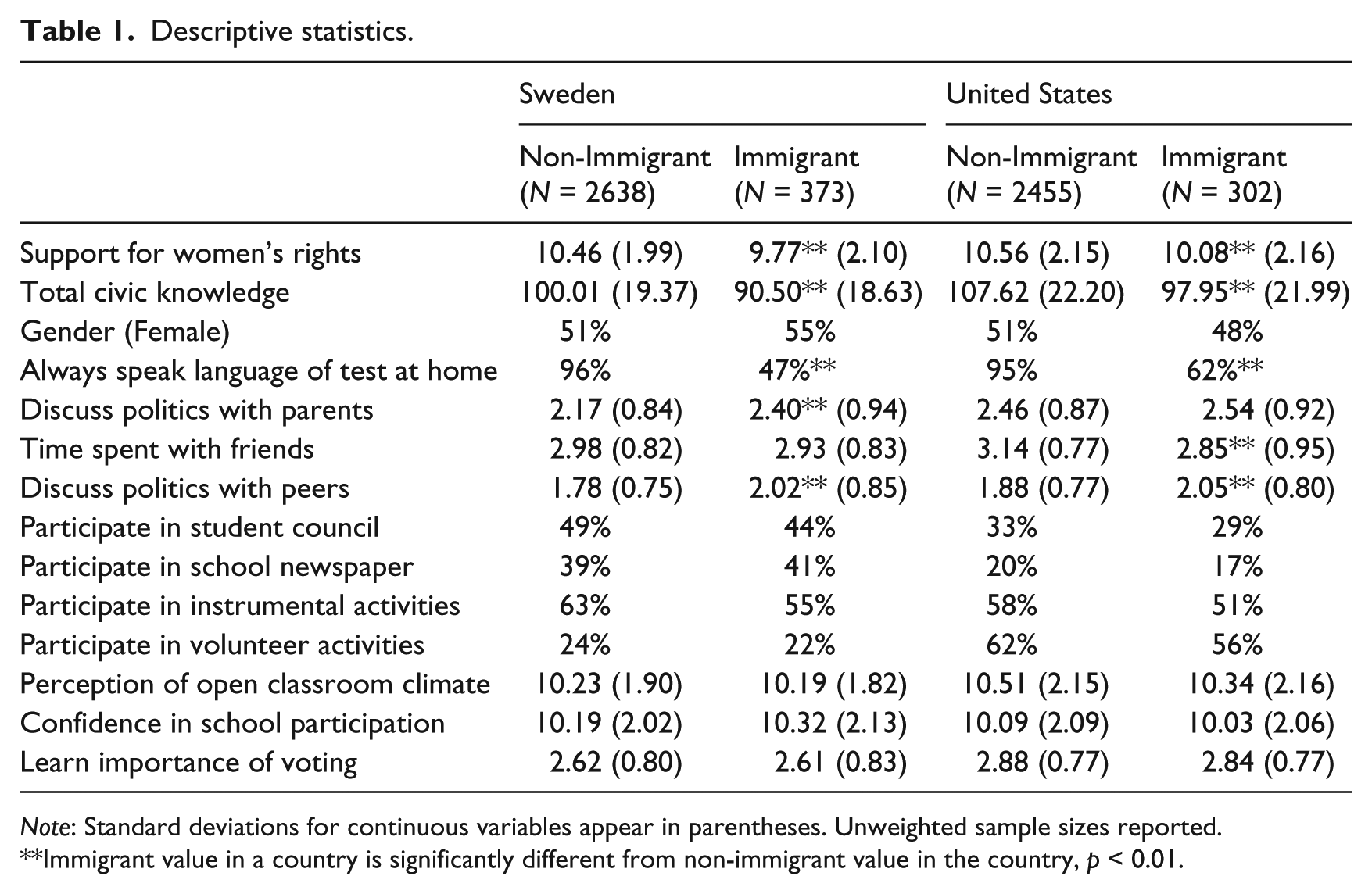
Note: Standard deviations for continuous variables appear in parentheses. Unweighted sample sizes reported.
Immigrant value in a country is significantly different from non-immigrant value in the country, p < 0.01.
Civic knowledge
Tables 2 and 3 report the results of our multilevel modeling of civic knowledge in the United States and Sweden, respectively. As noted earlier, in both countries native-born youth had significantly higher civic knowledge scores than did immigrant youth. As seen in Tables 2 and 3, gender was not significantly related to civic knowledge in either country. Looking at variables associated with the home context, civic knowledge was positively associated both with speaking the language of the test at home (more strongly so in Sweden) and discussing politics with parents in both countries (more strongly in the United States). The time students spent hanging out with friends was a negative predictor of knowledge in both countries to about the same extent. Discussing political topics with peers was not significantly related to civic knowledge. Looking at school curricular and extracurricular activities, the strongest associations were to student council participation (in both countries) and school newspaper participation in Sweden. Learning about voting in school was non-significant in both countries, as was participating in instrumental activities (such as environmental organizations). Participation in volunteer activities was non-significant in the United States, but was negatively related to student knowledge in Sweden. Turning to school climate, another consistently positive predictor was students’ reports of an open classroom climate for discussion (especially important in Sweden). The extent to which students felt confident in the value of school participation also predicted higher knowledge in both countries. Controlling for these variables reduced the gap between immigrant and non-immigrant students by 36% in Sweden and by 20% in the United States.
Multilevel model of civic knowledge in Sweden.
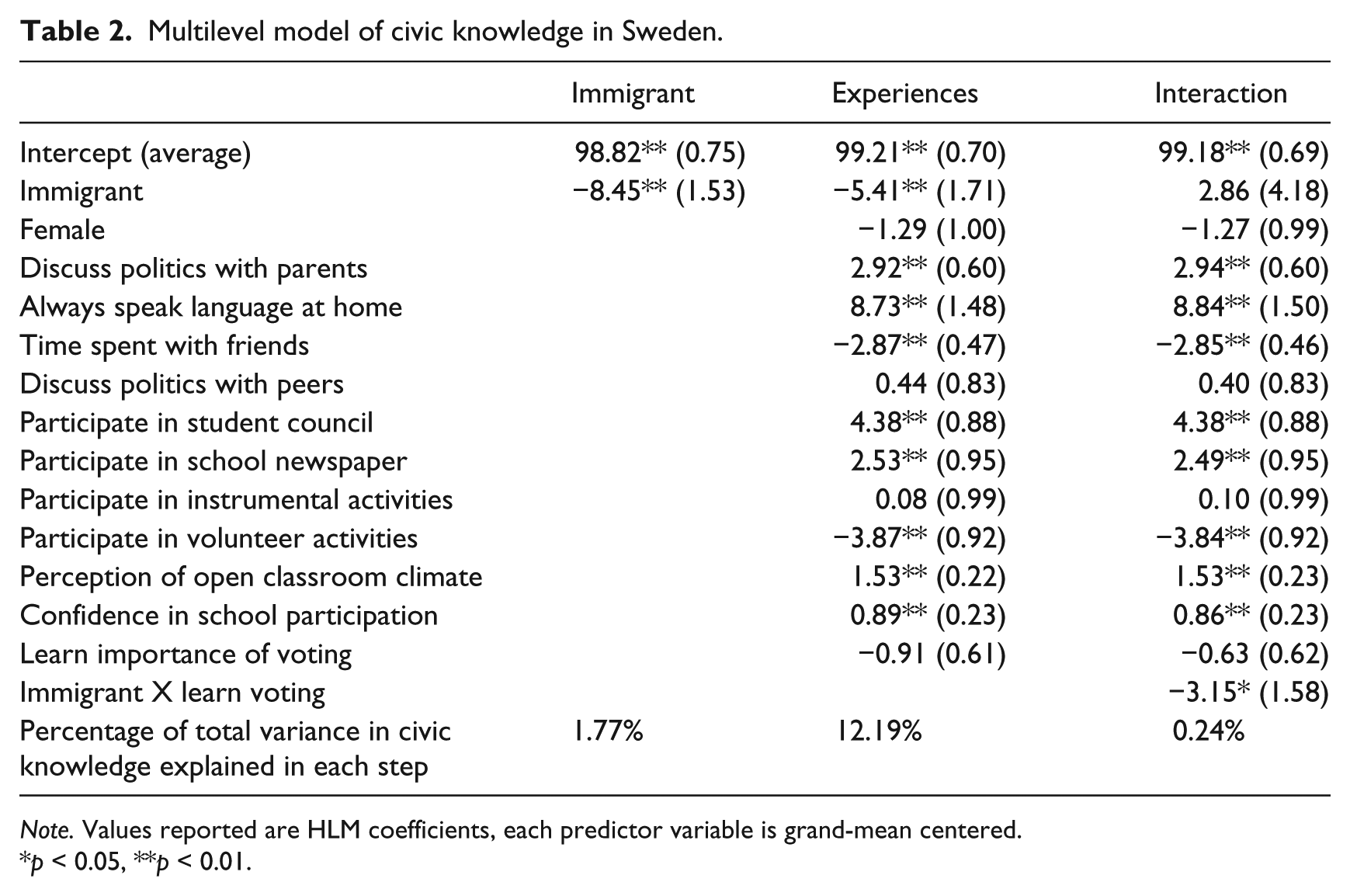
Note. Values reported are HLM coefficients, each predictor variable is grand-mean centered.
p < 0.05, **p < 0.01.
Multilevel model of civic knowledge in the United States.
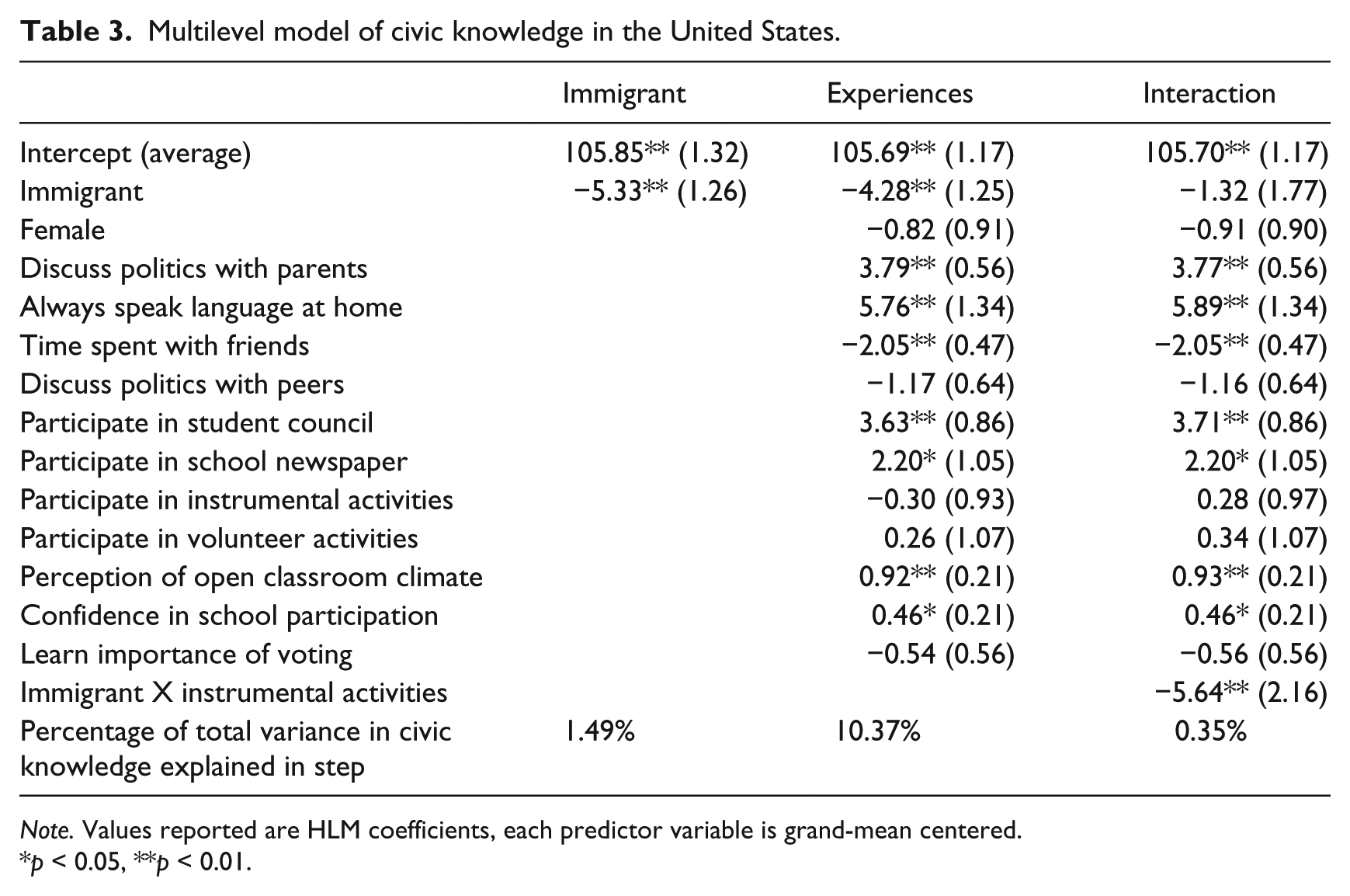
Note. Values reported are HLM coefficients, each predictor variable is grand-mean centered.
p < 0.05, **p < 0.01.
Finally, in each sample there was one statistically significant interaction between immigrant status and a formal school activity (curricular or extracurricular) that rendered the main effect of immigrant status non-significant. In Sweden, the interaction between immigrant status and learning the importance of voting indicated that in comparison to immigrants who did not learn about voting, immigrant students who did learn about voting had lower civic knowledge. Native-born Swedish students had similar levels of civic knowledge regardless of whether they reported having learned about the importance of voting.
In the United States, in contrast, there was a statistically significant interaction between immigrant status and participation in instrumental activities. While participation in these activities made little difference in the civic knowledge of native-born students, it was negatively associated with the civic knowledge of immigrant adolescents. In order to understand this difference, we further analyzed the frequency of specific activities that we categorized as ‘instrumental’. Although scouting was the most popular activity in both cases, immigrant youth were highly involved in exchange programs and human rights organizations. Although valuable, these activities may not stress the same civic-related concepts as the CIVED’s test of civic knowledge.
In summary, these analyses suggest that, in both countries, civic knowledge development was supported by having more experience with the language in which the test was administered, by actively participating in democratic educational contexts, and by discussing politics at home with parents. Unstructured peer time appears detrimental to the development of civic knowledge. Immigrant youth less frequently reported speaking the language of the test at home, which partially explained observed gaps in civic knowledge. Further, there appears to be limited evidence that immigrants’ lower scores were due to fewer supportive experiences in their social settings. However, the significant interactions (with learning about voting in Sweden and with voluntary activities in the United States) suggest that immigrants may have related more closely to their cultural group interests than to the concepts emphasized on IEA’s tests of civic knowledge and skill. Remember that many immigrant students may not see a path to citizenship for themselves, or the right to vote.
Support for women’s rights
We now turn to a discussion of immigrant gaps in attitudinal measures. As illustrated in Tables 4 and 5 (for Sweden and the United States, respectively), native-born youth had higher levels of support for women’s rights prior to adding in any additional predictors. It is also no surprise that females expressed more support for women’s rights than males. This was previously found in all 28 CIVED countries (Torney-Purta et al., 2001). Support for women’s rights was also higher among students who discussed political topics with parents in both countries. In the United States only, there was a language gap such that students who spoke English at home had greater support for such rights than students who did not. Students who spent more time with friends outside of school in unstructured contexts had less support for women’s rights, but discussing political issues with peers was a negative predictor in the United States only.
Multilevel model of support for women’s rights in Sweden.
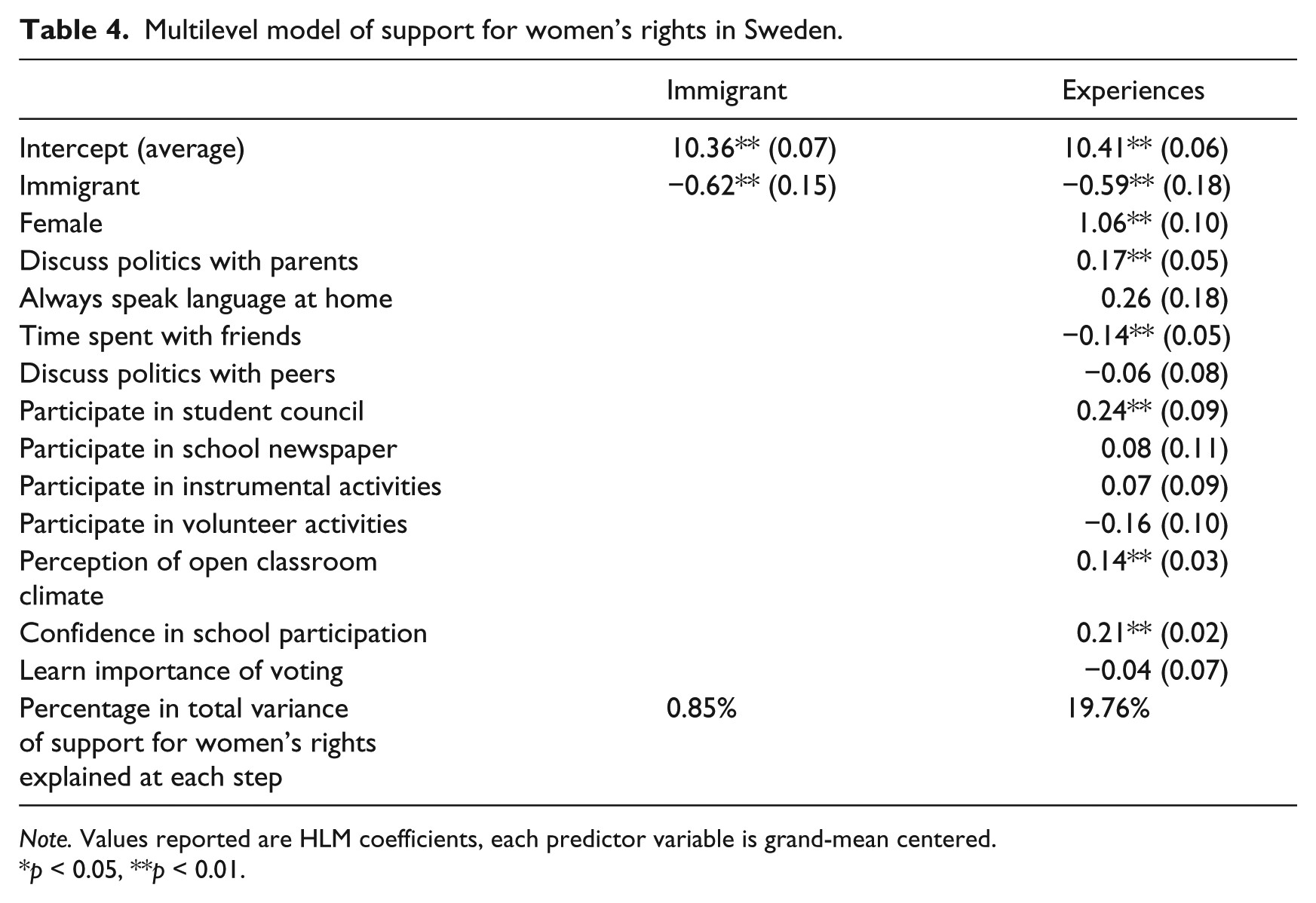
Note. Values reported are HLM coefficients, each predictor variable is grand-mean centered.
p < 0.05, **p < 0.01.
Multilevel model of support for women’s rights in the United States.
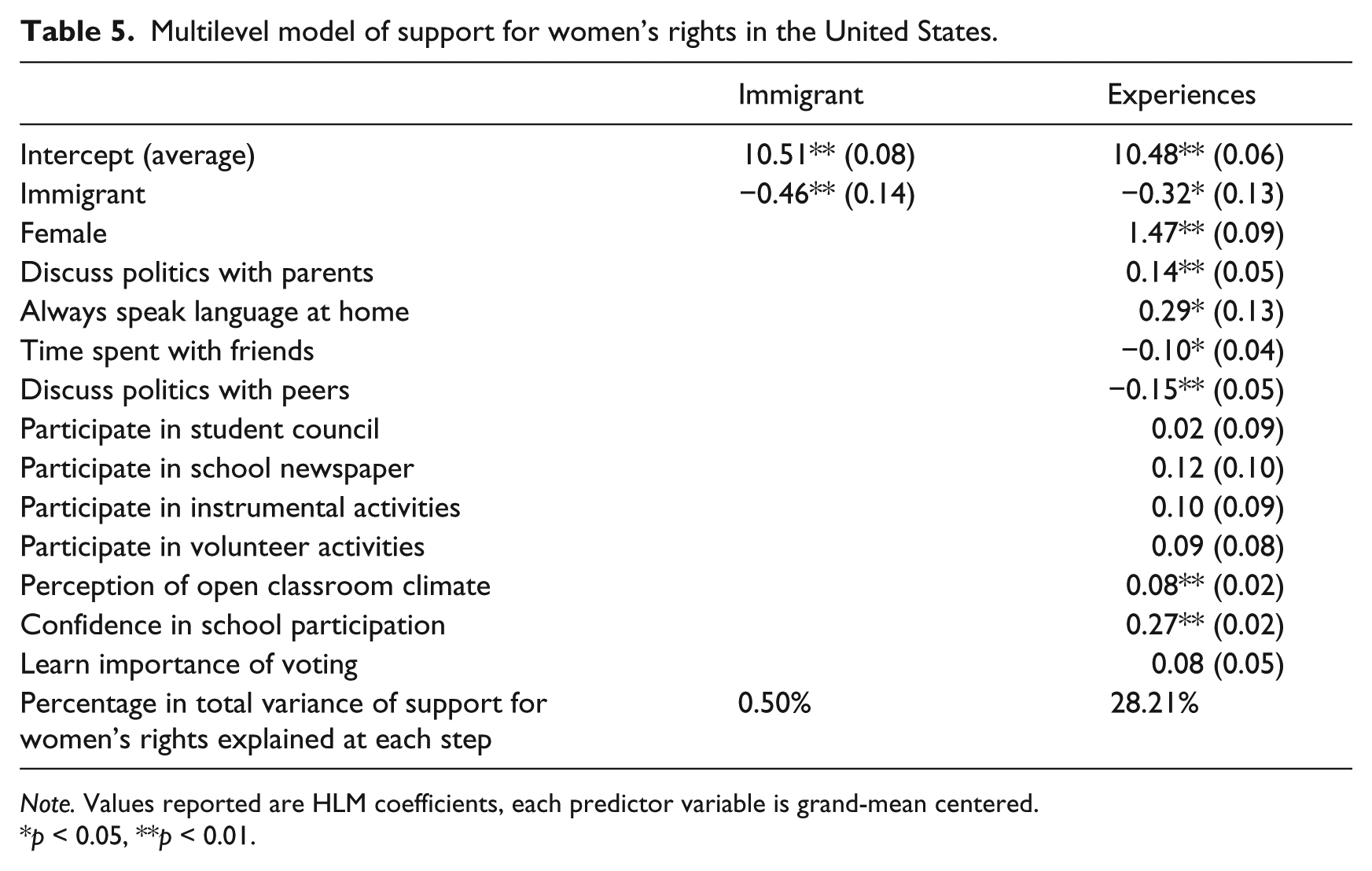
Note. Values reported are HLM coefficients, each predictor variable is grand-mean centered.
p < 0.05, **p < 0.01.
None of the extracurricular activities were significant predictors of support for women’s rights in the United States, while student council was the only significant predictor in Sweden. The most consistently positive predictors of support for women’s rights were the extent to which students experienced an open classroom climate for discussion and had confidence in the value of participation in their school. Interestingly, there were no substantial differences between immigrants and non-immigrants in reporting these experiences of a positive context in the classroom and school in either country.
At the conclusion of this analysis, significant gaps between immigrants and non-immigrants in support for women’s rights remained in both Sweden and the United States. In Sweden the inclusion of contextual variables reduced the gap between immigrant and native-born youth by 5%; the gap was reduced by approximately 30% in the United States. As before, while these models show the value of open, respectful climates for the development of support for gender equality in all students, we cannot say that differences in attitudes between immigrant and native-born youth were due to differences in the extent to which they experience such climates. Instead, within the United States, speaking the tested language at home appeared as a strong predictor of support for women’s rights. Speaking another language in the home is more frequent among immigrant students and may be an index of the family’s acculturation.
Discussion
Consistent with prior research, our analyses indicated that a gap existed between immigrant and non-immigrant students in civic knowledge and in attitudes regarding the political rights of women. Although this gap was present to some extent in both the United States and Sweden, the knowledge differences between immigrant and native-born students can be reduced to statistical non significance in both countries when factors in the home, classroom or school, and peer group are taken into account, and when we consider how specific activities may have resonated differently for immigrant and native-born youth. Regarding adolescents’ support for women’s rights, the difference between immigrant and native-born students remained significant despite accounting for this same set of factors and experiences and when similarly considering the possibility of different interpretations of experiences. This suggests, as will be elaborated later, that when the school’s role is clear (in imparting civic content and skills to students), one can suggest ways to decrease substantially the gap between immigrants and native students. In contrast, in spite of attempts to make support for women’s rights a priority in the education of immigrants (especially in Sweden), this set of attitudes is too deeply embedded in the home and neighborhood niches that students inhabit for the schools to have much impact. Although one usually focuses on families’ roles in these developmental niches, these analyses also highlight the role of time spent with peers.
With regard to specific findings, there are contextual factors pertaining to school characteristics and experiences that may explain the nature of the challenges faced by immigrant adolescents, especially with respect to civic knowledge. The considerable reduction in the gap between immigrants and non-immigrants in both countries when home language was considered underscores the concerns over linguistic background discussed in many studies of immigrant academic achievement (e.g., PISA, 2006). In Sweden, this linguistic divide appeared to outweigh any potential benefits to civic knowledge that may have come from students discussing politics more often with parents. Beyond this, however, the significant interaction terms when modeling civic knowledge indicated that even similar experiences among non-immigrant and immigrant students can result in different civic outcomes. Regarding the significant interaction of immigrant status and learning about the importance of voting, it may be that teachers discussed voting but emphasized that new immigrants were not able to vote, resulting in a resistance to socialization (in some ways parallel to what Fairbrother, 2003, found in Hong Kong). Or, perhaps, schools serving immigrant youth focused too intently on socializing young people to the importance of voting, given its importance as a civic activity for adult citizens. This may have provided too few opportunities to gain the conceptual knowledge and skills tested in the IEA assessment. Although speculative, this explanation would echo Torney-Purta and Amadeo’s concern (2011) that too much attention may be paid to participating in electoral activities at the expense of core knowledge and skills that can serve as a foundation for the emergence of other relevant and engaging forms of participatory citizenship.
Particularly in the United States, the significant interaction and subsequent follow-up analyses on the category of ‘instrumental’ activities suggest that immigrant students chose to participate in instrumental activities less associated with acquiring traditionally defined civic knowledge. Immigrant students more frequently participated in activities such as human rights organizations, but only two items in the CIVED knowledge scale addressed these issues (Torney-Purta et al., 2008). These findings suggest a need for educators and educational policymakers to broadly consider civic knowledge and participation in ways that match with immigrant students’ interests as well as legal constraints.
To contrast, we were not able to explain away gaps between immigrants and non-immigrants in support for women’s rights in either Sweden or the United States. It is interesting that in the United States, speaking a language other than English was related to the immigrant gap in support for women’s rights. This probably indicates that retaining the native language for home communication means a lower level of family acculturation (and perhaps greater embeddedness in the cultural, family and neighborhood developmental niche). In the Swedish context, this inability to account for the gap is interesting given the centralized education system’s long-standing focus on imparting gender equality norms to their nation’s immigrants. This analysis suggests that there are few differences between immigrant and native-born youth in how they perceive their school contexts, and those differences that do exist (e.g., more frequently reporting that they learn about voting, more frequent discussion with peers) do not expose students to activities likely to influence beliefs about gender equality. This explanation would echo Hahn’s (1998) finding that civics classrooms generally did not explicitly address gender and politics together. It is possible that more targeted activities promoting the discussion of and learning about gender beliefs might yield different results; however, such gaps might remain in spite of targeted school programs. Immigrant parents (and even the students themselves) may see the imparting of civic knowledge as an appropriate role for the school, but have quite a different view about challenges to beliefs about gender roles. These beliefs about the proper roles of males and females, acquired through daily interactions in the developmental niches of families, neighborhoods, peer groups, and cultures are well established by adolescence. Challenging gender beliefs may be ineffective as a result.
Finally, although not part of the central research questions regarding differences in civic outcomes, the descriptive statistics reported in Table 1 challenge the notion that immigrants are socialized in contexts that are less amenable to the development of emergent participatory citizenship. Certainly, immigrants whose native language is not English (in the United States) or Swedish (in Sweden) are at a disadvantage in assessments of civic knowledge that assume strong literacy skills in the native language (Zhang et al., in press). In many other ways, however, immigrant youth reported some experiences that are more amenable to citizenship development than their native-born peers, and other experiences that are similarly amenable. In Sweden, immigrant students discussed politics more often with both their parents and their peers. In the United States, immigrant youth spent less unstructured time with peers than did those who were native-born, and also discussed politics with their peers more often (although such discussion is not related to either of our outcomes of interest). Further, there were no observed gaps in either country in immigrant and non-immigrant youth’s perceptions of open classroom climate or their confidence in the value of participation at school – two predictors that, in line with previous research (e.g., Torney-Purta, 2002) were significantly and positively related to outcomes in both countries. Thus, another implication across both countries is the need to capitalize on the strengths and supports that immigrant youth have and better tailor their experiences to outcomes that are both valuable and developmentally appropriate. At the same time, it is possible that additional analyses of other contextual factors (e.g., those more specific to citizenship education in specific countries) may reveal inequities that could be addressed (Callahan and Muller, 2013).
There are several limitations to this work, however, and each highlights a complementary opportunity for future research. First, given our use of international CIVED data, we could not incorporate specific information on the countries of origin for immigrants. García Coll et al. (2005) have found that the nation of origin is often related to differences in other characteristics (such as parental education level and occupation) and experiences in the family and at school (such as everyday cultural routines and literacy activities in the developmental niche). Many of the findings in the present study may vary for specific cultural groups within a country. Second, in this dataset there is no distinction between first- and second-generation youth (i.e., those with immigrant parents who were themselves born in the country). However, some research indicates that first- and second-generation immigrant youth look very similar in their civic outcomes (e.g., Callahan et al., 2008). Future research with the ICCS 2009 data set (e.g., Friedman et al., 2013), which did collect this information, is warranted.
Third, more data are needed to understand the psychological mechanisms by which immigrants develop capacities for participatory citizenship in the countries in which they reside. Research by Berry and colleagues presented profiles of acculturation that characterized immigrant youth in thirteen countries (Berry et al., 2006). For example, US immigrants were more likely to have an ‘integration profile’, indicating a stronger effort to adapt to the new society and therefore take on similar attitudes and norms. Conversely, immigrants in Sweden tended to have an ‘ethnic profile’, maintaining their ethnic attitudes and beliefs. Future work could incorporate attitudes not only toward one’s new society, but also to their specific ethnic groups, to understand the role that such attitudes play in civic development. The IEA studies of civic and citizenship education include assessments of the former, but not of the latter.
Finally, although the 1999 data are useful for understanding the experiences of today’s young adults, it cannot be assumed that such findings are fully generalizable to contemporary educational contexts. Further research with newer data (from ICCS or other sources) can be used to replicate these analyses.
Further research needs to consider how immigrant status intersects with other identities in shaping the development of citizenship. In particular, gender is an especially salient consideration when discussing the development of immigrant youth, and many researchers have highlighted gender differences in immigrants’ civic outcomes (e.g., Hurd, 2004; Valenzuela, 1999a, 1999 b; and Vigil, 2004 in the United States; Kim and Amnå, 2015; and Westin, 2003 in Sweden; and Gavray et al., 2015 in Belgium). The same cultural mechanisms that make gender equality such a compelling outcome in the study of immigrant youth also emphasize that the experiences of young men and women differ in immigrant groups.
Lastly, future smaller-scale quantitative or qualitative research could complement the large-scale, cross-national analyses presented here and highlighted throughout our review. Large-scale quantitative studies like those administered by the IEA allow us to examine trends in nationally-representative samples of young people (including sizeable portions of immigrant youth) across a variety of settings and cultural contexts. However, such breadth leads to a sacrifice in the potential depth in describing the specific ways in which immigrant youth’s experiences may differ from those of their native-born peers even in settings that appear identical on the surface. Research on language brokering in immigrant families, to offer one specific example, describes a very specific aspect of parent–child relationships in some immigrant families (Dorner et al., 2008; Dorner et al., 2007). As a second instance, Suárez-Orozco et al. (2013) provided an example of case studies of schools in New York and Sweden and their effective programs for children in immigrant families, many of which incorporate collaborative activities into open and respectful classroom climates.
In conclusion, in light of these limitations we want to highlight the extent to which having nationally representative data sets containing both knowledge and attitude measures in well-developed scales is an asset in understanding the emergent citizenship of immigrant youth. When we examined framing literature, we were struck by the patchwork of research which is currently available. One can obtain a snapshot of Turkish immigrants in Sweden or of Latino immigrants in the United States, to provide two examples. These snapshots can be compelling, but for educational leaders or policy makers they may be unconvincing. The analysis of data from nationally representative samples can contribute greatly to our understanding of the immigrant experience across and between countries, by providing an opportunity to look across a multitude of settings, influenced by multiple cultures, to understand the unique niches in which these young people develop. Such work comes with the ultimate goal of improving the outcomes of this increasingly large group of young people whose contributions to democracy have such potential value.
Footnotes
Funding
This research received no specific grant from any funding agency in the public, commercial, or not-for-profit sectors.