




Abstract
Introduction
Living conditions for people with disabilities, and their experience of participation, depend to a large extent on how the design of the surrounding community is accommodated to their needs and conditions (Hammel et al., 2008; Verdonschot et al., 2009). People with disabilities, including people with intellectual disabilities, have the right to the support they need to achieve equal opportunities, to share influence and responsibility for decisions, and be full citizens of society (Redley and Weinberg, 2007; United Nation, 2006).
Participation is a human right under the United Nations Convention on the Rights of Persons with Disabilities (UNCRPD) (United Nation, 2006), however, many people with intellectual disability experience limited participation in their daily life (Tobin et al., 2014; Byhlin and Käcker, 2018; Hammel et al., 2008; Witsø & Hauger, 2020). Although they have the right to be listened to, to express opinions and to be able to get involved in decision-making processes (Shier, 2001; Browning et al., 2021; Bigby et al., 2017; Petner-Arrey and Copeland, 2014; Hart, 1992; Arnstein, 1969), they are rarely asked what they think of the support and service they receive (Arvidsson et al., 2008; Petner-Arrey and Copeland, 2014; Kjellberg, 2002).
In Sweden, The Act Concerning Support and Service for Persons with Certain Functional Impairments (swedish acronym LSS) (SFS 1993:387) gives people with intellectual disability special right to ensure good living conditions, including group homes, service homes and daily activity service centres. Moreover, the LSS Act states that people with intellectual disability should have the same opportunities as anyone else to be able to decide how they want their support and service provided (Hultman et al., 2019; Kjellberg, 2002; Talman et al., 2021; Umb-Carlsson and Sonnander, 2006). Nevertheless, people with intellectual disability often have difficulties in expressing themselves, in understanding written language, and could have a reduced ability to understand abstract verbal information (AAIDD, 2010). Conventional methods of evaluation and advocacy, e.g., written surveys and interviews, have therefore often not been offered to people with intellectual disability. As a result, people with intellectual disability often have limited opportunities to participate directly in surveys (Umb-Carlsson and Sonnander, 2006). When the persons concerned do not have the opportunity to express what they think about their life situation themselves, dependency relationships may develop (Verdonschot et al., 2009). People with intellectual disability may need facilitative compensatory support from staff in order to influence their living situation. To this end, social service managers have a key role in providing staff with the required working conditions. The staff need training, supervision, and time for reflection, as well as time to learn about the individual’s support need (Berlin Hallrup et al., 2019; Petner-Arrey and Copeland, 2014; Bradshaw et al., 2018). However, the professionals who are responsible for the high quality of the social service also need to have knowledge of WHAT needs to be improved from a service-user perspective. An area that is relatively unexplored.
In Sweden, there is ongoing quality assurance effort within the field of disability in social services for people with intellectual disability. As part of this, since 2016, users within the disability area of social services have been given the opportunity to respond to a cognitively adapted annual national web-based user survey in the field of disability (further referred to as the Survey) (SALAR, 2023), to highlight their perceptions of the quality of the support provided. The aggregated results from all the Surveys are accessible and used for statistics and quality comparison between municipalities.
To make the Survey accessible to people with cognitive disabilities, it has been designed in close collaboration with people with cognitive disabilities, including people with intellectual disability. Questions are, for example, based on what they place value on in their living conditions and with daily activities. Focus groups, video recordings, and test of the survey interfaces were used to validate questions and answers (Käcker et al., 2008). The Survey can be adjusted according to the individual user’s need for cognitive, visual, and auditory support. Level 1) questions and answer options can be read aloud, level 2) the text is supplemented with pictograms (SPSM, 2010), and level 3) visualise text using other graphic picture systems (Heister Trygg et al., 2009). There are nine questions relating to the areas of self-determination, influence, treatment, integrity and continuity in support and service. Survey participants can be assisted by a special question assistant to provide technical support to take the digital Survey. The assistant is an ‛outsider’ who does not provide the respondent’s daily support.
The municipalities that choose to participate in the annual Survey distribute an invitation to people with intellectual disability living in group homes, service homes and those who participate in daily activity centre in the municipality. Staff have a key role in informing about the Survey and encouraging people with intellectual disability to participate. In 2022, 180 of Swedens 290 municipalities participated in the Survey, and approximately 38,000 Surveys were answered (SALAR, 2023); a high response rate.
Despite the large number of surveys completed, there is a lack of knowledge about how people with intellectual disability experience their participation in the cognitively adapted surveys, and to what extent they are involved in the municipalities’ quality efforts in response to the results. Similarly, little is known about what the professionals perceive as barriers and opportunities for people with intellectual disability to influence the services they receive, based on user surveys.
The aim of this study was to describe the experiences of people with intellectual disability of participating in the cognitively adapted annual national user survey of social services from the municipalities, and their perception of participation in the municipalities’ improvement work, based on the results of the survey. A further aim was to get opinions from professionals in social services, within the field of disability, about the opportunities to involve people with intellectual disability in the improvement work based on the results of the survey.
Methods
Design
A qualitative design (Graneheim and Lundman, 2004; Lindgren et al., 2020) with focus groups (Krueger and Casey, 2009), and individual interviews was used to capture views and experiences of people with intellectual disability and professionals employed within the field of disability in the municipalities social service. Focus groups were chosen for people with intellectual disabilities as the interaction in the group where they share their experiences would facilitate the participants to deepen their discussions. Individual interviews with professionals were chosen with the objective of getting their experiences of, and how to involve people with intellectual disabilities in the municipalities’ improvement work linked to the results from the user survey. This was to contribute to new knowledge about how improvement work within social services can be developed and organised with a high degree of participation for people who take part in the service that the municipality is responsible to provide. The Swedish Ethical Review Authority has approved the study (Dnr 2020-0202).
Participants and procedures
An invitation to participate in the study was sent via a Research and Development Unit (R&D) in central Sweden, to the seven municipalities within the geographical area of the R&D unit. Four municipalities, two in rural areas and two in urban areas, chose to participate in the study.
The inclusion criteria to participate in a focus group were adult, above 20 years of age, with intellectual disability who responded to the Survey, because they live in group homes or service homes and/or have an occupation at a daily activity service centre in accordance with the Act LSS during year 2016-2019. The unit managers of different services in participating municipalities distributed information material to potential participants to register interest in participating in the focus group. All information about participation in the study was designed based on cognitive accessibility in mind, with easy-to-read text, pictures, a PowerPoint with pictures and a voiceover. Prior to each focus group, additional information was sent to those who had given informed written consent to participate regarding the objective of the meeting, who they would meet, and how the meeting would be organised. Three focus groups were conducted, with a total of 13 participants, LSS service users, comprising seven men and six women. All participants were of working age and had daily activities within a daily activity service centre as an intervention, according to the Act of LSS. The people in the focus groups were diverse in terms of both literacy and ability to express themselves verbally. Two people also had a visual impairment, one had a hearing impairment, one had unclear speech, and one had difficulty in taking turns. The people with intellectual disability had different experiences with computer use and digital tools, from daily activities with computers to only using their own phone to make calls.
The inclusion criteria to participate in an individual interview for professionals was a person employed as a manager, head of a unit, or development manager of disability services in one of the four participating municipalities, providing services according to the Act LSS for adults with intellectual disability, and who had experience of the Survey. A contact person in each municipality identified appropriate professionals with experience of the Survey for individual interview. Eight women with administrative positions in the municipality and experience of the Survey gave informed written consent to participate and were interviewed: five operations managers, two development managers, and a special question assistant.
Data collection
The research group created two preliminary interview guides – one for the focus groups and one for individual interviews – which they discussed with a reference group with representatives from the Swedish National Association for Persons with intellectual disability (FUB) and the Swedish Association of Local Authorities and Regions (SALAR). Based on feedback from the reference group, questions were added on how people with intellectual disability felt about completing the questionnaire, and how professionals enabled people with intellectual disability to complete the questionnaire.
The final interview guide for the focus groups contained questions about the experience of answering the Survey, experiences of feedback on the results, and how people with intellectual disability had been involved in the municipality’s improvement work. Questions were supplemented with clarifying pictures to enable cognitive accessibility, based on the researchers’ experience of interviewing people with intellectual disability.
The guide for interviews with professionals contained similar questions to those for people with intellectual disability, but from the perspective of the professionals. Questions concerned their experiences and views on how the Survey is made available to people with intellectual disability, how the municipality works with results and feedback, and how the professionals use the Survey in the municipality’s improvement work. Three focus groups were conducted, two in the daily activity service centres where the people worked, and one digitally (according to pandemic restrictions). The focus groups included five, five and three participants, respectively. Two out of the four authors (BW, AMÖ) performed the focus groups. One researcher had the main responsibility to act as a moderator and initiate a group discussion, and the other acted as a co-facilitator. Pictures were used in the discussions to clarify the questions and the structure of the focus group. The focus groups lasted about one hour and were audio recorded and transcribed verbatim.
The eight individual interviews with the professionals were conducted digitally by the last author (HL). At the first interview, the first author participated as an observer (AMÖ), and the interview guide and results were discussed. The interviews, which lasted 30-60 minutes, were audio recorded and transcribed verbatim.
Data analysis
Description of results, categories from the analysis of focus groups and individual interviews, organised in levels of the Pathway of Participation model, showing the degree of participation from the views of people with intellectual disability and professionals.
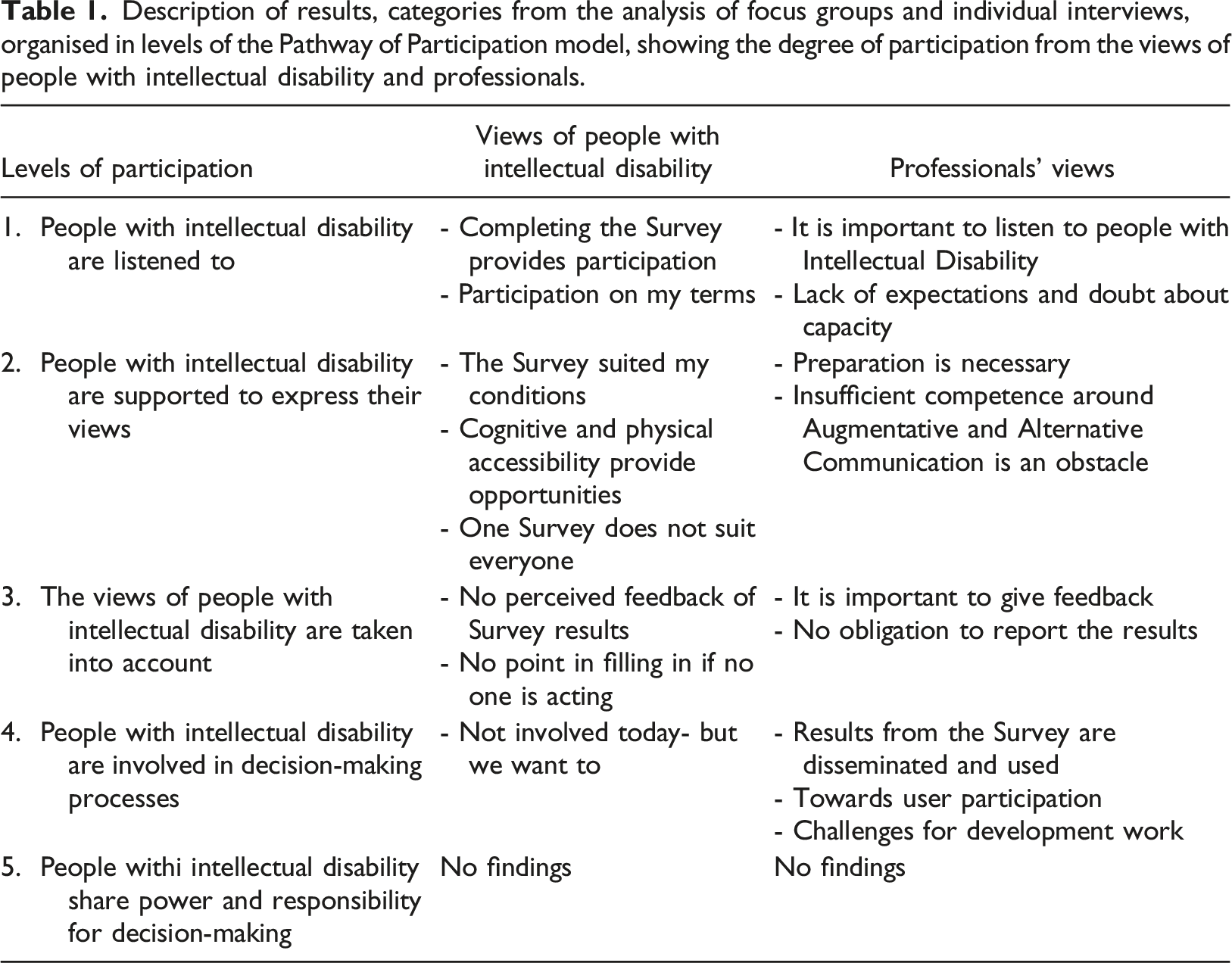
In the next phase, the Pathways to Participation model developed by Shier (2001) was used as a frame of reference to illustrate the level of participation described by people with intellectual disabilities and professionals. Shier’s model originates from the Convention on the Rights of the Child, Article 31 (UNICEF, 1989), and earlier publications by Hart (1992) and Arnstein (1969). The pathways for participation consist of five levels, in this study described from the perspective of people with intellectual disability. In the first, lowest, level of participation, the person is listened to, in the next level the person is supported in expressing their own views, and in the third level the person’s views are considered. At the fourth level, the person is involved in decision-making processes, and at the fifth and highest level of participation, the person shares power and responsibility for decision-making.
In this study, the categories from the qualitative analysis were inserted into the different levels of the Pathway of Participation model, the degree of participation was clarified in the analysed data from the focus groups with people with intellectual disability, and the interviews with staff (see Table 1). Throughout the analysis process, discussions went back and forth between the different steps of the analysis and the discussion of the analysis results in the research group.
Results
Findings from focus groups with people with intellectual disability and interviews with professionals are presented in the five levels of the Pathway of Participation model, described by Shier (2001) (Table 1).
People with intellectual disability are listened to (level 1, see Table 1)
Views of people with intellectual disability
Completing the survey provides participation
The results showed that when the participants had the opportunity to complete the Survey, they expressed feelings of being listened to and were proud to have responded the Survey. They stated a desire to be able to express their opinions and be involved in their lives at work and at home. None of the participants expressed that they had chosen not to fill in the Survey. It was described as being ‘… great to be able to say what you think’. (MM2)
Participants described a great commitment, among other things; they thought it was important to really think about the question asked. It was important not just to answer, but to really reflect on what they were feeling and thinking about the question. One person said
‘It’s sometimes difficult to answer [a question]. You have to think very hard to get it [the answer] right.’. (C1)
Participation on my terms
Being anonymous when filling in the Survey was of the utmost importance for the participants. One person expressed it as: ‛I do not think I like everyone to hear what I have to say’ (D1)
Some people with intellectual disability had experience of having a staff member or a question assistant as support to explain the questions, and sometimes even record the answers in the Survey. The support usually consisted of starting the Survey on a device, and the response options were read out. The participants felt that it was voluntary to choose whether or not they wanted support, and from whom.
Professionals’ views
It is important to listen to people with intellectual disability
All professionals stated that the Survey was an important tool, as it provides opportunities to listen to what people with intellectual disability thought about the services, and what needed to be changed. It increases their participation, something that was considered important. Some professionals expressed that the Survey was an important tool for finding out what people with intellectual disability in different municipalities thought about their services. Then they could compare results.
Lack of expectations and doubt about capacity
Some professionals stated that they were sometimes too quick to exclude people with intellectual disability before giving them the chance to answer the Survey. The perception was that more people with intellectual disability could participate if staff made more of an effort, and if staff expected people with intellectual disability to have the ability to do so.
Professionals even doubted that people with intellectual disability answered the Survey themselves. They thought that people with intellectual disability had not been able to answer, and they suspected that someone else had helped. They felt worried that ‛strong’ people, co-residents, co-workers, staff, managers, had manipulated them to respond in a certain way. The perception was that relatives, staff and others tended to know what was best. …it is so easy to manipulate fragile users, so, so … and you end up in this power relationship. And all the time I would say, not out of rudeness, but representatives, staff, the manager, the doctor … believe that they have the users’ best interests, that they know the users’ best interest. (P07)
People with intellectual disability are supported to express their views (level 2, see Table 1)
Views of people with intellectual disability
The survey suited my conditions
Most participants found the Survey easy to complete. Some filled it in as a physical Survey, but most participants did it digitally. They thought it was good that the Survey was text-based, but they also described using adaptations themselves, with pictures and text read aloud. One person expressed it in a few words: ‘The pictures. And listen.’ (E1)
Cognitive and physical accessibility provides opportunities
The participants expressed that the adaptations could also be beneficial for others with severe disabilities. Yes, of course we have different disabilities and that means that we have different difficulties. So, then it’s good to have different ways [to answer the survey]. Some may want it on paper, some want it on pictures. It’s pretty simple. Or so it is with speech. (M2)
Although all the participants described that the cognitive accessibility with pictures and read-aloud text facilitated their ability to fulfil the Survey, some described that the adaptations could be confusing. It’s those weird sentences for me that I must write and a lot of pictures that I must look at. Then I do not really know what to write and what to answer. In any case, I usually have problems with both pictures and how to write. (MM2)
Some participants expressed that it was difficult to answer the Survey, initially. It could be difficult to understand the questions or find suitable response options, for example, generalising based on the response options, and how to respond if the experience varied from time to time. One suggestion mentioned was that there should have been more choices, and that participants should also be given the opportunity to write their own answers. There are a little too few, like, choices when it comes to just these answers: yes, no and sometimes. And I think you want, like …, sometimes, I do not want to say no because right then it’s bad, like … a little, that it’s a dip. And sometimes it feels like … mmm. Yes, but it is still [fine] for the most part (laugh). (B31)
In one focus group, it was mentioned that it could be difficult to answer the Survey independently when you had a visual impairment. It was difficult to find the right answer options if you could not see. I’m thinking of one thing … the problem is that you must be able to respond because it’s touch or whatever it’s called. It would be easier with a Yes, or No in the machine which are buttons that you press. Because now you must see where to touch. There is Yes, and there is No. (M2)
One survey does not suit everyone
Participants described that they found it difficult to use the same Survey with the same questions for everyone. They further described that people had different cognitive abilities, which for some reduces the ability to understand the questions and express their opinions. It was described that there is a big difference in how people with intellectual disability might understand the questions, based on different levels of abstraction. The suggestion was that it might be better not to ask such “wide” or abstract questions but more questions about specific situations.
Suggestions were made to create a different type of Survey that was more about how to thrive. Participants said it was not so useful to have the same Survey for all services, both at home and at work, as the conditions were so different. One of the focus groups discussed that there are those who do not feel comfortable where they live or work, and the focus should be on more general questions. Well-being was perceived as very important, and it was also important that the purpose was clear when answering a Survey, i.e. what the answers would be used for. But I think like this, regardless of what kind of Survey you should do, you have to make sure that everyone understands what the Survey is about, and then you have to keep in mind that if it is a Survey to change the business, you have to ask these questions. (D2)
Professionals’ views
Preparation is necessary
It emerged among the professionals that thorough preparation needs to be made by managers and staff to prepare people with intellectual disability for the Survey. Examples of preparation that were made were scheduling a special time and a quiet room where the question assistant could go through the questions.
Examples given include putting up information sheets and giving an oral presentation at a ‛house meeting’. The information often needed to be repeated, and be individualised. Professionals tried to enthuse people with intellectual disability to answer by telling them about the results and talking about the importance of their answers, exemplified by ‘… try to talk about how your answers are also super important from an individual perspective’. (P05)
Professionals mentioned that many people with intellectual disability needed support to be able to express their opinions. This support could look different; it was common to have an assistant available when filling in the Survey. The assistant should not have a close relationship with the person with intellectual disability, such as a relative or staff. To make it possible to receive support from an independent person, a special question assistant had been employed. The assistant had knowledge in the field but no direct connection with the person. … If that [assistant] is an employee of my unit, then they [people] with intellectual disability] might answer a little less honestly. Because it can be sensitive things they want to express. So, it’s like the first thing, that we have someone who comes from somewhere else. (P01)
It was also reported that some people with intellectual disability wanted the support from someone they knew. Professionals talked about it as a balancing act, an undesirable situation. But sometimes it was necessary. The cognitive accessibility of the Survey, with pictures and the possibility to have text read out, was useful, but also necessary to enable some people with intellectual disability to complete the survey independently.
Insufficient competence around Augmentative and Alternative Communication is an obstacle
The professionals described that Augmentative and Alternative Communication (AAC) was an area that needs to be developed to replace or complement spoken language in order to improve the ability of people with intellectual disability to understand and communicate on their own terms. It was emphasised that staff had the necessary knowledge to work systematically with AAC, both in home settings and in daily activity centres. … where you also must work the same way with the whole person’s life, so that both housing and daily activity services work the same way … I’m a bit surprised that we have so much left to do when it comes to communication. (P05)
The views of people with intellectual disability are taken into account (level 3, see Table1)
Views of people with intellectual disability
No perceived feedback of Survey results
None of the participations expressed that they had ever received results from the Survey. It was clear that they were not aware that they could be informed of the results afterwards. They described being surprised that the opportunity existed. Well, I was going to ask you a question. Is the idea that we should get to know about the result? So, I can give the clear answer NO, we have not found out the answer. (M2)
There were thoughts that perhaps relatives or legal guardians had been told the result but not the people themselves who were directly affected. However, they expressed an interest in being able to access the results, but also an interest in receiving the national responses from the Survey. Being able to compare their answers with what others had answered was also something that was mentioned. One person said ‛What I want to know, is what the situation is like in the rest of the country’. (D2)
No point in filling in if no one is acting
Participants felt that no clear feedback of the results had been given; the meaning of completing the Survey was therefore discussed. Some expressed frustration that nothing seemed to happen, despite having completed the Survey several years in a row. Participants felt that it was the same questions every year and that nothing had been changed. They had ideas about who to share the results with and why, and expressed that “those who decide” should look and learn based on good examples and use them in other units. Well, maybe the municipality, yes, maybe the managers. So that the managers also know how we thrive. (B32)
Other people they thought might be interested were relatives, legal guardians, and managers, as well as professionals when new units started up, but not everyone. It would probably be relatives, representatives, and such. To the extent they want and are interested … But I think it’s like this. The average man in the street is probably not interested. (B31)
Some participants stated the importance of considering the Survey responses and the improvement work that resulted from them. It could be in the interest of the managers and organisation to find out what people with intellectual disability who work at a daily activity service centre think; what they want to change and what they don’t. One participant also expressed that ‘it might be a spur for … when it’s, if they have like a business where people in general might not feel quite as good [as we do]. That this might be a spur because they, they want to improve their results’. (B31)
Professionals’ views
It is important to give feedback
There was a widespread view among professionals that people with intellectual disability must have access to the results of the survey to understand the benefit of participating. It was the goal to report results, both what people with intellectual disability thought was good, and what they thought was lacking in the service. One example mentioned was showing the results of previous Surveys, and reminding people with intellectual disability of the views that had led to positive changes. The professionals were aware that the results must make a difference in everyday life for people with intellectual disability to continue participating in the Survey. As one of the professionals claimed ‛… if they notice it, I absolutely think they think it’s worth responding. Because you see that there will be a change’. (P07)
No obligation to report the results
There was no uniform policy on how to handle the results of the Survey based on the professionals’ descriptions. The possibility to participate in the improvement work depended on how the municipalities had chosen to handle the results, as well as routines and structure for participation in the group homes, service homes, or daily activity service centre. For example, the result was only reported to the administrative group within LSS, or to the manager, who communicated the results to staff who then drew up an action plan. The action plan was then presented to the people with intellectual disability, who were asked to give their views.
The professionals pointed out that the Survey results were often then reported to politicians. The Survey became a prerequisite for people with intellectual disability to give their views and opinions about changes in operations. It was somewhat unclear when in time this takes place and how the process had looked before, i.e. if the results had been fed back and if an action plan had been discussed with people with intellectual disability before the change proposal was decided in the committee. This also goes to the committee and politicians. The politicians get to know what it looks like. And … that, I think is extremely valuable. So that it doesn’t stop at having an investigation, in the office, but that it is … a political issue as well. (P04)
Sometimes the results were presented in a report, or published at the municipality’s website, or in a PowerPoint presentation for the managers. There were also units that provided feedback on the results to the people with intellectual disability in a written report, which only a few of them could access due to reading difficulties.
People with intellectual disability are involved in decision-making processes (level 4, see Table 1)
Views of people with intellectual disability
Not involved today – but we want to be
Participants expressed that they did not feel at all involved in decision-making processes based on the Survey. But they really wanted to be, as expressed in this quotation: ‛Everyone is different. I get to think like this that I want to work on daily activity service centre and be involved and do it better.’ (D2)
The discussion in the focus groups was about being involved in decision-making processes in the daily activity service centres and in individual matters. There was a strong desire to decide on what concerns the person themselves, as described in the following quote: ´Yes, if it’s a staff member who decides, then you want to be involved when that person decides’ (MM2). There was an awareness among participants that their opportunities to be involved and participate in a working group was a situation that was not self-evident in all countries. Previously in Sweden, people with intellectual disability did not have the same opportunities for their own accommodation and daily activity services. They also compared their current conditions with the limited situation they experienced during the pandemic, when the daily activity service centres were closed. In Sweden we are one of the few countries where disabled people are allowed to be out in society; if you look at Europe for example, people like us are locked up in large institutions. We should be glad that we don’t live in [some other countries] because then we wouldn’t be sitting here. I don’t think anyone can imagine what it feels like to be at home with nothing to do. I can tell you that it was hell to be at home [during the pandemic] and what am I going to do today, what am I going to do today? (D2)
Professionals’ views
Results from the Survey are disseminated and used
In some of the municipalities, the results from the Survey had been analysed at the municipality and unit level, disseminated and used in the development work. … we take on the development work and the business plan work. ... the management team works together with the manager, together with employees. (P05)
Results from previous years’ user Surveys were saved, and when action plans and business plans were drawn up, these were corrected based on the need for change that had appeared from the Survey. … this turn goes through the users, but then we put it into our business plan, which we do together, for next year. And it is important that we have goals that correspond to the need. (P06)
For example, in one municipality the results showed that many people with intellectual disability felt afraid at home and in daily activity service centres, and the managers were asked to submit action plans to make changes.
Towards user participation
There were recurring information meetings in group homes, service homes or at daily activity centres, where results and action plans for change work could be discussed. There was an awareness that there was a lack of user councils where people with intellectual disability could present and discuss their proposals for change in a larger group, for example a forum that could be given more weight regarding quality work based on research etc. One professional expressed that perhaps having reference groups made up of users, and users who get to work on these issues themselves … So, there we certainly have development potential. (P05)
Professionals were trying to create structures that allowed people with intellectual disability to be heard and to participate when an action plan was designed based on the results of the Survey. They were aware of forums for user participation, but people with intellectual disability were usually represented by others. … Because it is always someone else who makes their case. … It is representatives, it is politicians, it is others who push issues. But I can think that we lose the user voice very often. (P07)
Challenges for development work
The professionals expressed that it was difficult to keep the process alive over time from Survey to improvement work. They saw it as a challenge. They also describe that change work takes time. Time that sometimes does not exist due to a lack of resources. There was a lack of key personnel, e.g. development managers, and a need to improve routines for working with reporting the results. … as a manager, I almost always think that the biggest challenge is to get everyone on board, and to maintain it. ... that it will not only become relevant when we receive the results, but that we then also need to work on this continuously throughout the year. (P01)
An ambition was expressed to provide feedback and discuss the results with people with intellectual disability and have suggestions on what needs to be improved and/or changed. But it was difficult to adapt feedback and involve everyone in the discussion because many people with intellectual disability have difficulty understanding and communicating on an abstract level.
Most of the professionals stated that the municipalities could become much better at giving feedback of the results, and involve people with intellectual disability in the developmental process. It was a clear development area that the professionals wanted to work on and improve.
People with intellectual disability share power and responsibility for decision-making (level 5, see Table 1)
No examples were found in the focus groups or in the interviews.
Discussion
The results of this study reflected the experiences of people with intellectual disability of participating in an annual survey of the services they receive and their involvement in the improvement process. It also shed light on social service professionals’ views on the possibility of involving people with intellectual disability in this work. People with intellectual disability expressed that they feel listened to and supported to express their views. However, there is a discrepancy between their perception and that of professionals regarding whether the views of the people with intellectual disability are taken into account, and whether they are involved in decision-making processes.
Completing the Survey gave people with intellectual disability a sense of participation on their terms, and professionals considered it an important tool to gather users’ feedback of the services. Making changes based on people’s own opinions and allowing them to participate in improvement work aligns the principles of the UNCRPD, and should be standard practice in social services work.
Most people with intellectual disability in this study found the Survey suitable for their conditions and that the cognitive accessibility enabled them to participate. Both people with intellectual disability and professionals mentioned cognitive adaptations, such as using pictures that make questionnaire text more concrete. This ties well with the ISO guidelines of cognitive accessibility (SIS, 2020) for increasing participation in society of people with cognitive disabilities. Also using question assistants to help with technology and question comprehension is in line with Berlin Hallrup et al. (2019) and Petner-Arrey and Copeland (2014), who stated that staff engagement and knowledge of the consequences of the disability are important in concretising abstract text and situations.
One significant finding was that people with intellectual disability highly appreciate being able to answer the Survey themselves and remain anonymous, in line with the right to personal autonomy as stipulated in the UNCRPD. It also appeared, that most people with intellectual disability in this study chose to fill in the Survey digitally. Previous research has also described that cognitive digital adaptation can contribute to increased participation and provide enhanced opportunities for people with cognitive difficulties (Gillespie et al., 2012; Buchholz et al., 2013; Torrado et al., 2020; Yngve and Lidström, 2023).
There were concerns raised by some people with intellectual disability and the professionals that the Survey is not suitable for everyone, as the level of abstract thinking varies among the respondents. Despite this, professionals expressed that more effort could sometimes be made to extend the Survey to more people. The results highlighted that professionals are hesitant to ask people with intellectual disabilities to participate in the survey. They doubt if people with intellectual disability are capable of responding, and they don’t trust people with intellectual disability to respond themselves. This shows that the power of professionals to decide who to invite to participate can influence the results of the survey. Verdonschot (2009) found that staff attitudes are important for and influence the participation of people with intellectual disabilities, and Talman et al (2021) came to a similar conclusion for people with severe intellectual disabilities. This reflects a patriarchal attitude inconsistent with participation and autonomy outlined in the UNCRPD. The finding that some people with intellectual disability are not given the opportunity to express their views about the support and services they receive aligns with previous research (Arvidsson et al., 2008; Petner-Arrey and Copeland, 2014; Kjellberg, 2002).
There was a discrepancy in the findings between people with intellectual disability and professionals regarding feedback on the Survey results. People with intellectual disability expressed frustration at not receiving the results, while professionals, on the other hand, believed they provided feedback and give examples of changes based on the Survey results. This may highlight a lack of sufficient knowledge among staff on providing information in a cognitively accessible way, hindering people with intellectual disability to make sense of it. People with intellectual disability often have difficulties understanding and expressing themselves linguistically, which can, among other things, result in exclusion and difficulties in influencing their everyday life (Hamm and Mirenda, 2006). The use of AAC is effective in increasing communicative participation (Andzik and Chung, 2022; Holyfield et al., 2017) which we consider crucial for genuine participation according to Shier (2001).
The people with intellectual disability in this study did not feel involved in decision-making currently, but they express a desire to be involved. As an example, people with intellectual disability expressed a desire to compare their municipality’s result with others. These findings are consistent with research (Byhlin and Käcker, 2018; Hammel et al., 2008; Tobin et al., 2014) and indicates a strong desire from both sides to use the results of the Survey to improve services. However, according to Shier’s (2001) Pathways to Participation model as a frame of reference on the findings in this study, it becomes very clear that the participation of people with intellectual disability in the municipalities’ social services is limited, particular in decision-making processes and in sharing power and responsibility (Shier, 2001). The current findings indicate that more needs to be done to ensure that people with intellectual disability can participate in the decision-making process regarding their support and service in group homes, service homes and daily activity centres, which according to Wehmeyer (2020) is important for obtaining quality of life.
Further research should focus more on analysing the comments provided by people with intellectual disability in the Survey’s open-ended section, which could provide a deeper understanding of what people with intellectual disability want and value in services. A study highlighting good examples of communicating of survey results in a concrete and cognitively adapted way is also recommended, together with examples of involving people with intellectual disability in decision-making processes and sharing power and responsibility.
Strengths and study limitations
This study aimed to gain views both from people with intellectual disability and from professionals. To the researchers’ knowledge, this is the first study to specifically explore people with intellectual disability’s views of participating in a cognitive adapted user survey with a social service focus. Although the study’s participants were few and from a small geographical area, the result is important and adds new insights into the field.
Using a qualitative method including focus groups of people with intellectual disability, diverse in terms of both literacy and verbal expression, and with different experiences of using technology, enabled the researchers to gather rich data about this subject. The focus group format allowed for an exchange of experiences between participants, making it easier for them to remember and compare their experiences. The researchers’ long experience of meeting and discussing with people with intellectual disability, and of using cognitive accessibility in the form of structure and pictures to facilitate understanding of the discussion area, can be seen as a strength. Using interviews with professionals allowed the researchers to get a picture of how staff at different administrative levels experienced the work with the Survey, which is another strength. A weakness is that few of the participants worked closely with the people with intellectual disability, which may affect the examples described. This study was conducted during the pandemic, which affected recruitment.
The researchers’ choice to use Shier’s model for participation as a grid can be seen as a strength and can provide a suggestion for further research in the field. Shier’s model has mainly been used to describe children’s participation and how adults and organisations can facilitate participation, but has also been used for adults with intellectual disability (Talman et al., 2021). The model’s ability to identify both current levels of participation and what may hinder or promote participation at different levels of responsibility can facilitate development and research in the field.
Conclusion
Overall, the results show the importance of evaluating the services provided by social services as expressed both by people with intellectual disability and professionals, and that people with intellectual disability can respond independently using cognitive accessibility of pictures and read-aloud text. Both people with intellectual disability and professionals emphasise the need for feedback and communication about the services provided. It also appears that people with disabilities feel listened to, but do not feel that their opinions are taken into account in the municipalities’ improvement work. Professionals also highlight the lack of involvement of people with intellectual disability in the improvement process.
This study clearly demonstrates that one area of improvement in the municipalities’ social service with regard to the annual Survey is to make the results cognitively accessible. In addition, it was considered important to have a structured plan for feedback of results to people with intellectual disabilities, to ensure that reporting is comprehensible and to involve people with intellectual disabilities in discussions about how to improve services. In order to prioritise what may need to be changed, collaboration with people with intellectual disability is needed.
Footnotes
Acknowledgements
The authors would like to thank the people who participated in the focus groups as well as individual interviews in the study. We would also like to thank Annika Hedman and the municipalities concerned for the opportunity to conduct this study within their social services for.
Declaration of conflicting interests
The author(s) declared no potential conflicts of interest with respect to the research, authorship, and/or publication of this article.
Funding
The author(s) disclosed receipt of the following financial support for the research, authorship, and/or publication of this article: The Swedish Research Council for Health, Working Life and Welfare (FORTE); 2019-01451.
