




Abstract
This qualitative study focuses on what feeling safe means for people with mild intellectual disabilities and severe challenging behaviour, and which factors affect their sense of safety. Thematic analysis was used to analyse data collected during (1) ethnographic longitudinal research and (2) interviews and focus groups among professionals and service users. Feelings of safety were related to three main themes: (1) a physical environment that reduces risks and temptations; (2) a reliable, predictable, and supportive environment; and (3) an accepting environment that enables service users to establish a normal life. An analysis of which factors affect service users’ sense of safety identified 20 themes (e.g. team climate) and 34 subthemes (e.g. interactions with other service users). Many of these factors were interconnected. Future research should explore what residential service organisations for people with intellectual disabilities and external actors (e.g. the police) can do to promote service users’ feelings of safety.
Keywords
Introduction
Safety is a basic need in every human individual (Maslow, 1943), but because the meaning of safety in studies depends on the characteristics of the participants and the context, there is no generally accepted definition of safety. Safety has been associated with the absence of accidents or conceived as the antonym of risk (Aven, 2014; Aven and Renn, 2009). Defined in more positive terms, safety is the capacity to achieve successful outcomes under varying conditions (Aven, 2022). Several aspects can affect perceived safety. In healthcare settings, including (forensic) psychiatric care, perceived safety among patients can relate to the quality of interaction with support staff, such as the interest that support staff show towards patients, the extent to which patients perceive that they are taken seriously, and the level of communication with support staff (Kenward et al., 2017; Pelto-Piri et al., 2019). In addition, psychiatric patients’ feelings of safety have been shown to be affected by other patients, who can engender feelings of anxiety and a lack of safety through threatening or aggressive behaviours (Pelto-Piri et al., 2019; Verstegen et al., 2022a). Moreover, patients can feel unsafe due to a lack of information about other patients (e.g. about another patient’s mental state after an incident, so that they can ascertain the likeliness of future risky situations) (Pelto-Piri et al., 2019; Stenhouse, 2013).
The impact of relationships with support staff on service users’ feelings of safety has also been identified in studies involving children and adults with intellectual disabilities (Bambara et al., 2001; Tournier et al., 2022). Relationships with others, such as family, friends and other service users, also appear to affect the perceived safety of service users with intellectual disabilities (Griffith et al., 2013; Neimeijer et al., 2021; Robinson, 2014). For example, children and young people with intellectual disabilities and complex (mainly physical) needs were found to associate emotional and physical conflicts at home and social exclusion by other children with feelings of fear and anxiety (Robinson and Graham, 2020). Being in a familiar environment was another aspect that promoted feelings of safety and security. In a study by Robinson (2014), adults with intellectual disabilities mentioned many factors relating to physical safety in response to what ‘feeling safe at home’ means, such as locks on doors to stop strangers from entering.
In those with intellectual disabilities and challenging behaviour (CB), feeling safe is a particularly relevant issue, because the challenging behaviour may be triggered or prolonged when they feel unsafe (Van den Bogaard et al., 2019). In turn, challenging behaviour can have negative consequences on their quality of life due to restrictive interventions, social exclusion and transfers to another, often more restrictive setting, for example (Embregts et al., 2019; Heyvaert et al., 2015; Nankervis et al., 2019). challenging behaviour can also have an impact on the well-being of significant others around those with challenging behaviour, such as other patients, support staff and family members (Olivier-Pijpers et al., 2018; Vassos and Nankervis, 2012). As a consequence, support staff may, for instance, develop negative emotions, which can result in a burn-out (Mills and Rose, 2011; Zijlmans et al., 2012). When support staff do not feel safe, this can also lead to more coercive methods of control and a more hostile attitude towards service users (Willems et al., 2016).
To help people with intellectual disabilities with challenging behaviour to feel safe, it is important to know what feeling safe means to them and which factors promote or undermine this. However, to our knowledge, this has not yet been explored. In this qualitative study, we have therefore aimed to understand feelings of safety in people with mild intellectual disabilities or borderline intellectual functioning and severe challenging behaviour from the perspective of both service users and professionals in various roles. More specifically, we formulated the following two research questions: (1) What does feeling safe mean for individuals with mild intellectual disabilities or borderline intellectual functioning in a residential setting who display severe challenging behaviour? (2) Which factors affect the feelings of safety among these individuals?
Method
Setting: Project Pro
The study was conducted at six Dutch organisations involved in the project Pro, including three residential service organisations for people with intellectual disabilities, two care administrative offices and the Centre for Consultation and Expertise (CCE). These organisations started working together in Pro in 2017 in order to prevent a constant stream of transfers between care settings and to enhance the quality of life of 24 people with mild intellectual disabilities or borderline intellectual functioning combined with psychopathology, who exhibited severe challenging behaviour and of whom many have had a forensic background (Pro, 2023). The three residential service organisations each provide support to eight Pro service users following agreed principles: a) unconditionality regarding service users’ residential status and their relationships with support staff; b) striving for a life that is as normal as possible; c) adapting the environment to the needs of service users (e.g. safety, autonomy) rather than the primary focus being on preventing their challenging behaviour; and d) promoting the service user’s self-confidence (Pro, 2023). As well as these principles relating to the service users, the Pro organisations also focus specifically on the well-being of healthcare professionals and developing their competencies. Additionally, they underline the mutual responsibility of professionals in all positions (e.g. care workers, psychologists), including the board members of their organisations, to provide support according to these ‘Pro principles’.
Design
Non-participant observations and informal unstructured interviews were used to collect qualitative data and explore which factors affect the feeling of safety of service users with severe challenging behaviour (research question 2). These data were gathered by the first author during ethnographic longitudinal research in Pro, focusing on the practical implications and long-term outcomes of applying the Pro principles outlined above. Documents (meeting minutes) were also analysed. Data analysis produced a range of themes that appeared to play a role in service users’ sense of safety. These themes were validated using triangulation among service users and professionals involved in Pro through semi-structured interviews and focus groups. Interviews and focus groups were also used to gain more insight into what safety means for service users with mild intellectual disabilities or borderline intellectual functioning who display severe challenging behaviour (research question 1).
Participants
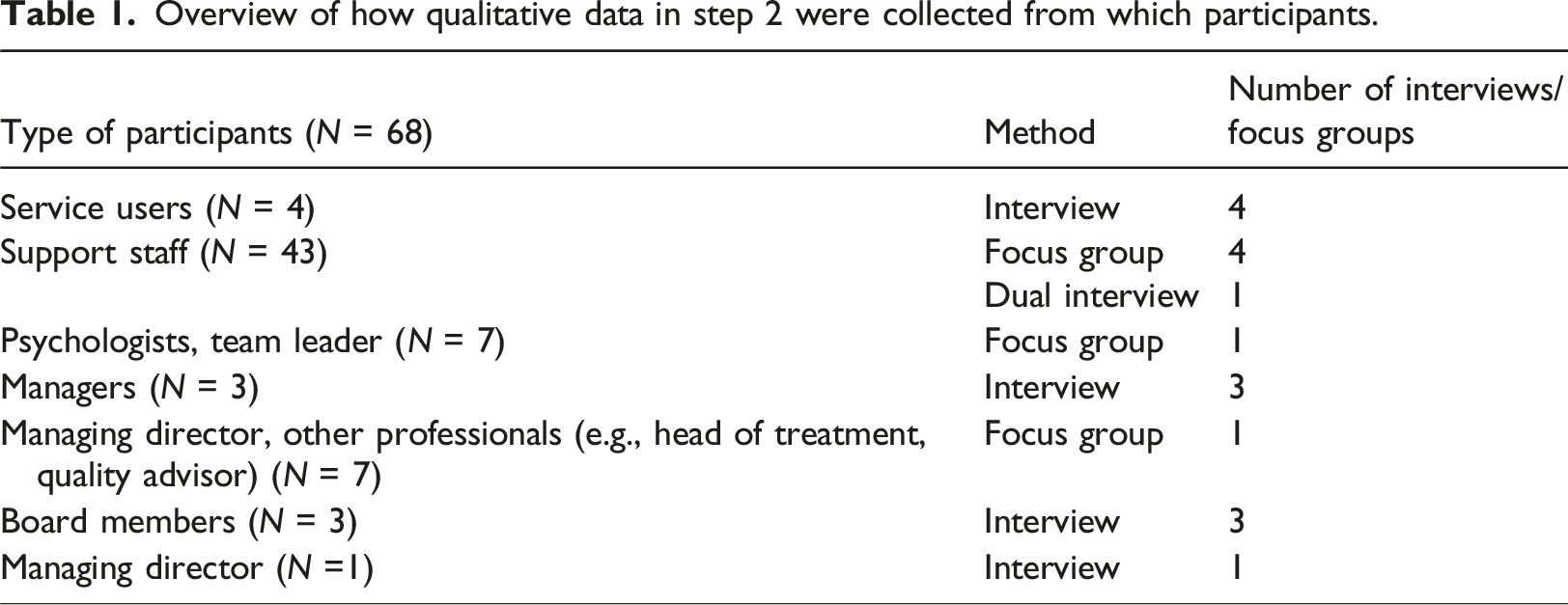
Overview of how qualitative data in step 2 were collected from which participants.
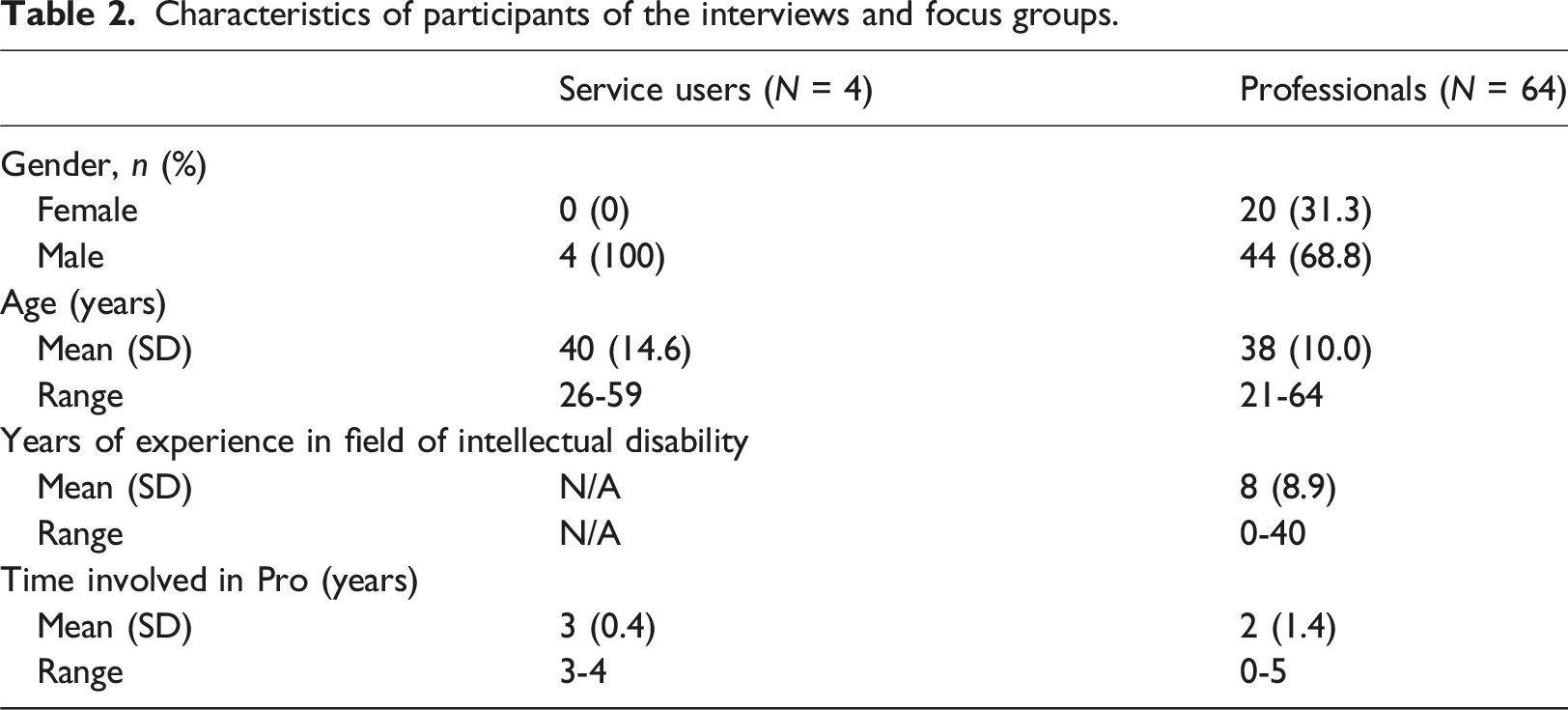
Characteristics of participants of the interviews and focus groups.
Procedure
Data for the study were collected in two steps: 1) the collection of qualitative data from ethnographic longitudinal research in Pro through non-participant observations, informal unstructured interviews, and document analysis; and 2) the collection of data through interviews and focus groups with people involved in Pro. We will describe these steps in more detail below.
Step 1: Exploration of qualitative data from ethnographic longitudinal research to Pro
Between 2019-2022, the first author collected qualitative data through ethnographic fieldwork as part of longitudinal research into Pro. To this end, she regularly visited each of the locations of the three residential service organisations involved in Pro and contacted team leaders, managers and psychologists by telephone or online (around once a month). She also attended a regular two-monthly meeting of the steering committee of Pro, consisting of treatment directors and managing directors, as well as the monthly meetings for team leaders, managers and psychologists working at the three residential service organisations, where the care being provided was discussed. Finally, she joined a couple of working conferences organised by the organisations involved in Pro.
Data was collected through non-participant observations and informal unstructured interviews, two commonly used techniques in ethnography (Jones and Smith, 2017). Data collection was aimed at gaining insight into the experiences of service users and professionals in Pro and the work that Pro organisations do to further the quality of care. The aim was not to collect data on the theme of safety specifically but the theme emerged throughout the data collection, which is common in long-term participant observation (Hoey, 2014). A total of 80 fieldnotes were made for the interviews and observations. In addition, 20 documents (meeting minutes, mostly drafted by Pro) were included as data.
Step 2. Data collection through interviews and focus groups
In addition to the data from the ethnographic longitudinal research in Pro, eleven semi-structured interviews, one double interview and six focus groups were held (see Table 1), with the focus now specifically on the theme of safety. Most of these interviews and focus groups were conducted face-to-face to help create a safe and comfortable atmosphere and facilitate non-verbal communication (Saarijarvi and Bratt, 2021). For practical reasons (e.g. to reduce travel time for participants with busy schedules, and to align with existing online meetings), some interviews and focus groups were held online with a video connection (using Microsoft Teams). These interviews were conducted by the first author using an interview guide. For each group of participants (e.g. service users, managers, board members), the base interview guide was adapted to the context (e.g. the role and tasks) of the participants. The interview guide for all the participants included the question of what sprang to mind when safety for Pro service users was mentioned. The interview guide for service users was developed using feedback from experiential experts with mild intellectual disabilities from the Academic Collaborative Centre Living with an Intellectual Disability.
The focus groups were moderated by the first author together with either the second author or an experienced co-researcher. The first three authors prepared several statements relating to the themes identified in the longitudinal data in order to encourage focus group participants to join in the conversation. The statements were again adapted to the roles of the professionals in the focus group. Following an introduction to the study, as a validation and form of member check, the moderators first showed the themes identified in step 1 and asked the participants whether they recognised these and whether they would like to add any more. Subsequently, participants were asked to complete the sentence ‘Safety for Pro service users is…’, similar to the question asked in the interviews. For the remainder of the focus group, the participants were shown the predefined statements. The interviews lasted an average of 75 minutes and the focus groups 83 minutes; three interviews were split into two meetings – one due to limited time during the first meeting (diary commitment of a board member) and two because of limited concentration span and responses (service users). All the conversations were recorded and transcribed verbatim.
Analysis
The authors conducted a thematic analysis with a constructionist perspective to identify, report and analyse themes emerging from the data (Braun and Clarke, 2021). Thematic analysis consists of moving back and forth through the data in six phases. The first three steps in thematic analysis (familiarising oneself with the data, generating initial codes, searching for themes) were completed twice, once during step 1 (longitudinal data) and once during step 2 (data from interviews and focus groups). The other steps in thematic analysis were completed using the full data set.
In step 1 (ethnographic longitudinal study), familiarisation with the data occurred during the data collection period (approximately two and a half years), when the first and second authors thematically analysed and discussed fieldnotes several times in an iterative manner to identify which factors affect the feeling of safety of Pro service users. To this end, they annotated relevant data using an inductive approach while comparing the findings with studies into safety experiences of people with intellectual disabilities and people who exhibit challenging behaviour. Several themes that affect the perceived safety of service users were identified in the data and discussed with the other authors. To ensure that no themes were missed in the analysis, the first author systematically coded the field notes and Pro documents into subthemes using Atlas.ti software at the end of the data collection period. She then clustered the subthemes into themes in Microsoft Excel, and discussed these with another researcher. No new themes were identified in addition to the themes identified during data collection.
In step 2 (interviews and focus groups), thematic data analysis started with an exploration of the data. The first author familiarised herself with the data from the interviews and focus groups by carefully reading the transcripts. In addition, the first author listened to the audio recordings while also reading the text to check the transcripts and amended these where necessary. Next, she coded the transcripts using Atlas.ti software, keeping the two research questions in mind. In Microsoft Excel, the first author merged the codes and established potential subthemes and themes for both research questions in an iterative process. An experienced researcher reviewed the subthemes and the associated codes, including those identified in step 1, ensuring internal homogeneity (consistent coding within subthemes) and external heterogeneity (clear distinctions between subthemes). The first author and other researcher engaged in discussions to reach consensus on the titles of the subthemes and themes, which were subsequently presented to the other authors for further discussion. Finally, all the authors worked together to define and refine the final (sub)themes and select accompanying narratives, working towards achieving consensus.
Ethical procedure
This study regarding safety is part of a longitudinal study involving the Pro project approved by the Ethical Review Board at Tilburg University (EC-2019.37). Participants received written and verbal information about the aims of the study. They all provided informed consent in writing regarding their contribution to the study and the sharing of (personal) data, as did those legally responsible for the service users who participated.
Results
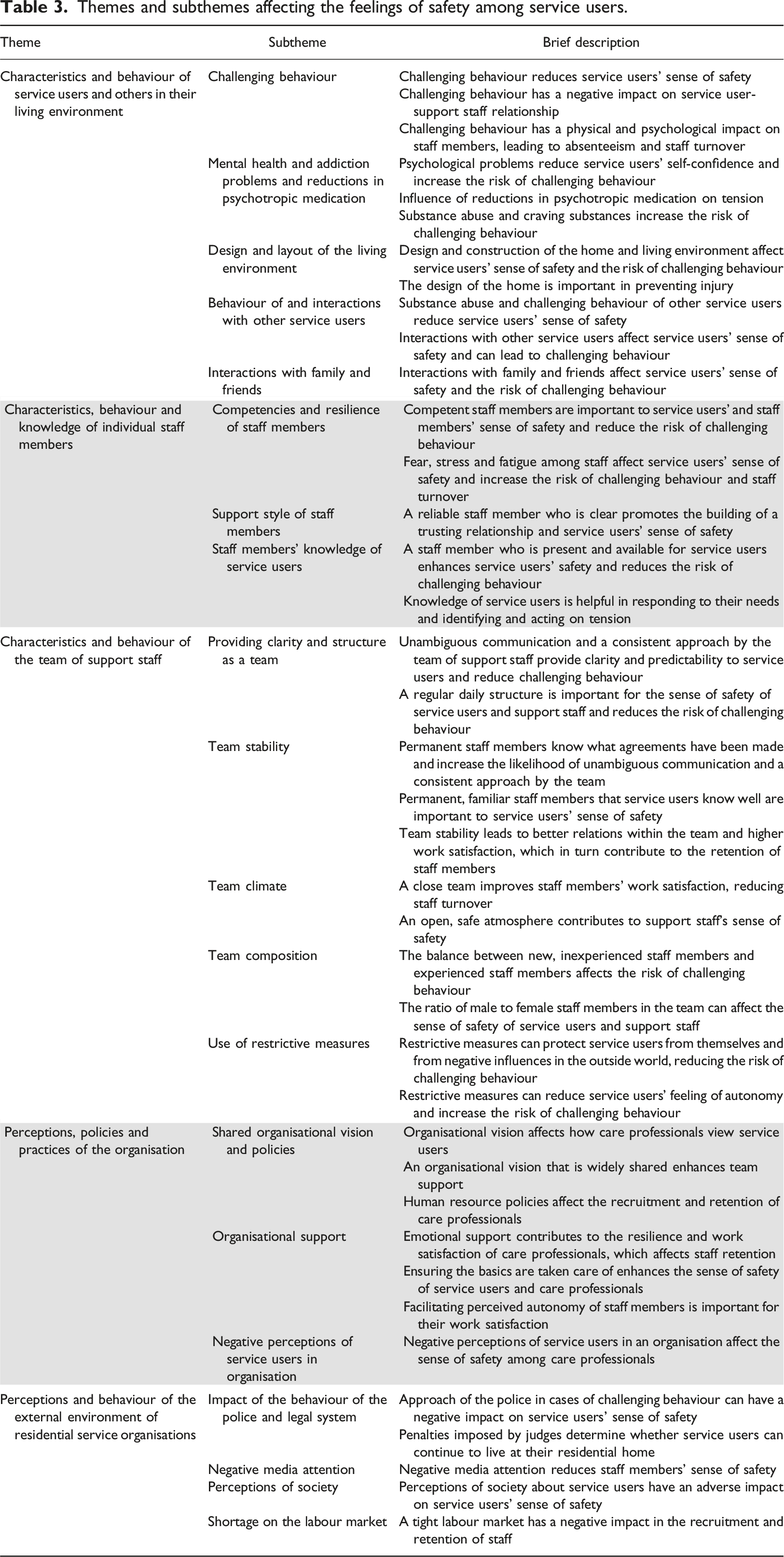
Themes and subthemes affecting the feelings of safety among service users.
The meaning of feeling safe
An environment that reduces risks and temptations
The first of the three main themes relating to the meaning of feeling safe concerns a physical environment that reduces risks and temptations. Participants mentioned a safe living environment where service users have their own room that they can retreat to, for instance, and the safety of service users was associated with an environment free of the risk of injury or being exposed to drug dealing. “But regarding safety, I also think of: what is the home like? What is the layout? A safe space in his or her own room […], because I think that it is important that service users are able to withdraw to their own safe environment.” (Manager 3)
A reliable, predictable, and supportive environment
The second main theme can be summarised as a reliable, predictable, and supportive environment that service users have confidence in. Codes belonging to this theme refer to feeling psychologically safe in a reliable, structured and predictable environment. This includes support staff who provide unconditional support, security, and a predictable daily routine. Many participants also mentioned that, in their experience, safety for service users means support staff who are always around and available for them. “A fixed team. A fixed programme. That comes back every time. That they know what is expected from them, and what they can expect from support staff.” (Support staff 5)
An accepting environment that enables service users to establish a normal daily life
The third main theme, an accepting environment that enables service users to establish a normal daily life, refers to an environment where service users feel appreciated, recognised, and like they can be themselves. It is also linked to the opportunity for phased societal integration and a positive outlook for the future, described by one of the service users as ‘things you can look forward to’. Examples relate to forming a loving relationship or a positive transfer to a home with less intensive support and restrictions. “... because you want to have a good position in life, you want a good position... That’s what I mean, that’s my definition of feeling safe... That you’re making progress in life and that you have things to look forward to instead of standing still, using drugs, or constantly fighting.” (Service user 3)
Which factors affect the feeling of safety among service users?
The themes and subthemes identified as playing a role in service users’ sense of safety involve the levels of 1) service users, their living environment and the people around them (5 themes, 10 subthemes), 2) individual staff members (3 themes, 4 subthemes), 3) a team of support staff (5 themes, 11 subthemes), 4) the organisation (3 themes, 6 subthemes) and 5) the external environment of residential service organisations (4 themes, 2 subthemes). Considering the high number of themes, we have limited the descriptions in this section to themes that are made up of subthemes. A complete overview of all the themes and subthemes for each level is provided in Table 3.
Characteristics and behaviour of service users and others in their living environment
An analysis of the longitudinal data, interviews and focus groups revealed that at the level of the service user, perceived safety was affected by challenging behaviour, mental health and addiction problems and reductions in psychotropic medication, the design and layout of the home and living environment, the behaviour of and interactions with other service users, and interactions with family and friends.
Challenging behaviour
It appears that perceptions of a lack of safety can trigger challenging behaviour in service users, and also that challenging behaviour leads to a perceived lack of safety. One of the service users explained that during an episode of challenging behaviour, he feels unsafe and that feelings of safety are taken away from him.
challenging behaviour may reduce service users’ sense of safety indirectly as well, in cases where the challenging behaviour has a negative impact on the relationship between service users and support staff – for instance, because service users feel mistrust of support staff or because support staff avoid contact with the user or are hostile in response to service users’ challenging behaviour. As the data analysis showed, following an episode of challenging behaviour it can be difficult for support staff to resume daily activities and be available for service users, as if nothing had happened. In some cases, support staff have even refused to continue working with a particular service user.
challenging behaviour can also affect the physical and psychological safety of staff. Several staff members have sustained significant physical and psychological damage because of challenging behaviour, which led to long-term absence or even leaving their position.
Mental health and addiction problems and reductions in psychotropic medication
As well as service users’ challenging behaviour, professionals and one service user indicated that service users’ sense of safety can be adversely affected by their mental health problems. Some of these problems relate to their complex life history, including the frequent transfers they faced due to severely challenging behaviour in the past. For example, one manager and board member mentioned that attachment-related problems and the revival of negative memories reduce service users’ sense of safety and increase the risk of unwanted behaviour and unsafe situations. “… if somebody is reliving certain memories, or… yes that doesn’t hold up their treatment, but yes briefly, it actually does stagnate briefly, yes that can be a short interruption in the treatment, and it can also lead to unsafe situations, for both the resident and the staff member.” (Manager 2)
Many service users are used to taking psychotropic medication to deal with their mental health issues. According to professionals, reducing this medication can cause service users to become tense because it removes one method of coping.
Alcohol and drug addictions among service users have also been shown to affect their sense of safety, because their cravings can lead them to run away. Without supervision, they are tempted to relapse and drink or use drugs excessively, which can trigger their challenging behaviour.
Design and layout of the living environment
According to professionals in various positions, a quiet, well-organised, predictable living environment enhances service users’ sense of safety. They also explained that the living environment should be pleasant and homely. Members of the steering committee of Pro (e.g. managing directors, head of treatment) indicated that such a homely environment invites normal behaviour (i.e. without challenging behaviour), as opposed to a bare, low-stimulus environment. In addition, one manager added that a private room or apartment where service users can feel at home gives them a place to retreat to, which can reduce tension. “Your living environment also needs to be a place where you like to be. That means that it needs to be pleasant. That you can’t get injured by anything, you’re not inclined to destroy it in that sense, and that it’s a nice place to be. That doesn’t mean that it has to be a very restrictive, controlled environment, where everything is locked up, or that, for instance, with a bread knife and making sandwiches, that you say: well, no knives, because that makes things more complicated.” (Board member 1)
At the same time, the living environment should be a place where service users cannot get injured. The home should be robust, for example.
Behaviour of and interactions with other service users
Other residents in the living environment can also influence the sense of safety among service users, as shown in the analysis of longitudinal data, interviews and focus groups. First, other residents can exhibit behaviour that elicits feelings of anxiety or an unsafe feeling – by dealing drugs, attempts to run away or aggressive behaviour, for example. In addition, support staff explained that seeing restraint measures imposed on other residents who are exhibiting challenging behaviour can affect service users (seeing another resident placed in a seclusion room, for instance). “… some time ago, when [name of client] was still living at the other residential home, when he was restless, other service users also felt unsafe if he started throwing things, that kind of stuff. In any case, if there is an escalation I think other service users feel unsafe, they’ll withdraw to their own room in certain situations…” (Support staff 1)
Second, the data analysis showed that interactions with other service users can affect service users’ sense of safety. They can feel unsafe or tense because of microaggression (Verstegen et al., 2022a), including negative interactions with other residents, and feeling irritated, bullied or belittled. At the same time, however, support staff and members of the steering committee also described how interactions with other residents can enhance the sense of safety among service users, such as when social bonds are formed. These positive interactions can help service users feel seen and supported, which increases their self-confidence.
Characteristics, behaviour and knowledge of individual staff members
When it comes to support staff members, their competencies and resilience, and their support style can be identified as factors that can affect the sense of safety among service users. In addition, as shown in Table 3, staff’s knowledge of service users appears to play a role.
Competencies and resilience of staff members
According to professionals in various roles, support staff working with service users with intellectual disabilities and severe challenging behaviour demands a particular skillset and abilities. In order to promote a sense of safety among service users with challenging behaviour, support staff need to be self-confident and should not become overwhelmed or afraid too easily. At the same time, however, they need to be sensitive and responsive. Professionals and service users indicated that it is important that support staff can read, hear and understand service users. In addition, they need to be able to regulate their own emotions and avoid arguments with service users. “I think that people, they definitely need to have empathy and be able to sense what a service user is experiencing, and their tension and habits, but also to be very good at navigating what a service user needs.” (Manager 1)
As well as these competencies, resilience in support staff was highlighted as significant to the sense of safety of both service users and support staff. Both professionals in various roles and service users stated that service users feel unsafe when support staff feel unsafe. Anxiety, stress, and fatigue mean that support staff become irritated more easily, are less alert, and adopt a more controlling support style, all of which increases the risk of challenging behaviour. “... I think that if you don’t feel safe as a staff member, you are not able to provide, or convey, or ensure, or demonstrate a sense a safety to residents.” (Manager 2)
Support style of staff members
All types of participants explained at length how the support style of staff plays a role in service users’ sense of safety and their challenging behaviour. One service user, support staff, psychologists and managers all indicated that support staff should be respectful, reliable, and clear to service users, and that support staff members need to be authentic. According to the professionals, this provides predictability and contributes to building trusting relationships and enhancing feelings of safety. “The fact that you do what you say you will. I think that’s also an important factor, especially for service users, and it helps them feel safer. He says something, and then he does it, so he’s reliable, yes.” (Support staff 2) “I would like them [support staff] to be honest and sincere and understanding. Being able to say what I want, that’s important. I should not have to be thinking about – can I say this or not, in order to prevent escalation.” (Service user 4)
Furthermore, professionals in various roles explained that support staff who are available for service users and close to them enhance the sense of safety experienced by service users. This is true at both good moments and bad moments, as one of the managers explained: “... also a certain sense of security that you experience, that you feel close to them, that as a service user you can say things freely and you’ll be listened to, even if you are not doing so well, that you feel listened to, and that’s about times when you’re not doing so well, but also that somebody notices what make you feel better and what keeps you feeling okay.” (Manager 1)
Characteristics and behaviour of the team of support staff
At the team level of support staff, we identified providing clarity and structure, team stability, team climate, team composition, and the use of restrictive interventions as factorss that can affect service users’ sense of safety.
Providing clarity and structure
Providing clarity and predictability appeared to be significant for service users’ sense of safety, and support staff and managers also explained that the team as a whole should communicate and act in a consistent manner. That means, for example, that all support staff members should be unafraid to set boundaries for service users and then stick to the boundaries that have been agreed. Otherwise, service users can become upset and the risk of challenging behaviour increases. “... that is challenging, because I agreed with one person [support staff member] something different to what they agreed on as a group [team], and that’s difficult to deal with, to react well to that is very hard.” (Service user 4)
One of the managers added that a good handover between shifts and all being present at team meetings also contribute to clear communication.
Professionals in various roles also mentioned that having a clear programme for the day improves predictability and supervision for both service users and support staff. Sticking to a structured daily programme is especially important when there is high staff turnover in the team, because service users need time to develop a trusting relationship with new or temporary staff members to help them feel safe and secure. Nevertheless, professionals indicated that if new or temporary staff provide stability in the service users’ daily activities, they can still help them to feel safe. “...so that kind of daily programme, if it’s consistent and, well, done as it is supposed to be done, then that can also provide some safety even when there’s someone who may not know the service user very well yet, because the programme for the day still remains the same.” (Working group content of care)
Filling the day with activities also fosters a sense of safety among service users because it leaves less time to dwell on problems and reduces cravings for alcohol or drugs.
Team stability
Another factor that helps support staff to act and communicate in a consistent way, and therefore promote a sense of safety, is having a stable team of support staff with permanent staff members. Permanent staff members generally know what is expected of them (e.g. they know the daily programme), what agreements have been made within the team, and what the overall aims are. “If they see different faces every day, people who do not know what the agreements are, that is perceived as just about the most unsafe situation there can be.” (Managing director)
Team stability also contributes to service users’ sense of safety because they have a better opportunity to build trusting relationships with staff who are around for longer. On the other hand, a team in which there are frequent changes reduces service users’ sense of safety. A constant stream of new faces makes it more difficult for service users to develop trusting relationships with staff. Service users indicated that they have been reluctant to up to another new staff member and start building a new relationship all over again. “If he doesn’t know me, or anybody, then I don’t speak to anyone. Then service users and support staff just have a problem with me.” (Service user 1)
In addition, support staff explained that a stable team contributes to the well-being and team climate of support staff. When staff have been working together for a longer time, they experience more safety during the shift because they know what to expect from each other. When there is frequent staff turnover, on the other hand, the job becomes more demanding for permanent staff members, who need to support new colleagues who are still learning the ropes. “Obviously, we have many staff changes in the team, new people all the time, that is... if I’ve worked several shifts with a certain person, then I know at a certain point how they will respond, and you only need to look at each other and you know enough. That is different to someone who is working in the group for the first time. That does give me some sense of safety.” (Support staff 1)
Team climate
Team climate also appears to have a positive effect on team stability, and therefore on service users’ sense of safety. According to the participants, a strong, close-knit team is an important reason to continue working in a team. Support staff explained that in a strong team you can support each other and build trust, experience a sense of togetherness, and get to know each another well.
Participants also mentioned that it is also important to have a team climate that is open and safe, because that enhances staff members’ sense of safety and helps to prevent challenging behaviour. When support staff feel free to discuss their insecurities or reduced resilience openly, other staff members can take on certain tasks and risky situations can be prevented. “You have to be honest when you don’t feel comfortable about doing something, that’s also important. Because if you just say “Don’t worry, I’ll do it” and you’re not open about it, and then your colleagues are standing there without the extra person, then you do have a problem.” (Support staff 5)
Team composition
The composition of the staff team affects the sense of safety among service users and support staff, as shown in the transcripts of professionals (e.g. support staff, managing director) and longitudinal data. When the team includes many new staff and hardly any permanent staff members, the risk of challenging behaviour increases because there are fewer experienced staff to provide coaching and guidance.
Regarding team composition, some staff members and one manager also indicated that the gender ratio in the team can play a role in the sense of safety among service users and staff. For instance, they mentioned that the physical strength and appearance of male staff members increases the sense of safety when dealing with physically stronger service users (who may become physically aggressive). On the other hand, some also argued that certain service users feel safer with female staff members, who can become maternal figures.
Use of restrictive interventions
Another relevant factor of a different order is the presence of restrictive interventions (i.e., interventions that restrict the rights or freedom of movement of a person). Both service users and professionals in various roles mentioned that restrictive interventions can be useful in setting boundaries for service users and preventing challenging behaviour and all its negative consequences (such as physical injury and psychological harm). Moreover, restrictive interventions, such as a perimeter fence around the site and locking doors at night can also increase the perceived safety of service users because they feel protected from negative external influences (such as narcotics). “I’ve spoken to people, including Pro service users, and they also felt that it kept them safer, that they can be themselves, so to speak, and that certain people they know cannot come onto the site, but it also stops them from doing things they shouldn’t be doing, so that physical barrier does apparently help for some people.” (Board member 2)
However, participants explained that restrictive interventions can also have an adverse effect on service users’ sense of safety, by reducing their sense of autonomy. This can lead to frustration, tension and aggression, increasing the likelihood of challenging behaviour. Whether restrictive interventions affect service users’ sense of safety seems to depend on how they are implemented and on how service users perceive the intentions of support staff. For example, one of the service users pointed out that restraint interventions do not reduce his feeling of safety because he believes support staff take those measures to help him, as illustrated below: “I: And what do you think of it when they do that [restrain you]? Do you think that is a good thing or not such a good thing? R: Good. Because otherwise something will happen that I don’t want to happen myself. I: It is necessary in those cases? R: Yes. Then it is… I really push it to the limit then. They just want to help me again, that’s all, to help and give me support.” (Service user 1)
Perceptions, policies and practices of the organisation
At the level of the organisation, the organisation’s vision and policies, support and negative perceptions were identified as factors that influence service users’ sense of safety. The effect of these factors on service users’ sense of safety seems to be mostly indirect, through the behaviour, safety feelings and well-being of staff members.
Shared organisational vision and policies
From the analysis of longitudinal data, interviews and focus groups, it emerged that the organisational vision affects how support staff and other care professionals view service users and their behaviour, and the way they act, thereby influencing the sense of safety among both service users and care professionals. For example, one of the board members explained that when service users are viewed as people with a low level of socio-emotional development and there is a focus on fulfilling their needs, service users are approached differently. Staff then aim to build unconditional relationships with service users, for example. In organisations where ‘safety’ means putting people with severe challenging behaviour behind bars, this is quite different. “We do sometimes find that people say about service users: no, low socio-emotional development age, of a five or six-year-old, but you know that’s sometimes as low as two years old. So you want to look at safety from that perspective, what somebody needs, which also creates a safe environment for staff members.” (Board member 1)
But it is not only the vision of the organisation that is relevant, but also the extent to which it is shared and adopted throughout the organisation. One managing director indicated that if professionals from all departments adopt the same mindset, they feel more supported by each other, which helps to make the vision into a reality.
Furthermore, the organisational vision influences decisions made regarding terms of employment (opportunities to develop and progress, wages, and travel allowances), and which type of employees to recruit (which qualifications or characteristics are deemed important). For instance, support staff explained that the willingness of staff to join the organisation and stay there is influenced by the wages they receive.
Organisational support
According to professionals in different positions, the extent to which staff receive emotional and practical support also affects staff retention and therefore service users’ sense of safety. Better support enhances staff’s well-being and job satisfaction. Professionals explained that staying resilient requires training for staff in how to manage aggression as well as giving staff enough time to recover and recharge their batteries. The importance of recognising and valuing staff members’ willingness to continue working in the organisation also became apparent from the data analysis. “… but the most important thing is, and this is what I’ve always found and I know that it actually has to be that way, you also notice that if you look at other residential homes, if there’s a positive team climate, so if people enjoy their work and feel that they are listened to and feel acknowledged, well I think that those really are the most important things when it comes to retaining people.” (Manager 2)
Organisational support in the sense of ensuring that the basics are properly taken care of can also affect staff’s sense of safety, and therefore that of service users too. For example, one of the managers indicated that when service users are more tense, higher staffing levels during shifts can improve the feeling of safety among staff. Participants also mentioned the importance of technical facilities that work properly, such as beepers and communications systems, in order for staff to work safely.
Lastly, in relation to organisational support, participants mentioned that it is important to ensure that staff experience a high degree of autonomy in order to keep them satisfied with their job and make them more likely to stay at the organisation. “There are some really talented people among them, and you need to give them space, because if you try to tie them up, you’ll lose them.” (Working group content of care)
Perceptions and behaviour of the external environment of residential service organisations
In addition to factors relating to the residential service organisation itself, factors in the outside world also appear to affect the feeling of safety among service users, including the behaviour of the police and legal system, negative media attention, perceptions of society, and labour market conditions.
Impact of the behaviour of the police and legal system
According to support staff, managers, and one managing director, the stricter and more demanding approach adopted by the police, irrespective of the socio-emotional level of functioning of the service user, can affect their sense of safety. “In November, we suspected that [name of client] was carrying some kind of a blade, so a police officer came […]. That’s pretty invasive for someone who is a young boy of seven inside. Yes, then he experiences quite a different approach”. (Support staff 5)
The legal system, including public prosecutors and judges, can also affect the sense of safety among service users through their decisions to initiate prosecution or impose sanctions on service users for past episodes of challenging behaviour. If a judge, for example, decides that service users must spend time in a secure setting or in prison, that service user is forced to move to an unfamiliar and unpredictable environment where a controlling, risk-based approach is prevalent.
The other factors that come from the external environment, such as negative media-attention, perceptions of society, and labour market conditions, relate to the perceptions of other citizens or difficulties in recruiting and retaining staff. According to professionals in various roles, negative views of service users or overestimating their capabilities can make them anxious of going outside and participating in society. With respect to the shortage on the labour market, professionals explained that creating team stability is very challenging under the current conditions.
Discussion
The first goal of this study was to improve our understanding of what feeling safe means for individuals with mild intellectual disabilities or borderline intellectual functioning living in residential care and who present with co-occurring psychopathology, severe challenging behaviour, and a long history of transfers within the care system. To that end, service users and professionals in a range of positions (from support staff to board members) discussed their views on the meaning of safety in interviews and focus groups. Their comments were categorised into three main themes: 1) a physical environment that reduces risks and temptations; 2) a reliable, predictable, and supportive environment that service users have confidence in; and 3) an accepting environment that enables service users to establish a normal daily life. The importance of a predictable, supportive, and physically safe environment has been highlighted in other research into safety, such as in psychiatric inpatient care (Pelto-Piri et al., 2019). However, an accepting environment where service users do not feel rejected but valued and able to be themselves seems particularly relevant to people with intellectual disabilities. Robinson and Graham (2020) also conclude that feeling valued contributes to a sense of safety among children and young people with intellectual disabilities and complex care needs. For people with intellectual disabilities, the importance of being accepted can be explained by the rejection and stigmatisation that they often face (e.g. Giesbers et al., 2019; Griffith et al., 2013). This stresses the importance of not seeing people with challenging behaviours solely in terms of that behaviour, and of treating them as human beings (McKenzie et al., 2018; Neimeijer et al., 2021; Olivier-Pijpers et al., 2019). Part of the third theme also relates to helping service users establish a normal life and giving them a positive outlook for the future, such as the prospect of a positive transfer to a different type of care and becoming better integrated into society. Giving service users more positive prospects has also been highlighted by the relatives of people with intellectual disabilities who exhibit challenging behaviour (Olivier-Pijpers et al., 2020). At the same time, for the service users in this study, participating in society independently can be very challenging. This involves resisting the temptation to use alcohol or drugs when often they also lack emotional and adaptive skills and are frequently unable to cope on their own (Chapman and Wu, 2012; Nieuwenhuis et al., 2022). If service users cannot overcome these challenges effectively, they may have an episode of challenging behaviour in public. This raises the question to what extent they can participate in society safely on their own, from the perspective of both the service users and of society. Given the relevance of social inclusion for service users’ sense of safety and wellbeing, and the fact that exclusion often remains the norm (Bigby, 2012), it would be interesting to examine how the safe social participation of the service users in this study could be facilitated.
The second goal of this study was to identify which factors play a role in service users’ feeling of safety. We looked for factors that affect service users’ feelings of physical or psychological safety. By using triangulation with data from ethnographic research (i.e. observations, informal interviews, document analysis), and additional data from interviews and focus groups, we identified a range of themes. These were ascribed to different levels – from the level of the service user through to the level of the organisation and the external environment. Factors that related to service users themselves included their mental health and addiction problems, the design of their living environment, and their interactions with other residents, family and friends. Regarding support staff, factors such as their competencies and resilience and their support style were identified at the individual level, and team stability and team climate at the team level. With respect to the organisation, the vision and support of the organisation were relevant. Lastly, attitudes in the police and legal system were among the themes at the level of the external environment. The data showed interconnectedness, meaning that changes in one factor can affect others. For instance, improvements in the team climate may improve team stability and the sense of safety among support staff, which may in turn improve the consistency and quality of the support provided, enhancing the sense of safety among service users too. It is relevant that residential service organisations are fully aware of these interactions when they are considering the impact of their policy decisions (e.g. with regard to investing in teams).
The results of this study also illuminate the interrelationship between service users’ sense of safety and that of support staff. Some participants stated that as a staff member, feeling safe is a prerequisite for creating a sense of safety for service users, and this has also been argued in previous studies (Haugvaldstad and Husum, 2016; Verstegen et al., 2023). In order to manage negative emotions in staff members such as fear, organisations could start by raising staff’s awareness of their own emotional responses, such as by facilitating reflection moments, mindfulness-based interventions or providing training on emotional intelligence and interacting with service users (Haugvaldstad and Husum, 2016; Zijlmans et al., 2015). In addition, individual coaching and training, such as aggression management and positive behavioural approaches, can enhance staff members’ sense of safety by increasing their confidence in managing challenging behaviours (Davies et al., 2015; Martin and Daffern, 2006; Verstegen et al., 2022b).
The findings of this study are in line with previous studies that indicate that higher staffing levels can enhance staff’s sense of safety (Marshall et al., 2019; Mulligan and Pitts, 2022). At the same time, organisations are finding it increasingly difficult to attract and retain staff and keep staff teams at full capacity in the current labour market. Although organisations are exploring some promising new approaches in order to retain staff and optimise the use of current staff, such as onboarding programmes and skills-mix changes increasing the staff-client ratio still is a challenge (Frögéli et al., 2023; Sibbald et al., 2004). Therefore, other approaches to promoting a sense of safety among staff, such as investing in staff support, would seem more easily attainable.
Regarding the use of restrictive measures, organisations should exercise caution since these can cause service users to display aggression (Griffith et al., 2013), thereby reducing the sense of safety among staff and service users rather than enhancing it. This does not imply that restrictive measures always have an adverse effect. Our study confirms previous findings that, in some cases, restrictive measures may not have a negative impact on the feeling of safety among service users (Kanerva et al., 2013; Neimeijer et al., 2021). Provided they are applied in a respectful way and explained properly, and service users perceive the restrictive measures as reasonable or even beneficial to them, they do not appear to reduce service users’ sense of safety or undermine the relationship with staff (Neimeijer et al., 2021). This means that decisions on whether to use restrictive measures are a balancing act, and professionals should be able to anticipate service users’ behaviour and take their perspective into account (Embregts et al., 2018; Neimeijer, 2021). In addition, it is important not only to register the frequency of the use of restrictive measures, but also how service users perceive these measures (Bisschops et al., 2023).
This study contributes to our knowledge of which factors play a role in service users’ sense of safety. In future research, it would be worth exploring how these factors can be managed in order to enhance service users’ sense of safety. Most of the factors identified in this study fall within the sphere of influence of residential service organisations. However, some factors concern the external environment of the organisation, including the perceptions, attitude and actions of society, media and police. It would also be interesting to explore what can be done in relation to these external factors to promote a feeling of safety among service users.
Our study has some limitations. First, it was conducted in organisations that were all involved in the project Pro. Pro has formulated and implemented a number of principles, such as trying to meet the human needs of service users rather than focusing on preventing challenging behaviour. That means that the professionals who participated in this study likely had these principles in mind. Qualitative research among professionals who approach their work from a different angle may have emphasised different aspects with respect to the meaning of safety for service users who display severe challenging behaviour. Another limitation concerns the difficulty that two service users had in discussing feeling safe. They found it hard to explain when they did and did not feel safe, although the first author was able to solicit responses by using additional prompts relating to experiences of safety, like ’feeling anxious, scared or tense’. Finally, the service users who participated in the interviews were all male, as were almost all service users involved in Pro. Therefore, we might have missed factors which are more applicable to women. Sexual assault, for example, is highly prevalent among women with disabilities and has been related to safety (Araten-Bergman et al., 2017, 2023; Robinson, 2014).
Conclusions
This study has explored what safety means for service users with mild intellectual disabilities or a borderline intellectual functioning who exhibit severe challenging behaviour. Participants in our study framed safety in a positive way with a focus on what promotes a sense of safety (i.e. a protective, predictable and accepting environment) rather than on preventing risks that can lead to a lack of safety. Also, our study revealed a range of factors that can play a role in the sense of safety among service users. As such, they can provide guidance for residential service organisations regarding where to focus in order to promote a feeling of safety among service users.
The study was conducted among professionals and service users involved in the project Pro. Pro provides support and treatment for a specific group of service users: those with mild intellectual disabilities or borderline intellectual functioning who exhibit severe challenging behaviour, have not received adequate care in the past and have a history of frequent transfers between more restrictive care settings. This study on the sense of safety among service users should be seen in this perspective.
Footnotes
Acknowledgments
We would like to thank the service users and professionals who participated in this study.
Declaration of conflicting interests
The author(s) declared no potential conflicts of interest with respect to the research, authorship, and/or publication of this article.
Funding
The author(s) disclosed receipt of the following financial support for the research, authorship, and/or publication of this article: This work was supported by the Dutch Ministry of Health, Welfare, and Sport [grant number 329156].
Ethical statement
Authorship
All authors have made substantial contributions to, seen, and approved the manuscript, and agreed to the order of authors as listed on the title page.
