




Abstract
There is limited knowledge regarding people with intellectual disability and their occupations in Sweden. The aim of the study was to examine young adults with intellectual disability who after secondary school participate in disability day programs (daily activity), with a focus on characteristics and longitudinal analyses of movements between occupations. The study used a national register of 26,908 people with intellectual disability, of which 13,128 individuals (48.8%) participated in daily activity. The group had slightly more men than women, many had attended individual programs in school, and significant associations were found between background factors and participating in daily activity. Proportions in daily activity remained stable over time; however, some individuals transitioned to employment or no known occupation. The study presents national and longitudinal understanding, highlighting the dominance of daily activity as an occupation. Further research is needed to increase knowledge on meaningful occupations for people with intellectual disability.
Introduction and background
The UN Convention on the Rights of Persons with Disabilities (CRPD) states that people with disability, including intellectual disability, have the right to participate in work and gain a living. The importance of having a meaningful occupation is well-established. The type of occupation can vary from studying, employment or participating in different activities such as physical or skill training. Employment has been linked to benefits of health and emotional well-being for people with intellectual disability (Beyer et al., 2010; McCausland et al., 2018; Robertson et al., 2019). However, despite the importance of a meaningful occupation being known, people with intellectual disability remain unemployed at a higher rate compared to the general population (McCausland et al., 2018) and face multiple challenges and barriers with finding a meaningful occupation (Arvidsson, 2016; Karhina et al., 2022; Kocman et al., 2017; Luthra, 2020).
In Sweden, young people with intellectual disability attend a special school form known as Upper Secondary School for pupils with Intellectual Disability (USSID). This school is meant for individuals with intellectual disability who are judged to not meet the grading requirements in mainstream school due to intellectual disability (Education Act 2010:800). According to previous research that examined post-school occupations for people with intellectual disability, who had a background in USSID, approximately 22% were employed, whereas 6% pursued further education, and 24% were not participating in an occupation at all (Arvidsson, 2016; Arvidsson et al., 2015). The remaining 47 %, almost half of people with intellectual disability, participated in disability day programs which in Sweden are called Daily Activity and is an unpaid occupation. Similar statistics on post-school occupations have been confirmed by the Swedish National Agency for Education (2022).
The Swedish Disability Act is a law that provides support for people with certain disabilities, including intellectual disability, with the goal of ensuring good living conditions (LSS1993:387). Daily activity is one of ten supports provided under the act and is meant for individuals of working age who are not employed or studying (not including adult education for people with disabilities) and consists of activities related to habilitation or production (National Board of Health and Welfare, 2008). The Swedish Disability Act emphasizes principles of self-determination, participation, and the individual having influence over their lives (LSS1993:387). The increased focus on the individual’s control in their own support and care (referred to as personalisation) is also seen in other countries (Power et al., 2022). Daily activity is a highly used support (National Board of Health and Welfare, 2019; Nikku, 2011). Yet despite its high usage there is limited knowledge about daily activity, including a description of characteristics for those who participate in this occupation, transitions in and out of daily activity, as well as individual’s experiences with the occupation.
Daily activity
Daily activity aims to contribute to an individual’s development and their participation in society, with particular emphasis on opportunities for employment (National Board of Health and Welfare, 2008). This support is for people with intellectual disability, autism, or intellectual impairment following brain damage in adulthood. In the Swedish Act concerning Support and Service for Persons with Certain Functional Impairments [Lagen om stöd och service till vissa funktionshindrade] (abbreviated as LSS), it is the support with the greatest increase in usage; for example, a 16% increase between 2007 and 2017 (National Board of Health and Welfare, 2019). Reasons for the increase include an increase of students in USSID, a tough labour market with demands for higher education and skills, increased diagnosis that lead to rights to LSS support, and difficulties to access resources such as the Swedish Public Employment Service (National Board of Health and Welfare, 2008; Nikku, 2011; Olsen, 2009). Many who apply for daily activity are young adults graduating USSID or individuals who have attempted to gain employment but been unsuccessful (National Board of Health and Welfare, 2010). Arvidsson et al. (2015) found that participation in daily activity in the year 2011 was associated with factors of gender and school program in USSID. However, more recent and in-depth knowledge of the group is lacking. Daily activity not only provides daily structure and engagement in activities, but can also be an arena for social relationships, increasing independence, and developing skills.
The content and design of daily activity varies tremendously. The form of daily activity should be adapted to individual needs and interests. Some examples are craft work, dog daycares, recycling activities, media/computer activities as well as activities focusing on educational and physical training (National Board of Health and Welfare, 2008). In other European countries, day centers sometimes consist of “care-related” activities with little variation (van der Putten and Vlaskamp, 2011). While some daily activities take place in groups at specific centers and serve people with one type of disability or with multiple/various disabilities, other daily activities are individual placements and integrated in the community or in regular workplaces (National Board of Health and Welfare, 2008). The content and design of daily activity is also influenced by the various needs of people with intellectual disability. As a result, the participants in daily activity have a role in shaping the service provision (Redmore, 2023). Research indicates that participation in day centers leads to better mental health (McCausland et al., 2018) and contributes to identity, friendships, and daily structure (Nikku, 2011). Hartnett et al. (2008) found that daily activities within the community related to higher quality of life for people with profound intellectual disability. The authors discuss opportunities for cultivating relationships and social roles as being key contributors. First-hand perspectives from the target group showed that social interaction and performing work tasks facilitated community and participation (Svanelöv et al., 2019).
Swedish municipalities are responsible for implementing and ensuring quality in daily activity (National Board of Health and Welfare, 2010). A main goal of daily activity is to increase chances of employment in the labour market. One way to ensure this is that individual’s abilities and opportunities to work in the labour market should be tested on a regular basis (National Board of Health and Welfare, 2008). Results continue to show, however, that few individuals transition from daily activity to employment (Nikku, 2011). For people with daily activity in the year 2014 only 0.2% transitioned from daily activity to paid long-term employment (National Board of Health and Welfare, 2019). Actors in the welfare system tend to automatically equate daily activity as an occupation for people with intellectual disability, whereas if individuals wish to work, they have to “fight the system” (Olsen, 2009: p.213). A lock-in-effect has been demonstrated where there is a lack of proper support to make the transition to employment (Tideman et al., 2017). Olsen (2009) discusses that competent workers may be kept in daily activities for profit purposes. Routines for testing work ability and cooperation between agencies and municipalities are not well-established (National Board of Health and Welfare, 2019). Moreover, people with intellectual disability may actively choose to distance themselves from supports (Luthra et al., 2018; Ringsby-Jansson and Olsson, 2006). For example, formal supports can be regarded as stigmatizing and controlling (Ringsby-Jansson and Olsson, 2006). Daily activity in particular carries stigma (Nikku, 2011) and can be viewed as “not a real job” where the individual sees themselves are more capable and does not identify with others in daily activity (Luthra et al., 2018). Daily activity is an unpaid occupation. However, municipalities may provide a voluntary low daily allowance (habilitation allowance) to participants between 10-15 SEK per hour. Many who partake in daily activities have limited income and receive financial support from the government. These may include sickness compensation which is characterized by a reduced capacity to work or activity compensation which is provided to people under age 30 who are unable to work fulltime for at least one year due to illness, injury, or disability (see Social Insurance Agency- forsakringskassan.se). Nikku (2011) discusses that the lack of individual income contributes to daily activity being viewed as not a real job, as well as an occupation with little value and recognition in society.
Daily activity is an occupation that may suit some individuals with intellectual disability. However, people with intellectual disability are not a homogenous group and variation in interests, abilities, and desires for an occupation exist. Many wish to have a job in the regular labour market, a so called “ordinary job” (Hennessey and Goreczny, 2021; Luthra et al., 2018; Olsen, 2009). Paid employment is often idealized and comes with various benefits. Supported employment is a program for individuals to gain integrated employment, with a tendency to focus on people with mild disabilities (Olsen, 2009). Research indicates that having supported employment related to better health and emotional well-being, compared to being in day services (Beyer et al., 2010). For people with intellectual disability the likelihood of having employment or other types of productivity activities has been found to be associated with age, sex, educational background, physical health, self-care, and communication skills (Arvidsson et al., 2016; Foley et al., 2013; Garrels and Høybråten Sigstad, 2021; King et al., 2022; Taubner et al., 2022a). Taubner et al. (2022b) identified five factors which led to stable employment for people with intellectual disability: experience with various types of jobs, enjoying their work, expectations and adaptations in the workplace, employer’s engagement, and financial compensations for the employer via wage subsidies. Apart from employment, another occupation that people with intellectual disability may engage in is further education. However, a background in USSID does not provide eligibility to study at post-secondary institutions such as universities. Finally, some individuals may be characterized as Not in Employment, Education or Daily activity (NEED). The use of NEED defines those individuals who have unknown activities and occupations. This term has previously been used in research (see Luthra, 2020).
Although the value of a meaningful occupation has been demonstrated in research, people with intellectual disability are disadvantaged in their pursuits of such occupations. Daily activity programs are a highly common occupation for people with intellectual disability; yet comprehensive knowledge of daily activity is lacking. Characteristics for those who participated in daily activity in 2011 was previously demonstrated, but up-to-date understandings are needed as well as broader insights on daily activity over time.
Aim and research questions
The aim of this study is to examine young adults with intellectual disability who after upper secondary school have daily activity as their occupation, by exploring characteristics in the group as well as longitudinal analyses. The research questions are: - What characteristics can be found in the group with intellectual disability who participate in daily activity? - Which factors are associated with having daily activity as opposed to having another occupation (employment, education, and NEED)? - How have proportions of individuals in daily activity and movement between daily activity and other occupations changed over time?
Method
Database
The study is based on the Halmstad University Register on Pupils with Intellectual Disability (HURPID) which consists of all individuals with intellectual disability who graduated from USSID between the years 2001-2020 in Sweden. This is a national database with a total of 26908 individuals. HURPID has been linked, through social security numbers, with the Statistics Sweden database Longitudinal Integration Database for Health Insurance and Labour Market Studies (LISA), as well as the National Board of Health and Welfare’s database on Support and Service under the Swedish Disability Act (LSS). Together these linked databases cover the period 2001-2020 and provide information on for example employment, education, family situations, and services and supports, including daily activity, for persons with disability.
Sample
A total of 26908 (women= 41.2%; men= 58.8%) individuals with intellectual disability who graduated from USSID between 2001-2020 in Sweden are included in the study. Of this total sample, n=13128 participated in daily activity in the year 2020. In the present study, the individual’s diagnosis of intellectual disability is based on their attendance in USSID, since having an intellectual disability is a criterion for attending this special school form (The Swedish Education Act 2010:800; The Swedish National Agency for Education www.skolverket.se). However, variations and irregularities that may occur with such a diagnosis are acknowledged. The study is part of a larger project focusing on people with intellectual disability and post-school occupations. Within the project, ethical considerations have been made regarding the use of HURPID. For example, when working with the register individuals are not identified, analyses are conducted on group level to protect anonymity, and only specific researchers have access to the register. The study has been approved by the Swedish Ethical Review Authority (Nos. 2020-01838).
Analyses and variables
The study consists of cross-sectional and longitudinal analyses. The cross-sectional analyses include descriptive analyses of the group with daily activity in the year 2020. This includes the variables gender (women/men), program in USSID (national, special designed, individual, and unknown program), program specialization in USSID (29 categories), complete versus incomplete report cards from USSID, age (19-25 years old/26-46 years old), municipality of residence (4 categories), and information on formal financial support (sickness compensation, activity compensation, and social assistance). As previously mentioned, having an intellectual disability is a criterion for attending USSID. Moreover, the type of program in USSID acts as a proxy for the degree of intellectual disability. A national program and special designed program suggest individuals with mild and moderate intellectual disability and individual programs are meant for people with more extensive intellectual disability. Municipality of residence is coded into 4 categories in line with The Swedish Association of Local Authorities and Regions. These 4 categories are: 1. Large cities and commuting municipalities near large cities 2. Medium sized towns, commuting municipalities near medium-sized town and commuting municipalities with low commuting rate near medium-sized towns 3. Small towns and commuting municipalities near small towns and 4. Rural municipalities and rural municipalities with a visitor industry.
Logistic regression analyses allow for studying significant associations between various factors (sociodemographic, education etc.) and the likelihood of participation in daily activity. Simple and multiple logistic regression analyses are conducted with the independent variables gender, age, program in USSID, and municipality of residence, while the dependent variable is participating in daily activity versus another type of occupation (employment, education, and NEED combined). The regression analyses are presented for the total population, women, and men. The longitudinal analyses examine proportions of people with intellectual disability who graduated from USSID and participate in daily activity over time (years 2004-2020), as well as movements between daily activity and other occupations of employment, education, or NEED. The data was analyzed in IBM SPSS Version 28.
Results
The results first present a characteristics description of the group with daily activity in the year 2020, in terms of background demographics and financial support. This is followed by simple and multiple logistic regression analyses examining associations with having daily activity as an occupation. Finally, longitudinal analyses of proportions that have daily activity as an occupation between the years 2004-2020 are presented, followed by more in-depth analyses of movements between various occupations over time.
Characteristics of individuals in daily activity in 2020
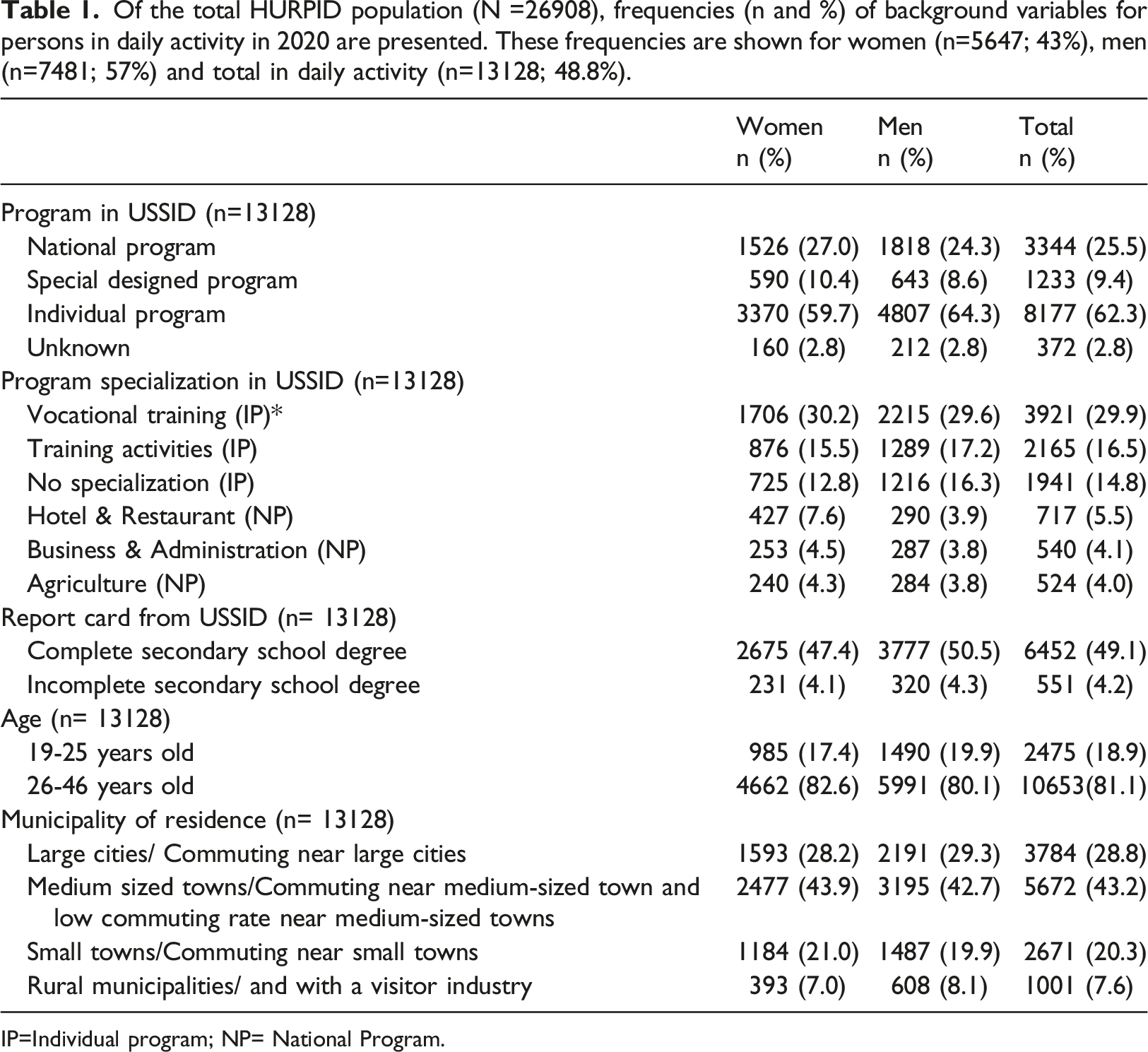
The total number of individuals who had daily activity in the year 2020 were n= 13128, which is 48.8 % of the total HURPID population (N=26908).
Of the total HURPID population (N =26908), frequencies (n and %) of background variables for persons in daily activity in 2020 are presented. These frequencies are shown for women (n=5647; 43%), men (n=7481; 57%) and total in daily activity (n=13128; 48.8%).
IP=Individual program; NP= National Program.
Many of those who had daily activity in 2020 also had various types of formal financial support (not shown in table). A total of 97.3% had sickness compensation. Slightly more than half of the group (52.7%) had activity compensation. Finally, 4.2% had social assistance.
Participation in daily activity compared to another occupation
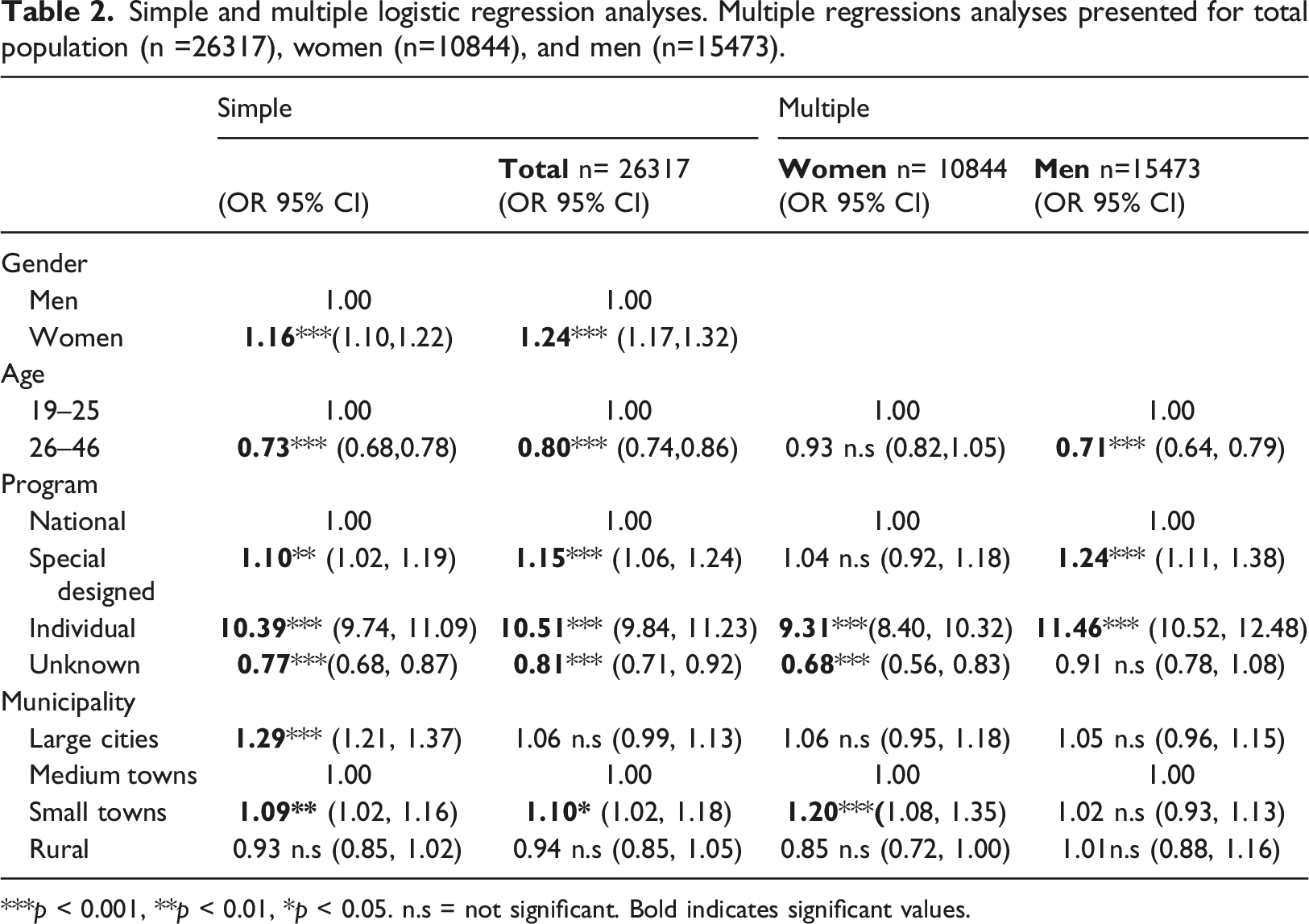
Simple and multiple logistic regression analyses. Multiple regressions analyses presented for total population (n =26317), women (n=10844), and men (n=15473).
***p < 0.001, **p < 0.01, *p < 0.05. n.s = not significant. Bold indicates significant values.
The simple logistic regression analysis for each independent variable shows various significant associations with participating in daily activity compared to having another occupation in the form of employment, education or being NEED (combined as reference variable). Women had a higher likelihood of being in daily activity compared to men (OR: 1.16, p < 0.001, CI = 1.10, 1.22). Being 26 years and older indicated a lower likelihood of being in daily activity compared to the younger age group (OR: 0.73, p <0.001, CI = 0.68, 0.78). For program in USSID, special designed programs (OR: 1.10, p = 0.015, CI = 1.02, 1.19) and individual programs (OR: 10.39, p = 0.000, CI = 9.74, 11.09) both meant greater likelihoods of having daily activity compared to national programs; while having attended an unknown program showed a lower likelihood of having daily activity (OR: 0.77, p < .001, CI = 0.68, 0.87). Finally, where an individual lives was also significant. Living in the large cities category (OR: 1.29, p <0.001, CI= 1.21, 1.37) and small towns (OR: 1.09, p = 0.009, CI = 1.02, 1.16) both made it likely to participate in daily activity compared to living in the medium sized towns category (reference category). However, living in rural municipalities was not significant OR: 0.93, p = 0.109, CI = 0.85, 1.02).
The multiple logistic regression analyses are presented for the total population (n= 26317), women (n=10844), and men (n= 15473). In the multiple analyses all independent variables are adjusted for each other. For the total population, all variables were significantly associated with participating in daily activity, except for living in large cities and rural towns. Similar to the simple analyses, the strongest predictor for the total population in the multiple analysis was individual program in USSID, which suggested ten times (OR: 10.51, p=0.000, CI = 9.84, 11.23) the likelihood of being in daily activity compared to national program in USSID.
The models for women and men show slightly different patterns. For women, it was more likely to participate in daily activity if they had attended an individual program in USSID (OR: 9.31, p = 0.000, CI = 8.40, 10.32) and lived in small towns (OR: 1.20, p = 0 .001, CI = 1.08, 1.35), whereas an unknown program in USSID made it less likely (OR: 0.68, p = <0.001, CI = 0.56, 0.83). For men, it was more likely to participate in daily activity if they had attended a special designed program in USSID (OR: 1.24, p = <0.001, CI= 1.11, 1.38) and individual program in USSID (OR: 11.46, p = 0.000, CI= 10.52, 12. 48). While being 26 years and older (OR: 0.71, p = <0.001, CI= 0.64, 0.79) made it less likely. In contrast to women, where one lives was not significantly associated with having daily activity for men. The different analyses for women and men suggest that the type of programs in USSID are important in understanding participation in daily activity. While individual programs showed greater likelihoods for both women and men, unknown programs were only significant for women and special designed programs were only significant for men. Living in small towns had a significant relationship for women in daily activity, while municipality type was not significant for men. Moreover, being older in age was only significant for men.
Daily activity between 2004-2020
Figure 1 shows the total study population (N=26908) and the proportions that had LSS support between the years 2004-2020. The diagram also shows proportions that had daily activity over the same period. Approximately half of the total population consistently had LSS support, and most of them had daily activity. In other words, daily activity was the most common LSS support. In the year 2020, besides daily activity, other LSS supports that were utilized included residence with special services for adults (25.7%), contact person (11.2%) and companion service (4.7%). The proportion of individuals with intellectual disability who after USSID had LSS supports and daily activity has been relatively stable between the years 2004-2020. Proportions (%) of total HURPID (n=26908) with LSS support followed by daily activity support specifically between the years 2004-2020.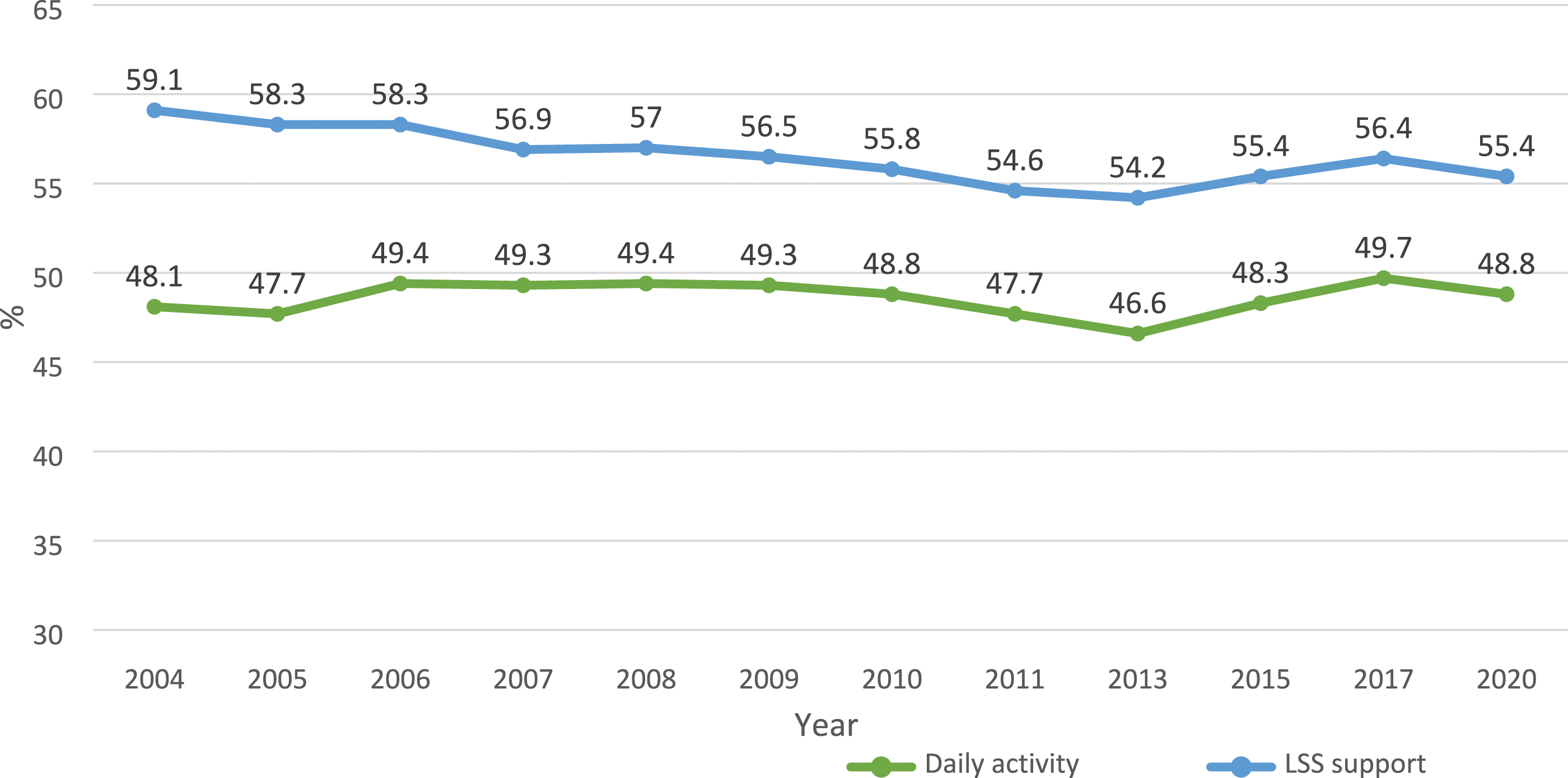
Movement between occupations over time
Figure 2 shows the group that had daily activity in the year 2010 (n=5050) and their movement between various occupations over time up until the year 2020. The analysis covers a 10-year period. Important to note is a small increase of missing cases (2.4%) over this period. In 2011, one year later in the analysis, most of these individuals still had daily activity (93.5%), whereas some had gone on to being NEED (4.6%). From 2013 to 2020, the majority stay in daily activity although the total proportion decreases from 93.5 % to 76.9 % during these years. At the same time, the proportions that instead are NEED and in employment increase, whereas those who study remain very low. Group with daily activity in the year 2010 (n=5050) and their movements to other occupations (employment, education, and NEED) over time period 2011-2020.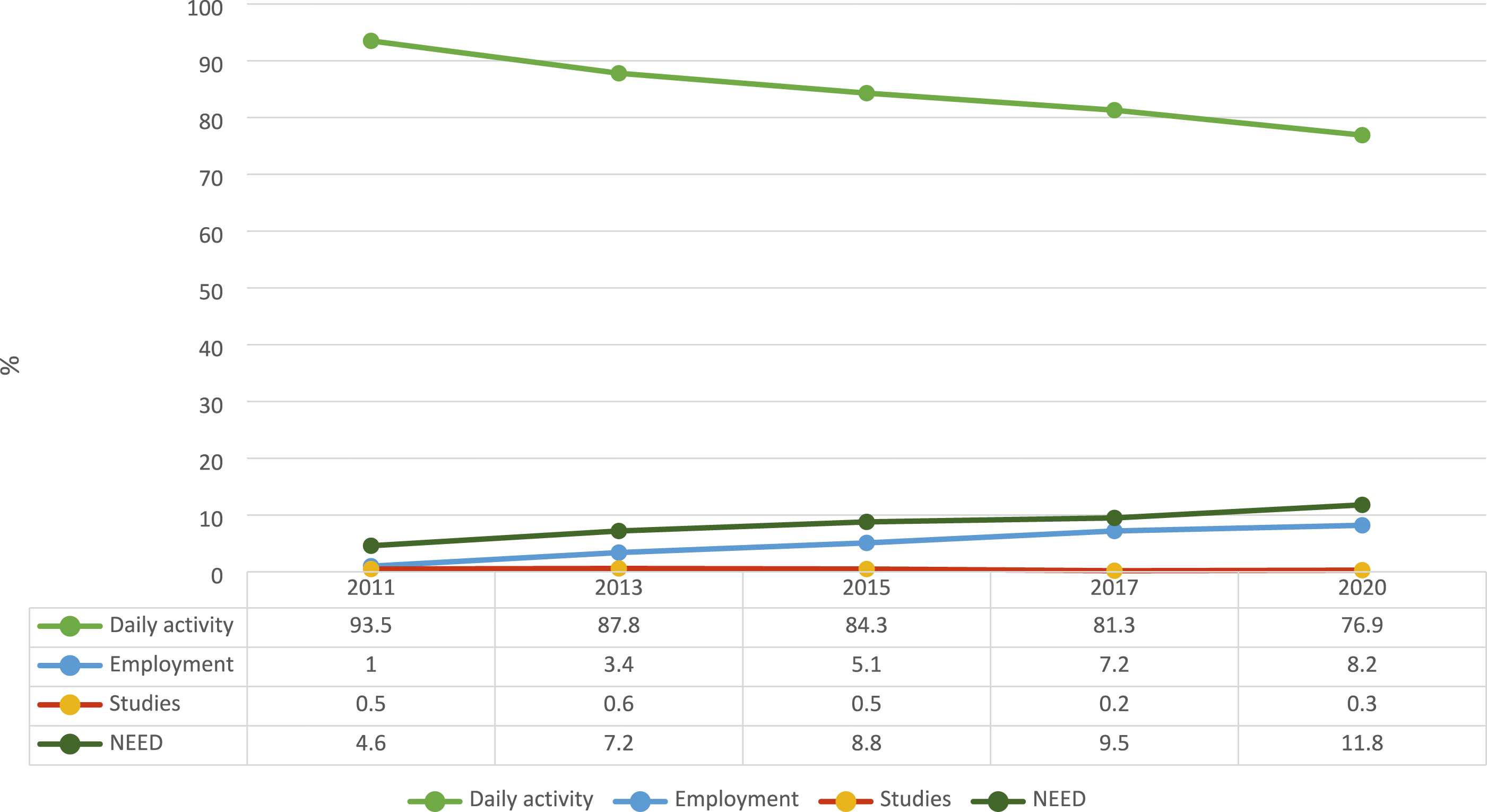
The figure shows several key points. Firstly, the majority who are in daily activity tend to still be in daily activity over a 10-year period. The second trend is that more individuals move from daily activity to NEED over the course of ten years (11.8%), as well as more individuals become employed over time even though this proportion is still low (8.2%). Since majority tend to stay in daily activity it suggests two different explanations. One being that daily activity is a suitable occupation for the individuals. The other explanation is that there is a lock-in-effect where many are limited in exiting daily activity to find another type of occupation.
The same analysis was conducted for the group with daily activity in the year 2005 (n=1759) and the group with daily activity in the year 2015 (n=9622). The results of these analyses (not shown in diagram) showed similar patterns, thereby movement for persons in daily activity between occupations can be summarized as follows: majority of individuals stay in daily activity over time. More individuals gain employment over time, but the percentage is low overall. More individuals become NEED with time and finally, the group in further studies remains very low (below 1%).
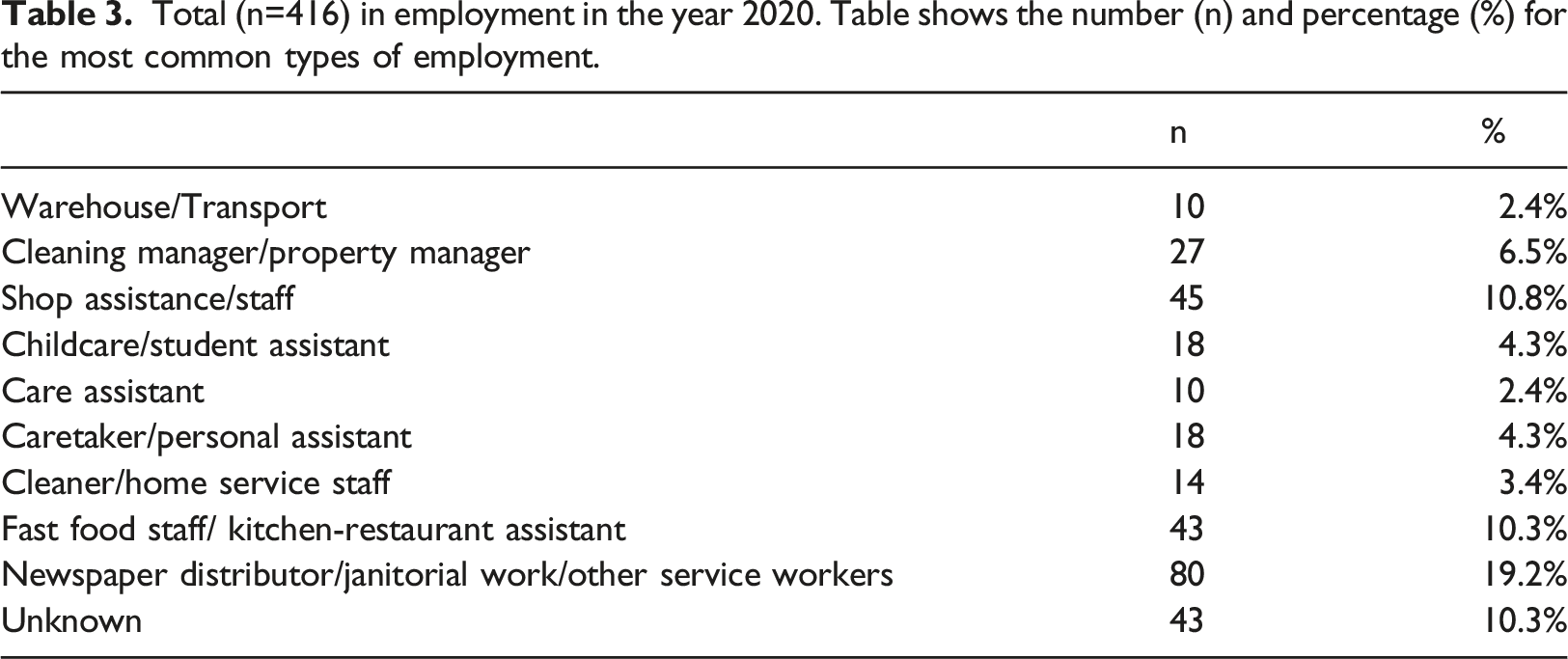
Total (n=416) in employment in the year 2020. Table shows the number (n) and percentage (%) for the most common types of employment.
Of those in daily activity in the year 2010, a total of n=597 persons (11.8%) were NEED 10 years later. In this group, there were slightly more men (54.8%) than women (45.2%). Unlike the group that was employed, more people in the NEED group had their educational background in individual programs (37.7%) or national programs (34%), with a smaller proportion in special designed programs (19.6%). Similarly, all these individuals were 26 years and older.
Discussion
Disability day programs in Sweden is the most common occupation among people with intellectual disability. Using a unique national register, the present study provides new knowledge of people in daily activity in Sweden that has previously been limited. The main findings include a description of characteristics for the group with slightly more men than women, majority aged 26 years and older, majority have attended an individual program in school, and almost all have financial support from government agencies. The other findings show various significant associations between background factors and participating in daily activity, as well as these being slightly different for men and women. The longitudinal analyses suggest that although proportions of people participating in daily activity remain stable over time periods of 5, 10 and 15 years, the aspect of time is essential. Starting in daily activity and transitioning to employment appears to be a process that comes over a long period of time, but the overall outflow from daily activity to employment although higher than expected remains relatively low. Of those who do find employment this tends to be in service-related jobs. At the same time, the present study finds that more people
Characteristics and associations with daily activity
The characteristics for people with daily activity in 2020 shows a diverse group, yet several similarities were demonstrated. The majority had attended an individual program in USSID which suggest individuals with extensive intellectual disability. Participating in daily activity can be a meaningful occupation for some individuals and lead to increased quality of life, mental health, social interactions, daily structure, and participation (Hartnett et al., 2008; McCausland et al., 2018; Nikku, 2011; Svanelöv et al., 2019). Paid employment may not be a feasible end goal for everyone. Moreover, some research demonstrates that despite gaining employment, exclusion can still occur in the workplace (Hall, 2010; Welsby and Horsfall, 2011). Rather than only fostering an ideal of employment, which centers on people without a disability (Wilson, 2003), it may be more beneficial to consider the meaning and value that an individual places on their occupation. Similarly, Olsen (2009) discusses that the way people with disability give meaning to and interpret their daily work leads to influence over their lives. This points to the need for society to broaden its concept of employment, thereby promoting value for alternative occupations and increasing inclusion for people with intellectual disability (Luthra, 2020; McCausland et al., 2018).
Even though daily activity can hold several benefits, it is an unpaid occupation with very low compensation. As shown in the results, many individuals have financial support in the form of activity compensation or sickness compensation. These amounts range from 10-21 thousand SEK/month before tax with lower amounts being for those with no prior employment (www.forsakringskassan.se); whereas median income for the general population in 2021 was 29-30 thousand SEK/month (www.scb.se). This approximation of difference in income suggests that people in daily activity have a low income. The poor financial situation and limitations in opportunities to increase income has been highlighted for people with intellectual disability (The Swedish National Association for People with Intellectual Disability, 2022). This impacts daily living conditions, impedes the ability to live like everyone else, and compromises the right to gain a living as outlined by the UN convention (CRPD). The low financial incentive with daily activity further highlights this occupation’s low value in society (Nikku, 2011). Another aspect to consider is the regulations of daily activity. Because a requirement is to not be employed or studying (excluding adult education for people with disabilities), it makes combining daily activity and employment a challenge (Tideman et al., 2017). Does this system then foster transitioning to employment if in actuality it prohibits the possibility to gain employment experience while also participating in daily activity? Research suggests that these regulations in practice are more flexible but point to the importance of stakeholders and agencies working together (Tideman et al., 2017). Broadening the analytical perspective, in line with Olsen (2009), people with intellectual disability participating in daily activity are in the middle of conflicting ideologies and systems. On the one hand, they are regarded as deviant from the norm, but on the other hand they are expected to have a job and financial situation equivalent to everyone else. Consequently, it is important to consider the systems surrounding daily activity and closer examine how these may promote or hinder a meaningful occupation.
Although various factors were associated with having daily activity as opposed to another occupation, the results were different for women and men. The type of program in USSID was significant for both genders, especially the relationship between an individual program and participation in daily activity. However, living in small towns was only significant for women, while older age was only significant for men. This in part falls in line with Arvidsson’s (2016) various findings of links between gender, age, and individual program in USSID with having daily activity in the year 2011, as well as where one lives relates to the type of occupation (daily activity, employment etc.) individuals with intellectual disability have. The present study, however, also shows gender differences in some of the factors that relate to having daily activity. Together this suggests that combinations of individual and environmental factors affect participation in daily activity. Moreover, this is congruent with research demonstrating the complexity in multiple factors related to occupational status for people with intellectual disability (Garrels and Høybråten Sigstad, 2021).
From daily activity to employment or NEED
The study finds that the proportions of people who have daily activity as a support has remained relatively stable between the years 2004-2020. Moreover, after several years most individuals tend to remain in daily activity. These findings confirm the high usage of daily activity reported by the National Board of Health and Welfare (2019). It is unknown whether the stable high proportion over time is due to daily activity matching the individuals needs or due to a lock-in-effect. Further research is needed to address this. However, the results of the present study find two other trends; namely that individuals move from daily activity to employment and from daily activity to NEED over time.
Exiting daily activity to employment was found for 8.2 % of the group after a ten-year period. This can be problematized from different perspectives. On the one hand, this is a significantly higher proportion compared to the National Board of Health and Welfare that reported 0.2%. Important to note, however, is that different measurements, samples, and time spans also attribute to different percentages. On the other hand, 8.2 % over ten years is generally low, and it is unknown whether this included long-term employment or not. This suggests that it can take time to find a suitable occupation, but also that the low outflow to employment could be due to daily activity being a meaningful occupation for many to remain in. More men were employed compared to women and the jobs were in the service sector. Factors such as sex and education background as significant determinants of employment have also been demonstrated in previous research (Arvidsson et al., 2016; Båtevik, 2019). Olsen (2009) found that people with intellectual disability chose work or daily activities based on traditional gender roles and explains this as a way to adhere to societal norms. This suggests both personal and collective meanings associated with one’s occupation. Although gaining employment relates to various factors, there is still limited research on this topic (Taubner et al., 2022b). It is important to continue to examine contributors to successful employment to increase the proportions employed in the labour market. Moreover, this increased knowledge is necessary to shorten the transition time from daily activity to employment for those individuals who desire and are able to work in the labour market.
Exiting daily activity to becoming NEED occurred for 11.8% of the group over ten years. The process of becoming NEED is not linear; firsthand perspectives suggest that individuals move in and out between NEED status and other occupations (Luthra, 2020). Previous research finds that people are NEED for various reasons and multiple subgroups exist (Luthra, 2020). Although young people in the general population who are not participating in an occupation have also been highlighted (termed Not in Employment, Education or Training-NEET) (Olofsson, 2014), people with intellectual disability face additional challenges. One possibility for becoming NEED instead of having daily activity could be the limited opportunities to transition to employment. Other possibilities are the reported lack of suitability of daily activity, the desire for a real job and income (Luthra, 2020). The results suggest that as time passes it may become difficult to obtain a meaningful occupation resulting in more people who are NEED. This not only raises concerns for those individuals without a known occupation, but also signals the need for interventions that include both early and continuous long-term support.
One difference between the individuals who had employment versus were NEED after 10 years is their educational background. While most in the employed group attended a national program, there were more in the NEED group that had attended individual programs or national programs. This suggests that those who are employed have a milder form of intellectual disability, while those who are NEED are a combination of people with varying levels of intellectual disability. This falls in line with other findings that levels of functioning are linked to the likelihood of having employment for individuals with intellectual disability (Foley et al., 2013). However, apart from focusing only on the individual and level of functioning, there needs to be equal focus on structural factors in the environment that in combination with the individual determine different occupational outcomes. This would allow for services, supports, and society to be better equipped to meet the needs of a diverse group.
An additional finding was that very few people moved from daily activity to further education. This was the occupation with the lowest proportion. The right to an adequate and equal education, as well as promoting lifelong learning for the target group is stated in national and international laws and conventions (see Education Act 2010:800; UN Convention on the rights of persons with disabilities). Given the importance of education and skills in the labour market, the results raise questions about the opportunities for people with intellectual disability and signals a need for further research.
Limitations and future research
The present study has several benefits since it covers a national comprehensive population as well as provides knowledge about aspects of daily activity that previously have been limited. However, there are also limitations with the study that provide directions for future research. The present study includes longitudinal analyses on a group level which should be complemented with individual level and qualitative analyses in order to gain a more in-depth understanding. Additionally, further analyses of subgroups and their reasons for leaving daily activity to becoming employed, studying, or being NEED after many years is necessary, since this likely consists of individuals in various situations and with diverse circumstances. The present study focused on starting in daily activity and transitioning to other occupations over time. However, future research should also examine continuous back and forth movements between occupations or transitions in the other direction (starting in employment, studies or NEED and moving to daily activity).
A major component for future research is to complement these statistics with first-hand experiences of daily activity. Research with a qualitative approach is needed that examines reasons behind the stable proportions of daily activity participation over time, as well as processes and factors related to transitioning out of daily activity.
Conclusion
There is limited knowledge about people with intellectual disability who participate in disability day programs, called daily activity in Sweden, despite that daily activity is highly used and the most common disability support. Based on unique national data, the present study’s results show characteristics for those who have daily activity, as well as various associations between background factors and daily activity with differences for women and men. The findings demonstrate the dominance of daily activity as an occupation and that many tend to remain in daily activity over time. The results also raise concern since even though gaining employment increased over time, this is still a low proportion, and more so the rise in NEED status leads to more individuals falling on the outskirts of society. There is a need for increased knowledge and research on occupations for people with intellectual disability, that in turn allow for supports and efforts that enable the target group in achieving a meaningful and desirable occupation.
Footnotes
Declaration of conflicting interests
The author(s) have no potential conflicts of interest with respect to the research, authorship, and/or publication of this article.
Funding
The author(s) disclosed receipt of the following financial support for the research, authorship, and/or publication of this article: This work was supported by School of Health and Welfare Halmstad University..
