




Abstract
After a long period of being constructed as anonymous administration complexes, first instance courts are once again being built as emblematic elements of the city, designed by renowned architects and rising on central plots adjacent to train stations, headquarters buildings and exclusive residential areas. This is happening at a time of centralisation, upsizing and property privatisation, and where European courthouses have radically decreased in number. The paper focuses on the changing relationship between the courthouse and the city as it has developed in the last decades, using Sweden as a case. Examining and comparing the fourteen new Swedish district courthouses built between 2000 and 2024, and the changes in their locations, we show how the territorial threshold between the court and the public space of the city is expressed and negotiated on different scales. Discussing aspects such as regional and local accessibility and visibility, as well as permeability and connectivity, we argue that the courthouse is gradually taking on a new role, where accessibility is increasingly monitored and specialised, and where the lawcourt as an object also has developed into a segregated territorial landscape, albeit often situated in a privileged location in the city.
While many of us might not visit them regularly, courthouses are vital parts of an infrastructure that sustains our societal life. One way to describe the courthouse is as a part of the social infrastructure 1 that enables and directs social relationships. Courthouses have long been a place for the law in our society; through trials, negotiations, preparations, etc., they situate justice, as well as certain formal interrelations between citizens, in time and space. The courthouse arguably plays an important part in the production of social life. It is therefore interesting to note that the approach to visibility and accessibility related to the courthouse seems to have changed remarkably, if one compares 1970 and 2020. As Brighenti suggested, the public can be seen ‘as a register of interaction, a regime of visibility’, 2 and the new attitude to interaction and visibility seen in lawcourt design of late has certainly also affected its publicness as well as its potential role in the social infrastructure of the city. In fact, different kinds of accessibility (regional, urban, local, visual) have also increasingly appeared to follow different logics over the last two decades of Swedish courthouse construction.
Using Sweden as a case, this paper aims to describe and pinpoint the changing relationship between the courthouse and the city as it has developed in recent decades. Building on a transdisciplinary research project on the architecture, technologies and spatial practice of contemporary courts of law, in this article, we will examine how the territorial thresholds between the court and the public space of the city are expressed and negotiated in different ways. We explore the fourteen new district courthouses built in Sweden between 2000 and 2024, comparing them first of all to the courthouses that they replaced, whilst also to some extent contextualising them in relation to other courthouses built in the earlier period and analysing their changing locations and relationship to the city and its public spaces. Discussing the courthouses’ presence in their regional and urban contexts (both in terms of access and visibility), then their local presence and relationship to their immediate vicinity, and finally their porosity, that is, the permeability of the buildings themselves, we show how the courthouse is gradually taking on a new role, becoming better connected in some respects, while arguably becoming more exclusionary, isolated and layered in others.
The relationship between the courthouse and the city has become a question of increasing importance in Europe and elsewhere, both when it comes to research and policy. 3 The changing relationship coincides with centralisation, upsizing and property privatisation, and with the radical decrease in the number of courthouses in several European countries. 4 The modernisation of courts in the Western world in the 1960s led to more anonymous courts that increasingly resembled other administrative buildings. 5 In Sweden, the construction of rättscentrum (that is, a law centre complex with more or less conjoined buildings related to different judicial activities) in the 1960s and 1970s took this even further. 6 The re-organisation of first instance courts in the country in the 1970s also led to the establishment of a centralised architectural model. 7 When replacing the local judicial districts as the owner of the courts’ premises, the state put forth a design concept based on ideas of predictability, efficiency and egalitarianism that resulted in courts resembling any other public administration premises and blending into city blocks and larger building complexes in anonymous ways.
Around 2000, the construction of a district courthouse became an increasingly complex task. The development goes hand in hand with what we claim is an increasing exclusivity of the courthouse as a building type. In 1971, the state took over all court premises from the local districts in Sweden, thus starting a process of centralisation. In 1968, there were 146 district courts 8 ; ten years later, there were around 100 (SNCA 1979). 9 The change was not as dramatic as the change that took place in the early 2000s, however, when the number of district courthouses halved, going from 96 in 1999 to 48 in 2009. 10 Besides the economic benefits, one of the main goals of this decrease was professionalisation, that is, ensuring that all courts would have enough cases of different kinds to maintain their expertise, or, to put it in other words, that no court would have fewer than three judges. The drop in the number of courthouses increased in building size as older courthouses were abandoned when the merged district courts moved to more metropolitan contexts. Issues of location and accessibility naturally moved upward on the agenda as courthouses dropped in number. 11
European courthouses started to become more emblematic and monumental again already in the 1990s. 12 Their increasing size made it possible to engage internationally renowned architects, such as Richard Rogers for the courthouse in Bordeaux, 1992–1998; Kenzo Tange, Renzo Piano and others for the Centro Direzionale in Naples in 1994; Jean Nouvel for the courthouse in Nantes in 2000, 13 and more recently, Renzo Piano again for the Judicial Court of Paris (Tribunal judiciaire de Paris), which opened in 2019. From the beginning of the twenty-first century, Swedish courthouses have also once again become emblematic elements in the city. In fact, it has become clear that the tendency towards the anonymisation of courts in the city has recently done an about-turn towards singularisation and monumentality. Like their predecessors, the post-2000 district courthouses are, as we shall see, strategically placed in close connection to train stations and public transportation hubs; this has become increasingly important as the number of courthouses has decreased. In a report from 2017, the Swedish Agency for Public Management, Statskontoret, downplays the problem, arguing that although the geographical distance to each courthouse has increased by an average of 13.9 km, improved connections, better locations and digital solutions have meant that the accessibility has not decreased. 14 In this article, we want to investigate how the recent changes in the location and architecture of courthouses have affected the accessibility of the district courts in different ways.
I. Theory and Method
This study will look into how courts of law have reinvented themselves as a building type in general, and their role in relation to the city and public accessibility in particular. We will use territoriology as a theoretical outlook, 15 and then methodologically draw on techniques primarily used in space syntax to analyse the spatial structure and accessibility of the new courthouses. 16 The territorial discussion will be used to analyse and give perspective on how the courthouse has developed, both as a territory in the city and as the assemblage of territories that now defines it. How can territories and their borders be visualised and accessed, and how are these expressed through location and urban and architectural design? A territoriological approach allows us to focus on territorialisation as an open and dynamic process of distance and boundary regulation. 17 The analytical techniques we will use include justified graphs and isovists. The justified graph illustrates connections of a spatial complex such as an urban district or a building; in a justified graph, spaces are represented by nodes and connections by lines. Starting from a certain point, such as the entrance, every new connection in relation to this entrance is represented as a topological step and numbered on the graph. 18 This technique is a rather basic method of analysis, and it has also been used outside of space syntax. 19 First described as a method of analysis by Michael Benedikt in 1979, an isovist is the view (i.e. the set of all points that can be seen) from a certain point, area or line; isovists are then mapped out on a plan drawing as an isovist field. 20
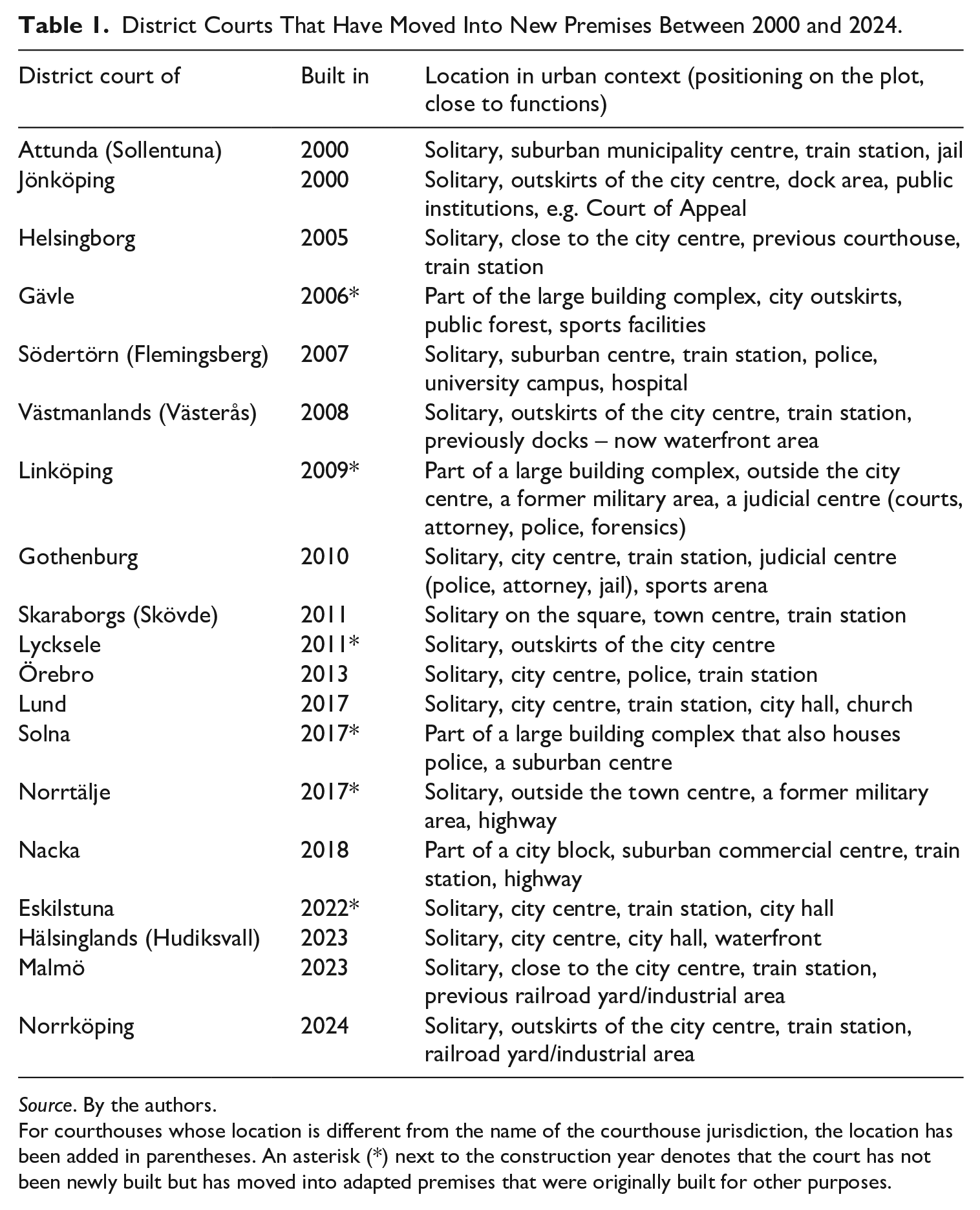
Empirically, we look at fourteen Swedish courthouses built between 2000 and 2024. During these years, an additional five district courts moved into refurnished older buildings that formerly housed other functions; while these are also taken into account, they will not be in focus here. All the new courthouses are shown in Table 1. For reference, and to compare and identify significant changes, we also include a table with their predecessors, that is, the courthouses that were replaced by the new courts (see Table 2).
District Courts That Have Moved Into New Premises Between 2000 and 2024.
Source. By the authors.
For courthouses whose location is different from the name of the courthouse jurisdiction, the location has been added in parentheses. An asterisk (*) next to the construction year denotes that the court has not been newly built but has moved into adapted premises that were originally built for other purposes.
Court Premises That Were Replaced Between 2000 and 2024 (Table by Authors).
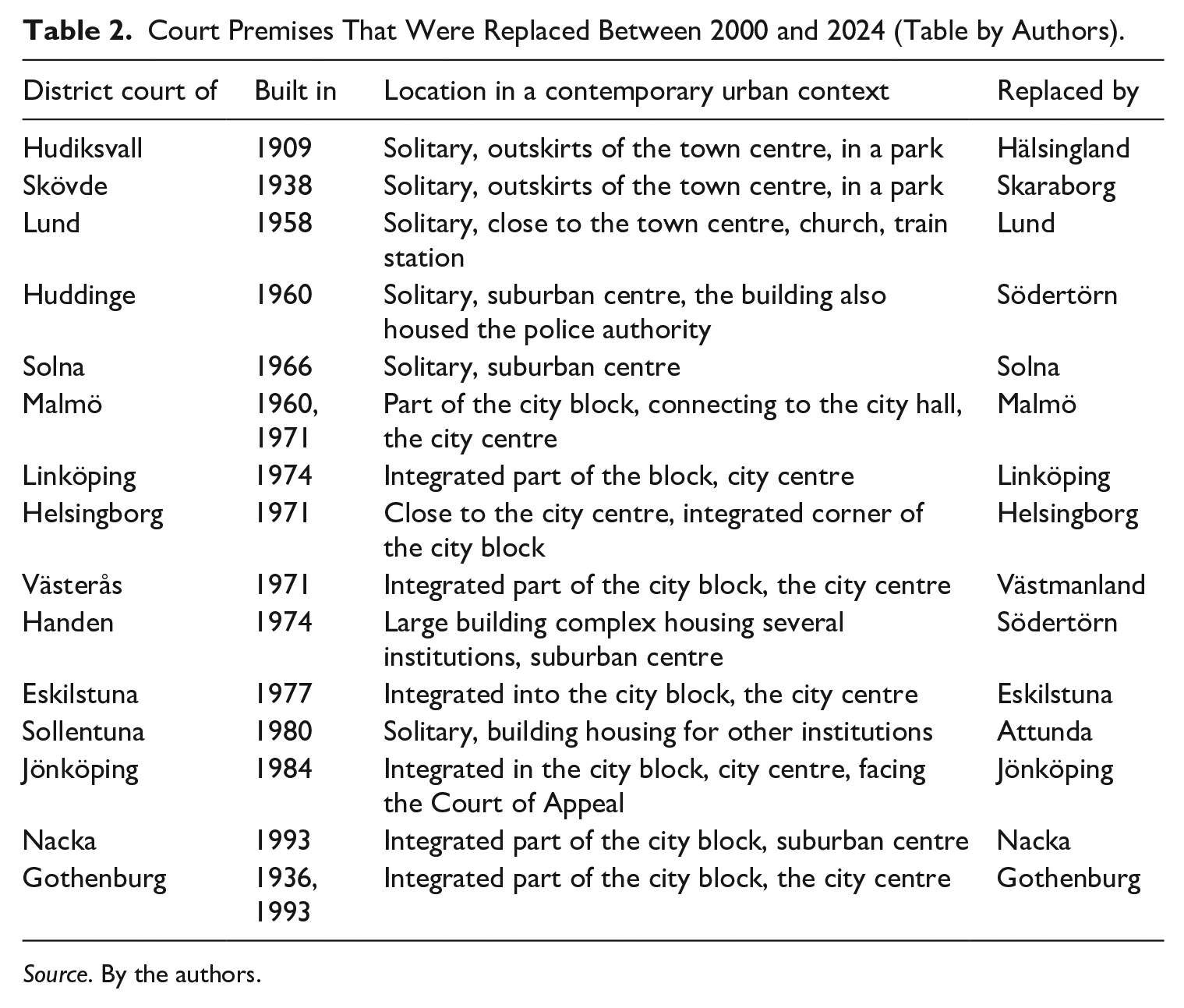
Source. By the authors.
The article is based on the study of plans, guidelines, documents and archive material as well as observations, field trips and interviews. Several documents, published texts and unpublished documents were either received directly from contact persons at the Swedish National Courts Administration – Domstolsverket – (hereafter SNCA) or accessed via its archive. The field trips to district courthouses from the period 1960–2020 were made between 2019 and 2023 and include Attunda, Eksjö, Gävle, Gothenburg, Halmstad, Helsingborg, Hälsinglands, Jönköping, Kalmar, Lund, Malmö, Söderhamn, Södertälje, Södertörn, Solna, Stockholm and Varberg – as well as to Göta and Svea Courts of Appeal. 21 Some older courthouses were also visited for context, for example, the former district courthouses in Gamleby, Helsingborg, Hudiksvall, Jönköping, Mönsterås, Oskarshamn, Solna and Västervik. This means that visits were made to more than half of the courts and nine out of fourteen newly established district courthouses from this period. The visits also included walk-alongs or short interviews with security guards and/or administrative or legal staff, as well as on-site studies of how the built environment was used, for example, by attending trials (in Gothenburg, Halmstad, Helsingborg, Lund and Malmö). At SNCA, we conducted a series of interviews with people responsible for security, technology and architecture. Some of these were conducted on-site in Jönköping in 2021, and some were carried out via Zoom.
II. Regional and Urban Presence
With the closing of the forty-eight courts between 2000 and 2010, many towns were left with empty, dedicated courthouses in central locations. In the municipalities that were granted a district court, most of these courts moved into new premises. The courthouse remained in the city centre, close to the urban elements that had previously formed important reference points: the railway station and the commercial centre. 22
Since the building of railroads in the late nineteenth century, Swedish courthouses have often been located within easy walking distance from a train station – that is, less than a kilometre. Of the fourteen new premises that were built between 2000 and 2024, seven moved closer to the station than their predecessors, four remained at approximately the same distance and three are now somewhat further away. The geographical difference is quite small, however. In Lund, Malmö and Sollentuna (Attunda), it is a question of 50–100 m, whereas the courts in Västerås (Västmanland), Örebro and Norrköping have moved up to a kilometre closer to the train station. The principal relationship between railway transport and the district court remains. If there is a court, there is normally a station quite close by (see Figure 1).
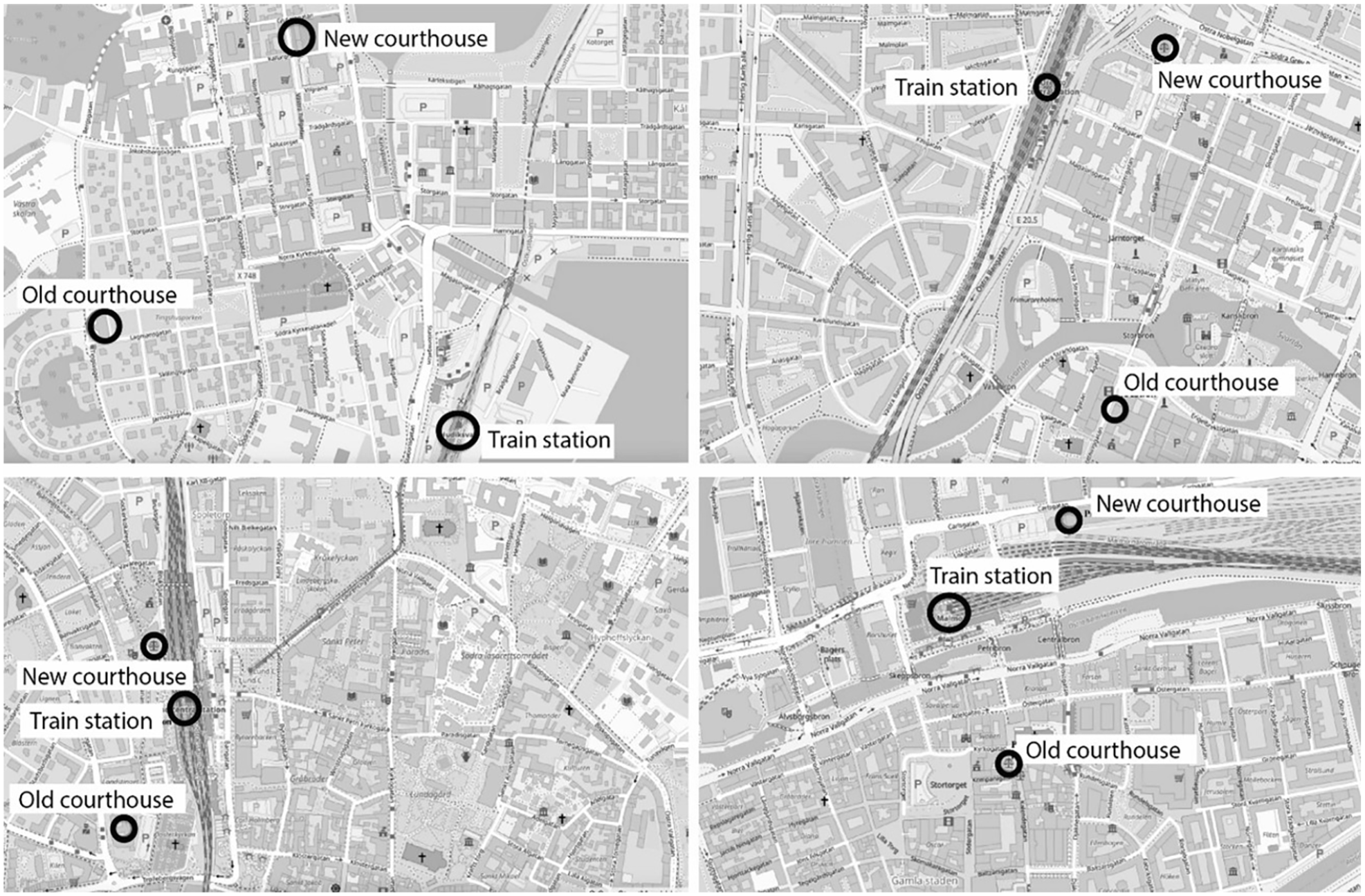
Above left, Hudiksvall; above right, Örebro; below left, Lund; below right, Malmö.
Where moving to new premises entailed leaving the old city centre, the court remains close to the train station. The relocation and distancing from the historic parts coincided with an expansion of the city centre, as well as with a densification of the area around the railway stations, which has been an important part of many urban development projects in Swedish cities in the 2000s. A new public space was created here as previously inaccessible industrial and/or railroad zones were transformed into residential or commercial areas and were included in the city.
In many cases, relocating meant co-locating with other public institutions, if not in the same building, then in adjacent and attached buildings. In some cases, such as Jönköping, the courthouse moved to be in the direct vicinity of the police. The idea of the law centre (an urban territory of law) is thus not entirely defunct, but when different institutions are co-localised, there is now a clear focus on how to make the courthouse a salient and easily identifiable part of the agglomeration. Looking at the four courthouses that moved into older buildings, we see that three of them moved away from the railway station and the commercial centre (Linköping, Norrtälje and Gävle) and are now located in formerly institutional areas: two of them are in former military areas that have been transformed for public functions. In Linköping, the court moved from the historical centre in 2002 to a military building in the city’s periphery, about 3.5 km from the railway station. It is now part of a law centre, and the district court is situated next to the administrative court, the district attorney’s office, the police and the Swedish National Forensic Centre.
In terms of spatial structure, one could argue that location in general has remained fairly similar since the end of the nineteenth century; that is, courthouses have been in close connection to railway stations on the periphery of the old city centres (where railway stations tended to be located). We saw that most newly constructed courthouses moved from locations that were more central in relation to the old city centres and closer to the train stations. While this change is not radical, and there are exceptions, one could at least argue that the railway-oriented location of courthouses has been further consolidated, hinting at the renewed importance of regional centrality. As mentioned above, the Swedish Agency for Public Management concluded that better connections and improved digital solutions meant that accessibility had not decreased, 23 but it is difficult to fathom how shutting down around half of Sweden’s courthouses could be balanced by digitalisation and a quite minimal move in the direction of the railway station.
How, then, do the architectural features of the new courthouses mark their presence in the cityscape? When and how do they appear as lawcourt buildings, and with what means? In her article ‘City/Courthouse Building’, Patrícia Branco summarises some points about courthouses: If once they were considered points of reference, courthouse buildings are now emblematic and eccentric creations, designed by renowned architects, but paradoxically they have turned out to be architecturally identical buildings (similar to shopping centres, museums or even other courthouses).
24
Swedish court buildings of the twenty-first century present few traits that distinguish them as courts. According to Branco, these kinds of buildings reproduce contemporary architectural norms, and with their substantial volume, choice of sleek materials and organisation of reflecting windows, they could easily be any state authority or office. However, they also have a certain newly found monumentality. Despite this monumentality, the specific building type is thus not always easy to determine. The new courthouses often rise on central plots adjacent to exclusive residential areas and company headquarters; in many cases, they also bear resemblances to the latter.
From the 1970s until around 2000, Swedish courthouses were rather low-key in terms of architecture. During this time, the courthouse became an important part of the social and government infrastructure, and expressing its autonomy and ‘the hegemony of law’ 25 grew less important. Courthouses of the 1970s often looked like anonymous state institutions or formed part of larger office complexes. After the backlash in the wake of the Swedish Million Programme, 26 we again saw courthouses that were smaller in scale during the 1980s and 1990s; in line with the low-density typology of residential areas that became prevalent during this time, they bore more resemblance to schools and daycare buildings. The re-monumentalisation of courthouses around the year 2000 may likewise be seen in relation to the idea of architecture as an instrument of branding and ‘making a statement’ – a strategy epitomised not least with the Guggenheim Museum of Bilbao in 1997, 27 which we also see in many contemporary corporate buildings. 28 Kim Dovey describes how new courthouse architecture works with transparency (glass) to demystify the judiciary system whilst reflecting stability and inspiring confidence in the law and the legal apparatus. 29 One also sees how architecture has become increasingly instrumentalised internationally, not least as an important means of expressing trust and confidence in the system. SNCA also recently produced its first architectural policy. In an interview with one of the responsible architects, we learned that this was related to the intensified work on premises provision plans at the SNCA, and to a recent Government Bill of 2017 ‘Policy for Designed Living Environment’ (2017/18:110), which aims to provide a comprehensive national architecture policy for Sweden. The architectural policy of SNCA states that courthouse premises should have ‘a certain degree of austerity and restraint, expressed through simplicity, utility and robustness’. 30 We believe it fair to say that the ambitions of Sweden’s new flagship courthouses are somewhat higher than this, at least when it comes to the question of conspicuousness (see Figure 2).
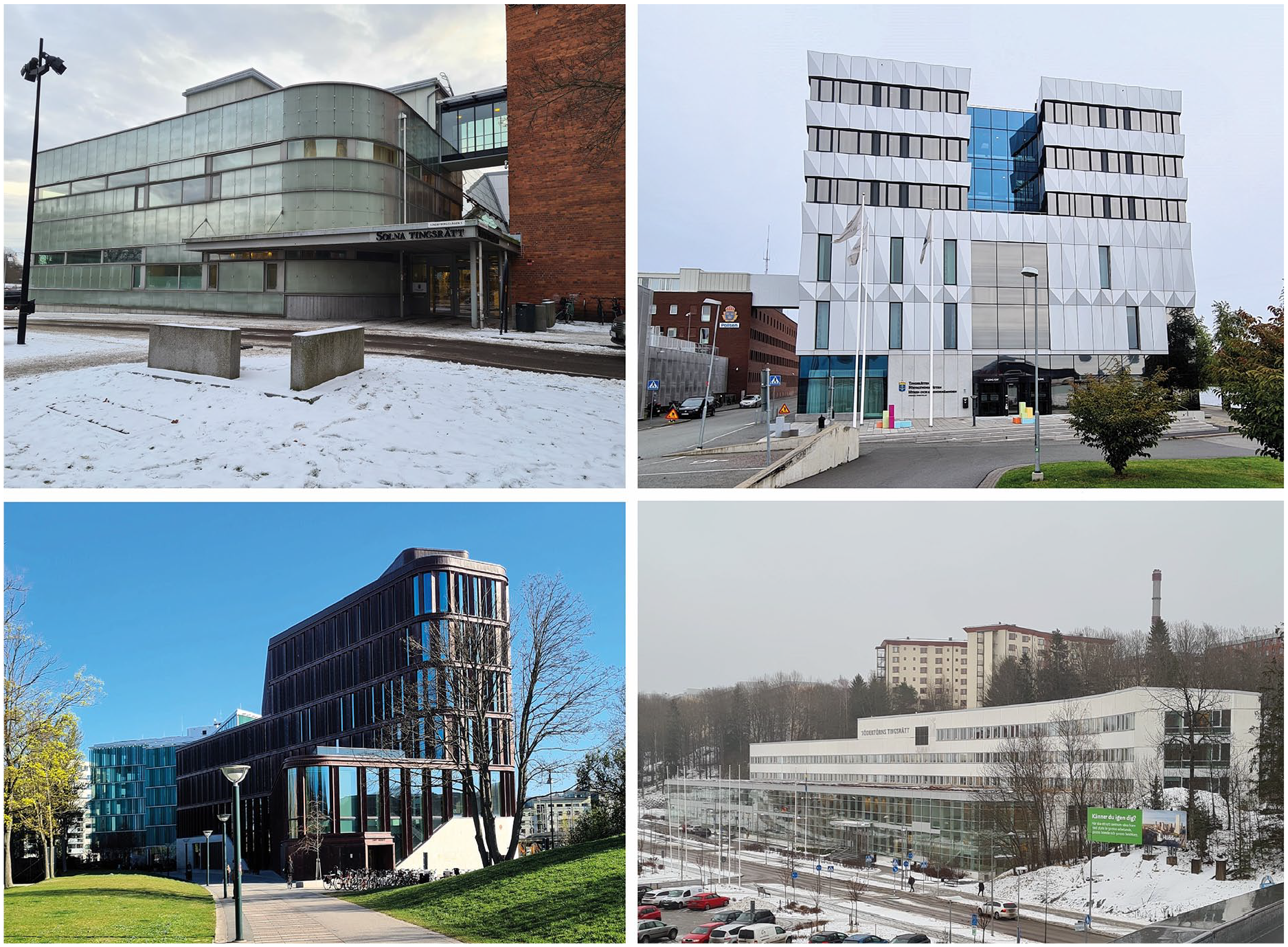
Courthouses. Above left, Solna; above right, Jönköping; below left, Lund; below right, Södertörn (photos by author). Courthouses of today are designed to look like solitary buildings. Not least due to their sheer size, they look increasingly more like large ferries in the urban landscape.
III. Local Presence
We have now seen how the courthouse has taken on a new role by becoming somewhat better connected in the regional network (sometimes at the cost of its centrality in the urban network), and by striving for a kind of spectacular recognition 31 through its architectural expression (also using internationally renowned architects like Henning Larsen in Malmö, and winning architectural prizes as in Lund, etc.). This spectacular recognition is not always coupled with a categorical recognition of the type, however. What, then, of its more local role; that is, how does the courthouse connect to its closer and more immediate surroundings? If we look at the courthouses that were vacated in the move to the new constructions, we see examples of how older courthouses often had a more dominant position in the city. Hudiksvall’s courthouse was located on a hill with a park and formed the backdrop for an important visual axis from the city’s church. Jönköping’s former courthouse, built in the 1980s, was not a particularly monumental building at all, but it was located along the main street and on one of the main central squares, facing the old Court of Appeal. Lund’s courthouse was moved from a location close to the old east entrance to the city centre and positioned closer to the railway, but not connected to any important street. The new and the old courthouses in Skövde are both connected to the important central street Skolgatan, but while the older courthouse faces the street, the new one is situated on a small local square/passage, facing a historical building and a place that is rarely used in daytime. Although the court is close to the commercial streets and the railway station, and its transparent front façade opens to the small space, it appears strangely cut off from the city. Taken together, it is clear that if location in the larger system of movement is deemed important (although often for regional movement more than urban), the connection on a local level has often decreased; as we shall see further below, this is probably not a coincidence.
If we go from local connection to local visibility, we can look at the isovists of three telling examples (Figure 3). These isovists are drawn from the façades of the main entrances, that is, mapping from where it can be seen, and comparing the old courthouse with the new one. First of all, we have the courthouse in Gothenburg, which moved from one of the city’s main monumental squares (Gustav Adolfs torg) to a much more peripheral location east of the station in 2010. Here, the visuality of the entrance façade has clearly decreased both in quantity and quality. Previously, it had been visible from Gustav Adolfs torg as well as from the important public place and transport hub Brunnsparken. Now, it is only visible from a back street and a short stretch of a canal, and a busy car road. In Hudiksvall and Jönköping, the area from which the entrance is visible has not decreased in terms of quantity, but the new entrances both face water and parking areas, and both turn their back on the city. Their visual integration in the city and its more central streets has decreased radically.
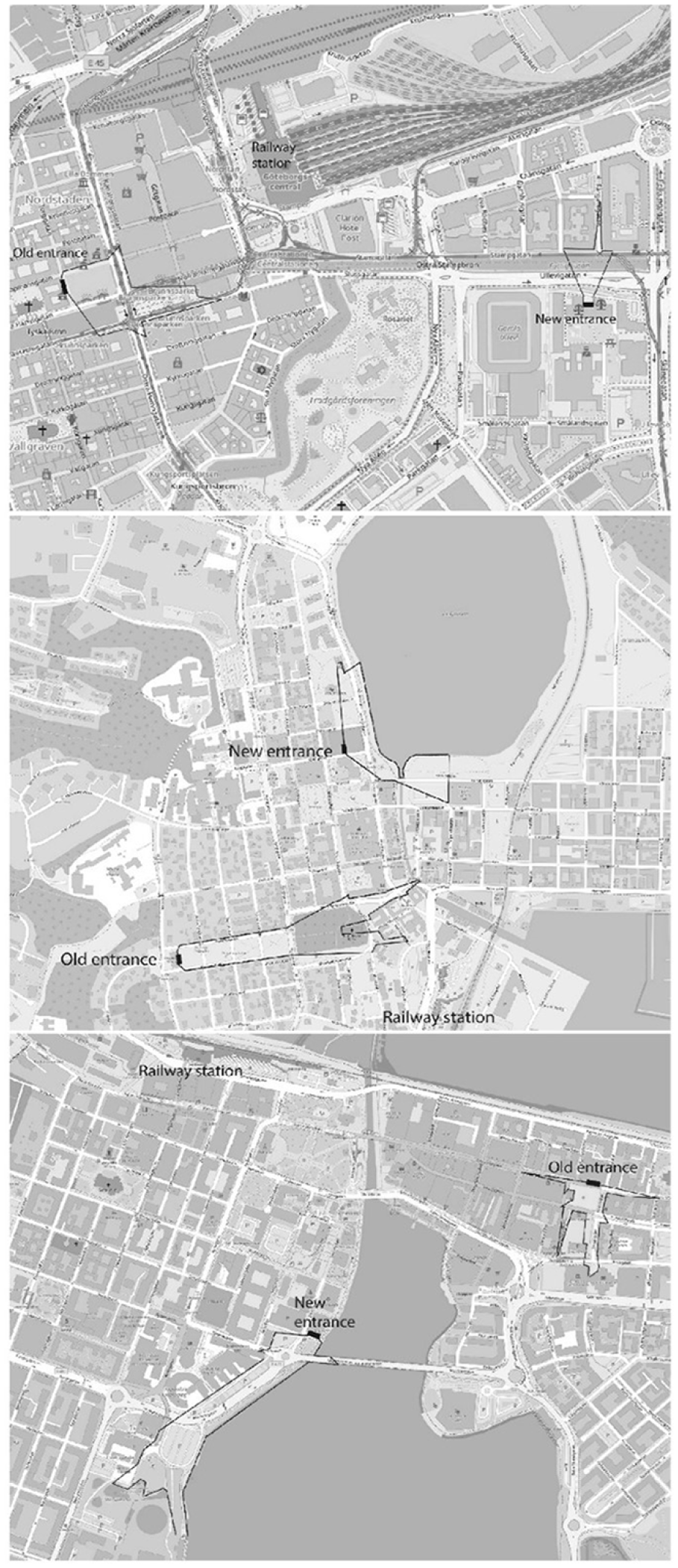
Isovists of entrance façades of the old and new courthouses in (from top to down) Gothenburg, Hudiksvall and Jönköping (figure by authors).
Facing parking areas and railway tracks is a common trait of several of the new courthouses. Södertörn courthouse faces the sizeable car parking area of the large supermarket ICA Maxi. In Sollentuna (Attunda courthouse), the windowed façade stretches right along the railroad, dominating the train passengers’ view as well as that of those waiting on the platform. Despite the short distance between the railroad and the courthouse, however, it is too far for anyone to perceive what is happening in the waiting hall, nor is it possible to see who enters the building (or even where to enter), as the entrance is out of sight. Similarly, Lund and Malmö are located close to the railway tracks and are to some extent visible from the city centre, but their main entrances are located off the main supporting street and the railway and face a park and a back street, respectively.
The degree to which the court buildings are transparent and open towards the public space outside is essentially dependent on season and time. The large windows or windowed walls of the first two floors of the main façade denote a foyer or semi-public space. In daylight, these function as mirrors and cause the court to withdraw from the city, but when it is dark outside – in Sweden, this is the case for large parts of the year – the illuminated waiting hall is bright and allows passers-by a good view. However, most courts no longer face important squares, main streets or busy passages. In other words, few people are there to see what takes place. Instead, the space immediately in front of the courthouse entrance often works like a small, monofunctional and spatially segregated entrance area to the courthouse. Since security checks were introduced in Sweden (around 2015), these places are regularly filled with smaller queues of people visiting the court, as security was not planned for people waiting indoors.
The SNCA guidelines state that ‘The main entrance (the public entrance) is clearly visible and is perceived as a dignified entrance for this type of building’. 32 Still, many of the courthouse entrances are hidden from main streets or located just around the corner from the main street (see Figure 4). When permanent security checks with X-rays were introduced into Swedish courthouses and soon became legion, even newly built courthouses such as those in Gothenburg and Jönköping had to redesign their entrances to accommodate the new security measures. In our interviews with SNCA, it was mentioned that security has become an increasingly important concern in the planning of courthouses, and it also seems to be one important reason why many new courthouses are being built in secluded places. While this was sometimes also legitimised from the user perspective – that one should be able to access the courthouse in a discreet way – the aspect of easy surveillance seems to be the main reason.
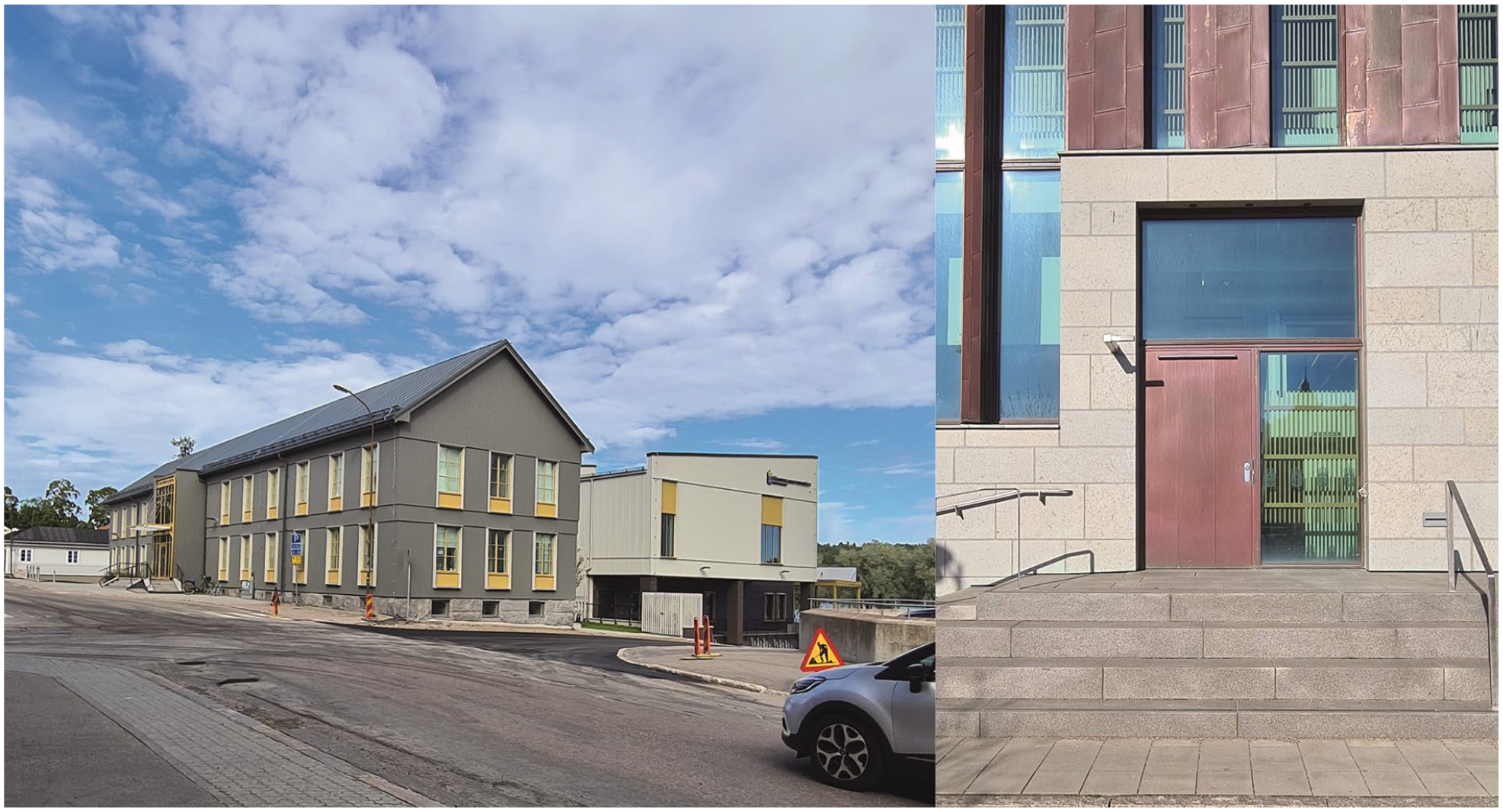
To the left: The new courthouse in Hudiksvall. Staff entrance from the main street. The main entrance around the corner faces a parking area and the waterfront (photo by author). To the right: No entrance, a door without a handle at the new courthouse in Lund (facing the railway tracks and the city centre). The public entrance is around the corner (photo by author).
IV. Porosity
The public entrance is getting harder to spot from the street, and the actual passage from outside to inside the courthouse is growing more complicated and stretched out both in time and space due to security checks 33 ; in addition, there is also an overall development towards more and more specialised and territorialised entrances, that is, entrances catering for people of certain categories. As we can see from the general spatial structure of Swedish courthouses as recommended in the SNCA guidelines (Figure 5), there are five different types of entrances to the courthouse, each serving their function and type of user.
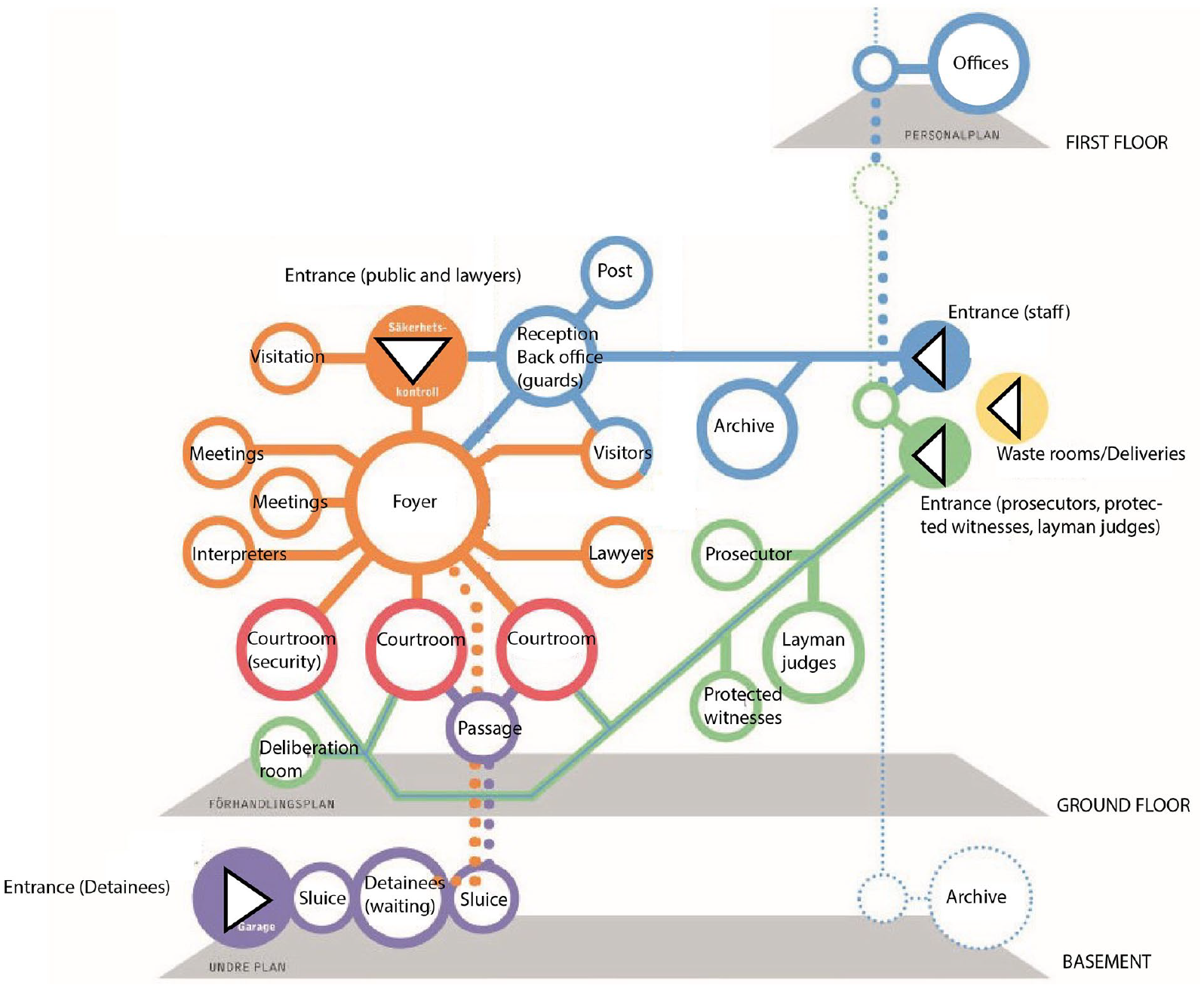
General spatial structure of Swedish courthouses. 34 English text and filled entrance signs by the authors.
When it comes to how the building distributes inhabitants and different kinds of visitors, 35 here we have not just one, but several different systems. The public, including lawyers and people who have been summoned to court, move on the surface of the building as part of the public circulation systems. Detainees also use a surface part of the building, albeit a restricted, secluded and non-distributed part. The largest circulation system is the ring structure around the courtrooms, which is also the deepest accessible part of the system (if counted from all entrances). Only the building’s occupants (judges and administrative staff) have full access to this otherwise spatially well-integrated part of the building. To investigate the distributed access a bit more carefully, we will look at an actual case: the courthouse in Lund from 2017 (see Figure 6).
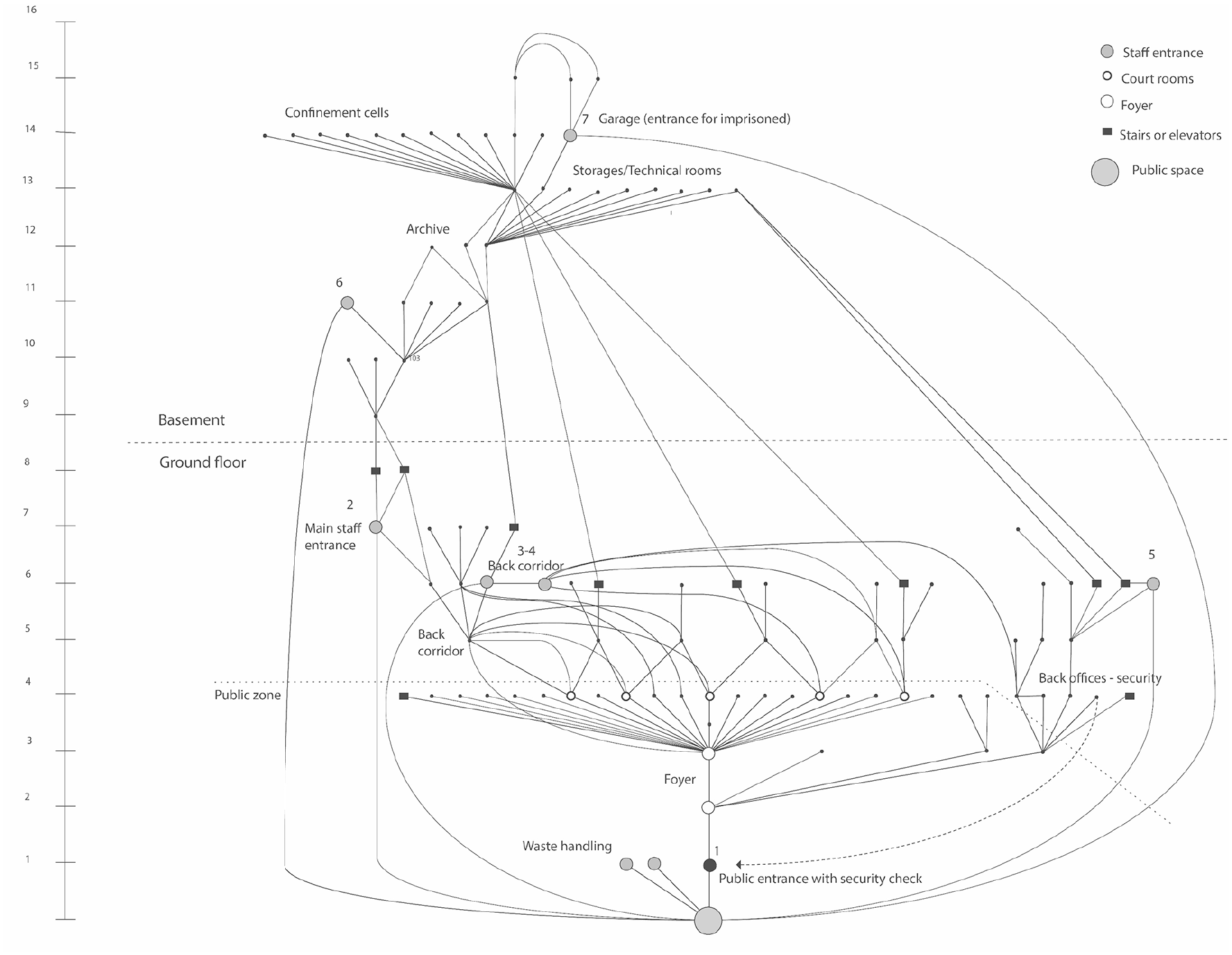
Justified graph of the ground floor and basement of Lund’s courthouse (2017), as seen from the public entrance (figure by author).
In Figure 6, we see a justified graph of the ground floor and the basement of Lund’s courthouse as structured from the public entrance. The second floor of the courtrooms and the top floors with offices are not included (they are otherwise connected through the stairs in the graph). From the perspective of the public entrance, the detainees are deepest in the structure, fourteen topological steps in. In terms of access, however, the courthouse distinguishes between at least four different kinds of visitors, each with their own entrance:
Visitors (including people summoned to court and lawyers) who are only allowed to use the main entrance (number 1 on the graph).
Detainees who are taken to the cell block in the basement through a garage entrance (6 and 8 on the graph).
Prosecutors, lay judges and protected witnesses who can use staff entrances and exits (2–4).
Security guards and back-office workers (5).
From the entrances available to category three, the whole system appears much shallower. These have direct access to the middle of the spatial structure (if viewed from the public entrance) and, if structured around the main staff entrance, the whole system is only nine topological steps deep (as compared to fifteen for the public).
To understand the increased complexity of courtroom accessibility, we will also compare the new courthouse in Lund from 2017 with the old, vacated courthouse (see Figures 7 and 8).
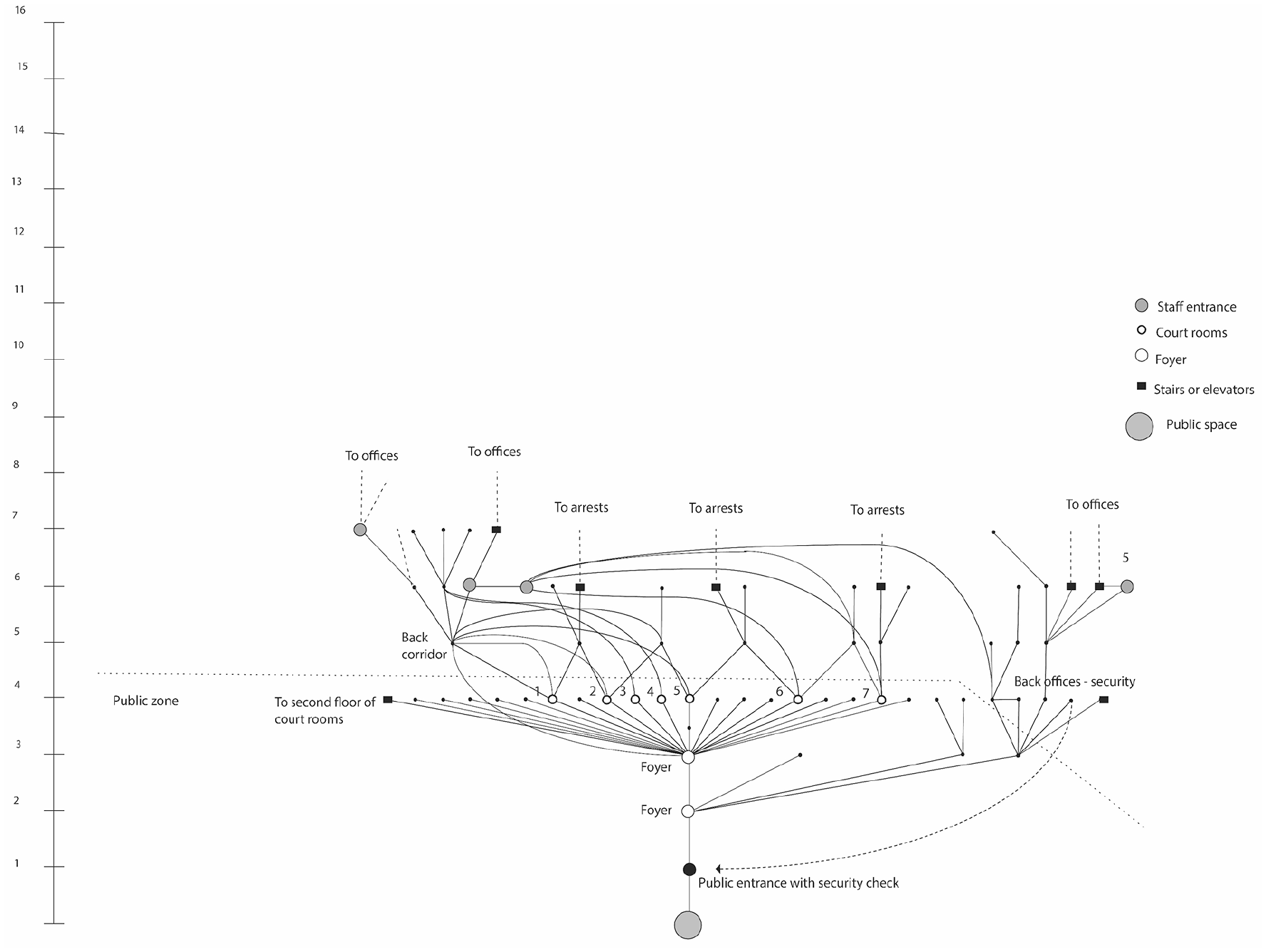
New courthouse in Lund. Justified access graph of the ground floor and basement of the Lund District Courthouse. Topological steps are counted from outside and the main public entrance on the ground floor, and from the main staff entrance for the basement (figure by author).
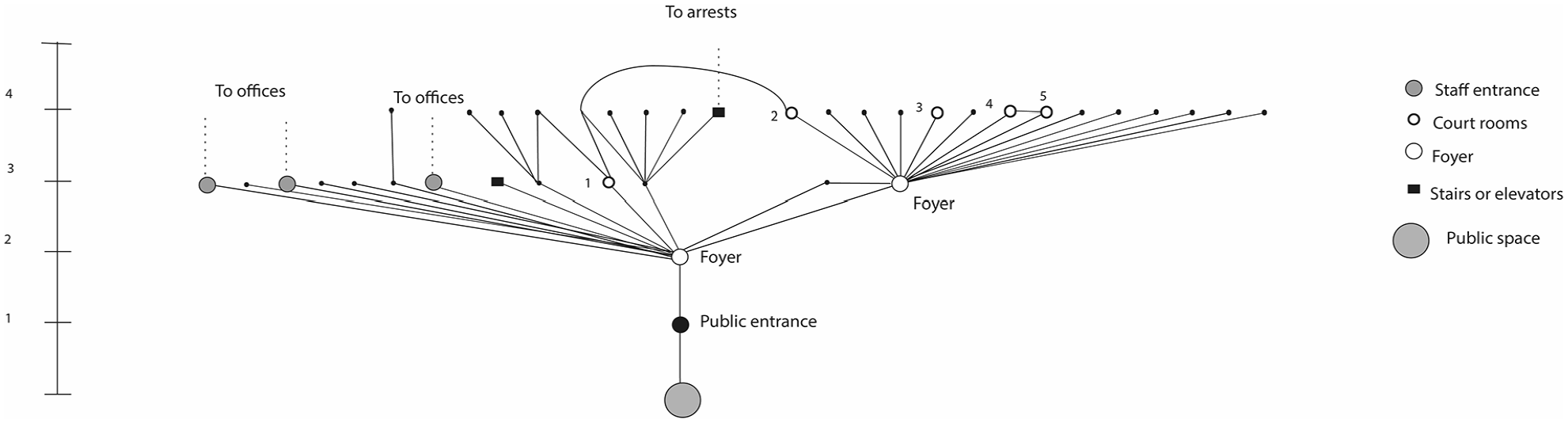
Lund’s former courthouse. Justified graph after the plan of the extension of the courthouse was made in 2003. The original courthouse opened in 1958, and only had one courtroom at the time (numbered ‘1’ here). 36 The second foyer and the other courtrooms are later additions (figure by author).
Figures 7 and 8 are justified graphs drawn from the main entrances, but in this case, we have only included spaces that are used to access the courtrooms (whether by staff or visitors). If we look at Figure 8, which depicts the spatial structure of the old courthouse in Lund just prior to the move, we see that the graph has a simple tree structure. It is built up around two foyers due to additions; the first of these was in the early 1990s, and the second in the early 2000s. The original courthouse from 1958 only included the first foyer and courtroom one. If we compare it with Figure 7, we see that the ring structure around the courtrooms has increased dramatically. This is related to the addition of new access points to the courtrooms to accommodate separate entrances for prosecutors, judges, detainees and the public to use. We can also note that the back-office system for security has become a spatial system of its own, appended to the public entrance and foyer. Different roles are thus increasingly given different specially designed territories in the building, and managing the interfaces between these zones has become increasingly intricate. In fact, these territorial strategies are sometimes even more finely distributed than the practices that they are meant to guide. In a short in situ interview with a prosecutor, she told us that she never uses the specific ‘prosecutor entrance’ to the courtroom, but always chooses the public entrance. Still, the machine of territorial separation is in place. Here, the recent proliferation of technology in relation to court procedures and security checks also plays an important role. As Jonathan Westin has pointed out, this proliferation is coupled with the introduction of moments of immobility (static bodies) in relation to key spatial practices of the courthouse, such as when entering the building and during trials. 37
If we leave the spatial accessibility and look at porosity in terms of visibility, we can see that all new courthouses have quite distinct and elaborate atria (see Figure 9). The recent rise in the atrium as a room type has been well documented in Sweden and abroad, and in different building types. 38 Starting in the 1970s and flourishing already in the 1980s, the atrium has, together with the sheer increase in building size, 39 come to change the relationship between larger buildings and urban space. Urban or urban-like spaces move indoors, and recent theories on interior urbanism thus discuss the increasing role of interiors for urban life, 40 as well as how an urban exterior is used as a panorama for these spaces. 41 The mobilisation of large-scale types, such as room types that we could see during the second half of the twentieth century, for example, interior streets and atriums, was initially rare in courthouses. However, as it is now common for courthouses to have grown to enormous complexes, the question of how they relate to urban questions is more pressing. In his analysis of three newly built courthouses in Melbourne from the early 2000s, Dovey describes how: ‘The courtrooms have been located as close as practical to the main entrance, and the lobby and the balcony areas that serve them have been designed in the language of a “street”’. 42
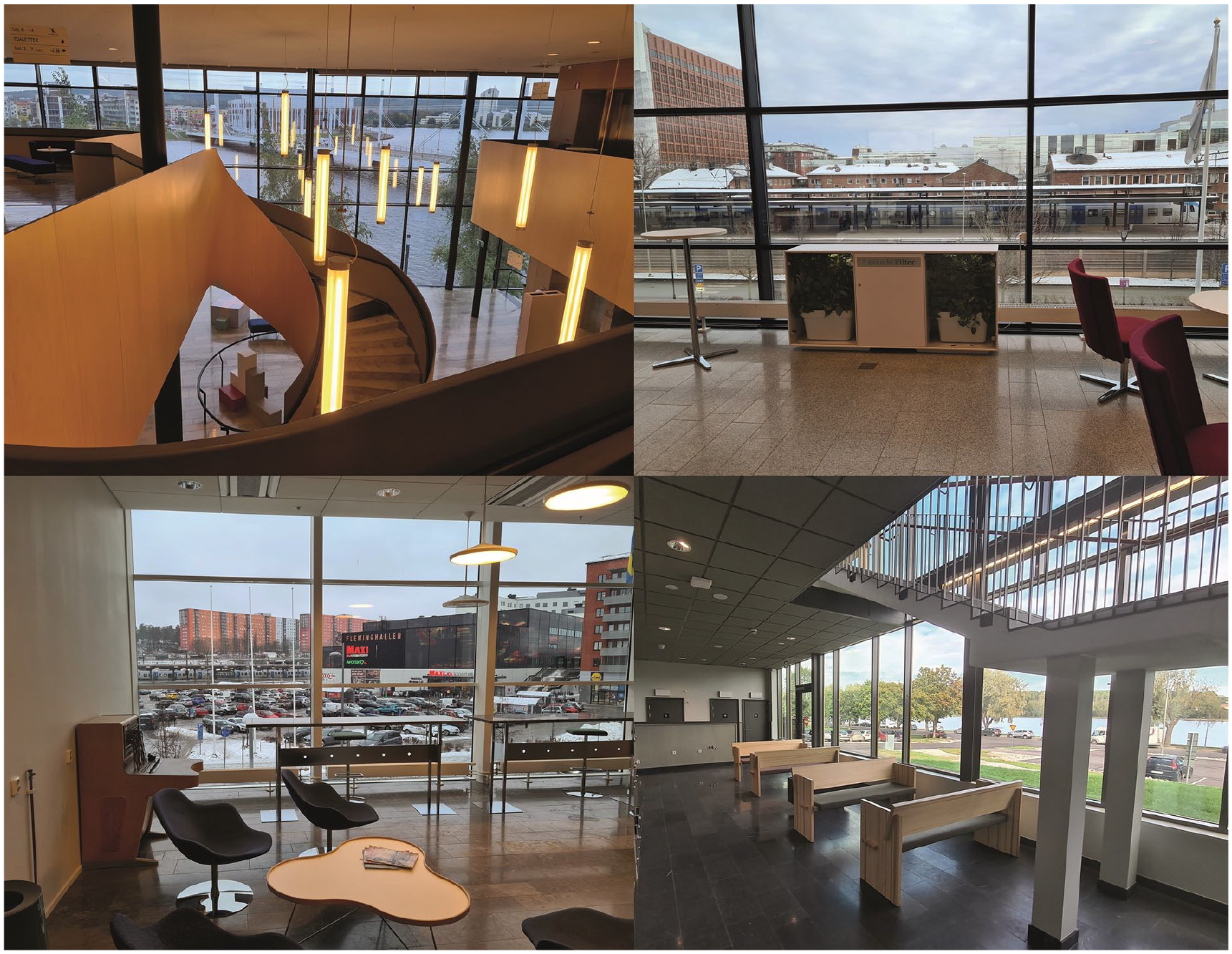
Foyers. Above left, Jönköping; above right, Attunda; below left, Södertörn; below right, Hudiksvall (photos by author).
Of the Swedish examples, perhaps only the interiority of the largest courthouses takes on an urban scale, for example, the one in Malmö. However, a vast majority of courthouse foyers have large windows and panoramic views that bring the urban landscape into the atriums. These large interior spaces also allow us to gaze out at the city, forming a fisheye architecture of sorts, where spectators stand behind closed and guarded doors and can peep out on the city through the large windows without being seen, at least during daylight hours. In short, the courthouse does not want its associated actors to engage or mingle in public space, but it allows us to gaze at it. Even less, it would seem, does it want to bring a heightened sense of publicness into the court. Instead, overlapping territories and territorial complexity are counteracted. 43 The feeling of safety and seclusion is strong when one sits in a closely monitored atrium inside the long, stretched and guarded (and always single) public entrance of the courthouse. In a way, the anonymity of the space also contributes to this feeling of safety; this is not because it gives the impression of a welcoming or thick place, 44 but because it is a neutral non-place, 45 an indistinct space, 46 which acts like an airport environment or like a McDonald’s restaurant. If you have seen just one of them, you know how the rest of them work. It is designed to be a space with no surprises.
V. Concluding Discussion
In this article, we have described how the increasingly exclusionary Swedish courthouses have gradually taken on a new role in the city. Newly built courthouses are becoming slightly more well-connected on a regional scale, both in terms of moving closer to large transport hubs and in terms of conspicuousness. They are, however, increasingly also becoming more exclusionary and isolated on a local scale. Front entrances turn away from important streets and places. The courthouse as a territorial object is well-connected, showcased and made visible on a regional scale. Yet, its front façade can be almost hidden, and its local connections are often weaker than its urban and regional ones, which indeed is the definition of a lack of spatial intelligibility. 47
We also see the proliferation of an intricate pattern of different accessibilities, where the spatial specialisation of different roles associated with the courthouse is taken further and further. Increased segmentation and zoning for different actors and an elaborate system of different front stages and back stages means that courthouse access becomes a layered and segregated structure. Different territories sit side by side and are only allowed to interact in very controlled ways. The lawcourt is a territorial landscape with an agglomeration of different territories, each following its logic. For the inhabitants of the court (judges), the courtroom is the spatial centre, a Swiss cheese of different entryways, catering for different actors and serving as the endpoint for a series of different entrances to the building. The theatrical aspect of the court and the separation of its different roles have, of course, always been important, 48 both when it comes to securing a place of law-making in the city and for distinguishing the different roles that need to take part in this activity – but perhaps it is only now that the spatial machine to match and even enforce this staging at a micro-level has been more fully developed.
For the public, the foyer has taken on a new and central position. It is anonymous, standardised and barely distinguishable from other courthouse foyers. It is well isolated from the public spaces outdoors by security checkpoints and dedicated entrance spaces, both inside and outside the courthouse building. Still, the foyer has large windows framing the outside urban landscape. Perhaps it is not by chance that the public/urban spaces are displayed as a diorama exhibition of sorts. At a time when the public life of the city seems to be withdrawing from the streets and moving into specialised and/or digital communities – and where everything can be done from the comfort of our homes – public space becomes something to display, much like the museum objects of old judicial paraphernalia encased in glass that draw our attention in several of the new courthouse foyers.
The recent sub-optimisation of accessibility and visibility affects the overall publicness of the court, and it is easy to forget that courthouses can and do play an important role in secure, professionalised judicial procedures, as well as in the social infrastructure of cities and regions. Perhaps this larger and more overarching role of the courthouse has been somewhat lost in recent developments. This particular democratic aspect has been lifted by Linda Mulcahy and Emma Rowden, 49 especially in relation to British courthouses, and our study confirms that it might also be an important issue for Swedish courthouses and their planners to revisit. In countries such as Australia, the problem of alienating parts of the population has been raised in relation to how indigenous people relate to court institutions. 50 It appears to be high time to address this question on a more general level in Sweden as well. Courthouses can and do play an important role in social infrastructure as a place for community-building, a public place for ‘weathering storms’, both literally and metaphorically. 51 Rather than allowing for intervisibility, the courthouse seems to have found a kind of Fordist solution to its spatial problems, with standardisation and separate assembly lines for different actors. Perhaps now is the time to take the role of the courthouse as a public space in the city more seriously. How can the court serve not just the law but also the city and its different publics in a better way?
Footnotes
Acknowledgements
This article has benefited from the helpful comments of Lars-Eric Jönsson and Jonathan Westin.
1.
Eric Klinenberg, Palaces for the People: How Social Infrastructure Can Help Fight Inequality, Polarization, and the Decline of Civic Life (New York, NY: Crown, 2018). See also Alan Latham and Jack Layton, “Social Infrastructure and the Public Life of Cities: Studying Urban Sociality and Public Spaces,” Geography Compass 13, no. 7 (2019): 1–15.
2.
Andrea Mubi Brighenti, Visibility in Social Theory and Social Research (Basingstoke: Palgrave Macmillan, 2010), 117.
3.
Patrícia Branco, “Analysing Courthouses’ Spaces, Places and Architecture: Some Methodological Outlines,” Oñati Socio-Legal Series 13, no. 1 (2023): 278–98.
4.
Patrícia Branco, “The Geographies of Justice in Portugal: Redefining the Judiciary’s Territories,” International Journal of Law in Context 15, no. 4 (2019): 442–60. See also CEPEJ Evaluation Report, Part 1, Tables, Graphs and Analyses. Strasbourg: European Commission for the Efficiency of Justice Commission for the Efficiency of Justice (2022), 96 ff., and Nathalie Chappe and Marie Obidzinski, “The Impact of the Number of Courts on the Demand for Trials” (Working Paper No. 2013-01, Université de Franche-Comté, Bresançon, 2013), 3.
5.
Marie Bels and Patrícia Branco, “Law and Architecture: Courthouse Architecture, Searching for a New Balance between Representation and Functionality,” in Law and the Arts: Elective Affinities and Relationships of Tension, eds. Werner Gephart and Jure Leko (Frankfurt am Main: Vittorio Klostermann, 2017), 190.
6.
Kjell Åke Modéer, “Tingsstället – Rättens boningar,” in Tingshus i tid och rum: ett rätts- och kulturhistoriskt seminarium i Domstolsväsendets informationscentrum (Jönköping: Domstolsverket, 1992), 7–29. See also Mattias Kärrholm, “Territorial Mimetics and Room Types: the Spatial Development of Swedish District Courthouses 1970–2020,” City, Territory and Architecture 10 (2023): 26.
7.
Erik Sigge, Architecture’s Red Tape: Government Building Construction in Sweden, 1963–1973. The Example of the National Board of Public Building, KBS (Kungliga Byggnadsstyrelsen) (Stockholm: KTH, 2017). For the design guidelines, see Lokaler för tingsrätter, KBS-rapport 60 (Stockholm: Kungliga Byggnadsstyrelsen, 1971) and Inredning av lokaler för tingsrätter, KBS-rapport 94 (Stockholm: Kungliga Byggnadsstyrelsen, 1971). For a discussion of the British case, see Linda Mulcahy, Legal Architecture: Justice, Due Process and the Place of Law (London: Routledge, 2011), and Linda Mulcahy and Emma Rowden, The Democratic Courthouse: A Modern History of Design, Due Process and Dignity (London: Routledge, 2019).
8.
Modéer, “Tingsstället – Rättens boningar,” 28.
9.
DV, Normer för tingsrättslokaler (GP Ting 1979), 1979-02-20, Unpublished document, Archive of Domstolsverket, Jönköping (Event. 4807-1976).
10.
DV, Tingsrätters effektivitet och produktivitet, RIR 2017:6 (Stockholm: Riksrevisionen, 2017), 33.
11.
DV, Lokalförsörjningsstrategi för Sveriges Domstolar vid om-, till- och nybyggnationer, Unpublished strategic document (Jönköping: Domstolsverket, 2017), 5.
12.
Bels and Branco, “Law and Architecture,” 193.
13.
Patrícia Branco, “City/Courthouse Building: A Mirror Game. Examining Connections between Courthouse Buildings and Location in the Urban Environment,” International Journal for the Semiotics of Law – Revue internationale de Sémiotique juridique 32, no. 3 (2019): 597–620.
14.
Statskontoret. Sammanslagna tingsrätter, en utvärdering (Stockholm: Statskontoret, 2007), 9.
15.
Andrea Mubi Brighenti, “On Territorology: Towards a General Science of Territory,” Theory, Culture & Society 27, no. 1 (2010): 52–72. See also Mattias Kärrholm, “The Materiality of Territorial Production: A Conceptual Discussion of Territoriality, Materiality, and the Everyday Life of Public Space,” Space and Culture 10, no. 4 (2007): 437–53, and Andrea Mubi Brighenti and Mattias Kärrholm, Animated Lands: Studies in Territoriology (Lincoln, NE: University of Nebraska Press, 2020).
16.
Julienne Hanson, Decoding Homes and Houses (Cambridge: Cambridge University Press, 1998), and Bill Hillier and Julienne Hanson, The Social Logic of Space (Cambridge: Cambridge University Press, 1984).
17.
Brighenti and Kärrholm, Animated Lands.
18.
Akkelies van Nees and Claudia Yamu, Introduction to Space Syntax in Urban Studies (Berlin: Springer, 2021), 3. See also Philip Steadman, Architectural Morphology (London: Pion, 1983), 216 ff.
19.
Tomas Markus, Buildings and Power, Freedom and Control in the Origin of Modern Building Types (London: Routledge, 1993); Kim Dovey, Framing Places, Mediating Power in Built Form (London: Routledge, 1999).
20.
Michael Benedikt, “To Take Hold of Space: Isovists and Isovist Fields,” Environment and Planning B: Planning and Design 6, no. 1 (1979): 47–65. See also van Nees and Yamu, Introduction to Space Syntax, 88 f.
21.
These field trips were conducted together with Lars-Eric Jönsson and Jonathan Westin as a series of nine two-day visits between December 2019 and September 2023.
22.
See Eva Löfgren, Rummet och rätten. Tingshus som föreställning, byggnad och rum i användning 1734–1970 (Stockholm: Institutet för Rättshistorisk forskning, 2011).
23.
Statskontoret, Sammanslagna tingsrätter, 9.
24.
Branco, “City/Courthouse Building,” 599.
25.
Bels and Branco, “Law and Architecture,” 189.
26.
Thomas Hall and Sonja Vidén, “The Million Homes Programme: A Review of the Great Swedish Planning Project,” Planning Perspectives 20, no. 3 (2005): 301–28.
27.
Bels and Branco, “Law and Architecture,” 194.
28.
Anna Klingmann, Brandscapes: Architecture in the Experience Economy (Cambridge MA: MIT Press, 2010), 255 ff.
29.
Kim Dovey, Becoming Places, Urbanism/Architecture/Identity/Power (London: Routledge, 2010), 228.
30.
DV, Lokalgrupper, lokalsamband, markdisposition m.m. 2021-03-24, revision G. Unpublished working document from Swedish National Courts Administration (2021), 12. In the original Swedish, the quote reads: ‘Viss stramhet och återhållsamhet i form av enkelhet, nytta och robusthet ska prägla utformningen av domstolslokaler’.
31.
Brighenti, Visibility in Social Theory, 55.
32.
DV, Arkitekturpolicy för Sveriges Domstolar vid om-, till- och nybyggnationer (Jönköping: Domstolsverket, 2021), 10. In the original Swedish, the quote reads ‘Huvudentrén (allmänhetens entré) är väl synlig och uppfattas som en värdig entré för denna typ av byggnad’.
33.
See Rem Koolhaas et al., Elements (Venice: Marsilio, 2014) on the notion of stretched doors.
34.
DV, Lokalgrupper, lokalsamband, markdisposition, 12.
35.
Hillier and Hanson, Social Logic of Space, 193 ff.
36.
See Tomas Tägil, Arkitekten Hans Westman, Funktionalismen och den regionala särarten (Lund: Lunds universitet, 1996), 199.
37.
Jonathan Westin, “The Courtroom as a Cyber-Physical Space. Spatial Mediation Through Technology, 1971–2021,” SPACE, International Journal of Space Studies in Architecture and Urban Design, 5, (2024, in press).
38.
See Charles Rice, Atrium (Cambridge MA: MIT Press, 2023); Albena Yaneva, “Is the Atrium More Important Than the Lab? Designer Buildings for New Cultures of Creativity,” in Geographies of Science, eds. Peter Meusburger, David N. Livingstone and Heike Jöns (Berlin: Springer, 2010): 139–50. See also Kärrholm, “Territorial Mimetics.”
39.
Cf. Rem Koolhaas, S, M, L, XL (Rotterdam: 010 Publishers, 1995).
40.
See Peter Sloterdijk, Spheres, Volume I: Bubbles Microspherology (Los Angeles, CA: Semiotext(e), 2011); Charles Rice, Interior Urbanism: Architecture, John Portman and Downtown America (London: Bloomsbury Publishing, 2016).
41.
Hannes Frykholm, Building the City from the Inside: Architecture and Urban Transformation in Los Angeles, Porto, and Las Vegas (Stockholm: KTH, 2020).
42.
Dovey, Becoming Places, 130.
43.
Kärrholm, “The Materiality of Territorial Production.”
44.
Robert David Sack, Homo Geographicus (Baltimore, MD: John Hopkins University Press, 1997).
45.
Marc Augé, Non-Places: An Introduction to Supermodernity (London: Verso Books, 1995).
46.
Fran Tonkiss, Cities by Design: The Social Life of Urban Form (New York, NY: John Wiley & Sons, 2013), 11.
47.
Bill Hillier, Space is the Machine (Cambridge: Cambridge University Press, 1996).
48.
See Leif Dahlberg, Spacing Law and Politics: The Constitution and Representation of the Juridical (London: Routledge, 2016); Antoine Garapon, Bien juger: essai sur le rituel judiciaire (Paris: Editions Odile Jacob, 2001).
49.
Mulcahy and Rowden, The Democratic Courthouse.
50.
See Thalia Anthony and Elisabeth Grant, “Courthouse Design Principles to Dignify Spaces for Indigenous Users: Preliminary Observations,” International Journal for Court Administration 8, no. 1 (2016): 43–59; Elena Marchetti, “Nothing Works? A Meta-Review of Indigenous Sentencing Court Evaluations,” Current Issues in Criminal Justice 28, no. 3 (2017): 257–76.
51.
Klinenberg, Palaces for the People.
Funding
The author(s) disclosed receipt of the following financial support for the research, authorship and/or publication of this article: This work was supported by the Swedish Research Council (VR) through the grant ‘Just Room? Architecture, Technologies and Spatial Practice of the District Law Court’, project 2019-02600.
Availability of Data and Materials
Some of the data used and analysed in this study can be found in the archive of The Swedish National Courts Administration, Domstolsverket (see references). Other data (e.g. photographs and maps) are available from the corresponding author on reasonable request.
