




Abstract
The 1882 Belt v. Lawes libel trial centered around aesthetic questions, of precisely the kind that judges usually seek to avoid. The trigger for the dispute was an article in Vanity Fair by Charles Lawes, asserting that Richard Belt, a sculptor and member of the Royal Academy of Arts, relied on his assistants to do his work. At trial, Lawes proposed an artistic skills test of sorts, suggesting that Belt verify his abilities by executing a sculpture in the courtroom. This evidentiary drama, and the aesthetically-freighted arguments mustered by the parties at trial, make it a fruitful historical episode to study conceptions of authorship and the artistic process, the development of modern copyright doctrine, and the status of expert artistic testimony in the law.
Is there to be no knowledge in art? Does not the experience of art contain a claim to truth which is certainly different from that of science, but just as certainly is not inferior to it? And is not the task of aesthetics precisely to ground the fact that the experience of art is a mode of knowledge of a unique kind, certainly different from that sensory knowledge which provides science with the ultimate data from which it constructs the knowledge of nature, and certainly different from all moral rational knowledge, and indeed from all conceptual knowledge—but still knowledge, i.e., conveying truth?
1
— Hans-Georg Gadamer, Truth and Method
The 1882 Belt v. Lawes trial was unusual for several reasons: it was the last trial in the law courts of Westminster Hall; it was the longest libel trial ever held there, lasting more than 100 days; and it centered around aesthetic questions, of precisely the kind that judges usually seek to avoid. The occasion for the dispute was an article in Vanity Fair by Charles Lawes, asserting that Richard Belt, a sculptor and member of the Royal Academy of Arts, was merely a “broker” who mediated between socialites (looking to fill their homes with art) and the true artists who actually executed the orders (his assistants). Belt and Lawes were well acquainted with each other prior to the litigation. Lawes himself was a sculptor, and Belt had spent 5 years working in his studio in the early 1870s. Yet, Lawes apparently believed so strongly in his claims that he invited Belt to sue him for libel, which Belt promptly did. 2
Although the dispute might initially have appeared triable without any need to make aesthetic judgments, Lawes proposed an artistic skills test, suggesting that Belt verify his abilities by executing a sculpture in the courtroom—a challenge that Belt happily accepted. The result was quickly pronounced deficient by the defense’s panel of expert witnesses, all members of the Royal Academy. Despite this, the jury found for Belt, in no small part because the judge had instructed them that the Academicians’ evidence should not receive any special weight. That instruction, in turn, formed the basis for a series of appeals in which the trial judge’s ruling on the expert evidence was initially rejected as a legal error warranting a new trial, but on further appeal was finally affirmed. Throughout the dispute, the courts were beset by the questions of whose aesthetic judgment mattered and how such judgments should figure in the analysis of the alleged libel. The trial was remarkable for directly confronting these questions. The trial judge, Baron Huddleston, thought that the success of Belt’s libel claim turned on aesthetic questions, including the grounds for claims of authorship, the degree of permissible assistance, and the credibility of connoisseurs.
A judge once observed that “qualitative evaluation of artistic endeavors [is] a function for which judicial office is hardly a qualifier.” 3 Other courts have agreed, and have generally refused any invitation to opine on such matters, emphatically disclaiming any competence in evaluating aesthetic merit. The most famous of these refusals is, perhaps, Oliver Wendell Holmes’s statement that “[i]t would be a dangerous undertaking for persons trained only to the law to constitute themselves final judges of the worth of pictorial illustrations.” 4 The case law abounds in other such disclaimers. 5 Perhaps, neither of the parties expected that aesthetic judgment would play any significant role in the trial process, or perhaps each of them, for different reasons, assumed that insofar as aesthetic judgment would be required, it would necessarily favor his own position. Belt may have thought that his credentials as a member of the Royal Academy would satisfy a jury in establishing that he was an artist, and not a mere broker. Or perhaps he assumed that his two studio assistants, Thomas Brock and Pierre Verheyden, would irrefutably confirm his own testimony about the unartistic nature of their assistance.
Belt could hardly have anticipated that Lawes would seek to use the courtroom to stage a competition, requiring Belt to produce a new sculpture to be matched against the busts whose authorship was under dispute. Lawes, on the other hand, may have intended all along to put Belt to the test in this fashion, but if so, Lawes must have believed that there was simply no ambiguity about Belt’s incompetence, and that no talent of fine aesthetic discrimination would be required to see the difference between the ostensibly Belt- sculpted busts and the one that Belt produced under supervision. Lawes turned out to be gravely mistaken: the jury ultimately found it quite plausible that Belt had designed all of them, and despite some difficulties as the case made its way through the appellate courts, that view was ultimately affirmed.
Yet, if Lawes’s hopes of using the trial to showcase an aesthetic dispute were fruitless, the question that he posed was nevertheless an uncomfortable one for Belt. Belt found himself constrained to assert, on the one hand, that his own “assistants” made no artistic contributions whatsoever to the work they helped to produce, even as he insisted, on the other hand, that his role as an “apprentice” in Lawes’s studio had involved a significant degree of aesthetic effort. Throughout the trial, Belt clung to this distinction between assistant and apprentice. Belt attempted to police a difference between one who simply keeps the studio in order and one who is being trained as an artist. The distinction proved difficult to maintain, both factually and conceptually. Evidently persuaded that the law’s categorical distinctions would not allow him to claim the status of a creator unless he had received no help at all from collaborators, Belt adopted a strategy that required him to recapitulate Lawes’s logic, minimizing the contributions of his own assistants in precisely the same way that Lawes was seeking to minimize Belt’s, during Belt’s time as his assistant.
Neither party was prepared to acknowledge that artistic authorship could be collaborative, so as to allow for joint authorship or for varying degrees of responsibility consistent with the primacy of the master artist. Just as Lawes argued that Belt had never played a significant artistic role as a studio assistant—and therefore could never have acquired the talents that would make him an artist—Belt embraced the same logic, now aimed at establishing his own status as the sole author of the busts emerging from his studio. Indeed, the closest that Belt came to crediting his assistants was in describing his own work as investing the sculptures with artistic merit, leaving to his assistants the non-artistic tasks associated with producing them. The case thus provides a window into the parties’ understanding of artistic authorship, embedded in an evidentiary drama in which an artist attempts to legitimize himself by crafting a sculpture completely unaided, as only a true artist could.
Belt’s lawsuit was not, however, entirely unique in probing aesthetic questions. Five years earlier, in 1877, James McNeill Whistler sued the art critic John Ruskin for libel. Ruskin wrote a newspaper column arguing that by demanding 200 guineas for Nocturne in Black and Gold and calling it a “finished” painting, Whistler was “flinging a pot of paint in the public’s face.” 6 There too the charge involved artistic deception, albeit of a different order: Ruskin characterized the series of Nocturnes as “unfinished” works cunningly passed off as complete. By suing Ruskin in response, Whistler sought to use the courtroom as a forum to publicize his ideas about art. 7 Scholars studying the trial, such as Linda Merrill, have suggested that Whistler’s interest in compensation was partnered with a desire “to correct what he believed to be a popular misconception of the very nature of art, engendered by Ruskin himself.” 8 This use of the court as an arena for adjudicating between rival aesthetic theories parallels Lawes’s insistence, in his Vanity Fair article, that the aesthetic question was so significant as to justify resort to a court.
Just a few years after the Belt lawsuit, Oscar Wilde would sue the Marquess of Queensberry for libel. The Marquess left a card at the Albemarle Club accusing Wilde of “posing as a somdomite [sic].” 9 Though it was not, on its face, a dispute about aesthetics, Wilde took numerous opportunities to transpose the evidence into an artistic register, and to treat the case as a controversy about the status of the artist. 10 His attorney, Edward Clarke, sought to preempt the defense from using a damning letter that Wilde had written to Lord Alfred Douglas. Clarke described the letter as a “prose sonnet.” 11 Clarke contended that while ordinary readers might regard Wilde’s style as extravagant, this simply exposed the “cultural gulf” separating them from Wilde. 12 Wilde’s artistic flair had to be carefully distinguished from immoral conduct and obscenity, Clarke argued. When Wilde lost the libel case, the newspapers regarded the result as a condemnation of his views on aesthetics. 13
Belt and Lawes, too, offered substantive theories of the artist and the artistic process. As we will go on to see, Belt endorsed a conception of authorship that required tactile contributions in addition to the intellectual exercise of conceiving the work. This stood in contrast to Lawes’s position, who argued that conception was the only artistically relevant task in the production of art. Both positions had their attendant conceptual difficulties. Belt had the issue of distinguishing between the type of execution that was artistically significant, and a kind that was purely mechanical, while ensuring that his own assistants did not undermine his status as author. Lawes had to make coherent the role of his expert witnesses, the Royal Academicians, who purported to examine the characteristic details an author imparted to his sculpture, invisible to the layman, that would reveal its true author. The use of these self-styled connoisseurs, trained in examining idiosyncratic tactile contributions, stood in obvious tension with Lawes’s view that the artist is a conceiver alone, whose hand need not even touch the sculptures he authored.
The conceptual difficulties that plagued the parties’ theories of authorship point to a number of related legal issues. Belt foreshadows the heavily discussed doctrine of aesthetic neutrality propounded by Oliver Wendell Holmes in Bleistein v. Donaldson Lithographing Co., 14 according to which judges ought not make aesthetic judgments in deciding legal disputes. In Belt, Baron Huddleston was suspicious of the Royal Academicians’ claims to settle the aesthetic dispute one way or another with their purportedly expert testimony, and indeed Lawes’s broader claim that one could deceive the public about one’s artistic talents to such an extent, as Lawes suggested Belt had done.
The Belt case also has important connections to the growing pains of modern copyright doctrine. Both parties were loyal to the still-dominant Romantic ideology of the time, which held that the production of art was the individual affair of a creative genius. Yet seeds of discontent with this view were emerging in the courts. At the time of the Belt litigation, employees had some success in winning copyright, and thus impliedly, authorship, over works produced in the course of their employment. Belt and Lawes offered differing strategies aimed at preserving the cult of the individual artist against the encroachment of their hired assistants. In all of these ways, Belt furthered the evolution of ideas about authorship.
I. The Trial of Belt and Lawes
1. Pre-Trial Events and Context
By the early 1880s, rumors began circulating that a certain sculptor in London was secretly using an assistant to produce his works, what Lawes would later call a “ghost.” These rumors appeared in print, on August 20, 1881, in Vanity Fair.
15
While the article was published anonymously, it became widely known that Charles Lawes had authored it. Lawes’s article begins by referring to Belt as “undoubtedly the fashionable sculptor of the day,” but quickly casts aspersions on his right to this reputation, asking whether Belt is “really the author of the works that bear his name.”
16
Belt was indeed a prominent sculptor of his time; he was one of several of London’s Royal Academicians that made a living by producing commemorative busts. Among his most prominent works were memorial busts of the Canons Kingsley and Conway, featured in the Chester and Rochester cathedrals, as well as a bust of Benjamin Disraeli, commissioned by Queen Victoria. Gathering much public attention and acclaim, Belt also won a national competition for a memorial to Lord Byron, beating out some 38 other sculptors, including August Rodin and Alfred Gilbert. Belt’s meteoric rise to fame was doubly significant because he was, by all accounts, a man of humble origin and a working-class background. His ability to earn the high-profile commissions of the Kingsley and Conway busts stood in stark contrast to the underwhelming sculpting career of his former employer, Charles Lawes, who would produce nothing that received the type of public visibility and acclaim that Belt’s oeuvre enjoyed.
17
In his Vanity Fair article, Lawes called for an inquiry into the rumors festering about Belt: The matter is one of no small importance not merely for Mr. Belt, but also for the world at large. If Mr. Belt has really designed and executed the works that pass under his name, a cruel wrong has been done him. If, on the contrary, not he but some other person or persons did indeed design and execute them, then Mr. Belt is the wearer of borrowed plumes which he ought not to be allowed to retain.
18
After setting out the challenge, Lawes purported to provide the results of an already con- ducted investigation. Lawes claimed to have examined Belt’s training and consulted several experts in sculpture before concluding that Belt was “only an ingenious and successful sculptor-broker, who presents to the public as his own work what has invariably been designed by hands other than his.” 19 Lawes identified Belt’s assistants, Thomas Brock and Pierre Verheyden, as the clandestine authors of the works Belt claimed as his own, and alleged that Belt was a “purveyor of other men’s works” and “an editor of other men’s designs.” 20
Notably absent from the original Vanity Fair article is the term “ghost,” which would become ubiquitous at the trial and in contemporaneous discussions about it. The term would appear a month later, on September 24, 1881, in an open letter to the Lord Mayor of London also published in Vanity Fair. In this second publication, Lawes shed the veil of anonymity, and defined a ghost as “a person employed by incompetent artists secretly to do up their work and make it artistic.” 21 In the letter, which attracted further public attention, Lawes noted Belt’s failure to respond to the accusations in his prior article, and welcomed the opportunity to have them tested in court. 22 Belt duly obliged.
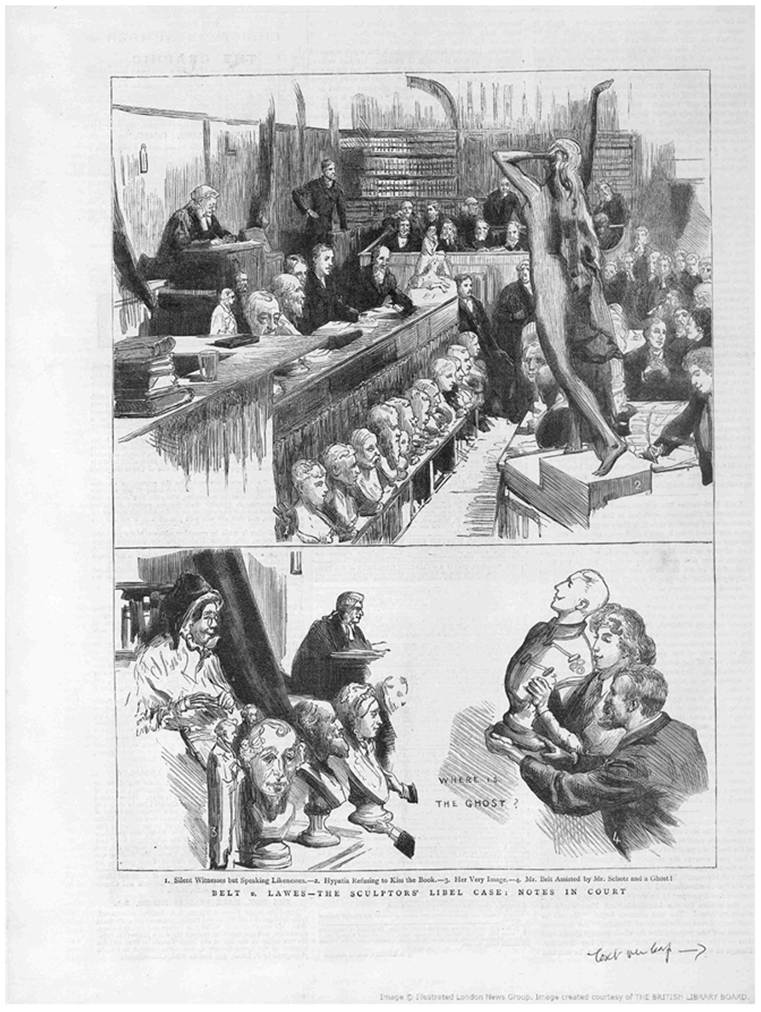
The Graphic depicts the remarkable scenes of the trial as Belt’s oeuvre is entered into evidence. 23
2. The Legal Dispute and Its Outcome
The Belt v. Lawes libel case, which opened on January 21, 1882, was tried before a jury and Baron John Walter Huddleston. As the press coverage of the trial emphasized, the sheer volume of evidence was remarkable: 129 busts and drawings, 62 documents, and 143 separate witnesses’ testimony were entered into evidence at trial. 24 Though several were in dispute, the busts that received the most attention at trial were those of the Canons Kingsley, Stanley, and Conway, as well as the bust of Lord Byron. 25 In each instance, Lawes’s arguments struck at the amount and kind of assistance Belt had received.
Belt’s initial strategy was to emphasize his training, and then to insist that he was responsible for both the conception of his sculptures and the artistically significant aspects of their execution. The defense sought to minimize his claims: first, by contending that when employed at Lawes’s studio, Belt performed only menial, non-artistic tasks; and second, by eliciting testimony from one of Belt’s assistants, Verheyden, that it was he, and not Belt, who had made the most significant contributions to the sculptures. 23 The defense also challenged Belt to demonstrate his skills in court by making a replica sculpture of a bust of Eugene Pagliati (a bust that had already been entered as evidence, and claimed by Belt as his own work 26 ), which the Royal Academicians (the defense’s proposed experts) then condemned. 27 Thus the weight afforded to the Academicians’ testimony made a considerable difference to the outcome: if the jury gave their evidence little weight (as the trial judge eventually instructed) the case was largely a factual dispute about which of the parties (and witnesses) was more credible. If the Academicians were credited as experts, their testimony could have tilted the balance, in a close case, and perhaps even overwhelmed the other evidence. In the event, the jury found for Belt, awarding him £5,000 in damages, the highest ever awarded for libel at the time. 28
The trial lasted for more than 100 days and drew the sustained attention of the public and artistic community throughout. Yet the case took a good while longer to be resolved as it wended its way through the appellate courts. Lawes appealed to the Divisional Court in January 1883, arguing that the jury had been misdirected, and that the damages were excessive. A three-judge panel took nearly a year to render a verdict. On December 16, 1883, in a split ruling, the court determined that there should be a retrial. The two judges in the majority held that the question of attribution was a matter of fact, to be determined by experts, and thus that the opinions of the Royal Academicians should have been conclusive at trial. 29 Baron Huddleston’s decision to dismiss their testimony was therefore an error of law. Nevertheless, rather than send the case back to the trial court, the Lord Chief Justice accepted a compromise proposed by his two colleagues, who suggested that if both parties should agree, the verdict would be allowed to stand with the damages reduced to £500—an effort to avoid the expense of a retrial. Though Belt accepted the compromise, Lawes rejected it, and the case went on to the Court of Appeal. 30
On March 17, 1884, the case was again decided in Belt’s favor, this time on the ground that the assessment of ordinary individuals, rather than the judgments of specialists in a “high-minded profession,” were best to answer the question of artistic credit. 31 The court restored the damages; however, Lawes promptly declared bankruptcy and said that he could not pay the £10,000 he now owed (£5,000 for the damages, and a further £5,000 for the costs). As a result, Belt himself declared bankruptcy, finally bringing the legal action to a close. 32 Though this brought the legal proceedings of Belt v. Lawes to an end, the case would live on in the imagination of the British public, as well as in publications that continued to canvass polarized views on the outcome of the trial and the aesthetic issues that the trial engaged.
II. The Law of Libel
Before turning to the parties’ aesthetic theories in more detail, brief remarks on the elements of a libel claim will be useful for our purposes here. 33 In order to bring a civil libel action— the type of defamation alleged in the Belt trial—a claimant must prove that the defendant published, or was responsible for the publication of, a defamatory allegation that is understood to refer to the plaintiff. A series of defenses are then available to the defendant. 34
The publication requirement means that the allegation must be communicated to at least one other person. The requirement of a defamatory allegation means that the content of the publication “would either tend to make people think the worse of the claimant or avoid him or expose him to ridicule.” 35 Finally, the allegation must refer to the plaintiff. 36 None of these requirements were in dispute in the Belt case. Lawes identified Belt by name and alleged that he was an imposter with no artistic talent. Curiously, it was later revealed that a man named Mr. Bagnall had written the Vanity Fair article; however, it had been supervised and edited by Lawes. Lawes did not shy away from accepting that the writing was his “in substance,” though, ironically, he admitted that he did not write every line of it. 37 It was also upon his insistence that the article was given to Vanity Fair to publish. 38
Lawes invoked the defense of justification, which absolves the defendant of liability if he can show that the libelous allegations were substantially true. 39 Indeed, in the Vanity Fair article itself, and in the follow-up letter to the Lord Mayor of London, Lawes insisted that his allegations were true. When the defendant pleads justification, the burden of proof shifts onto the defendant. The standard for determining proof is the ordinary civil standard of “on the balance of probabilities.”
If the defense is not made out, a successful plaintiff is entitled to damages, assessed by a jury, often with some guidance by the presiding judge. 40 Lawes’s task at the trial was to prove (by the standard described above) that his claims about Belt were true in “sub- stance and fact.” 41 Notably, Lawes did not allege that Belt’s sculptures were simply lousy. Had Lawes done this, he would simply have been making a statement of opinion that did not risk liability for libel. 42 Lawes instead contended that Belt was not an artist at all. Thus Lawes could not maintain that he was simply expressing a statement of aesthetic opinion. As I go on to explain, this was a feature of Lawes’s aesthetic theory, which required couching his allegations as claims of objective aesthetic assessment capable of expert verification. Lawes’s riskier legal strategy was necessitated by his theory of authorship and his supporting ideas about connoisseurship. 43 Lawes sought to draw a stark and categorical distinction between artist and non-artist. This meant that a factual claim (subject to refutation) was what Lawes required.
As a result of Lawes’s particular allegations, at trial, it became Lawes’s task to demonstrate Belt’s incompetence and deception, and Belt’s to undermine the evidence for this proposition by constructing a credible account of his training and artistic process. With this in mind, I turn to the evidence presented at trial.
III. Apprentice or Studio-Sweeper
1. An Artist in Training
The presentation of evidence tracked the chronology of the parties’ relationship. Belt’s early history and training was the first subject of testimony. Both parties seized on the importance of Belt’s time at Lawes’s studio, for the obvious reason that his role there would shed some light on his credibility as a trained sculptor. Belt himself was first to testify. He outlined his training and education as a sculptor, focusing on two chapters of that history: his time at the studio of John Henry Foley between 1869 and 1870, and at Charles Lawes’s studio from 1871 to 1875. 44 Belt contended that he was an “apprentice” at both studios, a label freighted with artistic responsibility. 45 He carefully specified that he was employed in artistic roles when working at the studios of Foley and Lawes, taking up tasks such as modeling clay. 46 Seeking to preempt claims that he was employed in non-artistic, menial roles, Belt denied that he was a janitor. 47 Belt emphasized that he was regarded as an equal to the other artists there, and reported that he was compensated as an apprentice, and not as a mere assistant. 48
Belt’s witnesses corroborated his claim that he had an artistic role at Foley’s studio, working as an apprentice learning sculpture. Belt called one Mr. Holmes, who was employed by Foley as an assistant for modeling, and Mr. Beeby, a general attendant at Foley’s studio. 49 Holmes testified that he saw Belt assisting the general sculpting of the studio—a role similar to his own. Beeby testified that he could not remember exactly what Belt’s role was, but that he was a pupil who was “practicing in modeling.” 50 Beeby explained that it was his own duty, not Belt’s, to sweep out the studio. Though Beeby noted that Belt sometimes mixed Foley’s basin of plaster, he insisted that it had no bearing on Belt’s status as an apprentice, because everyone in the studio did so. 51 Finally, one Mr. Humphreys, a journalist, was called to the stand by the plaintiff. Humphreys explained that he visited the studio to gather information for Foley’s obituary, and that in interviewing Brock, learned that Foley had asked Brock, Birch, and Belt to complete any unfinished work upon his death—showing that Belt was as much of an artist as the others who worked alongside Foley. 52
2. The Parties’ Origin Story
Belt and Lawes first crossed paths when the former worked, in some capacity, at the latter’s studio. Belt reported that he left Foley’s studio at Lawes’s request, and with Foley’s permission. While Belt could not recall the pay he received, he insisted that he was “engaged and treated as a modeler in clay,” and not “as a general attendant.” 53 Belt also revealed a bust of Adelina Patti, a prominent London-based opera singer, and testified that he completed it during his time at Lawes’s studio. 54
Belt took pains to emphasize that he was on equal terms with Lawes. He testified: “I was on most friendly terms with the defendant, as companion and as friend. I used to go to his house, and go with him to the theater. He treated me as his companion and his friend on equal terms.” 55 Belt’s point was that a mere general attendant—especially one of relatively lower social status such as he—could not have cultivated such a relationship with the studio owner. It was precisely because they had the same vocation that their friendly relationship thrived.
Charles McVicker, also called for the plaintiff, appeared next. McVicker was Lawes’s general attendant. In another effort to nudge Belt further up in the studio hierarchy, McVicker reported that Belt was the one who paid him his wages. 56 He also explained that he saw Belt working on a marble bust of the Nicholses, a family that had commissioned a bust from Lawes’s studio. 57 Belt called numerous other witnesses, but their testimony largely duplicated these claims in reference to different works.
In opening the defense, Charles Russell—Lawes’s attorney—also called his client to testify first. Lawes’s testimony sharply contradicted Belt’s. He reported that Belt approached him to ask if he was looking for an attendant, and that he agreed to hire him, first paying Belt wages of £1 per week, and subsequently raising it to £2.10 at Belt’s request.
58
On the topic of Belt’s work, Lawes said: [Belt] did nothing that could come under any definition of modeling. In subsequent years he would make himself useful, mixing plaster, mending broken clay or broken plaster. He would get the irons bent and fixed upon the boards to hold the figures. He would put the clay roughly on the irons, square up the base on which the figure was to stand, and any small mechanical piece of modeling; for instance, on two groups that I was doing there were Cupids with bows and arrows, bracelets and such-like ornaments, which he would assist in moulding. He would do it better than I could myself. It would be mechanical work.
59
Notably, Lawes characterized Belt’s tasks as purely “mechanical.” Lawes readily acknowledged help from his assistants. However, he argued that this assistance was of no ultimate consequence, and certainly did not threaten his status as the master artist: Mr. Birch assisted me in various states—mechanical assistance, and in various alterations, I suppose—no ideal work. When the figure was roughed in and brought to certain perfection at that stage, it was difficult to do without skillful assistance. Mr. Birch and Mr. Brock were employed to make copies of work to be executed; I do not recollect anyone else. The plaintiff never did any artistic or finish[ing] work.. I never saw him do any modeling for me; nor did I ever see him do any for himself.
60
Here we see the first hints of the type of work that Lawes believed an artist could permissibly have assistants perform on his behalf. Notice, however, that Lawes’s strategy was to deny that Belt had any role resembling his own assistants, Birch and Brock, who nonetheless were demonstrating some sort of artistic skill. Further discussing the assistance he received from Birch and Brock, Lawes said: My mind conceived of the idea of the particular bust. It was a great advantage to me to have an artist at my hand who would be able to carry out my ideas without putting me to the unnecessary trouble of altering it into this or that position.
61
Lawes contended that he alone deserved artistic credit given that he conceived of his works. As such, it follows that he could even have allowed Belt to take up the same role as one of his assistants who merely executed his sculpture (once he conceived of it). Nevertheless, Lawes’s strategy, at least at this initial stage, was to deny that Belt was even that type of assistant—rather, he was merely a general attendant, occupied with menial tasks. This strategy would shift as the trial unfolded, and in particular, as Belt’s lawyers made aesthetic arguments of their own.
Notice that even at this stage, when Belt’s role as a subordinate was at issue, both parties shared the assumption that some of the work of a studio is not artistically significant, such as blowing the bellows, mixing basins of plaster, and producing small ornaments like crockets. 62 Both parties eschewed the view that anyone involved in the artistic process deserved some aesthetic credit. Yet, such a notion was far from outlandish; as we will see in Section VI, this kind of view once informed copyright doctrine. For proponents of employee rights, studio-based sculpting is best seen as an exercise in collective authorship, even if some studio roles are not primarily aesthetic. 63 Neither Belt nor Lawes accepted that all studio roles functionally related to the end of producing a studio sculpture shared the artistic credit. Both parties saw authorship as the monopoly of a sole individual.
Belt insisted on his artistic contributions when serving as an apprentice to Lawes, while maintaining that his own assistants had precisely the kind of mechanical role that Lawes attributed to him. The difficulty of sustaining this position led Belt to reject the view that all studio work is artistic simply in virtue of being functionally related to the production of art. That view would have been equally unhelpful for Belt’s position; after all, even if this argument would establish that his role in both Lawes’s and Foley’s studios was artistic, it would also have converted his own assistants into artists, a proposition he emphatically resisted. Confronted with these conceptual issues, Belt opted to thread the needle: he used the evidence of his witnesses to substantiate the claim that he was an apprentice at Lawes’s studio, but that he received no artistic support at his own studio. In effect, he maintained that he had no apprentices of his own. These early skirmishes foreshadow the parties’ development of distinctive, opposing views about authorship. Indeed, both parties quickly seized on the need to offer a persuasive theory of authorship to secure their positions. I turn to these theories next.
IV. Conception versus Execution
1. The Artist as Conceiver
Recall Lawes’s words, which are worth quoting again: “My mind conceived of the idea of the [Nichols] bust. It was a great advantage to me to have an artist at my hand who would be able to carry out my ideas, without putting me to the unnecessary trouble of altering it into this or that position.” 64 Lawes argued that an artist is a conceiver alone, offering this view as a shield when his own use of assistants came under scrutiny. The work of dragging the conceived sculpture from the confines of his mind to physical reality is described as something of an inconvenient, contingent reality to be tolerated. While it could be imagined that an artist would relish the opportunity to alter her work meticulously, and indeed regard this as a key component of the aesthetic process, Lawes suggested that the necessary artistic work begins and ends with the conception of the work. The prior, artistically freighted task of formulating the work’s Platonic Form is divorced from the tactile modeling process. I call this Lawes’s “Conception Simpliciter” view of authorship.
For those supporting Lawes, the process of conception and execution could be cleaved apart so cleanly that the quality of the execution, even if poorer than what the artist himself could discharge, could not affect the authorship of the work once the conceiving agent had done his task. Sir Frederick Leighton, the President of the Royal Academy, suggested as much. Testifying about a sculpture of his own for which he hired Brock, Leighton made no effort to deny that someone else was almost entirely responsible for producing it. The plaintiff’s counsel sought to elicit a contradiction by throwing a spotlight on Leighton’s own use of assistants. Leighton explained away the help by arguing that “[t]he idea was mine, the conception was mine, and if to a less dignified hand although a great artist I confided the details, no less is the work mine.” 65
Indeed this was Lawes view of authorship in general; Lawes did not take himself to be expressing a view of authorship confined to sculpting. Recall that Lawes himself acknowledged, during his testimony, that he had not written the Vanity Fair article that was the subject of the litigation. Rather, it was the work of a man named Mr. Bagnall. Despite this, Lawes stated that it was his writing “in substance,” adding, “I did not write every line of it, but it conveyed my ideas.” 66 Belt took a different view of authorship, requiring something more than mere conception. As a result, Belt’s view would collide with Lawes’s single-step theory of the artistic process. I turn to Belt’s view next.
2. The Artist as Conceiver and Executor
An artist, Samuel Johnson once said, is a “skilled manual worker.” 67 Lawes and his witnesses from the Royal Academy would likely have balked at Johnson’s suggestion. But Johnson’s description would have been attractive to Belt. Belt made a more nuanced claim about authorship than his opponent, which included the requirement of tactile involvement in the execution of a sculpture. For Belt, the distinction between artistic and non-artistic work could not be aligned with a distinction between conception and execution. Instead, on Belt’s view of authorship, the artist can, and ought to, physically work on the object.
Belt’s attorneys and witnesses repeatedly stressed that he was not only the conceiving agent of his works, but that he also “worked up” and applied finishing touches during the artistic process. This strategy is doubly significant, because according to Lawes’s view of the artist as conceiver, Belt could have claimed aesthetic credit without any direct contact with his sculptures. It is notable that Belt did not do this; after all, Lawes could not, on pain of contradiction, have disputed that logic.
For example, when asked to produce a bust under supervision during the trial, Belt could have appealed to Lawes’s conception of authorship to show that the test was irrelevant. Belt could simply have answered that he conceptualized the bust and sketched a blueprint for it, and that he was entitled to use assistants, even during the trial. However, Belt made no such arguments. He opted to produce the bust by himself. Belt likely thought that the test was a way to prove the superiority of his own theory of authorship, one that provided a legitimate role for tactile involvement on the part of the author. To be seen “actually” executing a bust would not only be convincing as a spectacle, defying suggestions of his incompetence, it would also vindicate his aesthetic claim that artists must be involved in the execution of their work. The test, to be sure, was proposed by Lawes. But in the end, it was a strategic mistake. The fact that the court regarded the demonstration as fruitful registered a victory for Belt’s theory of the artistic process.
Indeed, a review of Belt and his witnesses’ testimony shows repeated efforts to posit the view of the artist as conceiver and executor. Discussing one of the busts that, according to the defense, was exclusively his assistant Verheyden’s work, Belt said, “I did this thing; no doubt, some persons may have assisted me; the idea was mine, the conception was mine, and the hand was mine.”
68
Two related phrases are repeated a number of times in the plaintiff’s testimony, namely, “working up” and “finishing” a bust. Both of these phrases suggest a level of tactile involvement with the sculpture that plays no role in Lawes’s account. Discussing the statue of Lord Byron, Belt offered a description packed with various intricacies of the sculpture process, and the involvement of several other individuals, from which he thought it clearly emerged that he alone merited the moniker of author: Harrison, Schotz, Verheyden, Curtis, and myself took part in building up the figure of Lord Byron and the dog. We did this with modeling tools and a sabo. Harrison put the clay together in the first instance. Harrison, Schotz, and Verheyden were in my employment. The finished touches were put entirely by my own hands. It was cast by Millen and Lowing in plaster, and then recast in bronze by Mr. Moore, of Thames Ditton. The pedestal was designed by Robinson, at Trollope’s, and executed by Trollope’s. I approved of the design. It was not worked upon, or finished, or invested with artistic merit by Verheyden.
69
Here, and in other instances, Belt acknowledged the important role of the artist as conceiver, but also insisted that he added key modeling details with his own hand, as a true artist must. 70 Contrary to Lawes, whose distinction between artistic and non-artistic contributions maps onto conception and execution respectively, Belt’s additional criterion distinguishes between artistic and non-artistic contributions at the level of execution as well. Accordingly, I call this the “Execution View” of authorship. 71
Though Lawes’s Conception Simpliciter view is on its face more radical, it enjoys a simplicity that Belt’s view lacks. As the quote from Belt’s testimony makes apparent, Belt took on the additional burden of explaining what type of work involved in executing a bust is artistic, and what is not. Belt thus had to identify a compelling difference between the genuinely artistic tasks done by hand (largely modeling), and other necessary, but only mechanical, steps. Belt was happy to acknowledge that others such as Schotz or Miller casted certain busts, 72 and also that others were engaged in the pre-sculpting process of “pointing up” sculpture. 73 These mechanical processes, Belt argued, were elements of the work that have no bearing on the artistic merit of the final product. Delegating those tasks to assistants therefore did not compromise his status as the sole author.
3. The Use of “Ghosts”
Belt’s Execution View also explains why he mounted a factual defense of the allegation that he was using a “ghost,” or clandestine author, to do his sculpting work for him.
Recall that Lawes first made this allegation in the open letter following the original Vanity Fair article. 74 Verheyden, one of Belt’s former studio assistants, testified that he was Belt’s ghost, explaining that he was hidden in an area of Belt’s studio. Verheyden reported being ordered to go through a trap door in the studio, leading to a room where he could do modeling work, out of sight from any visiting patrons. 75
This was a key aspect of Lawes’s allegations, not only because it contributed to what he identified as Belt’s conspiracy of deception, but also because it cut against Belt via the logic of Belt’s own aesthetic theory. Belt’s Execution View meant that if Verheyden was seen openly doing modeling work, this might well undermine Belt’s status as the sole author of his work.
Relatedly, notice that Belt would have had no need to hide Verheyden under Lawes’s view of authorship. On that view, a visitor seeing Verheyden in action—even engaged in modeling—would have no reason to doubt Belt’s status as an artist. There is no need to have a hidden modeler once the true artist conceives of the work. Thus, although on one hand, Lawes claimed that Belt used clandestine, illicit help, the Conception Simpliciter view seemed to make hiding the process of execution less than important. Recall the testimony of Leighton, who openly acknowledged, in the context of his own work, that he turned over the task of producing the sculpture entirely to someone else. 76 Why would anyone bother hiding an assistant, even one who was doing modeling work, if being an artist simply involved conceiving of the work, and delegating its execution to others? If anyone questioned the artist’s claim to authorship, the rejoinder would be that the assistants were simply executing the vision of the artist, a decidedly non-artistic endeavor.
Belt’s view committed him to denying that anyone else worked on the busts in a way that was artistically freighted. He seized on the need to prove that he was interacting with the sculpture as it was being executed. This task was taken up repeatedly by Belt’s witnesses, many of whom were patrons who had commissioned a bust from Belt. For example, the Canon Wilkinson had asked Belt to make a sculpture of his wife. Midway through production, the Canon asked his wife to propose some alterations to the bust to improve its accuracy. She requested 36 changes and testified that she saw Belt complete them in person. 77 Other witnesses sought to resist the notion that Belt’s studio was some sort of secretive lair. Lady Harriet Ashley testified that she dropped by Belt’s studio unannounced to monitor his progress on her commissioned work. 78 Testimony of this kind helped to undermine the claim that Belt was paranoid about visitors entering the studio, or that he attempted to hide Verheyden. Rather, according to these witnesses, patrons and visitors were free to walk in at any time and to see the work of the studio as it took place.
This testimony gave the mantle of authorship to Belt by the Execution View’s own criteria, namely by confirming Belt’s tactile connection via the work of refinement and finishing. This testimony connected Belt with the details of the busts over which he claimed authorship, and demonstrated that he acted on his client’s suggestions to improve the representational quality of the work, and its artistic merit as a whole. 79
Lawes had no means of disputing this testimony on factual grounds; his only response was to invoke the distinction between mechanical and non-artistic work. The witnesses may have thought that Belt was making significant modifications, Lawes explained, but because of their lack of artistic training, they mistakenly perceived minor changes as significant and artistic in character. But notice the slippage here—in offering this rejoinder, Lawes began to depart from his own Conception Simpliciter view. This response marks a new stage in the dialectic in which Lawes would develop a theory of connoisseurship to support his defense, seeking to distance lay observation from the judgment of art experts. This theory of connoisseurship was developed and deployed by the Royal Academicians of London, who offered their unanimous support to Lawes. Indeed, it fell to the Academicians to offer an assessment of the bust Belt produced at trial.
V. Connoisseurship: Who Can Judge Art?
1. A Test for Belt
The Royal Academicians claimed to be experts in assessing the identifying marks of an author. They also characterized Belt as a master of deception who duped the public and did not deserve the acclaim he enjoyed. The Academicians’ testimony complimented the test Lawes proposed, in which Belt would reproduce one of the busts he claimed to have authored. 80 The test, Lawes believed, would show that Belt could not create a work of art by himself in controlled conditions. The Royal Academicians would then swoop in to assess the result and pronounce it to be inferior. Belt accepted the challenge and offered to sculpt a bust of anyone the court proposed. Eventually, the parties agreed that Belt would reproduce a bust of Eugene Pagliati, one of Belt’s studio assistants. 81
Contemporary press coverage documented the public’s fascination with, and in some cases, derision of, the unusual nature of this evidentiary test. It was denounced in particularly strong terms in The Law Times, which described it as an excessive, untenable form of evidence, which, if replicated in the future, would cripple an already lengthy and cumbersome legal process:
A libeled novelist, for example, might insist upon reading all his works to the court, and upon calling all his servants to prove that he burnt the midnight oil alone and uncomforted. A libeled barrister might go through the fee books of his whole career, and call every client whom he had rescued from bankruptcy or penal servitude, as the case may be, to convince the jury how thoroughly he had deserved the fate he escaped. There is literally no end to the evidence which may be adduced if the example set in Mr Belt’s case is to be generally followed. 82
These worries did not move the parties nor the judge, and so the remarkable evidentiary spectacle proceeded. Belt was given a special, publicly accessible room which could be visited to check his progress, and presumably, to ensure no foul play. 83 When the finished product was presented during proceedings, Belt’s witnesses lauded it as a great work of art, and the Royal Academicians quickly branded it a worthless counterfeit. 84
Mr. Marshall, one of the Royal Academicians, reported that while the model for Belt’s work showed “dignity, refinement and true picturesqueness,” the copy “could never have been made by the person who did the [original Pagliati bust],” for “[t]here is absence of that dignity and refinement which we have in the other.” 85 Recall that Belt acknowledged receiving his assistants’ help with the original bust, but claimed to have “finished” it. Mindful of this claim, Marshall stated that “if the same hand worked upon each, as some of them said, it [must] certainly have been [that] the same hand could not have finished it.” 86 Yet this rehearsal of familiar arguments, albeit now from the mouths of the Royal Academicians, meant that the Pagliati test bust became just another addition to the growing collection of disputed busts entered into evidence. Both plaintiff and defendant simply repackaged their assessments and suggested to the jury that it was so plainly obvious that the bust was either defective or perfectly credible.
However, the skills test is notable for a reason I have hinted at already. Lawes’s proposal for Belt to produce a bust during the trial added a layer of paradox to the defendant’s position. When Lawes and Leighton appealed to the Conception Simpliciter view in the early stages of the trial, they were attempting to deny that Belt had done any artistic work while in Lawes’s studio. At the stage of the trial we are now concerned with, however, the Conception Simpliciter view, if accepted, would obviate any need for Belt to execute a sculpture. If conception is the artist’s primary task, then isolating him to see if he could produce a replica bust would prove little.
Belt could conceivably have made this tu quoque argument when asked to produce the bust, but did not. There are likely a few reasons for this, which run the gamut from theoretical to strategic motivations. First, as we have seen, Belt adopted the Execution View by emphasizing that he finished and touched up the sculptures that came from his studio. More pragmatically, the jury might have interpreted rejecting the challenge, regardless of the logical basis for doing so, as suspicious, and indication that Belt was indeed incompetent as an artist. Moreover, co-opting Lawes’s Conception Simpliciter View to squirm out of the challenge would have been a difficult task. Notice that even on Lawes’s view, an artist delegating mechanical tasks must provide instructions to his assistant. Yet Lawes left untheorized how much instruction was necessary. Surely an artist must offer more detailed orders to his assistant than something like “complete a bust of Pagliati.” Yet adding specificity might also be unwise. A highly detailed description might seem to justify the accusation of artistic incompetence, by suggesting that the real artistic work (of execution) was being palmed off to someone else. At bottom, this recreates the same interpretive dispute that characterized the trial as a whole: the instructions would either be seen as an attempt to delegate the real artistic work to one’s assistants or as entirely mechanical work and thus perfectly legitimate to delegate.
The friction between the skills test and Lawes’s theory of authorship makes Lawes’s decision to propose the skills test in the first place, somewhat mysterious. Why might Lawes have thought that the challenge he proposed was strategically sound, despite the inconsistency in his own position that he risked bringing to light? 87 As noted, Belt’s witnesses repeatedly emphasized Belt’s direct contact with his sculptures. Lawes likely found it difficult to dispute that testimony, and may have consciously shifted his strategy to explaining away the significance of Belt’s tactical contributions to the busts, rather than denying that he had worked on the busts at all. Moreover, it is likely that Lawes wanted some way to deploy what he undoubtedly regarded as a powerful weapon in his arsenal, the unanimous support of London’s Royal Academy of Arts. The test facilitated their use because they had some new piece of evidence—produced under controlled conditions and thus indisputably worked on by Belt—with which to compare the busts in dispute. However, this expert evidence was far from effective for Lawes, for reasons I turn to next.
2. The Royal Academicians and the Art of Connoisseurship
Four individuals spearheaded the Royal Academy’s contribution to the Belt trial: William Hamo Thornycroft, Cecil Lawson, and (the now familiar) Frederick Leighton and Mr. Marshall. In assessing the bust Belt freshly produced at trial, and comparing it with the busts under dispute, the Academicians claimed to identify details of the works that were invisible to the layperson. Branding themselves as connoisseurs, they proposed to examine the subtle, idiosyncratic marks of the artwork to reveal its true author.
The Academicians’ evidence is evocative of Giovanni Morelli’s famous method of artistic attribution. According to Morelli, sculptors tend to repeat certain characteristic features. 88 Morelli outlined several elements of a work that he thought were the locus of these unconscious, characteristic marks. In order of increasing importance, they are: (1) the pose and movement of figures, the expression of faces and color, and the treatment of drapery; (2) peripheral characters; and (3) anatomical details, such as hands and features of the human body. 89
These idiosyncratic details are precisely what the Royal Academicians claimed to detect in the freshly-produced Pagliati bust, which they described as inferior when com- pared to the other busts and sketches Belt claimed to have authored. When assessing a disputed sketch, Thornycroft testified that he noticed a “distinct touch, a certain fleshiness, and a slight irregularity of surface upon the flesh. . . [T]here is a sharpness of touch in the nostril. I have no doubt I can see Brock’s work upon it.”
90
When discussing several busts in tandem, all of which Belt claimed authorship over, Leighton remarked: Looking at these busts, it is absolutely impossible, in my judgement, that these five busts should have proceeded from the same man, as the handmarks of any artist which are apparent have a marked individuality of execution which pervades every portion of their work, and amongst these five I see two, especially, which have very marked characteristics pervading their work.
91
In describing connoisseurship this way, Leighton and his colleagues accepted the Execution View, allowing that an artist adds idiosyncratic tactile details to each bust. They announced that the busts in question lacked the very details that would identify Belt as their author. Leighton reported: “I see too many differences in the Kingsley and the Rous. The artist who produced the Kingsley could not have produced the Rous.” 92
According to the view the Academicians sketched in their testimony, the Morellian details of an artwork are not just identifying details; they also shed light on the artist’s competence. All of this furnished the connoisseur with a forensic ability to detect both the fraud and the incompetent artist, and in the Academicians’ view, Belt was both of those things. A fraud who passed off another’s work as his own would be detected by the connoisseur, because the bust would lack the delegator’s unconscious, stylistic marks. An incompetent artist who contributed some work, and then surreptitiously passed it over to another more skilled hand for completion would also be sniffed out; there would be heterogeneity in the quality of the Morellian details, something that a connoisseur is well-equipped to discern.
According to the Royal Academicians, the stylistic quirks of Belt’s studio assistants, Brock and Verheyden, were latent in the busts that Belt claimed sole authorship over. 93 Thornycroft went so far as to suggest that Brock’s style was noticeably that of the studio in which he was trained, i.e. the studio of Foley. 94 This remark drew a request for clarification from a juror during Baron Huddleston’s summing-up, which formed part of a telling exchange. The juror asked Baron Huddleston whether he “correctly understood your lordship to give Mr. Thornycroft’s evidence not merely that he recognized Mr. Brock’s style, but the school of Mr. Foley?” After Baron Huddleston confirmed this, 95 the juror asked whether, in that case, Thornycroft should also have recognized Belt’s style, since Belt was also trained in Foley’s studio. 96 Evidently, the juror found it hard to believe that something so nuanced as the studio where one was trained could be determined from these details. Moreover, as the juror pointed out, since Brock and Belt were both trained at Foley’s studio, the bust would doubtless display the marks of this school, but that could hardly confirm that Brock, rather than Belt, was its true author. When Baron Huddleston mentioned this exchange in his summing-up, they were his final remarks before an adjournment. He offered no indication of a response from Lawes.
3. Skepticism of the Expert
This skepticism of the Royal Academicians’ testimony festered. Baron Huddleston found their testimony difficult to swallow, largely because the Academicians provided no convincing basis to help the jurors understand their “expert” conclusions. This was deliberate. The Academicians maintained that the layman simply cannot see what the connoisseur sees. This epistemic elitism dovetailed with their broader narrative that Belt was an uncanny manipulator carrying out a “monstrous deception” on those untrained in the proper study of art and its production.
97
During cross-examination, Leighton was asked how he would respond if it were somehow proved, contrary to his assessment, that the busts were all done by Belt. He responded: I should remain of the same opinion. That would be most logical. That is my opinion, which I form from my experience and from my judgement; it is so strong that nothing can remove it, and if you were to prove now to demonstration that A and B were done by the same person, and yet I thought they were not done by the same person, you would not convince me at all.
98
Leighton’s fiercely dogmatic adherence to his own judgment, maintaining that it was essentially non-falsifiable, contributed to the concern that the Academicians had little more than their reputation to offer as a rationale for their evidence. Lawes’s attorney attempted to soften their position by contending that Baron Huddleston misquoted Leighton in his summing up. He claimed that Leighton simply insisted that he would not be convinced if two people had sworn that the busts were done by the same artist. Baron Huddleston tersely responded, “[t]hat comes very much to the same thing.” 99
The Royal Academicians also had the awkward task of explaining how their condemnation of Belt’s abilities could be squared with the fact that Belt had been admitted to the Royal Academy. The application process involved producing three works, all of which were completed to the selection committee’s satisfaction. 100 This was particularly problematic for the Academicians, who claimed that the Academy was a unique training site affording its members an expertise—and perhaps a monopoly—in judging art. The embarrassment was only made worse when it was noted that Belt’s works went on to be exhibited within the Academy after being approved by the committee. 101 The defense had little to offer as a rejoinder here, and simply insisted, yet again, that Belt’s ability to pull off this grand deception, and to penetrate the most reputable artistic institutions of his day, proved that he was not an artist, but instead a manipulator and broker of other men’s works.
Baron Huddleston pointedly refused to label the Academicians’ testimony “scientific.” He stressed that the Academicians’ testimony should not receive any special weight, and should instead be regarded as any other witness’s evidence would; after all, if their connoisseurship relied on a truly scientific methodology, it should have the crucial feature of unanimity amongst its users. Though the Royal Academicians were certainly unanimous in their support for Lawes, their testimony did have telling differences, even when it concerned their assessments of the same bust. At times, an individual Academician would offer comparisons that his colleagues did not. They also differed in the confidence of their assessments. In the case of the Yorke bust, Thornycroft claimed to recognize the same hand in a different selection of busts than his fellow Academicians, and was quite sure of this, while the rest give more qualified reports to this effect. Noting these differences, Baron Huddleston remarked, “When you find gentlemen who have devoted their attention to the art for some time stating opposite views, one of them saying, after carefully looking, ‘I see no resemblance,’ the other saying, ‘I see it distinctly,’ you can only say this is a fair example of the great hesitation with which scientific testimony of opinion must be tested.” 102 Baron Huddleston called this testimony, rather clunkily, “scientific testimony of opinion,” a phrase that guts the inclusion of the word “scientific” of any significance. In his summing up, Baron Huddleston was clear that the Academicians’ inability to reach consensus on the details of their assessment meant that their testimony should be treated cautiously, and certainly was not dispositive of the question of whether Belt was truly an artist. 103
In this way, the Royal Academicians unwittingly invited a discussion into the legitimacy of connoisseurship, directed by Baron Huddleston, and willingly entertained by the plaintiff’s witnesses. The Academicians’ insistence that Belt’s mid-trial replica was devoid of artistic merit seemed to defy the eyes of the jurors. 104 Baron Huddleston reaffirmed that the jurors could trust their own evaluation and appealed to prominent writers who denied that artists had some special insight into their own craft. For example, he quoted James Anthony Froude’s remarks: “Aristotle says that the public are better judges of works of art and literature than artists and men of letters themselves. Artists and men of letters are sometime jealous, sometimes narrow-minded; the public are impartial, and come to a better conclusion.” 105 Again invoking Froude, Baron Huddleston distinguished between artists and doctors, noting that only doctors can recognize the merits of other doctors, because “the outside public have not the means of forming an opinion.” 106 With respect to art, by contrast, the layperson is perfectly positioned to assess quality through the use of folk intuitions.
4. The Ghost of Bleistein
Baron Huddleston’s reckoning that the public had no reason to trust the judgment of connoisseurs draws to mind the oft-invoked doctrine of aesthetic neutrality expounded by Oliver Wendell Holmes in Bleistein. 107 The striking parallels suggest that Baron Huddleston may have been the “ghost” in Bleistein. 108 The legal dispute in Bleistein concerned whether posters advertising a circus could be the subject of copyright protection as an example of “useful Arts” per the Intellectual Property Clause of the United States Constitution. The owner of a traveling circus company ran out of posters which were produced by the plaintiff. Rather than order more from the plaintiff, he hired Donaldson Lithographic Company to manufacture them. The plaintiff sued Donaldson Lithographic Company for copyright infringement. The defendant argued that the posters were not artistic objects capable of achieving copyright protection; they were simply commercial instruments intended for advertising.
In writing for the majority, Justice Holmes held that it was not the place of the courts, staffed by judges trained only in the law, to determine if a possible subject of copyright merited protection on the grounds of its aesthetic quality, ushering in the “aesthetic neutrality” shift in copyright doctrine. 109 Assessing the “worth” of a work of art was not the task of a judge, and therefore, the posters came under copyright protection. 110 In reaching this result, Justice Holmes rejected the decision of the Sixth Circuit Court of Appeals, which held that the posters in question lacked “any intrinsic merit or value” and “failed to rise to the dignity of art.” 111
Justice Holmes’ decision has drawn criticism for only feigning aesthetic neutrality and instead disguising an implicit aesthetic judgment. 112 Barton Beebe contends that Justice Holmes determined that the market was the appropriate mechanism for testing aesthetic merit. 113 Insofar as anyone in the public was interested in reproducing the works in question, there was commercial value in them, and thus the market had conferred aesthetic value on them. Justice Holmes held, in a now famous passage, that were particular works to “command the interest of any public, they have a commercial value—it would be bold to say that they have not an aesthetic and educational value—and the taste of any public is not to be treated with contempt.” 114
Justice Holmes’ language is reminiscent of Baron Huddleston in Belt. Baron Huddleston rejected the views of connoisseurs who called for a dismissal of lay observation. Baron Huddleston’s remarks imply that an artist who achieves public acclaim ipso facto achieves the only relevant sense of artistic credibility there is. Public acclaim is the analogue to—or more precisely is the predecessor of—Justice Holmes’ market interest test. To challenge Belt’s credibility in the manner of the Royal Academicians was thus an error, because as a matter of aesthetic fact, what it was to be a genuine work of art was just to achieve public acknowledgment as art.
Both Justice Holmes and Baron Huddleston seem to affirm an age-old conception of art, one that deems trickery and deceit to be its modus operandi. 115 From this perspective, the Royal Academicians—and indeed any connoisseur—seemed to be engaged in a meaningless task, namely, sorting out artifice from “true” art. Because art is by definition artifice, there was no such distinction for a connoisseur to rest his task on. Even if Belt had succeeded in some sort of deception, he notwithstanding that—or rather precisely because of that—was an artist. Belt had profited from deception just as an artist ordinarily does. This explains why Lawes’s attempt to paint Belt as some sort of master manipulator who conned his way into the art world fell flat. Baron Huddleston seemed unmoved by the distinction between “true artist” and pretender, particularly given that Belt had won admission to the Royal Academy. Lawes’s strategy was not only ineffective, but counterproductive; Belt’s ability to win acclaim from the arbiters of aesthetic taste and the unwashed masses seemed to confirm that Belt was an artist.
Belt and Bleistein are not alone in their skepticism of testimony from connoisseurs. Over a century after Belt, the court in Greenberg Gallery v. Bauman held that a mobile sculpture of disputed authenticity “was more likely than not” the original Rio Nero by Alexander Calder. 116 The court came to this view despite the testimony of four experts to the contrary. Amongst the experts was Klaus Perls, who served as Calder’s exclusive American dealer for over two decades and frequently appraised the authenticity and value of Calders. The Greenberg Gallery court approached Mr. Perls testimony with the same skepticism as that of the Belt court toward the Royal Academicians. The court characterized Perls’ assessment as “cursory and mechanical,” 117 noting that he testified that determining authenticity would only “take a minute.” 118 The court also took issue with Perl’s inability to “base his opinion on other criteria in his area of expertise,” implying that the observations he had made were not sufficiently explained to those who purportedly lacked his expertise. 119 Finally, in yet another remark reminiscent of Baron Huddleston’s rejection of the Morellian underpinnings of the Royal Academicians’ testimony, the Greenberg Gallery court described as “inconsistent” Perl’s testimony that the sculpture was both “as exact a copy as can be produced” but that “every single blade. . . is not as it appears in the original.” 119 Just as Baron Huddleston struggled to see how invisible idiosyncratic details disclosed defects in Belt’s trial Pagliati sculpture, the Greenberg Gallery court struggled to understand how the alleged counterfeit, accurate as it was as a whole, could be discredited based on individual errors in its constituent parts that only Perls could detect. In Greenberg Gallery too, the distinction between artifice and real art seemed to blur together.
VI. The Romantic Author and Ideological Shift
As we have seen, conceptual issues hounded both parties as they offered competing conceptions of authorship. Yet Belt and Lawes were not alone in their struggle. Similar difficulties seized contemporaneous copyright doctrine. The parties’ difficulties were symptomatic of changing ideological currents concerning collective authorship. As the foregoing discussion noted, both Belt and Lawes eschewed any notion of collective authorship. The use of assistants was to be explained away with the parties’ respective theories of the artistic process—the Conception Simpliciter and Execution views. For Lawes, conception was the essence of authorship, and that made his assistants’ help, concerned as it was with merely bringing the aesthetic image into material existence, a purely contingent process that happened after the aesthetic work was complete. For Belt, authorship consisted in conception plus the finishing touches, and thus his assistant’s help was merely mechanical. In this way, both parties were loyal to the reigning Romantic ideology of authorship during their time, according to which the process of artistic authorship is an individual, intellectual affair driven by the genius of the artist. 120 As Martha Woodmansee describes the Romantic view, while there may be other “crafts- men” responsible for the finished product, the “artist is a special participant in the pro- duction process—the only one worthy of attention.” 121
By the time of yet another famous trial involving Oscar Wilde (this time, just his image), the 1888 case of Burrow-Giles Lithograpic Co. v Sarony, the Romantic conception of the artist appeared to be firmly entrenched in copyright doctrine. 122 In that case, Wilde’s photographer was held to be the “author” of his photograph because he was its “inventive or master mind.” 123 The court’s strategy in reaching this conclusion was to bring photography within the ambit of the arts by first marshaling the realm of the arts to the mind. 124 But copyright law’s assimilation of Romantic authorship, as exemplified by Burrow Giles, was not without doctrinal issues or growing pains. As Catherine Fisk notes, the modern copyright rule that employers enjoy copyright in their employees’ works was only firmly established in the first decade of the twentieth century. 125 In the two decades before that, Fisk explains, the law of employee copyrights was highly uncertain and outcomes were difficult to predict. 126 A string of cases in the United States settled on the employee-favoring rule that an employee’s copyright was only transferred to their employer if there was express contractual agreement to that effect. 127 Contemporaneous labor law treatises from the United Kingdom adopt the same position. 128
Belt, notably, is smack in the middle of this two-decade period of flux and uncertainty. Though Belt was not a copyright case, the parties could not ride on the coattails of an established pro-employer legal orthodoxy about authorship. Instead, Belt was litigated at a time when employees had successfully won copyright, and thus authorship, for their contributions. It was thus crucial for both parties in Belt to fend off any encroachments on their artistic monopolies from those in their employ. The case reveals two different strategies for doing just this. Lawes’s Conception Simpliciter View attempts to hold the line between aesthetic and mechanical within the mind of the author. In this way it is the more radical instantiation of the Romantic image of the author as an intellectual genius. Belt’s Execution View also clings on to the employer’s authorial monopoly, but does so by placing the frontier between aesthetic and mechanical in the process of execution, and thus in concrete parts of the aesthetic object itself.
VII. Conclusion
The trial of Belt and Lawes was remarkable for its willingness to settle a substantive aesthetic dispute via the adversarial legal process. Belt offered a window into contemporaneous conceptions of authorship, both in virtue of what the litigants accepted as uncontroversial, and in explicit points of friction between their views. Chief amongst the uncontroversial assumptions was the notion that an artist must be the solely relevant aesthetic agent of his works to be truly deserving of the moniker “author.” This shared assumption led both parties to draw categorical distinctions between themselves and those in their employ.
While Lawes was quick to identify conception as characteristically artistic, Belt, while aware that this view was available to him as well, deemed it more compelling to stress that he had, by his own hand, contributed to his sculpture. This clash would facilitate a discussion on the forensics of investigating artistic fraud. Questions surrounding the legitimacy of connoisseurship and attribution techniques were rampant at trial. Perhaps most usefully, the trial was not an occasion to rehearse settled opinions on the degree and kind of assistance that an author could legitimately employ, but one in which the litigants themselves seemed to still be working out the nuances of their positions.
Over a century later, exploring the conceptual difficulties both parties grappled with at trial remains a rich source of insight. In fact, there is something strikingly contemporary about this nearly 140-year-old trial. Anxieties about the role of assistants continue to accompany the household names of pop and modern art. Damien Hirst reports of his painting process, in an almost boastful elevation of his assistants: “I sit in a chair and watch, while they do the work. I employ about 100 people. . . [i]t’s too many; it feels more comfortable at about 60, otherwise I lose my involvement.” 129 And who could forget Warhol’s famous quip: “Why don’t you ask my assistant Gerry Malanga some questions? He did a lot of my paintings.” 130 David Hockney, another giant of modern art, has sought to distinguish himself from his colleagues, describing Hirst’s comments as “insulting to craftsmen.” 131 Hockney ensured that his 2012 exhibition at London’s Royal Academy of Arts—the foremost institutional antagonist in Belt—was accompanied by a riposte that Richard Belt might have offered himself: “All the works here were made by the artist himself, personally.” 132
Footnotes
Acknowledgements
I wish to thank Amy Adler, Brian L. Frye, and an anonymous reviewer for detailed comments on prior drafts. I am especially grateful to Simon Stern for many enjoyable conversations and countless suggestions during the process of writing this article. All errors are my own.