




Abstract
This article investigates the role the law has played in the construction of the US–Mexico border wall. It explores two episodes of wall-building in American history: the first surrounding the adoption of the Act of August 19, 1935, and the second the adoption of the Secure Fence Act of 2006, both authorizing the erection of a fence at the U.S.-Mexico border. The article observes that for each episode, the law provided the sites for the deployment of narratives that constructed Mexicans as “others,” instituting legal precedents that informed increasingly explicit and ambitious legal provisions for the construction of a border wall.
The border wall between the United States and Mexico consists of a series of discontinuous walls and fences within American territory that differ in size, composition, and level of permeability. Since the adoption of the Secure Fence Act of 2006 (hereinafter Secure Fence Act), 1 the United States has fenced over 650 miles of the border length it shares with Mexico, covering roughly one-third of the boundary between the two countries. Despite being referred to as a wall, at most points along the border, the structure is more akin to a fence, made of steel rather than concrete.
In all its forms, the wall is a controversial object, especially since 2015, when Presidential Candidate Donald Trump made the building of a wall at the US–Mexico border his signature promise. It is sometimes assumed that the wall has arisen outside the law, either because it encroaches on existing rights or because of the far-reaching authority laws that regulate its erection accord to executive powers. This physical barrier between two neighboring countries may seem inconsistent with a concept of governance resting on the rule of law. The violence it inflicts on the bodies of those confronting it does not conform to ideals of universal rights and freedoms.
2
Hence, it has been argued that the wall arises where the law has retreated.
3
It appears in a state of exception where extraordinary circumstances justify the suspension of legal norms that would otherwise constrain the sovereign state.
4
These are compelling arguments, but they hold only insofar as we equate law with justice. Yet, we must recognize the law’s capacity for injustice and oppression. To see the law as retreating in the face of illiberal impulses prevents us from taking notice of the law’s manifestation in the emergence of these walls. As Judith Shklar notes: [T]he real realm of injustice is not in an amoral and prelegal state of nature. It does not appear only on those rare occasions when a political order wholly collapses. It does not stand outside the gate of even the best of known states. Most injustices occur continuously within the framework of an established polity with an operative system of law, in normal times.
5
In fact, the law has served the wall in the American context for almost a century by providing it with legitimacy. A careful reading of this legislative history tells us that physical partitions are far from being an exceptional solution for exceptional times; their construction has remained predicated on fears and anxieties about the permeability of America’s southern border to (often mundane) incursions by its Mexican neighbor throughout the 20th century, underpinned by the ideal of a nation-state where belonging adheres closely to territorial (and racial) lines drawn in the written law. Perhaps it is more useful to think of the relation between wall and law as facilitating each other. On the one hand, the wall embodies the law of the state and acts as a marker between two sovereign territories and two people. On the other hand, the law contributes to legitimizing the wall, providing a site for the deployment of narratives that justify its existence.
In this paper, I adopt a socio-legal lens to investigate this latter aspect of the relationship between the wall and the law in the case of the US–Mexico border wall. I pay special attention to the historical legislative context that facilitated the erection of the wall to better understand the origin of that relationship and how it has shaped contemporary knowledge about the Mexican neighbor and the southern American land border. Here, the law is understood expansively to include legislation, US Congressional deliberations, and documents supporting the work of Congress and US federal agencies when debating the construction of fences or walls at the US–Mexico border. More specifically, the paper considers how legal debates surrounding the adoption of statutes authorizing the erection of border fences provided the site for the deployment of an enduring narrative that informed—and continues to inform—knowledge about Mexican identity and the governance of the southern American border.
In the first section, I analyze two episodes of wall-building in American history: the first surrounding the adoption of the Act of August 19, 1935, 6 and the second the adoption of the Secure Fence Act, both authorizing the erection of fences at the US–Mexico border. For each period, I investigate the considerations that served to justify the construction of fences between the two countries. Building on these findings, in the second section, I explore how these two legislative moments provided the sites for the deployment of oral and textual narratives that contributed to constructing the Mexican neighbor as an inferior and often threatening “other” in opposition to an idealized self-defined American identity. I argue that this rhetorical process contributed to create the perceived need for the wall. Finally, I consider how the legal history surrounding the erection of walls built into a crescendo of legal precedents that informed ever more coercive and exclusionary actions at the border.
I. Making the Southern US Border American
Most of the existing boundary between the United States and Mexico was defined at the outset of the Mexican–American War of 1846–1848. At the end of the war, Mexico lost half of its territory, including most of what is today Arizona, California, and New Mexico as well as parts of other states. 7 The drastically redrawn territorial limits of the two countries did not respect the social, cultural, and ethnic heritage of the people living along that new border. Indeed, in the process, about 100,000 Mexican nationals found themselves in American territory overnight 8 ; “they didn’t jump the border—it jumped them.” 9 The Treaty of Guadalupe Hidalgo, a peace treaty signed on February 2, 1848, between the United States and Mexico, was crucial to the rationalization and naturalization of the spatial and demographic alteration of the two states. 10 It became the source and authority that defined both the territorial limits of the American and Mexican states and their populations, as envisioned by the United States. Yet, a close examination of the dynamic that characterized the US–Mexico borderland shows the partial failure of the law to impose the territorial and national (American) vision figuring in the Treaty.
The artificiality of this new border made control of the borderland a challenge as it fueled secessionist sentiments on both sides of the divide. Individual definitions of identity and allegiance “were frequently opportunistic, responding to business opportunities, political convictions, or simply to survival needs.” 11 The Mexican Revolution that erupted in 1910 and the First World War (1914–1918) further frustrated border relations. 12 The initial response of the US government was to tighten border controls and restrict immigration. Still, it was only in the late 1920s that cross-border movement at the southern American land border became a primary concern for US authorities. 13 Owing to the Great Depression (1929–1939), US unemployment reached six million in 1930. 14 In parallel, Mexican migration levels rose sharply before and around that period. In 1924 alone, the United States admitted nearly 88,000 Mexican nationals. 15
Against this backdrop, the United States intensified efforts to consolidate control over the border with Mexico. The US Border Patrol was created in 1924. 16 A year later, the US Congress adopted the Act of February 27, 1925, which gave Border Patrol agents the power to arrest any alien they witnessed entering or attempting to enter the United States in contravention of laws and regulations on the admission of aliens. 17 These measures, together with the adoption of the Act of March 4, 1929, criminalizing entry into the American territory “at any time or place other than as designated by immigration officials” or by eluding examination or inspection by immigration officials, had severe consequences for Mexicans wishing to cross into the United States. 18 Intense repatriation campaigns of Mexican nationals, sometimes through coercive force, occurred between 1930 and 1939. 19 It is estimated that, in the 1930s, close to one million Mexican nationals were repatriated. 20 The US Congress’s specific authorization to build fences at the border with Mexico in 1935 was one additional measure taken during that period to close the southern border.
1. Early Fence Construction
In 1935, the US Congress adopted the Act of August 19, 1935—the first statute to expressly authorize the building of fences between Mexico and the United States. 21 The Act amended a previous Act on the equitable use of the water of the Rio Grande between the United States and Mexico. The inclusion in the Act of an authorization to build fences did not happen in a vacuum. Ranchers and railroad companies had erected private barriers along small sections of the border in the early 20th century. The US government too built, or at least proposed, fences in various cities along the border to prevent smuggling and crossing at ports of entry. 22 In the late 1920s and early 1930s, the US Immigration Service was especially interested in fencing the border along the twin cities of Nogales, Arizona, and Nogales, Sonora, and between El Paso, Texas, and Ciudad Juárez, Chihuahua.
Invariably, justifications for the fences rested on a disparaging narrative about the southern neighbor. During Congressional debates, US officials from federal agencies and lawmakers in favor of fencing the southern American border used belittling and deprecating language to frame Mexican identity in opposition to what was perceived to be American nature and the American way of life. In 1928, the US Immigration Services in Nogales, Arizona, recommended the construction of a non-climbable fence to prevent “[p]rostitutes, procurers, burglars, murderers, rapists, convicts, illiterates, aliens afflicted with syphilis, tuberculosis, gonorrhoea, leprosy, trachoma, insanity, and other diseases” residing in Nogales, Mexico, from entering Nogales, Arizona. 23
Similar concerns animated immigration officials in 1933 and 1934, when there was growing momentum to build fences in populated areas along the border in the American cities of San Ysidro, Calexico, Naco, Nogales, Douglas, and El Paso, foreshadowing the adoption of the Act of August 19, 1935. A report commissioned in 1934 by the US Immigration Services on the feasibility of an 8.6-mile international border fence between El Paso and Ciudad Juárez noted the high concentration of criminal aliens, previously deported back into Mexico, who remained in Ciudad Juárez waiting to cross back furtively into the United States to “rob, murder and what not.” 24 The fence, the authors of the report argued, would help deter these criminals from entering as well as narcotic smugglers, juvenile delinquents, thieves, beggars, undocumented workers, and aliens seeking medical care in the United States.
Written during the Great Depression, the report insisted on the cost of illegal crossings and the threat it posed to the state and the local economy. In that regard, two main criticisms were levelled against Mexicans: abuse of the American welfare system and the impact of Mexican labor on the American labor market. The report indicated that it was “a well-known fact that many residents of Ciudad Juárez enter surreptitiously for the sole purpose of securing free medical and/or surgical treatment at public expense in El Paso.” 25 The fence, the authors argued, would help deter their entry. It would also reduce public expenditures associated with the trial of aliens in local Federal District courts, the cost of sending Mexican juvenile delinquents to American state reform schools, and other charges that flowed from feeding “indigents” and caring for incapacitated aliens, all borne by American taxpayers. 26
Race emerged as a concern in the report, which also operated a conceptual link between race and immorality and criminality. Indeed, at times, race alone appeared to explain criminal pre-dispositions. The report noted the case of women “of the immoral classes” seeking admission at the El Paso City County hospital to give birth, which “[aside] from the cost to taxpayers, the element of their offspring being American citizens of probable criminal propensities is cause for serious thought.” 27 These children, it was argued, most likely contributed to the high numbers of “criminals of the Mexican race” in American prisons. 28 If US authorities had taken measures to prevent these births in the past, “our penitentiaries would not be housing so many thousands of criminals of the Mexican race who were born in this country and who in the main enjoy a dual citizenship status.” 29
A year following that report, the US Congress adopted the Act of August 19, 1935, providing a legal basis for the erection of fences by the United States–Mexico International Boundary Commission (IBC). 30 Having failed to obtain funding through the Works Progress Administration (WPA), a New Deal agency, following the adoption of the Act, for three decades, US representatives regularly brought fencing projects before the US Congress. From 1937, until the end of the 1940s, the State Department requested funding almost every year on behalf of other US agencies for the construction of fences along the border with Mexico. Two notable projects the US Congress considered concurrently in the mid-1940s were the western land boundary fence project and the Rio Grande fence project. The former provided for the construction of approximately 576 miles of fencing along the border from El Paso to the west. The latter fence project would have run approximately 415 miles along the shared Mexico–Texas border. Together, these two projects would have fenced close to 50% of the total border length. 31
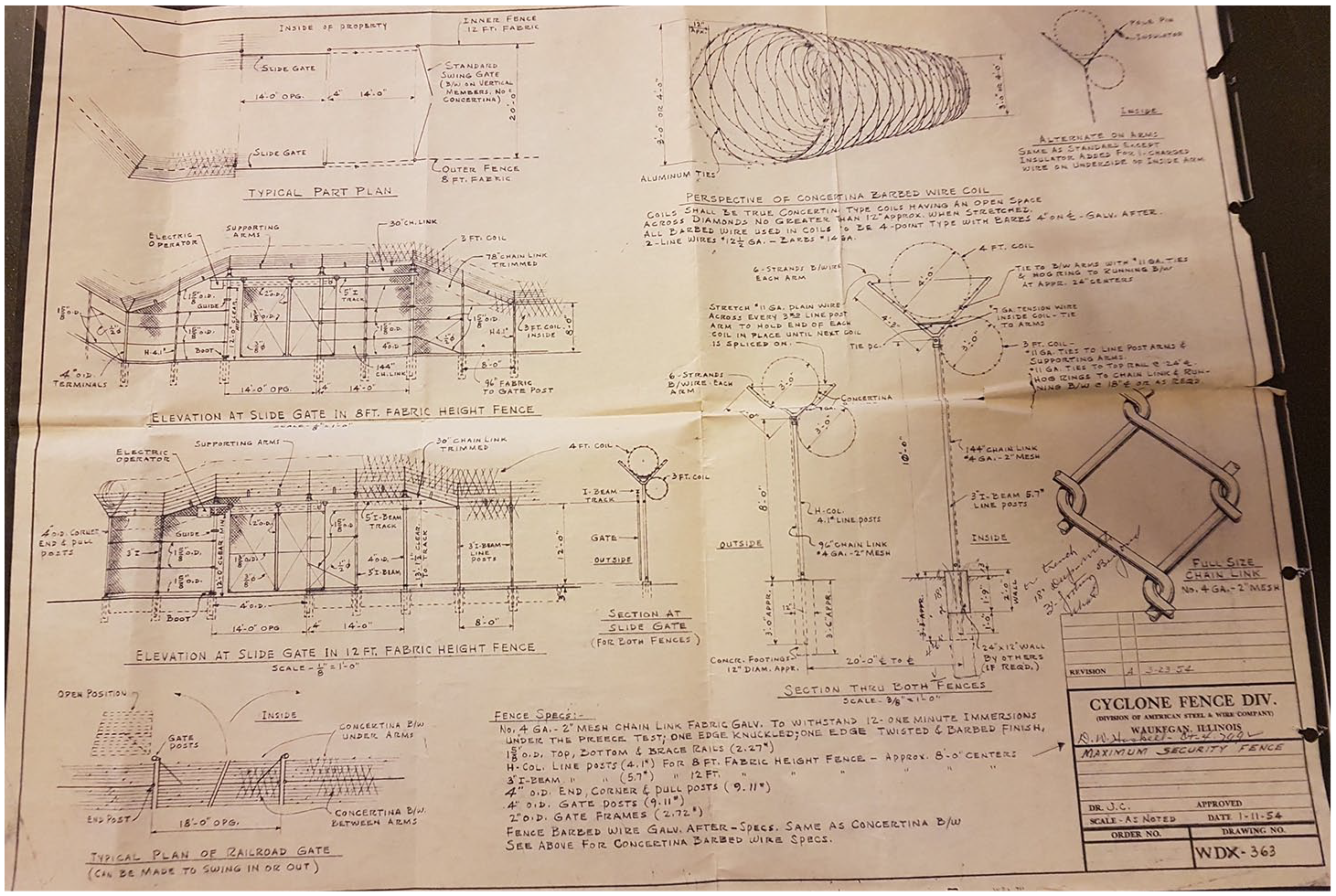
Fence design as envisaged in 1954 along the border between the United States and Mexico.
In 1947, the rationale for these two projects shifted from one primarily concerned with crimes and immigration to one about disease control. In January of that year, three US senators introduced S. J Res. 46, an emergency measure to prevent a foot-and-mouth disease outbreak in Mexico from spreading into the United States. Still, during debates on S. J. Res 46, the line between animal contagion and the fear of human invasion was blurred. Despite introducing S. J. Res. 46, on January 29, 1947, as an emergency measure to address the outbreak, immigration and smuggling resurfaced in discussions on the merits of allocating funds for the construction of the fence. As Senator Tom Connally from Texas noted when the Committee on Foreign Relations first considered S. J. Res. 46: this [foot-and-mouth disease] is just a particular incident that stimulated this thing. It has been a dream of the Department of State for many years to have this fence, not because of the hoof and mouth disease but for immigration and customs and smuggling and all of that sort of thing
32
In the 1950s, justifications for fencing projects authorized by the Act of August 19, 1935 followed similar motivations to those expressed in previous years by US officials. A report produced in March 1953 by David Snow, the Patrol Inspector in Charge of the Brownsville area, contended that the “construction of a boundary fence [in that area]. . . was almost imperative” to preventing smuggling activities, burglaries, and the crossing of “subversive elements,” notably sex workers. 33 The author of the report attributed the crime situation in and around the city of Brownsville to “undesirable and criminal elements of Mexico.” 34 The Mexican city of Matamoros, it explained, “is loaded with professional burglars, thieves, pickpockets, prostitutes, narcotics peddlers, beggars, bums, shoe shine boys and child thieves from all over Mexico.” 35 Alien prostitutes coming from the legalized red-light district of Matamoros were seen in dance halls, beer parlors, and cheap hotels of Brownsville. 36 The report predicted that a well-designed and appropriately manned 10-mile-long fence would eliminate these classes of “undesirable” foreigners. 37 The narratives that link vice, welfare abuse/public expenditures, and criminality to Mexican identity remained dominant and were perpetuated well into the second half of the 20th century.
2. Competing Visions of Immigration
The Secure Fence Act, signed into law on October 26, 2006, directed the Department of Homeland Security (DHS) to build at least 850 miles of double-layer fencing along five specified segments of the southern border. 38 It is following the adoption of this Act that DHS built most of the wall currently standing at the southern American border. Yet, the adoption of the Secure Fence Act was not necessary for the erection of these walled segments. The Act amended Section 102 of the Illegal Immigration Reform and Immigrant Responsibility Act of 1996 (hereinafter IIRIRA), which already provided a general authorization to the US Attorney General (now the Secretary of the US DHS) to erect such barriers along the border. 39 However, when the IIRIRA was adopted in 1996, provisions concerning border fencing went largely unnoticed. They were only secondary in an Act operating a fundamental overhaul of immigration law that contributed to further conflate the concepts of immigration and crime. 40 Notably, the IIRIRA reduced legal immigrants’ access to welfare, increased the range of offences under which they could be removed, mandated the detention of aliens ordered to be removed, and put constraints on judicial review of removal decisions. While several contentious proposals did not enter into law, the IIRIRA enacted some of the harshest measures ever taken against legal and illegal immigrants. Hence provisions relating to border enforcement, including fencing, were, as one observer noted, the “most humane method” to reduce undocumented immigration when compared with some of the measures proposed in the original Bill.41 By contrast, border fences are central to the Secure Fence Act.
The adoption of the Secure Fence Act is best understood in the light of the broader debate over immigration reform that animated the US Congress ahead of the 2006 mid-term elections, when all the seats of the House of Representatives and one-third of those of the Senate were contested. 42 In that context, the deliberations surrounding the Act provided the site for a contest between two competing visions of immigration, an issue hotly debated at the time: one focusing on border enforcement, and the other calling for a comprehensive reform of immigration law. The several legislative debates in the US Congress and hearings held before the adoption of the Secure Fence Act offered a stage where legislators could deploy narratives that favored a specific understanding of what US immigration law ought to achieve as they attempted to appeal to either their social conservative voters, on the one hand, and progressive or neoliberal constituencies, on the other.
Two legislative initiatives that preceded the adoption of the Secure Fence Act reflected this tension between the two visions of immigration. House Bill H.R. 4437—entitled Border Protection, Antiterrorism, and Illegal Immigration Control Act—advocated an “enforcement first approach.” It hinged heavily on border security, including more fencing and resources for the protection of the southern border. A protectionist and nationalist agenda guided the proponents of this Bill. They conceived of immigration as a security risk and a threat to American sovereignty, often conflating issues of immigration, crime, and terrorism. It was supported mostly by republicans and passed the House of Representatives on December 16, 2005.
Senate Bill S. 2611—entitled the Comprehensive Immigration Reform Act—sought, as the title suggests, a comprehensive reform of immigration, including a path to legalize undocumented immigrants in the United States. It did not reject enforcement altogether. However, the aim of a majority of Senators was to bring “illegal immigration under control and achieve border security” by combining enforcement “with a realistic framework for legal immigration”. 43 The Bill was a bipartisan initiative largely influenced by democratic Senator Ted Kennedy, from Massachusetts, and republican Senator John McCain, from Arizona. It passed the US Senate on May 25, 2006. Advocates of this approach aimed to reform immigration law to make it more responsive to the American job market. The adoption of the Secure Fence Act reflects the US Congress’ failure to reconcile the two bills, or visions. It also attests to the partial success of the “border enforcement” discourse over the more conciliatory understanding of (southern) immigration. The border wall provided for in the Secure Fence Act gave the appearance of action for those who favored vigorous border enforcement, while for those who did not subscribe to that vision, the Act provided a resolution of the issue at a low political cost.
Some Congressional representatives supporting a path to citizenship for undocumented immigrants hoped that their support for the erection of a fence would be interpreted as a “down payment” toward broader immigration reform. 44 Yet this strategy failed, as Jennifer Chacón explains, because these members’ support for a border wall reified “the popular but factually bankrupt narrative” that makes immigration enforcement a necessary condition of public safety. 45 The administration’s adherence to that narrative gave legitimacy to the misguided approach that sees “immigration as a crime and security problem to be solved rather than as a largely positive phenomenon in need of a more effective governing legal framework.” 46
II. Law as a Rhetorical Process: Building the Need for a Wall
When reviewing the debates that led to the adoption of the Secure Fence Act parallels between the contemporary narratives, or rhetoric, supporting the border wall and discourses held in the early 20th century are notable. Perhaps the declaration of Senator Rick Santorum the day the Senate adopted the Secure Fence Act provides the best illustration of the similarities between contemporary discourses and those of the past.
The current immigration crisis poses an immediate threat to our communities—gang violence, drug trafficking, murders, rapes, and the burdensome costs shouldered by our public education, health, and housing systems. Just last week the Immigration and Customs Enforcement arrested more than 100 criminals, fugitive aliens, and other immigration status violators living throughout Pennsylvania—from Philadelphia to York to Pittsburgh. Among those arrested were individuals convicted of sex offenses, burglary, larceny, robbery, criminal trespass, weapons violations, narcotics violations, aggravated assault, shoplifting, fraud, and resisting arrest.
47
Advocates for the Act of August 19, 1935 and the Secure Fence Act tapped into the criminalization of migrants to impress upon the US Congress and the American public the notion that border security, in the form of walls and fences, was not an option but a necessity. In the context of the Secure Fence Act, a series of hearings held by the House of Representatives in 2006 played a further role in legitimizing the narrative about Mexican criminality, all bearing suggestive titles that cast the border as a space of violence: Armed and Dangerous: Confronting the Problem of Border Incursions; Outgunned and Outmanned: Local Law Enforcement Confronts Violence Along the Southern Border; US Southern Border Security—National Security Implications and Issues for the Armed Services; Criminal Activity and Violence Along the Southern Border.
These legal debates underscore the role of the law as a site for the deployment of narratives that shaped understanding about Mexican identity. This points to James Boyd White’s argument that the law is usefully seen as a rhetorical activity or process, the outcome of which establishes, maintains, and transforms communities and culture. 48 Debates that preceded the adoption of the Act of August 19, 1935 and the Secure Fence Act were rhetorical exercises that described facts in a particular way to frame Mexican identity and southern immigration flows as a threat to be curtailed. The southern threat became the rallying myth supporting the corpus juris, that is, the legal prescriptions, authorizing the erection of border fences. 49
In justifying the erection of border fences, lawmakers and federal officials painted Mexican identity in the opposite image of the Anglo-American. This mode of differentiation is perhaps most famously expressed by Edward Said’s concept of Orientalism to describe a discursive process that makes “essentially reductive negative generalizations” about the Arab world. 50 It is a process where the other group’s identity is shaped either in opposition to the West or as a reflection of undesirable elements of Western society—the delinquent, the insane, the poor—as “problems to be solved.” 51 Essential ideas that are central to Orientalism revolve around the other’s “sensuality, its tendency to despotism, its aberrant mentality, its habits of inaccuracy, its backwardness—into a separate and unchallenged coherence.” 52 Although Said was interested in the relationship between Occident and Orient, the discursive process of othering that he describes applies to other groups, including Hispanics. 53 In this instance, the laziness and indigence of the Mexican neighbor, exemplified by his propensity for beggary, menial work, and exploitation of American public services, was seen as in stark opposition to the industriousness of Anglo-Americans. Chaos and lawlessness contrasted with an ordered, law-abiding, and virtuous American nation.
Language is crucial to this rhetorical process. For linguist Joshua Fishman, language is an important carrier, and thus producer, of meaning about how social relations ought to be imagined: Language itself is content, a referent for loyalties and animosities, an indicator of social statuses and personal relationships, a marker of situations and topics as well as of the societal goals and the large-scale value-laden arenas of interaction that typify every speech community.
54
Legal relations, indeed, are to a large extent created by categories and definitions expressed in language: “we make ourselves [and others] by making our language.” 55 Legal debates surrounding the adoption of the Act of August 19, 1935 and the Secure Fence Act illustrate the persistence of a certain vocabulary in the discourse of US officials when defending the need for a wall. In both instances, federal agencies and members of US Congress relied on a language heavy on generalizations, stereotypes, and metaphors around themes such as criminality, and licentiousness to justify the recourse to a border wall. If taken at face value, these discourses supplied the demands for walls with an explanation, they were more importantly a reflection of Anglo-American values and beliefs that permeated the law.
The repeated use of an othering language over time became the dominant narrative and a frame of reference that informed policy at the US–Mexico border. Even if less than 100 miles of fencing were built in the first half of the 20th century, this language remained a constrictive paradigm that made it harder to imagine alternative visions of the Mexican neighbor. This is illustrated by the fact that the desire for walls never fully disappeared from American consciousness. To the contrary, ever so often since the end of the 1950s, the American public, US officials, and lawmakers demanded the construction of border walls at the US–Mexico border. Since then, fences never ceased to be contemplated as an instrument for the governance of the relationship with the Mexican neighbor. The impetus for walling reached its apex with the adoption of the Secure Fence Act in 2006, which allowed for the building of hundreds of miles of barriers along the American southern border.
Another point the review of these legal debates highlights is how race has interacted with law to shape perception about a Mexican threat. Although no specific reference to race or ethnicity appeared in the text of the Act of August 19, 1935, racial considerations were evident in debates prior to its adoption. Behaviors and characters were defined along racial and ethnic lines, reinforcing stereotypes about Mexican identity. Race as a criterion for differentiation was most evident in the early 1930s, when racial identity, based on biological referents, was used to support assumptions about the inferiority, undesirability, and criminal propensity of Hispanic people.
These narratives shadowed the complexities of the transborder networks and structural conditions that stimulated crimes and smuggling activities, and made the vice industry flourish in Mexico and at the borderland more generally. For instance, as historian Deborah Kang explains, during the prohibition era, American citizens were in large part responsible for the success of these industries. Americans moved south to establish their smuggling activities; they also owned the majority of saloons, gambling parlors, and racetracks that attracted Americans south of the border. 56 Similarly, the association between Mexican women and prostitution, as Mae Ngai contends, did not rest on fact. 57 While some women were forced into prostitution for survival, others were wives accompanying their husbands working on American farms or domestic workers. 58 Instead, most assertions about the criminality of Mexican women rested on anecdotal claims.
In the second half of the 20th century, legislators muted express racial justifications when considering the construction of border fences. Yet, narratives underpinning the adoption of the Secure Fence Act highlight the continued influence of race and ethnicity in shaping today’s understandings about US–Mexico relations. The distinctive treatment by the US government of its southern and northern land borders reinforces this argument. The importance of the 2001 September terrorist attacks in supporting the narrative of a spatialized terror threat located at the southern border is at odds with the fact that there had been no case of suspected terrorists attempting to enter the United States through the southern border before 2006. However, there had been instances of individuals allegedly determined to commit acts of political violence entering at the US–Canada border. 59 These considerations should have directed attention to the northern border as a priority. Yet, no walls are prescribed at the northern border in the Secure Fence Act. Instead, the insistence on the southern border contributed to locating the “war on terrorism” at the boundary between the United States and Mexico, echoing a century-old discourse that associates lawlessness and violence with the southern neighbor and the southern border.
Importantly, the text of the Secure Fence Act reproduces this discourse when it introduces a rapprochement between immigration and terror, between the unlawful entrant and the terrorist, the unlawful combatant. This is apparent in the definition the Act gives of operational control—the primary objective of the fences—as “the prevention of all unlawful entries into the United States, including entries by alleged terrorists, other unlawful aliens, instruments of terrorism, narcotics, and other contraband” (emphasis added). 60 Through this “metonymic slide,” the anxiety aroused by the terrorist is extended to the mass of unlawful entrants contributing to constitute the two characters as a common threat. 61 Such movement from one figure to the other is only possible, according to Sarah Ahmed, because of certain associations between the two that are already in place. 62 If we pay attention to the narratives that supported the adoption of the Secure Fence Act, the associations are apparent. Both the undocumented entrant and the terrorist are imagined as an invasion of the nation’s territory, a danger that comes from without. Both are read as material threats, precursors of economic decline, and physical violence. Both threats are racialized. Both are constructed as dangers to the social and cultural fabric of the nation.
A number of insidious consequences emerge from this language that tends to compound all undocumented border flows with crimes. One is to deny the individuality, even the humanity, of the individuals that make up that category; there are only unlawful aliens. Representing the Mexican neighbor in that way objectifies her/him and makes it difficult to conceive of undocumented entry as other than a menace to the community as it brings into the totalizing unit of the lawbreaker all people entering outside ports of entry. This representation facilitates generalizations about the criminality of undocumented crossings, leaving little room for considering the many circumstances and experiences that bring people to cross the border undocumented and the possibility that they be well-intentioned. Notably, in this legal construction, the commuter who crosses into the United States to shop or visit family and even the more controversial figure of the undocumented worker are lost. Criminality is all that is left. As the figure of the unlawful entrant becomes entwined with terror, the perception of the degree of threat she poses to the American community is intensified and gives the state grounds to respond through hostile measures such as walls.
III. Divisive Precedents at the US Southern Border
When we examine the legal framework that has governed the erection of fences and walls at the US–Mexico border, we see a progression in the form these laws have taken and how each new iteration of the legal authorization to build border walls is increasingly explicit. The Act of August 19, 1935 was a procedural piece of legislation that merely provided an authorization to the State Department to erect fences at the border with Mexico. It can be thought of as a form of “private communication” between the legislator and the executive, who ought to carry out the law. 63 Despite the fence being secondary to the debate surrounding the 1996 IIRIRA, Section 102 of the Act marked a change in how law engaged with border fortifications and initiated a more conscious and structured approach to border wall construction. The Act, while still addressing US officials in priority, reframed the issue of wall building from a question governed by administrative law to one firmly rooted in the domain of immigration law, moving away from the general authorization provided in the Act of August 19, 1935. It also reinforced the association between immigration and crime. The IIRIRA signaled a more hands-on approach by lawmakers on the issue of wall building that also heralded the growing potency of the border enforcement discourse in national law and politics. Whereas in the past, fence projects had been initiated primarily by the executive branch of government, especially the Immigration and Naturalization Service (INS), this time, lawmakers in Congress were taking ownership of the issue, notably by directing the US Attorney General to build a fence and setting specific obligations concerning its location, length, and design.
It is only in 2006, however, with the adoption of the Secure Fence Act that the wall became a legislative centerpiece in the midst of a highly publicized debate on immigration. In a fundamental departure from previous provisions regulating the erection of walls at the southern border, the Secure Fence Act introduced into the law the othering narratives that for more than a century had justified closing the border but had not previously been reflected in the text of the law itself. Had it not been for the persistence and intensification of othering narratives about the southern neighbor and the representation of the border as a dangerous space, it is unlikely the Act would have been adopted in its current form.
This brings me to the idea of legal precedent to explain further the relations between the law and the construction of the border wall. In both common law and civil law traditions, legal precedents refer to previous court decisions that will guide judgments in future like cases. We do not speak of written law as a precedent. Still, I want to argue that legal texts and the discourses that justify them operate in a similar way to legal decisions and the doctrine of legal precedent, which by nature “requires the denying of competing narratives, historical incongruities, and the wider contextual considerations in which the original case was determined.” 64 Legal texts, like court judgments, take one set of facts or one version of a story and elevate it to the status of validated truth. 65 As they become the law, these stories gain authority because the legislative process that underpins the adoption of a legal text is seen as a guarantee that legal outcomes reflect superior information about the issues they regulate. 66
Developing the idea of precedents of injustice—instances of lawlessness silenced in legal records but essential to establish the rationale of a legal case and to create the condition for applying that rationale in the future—Eve Darian-Smith notes that ignoring these precedents: precludes us from seeing the larger structural inequalities and political contexts . . . [and] from fully understanding law in the United States for what it is—a site of constant struggle and negotiation over what constitutes ‘legitimate’ social, cultural, political, and economic interests at any one moment in time.
67
She adds that racially motivated precedents are hard to identify because they are usually excluded from the text of the law—as is the case with legal provisions authorizing the construction of border fences. 68 Still, it is essential to recognize these precedents of injustice because they shape legal knowledge. 69 As Nicolas Pedriana and Robin Stryker note, “values and language of prior law combine symbolic politics with state coercive power to create opportunities and constraints on later interpretation and mobilization of law by both state and societal actors.” 70 Hence, acts and statutes may influence the beliefs of the public and officials about what constitutes appropriate behaviors and inform future actions. 71
The concept of precedent is useful in understanding how the law facilitated the construction of the US–Mexico border wall. Early legal debates surrounding the adoption of the Act of August 19, 1935 provided the site for negotiating competing visions of the southern border and neighbor. In adopting the Act, legislators discarded narratives favorable to southern migrants and confirmed othering narratives proposed by fencing proponents. Through that process, a language or repertoire for describing and understanding Mexican identity and the US–Mexico border emerged, creating a legal precedent that informed future actions. Lawmakers drew from this repertoire when adopting new measures allowing the construction of border walls. With time, direct references to race were muted during legislative debates; still, legal texts authorizing border walls became increasingly ambitious in form and content.
From a modest authorization to erect fences at the border, buried deep within an obscure 1935 procedural act on the division of water between the United States and Mexico, in 2006, walling provisions became part of a prominent piece of symbolic legislation when Congress adopted the Secure Fence Act. As a result of a year-long debate over two competing narratives about immigration, the Act builds on othering narratives of Mexican identity that silenced alternative discourses about immigration put forward by proponents of a comprehensive reform of immigration law. For better or worse, it also excludes the many alternative remedies proposed in bills H.R. 4437 and S. 2611 to address undocumented immigration. The Act produces “an official version of the truth,” 72 which conceives of the southern border as a danger and the fence as the exclusive valid remedy to that threat. As with any form of legal precedent, the Act simplifies facts about illegal immigration and sums them up into one principle: border enforcement, for which the wall became the symbol.
As a discourse that conveys a vision of southern immigration in terms of criminal law and border enforcement, the Secure Fence Act provides a normative canvas that has structured meanings and informed later actions on immigration. It has set the tone over the issue of undocumented immigration by committing the US government to divisive and punitive strategies, thereby constraining opportunities for more compassionate options. This is illustrated by the failure to achieve a comprehensive immigration reform in 2013 and the rise of an “enforcement first” philosophy, whereby almost all measures considered to regulate illegal immigration have since focused on enforcement.
The most significant consequence of the Secure Fence Act is to narrow the narrative of border enforcement to the erection of the wall. The overwhelming attention placed on the border wall naturalizes it as a legal remedy to undocumented migration and unlawful crossings and, therefore, fuels demands for its construction. Responsive to the popular trend, US House and US Senate members introduced dozens of bills to fund the border wall or to demand more fencing (e.g., People’s Border Wall Fund Act, Fund and Complete the Border Wall Act, Border Fence Trust Fund Act of 2009), despite evidence about the failure of a border wall to curb unwanted border flows. 73 Then, in 2015 during the US presidential campaign, the “build a wall” narrative became a powerful rallying slogan for presidential candidate Donald Trump, who sought to appear tough on border enforcement. Two years later, the Secure Fence Act and the IIRIRA provided him with the legal basis for issuing Executive Order 13767, ordering the DHS to “immediately plan, design, and construct a physical wall along the southern border.” 74
The adoption of the Secure Fence Act has also emboldened people to take action when their demands for walls are refused by the government. For instance, in 2011, the State of Arizona tried to compel the DHS to complete the construction of the fences provided for in the Secure Fence Act. 75 In a counterclaim against the United States, brought before the District Court of Arizona by the State of Arizona and Governor Janice K. Brewer, the counterclaimants argued that the Secure Fence Act requires the DHS to achieve operational control of the border and to build at least 850 miles of fencing. It further argued that this obligation could not be withheld or delayed unreasonably and therefore sought an injunctive, declaratory, and mandamus relief against the United States and the DHS to complete it and take temporary measures to protect Arizona. Although the Court dismissed the claim and found that it could not compel the DHS to erect specific sections of fencing, the incident demonstrates how central the wall has become as a symbol of protection in the imagination of public officials following the adoption of the Secure Fence Act. It also highlights how, because of the definition of operational control in the Act and the identification of the fence as the path to achieving it, the failure to build a wall can be interpreted as a breach of the state’s responsibility to protect its population from perceived external threats.
Of course, not all audiences agree with the divisive message of the Secure Fence Act. In Nogales and at other segments along the US–Mexico border, artists have used the wall as a canvas to deflect the image of the closed border that it embodies. The US–Mexico border, Amilhat Szary explains, must be understood as a resistance scene of shifting narratives that creates opportunities for protesting against American policies of division. 76 Several advocacy groups and artists have answered the call and staged performances at the border that question and challenge the border wall’s narrative of exclusion. The performances of these communities, the way they appropriate the wall for themselves to challenge the narrative of a divisive landscape encourages questions about its legitimacy and highlights its indeterminacy. This said, for now, their impact on law and policy is limited, and the discourse that supports and is replicated in the Secure Fence Act still resonates strongly in certain Washington circles, not least inside the walls of the White House.
IV. Conclusion
Since 2016, the attention surrounding northbound flows of people crossing the US–Mexico border has soared as Donald Trump has made the construction of a border wall a central theme of his presidency. For all that is said and written about the wall, however, we rarely question its relationship to the law, even less so from a historical perspective. The events surrounding the adoption of the Act of August 19, 1935 and the adoption of the Secure Fence Act of 2006 show the law’s centrality in shaping the perceived need for a wall at the US–Mexico border for almost a century. In analyzing current legal narratives in light of those of the past, we can identify structural connections between the two legislative moments authorizing the construction of barriers between the United States and Mexico. In both periods, legal debates provided the site for deploying othering narratives that constructed understandings about the southern neighbor and the border around the themes of vice, abuse, criminality, and danger. Although rarely mentioned explicitly, race nonetheless informed these discourses.
Building on the values and language enshrined in legal precedents, each new legal text authorizing the construction of border fences brings immigration and crime closer together, heightening the perception that a wall is necessary. They are also bolder in regard to fencing requirements. The erection of hundreds of miles of walls under the authority of the Secure Fence Act engraved an “us” versus “them” discourse onto the border landscape. As the wall grows longer and sturdier, division is learned and becomes normal. The proposition that the law is made up of processes of exclusion finds application here. For Margaret Davies, the law is in many respects “a large-scale exercise in social line-drawing” between inclusion and exclusion. 77 There are few instances where the law provides a more literal answer to the question than in relation to the drawing of a national border and its further crystallization with the erection of a wall. With these material changes, the risk is that it becomes impossible to imagine a space undivided.
Footnotes
Funding
The author(s) disclosed receipt of the following financial support for the research, authorship, and/or publication of this article: This research received funding from the Australian National University and the Max Planck Institute for the Study of Religious and Ethnic Diversity.
1.
Secure Fence Act of 2006, Pub L No 109-367, 120 Stat 2638 (2006).
2.
See for instance: Geoffrey Alan Boyce, Samuel N. Chambers, and Sarah Launius, “Bodily Inertia and the Weaponization of the Sonoran Desert in US Boundary Enforcement: A GIS Modeling of Migration Routes through Arizona’s Altar Valley,” Journal on Migration and Human Security 7 (2019), 23–35. The authors explained the impact of the US Border Patrol’s strategy of “prevention through deterrence” on the number of migrants’ deaths.
3.
Wendy Brown, Walled States, Waning Sovereignty (New York: Zone Books, 2nd ed, 2017), 36.
4.
See Matthew Longo, The Politics of Borders: Sovereignty, Security, and the Citizen after 9/ 11 (Cambridge: Cambridge University Press, 2018), 64; Brown, Walled States, 97–99.
5.
Judith N. Shklar, The Faces of Injustice (New Haven: Yale University Press, 1990), 19. See also Austin Sarat and Thomas R. Kearns (eds) Justice and Injustice in Law and Legal Theory (Ann Arbor: University of Michigan Press, 1998).
6.
Act of August 19, 1935, 49 Stat. 660 (1935).
7.
Michael Dear, Why Walls Won’t Work: Repairing the US-Mexico Divide (Oxford: Oxford University Press, 2013), 1; Neil Foley, Mexicans in the Making of America (Cambridge: Harvard University Press, 2014), 39.
8.
Joseph Nevins, Operation Gatekeeper and Beyond: The War on “Illegals” and the Remaking of the U.S.-Mexico Boundary, 2nd edn. (New York: Routledge, 2010), 23.

10.
Treaty of Peace, Friendship, Limits, and Settlement with the Republic of Mexico (Treaty of Guadalupe Hidalgo), signed February 2, 1848, TS 207 (entered into force May 30, 1948).
11.
Dear, Why Walls Won’t Work, 38. See also Andrés Reséndez, Changing National Identities at the Frontier: Texas and New Mexico, 1800–1850 (Cambridge: Cambridge University Press, 2004), 2.
12.
Rachel St. John, Line in the Sand: A History of the Western U.S.-Mexico Border (Princeton: Princeton University Press, 2011), 296, 119, 138–39.
13.
S. Deborah Kang, The INS on the Line: Making Immigration Law on the US-Mexico Border, 1917–1954 (New York: Oxford University Press, 2017), 11, 32.
14.
David G. Gutiérrez, Walls and Mirrors: Mexican Americans, Mexican Immigrants, and the Politics of Ethnicity (Berkeley: University of California Press, 1995), 72.
15.
Gilberto Cardenas, “The United States Immigration Policy Toward Mexico: An Historical Perspective,” Chicano Law Review 2 (1975), 66–91.
16.
Kang, The INS on the Line, 45.
17.
Act of February 27, 1925, Pub L No 68-502, 43 Stat 1049-1050 (1925); Kelly Lytle Hernandez, Migra!: A History of the U.S. Border Patrol (Berkeley: University of California Press, 2010), 35.
18.
Act of March 4, 1929, Pub L No 1018, 45 Stat 1551 (1929). See Nevins, Operation Gatekeeper and Beyond, p. 68; Cardenas, “The United States Immigration Policy Toward Mexico”, 73.
19.
20.
Francisco E. Balderrama and Raymond Rodriguez, Decade of Betrayal: Mexican Repatriation in the 1930s (Albuquerque: University of New Mexico Press, 1995), 158.
21.
Act of August 19, 1935 § 2.
22.
Oscar J. Martínez, “Border Conflict, Border Fences, and the ‘Tortilla Curtain’ Incident of 1978–1979,” Journal of the Southwest 50 (2008), 266–67.
23.
R. M. Cousar, Inspector in Charge, Nogales to District Director, Immigration Service, El Paso, November 22, 1928, file 55 606/894, RG 85, National Archives.
24.
Nick D. Collaer and H. C. Horsley to District Inspector, Immigration and Naturalization Service, February 23, 1934, file 55606/894 RG 85, National Archives.
25.
Op. cit.
26.
Op. cit.
27.
Op. cit.
28.
Op. cit.
29.
Op. cit.
30.
The IBC was an international body comprising a Mexican and American section. It was renamed the International Boundary and Water Commission (IBWC) in 1944.
31.
House of Representatives, Subcommittee of the Committee on Appropriations, 79th Congress, 1st Session, First Deficiency Appropriation Bill for 1946 (November 3, 1945) 678. See also Senate, Subcommittee of the Committee on Foreign Relations, 80th Congress, 1st Session, S. J. Res. 46: Maintenance of the Western Land Boundary Fence Project and the Rio Grande Border Fence Project (March 13, 1947) 14.
32.
Senate, Committee on Foreign Relations, 80th Congress, Executive Session, S. J. Res. 46 (February 25, 1947), 14.
33.
David Snow, Patrol Inspector in Charge, Brownsville, Texas, report to Fletcher L. Rawls, Chief Patrol Inspector, McAllen, Texas, March 20, 1953, file 56363/44.14, RG 85, National Archives, p. 1.
34.
Op. cit., p. 2. Snow noted that burglary and robbery rates in 1952 in Brownsville were 2000% higher than in other comparable American cities.
35.
Op. cit.
36.
Op. cit.
37.
Op. cit., p. 4; W. F. Kelly to J.W. Holland, April 2, 1953, file 56364/44.14, RG 85, National Archives.
38.
Secure Fence Act § 3; Chad C. Haddal, Yule Kim and Michael J. Garcia, Border Security: Barriers Along the U.S. International Border (Congressional Research Service, 2009). The U.S. Congress amended these fencing requirements in the Consolidated Appropriations Act, 2008, Pub L No 110-161, div. E, 121 Stat 1844 (2007).
39.
Illegal Immigration Reform and Immigrant Responsibility Act of 1996, Pub L No 104-208, Div C, 110 Stat 3009 §102 (d).
40.
Jennifer M. Chacón, “Unsecured Borders: Immigration Restrictions, Crime Control and National Security,” Connecticut Law Review 39 (2007), 1842.
41.
The New York Times, January 13, 1996, 8.
42.
See Doris Meissner, “Keynote Address,” Temple Political & Civil Rights Law Review 16 (2007), 310. In her keynote address, Meissner noted that the issue of “immigration reform is going straight to the electorate in November in the form of something called the ‘Secure Fence Act’”.
43.
152 (16) Congressional Record 21395 (2006, Senate).
44.
Jennifer M. Chacón, “Essay: Immigration and the Bully Pulpit,” Harvard Law Review Forum 130 (2017), 249.
45.
Ibid.
46.
Ibid.
47.
152 (16) Congressional Record 21489 (2006, Senate).
48.
James Boyd White, “Law as Rhetoric, Rhetoric as Law: The Arts of Cultural and Communal Life,” University of Chicago Law Review 52 (1985), 684.
49.
Indeed, as Robert Cover notes, “no set of legal institutions or prescriptions exists apart from the narratives that locate it and give it meaning.” State law, he argues, consists of a corpus juris, but also language and myths (narratives) to justify the former: Robert M. Cover, “The Supreme Court, 1982 Term–Foreword: Nomos and Narrative,” Harvard Law Review 97 (1983), 4, 9. See also: Peter Brooks, “The Law as Narrative and Rhetoric” in Law’s Stories: Narrative and Rhetoric in the Law (Peter Brooks and Paul Gewirtz, eds) (New Haven: Yale University Press, 1996), 14. Although Brooks is mostly interested in the analysis of case law, his remarks are also relevant to legal texts. A similar point is made by Teemu Ruskola when he contends that material conditions support and give rise to certain legal representations and ideologies: Teemu Ruskola, “Legal Orientalism,” Michigan Law Review 101 (2002), 197.
50.
Edward W. Said, Orientalism (New York: Vintage Books, 1979), 296.
51.
Op. cit., 207. See, also, Ruskola, “Legal Orientalism,” 209: “Structurally, Orientalism as a discourse entails the projection onto the Oriental Other of the kinds of things that we are not.”
52.
Said, Orientalism, 205.
53.
See, e.g., Laura M. Goodall, “The ‘Otherized’ Latino: Edward Said’s Orientalism Theory and Reforming Suspect Class Analysis,” University of Pennsylvania Journal of Constitutional Law 16 (2014), 835–860.
54.
Joshua Fishman quoted in Michelle L. Burgis, Boundaries of Discourse in the International Court of Justice: Mapping Arguments in Arab Territorial Disputes (Leiden: Martinus Nijhoff, 2009), 34.
55.
White, “Law as Rhetoric, Rhetoric as Law,” 698.
56.
Kang, The INS on the Line, 38.
57.
Mae M. Ngai, Impossible Subjects: Illegal Aliens and the Making of Modern America (Princeton: Princeton University Press, 2014), 149.
58.
Op. cit.
59.
The CATO Institute reports that seven individuals who initially entered illegally the United States have been convicted of planning a terrorist attack on U.S. soil. These individuals entered either illegally from Canada or through an American maritime port: David Bier and Alex Nowrasteh, 45,000 “Special Interest Aliens” Caught Since 2007, But No U.S. Terrorist Attacks from Illegal Border Crossers, CATO Institute (2018).
60.
Secure Fence Act § 2(b). Section 2(a) of the Secure Fence Act requires the Secretary of Homeland Security to take all actions necessary and appropriate to “achieve and maintain operational control over the entire international land and maritime borders of the United States” including through technologies and physical infrastructure enhancements. Section 3 requires, as mentioned previously, fencing at specific segments of the border.
61.
I borrow the term from Sara Ahmed, who discusses the process in the context of antisemitism: Sara Ahmed, “Collective Feelings: Or, the Impressions Left by Others,” Theory, Culture and Society 21 (2004), 26.
62.
Op. cit.
63.
See Desmond Manderson, Songs Without Music: Aesthetic Dimensions of Law and Justice (Berkeley: University of California Press, 2000), 58.
64.
See Eve Darian-Smith, “Precedents of Injustice: Thinking About History in Law and Society Scholarship,” Studies in Law Politics and Society 41 (2008), 66.
65.
Op. cit.
66.
Pratheepan Gulasekaram, “Why a Wall?,” UC Irvine Law Review 2 (2012), 169–70.
67.
Darian-Smith, “Precedents of Injustice,” 63.
68.
Op. cit.
69.
Op. cit., pp. 66–67.
70.
Nicolas Pedriana and Robin Stryker, “Political Culture Wars 1960s Style: Equal Employment Opportunity–Affirmative Action Law and the Philadelphia Plan,” American Journal of Sociology 103 (1997), 642.
71.
Gulasekaram, “Why a Wall?,” 170.
72.
Darian-Smith, “Precedents of Injustice,” 66.
73.
Arizona Advisory Committee to the U.S. Commission on Civil Rights, “Briefing on Tragedy along the Arizona-Mexico Border: Undocumented Immigrants Face Death in the Desert” (Briefing Before the Arizona Advisory Committee to the U.S. Commission on Civil Rights, Tucson, August 23, 2002), 9.
74.
Executive Order No 13767, 82 CFR 8793 (2017) § 4 (a).
75.
United States v. Arizona, 2011 WL 13137062 (D Az, October 21, 2011).
76.
Anne-Laure Amilhat Szary, “Walls and Border Art: The Politics of Art Display,” Journal of Borderlands Studies 27 (2012), 214.
77.
Margaret Davies, “Exclusion and the Identity of Law,” Macquarie Law Journal 5 (2005), 6.