




Abstract
This article examines the Huawei 5G controversy in Europe through the lens of social group dynamics and power shifts. It traces Huawei’s European journey from the deregulation of telecommunications in the 1980s to the company’s recent challenges following the US ban. Utilizing theories of the social construction of technology, the study investigates four meta-categories of social actors defining the 5G technology disruption in the Huawei situation, showcasing the evolving roles of various social groups and the impact of geopolitical rivalry.
Introduction
As Feenberg (1992) noted, the form of technologies remains largely unnoticed except during rare times of controversy or redesign. The overall discussion of 5G technology was not that popular until Huawei – a China-based telecom supplier and phone manufacturer – caught the public’s attention when its chief financial officer, Meng Wanzhou, was arrested by the Canadian police for extradition to the United States on suspicion of violating US sanctions against Iran at the end of 2018 (Conger, 2018). With the Huawei ban in effect in the US, the White House saw the European preparations for 5G networks with Huawei also as a security risk for the US (Emmott, 2019). Being not only an important market for Huawei’s network, business and products, Europe also provides highly trained workers for Huawei’s R&D activities and manufacturing infrastructure (Drahokoupil et al., 2017). According to Huawei’s official data, it has invested more than US$10 million in 5G testbeds and trials in Europe, and signed more than 47 5G commercial contracts with European partners (Huawei company website, 2020). Indeed, Europe is the most strategic region for Huawei’s 5G technology rollout, which placed various European governments and network carriers in a paradoxical situation after the Huawei ban.
Unlike the technological deterministic belief that technology is the driving force for social and cultural change, the social constructionist theory highlights the importance of social factors that impact the development and use of technological artefacts and the political, economic and cultural environment in which the technology innovation was situated. Pinch and Bijker (1987) outlined four classic social factors: relevant social groups, interpretive flexibility, closure and stabilization. Based on that, Humphreys (2005) extended the original social construction of technology (SCOT) model and introduced meta-categories of relevant social groups: producer, advocates, users and bystanders (Humphreys, 2005: 235–238):
Producers: those who have a vested economic interest in the continued proliferation of a technological artefact and engage in/influence directly the construction of an artefact.
Advocates: those who have a political stake in technology without direct influence over the ways in which technologies are constructed.
Users: those who socially construct technology (directly) through their use or potential use of it.
Bystanders: those who have no vested interest in a particular artefact nor direct involvement but whose opinions and language may shape the social construction of technology.
From the definition of these meta-categories, only advocates are particularly connected to the political influence of technology innovation. Winner (1980) and Douglas (1990) both suggested that technologies can be politically used in ways that enhance power and authority. Ninan (2008: 186) further pointed out that the process of technology development connects closely to political choices, pervasive national identity, and the nation’s development. Burns et al. (2016: 17–20) also argued that government authorities could play a decisive role in facilitating the introduction of (technology) innovation, and that socio-political uncertainty may slow down, distort or block the eventual development of the innovation. In the field of telecommunication technology, the role of the state as owner, operator, regulator, facilitator, contributor and supporter has been discussed extensively (i.e. Bauer, 2010; Duch, 1991; Eliassen and Form, 2007). Scholars have also applied SCOT to contextualize the generation shift of telecommunication (Balbi, 2009, 2013; Kline, 2000) and pointed out that politics mattered not only in the country-specific environment for telecommunication technology rollout, but also in setting international standards through the establishment of the International Telecommunication Union (ITU) (Balbi et al., 2014). However, all the case studies were mainly nation-based (Balbi, 2013; Shin, 2007) rather than company-based. How geopolitical development could jointly shape telecommunication technology connected to specific industrial players hasn’t received sufficient research.
What’s more, most studies of SCOT have looked at the relevant social groups in a historical context, where social-technical arrangements have already been in place or the processes of technology stabilization had been completed (Flichy, 2007). Far less empirical research of SCOT studied emerging new technology during its process of designing and stabilizing (Liao, 2018). This article traces Huawei’s rise and business path in Europe through historicizing the European telecommunication market since its deregulation in the 1980s. It also sheds light on the different technological and communicative frames that are deployed to define the ‘future vision’ of 5G technology in the Huawei case.
Two fundamental concepts from SCOT are discussed in this paper. The first concept is the identification of ‘relevant social groups’ as the focal point of SCOT. Because 5G hasn’t been widely commercialized at the moment of writing, the social group of individual users is not considered. This paper focuses only on ‘organized’ social groups and looks at the power asymmetry among them (Klein and Kleinman, 2002: 30). The goal is to understand how specific social groups dominate the construction processes of Huawei’s 5G technology in Europe while other social groups are forced out.
The second concept is interpretive flexibility as both the cause and consequence of Huawei’s 5G controversy in Europe. Considering the rollout of new telecommunication networks is often accompanied by a great deal of uncertainty regarding its potential utility (Balbi and John, 2015), the introduction of 5G encounters more uncertainties and serious disagreements, as it refers to a set of new and different technologies that heavily depend on standardization and economies of scale due to its complicated system (Chen and Zhao, 2014). Consequently, the strategic use of 5G interpretive flexibility by particular social groups resulted in Huawei’s dilemma in the European market. This paper extended the discussion from national politics on 5G introduction to how the geopolitical complexity added uncertainties to facilitate/defend threats to 5G development, and how ‘the communication about the technologies becomes more important than the technologies in shaping the uses and effects of new media’ (Baym, 2010: 41).
Data and method
There are three sets of data collected for the analysis: (1) official company data from Huawei and Huawei’s 5G partners in Europe, including Huawei’s annual corporate reports (2010–2019), Huawei corporate news and internal corporate publication (Huawei People magazine, 1993–2020),Vodafone corporate news, and Deutsche Telekom (DT) corporate news; (2) official documents from the European Commission and the Chinese government relating to the information and communication technology (ICT) industry and telecommunication market; (3) news stories from Chinese and international media outlets, including profile stories from Huawei executives in Europe as second-hand personal interpretations (since interviews didn’t take place as planned) and news items from Factiva Database with the keyword search of Huawei and 5G in Europe. A critical analysis of primary and secondary sources is offered to situate the Huawei case during the prehistory of Huawei in Europe (1987–2012) and Huawei’s 5G technology development in the region (2012–2020).
Findings and discussion
Construction of Huawei telecommunication technology in Europe: Social groups
Following Humphrey’s extended SCOT model, the four meta-categories are identified in the Huawei case:
Producers: Huawei company and its European partners (telecom carriers);
Advocates: the Chinese government, the European Commission and European governments;
Bystanders: the American government and the European media; and
Users: European telecom carriers as Huawei’s business partners and European consumers as organized social groups during the anti-5G movement.
Different social groups played different roles. Their different conceptualization of telecommunication technology, Huawei’s corporate identity, and especially what was 5G and what 5G implied attribute different frames and priorities to shape the technology. Besides a clear tendency of role-shifting to ‘producers’ from different social groups, three different technological and communicative frames were identified in the analysis: (1) focus on telecommunication technology improvements, leading patent profile and innovations; (2) focus on marketing and device strategy; and (3) focus on security concerns.
The innovation-based Huawei (5G) technology
In the late 1980s and early 1990s, the entire Chinese telecom industry relied completely upon its acquisition of telecom equipment through imports from American and European vendors (Fan, 2006). This technology dependence and the expensive licensing fees paid for patent use to leading Western companies pushed Beijing to escalate the scale and scope of China’s self-sustaining model of ICT development, and to encourage, on a large scale, the entry of non-state-owned enterprises in the ICT manufacturing industry in the 1980s (Wen, 2020: 28). Following that, the Shenzhen government issued the ‘Tentative Provisions on Encouraging Technology and Science Personnel to Establish Non-State-Owned Technological Enterprises (1987)’ document in February 1987, which officially lifted the control on private ownership in the high-tech sector. Huawei was established in Shenzhen during the same year and began very quickly investing in research and development (R&D) and manufacturing its own products. According to the inaugural issue of Huawei People magazine in 1993, the company’s vision was clearly stated as ‘to continuously improve its position in China, and to move closer to international companies through Huawei’s high-quality products and excellent services’ (Zhou, 1993). After introducing its GSM wireless solution by extending research areas to mobile communication systems in 1997 (Ahrens, 2013), Huawei rapidly learned from Ericsson’s experience in broadband and mobile products (Huawei People, 1999) and established its first European R&D centre in Sweden – where Ericsson is based – in 2000.
According to Huawei’s annual reports, it has expanded to 17 R&D centres in eight European countries over the past two decades. Between 2010 and 2019, Huawei has invested over 480 billion RMB in R&D, with an investment rate of between 9.7 per cent and 15.3 per cent of its annual global revenue. While worldwide, the main inventions for 5G technologies came up in the years following 2012 (IPlytics, 2019), Huawei declared its 5G research activity began in 2009 (Huawei 5G, 2022). By reaching a total investment of over 260 billion RMB on 5G, Huawei is now one of the top 5G patent leaders, with about 3700 patent applications filed and 1300 granted (Table 1). By highlighting its focus on 5G technology research and innovative applications, Huawei’s goal of being integrated as part of Europe’s ICT ecosystem framed the company as a key player and patent leader to share and structure the future of 5G in the region (Huawei Corporate News, 2020).
Top 10 patent owners of 5G technology.
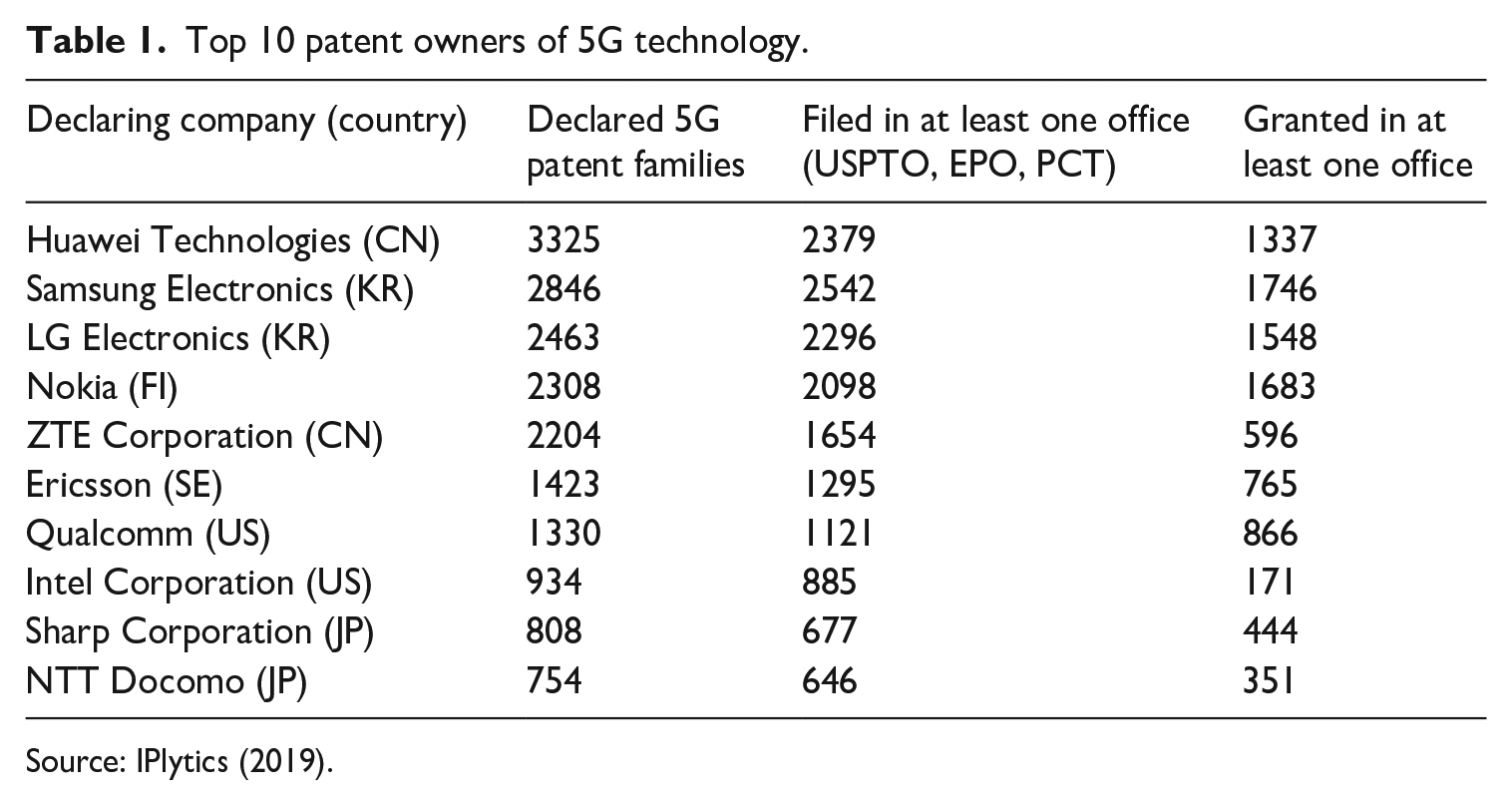
Source: IPlytics (2019).
As co-producers, European telecom carriers also engaged intensively in Huawei’s general product design, especially 5G technology design. Deutsche Telekom and Huawei, for example, jointly won the award for Most Notable Partnership between an Operator and Solutions Provider for 5G Trials and Development (Huawei Corporate News, 2016). DT corporate news documented the launch of the company’s commercial 5G network – powered by Huawei user equipment – in central Berlin as Europe’s first 5G connection. Huawei’s vice president was quoted in the news, optimistically predicting that their partnership could ‘fully prepare the commercial launch of 5G NR services in Europe by 2020’ (Deutsche Telekom News, 2017). According to Vodafone’s corporate News (2018), the world’s first demonstration of all end-to-end elements of a 5G call was jointly completed by Vodafone and Huawei, which was a ‘significant milestone for Vodafone towards the introduction of 5G’. Both European telecom carriers optimistically framed their future vision of entering 5G commercial trials riding on Huawei’s technology.
The importance of marketing for telecommunication technology
In the same year that Huawei was established in China, 1987, the European Commission adopted a green paper highlighting the importance of opening up markets for telecommunication to ensure Europe’s continued competitiveness (European Commission, 1987). It clearly stated that ‘national frontiers should not be allowed to hamper the development of a consistent communications system within the European Community’ (European Commission, 1987: 1). During the next decade, European Union (EU) governments were obliged to separate regulatory functions from the operational aspects of telecommunications, remove entry barriers to their national markets, and comply with the framework guidelines determined at the EU level (Mayer-Schönberger and Strasser, 1999).
Such top-down deregulation in Europe greatly supported the strong position of European telecom companies to grow international business worldwide by taking the ‘vast first-mover advantage’ from the European TDMA-GSM standard (Bekkers et al., 2002). It also opened a window for companies like Huawei to get into the European market. In particular, when some European telecom vendors began limiting expansion, reducing costs and cutting investment after the ‘boom and bust’ investment cycle in the early 2000s (Europe Economics, 2007), Huawei strategically increased its investment in building up a substantial Europe-based innovation network.
In 2001, the Chinese government incorporated the going-out policy as a national strategy in the Tenth Five-Year Plan and especially promoted the Chinese information industry to expand international business (Xinhua, 2005). And between 2003 and 2006, the high-sounding political rhetoric on the progress of expanding bilateral relations between the EU, the EU member-states and China also indicated a general opening environment for transnational business cooperation in all areas. Therefore, with one advocate pushing Huawei to ‘go out’, and another advocate shaping the market to ‘welcome it’, Huawei rode on this political and diplomatic support and seized the best opportunity to extend its business in the region.
However, according to the CEO of Huawei’s European headquarters, ‘many of the European customers had suspicions, uncertainty and refusing attitude towards a company coming from the Far East’ in the beginning (Peng, 2019). Huawei understood that it must ‘transform its technology-oriented strategy into a customer-demand-oriented strategy’ (Huawei People, 2005a) to establish its position as a newcomer in the standard-based European telecommunication market. Therefore, Huawei followed the Confucius wisdom of ‘harmony in diversity’ to establish ‘broad community of interests’ that supported ‘long-term cooperation, interdependence, and mutual development’ (Huawei People, 2005b).
As the critical producer of the telecommunication technology, Huawei opened doors for its European customers to shift their roles from users to producers so as to co-design the Huawei products. The first Collaborative Innovation Center Huawei established in Spain with Vodafone in 2006 evidenced the ‘technology incubation’ target Huawei had with its European partners. According to Vodafone’s global supply chain management director in 2007, Huawei deeply understood Vodafone’s business needs and helped it to ‘achieve strategic objectives’ (Huawei gets Vodafone, 2007). In particular, Huawei’s wireless distributed base stations and singleRAN solution helped Vodafone to save space and energy consumption and cut the total cost of operations (Huawei People, 2015).
Before 2012, the name of Huawei had been practically invisible in the news releases of European telecom carriers. The general frequency of Huawei headlines in European news media was also much lower than its competitors in the region like Ericsson, Nokia and Samsung (Figure 1). On the one hand, Huawei strategically decided to begin the business with low-end and middle-range customers and targeted the low-end market for entry. On the other hand, the Original Design Manufacturer (ODM) supply Huawei provides for European telecom carriers also engineered for the company brand to remain unseen. When Huawei invisibly expanded its business to almost the entire European continent by 2012 (Figure 2), the company decided to fundamentally change its device and marketing strategy in Europe with a future vision of building up Huawei’s overall brand awareness towards a ‘customer & operator win-win virtuous circle’ (Peng, 2019).
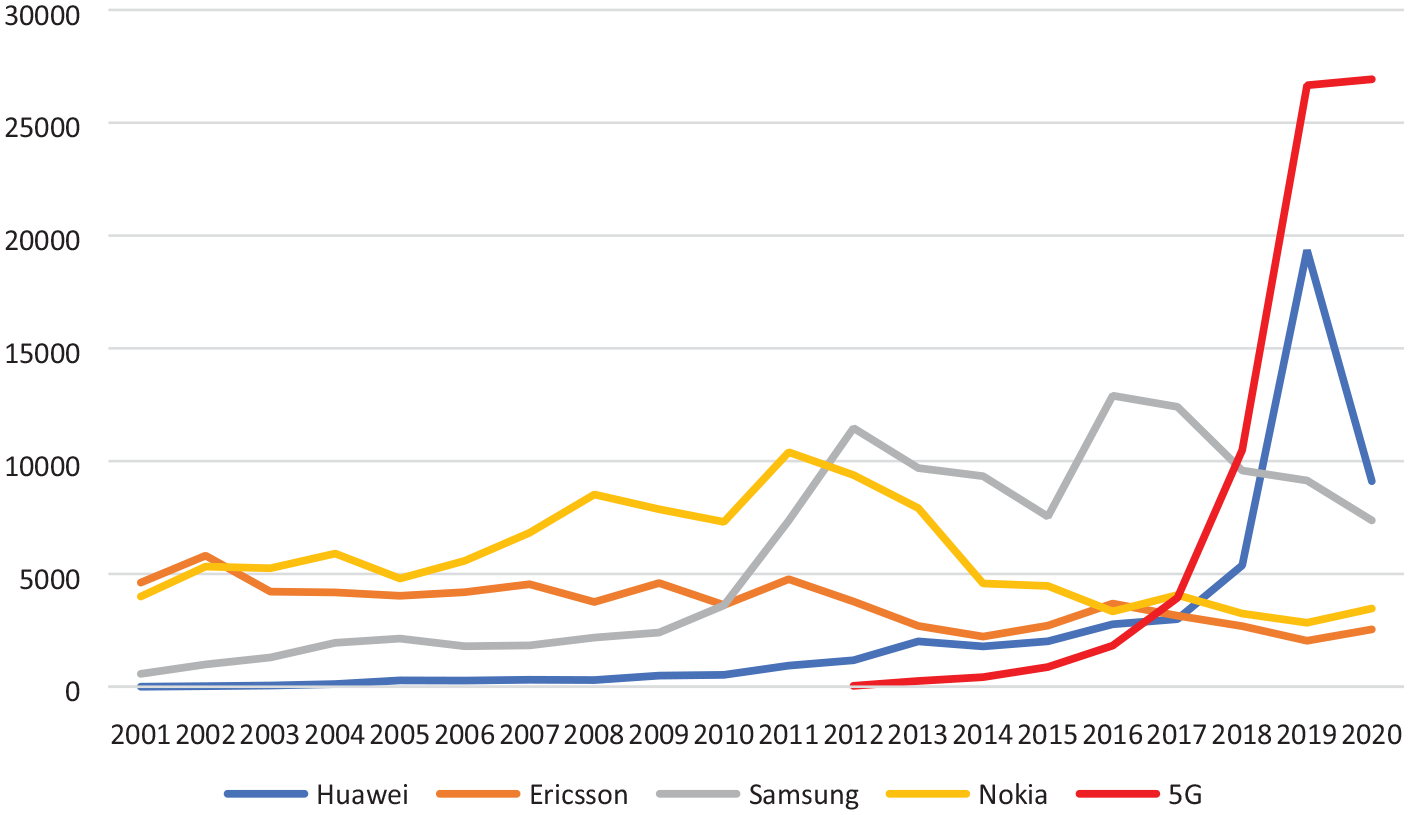
Number of news headlines with keyword search for Huawei, Ericsson, Samsung, Nokia and 5G among EU member-states.
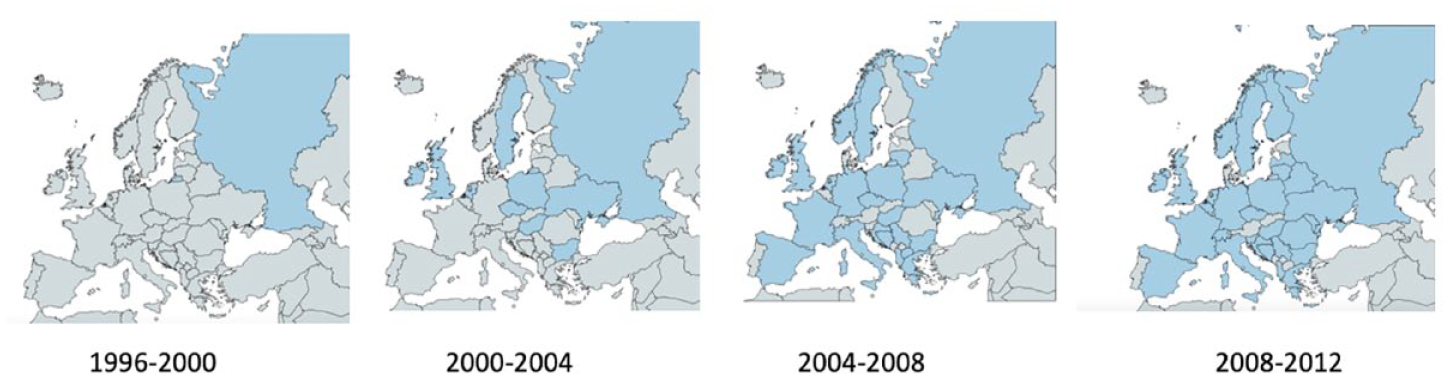
Huawei’s business expansion in Europe (1996–2012).a
Huawei abandoned ODM supply in 2012 and began to sell Huawei-branded products to European users – both business partners and individual customers. With a 60 percent decline in European revenue in 2012, it took 4 years until 2015 for Huawei to benefit from its changing marketing strategy (Sohu News, 2018). According to the study from the European Trade Union Institute, around 50 per cent of the equipment in the European market for 4G networks is provided by Huawei (Drahokoupil et al., 2017), among which Deutsche Telekom and Vodafone are the most dependent (Strand Consult Report, 2020). Huawei’s smartphone shipment share in Europe also increased significantly from 2015 to the first quarter of 2020, as the Top 3 market player (Statista, 2022).
Security concerns relating to Huawei
Security concerns relating to Huawei appeared very early in European media discourse. For example, between 2000 and 2018, Financial Times, which registered the highest number of Huawei headlines among elite news outlets in Europe, discussed security concerns in almost a quarter of its news articles (80/328). India was the first reported country in 2005 connecting security topics to Huawei (Merchant, 2005). Nevertheless, with Huawei’s rejection of such claims, the concern in India faded away after 2009, whereas the US began to gain most of the spotlight as it managed to block Huawei’s entry to the American market since the abandoned joint takeover of the 3Com in 2008 (Kirchgaessner, 2008). Besides the US, Financial Times also reported security concerns in the UK, Australia, Canada and New Zealand, mostly framing the Huawei founder Ren Zhengfei’s ex-military officer background and Huawei’s link to the Chinese state. Nevertheless, even within the Five Eyes Alliance, there was no agreement (Sevasstopulo, 2014).
Before 2019, the warning issued by Washington, DC, regarding Huawei technology’s threat to national security did not prevail over Europeans’ mainstream acceptance of Huawei products, despite a official report from the US Congress pointing out such risks (US Congress, 2012: 45) and US diplomatic pressure on potential suppliers in Europe (Arnold and Kirchgaessner, 2011). In response, Huawei published its first Cybersecurity White Paper in 2012 to discuss the impact of cybersecurity on technology, the global supply chain and society. Highlighting the company as ‘a multinational commercial corporation’, the White Paper demonstrated Huawei’s fundamental interest in ‘ensuring security of its global customers through an end-to-end global network security assurance system’ and called for international collaboration to tackle the challenge (Computers and Security, 2012).
In May 2019, the Trump administration issued an executive order declaring a ‘national emergency’ over IT threats (The White House, 2019). Being listed on the Entity List related to this order, Huawei was set as a clear target and was banned from doing business with any organizations that operated in the US. According to The New York Times, the US would stop sharing intelligence (with its allies) if they used Huawei and other Chinese technology to build the core of their 5G networks (Kang and Sanger, 2019).
In particular, Washington, DC, warned its allies in Western Europe to ‘wake up’ to the nefarious strategy being pursued by Beijing, clearly indicating that a European embrace of Chinese 5G technology could compromise the NATO military pact (Peel et al., 2020). The Trump administration also increased the frequency of visits to the Central and Eastern Europe (CEE) region and signed joint declarations or memoranda of understanding with countries on 5G security, including Romania, Latvia, Estonia, Lithuania and Slovakia (Andrijauskas et al., 2021; US Department of State, 2020a). By highlighting ‘backdoor security’ and detailing the risk that Beijing could use Huawei’s equipment to spy on other countries and companies, the American government successfully set security concern as the top priority frame for 5G technology. Consequently, Huawei was framed as an aggressive and malign actor connected to the Chinese Communist Party and Chinese military. The Clean Network Initiative clearly stated that it would ensure a clean path for all 5G network traffic and ‘keep our critical data and our networks safe from the Chinese Communist Party’ (US Department of State, 2020b).
The European Commission did not immediately respond to the Huawei ban in 2019, but published the 5G security toolbox in January 2020, aiming at ‘mitigating the main cybersecurity risks of 5G networks’ (European Commission, 2020a). Without listing Huawei by name, the European Commission and the EU Agency for Cybersecurity required the EU member-states to adopt a coordinated approach at the national level. The relevant restrictions for 5G network equipment suppliers considered high risk had to be implemented to avoid dependency on these high-risk suppliers (European Commission, 2020a). Consequently, as one of the leading telecom suppliers in Europe, Huawei naturally became the main target of these assessments.
To implement the EU toolbox, different European governments launched a process to review and upgrade existing security measures and enforcement mechanisms on a national level. In July 2020, a report was published on member-states’ progress in implementing the EU toolbox on 5G cybersecurity. It highlighted that ‘national regulatory power needs to be strengthened, including ensuring that authorities have powers to regulate the procurement of network equipment and services by operators’ and ‘exposure to high-risk suppliers needs to be minimized and further identified’ (European Commission, 2020b).
European media news stories headlining Huawei also surpassed all other telecommunication companies between 2019 and 2020. Especially in 2019, news headlines on Huawei were more than the sum of all the news items headlining its competitors in Europe (Figure 1). News about the American government topped the European narrative during 2019, as the word frequency of Trump (571) significantly exceeded the frequency of the Huawei founder Ren Zhenfei (305) and the Chinese president Xi Jinping (65). Security concerns became the leading frame with contradicting viewpoints.
The Czech government was the first to close its doors to Huawei, citing the possibility of a security threat in February 2019 (Czech News Agency, 2019). The attitude of the UK began to shift from June 2019 as the government could not disregard warnings from the US (UK tells, 2019) and it announced the Huawei ban in November 2020. France and Germany were caught between American geopolitical pressure and Chinese economic power. The German press called it a ‘horror scenario for Germany’ if the US would no longer exchange intelligence information with the federal government (Würzbach and Röpcke, 2020). The French media echoed the same concerns, adding the worry that France’s restrictive measures against the Chinese supplier would result in retaliatory measures from China (Balenieri, 2020).
Unlike the prehistory phase, the European media engaged much more actively in the discursive construction of 5G technology in the wake of the Huawei ban. The media discourse contributed largely to discussing the ‘security’ problems identified by the US and helped create the ‘zeitgeist’ surrounding the 5G technology (Humphreys, 2005). Although various perspectives were presented across different news outlets, the intensity of the spotlight given to the American government and the rising attention paid to the risks of technology espionage potentially shaped public opinion towards Huawei and 5G technology in general in European societies.
Taken together, the actual ‘producer’ of the 5G technology in the case – Huawei – seemed to have very little decisive power. Without the European Commission shifting its role from advocates to producers during the deregulation, Huawei would have no chance to enter the European market. Without European telecom carriers changing their positions from users to producers, Huawei would not be able to expand its business in the region and further invest in 5G technology and conduct trials. And, without the American government changing its position from bystander to producer, the entire controversy against Huawei would probably not have been stirred up in Europe.
With this enlarged social group of producers, explicit and implicit political interests, financial interests, and geopolitical interests all got into the ‘rules of play’ depending on the structural location of the social actors (Klein and Kleinman, 2002). Looking at the power dynamic map of the controversy (Figure 3), Huawei and the European telecom carriers are located at the centre, with Huawei holding an active role and the European carriers semi-passive involvement, depending on their interdependence on Huawei products from the previous generations of telecommunication networks. Governments as advocates and producers are in a powerful position to shape the character of the technology in the Huawei case. Therefore, the power asymmetry between the American government, the Chinese government and the European governments would quickly change the dynamic behind the technology by giving advantages to certain actors over others (Kleinman, 1998).
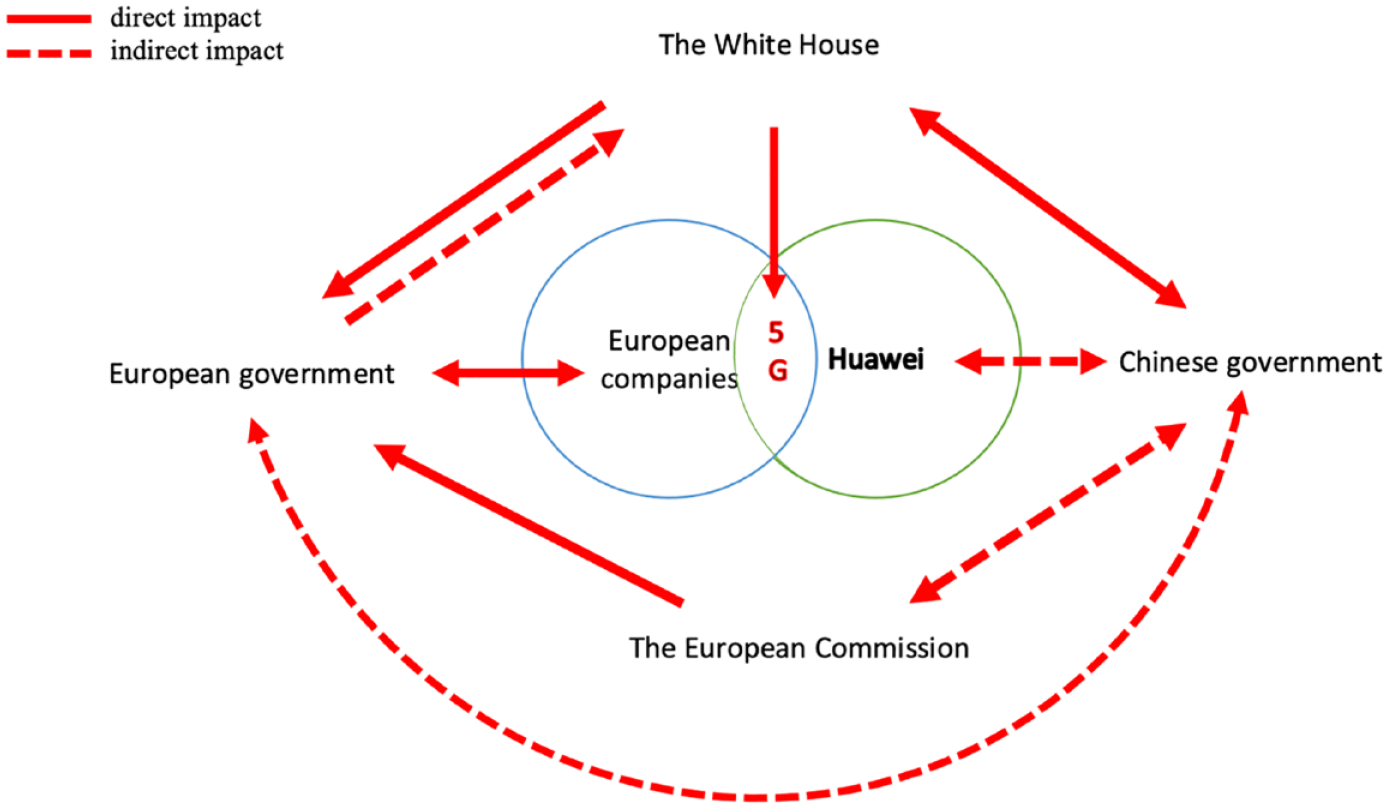
The power dynamic of Huawei’s 5G controversy in Europe.
With the Huawei ban initiated by the Trump administration, the American government inclined all the advantages to security concerns with a direct impact on other social groups. Ironically, the advocate role of the Chinese government became more that of a disruptor during the 5G controversy in that the more it reacted to the unfolding situation, the more it proved the security concerns of which Washington, DC, had accused Huawei. Therefore, the supportive domestic industry policy and Beijing’s firing back over Huawei by urging the US to stop the ‘unreasonable bashing’ of Chinese companies (Foreign ministry spokesperson, 2019) all became evidence that Huawei is closely linked to, if not controlled by, the Chinese government.
The European governments are in a very strategic position. They receive direct impact from European carriers, the EU and Washington, DC, as well as indirect influence from Huawei and Beijing. They are also more on the frontier to exert ‘national regulatory power’ on 5G technology. With Huawei’s direct investment and business integration in the national market, different technical and operational matters on the practical level make it difficult for the European governments to either decide on a nationwide ban on Huawei or impose multi-vendor strategies within a short time period. The time, capital, research capacity, digital infrastructure maturity level, and business integration may cause tremendous economic loss and waste of social resources for a complete change of the 5G supplier. Moreover, the geopolitical context of the trade war between the US and China and the changing bilateral relations the European governments have with both also add more sensitivity to the decision-making.
The interpretive flexibility: Is 5G ‘inherently political technology’?
As discussed above, the security concern over Huawei is not a new frame, therefore it doesn’t fit into the process of technological frame renewal with the American government as a new actor which defines the new problem (Yousefikhah, 2017), although it did destroy the previously established technological frames focusing on innovation and marketing. Therefore, the questions remain as to why the same security concern (from America) over Huawei’s telecom technology did not interrupt the company’s business in Europe until 2019, and what is the exact interpretive flexibility produced in the 5G case?
Winner (1980) identified two ways in which technology can have politics: (1) instances in which technology becomes ‘a way for settling an issue in a particular community’; and (2) cases of ‘inherently political technologies that appear to require, or to be strongly compatible with particular kinds of political relationships’. Until the Trump administration issued the Huawei ban as a ‘national emergency’, telecommunication technology was never considered ‘inherently political technology’ where ‘rigid relationships of authority become necessary in its immediate presence’ – like nuclear technology (Winner, 1980). By tagging the cybersecurity risks of Huawei products as a threat to national security and highlighting data security in connection to the Chinese government’s information control, the American government redefined the hierarchy and called for urgency and immediate intervention from the European states on Huawei 5G.
On the one hand, the American power over global communication, the array of US-based ICT monopolies, the use of diplomatic devices, and practices of media imperialism have all been extended in the Huawei case (Tang, 2020). So much so that the ‘security concern’ connecting to the American suspicions about Huawei since 2008 eventually became a global perception. As Aouragh and Chakravartty (2016: 565) observed, telecommunications may comply, cooperate and bend to state power and US imperial interests. Therefore, the reproduced interpretive flexibility of Huawei 5G technology combined a ‘military-digital complex’, which assisted the American government with data collection for strategic exterritorial interests (Schiller, 2011), and ‘inherently political technology’ logic together. Consequently, innovation-based and marketing-focused technological frames embraced by the industrial producers were ruled out. In contrast, security concerns became the dominant frame to shape the construction of 5G technology’s engineering potential and Huawei’s design purpose. Choosing Huawei 5G technology thus became a signifier of choosing a particular form of political life, as China’s political system differs from those of the European democratic societies.
Moreover, the newly published National Intelligence Law in China added even more ‘interpretive flexibility’ with increased media discussion on the degree to which ‘Chinese organizations or citizens should support, assist and cooperate with the nation’s security and intelligence services under the law’ (The National Intelligence, 2018). The question here is not only about whether Huawei would comprise the security of its products to help espionage, but also about the legitimate interests of all Chinese tech companies in business transparency and data protection. With China’s fast-growing digital economy and rising capacity in large-scale data mining, Huawei’s controversy in Europe is foreshadowed by Beijing’s attempts at multilevel information control.
On the other hand, personal privacy and data security are super-sensitive topics in European societies in the aftermath of the ‘Snowden effect’. The vulnerability of the telecommunication technology users and the extent of electronic surveillance downplayed by businesses and governments (Balbi and John, 2015) have already prepared European sentiments towards minimizing security threats and protecting the public. In 2020, 15 EU countries raised the alarm about the anti-5G movement as telecom groups reported criminal acts and attacks across Europe (Cuthbertson, 2020). Although these movements were not associated directly with Huawei and its cybersecurity risk, a general mistrust in 5G technology for its potential damage to individual health and rights were on the rise in European societies. According to the 5G Awareness and Needs Survey conducted by the European Telecommunication Network Operators’ Association (ETNO) in 23 European countries, only one out of four Europeans claimed to have a good understanding of 5G, and the understanding correlated strongly with the public’s attitude towards 5G (ETNO, 2020). Following the Huawei ban and the misleading conspiracies over 5G networks during the COVID-19 pandemic, 5G infrastructure rollout slowed down significantly in Europe.
The paradox between Huawei and its country of origin
The name ‘Huawei’, short for ‘China with achievements’ in Mandarin, appeals to Chinese nationalism and crowns a national champion identity, although the company is not state-owned (Tang, 2020). This company culture, drawing from a nationalistic identity, is also evidenced in Huawei’s internationalization path. After Huawei’s first entry in Russia in 1996, the company decided to closely follow Beijing’s diplomatic routes to ‘promote the corporate brand with the nation’s brand and get support from China’s public diplomacy’ (Lanxueyanjiu, 2019). The first contract Huawei signed in the Netherlands with Telfort, for example, was signed in the presence of the Dutch and Chinese premiers during a state visit. The signing ceremony was part of the diplomatic agenda and recognized as ‘an essential testimony of strengthening economic exchanges between the two countries’ (Huawei signed, 2004).
However, this diplomacy-leaded business strategy has changed in recent years. The Chinese president Xi Jinping began the Belt and Road Initiative (BRI) in 2013, aiming to connect Europe, Asia and Africa with both on-land and off-land infrastructure projects. The Digital Silk Road was begun in 2015 as part of the BRI, focusing on strengthening internet infrastructure among the BRI countries. Huawei’s expansion of its telecommunication infrastructure projects fits exactly into this vision of globalization. However, BRI was not mentioned at all in any of Huawei’s annual reports (2013–2019) or news releases connected to the company.
Nevertheless, BRI, Made-in-China 2025 and Huawei’s 5G technology are framed together by the US as China’s three tools to become an economic hegemon. According to Die Welt’s interview with Trump’s former chief ideologist, Steve Bannon, once these three goals are achieved, the US and Western Europe will become ‘vassal states’ (Mülherr and Wergin, 2019). Although this hegemony narrative did not become a leading frame in Europe, with the historical negativity plunge towards China in the wake of the COVID-19 pandemic (Silver et al., 2020), Huawei found it more difficult than ever to demonstrate its technology-neutral stance in the region. As China’s spokesman once commented, ‘the only mistake Huawei has is that it is a Chinese company’ (Li, 2020).
Conclusion: The way out of the controversy?
We are now witnessing a decline in the ‘long-standing rules-based international order’ since technology innovation has become one of the most complicated, essential and prominent challenges of power competition (Center and Bates, 2019; Mattis, 2018). Huawei is a proxy for Chinese ascendancy and, simultaneously, a pawn held hostage in America’s trade war with China (Pearlstine et al., 2019). Washington, DC, would do anything possible to protect American dominance in all ICT areas and gain time for American vendors to get back to their leading position in the telecommunication infrastructure business, where they obviously fell behind in recent years (Table 1). And having the second-largest geographical ownership in Ericsson, the American investment behind European patent owners could also be secured even if the American vendors were not the direct beneficiary during the Huawei controversy in Europe. Nevertheless, Beijing would also not compromise anything in transforming China into a technological powerhouse in the world. As a result, Huawei’s 5G business in Europe is politicized as the battlefield of this great power rivalry.
Based on the findings and discussions of this study, we understand that with different social groups’ shifting their roles to producers, political power – rather than technological excellence – seems to have a more dominating impact on the social construction of 5G technology. The technological and communicative frame of security concerns, which the American government has used against Huawei since 2008, got emphasized under the ‘inherently political technology’ logic in 2019 and eventually redefined the interpretive flexibility of Huawei’s 5G design as well as its business future in Europe. Geopolitical competition and the superpower standoff between America and China further interrupted the future process of 5G innovation with potentially disastrous consequences in the European markets, posing challenges to worldwide technology development and prosperity.
Such technology interruption caused by political rivalry may not reach an absolute ‘closure’ unless a redefinition or solution to the current technological framework – with security concern tops the priority – emerges. Very possibly, none of the discussed social groups will bring about such redefinition since most of them are too close to their position as the ‘producers’ of the technology with conflicting interests. A third-party social group like the ITU may have a more far-reaching impact on the global regulations of telecommunication disputes when the transparent and inclusive multi-stakeholder model – favoured by the US – faces its limits in accepting market competitors from China.
According to Balbi and Fickers (2020), ITU has been one of the key actors, arenas and antennas to establish, reinforce and change the order of telecommunications management. Indeed, ITU’s adoption of different telecom network standards has facilitated the telecom entrepreneur in getting open market developments started. As a techno-diplomatic actor and arena, ITU has developed into a hub where nation-states and transnational institutions meet and negotiate the many tensions involved in strategic manoeuvres to introduce new standards and regulations. According to the ITU telecommunication standardization advisory group report, between 2019 and 2020, the standardization work for 5G security was already under study to identify new security schemes and develop a standardization roadmap, as ‘security is absolutely first everywhere’ (Heung, 2019). Therefore, the role of ITU as a security competence centre and as a neutral social group without direct political stake or geopolitical interests must be further understood in the social construction of 5G technology.
Is 5G an actual ‘inherently political artifact’? Is Huawei ready to challenge American technological primacy and the global value chain? Will the American imperialistic logic ever let any external player challenge its hegemony in ICT globalization, even if it is not Huawei? These questions have no answers now, but the analysis of different social groups constructing the Huawei 5G controversy in Europe provides an example to understand the complex geopolitical power dynamic behind the technology. 5G is expected to be user-centric rather than operator-centric (like in 3G) or service-centric (as in 4G). Therefore, many technical characteristics and the related interaction, management, regulation and power relationship may witness significant changes and redefinitions in the years to come. The Huawei controversy in Europe is merely a starting point for such complex processes that involve various social actors for negotiations and decision-making from a transnational and global perspective in telecommunication technology.
Footnotes
Acknowledgements
I would like to express my sincere gratitude to my dear colleague, Prof. Gabriele Balbi, for our many discussions on the development and regulation of telecommunication technology in Europe. These conversations greatly inspired the historical approach of this paper. Additionally, I wish to extend my thanks to the two anonymous reviewers whose insightful feedback and suggestions significantly enhanced the quality of this article.
Funding
The author received no financial support for the research, authorship, and/or publication of this article.
