




Abstract
Cross-national media freedom comparison is often based on Western-biased indices published by organizations such as Freedom House or Reporters Without Borders. Additionally, Eurocentric analysis and comparison are endorsed by the application of hegemonic media systems models to compare media environments. This study argues that cultural contextualization is indispensable to challenging the prevailing Eurocentrism. Comparison of the ‘connotative’ contexts of Malaysia, Myanmar and Thailand demonstrates the analytical and explanatory power of inductively inferred variables to understand the formation of political communication. The comparison highlights factors which go beyond the comparison of media systems using predefined categories and models.
Keywords
Comparative media systems research has provided productive contributions to systematic analysis and has been instrumental in the development of media systems models over the past six decades. However, most media (systems) theory and standard models for cross-national comparison focus on and originate from Western contexts, a fact that has drawn intense criticism from several scholars. The universality of media systems models has been called into question, including the gold standard models by Hallin and Mancini (2004), whose four dimensions have come under increasing scrutiny as to whether they truly reflect the most significant factors for categorizing media systems. Norris (2009), for instance, harshly criticizes the absence of the variable ‘media freedom’ in frameworks for comparing media systems, while Brüggemann et al. (2014) stress ‘that limits on news content and press freedom are probably the most important dimension to distinguish media systems on a global scale’ (p. 1041). In response to this criticism, this study focuses on the analysis of impacts on media freedom in the comparison of media systems.
A de-Westernized approach to media (systems) theory requires greater sensitivity to context because the unadjusted application of Western media systems models to other contexts fails to take into account that the ‘West’ and the ‘Rest’ do not share the same history (Huang, 2003; McQuail, 2000). The impact of key variables of political communication, such as its social, political, economic, cultural and historical contexts, is often not properly acknowledged by a priori Western-biased categories and media systems models. This fundamentally calls the applicability of Eurocentric media systems models to any other than their specific contexts for comparing media freedom into question because it highlights their innate inability to adequately capture the reality of their research objects.
The Eurocentrism inherent in hegemonic 1 media systems models and measurements or comparisons of media freedom strips their research objects of their specific cultural context. To counter this Eurocentric bias, this paper’s focus on ‘connotative contexts’ aims to show how frequently applied Western-biased media systems models, such as the ‘Three Models of Media and Politics’ (Hallin and Mancini, 2004), fail to comprehensively characterize non-Western, non-democratic contexts. Based on an inductive study of the contexts of Malaysia, Myanmar and Thailand, this comparison highlights factors that elude the comparison of media systems using predefined categories and models.
A totalizing, systematic approach without cultural contextualization is a highly questionable, self-replicating endeavour. By its very design, its typologies, categories and indicators are inherently tainted by Eurocentric preconceptions, hence the knowledge that it (re)produces is restricted by its pre-existing normative categories and indicators (Huang, 2003; Kim, 2007; Rantanen, 2013). The same criticism also applies to cross-national media freedom analysis, which is primarily based on international indices published by organizations such as Freedom House, Reporters Without Borders, Gallup or International Research & Exchanges Board (IREX). These rankings all assign a similar (low) degree of media freedom to the contexts in question in a global comparison but do not sufficiently explain control mechanisms because they are hampered by the same lack of contextualization as Eurocentric media systems theory. Although these rankings have a broad public reach and are often cited by academics, the media and politicians as if their results were sound academic data, their uncritical application has drawn considerable criticism due to the financial dependence of the organizations, a lack of scientific methodologies, and a predominantly Western bias (e.g. Becker et al., 2004; Goldstein, 1986; Holtz-Bacha, 2011).
Challenging the dominance of Eurocentric media (systems) theories is the focus of this paper and provides the foundation for a hermeneutic three-level relational framework that encompasses an analysis of the ‘connotative context’, ‘relations (network of interactions)’ and ‘interventions’ for comparisons of political communication environments. This approach is based on theoretical reflections on relational sociological network theory. According to the paradigm of relational network theory, all relations, interactions and interventions in political communication networks are embedded in social and cultural structures (Mützel and Fuhse, 2010), hence they occur in a ‘connotative context’ (Emirbayer and Goodwin, 1994; Häußling, 2006). The connotative context frames the relations and interventions in the network and gives them meaning. An understanding of the connotative context is essential for a correct interpretation of the relations and interventions.
Therefore, analysing media environments, most notably in under-researched regions, requires consideration of culturally-specific characteristics without the assumption of an exceptional uniqueness or otherness of their context. Contextualization and an awareness of one’s own academic perspective on and relation to the object of analysis (Hantrais, 1999: 103–104) is the basis for this paper. It is an endeavour to resist Euro- and ethnocentric perspectives in media systems theory and to resolve the dichotomy between ‘Western’ and ‘non-Western’ models (de Smaele, 1999; Kuo and Chew, 2009) by comparing the connotative context within a heuristic framework that is open to new findings in all contexts.
The ‘relational turn in social sciences’ (Eacott, 2018: 25–41) provides a useful perspective for overcoming Eurocentrism and the omission of transformation processes in cross-national media systems comparisons. Elaborating on the fundamental theoretical orientation of sociologists who comprehend structure as ‘intrinsically relational’, Mische (2011) asserts that ‘relational thinking is a way to overcome stale antinomies between structure and agency through a focus on the dynamics of social interactions in different kinds of social settings’ (p. 80). This approach also provides the analytical framework to capture transformation processes, which are often completely overlooked in media systems comparisons (Esser and Pfetsch, 2012; Huang, 2003; Jakubowicz, 2010; Voltmer, 2012). Donati (2011: 168–190) even goes so far as to claim that a relational sociological perspective is the only adequate approach to understand and explain social change.
In combination with Emirbayer and Goodwin’s (1994) assertion of contextual primacy in the analysis of cultural contexts, the comparison of the connotative contexts of the three countries studied here is an adequate means to address the analytical shortcomings of a prevalent Eurocentrism. This comparison lays the groundwork for future research on the second level (relations) and the third level (interventions) of the three-level framework to analyse and compare the transformation processes of media systems.
Finally, it is necessary to substantiate why we need to analyse and compare media freedom in Southeast Asia, specifically in Malaysia, Myanmar and Thailand. Although globalization, the networking of societies and transnationalization of communication and its policies are expanding the significance of previously under-researched regions, current research is still predominantly focussed on Western contexts. Southeast Asia in particular is of great interest due to its religious, cultural, ethnic and social diversity because these factors impact the variety of formations of social systems, including media systems, and provide diverse explanations for multidimensional mechanisms that result in highly diverse forms of political communication (control).
The very fact that the region is under-researched should be ample justification to focus on Southeast Asia because the results could provide new insights essential to understanding other contexts and could potentially yield implications necessitating a reconfiguration of Eurocentric media systems theory. Of course, there are several more specific reasons to study the three contexts in question: for the analysis of media freedom in this region, the diversity of factors of analysis enables a qualitative heuristic analysis that highlights blind spots and opens up new avenues for research. For qualitative heuristic social analysis, a variation in the impacting factors is the foundation for the maximized structural variation of perspectives on the research object (Kleining, 1994: 28–31).
The three cases represent a wide range of political, economic, developmental and cultural facets: post-colonial Malaysia has reached a relatively high socio-economic and technological standard and represents a counter-example to the transition paradigm (Nissen, 2016), which is fundamentally called into question by scholars such as Carothers (2002) and Sparks (2008). Despite the country’s liberal economic development, it practises a discriminatory Malay supremacy and Islamization policy, does not respect human rights, and has been ruled by an autocratic government since its independence in 1957. While liberalization of the market brought about relative economic wealth, formal democratization only led to an ‘electoral authoritarianism’ (Tapsell, 2013: 614).
In contrast, post-colonial Myanmar is one of the poorest countries in the region and until recently was one of the poorest in the world. Ruled by the Tatmadaw (military junta) for nearly half a century, it was one of the world’s most closed economic, political, social and media systems until 2010, a dubious accolade shared with countries such as North Korea and Cuba. Myanmar’s transition process, starting with top-down democratization through the ‘roadmap to democracy’ initiated by the Tatmadaw in 2003, has followed a similar pattern of elite continuity that scholars such as Sparks (2008) have identified for the comparison of China, Russia and Poland.
Although the post-colonial societies of Malaysia and Myanmar are both multilingual and multi-ethnic, divergent historical developments, social constellations and cultural contexts call for different causal explanations for the formations of power constellations in political communication control mechanisms. Thailand and Myanmar both maintain a Buddhist supremacy and face persisting violent conflicts in contrast to Malaysia where a Muslim Malay supremacy characterizes every level of political and social action.
Thailand, known around the world as a tourist destination, is a mid-range income-level country in Southeast Asia that is socially and politically shaped by a deep divide between Bangkok’s progressive middle-class elites and traditional rural areas. In contrast to the relative political stability in both Malaysia, which was under the Barisan Nasional (BN, or National Front) coalition government between 1973 and 2018, and Myanmar, which was ruled by the Tatmadaw between 1962 and 2011, Thailand has experienced 12 coups since the end of absolute monarchy in 1932. It is marked by a persistently discontinuous political landscape and the continuing dominance of the military and monarchy as political forces, but has never been under foreign control by colonial or other powers.
Although the three countries present a wide range of contextual factors and social, cultural and political formations, the dependent variable ‘media freedom’ is on a relatively equal level because the three countries do not provide adequate conditions for free media reporting or free speech. Nevertheless, the control mechanisms differ significantly and originate from the unique formations of their specific contexts. Therefore, the analysis of the historical and cultural formation of the conditions for political communication control in their connotative contexts is the focus of this study due to its potential to provide new insights into the contextual foundations and underlying concepts of control mechanisms in (non-Western) media systems.
In the following analysis, I conceive of media freedom as an analytical question rather than as a normative concept. With reference to the paradigm of relational sociological network theory, I formulate the research question, ‘How and why do (meaningful) relations and interventions (in the political communication network of interactions) lead to constellations affecting public political communication (control) in a specific spatiotemporal context; and how does the connotative context enrich these relations and interactions with meaning?’
Methodology
Comparative media systems research’s predominant focus on the Western world established Eurocentric approaches and theories in the field. Although developed in Western contexts, these approaches often arrogate a claim to universality and are applied to non-Western contexts without adjustment. Most of these studies categorize media systems with a lack of characteristics. They do not characterize the reality of the respective media system itself, but instead evaluate its democratic performance and compare it normatively. Autocratic, semi-democratic or transformative media systems in particular are more often characterized by their deficiencies rather than by their context-specific characteristics.
To address this shortcoming, the development of a contextual theory for comparing media systems is necessary to adjust and extend existing approaches. Therefore, the framework for this study will follow a ‘[p]retheoretical research strategy with context factors. . .[as] a means to theory development and/or the connection to previously existing theories’ (Wirth and Kolb, 2004: 93) to analyse media systems in their specific social, political, economic, cultural and historical contexts (George and Bennett, 2005: 75), instead of forcing them into pre-existing models, often developed in (and for) the Western world. For this purpose, a qualitative in-depth case study comparison following a methodological triangulation with expert interviews, multi-perspective exploration of external data, and category-driven analysis serves to identify ‘functional equivalents’ for comparison (Esser, 2010: 9). Expert interviews enrich the qualitative in-depth case studies and provide insights to understand the reality of the media systems and to better identify and understand ‘blind spots’.
The basis for comparing the connotative contexts is data gathered during field research trips to Malaysia, Myanmar and Thailand in 2017, including 44 in-depth expert interviews with local and exiled journalists, media owners, non-governmental organization (NGO) workers, artists, members of journalists’ associations and the press council, civil society organization workers, researchers and government personnel. I conducted the expert interviews in Malaysia, Myanmar and Thailand between 13 February and 20 April 2017. The experts were not selected at random; instead, different media sectors and different political and ‘ideological’ perspectives were considered in a selection process that included as many perspectives as possible: for example, oppositional, state/government, mainstream, alternative, local and international. Thirty-two interviews were selected for the category-driven analysis: 13 for Myanmar, 10 for Malaysia, and nine for Thailand.
The interview questionnaire was constructed deductively and inductively based on topics and problems in media systems and media freedom research and adapted to the specific context of the respective country (see Table 1). The comparability between the three countries was upheld by a similar questionnaire design for all three contexts, which contained the following question sections:
Questionnaire topics for in-depth expert interviews.
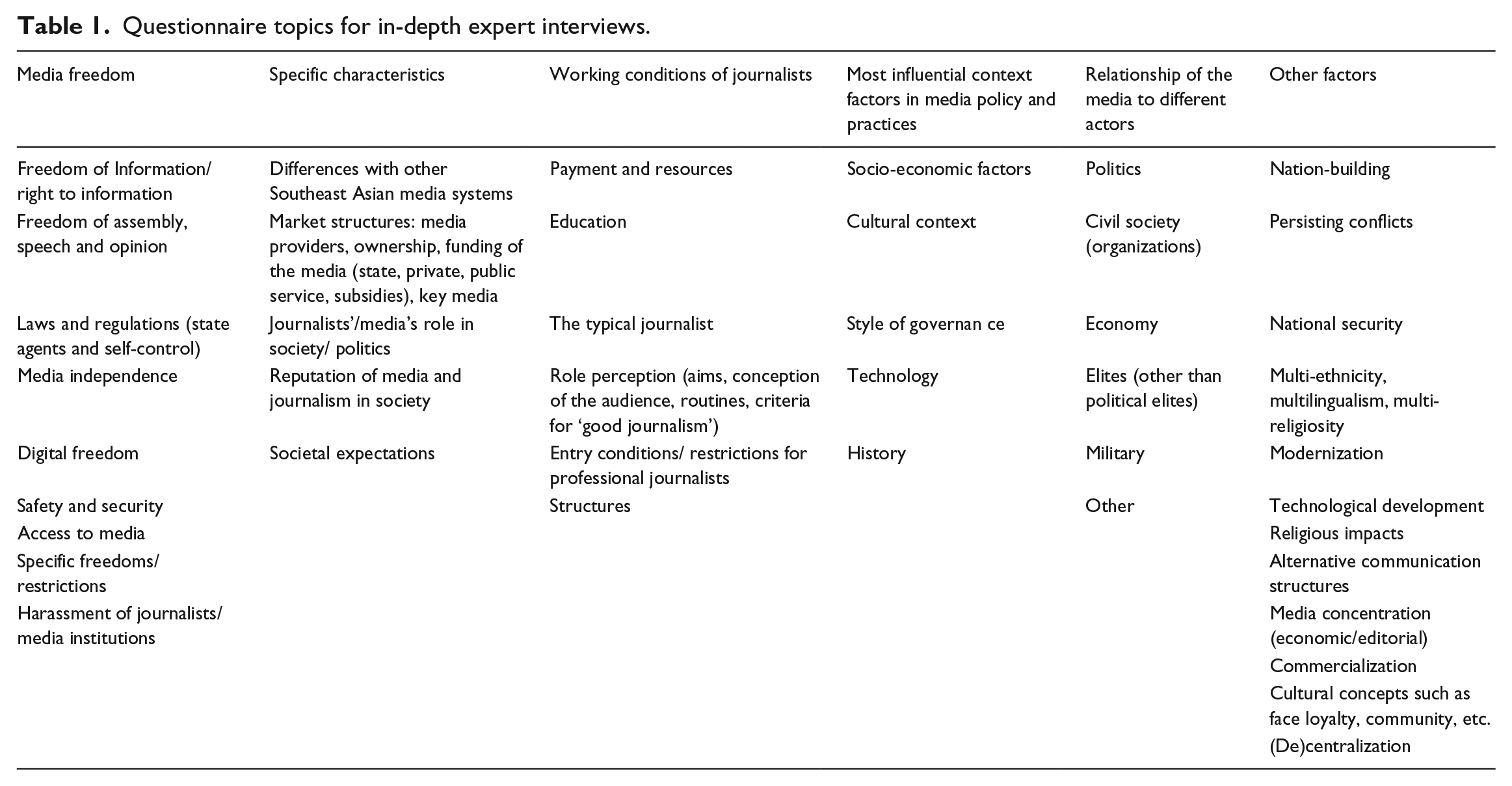
The evaluation of the interview data was carried out both deductively and inductively from the interview material after transcription. The text was subsequently condensed to central variables of interpretation patterns using paraphrasing. This led to the attribution with the connotative context factors for analysis of the three contexts with their respective data.
The comparison produces new knowledge by using an inductive approach that facilitates the identification, interpretation and understanding of processes and mechanisms that lead to different and similar forms of political communication control. By analysing the connotative contexts in a relational sociological perspective, I provide examples for significant inductively inferred factors affecting the media systems and media freedom in Malaysia, Myanmar and Thailand.
Comparing the ‘connotative contexts’ of Malaysia, Myanmar and Thailand
I distinguish two parameters for the connotative context: firstly, situational conditions that provide the basis for the construction of relations and the foundation of interventions; and secondly, non-situational parameters that affect relations and interventions from outside the specific situation (relation/interaction) and fall within superordinate frameworks (Häußling, 2006: 126–132). Whether a connotative context factor is considered a situational condition or a superordinate framework depends on the relation or intervention in question: for example, while supremacy of religious norms and values (Table 2) is a situational condition in the analysis of the effects of the ethnic riots in 1968 in Malaysia (short-term ‘intervention’) on the media system, it serves as a superordinate framework to understand the stratification of the media landscape due to the government’s policy of Ketuanan Melayu (Malay supremacy).
Connotative context factors, inductively inferred from 32 in-depth expert interviews in Malaysia, Myanmar and Thailand.
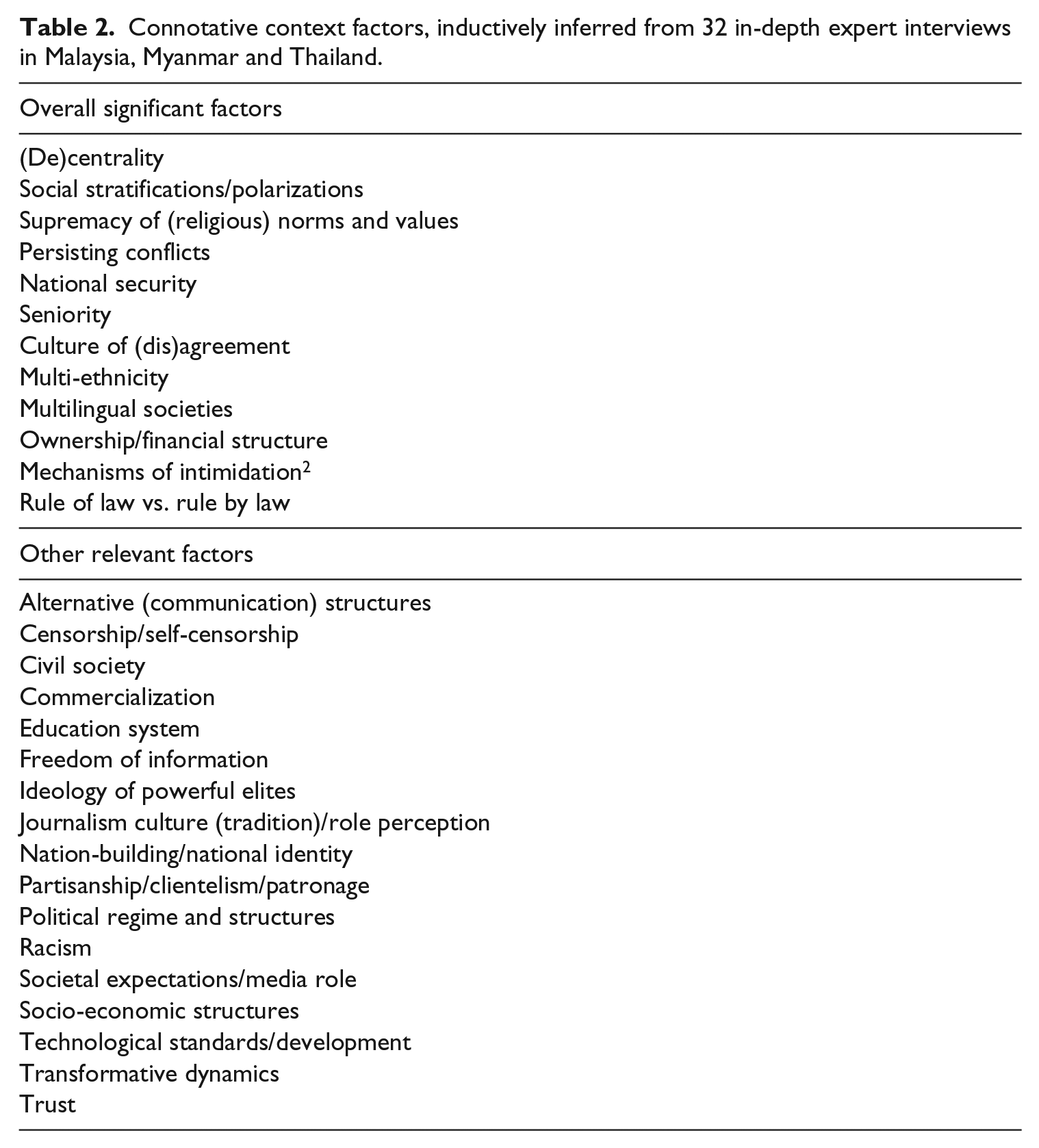
The following table exclusively comprises connotative context factors that were inductively inferred from the qualitative interview data. The table provides an overview of the factors that are crucial to understanding and explaining the formation of the three media environments. The most significant factors for an overall analysis and understanding of the formation of media control mechanisms in Malaysia, Myanmar and Thailand are shown in the upper (black) part of the table. The lower (grey) part lists connotative context factors that are relevant to understanding specifics in the media control mechanisms but bear different importance for the explanations in the three contexts (also depending on the focus of the research question).
Although the factors are listed separately, the qualitative analysis shows them to be overlapping.
The following exclusively comprises connotative context factors that have been inductively inferred from the qualitative interview data. In the conclusion, I give examples of the connotative contexts’ impact to explain the how and why of the formations of specific relations and interventions in order to illuminate the potential explanatory power of connotative contexts for understanding the constellations affecting public political communication control in the three contexts (in future research).
(De)centrality (and social stratifications/polarizations)
The aspect of (de)centrality of the media system, or, respectively, the political system, impacts all three contexts. There is significant impact on media reporting in Thailand due to a Bangkok-centric media structure:
3
Any news story which breaks outside Bangkok is first and foremost a provincial story; only in a secondary sense will it be considered a crime story, a political story, or whatsoever. (McCargo, 2000: 3–4)
Similarly, media production in Myanmar is concentrated in Yangon and Mandalay due to centralized structures established by the Tatmadaw, which still affect and restrict to this day media reporting, media distribution and media production. 4 While Myanmar’s media system’s centralization is caused by poor infrastructural development and centralized structures established by the former military junta, Thailand’s Bangkok-centric media system reflects the deep social and political divide in the country, accompanied by the conflicting transformative dynamics of value sets (Horstmann, 2001) between a progressive political middle-class elite (‘yellow shirts’) and the traditional rural folk (‘red shirts’). 5 Malaysia’s media and federal political landscape is affected by centrality in a different way but represents a divide similar to the one in Thailand: the mainland Peninsula Malaysia and Eastern Malaysia mirror the social stratification of an oppositional elite in Peninsula Malaysia and conservative rural voters backing the former ruling BN in Eastern Malaysia. 6
Supremacy of (religious) norms and values
Supremacy of religious norms and values is highly relevant for the analysis of the media landscape in the three countries. For Malaysia, Zaharom Nain, 7 among others, emphasizes the impact of the three Rs – ‘royalty, religion and race’ – of the ‘Malay Sovereignty’ (‘Ketuanan Melayu’) policy, which encompasses privileged treatment for Malays, such as for scholarships and research funding, public service jobs or public–private partnerships/contracts and an Islamization policy in the multi-ethnic and multireligious nation (Liow, 2014; Ting, 2009). 8 The former ruling BN coalition, dominated by a political ethnic elite of the United Malays National Organization (UMNO), has followed a policy of ‘divide and rule through ethnicity and religion” since independence in 1957 (Ting, 2009). 9 This Malay sovereignty and Islamization of the society is implemented on various levels, for instance in the education system and government structures, and is reflected in a social stratification (Liow, 2014; Ting, 2009), as many of the interviewees assert.
In Thailand, where ‘the state manipulated Buddhism in order to subordinate citizens’ (McCargo, 2004: 167), Buddhism serves as a source of identity for Thai people and provides the ground for nation-building (McCargo, 2004). Likewise, Buddhism was exploited by Myanmar’s military junta to create a cultural and political identity, which assisted in claiming and legitimizing political power (Schober, 2005). In both Thailand and Myanmar, Buddhist radical nationalists are sources of a political rhetoric of supremacy of religious norms and values that weaponizes racism reflected in the media, as interviewees pointed out (cf. McCargo, 2004).
Although both Myanmar and Thailand protect Buddhism by law, supremacy of religious norms and values is not formally implemented in policies to the same degree as it is in Malaysia, but the conflict between privileged Buddhists and disadvantaged Muslim/ethnic minorities leads to persisting armed conflicts in both states.
Persisting conflicts and national security
In all three contexts, persisting conflicts (both armed and unarmed), which are connected to supremacy of religious norms and values and multi-ethnicity, induce a strong ‘national security culture’ (Peri, 2012: 12). In Myanmar and Malaysia in particular, both ‘postcolonial societies [in which] multiculturalism is a historical problem conditioned by colonial racial knowledge and state formation on the one hand, and by the ethnic conflicts of decolonization on the other’ (Goh, 2008: 232), these conditions have fostered a national security culture that serves as a justification to curtail media freedom.
In Myanmar, the currently strongly criticized and internationally well-reported Rohingya crisis (in addition to other armed persisting conflicts, cf. Maw Lapaih, 2014) mirrors connotative context factors such as racism, persisting conflicts and national security, multi-ethnicity, supremacy of religious norms and values and nation-building/national identity (Ahsan Ullah, 2016), which significantly impact Myanmar’s political and social processes and media reporting. For example, with reference to religious values, most interviewees in Myanmar problematize hate speech and disinformation, predominantly in online media (in Myanmar, this essentially means Facebook). Disinformation has a high public impact due to low media literacy, brought on by nearly five decades of military rule with one of the most restrictive media systems worldwide, a technological development that leapfrogged decades of communication technologies 10 (technological standard, modernization) and a bad education system, ‘which is one of the reasons. . .why the older generation is better educated than the young people’ (Mar Mar, 2014: 314), in combination with the connotative context factors highlighted with reference to the Rohingya crisis. 11
Since 2004, the violent persisting conflict in southern Thailand has also taken root in the multicultural and multi-ethnic social structure in the southern borderlands (Horstmann, 2001). The persisting conflict between Thai Buddhists and Malay Muslims reflects the Buddhist supremacy in Thai politics and the media bias towards it (Kularb, 2016; McCARGO, 2006). Phansasiri Kularb emphasizes a communication policy by officials called an ‘information operation’, which is similar to what experts report from Myanmar and is marked by racism and supremacy of religious norms and values: [T]he military call [it] information operation, I.O., they tend to call it I.O. So, basically what happens in the south, that is very similar to the situation in Myanmar, is that some of the soldiers or some of the military officers will have some fake accounts, Facebook account or Twitter account, and follow civil society organizations’ website or medium and make some comments on that, so kind of like mixing up a little bit the discussion so it would not sway towards their purpose only.
12
Additionally, the persisting conflict between progressive urban ‘Bangkok’ elites (‘yellow shirts’) and the traditional, rural Thaksin Shinawatra supporters (‘red shirts’) splits society into either ‘red’ or ‘yellow’, which has resulted in several street protests (with hundreds of deaths), during which the deeply polarized media often took on a leading role in a media war ‘full of imagery and symbolism’ (Forsyth, 2010: 466; see also Horstmann, 2001; Lewis, 2008). Due to the deep polarization of the ‘red’ and ‘yellow’, according to interviewees, Thai citizens seem to be blind to any other than their own political standpoints, which interviewees view critically because lack of political debate undermines the democratic potential of a truly plural Thai media landscape. 13
Multi-ethnicity and multilingual society
In Malaysia, multi-ethnicity, a multilingual society, and supremacy of religious norms and values are reflected in the vehemently enforced primacy of Malays and Islam, which causes social stratification (Chin, 2016) and the fragmentation and polarization of the media landscape with a strong elite-media parallelism (Strout, 2015). This is exploited by the government to manipulate different factions of society to maintain power, as the interviewees noted critically.
The fragmentation of the media market reflects social stratifications along many lines: ‘[N]ew and old media, fragmentation between the rural and urban areas, fragmentation is equally important between Peninsular Malaysia and East Malaysia’. 14 Zaharom Nain also points to the link between the ideology of the ruling elite and language in the fragmentation of the media market: ‘But it’s not so much the multilingual, it’s what goes behind that, it’s the link within language and ideology, language and ethnicity’. 15 Nevertheless, in Malaysia, the three largest ethnic groups (Malays, Chinese, Indians) are well integrated into the multilingual media market (Yang and De Rycker, 2017), whereas in Myanmar, a variety of over 100 different languages is effectively not represented in the media.
In Myanmar, unauthorized publication in ethnic languages is criminalized, which impedes cultural expression. Therefore, some small exile media in the Thai-Myanmarese border region publish from outside the country to provide information in ethnic languages for recipients within Myanmar but even more so for exiled communities, such as the Karen community in the refugee camps close to Mae Sot, according to Nan Paw Gyi, director and editor-in-chief of the Karen Information Centre. 16 Some interviewees criticized the lack of representation of Myanmar’s multi-ethnicity as lack of media freedom, with the exception of the inadequate, outdated representation in the ethnic programmes that makes them very unappealing to watch. 17
Nevertheless, the nation-building policy to only teach Burmese in public schools may have a positive impact on the integration of ethnic groups into a cohesive public sphere and may not lead to fragmentation along different languages as is the case in Malaysia. Mauzy’s (1985) conclusion regarding the impact of the deep social divides – ‘Of the major cleavages separating the ethnic groups in Malaysia, language, as the conveyer of culture, has been one of the most important ones in the past’ (p. 157) – is still supported by the experts interviewed (see also Gill, 2014). Although ethnic groups other than Thais exist in Thailand, the notion of ‘Thai-ness’ (national identity) seems to unite the nation and curbs demands for the inclusion of languages other than Thai in the media, according to the interviewees. This unifying ‘Thai-ness’ contrasts with the strong social polarization and the significantly weak degree of nationalization of the political party system (Croissant and Schächter, 2008).
While the multilingual media market in Malaysia does represent the main ethnic groups, interviewees make it clear that this does not result in a constructive pluralism because the information presented in each language is focussed on the respective ethnic/religious group (Yang and De Rycker, 2017), which allows the political elite to manipulate media reporting to spread hatred among them (racism). All interviewees harshly criticized the stratification of the Malay media market and considered it to be one of the most significant factors affecting the degree of media freedom through manipulation by political elites.
Seniority
Seniority is a cultural concept that predominantly affects the social systems of Thailand and Myanmar to the extent that even, for example, social relations, newsroom structures and language are subject to it. In Myanmar, even news headlines reflect the hierarchical system of seniority in that, regardless of the content, any senior person mentioned in a story must be referred to with reverence. This can change the factual content of news and restrict reporting, as noted by the interviewees. The male-dominated reporting and the very low number of female journalists also reflects a patriarchal system (Mar Mar, 2014; Nwe, 2003, 2009). Interviewees explain that the profession is seen as dangerous for women, so women are less likely to be sent to rural areas for investigative reporting by editors, an issue which affects both Malaysia and Myanmar. Additionally, media monitoring highlights Myanmar’s male domination: ‘Sex segregated data shows that women represent 16 % of the voices portrayed in the media, while men represent 80%’ (Swindon, 2017: 15). This male dominance is even more pronounced in Malaysian reporting, where only 8 percent of the news represents women (GMMP, 2015). By comparison, women are represented in 28 percent of the news in Germany and in 36 percent of the news in the US (GMMP, 2015).
Seniority also forms the basis for a patriarchal and hierarchical Thai society (as well as partisanship/clientelism/patronage (Lao, 2015)), which results in a culture of agreement, or absolute obedience, because juniors are not eligible/allowed to confront seniors.
18
Seniority is often cited as a reason for the culture of agreement and as an explanation for typical structures in the profession of journalists and the current uncritical reporting on the military junta: [T]he culture of Pooh Yai and Pooh Neuh; Pooh Yai means senior, Pooh Neuh means young people. If Pooh Yai treats you well you should take it as respect, but if Pooh Yai punishes you or orders you, you also should accept it.
19
This affects the structure of Thai news production, media-politics and media-society relations. The concept of seniority impacts the journalistic work of juniors and seniors and splits up the process of news production, as interviewees explain: for example, journalist novices are sent out to gather information, which is considered the more unpleasant journalistic work because seniors prefer to be in an air-conditioned, well-equipped office. As the novices are inexperienced and beholden to a conflict-avoidant culture of agreement, they simply collect quotes rather than substantial statements because they do not challenge politicians or persons of interest to argue their positions. From the comfort of their air-conditioned newsrooms, the senior journalists then process the information, or rather the quotes gathered by the novices and write the news article.
In both Myanmar and Thailand, where interviewees emphasized seniority as central to the formation of social systems such as political or media systems, patriarchal hierarchical structures occur in combination with a culture of agreement.
Culture of (dis)agreement
A culture of (dis)agreement affects media landscapes in the sense that in contrast to public consensus, which is fundamental for democratic legitimacy and decision-making, here a culture of agreement refers to a social habit that is conflict-avoidant, features a culture of acceptance, and muzzles the type of social dissent that invigorates political debate. Consensus can be ordered by powerful rulers but is also implemented in cultural and social practices.
In Myanmar, the nearly five-decade-long military dictatorship still has a lingering effect in sustaining a culture of (dis)agreement. Obedience was ordered and, if not adhered to, punished by the Tatmadaw, which implemented a pervasive culture of fear (Egreteau, 2014; Fink, 2009). The Malaysian culture of agreement seems to originate from a different concept than that of seniority. Interviewees explain ‘peacefulness’ by means of the concepts of ‘face’ and ‘harmony’ (both are also cited by experts as an explanation for the culture of agreement in Thailand) due to the prerequisite of harmony for a peaceful multi-ethnic society. They trace the culture of agreement back to British colonial rule, stating that they ‘were taught by the British how to keep quiet’. 20 As in Myanmar, a culture of fear is the dominant explanation by experts for a culture of agreement in Malaysia.
Although Thais tend to avoid conflict and practise a culture of agreement, this is not reflected in the tone of reporting, which, among others, is substantiated by a discourse analyst: ‘[T]he discourse of hatred is very tangible in Thai media. . .because we do not acknowledge the risk of this kind of language use in the media’.
21
This harsh confrontational tone demonstrates the ambivalence between the culture of agreement and the strong political partisanship and elite parallelism in Thai media. This is enforced by symbiotic patron-client relationships in all social processes (Bünte, 2000; Croissant, 2008), which lead to nepotism and partisanship in the media: [S]ymbiosis, symbiotic relationship is the kind of relationship that runs along every sector in Thai society; . . .So, it creates kind of obligation for the reporters to repay; so, this is part of the source of polarization – media, partisan, things like that. You can’t help but be in favor of someone who helps you out all the time, gives you free lunch and things like that. It’s not bribery in a Thai sense but in fact, it is.
22
Symbiotic relationships are well reflected in the ownership structures of the contexts in question and greatly impinge on free reporting.
Ownership structures
One of the most influential connotative context factors for media freedom analysis is the structure of ownership, which causes self-censorship and is widely marked by cronyism in all three contexts due to favouritism towards cronies in granting publishing licences and deep business-government entanglements. Malaysia’s media ownership structure is the key explanation for censorship, self-censorship and other factors curtailing media freedom. Steven Gan, among others, considers the mainstream media a ‘party organ. . .; so basically, that’s where you see a lot of censorship, a lot of spinning, a lot of reporting half-truths. . .’.
23
Zaharom Nain pointedly criticizes the consequences of the ownership structures and refers to the media as propaganda organs: As far as the mainstream media is concerned; for a long, long time the Malaysian media has been very much in the hands of the state and private actors that are close to the state, corporations that are either very close to the state or in many cases government-linked companies. Well, some call them GLCs, there are GLCs and then there are GLICs now. The government linked investment companies.
24
Interviewees criticized strong entanglements because they enabled ministers and government personnel to call up editors to threaten them and spread fear. Regarding these ownership structures, the ‘mainstream press in particular and the media in general is a crude manifestation of the symbiotic relationship between the state and the media’ (Anuar, 2005: 27). Many interviewees state that control via these informal structures is more subtle and therefore scarier because it is more unpredictable. The resulting chilling effect causes journalists and editors to be very cautious about what they publish: [T]he bigger thing being that at any point, at any time, at any opportunity, the government can shut me down, whether you are a corporate entity or even a state media outlet that is closely aligned to the government and the ruling party. . . .And I think that the reality of that has become a lot more frightening.
25
In Thailand, government-linked ownership structures
26
and financial dependencies are especially relevant for the broadcasting sector due to the dependence on government licences: So, that innocent kind of control; . . .they don’t want to upset people who hold their license. . .. But at the same time, they know that because of this license, the government sector, particularly the army, they earn a lot from these license fees.
27
Although the broadcasting frequencies in Thailand were declared a public good in the 1997 Constitution, resulting in the democratization of the broadcasting sector and the establishment of public service broadcasters such as the Thai Public Broadcasting Service (TBPS, mainly funded by taxes on alcohol and cigarettes), which guarantees a platform for free expression, ownership is largely linked to and monopolized by the military (Harding and Leyland, 2011; Lewis, 2008; McCargo and Pathmanand, 2005; Pathmanand, 2001).
With the liberalization of the broadcasting sector in 2015, the dependency on licences decreased when the National Broadcasting and Telecommunications Commission (NBTC) offered licences for Digital Terrestrial Television to open up the digital broadcasting market for the private sector (Malisuwan et al., 2016). Due to the high prices for licences, media businesses had to rely on financial support from the government. Some interviewees criticized the very late liberalization of the broadcasting sector by the NBTC and characterized the broadcasting sector as suffering from its financial dependence on the state because broadcasters are still required to pay licence fees to the government. Additionally, the growth of online television withdraws a lot of advertising profit from the traditional broadcasting sector. In the new digital economy, no licences are needed to provide online television, hence traditional broadcasting is at a severe disadvantage due to very expensive licence fees and decreasing advertising revenues.
These criticisms of the hidden connections between the media and the government and military and the concomitant cronyism are also reflected in Leyland’s (2010) analysis of the legal framework for freedom of expression in Thailand: Serious problems relating to conflict of interest remain. It should be remembered that in Thailand senior figures in the armed forces remain major players behind the scenes in Thai politics. At the same time the military are in control of a substantial part of the media (p. 119).
Although the 2007 Constitution has since been replaced by a new constitution, implemented by the military after the 2014 coup, Leyland’s (2010) findings are even more relevant today because of further restrictions on media freedom enacted in the new Constitution (for a detailed analysis, see Southeast Asian Press Alliance (2016)).
Just as in Thailand, the military in Myanmar owns most of the media infrastructure, and cronyism is considered the dominant structure in the political, economic and social transformation of the country by the interviewees: ‘The problem is now, today, most of the media industries are owned by the cronies and the former military generals’ relatives.’ 28 The strong links between the Tatmadaw (which still holds 25 percent of parliamentary seats as guaranteed by the 2008 Constitution) and private companies monopolize the market. This leads to a market-driven freedom of expression in which outlets other than the high-circulation state-owned publications, such as the Global New Light of Myanmar daily (still 51 percent state owned after a transition as a joint venture with private companies, which resembles the old propaganda mouthpiece), have no chance of surviving on the crony-dominated market.
Wealthy elites try to increase their power by interfering with the public discourse in Myanmar through investments in the media market and ownership of media outlets: ‘[T]hey have a lot of money and they don’t need it. They don’t care about losing money, but they want to influence the people’. 29 New independent newspaper outlets, which were licenced in April 2013, mostly failed due to the dominance of the government and cronies in the market who also control technologies and distribution channels. 30 Although the process of issuing broadcasting licences started a few years ago and a new broadcasting law was enacted in 2015, the sector is still in the hands of the government and the Tatmadaw because it took years for the National League of Democracy (NLD) government to finish granting licences to the private sector. It took until April 2017 for five companies – DVB Multi Media, Fortune International, Kuang Myanmar Aung, Mizzima Media and Young Investment Group – to finally be awarded licences after a protracted process. Additionally, the transformation of the state-owned broadcaster Myanmar Radio and Television (MRTV), into a public-service medium preserves a strong entanglement of the government and the Tatmadaw with the media sector and does not offset the government’s monopolistic advantages. The ideological alignment of former state-run media outlets that have been converted into public-service broadcasting companies ‘remains extremely vulnerable to state interference’, as shown in the analysis of other transitional contexts (Voltmer, 2012: 237). This development highlights ‘a high degree of elite continuity throughout the societies, demonstrating a shift from political to economic power’ (Sparks, 2008: 1), and serves ‘as an example of “elite continuity”, in which the former bureaucratic ruling class attempts to restructure itself as the owners of private capital’ (Sparks, 2008: 18).
Regarding the transformative dynamics of market liberalization policies that lead to commercialization, in response to Hallin and Mancini’s (2004) question of ‘whether commercialization has increased or decreased the flow of political information and discussion’ (p. 279), experts in all three countries illustrate a trend that is mainly influenced by crony ownership/financial structures, leading to nepotism and partisanship. The increase in commercial interests stymies the democratic potential of the media to provide free and plural information to inform the voters.
The connotative context as analytical scaffolding for relations and interventions
Focussing on the first level of the three-level framework, the connotative context, this paper demonstrated the explanatory and analytical power of contextualization for the comparison of media freedom in Malaysia, Myanmar and Thailand. The analysis of the first level of the hermeneutic framework showed that a reconfiguration of the hegemonic media systems model research is indispensable in order to access new paths in comparing media systems and to challenge Eurocentric perspectives and analytical parochialism in the configuration of frameworks and approaches for the comparison of media freedom in different world regions.
The connotative context enriches relations and interactions with meaning to understand how and why (meaningful) relations and interventions lead to constellations affecting public political communication control in a specific spatio-temporal context. Comparing exemplary connotative context factors for Malaysia, Myanmar and Thailand has demonstrated its analytical and explanatory power. This analysis of the first sine qua non level of the relational three-level framework is the prerequisite for future research on relations and interventions affecting media freedom. Only by means of analysing the connotative context can the meaning carried by relations and interventions be revealed.
On the one hand, analysis of the connotative contexts captures the meaningful relations and interventions for a macro-level comparison. In contrast to most media systems models that focus on state-media relationships, the analysis of connotative contexts demonstrates that accompanying relations strongly affect media freedom. In Malaysia, it is an ethnic (and religious) elite that has influence on the country’s political communication environment. In Thailand and Myanmar, the military is a political player in its own right – these countries can therefore be considered praetorian states (Egreteau, 2014) – and the strong culture of cronyism, nepotism and partisanship provides the military with a unique influence in both contexts. Hence, military (religious, ethnic and economic) elites and society-media relationships provide a broad spectrum of analytical starting points.
On the other hand, the analysis of connotative contexts also reveals knowledge necessary to understand underlying concepts, or rather their relationships and how they interact, which in turn provide vital insight on the formation of media environments. For example, the analysis of the influence of multilingual societies significantly underscores the need to understand the specific connotative contexts – simply comparing the impact of the underlying structures of a multi-ethnic society on media freedom in all three countries by analysing media market structures would not yield the same insights given that Malaysia is the only one of the three countries where an actual multilingual media market exists. Analysing the connotative contexts is an effective way to understand that different formations and conditions give rise to a multilingual media market; neither does the existence of a multilingual society alone necessitate the emergence of a multilingual media market, nor is the mere existence of a multilingual media market an indicator for a free and plural media system in a multilingual society. In the case of Malaysia, the impact of multi-ethnicity negatively affects media freedom in the multilingual media market, despite providing a superficial veneer of pluralism, because the fragmented media landscape is manipulated by a powerful ethnic elite, intertwined with the media sector through crony ownership structures.
For an analysis of the impact of the media-society relationship on media freedom in Thailand, it is important to recognize the impact of the superordinate culture of agreement framework: based on the concept of saving face (subordinated to the culture of agreement in this case), which is vital in Thai culture, it is a common complaint in Thai society that the media has too much freedom to intimidate (senior) public persons accompanied by demands for less freedom to carry out confrontational reporting. To publicly criticize a politician is antithetical to the concept of saving face (and against the culture of respecting the seniority of a person). Additionally, the sensationalist publication of pictures of victims in the media leads to demands for less media freedom, even resulting in a campaign by the Thai Journalists Association (TJA) calling for more responsibility and accountability by the media. This underpins the relevance of societies’ attitudes towards media freedom (see Naab, 2012).
In contrast, for the analysis of the intervention by the 2014 military coup in Thailand, the culture of agreement serves as a situational condition to explain the broad acceptance of the (media) purge after the coup, which entailed wide-ranging repercussions including the wholesale replacement of entire editorial departments, attitude adjustment camps for editors and journalists and direct intimidation through media shutdowns. Here, the culture of agreement, which encompasses conflict avoidance and the need for intermediaries to solve (political) conflicts, is the situational condition impacting the military’s intervention and partly explains society’s acceptance of military rule since 2014 as a superordinate framework: after a long period of political turmoil during the unstable and incapable government of Yingluck Shinawatra, which saw protests and fatal terror attacks, the culture of agreement explains the society’s acceptance and need for an intermediary to solve this conflict via military intervention.
For the analysis of the long-term intervention of Myanmar’s political opening in recent years, which includes a media reform process, factors other than the ones analysed here play an important role: Htaike Htaike,
31
who monitors hate speech online, points out a very symptomatic development in the media-society relationship in this long-term media reform intervention, mainly impacted by low media literacy, a bad education system and the leapfrogging of technological development levels: Media literacy, it’s also a very important factor. I mean, in Myanmar, because we are a latecomer of people using Internet, people tend to believe everything that’s written on Facebook, and there are lots of people that thought Facebook is the Internet, and also think that Facebook is a media house like for example BBC or CNN.
So, for most of Myanmar’s population, the internet equals Facebook. 32 Interviewees also emphasized the high degree of trust put into information on Facebook due to mistrust of official information. After five decades of military propaganda in the media, people trust personal information from friends and family over official or media publications. Facebook activates this form of trust because it is designed to share and receive information within a personal ‘trusted’ network, which makes it easy to spread disinformation and to manipulate information by government or military officials and other elites.
In conclusion, the analysis and comparison of the three connotative contexts strongly emphasize the significance of cultural contexts to understand and compare media systems, either in non-Western or Western contexts, to challenge a prevailing Eurocentrism. The explanatory and analytical power of the connotative context for either relations or interventions plausibly substantiates how contextualization in the three-level framework serves to identify conditions and explanations in the formation of media environments. The inductively inferred connotative context factors provide a wide range of starting points for further analysis to investigate their relevance for media context comparisons beyond this regional scope.
Footnotes
Funding
The author disclosed receipt of the following financial support for the research, authorship, and/or publication of this article: The author received a travel fund by the FAZIT Foundation) for the data collection.
