



Abstract
This research is an investigation into changes in the radio listening habits of consumers who use on-demand radio. Findings indicate high daily listening rates to online on-demand radiophonic content as listeners are not dependent on schedules. Listeners proactively use the options offered by on-demand radio to satisfy listeners’ diverse needs, in line with the uses and gratifications theory. The diversity of online radio offerings encourages frequent consumption of more varied content. Findings indicate that radio’s entry into the new medium offers interactivity, demassification and asynchroneity, expands its distribution and helps it maintain its role as a relevant medium of influence.
Introduction
Previous research has focused on the profound changes in the radio industry and its convergence with new media, facilitated by internet platforms. As a result, combinations of radiophonic content with visual features such as text, picture and video have become far more common. Radio now offers online radio on apps and websites, on-demand radiophonic content archives and content fragmentation features (splitting content into segments). In addition, radio consumers now have broader access to radio content than before through various mobile devices (Cordeiro, 2012; Ignatiew, 2017).
This research examines changes in listening habits of radio audiences using new media by focusing on on-demand radiophonic content and content fragmentation. The radio station selected for our research is Radio 103 FM, a regional radio station in Israel with a relatively high listening rate and an interactive website characterised by rich archived content available on demand. The research combines a survey of station website users and structured in-depth interviews to evaluate consumption patterns of on-demand content. Based on user-focused data, the current research examines whether radio’s convergence with the internet and use of on-demand services, together with the successful use of available technological means that facilitate interactivity, demassification and asynchroneity, allows the radio to meet the challenges posed to all media according to the uses and gratifications theory, which is to identify, study and satisfy a broad range of consumer needs.
Literature review
Radio and new media
New media offers unprecedented content options to radio listeners, precipitating a profound change in the structure of traditional radio and listening habits. As digital trends continue to accelerate, the radio industry is forced to continually reinvent itself to maintain its relevance in a multimedia web-based world (Cordeiro, 2012; Farrell, 2016; Laor et al., 2019; Moshe et al., 2017; Starkey, 2017; Te et al., 2011). Although digital broadcast has taken longer than anticipated to become established as the norm for radio listening (Lax, 2017), 92 percent of all Americans still report incorporating over-the-air radio content in their daily listening habits (Nielsen, 2017), and about 40 percent now listen to their favourite programmes and hosts on a digital platform such as an iPhone (Punnett, 2016). In younger radio listener rankings, the preference of digital radio listening over terrestrial signal listening is significant: digital radio listening, the most preferred method by younger radio listeners, ranks ‘iPod use’ second and over-the air radio signals third (Saffran, 2011).
Digital radio refers to an audio product that is delivered through digital platforms, such as smartphone applications, online radio stations, the so-called HD radio, audio podcasts and satellite radio (Punnett, 2016). Cordeiro (2012 proposed to call this new radio model, r@dio – radio that integrates into its traditional shape various functions that characterise new media, including interactive content and online archived podcasts (Samuel-Azran et al., 2019). This model also incorporates sharing platforms such as Facebook and Twitter, which enable stations to create interactions with listeners and encourage their active participation (Farrell, 2016; Laor and Steinfeld, 2018). Digital radio uses new media technology to maximise its potential as a multiplatform, interactive broadcaster that offers its audience multiple means to react, respond and provide content and critique (Sinton, 2018). Digital radio also enhances the accessibility of radio hosts because listeners are more likely to encounter their personalities on its social media platforms. As a result, social network presence has become a crucial part of audience interaction strategies in radio stations (Mohammed and Thombre, 2017).
Convergence is the term used by scholars to describe the technological and economic changes in the media and communication industries (Herkman, 2012), and specifically the integration of different technologies and media. Media convergence is more than merely a technological shift: it describes a world in which each story, image, sound, brand and relationship plays itself out across the widest possible array of media platforms (Jenkins and Deuze, 2008). Today, technological convergence is altering the relationship between existing technologies, industries, markets, genres and audience (Jenkins, 2004). Moreover, increasing technological significance conceals changes affecting radio, obscuring to some extent how different stations understand their potential to shape public opinion and use their websites to distribute content and produce radio-listener interaction.
New media offer several significant benefits to radio stations. First, new media extend radio’s listening range, eliminating the constraints of limited frequency reception ranges (Ignatiew, 2017; McClung, 2001). In this respect, the Internet complements and even replaces FM transmissions (Cordeiro, 2012; Farrell, 2016; Laor, 2018). Three additional advantages include: (1) the option to listen independently to programmes at any time, independent of transmission schedules; (2) the option to listen from any location in most regions of the world and (3) the option to customise content consumption (Lind and Medoff, 1999). Listeners in surveys have confirmed that these features are viewed as unique aspects of internet radio (Laor et al., 2017; Lin, 2006; McClung, 2001; Moody et al., 2003).
Online radio expands a station’s interactions with its listeners, who can now respond to broadcast content across multiple platforms and hear listeners’ feedback within minutes of delivery. Web 2.0 interactivity gives an immediate voice to an audience, one of the most important tasks of radio (Silva et al., 2018; Sinton, 2018). Furthermore, internet radio also adds a visual dimension to what has traditionally been a ‘blind’ medium for listeners who could only listen to the broadcasters. Digital technologies have transformed radio to a medium is both heard and seen, as social media visuals give audiences a real-time glimpse into broadcast operations and talent (Ferguson and Greer, 2018).
Despite new media’s benefits to radio, US radio stations are slow to create original digital content on their websites (Punnett, 2016). In Israel, however, most radio stations operate websites that listeners can access in order to listen to station broadcasts and avail themselves of various content services (Laor et al., 2017). Slightly over 50 percent of all traditional radio stations have a mobile app (Laor et al., 2017). One-third of Israelis use such digital radio services (Moshe et al., 2017), and 18 percent of Israelis consume radio content on a station app (Bezeq Survey, 2017).
Radio content on-demand
Online radio has radically transformed the definition and essence of the radio landscape (Ferguson and Greer, 2018; Silva et al., 2018; Sinton, 2018). On-demand consumption refers to consumption of a proliferation of content available for use wherever and whenever the consumer wishes, independent of programme transmission times (Bury and Li, 2015). Consumer flexibility and control are an integral part of the on-demand content experience (Bonet et al., 2011). Consuming on-demand content offers control of the listening experience (e.g. using pause and rewind buttons) as well as vital time-saving options either by skipping advertisements or by listening to streaming live broadcasts, specific segments, archived programmemes, podcasts, music channels, edited music playlists and reading radio content that reflect their ‘personalised choices’ (Glantz, 2016; Laor, 2018; Punnett, 2016). In many ways, digital radio echoes the recent changes in television and television viewing triggered by technological change. These new options have transformed television viewing habits and seriously challenged the television industry, which relies on fixed timetables (Carlson, 2006; Laor, 2021).
In radio, considerable effort is made to make content available to listeners on diverse platforms, creating formats such as podcasts and radio on-demand (Bonet et al., 2011; Laor, 2019a; Steinfeld and laor, 2019). The word ‘podcast’ (a combination of ‘iPod’, a brand of portable media players made by Apple, and ‘broadcast’) refers to information-based online broadcasts available for live listening or downloading at any time (Berry, 2006). Many consumers consider podcasts to be a type of radio platform because a podcast’s audio content can be listened to without reference to visuals (Punnett, 2016). The popularity of audio on-demand and podcasts is increasing steadily and many US podcasts attract more than 73 million listeners per month (Edison Research, 2018). Serial, an original podcast documenting the investigation into a murder in 1999, reached 5 million downloads, becoming the most popular podcast in iTunes’ history (Punnett, 2016)
Radio on-demand allows personalised choices. Content can be tailored to the tastes of individual listeners in a way it can’t on traditional radio. Although users can connect via social media, streaming services ignore all notions of a collective and focus on the desires and interests of each individual consumer (Glantz, 2016). Research also indicates that on-demand segmental listening offers the added value of selection of specific aspects of content based on individual preferences. The division of content into segments is presented to consumers as a time-saving tool to allow listeners to focus on relevant content by filtering out irrelevant content. This concept is known as ‘time squeezing’, allowing the consumer to ‘shrink’ content in time and space and to adjust it to lifestyle preferences (Moshe, 2012). Accessibility of segments and programmes on demand encourages listeners to consume additional and new content by spillover (Moshe et al., 2017).
Moreover, on-demand radio changed its traditional one-to-many media function to a multi-lane communication highway in which broadcaster and listener talk with each other, and listeners talk among themselves (Berry, 2013). A study of radio listeners (Glantz, 2016) found that digital radio offers a greater diversity of listening options than other media. Listeners rely on streaming audio primarily for recreation and relaxation, and listening is a habitual activity that may be pursued over the course of an entire day.
The multiplicity of means of access and platforms broadens radio’s range and location of its activities, so that one can now listen beyond reception range (Laor et al., 2017) and access radio content on demand. Consequently, the internet can be considered a substitute for FM transmissions, broadening the platform of station content distribution (Cordeiro, 2012; Laor et al., 2017; McClung, 2001).
Radio on-demand is equal in its importance to traditional media as it provides access to knowledge that enables society to express its opinion and citizens to participate in decision-making (Chadha et al., 2012). While many studies have explored video on-demand (VOD) content, the interactive service of content that enables postponed viewing of television and on the internet, the research literature is still poor regarding radio on-demand and postponed listening.
Radio in Israel
In Israel, similar to other countries around the world, the two main models of radio – commercial and public – exist alongside military stations, Gal Galatz and IDF Radio (Laor, 2020b; Soffer, 2014a), representing a unique broadcast model. The main aim of public radio is to educate the public and promote public interest, in contrast to commercial radio, the goal of which is to generate profit (Bonet et al., 2011; Sabir, 2013), and the social benefit of which is therefore questionable. The commercial radio system offers listeners an opportunity to choose content – specifically, entertainment content – that suits them, and station mangers prefer to pursue traditional and familiar formats to prevent risking potential economic benefits (Irvine, 2000). These considerations are not typical of public radio, which is free of commercial considerations, and where decision-making about broadcasting, formats and music is more flexible, although the fierce competition between radio stations compels public radio to introduce major changes in its broadcasting policy and to align with the mainstream media environment to prevent its audience from defecting to rival stations (Hendy, 2000; Hilmes and Loviglio, 2002). For example, BBC network’s music stations broadcast music that is not different from the music broadcast on commercial radio stations in the UK. Nonetheless, the network tries to be a leader in musical tastes and promotes local British music more than commercial stations do (Hendy, 2000).
Radio was first used in Israel during the British Mandate period (1920–1948). With the establishment of the State of Israel, the Voice of Israel (Kol Israel) was established as the official radio station and as a part of the government system. Over the years, Kol Israel, which had almost exclusive broadcasting privileges, expanded into several stations: Reshet Bet, Gimmel, Dalet and an Arabic channel (Moshe, 2007). When the Broadcasting Authority was established, Kol Israel officially became an independent entity, but remained connected to the government. For example, during the Six-Day War, Kol Israel and Army Radio (Galei Zahal) were the voice of the government (Naveh, 2009). These stations represent a public broadcasting model, with the responsibility for providing information aimed at improving social life, educating society, creating local radio production and involving listeners. That is, it is a model the purpose of which is to put the public interest at the centre of its mandate (Sabir, 2013). In the early years, radio was available to many citizens of the country and was, therefore, perceived as having a central role in the public and private spheres, shaping the collective Israeli identity (Liebes, 2006; Loviglio, 2005). Later, radio served as a mediator of various transformative ‘media events’ in the social and political structure of the state. Examples include the United Nations vote on the establishment of the State of Israel, Ben-Gurion’s declaration of Israel’s independence and the Eichmann trial – each of which left a mark on Israeli collective identity and culture (Liebes, 2006).
Commercial regional broadcasting commenced in the 1990s, with the establishment of the Second Authority for Television and Radio (Kaplan and Hirsch, 2012). Regional stations are operated by private franchisees and their broadcasts are under the supervision of the Second Authority for Television and Radio. This marked a major change in radio broadcasting in Israel, which increased the range and volume of broadcasts in Israel, and a shift from public service to profit motivation, an approach focused on appealing to the tastes of listeners. In response, Kol Israel launched the college radio project with the goal of broadcasting to local communities and training a reserve for the radio industry (Laor, 2019b, 2019c, 2020a)
Military broadcasts targeting civilians are not conventionally found in democratic states: the broadcasts of Israel’s military radio stations are unique in that these stations are considered to be bastions of democracy and the breeding ground of the country’s top media professionals (Laor & Galily, 2020; Naor, 2014; Soffer, 2015). As military stations, they could conceivably serve a military agenda and play an instrumental role in inward propaganda. Although, early in its history, IDF Radio would frequently broadcast jingles with patriotic messages and slogans, later on, the station was not used to convey outward or inward propaganda, unlike military radio stations in other countries. IDF Radio’s official aim was mainly civilian education (as was the official aim of the country’s foremost civilian radio station, The Voice of Israel). Over time, the station adopted a professional approach that supported the expression of diverse opinions and counter-opinions (Soffer, 2014b, 2015). IDF Radio also established Gal Galatz, its musical arm (Soffer, 2014a), in response to the proliferation of pirate radios, specifically the Voice of Peace (which was responsible for the introduction of pop culture in Israel). The Israeli IDF Radio station’s digression from the norm for military stations has and continues to spark debate on its practices, including potential conflicts between the station’s commitment to media ethics and norms and its compliance with the dictates of IDF and the Ministry of Defence, to which it is formally subordinate (Soffer, 2015).
Uses and gratifications theory
Whereas early communication theories in the 1930s and 1940s, on how the media affects its audiences, postulated strong media effects, this question was reversed by Katz, who eschewed the view of a passive audience and proposed to study what people do with media (Katz, 1959). In his view, the paradigm that recognises the media’s limited effect on its consumers provides a better prism for understanding media-audience relations. Katz et al., (1973) challenge two assumptions: (1) that existing patterns of audience needs exclusively support the prevalent patterns of media provision; and (2) audiences are interested in trivial and escapist content.
Katz’s uses and gratifications theory, which emanates from this view, explains how users proactively and deliberately consume media to satisfy different needs. The basic assumptions of the theory are that the value of a media product is assessed solely by the consumers who, in turn, force media providers to continually compete to satisfy their needs (Katz et al., 1973). These researchers believe that, although the uses and gratifications approach is oriented towards the audience, this approach should not take a necessarily conservative view: while it is true that the media take into account audience preferences, they do not focus exclusively on demand for specific types of content yet emphasise the diversity of audience groups and audience interests that exist. Rather than describing the media as entirely bound to audience expectations, the uses and gratifications approach should emphasise the audience’s role as a source of challenge for producers that drives media to provide richer content that matches the diversity of demand and roles that the media themselves reveal.
According to Blumler (1979), media satisfy the following main psychological needs for their viewers: (1) cognitive needs, such as the need to make sense of different events; (2) affective needs, related to consumers’ attitudes and belief systems; (3) integrative needs, related to consumers’ need for self-confidence and stability; (4) strengthening contacts with friends and family and wider society and (5) the need to escape the tensions of modern life. In a more recent account, McQuail (2010) notes that according to uses and gratifications studies, goals for media use can be grouped into five main uses, based on media consumers’ desires: (1) to be informed or educated; (2) to identify with characters of the situation in the media environment; (3) to view media content for pure entertainment; (4) to enhance social interaction and (5) to escape from the stress of daily life.
Studies of online media have found these uses and gratifications highly relevant for their analyses. The convergence of mass media and digital technology has altered the patterns of many media consumers (Finn, 1997) who are confronted with an unprecedented variety of choice. In such an environment, media choices are more dependent than ever on motivation and satisfaction and, therefore, must be taken into account in audience analyses. Thus, for example, a study of uses and gratifications identified that users use instant messaging for relaxation, affection, sociability, entertainment and inclusion (Leung, 2001). Similarly, a study of social media’s uses and gratifications identified that the main reasons for online network use include a need to vent negative feelings, a need for affection, a need for recognition and a need for entertainment (Leung, 2013). The growing research interest in online audiences by communication scholars may also be prompted by the obliteration of the boundaries between message sender and message received in interactive media, which may be particularly intense because of the make-up of these newer media forms (Singer, 1998). Additional features of new media such as the internet include demassification and asynchroneity, which are also not commonly associated with traditional media (Ruggiero, 2000).
Williams et al. (1988) defined demassification as the individual’s control over the medium, ‘which likens the new media to face-to-face interpersonal communication’ (p. 12). Thus, demassification is the media user’s ability, through new technologies, to select for individual use from a large selection of media and tailor content to their needs, where in the past such content could only be disseminated as mass media (Chamberlain, 1994).
Asynchroneity refers to the concept that the consumption of media messages is no longer time-dependent, and content may be consumed at times other than a specific broadcast time. Independent of broadcast schedules, individuals can send, receive, save or retrieve messages at their convenience (Chamberlain, 1994).
Previous studies have found that the popularity of radio on the internet and podcasts is constantly increasing (Laor et al., 2019a; Lissitsa $ Laor 2021; Samuel-Azran et al., 2019). Radio remains a relevant, significant and up-to-date communication channel for the wider public who consume its content on a regular basis. Our study aims to extend our knowledge of the uses and gratifications of new media platforms to the realm of on-demand radio.
Research hypotheses
Our primary research explores the consumption patterns of on-demand radiophonic listening content, specifically archived programmes and programme segments available for listening on radio station websites: based on the uses and gratifications theory and previous research on new media, it can be assumed that radio, through its convergence with the internet and its use of on-demand radio that offers interactivity, demassification and asynchroneity, successfully meets the challenge facing the media by identifying, studying and satisfying the diverse needs of its consumers.
In addition, we assume that listeners consume on-demand radio content to satisfy various needs, including functionality, escapism, calming effect and hobbies. We hypothesise as follows:
Listening to on-demand radio will lead to increased availability and consumption of radio content.
Reasons for listening to archived programmes and programme segments will include convenience of listening time, circumvention of reception issues and option of repeated listening to favourite content.
Users are most likely to share visual content, however station website and app users who listen to on-demand radio will not fully exploit sharing tools for programme segments, where such tools exist.
Methodology
This research focused on Radio 103 FM, a regional radio station in Israel. This station was founded in 1995 and broadcasts at a frequency of FM 103 in central Israel, and at FM 104.5 and FM 101.5 in northern Israel. In 2016, Radio 103 FM had the highest listening rate of all regional stations (10%, which constitutes 19%of the listening bloc) according to TGI data (Moshe et al., 2017). The station programmes offer diverse programmes on current affairs, sport, talk radio, entertainment and music and emphasises conversations and interactions with listeners.
This station was chosen as a test case because it was found to be superior in the demand for and accessibility and quality of its internet content (Laor et al., 2017). The radio station’s editorial staff updates the content according to demand, and complete programmes and segments are systematically uploaded to the station’s website immediately at the end of each programme. One can listen to the station transmissions on the website and via the archive of programmes and segments using an advanced search engine. The station website also offers podcasts that are not part of its transmission schedule. Furthermore, the website offers listeners varied possibilities of interaction with the content by responding to transmissions, sharing opinions and adding ‘Likes’ on the station’s Facebook page (Laor and Steinfeld, 2018, 2019).
The research combines quantitative and qualitative research methods. For this purpose, a survey was conducted over 3 weeks in April 2016 using a ‘pop-up’ page on the station website’s homepage, requesting all website users to answer a short survey on their listening habits. A total of 2013 responses were submitted (1491 male, 522 female). Semi-structured in-depth interviews were conducted with 30 frequent listeners who participated in the survey and agreed to take part in the interviews and elaborate on the survey results.
The interviews were conducted by two research assistants, who, in line with the semi-structured interview method, asked the interviewees to elaborate on specific points and issues raised during the interview.
The interview questions produced by the researchers emerged as a result of the literature review. First, we asked the interviewees questions that were meant to make them feel comfortable with the interviewer. For example: ‘How often you listen to radio?’ and ‘What are your favourite radio programmes?’ Questions 4–15 dealt with radio’s increased availability and consumption of radio content due to on-demand radio and the mode of use, as radio adapts to multimedia. Questions 16–22 focussed on reasons for listening to archived programmes and programme segments, including questions about convenience, repeated favourite content and reception. Questions 23–27 dealt with the use of sharing tools for programme segments within the station website, and app users.
The interviews were recorded and transcribed by four research assistants. The interview transcripts were analysed using qualitative analysis methods (Doshnik, 2011). The authors read the interview transcripts and identified elements associated with the interview questions.
Findings
Survey findings
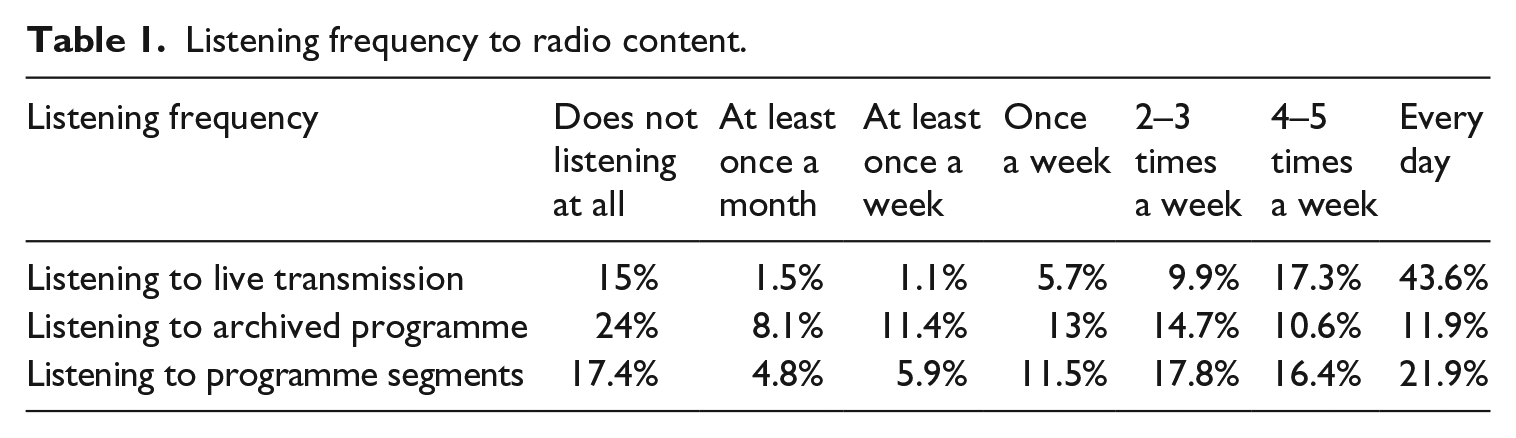
According to our findings, 76.5 percent of participants listen to live transmissions of radio content at least once a week, and over 60 percent listen to live transmissions almost every day. Approximately 22 percent listen to archived programmes on the website or app almost every day, and 50 percent listen to archived content at least once a week. In addition, 38.3 percent listen to programme segments on the website or app almost every day, and 67.6 percent listen to programme segments on the website or app at least once a week (See Table 1).
Listening frequency to radio content.
Listening to archived programmes
Table 2 presents the respondents’ reasons for listening to archived programmes.
Reasons for listening to archived programmes.
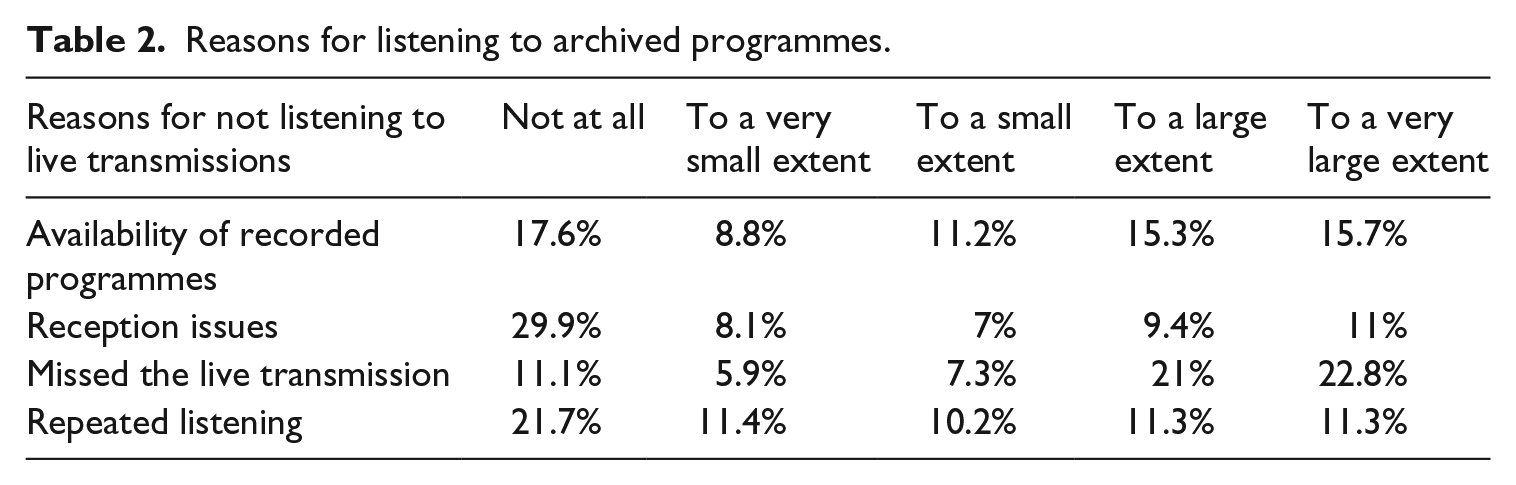
More than 30 percent refrained from listening to live transmissions due to the availability of recordings in the archive. Almost 45 percent listened to programmes on the internet because they had missed the live transmissions. Approximately 40 percent listened to archived programmes due to reception problems during transmissions, and 25.7 percent listened to archived programmes they had enjoyed during their original live transmissions.
Listening to programme segments
Table 3 presents respondents’ reasons for listening to programme segments.
Listening to programme segments.
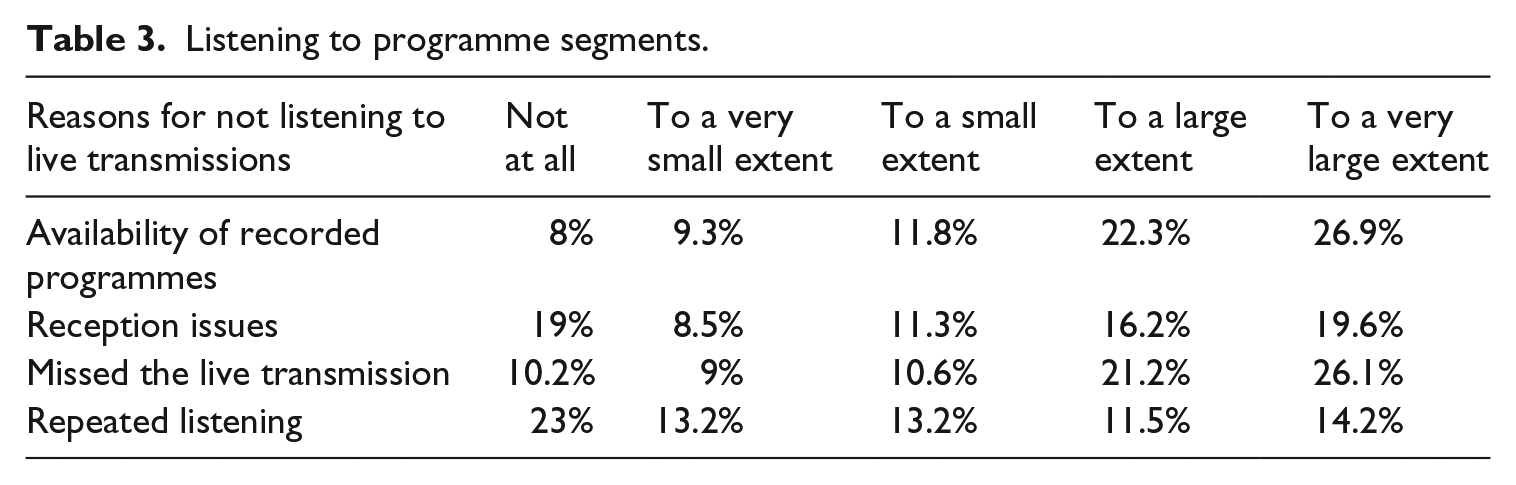
Nearly 50 percent of the survey respondents listened to programme segments rather than live transmissions. Close to half (47%) listened to programme segments on the internet because they had missed the live transmission, close to 40 percent listened to archived programme segments due to reception problems, 35 percent relistened to segments they loved in live transmissions, while 11.1 percent of the respondents shared segments on Facebook. A small portion of the listeners shared segments on social media, and close to 42 percent reported that they did not share content at all.
The reasons for listening to on-demand radiophonic content are given in Table 4.
Summary and main findings: Listening frequency and reasons for listening to archives and segments.
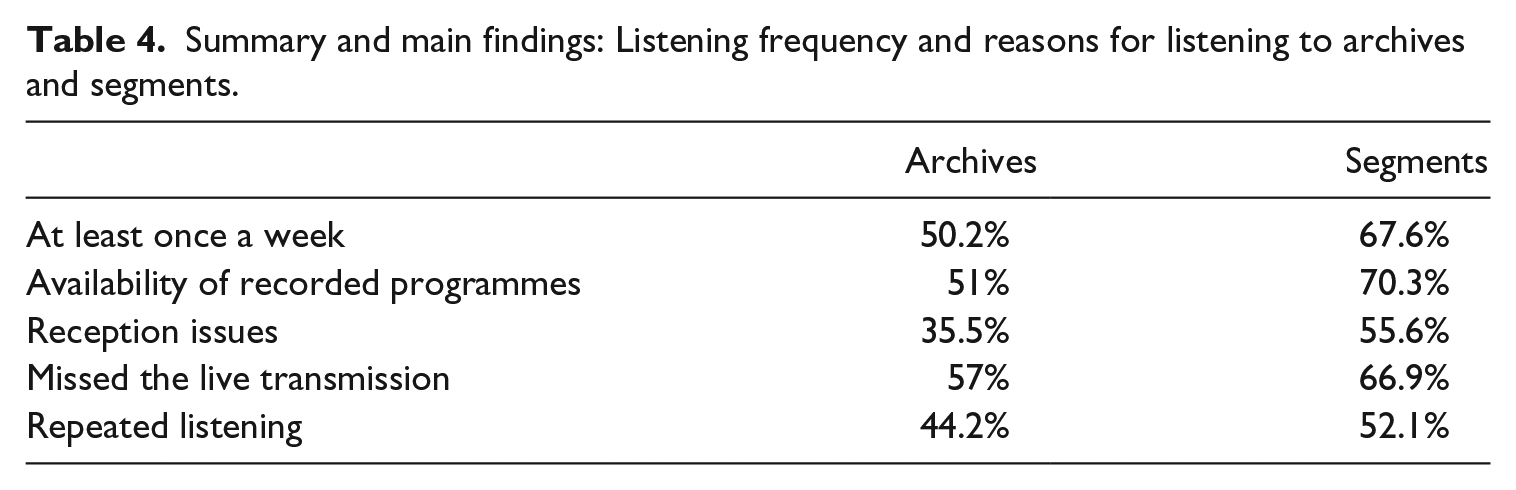
To sum up the findings, 50 percent of the survey respondents listened to archive programmes at least once a week. The two leading reasons were having missed the live transmission (57%) and the availability of recorded programmes (51%). Other reasons were repeated listening (44.2%) and reception issues (35.5%). In addition, the findings showed that nearly 70 percent of the survey respondents listened to programme segments at least once a week. The two leading reasons were availability of recorded programmes (70.3%) and missing live transmission (66.9%). Other reasons were reception issues (55.6%) and repeated listening (52.1%).
Findings from in-depth interviews
For a deeper understanding of consumption patterns, semi-structured interviews were conducted with frequent listeners. In the interviews, the frequent listeners were requested to list the programmes they listen to and their preferred listening modes, and asked to elaborate on their preferences for listening to archived programme segments or archived programmes.
Mode of use
All interviewees reported listening to radio content via a smartphone app or the station website. Most interviewees listened to live transmissions as a secondary activity, so they did not typically set a specific time for listening as opposed to listening to archived programmes on the website or the app:
One interviewee said, ‘There are no rules about it. When I have a free hour when I can sit down; I do office work and can listen to the radio as I work [. . .] so I put on all kinds of programmes from the archive in the background.’
Another listener mentioned listening to archived programmes due to lack of time: ‘I don’t find the time to listen to the radio, you know, in the traditional way, every day. That means – to receive it on a live transmission. So, everything I consume is only through the archive.’
Thus, listeners mostly listen to the radio when transmissions coincide with other necessary tasks, and rarely schedule their listening according to the station’s timetable.
All interviewees reported that they used the archive due to ‘flexibility of the listening time’. As one female interviewee elaborated, ‘I can listen whenever I want. Repeat everything, that’s obvious. If I miss something, I can hear it again, and I can always access [the content].’
Another interviewee referred to the convenience factor: ‘I can listen on my own time. That way, I enjoy the programme without having to be available for the live transmission. I’m not always available myself, and my work or other things don’t let me listen to the radio. So, at the end of the day, [I can] listen on my own free time and that way, it can be combined with other activities. . .it’s convenient for me.’
An interviewee discussed convenience of use and ease of access: ‘This idea of archive, or what they call the radio’s VOD, absolutely lets me listen to desirable contents where and when it is convenient.’
Interviewees also mentioned the advantage of skipping advertisements. Several interviewees even stated explicitly that commercials are the reason for not listening to live transmissions: ‘I listen to the programmes without all the commercials. . .and that is why I prefer not to listen in real time.’
This position was reaffirmed in the context of preventing waste of time: ‘See, Radio 103 has a lot of empty segments, really. That’s okay, but not everything is interesting. When I access the website, then I listen only to the things that interest me. [. . .] there are too many commercials. [. . .] and I do not want to waste my time, so I don’t listen to live radio.’
Another interviewee added that listening to archived content allows her to bypass content that is not interesting or relevant to her: ‘When I listen on the archive, there is no way that I will listen to commercials. . .it is also more convenient and simple compared to live [listening]; it is really in my control. . .. I can skip items that are less interesting to me, for example.’
However, some interviewees preferred listening to complete programmes: ‘The whole programme is interesting, so why would I hear only a part?’ This sentiment was echoed by another interviewee: ‘If I miss a programme. . .I will always go to the archive, and less so, to segments. I like to hear the whole programme. I put it on as the background for doing something, let’s say, if I am putting on my makeup, I will put on my makeup and listen at the same time.’
All interviewees expressed satisfaction with this system of content access and declared that it increased their listening: ‘I listen more. . .without an archive I would listen much less.’
One interviewee favourably compared online radio (programme segments and archived programmes) to VOD on television: ‘There is no doubt it is much more convenient. I did not listen so much before. Now it is like a kind of television on demand. I can listen to whatever is interesting to me whenever I want, and that is much more convenient for users. Our lives make it impossible to be tied down to specific hours and schedules. I can listen to [a programme] once in a while if it is possible, but following a certain programme [over time] is almost impossible. The same goes for television. I hardly watch any live broadcast.’
Interestingly, radio listening is distinct in that it typically takes place in conjunction with other activities: ‘When I arrange the house, I turn on programmes, or when I drive in the car. Or in my leisure time. . .I put it on, in the background. I wouldn’t sit and only listen to a programme. I wouldn’t pay attention only to a programme. I can do other things, too.’
The few interviewees who live outside the reception range of 103 FM listen by internet only: ‘I don’t get reception of 103, so I have to listen through the computer, sometimes [I listen] to recorded programmes and sometimes in real time. I also listen to the archived recordings more often also because we don’t have reception here.’
In a special case, one interviewee, a frequent international traveller, stated, ‘When I am abroad, I listen through the 103 app because that is the only way I can listen.’
Listening to programme segments
Factors influencing listening to on-demand segments
Factors informing this form of indirect and unplanned content selection include a catchy or eye-grabbing segment title: ‘See, I browse there and I suddenly find something with a certain title, so I click on it and check what’s there.’ Another interviewee also discussed the importance of the segment title: ‘Usually, the person who creates the titles does a really good job and many times I’ll encounter a title that is really appealing. I’ll say, “Hey, I’s like to listen [to that] for a moment!” Then I’ll click on the link. But it is still a “by the way” sort of thing, as if the archive is really something I do by habit. That is, if and when [there] is something that catches my eye.’
The title is a visual component that attracts listeners to a specific audio segment and, in many cases, is the main motivator for unplanned listening. Titles obviously help listeners choose their desired content, for both planned and unplanned listening: ‘Let’s say, if I don’t have a lot of time, I check. . .. I go to segments that will interest me more; in fact, each segment has a title and I listen to the specific one I want.’
Segment popularity rankings are another factor that influences content selection. As one interviewee explained, ‘First, I see how many people listened to it in total. Then I check out the title, of course, and if I see content that interests me. . ..’
Sharing on social networks is another activity that affects segment listening habits: ‘On the computer I listen to specific content that I look for – either somebody tells me about an interview that I missed, or the content is floating around on Facebook or Twitter. If somebody mentions something, or there is a “buzz” around it, I go and look for that segment.’
Benefits and disadvantages of listening to segments
As noted, several interviewees expressed positive attitudes towards listening to programme segments: ‘[I will listen to] complete programmes only if I know that I am under huge pressure at work and have no other way to listen to them, but otherwise I will never [listen to] complete programmes.’
The time-saving advantages of programme segments were also clearly noted: ‘The advantage is, like I pointed out, that I simply filter only what I like. . .. Of course I understand that they can’t talk only about the topics that I like; they have to talk about a wide range of topics, like current affairs and so on. But not all topics are interesting for me, so yes, [I listen to segments] mainly to pick out the wheat from the chaff. To listen to only what I want to listen to. It is simply a matter of efficiency, to save time.’
Many interviewees referred to the greater control they have in choosing content according to their personal interests as the reason for listening to segments. One of the interviewees listed the benefits of listening to segments from his point of view: ‘[This way,] I don’t have to listen to things I don’t like. For example, in Zahavi’s programme, there are maybe two interesting conversations out of the entire two hours. In Sheftel’s programme, there might be three interesting conversations and the rest is repetition. Didi Harari’s programme is really only a quarter of an hour, so I listen only to what is interesting for me.’
Other interviewees stated a preference for complete programmes, but also appreciated the availability of programme segments. These interviewees explained their strategies for listening to different programme formats: ‘I prefer the complete programmes, but, again, it depends on the time I allocate to myself. If I go running for an hour, then I prefer a complete programme. If my time is limited, then I might only consume specific segments.’
In summary, listeners are primarily drawn to programme segments because they offer them more control over specific content that is relevant to them, and because of their time-saving potential.
In addition, interviewees noted that it was easy to relisten to segments: ‘There are segments that you have to listen to again and again [although] I wouldn’t play the whole programme again. . .those programmes are like Bourekas films 1 . . ..’ However, listening to segments requires some degree of focus and concentration, more than complete programmes, which is perhaps easier to do while engaging in other tasks: ‘Because it is very short and focused compared with a complete programme, you can put it on and go do something else while listening to it in the background. It does not take up my time; I could probably listen to [the segments] while checking Facebook, but it requires more concentration.’
Furthermore, listening to segments does not supply a fluent comprehensive listening experience as is the case with a complete archived programme. In fact, the distinct satisfaction the listeners derive from listening to a complete programme does not seem to be transferable to the experience of listening to segments: ‘The archive gives you a sense of the whole atmosphere, the whole experience of the programme. Segments do not transmit it, because it is very concentrated: [there’s the introduction, the item, and the ending. . ..] This does not give you the full experience of the programme: it’s [only] an item. It is not a programme, it is a segment.’
Some interviewees also pointed out that browsing through the archive helped them discover and appreciate new segments that they had not originally intended to listen to: ‘I have my favourites and sometimes there are programmes that I inadvertently bump into. For example, the category of Consulting. So, once in a while, I will feel like listening to such a segment. It is also very interesting sometimes.’
Relevance
It is clear from the interviewees’ answers that the content relevance depends on the programme category. For certain areas such as current events and sports, the relevance of a programme or segment content fades over time, sometimes quite quickly: ‘The world of sport is so dynamic that what happens is relevant for today only. Tomorrow there will be new games, new thrills. If I don’t hear about something in real time, it has to be extremely exciting to make me check it out. It needs to be something very interesting to make me listen to it while other sources of excitement are already available.’
Indeed, respondents were asked to comment on the effect of relevance on listening to content after its live transmission: ‘[Do I. . .] listen to current events? Yes, of course. That’s the reason that, if I listen to it, I will listen a day or two after [the broadcast], but not later, because it loses [its relevance]. But entertainment – I will listen to that a few days after [the live broadcast], not a month later, but if it is [available] in the week or two [after the broadcast] I will certainly [listen].’
For listeners who mainly listened to entertainment programmes, the issue of relevance is not as critical: ‘Something happened and they (Shay & Dror) laughed about it. Even if it is [related to] current events, it doesn’t matter whether I listen to it exactly at seven o’clock in the morning or at ten o’clock in the morning or eleven o’clock at night: It will still make me laugh. Maybe it won’t be relevant. . .but in the end, I don’t listen to that programme for information alone.’
Sharing segments
Interestingly, although listeners noted that their content choices are influenced by content shared on social media, they reported a passive stance towards sharing segments on social networks. Online radio listeners share less archived audio programmes or segments than conventional social media users who share video, images and text-based posts. As one interviewee stated, ‘The majority [of those who log into Facebook] share less often, and this is the same concerning Likes and Comments. . .. Sharing happens only when there is a high interest in the segment. Maybe, in rare cases, if the listening rate exceeds ten thousand. . .. Sometimes, with Nathan Zehavi, when a “troublemaker” comes on the air and they begin to argue, the listening can reach twenty thousand. . .. I would share [content] only in this case, so that others enjoy it, too.’
Other interviewees noted that the significance of the content potentially determines their willingness to share: ‘I share, but it depends how urgent and relevant [the content] is, and how important it seems to me at the moment.’
Sharing can also be prompted by the motivation to initiate a conversation on the subject: ‘If there is something interesting and people are talking about it, so yes, I share. Many times I upload things to Facebook for people to listen to, so that my friends on Facebook will listen to [because it was] a certain item that interested me, and maybe it might interest them too. . .[in order] to see what they say about that item, what other opinions there are, and if they are for or against what was said – if they are against, I want to know why.’
Some listeners share more readily if they feel a special connection to the content: ‘It varies: sometimes I am more emotionally involved, and other times I am a passive listener.’ This affective dimension was noted by other interviewees: ‘I won’t talk about it a lot unless it is a segment that really made me laugh, and I then will share that segment, specifically.’
Discussion and conclusions
As radio incorporates on-demand radio, it remains a part of many people’s everyday lives. Through a study of radio consumers, the present research examined whether radio, through its convergence with the internet and its use of on-demand content, successfully meets the challenge of the media according to the uses and gratifications theory, which is to identify and study the range of prevalent consumer needs that stem from different social conditions, among other factors. We studied whether radio on demand satisfies contemporary users’ needs. Data analysis shows that the majority of respondents in our study (76.5%) listen to online radio very frequently (at least once a week), while around 60 percent listen to archived programmes and/or programme segments on the station website and/or app least once a week to (50% and 67.6%, respectively). According to the Second Authority of Television, 2 radio listening rates are high, with 74 percent of Israelis listening to radio almost every day (Shwiki, 2016). Radio remains a popular medium in the United States as well, where the weekly listening rate is 92 percent (Nielsen, 2017). These figures confirm that radio remains a relevant, significant and up-to-date communication channel for the wider public who consume its content on a regular basis. These data reinforce previous studies that found that the popularity of radio on the internet and podcasts is constantly increasing (Arbitron and Edison, 2012; Samuel-Azran et al., 2019).
Listening frequencies of on-demand radio indicate that the convergence of radio with new technologies, including online and on-demand options, has been significantly assimilated in radio consumption patterns. That is to say, online and on-demand services meet consumers’ needs and offer new possibilities of exposure for the medium (Finn, 1997). Radio content producers have successfully identified consumers’ changing needs and designed content modes that satisfy these needs through on-demand options and fragmentation.
In the research literature, traditional radio is described as a secondary medium that is typically consumed together with another primary action of the listener. Since radio engages a single sense (hearing), listeners can perform other tasks concurrently, transforming radio into a kind of ‘background’ for other activities (McQuail, 2010). Despite new media’s unique options for radio, they have done little to change listeners’ traditional modes of engagement with radio, and listeners continue to listen to radio while performing other activities. Nonetheless, the multiplicity of means of access and platforms extends radio’s reach, allowing listeners to consume radio content beyond reception range (Laor et al., 2017) or access radio content on demand. In this manner, the internet can be considered a substitute for FM transmissions, broadening station content distribution (Cordeiro, 2012; Laor et al., 2017; McClung, 2001).
According to the qualitative and quantitative findings of the current study, live transmissions are no longer considered a critical component of the radio experience. In contrast to the past when consumers adapted to radio transmission schedules, as listening to a live transmission was the only consumption option available, today, radio is undergoing a major transformation and is adapting itself to new audience consumption habits. The findings of the current research emphasise how consumers are proactively and deliberately consuming the medium in ways that satisfy their needs, as posited by the uses and gratifications theory (Katz et al., 1973). Research also shows that online consumers consider on-demand content on websites and apps to be a viable alternative to traditional transmission scheduling, similar to the attitudes towards television that emerged with the introduction of DVR (Nielsen, 2009). The findings of the study support the hypothesis that listening to on-demand radio will lead to increased production and availability of radio content.
As with TV, content on demand in radio and the availability of segments and archived programmes facilitated by websites and apps have radically increased listeners’ exposure to greater amounts of radiophonic content (Punnett, 2016), changing the radio industry forever. Radio’s transformation by adopting interactivity, demassification and asynchroneity (Ruggiero, 2000) would probably not have occurred without the revolutions in information and mobile technologies. Through its adaptations, radio continues to satisfy both the traditional cognitive and informative needs that consumers expect of media (Blumler, 1979), as well as new needs driven by new technological opportunities. The findings of the current study show that programme segments command higher consumption rates than archived programmes (38% vs 22% for daily consumption; 67% vs 50% for at least once a week consumption). This finding confirms the research assumption that more listeners listen to programme segments than to complete programmes. Consumers’ new listening habits, and specifically their preference for programme segments over complete programmes, support the theory of use and gratification: radio offers listeners many options and listeners actively and deliberately consume the medium according to their needs and preferences, taking into account how radio best meets their needs.
As noted, listening to segments and archived programmes represent two distinct radiophonic experiences. The primary motivators for listening to archived programmes are having missed a live broadcast, reception problems, time shifting (listening after the broadcast to accommodate one’s schedule) and a desire for repeated listening to favourite segments. The interview results confirmed that consuming archived programmes gives consumers greater flexibility to manage their content consumption, and to circumvent inconvenient scheduling and reception problems (FM). Audio on demand also offers vital time-saving options either by skipping advertisements or by listening to specific segments that reflect their ‘personalised choices’ (Glantz, 2016).
Many interviewees noted that listening to live broadcast schedules is inconvenient or impossible due to other obligations. Audio on demand effectively makes obsolete past behaviours of accommodating oneself to station transmission schedules, as consumer flexibility and control have become an integral part of the on-demand content experience (Berry, 2006; Bonet et al., 2011), a development first seen in the television industry (Abrahamsson and Nordmark, 2012; Moshe, 2012).
As stated in the interviews, the primary advantage of archived programmes is listeners’ control over consumption, allowing listeners to circumvent content that is not interesting to the listener. Listeners’ control is further enhanced by navigation tools that allow one to pause at a certain point, pause the programme, skip forward or back and so on. Thus, radio on demand offers listeners control at the macro level (by selecting what, when and where to listen) and at the micro level (by selecting the content of the programme itself). This finding supports the theory of Bjur (2009) who claimed that technological change promotes services for the individual and influences entire communication systems. Moshe (2012) also found that on-demand content offer consumers more effective tools for managing the flood of media information in an era of channel proliferation. New consumer tools such as skipping advertisements ultimately affect listening habits, and were also found to be beneficial for television consumers (Wahlström and Kankainen, 2011).
The added value of programme segments is reducible to efficiency of listening and time saving. The segments are already ‘distilled’ – ready to be browsed for listening relevance and consumed in edited and packaged form. This division of content into segments may be the product of considerable technical labour but is presented to consumers as a time-saving tool to allow listeners to focus on relevant content by filtering out irrelevant content, According to Moshe (2012), this concept is known as ‘time squeezing’, allowing the consumer to ‘shrink’ content in time and space to more effectively conform to lifestyle preferences. As a result, internet consumers are now used to consuming short and segmented content that meets specific and individual needs at the time and location most convenient to them. Audio segmentation is aligned to the fast-paced social media era and to members of the Facebook generation, habituated to consuming short and condensed content. That is, listeners’ needs for escapism, entertainment, information and education (McQuail, 2010) are now being met in a focused manner by radio on demand, as the findings of the current study show that radio satisfies these needs.
In contrast to traditional radio transmissions that are occasionally subject to factors that adversely affect listeners’ experience, such as transmission faults or mismatched schedules, on-demand radio meets listeners’ demands by circumventing these factors and ensuring content availability at the listeners’ convenience. These listeners’ needs ‘compel’ radio to adapt in order to satisfy their needs, as indicated by the theory of uses and gratifications (Katz et al., 1973; Leung, 2013). Thus, Hypothesis B is supported.
Although short programme segments facilitate simple and convenient sharing on social media, in our case study of Radio 103 FM, the interactive online tools have not produced the desired listener interaction (Laor and Steinfeld, 2018; Laor et al., 2017; Moody et al., 2003). Our findings show that most listeners do not extensively engage in sharing or posting comments to audio segments, and listeners only share segments in which they have a high level of interest. These findings contrast with other earlier research that found that the new form of radio increases listeners’ interactivity (Silva et al., 2018; Sinton, 2018). The limited sharing by Radio 103 FM listeners may be explained by the audio rather than the visual nature of the segments as studies have confirmed that sharing visual content on social network is the preferred and far more popular mode of sharing (Laor and Steinfeld, 2018). Furthermore, these segments are merely parts of a complete programme and were not designed to be viral.
In addition, sharing on-demand segments with others on social media may not be popular, despite availability and accessibility, because sharing does not satisfy any audience needs and fills no function for them. Social interaction conceivably satisfies the need for enhanced social interaction, as identified by McQuail (2010). However, sharing radio content does not seem to satisfy this need, possibly due to the differences in media language (visual vs auditory). This finding supports Hypothesis C, that users are most likely to share visual rather than archived radio (audio) content. Therefore, if radio stations believe that sharing segments and programmes will increase listening frequency rates, they should invest efforts and resources to create segments designed with viral characteristics in mind so as to increase their popularity and shareability.
Finally, the importance of on-demand radio content interactivity, demassification and asynchroneity (Ruggiero, 2000) for consumption cannot be overstated. Availability and ease of access promote browsing, as a result of which listeners often find themselves exposed to unexpected programme segments that spark new interests and direct them to unfamiliar programmes. This phenomenon can be referred to as spillover. All the interviewees said that sometimes they inadvertently encountered unfamiliar segments. The study findings also show that content supply, and specifically the multiplatform availability and wide distribution of content on websites and apps, encourages listening to segments that would not be listened to otherwise. This kind of spillover can be compared to the spillover on YouTube, in which related content is visible on the margins of the screen to promote further viewing. This phenomenon also supports the first hypothesis of this study on increased consumption of content.
Trends in on-demand radio listening habits correlate with the TV viewing experience, in which supply and control are leveraged to increase content consumption and extend the types of content viewed (Moshe, 2012; Nielsen, 2014; Yu et al., 2006). Appealing titles have been shown to be effective in promoting ‘dripping’ (listening) to additional segments. The interviewees indicated that a ‘catchy’ segment title draws their attention. This finding shows that although radio is essentially audio content, internet radio relies heavily on visual elements to attract consumers, which reflects the technological and economic convergence that is creating a new model for radio (Cordeiro, 2012; Ramsey, 2018).
By increasing listeners’ exposure to new content, spillover satisfies a range of needs including cognitive, entertainment, educational and escapist needs (Blumler, 1979). As on-demand radio connects the content that a listener consumed to other similar content that ‘pops up’, radio is more accurately than before satisfying its consumers’ needs. Use of a recommendation system to enhance exposure to new content is one example of radio producers’ efforts to cultivate new modes of adapting to audience needs and expanding its functions, in line with the uses and gratifications approach (Katz et al., 1973).
The interviewees noted that the relevance of archived current events programmes declines as time elapses from the live broadcast. These findings correspond to previous research on delayed television viewing, which found that some programmes are defined by short life expectancy and lose relevance after even a few hours (Abrahamsson and Nordmark, 2012). On the other hand, entertainment and educational programmes may be relevant for longer periods of time, enjoying a longer radiophonic ‘shelf-life’ (Laor et al., 2017).
Listening to programme segments (demassification) has several implications for traditional radio listening habits. First, demassification creates an interaction between the user and the radio station in which the selection and consumption process becomes similar to a face-to-face experience between the requester and the responder (Williams et al., 1988). Second, selecting segments requires concentration and focus and may sometimes not be compatible with secondary consumption of radio content. Third, as extracted elements of a complete programme, segments may not reproduce the experience and message of the complete programme.
In summary, we see that consumers make intentional use of on-demand radio to satisfy specific needs, and not merely due to the availability of the technology. Consumers listen to specific content that is relevant to them, and do so in conditions that are individually optimal, forcing media providers to continually compete to satisfy their needs (Katz et al., 1973). This finding supports Hypothesis A (listening to on-demand radio will lead to increased availability and consumption of radio content) and Hypothesis B (reasons for listening to archived programmes and programme segments will include convenience of listening time, reception issues and repeated listening to favourite content).
Summary
Online radio has radically changed the definition and essence of the radio landscape (Ferguson and Greer, 2018; Silva et al., 2018; Sinton, 2018). The current research shows that radio remains a major and relevant communication medium because it continues to meet listeners’ needs by offering useful formats that satisfy the listeners’ needs more precisely.
The findings of the current study support the uses and gratifications theory by illuminating several reasons for online and on-demand radio listening. The research findings show that radio consumption is high and meets consumers’ needs for interactivity, demassification and asynchroneity, a fact that underscores the continued relevance of radio, and is supported by the transition from listening to complete programmes as per a station’s programming schedule to consumption of segmented on-demand content aligned with individual needs and wants. Listeners select the specific listening time, place and programme segments and the specific content that will satisfy their needs, and these more individualised listening patterns are more accurately aligned with their individual needs and wants. In effect, listeners are challenging radio and driving its transformation (Katz et al., 1973): Through these new patterns of consumption, listeners accurately signal their diverse needs and subjugate radio to their needs. Radio’s attentiveness to the challenge posed by its listeners has, in turn, spurred ratio to develop diverse opportunities for focused and customised listening.
The current study focused on a comparison of two types of on-demand radio listening modes: listening to segments and listening to complete archived programmes. Our findings show that segment listening represents a larger listening bloc than programme listening. Listening to archived content offers flexibility of listening time and control of the listening experience (pause, rewind, etc.), while segmental listening offers the added value of choice of specific aspects of content based on individual preferences. Nevertheless, both modes of listening are important to on-demand radio listeners, and can be considered as two parallel, possibly complementary, modes of listening.
Accessibility of segments and programmes on demand encourages listeners to consume additional and new content by spillover. Assigning appealing titles to segments further broadens the reach of the new radio.
Despite the extensive content supply and tools for listener interactivity, radio consumers remain mostly passive and typically refrain from sharing and commenting on segments on social media. It is possible that online radio listeners are not accustomed to distributing radiophonic content in this manner, or that radiophonic content lacks features that promote internet sharing and distribution. Future research should investigate the causes of on-demand radio listeners’ limited sharing and the features of segments that are shared.
Although on-demand radio has reduced listeners’ dependence on broadcast schedules, radio schedules remain relevant for specific programmes such as current affairs, in which listeners are required to closely follow the original broadcasts. Future research should seek to provide an in-depth understanding of the relationship between listening patterns and content type. In light of new online listener radio consumption patterns, stations are advised to recognise their new role as producers of content for a wide range of different platforms – live transmissions, social networks, websites and applications and other emerging media innovations – and recognise their new roles as perceived by their audience. The more radio incorporates new technologies that present increasing consumption options to their audiences, motivation and satisfaction become more significant factors in audience analysis (Singer, 1998). The media should continue to study audience needs and the social conditions that create the foundation for the emergence of these needs. At the same time, the need to seriously determine optimal transmission schedules for the digital era remains a key task.
The findings of this study support the argument that as long as the radio industry adapts itself to the needs of its consumers, and specifically to audiences’ needs for escapism, entertainment, education and information, in line with the uses and gratifications theory (Katz et al., 1973), it will retain its power as a relevant medium.
Footnotes
Funding
The author(s) received no financial support for the research, authorship, and/or publication of this article.
