




Abstract
Moving people comprise both a subject of news reports (of refugees, migrants and other people-on-the-move) and a way of reporting on the issues involved. Viewers can be moved and placed in a discursive relation to the displaced when news stories construct what Arendt called ‘proper distance’. This possibility is explored in the article, which compares coverage of migration issues in 2019 on four global television news channels: Al Jazeera English, BBC World, CNN International and RT. The results provide evidence of approaches that differ in striking and thought-provoking ways, giving global television news consumers different resources for making sense of a complicated global crisis.
Keywords
Introduction
Being on the move is an ancient and enduring human trait. Hunter-gatherers followed animals in search of sustenance, and millennia after today’s Europeans walked north out of Africa, the map of the continent was rewritten by the Völkerwanderung, as was that of the world centuries later by people moving across the Atlantic from the ‘Old’ to the ‘New’. These physical moves have left traces in speech acts. In English, the old word ‘ways’ signifies both the paths taken by people moving on foot and the customs associated with different societies. The perceived threats to such customs by those making their way to Europe and North America have, in the turbulence of recent years, left their mark on the words used to designate people on the move (POM), with ‘refugee’ and ‘migrant’ being used, misused and confused in public, political and media discourse. Our point of departure is that the ongoing ‘migration crisis’ (as the hydra-headed complex of issues is often referred to) poses a problem not only to the afflicted, but also to global media scholarship, by raising difficult questions about what can be expected of journalists speaking to viewers in a world of shared crises.
While it is natural to move, the number of people compelled to do so by war, terror and persecution has reached unprecedented levels. As Hill (2018) notes, the mass movement of people ‘is arguably the biggest story of our time’. In 2015, when the crisis was the subject of substantial attention in politics, media and scholarship, the United Nations High Commissioner for Refugees (UNHCR) reported there were 65.3 million people displaced worldwide. At the end of 2019, the figure was 79.5 million. 1 But by then, refugees and migrants had been displaced from the centre of attention as well as their homes.
Just as with the variability of attention paid to it, the words used to tell our time’s ‘biggest story’ are loaded and politicized. This matters to scholars, journalists and their publics. Like the War on Terror, this is a classic example of global crisis as delineated by Cottle (2009) in that it has both a physical and discursive dimension. But its backdrop is information warfare rather than the War on Terror, as the migration crisis intersects with a crisis in public discourse, characterized by a rise in incivility and the pollution of public debate. Discourses around people on the move serve as battlefields in that information war, in which combatants include populist politicians and trolls intent on influencing elections and destabilizing democracies worldwide. As with every war, there is a resistance, and some journalists can be observed adopting an activist stance when their values of objectivity and balance are barraged with misinformation and ‘alternative facts’. Such stance-taking matters to understandings of professionalism, regardless of whether the news culture is ‘sacerdotal’ or ‘pragmatic’ (Hanusch, 2009; Robertson, 2015: 56–57).
It is problematic that the attention of the academy has been distracted from global issues and cosmopolitan responses at this critical juncture by the surge in nationalist imperatives in both politics and journalism. Mediations of refugees and migration have, of course, been the subject of a good deal of academic scrutiny (see Eberl et al., 2018, for a meta-analysis of studies published since 2000). But the focus has been predominantly on national media (e.g. Chouliaraki and Zaborowski, 2017; Sakellari, 2021; Vollmer and Karakayali, 2018), newspapers and websites (e.g. Cooper et al., 2021; Fengler et al., 2020; Greussing and Boomgaarden, 2017; Jiang et al., 2021; Tong and Zuo, 2019; Zaman and Das, 2021), and social media sites and user-generated content (e.g. Abid et al., 2017; Bennett, 2018; Creta, 2021). News produced for television has received less scholarly attention of late (exceptions are Dan et al., 2020; Kyriakides, 2017), despite that medium (whatever the platform on which it is disseminated) remaining a key site for political information and a leading disseminator of visually compelling stories. On a more general level, questions about the proper way to act vie for attention with enquiries preoccupied with technology: scholars interested in the changing face of journalism are energetically exploring how technological change impacts on praxis, but pay less attention to how professional journalists grapple with the challenges of reporting morally charged and controversial global issues.
This problem complex – the intersection of mutually dependent crises – invites both investigation and reflection. With that in mind, the aim of this article is to compare coverage of migration issues in four global television news channels throughout 2019 in order to problematize the role of global journalism in this context. Al Jazeera English (AJE), BBC World (BBCW), CNN International (CNNI) and RT (formerly Russia Today) are based on different continents, have different business models and different relationships to political power in the countries in which they are moored, yet they all espouse professional values and address an ostensibly single world in English. The topic is one with global impact and provides a vantage point on the challenges facing journalists in a world of moral dilemmas, and the discursive strategies deployed to meet them. The fact that the four channels have been involved in the information war in one way or another makes them even more compelling to study.
The aim of the article is operationalized in three broad but simple sets of research questions, which have a bearing on the relationship between media and cosmopolitanism, with answers sought in both quantitative description and qualitative analysis:
How big are the ‘newsworlds’ in which the migration crisis unfolds and how prominent a feature of those newsworlds is migration?
Who populates the newsworlds of migration? Whose voices define the issue, how are people on the move named and framed, and where are they situated?
Whose business is the crisis depicted as being? Where are viewers positioned in migration reports, and at what distance from people on the move?
The ‘distance’ we have in mind is that associated with the ideas of Hannah Arendt, which have taken on renewed salience in these troubled times (Bernstein, 2018). In particular, her thoughts about ‘proper distance’ and ‘visiting’ can be used to distinguish in helpful ways between different journalistic approaches to the challenge. The next section reviews these ideas, before moving on to a brief discussion of how global media can be thought to implicate ‘us’ in affairs that transcend borders. Central to this is the connection between justice and representation made by Fraser (2010). Her concerns about framing and ‘misframing’ are shared, as we go on to discuss, by scholars and journalists who have drawn attention to the problem of mislabelling refugees as migrants. The investigation then segues from the concerns of journalists to their deeds, with the presentation of an empirical study of 78 television news reports of migration, broadcast between 1 January and 31 December 2019. We argue that the results are evidence that global news consumers are provided with rather different resources by different newsrooms to use in the work of understanding whether the global crisis of people on the move is about politics, humanity, solidarity or morality.
The point of this work is not to present an exhaustive empirical analysis, but to use a modest (if thorough) one to think through larger issues pertaining to the challenges, and strategies to meet those challenges, of representation in a globalizing world.
Arendt, global media and misframing
Understanding, according to Arendt, is to be distinguished from the possession of correct information. It is ‘is an unending activity by which, in constant change and variation, we come to terms with and reconcile ourselves to reality, that is, try to be at home in the world’ (Arendt, 1994[1943]: 307–308). The distinction is relevant to the business of thinking through the difference between journalism conceived of as information-dissemination and journalism as a praxis whereby the reporter-as-storyteller helps the viewer to understand as well as to know (Robertson, 2010). This matters to depictions of global crises in general, and to the issue of people on the move in particular.
Being at home in the world in Arendt’s terms entails the activation of imagination to make present in the mind the standpoints of absent others, putting things ‘in their proper distance’ and bridging the chasm between us and others (Biesta, 2016: 186). Presupposing plurality, this act of imagination, in the view of Silverstone (2007: 119) has to do with the capacity of enlarging one’s perspective and ‘the willingness to recognize the other in her sameness and difference’. Holding both sameness and difference, ‘proper distance’ resists being so far removed from the other that they seem beyond the reach of care. The notion also asks us to resist an understanding of the other that is so closely aligned as to erase the difference that is fundamental to recognizing and valuing the stranger (Hull and Stornaiuolo, 2014: 19). The negotiation of proper distance is thus an important act.
Arendt uses the metaphor of visiting to explain this imaginative bridge-building. Visiting, as Disch (1994) explains, has to do with ‘constructing stories of an event from each of the plurality of perspectives that might have an interest in telling it and imagining how I would respond as a character in a story very different from my own’ (Disch, 1994: 158–159, quoted in Biesta, 2016: 186). Visiting is not to be confused with tourism or empathy. The former, argues Biesta, ‘erases plurality’ by adopting an objectivist stance that uses ‘how we do things’ as a lens through which to look at people who can thus only appear as the other. The other need not be distant, either in geographical terms or because of their situation as supplicants on the border asking to be let in: depending on the stance of a given journalist or news outlet, a cynical White House inhabitant might be represented as a stranger or other. Visiting is different from empathy because it is wrong to assume, as empathy does, that it is possible to take the position of the other. ‘Visiting is therefore not to see through the eyes of someone else’, explains Biesta (2016: 187), ‘but to see with your own eyes from a position that is not your own’.
Deployed in this way, the notion of visiting is akin to the activity of cultivating cosmopolitan outlooks, and to what interests scholars who consider news narratives to be resources for understanding rather than simply information. It has been suggested that this discursive power could work differently in different dimensions. One is where awareness is promoted, in the provision of answers to questions such as: what is happening in the world, and to whom? It is here that the ‘latent cosmopolitanism’ referred to by Beck (2006) can be thought to reside, and where the tourist wanders. The activation of that which concerns Boltanski (1999) and Chouliaraki (2006) – the appeal to empathy and pity – takes place in the second dimension. But the people I feel sorry for may not necessarily be like me; they may be at home in another world. Distinct from empathy is the imaginative work that takes place in a third dimension, that of identification, where the viewer of television news is encouraged by the journalist, or the way the narrative is constructed, to imagine that the other is not distant at all (Robertson, 2010: 140). This encouragement might take the form of entering a refugee tent at the side of a reporter, or walking alongside people as they march from the Budapest train station to an asylum in northern Europe. Depending on how viewers are situated, a news report may or may not allow or even encourage them to visit.
It is reasonable to expect that opportunities for Arendtian visiting should be plentiful in the current context of problems shared across national borders, as global crises by their very nature call for the building of bridges across the abyss, both practical and discursive. By ‘constructing and communicating global threats, public anxieties, and narratives of emancipation’ (Chopra and Gajjala, 2011: 9), however, media play a complex, if not confusing, role. Part of the confusion has to do with the penchant for depicting global crises not as shared across borders, but as national problems.
This can be thought to happen, even in media that cannot assume a national ‘we’, when the approach taken by journalists to newswork conforms to what Hänska (2018: 107) calls ‘ritual’. Public communication in such instances has to do with ‘the emergence, constitution and reproduction of collective (national) identities’, in a process of ‘performing, affirming and negotiating belonging’ (Hänska, 2018: 107). By way of contrast, the representative or democratic framework ‘views the public sphere as a forum in which people can gain voice’ through ‘the journalistic representation of the public’s interests’, among other things. Public communication understood in this way has a representative function. ‘In a world where transnational interdependencies are on the rise’, Hänska argues, ‘journalists should assume a less parochial, more cosmopolitan view of the public and its interests’ (Hänska, 2018: 106; see also Ward, 2010). Journalism that adopts such an approach speaks to a public that is coincidental with a community of fate that is defined as such because its inhabitants are affected by the same issue – be it pandemic, global heating or migration – rather than by residence in the same territory. By giving voice to those affected, such journalism conforms to the traditional ‘watchdog’ role of holding power responsible to those it affects, argues Hänska (2018: 106). But it resonates even more with roles identified by Hanitzsch and Vos (2018: 152), which they argue are more relevant to a globalizing world – roles such as ‘storyteller’, ‘educator’ and ‘advocate’ who act as spokespersons for the socially disadvantaged.
Hänska turns to journalists working for the BBC’s Persian Service to explore this approach empirically, but there is more striking evidence of it in other global newsrooms. Journalists working for Al Jazeera English, for example, have been quoted as saying that reporting to ‘a genuinely global audience’ involves a rationale which ‘transcends’ cultures and languages, and which reports global themes. For that reason, an elite perspective is avoided: When other networks go to the summit. . .we go and find stories about some of the issues which are being debated at the summit which are affecting the lives of ordinary people. We move away from ‘high helicopter issues’ that the state, prime ministers, presidents want to talk about. . .our fundamental rationale is that we really want to hear from people in the world who have something to say but don’t have the channel or means of saying it (Executive producer at AJE, quoted in Robertson, 2015: 30).
Instead of looking at a single outlet to find out whether global newsrooms engage in news practices that are more global or cosmopolitan than national in orientation, we argue that the question is better suited to comparative analysis.
In her influential work on the reimagining of political space and the public sphere under globalization, Fraser (2010, 2014) directs attention to the key issues of whose interests count, whose voices get heard, and to whom we have moral obligations when new forms of representational injustice arise in a context of global crises. ‘Misframing’ is the term she uses to designate the injustice suffered by people who lack standing in the communities whose decisions impact their lives, or ‘the ordinary people’ referred to by the Al Jazeera executive producer quoted above. Beyond this is the injustice Fraser refers to as ‘meta-political misrepresentation’ which happens (to adapt the philosopher’s idea to the journalist’s metaphor) when a ‘high helicopter’ view is used to frame shared issues, thus excluding the affected from the frame and denying them a role in determining that frame. In the tradition of Arendt (among others), the political space Fraser has in mind when she writes of representational justice is structured around ‘transnational solidarity, transborder publicity, and democratic frame-setting’.
Fraser’s concern with framing and misframing is of direct relevance not just to the migration crisis, but also to the crisis in public discourse referred to at the outset. The same concern was voiced in a campaign film by PEN America (an organization of writers who lobby to protect free expression in the US and across the world) that circulated after the inauguration of Donald Trump as president in the US. Itemizing how his threats to journalists bear an affinity to the behaviour of authoritarian leaders elsewhere, the narrator says that Trump’s denial of the meaning of words is alarming because: words transcend borders and drive our curiosity. They are how we share, and understand others, tell stories, and come together. Words allow us to know. . .
2
When words are misused – deployed by government or other political actors to denote the opposite of their original meaning – then the thing originally denoted can no longer be described and thus ‘does not become a fact of shared reality’. Returning to Russia as a journalist in the early 1990s, Gessen (2017) found that ‘the language of politics had been pillaged, as had the language of values’. The same thing, she argued, happened in the Trumpian US and in other places where Right-wing populist interventions have shifted the meaning of words needed to talk about politics in a common language. The political air we breathe becomes polluted, and public space – ‘the space of our shared reality’ – becomes ‘filled with static’, she argues. The ability to call things by their proper names is essential to that shared reality. Gessen quotes Arendt, who argued that if someone ‘wants to see and experience the world as it “really” is, he can do so only by understanding something that is shared by many people, lies between them, separates them, showing itself differently to each and comprehensible only to the extent that many people can talk about it and exchange their opinions and perspectives with one another’ (Gessen, 2017). It is thus a matter of considerable concern that shifts in the meaning of words like ‘refugee’ and ‘migrant’, and the deployment of adjectives relating to the legality of their movements, are rendering fraught public communication about this particular global crisis.
Arendt herself knew a good deal about migration and statelessness. Writing in 1951, she said it had become a mass phenomenon, and that the ever-growing number of stateless was ‘the most symptomatic group in contemporary politics’ (Arendt, 1976: 277). Bernstein (2018: 20) has demonstrated the renewed relevance of this observation. The ‘right to have rights’ is threatened in the case of stateless refugees; their plight ‘is not that they are not equal before the law, but that no law exists for them’ (Arendt, 1976: 295). This is a problem that exercises journalists working for global outlets and is connected, at least in part, to the problem of words, even when the medium in question is television.
People crossing the Mediterranean in search of sanctuary in Europe, or attempting to cross the southern border of the United States, are often dismissed as ‘economic migrants’, which characterizes them as less deserving than other people on the move. A ‘strong political and media narrative’ has been perceived, according to which even people fleeing war and human rights abuses should remain in the first countries in which they arrive (Kuschminder and Koser, 2016). By failing to do so, they become ‘migrants’ rather than ‘refugees’ and thereby risk losing the right to have rights. The problem is the use of these different words ‘to differentiate between the experiences of those on the move and the legitimacy or otherwise of their claims to international protection’ (Crawley and Skleparis, 2018: 49).
The problem of how to name people on the move is not new. Arendt grappled with it in 1942. ‘With us the meaning of the term “refugee” has changed’, she wrote (Arendt, 1994[1943]: 264). Having lost its meaning of someone fleeing from political acts or opinions, the term, she noted, had come to designate the most unfortunate: people arriving in a country without means and in dire straits. Arendt described refugees struggling to rid themselves of the term, preferring to be framed as people who chose to leave their homes, for whatever reason. While her essay ‘We Refugees’ is in marked contrast to the 21st-century discursive struggle over the naming of refugees so as to acknowledge their rights, it is a useful reminder of the double effect of such terms and how political their shifting meanings are.
Scholars and public intellectuals have not been the only ones to draw attention to the problem, journalists have done so too. Al Jazeera went so far as to take an editorial decision in 2015 to use the word refugee rather than migrant in its coverage of the crisis unfolding across Europe.
3
Correspondents in the field, who had reported on people on the move in France, Greece and at the North Macedonia border, explained how the editorial shift mattered to their coverage. One said: Well I haven’t asked these people, of course, what they prefer to be called. I think that after all they’ve been through, that is unnecessarily obtrusive. But the point about this terminology is. . . the audience’s understanding of the wider context of this vast movement of people. And in that sense, the word refugee well beats the word migrant. . . because it suggests a voluntary, opportunistic movement of people looking for better work conditions; a better life. That’s not what this is. (Jonah Hull)
Another talked of covering ‘the so-called migrant crisis’ in Calais and discovering very quickly that the vast majority of the thousands in the camps were refugees, not migrants. He spoke of how disturbing it was to hear the British prime minister referring to a ‘swarm’ of migrants threatening the UK and the ‘media frenzy’ such comments stimulated: There were a number of journalists there from the tabloid press, I think there was even one British daily newspaper that ran a line, something along the lines of, well ‘Britain managed to keep Hitler at bay, surely it can keep a group of migrants at bay too’. So it becomes evident just how difficult this word is – migrant – and how it plays into a loaded agenda of politicians, of political leaders. I think it’s fundamentally important that we really reassess the use of this word. (Charles Stratford)
Taken together, voices from different quarters and different times offer compelling reasons for paying attention when analysing news discourse to how people on the move are named and portrayed and how the world ‘in which we are at home’ is depicted. Is migration framed as a global or national concern? Am I led to understand it is a matter for elites or something that is also ‘my’ business? Are there traces of Arendt’s visiting – of cosmopolitan approaches – in the migration coverage of different global outlets, or is the ‘ritual’ perspective more in evidence? In what follows, we look for answers in the coverage of four global broadcasters.
Material and method
Material
One broadcast of each channel was analysed for each week of 2019, resulting in a sample consisting of 205 broadcasts: 52 each for Al Jazeera English (AJE), CNN International (CNNI) and RT and 49 for BBC World (BBCW; three broadcasts were missing due to technical problems). Each of the broadcasts – a combined broadcast time of 114 hours – was reviewed from start to finish and a total of 78 news items were coded as pertaining to migration (including the movement or plight of refugees, asylum-seekers, displaced people and those labelled ‘migrants’): 3.6 hours in total, or 3.2 percent of the total broadcast time. The material was selected by a group of eight coders (of six nationalities) using constructed week sampling to ensure that it was representative for the year under analysis. One constructed week consists of seven consecutive calendar weeks, with a different day of the week randomly assigned to each.
Apart from representativity, there are a number of reasons why this material was chosen for analysis.
The first point to address is the choice of television, given the centrality of social media to public debate about politics in general, and migration in particular. Television remains ‘a widely used and important source of news’ (Nielsen and Sambrook, 2016: 3), especially when the contemporary media environment is understood as a hybrid one (Chadwick, 2017). It is perhaps the most democratic of media, with a low threshold of accessibility, and – unlike devices reliant on internet connections – requires neither literacy nor particular competencies (Meyrowitz, 2009). Where social media have been associated with ‘closing down’ and with ‘filter bubbles’, television, it has been argued, ‘opens up’ and is the medium most suited to giving us a ‘window on the world’ and to expanding our experience of it. It offers a site for mutual visibility and recognition, which matters to people making claims (Robertson, 2018). Global television is particularly worthy of attention because outlets such as the four studied here continue to have robust finances in relation to other ‘traditional’ media that have long been threatened economically and compelled to scale down on news from abroad. Moreover, they are players in the ongoing global information war. Given the argument that global crises call for shared understandings of and responses to shared problems, television news outlets that purport to speak to the world are of special interest. Despite this, systematic, comparative analyses of their output are thin on the ground (Robertson, 2015; Robertson et al., 2018).
While the four channels whose reporting is analysed in what follows all address their global audiences in a common language (English) and share an avowed commitment to the shared values, norms and principles of journalistic professionalism, they differ in ways that matter both to the study of cosmopolitanism and the media in general and to the migration crisis in particular. Apart from the aforementioned editorial decision regarding the proper nomenclature to use when referring to people on the move, AJE is a suitable choice for analysis because of its avowed mission to give a ‘voice to the voiceless’ and to produce ‘truly global’ journalism for a ‘truly global audience’ (Robertson, 2015). BBCW has long been the touchstone for professional, impartial journalism and broadcasts from a country with a troubled history of migration that contributed to the embattled decision to leave the EU. Originally a synonym for global news, CNNI was, at the time of this study, fighting a battle of its own in the information war with the White House, and the question of migration featured in many a skirmish. RT promotes itself as one of the alternative outlets that challenge the hegemony of mainstream media, particularly when it comes to straight-talking about migration (Holt et al., 2019).
The period between 1 January and 31 December 2019 was chosen for sampling because it provides new insights several years on from the 2015 migration crisis that has absorbed the lion’s share of attention, and because the issue has only grown in urgency. The sample is limited yet large enough for the differences documented in the study to be considered indicative of general tendencies – of variations in journalistic strategies to meet the challenge outlined at the outset of this article. Highlighting these tendencies is our reason for considering these news texts, rather than the ambition of producing a comprehensive analysis of migration reporting.
Method
The analysis of ‘migration items’ was conducted in two steps, one quantitative and one more interpretive. Items that only mentioned migrants or refugees in passing, that were telegrams or live feeds from press conferences, or comprised ‘talking heads’ (anchor and correspondent chatting to each other) rather than an edited report were excluded from the second step, which was designed to explore the preconditions for ‘visiting’ or ‘tourism’.
The first research question was operationalized in two ways. The time devoted to the topic, relative to total broadcast time, was coded to establish how much space migration-related issues took up in the newsworlds of the four channels. An answer to this question was also sought by documenting the size of what we dub ‘newsworlds of migration’. How big were those worlds, measured by the number of countries affected by the issue?
The second research question was about the inhabitants of those newsworlds. An answer was sought first and foremost by attending to voice, by coding for the ‘speaking actors’, be they politicians, experts or refugees (among other actor categories). But attention was also paid at the interpretive stage to verbal and visual cues. Were the people on the move in these stories referred to as refugees – people with rights – or migrants, and if the latter, as illegal or as engaged in illegal acts? And what is it they inhabit? Put differently: where do we encounter them, what do we see when they are given voice?
Answers to that second question overlapped, particularly in the interpretive reading, with the third research question, which asked whose business the migration crisis was depicted as being. The overlap is due to a discursive relation being established (or not) between the people on the move and others who might be implicated (or not). Did a given news item frame the issue as a problem for politicians to solve, and if so, were they national or supranational actors? Was it about a civil society actor – a rescue worker, doctor or volunteer – and their efforts to help out in a crisis? Was it a story of journalists denied access or struggling to find the proper way of reporting a complicated and infected issue? Or was it – as Arendt or Fraser might suggest should be the case – the story of a refugee or migrant, an individual compelled to leave their home and the problems they experience? It also involved asking the news texts where ‘we’, the viewers, were positioned. Were we situated at a press conference (with the politicians), on a rescue boat picking up refugees, on a shore waiting for them to disembark (with civil society actors), or in a refugee tent or detention centre (where we can view the world from the perspective of the person on the move)? Or does the journalist speak to us in such a way that we are placed at the correspondent’s side, as second-order witnesses (Boltanski, 1999)? To use the language of Arendt, the point of this was to establish whether it was possible for me, the viewer, to see the crisis from a position that is not my own.
While an article of this length does not provide the scope for an exhaustive presentation of the answers, the following section provides some that are both representative and key to the discussion.
Results
The newsworlds of migration
Of the 78 migration items found in the 205 broadcasts, more than half were broadcast by AJE (41), followed by CNNI (16), RT (12) and BBC World (9). These figures include both news items in which issues related to migration were in focus and items in which migration was not the primary issue covered. The length of an average broadcast was not the same for each channel however, so a more reliable measure, for comparative purposes, is the time devoted to migration, relative to the respective total broadcast time. Measured in terms of time rather than the number of items, AJE retains its lead, with 6.4 percent of its total broadcast time in the 2019 constructed week sample devoted to migration (116 minutes). BBCW devoted less than half that time (2.6%, or 27 minutes), RT somewhat less (its 36 minutes amounted to 2.4% of its broadcast time, given that this was longer than BBCW’s), and CNNI only 1.5 percent (39 minutes). As well as these differences, Table 1 also shows that more than half of the items in the AJE sample (21 of 41) were deemed interesting enough to warrant a closer look, using the criteria set out in section 3.2, as compared with a third of the BBCW and RT items (3 out of 9 and 4 out of 12, respectively) and less than a third of CNNI’s (5 out of 16).
Attention given to migration issues in 52 constructed weeks in 2019 on the four selected channels.
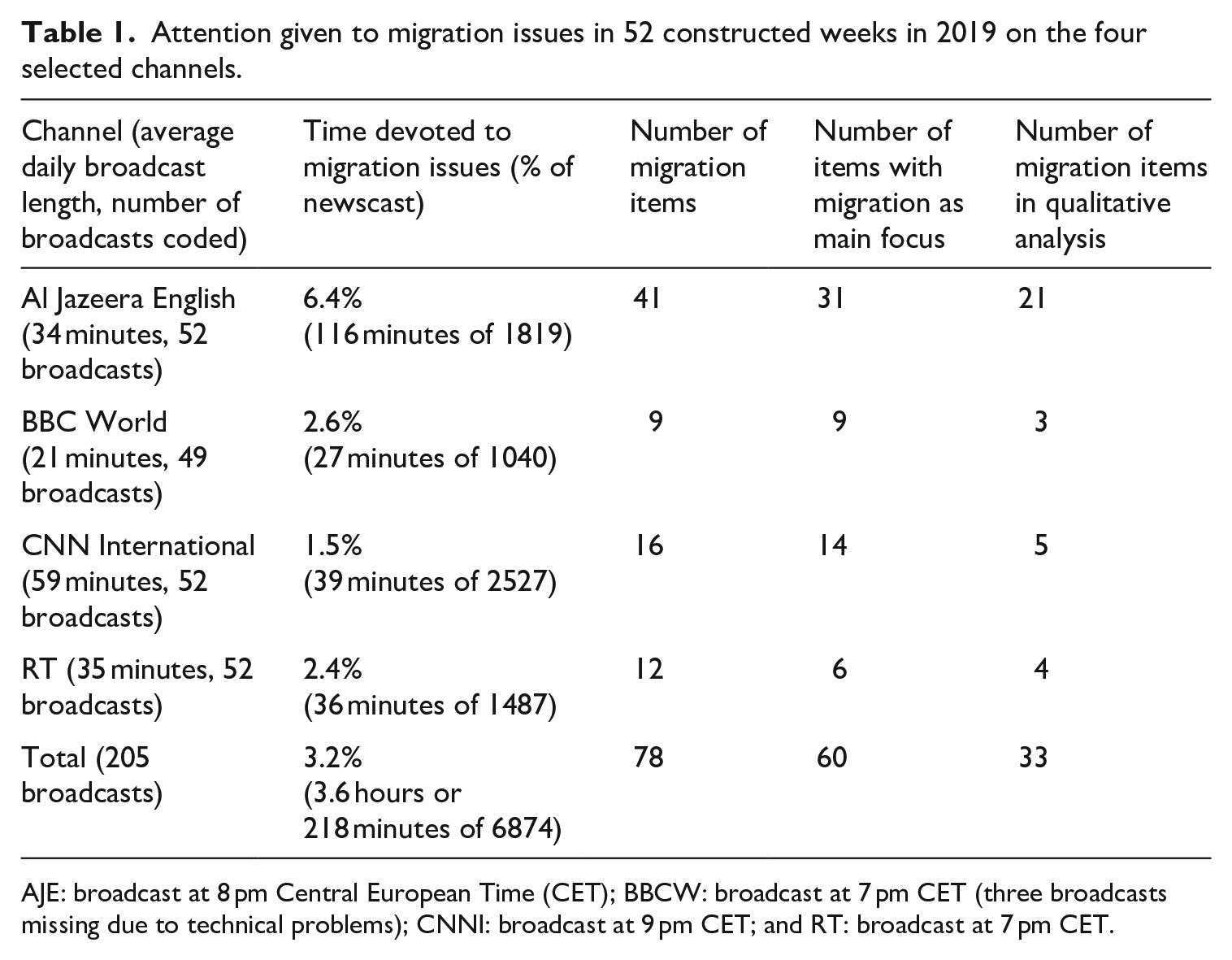
AJE: broadcast at 8 pm Central European Time (CET); BBCW: broadcast at 7 pm CET (three broadcasts missing due to technical problems); CNNI: broadcast at 9 pm CET; and RT: broadcast at 7 pm CET.
When it comes to newsworlds – the size of which was measured by counting the number of countries that feature in reports that focus on migration – Table 2 shows that AJE’s world of migration was considerably bigger than that of the other channels, with 28 countries implicated at some point, as compared to 13 in CNN, seven in RT and six in BBCW.
The countries that appear most frequently in new items focusing on migration in the 2019 constructed week sample.
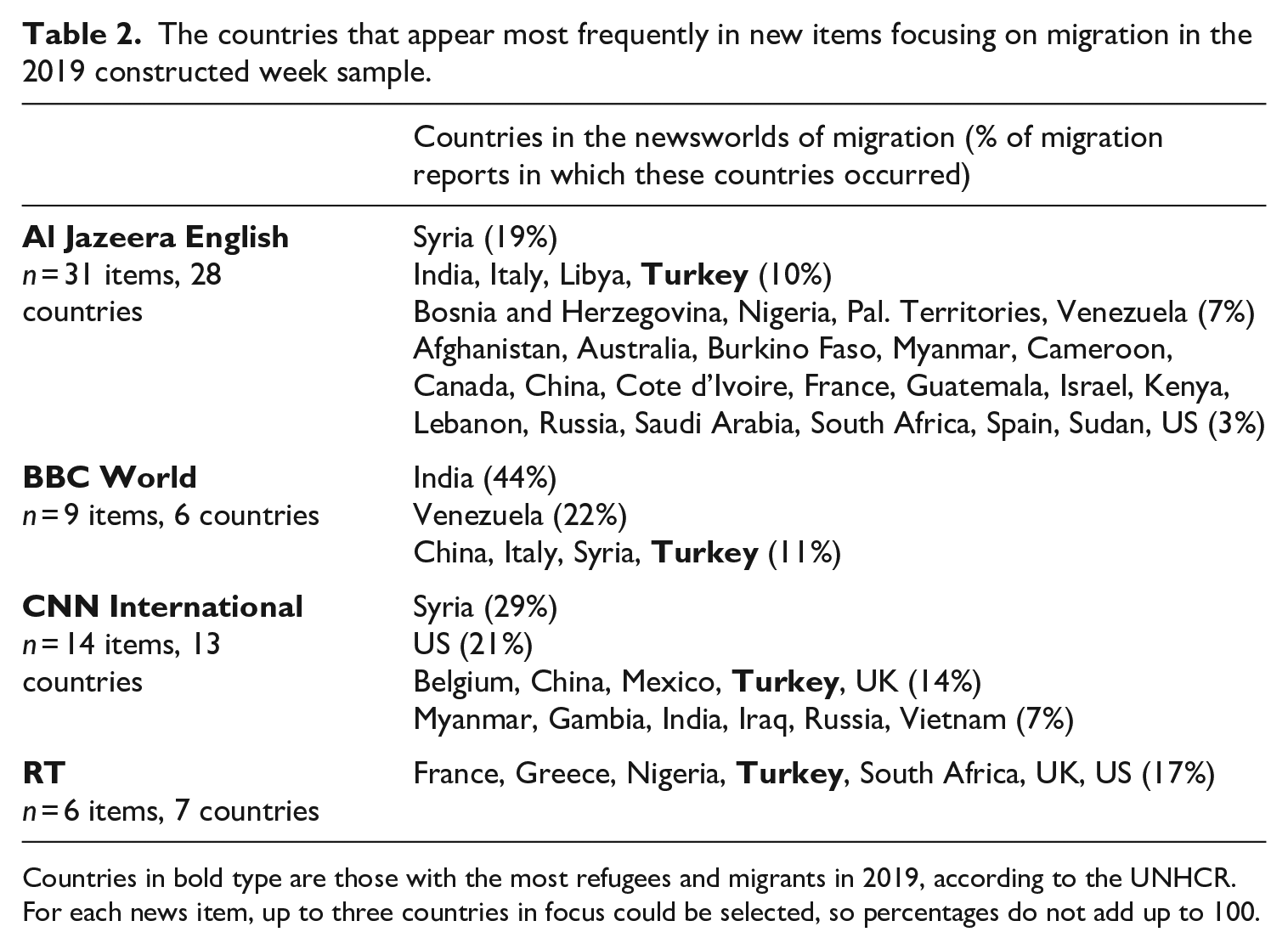
Countries in bold type are those with the most refugees and migrants in 2019, according to the UNHCR. For each news item, up to three countries in focus could be selected, so percentages do not add up to 100.
The vast majority of displaced people shelter in countries outside the West, with Turkey, Colombia and Pakistan hosting the largest numbers of refugees in 2019. 4 The televised world of migration, however, proved to be distinctly different from the statistical one. RT’s migration coverage, for example, focused mostly on Western countries. CNNI’s coverage paid particular attention to developments in Syria and the US (29% of their migration coverage focused on Syria, 21% on the US). BBCW’s coverage was not as heavily skewed towards the West, but did not inform viewers on migration issues related to Pakistan or Colombia. Colombia was also absent in AJE’s coverage, despite the fact that AJE covered more countries than the other channels.
Who populates the newsworlds of migration?
The second research question directed our gaze to depictions of people in the migration reports. Answers were sought by documenting whose voices were used to explain the issue, by attending to verbal cues (how people on the move were named) and visual cues (where they were situated).
When it comes to the first of these analytical approaches, previous research (Robertson et al., 2018) has documented significant variations in the number of voices heard in news reports broadcast by the channels in this study. On the one end of the spectrum, CNNI has a proclivity for ‘talking heads’ – reporters chatting to each other on camera or anchors interviewing experts in the studio. At the other end, AJE has been found more likely to put the microphone in front of a larger variety of people, and its reports are filed from the field rather than the studio more often than those of the other channels. This turns out to be the case with refugee and migration reports as well.
The results presented in Table 3 show that the people for whom the crisis is an existential matter - refugees and migrants - were not heard as often as one might expect. Only 6 percent of the speaking actors in BBCW’s migration coverage and 11 percent in RT’s were people on the move. In CNNI, 28 percent of the speaking actors were people on the move, but ‘ordinary people’ were interviewed more often (44%). It must also be borne in mind that its absolute figures are small (n = 13). As already mentioned, AJE had notably more speaking actors than the other channels, and of these, 25 percent were people on the move. No other actor category is given voice more often in AJE, although representatives of international or national non-governmental organizations (NGOs) are close behind.
Distribution of actors who speak in reports on migration on AJE, BBCW, CNNI and RT.
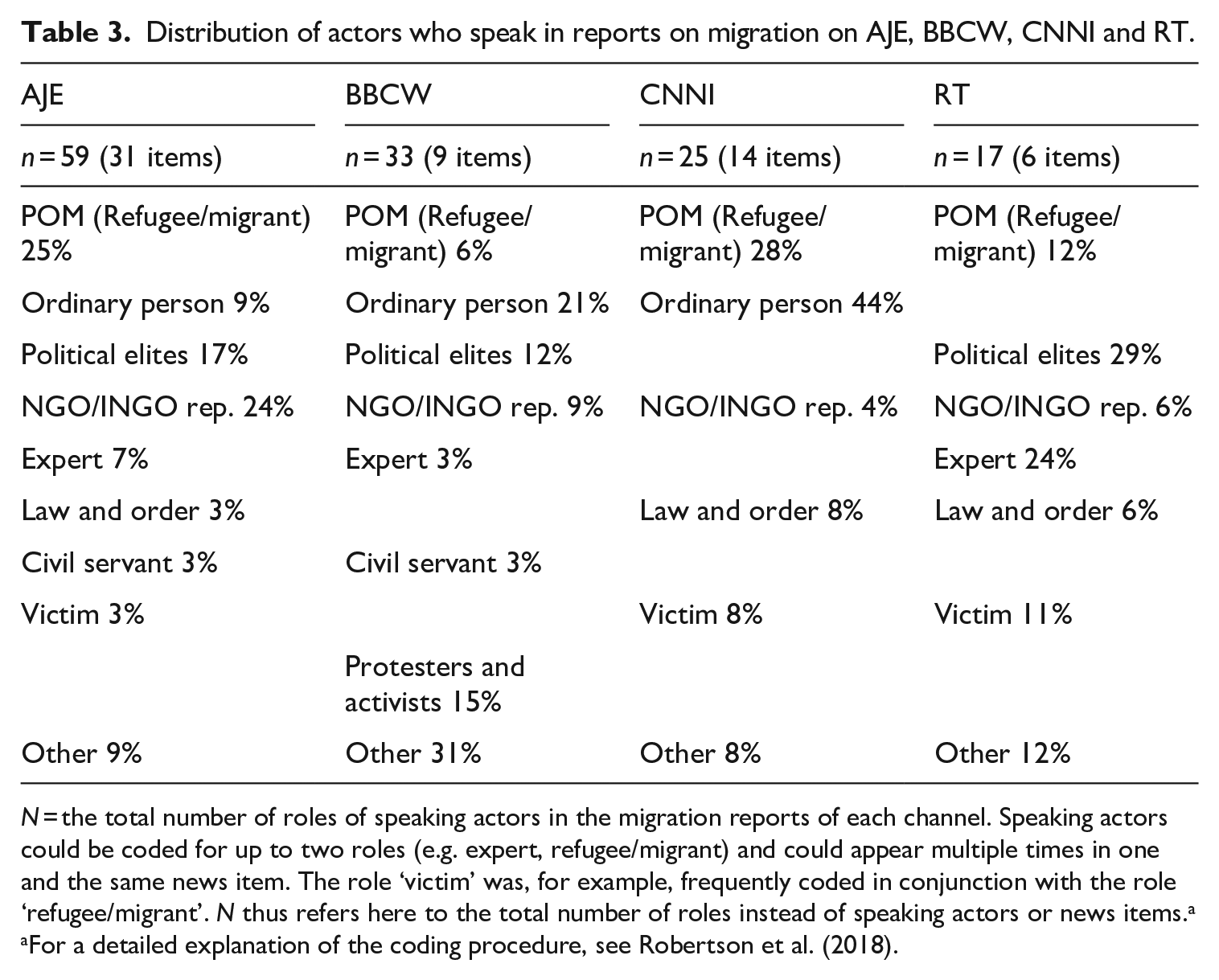
N = the total number of roles of speaking actors in the migration reports of each channel. Speaking actors could be coded for up to two roles (e.g. expert, refugee/migrant) and could appear multiple times in one and the same news item. The role ‘victim’ was, for example, frequently coded in conjunction with the role ‘refugee/migrant’. N thus refers here to the total number of roles instead of speaking actors or news items.a
For a detailed explanation of the coding procedure, see Robertson et al. (2018).
As well as ‘voice’ (speaking actors), there are variations in ‘naming’ worth mentioning (verbal cues). In keeping with the policy change referred to earlier on, AJE uses the descriptors ‘asylum-seeker’ and ‘refugee’ and resorts to ‘migrant’ only in specific cases. BBCW uses the words ‘migrant’ and ‘migrants’ (a related study found that, in its reporting of the family separation issue in 2018, it also referred to ‘US child migrants’, ironically bestowing on them the nationality of the country that had rejected them (Robertson and Schaetz, 2019). While not necessarily providing a plurality of perspectives in an Arendtian sense, CNNI distinguishes itself in the plurality of frames, or perhaps misframes, it uses to narrate the crisis, referring indiscriminately to immigration, migration, illegal immigration and the refugee crisis. As CNNI’s Hala Gorani once said, journalists find it ‘exhausting’ trying to get things right (Robertson and Schaetz, 2019). The terms ‘refugee’ and ‘asylum-seeker’ occur in RT coverage when someone is quoted, but the term its journalists use is ‘migrant’.
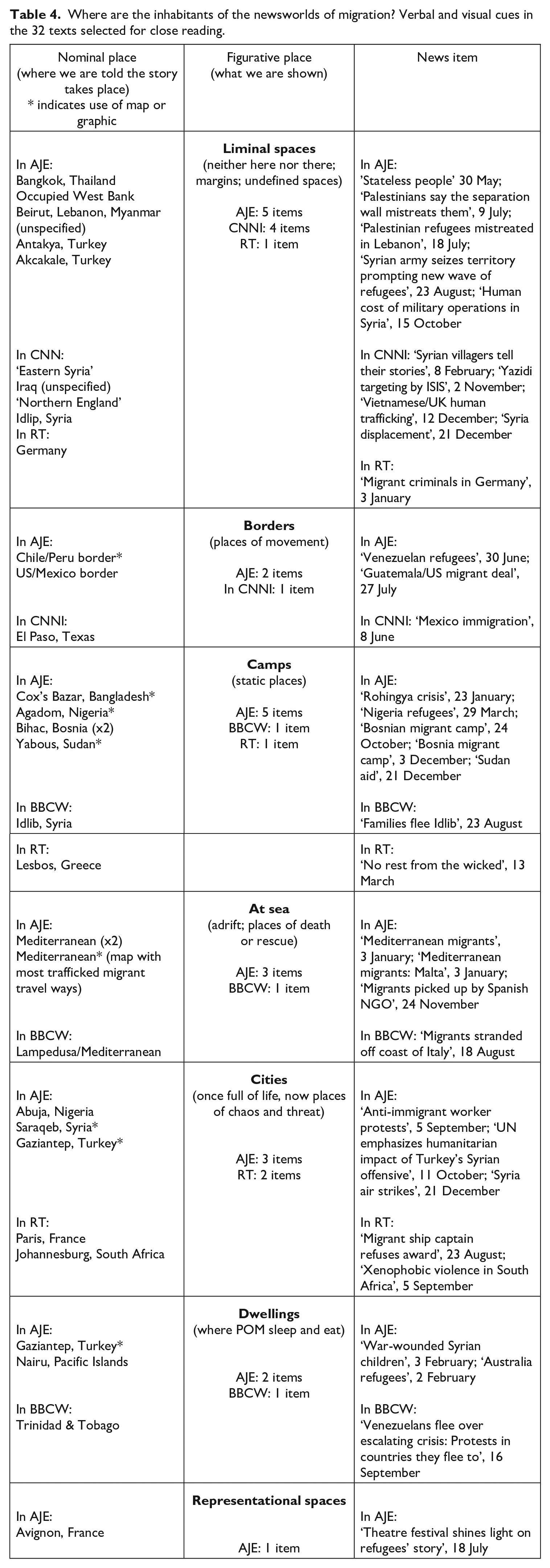
The channels vary in their visual depictions of people on the move as well as in the words they use to name them. There are two sorts of answers to the question of where the news narratives situate the people who inhabit the newsworlds of migration. One is nominal (the stated location), the other figurative (what could be thought to serve as the ‘setting’ or ‘orientation’ in the parlance of narrative analysis). Unsurprisingly, given the relative size of AJE’s migration newsworld, the nominal places in which people on the move are found in the 21 items that qualified for a closer reading were many and varied. With a few exceptions, they are in the Global South, and a precise location is usually given. BBCW’s nominal places are in Syria, Europe and a former British colony. CNNI’s are Syria, Iraq, the US and the UK – often ‘somewhere’ in these countries, with information vague or absent as to the precise location. RT’s nominal spaces are in Europe and South Africa. The details can be seen in Table 4, which also indicates that BBCW viewers see displaced people in camps, at sea and, once, in their own living spaces. CNNI shows them in liminal spaces and, once, on the border (which is itself depicted as a liminal space in many respects). RT shows us migrants in cities, where there is conflict and protest, and in a camp in Greece, but remains more detached than the other three channels from the places people flee or those in which they look for shelter. AJE viewers find people on the move in a greater variety of figurative spaces than the other channels, perhaps because of the larger number of stories it tells about them. They are often encountered in liminal spaces and margins, in the more static spaces of refugee camps, on borders, at sea and at home and, once, in the representational space of the theatre, where Africans tell their stories of finding their way to Europe.
Where are the inhabitants of the newsworlds of migration? Verbal and visual cues in the 32 texts selected for close reading.
Whose business is the crisis depicted as being?
This overarching research question was also operationalized into a number of sub-questions that were posed to the news items in the close reading (qualitative) sample. One set of sub-questions probed how the viewer was situated (from which position do we follow the story? Does it feel like we get close to the people in focus? Do we look over someone’s shoulder or meet someone’s gaze? Are we placed in a moving vehicle?). Another question asked whose story is it – that of the migrant or refugee, of someone trying to help them, of political actors or ordinary people taking a stance on the issue? Or is it the story of the journalist and the experiences or challenges faced when travelling to a war zone or border town to bring us the news (something more connected to ‘tourism’ than ‘visiting’)? Of interest here is the distinction between ‘realist’ reporting techniques (used by the omniscient journalist-narrator who is in the centre of the story; all voices go through this narrator) and ‘naturalist’ techniques (evident in reporting when the journalist keeps away from the centre and in some cases out of view altogether, fills in background information but lets the people whose story it is tell us about their experiences). While these questions were coded separately for each of the items in the qualitative sample, answers are collapsed in what follows, in the interests of brevity.
It is easy to be brief about RT because people on the move are largely absent from its reports, which rely on reporters or ‘experts’ giving their views, sometimes with disembodied agency footage in the background, and on statements made at press conferences or on Twitter appearing in scare quotes on screen. These stories are not about the plight of refugees and migrants: they are about ‘hypocrisy’ and about ‘wrangling’ between Europeans as to how to deal with migrants, be they Greeks enraged by other European Union (EU) members failing to shoulder their share of the burden, spats between the Germans and the French, between French politicians at different levels of power, or German politicians hampered by legislation that prevents them from deporting ‘migrant criminals’ and ‘violent asylum-seekers’. The issue, in other words, is the business of European political elites, and they are dealing with it badly.
BBCW also highlights the tensions arising in recipient countries when people seek refuge there. Migrants marooned for two weeks on the Mediterranean jumped into the sea and tried to swim ashore after the Italian government refused to let them dock (18 August). Interior Minister Matteo Salvini said that ‘presumed refugees fleeing the presumed war’ are not welcome; the borders of Italy must be defended. The reporter is not on site: images of chaos on board are filmed by the man who operates the rescue boat and who talks about ‘fights, violence, anxiety, panic’ and an unsustainable situation. The reporter is on site in a story about the 40,000 Venezuelans who fled to the former British colonies of Trinidad and Tobago (16 September). Their presence caused tension with the local population, and the first thing that greets the viewer is the sight of anger on the streets. We come close to the police and to protesters who say the Venezuelans have come to their island for jobs and health care, not asylum. As with the Italian news item, the government is not shown in a good light and it is possible to sympathize with the ‘desperate mass of humanity’, as a volunteer at a registration centre puts it. Between the streets of protest and the registration centre of panic, we find ourselves in the home of one of the Venezuelans who fled. He talks to the reporter while his wife makes a meal and his children sit with their books at the table, and his story contradicts the claims of the protesters. A former judge, he has worked as a fisherman, carpenter and security guard since arriving, and faces death if forced to return. It is a moment of ‘visiting’ in a sympathetic report that nevertheless draws on realist narrative techniques. We don’t get to talk with any of the people at the centre, where the story ends, but the reporter tells us how they feel. ‘The desperation from these Venezuelans is so palpable – you can see it here’, he says, gesturing, ‘Look!’ Similarly, in the final item in the BBCW sample that qualified for a close reading (23 August), viewers get to follow refugee families at close quarters as they flee the violence of the war in Syria, and they are shown what they are fleeing, with a glimpse of eyewitness footage filmed on smartphones. A small child hiding behind a gas tank looks us briefly in the eye. A man who is setting up a living space for his large family in an olive grove sits in conversation with the invisible reporter and says they wonder why the world has abandoned them. But the interview excerpt is only a few seconds long and the other displaced people – notably women and children – do not speak to us. The item is sympathetic, but viewers are not really invited to visit, perhaps because it is difficult to visit people who are on the road.
The CNNI reports are also sympathetic and implicate the viewer: as with the BBCW news items we are asked to look, so it would seem to be our business, but we are treated more as tourists than visitors and the voices of the people on the move are channelled through the reporter, whose story it usually is. A report from El Paso, Texas (8 June), is typical of the approach. Graphics take us from the studio to the liminal space of the US–Mexico border and to the reporter on the site – a small red dot on the map grows larger and becomes a headshot – but while the US is clearly identified as such on the map, the setting of the story is a dark, unlabelled spot on it. As the map fades from view, the reporter takes over the screen. Standing in front of a barbed-wire fence, he establishes his authority by telling us that he and the reporting crew witnessed something, and by telling us how we will react to the images: ‘What we witnessed, and what you’re about to see, was chaotic, emotional, and sad’. We are then discursively placed in the van of the border guards who the journalists saw apprehend eight different family units in a 60-minute span. To a shot of dead space – a brown expanse with a flyover in the background – the reporter says people come out of the Rio Grande every 5–10 minutes. He tells us about Juana (whom we see in close-up but do not hear), her family, and why she had to leave Guatemala. We see (but do not hear) Sandy, who is heavily pregnant and walked from the Honduras, where her husband and brothers were killed by gangs. ‘And then we met a man who brought his two sons’. We stand behind the reporter looking into the van where the man is in tears. The reporter turns around and tells us, ‘It’s tears of happiness, he says, that he made it. He’s very happy’. This CNNI report ends with the reporter emphasizing how kind and professional the border patrolmen are (‘great ambassadors for the United States’) to the migrants (‘who have gone through an awful lot’). The report gives us an outing, but not opportunities to engage in dialogue with the people in it.
The AJE close reading sample – considerably larger than those of the other three channels – contains examples of all the reporting types mentioned so far. There are dispassionate, distanced items that relay information about refugees trapped in one place or moving to another. There are reports in which realist techniques are in evidence, and which position the viewer as a tourist whose business it is to know about the plight of these unfortunates, but not necessarily to act on that knowledge. But there are also examples of reports that do suggest it is our business to act, and that use naturalist storytelling techniques that invite us to visit refugees and migrants, encounter them close-up and on their own (albeit temporary) terrain. An example is an item broadcast on 30 June, also about Venezuelans on the move, but this time encountered on the border between Chile and Peru, rather than in the Trinidad of BBCW’s newsworld.
As in that other story, the government does not get favourable treatment, and it and other authorities are invisible. But instead of beginning with locals protesting against incomers, the AJE story opens with cold, hungry Venezuelans encountered at close quarters. Whereas they speak to the reporter in the BBCW item – a reporter who is often in view and indeed in the centre of the screen – they speak directly to us in the AJE story. After travelling south for weeks to get to friends and families, these Venezuelans are stranded on the Peruvian side of the border because Chile won’t let them in. Maria, who we see at eye level although she is sitting, her son on her lap, in the street, explains what the rule change has meant for her. We find ourselves in the desert, where families are sheltering from the sun and cold under flimsy scarves, and then Carolina tells us about her journey and her desperate situation but also that she has something in that liminal space that she did not have at home: hope. Others are more impatient, says the reporter, who (finally in view, momentarily) takes us to a barbed-wire fence on the border, directs our attention to the red sign that warns a minefield lies beyond, and explains it is not deterring Venezuelans from taking that route to bypass legal entry points. A Chilean volunteer at a welcome centre talks about the problem with her government’s stance and the need for more flexibility. We leave the Venezuelans at the border, as a newly arrived family smiles and expresses hope. The reporter’s voice concludes that the authorities might be trying to control the wave of ‘economic refugees’, but it will not be able to stop it. In contrast to the BBCW piece – sympathetic and outraged as it was – the AJE story provides an encounter with people who have agency, with determination and hope as resources.
Words transcend borders
Relating the traces of newswork that can be gleaned from the content of the 78 television news reports analysed in this study to Hänska’s ‘ritual’ and ‘democratic cosmopolitan’ perspectives, it transpires that different global outlets ‘perform, affirm and negotiate’ belonging in different ways, indicative, perhaps, of different estimations of what might be a ‘proper distance’ to strike towards others, and who those others might be. Even when purporting to speak to the world, there is evidence of alignment to the ‘emergence, constitution and reproduction of collective (national) identities’. But in the few field trips to the sites where displaced people are to be found – on the move or trapped in immobile limbo – there is also evidence of journalistic storytelling that is arguably more conducive to the cultivation of cosmopolitan outlooks.
The discussion in this article is based on the analysis of routine news coverage extending across one year, but it is part of a multi-year study. Taking a step back to view the bigger picture, we have found that the overarching BBCW, CNNI and RT narratives of migration are about politics: the global crisis of people on the move that dominated headlines in 2015 and then disappeared from them is a political matter, not least for leaders in the North and West. Viewers of AJE, in contrast, are told a story about a problem that is global rather than national, and about people as much as politics (Robertson and Schaetz, 2019). But with the exception of RT (which tells migrant stories for different reasons, and which warrant a piece of their own), the journalists whose job it is to inform us about the issue, and hopefully understand it, face a shared quandary. It is not peculiar to the year of coverage analysed here, but rather is in evidence in other samples we have studied, an example from which can be instructive when thinking through the challenges involved.
CNNI’s Hala Gorani ended a broadcast on World Refugee Day in 2018 by telling viewers that the images they had been seeing, shot at the US border, were not unique to the Americas, that Europe was also struggling with its biggest refugee crisis since World War II. She also talked of a problem, not one facing the people forced to flee their homes, but rather journalists and their audiences: The scale of trauma and devastation. . .is simply too great for any one of us to comprehend fully. In fact, that’s why we often hone in on one particular story, one particular face, because it feels like the only way we can begin to relate is to do that.
The CNNI reporter speaks then of a ‘different approach’ to the problem taken by a UK media outlet. ‘Look at this!’ she urges viewers, holding up a printed copy of that day’s The Guardian newspaper. Noting that the text ‘may be too small for you to read at home’, she explains that it contains the name and cause of death ‘of every single migrant who has died trying to reach Europe since 1993’: If nothing else, laying out this information in black and white – like some people for instance died trying to cross a mountain range, freezing to death, or others died because they couldn’t take it any more, they were told they would be deported so they killed themselves in their detention cell. And it’s this type of thing that I think brings home, because the scale of it – you see how thick it is [she holds up the newspaper] brings home the magnitude of the crisis, as Europe continues to try to find a way to respond to it.
She cites no audience research to show that her method ‘brings home’ the magnitude of the crisis to the viewer, and neither have we yet had the chance to explore how the ‘we’ invoked by Gorani responds to stories of migration such as those analysed here. Her claim should nevertheless be considered carefully. Despite her obvious outrage and empathy, and her direct appeals to viewers ‘at home’, she does not invite them to see the migration crisis from a position that is not their own. In the newsworld of CNNI, ‘we’ are the liberal-minded who are preoccupied with the crisis in public communication experienced in the US (and elsewhere), and are assumed to be outraged by Right-wing populist governments’ treatment of displaced people. In this discourse, viewers are placed at the side of the journalists and invited to rejoice in their good work. A ‘big surge in coverage’ around the Trump administration’s policy of separating families at the border in 2018 led to a change in policy, and she says, it ‘reached a boiling point largely thanks to news media coverage’ (CNNI, 20 June 2018).
A year later (when the reports analysed here were broadcast) and two years beyond that (at the time of writing), the coverage seems to have gone off the boil. What the CNNI anchor is describing is the work of the conventional watchdog and indicative of Hänska’s ‘ritual’ approach, but the words were nevertheless uttered in what is arguably also an ‘age of media transition’ – a transition of roles rather than one resulting from technological change, in the context of an information environment polluted by ‘mis-statements’ and misframing. Such newswork implicates the viewer by constructing an ‘us’ that is comprised of journalists and viewers all keen to establish what is really going on, and to man the resistance in the face of disinformation.
There are different responses in evidence that can be thought to place the viewer at the side of the displaced person rather than the journalist. A newspaper replete with 1000s of tiny words, too small to see at home, can be held to the camera. Or it can be used to establish a discursive connection with discernible faces and voices. Journalists can take their viewers down from what AJE calls the ‘high helicopter’ view of policy elites to the nominal spaces of cities, roads and seascapes in newsworlds that we find vary dramatically in size, and to the figurative spaces of the margins. The ‘other’ in the BBCW stories of Venezuelans in Trinidad and Africans off the coast of Italy, in CNNI stories of families separated at the US border, and in most AJE stories of migration are not ‘illegals’ or ‘swarms of migrants’: they are inept or intransigent politicians and the anti-immigration parties and their supporters who deny people the right to have rights and who make it difficult for civil society, and for ordinary people with whom the viewers might identify, to do the morally right thing.
The newswork analysed here offers different answers to the question of proper distance and raises new ones as well. Is the stance-taking in evidence in these reports necessary and sufficient? And should the venerable professional values of balance and objectivity continue to be honoured in contexts where millions of people are denied the right to have rights at the same time as being misframed by populist politicians? The answers have a bearing on communication rights and information equality, to our understanding of the mediated dimension of global crises, and to the interrogation of theoretical claims in comparison with their enactment in everyday journalism praxis. Crawley and Skleparis (2018: 60) argue that we ‘need to recognize the dangers of simply working with the categories constructed by others’ and ‘to explicitly engage with the politics of bounding, that is to say, the process by which categories are constructed, the purpose they serve and their consequences’. They are referring to social scientists, but we have common cause with journalists.
Footnotes
Acknowledgements
We would like to acknowledge the work of Luiza Chiroiu, who contributed to the analysis, ran descriptive statistics and collated the results. The empirical material was coded by Clarie Åkesson, Susannah Cook, María de la Huerga, Esmé Fransen, Max Maccarone, Alexa Robertson, Linda Ling Xuo and Yanthe Zebregs.
Funding
The author(s) disclosed receipt of the following financial support for the research, authorship, and/or publication of this article: The study reported in this article is is part of the project entitled Just Information(Infojämlikhet), financed by the Swedish Research Council (Vetenskapsrådet) grant #1054707.
