




Abstract
The 2017 Gulf crisis raises important questions about what happens when news networks become part and parcel of a political conflict. This research employs content analysis to analyse how two flagship evening news programmes – Al-Hasad (The Harvest) on Al Jazeera and Panorama on Al Arabiya – framed the early phase of the 2017 Gulf crisis. The study provides an elucidation of how, specifically, editorial positions were made manifest and, importantly, what framing mechanisms were employed. Results suggest that Al Jazeera’s Al-Hasad took the position of a victim being attacked by an external oppressor, while Al Arabiya’s Panorama framed Qatar as a sponsor of terrorism.
Introduction
On 5 June 2017, a political crisis erupted inside the Gulf Cooperation Council (GCC), as Saudi Arabia, the United Arab Emirates (UAE) and Bahrain announced they were severing diplomatic and economic ties with Qatar, which was accused by the Saudi-led axis of sponsoring terrorism. The additional participation of Egypt, which joined the blockade against Qatar, further complicated matters and ensured that the conflict’s ramifications would extend beyond the six-nation GCC (Chong, 2017).
The June 2017 crisis was only the most recent iteration in a prolonged clash between Saudi Arabia, the UAE and Egypt on one hand, and Qatar on the other. Analysts often trace the beginning of tensions back to the mid-1990s when the Qatari government established the Al Jazeera News Network. However, tensions – particularly between Qatar and Saudi Arabia –predate Al Jazeera, and have historically been ignited by a combination of foreign policy objectives and economic imperatives, in addition to media coverage (Champion, 2017). Qatar’s disagreements with Saudi Arabia are of special importance to the larger regional crisis, in particular, because Saudi Arabia has often seen itself as the key powerbroker in the region, with several smaller, less influential countries often following its lead (Miller, 2018).
Qatar has long resented Saudi attempts to exert control over its foreign and domestic policies as well as its push to realize broader regional hegemony (Haykel, 2013; Miller, 2018). The two nations were locked in a border clash for parts of the early 1990s, and collided again in the mid-1990s when Saudi Arabia allegedly supported multiple attempts to overthrow Qatar’s then Emir, Sheikh Hamad Bin Khalifa Al-Thani (Haykel, 2013; Jehl, 1997). In 2002, Saudi Arabia withdrew its ambassador to Qatar following Al Jazeera’s decision to air an interview with a Saudi opposition figure (Kirkpatrick, 2014). The two nations have also quarrelled over relations with Israel (Rabi, 2009) and Qatar’s plans to build a gas pipeline to Kuwait (Seznec, 2018), among other things.
The fissure widened in 2011 when Qatar (and Al Jazeera) supported most of the Arab Spring protest movements. The Arab Spring, which arguably served as the final trigger for the 2017 political conflict, helped further define and demarcate Gulf relations. On the Arab Spring, the UAE and Bahrain – as well as Egypt’s ‘deep state’ – found themselves aligned with Saudi Arabia. Qatar, meanwhile, remained relatively isolated among GCC and other Arab governments, most of which opposed the democratic protest movements.
With Qatar’s support for the Arab Spring came accusations that it backed Turkey’s Islamist Justice and Development Party, which also supported the Arab Spring, and the Muslim Brotherhood, which won the post-Arab Spring elections in both Egypt and Tunisia. In 2012, the UAE, bothered by Al Jazeera’s media coverage, Qatar’s relationships with Turkey and the Muslim Brotherhood and the Qatari government’s broader bolstering of the Arab Spring movements, set up a multimillion-dollar American consulting firm, the Camstoll Group. The new company’s primary purpose was to plant negative stories about Qatar in American news media (Greenwald, 2014). In 2014, the UAE, Bahrain and Saudi Arabia withdrew their ambassadors from Qatar over the country’s alleged support for the Brotherhood (Kirkpatrick, 2014).
Al Jazeera has not been the only media outlet to take centre stage in the Gulf crisis. Other media outlets also played prominent roles – both aggressive and passive – in the June 2017 reactivation of Gulf tensions. For example, the 5 June 2017 proclamation by the Saudi-led axis was precipitated by the UAE government’s May 2017 hacking of the Qatar News Agency (DeYoung and Nakashima, 2017). UAE intelligence allegedly hacked into the Qatari news site and attributed fabricated quotations to Qatar’s Emir, Sheikh Tamim Bin Hamad Bin Khalifa Al-Thani. The quotes were used as a pretext to launch an anti-Qatar media and political blitz through mainstream UAE, Saudi and Egyptian media outlets.
Al Jazeera was an even more direct party to the 2017 Gulf crisis. In late June 2017, the Saudi-led axis issued a list of 13 demands for the Qatari government (Wintour, 2017). One of the demands was that Qatar shut down Al Jazeera. Qatar rejected the entire list of 13 demands, asserting that Al Jazeera would not be up for negotiation or discussion.
Anecdotal evidence suggests that in the initial weeks and months of the Saudi-led blockade against Qatar, both Al Jazeera and Saudi-aligned satellite news network Al Arabiya took hardline stances in favour of their respective ownership groups. To date, however, no research has systematically examined the networks’ coverage.
This study employs quantitative content analysis to analyse how two flagship evening news programmes – Al-Hasad (The Harvest) on Al Jazeera and Panorama on Al Arabiya – framed the early phase of the conflict. The study also attempts to provide an elucidation of how, specifically, editorial positions were made manifest and, importantly, what framing mechanisms were employed. In addition, this article attempts to place the networks’ coverage within the general parameters of journalistic professionalism. The Gulf crisis raises important questions about what happens when networks like Al Jazeera become part and parcel of a political conflict.
Literature review
Al Jazeera
Al Jazeera has garnered significant scholarly attention since its establishment in November 1996 by Qatar’s then Emir, Sheikh Hamad Bin Khalifa Al-Thani, who intended the network to be a tool of Qatari soft power (Samuel-Azran, 2013). El-Nawawy and Iskander (2002, 2003) charted the network’s initial phases, arguing that the channel pushed the limits of free speech in an otherwise censorship-laden Arab world, and forced authoritarian governments to rethink political and media strategies.
The analyses by El-Nawawy and Iskander were corroborated by subsequent research. Lamloum (2004) said that Al Jazeera was aiding in the formation of a new type of democratic Arab political culture, while Wojcieszak (2007) called Al Jazeera ‘counter-hegemonic’ (p. 121) because, she argued, it operated against the basic premises of authoritarianism and censorship. Furthermore, Pintak (2011) posited that Al Jazeera’s critical news coverage may have been one important catalyst for the Arab Spring; Seib (2008) and Thussu (2007) contended that Al Jazeera’s introduction of critical, non-Western perspectives served to counterbalance, to at least some extent, Western news imperialism; and Miladi (2006) argued that Al Jazeera helped solidify notions of Arab identity.
Researchers have noted Al Jazeera’s comparatively high level of news production quality, which has forced other Arab television news networks to improve their own production efforts in order to stay competitive (Rugh, 2004; Sakr, 2001). More significantly, perhaps, research has highlighted Al Jazeera’s relatively high level of journalistic professionalism, especially when compared with other Arab news organizations (Abdel Mawla, 2015; Arif, 2014; Association for International Broadcasting, 2008; Auter et al., 2004; Barakat, 2011; El-Nawawy and Iskander, 2002, 2003; Johnson and Fahmy, 2008; Miladi, 2006; Miles, 2011; Seib, 2008; Thussu, 2007). According to one perspective, Al Jazeera has, for the most part, been able to cover events independently and in a way that is consistent with mainstream Western notions of news professionalism (see (Miladi, 2006; Wojcieszak, 2007).
Following the launch of the original Arabic-language Al Jazeera network in 1996, the network has expanded to include several other channels, including Al Jazeera International, Al Jazeera Mubasher, Al Jazeera Sports, Al Jazeera Children’s Channel and Al Jazeera Documentary.
Al Arabiya
Al Arabiya was established in 2003 in Dubai by the Middle East Broadcasting group (MBC), which is owned by a Saudi businessman with close ties to the Saudi monarchy. The network enjoys high viewership in the Arab region (Al-Rawi, 2016; Elmasry et al., 2013; El-Nawawy and Strong, 2012b; Nisbet and Myers, 2011), often ranking second in viewership to Al Jazeera (El-Nawawy and Strong, 2012a).
Al Arabiya positions itself as both a rival to Al Jazeera and standing in opposition to extremism (Zayani and Ayish, 2006). It is seen as exhibiting more professionalism than typical government-owned, highly censored Arab news outlets (Ismail, 2011) and is credited with securing high-profile exclusive interviews and breaking a number of key regional stories (El-Nawawy and Strong, 2012b).
The network is also seen, however, as more or less a Saudi government propaganda arm (Al-Rawi, 2016; Cochrane, 2007; Hammon, 2007; Mellor et al., 2014). A study by El-Nawawy and Strong (2012b) chronicled some of the direct Saudi government constraints exerted on Al Arabiya’s editorial policy. In spite of these constraints, however, Al Arabiya’s journalists report a high level of employee satisfaction (El-Nawawy and Strong, 2012b).
Framing
Framing is a media and communication paradigm useful for examining the implied meanings of communication messages. The perspective suggests that the manner in which messages are presented is at least as important as the facts they contain.
Gamson and Modigliani (1987) defined a frame as a ‘central organizing idea or story line that provides meaning’ (p. 143). Valkenburg et al. (1999) described a frame as a way for news workers to ‘compose a news story to optimize audience accessibility’ (p. 550). For Entman (1993), framing is about ‘selection and salience’ – that is, frames are determined by the parts of a text a communicator chooses to highlight and make more prominent (p. 52).
Framing is a natural part of communication, and ‘every story has a frame’ (Tankard, 2001: 101). Tankard (2001) argues that framing provides a better tool with which to examine news texts than the old ‘bias’ paradigm, which assumes intentionality. Framing is understood as subtle, inescapable and pervasive.
Framing can powerfully impact how message recipients receive and interpret messages. For example, framing an act of violence as an act of aggression might make negative interpretive evaluations more likely, while framing the act as self-defence might generate more sympathetic readings (Elmasry, 2009). Alternatively, framing a medical treatment programme in terms of lives that will be ‘saved’ will be more favourably received than framing the programme in terms of victims who will ‘die’ (Tversky and Kahneman, 1981).
News frames, however, interact with audience (or individual) frames – mental schema stored in individuals’ minds which help them organize and make sense of the world. Because audience frames differ across individuals and groups, media frames are not always interpreted in exactly the same way by different people (Chong and Druckman, 2007).
Some content studies approach framing deductively, using predefined framing categories, and others employ an inductive approach, permitting frames to emerge naturally. Common framing categories in deductive studies include conflict, human interest, economic consequences, morality and responsibility frames (Semetko and Valkenburg, 2000).
Frames can be dictated and driven by inclusion and exclusion of information, keywords, visual images, placement, repetition, association and information sources, among other things (Entman, 1993). As will be explained in the methodology, this study’s coding scheme looked closely at issues of inclusion and exclusion, prominence, keywords, associations and sourcing.
Some work has focused on how Al Jazeera and Al Arabiya frame prominent issues and events. In the case of Al Jazeera, research suggests that the network’s attempt to present and defend otherwise marginalized perspectives may sometimes influence it to take sides in political conflicts. For example, studies by Barkho (2011) and Elmasry et al. (2013) have found that Al Jazeera news framing strongly favours Palestinian perspectives over Israeli perspectives in the Israel–Palestine conflict, while a separate study by Jasperson and El-Kikhia (2003) found that Al Jazeera’s framing of United States foreign policy in the Middle East was overtly critical and negative. In addition, a study by El-Nawawy and Elmasry (2015) suggested that Al Jazeera’s coverage of the 2011 Egyptian uprising framed the event in a way that enthusiastically embraced the anti-government protesters. Al Jazeera has typically responded to claims of imbalanced framing by arguing its coverage is an exercise in speaking truth to power and giving voice to otherwise voiceless people (Ismail, 2011; Lynch, 2005, 2006).
Al Arabiya’s framing of the Arab Spring stood in stark contrast to Al Jazeera’s (Al-Rawi, 2016). In the case of Egypt, for instance, Al Arabiya framed ousted dictator Hosni Mubarak favourably, and suggested that the protests against his rule were an attempt to sow chaos (El-Nawawy and Elmasry, 2015). Importantly, Al Arabiya offered meaningful voice to the Mubarak government during the protest period, regularly including Egyptian officials and sympathizers as information sources (El-Nawawy and Elmasry, 2015). Interestingly, Al Arabiya was the first network to interview Mubarak following his ouster (El-Nawawy and Strong, 2012b).
Research questions
This study aims to examine the dominant frames and framing mechanisms employed by Al Jazeera and Al Arabiya in their framing of the initial phase of the 2017 Gulf crisis. The research presents the following research questions:
RQ1. What are the dominant frames in Al Jazeera’s Al-Hasad and Al Arabiya’s Panorama coverage, and how do the programmes’ framing patterns differ?
RQ1A. Which side in the conflict did the two programmes most prominently support, and how likely were the programmes to show balance?
RQ1B. How likely were the programmes to make terrorism accusations?
RQ2. How did the framing mechanisms make dominant frames clear?
RQ2A. What sorts of accusations did the programmes make, and what kinds of associations did they draw between accusations and accused individuals or groups?
RQ2B. What sorts of keywords did the programmes use?
RQ2 C. How did the programmes use guests and information sources?
Methodology
To answer the research questions, a content analysis of Al-Hasad and Panorama was carried out. Content analysis is a quantitative communication and media research method that involves systematically counting the presence and absence of aspects of manifest content (Riffe et al., 2005).
Al-Hasad (Al Jazeera) and Panorama (Al Arabiya) were selected for analysis because they are flagship evening newscasts and compete against one another for viewership.
Sampling
The unit of analysis was the entire broadcast news segment. To find news segments, the researchers searched the Internet for available episodes airing during the first 4 months of the crisis – from 5 June 2017 to 5 October 2017. YouTube was used to gather Al-Hasad episodes and al-Arabiya.net was used to gather Panorama episodes.
Not all episodes were available online, and some located episodes did not devote any news segments to the 2017 Gulf crisis. When episodes included multiple news segments about the Gulf crisis, only the first two complete news segments about the crisis were selected for analysis.
Using available episodes, and selecting the first two segments about the crisis in episodes containing more than two such segments, yielded a total of 83 Panorama news segments. A greater number of Al-Hasad segments were available on YouTube, but the researchers decided to limit the total number of selected Al-Hasad segments to 83. This left a total final sample of 166 broadcast news segments, or 83 for each programme.
Coding
The coding scheme measured the dominant frame, directionality, length of news segments, keywords, information sources and terrorism accusations and associations. For reasons of manageability, all variables were measured at the nominal level. Two graduate students fluent in the Arabic language served as coders. The coders were compensated from a small grant made available by the researchers’ institution. Coding categories were drawn in part from the literature on framing and Al Jazeera and Al Arabiya and a pre-viewing of news segments not included in the final sample. The pre-viewing revealed observations about word choices, guest contributors and terrorism associations, among other things. These observations formed the basis for some of the coding categories.
Following intensive training on the coding scheme, intercoder reliability testing was carried out on 15 per cent of the total sample. Intercoder reliability scores were measured using Scott’s Pi, a conservative metric that takes into account chance agreement (Neuendorf, 2002), and with the assistance of ReCal2, an online tool for intercoder reliability calculation (Freelon, 2018).
Nearly all Scott’s Pi scores ranged from .71 to 1. According to Neuendorf (2002), Scott’s Pi measures of .7 or higher are considered ‘good’. The Scott’s Pi intercoder agreement score for one variable – news segment length (.67) – fell just below the .7 threshold. Neuendorf (2002) and Chang et al. (2009) consider Scott’s Pi scores ranging from .6 to .7 to be acceptable. Thus, this variable was kept in the study.
Results
The coding scheme was designed to answer the overarching research questions about dominant frames and framing mechanisms, with attention to keywords, sourcing and the issue of terrorism. Overall, significant framing differences between Al-Hasad and Panorama were found. Al Jazeera’s Al-Hasad provided a consistent message of sympathy for Qatar, blamed the conflict on the Saudi-led axis, linked the blockade to an alleged ‘counter-revolution’ against the Arab Spring and focused on the human cost of the crisis. Coverage by Al Arabiya’s Panorama blamed Qatar for the conflict, accusing it of terrorism. Both networks relied heavily on sympathetic guests, but Al Jazeera’s Al-Hasad did offer at least some critical voice.
Prominence
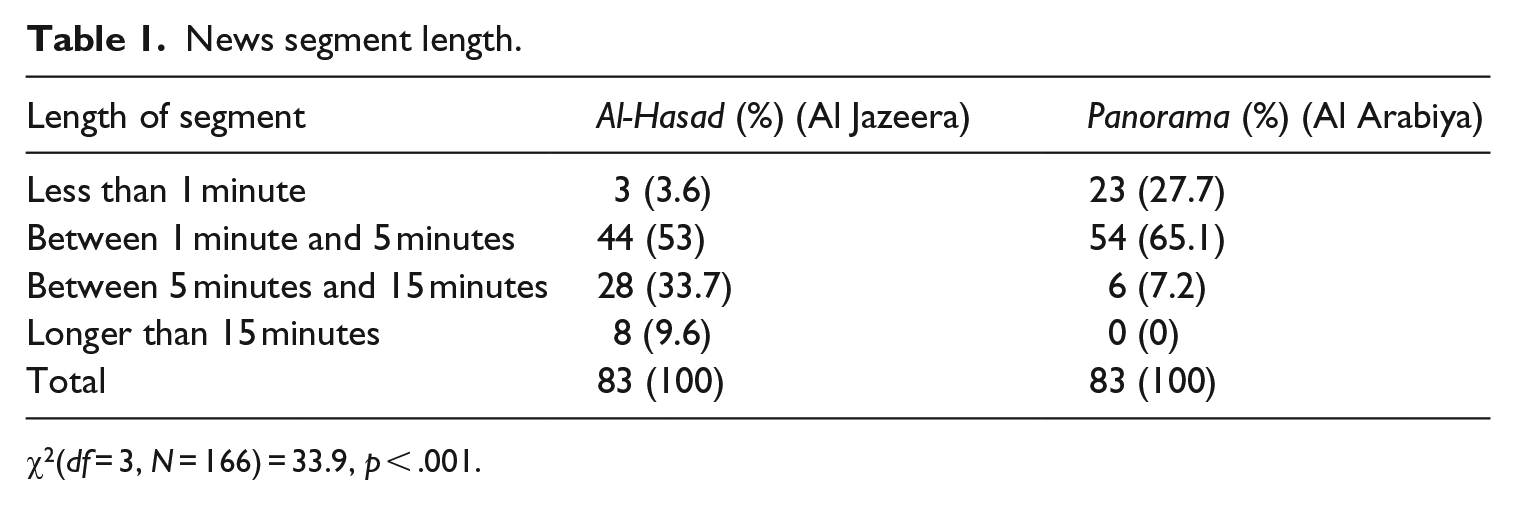
Al Jazeera’s Al-Hasad devoted significantly more time to discussing the 2017 Gulf crisis than did Al Arabiya’s Panorama. Al-Hasad tended to rely on longer news segments, while Panorama’s were comparatively shorter (Table 1). In all, more than 43 per cent of Al-Hasad segments were greater than 5 minutes in length, compared to just 7.2 per cent of Panorama segments. Nearly 30 per cent of Panorama segments were less than 1 minute in length, compared to just 3.6 per cent of Al-Hasad segments that were this short. A chi square test revealed these differences to be statistically significant at the .05 level (χ2(df = 3, N = 166) = 33.9, p < .001).
News segment length.
χ2(df = 3, N = 166) = 33.9, p < .001.
Dominant frame, directionality and terrorism
A series of coding scheme items measured dominant frames, directionality of coverage and the usage of the word ‘terrorism’.
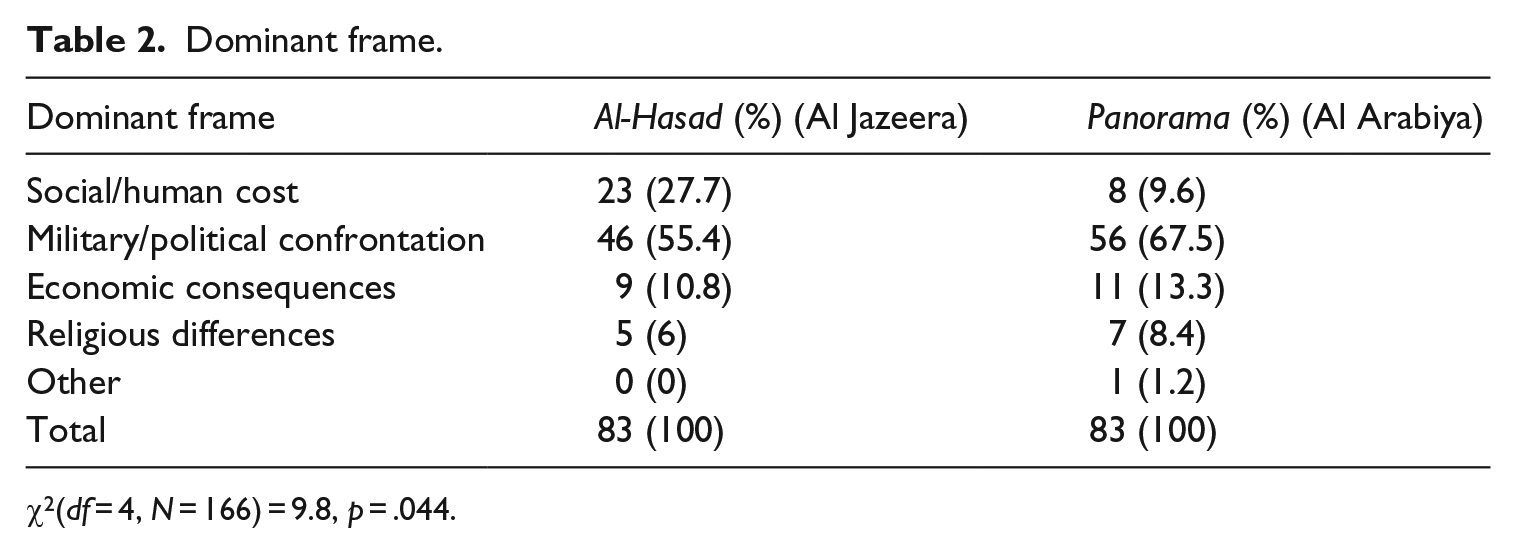
The coding scheme sought to assess the dominant frame through which the programmes spoke about the crisis. A pre-viewing of newscasts not included in the sample formed the basis of the coding scheme categories, which included a social/human cost frame, a military/political confrontation frame, an economic consequences frame and a religious differences frame. The programmes were almost equally likely to frame the crisis along economic or religious lines, but differed sharply in their employment of social/human cost and military/political confrontation frames. Al Jazeera’s Al-Hasad (27.7%) was significantly more likely than Al Arabiya’s Panorama (9.6%) to employ a social/human cost frame, while Panorama (67.5%) was more likely to employ a military/political confrontation frame than Al-Hasad (55.4%). Dominant frame differences were found to be statistically significant at the .05 level (χ2(df = 2, N = 166) = 82.3, p < .001) (Table 2).
Dominant frame.
χ2(df = 4, N = 166) = 9.8, p = .044.
Another coding scheme item sought to assess directionality – that is, the pro-Qatari, pro-Saudi or neutral direction of specific news segments. Specifically, the item sought to determine whether segments were essentially balanced or attacked one of the sides in the conflict. Findings were generally consistent with the previously discussed findings on dominant frames, although Al Jazeera’s Al-Hasad programme showed a significantly greater predilection for balance. The overwhelming majority of segments on Al Arabiya’s Panorama programme (94%) attacked Qatar. About half of Al-Hasad’s segments were balanced (49.4%), with the other half attacking Saudi Arabia (50.6%). These differences were found to be statistically significant (χ2(df = 2, N = 166) = 132.9, p < .000).
Given the importance of the word ‘terrorism’ in driving media narratives (Bhatia, 2005), and also the fact that Qatar and the Saudi-led axis exchanged terrorism accusations, the study sought to assess how the terrorism descriptor was used by both programmes under study.
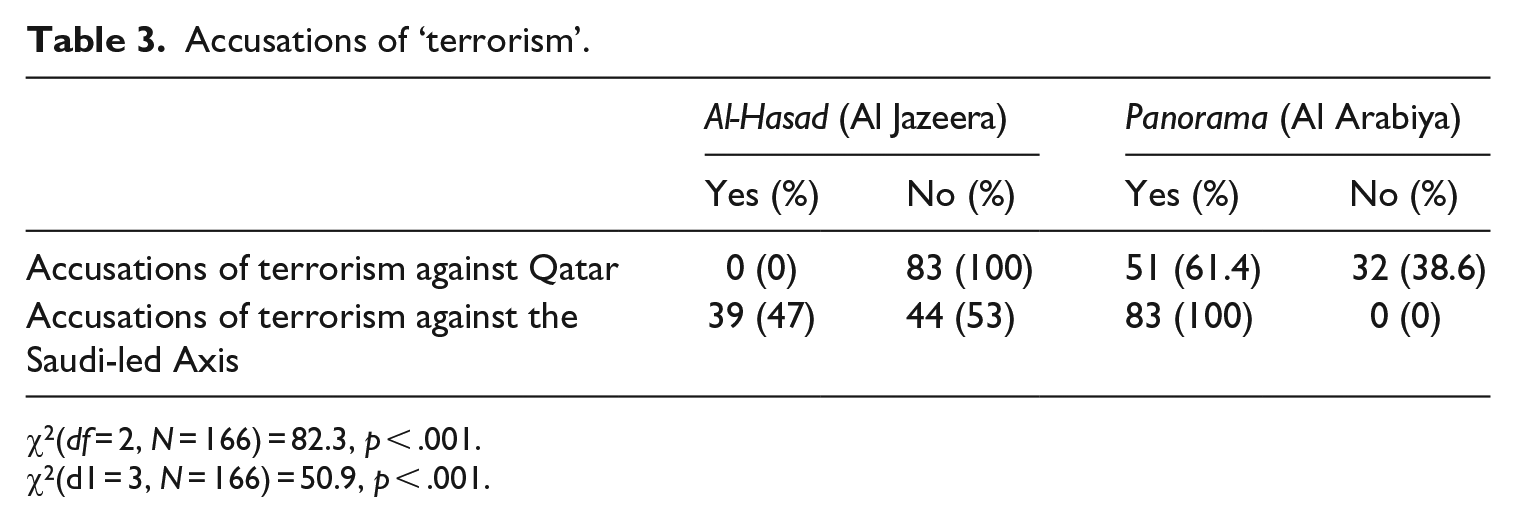
Unsurprisingly, the programmes differed sharply in their use of the word. Al Arabiya’s Panorama used the word ‘terrorism’ at least once in 51 different news segments (61.4%), with all 51 references representing accusations against Qatar. Al Jazeera’s Al-Hasad used the word in 39 separate news segments (47%), and all of these references were accusations directed against the Saudi-led axis. Chi square tests revealed these differences to be statistically significant at the .05 level (χ2(df = 2, N = 166) = 82.3, p < .001, and χ2(df = 3, N = 166) = 50.9, p < .001) (Table 3).
Accusations of ‘terrorism’.
χ2(df = 2, N = 166) = 82.3, p < .001.
χ2(d1 = 3, N = 166) = 50.9, p < .001.
Framing mechanisms
A series of coding scheme items attempted to assess specific framing mechanisms. Entman (1993) noted that associations, keywords and sourcing can act as key frame drivers. Several coding scheme items sought to measure these aspects of the framing process.
One item was designed to assess how terrorism was talked about, and whether it was associated with other issues or groups. A pre-viewing of news segments not included in the studied sample suggested that Al Jazeera talked about alleged Saudi, Emirati, Bahraini and Egyptian terrorism in the context of an alleged counter-revolution against the Arab Spring and violations against press freedom. The pre-viewing suggested that Al Arabiya often talked about alleged Qatari terrorism in the context of either the Muslim Brotherhood or extremist Islamist groups.
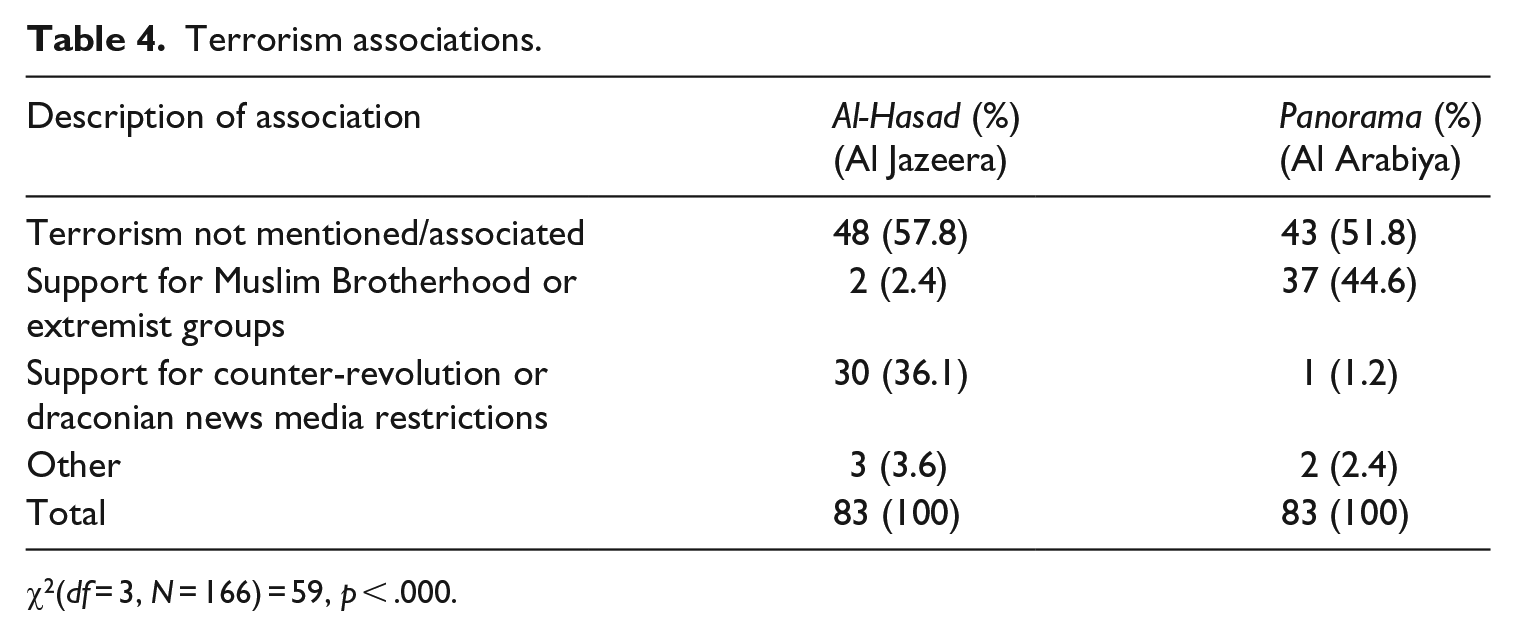
Most news segments on both programmes simply accused rivals of terrorism, without linking terrorism to other issues or groups (Table 4). However, a significant percentage of Al-Hasad segments (36.1%) tied accusations of Saudi terrorism to the alleged ‘counter-revolution’ against the Arab Spring and violations against journalistic freedom. A large number of Panorama segments (44.6%), meanwhile, tied accusations of Qatari terrorism to the Muslim Brotherhood and extremist groups. These differences were found to be statistically significant at the .05 level (χ2(df = 3, N = 166) = 59, p < .000).
Terrorism associations.
χ2(df = 3, N = 166) = 59, p < .000.
The programmes also differed in terms of how they characterized the crisis. A pre-viewing of news segments not included in the sample suggested that Al Jazeera’s Al-Hasad programme was more likely to use the word ‘blockade’ (Arabic: hisaar), which arguably has more negative connotations for the Saudi-led axis and paints Qatar as a victim. The pre-viewing suggested that Al Arabiya’s Panorama was more likely to use the word ‘boycott’ (Arabic: muqati’ah) in its characterizations of the conflict. The pre-viewing suggested that both networks seemed to regularly use the more neutral term ‘crisis’ (Arabic: ezma). A coding scheme item measured the frequency of use of all three terms.
A total of 63 per cent of Al-Hasad segments used the word ‘blockade’, compared with just 8 per cent of Panorama segments. On the other hand, 46 per cent of Panorama segments used the word ‘boycott’, compared with just 10 per cent of Al-Hasad segments. Both programmes were fairly likely to use the more neutral word ‘crisis’, but Panorama was more likely to employ it. Al-Hasad used ‘crisis’ at least once in 37 per cent of its segments, while Panorama used the term at least once in 57 per cent of its segments. Chi square tests revealed these differences in keyword choice to be statistically significant at the 05 level (Table 5).
Keywords.
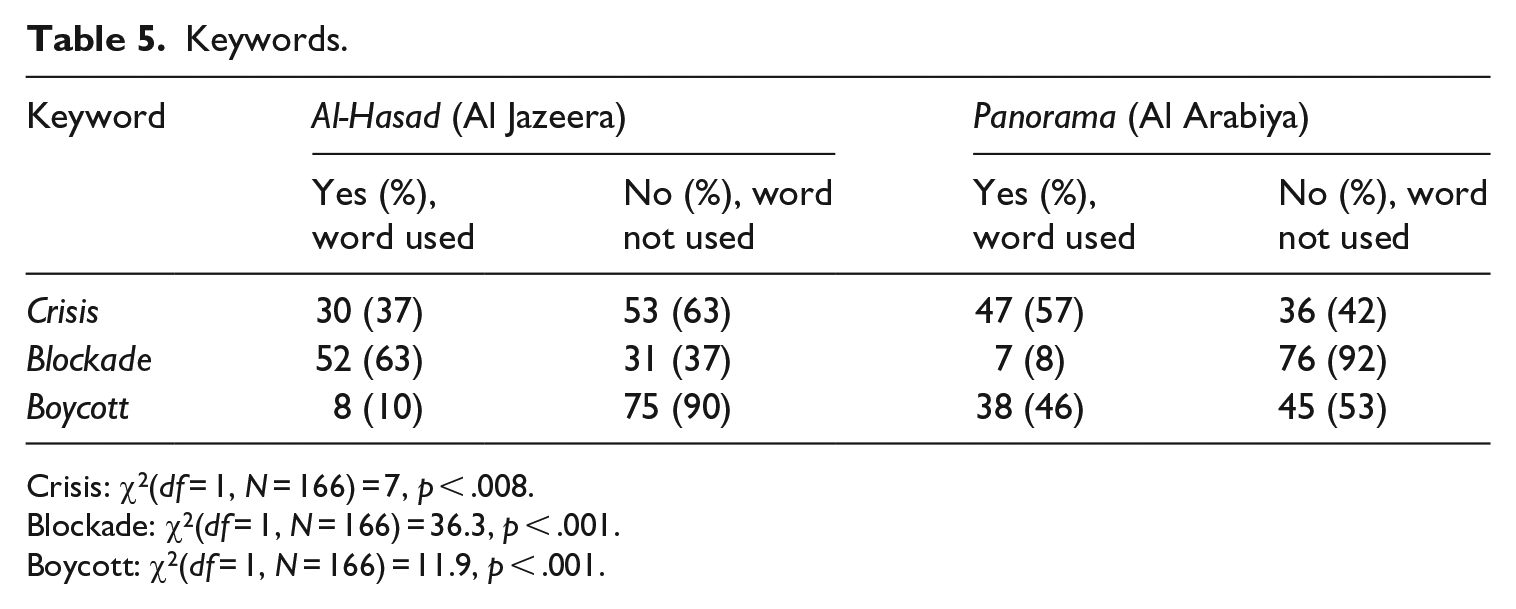
Crisis: χ2(df = 1, N = 166) = 7, p < .008.
Blockade: χ2(df = 1, N = 166) = 36.3, p < .001.
Boycott: χ2(df = 1, N = 166) = 11.9, p < .001.
The coding scheme measured sourcing in a few different ways. One item asked about the kind of interview guests – experts, government officials, media personalities, religious leaders – that programmes featured, while another asked about the political positions of the interview guests, and a third asked about information sourcing.
Al Jazeera’s Al-Hasad and Al Arabiya’s Panorama programmes were about equally likely to feature experts, government officials, media personalities and religious leaders as interview guests, and also about as likely to include segments without any interview guests at all. Nearly 60 per cent of segments on both programmes did not feature interview guests. Al Jazeera was slightly more likely to feature media personalities and Panorama slightly more likely to feature government officials. These slight observed differences were not found to be statistically significant, however (χ2(df = 4, N = 166) = 1.5, p = .831).
There were, however, statistically significant differences between the positions of interview guests featured on the programmes. For Al-Hasad, a significant percentage of news segments featured at least one pro-Qatari guest (30.3%). For Panorama, on the other hand, pro-Saudi interview guests were more common (37.3%). Neither programme was very likely to include antagonistic guests, but Al Jazeera’s Al-Hasad did include a pro-Saudi guest in 4.8 per cent of all its news segments. In addition, 8.4 per cent of Al Jazeera’s interview guests were ‘neutral’, compared with just 1.3 per cent of Panorama’s. It can be stated then that while both networks lacked balanced guest choices, Al Jazeera’s Al-Hasad programme seemed to make more of an attempt at balance. These guest position differences were found to be statistically significant (χ2(df = 3, N = 166) = 33.3, p < .000) (Table 6).
Interview guest positions.
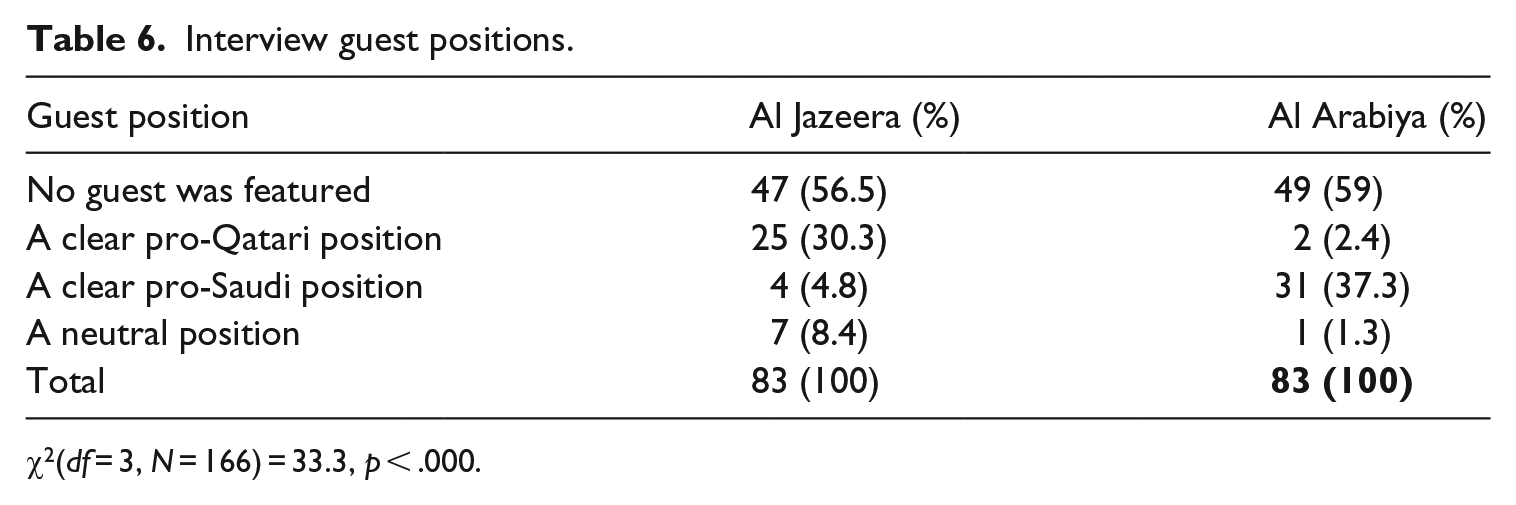
χ2(df = 3, N = 166) = 33.3, p < .000.
One of the coding scheme items sought to measure information sources (Table 7). Specifically, the item was designed to determine to whom news segments attributed information. There were five category groups – independent sources, correspondents working for the news outlet, official sources, expert sources and external media sources. There were no statistically significant differences observed for correspondents working for the news outlet, official sources or external media sources. Both programmes tended to rely most heavily on official sources. However, Al-Hasad and Panorama did use private information sources and expert sources differently. Al Jazeera’s Al-Hasad programme was more likely to rely on both these types of information sources. Al-Hasad attributed information to private information sources in 14.5 per cent of its news segments, compared with just 1.2 per cent of Panorama’s. Meanwhile, Al-Hasad attributed information to expert sources in 28.9 per cent of its news segments. Panorama did so in just 4.8 per cent of its segments. Chi square tests revealed the differences related to the use of private information sources and expert sources to be statistically significant at the .05 level.
Information source attribution.
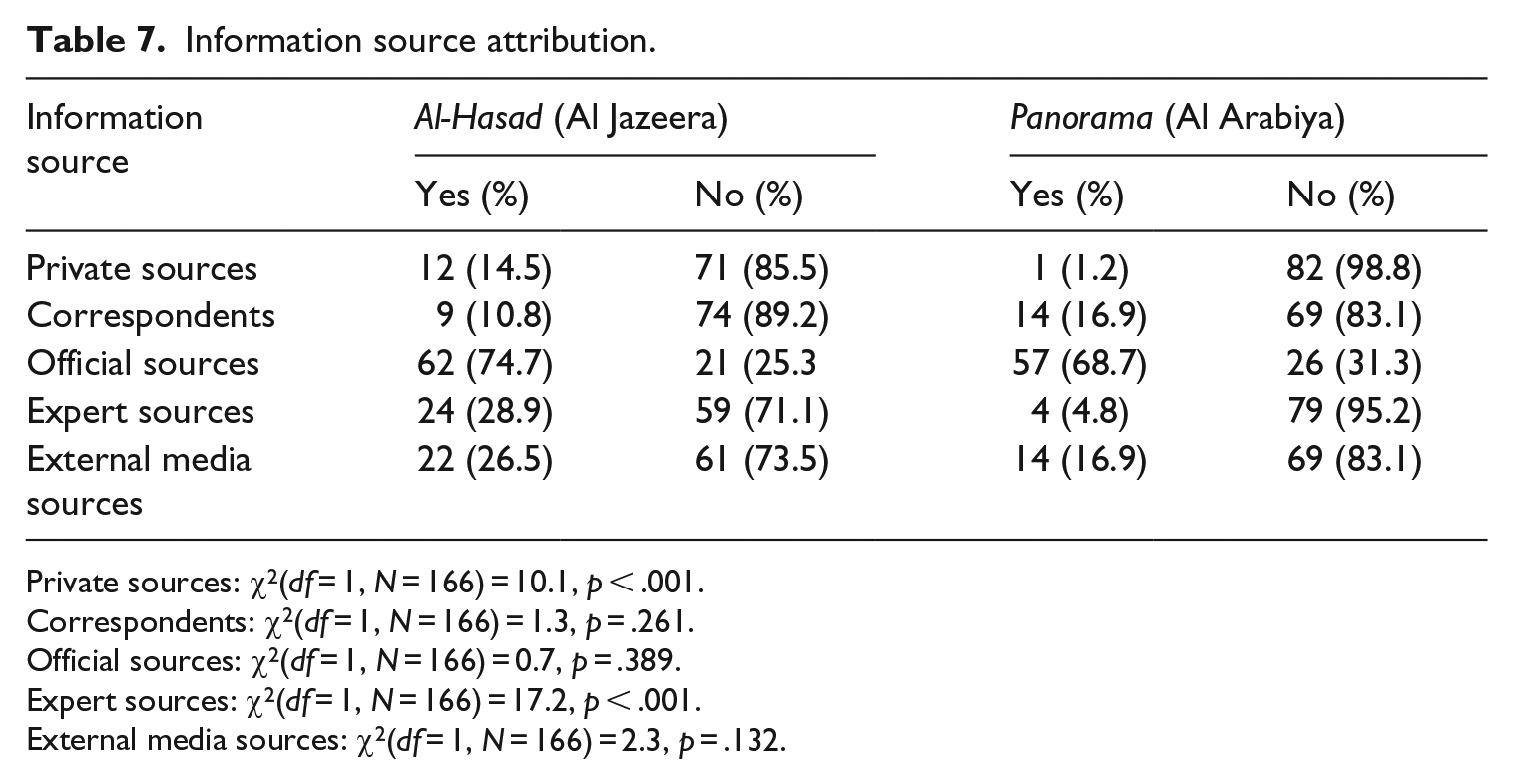
Private sources: χ2(df = 1, N = 166) = 10.1, p < .001.
Correspondents: χ2(df = 1, N = 166) = 1.3, p = .261.
Official sources: χ2(df = 1, N = 166) = 0.7, p = .389.
Expert sources: χ2(df = 1, N = 166) = 17.2, p < .001.
External media sources: χ2(df = 1, N = 166) = 2.3, p = .132.
Discussion
This study set out to compare coverage of the 2017 Gulf crisis in flagship evening news shows on two pan-Arab satellite news networks, Al Jazeera and Al Arabiya. The study, which employed quantitative content analysis and used framing theory as a conceptual underpinning, analysed both dominant frames and framing mechanisms on Al Jazeera’s Al-Hasad and Al Arabiya’s Panorama.
Results suggest that Al-Hasad and Panorama presented two vastly different versions of the 2017 Gulf crisis. Perhaps unsurprisingly, both networks adopted the positions of the governments to which they are allied.
Al Jazeera’s Al-Hasad seemingly took the position of a victim being attacked by an external oppressor. The programme covered the crisis prominently, often devoting more than 5 minutes to individual news segments; emphasized the human/social cost of what it termed a ‘blockade’; used language that accused the Saudi-led axis of terrorism; and associated the Saudi-led axis with a counter-revolution against the Arab Spring and draconian news media restrictions. The network relied on a bevy of guests sympathetic to the Qatari position.
Panorama’s coverage painted a very different picture. The programme used mostly shorter, quicker hitting segments to frame Qatar as a sponsor of terrorism. Panorama portrayed a bleak political or military confrontation as the likely outcome of the crisis, and used keywords, guests and information sources to suggest that its ‘boycott’ of Qatar was a reasonable response to a series of provocations.
Coverage on both studied programmes was meaningfully one-sided, but, interestingly, Al-Hasad was the more likely of the two programmes to attempt balance. A coding sheet item assessing directionality showed that although Al-Hasad’s news segments did not ever come across as anti-Qatar, about half (49.4%) of its sampled segments were balanced. By comparison, only 6 per cent of Panorama news segments were balanced. Also, Al-Hasad was only about 6.5 times less likely to include oppositional guests (4.8% of segments) as pro-Qatari guests (30.3% of segments). This stands in stark contrast to Panorama, which was 15 times more likely to include pro-Saudi guests (37.3% of segments) as oppositional guests (2.4% of segments). Al-Hasad (8.4% of segments) was also significantly more likely to include neutral guests than Panorama (1.3% of segments). Moreover, Al-Hasad was much more likely to rely on expert sources. This may not be the product of balanced reporting; however, it may be that there were more experts representing pro-Qatari positions than defending pro-Saudi positions, or that Al-Hasad exclusively sought out experts supporting Qatari positions.
This research raises interesting questions about the normative role of news organizations under attack by regional or world powers. Al Jazeera was not simply party to the 2017 Gulf crisis – it was a primary actor, targeted directly by foreign governments. To what extent should a news organization remain balanced and neutral? Should Al Jazeera have done more to present pro-Saudi positions, or be critical of its own role in contributing to regional tensions?
These questions are beyond the purview of this study, but they do offer important directions for future research. Media scholars and journalists should work towards developing professional guidelines for news organizations under attack by powerful actors. This issue is relevant beyond the Arab region and authoritarian political environments. American President Donald J. Trump has attacked mainstream American news organizations, labelling many of them as proffering ‘fake news’. Like Al Jazeera, these news organizations have become part of a political crisis.
Footnotes
Funding
The author(s) received no financial support for the research, authorship and/or publication of this article.