




Abstract
This paper delves into the complex relationship between business leadership, sustainability, and inclusivity, representing a step toward developing a more inclusive leadership approach to sustainable development that fosters shared power relations between business leaders and marginalized members of society. With environmental and social conditions worsening, it is urgent for corporations to move away from the neoliberal profit-maximization models advocated by Milton Friedman and instead prioritize humanity and the environment. This shift requires a fundamental restructuring of businesses to move beyond profit maximization and address societal power imbalances by including all stakeholders. Our inclusive leadership for sustainable development framework, rooted in symbolic interactionism, offers a holistic lens for including marginalized groups. At the microlevel, it focuses on business leaders’ personas, characterized by pro-demographic diversity and biodiversity, cognitive complexity for sustainable development, and social empathy, which can potentially create a macro-level impact. These characteristics, accompanied by macro perspectives toward repurposing corporations away from neoliberalism, would be a step forward in cultivating shared power dynamics between business leaders and marginalized communities for the betterment of society.
Keywords
Introduction
“Leave no one behind” is the central transformative promise of the United Nations Sustainable Development Goals (SDGs). In the Anthropocene era, marked by the degradation of the natural environment, this paper adopts an advocacy stance by asserting the crucial role of inclusive business leaders in incorporating the perspectives of marginalized communities, including proponents of biodiversity conservation, to promote sustainable development (SD) and recalibrate societal power dynamics. Several scholars have argued for a fundamental reevaluation and restructuring of businesses to address societal power imbalances, advocating for a shift towards the inclusion of all stakeholders, by harnessing corporate power to meet shared environmental, social, and economic goals (e.g., Adler, 2022; Anderson, 2017; British Academy 2019; Davis, 2022; Tourish, 2024). Although scholarly discourse advocates for corporations to realign their values, mission, and strategy away from neoliberalism and prioritize stakeholders beyond shareholders (George et al., 2023), there is a gap in understanding how leadership practices might evolve to produce this change. Thus, this paper seeks to address this critical gap through the prism of inclusive leadership. Our advocacy for inclusive leadership for SD stems from the acknowledgment that extreme societal power has become “excessively concentrated in the hands of a select few, while disenfranchising the many” under the influence of neoliberal ideology (Tourish, 2024 p. 387). This concentration has contributed to decades of corruption scandals, human rights violations, escalating levels of inequality with significant implications for the ecological fate of our planet (Ferreras et al., 2022; Morrison and Mota, 2023).
Despite the recognized potential of inclusive leadership as a catalyst for SD, its application has predominantly been confined to workplace dynamics, with insufficient attention directed towards broader societal power dynamics (cf. Korkmaz et al., 2022; Randel et al., 2018; Fujimoto et al., 2023). Specifically, there remains a dearth of knowledge concerning how inclusive leaders navigate and address power imbalances in society, particularly in the context of SD challenges, spanning various levels from local to global. To address this gap, our study aims to shed light on how inclusive leadership can drive transformative change towards SD, bridging the divide between organizational and societal realms. Our call from this research is to transform the personas of business leaders from profit-driven to stakeholder-driven through engaging in meaningful and collaborative decision-making with marginalized segments, fundamentally reshaping corporate purpose for the betterment of society, achieved through power sharing (cf., Mor Barak et al., 1998; Nembhard and Edmondson, 2006; Nishii, 2013; Nishii and Mayer, 2009; Roberson, 2006). By adopting a micro-approach over time and space, we propose that inclusive leadership practices can contribute to tackling the grand societal challenges of repurposing corporations’ purposes, shifting from prioritizing the interests of shareholders to incorporating those of wider stakeholders (Fujimoto and Uddin, 2021; Gast et al., 2020). In doing so, business leaders from corporations may weaken the influence of neoliberal ideology in leadership practices from within, a task often overlooked in mainstream theorizing (Tourish, 2024). Therefore, we advocate that our micro-focus on leadership makes sense only when accompanied by a broader macro perspective.
The concept of inclusion, which is fundamental to inclusive leadership, has primarily been theorized from perspectives of social identity, valued roles, and inclusive organizational practices to break the power status differentials, encompassing an individual’s sense of belongingness and uniqueness; participatory organizational decision-making and joint problem-solving; and the fair implementation of employment practices (e.g., Mor Barak et al., 1998; Nishii, 2013; Randel et al., 2018; Roberson, 2006; Shore et al., 2011). Given that this concept has been mainly theorized as a workplace phenomenon, it has been discussed in the workplaces as encompassing leaders’ demonstration of openness and their efforts to ensure accessibility for their followers (e.g., Carmeli et al., , 2010; Hirak et al., 2012; Mitchell et al., 2015; Nembhard and Edmondson, 2006). At the workplace level, inclusive leadership is rooted in the individual traits of pro-diversity beliefs, cognitive complexity, and humility, playing a crucial role in fostering united workgroup identity and psychological empowerment, which, in turn, lead to positive work outcomes such as creativity and innovation (Randel et al., 2018). To address the lack of consideration of power dynamics in current theories of inclusive leadership, we expand these individual characteristics to propose ‘inclusive leadership for SD’ that fosters shared power relations between business leaders and marginalized members in society to make collaborative decisions for SD. Furthermore, although existing leadership theories for SD are commendable, they fall short in articulating the individual characteristics business leaders need to incorporate perspectives from marginalized societal members. Since both business and society are pluralistic entities with multiple competing interests and perspectives, questions remain on how leaders can collaborate and promote power sharing through participative dialogue approaches to address grand challenges (cf. Visser and Courtice, 2011). We advocate inclusive leadership as a foundational approach to addressing SD, with the caveat that this approach necessitates business leaders’ recognition of the macro-level issues surrounding the proliferation of leadership power within the context of neoliberalism. Thus, inclusive leadership can be one of the fundamental steps toward reshaping power dynamics within both businesses and society. However, this approach is under-theorized.
Our paper addresses these gaps to theorize the characteristics of inclusive leaders for SD based on the symbolic interactionism theory (Carter and Fuller, 2016). The symbolic interactionism theory, viewed through a sociopsychological lens, sees society as comprising overlapping proximate, intermediate, and large structures. Within these structures, individuals make sense of their worlds from a bottom-up perspective through repeated social interactions. This process helps them to continuously understand their roles and identities as they coevolve within social relationships (Carter and Fuller, 2016; Stryker et al., 2005). From this lens, we articulate how individual characteristics of inclusive leaders for SD can balance power relations and extend their influence from the micro-level to macro-level impacts. We elaborate how inclusive leadership characteristics at the microlevel may act as catalysts for changing power dynamics in society at the macrolevel involving marginalized groups in addressing complex problems on an equal footing (Grint, 2022). Specifically, we expand the three characteristics of inclusive leaders (Randel et al., 2018) to: (1) dual beliefs in demographic diversity and biodiversity; (2) cognitive complexity for SD; and (3) social empathy that bridges the internal (psychological) and external (sociological) worlds, facilitating the co-creation of a sustainable society with marginalized group members (cf. Islam, 2020). We delineate each of these leadership characteristics for facilitating greater power sharing and shared decision making with marginalized group members in society.
We consider marginalized groups as those who suffer from societal inequality, yet whose voices are critical for SD (Sakr et al., 2023). These groups may include traditional fishers, the urban poor, minority ethnic groups, women in rural areas, refugees, displaced persons and rural communities facing economic disadvantages that provide crucial insight into SD and environmental protection efforts (Dorsey, 2003). Our definition of marginalized group members further includes established group members from seemingly powerful backgrounds, like environmental scientists and engineers who may experience marginalization in business decision making for reasons unique to their experiences, despite outward appearances of authority. All of these groups have the potential to contribute significantly to SD by sharing their unique knowledge, but their voices are often not actively sought after. This is particularly relevant to developing countries on a global scale, which face disproportionate challenges from the impacts of climate change such as droughts, hurricanes, deforestation, and pollution. Therefore, knowledge on how to integrate these diverse groups perspectives into business decision-making processes at the micro-level is essential for formulating effective and inclusive policies for SD at the macro-level.
This paper begins by recognizing the strengths and shortcomings of existing leadership theories for SD. We then position inclusive leadership approach in the context of existing leadership challenges faced by business leaders. Following this, we elaborate on the individual characteristics of inclusive leadership for SD, drawing from relevant research and symbolic interactionism theory to reshape power dynamics from micro- to macro-levels, thereby influencing SD. We conclude by discussing our findings and provide future research implications.
Strengths and shortcomings of leadership theories for SD
Leadership theories’ characteristics enhance understanding of diverse values and opinions to foster SD globally (Jenkins, 2012). For instance, transformational SDG leadership delineates the importance of stakeholders’ responsibility and the integration of local and global economies for attaining sustainable economics, as well as provides insights on how to overcome challenges to SD (Galpin and Whittington, 2012; Plowman et al., 2007; Rendtorff, 2019; Visser and Courtice, 2011). However, there is a lack of understanding of implementing SDGs at the micro level and embedding SDGs in local community economic practices. While global critical leadership promotes critical thinking skills for achieving SD (Rendtorff, 2019), it overlooks the local nuances and significance of practical solutions from marginalized society groups. Other theories of leadership i.e., responsible leadership (Pless and Maak, 2009; Siegel, 2014), sustainability leadership (Metcalf and Benn, 2013; Visser and Courtice, 2011), authentic leadership (Avolio et al., 2004a; 2004b), collaborative leadership (Hartman et al., 1999; Hull et al., 2020; Snowden and Boone, 2007), ecocentric leadership (Biswas et al., 2022; Uddin et al., 2021), complex leadership (Plowman et al., 2007), wicked leadership (Hull et al., 2020), and ethical leadership (Brown et al., 2005; Freeman et al., 2006) focus on different leadership characteristics for SD. These theories underscore the importance of fostering responsible mindsets and caring for needs of others, empowering people by valuing individual differences, collaborating initiatives among stakeholders, building relationships with the environment by engaging individuals with a shared understanding and creating a conversation about ethics and values that are inevitable to address sustainability issues and problem-solving. However, there is a lack of perspectives on how to overcome dilemmas when leadership initiatives for SD are not aligned with sustainability practices at the micro level. Sustainability efforts may be fragmented due to leaders’ limited understanding of marginalized individuals’ sustainability practices. Thus, SD often requires tailored solutions considering the local ecological, social, and economic contexts.
Additionally, Waddock (2013) advocates for leaders to foster SD at the organizational and societal levels, aiming for collaborative solutions to create greater system resilience and wiser use of limited resources. Redman and Wiek (2021) identifies micro-to-macro competencies of intrapersonal and interpersonal, anticipatory and strategic, as well as systems-thinking competencies, as an integrative competence for SD. Robinson et al. (2011) propose a specific intervention of originating ideas from the preferred futures envisioned by community members, rather than from externally supplied goals. However, what is missing in current leadership theories for SD is an understanding of how business leaders reach collaborative solutions with marginalized members of society, emphasizing individual characteristics that foster power-sharing through decision-making between leaders and marginalized communities for the betterment of society. We elaborate on these individual characteristics next.
Inclusive leadership for SD
Business decisions generally do not seamlessly incorporate marginalized perspectives due to existing power structures, diverse perspectives, and the complexity of the challenges. Grint (2022) underscores the complexity of wicked problems, highlighting their entanglement with entrenched power dynamics and institutional inertia. Recognizing these complexities, including the diverse and often contrasted perspectives affecting decision-making, underscore the need for business leaders to challenge power dynamics and reconsider the fundamental purpose of business beyond mere profit maximization. To explain inclusive leadership’s potential role in reshaping power dynamics in local and global joint SD, we draw upon symbolic interactionism theory. Notably, this theory regards the macro or societal issue as a “small world problem,” centralizing social psychology as an indispensable engine of coordinated human activities in a globalized society, centralizing social relationships as the main determinant of the degree of societal inclusiveness (Blumer, 1962; Brewer, 1991; Carter and Fuller, 2016: 691). Brewer (1991) also encourages inclusive social relationships that meet individuals’ needs for belongingness and uniqueness in different contexts (e.g., team project, workplace, community, and region), thereby fostering the inclusivity of marginalized individuals’ social roles and identities in diverse circumstances. Thus, we regard the self to represent a psychological and sociological role of individuals who are also influenced by the psychological and structural inclusion of others in a given social world (Blumer, 1962; Carter and Fuller, 2016: 931; Mead and Schubert, 1934).
Our study demonstrates how a multitude of inclusive social exchanges at the micro-level can potentially dismantle broader macro-level power structures promoting a balance of power and enhancing relations across different social groups through power-sharing at the macro-level (Blau, 1986; Herring, 2009; Kossek and Zonia, 1993; Roberson, 2006). To serve this goal, we delineate leadership characteristics to address existing leadership challenges that lead towards shared power dynamics by facilitating joint decision-making process with marginalized members of society. Figure 1 illustrates our baseline framework for inclusive leadership, which transforms the social and role identities of both marginalized and mainstream group members (such as environmental scientists, who might feel marginalized) by encouraging their involvement in business activities at various levels. This involvement facilitates both sociopsychological and sociological transformations, contributing to the creation of a more inclusive world. Baseline model of inclusive leadership for SD: Social psychological and sociological development.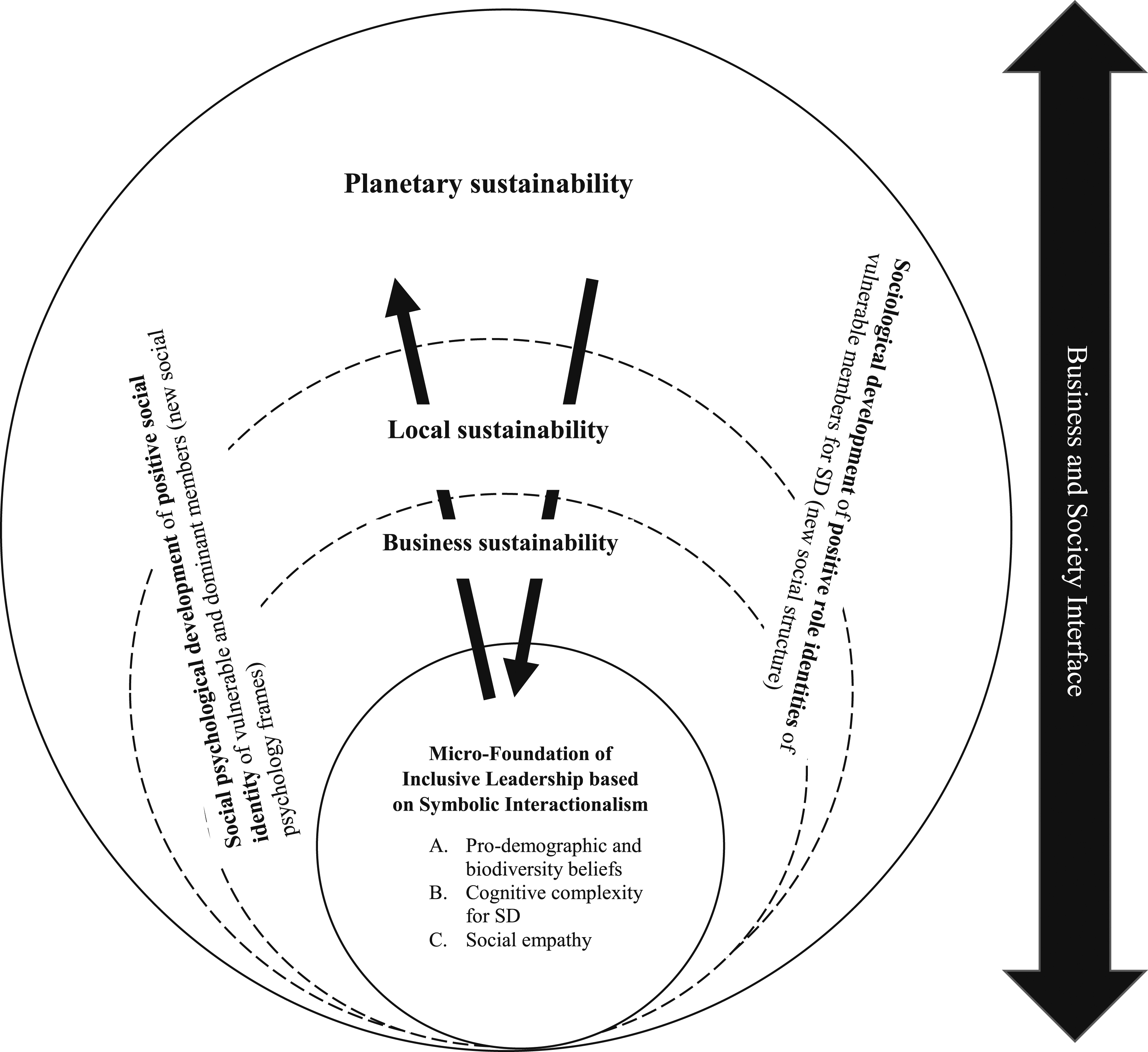
Inclusive leadership characteristics
Departing from the individual characteristics of inclusive leadership at a workplace (Randel et al., 2018), the characteristics of inclusive leadership for SD connotes business leaders’ inclusion of humanity and nature, regardless of location, role and background, to address interrelationships between business, poverty, demographic bias, and ecosystem degradation (cf. Gladwin et al., 1995; Griggs et al., 2013). Such leaders are more likely to generate sustainable business solutions with marginalized members in society to overcome neglected local perspectives, and power inequality (cf. Ayompe et al., 2021; cf. Bansal and Song, 2017; Islam, 2020). We discuss the following inclusive leader characteristics for SD that bridge the internal (psychological) and external (sociological) worlds toward co-creating an inclusive and sustainable society with marginalized group members (cf. Islam, 2020).
Dual beliefs in demographic diversity and biodiversity
While the pro-demographic diversity belief welcomes marginalized members of society to share their unique perspectives (cf. Hahn, 2009), pro-biodiversity belief welcomes voices for the natural environment (e.g., forests, underwater species) in business decision-making (Rockström et al., 2009; Spash and Hanley, 1995). The pro-demographic diversity and biodiversity beliefs promote the equally valued roles of marginalized individuals, regardless of their involvement in business development and/or environmental protection. Such a dual approach also invites and welcomes individual unique perspectives for SD regardless of their power and positions inside and outside businesses with the sense of belongingness to interdependently address environmental issues between marginalized and dominant groups in society (cf. Brewer, 1991; Nishii and Mayer, 2009; Randel et al., 2018; Van Knippenberg et al., 2007). Business leaders with dual beliefs would promote individuals’ inclusive role identities so that they can confidently share their perspectives on societal consequences of business development (cf. Hogg et al., 1995; Shibutani, 1988).
Cognitive complexity for sustainable development
Randel et al. (2018) articulate leaders’ cognitive complexity as their ability to think multidimensionally by evaluating the social identity of the group in a positive manner (Hogg and Terry, 2000). This concept, in line with social identity theory, highlights how people with high cognitive complexity value the various social identities in gathering, appreciating members’ unique contributions based on multiple identities while understanding and managing the complexities of group dynamics for the collective good (Bieri, 1955; Dierdorff and Rubin, 2007). To address complex challenges, business leaders need to open up dialogue with diverse perspectives to collectively address the wicked problems that were unsolved before (Grint, 2022). Thus, extending the original scope of cognitive complexity by Randel et al. (2018), business leaders taking a cognitively complex approach to SD will carefully examine as many demographic and biodiversity concerns inside and outside their businesses as possible to construct new norms for addressing sustainability challenges (cf. Calton et al., 2013; Hahn et al., 2014; Hahn et al., 2018; Ostrom, 2009; Pless and Maak, 2004). In essence, leaders possessing cognitive complexity are more likely to foster meaningful social interactions with marginalized groups in multifaceted ways, enhancing feelings of belonging and uniqueness among minority members while reshaping power dynamics and structures (cf. Brewer, 1991; Hogg et al., 1995). Such interactions foster the feelings of accepted identities and an authentic society, enabling individuals to co-create inclusive societal norms and values while jointly solving societal problems (Mead and Schubert, 1934). Notably, previous research has also identified cognitive complexity as a critical leadership character for creating social value within impoverished communities by taking their contextual constraints into account (Lashitew et al., 2021). Consequently, leaders with cognitive complexity are likely to effectively address concerns ranging from social and economic to environmental issues (cf. Hahn et al., 2018).
To demonstrate how it plays out in terms of leadership, several studies and reports have implicitly promoted the cognitively complex behaviors of inclusive leadership at business, society and nature intersections (Inclusive Business Action Network, 2023). Besides promoting macro-initiatives of financial aid for those living in poverty to earn incomes by starting small enterprises, few cases implied a cognitively complex inclusive leadership approach. For example, an agricultural organization in the Philippines consciously invited low-income farmers, scientists, NGOs, and community associations to share their perspectives in the organizational decision-making process. By welcoming the unique perspectives of marginalized groups into planning, implementation, and evaluation, these groups have been able to attain various leadership positions (i.e., role transformation). These positions have allowed them to reshape power dynamics through starting novel initiatives, such as facilitating cross-farm visits between farmers and conducting farmer-to-farmer training (Glotzbach, 2012). Such initiatives struck a balance between the farmers’ sense of belongingness in organizational decision-making and their sense of differentiation or uniqueness (i.e. inclusive social identity). It empowered them to contribute their unique information about local ecologies or practical know-how, thereby recognizing and valuing their expertise in the decision-making process. Respected as knowledgeable and indispensable leaders for introducing new forms of agriculture in the region, these farmers experienced the sociopsychological and role transformation of group worth and distinctiveness (cf. Brewer, 1991; United Nations Environmental Program [UNEP], 2020). This framework has eventually resulted in a large-scale business and societal transformation of a chemically dependent agricultural approach into a system of local organic production, which benefited marginalized stakeholders and SD at the provincial, regional, and national levels. Another example was seen in China, where farmer networks have been invited to collaborate with the government and biological technicians for the rural differentiation of poverty alleviation and eco-friendly energy policies. This effort increased the economic and health benefits of impoverished communities via coordinated inclusive interactions among neighboring villages (Fan et al., 2011; Liu, 2010).
These sustainable projects underscore a bottom-up perspective and inclusive spaces that foster a sense of belonging and uniqueness in a multidimensional manner, reshaping power dynamics and structures within society toward collaborative problem-solving. This approach emphasizes the tandem inclusion of both micro (psychological) and macro (sociological) processes, along with joint problem-solving within an inclusive network. Additionally, the cultivation of social empathy further strengthens collaborative decision making.
Social empathy
Social empathy averts preexisting emotional dissonance felt by marginalized individuals to address sustainability challenges jointly (cf. Lawler, 2001; see Figure 1). Randel et al. (2018) promote leaders’ humility as a factor in developing an inclusive workplace for all employees from diverse demographic backgrounds by fostering marginalized employees’ sense of belongingness and uniqueness. We maintain the importance of humility that recognizes own limitations and appreciates others’ unique contributions by expanding it to incorporate social empathy inside and outside workplace domains. Beyond work issues, social empathy is the insight one has into marginalized people’s living conditions, cultivated by adopting perspective-taking and deep listening to improve their livelihood and circumstances (Hart and Sharma, 2004; Maak and Pless, 2006; Segal, 2007). When marginalized individuals interact with dominant members of society, they may experience negative emotions due to their low power status, such as feeling less worthy or important in the dialogue (Ridgeway and Johnson, 1990; Stets and Harrod, 2004).
Therefore, the involvement of inclusive leaders, who practice perspective-taking with genuine interest and active listening to respond to individual needs (Roberson and Perry, 2022) may foster shared power relations, shared ownership, and exchangeability (Weber, 1968) with marginalized members of society in decision-making. By engaging in interactions that emphasize inclusion, these leaders highlight the significant impact of employing emotion-aware strategies. This approach is particularly effective among individuals from varying power statuses, dismantling existing power differentials during collaborative problem-solving efforts (Carter and Fuller, 2016; Hochschild, 1979). For example, dominant leaders may symbolically interact with marginalized individuals by openness, encouragement, help, enthusiasm, and compliments for their viewpoints to delegitimize power imbalances and promote greater power sharing via joint problem-solving process (Carmeli et al., 2010; Hirak et al., , 2012; Mitchell et al., 2015).
By inviting their unique knowledge and information with these conscious gestures, leaders may foster marginalized individuals’ positive self-worth and ideal self, laying strong psychological foundations for the inclusive social order (cf. Brenner et al., 2014; Merolla et al., 2012). This inclusive leader character may create a deflective emotional experience that is contrary to these individuals’ expectations of their treatment by leaders with high-power status (Lawler, 2001; Lovaglia and Houser, 1996; Ridgeway and Johnson, 1990). When leaders of high status foster inclusive social exchange, marginalized individuals may experience an emotional uplift (e.g., excitement, pride, and gratitude) based upon invited identity and roles in their mainstream groups, networks, and movements (e.g., Lawler and Yoon, 1996 as cited in Lawler, 2001). Therefore, positive emotions facilitated by inclusive leaders’ social empathy promote stronger affective ties, resolving the dissonance between the individuals of mixed-status groups to increase low-power status individuals’ contributions to sustainable business development (Lovaglia and Houser, 1996). Notably, empathetic leaders also foster emotional connections in human–nature relations that direct their decision-making and actions in response to environmental degradation and poverty, encouraging the development of pro-environmental behaviors (Brown et al., 2019; Tyler, 2006).
Through business leaders’ socioemotional support for belongingness and the unique strengths of marginalized individuals - accompanied by the dual beliefs and cognitive complexity for SD, they are likely to foster collaborative business decision making with disadvantaged communities (London and Hart, 2004), preserving those communities’ livelihood and natural resources (Tyler, 2006) and addressing their environmental concerns and conservation efforts (Tam, 2013) with positive regard (Ridgeway and Johnson, 1990).
So far, we have introduced the micro-level characteristics of inclusive leaders who actively engage marginalized individuals in problem-solving to reshape power dynamics. This is a significant step toward generating diverse perspectives and innovative solutions, thereby fostering SD. As Figure 2 illustrates, business leaders integrate pro-demographic diversity and pro-diversity and biodiversity beliefs, cognitive complexity for SD and social empathy as three essential individual characteristics. These characteristics psychosocially, structurally, cognitively, and emotionally transform the experiences of marginalized individuals at the micro level, while also potentially impacting the macro-level for business, local, and planetary sustainability (Lawler, 2001). In the following section, we delve deeper into how micro-level inclusive leadership can facilitate the global integration and local distinctiveness of marginalized groups within global operations for SD (cf. Merolla et al., 2012). Inclusive leadership framework for sustainability development.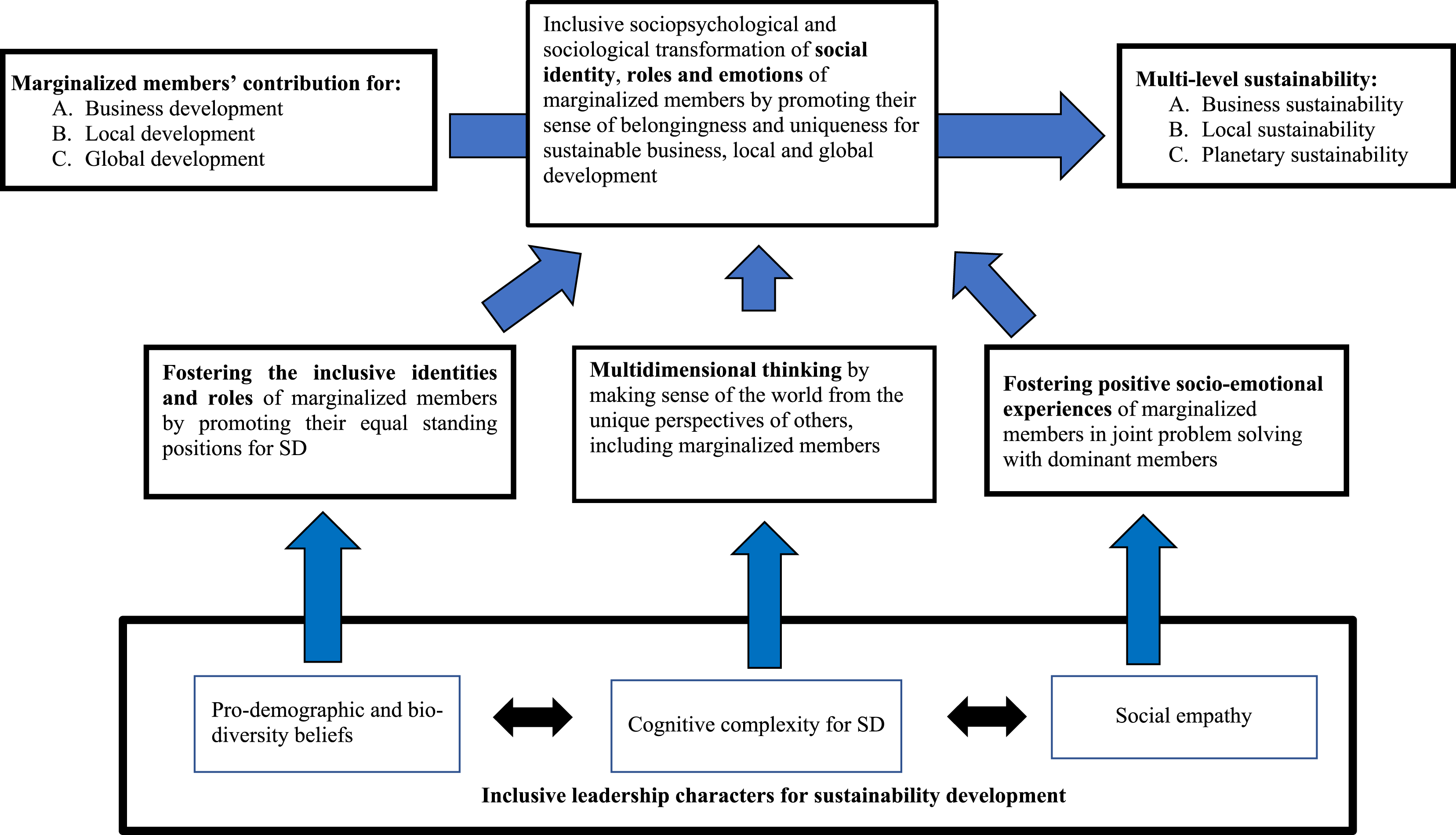
Inclusive leadership for sustainable development at the macro/global level
In this section, we present how the inclusive leadership characteristics for SD at the micro level act as a bedrock for fostering marginalized members’ local distinctiveness and global integration at the macro-level for planetary sustainability (cf. Cook, 2000; Merolla et al., 2012). In the era of ever-increasing communication technology, enlarging our social worlds across geographical space and time promotes a borderless social reality (cf. Carter and Fuller, 2016). In this borderless space, inclusive leadership emerges as a collective force for SD, aptly positioned to accelerate an inclusive planet by addressing various forms of inequality such as age, gender, race/ethnicity, disability, and socioeconomic status. It operates across geographic locales, employing a bottom-up holacracy leadership framework as illustrated in Figure 2. Figure 2 provides a comprehensive framework for inclusive leadership for SD. It demonstrates how inclusive leadership characteristics at the micro-level can scale up from business and local development to global development, embodying a psychological and sociological transformational process. This approach also fosters changing power dynamics at the macro-level, from business to local and global levels, transforming power dynamics by actively integrating marginalized groups into decision-making processes. In other words, inclusive leadership as a collective force at the micro level is likely to cumulatively empower marginalized groups’ ability at the macro level to obtain better global standing for addressing worldwide challenges, such as climate change (cf. Merolla et al., 2012; Rockström et al., 2009).
In particular, the implementation of a bottom-up holacracy framework that contributes to societal development on a global scale, beyond businesses and localities, is crucial in reversing the profound global inequality perpetuated by dominant economic systems, especially between the Global North and the Global South. Notably, local poverty and environmental degradation in Global South regions are often caused by unsustainable global production networks that transcend national borders. Those conditions are not inherent in global production networks per se but are contingent upon the extent to which powerful global and local leaders respect local communities and the environment as part of their transnational decision-making processes through their pro-diversity (demographic and biodiversity) beliefs, cognitive complexity for SD, and social empathy (Ostrom et al., 1999). Therefore, these inclusive leadership characteristics at the micro-level are foundational in creating a borderless, inclusive planet (cf. Bavinck et al., 2014; Johnston et al., 1994; Ostrom et al., 1999).
At this juncture, we expand the concept of inclusive leadership beyond its application to business leaders to incorporate leaders from other transnational associations, such as the World Health Organization, the United Nations, and the International Labour Organization, as well as from other organizational types (e.g., NGOs, social enterprises, and nonprofit organizations) as key leaders for facilitating the inclusive leadership movement at the global level. Inclusive leadership for SD, as a collective movement, would strengthen its political influence in fostering planetary sustainability inclusively. This approach aims to reduce macro inequality by facilitating the global integration and local distinctiveness of marginalized groups within globally organized relationships, all under the holacracy framework of inclusiveness (cf. Brown et al., 2016; Riaz, 2015). In light of how inclusive leaders might address perpetuating global inequality, we identify three features of inclusive leadership that promote SD at the macro level: cultivating global integration and local distinctiveness, transnational resource mobilization for SD, and universal sustainability languages.
Cultivating global integration and local distinctiveness
To promote planetary sustainability, inclusive leadership as a global movement addresses amplified demographic diversity and biodiversity and unveils vast cultural groups with different worldviews, identities, norms, values, and communication styles. By welcoming the complexity of individual and collective identities, inclusive leaders may foster open dialogue with intersectional lens to sensibly address the nuances of identity-based oppressions and privileges to address systemic inequality (Hooks, 2000, 2009). For example, inclusive leadership at the global level can increase the permeability of economic boundaries by establishing a transnational space where both dominant and marginalized groups share an equal sense of belongingness and uniqueness to allow for intersectional identity conversation. This inclusive and collective social identity fosters collaborative development and promotes SD locally and globally (cf. George et al., 2016; Habermas, 1981; Johnston et al., 1994). By jointly tackling global challenges at the global level (e.g., marginalized factory workers from the Global South invited by MNCs to make joint decisions for SDGs), this social movement enables marginalized members to free from local power imbalances and provides a platform for them to express their vulnerabilities and suggestions at the global level (Ellemers, 1993; Turner and Brown, 1978). Importantly, this movement reinforces the inclusion of Global South groups in the global sphere, empowering them to address local sustainability issues on a global scale with greater political influence (cf. Seyranian, 2014; Shore et al., 2011; Tajfel and Turner, 1979).
To illustrate, Figure 3 introduces a 4 × 4 framework for sustainable development, conceptualizing ‘inclusion' as the integration of individuals and nature into the global economic system. This integration is not just about being part of the system, but also about actively contributing unique local insights, such as resource management knowledge and specific needs. This approach emphasizes the importance of maintaining local distinctiveness within the overarching global economic framework. Figure 3 illustrates the inclusion quadrant at the macro-level, in which inclusive leadership in global operations may develop marginalized groups’ sense of belongingness through global integration while simultaneously promoting their uniqueness through maintaining local distinctiveness in dealing with local sustainability challenges (cf. Arnett, 2002; Devine-Wright, 2011; Devine-Wright and Batel, 2017). We expand Shore et al.’s (2011) inclusion for workplace diversity concept to encompass the local–global diversity that governs business, society and environment relationships in the global business. Inclusion matrix via global belonginess and local uniqueness for sustainable development.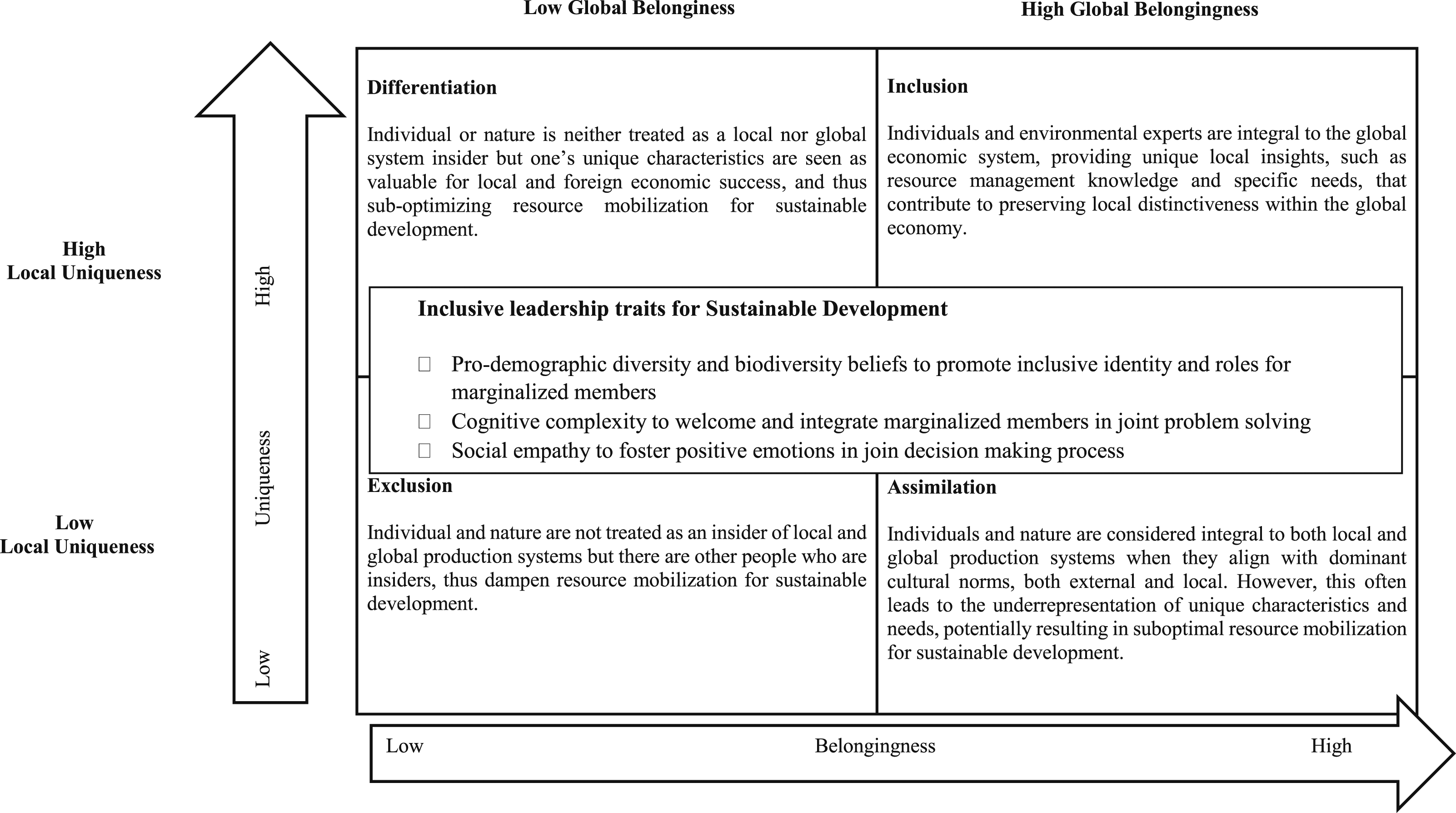
The exclusion quadrant relates to the treatment of individuals and natural environment as neither local nor global field system insiders, as having low levels of unique value and belongingness under economically powerful institutions. The assimilation quadrant refers to the acceptance of individuals and environment as insiders as long as they conform to external market and economic norms. The differentiation quadrant refers to the recognition of individuals and environment for their unique local contributions to economic growth by responding to market demand, even though they are not considered insiders of a global production system to participate in making joint decisions for SD. We contend that to foster local distinctiveness and the global integration of marginalized groups into sustainable global production systems (i.e., the inclusion quadrant), inclusive leadership anchored in symbolic interactionism provides a crucial impetus for groups’ interdependent participation in business, local, and global domains (cf. Boyatzis, 2008). The inclusion quadrant, in particular, promotes transnational resource mobilization and universal sustainability languages to foster SD.
Transnational resource mobilization
Inclusive leadership within various organizations across geographical boundaries can harness unique local knowledge about resources, networks, influential leaders, and community groups to develop regional tactics for sustainable resource mobilization at the local and global levels (Briscoe and Gupta, 2016). Furthermore, inclusive leaders can gather local and global supporters to foster transformation among elite group members (who might also feel marginalized in business decision-making, such as environmental scientists), encouraging them to become advocates for actively inviting the voices on behalf of nature/marginalized groups to promote SD (cf. McCarthy and Zald, 1977). Moreover, inclusive leaders can potentially persuade consumers to buy products that support the livelihood of marginalized groups (Sogari et al., 2017). In short, inclusive leadership across geographical borders and organizations/associations may aggregate myriad resources for SD locally and globally. This transnational mobilization can strengthen various global strategies toward creating a more sustainable transnational system of humanity to safeguard the planetary boundaries (cf. Hirsch, 1986). Transnational resource mobilization may also be strengthened by inclusive leaders using universal sustainability languages.
Promoting universal sustainability languages
Existing literature emphasizes repeated symbolic communication or the interaction of subjective meanings to bridge micro and macro settings in a way that demonstrates the significance of meaningful interactions in defining how to make up ‘society’ (Carter and Fuller, 2016; Habermas, 1981). One major impediment to fostering inclusive SD at the global level is the large number of sustainability languages embedded in various cultural norms across national and regional contexts (Seyranian, 2014; Welch et al., 2005). Grint (2022) also talks about the need for a common language to mobilize people for solving wicked problems. Despite criticism of the SDGs’ potentially reductionist approach (Fukuda-Parr and McNeill, 2019), the use of well-known SDG language as universal sustainability language may accelerate Global North and Global South groups’ belongingness and uniqueness by jointly tackling common challenges. Although universal SDG language may shift to other sustainability languages, continuous utilization of universal sustainability languages by inclusive leaders will provide a united front for local and global leaders to harness each other’s unique strengths to tackle the various sustainability challenges (cf. Heikkurinen and Mäkinen, 2018; McVea and Freeman, 2005; Simões and Sebastiani, 2017).
By expanding the inclusive leadership characteristics for SD from micro to macro levels, we propose inclusive leadership for SD as a form of collective leadership dynamism. This approach encourages business leaders to address power imbalances in society by involving marginalized group members in efforts to safeguard planetary sustainability. However, given that organizations are not unitarist, particularly within the context of neoliberalism, where the focus on profit maximization is dominant, we recognize that including marginalized voices can present complexities. For example, in certain situations the perspectives of marginalized groups might differ from those of business leaders, challenging conventional notions of profitability. Alternatively, leaders might prioritize their own vested interests, including marginalized groups as a token, creating a smokescreen of commitment to sustainability without genuinely restructuring business practices. Such situations highlight the need for a fundamental reorientation of business priorities at the macro level, away from profit-driven motives towards a more holistic approach that values sustainability, social responsibility, and ethical practices. Viewed from this perspective, shared leadership has the potential to be a double-edged sword. While it could promote a greater focus on sustainability by incorporating diverse perspectives and fostering collaboration, it could also lead to conflict and disagreement. The inclusion of multiple voices and viewpoints may result in competing interests and differing priorities, potentially hindering decision-making processes and slowing down progress towards sustainability goals.
Despite these potential macro-level challenges, including marginalized voices is a step in the right direction for leaders to move forward. Hence, for our micro approach on leadership to be effective, it needs to be complemented by macro perspective that considers the broader socio-economic and political context in which businesses operate. This includes understanding of why sustainability has often been overlooked in favor of profit-seeking motives within businesses, how the growth of leadership power in the context of neoliberalism potentially enhances these challenges, and the necessity for reimagining and reconstructing business models to encompass interests beyond shareholder value.
Discussion
The intersection between business, society, and the degrading natural environment has heightened the urgency for leadership focused on SD that is inclusive and deeply embedded. Building on the inclusive leadership framework (Randel et al., 2018), we have addressed the void in leadership theories regarding how leader characteristics may foster collaborative decision-making with marginalized members of society. To this end, we have theorized inclusive leadership for SD as encompassing collective characteristics of pro-biodiversity and pro-demographic diversity beliefs, cognitive complexity tailored to SD, and social empathy that foreground collaborative decision-making with marginalized members of society to advance business, local, and planetary sustainability. As mentioned earlier, this approach is only feasible if business leaders have the vision to confront the macro-issue of corporations existing within the neoliberal vacuum, where sustainability is often sidelined in favor of serving profit-seeking interests (cf. Tourish, 2024). There is a need for inclusive leaders with a macro-vision to execute these micro approaches at multiple levels. They should have a vision to reconstruct businesses to encompass interests beyond shareholder value, fundamentally reshaping power relationships within both businesses and society as a result.
Having acknowledged the importance of business leaders with a vision to repurpose corporations towards stakeholder-oriented rather than shareholder-oriented agendas for sustainable development, we contend that our proposed individual characteristics of leadership characteristics are crucial for addressing existing power imbalances, both psychologically and sociologically. These traits foster a sense of belonging and uniqueness among marginalized groups, facilitating joint collaborative decision-making for business, local, and planetary sustainable development. Our framework (Figure 2) connects psychology and sociology to create inclusive internal (psychological) and external (sociological) environments for SD. To illustrate, Figure 2 provides a comprehensive framework for inclusive leadership for SD demonstrating how inclusive leadership characteristics at the micro-level can scale up from business and local development to global development, embodying a psychological and sociological transformational process. Proactive engagement of the marginalized groups based on inclusive leadership characteristics based on collaborative participation and decision making will safeguard the authenticity of their voices and insights which, in turn, mitigates the potential risks of rejection or co-optation. We argue that, in this era of unprecedented humanitarian and environmental shocks, inclusive leadership may act as an indispensable social force, fostering inclusive problem-solving to produce innovative solutions at multiple levels, promoting safe operating spaces for humanity where no one is left behind (cf. Jaén et al., 2021).
As stated earlier, implementing an inclusive leadership approach may pose challenges for business leaders due to the complexities that range from disrupting power relationships to contending with the varied interests that influence decision-making and reassessing the fundamental rationale for conducting business beyond profit maximization. Additionally, since organizations do not adhere to a unitarist view with seamless unity among all stakeholders around a common agenda, and given the intricate power dynamics and underlying motivations, leaders may therefore encounter difficulty in retaining agency and involving others in decision-making processes for SD. We further acknowledge that due to inherent organizational complexities our inclusive leadership does not guarantee immediate change. Furthermore, there might be certain unintended consequences of inclusive leadership as well. As stated earlier, involving the participation of marginalized groups may not be easy due to their heterogeneity—socio-economic status, cultural background, geographical location, and personal experiences—and diverse needs. There is a risk of their voices and insights being rejected or co-opted in decision-making. Another unintended consequence relates to the possibility of marginalized groups contesting with each other for recognition, resources, or influence which could add further complexity through creating tensions, hindering agility and efficiency.
Despite these challenges, we advocate that the ultimate outcomes of inclusive leadership for SD is a step towards opening opportunities for marginalized members to contribute their knowledge and perspectives through intentional collaborative decision-making. This signifies localized solutions that, in turn, foster a more non-hierarchical, resilient society capable of addressing SD challenges across various locales. It’s therefore crucial for business leaders to anticipate potential challenges to ensure that their efforts towards inclusive leadership yield intended outcomes while mitigating any adverse effects. We advocate that the presence of inclusive leaders would address part of societal inequality by changing the power dynamics by collaborating with marginalized groups to deal with complex problems (Grint, 2022). By fostering power sharing in psychological and sociological ways, they are likely to promote equal standing for marginalized groups and include their atypical perspectives to address both social and environmental concerns locally and globally.
Theoretical contributions
We have advanced leadership research for SD in three ways. First, we propose inclusive leadership for SD framework (Figure 2) based on the holistic bottom-up holarchy framing based on symbolic interactionism (Figure 1). Supported by sociological and psychological theory of symbolic interactionism, inclusive leadership characteristics for SD provide an essential advancement for micro-foundation of SD for macro-consequences, by signifying the bottom-up perspective via repeated social interactions of inclusive leadership for SD (c.f. Carter and Fuller, 2016) to promote societal inclusiveness for SD. Our framework fundamentally proposes a micro-foundational leadership approach for SD in multiple overlapping levels, centrally promoting the sense of inclusion (i.e., belonging and uniqueness) of marginalized individuals, thus moving away from an individualistic uncontextualized SD approach (Gross and De Dreu, 2019). Our frameworks (Figures 1 and 2) advance inclusive leadership as a cumulative force to foster SD across multi-level or bottom up holacracy by fostering marginalized individuals’ sense of inclusion in promoting SD across the business, local, and global contexts (Marcus et al., 2010: 404; Slawinski et al., 2017; Waddock and Albareda, 2018).
Second, our study extends the current literature on inclusive leadership by broadening its application to SD. Moving beyond the workplace perspective of inclusive leadership (Randel et al., 2018), we redefine inclusive leadership to promote SD by detailing how proposed individual characteristics can foster power-sharing dialogues between business and society. This extension draws on perspectives from void in sustainable leadership theories, resulting in our unique contribution of inclusive leadership for SD. We highlight the four theoretical features underpinning the framework of inclusive leadership as follows: (a) demographic and biodiversity inclusion, expanding the connotation of inclusion beyond its workplace relevance to integrate impoverished communities and the natural environment; (b) the inclusive leadership characteristics of pro-demographic diversity and biodiversity beliefs, cognitive complexity for SD, and social empathy as the key drivers of the psychological and sociological collaboration with marginalized groups in business and society interfaces promoting SD; (c) a bottom-up holacracy inclusive leadership framework from psychological and sociological perspectives as the cumulative leadership capacity to promote the inclusion of marginalized groups for business, local, and planetary sustainability representing a micro to macro approach; and (d) cross-boundary inclusive leadership concepts that promote local distinctiveness and global integration by transnationally mobilizing valuable and scarce resources from marginalized perspectives. Overall, by preventing exclusion, resolving relational conflicts, and addressing unequal decision-making power across different contexts, inclusive leadership may serve as a potential force in reshaping power dynamics. Such a leadership approach can foster economic, social, and ecological equity, through facilitating the active participation of marginalized groups in collaborative solutions to grand challenges like climate change and ocean pollution (cf. Ayompe et al., 2021; Khan et al., 2007; Mair and Marti, 2009).
Third, we have expanded inclusion concepts to the global society by promoting marginalized groups’ global integration and local distinctiveness which in turn contribute to SD locally and globally. Specifically, our global inclusive leadership matrix (Figure 3) promotes endogenous psychological and sociological paths to solving scarcity-of-resource problems by fostering marginalized groups’ sense of global integration and local distinctiveness, thereby creating a sustainable global economy (cf. Jenkins, 1983; Ostrom et al., 1999). We argue that the inclusive leadership characteristics at the micro level- dual beliefs in demographic diversity and biodiversity; (2) cognitive complexity for SD; and (3) social empathy -have the potential to bridge the internal (psychology) and external (sociology) worlds acting as a foundation for fostering marginalized group members’ local distinctiveness and global integration at the macro-level for planetary sustainability while addressing power imbalances. At the macro-level, the micro level characteristics lead towards cultivating global integration and local distinctiveness, transnational resource mobilization for sustainability, and the use of universal sustainability languages for inclusion of marginalized communities. By taking the micro-to-macro approach, inclusive leadership, as a politically weighted force at the local and global levels, may foster SD and gradually restructure global economic systems to protect and preserve the collective pool of the planet’s resources for humanity. This approach promotes the microfoundation perspective of business management for SD (Barney and Felin, 2013; Gross and De Dreu, 2019).
Practical implications
Given the need for inclusive leadership to promote sustainable development, our paper has practical implications. Many leading leadership journals and scholars often fail to confront how we can take a step toward addressing the flaws of ‘brute capitalism,' which is rapidly destroying our planet, by asking fundamental questions about leadership for what and for whom (Jackson and Parry, 2018: 131; Tourish, 2019). Inclusive leadership for SD, based upon the symbolic interactionism lens, can present the implications of “lived experience of social policies.” Policies constructed from inclusive social interactions invite the experiences and understanding of marginalized members within their micro-contexts, thereby linking their social worlds to the reality of macro problems via a micro-macro bridging mechanism (Estes and Edmonds, 1981: 82). Through inclusive interactions that transform marginalized members’ identities and roles to jointly solve problems with dominant members, this micro-process validates “the meanings, experience, and understanding of those of lower status as significant as those of higher status” by addressing societal challenges (Estes and Edmonds, 1981: 81). Through this lens, we present two practical implications.
First, we advocate that in the neoliberal context, leaders at the macro level need to consider and actively engage in dialogue to reimagine the fundamental purpose of businesses. This shift should move away from mere profit maximization and instead prioritize the consideration of stakeholders and putting sustainability at the forefront. Second, leaders’ pro-demographic and biodiversity beliefs, cognitive complexity for SD, and social empathy are key criteria for business leader selection to establish the necessary conditions for reshaping power dynamics for local responsiveness and global integration of marginalized members, promoting business, local, and planetary sustainability. Through the emergence of more inclusive leaders, deliberate inclusive interactions that address social and structural inequality for marginalized members in business development can generate significant collective forces for humanity to tackle SD at local and global levels (cf. Ragins et al., 2012). Business leaders play critical roles in accelerating sustainability efforts. For instance, they can promote biodiversity and demographic diversity beliefs through a company’s intranet and community town hall meetings. They can also invite marginalized community members to participate in joint brainstorming sessions to develop sustainable activities, products, or services that contribute to business and local sustainability. Furthermore, establishing sustainability guidelines, such as prioritizing the hiring of new employees with inclusive leader characteristics for SD (cf. Kramar, 2014), is important. We also advocate for companies to view diversity beyond demographic representation within workplaces and extend it to encompass all members throughout the entire manufacturing value chain, both locally and globally. Additionally, we encourage companies to promote inclusion by providing opportunities, fostering a sense of belonging, and recognizing the value of all employees throughout the value chain, not just within the workplace.
Finally, inclusive leadership for SD should be promoted within SDG or equivalent sustainability forums. These forums can serve as platforms to advocate for and encourage inclusive leadership that actively fosters a sense of belongingness and recognizes the uniqueness of marginalized members in problem-solving processes, serving as a fundamental conduit for SD. Inclusive leadership for SD will facilitate the full participation of marginalized members within and outside of businesses, enabling them to contribute their ideas for local and planetary sustainability. Overall, our framework emphasizes the importance of business leaders adopting an inclusiveness mindset to govern the relationships between business, humanity, and nature. This mindset should embrace a broader notion of community, sustainability, justice, and democracy, with the aim of creating more ecologically sustainable organizations and societies (cf. Fujimoto et al., 2014, 2019; Jennings and Zandbergen, 1995; Kaplan, 2020; Soron, 2010: 180).
Future research
Our inclusive leadership perspective presents an opportunity for future research. In particular, further research is warranted to address areas not covered in this foundational paper – our limitations. These areas include the potential for comparison between inclusive leadership and other leadership frameworks, the macro contextual influences of societal power networks and elite dynamics underpinned by neoliberalism ideology on this approach. Another area for future research would be to study the unintended consequences resulting from inclusive leadership, which were not addressed in this paper. Additionally, empirical research on topics such as how the inclusion of marginalized voices navigates dynamic processes of conflicts and struggles in jointly solving complex sustainability problems can be explored (Tourish, 2019a, 2019b). Future research may further include investigating how inclusive leadership in various proximate settings addresses inequality and social disorder toward establishing new policies to address grand challenges. In particular, we suggest more qualitative studies to unpack these phenomena by “going beyond taken for granted understanding of social problems” and inductively examining the “experience, meaning, interpretation and social reaction” of marginalized members (Estes and Edmonds, 1981: 76) to address grand challenges. Exploring the viewpoints of non-marginalized group members is also an important topic for future research, as the implementation of advocated inclusive leadership approaches necessitates changes in dynamics for all parties involved. Furthermore, perceptions of legitimate membership/non-membership may prove to be more complex than initially anticipated. Qualitative explanations may take place at multiple levels. At the organizational level, future research may explore how organizational leaders: (a) influence organizational SD through an inclusive decision-making process to improve demographic diversity and biodiversity preservation; and (b) translate sustainable ideas and initiatives into ongoing organizational principles, policies, and practices through the collaborative efforts of marginalized members inside and outside the organizations. At the local level, future research may explore how organizational leaders in a given context: (a) engage with fringe stakeholders to derive sustainability solutions more collaboratively; (b) foster the wellbeing of the poor by engaging them in innovative economic activities, such as environmental services and off-farm activities of food transformation, processing, and packaging; (c) interact with the poor from different impoverished demographic backgrounds; (d) develop an understanding on their views and perspectives on biodiversity; and (e) develop different interventions catered to specific contextual settings. Such interactions with fringe stakeholders are crucial in developing an understanding of how to reach sustainable development by generating jugaad innovation (Radjou et al., 2012), and eradicating environmental degradation by using fringe stakeholders’ local experiences and innate knowledge. The incorporation of marginalized voices in addressing complex sustainability challenges prompts considerations of capacity, agency, and motivation, as well as issues related to ownership and resolution which are also potential areas for future research.
At the global level, future studies may explore how organizational leaders: (a) engage in global SD activities that invite marginalized community members of the Global South to jointly transform globalized local production processes and foster global integration and local distinctiveness to promote planetary survival; (b) deal with multisectoral coordination of social and economic sectors to materialize policies and programs on poverty reduction and economic inclusion of the poor; and (c) strengthen or weaken community resilience against environmental shocks. Future research could also investigate the effect of contextual influences on our framework to identify exogenous causes and investigate how they affect the operation of inclusive leadership for sustainable outcomes across multiple levels. That is, are there any contextual factors that could have an enabling or limiting influence on inclusive leaders’ behavior while working for sustainability? Research may also examine the cascading effect of inclusive leadership at the global level and how it influences leadership at the local and organizational levels, and vice versa.
Conclusion
This paper has provided an overarching framework of inclusive leadership for SD from symbolic interactionism perspectives to engender how business and other leaders may involve marginalized groups for SD through establishing shared power relations. In doing so, we offer an overlapping multilevel view of how leaders psychologically and sociologically include marginalized members to foster SD. In a post pandemic era characterized by unprecedented humanitarian and environmental challenges, the world needs more inclusive leaders that focus on inclusivity at the micro-level for macro-consequences. Business leaders are called to include the world’s marginalized groups, regardless of location, demographic background, or status, to jointly foster SD. They should feel valued and welcome to make SD contributions as a boundary condition for transforming the Earth Systems where humanity and the planet can thrive together. Our paper is a step towards facilitating inclusion of minority and disadvantaged groups as critical for SD through the lens of inclusive leadership for SD.
Footnotes
Declaration of conflicting interests
The author(s) declared no potential conflicts of interest with respect to the research, authorship, and/or publication of this article.
Funding
The author(s) disclosed receipt of the following financial support for the research, authorship, and/or publication of this article: This work was supported by the The Sumitomo Foundation (2230235).
