




Abstract
This research examines the social construction of political leadership by social media followers of two Croatian politicians, president Zoran Milanović, and the mayor of Sinj, Miro Bulj, within the context of celebrity politics and populism. Through the interaction between theory and analysis, we integrate elements that construct leadership into what we distinguish as vertical (extraordinary) and horizontal (ordinary) dimensions, adding populism as an element of both dimensions. This analysis is grounded in the qualitative content analysis of 20 interviews with the two politicians’ Facebook followers, empirically showing that neither one of the elements is dominating the construction of leadership, putting the focus on the importance of the balance between the dimensions of verticality and horizontality, with modesty allowing for the mediation between the extraordinary and the ordinary. Equally important is the followers position that a perfect balance between verticality and horizontality (and a perfect leader) cannot be achieved. In short, leadership is shown to be paradoxical but not contradictory, as it is an always imperfect reconciliation of the horizontal and vertical dimensions.
Introduction
This article aligns itself with the social-construction-of-leadership approach (e.g., Barge and Fairhurst, 2008; Barker, 2002; Fairhurst, 2007; Fairhurst and Grant, 2010; Grint, 2000, 2005; Meindl, 1995; Nyberg and Sveningsson, 2014), with a focus on political leadership (see, e.g., Elgie, 2015), within a populist and celebrity politics context. The importance of this approach, Fairhurst and Grant (2010: 172) argue, lies in the shift away from the too exclusive focus on the “individual and cognitive lens of leadership psychology”, combined with a cessation of “the privileging of a researcher-imposed view of leadership in favour of lay actors’ constructions of the concept”.
When leadership is considered as a social construct, it becomes (even more) important to consider its contingency, which implies that how leadership is constructed can change (for instance, over time) and that its definition itself is object of political struggle. Moreover, we also become more attentive towards the constitutive elements of leadership’s construction through—what we present as—the vertical (extraordinary/superior) and horizontal (ordinary/on the same level) dimensions of leadership. More than simply a re-labelling exercise, these concepts are a part of a modelling strategy, which is, as Briggs (2007: 592) wrote, “particularly applicable to theory-seeking case studies”. This model structures existing theoretical concepts and the qualitative-empirical evidence from our research, including the creation of more developed connections with populism theory. This article’s objective is not only to analyse how these two dimensions (co-)exist, but also how they are articulated, how they relate to each other and how they become reconciled.
These analytical sensitivities allow us, in particular, to appreciate the literature on celebrity politics, populism and populist leadership, as these bodies of knowledge allow us to better understand the horizontal dimension of leadership. Celebrity politics refers to the interplay of the political sphere and the world of entertainment (Street 2004; Van Zoonen, 2005; Wheeler, 2013). Marsh et al. (2010: 337) recognize celebrity politics as the politics of late modernity and conclude that “it is inextricably tied with the late-modern constitution of the public sphere and it is therefore here to stay”. Populism, as we will explain more in detail later, is seen here as a discourse that constructs an antagonistic relation between elite and people (Rooduijn and Akkerman, 2015: 2), but that also relies “on strong leaders who are able to mobilize the masses and/or conduct their parties with the aim of enacting radical reforms” (Mudde and Kaltwasser, 2017: 62). Our interest here is not so much in how celebrity politics or populist leadership function, though. We aim to move beyond these existing bodies of literature by focussing on the social construction of leadership itself, in a context of celebrity politics and populist leadership. Our article also aims to analyse how the horizontal and vertical dimensions operate together in this contemporary condition of the politics of late modernity, where, for instance, populism has become normalized (Liebhart, 2020). As McDonnell (2017: 30) wrote: “while populist leaders may come and go, populism in Western democracies appears here to stay”. Finally, we also aim to contribute to the existing literature by examining the mechanisms that allow for the negotiation of a balance between the horizontal and vertical dimensions of leadership.
We focus on how citizens, who follow two Croatian politicians on social media, use particular social constructions of leadership, and how these constructions are structured through the dimensions of horizontality and verticality. With our selection of two Croatian politicians –Zoran Milanović, current Croatian president, and Miro Bulj, mayor of the city of Sinj–as case study, we also want to contribute to increasing the attention for the less researched geographical areas, as the leadership in/of the USA and UK receives a disproportionately large part of scholarly attention (for example, Manning et al., 2017). Moreover, both Croatian politicians fit the typology of celebrity politicians (West and Orman, 2003; Street, 2004; Van Zoonen, 2005; Drake and Higgins, 2006; ‘t Hart and Tindall, 2009; Wood et al., 2016) well. Finally, with our empirical focus on Facebook followers, we also acknowledge the increased importance of media, as a centre stage for politics, where politicians perform, communicate, and address the people. Here, social media provide a specific context, where leaders and citizens—in principle—can communicate directly. This dialogical opportunity that social media, including Facebook, offer, introduces more horizontality and thus also offers a new context for the construction of leadership. This is why we focus in this study—through 20 semi-structured interviews—on these two politicians’ Facebook followers, with the objective to study how they construct leadership, and how they deploy and reconcile the dimensions of verticality and horizontality, even though without aiming to focus on the role of social media in this construction process, however relevant this (also) may be.
A brief introduction on social constructionism
We develop a strong theoretical framework, which then engages in intense interactions with the empirical analysis. This so-called retroductive approach (Glynos and Howarth, 2007), which is related to the hermeneutical cycle (Gadamer, 2004), generates iterations between theory and analysis, allowing both to cross-fertilize each other, even though in the written-up version, a linear narrative (starting with theory) still has to be deployed.
As already indicated, our understanding of leadership strongly relies on the social constructionist paradigm which—in opposition to positivism and essentialism—does not see meaning as finally fixed (Burr, 2015). One of the main ideas of social constructionism is that the understanding of reality is context-dependent, as it is specific for the historical and cultural moment; moreover, it is also a product of this context (Burr, 2015: 4). This article also takes inspiration from Hall’s (1997) elaboration of representation theory, where representation becomes seen as a construction-of-meaning process. Hall’s emphasis on the two systems of representation—the shared conceptual maps and language—allows us to connect social constructions, which circulate at a societal level, with individual signifying practices 1 (Hall, 1997: 5). Social constructions are, on the one hand, outside the control of individuals, as they are social and collective processes, and the outcome of ongoing societal negotiations about the meanings attributed to our worlds (and our leaders). But, on the other hand, the endless stream of individual signifying practices is exactly what produces these social constructions, what confirms and maintains them, and what resists and possibly alters them.
In the production and distribution of signifying practices, media have their own logic – with specific conventions related to format and content – that affects social constructions (Altheide and Snow, 1979). Even though this specificity has many components—for instance, through the (over)emphasis on the spectacular (Kellner, 2003)—we can point here in particular to the alignment of entertainment and politics (Street, 2004; Van Zoonen, 2005; Wheeler, 2013), which has also been connected to the mediatization of politics (Mazzoleni and Schulz, 1999). In practice, this implies that the representation of politics and politicians (and leaders) uses signifying practices that are similar to those used to represent celebrities, thus blurring the lines between them. Interestingly, even when social media allow more non-professional voices to generate signifying practices, they do not escape from these representational logics. This interaction between media, entertainment, and politics also offers a particular context, which connects with how leadership is constructed.
The construction of political leadership
In line with our retroductive approach (Glynos and Howarth, 2007), the theoretical framework has been developed in interaction with our analysis. In a first step, we generated an initial theoretical framework (with concepts related to hierarchy, personality, skills, fame and ideology), which then, in a next step, functioned as a series of sensitizing concepts, allowing to create bridges between theoretical reflections and empirical analyses, acting as starting points for the analysis. After an initial empirical analysis, supported by these sensitizing concepts, the analytical outcomes were then used to further enrich the theory development, leading to a series of iterations and mutual adjustments. Even though the discussion below—because of the linearity of our narrative—might give the impression that the theoretical framework was a pre-determined template, our analysis motivated the creation of all main categories, which includes the article’s main structure, namely the vertical and horizontal dimensions. These categories were then further theoretically developed, and again deployed in the next analytical iteration, until both the theoretical and the analytical part were completed.
Paradigmatically, the social-construction-of-leadership approach suggests that what is included (or excluded) from a concept such as political leadership changes with its context and its politics, as the concept itself is not ultimately fixed. We argue that political leadership in the politics of late modernity, with its unique combination of the more traditional elements of leadership, celebrity politics and populism, is constructed through the vertical and horizontal dimensions, which may be traced back to the idea of the “paradox of the democratic leader” (Kane and Patapan, 2012). The vertical dimension of leadership refers to the demand for the extraordinary leader, while the horizontal dimension puts the leader at the same level as ordinary citizens. Leaders are thus constructed as extraordinary and ordinary at the same time, which also links up with the celebrity politics literature (Van Zoonen, 2005: 84; Street, 2004).
More specifically, we argue that vertical leadership has five elements: hierarchical position, charisma, “great person” 2 personality, politico-managerial skills, and (the vertical dimension of) populism. Horizontal leadership has three elements: authenticity, layperson’s personality, and (the horizontal dimension of) populism. We distinguish between populism as an element of both dimensions, in the recognition that both elements complement each other, while still being distinct. We will return to populism in a separate section of the theoretical framework.
The vertical dimension of leadership
The first element of the vertical dimension is the leader’s hierarchical position, referring to those who operate in specific social structures and have been allocated decision-making powers; in the case of political leaders, the realm of decision-making is situated in the political sphere (Grint, 2010). This is related to what Weber (1924) categorized as the legal-rational authority. In democratic systems, one comes to a political position through democratic elections, but other forms of obtaining a leadership position exist. Weber (1924), for instance, refers to traditional authority, which often implied leadership by birth.
The second vertical leadership element is charisma, a concept with a strong affective component (Joosse, 2014). Leaders are represented as charismatic, and ascribed extraordinary, divine, supernatural, and even “godlike” qualities (Joosse, 2014: 270). Also, leaders are represented through the element of charisma when they are considered influential, inspiring, and motivate and mobilize followers, also outside the formal hierarchy (Mio et al., 2005; Mumford et al., 2009: 84). Charisma manifests itself not only through communication (Lilleker, 2006: 95), but also through the body of the leader, which includes “gestures, facial expressions, how people hold themselves and move, dress and hairstyle, and so forth” (Fairclough, 2000: 4).
The “great person” personality is the third element of verticality. This element can be traced back to Plato’s idea that the best person, again almost godlike, should rule (Keohane, 2014: 3). A similar description can be found in Machiavelli’s (2005: 61) work from the 15th century, who wrote about leadership qualities as “merciful”, “faithful”, “humane”, “religious”, and “upright”. Throughout 19th century, the idea of the “great person” –who Tucker (1977: 383) labelled as the “great man”–constructed leadership, privileging wisdom and courage.
Politico-managerial skills are the fourth element of the vertical leadership dimension. First, the leader becomes represented as a leader through the possession of a managerial skillset, for instance, related to team-organization, problem-solving and proactivity (Dyson, 2018). For Corner (2000), this is connected to the sphere of political institutions and processes, with skills such as policy formulation and the creation of political programs. Greenstein, when discussing American presidents as leaders, refers to both political and managerial skills, mentioning negotiation, diplomacy, and organization (Greenstein, 2009: 123, 156, 220). Rhetorical skills can also be included here (Harvey, 2006: 42, Kohrs Campbell and Hall Jamieson, 2008).
The horizontal dimension of leadership
In the (equally important) horizontal dimension, leaders are represented as being (on) the same (level) as ordinary people. The first element of the horizontal construction of leadership is authenticity, which suggests that the leader is “true to oneself (embracing and remaining committed to one's values) and to others (being transparent about one's values)” (Jones, 2016: 490), combined with an expression of uniqueness and style (Gardner et al., 2011: 1142). Moreover, authenticity “implies a firm commitment to one’s principles, whether right or wrong” (Jones, 2016: 492). Consistency (Luebke, 2021: 642) becomes thus an important part of authenticity. Luebke (2021: 11) adds one more element which is relevant here, namely immediacy, which captures the “real-time communication reflecting spontaneous thoughts from a politician’s mind without revision or reflection”. It is important to clarify here that the research on authenticity in leadership is not uncontested 3 (Bradley-Cole, 2021; Larsson et al., 2021; Iszatt-White et al., 2021; Ladkin, 2021), with Alvesson and Einola (2019, 2022) criticizing both the ontological-theoretical foundations and empirical research of authentic leadership (studies). They conclude that “authenticity is just very difficult to grasp and study in a straight forward manner” (Einola and Alvesson, 2021: 485). In particular, the tendency to essentialize authenticity—where “Authentic leadership is generally treated as a stable, fixed essence or quality” (Alvesson and Einola, 2019: 393)—is considered problematic. When authenticity becomes embedded in a social-construction-of-leadership approach, where we are interested in the articulation of political leadership, we can avert these problems and the critiques of psychological reductionism (Alvesson's and Einola, 2019: 393). We can find support in the work of other authors, who have moved away from these realist (ontological) perspectives and have emphasized the interpretative negotiations that take place, where followers make a “subjective assessment (…) in which they judge whether they believe politicians are true to themselves” (Luebke and Engelmann, 2022: 2), and display affective responses when leaders are deemed authentic (Bradley-Cole, 2021).
A second horizontal element of leadership is the layperson’s personality. This means leaders are not only those with the platonic great person qualities, as mentioned above, but that they (also) have—what Luebke (2021: 644) calls—ordinariness, or having the characteristics of the ordinary, common people. Wood et al. (2016), in their writing about everyday celebrity politicians, have argued leaders then become represented on a human, ordinary, and emotional level, as people that are “just like us” (Wood et al., 2016). One way that the element of the layperson’s personality is represented is through the informal and colloquial language they use, connecting with their followers on a personal level (Corner and Pels, 2003: 2). Moreover, leaders’ personal problems, private lives and emotions become highlighted (Grbeša, 2004; Holtz-Bacha, 2004), and they are seen to engage with the world of entertainment and popular culture, signifying that leaders have similar interests as ordinary citizens (Van Zoonen, 2006; Street, 2016).
Populism in vertical and horizontal dimensions of leadership
When defining populism, we again run into a multitude of disciplines and approaches, sometimes understanding it as an ideology, a strategy, or a discourse/performance (for detailed discussion, see, for instance, Moffitt, 2020: 10–29). Nevertheless, there is quite a strong agreement that populism centralizes “the people”, and constructs an antagonism between two groups considered homogenous: the people, who are good, and the elite, 4 who is problematized (Rooduijn and Akkerman, 2015: 2). This antagonism can also be seen in one of the most-used definitions that sees populism as “an ideology that considers society to be ultimately separated into two homogeneous and antagonistic groups, ‘the pure people’ versus ‘the corrupt elite’, and which argues that politics should be an expression of the volonté générale (general will) of the people” (Mudde, 2014: 543). This basic distinction between the people and the elite matters for our theoretical framework, as it allows us to posit that populism too has a vertical and horizontal dimension, very much aligned with the construction of leadership.
One key source for this theorization is the literature on populist leadership, which brings in a variety of focal points, for instance, by looking into the differences between populists in time and place, especially between their policies and nature of populism once they come to the power (Bartha et al., 2020; De Beus, 2009; Mudde and Rovira Kaltwasser, 2017; Pappas, 2019); the duration of their governance (Albertazzi and McDonnell, 2015); and populist leaders’ communication (Zulianello et al., 2018) and personalities (Nai and Martínez i Coma, 2019; Schneiker, 2020). Charisma is of particular interest, when considering defining elements of populist leaders (Mény and Surel, 2004: 100; Taggart, 2000: 100–103; Albertazzi and McDonnell, 2008: 7; McDonnell, 2016).
Even though our interest lies in analysing how leadership—in general—is (socially) constructed through the articulation (and reconciliation) of horizontal and vertical dimensions, and we do not want to be blinded by a too exclusive focus on populism when writing about leadership, the literature on populist leadership does include these two dimensions (although they are rarely explicitly labelled as such). In the vertical dimension of populism, populist leaders are seen to distance themselves from the elite and to represent themselves as the ones who will replace the ‘old establishment’. They claim they are the only ones who can represent the people, and who will finally empower them (Mudde, 2004: 543, Hawkins and Rovira Kaltwasser, 2019: 4; Müller, 2016: 2). In the horizontal dimension of populism, populist elements are visible in the identification of the leader with their followers (Müller, 2016: 27). Moffitt (2016) argues that populist leaders create strong perceptions of intimacy with people. They appeal to the people, claiming they are the part of them and arguing that they are following the will of the people, which then serves as a justification of their actions (Moffitt, 2016: 96).
In Figure 1, we can find the overview of all elements that construct political populist leadership as it features in our research project. Elements in the construction of political populist leadership.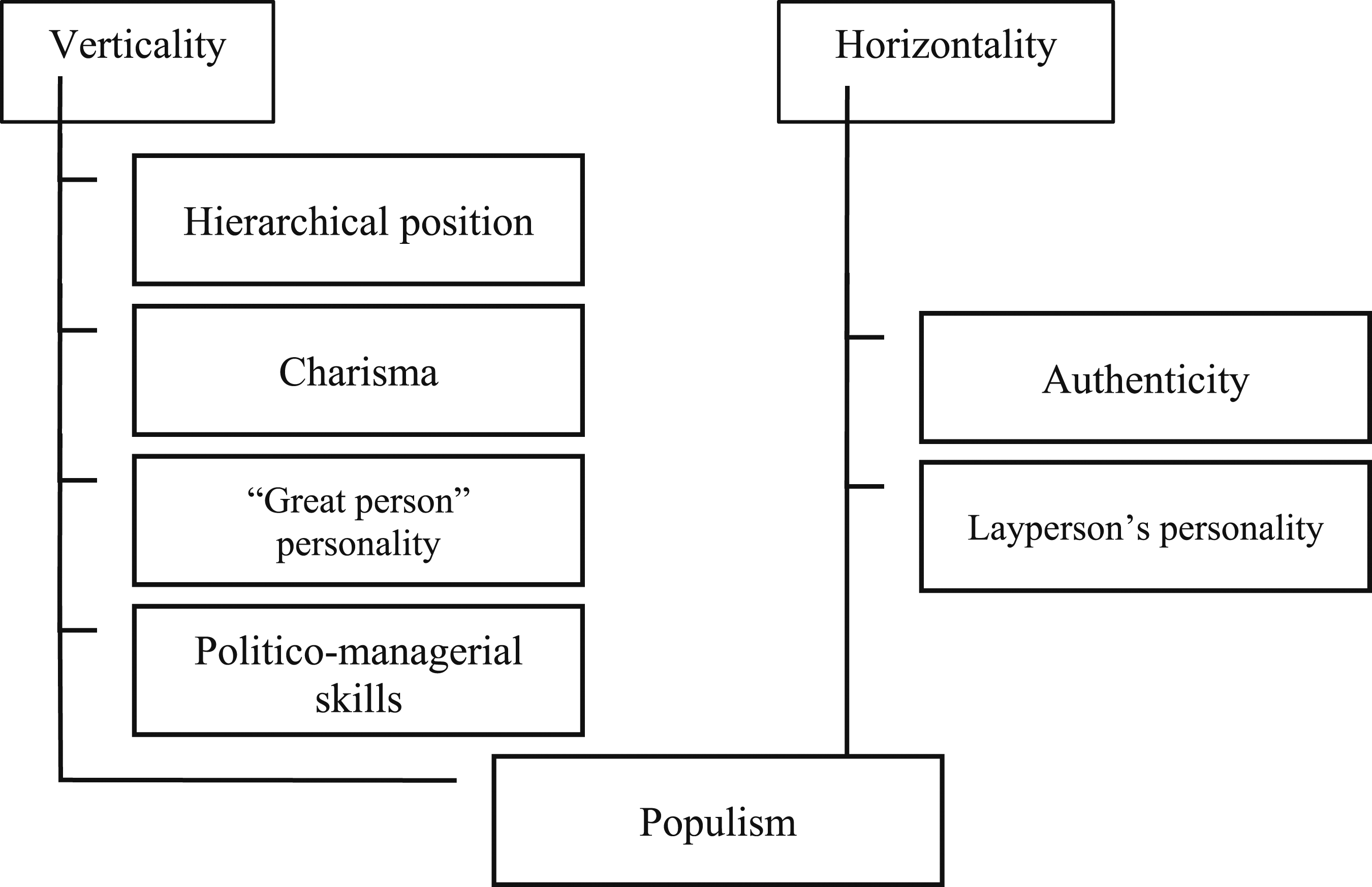
Method and context of the case study analysis
As our research focuses on two Croatian politicians, we first introduce them and the political context in which they function. Croatia became an independent country in 1991 after it declared independence from Yugoslavia. The country became a parliamentary democracy, and later connected more strongly to the USA and Europe, by joining NATO in 2009, and the European Union in 2013. The Croatian War of Independence marked the first years of its independence, and the consequences of this war remain visible in the political and economic life until today (Grbeša and Šalaj, 2019).
Two political parties, the Croatian Democratic Union (HDZ) and the Social Democratic Party (SDP), have been the two main parties since the country gained its independence. Nevertheless, this duopoly has been disrupted in 2015 and 2016 when the anti-establishment parties Most (The Bridge) and Živi zid (The Human Shield) appeared (Henjak, 2018). Those elections are considered a turning point that opened up space for more anti-establishment candidates and populists (Henjak, 2019). Therefore, Croatia does not lack populists nor celebrity politicians, where the latter is mostly connected with the processes of the popularization and the personalization of politics (Grbeša and Šalaj, 2019). We should also mention here that in the EU, the country has one of the lowest levels of trust in the national government (Eurobarometer, 2021).
The first politician we have selected is the current Croatian president Zoran Milanović; the second one is Miro Bulj, the mayor of the city of Sinj and a member of parliament. Our choice for Milanović is motivated by his function as president, but also his status as the most popular politician in Croatia, according to the Crobarometar poll of January, March, and April 2022, (Dnevnik.hr, 2022a, 2022b, 2022c). He was a leader of the SDP and was a prime minister from 2012 to 2016. Despite Milanović’s earlier opposition to populism, after he was elected president in 2021, he has started deploying populist strategies (Prnjak, 2021). Because of his rhetoric, vocabulary and anti-EU discourse, he has even been referred to as the “Croatian Trump” (Klauški, 2022). Milanović then also started to actively use his Facebook account to communicate his views and to attack and criticize political opponents, often by using what Beck (2022) called a vulgar populist rhetoric, replete with metaphors. Even during the campaign period, Milanović’s social media strategy featured personalized messages that highlighted his personality and character, positioning him as an authentic politician (Galić and Bebić, 2021).
The second politician whose followers were selected is Miro Bulj, the mayor of Sinj, a city in the Dalmatian Hinterland region (Dalmatinska Zagora). Bulj started his career in local politics, first as an activist. He has been a member of the Croatian parliament since 2016 when he was elected on the Bridge of Independent Lists, today the right-wing political party Most. Most is described by Grbeša and Šalaj (2017) as a political party that combines anti-establishment and centrist populism. Bulj was famous for being the most active representative in the parliament, and his image is centred around the idea that he is “the man from the people”. He was elected mayor of Sinj in the 2021 local elections. He (and Sinj) were in the Croatian media and public focus during the second COVID wave in the winter of 2021, because Sinj was the only city in the country in which the mayor has decided to not follow the rule to require COVID passes to enter public administration buildings and offices. When it comes to Bulj’s Facebook account, it is worth mentioning that his posts use various formats, combining videos, photographs and text. Still, Bulj regularly writes lengthy texts through which he communicates his thoughts and viewpoints to his followers. He also frequently uses Facebook live streams which contributes to (the perception of) his authenticity, (also) through the logic of immediacy. Bulj’s posts represent him in both political and everyday context, ranging from delivering speeches in parliament to casually interacting with common people.
In our research, we focused on how social media followers of these two politicians represent leadership. For that purpose, we selected Facebook because it was the most popular social media platform in Croatia in 2021, both as a news source and as a social media platform overall (Digital News Report 2021, 2021). Moreover, Milanović and Bulj used Facebook more than any other social media. In order to understand the construction of leadership, we conducted twenty semi-structured interviews with their Facebook followers (10 for each leader). Participants were chosen based on the fact that they commented or reacted to a recent Facebook post of Milanović/Bulj. From those who commented or reacted, every tenth person was then selected. In the case of the followers of Milanović, 56 persons who commented or reacted to his Facebook posts were contacted through a direct message on Facebook Messenger. The first 10 people who then agreed to participate were interviewed. In the case of Bulj, 113 persons were contacted and only seven were willing to participate. For that reason, we turned to the snowball method, asking the participants to reach out to their friends who were also reacting to Bulj’s Facebook post. The three last participants were chosen on the basis of this method.
The interviews were done online through Zoom or Messenger, but with three participants it was possible to interview them in person. Interviews were conducted in the period from the end of January to the end of February, 2022. There were eight female and 12 male interviewees, the language spoken was Croatian, and the interviews lasted between half an hour and 1 hour and a half. The exception was one person who agreed to participate but asked to have a written interview through email, because of his hearing problems. The interviews were structured on two main themes: political leadership in general, and the leadership of Milanović/Bulj. Questions related to the first theme aimed to understand interviewees’ perception of leadership, their opinion on who can be considered a leader, and the qualities they associate with good leadership. The second theme focused on questions about Milanović/Bulj. Participants were asked whether they view these politicians as leaders, and to elaborate on the examples and characteristics of Milanović/Bulj that they believe do or do not qualify them as leaders. The interviewees were between 20 and 50 years old, with one exception of the person older than 60 years. They were from various Croatian cities and regions (but in the case of Bulj seven out of 10 participants were from Sinj). Even when we could assume that they were not necessarily political followers (or party members) of the two politicians, in most cases, as ‘their’ Facebook followers, they had a positive inclination towards these politicians, which makes our selection specific (limiting the generalisability of our analysis). The interviews were later transcribed ad verbatum, and a qualitative content analysis was then performed on the material.
The data was coded in two cycles following the methods described by Saldaña (2013). The first cycle data was coded using in vivo, descriptive, and eclectic codes. The second cycle used descriptive codes, allowing for the creation of the dimensions of horizontality and verticality, and their elements. During the interview analyses, saturation was relatively quickly reached, and no additional interviews were deemed necessary.
The vertical dimension in the leadership construction by the 20 facebook followers of Milanović and Bulj
The leadership construction on the vertical dimension manifests itself through the elements of hierarchical position, charisma, the “great person” personality, and populism. First, the hierarchical position allows Bulj, a mayor, to be referred to as the leader of Sinj. Moreover, because of his position as a representative in the parliament, he is also seen as a leader of the Dalmatinska Zagora (Dalmatian Hinterland) region. President Milanović is, because of his position in the political hierarchy, represented as the leader of Croatia. Nevertheless, interviewees highlight the fact that not everyone in these positions is necessarily a leader, signifying that one element does not suffice. Interviewee M6,
5
for example, argued that “Milanović is only the president, but not the leader”. As interviewee B4 puts it, when talking about Bulj: “He is the leader because he is the mayor of Sinj, and he is a good leader because he is fighting for his citizens”. Also, some interviewees argue that Milanović is a better leader now, as president, than he was when he was a prime minister. Interviewee M2 explains this as follows: “He was not a perfect prime minister, but he is a great president. I think this position is better for him because he can be freer, he is not responsible to others, he is not responsible to the party, he does not have to justify himself to anyone, only to the citizens”.
The second element through which interviewees construct leadership is charisma. One of the ways they refer to charisma is by explaining that leaders should have something special. Interviewees define leaders are those who “have that something” (M6) or “have that leadership” (M1). When asked what “that” is, interviewees do not easily find the words to explain what they mean. Interviewee B2 explained that, for him, charisma is ‘just’ something subjective, something he feels in connection to the other person. Stage presence—as something that can be physically observed—is also represented as part of charisma. For example, when talking about the leadership of Milanović, interviewees talk about his stature, strong posture, his ability to come across, both in the written and spoken language, as someone who knows what he is talking about.
The “great person” personality is the third element of the vertical dimension. Here, the interviewees represent leadership through the idea that the leader has superior qualities, who is fearless, has self-control, courage, integrity, confidence, and is independent and resolute. Interviewee M5 says a leader should have courage and confidence to follow his values and opinions, and not change his mind just to avoid possible problems. Another interviewee, B1, similarly, argues that “a leader should know what he wants”. Almost all interviewees emphasized the fact that a leader has to have a firm stance. This firm stance is also perceived as having a calm, specific, and clear way of communicating. For example, interviewee M1 said that “the leader should never start yelling and talk nervously because it implies losing control, and lack of confidence”. Not unproblematically, some interviewees associate leadership with authoritative leaders: two interviewees mentioned Franjo Tuđman 6 , but also Vladimir Putin and (even) Adolf Hitler were mentioned, connecting the (hyper-) dominant and authoritarian personality to leadership.
The vertical dimension of leadership is also represented through the element of politico-managerial skills. Leaders become represented as leaders when they are, for instance, able to gather a quality team. This implies that interviewees do not expect the leader to know everything, but they believe the leader should know how to surround himself with people who have high qualifications. Interviewee B1 says: “A leader does not have to know everything, but he has to recognize problems, because he has his team to help him, and he is the coordinator”. Skills such as problem-solving, negotiation, networking, and persuasion are all parts of this element. As interviewee M2 puts it: “I think the leader should be constructive. If he notices a problem, he should understand it, and offer a solution, and work to solve that problem”.
The final element of the vertical construction of leadership is populism, in particular, populism’s vertical component. Leadership is represented in reference to the people. For the interviewees, leaders are those who unify “the people” and take a stance against “the elite”. Interviewee B10, for example, said he respects that Milanović “dared to counter the powerful people in Brussels”. Interviewee M3 explains it, in a similar way: “Each of us wants to stand in front of the prime minister and tell him ‘this is not good, and this, and this…’. Milanović is doing it easily, in the way every citizen wishes to do it”.
Milanović thus becomes perceived as the leader who, as a president, has the power to represent “the people” and oppose “powerful elites” in a way citizens cannot easily do themselves. An almost identical argument is made about Bulj who, according to some of his followers, deserves to represent the people because throughout his (political) life, he was not afraid to take an anti-establishment position. Finally, the complexity of populism, and its fluid border with democratic representation also becomes apparent, when followers talk about leaders as those who do not want power for selfish reasons, but instead work for the good of the people. They use phrases like “they stand up for the people” (M2), “work for the people” (B2), and “fight for the people” (B2; B5).
The horizontal dimension in the leadership construction
Leadership is also constructed by the followers through the horizontal relation between leaders and citizens. Here, we distinguish three elements: authenticity, ordinariness and populism. First, authenticity features prominently in how interviewees construct leadership: Leaders are represented as those who are consistent and true to themselves, as interviewee B7 puts it, when talking about Bulj: “He is always the same. He does not act differently in front of media or public, he is the same when the camera is on and when the camera is off”. Also Milanović is perceived, by his followers, to be his true self as interviewees describe him saying “it is just the way he is” (M1). The absence of pretence is equally important here, even when this results in others being offended. This is well explained by interviewee M1 who refers to Milanović’s controversial statements: “Ok, yes, maybe he sometimes offends others, and yes, it may be funny how he does it. I know he should not do that, but we all know it is Milanović, it is his style, so I can turn a blind eye to that”.
Authenticity leads to an increase in trust for some of the interviewees. This is because, as interviewee M2 points out, it soon becomes apparent when a person does not communicate what they truly believe in. As interviewee M4 says: “Milanović is direct, he says what is on his mind, what he is thinking. I believe he was completely honest, for example, when he was explaining that controversial situation he got into during the COVID”.
The second element of the horizontal construction of leadership is ordinariness, or a layperson’s personality. This implies language usage that is considered common to ordinary people, friendly, and less formal. Interviewee M3 describes his perception of Milanović in the following terms: “I perceive him as a person I would enjoy having a beer with. If it was a family lunch, and he was there and say something, I think I would just sit and listen”. Similarly, interviewee B7 describes Bulj as a man who is “pretty simple, communicates with people, is available to everyone, and can find common language with anybody”.
The final element in the horizontal construction of leadership is populism, which, in practice, intersects with the element of the layperson’s personality, as this articulates the leader as a common person who is part of the people. Populism—in its horizontal component—is invoked by interviewees, when they talk about the leader as someone who is one of the people, establishing a relationship of similarity between them. This, for instance, occurs when they say leaders are those who can understand people’s problems because they have experienced the same issues. As interviewee B1 explains this, when talking about Bulj: “He is a man of the people. He went through a lot in his life, with other people, and now he is the leader of the same people as he once was. He is not coming from a rich family, neither his mother nor father was influential. He knows what people need. When 99% of the people in the country are normal, everyday people, and you grew up in the golden cage, and the good opportunities, the position and everything was just given to you, I do not think you can understand what it actually means to live in this country and what people of this country need”.
Balancing between the vertical and horizontal dimensions
The vertical and horizontal dimensions do not construct leadership in isolation from one another, but they become articulated, interacting with each other, and influencing each other. Arguably, the balance between the elements and dimensions is a crucial part of the contemporary construction of leadership. We can also find these interactions between the dimensions of horizontality and verticality in the interview material, in three different ways. First, some of the elements pair, because of their structural similarities. Second, modesty produces a bridge between the ordinary and the extraordinary, and finally, the impossibility of a perfect balance is also acknowledged.
Some of the elements of the horizontal and vertical dimensions have structural similarities, in particular to the charisma/authenticity pair (which share an affective component) and the “great person”/layperson’s personality pair (which both relate to personality). Also in the case of populism, its horizontal and vertical components are intertwined. One example of the charisma/authenticity pair is when Milanović’s character is perceived by followers as to be his true self, linked to his charismatic character (which was also a part of his presidential campaign as his slogan was “President with character”). Similarly
There are also arguments in favour of balance between different elements outside the pairs, for instance when interviewee B4 argues for a balance between decision-making capacities (“being in charge”) and the “great person” personality element (self-sacrifice), in the following terms: “I would compare the good leadership with the wolfs: The one who is the leader of the pack is in charge, but at the same time he sacrifices himself for each individual in his pack”.
Secondly, modesty is a concept that plays a crucial role in mediating between horizontality and verticality. As a concept, modesty has a long history in playing this cultural and political role, which motivates our brief elaboration here. In Ancient Greek philosophy, the notion of the mean was connected with moderation and modesty, and was considered a vital ethical characteristic. To use Aristotle as an example: in Book II of Nicomachean Ethics he positioned morale as a balance between excess and deficiency, for instance, when he wrote that “temperance and courage, then, are destroyed by excess and defect, and preserved by the mean” (Aristotle, 2009: 25). This notion of the Aristotelian mean also played a role in (ancient) Greek politics, as, for instance, Kokaz (2001: 106) argues. Together with other variations of the mean, among others in Confucianist thought (Yu, 2002), this notion has had a pervasive and long-lasting political and cultural impact. 7 Even when Aristotle has been critiqued for not considering modesty as a virtue (see Bommarito, 2018), Aristotle’s work allows us to approach modesty as a contemporary translation of the concept of mean, balancing between the excess of complacency and the defect of passivity.
In the interviews with the Croatian followers, we can find modesty playing a significant role as mediator between the vertical and horizontal dimensions, between the extraordinary and the ordinary. Disruptions of this balance become often represented as ‘bad leadership’. One example relates to self-confidence, when interviewee M3 compared president Milanović with Croatian prime minister Andrej Plenković, saying “Milanović is maybe arrogant, but he is not exaggerating in arrogant communication as much as Plenković does”. M3 added that Plenković seems to think too highly of himself, and as such does not align with the idea of a good leader. Another example relates to the everyday life of politics, where interviewee M1 said “leaders should not necessarily own the best cars”, but that he prefers them using humble ways of transportation, such as bicycles.
Finally, the third way that verticality and horizontality interact—in the interviews—is through the acknowledgement that a perfect balance cannot be reached. The followers of Milanović and Bulj do not perceive them as perfect or ideal leaders, as they are both seen to have their limits. Interviewee M10 emphasizes that “no one is perfect”, and interviewee B2 and B3 critique Bulj for lacking communicative and diplomatic skills so interviewee B2 sees him as a great mayor and regional representative, but argues that his limits will prevent him from becoming a national leader: “He is the real person. He drinks coffee every day in the same coffee bar and talks with everybody. He buys coffee for others, he unites people. When you see him, you would say he is just some random dude… He does not dress up, he is not a gentleman, he is totally ordinary person, and he does not act like a bourgeois. I like that, but it would be maybe better if he was on a bit higher culture level… I mean, he is ok, even great, but if he was on a higher level of political culture maybe he would have a better chance on the national level…”.
Conclusion
The social-construction-of-leadership approach allows us to unpack how, in a series of interviews, individual Facebook followers of Croatian politicians Milanović and Bulj represent the notion of leadership, and in particular, how these representations contain references to what we recognize as the vertical and horizontal dimensions of leadership. Our analysis is thus an attempt to both theoretically and empirically grasp the consequences of the politics of late modernity, characterized by what Turner (2010) called the demotic turn, the increased entanglement of media and political logics, with its mixture of the mediatization of politics (Mazzoleni and Schulz, 1999; Couldry and Hepp, 2013), celebrity politics (Van Zoonen, 2005; Wood et al., 2016), and rising populism (Moffitt, 2016; Fieschi, 2019). This contemporary condition provides the stage for an analysis of the social construction of leadership, with its balance between the verticality and horizontality of leadership, integrating the existing knowledge about leadership and enriching it by a structuring narrative (grounded in both theoretical reflection and empirical research). Simultaneously, we want to remain focussed on leadership itself, and demonstrate how the leadership construction integrates these semi-novel contexts of celebrity politics and populism, and how, at the same time, still many of the more traditional elements of this leadership construction also remain present. As the nature of our qualitative-research methodology does not allow for generalization, the model we present here invites for further research in other cases and contexts, and for more elaborate theorizations.
Even though our approach certainly has its limits, as we do not want to disentangle the roles of celebrity politics, the mediatization of politics or populism, 8 but focus on the contemporary construction of leadership within this particular context, our analysis offers a conceptualization of contemporary political leadership, which is grounded in the presence of both the dimensions of verticality and horizontality in the signifying practices of the 20 interviewees (without wanting to claim that the horizontal leadership dimension is entirely new). Moreover, our analysis also shows the richness of both dimensions, as the interviewees explain, with considerable detail, how both dimensions remain important in ‘their’ perspectives on leadership.
While we show that the horizontal dimension of leadership is important, the vertical dimension remains equally present and relevant, showing that extraordinariness still deeply matters in the construction of leadership. A similar argument can be raised about the role of populism, which is also very present in the interviewees signifying practices on leadership, with both its components.
Finally, our analysis also shows that all the elements, that came out through the iteration between theory and analysis, define political leadership together. No element is dominating this construction of leadership. In other words, leaders are not defined by followers exclusively through their charisma, authenticity, superiority or ordinariness, but all these elements become activated together, negotiated in different ways by different people. Moreover, our analysis shows how the exact nature of the balance between the verticality and horizontality of the leadership construction is also negotiated, being mediated through the notion of modesty. The different elements of the verticality and horizontality intersect with each other, but they are still very different, and even paradoxical; for example, a leader is constructed as someone who is, at the same time, a “great person” and a “layperson”. The co-occurrence of both ideas, which we find in the empirical material, necessitates moments of reconciliation, to avoid contradictions. It is the notion of modesty that allows for these moments, also resulting in deviations from this modesty-norm to be sanctioned with the label of ‘bad leadership’. In addition, the interviewees communicate that the long list of requirements and the perfect balance between verticality and horizontality is a utopian quest, or, a phantasy—in the Lacanian sense (Lacan, 1979)—which acts as a driving force to search for leaders that strike the balance between verticality and horizontality in the best possible way. In short, leadership is paradoxical but not contradictory, as it is an always imperfect reconciliation of the horizontal and vertical dimensions.
This acknowledgement of the imperfection of leaders, and the desire for properly balancing verticality and horizontality gives—one could comment from a democratic perspective—reasons for hope for the further protection (and even deepening) of democracy. This argument is particularly important given Croatia’s history of authoritarian regimes and the country’s still recent transition to democracy in the 1990s. Elements associated with authoritarian leadership do not dominate the current construction of leadership. This is likely due to the lengthy process of political and system changes, as well as the contemporary conditions that have fostered an understanding of leaders as complex individuals who struggle to find a balance between vertical and horizontal relations with ‘their’ citizens.
Footnotes
Declaration of conflicting interests
The author(s) declared no potential conflicts of interest with respect to the research, authorship, and/or publication of this article.
Funding
The author(s) disclosed receipt of the following financial support for the research, authorship, and/or publication of this article: This research was supported by the Joint Writing Seminar at the Institute of Communication Studies and Journalism, Faculty of Social Sciences, Charles University in Prague.
