




Abstract
Whilst Day's (2000) description of leadership development as an investment in social capital has been widely cited, there has been little subsequent empirical or theoretical work to explore and articulate the nature and purpose of this ‘social capital’ or how it changes over time. This paper revisits this issue by presenting findings from a qualitative in-depth longitudinal evaluation of a corporate leadership development programme. The study explored the multi-faceted and shifting nature of social capital during and after the programme, with particular attention given to how different aspects of social capital were perceived and engaged with by key stakeholders over time. Findings reveal differing perspectives on the nature and purpose of social capital and illustrate the impact of changing organizational contexts on programme aims and outcomes and how these are evaluated. The paper concludes by outlining implications for the evaluation of leadership development, advocating the value of a pluralistic approach that incorporates criticality alongside the logics of accountability, development and knowledge that characterise most current approaches to evaluation Kennedy, Carroll and Francoeur (2013).
Introduction
It has been over two decades since Day (2000) first distinguished between ‘leader development’ and ‘leadership development’, suggesting that most interventions remain focussed on developing individual rather than collective leadership capacity. Within this highly influential paper (with over 1000 citations on Science Direct and nearly 4000 on Google Scholar) Day characterises leader development as an investment in ‘human capital’ and leadership development as an investment in ‘social capital’. Whilst both are important, he suggests most interventions give insufficient attention to ‘building networked relationships among individuals that enhance cooperation and resource exchange in creating organizational value’ (ibid, 85).
The past two decades have seen significant growth in theory and research on leadership development, many of which refer to this distinction. A recent special issue of Leadership Quarterly, for example, brings together a series of articles that showcase ‘state-of-the-science research, theory, and practice’ on 21st Century Leadership Development (Day et al., 2021: 2). Papers are categorised into those that focus on methodological issues, those that explore individual leader development, those that bridge leader-leadership development, and those focus on leadership development – ‘defined as enhancing the capacity of a collective (such as a team or organization) to engage in leadership’ (ibid: 3). Concluding the editorial to the special issue, Day et al., (2021) identify six key priorities for further work: ‘(a) theoretical foundations of leadership development, (b) practices and methods of development and talent selection for development, (c) the role of time in developing leaders and leadership, (d) accurately estimating return on investment for leadership development initiatives, (e) understanding and remedying biases and inequities in leadership development, and (f) the role of development in dealing with the dark side of leadership.’ (ibid: 7)
Whilst these are undoubtedly important areas for attention the emphasis on a ‘scientific’ approach, which seeks to identify ‘cause-and-effect relationships’ (ibid: 2), plays down the contested and political nature of leadership and leadership development in organizations (Smolović Jones et al., 2015). Indeed, a relative neglect of alternative and competing expectations, experiences and agendas of/for leadership development characterises much extant literature on leadership development. By taking a functionalist perspective (Mabey, 2013) on leader/leadership development, however, not only does such work perpetuate existing power inequalities but also limits the capacity to provide genuine insights in what does/n’t work, where, when, why and for whom.
The aim of this paper, therefore, is to provide a nuanced analysis of the shifting configurations of social capital within a corporate leadership development programme and how this is perceived by different stakeholders over time. Attention is given to the interplay between leadership development and organizational change and the potential for contextual factors (beyond the scope of the leadership development programme itself) to have a direct and tangible impact on programme outcomes. Such issues have important implications for the evaluation of leadership development interventions by highlighting (a) the complex and contested nature of social capital in organizations; (b) the impact of such perspectives on the perceived ‘value’ of leadership development interventions; and (c) the inter-relationship between leadership development and organizational change and the potential for unintended, negative outcomes to arise.
The paper begins with a brief review of literature on leadership development and social capital, before outlining the research context and method; findings and analysis. The paper concludes with a discussion and conclusion that considers the implications for theory and practice.
Literature review
Leadership development and evaluation
Leadership development is big business, with an estimated $14 billion p.a. spent in the U.S alone (Derler, 2016). Investment in leadership development is driven by a number of factors, including a desire to improve individual and organizational performance (Avolio et al., 2010), the need to respond to increased competition and complexity (Iordanoglou, 2018; Uhl-Bien and Arena, 2017) and the changing demands of work and ‘managing’ (Hirsh and Carter, 2002). Despite the interest, however, there is still a dearth of robust longitudinal studies which explore the processes and outcomes of leadership development in context (Gagnon and Collinson, 2014; Iles and Preece, 2006) and over time (Day and Dragoni, 2015; Joseph-Richard et al., 2021) and many investments remain an act of faith (Berkovich, 2014; Mabey and Ramirez, 2005).
Within both academic and practitioner literature there is a lack of critically orientated research around the evaluation of leadership development programmes (Hannum and Craig, 2010; Newstead et al., 2020). Extant evaluation literature shows a tendency to adopt well-established frameworks, such as Kirkpatrick’s (1994) four levels of evaluation which, despite its popularity, has a number of well-recognised limitations such as the difficulty in measuring learning transfer (Anderson, 2010), establishing programme impacts at the organizational level (McLean and Moss, 2003), and its poor suitability for evaluating programmes with systemic and/or emergent outcomes (Jarvis et al., 2013; Kennedy et al., 2013). Overall, the evaluation literature tends to promote functional or mechanistic approaches, such as Return on Investment (ROI), which frame outcomes in narrow terms and against largely pre-determined measures of organizational performance (Avolio et al., 2010, Mabey and Finch-Lees, 2008).
With regards to questions of ‘value’, however, it is vitally important to consider value for whom, against what criteria and for what purpose. Kennedy et al. (2013) set out three logics of evaluation and the underlying assumptions within each. An accountability logic responds to the call to demonstrate the value of a programme in terms of measurable outcomes. A development logic represents a shift from ‘attribution to contribution’ (ibid: 17), whereby the evaluator is seen as a ‘partner’ who actively contributes to the development process. The ‘evaluation for knowledge’ logic sees evaluation as a series of ongoing ‘conversations’ with participants about the relationship between the programme and their leadership practice. Each logic reveals differing perspectives on the purpose of leadership development evaluation, identifying it respectively in terms of understanding cause and effects, as a means of improving the development process, and as a developmental dialogue amongst all stakeholders.
The functionalist approach within mainstream evaluations of leadership development emphasises an accountability logic and is associated with a tendency to neglect unintended or undesirable outcomes. Arnulf et al. (2016: 4), however, demonstrate that leadership programmes may well produce negative outcomes, such as ‘(a) directly reducing the person’s capacity to perform leadership roles or (b) indirectly reducing organizational performance by wasting resources and undermining the belief in developmental efforts’. They identify a number of factors that may contribute to this, including ineffective interventions that lead to participant frustration and negative effects that impact on participants’ work capability and well-being. Larsson et al. (2020) report findings from an in-depth evaluation of a leadership development programme that reveals a paradox between programme outcomes, whereby the space they provide for participants to share their frustrations both develops their own sense of agency whilst simultaneously creating a sense of disengagement from their employing organization.
Recent analyses suggest that many evaluation models do not fit well with contemporary theories of leadership that stress the relational, discursive, shared and systemic nature of leadership practice (Mabey, 2013; Raelin, 2018; Uhl-Bien and Arena, 2017). Whilst many evaluative studies are individually centred and economically focussed, there is a need to better understand qualitative impacts at an inter-personal and systemic level. Linked to this are calls for evaluative studies that explore the complex relationship between leadership development and social capital (Van De Valk, 2008), particularly those that consider both context and time (Galli and Müller-Stewens, 2012).
Leadership development as an investment in social capital
Day (2000) distinguishes between leader and leadership development. The former is based on traditional conceptions of leadership as an individual level skill that resides with a ‘leader’, with a strong separation between ‘leader’ and ‘follower’. Leader development is therefore viewed as the development of human capital, focusing primarily on intrapersonal skills and abilities. Leadership development on the other hand corresponds to more recent definitions of leadership as a social influence process (Uhl-Bien, 2006) and is defined by Day as the development of social capital.
Day’s (2000) characterisation of leadership development draws on Nahapiet and Ghoshal’s (1998) typology of social capital, which identifies three dimensions: structural, relational and cognitive. The structural dimension refers to ‘the overall patterns of connections between actors’ (ibid: 244), with a particular emphasis on the importance of network ties. The relational dimension focuses on ‘assets’ (such as trust, obligations and expectations, and identity and identification) that are developed through relationships. Finally, the cognitive dimension focuses on shared patterns of behaviour and ways of seeing and interpreting the world, including the development and use of shared language, codes, and narratives.
There is an extensive body of theory and research on social capital in other contexts but its application to leadership development rarely extends beyond the approach set out by Day (2000). Tzanakis (2013: 2), however, suggests that ‘social capital means different things to different social scientists, particularly if it is elevated from the individual to the aggregate level to characterize communities, regions or states’.
Contrasting the approaches of three key theorists - Coleman, Putnam and Bourdieu - Tzanakis (2013) highlights important differences in the theoretical traditions underpinning their conceptualisation and operationalisation of social capital. Drawing on a functionalist view of social action as well as rational theory, for example, Coleman (1988) suggests that social capital resides in the structure of relations between different actors, including ‘obligations, expectations and trust’, ‘informational channels’ and ‘norms and effective sanctions’. For Coleman social capital is ‘productive’ in that it enables the achievement of certain goals that would not be possible without it. Putnam’s (1993) work draws heavily on Coleman’s ideas to explore how social capital can help build social and community cohesion. He described social capital as ‘the features of social organization such as networks, norms and social trust that facilitate coordination and cooperation for mutual benefit’ (Putnam, 1993: 35).
A central theme of both Coleman and Putnam’s work is the importance of trust in the development of social capital. Within an organizational context interpersonal trust is an ‘interactive process in which individuals learn or unlearn to establish and maintain trustworthiness, under given organizational (contextual and structural) settings, and subject to policies directly or indirectly, positively or negatively sanctioning the building of interpersonal trust’ (Six and Sorge, 2008: 859). In order to develop and sustain trust it is suggested that ‘trustors’ must be convinced that ‘trustees’ (a) have the ability to behave as expected and (b) have an intention to sustain the relationship in the future (ibid) – thereby highlighting the importance of ‘trustworthiness’ as a basis for enduring social capital.
These perspectives present social capital as something relatively stable that can be deployed by members of a social group to achieve their aims. This mirrors common conceptualisations within leadership and management literature, such as Adler and Kwon’s (2002: 23) definition of social capital as ‘the goodwill available to individuals or groups. Its sources lie in the structure and content of the actor’s social relations’. The suggestion, therefore, is that social capital is underpinned by trust (Prusak and Cohen, 2001), shared values (Fukuyama, 2002) and mutual understanding (Prusak and Cohen, 2001) and forms the basis for effective collaboration and partnership working.
In contrast Bourdieu (1977, 1986), informed by his work on relational sociology, takes a more critical approach. He suggests that rather than having a tangible essence, social capital is one of a number of forms of capital (alongside cultural and economic capital) which are manifestations of ‘symbolic capital’ through which power and influence is exerted within social groups. According to Siisiainen (2003), Bourdieu sees society as ‘plurality of social fields’ in which people and groups draw upon a variety of resources (including social capital) to enhance their relative ‘positioning’ in the ‘field’. Emirbayer and Johnson (2008: 3) note, ‘as Bourdieu puts it, capital does not exist and function except in relation to a field’. For Bourdieu, therefore, social capital is part of a continuous cycle of creation and destruction - characterised by competition rather than collaboration - and cannot be meaningfully considered outside the context in which it operates.
Despite the prevalence of unequal power dynamics within leadership development, active engagement with the dynamic, critical perspective of Bourdieu’s conceptualisation of social capital is rare, with authors tending to opt for the more functionalist and rational perspectives of Coleman, Putnam and others. Exceptions include Tomlinson et al. (2013) who take a Bourdieusian approach to argue that formal leadership development interventions can act as a form of ‘symbolic violence’ and ‘domination’, which lures participants in by creating opportunities to develop cultural and social capital to further negotiate their place in the ‘field’; suggesting that participants ‘misrecognise’ these initiatives as enhancing their own agency, whilst organizations use them as a means of control. In addition, Stead et al. (2021) take a Bourdieusian approach to highlight how political leaders use different forms of social capital in the quest for ‘leadership legitimacy’. In doing so they illustrate how social capital is multidimensional and strategically deployed.
Evaluating the impact of leadership development on social capital
As outlined above, since Day’s (2000) article there has been a significant trend towards academics and practitioners considering leadership development as an investment in social capital. There have also been increased calls for more robust analyses of the impact of leadership development. Despite this, as DeRue and Myers (2013: 836) suggest ‘few scholars consider the purpose of leadership development or how leadership development is aligned (or not aligned) with organizational strategy’. This is surprising given the scale of the leadership development industry and continued belief in the importance of ‘good’ leadership within organizations.
In terms of the value attributed to social capital formed through leadership development many authors draw attention to the importance of developing network ties that facilitate ‘bridging’ and ‘bonding’ between and within social groups (Adler and Kwon, 2002; Kwon and Adler, 2014; Van De Valk, 2008). Iles and Preece (2006) also highlight the role that leadership development plays in ‘brokering’ relationships that support cooperation and resource exchange.
McCallum and O’Connell (2009) highlight some of the ways in which social capital can be embedded and encouraged within leadership development interventions, paying particular attention to the role of shared stories and trust. They suggest that in order for organizations to fully maximise their leadership capabilities there needs to be ‘active nurturing of social capital elements such as building relationships, fostering trust, goodwill and reciprocity’ (ibid: 164) Galli and Müller-Stewens (2012) explore the relationship between leadership development and social capital from a strategic management perspective, distinguishing practices that facilitate assimilation, identification and/or self-reflection experiences. Through their work they confirm that most leadership development research is ‘leader-centric’, with insufficient attention given to organizational and social context.
Willem and Scarbrough (2006) draw a distinction between ‘instrumental’ and ‘consummatory’ perspectives on social capital. An instrumental approach focuses on benefits resulting from networks and relationships created between people in organizations for knowledge sharing purposes. In this view, relationships are developed in order to achieve particular outcomes of direct benefit to the individual and/or organization. A consummatory approach sees the development of networks and relationships as a means of creating a sense of belonging, shared identity and/or purpose. Such relationships may have no direct benefits other than a stronger sense of friendship, commitment and/or shared purpose amongst people.
There are only a small number of studies that attempt to illustrate the fluid, dynamic and socially constructed nature of social capital in leadership and leadership development. Leitch et al. (2013), for example, explore the role of human, social and institutional capital on the development of entrepreneurial leadership, suggesting that the leadership development process depends on social capital at two levels: participant to participant relationships developed during the programme and ‘bridging social capital’ enabled by the programme director’s connections to other cohorts and programmes.
From the literature reviewed in this section it becomes possible to identify a number of competing perspectives on social capital in the context of leadership development programmes, as outlined in Figure 1. The first dimension - ‘nature of social capital’ - reveals the tension between representations of social capital as a relatively stable, fixed entity or dyamic and socially constructed. The other dimension - ‘purpose of social capital’ - focuses on the tension between ‘instrumental’ and ‘consummatory’ (Willem and Scarbrough, 2006) interpretations of social capital. Perspectives on the nature and purpose of social capital in leadership development.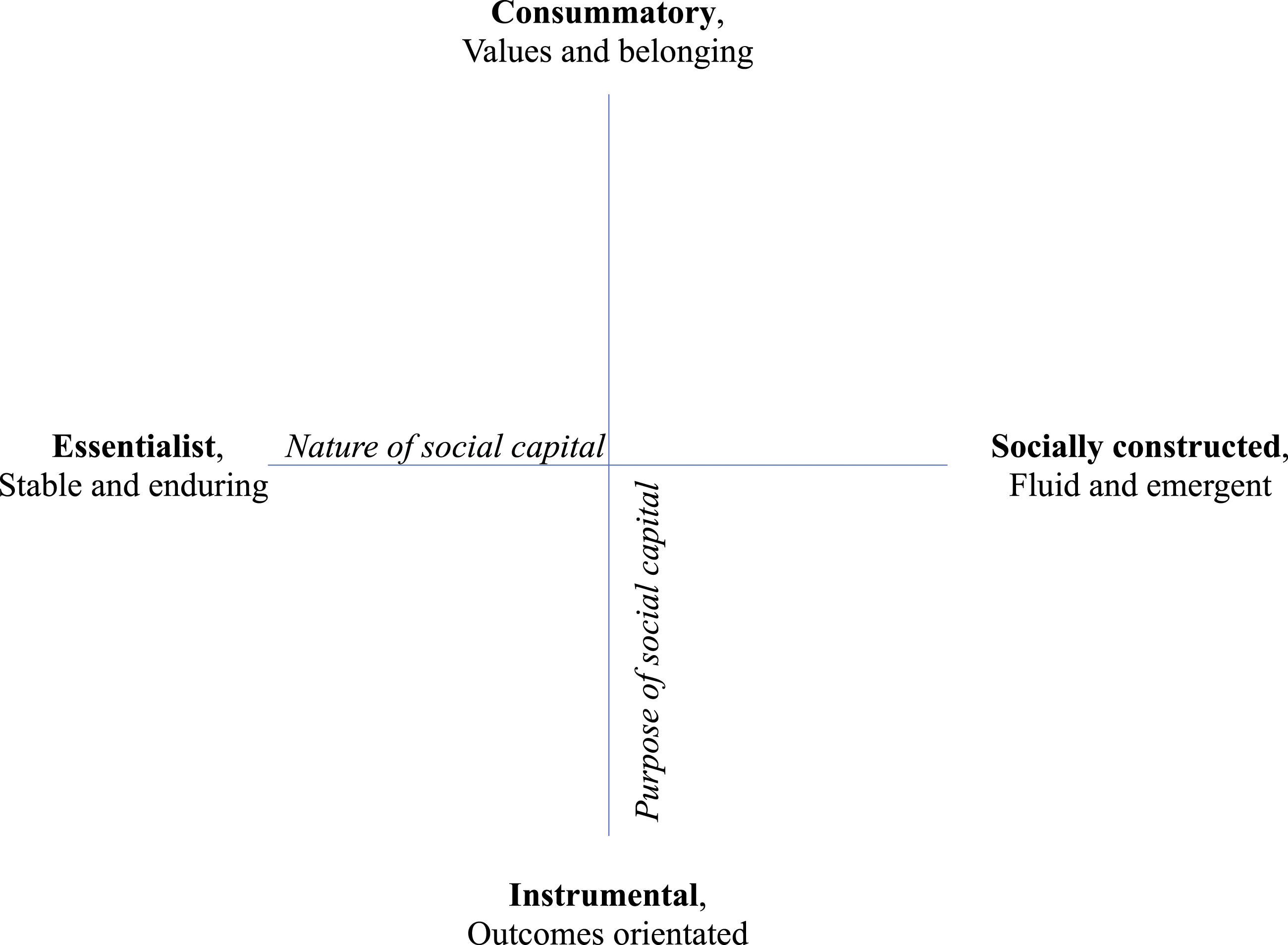
In highlighting these two axes, it can be seen that different stakeholders may take different perspectives at different times. Not all forms of social capital are perceived to carry equal status and all are subject to change over time and in response to shifting contextual and relational factors. Monitoring and tracking the various understandings of social capital might therefore help those who design, deliver and evaluate leadership development to assess the relative impact and contribution of programmes and interventions in relation to their espoused aims and to develop approaches to embedding and sustaining progress. Given these competing perspectives, it is not enough to simply say that ‘social capital’ has been developed during the course of a leadership development programme without exploring which aspects of social capital are being developed, for what purpose and as perceived by whom.
Research context and methodology
In this paper we take a multi-stakeholder perspective to explore the ways in which social capital is experienced and enacted during a corporate leadership development programme, with particular attention to the impact of organizational context and the implications for evaluating impact. We begin this section by outlining the research context, before describing the methodology and data analysis approach.
Research context
The empirical evidence for this paper comes from a long-term evaluation of a corporate leadership development programme (LDP) delivered to 26 senior executives and middle managers working for the Northern European part of TELCORP, a large multi-national telecommunications organization (note: pseudonyms have been used to protect anonymity). TELCORP formed as the result of a merger between two organizations of different national origin 4 years earlier. Two years later, a new CEO was appointed who aimed to address the ‘silo’ culture and to drive the organization and its members to be more competitive as it had struggled to be financially successful. The LDP was designed as a pilot programme and was the first of its kind since the merger.
The programme was commissioned by TELCORP’s corporate university and delivered by a group of four external consultants over a 6-month period. It comprised a 1-day introductory event, four 2-day modules and a 1-day review session. At the start of the LDP, sessions took place off site but due to cost constraints were moved onsite later on. A number of different pedagogical techniques were included, such as classroom learning, small group work, psychometric tests and experiential elements such as drumming, playing hockey and vocal coaching. The sessions also included talks on different aspects of leadership by internal and external guest speakers. The four modules were centred on the themes of ‘leading talent’, ‘leading change’, ‘leading strategic customer solutions’ and ‘leading teams’. Time was set aside at the end of each module for facilitated peer group coaching sessions where participants could discuss challenges they were facing. The main aims of LDP were to enhance collaboration amongst employees in different departments/divisions and to develop individual and collective leadership capacity.
The participants were mainly from sales or research and development roles, with a minority from finance and accounting. There was little diversity amongst the cohort, with only three of the 26 participants being female and all but one, White European. The organization was heavily engineering focussed, with a large number of employees who had progressed to leadership and management positions from technical roles, with very little exposure to formal leadership developmental experiences along the way.
Despite the LDP being positioned as a way of bringing people in similar roles from disparate parts of the organization together, there were several large-scale changes that occurred during and beyond the programme that undermined this aim. The day before Module 2 started, for example, a round of restructuring was announced that would divide the UK and Ireland division from the Nordics division. Within 6 months of the LDP ending, more restructuring was announced that led to a number of participants losing their jobs. Three months later more programme participants were made redundant and others were required to move into different parts of the organization. One division of TELECORP was sold off which directly affected two of the LDP participants as they would no longer be working for the organization.
This research was part of a PhD project completed by the lead author, with supervision from the co-authors. The project was framed as an evaluation – seeking to explore the impact of the LDP on individual participants as well as the organization more widely – but, as with much doctoral research a broader conceptual framing was taken to enable an inductive, critical analysis of the principles and assumptions on which the programme was based, and the organizational and societal context in which it played out. The need for independence was explained to the HR lead, consultants, line managers and participants and, despite occasional requests to demonstrate the return on investment, a critical stance was sustained. Interviews and discussions with individual participants were kept confidential, no remuneration was provided, and there was no conflict of interest between the research team and other parties.
Methodology
The methodology consisted of observation, semi-structured interviews and documentary analysis. Observation enabled consideration of the ‘taken for granted’ and sensitivity to context, whilst qualitative interviews enabled insights into the perceptions and understandings of different stakeholders.
The lead author acted as both an active and passive participant (Spradley, 2016), depending on the nature of the particular activity – with active participation in the experiential learning components at the beginning of each module and a more passive role in other activities such as group work, classroom learning and peer group coaching in order to observe and record behaviour. Observations were not restricted to formal gatherings, and included informal discussions held at lunchtimes, breaks and evenings. Participants were aware of the role of the researcher and gave consent for conversations to inform the research, as long as this was done anonymously.
In total, 95 pages of field notes were recorded, which served to both provide context for the LDP and to complement interview data by providing detail on aspects such as which relationships seemed to be developing during the LDP (e.g. who chose to sit and work with whom), how context, particularly organizational change was discussed, the involvement of senior managers during the course of the LDP and power dynamics during modules. Engaging in this participant observation process facilitated the development of trusting relationships between the interviewer and research participants (Waddington 2004).
Documentary analysis involved examining materials related to the LDP such as module presentations, session plans, suggested reading, briefing documents and the initial tender submitted by the consulting team. The documents also included information on TELCORP such as aim and objectives, core competencies, the ‘leadership profile’ they were encouraging and their leadership team. Information on organizational change was reinforced by looking at media reports during and after the LDP.
Interviews were carried out at three points during the study: after the first module (T1), at the end of the programme (T2) and seven to 9 months after its completion (T3). The interview sample consisted of four distinct groups of individuals (participants, line managers, consultants and the HR lead), from which a total of 58 interviews were undertaken over a 13-month period, as summarised in Figure 2. Overview of research methodology, programme delivery and timings.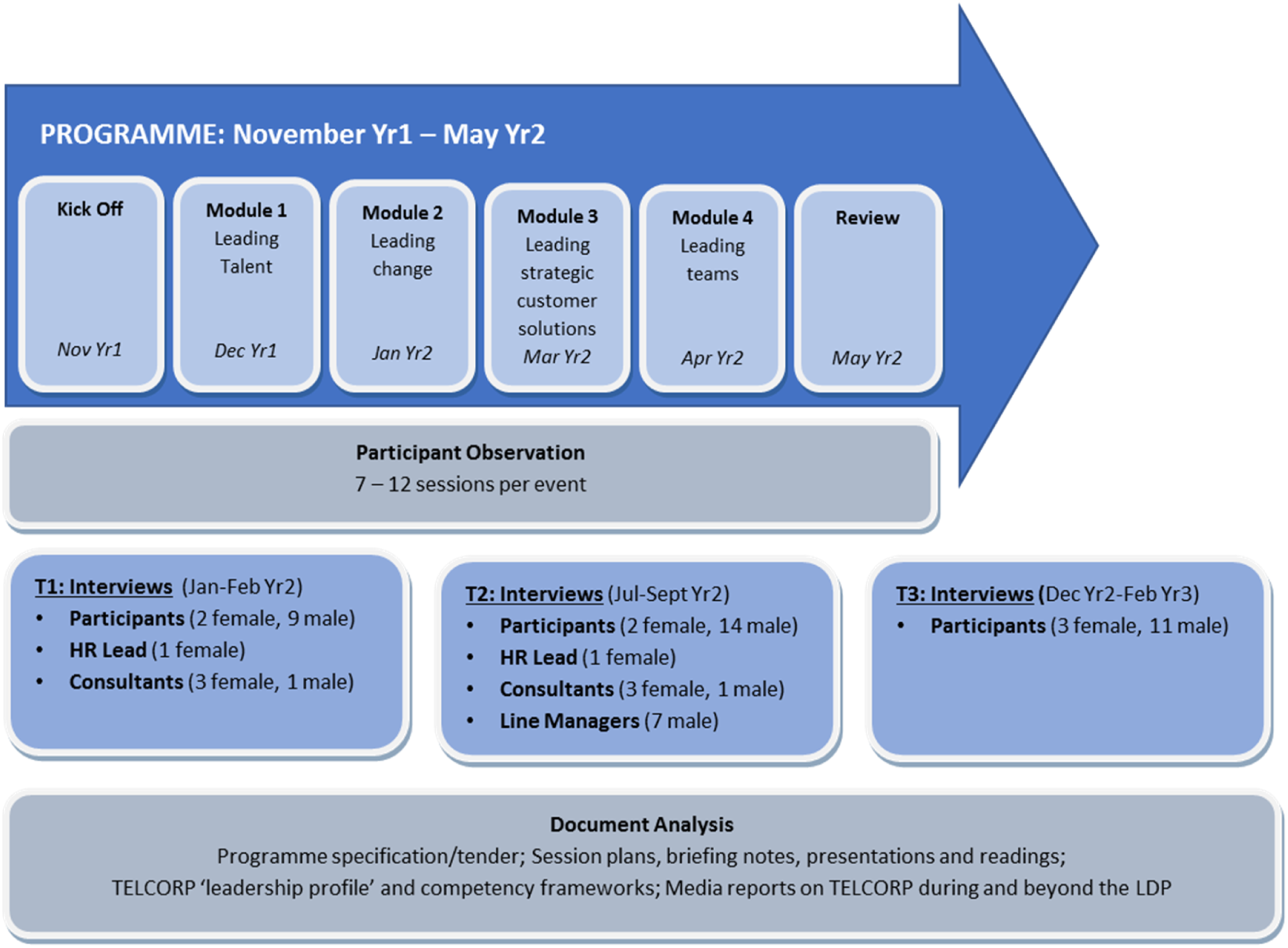
Interviewees were selected using a purposive sampling strategy (Maykut and Morehouse 1994), with a sample of participants interviewed at all three stages of data collection. Initially in the first phase of interviews, a representative sample of 11 participants was selected, in order to obtain a range of viewpoints taking into account factors such as department, gender, location and nationality. Once the programme had ended, all 26 participants were invited for a second round of interviews. A total of 16 participants agreed to be interviewed at this stage, of whom eight had been interviewed previously. For the final set of interviews, which took place seven to 9 months after the programme ended, all participants who had been interviewed previously were contacted, of whom 14 agreed to be interviewed for a final time. Across the three time periods, all three women on the programme were interviewed. The prevalence of organizational restructuring at TELCORP and the associated redundancies made it challenging to follow the same group of participants through every stage of interviewing, however eight participants were interviewed at all three time periods.
All four members of the consulting team (one male and three female) delivering the programme were interviewed at the start and the end of the programme. These interviews provided an understanding of how the consultants viewed the programme, the participants and the organization.
In order to capture a range of perspectives across multiple levels on both the impact of the LDP and contextual factors, a sample of the participants’ line managers were also interviewed once the programme had ended. All fourteen line-managers were contacted, of whom seven agreed to be interviewed. All line managers interviewed were male, which reflected wider gender patterns within the organization. The HR lead was interviewed at the start and at the end of the programme. She acted as a gatekeeper between the research team and the organization and was responsible for the implementation of the LDP.
Data analysis
Interviews were analysed using the four phases of thematic analysis as set out by Braun and Clarke (2006). The first stage is ‘familiarising yourself with the data’, whereby all 58 interviews were transcribed by the lead researcher before commencing with the analysis. The second stage was ‘generating initial codes’, whereby participant interviews were systematically coded. Taking an inductive approach, codes were ‘data driven’, rather than ‘theory driven’. The next stage involved ‘searching for themes’ - conducted manually with themes placed into tables and relevant codes and extracts displayed alongside them. In the fourth stage, ‘reviewing themes’, the themes were verified and refined.
As this was a longitudinal data set, once themes had been identified the data was sorted by theme and by time period in order to understand how the themes developed over time. In addition to carrying out this process at a general level and within stakeholder groups (participants, line managers, consultants and the HR lead), it was also done for each participant in order to track individual trajectories over time.
In refining and deepening the analysis around the development of social capital, a second round of coding and analysis was completed using Nahapiet and Ghoshal’s (1998) distinction between structural, relational and cognitive dimensions of social capital as an integrating framework into which other key concepts, such as bridging and bonding, trust and the perceived value of social relations (instrumental and consummatory), could be integrated. The aim was to develop a contextualised appreciation of the ‘social’ dynamics of the LDP and to explore how different stakeholders exerted power and influence over the evaluation and deployment of different aspects of social capital.
Findings
This section sets out key findings arising from the thematic analysis of interviews, complemented by a review of observation and field notes. In order to reveal insights about the development of social capital, particular attention is given to the second round of analysis and the differing perspectives of key stakeholders.
Structural aspects of social capital
The HR lead indicated that the LDP had been commissioned following a staff survey that reported dissatisfaction with leadership across the organization. Whilst TELCORP already ran a suite of programmes for ‘high potential’ managers (defined as the ‘top 3% of talent’ in the organization), the LDP was, in her words, for ‘the rest of them’. A significant aim of the programme was to help build a ‘one company’ culture and to strengthen the quality, consistency and alignment of leadership across the many business units, specialist functions and geographic regions that comprised the wider organization. It further aimed to develop a cohort of mid-level leaders who could help mobilise change across the organization. Programme design and recruitment aimed to enhance both intra and inter-group relations. Surely pooled together that collaborative effort will you know if they can share how they got over these things then that would help others really. I think you know what we’re trying to do ultimately is to increase shareholder value and you know regain market share and enhance market capitalisation. (Stacey, HR Lead, T1)
In T1 interviews (following Module 1), participants reported appreciating the opportunity to network with peers from other business units. Following restructuring, however, the perceived value of these relationships declined, particularly where individuals performed different roles to themselves. One of the most significant changes was announced the day before Module 2 and involved a separation of the Nordic division from the UK and Ireland. The field notes taken from observations on the day of the announcement indicated that this change was unexpected and very unsettling for those concerned. Employees were visibly upset. This undermined the aim of the programme and had a direct impact on the perceived value of the relationships that were being developed, as illustrated by the following comment from one of the participants in the T2 interviews. Until that point [we were] part of the same organization and [then] were kind of broken apart into different organizations. (Sara, T2)
Both interview data and field notes demonstrated that participants tended to socialize and work in groups with members of their own business unit or those facing similar circumstances, such as working in a small subsidiary. Whilst intra-group (bonding) relationships appeared to endure into T2 and T3, inter-group (bridging) relationships often dissipated over time. But to be honest a lot of these people day to day I have no day to day contact with virtually anybody who was on the course […] We really don’t have a lot in common on an organizational basis. (George, T2)
Interviews with line managers in T2 highlighted several perceived purposes for the programme, including developing networks, improving individual performance, demonstrating an investment and rewarding employees and driving change. I think it’s a conscious start to try and equip some of our more capable people to take us on that transformation. (Adam, line manager, T2)
Whilst line managers saw the benefit of intra-group networking, some questions were raised about the value of developing inter-group relationships. My guy Steve, you know how often does he need to interface with the people from [sub-division] in his professional world? Not very often – if never. (Sam, line manager, T2)
The programme offered very little opportunity for participants to strengthen relationships with their line managers or TELCORP senior management. By T2 and T3 the majority of participants questioned the value that the organization placed on the LDP because of the lack of recognition and engagement that they had experienced – something illustrated through the fieldnotes where, despite all line managers being invited to the celebration event at the end of the LDP, only a small minority attended. The consultants also expressed concerns over the lack of senior management engagement, despite repeated attempts to involve them.
Relational aspects of social capital
Despite the HR lead suggesting that the programme aimed to enhance collaboration, there seemed to be a lack of consensus on its aims between the different stakeholders, including the different participants, line managers and consultants. This arguably had a knock-on effect in terms of the recruitment and engagement of participants. Whilst both the consultants and HR lead expected participants to have a moderate level of prior leadership development experience, the nomination and selection of participants was at the discretion of individual line-managers. The inconsistent approach to recruitment and selection and how this was communicated meant that participants started the programme with differing expectations, which impacted on the perceived purpose and value of the programme over time.
It was initially presented as “people were targeted individually”, told they’d been selected for a high-performance programme of senior leadership training. I think when people get those invitations you know they felt quite pleased, motivated and they felt as though they’d been singled out. But the reality I think is pretty much everybody of the same management level got the same email. (Keith, T1)
In T1 interviews many participants expressed a desire to learn about and enhance their identification with the wider organization. Although a sense of community developed, this faded over time and participants felt a stronger identification with their own unit, department or team.
They’re not part of my business. So I suppose the answer to that is – by default is like the allegiance has to be to the organization. You know the local organization rather than the people on the [LDP]… There’s no common goal I suppose. (Frank, T3)
This was especially pronounced for participants working in small acquisitions or autonomous sub-units. Indeed, through their involvement in LDP, several individuals became aware of negative aspects of TELCORP that decreased their willingness to engage.
So, in many ways not being part of the main organization I think assists me […] Courses like that should have opened it up a bit. It’s actually just made me appreciate more what I’ve got to be honest. (Graham, T3)
Whilst levels of trust between participants increased throughout the programme there was a loss of trust and confidence in line managers and senior management as a result of their poor engagement throughout the programme, minimal recognition of participants for attending it and lack of progression opportunities afterwards.
I have a boss that’s said, “I think it’s all mumbo jumbo and teaching a mother to suck eggs and I don’t know why you’re on it in the first place”. (Lisa, T3)
This was exacerbated by reorganization and redundancies during and after the programme, which not only led to those directly affected losing trust in the organization, but also their peers.
I took it as a personal insult almost when those two guys [other LDP participants] were made redundant. (Tim, T3)
The actions of some managers further diminished the level of trust amongst the participants towards the wider organization. The decision to remove managerial responsibilities from one participant who did not meet their line manager’s expectations, for example, suggests an instrumental approach and a lack of reciprocity.
The person that we sent [Vicky] was someone who was new to managing the team and actually was struggling. I think she enjoyed the course [and] benefitted from it but there’s been no noticeable improvement to such a level so we swapped her out of that role now. So she no longer manages the team. (Adam, line manager of Vicky, T2)
Furthermore, whilst the programme was originally delivered off-site, once it moved on-site (to reduce costs) protected time/space for participation was quickly eroded, with several line managers scheduling meetings that meant participants missed parts of the programme. The consultants also commented on the detrimental effect of poor engagement from managers within the organization.
I think many of them had managers who possibly even resented them taking the time out and doing the leadership work. So, I think when they went back to their workplaces they weren’t all necessarily supported as much as they would wish. (Mike, consultant, T2)
Cognitive aspects of social capital
Interviews with the HR lead indicated that the programme was designed to create a ‘one company’ culture and a degree of consistency in the understanding and practice of leadership linked to core organizational competencies. The consulting team sought to address this through focusing on self-awareness and the ‘soft skills’ of leadership. They introduced frameworks and models to enable a sense of shared language and commonality of understanding amongst participants and offered alternative ways of conceptualising leadership beyond the ‘command and control’ approach that prevailed within the organization. The shared language enabled participants to discuss things in a way that sometimes excluded others who had not attended.
Our senior manager who obviously didn’t do the course sometimes misses out on some of the stuff we’re talking about. You know because we tend to go back to some of the kind of phrases and buzzwords that we used on the course […] I think he sometimes feels a little bit left out of some of the conversations. And hey you know that’s also useful as well. (Frank, T2)
Peer group coaching sessions at the end of each module were cited as being one of the most valuable aspects of the programme in developing a sense of shared values, acting as ‘one team’, developing mutual understanding and providing reassurance that they were not alone in the issues they faced.
You find out that actually you know thirty people are experiencing similar things that I’m experiencing[ …] And that’s quite comforting to know so that you’re not alone – you know there’s other people going through the same – sharing the same experiences […] As a manager you move further up you know there’s less people to confide in and talk to. (Colin, T2)
Line managers stressed the need for LDP participants to demonstrate how the programme contributed towards the delivery of organizational performance and change, although little consideration appeared to be given to their own role within this process.
How do you take those – that educated bunch of evangelists out of [LDP] and then how do you utilise them across the bigger business? (Adam line manager, T2)
During and after the LDP, TELCORP underwent frequent organizational change, which meant that participants lacked consistent managerial support. Frank for example reported having eight managers in the space of 2 years.
On average every six months they’re changing the organization around me. And that obviously affects me and affects the people below me, because each new manager comes in with slightly different ambitions, slightly different objectives and you know we have to manage that as a team. And it’s difficult! (Frank, T1)
The challenges associated with organizational change at TELECORP were discussed by all participants and had a tangible impact on their experience of and engagement with the LDP. On one occasion the consultants had to halt a session with guest speakers from the organization when it became particularly ‘heated’ and risked disrupting the flow of the day.
The scale of the restructuring meant that it had a direct effect on the job security of participants, with several being made redundant shortly after the programme and others a few months later. Change was discussed by almost every participant and line manager as being the most significant challenge they were facing. Somewhat ironically, whilst the LDP was commissioned to encourage participants ‘drive change’ most of them expressed a desire for greater continuity and stability.
Summary: Shifting perspectives on social capital over time
The findings demonstrate shifting perceptions and configurations of social capital during and after the leadership development programme at TELCORP. It has been shown how the perspectives of the four stakeholder groups (HR lead, participants, line managers and consultants) shifted over time, in response to the impact of organizational restructuring. Whilst the programme initially set out to develop a ‘one company’, collaborative approach the evidence suggests that as it progressed inter-group relationships diminished as intra-group bonds strengthened. Perceived poor engagement from senior and line managers within the organization left participants feeling isolated and unappreciated. The following section explores these findings further and considers the implications for leadership development evaluation.
Discussion
The findings show a complex and evolving pattern of perceptions and experiences that support the argument that simply describing leadership development as an investment in social capital (Day, 2000) misses important nuances in the perceived nature and purpose(s) of social capital over time. This section begins by reflecting on the findings in relation to the structural, relational and cognitive aspects of social capital, before illustrating additional insights from a more critical, Bourdieusian perspective. The section concludes by outlining implications for the evaluation of leadership development.
Shifting configurations of social capital
Structural aspects of social capital (Nahapiet and Ghoshal, 1998) developed through ‘bonding’ and ‘bridging’ networks were established through the course of the programme, although several networks subsequently lost their perceived value as a result of organizational restructuring and change. Relational aspects of social capital were evidenced by the sense of shared identity and community that started to develop during the course of the LDP, as well as increased levels of trust between participants. Whilst ‘trust’ as a term was rarely mentioned, it was inferred through the manner in which participants talked about the sense of openness and support that they had experienced during group work, informal gatherings and peer group coaching. Their trust in managers however declined during the course of the programme due to a perceived lack of reciprocity and trustworthiness arising from the lack of support, recognition and engagement as well as the threat and reality of redundancies. Cognitive social capital was demonstrated through the frameworks and ideas acquired by participants during the programme, as well as their enhanced awareness of wider organizational culture and context – even if this led to them feeling more detached.
Whilst much of the literature on leadership development and its evaluation fails to consider the potential for unintended or negative outcomes, the findings demonstrate how different stakeholders held competing perspectives on the purpose and impact of the programme over time. Such insights highlight the need to move beyond functionalist approaches that take a unitary perspective on programme outcomes towards a more critical, interpretivist approach that highlights the complex, multi-faceted and contested nature of leadership development and its impact – as illustrated in the right-hand quadrants on Figure 1 (see also Arnulf et al., 2016; Larsson et al., 2020; Tomlinson et al., 2013).
The findings indicate that a rather ‘instrumental’ approach to social capital was taken by most stakeholders, even though the programme set out to create a ‘one company’ culture that would suggest a ‘consummatory’ approach would have been more appropriate (Willem and Scarbrough, 2006). Where consummatory social capital did emerge, there appeared to be a shift over time from bridging and bonding across the wider organization to strengthening relations within sub-units. The perceived absence of a compelling organizational culture and identity revealed throughout the programme appeared to reinforce, rather than reduce, organizational silos.
Differing functions of social capital
Adopting a Bourdieusian lens reveals how stakeholders made use of social capital to justify and position themselves within the field. Bourdieu (1986) highlights the fluid and shifting nature of social capital as actors vie for influence, where symbolic capital brings different aspects and interpretations of the value of this (and other forms of) capital to the fore. Symbolic capital is defined as ‘the form that the various species of capital assume when they are perceived and recognised as legitimate’ (Bourdieu, 1989: 17). Symbolic capital therefore is not a discrete form of capital per se but legitimises other forms of capital. From a Bourdieusian perspective, social capital is transitory, in a constant state of destruction and renewal.
In the T1 interviews a number of participants noted how the perceived value of their involvement with the programme reduced once they realised that the rest of their peer group were on it, which equalised their standing with respect to other actors in the field (echoing points made by Tomlinson et al., 2013). During the course of the LDP a number of sub-groups began to emerge as people associated with those with whom they felt the greatest affiliation, thereby creating in/out groups with different strengths of social capital. By the end of the programme actors began to (re)position themselves as separate and distinct from other parts of the organization, with the destructive effects of staff redundancies and organizational restructuring particularly evident. This also suggests that whilst ‘bonding’ social capital may have developed within groups it diminished across the wider organization and that there was a shift in the perceived value of consummatory and instrumental forms of social capital and the extent to which they facilitated ‘bridging’ and ‘brokering’ with key individuals/groups (Iles and Preece, 2006; Willem and Scarbrough, 2006).
For Bourdieu (1989), competition for status and influence lies at the heart of social capital. Whilst the espoused aim of the programme was to enhance collaboration and break down organizational silos different stakeholders took very different perspectives on the nature and purpose of community engagement. Following restructuring, for example, participants from the Nordic region saw it as more important to develop relationships with colleagues from the same region rather than to continue building relationships with their UK and Ireland counterparts. This sense of community and the social capital that resided within these relationships made sense to the participants but went largely against what the TELCORP HR team and senior management had in mind when they commissioned it. The perceived value of social capital also shifted following redundancies, as participants sought to use the relationships developed through LDP to secure new opportunities within the organization. Initially ‘mutual understanding’ and a ‘shared purpose’ were discussed (mirroring Willem and Scarborough’s (2006) notion of ‘consummatory’ social capital) following the announcement of redundancies, however, several participants used the networks to search for new jobs instead (echoing Willem and Scarborough’s notion of ‘instrumental’ social capital).
There is an underlying power dimension that cannot be ignored when considering how the LDP ‘community’ was perceived by different stakeholders. The programme had been commissioned and funded to support organizational transformation and performance. Despite this, many participants were quite vocal about the negative impact of the restructuring that happened during the programme and became increasingly sceptical as time progressed. Participants also expressed dismay that despite the original promise of the programme to develop their power and influence within the organization, opportunities for enacting leadership were eroded by poor senior management engagement and lack of clarity around their selection to the programme.
For line managers and senior management within TELCORP, the social capital that developed between the participants had the potential to act as a mechanism for change or control. One of the line managers, for example, referred to the LDP participants as an ‘educated bunch of evangelists’. There is a tension, however, between the organization being able to draw upon the social capital for its own aims (such as driving organizational transformation) and the cohort engaging in discussions and initiating changes that are not endorsed by their managers. Whilst line managers appeared to assume that they had the ability to dictate the way that social capital is deployed, participant interviews suggest that it may be used in other ways, such as mobilising resistance (Zoller and Fairhurst, 2007).
For the consulting team, it was important that networks and relationships were developed in order to demonstrate that they had been successful in achieving programme aims of increasing collaboration and engagement across the organization, which might lead to being re-commissioned for further cohorts (something that did not happen as far as we are aware) and/or to provide a positive story to support bidding for subsequent consultancy work.
For the HR lead, the LDP had an additional purpose. It was her project and one of the first that she had instigated in her role. She expressed a desire to prove a return on investment so that she could formulate a case for future programmes to present to relevant stakeholders, thereby combining a relational approach that would strengthen her position in the field (Bourdieu, 1986) and articulating a sense of the social capital developed through LDP as a resource that could be used by the organization and the various stakeholders within it.
Contested interpretations of the nature and purpose(s) of social capital
Coleman (1988) describes social capital as a resource and distinguishes between the different forms social capital can take: ‘obligations, expectations and trust’, ‘information channels’ and ‘norms and effective sanctions’. Whilst trust developed between some of the participants, particularly within the peer-to-peer coaching sessions, the development of obligations and expectations between the participants is less evident. Participants also expected greater recognition and engagement from senior and line managers and when this did not materialise became less engaged with the organization. The level of trust also deteriorated as the result of participants, who had given up their time to attend the programme and who had felt invested in, being made redundant. If the evaluators are considered as stakeholders too, it is worth noting that the level of openness expressed in participant interviews was predicated on the level of trust developed between the researcher and interviewees over time. Expectations and obligations were also placed on the research team by the HR lead and the consultants to evaluate the programme in a positive way, although this was resisted by making our critical and independent stance clear. This highlights the inherently political nature of evaluation and the challenges of ensuring an ‘objective’, ‘independent’ or ‘representative’ account of the impact of any leadership development intervention (Mabey 2013).
Whilst information channels developed between the participants, after the programme the majority of participants only maintained relationships that they saw as being useful to their job in some way. Information channels during the programme also proved problematic for other reasons. Several participants reported that as a result of the LDP they developed a more negative perception of TELCORP, which can partly be attributed to the information obtained through discussions with their peers. From an organizational perspective this would be seen as a negative outcome of the programme, even if it might be perceived as empowering by individual participants, echoing points made by Larsson et al. (2020).
The development of ‘norms and sanctions’ was less evident within the cohort although this was arguably something that line managers had hoped for through wanting the participants to become ‘evangelists’ for change. The ultimate sanction for this group of participants was that in some cases people were made redundant if they did not fit the organization’s norms and/or expectations. Vicky, for example, kept her job but lost all leadership responsibility as her manager did not think her behaviour had changed sufficiently having attended the LDP, although it remained unclear what change was expected and whether or not this was a realistic expectation given the shifting organizational context.
This discussion suggests that those evaluating leadership programmes should be aware that the development of social capital may take unintended forms, influenced by organizational context and the changes occurring within it. In the case of TELCORP, for example, organizational restructuring that occurred during the programme shifted the boundaries in terms of who participants chose to develop networks and relationships with and also led to the sharing of negative views about the organization within programme discussions, which decreased rather than increased the commitment and engagement of participants to the wider organization.
Conclusion
This paper set out to provide a nuanced analysis of the shifting perceptions and configurations of social capital within a corporate leadership development programme over time. The findings and discussion raise a range of issues that have implications for how we go about evaluating the impact of leadership development.
Firstly, our study highlights a level of complexity and contestation around the nature and purpose of social capital that is rarely considered by those applying Day’s (2000) notion of leadership development as an investment in social capital. Simply suggesting that social capital has/n’t been increased neglects the dynamic and contextualised nature of social capital and how it may be perceived and experienced by different stakeholders differently over time. Instead, evaluators need to pay far more attention to which aspects of social capital (e.g. inter/intra group relations; bridging, bonding and brokering; reciprocity and trust) emerge at different points in time and the perceived value of this for different stakeholders (e.g. instrumental or consummatory).
Secondly, the functionalist and rational underpinnings of both popular conceptions of social capital as well as leadership development evaluation tend to neglect the power and politics of organizational life. A more critical perspective (such as one based on the work of Bourdieu) explores power dynamics as actors compete for ‘symbolic capital’ to enhance their position in the ‘field’. This implies that evaluators should actively explore power dynamics between key stakeholders (including participants, managers, consultants, commissioners, etc.) and seek to present an account of programme impacts/outcomes that gives voice to marginalised individuals and groups and reveals the assumptions underpinning dominant discourses of value, success and performance.
Thirdly, we demonstrate the interconnections between leadership development and organizational change within a corporate context. From this perspective programme outcomes must always be considered within the organizational and societal context in which they are situated. In the TELECORP case study, for example, it is possible that senior managers would conclude that the programme had failed to deliver the return on investment they had expected to be achieved. Such a conclusion, however, is likely to shift blame for this failure onto the consultants who were commissioned to deliver the programme, the HR manager who commissioned it, or even the failure of participants to assimilate the learning, rather than recognising the disruption caused by organizational change and/or the poor engagement of senior managers in the programme themselves which diminished potential development of social capital. Evaluators, therefore, must seek to present a balanced account that considers barriers to success (and what could be done to address them) rather than taking a narrow focus on programme content and outcomes alone.
Fourthly, we provide evidence to support the argument that the impact of leadership development is not always positive and can actually have a detrimental effect. In this case, for example, the knowledge and experiences gained through the LDP led many participants to disengage from the wider organization, strengthening (rather than reducing) organizational silos. Taking a longitudinal approach to evaluation that enables the capturing of data both at various points within the programme, as well as an extended period after it has finished, is particularly important in this respect.
Revisiting the three logics of leadership development evaluation outlined by Kennedy et al. (2013) our research suggests the value of adding a fourth category that brings a critical perspective that explores the assumptions, complexities and power dynamics within leadership development. We do not propose that this should replace other approaches but could be usefully used alongside them to enable a pluralistic account of programme outcomes. Whilst the notion of pluralistic evaluation has been recommended in fields such as healthcare (Hall, 2004) and policymaking (Gunton et al., 2022), we are not aware of such an approach being used in relation to leadership development. Despite this, we feel that significant benefits for theory and practice could be gained from such an approach, especially where there is an aspiration to move from individualistic, ‘leader development’, to relational and collective ‘leadership development’ (Day, 2000).
As a single case study there are clearly limitations to the conclusions that can be drawn from this work and the degree to which it can be generalised to other contexts and settings. Despite this, we hope that the evidence and arguments presented encourage leadership scholars, practitioners and developers to further explore the ways in which leadership development contributes towards the development of social capital and the importance of taking a longitudinal, multi-stakeholder perspective. Future research could also usefully explore both the power dynamics and tensions between the development of human and social capital within leadership development and the ways in which spaces for constructive debate between stakeholders can be fostered before, during and after programme design and delivery, to enhance the effectiveness of such programmes.
To conclude, this paper has demonstrated that whilst corporate leadership development programmes may support the development of social capital this is a complex and contested process. Whilst social capital is often regarded as if it were a resource to be acquired and deployed as and when required, in practice this is closely tied into the context and the interplay between different actors. By considering the fluid and shifting nature and purpose(s) of social capital we gain a better understanding of its potential value and how this can disappear as quickly as it emerges through the course of a leadership development programme and thereafter.
Footnotes
Declaration of conflicting interests
The author(s) declared no potential conflicts of interest with respect to the research, authorship, and/or publication of this article.
Funding
The author(s) received no financial support for the research, authorship, and/or publication of this article.
