




Abstract
In leadership research, it has proven useful to understand leadership as a relational phenomenon and to conceptualize leadership structures as networks of leader-member ties. Currently, research further highlights the dynamic nature of these structures and examines their emergence in more detail to uncover the underlying mechanisms. In this literature, emergence is conceptualized as social exchange in teams and investigated experimentally. This paper argues that by doing so, the influence of social context has been neglected. I draw on findings from broader tie-formation research to substantiate the influence of social context and to tackle the conceptual shortcoming. Drawing on this rich literature, I identify eight mechanisms that explain in detail how four dimensions of social context (Culture, Social Networks, Population Characteristics, and Opportunity Patterns) shape the formation of leader-member ties. Finally, I derive 13 propositions based on these mechanisms. These propositions, on the one hand, provide solid starting points for further empirical research. On the other hand, they indicate that the underexposure of social context has led to an overly positive picture of emergent leadership in the current literature. They suggest that much more often than assumed so far, the wrong people become and remain leaders.
Keywords
Introduction
Leadership is increasingly understood as a relational and dynamic phenomenon (DeRue and Ashford, 2010; Hanna et al., 2021; Uhl-Bien, 2006). There are two interrelated reasons for this. First, leadership research has shown that it is not sufficient to focus on the formal positions, characteristics, and actions of individuals in order to understand leadership adequately, but that the social, informal, and implicit processes between the members of a team must be taken into account (Dinh et al., 2014; Hanna et al., 2021; Pearce, 2004). Second, these processes are gaining importance in organizational practice, since formal hierarchies are being currently dismantled in many organizations in order to unleash adaptability and innovativeness (Edelmann et al., 2020; Kirkman and Harris, 2017; Spisak et al., 2015). Against this background, it has proven useful to conceptualize leadership structures as social networks composed of leader-member ties (Carter et al., 2015; Grosser et al., 2020; Hoppe and Reinelt, 2010).
Given the importance of social leadership networks and their (increasing) decoupling from formal structures, the emergence of such networks has become a central field of research for leadership scholars (Acton et al., 2019; Hanna et al., 2021). In this research, the formation of individual leader-member ties is conceptualized as social exchange in order to understand the underlying processes. It is assumed that those who particularly contribute to the current success of a team rise in the informal hierarchy (DeRue and Ashford, 2010; Wellman, 2017). The conception of the emergence of leadership structures therefore suggests that social exchange processes automatically distribute leadership roles to the most capable members and that appropriate adjustments take place as tasks change (Aime et al., 2014; Zhang et al., 2012). This depiction therefore nourishes the expectation that the reduction of formal hierarchies in practice fosters the task-adequate and dynamic formation of leadership structures and thus promotes the performance of teams.
However, a number of leadership researchers have pointed out that the positive performance effects often do not materialize in practice (DeRue and Ashford, 2010; Hanna et al., 2021; Lanaj and Hollenbeck, 2015; Wellman, 2017). They find that informal leadership structures often evolve in a less dynamic and task-appropriate manner than suggested by established leadership emergence theories. To date, however, this explanatory gap has not been successfully addressed. In this paper, I argue that a systematic consideration of social context allows us to overcome this shortcoming. Until now, social context has been marginalized in research on the emergence of leadership structures by focusing on social exchange and studying it experimentally. To facilitate the systematic consideration of social context, this paper applies concepts from social network research to the emergence of leadership. Because leadership structures are conceptualized as networks of social relationships, the social network literature is highly connectable (Balkundi and Kilduff, 2006; Hoppe and Reinelt, 2010). Because the influence of social contexts on the formation of social relationships has been analyzed nuanced in social network research, the literature offers rich and empirically grounded concepts to describe this nexus (McFarland et al., 2014; Rivera et al., 2010; Schaefer and Kreager, 2020). Applying the concepts from this literature therefore promises to substantially enhance our understanding of the formation of leadership structures. Considering four dimensions of social context (see Figure 1), this paper presents eight mechanisms that describe in detail how and with what consequences social context influences the emergence of leadership structures, and derives 13 related propositions. Four dimensions of social context (in dashed box) impact the emergence of leadership structures.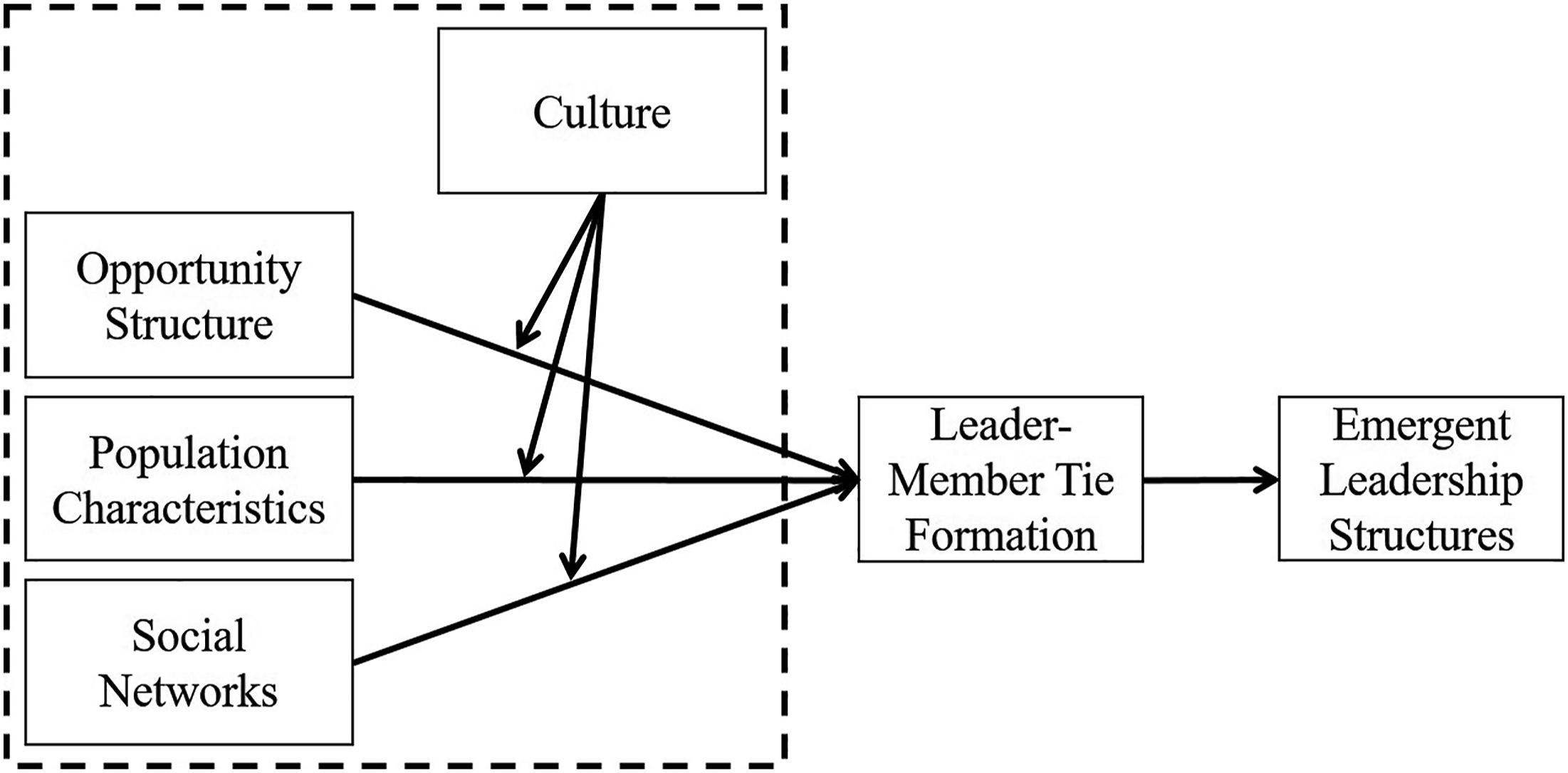
State of research: Dynamics of emergent leadership structures
Before elaborating on the impact of social context, I will introduce the relational understanding of leadership structures and the dominant exchange-theoretical conception of their emergence. In the following main part of the paper, the influence of different dimensions of social context will be systematically examined. In this way, the current conception of the subject matter is expanded step by step, building on insights on tie formation from the social network literature.
The emergence of leadership structures from social exchange
Formal hierarchies determine who manages whom in organizations. However, two findings in particular have led leadership researchers to the assumption that it is insufficient to explain the distribution of leadership tasks exclusively on the basis of formal hierarchies. First, it has been shown that some formal leaders are not perceived as such and do not act accordingly, while others lead and are perceived as leaders despite not occupying a corresponding formal position (Bedeian and Hunt, 2006; Spreitzer and Quinn, 2007). The prevalence of these two phenomena makes it clear that a strong focus on formal hierarchies cannot adequately reflect the organizational practice of leadership. Formal status must be understood in this context as a factor among others. Second, formal hierarchies are also becoming less important because they are being dismantled both qualitatively and quantitatively in order to speed up decision-making processes and make teamwork more flexible (Dinh et al., 2014; Kirkman and Harris, 2017; Pearce, 2004). Thus, to adequately capture leadership in organizations, leadership structure must be understood as an emergent phenomenon that can only be incompletely explained in terms of formal structures (Acton et al., 2019; Hanna et al., 2021).
Consequently, in current leadership research, leadership is understood as a relational interaction process in which formal structures are one factor among others (DeRue and Ashford, 2010; Dinh et al., 2014; Uhl-Bien, 2006). In this context, it has proven particularly useful to conceive leadership not as individual action, but as a dynamic relationship between leaders and members. Accordingly, leadership structures in teams or organizations can be adequately understood as social networks consisting of leader-member ties (Balkundi and Kilduff, 2006; Hoppe and Reinelt, 2010; Mehra et al., 2006). Leader-member ties are defined as dyadic social relationships that encourage one actor to follow the other (Graen and Uhl-Bien, 1995). Particularly helpful in explaining the formation of these leader-member ties has been the application of social exchange theory (Eichenseer et al., 2021; Graen and Uhl-Bien, 1995; Hanna et al., 2021). Fundamental to this approach is the distinction of social exchange from economic exchange. “In economic exchange the obligations of both parties are clearly specified in advance. Unless both parts of a transactions occur simultaneously - for instance, when paying for merchandise in a store - an explicit contract specifies the obligations of both - or all - parties. In social exchange, by contrast, only diffuse obligations are incurred. If you invite me to dinner, I am obligated to reciprocate, but you do not know when I will, how I will, or whether I will at all, though if I do not, or do so too late, or too soon, my standing in your eyes will suffer. Social exchange among new acquaintances typically starts with minor favors of services, and recurrent reciprocation increases mutual trust, thereby expanding the exchange transactions and simultaneously strengthening the interpersonal bond.” (Blau, 1995: 21)
As Blau makes clear, social exchange is characterized by uncertainty with respect to the return of a gift. Uncertainty refers both to when and in what form a debt incurred by the acceptance of a gift will be settled. Both dimensions of uncertainty contribute to the persistence of a relationship between the actors involved in the exchange. While the well-defined terms of economic exchange cause the use of goods and services to lead to a claim for a defined return (mostly in the form of the payment of a sum of money in a defined period of time) that can be satisfied unambiguously, in social exchange, due to uncertainty, there generally remains a residual room for interpretation with respect to the exchange balance. Nevertheless, since it is assumed that norms of reciprocity apply, at the conclusion of every social exchange there is a diffuse debt relationship that suggests further exchange. Relationships are constituted through continued exchange and the expectations of (reciprocal) gifts as well as the expectations of expectations related to them.
Hierarchies arise when exchange relationships are not balanced (Cook et al., 2013; Pearce et al., 2008). This occurs primarily when actors do not have the resources they need to compensate their debts. By recognizing the existing obligation and the fact that one is currently unable to compensate for it, the superiority of the donor is acknowledged. Further, the diffuse debt relationship induces the debtor to take advantage of given opportunities to reduce existing debts. This gives the giver an increased chance that the debtor will follow his lead (Carter et al., 2015; Cook et al., 2013).
Exchange in organizations is structured to some extent by formal roles and rules that assign specific duties to individuals. For members of an organization and individuals in specific positions, certain contributions to social exchange are therefore obligatory (Bastardoz and Day, 2022; Settoon et al., 1996). Fulfilling these duties is expected as a matter of course and does not induce exchange partners to seek reciprocation. For the emergence of leadership structures, therefore, these obligatory exchanges do not matter. Significant here are only those transactions that go beyond the obligatory. However, since these formal obligations usually regulate only very basic elements of organizational processes, there is ample scope for status-relevant social exchange. A well-researched example of this is informal knowledge sharing, which is essential for many organizational processes but hardly formally regulated (Agneessens and Wittek, 2012; Roth, 2022a, 2022b).
The upside of emergent leadership
The emergence of leaders can result in an individual leading a team long-term. This constellation is on the surface comparable to classic formal hierarchies. In the corresponding literature, the advantages of emergent leadership are therefore seen particularly in the fact that it enables forms of shared leadership. Shared leadership describes leadership structures in which several individuals take lead at the same time or alternately over time (Döös and Wilhelmson, 2021; Edelmann et al., 2020; Hanna et al., 2021: 82). Subsequently, I will elaborate on the reasoning behind this depiction.
In previous research on the emergence of leadership structures, formal positions and attributes of individuals have been considered as resources for the formation of exchange relations. Thereby, formal status is reflected insofar as it is linked to access to specific resources that can be asserted in social exchange (Wellman, 2017; Zhang et al., 2012). Likewise, qualities of individuals become significant for the emergence of leadership structures especially when they are brought in for the benefit of others. In the organizational context, contributions to team success find particular recognition (Aime et al., 2014; Drescher et al., 2014; Zhang et al., 2012). By being recognized by others, the above-average contribution of individual employees to collective success is (more or less consciously) understood as a gift in a social exchange process. It founds asymmetries and thus informal hierarchies. The application of individual qualities that foster the success of teams thus bring individuals into leadership positions. In corresponding research, for example, creativity, task ability, agreeableness, conscientiousness, social skills, attentiveness, and promotive voice were found to be significant (Hanna et al., 2021). These results show that qualities that matter are those that help to solve tasks as well as those that enhance team collaboration. Following this mechanism, leadership tasks are thus distributed in the team in such a way that the team members who are best suited to a given task, both knowledgeably and socially, are also empowered to take the lead. The informal and democratic process of leadership structure formation therefore appears superior to formalized hierarchies (Hanna et al., 2021; Zhang et al., 2012).
Besides that, the dynamics of the mechanism contribute to the high degree of fundamental fit between leadership tasks and personnel. When tasks change, so do the skills that are particularly valuable in a team at a given time. Subsequently, team members with previously less required skills can make important contributions to the team’s success. In recognition of these contributions, their informal status rises and they are recognized as leaders. Conversely, an employee’s leadership status may decline if s/he contributes less because s/he is less skilled at current tasks. As a result, leadership shifts to those individuals who have recently made particular contributions to team success (Aime et al., 2014; Drescher et al., 2014; Zhang et al., 2012).
Against this background, it seems to be advantageous to dismantle formal hierarchies in order to unleash social dynamics (Edelmann et al., 2020; Pearce, 2004; Zhang et al., 2012). As already indicated, there are three main reasons for this. First, a high fit between skills and leadership task is desirable, and the informal process seems more likely to ensure this than formal selection processes (Aime et al., 2014; Klein et al., 2006). Second, social dynamics promise a broader distribution of leadership tasks and thus the emergence of heterarchical leadership structures (Aime et al., 2014). As a result, more diverse perspectives tend to be better integrated into teamwork. Multiperspectivity has been shown to be particularly beneficial for solving complex problems and creatively developing innovations (Roth, 2022b). Third, the dismantling of formal hierarchies is recommended because social processes lead to dynamic adjustments. Depending on the challenges a team is currently facing, the leadership structures adapt with slight delays and those who are currently needed most are put into leadership positions (Acton et al., 2019; Zhang et al., 2012). The dismantling of rigid formal structures is therefore associated with an increase in the organizational ability to successfully adjust to changing environmental conditions and thus foster organizational agility and resilience.
The downside of emergent leadership
The previous research on emergent leadership structures has been criticized for focusing primarily on these benefits, with little attention to unintended negative effects (DeRue and Ashford, 2010; Hanna et al., 2021; Wellman, 2017). An exception is the paper of Mehra et al. (2006). It identifies a problem that can arise when leadership structures emerge. It argues that the beneficial effect of heterarchical leadership structures presupposes that the individuals occupying leadership positions perceive and recognize each other in this function. If this is not the case, fragmented leadership structures emerge. In such constellations, decentralized leadership appears uncoordinated. The perspectives embedded in the fragmented structure are not integrated into joint decisions. Moreover, since different decisions are made that are not coordinated with each other, they have a disruptive effect which leads to conflict. The performance of groups in which heterarchies have an uncoordinated effect is correspondingly worse (DeRue and Ashford, 2010: 635; Mehra et al., 2006; Wellman, 2017: 610).
However, the overall very positive view of emergent leadership structures also seems to be due to the fact that the few studies that analyze the formation in detail are experimental in nature and thus systematically exclude social context (Aime et al., 2014; Drescher et al., 2014; Gerpott et al., 2018). Social context in the sense of cultures, everyday routines, or structures of social relationships develop in the long term (Fine, 1979; Granovetter, 1985; Monge et al., 1985). In contrast, participants in experimental studies interact with each other for a relatively short period of time only. Since they disperse again after the experiment, their behavior in the experiment has furthermore no long-term consequences for their position in the social network of relationships, for example. In the interactive formation of leadership structures in experiments, social context is therefore marginalized in comparison to everyday organizational life. Both existing social structures in teams and social structures in the teams' environment are hence systematically marginalized by the experimental situation. In order to grasp the emergence of leadership structures under these special conditions, exchange theory is very well suited since it can explain the formation of relationships largely from the observed interaction sequences.
In contrast, I argue that a systematic consideration of social context is needed to adequately describe the emergence of leadership structures and to pinpoint the negative effects and their preconditions. Some seminal work already indicates the importance of social context. On the one hand, it is argued that leadership ability is defined in a culture-specific way. Because the definitions also contain criteria that are not linked to leadership aptitude (e.g., race), suboptimal hierarchies result (Lanaj and Hollenbeck, 2015; Stackhouse et al., 2017; Wellman, 2017). On the other hand, DeRue and Ashford (2010: 641) argue that leadership identities emerge “in relation to specific situations, but through repeated claiming-granting processes, those identities can shift from situated to generalized identities.” Accordingly, they assume that existing ties as social context can constrain the dynamic adjustment of leadership structures. These studies make the case for the relevance of social context. At the same time, however, they only illuminate isolated elements of context. There is a lack of systematic consideration of social context in research on the emergence of leadership structures.
This need for systematic integration of social context, however, is especially evident with regard to research on the formation of other types of tie (McFarland et al., 2014; Rivera et al., 2010). Here it has been shown in many respects that social context fundamentally structures the formation of ties. I argue that the mechanisms found here also affect leader-member tie formation. Through this network-theoretically sharpened lens, it becomes feasible to reveal the emergence of unfavorable hierarchies and their rigidification in organizational practice or more briefly, that the wrong people become or remain leaders. Systematically accounting for social context in the emergence of leadership structures promises a better understanding of the underlying social processes and a more realistic assessment of unintended negative effects and their preconditions.
In the following, I will draw on the literature on tie formation, since social context is conceptually and empirically particularly well elaborated here and hierarchies are compellingly conceptualized as social networks consisting of leader-member ties. It should be noted that the tie formation literature has a much higher level of abstraction and different types of ties are considered here in different contexts. Thus, I virtually make use of various neighboring research fields here, insofar as they are integrated into the more general literature on social networks. At the same time, I focus on work on those ties that directly address the informal social exchange in organizations that drives the emergence of leader-member ties. Specifically, I refer to work on advice ties, collaboration ties, informal knowledge sharing, informal consultations, and instrumental ties. Furthermore, I include contributions that focus on the development of strong ties and trust as the basis for social exchange. Although there is a lack of systematic linkage between the literature on the formation of these ties and the literature on the emergence of leadership structures, there are individual papers that do address hierarchical structures in organizations in terms of network analysis or address the importance of individual dimensions of social context in broader leadership research. Where possible, these findings, which are close to the subject matter, will be integrated in the following in order to increase the resilience of the conceptual bridging and to elaborate the abstract arguments.
Social context and the emergence of leadership structures
In research on tie formation, four types of mechanisms have proven to be useful, each of them referring to specific dimensions of social context. In describing the first three types, I follow the recent mainstream in social network research (Rivera et al., 2010; Schaefer and Kreager, 2020). A significant extension is the fourth type, cultural mechanisms, which is taking shape in current network research and cannot yet be described as a classical approach (Fuhse and Gondal, 2022; McLean, 2017). With regard to the systematic conceptualization of social context, however, it seems appropriate to go beyond the canonical mechanisms. The four types of contextual tie formation mechanisms that will be drawn upon in the following are: 1. Social Network Mechanisms that draw on the structuralistic assumption that trust, information, and introductions are conferred through actors’ positions in existing social networks; 2. Population Characteristic Mechanisms that emphasize compatibilities and complementarities between actors’ attributes; 3. Opportunity Pattern Mechanisms that focus on the organization of social interaction in time and space and 4. Culture Mechanisms that take into account that action is structured by practical knowledge that is shared and taken for granted in a social context
In the following, the mechanisms concerning the four dimensions of social context will be applied one by one to the emergence of leadership structures, thereby systematically linking the related dimensions of context (see Figure 2). Eight mechanisms (in italics) describe how dimensions of social context impact the emergence of leadership structures.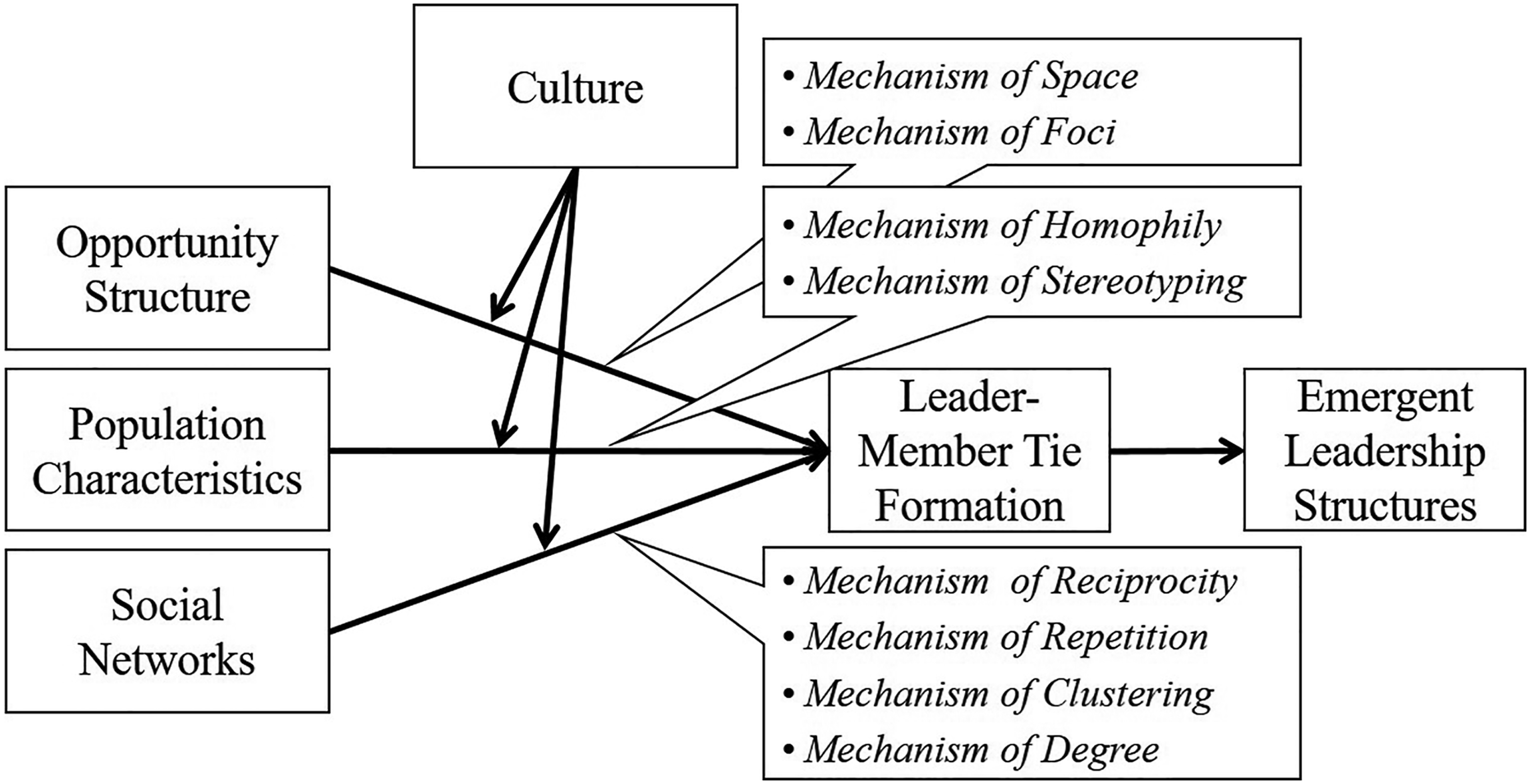
Social networks as dimension of social context
Social Network Mechanisms draw on the structuralistic assumption that trust, information, and introductions are conferred through actors’ positions in existing social networks.
Social Network Mechanisms address social context as existing networks of social relationships. In tie formation research, effects of both direct and indirect ties are revealed. In the following, I will discuss two mechanisms related to direct ties and two mechanisms related to indirect ties.
The first mechanism, Mechanism of Reciprocity, is the one already established in research on the emergence of leadership structures (Carter et al., 2015; Dinh et al., 2014). However, looking at other types of ties points to the multiplexity of (exchange) relationships (Lazega and Pattison, 1999). Multiplexity means that different types of tie can overlap in an interpersonal relationship. In particular, experimental research on the emergence of leadership structures allows for a relatively isolated view of task-related ties. However, field research shows that other forms of ties, such as friendly or amorous relationships, also exist in organizations and, further, that the different relationship networks do not exist independently (Casciaro et al., 2015; Methot and Rosado-Solomon, 2020). Casciaro et al. (2014) show, for example, that amicable relations legitimize task-related exchange and that friends are therefore preferred for task-related exchange. Since task-related exchange is fundamental to the formation of leader-member ties, I argue that amicable ties affect the formation of leader-member ties. More generally, it seems sensible to take greater account of the multiplexity of social networks in research on the emergence of leadership structures and, accordingly, to include other types of social networks as a social context for the analysis of task-related hierarchy networks. Proposition SN1: Types of ties that are less task-related influence who becomes a leader and thus cause a suboptimal distribution of leadership tasks.
Mechanism of Repetition describes the finding that different social relationships tend to solidify because the corresponding partners are repeatedly selected for a relationship-constitutive form of interaction. Four main explanations are offered for this in the literature (Rivera et al., 2010; Uzzi, 1997). First, this finding is explained in terms of exchange theory. As described above, social exchange leads to the formation of relationships because diffuse debt relationships arise. In principle, individuals strive to compensate for these and to avoid asymmetries, since a lower social status is also associated with a lower self-esteem. Therefore, partners are preferred with whom a balanced exchange relationship already exists, because under these conditions it is assumed that one can also reciprocate in the future (Blau, 1955: 129ff; Cross et al., 2001). Accordingly, the existing exchange relationships structure with whom social exchange will be conducted in the future. Second, repetition is caused by the fact that many forms of social exchange presuppose trust, which can only be developed through personal experience (Uzzi, 1997). Once a trust advantage is established, it can repeatedly be a decisive factor in selecting a potential colleague and not another. In a circular process, the trust relationship with colleagues can potentially increase further and further, while other colleagues do not have the opportunity to prove their credibility. Trust therefore tends to perpetuate itself and with it certain ties (McEvily et al., 2021; Uzzi and Spiro, 2005). Third, it is familiarity that causes individuals to draw on existing strong relationships (Casciaro and Lobo, 2015; McPherson et al., 2001). This means that individuals get to know each other better as their relationships develop. Accordingly, they have detailed personal knowledge and on this basis are able to understand each other better. On the one hand, this better understanding is intrinsically more satisfying because it establishes fluency and helps avoid unpleasant irritations. On the other hand, it also has a high functional value because it promotes the success and efficiency of coordination. This is demonstrated, for example, by Uzzi (1997) in his research on social networks in the New York garment industry. Here it is shown that which potential contractors are chosen depends not only on their basic qualities but also on the extent to which they possess customer-specific knowledge that enables them to implement the formally only vaguely defined order in the way the customer wants. The person-specific knowledge inherent in strong existing ties prompts repetition (Rivera et al., 2010). Fourth, the selection of partners for various (professional) forms of interaction in everyday life occurs, to some extent, routinely. Because established relationships also map cognitively, certain demands are associated with certain people. Hence, there is a tendency to approach those persons for the same activities with whom one has already performed the activities in the past (Granovetter, 1985).
The four reasons given indicate that there is a pronounced tendency to reproduce relationships. In research on the emergence of leadership structures, however, these effects have so far been insufficiently taken into account because their formation is usually considered starting from a zero point at which no ties exist. Following the previous considerations, however, it seems compelling that repetition also affects the emergence of leadership structures. In particular, they ensure that existing hierarchies are stabilized and that dynamic alignments in light of new challenges are absent or impeded. Accordingly, in order to understand the emergence of leadership structures, it seems useful to consider existing social networks as an important dimension of social context. Proposition SN2: The inertia of established ties impedes the short-term adjustment of leadership structures in line with new team-challenges.
Mechanism of Clustering refer to the effect of third parties and thus addresses more complex network components. When two unrelated persons maintain positive relationships with a third person, their propensity to form a tie with each other increases and it is likely that the three will form a triad (Lazega and Pattison, 1999; Uzzi and Spiro, 2005). If one of the freshly connected persons maintains further relationships, they themselves become the third person between two unconnected whose binding tendency thereby increases. Because the number of manageable relationships is limited, this process does not continue until everyone is connected to everyone else. However, it is apparent that clusters are forming, in which a limited number of people maintain ties with one another. Two explanations for this tendency are offered in the literature.
First, it is pointed out that third parties (typically positive ones) convey person-related information (Obstfeld et al., 2014). In this way, qualities of a person can become apparent that motivate the establishment of contact. Moreover, third parties build trust because they demonstrate credibility with their positive relations to the unconnected partners and act as a controlling instance (Burt and Knez, 1995; McEvily et al., 2021) “Better than the statement that someone is known to be reliable is information from a trusted informant that he has dealt with that individual and found him so.” (Granovetter, 1985: 490)
Second, the propensity for triad closure is explained by third parties creating opportunities for contact. When individuals spend time with the same third person, the opportunity for contact is more likely to arise, even if they are not introduced to each other (Feld, 1981; Kossinets and Watts, 2009).
The Mechanism of Degree also concerns the social network beyond the dyad. Here, however, it is not the connection via third parties that is important, but rather the network centrality of a person. This is expressed by the number of a person’s ties in comparison to the number of other people (in the same network). The more ties persons have, the more central they are. Furthermore, the centrality increases due to the number of relationships of the direct partners. Numerous studies have found that high centrality increases the likelihood of additional ties being formed (Rivera et al., 2010). In addition to the aforementioned triad closure effects, this is first explained by the fact that ties can be leveraged as social capital and that individuals with a particularly large number of ties have access to a particularly large number of resources (Lin, 2001). This makes central individuals extra useful and, as partners, extra rewarding. Second, it is argued that centrality is interpreted as a marker of qualities. Persons with exceptionally many (specific) ties thus become more attractive to others (Borgatti and Everett, 2020).
The latter two mechanisms describe that the social network in which two individuals are embedded influence the formation of a tie between the two. In contrast, exchange theory-based research on the emergence of leadership structures has focused solely on individuals and the interactions between them. Accordingly, the emergence of leadership structures has been conceptualized as the independent decision of individuals. Hence, it is assumed that the different perspectives in the team are equally involved in the process. However, embeddedness causes better-connected individuals to be more likely to become and to remain leaders, regardless of their abilities. In terms of the overall leadership structure, these mechanisms further lead to greater centralization because individuals who are connected align their decisions with each other and recognize the same person as a leader. Proposition SN3: Better-Connected Individuals are more likely to become leaders, regardless of their aptitude.
With regard to the dynamics of emergent leadership structures, the findings on the relevance of the surrounding social network clearly speak for a stabilization of existing structures. If the structures of the overall network do not change in a coordinated way, the forces emanating from them remain the same and thus also stabilize the individual decision to acknowledge leadership claims. The structural embedding of individual leader-member relationships in the network is therefore inertial, which means that leadership structures generally change only very slowly and in an evolutionary manner. Rapid upheavals, which are required to enable the agility described in the literature, appear conceivable only through sharp breaks in continuity (for example, the sudden departure of a central actor) and not from within the given team network. Against this background, it seems useful not only to focus on dyads between individuals, but to consider the more complex social networks in which they are embedded as a relevant dimension of social context. Proposition SN4: The interdependence of individual relationships hampers the agile adjustment of leadership structures towards shifting team challenges.
The interrelationships described here address the embedding of leader-member ties in broader network structures, the development of these networks over time, and other types of ties. For the empirical investigation of the propositions and research questions (see Appendix), classical methods of social network analysis are particularly suitable (Wasserman and Faust, 2007).
Population characteristics as dimension of social context
Population Characteristic Mechanisms emphasize compatibilities and complementarities between actors’ attributes.
In the case of Population Characteristics, the focus is on individual qualities and their social meaning. Thus, this type of mechanism is not initially tied to social context. However, social context is addressed by individual qualities, insofar as the effect of these mechanisms depends on the demographic structure of the context. In the following, I will discuss two mechanisms in more detail.
The first mechanism, Mechanism of Homophily, has been shown to be particularly powerful in network research and describes the tendency to prefer self-similar partners (Lazarsfeld and Merton, 1954; McPherson et al., 2001). Research shows that especially in the early phase of relationship formation, characteristics that are obvious at first glance are of great importance, for example, gender or race. As relationship formation progresses, more subtle characteristics also gain importance, for example, personal preferences or attitudes (Schaefer and Kreager, 2020). The preference for self-similar partners is mainly explained by the fact that shared categories are (unconsciously) used to infer more fundamental similarities (Tajfel and Turner, 1979). Given these, mutual understanding seems more likely. Because identically categorized individuals believe they can assess each other better than differently categorized individuals, they trust each other more and expect more efficient and satisfying interactions in the assumption of common interests and perspectives (Katz and Allen, 1982; Kossinets and Watts, 2009). In addition, the familiar is cognitively processed more fluidly and this also increases the attractiveness of a partner. Particularly relevant for the development of leader-member relationships is that these basic assumptions and perceptions are also associated with the attribution of competencies (Casciaro et al., 2015; Joshi and Roh, 2009).
This process is influenced by context-specific demographics in that categorization comes into play particularly when the members of a team are diverse in terms of the relevant characteristics. In demographically highly homogeneous contexts, homophily plays a subordinate role. In contrast, it is significant that homophily is promoted by majority-minority relations in social contexts (Ibarra, 1997; Mehra et al., 1998). The reason for this is that, for example, the only woman in a group tends to stand out among numerous men and the category of gender becomes more prominent than if men and women were equally represented.
Self-similarity is not a suitable criterion for selecting the optimal leader. The propensity for homophily therefore contributes to leadership not being assigned on the basis of factual suitability alone. Because hierarchical structures do not emerge from individual dyads but from the sum of them, the demographic structure of a social context has a decisive influence and minorities are systematically disadvantaged. Further, this effect is amplified because the mechanism is triggered by asymmetric demographic structures. Proposition PC1: Team populations that are unbalanced with respect to characteristics relevant for categorizing individuals disadvantage minority members in becoming leaders.
If, on the other hand, the ratios are balanced, the mechanism is less effective. However, other problems result. As stated above, Mehra et al. (2006) found that emergent leadership structures lead to performance-damaging conflicts when there is a fragmentation of the team. This hazard is particularly likely to arise if the homophily mechanism is effective and the relevant demographic characteristics of the team members are distributed in such a way that subgroups of members are very similar to each other and at the same time differ significantly from other, homogeneous subgroups. Proposition PC2: When certain characteristics in a team are of high importance for categorization and are equally distributed among the members, fragmented leadership structures emerge.
In addition to the suboptimal selection of leaders, homophily also causes inertia because it tends to have a continuous effect and can hardly be overridden by new tasks with changed requirements. Proposition PC3: The preference for self-similar partners hampers the agile adjustment of leadership structures towards shifting team challenges.
It therefore seems necessary to reflect social context in the sense of demography more systematically in research on the emergence of leadership structures in order to reach a more realistic depiction of these structures, including the possible negative consequences of this process.
The Mechanisms of Stereotyping are also based on social categorization (Tajfel and Turner, 1979). In contrast to the previous mechanism, however, they are not based on the relations between individuals, but on the social definition of categories (Schneider, 2005). This means, for example, that certain expectations of action are socially associated with the gender attributed to a person. On the one hand, these action expectations determine the formation of social relations, because action expectations are projected onto potential partners and they are treated accordingly (Fiske and Taylor, 2013; Yoon and Hollingshead, 2010). This can lead, for example, to specifically categorized individuals not being considered as potential partners in the first place because of corresponding expectations. Anticipated behavior structures actual partner selection. On the other hand, in the course of their socialization, people learn to apply the social categories to themselves and to behave accordingly (Shih et al., 1999). The definition of the categories thus also establishes self-selection.
This becomes particularly apparent in the case of gender stereotypes. Based on gender role theory, it has been shown that masculinity is associated with object orientation, independence, and assertiveness, whereas femininity is associated with communal qualities like helpfulness, nurturance, or kindness (Eagly and Karau, 2002). Following on from this, leadership research has shown that leadership roles are more likely to be associated with the action expectations that are also associated with masculinity (Bligh and Kohles, 2008; Eagly and Karau, 2002). As a result, women in leadership roles face conflicting expectations for action. Women who meet the expectations associated with leadership roles are then often viewed critically because they simultaneously lack the social orientation expected from women. In contrast to expectations, women are then seen as colder and more arrogant than men when behaving in the same way (Koenig et al., 2011; Livingston et al., 2012).
With regard to the emergence of leadership structures, this means that women tend not to be attributed leadership qualities due to corresponding stereotypes and that typical leadership behavior tends to be evaluated negatively (Lanaj and Hollenbeck, 2015). Therefore, even with equal performance, women have lower chances to get into leadership positions. The example of gender shows that social stereotyping can contribute to the emergence of less-than-optimal leadership structures and, through its enduring effects, hinders dynamic adaptations. Thus, social categories should also be considered as a dimension of social context in research on the emergence of leadership structures. Proposition PC4: Individuals who are perceived to be less suited to leadership by stereotyping are less likely to become leaders, regardless of their qualifications.
Brands et al. (2015) further dissect this mechanism. They show that men are perceived as suitable leaders, especially in team networks in which one or a few individuals are very central, whereas women are more likely to be recognized as leaders in more balanced networks in which team members are embedded similarly. They explain this finding by arguing that leadership tasks in very centralized networks are perceived to correspond more with masculine gender stereotypes, whereas in less centralized networks the qualities attributed to women appear more appropriate. Based on this, I propose that the social definition of leadership roles fundamentally depends on characteristics of the context and, subsequently, which social categories favor leadership acknowledgment. Proposition PC5: Which social categories actors associate with leadership depends on contextual factors that affect the perception of leadership tasks.
In addition to the classic network analysis methods, which facilitate the description of leadership structures and their interaction with the characteristics of individuals, qualitative methods are also useful for investigating the propositions and research questions developed from this section (see appendix). It seems particularly promising here to visualize the networks and use them to reconstruct the meaning of the categories associated with the various relationships in qualitative interviews (McCarty et al., 2007).
Opportunity patterns as dimension of social context
Opportunity Pattern Mechanisms focus on the organization of social interaction in time and space.
The interactive formation of most types of ties presupposes opportunities. Accordingly, who forms which relationships with whom depends not only on who prefers whom, but also on which potential partners have opportunities to develop (specific) relationships with each other (Feld, 1981; Small and Sukhu, 2016). The impact of opportunities offers another approach to explaining tie formation because opportunities arise systematically from the stable patterns of people’s everyday lives (Monge et al., 1985; Roth, 2022a). In the corresponding research, two mechanisms have proven to be particularly robust, each addressing specific forms of (context-specific) organization of everyday life.
Mechanisms of Space explain the formation of ties in terms of spatial relations between individuals. They emphasize that spatial distances and spatial layouts influence contact opportunities and situations. Research approaches that focus on spatial distance address space primarily as an obstacle to planned face-to-face contact. The greater the spatial distance, the greater the effort involved in overcoming it. It turns out that this applies both to the immediate work environment, where distances can be overcome by walking (Allen, 1977; Small and Adler, 2019), and to large distances that require traveling (Knoben and Oerlemans, 2006). In both cases, radii can be determined within which individuals are willing to initiate face-to-face contact and a strong decrease in this willingness beyond the boundaries of these radii. The effect of space on the frequency of face-to-face contact is important here because it is assumed that face-to-face contact is significantly richer than media-mediated communication (Wilson et al., 2006). Thus, face-to-face, knowledge can be conveyed better and faster, commitment can arise more easily, and trust is more likely to develop (Nilsson and Mattes, 2015). All these processes are important for tie formation, and spatial proximity has a correspondingly beneficial effect (Allen, 1977; Nilsson and Mattes, 2015; Small and Adler, 2019).
A differentiation of the Mechanism of Space is made following the space syntax approach (Hillier and Hanson, 1984). Thereby, spatial layouts are examined with respect to concrete movement profiles of individuals. This enables a dynamic understanding of proximity. By comparing movement profiles of individuals, overlaps can be determined, and contact probabilities derived. In contrast to approaches focusing on static distances, which mainly explain planned encounters, unplanned encounters can also be explained. Empirical findings show that individuals whose movement profiles overlap to a higher degree are more likely to maintain advice ties or to cooperate with each other in scientific projects (Catalini, 2018; Kabo et al., 2014; Rashid et al., 2006).
Furthermore, this research has shown that encounters are a basic but not a sufficient condition for many relationship-building forms of interaction (Rashid et al., 2006; Small and Adler, 2019). It has been shown here that the characteristics of the social situations in which individuals encounter each other can foster or hinder such interactions (Fayard and Weeks, 2007; Roth, 2022a). Mechanism of Foci follow a comparable approach, insofar as it also uses the opportunities and circumstances of encounters to explain tie formation. However, they focus less on spatial constellations than on the social organization of everyday life. A focus is defined as a social, psychological, legal, or physical entity around which joint activities are organized (e.g., workplaces, voluntary organizations, hangouts, families, etc.). As a consequence of interaction associated with their joint activities, individuals whose activities are organized around the same focus will tend to become interpersonally tied and form a cluster. (Feld, 1981: 1016)
More or less formalized foci thus ensure that certain people meet more frequently. In addition, it is assumed that the encounters differ with regard to their effect on tie formation and that some foci have a stronger relationship-building effect than others (Small and Sukhu, 2016). Key factors here are, for example, the exclusivity of the focus or the characteristics of the activities carried out in the focus. According to the focus concept, tie information becomes more likely to the extent that individuals are engaged in the same foci and that these foci are conducive to the formation of relationships.
Both space and foci structure the emergence of ties by making tie-forming interactions more or less likely. In previous research on the emergence of leadership structures, interaction processes in the team are conceptualized as equally accessible to all team members. However, I assume that interactions relevant to the emergence of leader-member ties are not carried out in everyday life exclusively in the presence of the entire team. Rather, it can be assumed that numerous relevant interactions take place beyond official team meetings, with accessibility and opportunity playing an important role. Drawing on the research on the two opportunity structuring mechanisms, the chances of participating in such interactions and thus improving the own social status are distributed unequally. For example, central positions in the spatial layout provide individuals with significantly more opportunities to interact with a larger number of people than more peripherally positioned colleagues. And even in the bar around the corner or in the locker room after soccer practice, interactions can be carried out that may be relevant for the formation of leadership structures. Opportunity patterns can thus result in inequalities of chance that make it more difficult for capable team members to achieve leadership positions. Insofar as they have a stabilizing effect, they also contribute to the inertia of leadership structures. Proposition OP1: Individuals who systematically face a greater number of opportunities to show their leadership qualities are more likely to become and remain leaders.
Thus, it is also true for opportunity patterns that they should be better considered as a dimension of social context in research on the emergence of leadership structures. By taking into account the everyday embedding of the leadership structure formation’s underlying interaction practices in space and foci, this process can be more adequately understood. In order to tap into the meaning of opportunity structures, space syntax analyses (Catalini, 2018), which allow us to quantitatively describe spatial structures and positions in terms of their effect on encounters, as well as ethnographic observations (Fayard and Weeks, 2007) or event-based diaries (Roth, 2015), which make the everyday meaning of opportunities accessible.
Culture as dimension of social context
Culture Mechanisms take into account that action is structured by practical knowledge that is shared and taken for granted in a social context.
Recent social network research increasingly reflects that the tie formation mechanisms identified so far are moderated by their cultural embedding (Crossley, 2012; McLean, 2017). Culture is defined in current cultural sociology as practical knowledge that is shared and taken for granted in a social context (Vaisey, 2009). An important function of this shared knowledge is to enable people to anticipate the expectations of their interaction partners. Because they reference shared knowledge, actors are able to reliably predict how others will interpret and respond to their utterances and actions (Berger and Luckmann, 1966). Through socialization into a social context, actors learn to see themselves, as Mead (1934) put it succinctly, through the eyes of others. Thus, shared knowledge causes them to behave according to the rules inscribed in it and to develop corresponding routines. Systematic differences between idiosyncratic bodies of knowledge can also exist between smaller social units such as organizations, families, or teams (Fine, 1979). It has therefore proven useful to recognize that interactive practices follow, to some extent, context-specific eigenlogics. Culture is therefore an important dimension of social context and is accordingly taken into account in social network research (McLean, 2017).
In network research, culture is particularly important because ties are formed and performed interactively. With regard to the performance of relationships, it has been shown that comparable types of ties have different meanings in different social contexts and therefore have different effects (Fuhse and Gondal, 2022). For example, weak ties, which are of great importance in hiring in the United States, have been shown to be insignificant in Israel, where formal qualifications, rather than social chemistry, are considered crucial (Sharone, 2014). Similarly, boundary spanning has been shown to be extremely beneficial in individualistic cultures because non-redundant information can be transferred between unconnected network clusters, whereas the same practice is sanctioned in collectivistic cultures because the loyalty to one’s group is thereby challenged (Xiao and Tsui, 2007).
The influence of culture is also evident with regard to the formation of ties. Here it can be seen that culture influences which tie-formation mechanisms operate in a context and how exactly these are configured (McLean, 2017). With regard to the formation of advice ties, the author et al. (forthcoming) show in a comparative study based on four examples that the impact and configuration of the formation mechanisms can vary between local cultures. First, they show that triadic closure is of different importance in two comparable startup communities. In one case, triadic closure is of great importance because intros by common acquaintances are a cultural prerequisite for the legitimate initiation of these relationships. In the other case, they are of no particular importance. Second, they show that norms of reciprocity vary between the two communities due to different local cultures. While in one case direct reciprocity as described above is practiced, in the other case it is generalized reciprocity. Hence, individuals do not expect to receive compensation directly from each other but see their gifts to members of the community as gifts to the community as a whole, from which they have already benefited and will benefit in the future. Because of the different local cultures, the mechanism is configured differently. Third, using the case of advice ties in large corporations and with regard to opportunity patterns, they show that the systematic occurrence of encounters does not depend on spatial layouts alone, but on the cultural practices associated with them. This is illustrated by the example of lunch breaks in canteens. While in one case employees gather at the workplace and appear as closed groups in the canteen, in the second case it is legitimate to go to the canteen alone and find company there. Despite the same spatial structures, informal interaction with other teams occurs in the second case and not in the first. Fourth, with respect to the effect of face-to-face encounters, they show that the publicity of situations has different effects in three social contexts. In the first case, public places are used to find informal advisors. In the second case, informal consultations do not occur there because more extended informal activities violate a cultural norm (focus on work), and publicness enables social control. In the third case, employees anticipate opportunistic behavior of colleagues based on culturally shared knowledge and therefore avoid consultations in public situations because they would make themselves vulnerable by openly addressing problems. Materially identical situations have different effects in different cultural contexts.
The four examples show that context-specific cultures moderate both the strength and the specification of the individual tie formation mechanisms. I further argue that culture not only moderates the exemplified mechanisms in the way described, but that all mechanisms are culturally influenced (the author, forthcoming). Subsequently, I argue that the emergence of leadership structures is also moderated by cultural context and that it is appropriate to systematically consider culture as a dimension of social context. To illustrate this argument, in what follows I will pick out one mechanism for each of the three contextual dimensions discussed above and elaborate more precisely on the influence of culture on the emergence of leadership structures.
Social networks
In previous research, it has proven useful to conceptualize the emergence of leadership structures in terms of exchange theory. Fundamental to the dynamic development of leadership structures is that members openly display their skills in teamwork, thereby signaling their leadership ability and practicing leadership. Cross-cultural leadership research has already shown that the willingness to openly introduce one’s skills is not equally present in all cultural contexts. More specifically, the emergence of leadership structures has been shown to be unlikely to develop the expected momentum in collectivist cultures that put high value on equality and in hierarchical cultures where employees are expected to show deference to leaders (Furu, 2012; Stackhouse et al., 2017). In both types of culture, there is social sanction for employees to make leadership claims by openly contributing their perspectives and competencies. Accordingly, hierarchical and collectivist cultures hinder the dynamic development of leadership structures.
In addition to the willingness to openly display competencies in social exchange, the concrete rules of social exchange are also culturally shaped. Comparative cultural studies of social exchange showed early on that reciprocal expectations are structured by culture-specific norms of reciprocity (Mauss, 1925). The author et al. (forthcoming) have shown how these norms structure tie formation, depending on the degree to which generalized or direct reciprocity is culturally dominant. With respect to the emergence of leadership structures, I argue that the salience of this norm also makes a crucial difference. If the norm of generalized reciprocity dominates, the focus is more on the team as the recipient of gifts and the status of individual members is defined primarily by this. In contrast, the profit of individuals through gifts is more in focus in the opposite case. As argued above, these individual interests may concern other forms of relationships and gifts than contributions to team success. The multiplexity of relationship networks would be of greater importance here for the social exchange processes in the team. Accordingly, the positive effect of emergent leadership structures would be favored by generalized reciprocity and diminished by direct reciprocity. Proposition C1: In cultures with generalized reciprocity, leadership structures emerge that are more conducive to success than in those characterized by direct reciprocity.
Population characteristics
In culture-comparative leadership research, it has been shown that ideas about how leaders behave (implicit leadership theories) can differ across cultures (DeRue and Ashford, 2010; Lord and Maher, 1991). For leadership emergence, this means that the criteria for what is recognized as leadership behavior may vary across cultures (Hanna et al., 2021: 91f.). This can affect the dynamics of the process in that the range of recognized forms of leadership can be broader or narrower and the qualities associated with leadership are more or less strongly linked to performance. If the range is narrow and less performance-related criteria are significant, culture affects the emergence of leadership structures that are appropriate to current challenges because, for example, members of certain ethnic groups or individuals whose behavior only partially aligns with the leadership stereotype have little chance of influence, even if their skills would help the team (Gündemir et al., 2019). Proposition C2: Cultures that convey a narrow conception of leadership that includes less performance-related elements promote the emergence of inferior leadership distributions and hinder dynamic adaptations.
With regard to the mechanism of stereotyping, I pointed to the finding that conflicts between female gender roles and leadership roles can result in disadvantages for women. With regard to the cultural variance of implicit leadership theories, I argue that the different roles conflict with each other to different degrees in different cultures. It is conceivable that women’s roles align very well with leadership roles in other cultures and that men face conflict here. Accordingly, which groups are discriminated against by the role-based mechanism and to what extent varies between cultures.
Opportunity patterns
With regard to the mechanism linked to opportunity patterns, it has been shown that movement profiles are not defined by spatial layouts alone and that specific forms of interaction have different situational prerequisites. Both are influenced by culture (Rashid et al., 2006). Culture thus influences how strongly and selectively opportunity patterns operate. In the section on opportunity patterns, I argued that they hinder the dynamic adjustment of leadership structures because they statically favor certain individuals regardless of their abilities. Thus, when cultures mitigate this undesirable effect, they ensure that leadership structures appropriate to current challenges can emerge dynamically. For example, the culture-specific relevance of informality could be crucial for this. Scheidgen (2020) and Saxenian (1996) showed that when initiating a professional interaction, it is of great importance in some cultures that the material interest in the interaction is kept in the background while the personal relationship is emphasized. In addition to social relationships, opportunities are particularly important in such informal cultures because interactions can (apparently) arise spontaneously, so that the material interest does not have to be emphasized in order to motivate the meeting (Hallen and Eisenhardt, 2012). Hence, opportunities play a major role in team exchanges, especially in informal cultures, and thus structure who takes on leadership roles and to what extent. Individuals with central workplaces or in close proximity to key team members would be more likely to be leaders here, regardless of their skills, because they are more likely to have opportunities to contribute successfully. In more formal cultures, this effect might be neutralized because the relevant interactions take place in formal team meetings that are equally accessible to all members. Proposition C3: In informal cultures, opportunity patterns shape leadership structures more strongly, thus promoting the disadvantageous distribution of leadership tasks and hindering their dynamic adjustment.
The three examples show that culture influences both the specific operation and the strength of mechanisms. The moderating effect of culture appears to be significant for the emergence of leadership structures primarily because it can mitigate other effects of context that impair the adequacy and dynamism of leadership structure formation. Therefore, it seems useful to systematically consider culture as a dimension of social context when examining the emergence of leadership structures. In order to empirically capture the moderating effect of cultures, the use of two methods seems particularly suitable. First, systematic comparisons of contexts whose cultural differences have been demonstrated are suitable here (Yin, 2012). Second, qualitative methods such as interviews, diary procedures or ethnography are particularly suitable for tracing the concrete effect of culture on the formation of leader-member ties (Hollstein, 2011; Roth, 2015).
Conclusion
Emergent leadership structures are increasingly shaping organizations as formal hierarchies lose significance. In order to gain a differentiated understanding of the impact of this change, it is crucial to comprehend the mechanisms underlying the emergence of leadership structures. To this end, it has proven helpful to conceptualize leadership structures as social networks and the formation of individual leader-member ties as social exchanges (Emery et al., 2013; Hoppe and Reinelt, 2010). This paper argues that previous research, by applying an exchange-theoretical lens, focused on isolated interactions and neglected social context. In consequence, important cause-effect relationships are overlooked and especially negative effects are underestimated (Hanna et al., 2021). I have therefore suggested to draw on insights and concepts from the broader tie formation literature. This literature is particularly appropriate here because of the high conceptual fit and the rich findings on the effects of social context.
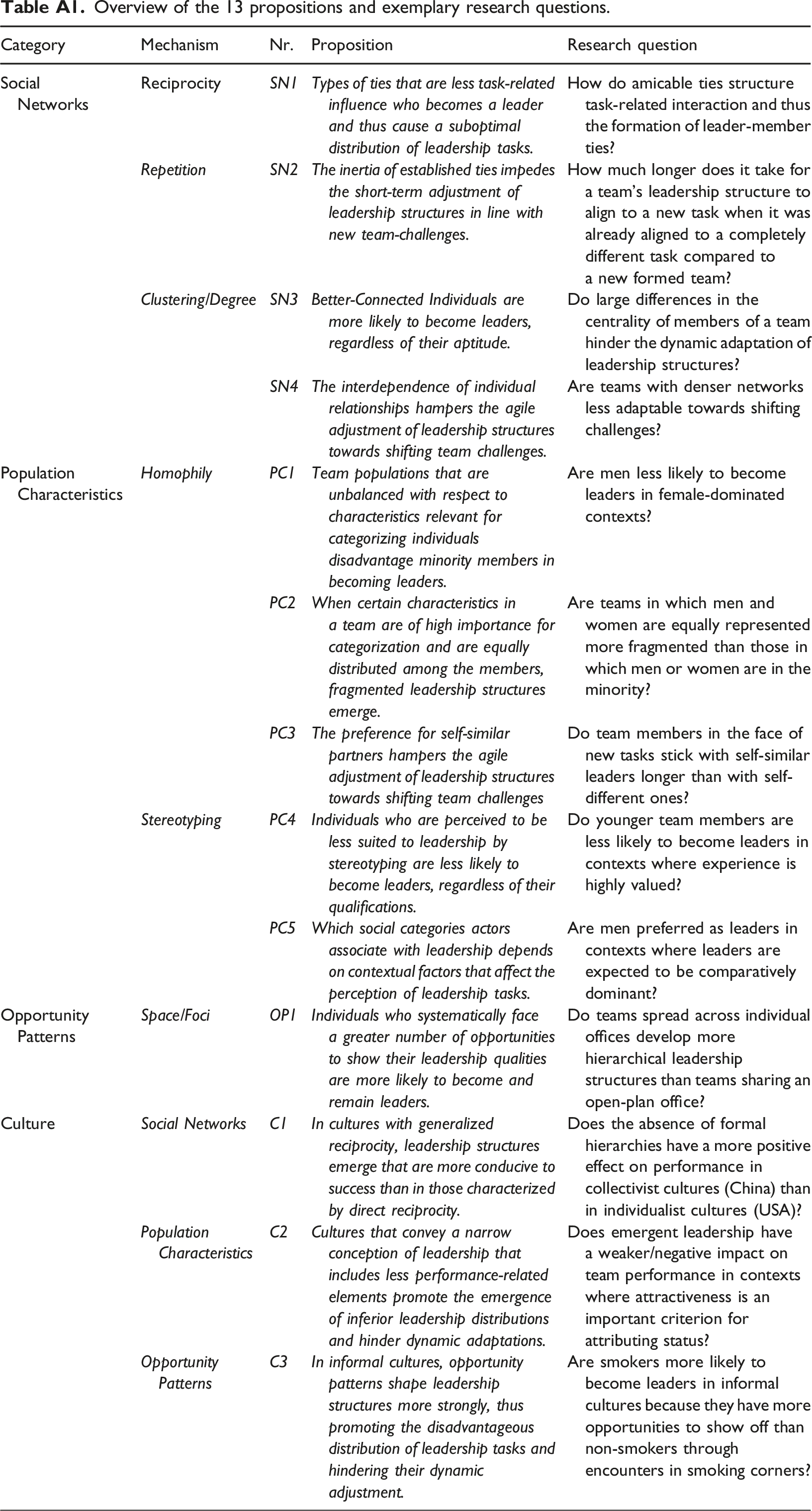
The paper’s contribution is to merge the two research fields and thus to introduce a sophisticated, four-dimensional conception of social context into research on the emergence of leadership structures. In doing so, the underlying mechanisms were reconstructed precisely and, drawing on this, their effects on the formation of leadership structures are derived in detail. With this conceptual work, the paper contributes in two ways to guide further empirical research. First, the systematic proceeding and modeling makes it possible to better locate research on the emergence of leadership structures in an overall picture. Second, the paper identifies a wealth of specific causal relationships and, building on these, derives 13 research propositions that provide well-founded impetus for further empirical research in this area (see Table A1 in Appendix A for an overview).
Finally, the plausibility and density of the arguments can be read as an indication that social context is highly relevant to the emergence of leadership structures. Hence, taking social context into account promises a considerably more adequate conceptualization of the subject matter and a better consideration of unintended, negative effects of shared leadership structures. Accordingly, the paper aims not only to suggest how social context should be incorporated into the study of leadership emergence, but also that we are in urgent need to do so.
Footnotes
Acknowledgements
I thank Dennis Tourish, the anonymouse reviewers, Thomas Roulet, Eva Boxenbaum, Joep Cornelissen, Marion Weissenberger-Eibl, Astrid Schulz and Ronja Rieger for encouraging, precise, and wise feedback on earlier versions of this paper.
Declaration of conflicting interests
The author(s) declared no potential conflicts of interest with respect to the research, authorship, and/or publication of this article.
Funding
The author(s) disclosed receipt of the following financial support for the research, authorship, and/or publication of this article: This work was supported by European Social Fund (02L17C000) and Bundesministerium für Bildung und Forschung (02L17C000).

Author Biography
Appendix
Overview of the 13 propositions and exemplary research questions.
| Category | Mechanism | Nr. | Proposition | Research question |
|---|---|---|---|---|
| Social Networks | Reciprocity | SN1 | Types of ties that are less task-related influence who becomes a leader and thus cause a suboptimal distribution of leadership tasks. | How do amicable ties structure task-related interaction and thus the formation of leader-member ties? |
| Repetition | SN2 | The inertia of established ties impedes the short-term adjustment of leadership structures in line with new team-challenges. | How much longer does it take for a team’s leadership structure to align to a new task when it was already aligned to a completely different task compared to a new formed team? | |
| Clustering/Degree | SN3 | Better-Connected Individuals are more likely to become leaders, regardless of their aptitude. | Do large differences in the centrality of members of a team hinder the dynamic adaptation of leadership structures? | |
| SN4 | The interdependence of individual relationships hampers the agile adjustment of leadership structures towards shifting team challenges. | Are teams with denser networks less adaptable towards shifting challenges? | ||
| Population Characteristics | Homophily | PC1 | Team populations that are unbalanced with respect to characteristics relevant for categorizing individuals disadvantage minority members in becoming leaders. | Are men less likely to become leaders in female-dominated contexts? |
| PC2 | When certain characteristics in a team are of high importance for categorization and are equally distributed among the members, fragmented leadership structures emerge. | Are teams in which men and women are equally represented more fragmented than those in which men or women are in the minority? | ||
| PC3 | The preference for self-similar partners hampers the agile adjustment of leadership structures towards shifting team challenges | Do team members in the face of new tasks stick with self-similar leaders longer than with self-different ones? | ||
| Stereotyping | PC4 | Individuals who are perceived to be less suited to leadership by stereotyping are less likely to become leaders, regardless of their qualifications. | Do younger team members are less likely to become leaders in contexts where experience is highly valued? | |
| PC5 | Which social categories actors associate with leadership depends on contextual factors that affect the perception of leadership tasks. | Are men preferred as leaders in contexts where leaders are expected to be comparatively dominant? | ||
| Opportunity Patterns | Space/Foci | OP1 | Individuals who systematically face a greater number of opportunities to show their leadership qualities are more likely to become and remain leaders. | Do teams spread across individual offices develop more hierarchical leadership structures than teams sharing an open-plan office? |
| Culture | Social Networks | C1 | In cultures with generalized reciprocity, leadership structures emerge that are more conducive to success than in those characterized by direct reciprocity. | Does the absence of formal hierarchies have a more positive effect on performance in collectivist cultures (China) than in individualist cultures (USA)? |
| Population Characteristics | C2 | Cultures that convey a narrow conception of leadership that includes less performance-related elements promote the emergence of inferior leadership distributions and hinder dynamic adaptations. | Does emergent leadership have a weaker/negative impact on team performance in contexts where attractiveness is an important criterion for attributing status? | |
| Opportunity Patterns | C3 | In informal cultures, opportunity patterns shape leadership structures more strongly, thus promoting the disadvantageous distribution of leadership tasks and hindering their dynamic adjustment. | Are smokers more likely to become leaders in informal cultures because they have more opportunities to show off than non-smokers through encounters in smoking corners? |