




Abstract
The clamour for leaders to be authentic in enacting their roles is now widely heard in both the academic literature and popular media. Yet, the authentic leadership (AL) construct remains deeply problematic and arguably impossible to enact. Using the performance of emotional labour (EL) as a lens to view relational transparency, a core component of AL, our research surfaces the paradoxes inherent in this construct and their implications for practicing leaders. Our data reveal something of the mystery surrounding how practicing leaders are able to feel authentic even as they manage their emotions as a routine tool of accomplishing their leadership role. This apparent disconnect between the experiencing of authenticity and the actions/interactions in which this experience is embedded raises profound questions concerning authenticity as a phenomenon, how it is discursively constructed, its relationship to inauthenticity – especially in the practice of leadership – and even its relevance. Drawing on these concerns, we suggest an agenda for future research in relation to authenticity in leadership and highlight the value of EL as a challenging ‘test context’ for honing our understanding of what ‘authenticity’ might mean.
Introduction
The call for leaders to be authentic in the daily enactment of their role is a frequent one, both in the academic literature (Avolio and Gardner, 2005) and in the media (Elliott and Stead, 2018). At the same time, authentic leadership (AL) as a phenomenon has been recognised as encompassing the enactment of emotional labour as a form of labour central to accomplishing leadership goals (Kempster et al., 2019), although tensions between the two have yet to be interrogated in the literature. This is a significant omission that neglects a fundamental experiential aspect of authenticity that informs how it is socially constructed. By interrogating AL within the context of emotional labour, this article aims to hold up to scrutiny the concept of authenticity and to reveal the tensions and paradoxes involved in being authentic as a leader.
The AL construct was developed from an explicitly normative and functionalist perspective (Avolio and Gardner, 2005; Avolio et al., 2004), with the expressed aim of delineating a style of leadership capable of producing measurable organisational outcomes (Avolio et al., 2004; Gardner and Schermerhorn, 2004), through leaders who are said to be ‘transparent about their intentions and [who] strive to maintain a seamless link between espoused values, behaviours and actions’ (Luthans and Avolio, 2003: 242). While this notion of ‘relational transparency’ as a core component of AL has not been without its critics (Kempster et al., 2019), the four-component Authentic Leadership Questionnaire (ALQ) psychometric (Walumbwa et al., 2008) of which it is a part is widely accepted and applied. More broadly, challenges from existentialist (Lawler and Ashman, 2012) and psychodynamic (Costas and Taheri, 2012) perspectives suggesting a more complex, political and contested understanding of authenticity have struggled to gain traction in the literature. Similarly, critiques of AL that rest upon interaction and the ‘intersubjective, embodied relationships’ (Gardiner, 2013: 66) as truer reflections of authenticity than self-awareness and our ‘inner life’ have failed to receive the attention they deserve in shifting the focus of AL scholarship.
As noted by Iszatt-White and Kempster (2019), the AL construct appears to have achieved general acceptance with little substantiation of how it was actually developed. It has cut short the early phases of construct development (Reichers and Schneider, 1990) – through which new constructs are introduced, elaborated, evaluated and augmented – to arrive at the mature phase – in which accepted operationalisations are uncritically utilised as a contextual variable in more general models – somewhat prematurely. The premature adoption of the AL construct in this way has resulted in substantive flaws in its philosophical underpinnings and empirical grounding going unresolved, to the detriment of both its theoretical robustness and practical value. A partial reframing of authenticity as underpinned by ‘fidelity to purpose’ (Kempster et al., 2019), rather than relational transparency, offered a potential route back to firmer practice-related foundations by teasing out the difference between transparency as being enacted in the moment and fidelity as holding true over the longer term. This reframing fell short of addressing more fundamental tensions inherent in the juxtaposition of relational transparency and emotional labour, however.
The requirement for leaders to perform emotional labour (Hochschild, 1983) as a routine part of enacting their role is widely accepted in the leadership literature (Connelly and Gooty, 2015; Humphrey et al., 2008; Iszatt-White, 2009, 2012), as is the distinction between general social/professional emotion management and the intentional employment of emotions as a tool for enacting a leadership role which constitutes emotional labour. The growth of interest in leadership and other professional (Harris, 2002; Isenbarger and Zembylas, 2006; O’Brien and Linehan, 2014; Ogbonna and Harris, 2004) roles as sites of more value-driven, less commercially instrumental forms of emotional labour has suggested that leaders are in some sense ‘faking in good faith’ (Rafaeli and Sutton, 1987). For us, this suggestion is problematic, however, as is the juxtaposition of the requirement to perform emotional labour as a routine part of enacting leadership and the notion of ‘relational transparency’ as a component of AL. We would suggest that the performance of emotional labour represents an extremely challenging ‘test context’ for AL in this regard and offers a focal point for conversations seeking to hold the AL construct up to scrutiny. Superficially, at least, the routine enactment of emotional labour suggests the impossibility or irrelevance of authenticity as defined within the AL construct: A proposition with which our research seriously engages. Building on the work of Kempster et al. (2019), we utilise the performance of emotional labour as a lens to surface the ways in which leaders make sense of the need to manage their emotions in the accomplishment of their role and to explore the apparent paradoxes this creates. In adopting this focus, we seek to enrich current understanding of the discursive construction of AL (and authenticity more generally) by showing how its opposite – inauthenticity – is an inescapable element of its enactment.
Adopting principles of template analysis (King, 2012), we analyse 24 in-depth interviews with 12 leaders across a range of not-for-profit and private sector organisations. Our data reveal something of the mystery surrounding how practicing leaders are able to feel authentic at the same time as they are required to regulate their emotions as a routine tool of performing their role. Drawing on articulated ‘rationales’ through which practicing leaders make sense of this apparent disconnect between the experiencing of authenticity and the actions/interactions in which this experience is embedded, we raise profound questions concerning authenticity as a phenomenon, how it is discursively constructed and its relationship to inauthenticity – especially in the practice of leadership.
This article is structured as follows. First, we outline the literature on AL, highlighting key elements of the construct that we perceive as problematic. We then examine the literature relating to leadership as emotional labour, as the lens through which we will explore the paradoxes inherent in the AL construct. Next, we set out our methods of data collection and analysis. We then delineate the ‘rationales’ articulated by participants for the compatibility of emotional labour and a sense of authenticity, before exploring what these rationales tell us about how authenticity is constructed, and how these constructions call into question the phenomenon of authenticity. We conclude by suggesting an agenda for future research in this area and highlight the value of emotional labour as a key context for sharpening and testing our understanding of authenticity in leadership.
AL – a positive panacea?
At its broadest, ‘authenticity’ has been subject to two very different symbolic interpretations (Carroll and Wheaton, 2009). Type authenticity, associated with products, tourist experiences and the like, is routinely established via authentication markers – hallmarks, patents, etc. – that are widely recognised and largely unambiguous. Moral authenticity, where ‘the issue concerns whether the decisions behind the enactment and operation of an entity reflect sincere choices, rather than socially scripted responses’ (Carroll and Wheaton, 2009: 255), is somewhat more complex. For example, Harter (2002: 382) tells us that authenticity occurs when ‘one acts in accord with the true self, expressing oneself in ways that are consistent with inner thoughts and feelings’. On this view, authenticity is a property of that which is claiming to be authentic and arises as a natural or spontaneous occurrence. Hence, Luthans and Avolio (2003) claim that authentic leaders are transparent in aligning their intentions and espoused values with their actions and behaviours.
Deriving from positive psychology (Avolio and Gardner, 2005), the AL construct was a response to a loss of faith in previous forms of leadership, said to have resulted in an ‘ethical corporate meltdown’ (May et al., 2003: 247). The construct grew out of attempts to answer the question ‘what are the factors that influence ethical decision-making processes and behaviours of leaders and why they choose to deceive their followers, shareholders and the general public?’ (May et al., 2003: 247). As such, it has the explicitly normative and functionalist goal of specifying a style of leadership aimed at producing measurable organisational outcomes (Avolio et al., 2004; Gardner and Schermerhorn, 2004). In its relatively short history, AL has arrived at a generally accepted definition and operationalisation – both arising from Walumbwa et al.’s (2008) construction, ‘validation’ and subsequent mass propagation of the ALQ psychometric instrument – while it has yet to resolve more substantive issues of its theoretical underpinnings and philosophical antecedents (Iszatt-White and Kempster, 2019; Tourish, 2019). Proponents of the construct have largely failed to respond to the challenges arising from existentialist (Lawler and Ashman, 2012) and psychodynamic (Ford and Harding, 2011) perspectives which suggest the need for a more complex, political and contested conceptualisation of authenticity (Algera and Lips-Wiersma, 2012; Ford and Harding, 2011; Lawler and Ashman, 2012). They have also largely ignored scholarship which shifts our thinking from authenticity as an attribute or possession to the inherently relational nature of human existence and the implications of this for what it means to be authentic (Bathurst and Cain, 2013; Gardiner, 2013; Tomkins and Nicholds, 2017).
Algera and Lips-Wiersma (2012) suggest that insufficient focus has been accorded to the ontological question of what it means to be authentically human as a necessary precursor to what it means to be an authentic leader. Without due attention to the complexities raised by existential authenticity in relation to inevitability, personal meaning, goal/value congruence and intrinsic ethicality, they see the theorising of AL as unavoidably limited and inconsistent. Lawler and Ashman (2012) echo these concerns by rejecting AL’s focus on an ‘inner’ or ‘true’ self – rejected by existentialist thinking – in favour of the need to consider context and both subjective and intersubjective experience in the practice of AL. In a further challenge to AL’s leader-centric perspective on authenticity, Gardiner (2016: 633) draws on the work of Arendt to suggest that we are ‘always already beings in the world’ and hence that our actions and deeds are a truer reflection of who we are than our inner sensibility. The embodied nature of social history as context that shapes what individuals from different backgrounds can display and still be considered authentic (Fox-Kirk, 2017) is of relevance here, with Fox-Kirk (2017: 445) holding that ‘the idea that the working-class, Black woman from the American South and the elite, white man from New York can both equally express their “true self” in any social situation and be perceived as “authentic” is simply false’.
Also, at issue here is the framing of selfhood as something that is singular and static, rather than plural, fluid and contingent (Tomkins and Nicholds, 2017), and the presentation of the rhetoric of authenticity as an ‘idealised project of selfhood’ (2017: 264) that fails to capture the unfolding of authenticity within the inherently relational context of our engagement with the world. Relatedly, Ford and Harding (2011) argue that AL as a reflection of the ‘true self’ is impossible since the AL construct, in being predicated on leaders sacrificing their subjectivity to that of the organisational collective – privileging their collective or organisational self over their individual self – ‘contains the seeds of its own destruction’ (2011: 464).
Sparrowe (2005) draws on the work of Ricouer to present an alternative perspective on leader authenticity based on the notion of the ‘narrative self’ and echoes the relational perspective of Gardiner (2013, 2016) in suggesting that ‘authenticity is not achieved by self-awareness of one’s inner values or purpose, but instead is emergent from the narrative process in which others play a constitutive role in the self’ (2005: 419). Ricouer’s (1984) idea of ‘emplotment’ – which ‘draws a meaningful story from a diversity of events or incidents’ (1984: 65) – is used to bridge the gap between static, enduring conceptions of the self (as the ‘what’ of narrative identity or ‘character’) and the subject which continues throughout the many events and activities of a narrated life (as the ‘who’ of narrative identity or ‘self-constancy’). From this perspective, ‘authenticity cannot be meaningful if the self is empty of character, but it cannot be real if it ignores the dynamics of lived experience’ (Sparrowe, 2005: 430). At a practical level, the challenge of how a unitary ‘true self’ might be embodied such that ‘leadership enactments can be created which express something of that self in a way which can be read and interpreted as “authentic”’ (Ladkin and Taylor, 2010) has also been raised. Ladkin and Taylor draw on Stanislavski (1936a, 1936b, 1961) to explore how authentic dramatic performances are created and how a somatic sense of self contributes to the felt sense of authenticity such that ‘leadership can be performed in a way which is experienced as authentic’ (Ladkin and Taylor, 2010: 64). The idea of an ‘authentic performance’ is significant for us, but so too is the notion that authenticity is relationally negotiated and collaboratively achieved, rather than individually enacted (Bathurst and Cain, 2013).
Notwithstanding both theoretical and practical critiques, with the exception of one limited attempt at modification (Neider and Schriesheim, 2011), the ALQ psychometric (Walumbwa et al., 2008) has remained largely unchallenged in the literature and is widely accepted and utilised. As a result, practitioner perception has continued to see AL – operationalised via the components of self-awareness, relational transparency, balanced processing and internalised moral perspective – as something both unproblematic and aspirational, with current methodologies in the field tending to replicate existing paradigms, however faulty (Shaw, 2010). For us, the supposed ability of a reductionist psychometric to comprehensively capture the complexities of authenticity in leadership is at the heart of substantive flaws to which the notion of AL remains subject, as are the components themselves. The difficulty of being ‘true’ to a ‘self’ that is either existentially or psychodynamically complex or in doubt has already been noted above. The inclusion of an internalised moral compass has also been problematised, with Antonakis (2017) drawing attention to the ‘loaded’ definition of authenticity within the construct – that is, the definition includes the outcomes it is seeking to deliver in a way that is positively and morally valenced. In discussing this inherent circularity in AL’s moral component, Ciulla (2013) draws attention to Heidegger’s framing of authenticity as a morally neutral ontological description, rather than a metaphysical cause. Nyberg and Sveningsson (2014) question the assumption that an authentic leader’s ‘true self’ is morally good and explore whether acting according to one’s perceived ‘real self’ necessarily leads to good outcomes either personally or organisationally. As Zandor (2013: 279) observes, one could be an ‘authentic jerk’ and ‘placing value on being authentic can often become an excuse for bad behaviour’. For us however, it is the requirement for leaders to be ‘relationally transparent’ – a requirement that has been described as the ‘most fundamental element of AL’ (Ciulla, 2013: 156) – which is most problematic. The need for relational authenticity (Eagly, 2005) – to be true to ‘self-in-relationship’ (Erickson, 1995: 139), rather than merely true to self – proposed by Eagly highlights the issues here. She draws attention to the ‘emotional labour and effort involved in striving for an unfamiliar display of emotions and behaviours’ required by women leaders to ‘authoritatively project their vision for a group, organisation or society’, and hence appear as authentic leaders. This, Eagly continues, requires them to ‘engage in a certain amount of acting, belying the advice to know yourself and express your values that theorists of AL have promoted’ (Eagly, 2005: 471). As Tomkins and Nicholds (2017: 260) note in their focus on gender, ‘finding one’s voice and overcoming gendered expectations about how ‘feminine’ it is to speak up [for what one really thinks, feels or believes] are thus important markers of authenticity struggle. For us, this juxtaposition of emotional labour and ‘relational authenticity’ epitomises the paradoxes at the heart of AL, and hence the impossibility of enacting AL as currently defined. The complexities raised in the literature speak to us of the need to examine practice – what is going on and what is being experienced – in order to surface a fuller understanding of what authenticity in leadership might mean.
Emotional labour – giving the lie to AL?
Hochschild’s (1983) seminal work The Managed Heart drew attention to the requirement for employees, particularly those working in service industries, to manage their emotions in order to present only those feelings deemed appropriate to their work setting. The requirement to conform to socially accepted ‘feeling rules’ (Ekman, 1992) is accepted by Hochschild as a necessary skill within a smooth-running society: It is the appropriation of this skill for commercial purposes, which is most properly termed ‘emotional labour’. This commercial appropriation of feeling rules requires employees to ‘induce or suppress feeling in order to sustain the outward countenance that produces the proper state of mind in others’ (Hochschild, 1983: 7) in order to successfully manage service encounters or accomplish other aspects of their role. It is an intentional effort to convince others that one feels a particular emotion in order to influence their perceptions of, and reactions to, the situation in hand (O’Brien and Linehan, 2018). The fixed smile and friendly manner of airline cabin crew and the cheery greeting of McDonalds staff are presented as the epitome of ‘the social actor’s ability to work on emotion in order to present a socially desirable performance and capitalism’s appropriation of that skill’ (Bolton and Boyd, 2003: 291).
Under Hochschild’s formulation, employees employ either surface or deep acting in delivering their emotional performance. Surface acting is portrayed as the ‘expression of an “as-if” emotion to mask negative, inappropriate or unfelt emotions’ and is ‘directed at outward expression’ (Van Gelderen et al., 2017: 854), while deep acting refers to ‘a cognitive change in which emotions are felt prior to their display or suppression’ (2017: 855). Bolton and Boyd (2003) saw this distinction as failing to take into account differences between the capitalist exploitation of ‘service with a smile’, emotion work arising from internalised views of professional norms of conduct and emotion work arising in the normal course of social interaction. In moving between these different modes, they suggest that emotional labourers are ‘skilled emotional managers who are able to juggle and synthesise different types of emotion work dependent on situational demands’ (Bolton and Boyd, 2003: 289).
This more nuanced interpretation of emotional labour recognises both positive and negative effects on those performing it and the differential effects for the performer of engaging in surface and deep acting. Studies have suggested (Brotheridge and Lee, 2002; Van Gelderen et al., 2017) the emotional facade required to perform surface acting provides service workers with little support for authentic self-expression, whereas the alignment of inner feelings and displayed emotions in deep acting could permit authentic expression of the self. Hülsheger and Schewe (2011) found that surface acting was productive of emotional exhaustion through the mechanisms of felt inauthenticity and the inauthentic expression of emotions, while Rayner and Espinoza (2016) found that jobs with more freedom and self-governance promoted a sense of positivity which could offset the negative effects of emotional labour. Zapf and Holz (2006) demonstrated that it was the emotional dissonance produced by some forms of emotional labour that was experienced as stressful, rather than emotional labour per se: In contrast, displaying positive emotions or ‘sensitivity requirements’ (2006: 1) was shown to have positive effects for personal accomplishment (Brotheridge and Grandey, 2002).
These debates suggest that where emotional labour is performed in support of a valued identity – such as may be the case in professional settings, the performance may be experienced positively (Humphrey et al., 2015), and thus facilitate a sense of being ‘true to oneself’. According to Humphrey et al. (2015), the fact that the emotion being performed is not felt in the moment of expression does not preclude its being resonant with a ‘deeper level of authenticity – where identity resides’ (Humphrey et al., 2015: 754). They fail to address the existentialist questions, already discussed in relation to AL, concerning the nature and existence of the ‘self’ to which one can be said to have a sense of being true, however.
A significant strand of writing within the field has transferred the construct of emotional labour to the practice of leadership (Iszatt-White, 2009, 2012), recognising that as a social influence process (Yukl, 2002), leadership requires the use of emotional and rational skills to achieve organisational goals. Recent research has considered the mechanisms through which emotions exert influence, such as emotional contagion and empathy, and highlighted the importance of emotion regulation strategies in leader/follower exchanges (Connelly and Gooty, 2015). Emotion management – and specifically emotional labour – has also been considered as a tool for accomplishing leadership goals (Schatzki et al., 2005). This research highlights how the practice of leadership requires the performance of more complex emotions than mere ‘service with a smile’, often encompassing elements of customer service, professional care and social control (Burch et al., 2013). The degree of value congruence (Iszatt-White, 2009) has been shown to differ markedly from that of formulaic service role encounters (Ashforth and Humphrey, 1993; Hochschild, 1983), as does the extended nature of the leader/follower relationship and the potential sense of shared purpose. Thus, the distinguishing features of leaders’ emotional labour, compared to those in the service sector, are the wider range of emotions leaders are required to display (Humphrey et al., 2008) and the greater judgement entailed in deciding which emotion to display, when and to whom (Harris, 2002). While leaders are understood to be frequently acting on internalised, professional and personal values, with many of their interactions tapping into the natural expression of genuinely felt emotions, leaders are still recognised as experiencing dissonance between their felt and expressed emotions. For us, it is the consciousness of this dissonance, experienced while performing in a value-congruent role, which makes leaders’ emotional labour such a powerful testing ground for notions of authenticity and AL. Superficially, the daily performance of emotional labour suggests the impossibility of authenticity in terms of relational transparency. Managers’ acceptance of emotional labour as a routine part of accomplishing their leadership goals might even suggest the irrelevance of authenticity in this context. That practicing managers do find ways of ‘squaring the circle’ between these apparently incommensurate demands suggests the pivotal value of emotional labour as a ‘test context’ for establishing (or challenging) the possibility and relevance of AL as currently constructed.
Method
Our research design is based on understandings of leadership as a socially situated and shared practice emerging from experience and interaction with others (Jepson, 2009). It is underpinned by a discursively constructed understanding of phenomena such as authenticity and leadership. This stance recognises the need for contextually sensitive research methods that enable interviewees to express feelings and focus on aspects salient to them in managing emotions in their everyday practice (O’Brien and Linehan, 2014).
Data collection
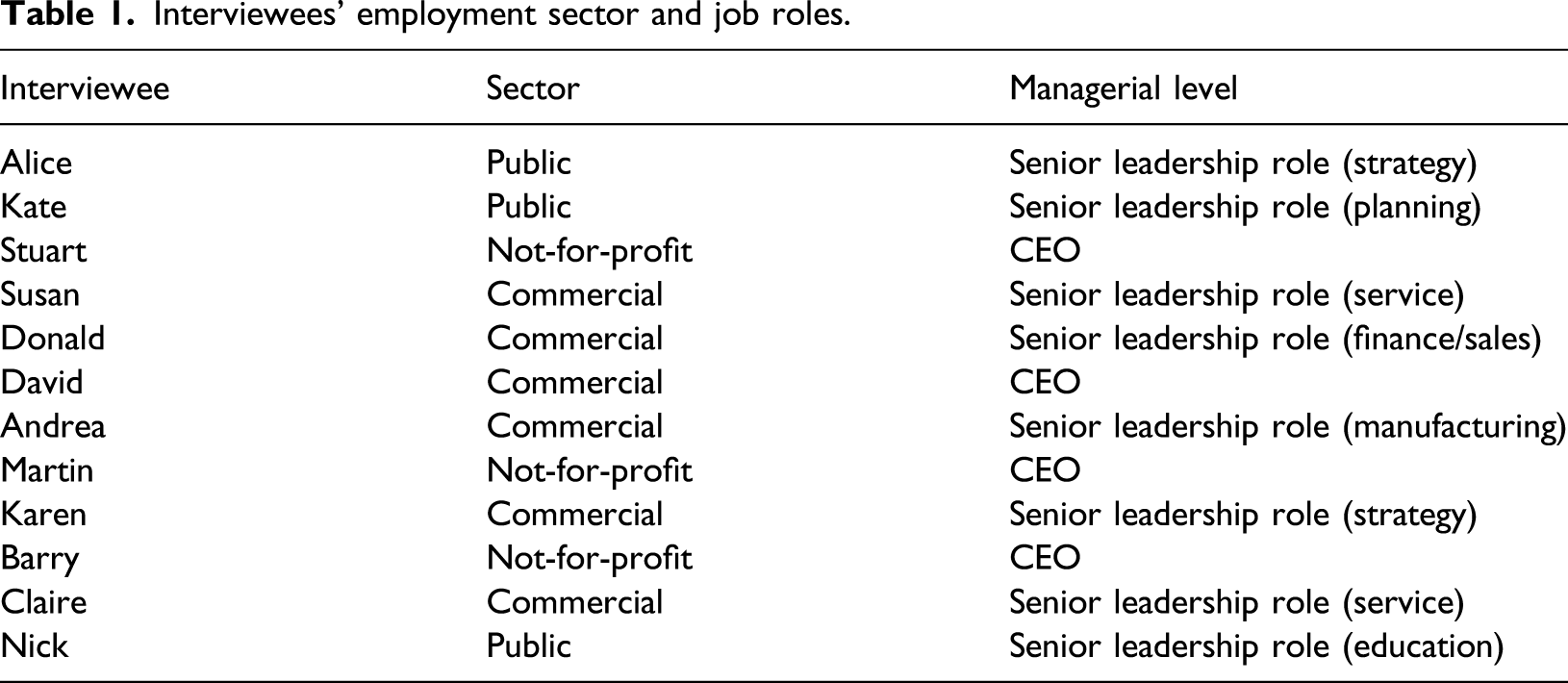
Adopting a longitudinal design, we engaged in three sets of activities over a 15-month period, collecting data from 12 individuals in leadership roles. This included two sets of semi-structured interviews (24 interviews in total, lasting on average 90 min each), diary studies and fieldwork observations. The design aimed to help researchers and participants develop trusting relationships, so providing the potential for greater understanding of the participants’ experience of managing emotions (Kempster, 2006). Observations of leaders in their workplace and diary studies provided researchers with insights into their daily activities and the opportunity to engage in informal conversations that helped to provide context for both sets of interviews. Initial interviews focused on the extent to which participants felt they had to manage emotions and perform emotional labour in their role. Second interviews were used to explore ideas of authenticity including how the participants expressed and performed their authenticity at work.
Interviews were mainly conducted face to face and were recorded and transcribed with the participants’ permission. Semi-structured interviews allowed both flexibility and in-depth exploration (Ambrosini and Bowman, 2001). While our interest was focused on particular areas as outlined above, we used a narrative approach to reduce the likelihood of social desirability bias (Őberseder et al., 2011), asking the participants to tell us about the kind of situations they have to deal with in their everyday practice.
Participants
Interviewees’ employment sector and job roles.
Analysis
Transcripts were coded using broad principles of template analysis (King, 2012), a form of thematic analysis that combines an initial coding template with a scope to incorporate emergent interpretation (Brooks et al., 2015). This approach enables researchers to develop a coding template through analysis of a subset of the data, before applying this more broadly to the full data set, thus allowing for full data responsiveness without compromising rigour, reliability or validity.
In the initial coding phase, the researchers independently read eight interview transcripts, selected for their cross section of different workplace contexts, experiences and issues (Brooks et al., 2015). The aim was to identify aspects of the text that appeared relevant to the perceived paradox of performing emotional labour and yet perceiving oneself as being authentic by drawing on ‘sensitising concepts’ (Blumer, 1969) from the literature. During this initial coding, additional, emergent themes were identified and redundant codes removed. The researchers then examined how themes related to each other and identified four distinct clusters expressing different rationales for the management of emotions. These rationales allowed the leader to retain a sense of authenticity at the same time as highlighting the disconnect between ‘authenticity’ and ‘relational transparency’.
The four clusters were utilised as an initial coding template, which the researchers independently applied to further eight interviews. This resulted in a number of modifications to enable a ‘rich and comprehensive interpretation’ (Brooks et al., 2015: 204) of the data. A further cycle of discussion between researchers led to more interpretive and abstract codes (Miles and Huberman, 1994) that could offer a basis for formulating potential explanations. At this stage, a fifth code was added to distinguish between managing emotions for the benefit of others and managing emotions to protect oneself. The final template, capturing the recurring explanations or rationales through which participants constructed authenticity and AL in ways that bridged the apparent paradox between authenticity and emotional labour, was then applied to the full data set.
Findings
Having begun our data collection with a sense of the incommensurability of performing emotional labour and retaining a sense of authenticity as a leader, the themes that emerged – which we have framed as ‘rationales’ – were rather surprising. They suggested participants’ ability to articulate feelings of authenticity even as they regulated their emotions as a routine tool of their leadership role. What emerged for us was the potential of these rationales to detach the experience of personal authenticity from the actions and interactions performed such as to construct a plausible relationship between emotional labour and AL. The underlying values and goals to which participants were committed served to supplant relational transparency as a key underpinning of authenticity and to frame emotional labour as both integral to their leadership role and beneficial to colleagues and the organisation. We now set out the five rationales derived from the data before identifying a series of paradoxes arising from them.
Emotional labour as integral to leader role
Throughout the transcripts, research participants made connections between the performance of emotional labour and their sense of what it means to be a leader, accepting the management of their emotions as integral to the professional expectations that go with holding a leadership role. They talked about ‘the role I have to play’ (Karen) and the need to ‘put on a persona’ (Andrea) or ‘work face’ (Claire) at the same time as seeing this as ‘what’s expected’ (Alice). Donald expresses this as follows: So, the times I have to manage my emotions are probably when I’m frustrated about a situation.…I have to deliver a message in a way that will get the best result for the company and the best result for that individual…and get to where we need to be. That’s just part of the job, and I know that if I don’t control those things, I will be doing a bad job (Donald).
Similarly, David saw his behaviours as a leader having ‘a huge impact’ because they ‘filter down’. Karen sees this as a natural consequence of a leader’s visibility, saying that as a result of ‘this unwritten rule book on how you will act and how you will behave’, leaders’ behaviours will be ‘picked up and commented on’. Hence, leaders were perceived as needing to ‘hold yourself to a higher standard’ (David), with professionalism setting a ‘boundary’ (Claire) to the emotions a leader can show. Barry expressed the need to ‘hold back’ his emotions and only display them ‘within certain parameters’.
As leaders, research participants also recognised emotional labour as something that was ‘beyond professionalism’: something that they actively used as a tool to enact leadership and achieve leadership goals. Barry talked about ‘showing a positive attitude’, while Stuart saw it as the need to ‘look imperturbable in order to inspire confidence’. While this rationale was expressed in terms of the general requirement to manage one’s emotions as part of being a leader, rather than in alignment with the need to be authentic, the challenge to relational transparency in the enactment of any kind of leadership is clear.
Managing emotions as an explicit part of being authentic
Participants articulated a sense of feeling authentic as leaders that was compatible with the performance of emotional labour but did not express this in relation to the core components of the AL construct. Specifically, the achievement of long-term goals to which they were committed was seen as a key priority in being true to oneself – with the performance of emotional labour being a legitimate and necessary tool of accomplishing these goals – while relational transparency was strongly subordinated where it was mentioned at all. With these goals in mind, leaders were able to suppress felt emotions or withhold information in order to keep colleagues on board or appear calm and in control while feeling frustrated or angry, all at the same time as feeling authentic.
Participants saw consistency – similar to Ricouer’s (1984) self-constancy in capturing the recognisable ‘subject’ which continues throughout a narrated life – as being important in projecting authenticity as leaders. It was seen as more important for staff to ‘see consistency in the type of leadership and behaviour’ (Alice) than it was to ‘tell everyone everything about your life’ (Martin). Related to consistency was the need to be ‘measured’ (Barry) and to ‘temper’ (Alice) some of your natural reactions to situations. Barry was clear that ‘being authentic is not just shooting from the hip every moment’ but requires you to ‘knock off some of the rough corners’ in how you present yourself. Kate summarised this when she said, If I don’t go in with my smile on my face, they may perceive someone that’s grumpy. In actual fact, it’s just someone that’s distracted…So actually, just putting a smile on is the right thing.…the authenticity’s still there because actually you may still talk to them about what’s on your mind, but you’re doing it with a different visual, I guess (Kate).
There appears to be a recognition of inauthenticity in Kate’s ‘different visual’, discursively constructed as ‘authentic’ through its alignment with internalised organisational goals. This long-term pursuit of valued goals vis-à-vis the expression of short-term emotions was evident in our data. Kate, for example, saw it as okay to ‘feel inauthentic in the moment’ knowing that she ‘won’t leave it’ but will find a different opportunity to get her point across. She acknowledges that ‘if I had said [my immediate thoughts] as I was hearing them and feeling them, they possibly would come across negative, or even aggressive sometimes because it’s the passion’. This inextricability between authenticity and inauthenticity was most cogently expressed by Alice as the need to ‘play the long game’: In everything I do, I play the long game…because to me that’s where the vision takes you. It isn’t a six-month or a twelve-month thing. It’s years to get to where you want to get to. So, when I’m dealing with people, they can really frustrate me sometimes and sometimes really make me quite cross, but…I will essentially swallow that anger and that frustration and I will deal with them in a very kind of considered and managed way because at the end of the day, it’s about what I want to ultimately achieve (Alice).
Emotional labour is necessary to the fulfilment of their values and beliefs
There was clearly a connection in the participants’ reasoning between feeling authentic and fulfilling their values and beliefs, with this connection still holding good through the lens of emotional labour. A key underpinning of their reasoning on the need for performing emotional labour revolved around the importance of shared values and for behaving in ways which brought others along with them. Hence, Karen told us, ‘probably a lot of [my] frustration and exasperation [comes from] the fact that people are not there on the same journey as me yet’. While Karen was trying to bring her customer service representatives team on her ‘values journey’, David struggled to convince his fellow director of the benefits of change: So, our Development Director, any change that comes to him, his first thing is to block it and go ‘no’. And it can be the best change in the world but he’s still going to come at it from that point of view of ‘not invented here; I don’t understand it; no, we’re not doing it’…after he’s done that enough times to you in the day you just want to shout at him and go ‘for crying out loud, stop getting in the way of things!’ ... Whereas actually what you do is step back and know that you need to take him on that journey and quietly have that conversation and bring him with you (David).
While David highlighted the huge ‘emotional investment’ required to manage his fellow directors, Kate noted the importance of the ‘timing’ of an intervention in working to bring people on board and the emotional labour required in doing this. She told us, I’m very, very aware of having to manage my emotions in those stages and, for me, frustration is…I am having to think about the words I use because I can be very black and white and very direct, so I have to try and soften that.… It’s that balance of, in the moment you can feel not authentic, but actually, you’re still living to your true values because you’re working to the end goal (Kate).
This is another example of inauthenticity being discursively constructed as ‘authentic’ through its alignment with internalised organisational goals.
Managing emotions for the benefit of others
The most frequently mentioned rationale for performing emotional labour was for the benefit of others. At its most basic, this was expressed in terms of not letting their own emotional issues come before the needs of their staff. Alice was clear that ‘things [that] happen to you outside of work, you can’t and shouldn’t carry [them] into work with you’. Kate was aware that ‘a good part of leadership is how you make others feel’. This had real resonance for her when a colleague described her as having a potentially negative presence: I can haunt a room when I walk in…I don’t try and do that, it just happens, and because of that I’ve got an obligation, really…I’ve got a presence, people look at me, people listen to what I say. So…I have to be very careful about how I interact because if I’m in a bad mood and they think it’s about them it hits their own insecurity (Kate).
There was also a perceived need to protect and support others. Karen saw it as ‘act[ing] the role of a protector’ in situations where ‘brutal honesty is going to cause people unnecessary worry/concern’. Barry, a senior leader in the healthcare sector, articulated the need to ‘exaggerate empathy’ in order to support his staff. More broadly, Nick talked about the need to present himself as ‘emotionally stable’ as a means of ‘giving people confidence’. Importantly, participants talked about the need to affirm others and appeared to accept that there could be a level of deception or inauthenticity involved in doing this. Donald expressed this clearly by saying: There is definitely a sense of being very cautious about saying anything that might come across negatively. So, if there is any challenge or critique of their work, I’m very conscious of trying to deliver that in a very positive, affirmative, learning, mentoring way rather than just the facts which could leave them feeling put down (Donald).
In expressing this rationale, it was clear that participants were aware of the tension between managing their emotions for the benefit of others and being true to themselves in an immediate sense, yet the sense of being true to their values – to their ‘deeper’ (Humphrey et al., 2015) self – enabled them to reframe this tension in a way that felt acceptable.
Managing emotions to protect themselves
The final rationale identified in our findings illustrates how participants manage their emotions in order to protect themselves, as a last-ditch response to specific, toxic situations. As a minimum, Nick articulated the need for a ‘safe place with a safe person’ where he could ‘refill that emotional well’ when he had reached capacity. Barry said he ‘[felt] safe in showing extremes of emotion outside work’ but would not do so in work where he could not afford to feel ‘in any way vulnerable’. Alice described it as ‘showing nothing, don’t show your hand, don’t give people any idea how you feel about anything’, while Donald described being ‘extremely guarded’ with a difficult client where ‘I am guarding myself, knowing that [he has] the capacity to hurt me’.
Surprisingly, participants who expressed the need to protect themselves still wanted to add value to the business, even at a cost of their own well-being. Susan’s complex emotional position powerfully captures the emotional cost of this devotion to duty: What was happening by me having to suppress all of that and feeling angry all the time about not being able to influence things and feeling disempowered and controlled and very, very angry – I didn’t find ways to express that within that context when everybody was being really cynical and negative; then I’d be with the consultants [rather than the directors] and I’d be, like, ‘Raarrgghh! (Susan)’.
Not surprisingly, perhaps, Susan left this organisation not long after our research concluded.
Taken together, the five rationales articulated by the participants provide insights into how they discursively construct authenticity in a way that is compatible with the performance of emotional labour. Through this process of discursive construction, they seem able to detach their personal experience of authenticity from the actions and interactions they are required to perform, at the same time as weaving a plausible relationship between the two. The data thus reveal the complex patterns of authenticity and inauthenticity that characterise emotional labour, and hence challenge the suggestion of a direct link between leadership and authenticity, as suggested by the AL construct. We suggest three core paradoxes as emergent from participants’ construction of authenticity, as given in the following text.
Role modelling professionalism – who they should be rather than who they are
The participants articulated a sense of how they should present themselves as leaders, using phrases like ‘persona’ or ‘work face’ to describe this outward presentation. They described the expectations of professionalism as setting a ‘boundary’ around their behaviour and the emotions they could show because their behaviours were likely to be ‘picked up and commented on’ by others. The connection here between how they should be and who they should be – and hence what an ‘authentic leader’ should look like – is evident, as is the sense that they have internalised the need to conform to these expectations and hence no longer view them as inauthentic. Even at their most extreme – where toxic situations forced participants to be ‘extremely guarded’ or to not ‘give people any idea how you feel about anything’, this was still constructed as being in the service of what it means to be a leader. Thus, authenticity is constructed as something that is bounded or circumscribed by the expectations of the role or situation to which it pertains and underpinned by the duty of professionalism in interactions with others.
Underpinning values as a key driver – what they were true to rather than who
The achievement of internalised, value-congruent goals was a strong driver for all our participants and expressed as an integral part of being true to oneself. Thus ‘play[ing] the long game’ because ‘that’s where the vision takes you’ was seen as both legitimate and acceptable in order to achieve valued goals. The performance of emotional labour may mean that ‘in the moment you can feel not authentic’, but a deeper authenticity was felt in terms of the eventual achievement of valued goals. In this way, authenticity was constructed as something deeper than how you appear and whether this coincided with what you were feeling in the moment: It was the sense that your ‘true self’ was reflected in the goals to which you aspired and your commitment to bringing them to fruition.
Self-consistency – being the same self over time and across situations
The articulation of consistency over time – of showing the same self in different situations and no matter what was going on for you personally – stands in direct opposition to the idea of relational transparency as a marker of authenticity. The concern for self-consistency is articulated as authentic but involves the emotional labour of masking certain feelings: This is clearly paradoxical and, at some level at least, inauthentic. Expressed in terms of needing to ‘temper’ some of your natural reactions, of being a ‘stabilising force’ for others, the idea of self-consistency speaks to a self over time and place to which one is being consistent, rather than a ‘self in the moment’ to which one is being true. Authenticity, here, is constructed as a recognisable ‘you’ that others can rely on to be the same each time they interact with you.
Taking these themes together, the phenomenon of authenticity, as it is constructed and manifested by practicing leaders, becomes a bricolage of deontological role expectations (who should you be), commitment to underpinning values and goals (what you are true to) and maintaining a recognisable self that others can relate to (self-consistency in personal presentation). These components necessarily make authenticity subjective, situational and unlikely to be captured within the constraints of a normative, reductionist psychometric. They also reflect the intersubjective relationality (Gardiner, 2013) of authenticity as it is accomplished in the world. At the same time, there is a fourth element to the construction of authenticity by our participants, which brings us back to our point of departure: the inherent inauthenticity – being inauthentic in order to be authentic – that is the fundamental paradox of AL. The acceptance of emotional labour as ‘just part of the job’ – the requirement to ‘deliver a message in a way that will get the best result’ or for ‘showing a positive attitude’ even when you do not feel it – with, it would appear, the ability to reframe any feelings of inauthenticity this may be expected to invoke gets to the heart of the problem here. That leaders can ‘talk to [staff] about what’s on your mind, but…with a different visual’ or ‘exaggerate’ a feeling, or ‘model it more expressively’ to enhance a message that articulates quite powerfully that for these leaders, ‘being authentic is not just shooting from the hip every moment’ but requires you to ‘knock off some of the rough corners’ in how you present yourself. The apparent incommensurability of emotional labour and AL appears swept away in the daily reality of the practicing (authentic) leader.
Discussion and conclusion
The paradoxes emerging from our data have implications for our understanding of authenticity as a phenomenon and raise profound questions for the AL construct. We now explore how the coexistence of emotional labour and feelings of authenticity in leadership practice requires us to acknowledge inauthenticity as a fundamental if paradoxical element of AL.
The five rationales demonstrate that participants saw emotional labour as integral to their sense of themselves as leaders and accepted emotional labour as a tool to deliver valued goals. This latter resonates with ideas of a ‘deeper level of authenticity – where identity resides’ (Humphrey et al., 2015: 754) and with deep acting’s effort to ‘conjure up a sincere performance’ (Bolton and Boyd, 2003: 290). For most interviewees, managing emotions was clearly articulated as a necessary part of being consistent and appearing credible. The rationales thus implicitly construct authenticity as a situated and subjective phenomenon: true to the self, yes, but a more fluid and contingent self (Tomkins and Nicholds, 2017) than this phrase implies. Significantly, managers appear to shift seamlessly from the deontological elements of ‘being true’ – grounded in notions of standards of professionalism that they are obliged to portray – and more teleological elements – where the achievement of valued goals as ends justifies the in-the-moment presentation of an inauthentic self through the performance of emotional labour as legitimate means. The ability to hold both these ethical systems in play at the same time, rather than choosing between them, suggests a more complex understanding of the ethical components of what it means to be authentic than the possession of an ‘internal moral compass’ (Walumbwa et al., 2008) suggested by the AL construct.
In delving into the foundational questions for AL raised by our exploration of emotional labour, however, our primary concern is with the inclusion of ‘relational transparency’ (Walumbwa et al., 2008) as a key component of the construct. Specifically, if authenticity is concerned with the ‘true self’ and relational transparency requires the showing of that true self, then emotion management/emotional labour must perforce require leaders to be in authentic. The routine acceptance of emotional labour as a tool for the leadership role thus suggests the impossibility of enacting authenticity as specified by the AL construct. By implication, enacting AL as currently constructed is also impossible. At the same time, however, the utilisation of emotional labour as an accepted ‘means’ for accomplishing value-driven ‘ends’, with little or no apparent tension or dissonance for practicing leaders, suggests that relational transparency as a core component of the AL construct is largely irrelevant for these leaders. And if leaders can feel authentic while intentionally being less than transparent in their relationships with others, then what is the relevance to them, in practice, of authenticity (as defined within the AL construct)? Again, if relational transparency – the ‘most fundamental element of AL’ (Ciulla, 2013: 156) – is perceived by practicing leaders as irrelevant, then what does this say for the relevance – or irrelevance – of AL as currently constructed? And if the routine performance of emotional labour makes relational transparency an impossibility (which it appears to), then surely, it also makes AL, as currently defined, an impossibility too. This leads us to the fundamental paradox of ‘authentic inauthenticity’ as enacted by practicing leaders: a paradox which we have attempted to unravel through the lens of emotional labour. In accepting emotional labour as a routine part of their leadership practice and an essential tool for the accomplishment of valued goals, the study participants constructed AL as requiring them to be inauthentic in order to lead effectively. That this implicit inauthenticity did not, in practice, provoke feelings of being inauthentic – that it, instead, was subsumed into their experience of being an authentic leader – speaks to the need for a more complex, social construction of authenticity in leadership – with inauthenticity at its heart – than the current AL construct is capable of offering. A revised construction of authenticity needs to combat irrelevance/impossibility by embracing, rather than denying, its inextricable symbiosis with inauthenticity and accepting not only that not all inauthenticity is bad but also that it may be in moments of intentional inauthenticity that we are most aware of the whole authenticity project.
The present study is not without its limitations, not least the potential for post hoc rationalisations as part of the sense-making process. In addition, our research participants presented us with personal and situated rationales for their behaviour and perceptions, which may not be replicated in other contexts or by other leaders. Notwithstanding these limitations, we believe our findings richly evidence the paradoxes inherent in the AL construct and the significant disconnect between this construct and practicing managers’ constructions of their experience of (in)authenticity as leaders.
Based on the rich vein of data we have been able to access, we would encourage other scholars to consider the performance of emotional labour as a prime lens for exploring the accomplishment of authenticity in leadership and for bottoming out the foundational paradoxes within the current AL construct. We have focused primarily on relational transparency, but emotional labour may offer a productive testing ground for the remaining three components and a valuable vehicle for the regrounding of authenticity in leadership from a practice perspective. Key questions for future exploration could usefully include the following: What does the performance of emotional labour tell us about the intentional versus attributional nature of authenticity, and how could this inform a regrounding of the AL construct? How (if at all) can the tensions between the deontological versus teleological ethics underpinning leader authenticity be reconciled, and what are the implications of such reconciliation for AL? How might leadership learning interventions, based on surfacing a more nuanced awareness of leadership authenticity, help support practicing leaders in managing the complex dynamics at play in feeling authentic as a leader? and To what extent does the impossibility/irrelevance of authenticity as defined within the AL construct and as surfaced by our study suggest the need for a wholesale shift away from AL as a means of capturing our aspirations for good leadership?
We hope that the more nuanced understanding of AL, which this a type of research can be expected to produce, will support developing and practicing leaders in combatting the more normative and functionalist (Avolio et al., 2004; Gardner and Schermerhorn, 2004) portrayal of AL which has served to add pressure to their already challenging roles. We hope, too, that it will help leaders come to terms with the notion that ‘confronting one’s own inauthenticity is an inescapable element of the authenticity journey’ (Tomkins and Nicholds, 2017: 265).
Footnotes
Declaration of Conflicting Interests
The author(s) declared no potential conflicts of interest with respect to the research, authorship and/or publication of this article.
Funding
The author(s) received no financial support for the research, authorship and/or publication of this article.
