




Abstract
The notion of leadership competencies is a much-debated issue. In this article, we propose that how the leader makes sense of his or her competencies is key to leadership practice. Specifically, we look at how leaders reconcile discrepancies between the self-perceived proficiency of various competencies and their corresponding importance. Empirically, we study leaders within the music domain – how choral conductors make sense of their competencies in the shaping of their professional practice. We investigated how choral leaders in Scandinavia (N = 638) made sense of their competencies in the face of demands in their working situations. A mixed methodology was used, comprising a quantitative survey with qualitative comments and in-depth interviews with a selection of the respondents. The results show that when choral leaders shape their practice, they frequently face competency gaps that compel them to act or adjust their identity. The key to this sensemaking process is how they move competency elements they master to the foreground and wanting elements to the background. The concept of ‘sensemaking affordance’ is introduced to account for how various leader competency categories are negotiated to safeguard overall efficacy.
Introduction
The concept of organisational sensemaking was originally developed to better account for the apparently ubiquitous imperfections of real organisations (Weick, 1995). Sensemaking generally refers to how people seek to understand ambiguous or confusing issues or events, and since its inception, the concept has been applied and developed by a number of scholars (Brown et al., 2015). In this study, we apply sensemaking to the individual leader in the open-ended structure of a professional practice and explore how leaders make sense of their competencies. Specifically, we look at how leaders reconcile discrepancies between self-perceived proficiency in various competencies and their corresponding importance. Empirically, we study leaders within the music domain, and how choral conductors make sense of their competencies in the shaping of their professional practice. Choral leadership encompasses an array of managerial and artistic functions that require people skills as well as musical craftsmanship (Jansson, 2018). Conducting is in one respect a generic leadership practice similar to other organisational domains, while at the same time offering specific qualities that have inspired leadership research (Atik, 1994; Bathurst and Ladkin, 2012; Hunt et al., 2004; Koivunen and Wennes, 2011; Mintzberg, 1998). The most conspicuous feature of conducting is gestural leadership, relying only on hand movements and bodily appearance in the performing situation. However, beyond the emblematic role of gestures, choral leadership is also a ‘regular’ organisational domain.
The topic of this study finds itself in the tension between two opposing views of leadership: entitative versus relational (Dachler and Hosking, 1995; Hosking and Shamir, 2012; Raelin, 2016; Uhl-Bien, 2006). Leadership theory has traditionally been biased towards the individual leader as the primary unit of analysis, even when relationships and contingencies are considered (Dinh et al., 2014). The entitative position runs the risk of neglecting the subtle, moral, emotional and relational aspects of human organisation, and several scholars have questioned traditional conceptualisations of leadership (Alvesson and Sveningsson, 2003b; Bligh et al., 2011; Dachler and Hosking, 1995; Gemmill and Oakley, 1992; Ladkin, 2006; Yukl, 1999). The antithesis to the entitative view is to shift attention to the ‘middle space’ as the primary study object rather than to the participants. However, it is challenging to operationalise and measure what goes on ‘between’ people, as suggested by LMX theories (Sheer, 2015). According to Ladkin (2010), the leader–leadership dichotomy presents ontological unclarity that deserves fundamental philosophical scrutiny. Some scholars argue for a reconceptualisation of leadership that implies not only a full shift to a process view, but also a conception of leadership as an emergent and fluid notion that is socially constructed (Crevani, 2018; Pye, 2005; Raelin, 2016).
One particular aspect of the critique of the entitative position is the preoccupation with leader competencies (Bolden and Gosling, 2006; Carroll et al., 2008; Fisher and Robbins, 2015). Bolden and Gosling (2006) found a disturbing gap between attributes required of leaders themselves and popular competency frameworks. They argue that a competency approach to leadership nurtures a fragmented rather than a gestalt view.
The music ensemble is a type of organisation that seems particularly vulnerable to the critique of the entitative and competency-based leadership view. The position and the romanticisation of the maestro render the leader entity rather conspicuous and a coveted study object (Faulkner, 1973; Hunt et al., 2004; Lebrecht, 1992; Mintzberg, 1998; Woodbury, 1955). At the same time, the music ensemble may be the most obvious showcase of a relational leadership paradigm, which by various scholars is framed as collective agency (Raelin, 2016, 2020), collective virtuosity (Marotto et al., 2007) and emergent collective behaviour (Will, 2016). In this fine-grained coordination in the intersubjective space between ensemble members, individual boundaries are transcended (Jansson, 2019; Ladkin, 2006), and leadership as cause and effect ‘disappears’ in the act (Alvesson and Sveningsson, 2003a; Ladkin, 2010).
Even if we adhere to a process ontology of leadership, we nonetheless argue that the leader entity still matters, and how the leader makes sense of his or her competencies is key to leadership practice: the ensemble leader remains a distinct figure and has an identifiable impact on the ensemble and a number of distinct competencies are taught in universities and academies. The relational view was created as an opposite to the entitative view, and reconciling the two has not been a prime concern. Our point of interest was exactly this: given that we cannot merely conjure the maestro out of the relational view, how might we rethink the leader entity in a way that is sensitive to the relational leadership view? We argue that sensemaking theory (Maitlis and Christianson, 2014; Weick, 1995) is a potent mediator because it accommodates both the ongoing, enactive and imperfect nature of social practices and a role for the sensemaker. Even within the collective agency of an organisation, ensemble members cannot be empty shells, and the ensemble leader comes to the party with a certain habitus (Bourdieu, 1977; Bush, 2011) – competencies, beliefs and predispositions that deserve attention.
When we put ourselves into one of the lingering dichotomies in leadership theory, this should be read with considerable modesty. Our ambition is merely to point out how the sensemaking concept offers some untapped potential in this space. Our curiosity was triggered by a study of choral leaders whose self-perceived level of proficiency for a comprehensive set of skill elements was found to correlate strongly with the importance rating of those skills (Jansson et al., 2019a, 2019b). What might have been seen as a methodological flaw instead presents a case of pervasive sensemaking that is crucial for the very notion of leader competency. The importance of a given competency and the corresponding proficiency are at the outset distinct phenomena. Importance is externally induced, although assessed in light of own practice. Proficiency is internally generated, although externally applied. However, as choral leaders reflected on a competency, they immediately became entangled in a web of the ideal and the possible, external expectations and individual beliefs, action or paralysis; in other words – sensemaking. We therefore asked the following research questions: How does a leadership practice appear through a sensemaking lens, with emphasis on self-perceived competency? What is the nature of the sensemaking activity that choral leaders undertake in shaping their practice, and how does this inform sensemaking theory?
The empirical basis for the present article is the original data with a renewed look, complemented by additional interviews with a selection of the respondents.
Theory
Observing sensemaking
The aim of this section is to pinpoint those aspects of sensemaking that can be made observable in our study. Without a single agreed definition, there is ‘an emergent consensus that sensemaking refers generally to those processes by which people seek plausibly to understand ambiguous, equivocal or confusing issues or events’ (Brown et al., 2015: 266). In retrospect, Karl Weick’s (1995) seminal concept of organisational sensemaking was an overdue response to lingering problems with theory in order to better understand how organisations operate and evolve in an era of uncertainty, complexity and diversity. Weick developed seven properties of sensemaking: it is (1) ongoing, with no clear beginning or end, (2) rooted in identity as well as an impetus for identity formation, (3) social, (4) triggered by cues as well as conducive of which cues we attend to, (5) retrospective, (6) enactive and (7) favours the plausible over the accurate. The fact that sensemaking is driven by pragmatics, reasonableness, invention and instrumentality makes it useful in the messy and ambiguous world of work and organisations. Sensemaking is both a process and a result, which may be analytically challenging, but this is an inevitable consequence of its ongoingness.
Originally, the concept was developed for organisations where the unit of analysis is the collective of individuals in a well-defined entity. In our case, we apply it to the individual leader in the more open-ended structure of a professional practice. Although sensemaking is conceptualised as a social phenomenon, it is also fundamentally tied to individual identity formation (Brown et al., 2008). For the seven properties to apply on the organisational level, they cannot be removed from the individual – they must somehow also be at work on the cognitive level. A pertinent issue is whether institutions (such as a professional practice) frame sensemaking or whether sensemaking constitutes institutionalisation (Weick et al., 2005). Our premise is that a professional practice arises as a macro-phenomenon but is inherently an interplay with the microstates of individual actors (Hedström and Swedberg, 1998), that is, professionals operating within a fuzzy organisation of peers and fellow practitioners. According to Weick (1976), such loosely coupled systems imply increased pressure on individuals to construct their social reality, although they might have fewer resources for sensemaking, given the level of unpredictability and ambiguity.
The seven properties of sensemaking are conceptually distinct, although interconnected. Survey and interview questions function as events or interrupts that trigger sensemaking activity. Survey and interview questions impose themselves on respondents as cues that prompt articulation, although similar cues may already slumber beneath the surface. From an epistemological point of view, cues make sensemaking salient. In our data, where we focus on an evolving professional practice, cues are biased towards the encounter between own competencies and the demands of the working situation. According to the enactive property of the theory, respondents are compelled to talk about what they did about a certain situation or what it did to them. Notably, action includes the changing of the mind, that is, reconstructing the original problem (Moldoveanu and Stevenson, 2001). A problem may be solved to a lesser or larger degree – a plausible solution will do, including a modification of identity if needed. Given our research questions and our data set, enactment, plausibility and identity form the ‘grinding wheel’ of sensemaking, where the process comes to light. In contrast, ongoingness, retrospection and sociality operate more as a platform for making sense of the professional practice and are observable to a lesser degree. This structure is depicted in Figure 1. The observational structure of sensemaking in survey/interview data.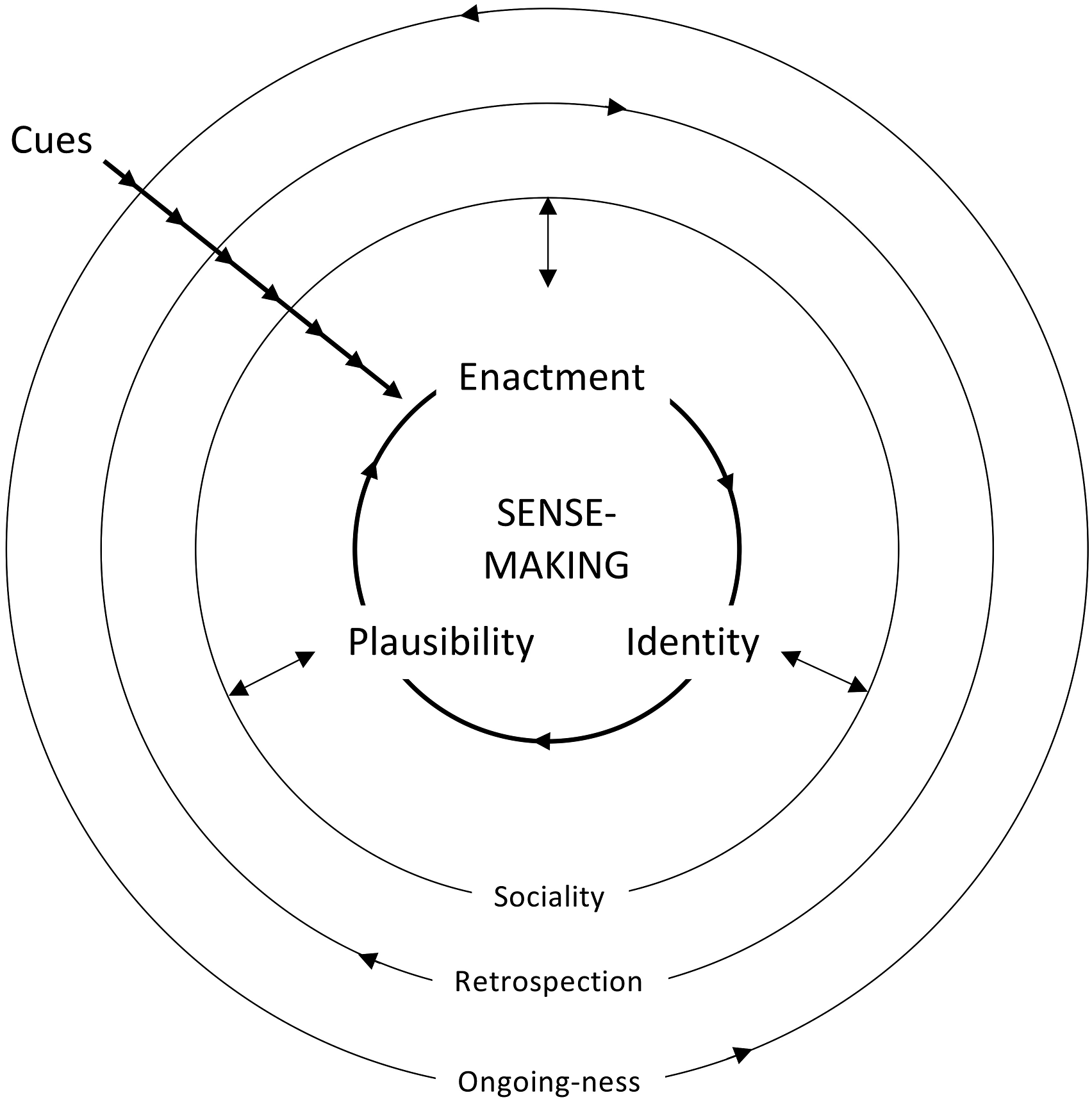
A cue is particularly noticeable when it creates a cognitive dissonance (Coutinho, 2010; Festinger, 1957; Perlovsky et al., 2013), and the impetus for sensemaking is more compelling when the dissonance is strong. ‘[W]e expect to find explicit efforts at sensemaking whenever the current state of the world is perceived to be different from the expected state of the world’ (Weick et al., 2005: 414). Because our data set highlights the encounter between self-perceived competency and working situations, making sense of cues through the enactive and identity-shaping properties inevitably involves attempts to reduce cognitive dissonance. Plausibility is the property that makes it possible to remove dissonance even if the original problem is not fully solved.
The impact of a shared ‘meaning object’
The aim of this section is to provide a rationale for how musical leadership is a particularly intense meaning-making domain that has a bearing on leadership. Leadership models have tended to neglect leader schema, scripts and knowledge structures as explanatory variables (McCormick and Martinko, 2004). Also, in sensemaking studies, attending to how cognitive frames shape sensemaking has been called for (Weber and Glynn, 2006); specific forms of sensemaking, including the context in which sensemaking happens and the role of institutions (Maitlis and Christianson, 2014). Some studies have applied sensemaking theory specifically to how musical ensembles operate (Cornelissen, 2006; Humphreys et al., 2012; Weick, 1998). Weick anticipated aspects of sensemaking in the context of music in his earlier work (Weick et al., 1973). Sensemaking has also been used more implicitly to describe the experiencing of perfect ensemble coordination – moments of ‘collective virtuosity’ in orchestras (Marotto et al., 2007) and the intersubjectivity of choral singing (Jansson, 2018). What distinguishes music from most organisational domains is the degree of codification – shared rules that guide appropriate actions and relationships, similar to an institution (Barley and Tolbert, 1997). The music as institution functions as ‘a coherent symbolic code, while sensemaking is the practice of using the code’ (Weber and Glynn, 2006: 1643).
Music represents ‘minimal sensible structures’ available for sensemaking (Weick, 1995) which are both precise and commonly shared. Hence, musical meaning has unsurprisingly been attributed to the music material (Adorno, 1941). However, there is a growing realisation that people make sense of and with music through an interplay of intra-musical qualities and the social context of production and reception (Cook, 2001; Koopman and Davies, 2001; Ruud, 1997). DeNora’s (2013) notion of music’s affordance expresses its sensemaking potential. When Small (1998) claims that it is our engagement with music that creates meaning, he aligns with the enactive property of sensemaking. The crux is that music is a partially stable meaning object. On the cognitive level, music exhibits embodied, universal features (Leman, 2008; Koelsch, 2011), but they promptly appear subjective as soon as we engage with it, meaning for me. A level of intersubjective meaning may appear on the social level (meaning for us) as more or less authorised meanings, such as Jimmy Hendrix’ music is ‘rebellion’, folk music is ‘authentic’ and Wagner in Israel is ‘inappropriate’. Music is therefore a powerful identity marker to the extent that music can become a ‘personal soundtrack’ of one’s life or ‘metaphor for identity’ (Ruud, 1997: 11).
Because musical meaning oscillates between the subjective and objective, music is a vehicle for intersubjectivity and serves as a conduit between individual lifeworlds (Nielsen, 2011). When people engage jointly with music in a limitless variety of situated practices, whether the amateur choir, teenagers listening to the same band or the professional symphony orchestra, their sensemaking is somehow guided by an inherent logic of the mission. A key characteristic of the musical ensemble as an organisational domain is the engagement with a shared meaning object and the intense purposefulness that imbues the mission.
The domain of the present study is the musical ensemble with a dedicated leader role: the conductor (from conducere, ‘to lead with’). The leaders are choral conductors, which means that they lead choirs, that is, singing ensemble members. Although conductors often lead mixed ensembles comprising singers as well as instrumentalists, choral conducting is considered a distinct profession. Ensembles typically need a leader when the number of members exceeds twenty, or less when the music to be performed requires complex coordination. Despite wide variation in musical genres, choral conducting is a global phenomenon (Geisler, 2010). The choral leader fulfils several functions in preparing and performing a musical programme and engages in sensemaking on multiple levels: within the musical flow (micro), within a musical project (meso) and on the level of the conductor’s professional practice (macro) (Jansson, 2018). Although these levels are interconnected, it is sensemaking on the macro level that is the focus of this article.
Choral leader competencies
The aim of this section is to explain the competency model that was used to generate the data. The notion of leader competency is rather slippery because it includes objective requirements as well as the leader’s self-perceived capacity to assume the role. Belief in one’s own ability to lead has been found to predict performance and has been conceptualised as leader efficacy and leadership self-efficacy (Hannah et al., 2008; Van Knippenberg et al., 2004). People with high self-efficacy have been found to attribute positive outcomes to themselves, as opposed to those with lower self-efficacy who make more self-effacing attributions (McCormick and Martinko, 2004). Moreover, followers atribute leadership abilities to individuals who exhibit leaderly demeanour, that is, who fit certain prototypes of leader appearance (Conger et al., 2000; Meindl et al., 1985). Consequently, leader competency is a somewhat circular concept: leader and follower beliefs in capability sustain leader effectiveness, and the ability to induce such beliefs therefore constitutes a competency. How a leader makes sense of his or her own leadership practice is intertwined with the enactment of the practice. This blurring is only a problem if pursuing a predictive model of cause and effect of leadership and leader competencies. For our research questions, a descriptive competency model will suffice, and how competencies come into play for an individual leader is a matter of perception. Sensemaking theory recognises that ‘constraints are partly of one’s own making and not simply objects to which one reacts’ (Weick et al., 2005: 419). Sensemaking shapes self-efficacy when cues are acted upon, and self-efficacy shapes the identity on which sensemaking is rooted. The circular notion of leader competency then becomes the sensemaking fabric from which a professional practice is woven.
Competency categories.
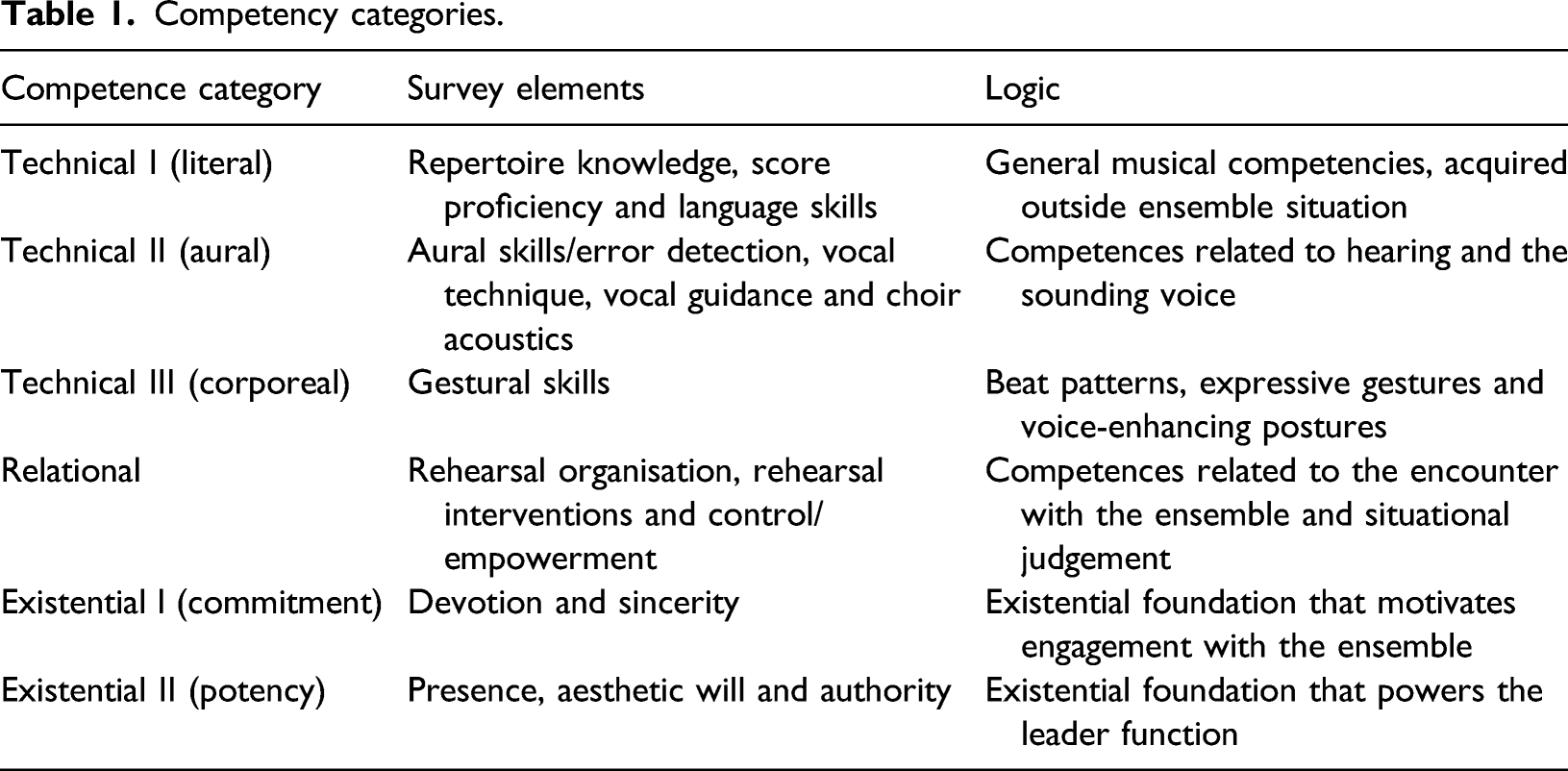
The existential category requires a commentary because it is rated as more important than the other categories by leaders and ensemble members alike and yet is rarely explicitly addressed in formal education (Jansson, 2019; Jansson et al., 2019b). When Kempster et al. (2011) argue that purpose is more fundamental to leadership than vision, mission and goals, this point is particularly valid for the musical leader because music is associated with existential meaning, that is, with intrinsic purpose, whereby the leader’s existential features assume the position of competency, a necessary capacity in order to lead. The nature of the leader’s commitment, comprising sincerity and devotion to the ensemble and the music, is found to be a showstopper. When not in place, everything else seems futile. The leader’s potency, comprising presence, authority and aesthetic will, is what ultimately enables the dense blend of power and sensitivity in the choral leader to act.
Materials and methods
Sensemaking is inherently a complex and qualitative phenomenon, and quantitative study approaches are rare. Our combined data set, comprising survey data as well as textual material, unavoidably called for a mixed methodology. Mixed methods have increasingly been applied in the social sciences (Leech and Onwuegbuzie, 2009) but are still marginal for leadership research specifically (Stentz et al., 2012). The rationale for a mixed methodology within the same study is that the combination will give better answers to the research question than the two separate methods (Cresswell and Piano Clark, 2011). The challenge with mixed methodologies is to cope with different epistemologies, not least with the tension between deduction and induction, which is even a problem within qualitative methods alone. A deductive epistemology is silent about theory construction and, in a strict sense at least, takes phenomena merely as objects or contexts for theory testing. A third logic is at hand – abduction – which is understood as a continuous and iterative process of conjecturing about the world, shaped by existing knowledge (Timmermans and Tavory, 2012; Rennie, 2012). While deductive methods take existing theory as the starting point and inductive methods generate theory from data by uncovering empirical generalisations, abductive methods involve reasoning from discovery of an unexpected phenomenon in need of an explanation (Haig, 2005).
While mixed model advocates may retain a positivist philosophy of science foundation, for example Böhme et al. (2012), our study adheres to a praxis-oriented, abductive epistemology that accommodates intuition and reasoning, bracketing and preconceptions (Raelin, 2020). We first present the data collection and then return to the specifics of the analysis process.
Questionnaire and collection of quantitative data
We distributed a questionnaire covering 17 competency items pertinent to the choral leader role to a wide population of conductors in Norway and Sweden in the autumn of 2017 and spring of 2018. We posed the questions with the conductor’s experience in mind. The perspective on competency is therefore subjective and situated. The two survey questions of relevance for the present article were as follows:
Q1: How important is this competency in your own conducting practice?
Q2: To what degree are you comfortable with your own competency level?
The responses were given on a five-point scale. The order in which the various competency items were presented was arbitrary, without any numbering or grouping. For the analysis, we aggregated the elements into six categories, supported by a factor analysis. These competency categories are shown in Table 1.
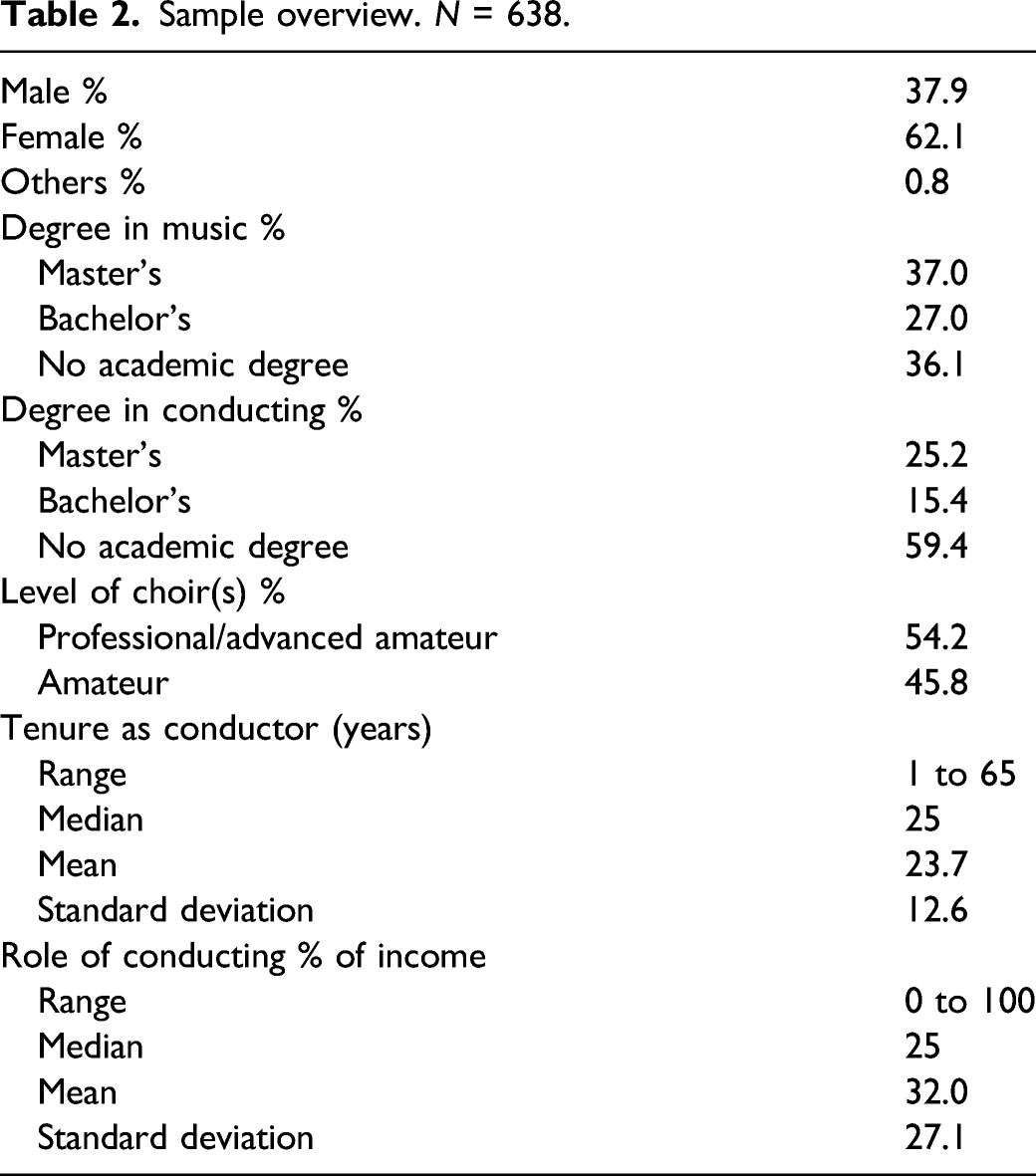
Sample overview. N = 638.
Commentaries and interviews
Because the survey was first distributed in Norway and then later in Sweden, the role of qualitative data changed as we gained experience. In Sweden, respondents were invited to write short personal commentaries, whereas there was limited space for this in the Norway survey. To compensate, we conducted 20 in-depth interviews in Norway during the summer of 2018. The data collection process was approved by the Norwegian Centre for Research Data. The potential list of interviewees was based on interest indicated on the survey form, and the selection aimed for a variety of conductor profiles. We completed interviews as video conferences, each lasting between 30 min and one hour, where only audio was recorded and transcribed.
Abductive analysis
Our analysis consisted of three concurrent processes: (1) textual proposition, (2) numerical substantiation and (3) conceptual emergence. These processes were not linear but rather iterative and interdependent – what Alvesson and Sköldberg (1994) describe as a constant shifting between empirically loaded theory and theory-loaded empirical material. Textual proposition: We thematically coded the transcribed text (Van Manen, 1990; Kvale, 2007) using the software programme HyperRESEARCH, seeking to capture the sensemaking activity reflected in the transcripts. Specifically, we sought situations where one or more of the properties of sensemaking became salient. Such situations were by design oriented towards competency in light of working situations. Situations were expected to be described in terms of what the informants did about them or what the situations did to them. Numerical substantiation: We looked for manifestations of sensemaking in the quantitative data. Specifically, we attempted various numerical constructs that could be tested. For example, we looked at alternative ways of quantifying correlation between importance and competency level. We also tested the degree to which correlation was contingent on the contextual variables at hand. Given that sensemaking is a general and omnipresent phenomenon, we would expect moderate variation across contexts. Within an abductive approach, numerical findings cannot be seen as proof of sensemaking, but rather indications of it. Conceptual emergence: We sought to construct a picture of how sensemaking in the context of leadership competencies appears on an aggregate level (‘self’) as well as on the competency element level. With regard to the interdependence of the three processes, a key point is that unexpected observations are generative, and discovery and justification are often inseparable moments. We conceptualised our insights as they evolved by aiming for what Timmermans and Tavory (2012: 180) call a ‘dialectic of cultivated theoretical sensitivity and methodological heuristics’. According to Reichertz (2019), abduction is a mental act that also involves mental leaps that bring together things which previously were not associated with each other. In our case, such leaps constituted moving from correlation to sensemaking and hypothesising various sensemaking mechanisms.
There was close interaction between quantitative and qualitative analysis, a fairly balanced blend of the two, and concurrent timing (in the sense that there was no link between consecutive data collection steps), where the blending occurred at the results/analysis stage. In the taxonomy of Cresswell and Piano Clark (2011), this mixed method approach is called convergent parallel design.
Results
Correlation between importance and level of competencies
Correlations between ratings of importance of competency and self-perceived competency level. N = 638.
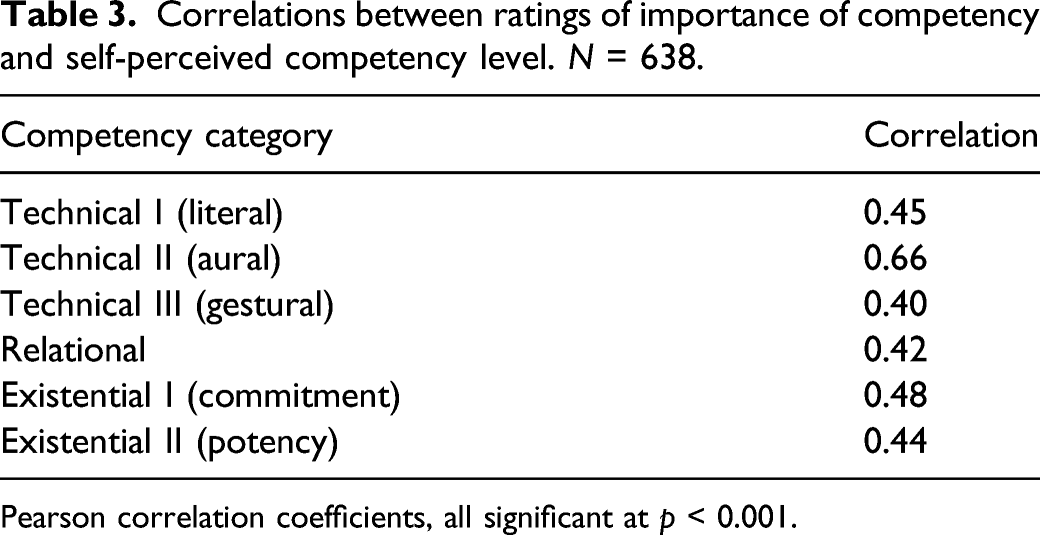
Pearson correlation coefficients, all significant at p < 0.001.
Table 3 shows notable correlation coefficients with unquestionable significance. The notions of importance and competency level are at the outset distinct in the sense that importance is ‘external’, and competency is ‘internal’. Importance derives from external expectations because it asks about what matters in the face of a given professional practice. Competency level, on the other hand, reflects the individual’s comfort level with his or her own proficiency. However, the correlations indicate that blending occurs – that respondents immediately engage in making sense of their own competency. One respondent explicitly realised that she did in fact blend competency and importance when answering the question about importance: The answers reflect the skills I believe that I have rather than what is ideal. At the outset, the factors [competency items] should be equally important.
Although this respondent found it challenging to rate the competencies, she did in fact differentiate between importance and competency level across the elements. At the individual level, scoring expresses a nebulous blend of importance and competency level, which at the aggregate level reveals the pattern shown in Table 3. From the data, we observe two aspects of sensemaking on the overall role level: a trade-off between competency elements and a failure to meet all the demands.
Adjusting relative importance to safeguard overall comfort level
An example of trading between competencies is given by one conductor (whose father is also a choral conductor) as he explains how he shifts his emphasis from where competency is wanting to where his strength lies: My father said when seeing me in concert a couple of years ago: “Well, that wasn't the most elegant conducting”. It is improving. [But] I have put more emphasis on vocal technique and on making them sing better. Then it doesn't matter so much what I do [conducting]. But there is some catching up to do on conducting technique.
The conductor recognises his weakness, accepts it and at least for the time being compensates by using his particular strength. He makes his hand movements matter less by preparing how the choir sings through vocal technique instructions. There are numerous examples of similar shifts among the conductors. Some explain how they specifically avoid certain interventions or behaviours, such as preferring verbal leadership over gestural leadership. A more specific example was given by a conductor who demonstrates for the choir by playing the flute rather than singing because she is a trained flutist, but not a singer. Some shifts are more subtle, such as choosing a repertoire that aligns with their skills and avoids exposing a key weakness. Trade-off also takes place between competency categories with quite different functions, such as mobilising enthusiasm and team-building skills when technical skills are wanting. The sensemaking function of all such trade-offs is to retain an overall capacity to fill the leader role as best as possible.
Adjusting identity to a plausible notch
The feeling of falling short overall in the role – or the mere fear of falling short – is a cue that unavoidably triggers sensemaking. Examples include not getting sought-after jobs, failing to deliver the desired artistic results or failing to develop the ensemble as intended. Such cues trigger sensemaking activity, which may entail specific action or adjusting one’s identity. One conductor is quite content with her own level but has come to terms with this level being below top notch: I am a pretty good conductor. [...] All the time, I search for the holy grail, but I haven't found it. It’s a long stretch. I have respect for competent conductors, and I don't feel that I am one of those super-conductors. But I feel that it is good enough for the choir I have.
Choral leaders reconcile the importance and the mastery of skills by adjusting their perceptions. Coming to terms with one’s own level is a manifestation of sensemaking activity.
The sensemaking functions of competency categories
We found that trade-off between competency elements is a key mechanism in the process of safeguarding overall leader effectiveness and the integrity of the role. A reasonable hypothesis would then be that various competencies have different functions in the sensemaking process. To investigate each competency, we plotted the average competency scores against the average importance scores for the six competency categories. The diagonal represents points where competency and importance scores are equal. Positions above the diagonal indicate respondents' perceived ‘competency surplus’ – a stronger sense of mastery of a particular competency relative to its importance – or conversely, a ‘competency deficit’. Although the distances from the diagonal are small, the confidence intervals for each point show that the competencies appear distinctly different. The different positions therefore do carry meaning and suggest that the competencies provide different sensemaking opportunities.
Figure 2 shows that Technical I and Technical III both show the largest surplus and the lowest importance. At the other end, we observe Existential II as showing the largest deficit while being the most important. Existential I is the category that comes closest to providing surplus mastery of an important skill. We observed the sensemaking opportunities arising from different positions of the competency elements by how the respondents reasoned about them, in particular with regard to their interchangeability. Average competency level and importance score for the six competency categories. 95% confidence intervals for both axes are shown. Numbers are shown in Appendix 1.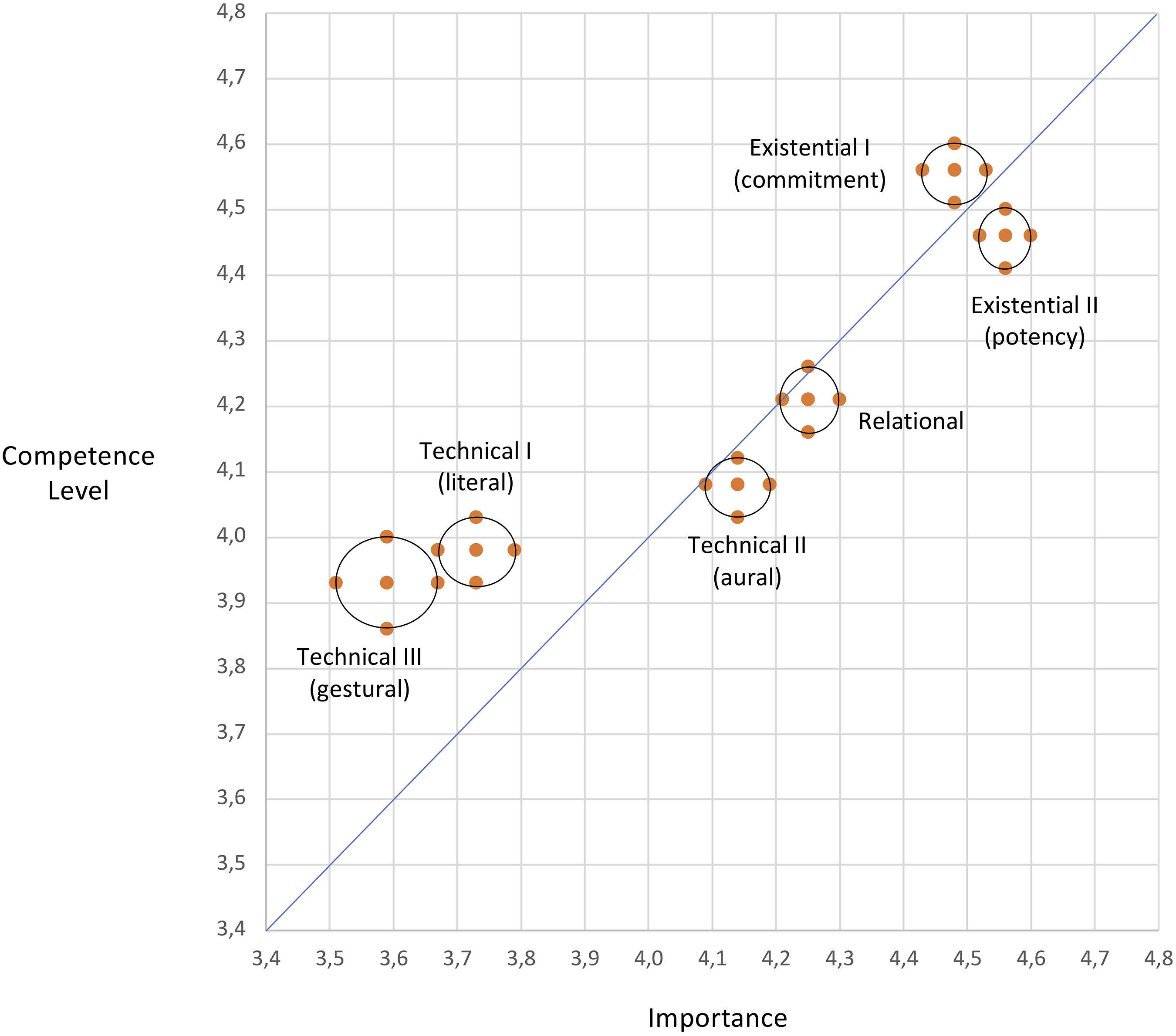
Interchangeability of technical skills
Technical I and Technical III skills fall into an area that might indicate some level of indifference, comfortably proficient in something less crucial. It is rather counter-intuitive that Technical III (gestural) skills matter least, being the visual emblem of the role, but the ensemble does not always make use of the communication they offer: You can do whatever you want with your hand, because they look down in their sheet music anyway—at times. I knew that before I began my studies. On my part, it has come to this, that I focus on improving my technique as much as possible, so that I at least don't make things worse for my choristers.
In addition, the functions of conducting gestures are frequently replaced by other modes of communication, for example, detailed verbal instructions in the rehearsing process. In general, the variety of technical competencies makes them interchangeable to a considerable degree, which may be understood as lower relative importance.
Technical II (aural) skills are deemed less important than existential skills and therefore less worrisome. However, they provide less surplus than the other technical skills, probably because conductors cannot easily do without them. Even within this category, there is opportunity for trade-offs: And then, aural skills, of course, which are extremely important. On that account, I must admit that I am not the most skilled. [...] With regard to intonation, my hearing is fine, but when it comes to detecting an error in a voice group, for example, I am absolutely not confident [...] Another important competency is my vocal competency [...], not least my knowledge of voice physiology. So, a very important part of my job [...] is to help singers use their body and voice in an ergonometric way. [...] I am rather well equipped on that side.
The sensemaking that goes on here is enactive but is also rooted in identity. Lack of error detection skills is very difficult to circumvent because errors will either stick or be detected by someone else – both of which are uncomfortable for a leader. In the statement above, the conductor simply raises the importance of another skill: vocal technique.
The holism of relations
Technical skills are more discrete than existential attributes, which tend to represent integrity and the human gestalt. Although relational skills to some degree might be analytically decomposed, they also eventually come together as a whole. Hence, existential and relational competencies are not replaceable to the same degree as technical competencies. The conductor is not merely a musician, but also a leader: If you only concentrate on the musical [technical] competencies, you more easily become a dictator. It is not pleasant. Nobody likes those conductors. I believe that if it [instead] comes from within—unconsciously, you can inspire them to do such or such, and they won't feel that it's being pushed down their throats.
The relation between conductor and ensemble is pervaded by cues that induce sensemaking. While this might be said for any leader role, in the ensemble situation the relational cues are simultaneous, diverse and intense. Unsurprisingly, conductors tend to experience a ‘deficit’ of relational skills: The role you have as a conductor is a very special type of leader job. There are so many factors [...]. You need to be able to read the different singers—some are very touchy, some are pushy, and some are timid. You need to make all these come together. It’s very personal. You kind of have to be a diplomat, almost like a politician [...]. You have to make people like you and buy into what you're trying to do.
The challenge is reinforced by how relational skills both depend on and are moderated by willpower and self-perceived authority. Sincerity and vulnerability are desired attributes in a conductor. At the same time, choral singers do not want to relinquish a clear musical idea and strong will. This tension between sensitivity and power is inherent in live and vibrant music-making and therefore cannot be brought to closure: It is such a delicate balance—between being the boss and deciding stuff, and being fair and seeing everyone. Having a certain distance. [...] At the same time being human and almost like a friend. [...] I really ponder where the boundary is [...]. For example, [my] insecurity—to what extent should they know about it, or should I keep it from them?
Such lingering tension provides a constant stream of cues that must be attended to. A feeling of never fully getting the relational issues right creates a boiling cauldron of sensemaking activity.
The comfort of commitment
If conductors had superpowers, they would be found in the upper-right corner of the chart. Passion for the music, devotion to the ensemble and sincerity of engagement (Existential I) come closest to this position. They drive a level of commitment that is not only important, but that also overcomes other hurdles: I know my shortcomings, but I am not afraid of attempting something if I am passionate about the music. Then I try to ask a more competent conductor for guidance and help.
Passion here redeems the lack of other skills and boldly enhances self-efficacy. Another conductor views passion as much more important than textbook gestural conventions, to a degree where she sees herself not fit for all settings. I am an intense, passionate choral leader with long experience in various genres and a leadership style of my own, which may be seen as a little “crazy”, as I don't express myself very formally and conduct with my whole body, and not always according to the textbook. So, my competency works well with choirs and choristers who want to be inspired for a weekend or a single project, as well as those choral singers who are comfortable with that leadership style. Others want things to be a little calmer and more formal when they sing—and then they choose not to be part of any of my choirs.
The unimportance of gestural conventions is reinforced by trading it with passion. The notion of importance (which the survey defines in the context of own practice) is adapted to situations where the conductor’s competencies fit, also outside current practice. In other words, the sensemaking activity retrofits importance and competency – as an amalgamation of both – in the trade-off between competency categories.
Properties of sensemaking
The qualitative data expose how the properties of sensemaking are in play (see Figure 1). Survey and interview questions gave rise to cues from their entire trajectory, from initial exposure to conducting and from formal education to their ongoing practice. The retrospective nature of sensemaking is inevitably demonstrated when respondents were asked to reflect on their professional practice. The shaping of their professional practice is a social endeavour, and it is immersed in the engagement with one or more ensembles. However, it is the three remaining properties that are most explicit in our data: the enactive impetus, the ties with identity and the prominence of plausibility.
The enactive triad
In some cases, the three properties of enactment, identity and plausibility appear in combination and make a sensemaking activity particularly salient. One conductor, who is a musicologist, finds that he struggles to establish a clear identity: I don't have the same first-hand experience of being an orchestra musician as I have as a choral singer. The race is probably over, but I have an inferiority complex because I am not a musician and I am not a good enough singer to be called a performing artist. Not that I wouldn't want to be one some time, but I am not good enough to be one. So, I try to practice and take care of my voice. It has served me well with my choirs, because I can make them sing well.
Although he is solidly educated and has built a conductor identity over a decade, he still has a sense of inferiority from not having an underlying performing background. But he acts on it, he sticks at it, he develops his voice and he reaches a plausible solution: he is good enough for his practice.
The notion of plausibility also applies at the intra-musical level. From a leadership point of view, some music-making features are usually subject to absolute power on the part of the conductor, such as deciding when to start or choosing the tempo. But even here, apparently non-negotiable ideals may be relinquished: The first years, when the orchestra didn't catch the tempo I had in mind, I tried to adjust the tempo after having started. You can do that, but with experience, I have understood that it's often better to let the tempo be, unless it's completely off, that this gives the music more freedom than the negative effect of trying to impact the ensemble by correcting a tempo.
Realising that the actual tempo is not what you had in mind is a very troubling cue for a conductor. Abstaining from corrective action is nonetheless highly enactive from a sensemaking perspective. Non-action is made more meaningful than action. A plausible solution becomes more attractive than the ‘right’ solution.
Relinquishing the ideal also happens for the professional practice as a whole. The deeply meaningful is the most common driver for engaging with music and choosing conducting as a profession. However, one conductor has, from painful experience, found a solution where job security matters more than artistic freedom: I would really like to work freelance, not as a full-time conductor, but to take singing jobs, for example, or perhaps teach for part of the week in a school. To be a freelance musician is a patchwork existence. I need financial freedom and stability. I have been in a bad financial situation so many times, so it is more important for me to have money than doing what I’m passionate about.
Here, there is a clear path from the cue of financial distress to actively opting for well-paid jobs, settling for a less than perfect conducting practice and accepting whatever implications she has to face in terms of her identity.
Letting go and moving on
One of the permanent leadership challenges in the conductor role is striking a balance between working on details and letting the ensemble experience the integrity of the music: You get to a point where the details you are working on just get worse and worse, the singers begin to shake their heads and you know the cup is full. Then we move on. And when we return to it the next time, it's in place. [During my education] I learned that there is a limit, you don't always reach the goal with the details, but you still have to move on. And I have learned from experience how long I can keep pushing.
Every conductor has experienced this dilemma. The cue that arises when improvement efforts come to a standstill is as common as it is brutal. The enactive property of sensemaking is ambiguous here – is the meaningful action to solve the problem or to move on? Will the problem have solved itself at the next run-through or will an error stick? The actual judgement of the moment will be rooted in the conductor’s ideals and identity as a pragmatic or as a fundamentalist.
A totalitarian approach apparently violates the plausible nature of sensemaking. One conductor sees himself as someone who cannot give anything less than his best: Maybe I am too restless. I want to move along quickly. I am very preoccupied with the holistic aspect. Maybe too much so, sometimes, I don't know. And I am probably a conductor who spends too much energy on the job. I cannot tone it down. I am struggling to make little out of it. This is good for my choirs, but it is not sustainable.
To settle for less – in the interest of personal sustainability – would have made sense. It would have provided a plausible solution to the lingering cue that he moves too fast and wants too much. However, we might suspect that his identity (and pride) is too closely associated with being the energetic fast mover. In the end, therefore, it makes more sense to continue as is.
Sensemaking as a ubiquitous phenomenon
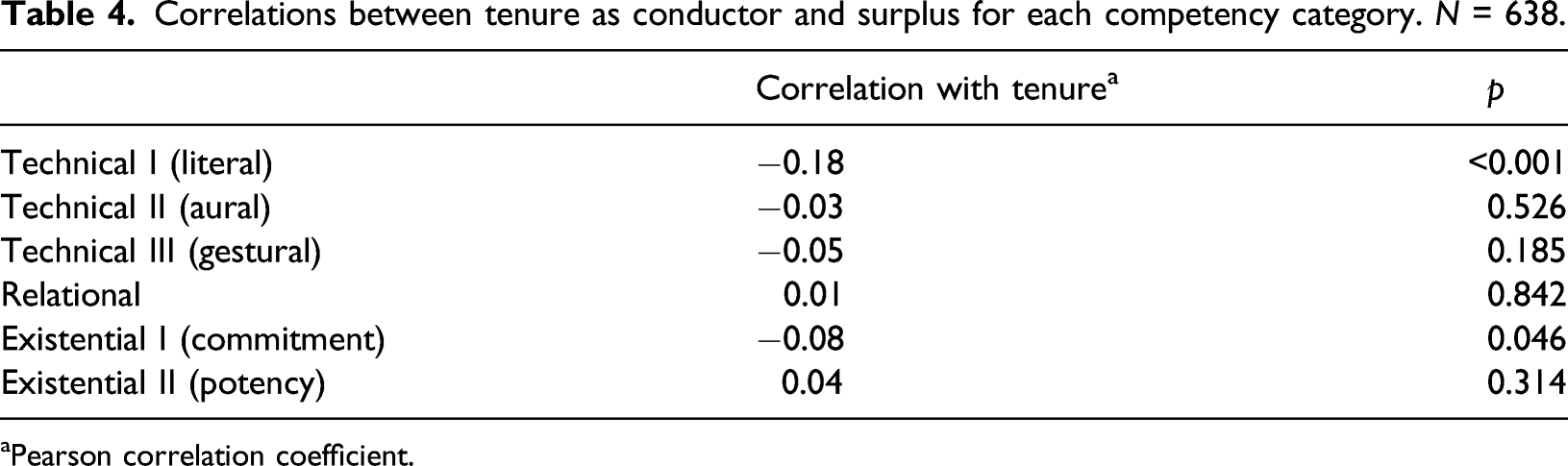
Correlations between tenure as conductor and surplus for each competency category. N = 638.
aPearson correlation coefficient.
How is it possible that the total competency surplus is lower with longer tenure and more experience? One conductor very succinctly brings to light a plausible mechanism. During his education abroad 10 years ago, he was given the challenge of conducting an opera: I remember the day before the concert, it was like ... darn, I should quit conducting, continue my maths education and become an astrophysicist, that's much easier. That feeling was quite new, and I learned a lot. I feel that I am now much more insecure as a conductor than before I went to [academic institution abroad], even if I am a more competent conductor now.
During his ten-year tenure as a choral conductor, his self-perception of capacity to lead has diminished. The statement illustrates that his self-confidence does not come from his competency level as such, but rather from 'surplus' competency in the context of current demands, whether self-inflicted or externally imposed. As choral leaders develop their competencies through experience, they also raise the bar. In the sensemaking process, any 'surplus' seems to be negotiated away to the point where it grows negative on the sample level.
Discussion
The results show that the unfolding of a choral leader practice is imbued with sensemaking. The properties of sensemaking come to light as leaders assess their own competency as well as make career choices. These are rather mundane as opposed to the critical situations most sensemaking studies address (Baran and Scott, 2010; Colville et al., 2013; Dixon et al., 2017; Kavanagh and Kelly, 2002), and our study therefore responds to the call by Brown et al. (2015). The fuzzy institutional frame of a professional practice in our study is a case of what Weick (1976) in his earlier work called a loosely coupled system. A profession is an example of patterns across contexts rather than a single organisational case, and applying sensemaking to such patterns was called for by Maitlis and Christianson (2014). From our results, the construction of a leadership practice appears essentially as a sensemaking process. At first sight, this seems to be in conflict with Pye (2005), who makes the point that sensemaking cannot replace leadership as the primary topic of interest. However, while sensemaking is considered by Pye as one epistemological avenue to understanding leadership, it aspires to ontological status with regard to the shaping of a leadership practice. A key to the shaping is the fluidity with which competencies are promoted and demoted in the leader act, both in terms of how they are put to actual use and how leaders think about them. The rich set of applicable leadership competencies presents an abundance of sensemaking affordance, that is, opportunities to flexibly deal with one’s own capacity in the demands of the working situation.
Sensemaking affordance
The various competency categories play different roles in the negotiation between competency elements. From the quantitative and qualitative findings, we propose a conceptualisation as shown in Figure 3. The two dimensions of competency level and importance define a sensemaking space for the choral leader practice. Competencies that are situated in the low–low area are acceptable but are rather peripheral in the practice. Conversely, competencies in the high–high area provide a reservoir, a source of mastery and pride. For the leader, it makes ‘perfect sense’ to be on the diagonal between these two areas where the two dimensions are balanced. Competencies may be off-balance in two ways: mastering something that is not important (redundancy) or not mastering something that is important (problem). Both are uncomfortable and induce sensemaking activity. Sensemaking affordance of competencies based on the position of a given competency in the competency level/importance map. Each zone gives a competency a sensemaking function by how they are negotiated in the process of ensuring overall leader effectiveness.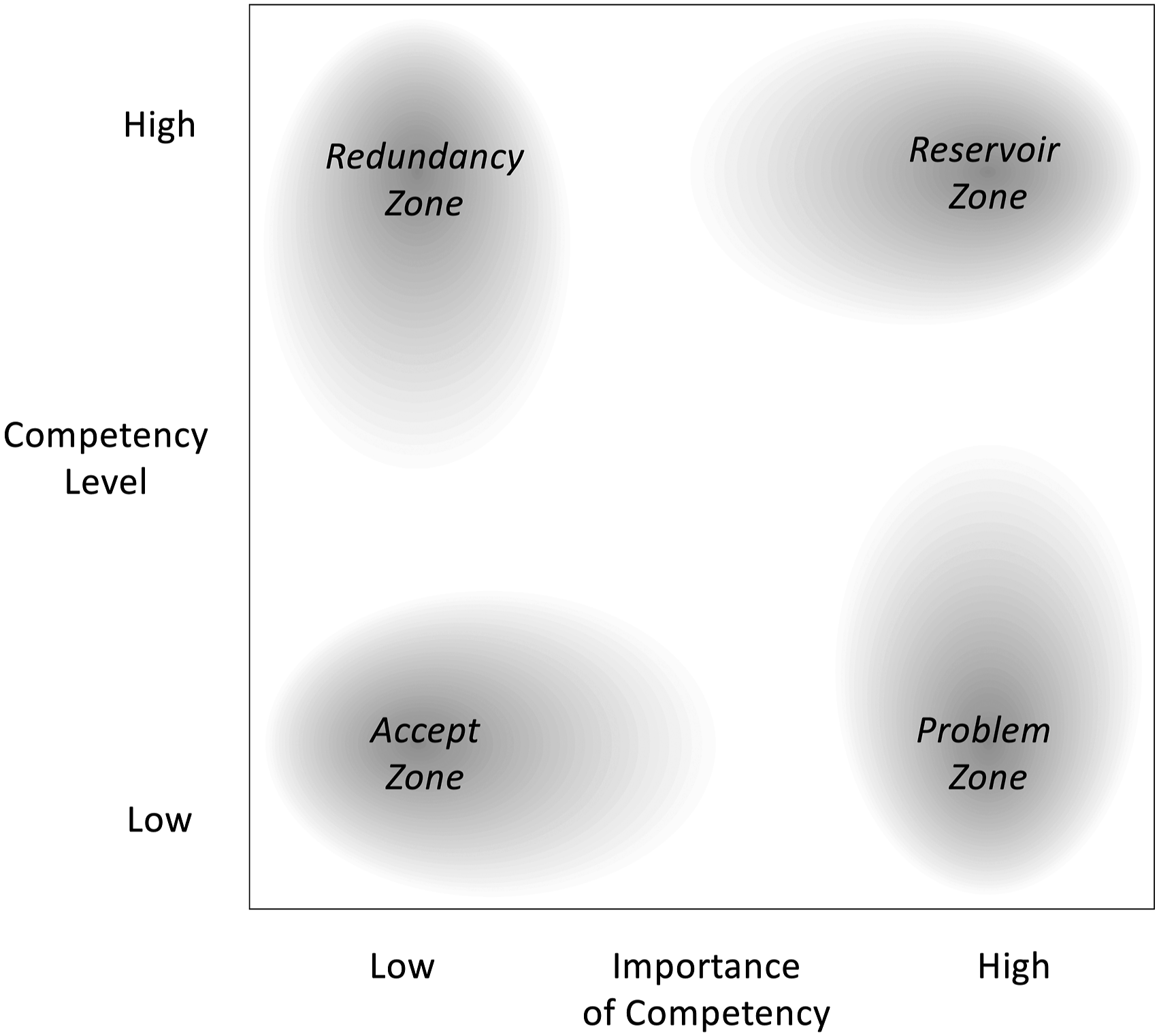
Figure 3 captures variety in terms of sensemaking affordance, where the leader may negotiate with competencies by adjusting behaviour and perception of self. The competency/importance zones are labelled according to their sensemaking function. The point is not that a competency group on average unequivocally falls into a zone (although for an individual, it might), but rather that the results are indicative of tendencies. We observed that the competencies were positioned near the diagonal from low–low to high–high, which means that on the sample level we captured ‘sense already made’. The quantitative data therefore only show reminiscences of the sensemaking process.
The redundancy zone hosts competencies where there is a certain level of mastery, but they are viewed as less crucial. The technical skills fall closest to this zone. Our hypothesis is that the various technical skills are complementary and can to some degree substitute each other and hence are highly negotiable. Relational and some of the existential competencies are closer to the problem zone because these operate in a more integral manner and are therefore not easily replaceable. Specifically, choral leaders may experience more discomfort if lacking authority, presence and will (Existential I) because this category provides the basic legitimacy of the leader position, and faking it is difficult. On a related note, faking emotions is found to be detrimental to self-efficacy (Pugh et al., 2011). The reservoir zone can be mobilised to compensate for deficits in other areas. Commitment, expressed as devotion and sincerity, is closest to this zone and seems to be actively used to overcome deficiencies in other areas. We found no competency clearly positioned in the accept zone, mainly because the relevance of all the competency elements in the survey had been validated a priori.
When leaders promote and demote skill items in constituting their practice, it is not a self-deceptive re-authoring of the model leader, but rather that some skills are made prominent and others are avoided in the leader act. The eloquent but dyslectic leader would rely on facetime rather than memos. The conductor with perfect pitch but no piano skills demonstrates by singing, not playing. Specific leader skills are made important when they matter and can be mastered. Leaders shape their practice to ensure overall effectiveness. The enactive facet of sensemaking goes beyond merely dealing with a cue; it shapes the context in which the cue is given meaning.
One particularly impactful way of shaping the context is to operate in multiple, simultaneous practices, that is, to have multiple callings. Berg et al. (2010), one of the few to have discussed sensemaking in the context of professions, point at how occupation and identity are inseparable for professions of calling, of which choral conducting is a prime example. They propose that people with additional callings are somewhat protected from dissatisfaction, which is what choral leaders achieve when making sense of a portfolio of ensembles or when combining conducting with other assignments (Jansson and Balsnes, 2020).
When we consider these construction processes as sensemaking, is there no role for concrete (‘real’) proficiency? On the one hand, overall mastery (as seen by the leader) is a social construction, in the sense that what matters in the encounter with the ensemble is in fact what the leader allows to matter. On the other hand, choral leaders work on their specific skill items in order to construct concrete proficiency. Within the bubble of the single skill item – an entitative attribute – there is clearly a role for real, objective proficiency. However, as soon as attention shifts to the leader gestalt, where there is ample opportunity for trading between skill items and adapting behaviour, we are back in subjective sensemaking mode. Competency is therefore an unstable phenomenon as it might be seen to oscillate between real proficiency – meeting task-driven demands – and the delicately balanced and situationally appropriate gestalt.
Theoretical connections for further research
Although the concept of sensemaking on its own provides reasonably solid ground for the analysis, there are several linkages to adjoining theories beyond the scope of this study that deserve further research.
Although the concept of cognitive dissonance was central in the inception of sensemaking theory (Starbuck, 2015), it is strikingly absent in sensemaking research today (Hinojosa et al. (2017). Our data suggest that self-perceived competency, cognitive dissonance and sensemaking are tightly interwoven, and we see two reasons for a renewed look. First, the body of research on cognitive dissonance, including integrative concepts of meaning maintenance (Proulx and Inzlicht, 2012), can be more systematically applied to elaborate sensemaking theory. Specifically, the various coping strategies to resolve cognitive dissonance are essentially fragments of generic sensemaking strands. The second reason to reconsider cognitive dissonance is that it elucidates the plausibility property. In our data, plausibility cushions any remaining cognitive dissonance, even when action is taken. The bias for action means that the baseline is constantly shifting. Remaining dissonance is related not to the original cue but rather to the emerging alternatives when going forward. Coping with cognitive dissonance does not imply a restoration to the pre-cue situation. The ongoingness of sensemaking provides a moving frontier of updated signification of cues.
The sensemaking work that our informants expose when they reflect on their various skills and their evolving careers is predominantly about coming to terms with their own capacity to fill the choral leader role. The product of such sensemaking resonates with the self-efficacy construct in its various guises – the belief that one can perform well within the given expectations (Bandura, 1977; Hannah et al., 2008; Van Knippenberg et al., 2004). Self-efficacy has been recognised as a crucial leadership competency (Caldwell and Hayes 2016). It goes beyond the mastery of specific tasks and includes the ability to cope with ambiguity and situational judgement inherent in the role (Wang and Hsu 2014). A leader appears as a gestalt, where there are innumerable ways in which single competencies and behaviours come together as a whole. Bolden and Gosling (2006) have warned against fragmented and prescriptive models that miss the subtleties of situational and relational factors. The theoretical implication is that various attempts to decompose the efficacy construct (Hannah et al., 2008; Machida and Schaubroeck, 2011) may be difficult to observe in practice because the sensemaking act creatively rewrites how partial efficacies come together and form overall self-efficacy. In other words, sensemaking seems to mediate a traditional competency view of leadership and the construction of the gestalt leader-in-process. Another theoretical issue that warrants more scholarly attention is that if sensemaking is both a process and a product, so must self-efficacy. Our results bring to light how sensemaking moulds self-efficacy, but sensemaking work is also founded on initial self-efficacy. While self-efficacy is mostly regarded as a product, research should also address the construction of self-efficacy as a (sensemaking) process.
Limitations of the study
In light of the research questions, we deem the findings to be reasonably reliable and valid. The quantitative data are indicative of sensemaking effects, and the qualitative data can clearly be interpreted as sensemaking activity. To the extent that there are scoring biases in the data, these should not impact the structural findings. However, we do not expect our results to uncover any exhaustive picture of the sensemaking going on in the shaping of a leadership practice. The main limitation of our study is related to the observability of sensemaking in the data. While we have applied the most comprehensive extant competency model for the choral conducting practice, it still has a limited level of granularity. The qualitative data reveal fragments of sensemaking, but what comes to light is what can be brought to light by articulation. The unspoken, yet meaningful, to the respondents is beyond reach. The structure of the sensemaking affordance model is probably quite robust, even if the reliability of our specific interpretations were uncertain. Furthermore, this model should be expected to have a reasonable degree of generality, although its exact content will depend on the organisational domain in question and therefore the competency model being used. The fact that technical, relational and existential competencies have different sensemaking functions is probably rather general, however, and the precise functions will vary across domains. The choral leadership domain has general features as well as notable specifics – the importance of purpose and existential competencies in particular. Other domains with these characteristics could be expected to exhibit similar sensemaking activity.
Footnotes
Acknowledgements
We would like to thank the choral associations and federations of choral conductors in Norway, Sweden and Berlin for sending out survey invitations.
Declaration of Conflicting Interests
The author(s) declared no potential conflicts of interest with respect to the research, authorship and/or publication of this article.
Funding
The author(s) received no financial support for the research, authorship and/or publication of this article.

Author biographies
Appendix 1. Descriptives for importance and self-perceived competence level for each element.
SD = standard deviation. N = 638. aMean difference between competence and importance. b95% confidence interval for the mean.
Element
‘Surplus’
a
Importance
Competence
Mean
SD
Lower 95% CI
b
Upper 95% CI
b
Mean
SD
Lower 95% CI
b
Upper 95% CI
b
Mean
SD
Lower 95% CI
b
Upper 95% CI
b
Existential I: commitment
0.08
0.59
0.03
0.12
4.48
0.62
4.43
4.53
4.56
0.54
4.51
4.60
Existential II: potency
−0.11
0.56
−0.15
−0.06
4.56
0.52
4.52
4.60
4.46
0.53
4.41
4.50
Relational
−0.04
0.63
−0.09
0.01
4.25
0.60
4.21
4.30
4.21
0.58
4.16
4.26
Technical I: literal
0.25
0.74
0.19
0.30
3.73
0.76
3.67
3.79
3.98
0.61
3.93
4.03
Technical II: aural
−0.09
0.65
−0.14
−0.04
4.10
0.68
4.05
4.15
4.04
0.59
3.99
4.09
Technical III: gesture
0.34
1.02
0.26
0.42
3.59
1.00
3.51
3.67
3.93
0.86
3.86
4.00
Appendix 2. Linear regression analysis of total surplus competence (difference between competence level score and importance score for all competence elements): unstandardised and standardised coefficients.
R2 = 0.03.
Unstandardised
Standardised
p
Professional/advanced choir
−0.21
−0.01
0.769
Share of income from conducting (%)
0.01
0.03
0.464
Tenure (years of experience of conducting)
−0.07
−0.10
0.012
Bachelor’s degree in conducting
1.28
0.06
0.225
Master’s degree in conducting
−0.27
−0.01
0.763
Bachelor’s degree in music
−0.03
0.00
0.977
Master’s degree in music
−0.49
−0.03
0.577
Sweden (dummy)
2.13
0.13
0.002
Male (dummy)
1.25
0.07
0.066