



Abstract
Scholars within the field of Leadership-as-Practice (LAP) address the way that individuals ‘transcend their own immediate embeddedness’ to achieve volitional coherence known as collaborative agency. The process of collaborative agency is described as inseparable from LAP, yet it remains a nascent field of enquiry requiring additional empirical research. This article presents an investigation of collaborative agency through an abductive case study using video ethnography and interviews. To interpret our results, we turn to the Japanese ideogram for ‘place’, known as ‘Ba’. Rather than a physical reality, Ba is considered an existential space in which leadership groups weave together to create and ripen collaborative agency. Ba guides us to look across and around a group and its socio-material practice. We find that collaborative agency is trans-subjective in nature and sits on a spectrum on which we identify the outer reaches, from one end where Ba is woven through to the other end, called Collapse. We suggest that the place of leadership is within the warp and weft of collaborative agency, including but not limited to a special place woven in Ba where collaborative agency is high and where the group reports they are able to transcend their individualism.
Keywords
Introduction
Without some form of connecting around and across agents, we are inevitably left with individuals. Following this logic, pluralised forms of leadership rely on the coherence, coalescence and/or collaboration of individuals in some way or another. The scholars within the field of Leadership-as-Practice (LAP) address the way that individuals ‘transcend their own immediate embeddedness’ to achieve this connecting, defined as collaborative agency (Raelin, 2016a: 138), but only partially. This article answers the call by Denis et al. (2010) to study how participants coalesce dynamically in the context of practical activity to create leadership and specifically we seek to understand the emergence of collaborative agency.
Leadership-as-Practice considers that leadership emerges from a perpetually unfolding social process and turns to collaborative agency to explain how people connect together irrespective of role or hierarchy (Raelin, 2020). Whereas coordination can be achieved administratively, it is unlikely that the self-transcendence underpinning collaborative agency can be mandated through crude administrative processes. More likely is that collaboration and agency will be freely given (withheld) as the group becomes more or less one unit and self-transcendent. This idea is identified by Gronn (2015) who suggests that agency arises from volitional coordination and groups’ expressed ‘we’ intentions – where ‘we’ is understood as a single, unified centre of attitude and action.
Despite the centrality of collaborative agency to LAP, the literature is empirically silent on how coalescence emerges (Kempster and Gregory, 2017; Raelin et al., 2018). Our aim is to extend our understanding of this through the guiding research questions: What is the lived experience of groups working amongst the processes of collaborative agency? How does the group’s collaborative agency enable individuals to transcend their own embeddedness?
To answer these questions, we undertook an exploratory case study involving 40 h of video ethnography and interviews following a group of senior functional leaders working in a matrix structure over two 2-day meetings. Such a matrix structure offers a research context within which collaborative agency may arise because it is a way to avoid stalemate and enable an effective way forward given that everyone has equal standing, and all strategies are interdependent. Our study is designed to provide an initial step towards a better theoretical and empirical understanding of the nature of collaborative agency.
Although not part of our initial investigation, we turned to a Japanese tradition called ‘Ba’ (Nonaka and Konno, 1998) to provide a unifying idea for our data. Whilst it is inappropriate to define Ba with a single word, a useful approximation is ‘place’. In Ba, self and other co-emerge (Von Krogh et al., 2013) with multiple participants mutually forging each other – individual self is bound to the collective self. It is possible, and natural in Ba, to transcend ideas of subject and object to become pure unselfconscious experiencing (Graupe and Nonaka, 2010). Ba and its notion of place guide us to look across and around the group not simply between individuals inter-subjectively. Building on Raelin’s idea of self-transcendence and the evidence from our study, we suggest that collaborative agency is appropriately described as trans-subjective. Transcendence goes further than shared conscious interpretations between participants to something within the place, or space, of their experience.
The remainder of this article is structured as follows. We commence with the theoretical basis for the article explicating LAP and its attendant theories drawn from collective leadership. We explain the contribution that Ba offers to our understanding which frames the subsequent findings. Next, we describe our research methodology and the choice of video ethnography in a case study of leaders who sometimes create leadership. Thereafter, the discussion explains our empirical and theoretical contributions to LAP by exploring how groups work as collaborative agents. We end with a review of the research limitations and a summary of our conclusions.
Theoretical background
All forms of collective leadership (CL), including LAP, stand as an antidote to the hegemony of the single heroic leader and usually embrace pluralised, non-normative and emancipatory ideals (Barker, 2001; Collinson et al., 2018; Crevani et al., 2010). However, neither LAP nor CL is a uniform field of theorising.
Collective leadership is ravaged by contradictions and a plurality of definitions: 120 papers, 28 labels and 121 definitions (Alexy, 2020); alternatively, 935 articles spanning seven forms (Fairhurst et al., 2020). As D’Innocenzo et al. (2016) remark, ‘the literature has become quite disjointed with a proliferation of nomenclature and conceptualizations’ (p. 1965). The field of LAP fares little better with different researchers adopting a range of philosophical perspectives (Simpson, 2009; Woods, 2016), strong or soft views of process (Crevani and Endrissat, 2016) and different understandings of practice (Cunliffe and Hibbert, 2016). This multiplicity of approaches makes it impossible to reliably disentangle the fields.
Ospina et al. (2020) seek to offer conceptual clarity to CL using a 2 × 2 matrix contrasting researchers’ ‘locus of leadership’ with ‘view[s] of collectivity’. The former axis locates leadership as either residing in the ‘group’ or in the ‘system’. The latter axis is divided into those seeing collectivity as either a ‘type’ of leadership, or a ‘lens’ on leadership. Ospina et al. situate LAP as a ‘lens’ on leadership within a ‘group’.
Our contention is that this is one way to categorise LAP, but it is not ours. In particular, the adoption of a strong process ontology (Langley and Tsoukas, 2017) has consequences providing a locus of leadership rooted both within the group and across and around it as well, thus straddling ‘group’ and ‘system’. Later, we propose that trans-subjectivity better describes the nature of collaborative agency, acknowledging that beyond the group, but not at system level, there lies another place of leadership.
Comparable features of Leadership-as-Practice and Collective Leadership.
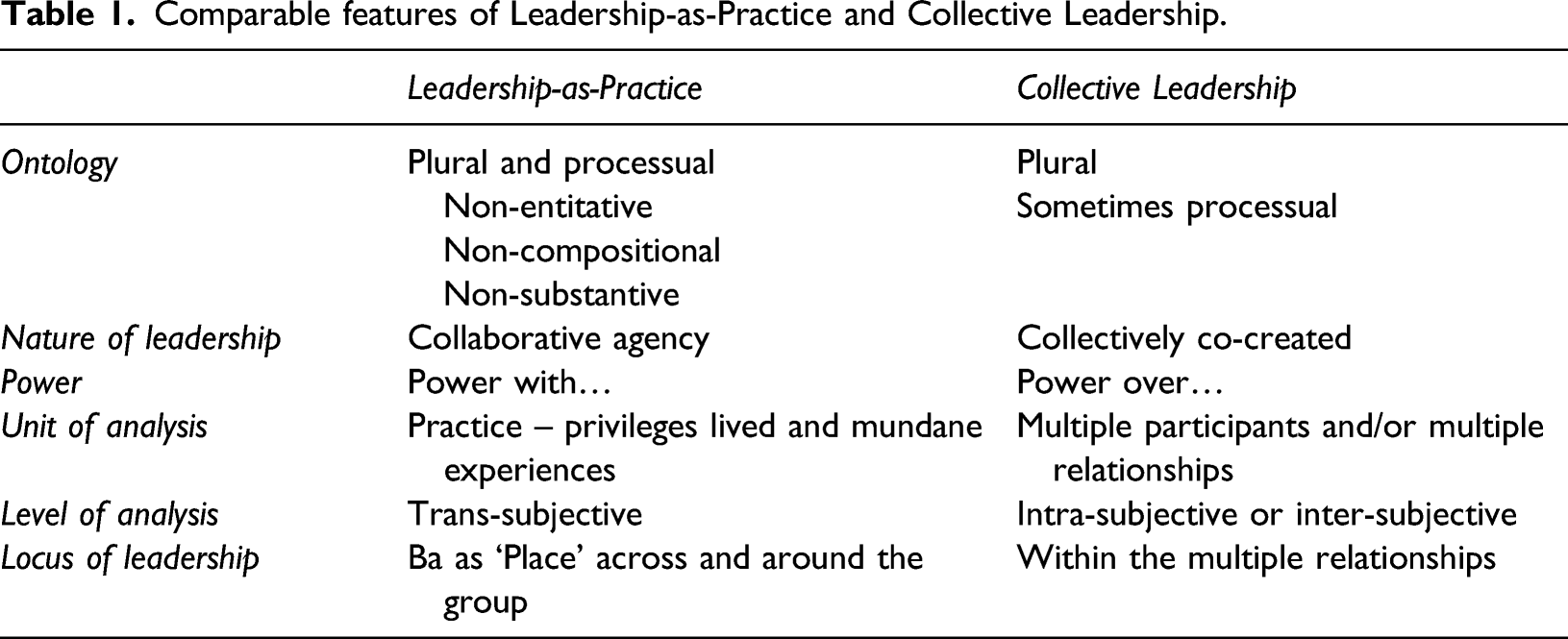
Ontology
One differentiating feature of CL and LAP is the extent to which a process ontology is used. LAP, based on a process ontology, suggests no two moments can be the same because all the causes and conditions that create this moment are unrepeatable, ad infinitum (Langley and Tsoukas, 2017; Tsoukas and Chia, 2002). Other leadership research might adopt a process approach and/or be situated within LAP but it is not always the case that researchers adhere to non-entitative, non-compositional and non-substantive views.
The natural outflow of an ontology that foregrounds process and moves the lens to the social practice of agents is a non-entitative approach. Because ‘[t]his focus on process …undermines major assumptions…. entities disappear … the traditional scientific commitment to illuminating a systematic and predictable world of cause and effect falls moribund’ (Gergen and Hersted, 2016, p. 179).
In common with some other forms of CL, leadership within LAP is not simply additive (Kozlowski and Klein, 2000). ‘Collaborative agency transcends individual agencies….It is not a collection of individual agencies’ (Alexy, 2020: p. 25). This principle of holism whereby the sum is different from its parts (Koffka, 1935) is shared with, for example, complexity leadership (Marion and Uhl-Bien, 2003) and is the backbone of emergence.
In both CL and LAP, the granular linkages between research philosophy and subsequent choices are sometimes obscured. By way of illustration, Hiller et al. (2006) acknowledge that CL is more than the sum of individual role taking, and this is the point of their enquiry. As such, the study provides an almost perfect predecessor to our work framed within LAP. But in the article, there are compositional assumptions that a group comprises 1 + 1 + 1 (Klein et al., 2001). Our contention is that using an ontology of emergence is not congruent with measures of individuals being aggregated in this way. Leadership-as-Practice is non-compositional.
There is a further distinction amongst process researchers whereby substantive ontologies assume that changes happen ‘to things which retain their identity as they change’ (Fachin and Langley, 2018: p. 3), whereas in non-substantive ontologies, the entanglement of agents leaves no one or thing unchanged. It is from the constitutive entwining and continuous refiguration of each other that leadership emerges (Shotter, 2006; Simpson, 2016). Sometimes this distinction is not clear as researchers use the same terms differently (Simpson, 2016).
These ontological commitments and consequences do not simply differentiate authors within LAP but also within CL. By way of illustration, the study by Denis et al. (2010) expressly uses a practice lens to consider three cases of leadership. Although located within human action and praxis, the authors nevertheless study leaders, so whilst the study is not compositional, it is substantive. By contrast, a case provided by Sklaveniti (2020) is not expressly within the practice frame, yet it is ruggedly non-entitative as it considers the development of co-action across collaborators. The authors reveal leadership trajectories built on invitation, exploration and affirmation. We consider that this study is LAP in all but name.
Nature of leadership
Whilst it may be tautological, leadership in CL is achieved collectively. In contrast, within LAP, leadership is achieved through collaborative agency which has an ‘inseparable connection’ (Raelin, 2016a: p. 131) to leadership. Whilst collaborative agency is described variously, used extensively, and only investigated occasionally, our starting point is Raelin (2016a, 2016b) where he suggests that collaborative agency relies on individuals who ‘transcend their own immediate embeddedness’ (Raelin, 2016a: p. 133). Raelin suggests that people can be transformed by the relationship between them quoting from Hegel ‘an I that is we and a we that is I’ (Hegel et al., 1869, Sec. 177). Ideas of collaborative agency depend on a shift from ‘self to relational to collective orientation’ (Carroll et al., 2008: p. 368); ‘transformed by the relation between them - which is not just the sum of their qualities’ (Raelin, 2016a: p. 135/136).
Collaborative agency may be ‘relationality’ (Crevani and Endrissat, 2016; Shotter, 2016) whereby people’s selves are changed by being in process with each other. People do not remain static when in connection – others have the capacity to move them and make new. Or collaborative agency may be ‘trans-action’ (Carroll and Simpson, 2012; Simpson, 2016) where agents both construct and are constructed by their social interaction. Both descriptions chime with the non-compositional and non-substantive ontologies discussed earlier.
Only a few have investigated collaborative agency empirically. Carroll et al. (2008) presented the first LAP study proposing that leadership is a shift of consciousness that has the potential to remove ‘any distinction between subject, object and reliance on mental models and cognitive frameworks’ (Carroll et al., 2008: p. 375). However, against their own criteria, the authors do not satisfactorily show a collective and socially constructed view of leadership because they rely on individualistic perspectives. The data are evidently not inherently relational nor collective.
A number of articles offer further clarification, yet empirical insights into the question of how interrelating becomes collaborative agency is limited, and the articles tend to vary considerably in their adherence to the ontologies described above. Carroll and Simpson (2012) use the term ‘sociality’ to explore issues of collaboration and emergent leadership in an online forum. Through the movement of frames, sociality is built so that the group coheres while retaining emergent and dynamic properties. These authors align closely to our view of LAP. However, the article is concerned with how ideas of leadership develop through online conversations, rather than specifically on whether collaborative agency or inter-subjectivity is more than conversation.
An organisational restructuring studied by Simpson et al. (2018) has the potential to fragment collaborative agency. Once again, ‘talk’ is the means by which coherence is achieved and the article maps the ebbs and flows of talk through different phases of the restructuring. In keeping with the foundational theorising of Raelin (Raelin, 2016b), the authors consider that leadership comes out of social discursivity. The article is internally consistent with all the dimensions we have outlined, and it provides methodological inspiration with its elegant charting of talk forms onto a musical stave.
Also related to our field of interest are three cases in an article by Crevani et al. (2010) where collaboration is considered as a form of spanning across institutional and personal identities. One case provides an example of socially constructed ideas having agency, such as boundaries, and how the same talk that creates these boundaries can be used to de-construct them. Talk both manifests and destroys ideas that have power to constrain or enable actions of the participants. Nevertheless, the unit of analysis is the individual and for the purposes of developing a deeper understanding of collaborative leadership, the across group process is missing.
Notwithstanding the above empirical work, collaborative agency, for all its centrality in LAP, remains persistently under studied.
Power
Collinson (2018a, 2018b) levels criticism at LAP, charging researchers with wilful blindness concerning power and control. Similarly, many who study CL set out to challenge the binary nature of leadership and followership (Empson, 2020; Empson and Alvehus, 2020; Pye, 2005) and may see LAP as lacking in criticality. In our view, the conceptualisation of power helps set LAP apart (Raelin et al., 2018). The non-entitative and non-substantive nature of leadership means that power cannot be conceived of as a possession, suggesting these issues need fresh thinking with power re-conceived as unfixed and unattached to individuals (Latour, 1984).
However, we acknowledge that not all authors re-conceive power as fluid and unfolding but continue to see the issue as ‘power over’ others. The study by Case and Śliwa (2020) is one such example, combining both an LAP research approach and a concern for how power is exercised. The authors locate their enquiry within ideas of ‘process and emergence’ and consider how the exercise of leadership (i.e. power) has an effect on the trajectories of discussions (Case and Śliwa, 2020). Similarly, Wellman (2017), using a relational model of leadership, relies on emergence, considering authority as a form of rank providing a hierarchical ordering. Both articles focus on leadership power and seek to respond to the lacuna of research in this area especially amongst the post conventional narratives. However, these authors are also ontologically inconsistent having claimed the domain of emergence but then lapsing to individualistic perspectives: demonstrating the challenges of working within this field whilst honouring different underlying ontological commitments.
Consistent with our thinking are ideas of power viewed through a processual lens where it can be considered more dynamic and free-flowing and not residing in a single or even multiple human forms, and this chimes with descriptions of Ba as a sphere (see below). Thus, power within collaborative agency may be better conceived of as something held collectively and passed around like a ball (Aime et al., 2014; Nonaka and Toyama, 2002). Consequently, any practice has the possibility of instantiating power because it can account for power in the way that a trajectory is shaped, moved or confirmed. All practice, and all collaborative agency, has the potential to be infused with power that collectively and co-actively develops; this becomes a more egalitarian ‘power with’ (Rosile et al., 2018; Simpson, 2016). These issues of power stretch far beyond the scope of this article and offer rich potential for further research.
Unit of analysis
The necessity of using practice as a unit of analysis in LAP follows the preceding ontological commitments allowing researchers to focus on the social act (Simpson, 2009). Following Jarzabkowski (2004), we are concerned to look for an empirically researchable unit of ‘doing’. Nicolini (2011, p. 603) proposes ‘adopting a practice-based approach is more than just a shift in methods and analytical sensitivity. [The] essential message … is that much is to be gained if we radically change our basic unit-of-analysis from individuals and their actions to practices and their relationships’. Practice (as a verb) includes all social features of relevance to the process of interest and the continuously flowing agencies (Buchan and Simpson, 2020). We take this to mean that practice encodes speech and actions, intentions and beliefs, power relationships, sociomateriality, mental heuristics, personal values and agency (Feldman and Worline, 2016; Nicolini and Monteiro, 2017). Despite contradictions within the LAP literature on the use of practice(s) as a unit of analysis, the starting point of all LAP empirics is the messy and mundane lived experience of those embarking on the activity (Feldman and Orlikowski, 2011; Nicolini, 2013b; Raelin, 2017).
A concern levelled at LAP research is whether practice as a unit of analysis makes it ‘somehow more important than other concepts… why is practice treated as analytically more significant …?’ (Collinson, 2018a: p. 368). In the foregoing, we have sought to demonstrate that LAP and practice are not ‘more important’ or ‘special’, but that definitionally LAP holds onto some fundamental metatheoretical assumptions (Alexy, 2020; Raelin, 2017). Deviating too far from these assumptions has ‘non-trivial’ consequences (Hyysalo et al., 2019: p. 4) because at some point, deviation renders research non-LAP.
Level of analysis
Unsurprisingly, LAP faces many unanswered questions, including that of relationality and how agents who are in process together change each other (Shotter, 2016). Even though a number of authors have relied on this idea, for example – becoming ‘we’ (Gronn, 2015), or ‘inter-subjective’ (Raelin, 2011, 2017) or ‘trans-acting’ (Carroll and Simpson, 2012; Simpson, 2016) – no one has directly explored this process of coalescence nor how participants experience it. Denis et al. (2010) suggest it is time to study how agents coalesce dynamically in the context of practical activity. In seeking to focus on these questions, our study draws on research beyond the usual Westernised views. For example, Marion and Uhl-Bien (2003) chart how Al-Qaeda leadership achieves coordination in the absence of the usual organising structures by relying on a form of cohering. Al-Qaeda leans on family, history, ideology and loyalty to provide ties that bind using tags which include ideas, physical symbols such as flags, common enemies or beliefs. Tags emerge from interactive dynamics, but they are not restricted to inter-subjective relating.
Similarly, the work of Sveiby (2011) on Aboriginal and African tribes examines leadership in societies where power is flat, and individual leaders are not recognised. Coherence emerges through story and folklore, weaving together behavioural charters, routines and agreed practices which are developed to prevent controversy destroying the cohesion of the group. Furthermore, in the Māori culture, ancestors are called into meetings, future generations are woven into the present and land and rivers are considered beings with equal ‘human’ rights (Spiller et al., 2020).
Whilst Ospina et al. (2020) might distinguish these studies from LAP, these other authors draw attention to phenomena and processes beyond the immediate actors and their inter-relating, bolstering our claims that leadership can transcend the group. The issue of where leadership is located is a key determinant of Ospina et al.’s (2020) 2 × 2 matrix, and it is also the place of enquiry for this article. Our main challenge to the matrix is that ‘group’ or ‘system’ levels of leadership are too absolute when looking at processes that are across and around a group.
Taking account of terms such as inter-subjectivity, trans-action, relationality, as well as the ideas from LAP that inspired us, our study (as fully explicated below) led us to identify the processes of transcending individual embeddedness as trans-subjective in nature. Working trans-subjectively draws attention to processes across and around a group (beyond ‘group’, but not yet ‘system’) and consequently we alighted on Ba, a Japanese concept which enhances our ability to understand the locus or place of leadership. Given its centrality to our contribution, we introduce Ba at this point. Doing so is inconsistent with the format of traditional academic papers, given that we identified it through the study. However, it simplifies understanding for the reader, consistent with the real-life complexity of our research.
Locus of leadership: Ba as ‘Place’
The Japanese Kanji for Ba is 場. Kanji is a symbolic language, and meanings are not fixed and are better described than defined (Graupe and Nonaka, 2010). Ideograms symbolise the idea of a thing and require us to understand an essence, not an exactness. As applied to the field of knowledge management by Nonaka and Konno (1998), Ba can be considered as a shared and existential place that serves as a foundation for mutual understanding, a place where knowledge and people are constantly transforming. Furthermore, Ba is part of the ‘self-transcending process through which one transcends the boundary of the old self into a new self by acquiring a new context, a new view of the world, and new knowledge’ (Nonaka et al., 2000: p. 8). Indeed, ‘to participate in Ba means to get involved and transcend one’s own limited perspective or boundary’ (Nonaka and Konno, 1998: p. 41). Ba provides the container in which this transcendence can occur, but it is neither a dispassionate object nor a direct actor. It is woven into the very fabric of the process.
Ba too is ineffable and integral, in much the same way as a ‘living social topos’ (Graupe and Nonaka, 2010: p. 22). Like the ground on which a tribe stands, Ba is a presence: it has meaning and substance. For Gueldenberg and Helting (2007), Ba is the process of ‘opening up a space or lived place’ within which human beings can encounter each other and the world they face (p. 112). Hence, the place of Ba is neither an attribute of things nor an attribute of consciousness nor is it a place for simply locating things but instead Ba provides an opening for human experiencing.
Nonaka and Toyama (2002) explain Ba using the metaphor of a sphere to demonstrate the maximum external surface area and variety whilst maintaining bounded connectedness. Every participant is at the same distance from the notional centre, and there is no difference among the participants in terms of their access to the centre. Crucially, the authors argue that the centre is not a fixed point. In Ba, anyone has a potential to be a centre, and as Ba is a shared context in motion, the centre can change as the context evolves. Thus, they suggest that power too is passed around the sphere as it rotates.
A study by Fujii (2012) concerned with different aspects of problem solving begins to shine a light on how collaborative agency might emerge. In the study, Japanese students working together resonate off each other and create Ba. Fujii explains, ‘…they do not simply act as separated actors but rather resonate each other by entraining themselves in the given place or Ba. In other words, their places or Ba merge into one and create a stage where each self, interacts’ (Fujii, 2012: p. 657). We see Ba as a framing for LAP and this draws our attention to trans-subjectivity: ‘At Ba, participants… achieve trans-subjectivity’ (Nonaka and Toyama, 2002: p. 1002). Commensurate with non-substantive ontologies, Ba can be talked and enacted into being, wherein a new being emerges. It is Ba that provides this fertile breeding ground (Fayard, 2003; Senoo et al., 2007).
We now explain the methodology for our case study before turning to the findings.
Data and methods
Carroll et al. (2008, p. 375) urge scholars to ‘find methods that capture the complexity of interaction … rather than an individualistic perspective’, and others note, ‘methodological innovation has not kept pace with new leadership theory’ (Simpson et al., 2018: p. 645). In response, we use a video ethnographic case study because it allows the investigation to capture complexity and details both across and around the group, at the level of practice. Case studies are consistent with the nascent state of the LAP field and the need for rich data in exploratory research (Yin, 2018).
The case study is located within one of the world’s leading industrial technology companies. The participants have worked together for approximately 6 months, having previously known each other and coordinated their activities more informally. In 2018, core functions were recentralised and these individuals re-applied for their jobs with direct reporting to a new functional head. Some of the participants have therefore worked together in different configurations for several years, but other, newer participants have joined throughout the preceding 6 months. The recent changes, the matrix structure, the unfixed membership of the group, the strategic significance of the meetings and the dynamic environment offered a relevant context to investigate LAP and the potential emergence of collaborative agency.
Overview of the case study.
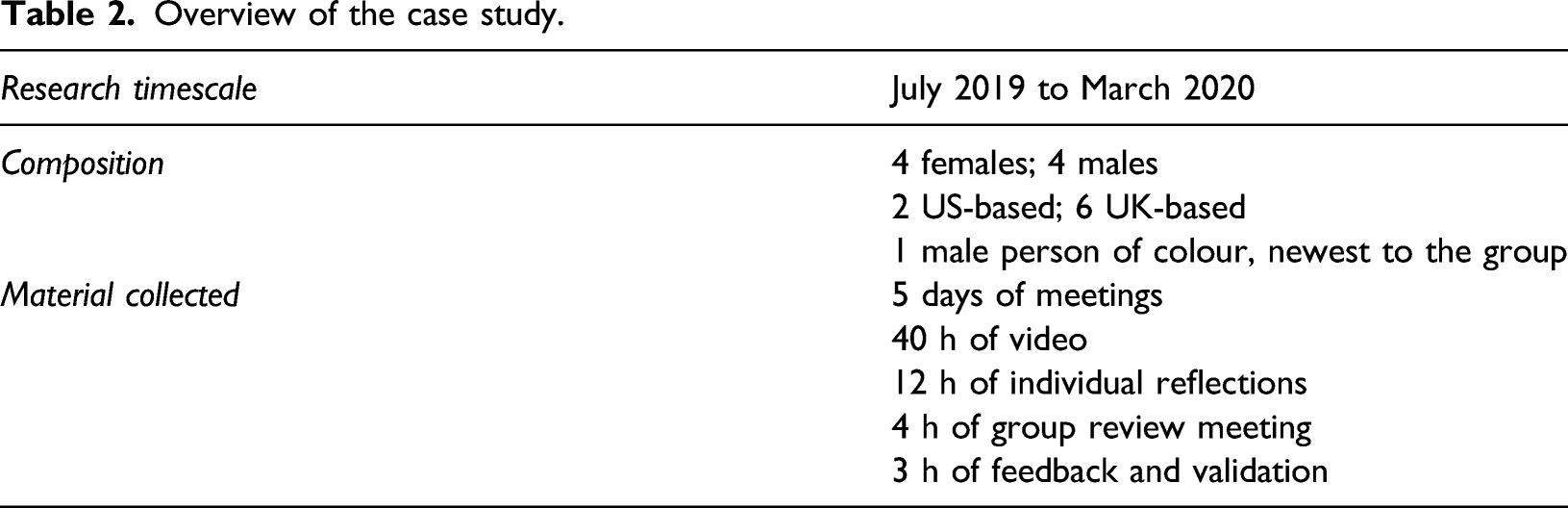
Video ethnography was augmented by direct observation and interviews that invited reflection with individuals and the whole group. The first author was present during the meetings working as a participant–observer, whereas during the group interviews, her stance became one of co-discoverer. In the latter phases of the research, there was a certain amount of with-ness (Shotter, 2006) between the researcher and participants as this was new terrain under investigation, and it was for everyone concerned to be part of the enquiry.
Research iterations
To align ontologically with a strong process view of LAP, it was important to maintain an across-group focus for the research as far as possible. As illustrated in Figure 1, there were several research layers and, consistent with emergent principles and the messiness of real-life leadership, we use shaded lines between each of these layers within an egg-style diagram to foreground the porous nature of the activities and to avoid any misinterpretation of arrows as denoting causality (Feldman, 2016). We see these as entwined and iterative steps. Research approach.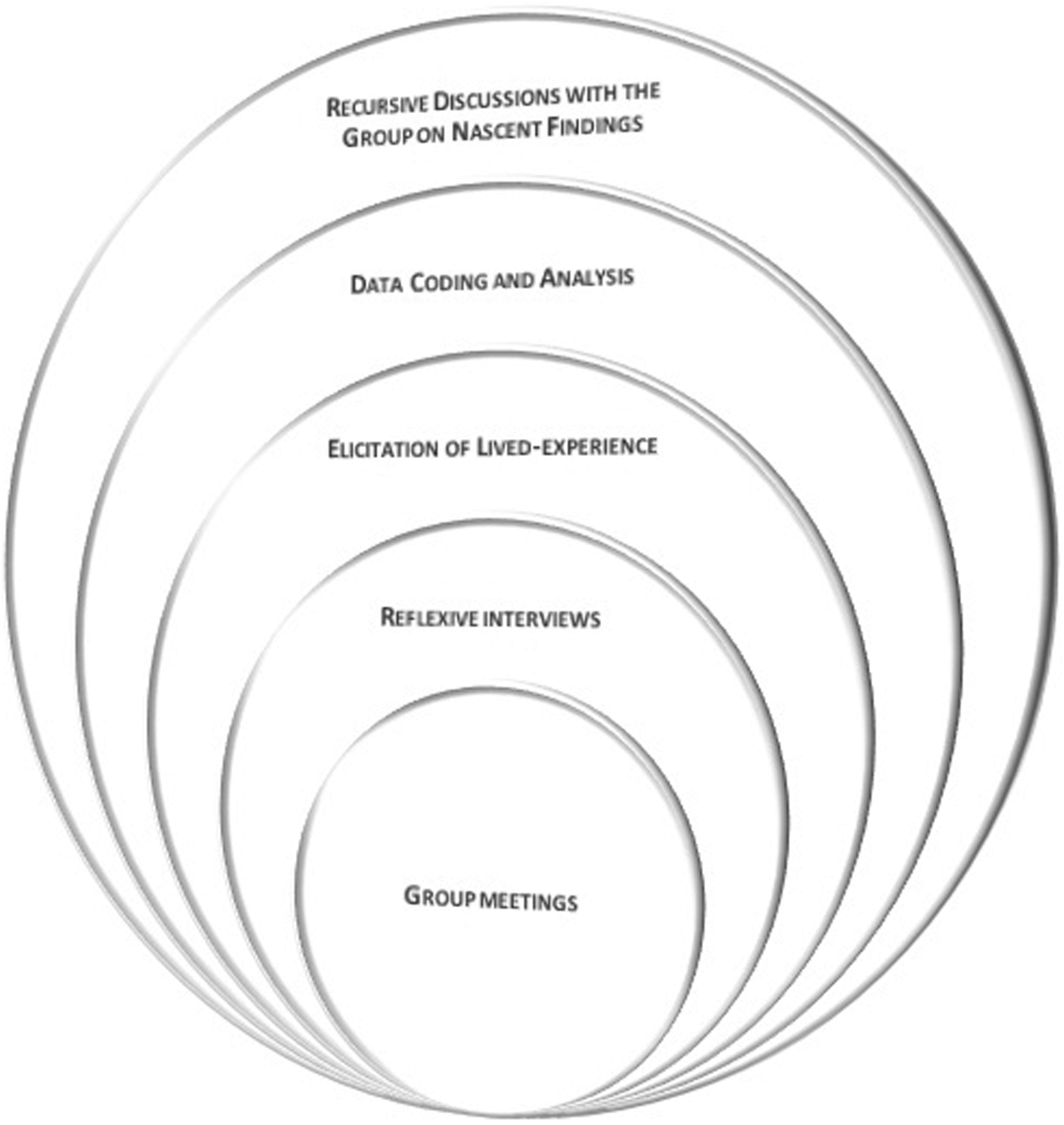
Video ethnography – The group meetings
The participants chose strategically important meetings for the first author to attend. The intention was to reduce the distracting effects of the presence of the researcher and to help ensure their attention would be fully absorbed in their work. Two 2-day meetings were chosen of which 3 days used telepresence (simulated presence in a virtual room projected on a large screen) whilst they were all physically co-located on the other day.
Video ethnography aims to capture natural interaction to try to understand how participants are constructing leadership through the very actions that are recorded. It is a near perfect method for studying leadership as a situated phenomenon (Sutherland, 2018). In common with other sources of ethnography, video provides data-rich archival material, making it possible to investigate the mundane activity of leadership (Sutherland, 2018). Video allows for a saturation within the happenings of the group, but it also presents a challenge (see next section below) when translating data from the three-dimensional image to the two-dimensions of paper.
Individual reflexive interviews
In common with all forms of qualitative research, our video ethnography provided an abundance of data. Selecting and working with these data presents a challenge. Steered by our research questions, we involved the participants themselves in guiding the selection of where to focus our attention to ensure that the choice was most salient to them and their lived experience. The more-usual qualitative approaches of transcribing interviews or working with ethnographical records and coding from these sources inevitably leaves the selection of material and narrowing of data to the researcher. Implicit in that approach is the researcher ‘knowing’ what needs to be foregrounded. Very definitely, we did not ‘know’ and wanted the group’s view to prevail where possible.
Each participant took part in a reflexive interview shortly after the observed meetings. We name these reflexive interviews to draw attention to the meta nature of these discussions, where participants ‘turned-back’ on their experience to reflect. Whilst individual interviews are inconsistent with our commitment to working across the group, the alternative of asking the group risked prioritising status, loudest voices or tenure in identifying salient moments. We gained assurance that the presence of the camera and researcher were ignored. Next, each person identified sections of the meetings of salience to them, avoiding judgements about ‘good’ or ‘bad’. From these reflexive interviews, the salient video segments were separated for later discussion by the group.
Reviewing salient moments as a group – Elicitation
To help sensitise participants to our practice lens, we shared videos of waves on a beach and flocks of starlings (murmurations) and explored these metaphors of coherence and leadership in the doing, achieving and collaborating. This sought to move everyone’s attention from themselves as individuals to consider the perspectives across the group and placed their attention beyond just discourse per se. It provided the group with an understanding of holism rather than atomising to single entities.
In a half-day meeting, each chosen video segment was viewed by the group, and subsequently, they re-lived their experience as a group. The researcher’s questions in the group discussion were based on elicitation (Petitmengin et al., 2007). Elicitation interviews are designed to bring pre-reflexive processes (cognitive and otherwise) to the fore and help the group to see their coherence and fragmentation. Such an elicitation approach seemed consistent with the idea that collaborative agency is a process for which people may lack theory or language to describe. Whilst we were unaware of Ba at the time of designing the research and choosing elicitation, Ba as an emergent property of a group is similarly aligned.
Coding
On completing the group meetings and elicitation interview, we faced the methodological question of translating a three-dimensional moving image onto a two-dimensional static page. To retain fidelity to the source, we sought terminology or labels throughout the iterative coding process to invoke the trajectories or movements of the group’s practice. This had the beneficial effect of keeping these labels value neutral: for example, advancing, diverging or redirecting. We also sought diagrammatic approaches which might help minimise value judgements and support the ability to frame the findings as movement rather than more traditional static forms of data. For example, allowing us to see and experience when an action or trajectory took place and its relationship with other activities, rather than counting how often events took place in tabular form.
Primary data coding
Following the discussion with the group, we sought to code each segment of each salient video using the concept of trajectories. All the videos were watched first to further sensitise ourselves to the potential patterns including sayings and doings. The final coding schema (provided in the Findings section to facilitate data interpretation) was a highly emergent process given its atheoretical underpinning and arose from many iterations. We note that research papers often imply a deterministic step-by-step coding process with discrete results, this was not, and nor does it continue to be, our experience. On three occasions during the coding process, we held video calls with the group to test our ideas, to share our coding terminology and descriptions, and to explore their feedback.
Furthermore, exploring without a map, whilst emergent, is also disorienting. After several exploratory passes at the analysis, we knew that the group had described lived experiences but we had little theory to guide us. So, working abductively we searched for literature and alternative perspectives that might inform our thinking. Thanks to the Buddhist philosophy which so closely parallels some of the ontologies described earlier, we alighted on the literature of Ba. This was fundamental in our seeing and understanding the Place of leadership and enabling the useful coding of our data. As a result, we eventually landed upon a set of discernible patterns using tools, discourses and bodies (Nicolini, 2013a) which provide insights into LAP. We chose ‘patterns’ as the descriptive noun for these practices across and around the group which includes talk and physical movements such as nodding heads, making notes on flipcharts, handing items to each other, using slides and computers.
Identifying and naming these different patterns provided a useful shorthand so that the video segments could be viewed and labelled accordingly, allowing us to gain a sense of how these patterns played out. Nonetheless, to explore the data, we needed a way to overlay some minimal order upon it. We tried many different data display techniques before alighting upon our preferred mechanism which we named Pulse Charts (see Figure 2 below). Additionally, we had to determine which code or pattern should appear where on the relevant axis given the huge number of potential options. After many iterations, we decided to order these simplistically by reference to the total frequency of each pattern across all the salient meeting segments as there appeared to be no discernible benefit in different variations. In contrast, in socialising these pulse charts with the group, they were initially displayed horizontally with time running left to right and the patterns identified on the vertical axis. However, when the group looked at the charts this way, we noticed that they overlaid a prejudice, assuming that those codes high on the vertical axis were ‘better’ than those lower down. We held no such assumption. To solve this, the charts were turned 90 degrees into a vertical form. This changed the feedback and hence the value of the pulse charts to our investigations. Spectrum of collaborative agency.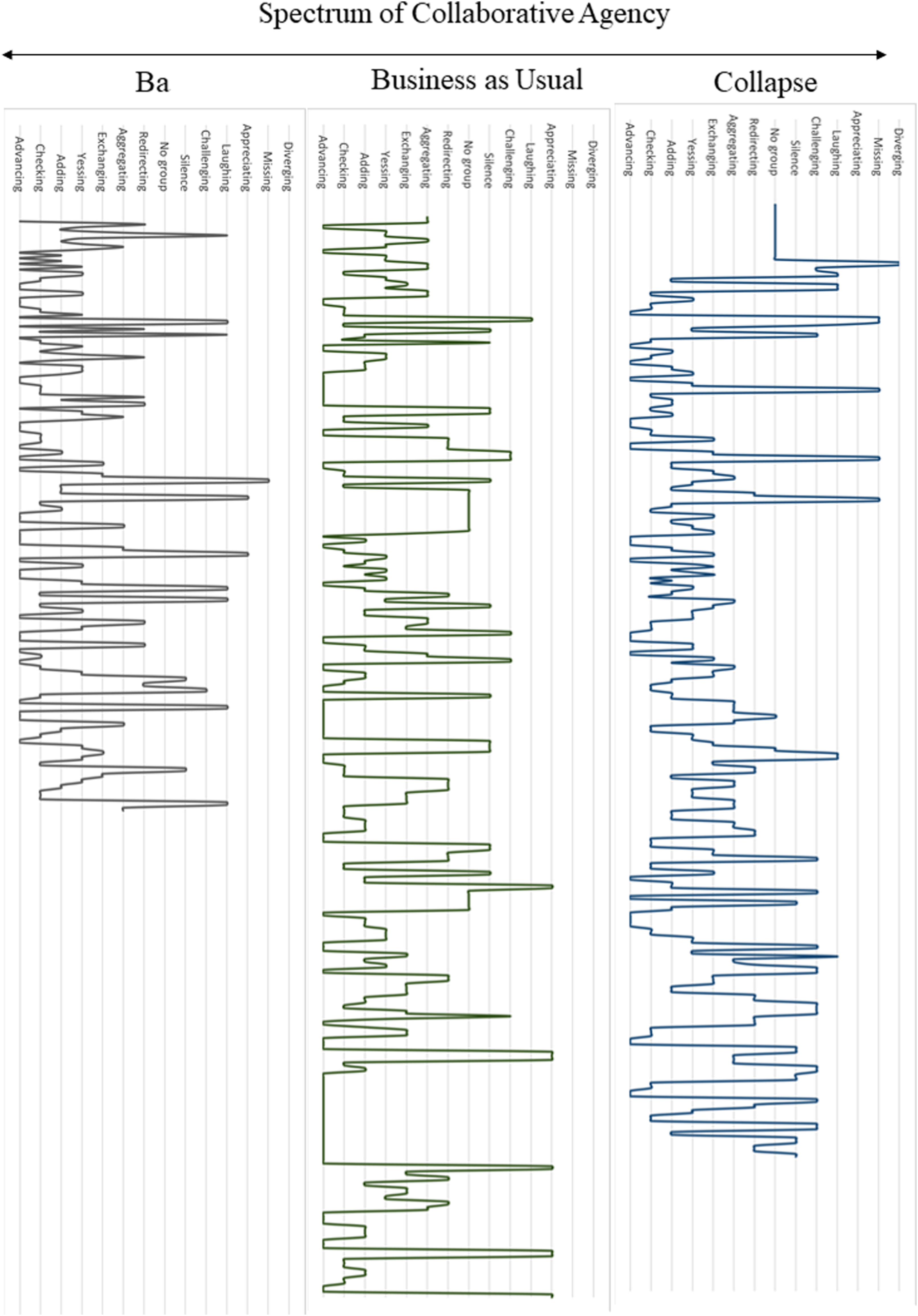
Secondary coding
The secondary coding aimed to fit categories together to develop a comprehensible synthesis of the corpus (Saldaña, 2010). In a reorganisation of all data, we returned to the patterns for each segment alongside the group review and began to discern connected orientations. Whilst in our primary coding schema, we did not ascribe a purpose, it became apparent that there might be a consistent set of logics between certain patterns. For example, the pattern of adding and the pattern of aggregating might have the common logic of moving the group forward. This iterative moving within and between the different layers of data helped us to see that the patterns could be further clustered using similar logics. To differentiate them, and for consistency with weaving the place of Ba, we subsequently named these patterns of patterns, tapestries. To aid comprehension of the charts, these too are provided in the Findings section which we now turn to.
Findings
To provide everyone with an equal say in the selection of the video material, we asked them individually to choose moments that were salient to them in the 2 × 2-day meetings. All eight participants chose the same three sections which were 20, 40 and 35 min long, respectively. The discussion of each of the segments resulted in three qualitatively different types of situations which we have named ‘Ba’, ‘Business as Usual’ and ‘Collapse’. We now analyse and explicate these. As guided by our research question, we first establish the lived experience of the participants and use the group’s descriptions to identify a potential spectrum of collaborative agency. Next, we investigate how the patterns fluctuate within segments and then across segments. Finally, we describe the overall tapestries of patterns and what they reveal about the Place of Ba and the similarities and differences across the segments on the spectrum.
The lived experience of collaborative agency
In this section, consistent with the practice lens and looking across the group, we provide quotes as voices from the whole, not from individuals. Throughout the group interview, we were careful to get input from everyone, not just those who were naturally forthcoming, and we feel confident that the samples provided are representative of the whole.
Ba
Quotes in Ba.
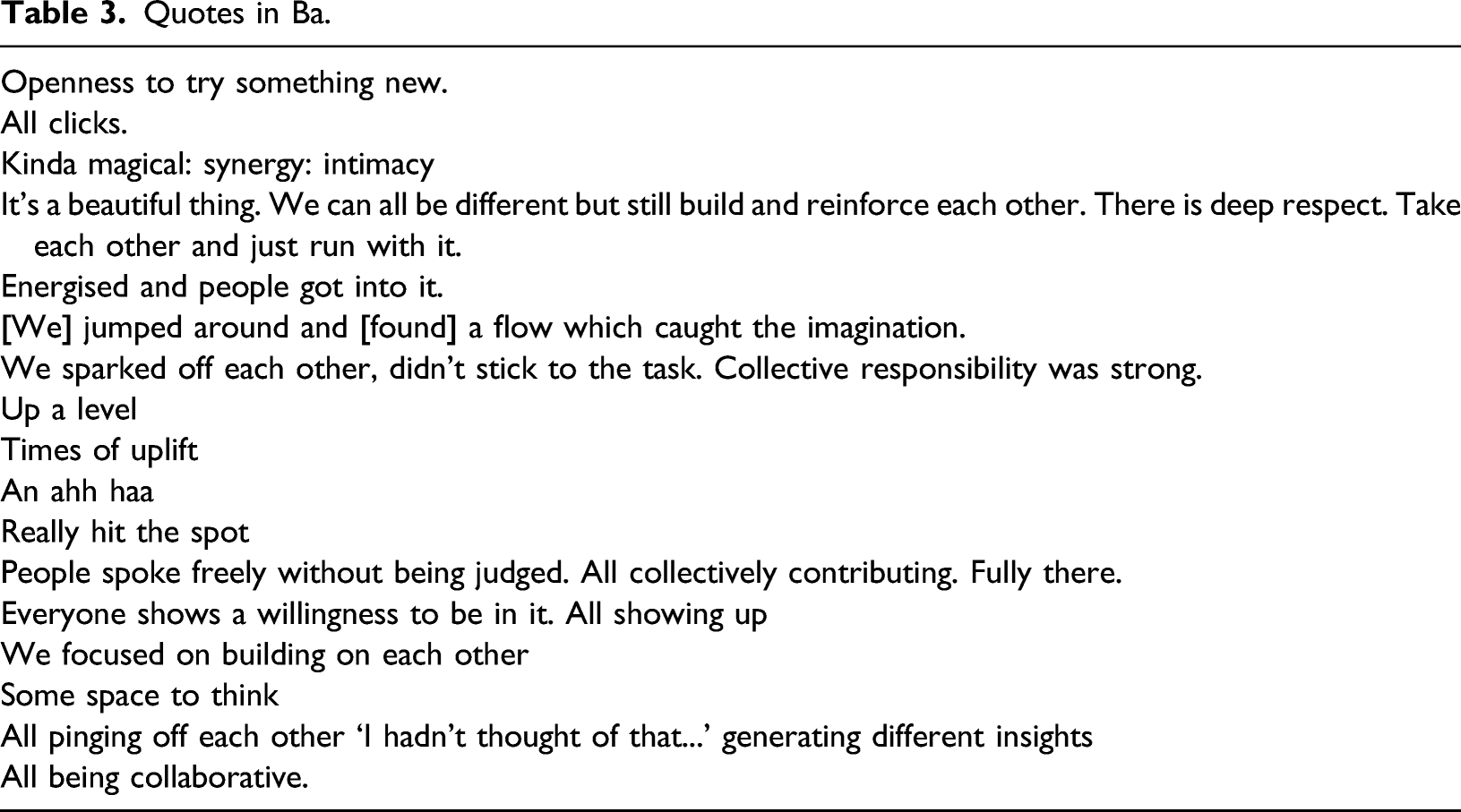
Consequently, we propose that Ba provided an existential space where individuals could transcend their embeddedness. The group used terms such as ‘synergy’, ‘intimacy’, creating ‘space’ and ‘all pinging off each other’. Without using the label of Ba but fully aware of the experience, multiple participants mutually forge each other (without losing their own identity) in a constructed place where they could ‘ping’ off each other and experience non-separation.
Collapse
Quotes in collapse.
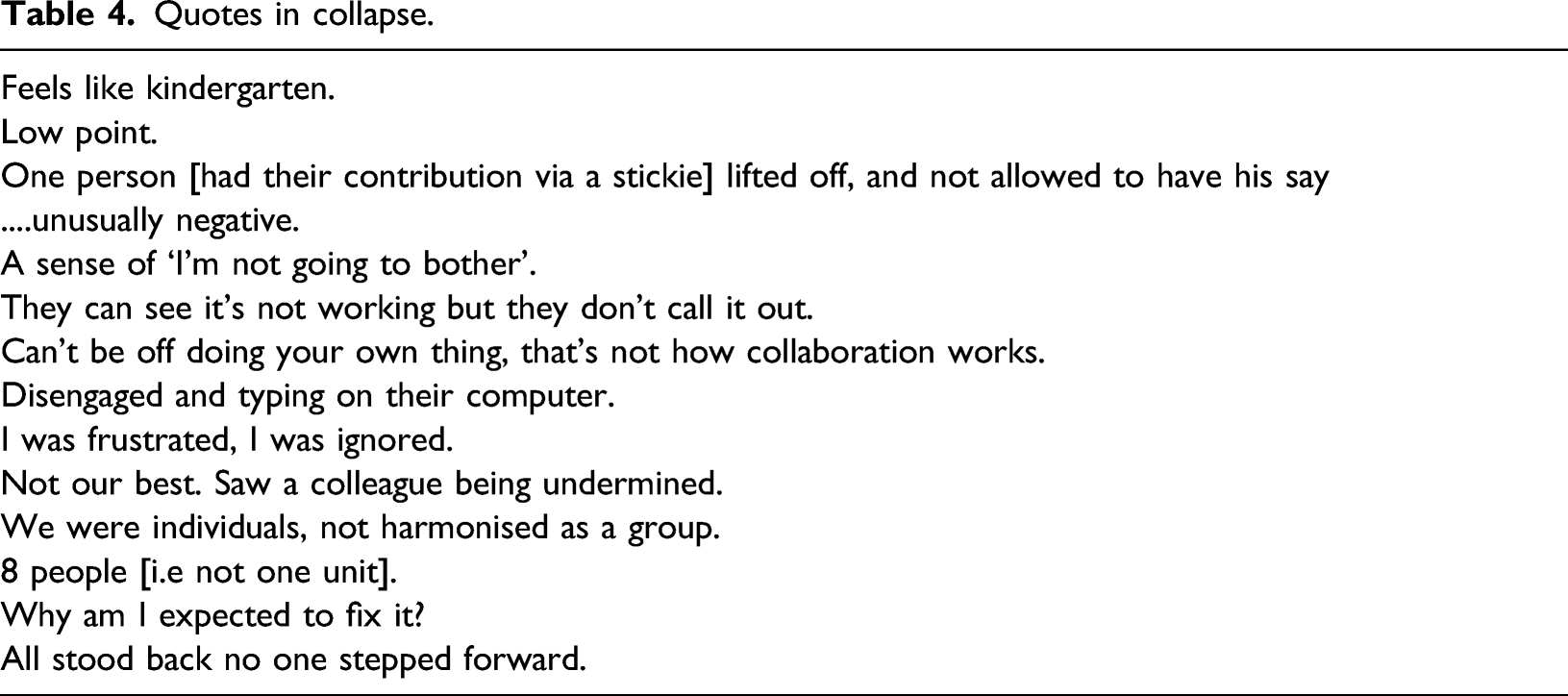
There is a whiff of accusation that it is others’ fault ‘they see’, ‘doing own thing’ as well as ‘why am I expected’. It is not that the group is unaware of what is happening. There are quotes to show that even as the meeting progressed, participants had the feeling they were ‘not harmonised’ and lacked unity: [it] ‘feels like kindergarten’. Something was missing and each was looking to the other to provide it. No one, nor any coalition of individuals, was taking care of the whole; ‘all stood back no one stepped forward’ and there was no mutual construction of space or place and hence Ba was not woven.
We call this lived experience Collapse of Ba (Collapse for short) because it stands in stark contrast to the place of Ba. In the discussion, we will consider whether Collapse of Ba is equivalent to a collapse of collaborative agency and explain why we think not.
Business as Usual
Quotes in business as usual.
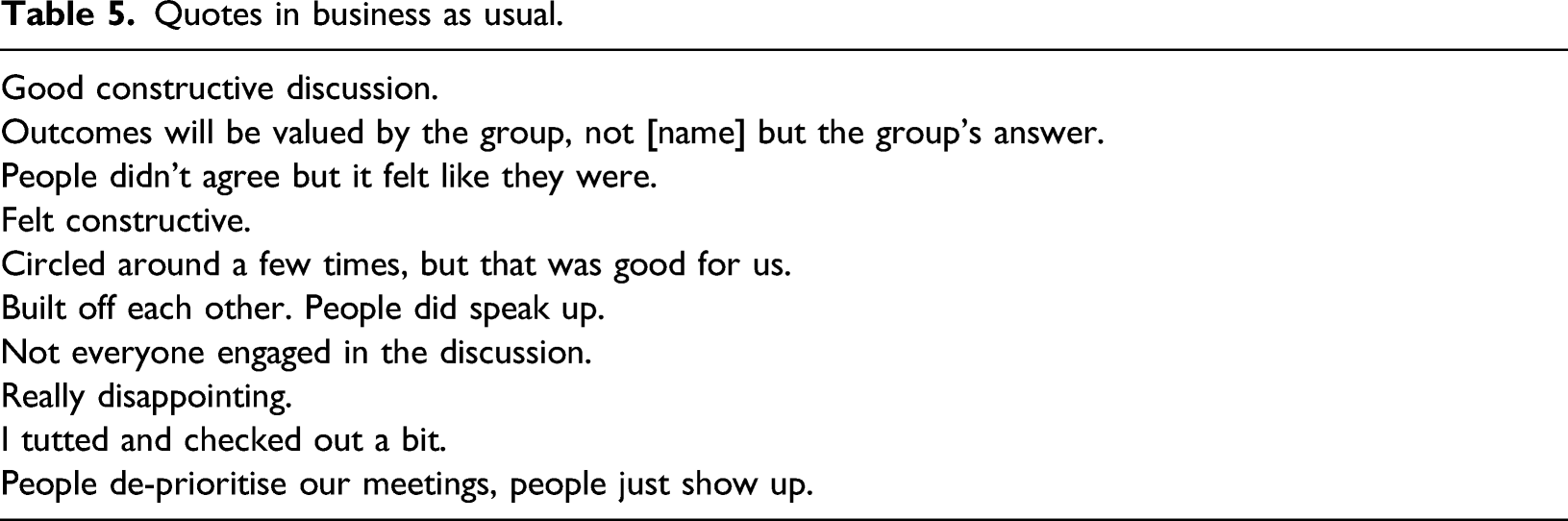
Descriptions diverge, with some participants seeing the conversation in one way – ‘constructive’ and others seeing the conversation another way – ‘checked out’. Their reading of the situation and of each other is not cohering. This is important. If each individual is interpreting the conversation and the sociality (Carroll and Simpson, 2012) of the room in a way that does not align to others, this reading of the situation could lead to contributions to the group that for others may feel ‘off-key’. Weaving a place of Ba without a consistent reading of each other seems nearly impossible. Nonetheless, there are descriptions which seem consistent with collaborative agency, for example, ‘[We] Built off each other. People did speak up’. As we explore below, this suggests that Ba may become more latent or liminal from time to time.
In combination, the descriptions of these three places suggest a spectrum of collaborative agency. At or towards one end of the spectrum, we identify that Ba is woven, and collaborative agency is high. At or towards the other end of the spectrum, we see the opposite where Ba has collapsed but we propose some minimal form of collaborative agency continues. Somewhere between these two ends, we find Business as Usual where the group experiences more collaborative agency than during Collapse, yet there is evidence the group fails to weave a place of Ba.
Patterns of collaborative agency – Primary coding
Primary coding of patterns
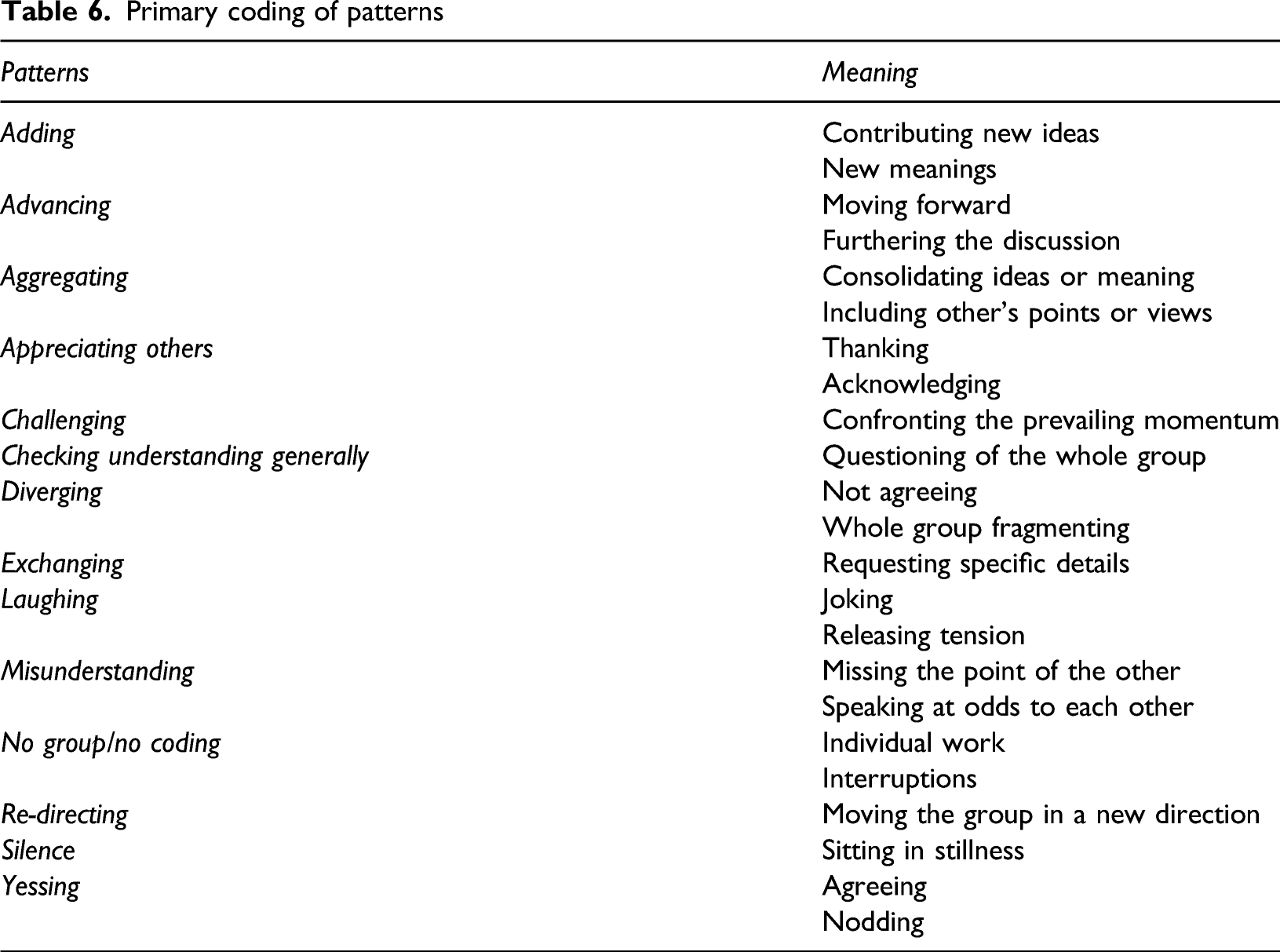
Using a sequence of patterns provides a way to compare, for example, how one pattern follows another or how long the group spends in one pattern or how one pattern is often adjacent to other patterns. To enliven these ideas, we developed the concept of pulses whereby the trace or imprint of each segment of the meeting can be illustrated and compared to other segments of the meeting. These pulse charts show the sequencing of the patterns across time and are created by using the frequency of patterns to create the horizontal axis. For example, advancing is the most frequent pattern and is placed at 0, whereas diverging is the least frequent and is placed at 14. The three points on the spectrum produce three distinctive pulse charts as shown in Figure 2.
Each of these pulse charts is distinctive and we turn now to look at what differentiates the patterns of collaborative agency within and across the different segments.
In Ba – Pinging off each other
This was the final section of the agenda for the group following a 7-h meeting, and two members were suffering jetlag; also, two participants did not speak throughout the segment, and a third member only spoke once. These actualities are noted given their reported lived experience of ‘all showing up’. There is no diverging, but there are still patterns of checking, challenging and exchanging indicating that there is interrogation of ideas and of each other. The most laughter occurs at this point, and we also note that there are no interruptions.
Across the three pulse charts, no group uses all the patterns. However, the two distinctive features of the pulse of high collaborative agency in Ba is the wide variety of patterns throughout and the high tempo. Tempo is indicated by the frequent pattern changes which aligns with the earlier descriptors of people actively contributing. These two features make the pulse regular and even.
Collapse – Like kindergarten
The group is, at this point, on the spectrum for 35 min; it is mid-morning on the second day of the first meeting. The group has the highest number of no codes. This is the only segment where there is no appreciation expressed, and it is the only segment where the group diverges. They also have nine sections where the pattern is ‘missing’ which indicate misunderstandings.
The pulse of Collapse has a similar energetic feel to high collaborative agency as the group switches patterns more frequently than in Business as Usual, but the group also demonstrates occasional table-tops and plateaus. These table-tops/plateaus are times when the group subsists in one pattern for an extended period. In Collapse, there is the least amount of advancing. Also, notably, the pulse of Collapse begins with divergence, followed by four instances where the group is talking or working at odds with each other (missing).
Business as usual – Constructive and disappointing
During this segment, the group is at the end of a second day of meetings. A distinguishing feature of this video is that the group exhibits turn taking with each speaker neatly slotting onto the end of the previous speaker. The pulse of Business as Usual shows the group switches from pattern to pattern at a lower tempo than at other times; thus, the group stays in single patterns for longer as demonstrated by the table-tops and plateaus within the pulse chart. Energy levels in the group seem low which is also noted in the verbatim comments earlier.
Over the 40 min, there are 24 no-coding patterns which are interruptions derived externally (technology failure) or internally (individual brainstorming). The group does not use diverging and they continue checking, challenging and exchanging information with each other during the discussion. This is the lowest pattern of laughter in this segment and the highest count of advancing, adding and redirecting.
Weaving tapestries – Secondary coding
Secondary coding of tapestries.
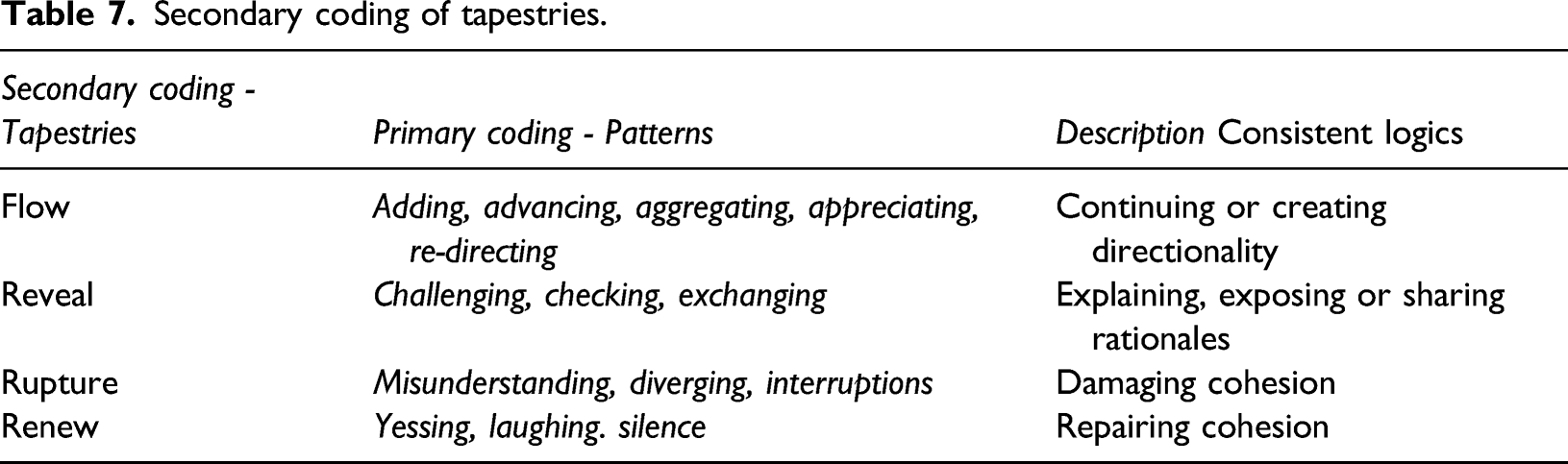
Figure 3 compares the three places on the collaborative agency spectrum and applies the secondary coding schema. All three sections are predominantly in Flow as shown in the left-hand column. These moments in Flow are often broken by Reveal activities when the group is challenging and checking progress and understanding. The third column from the left hand side represent Renew activities comprising silence, laughter and yessing which can have the effect of re-unifying the group. Finally, the fourth column represent Ruptures in the activity of the group. Tapestries for spectrum of collaborative agency.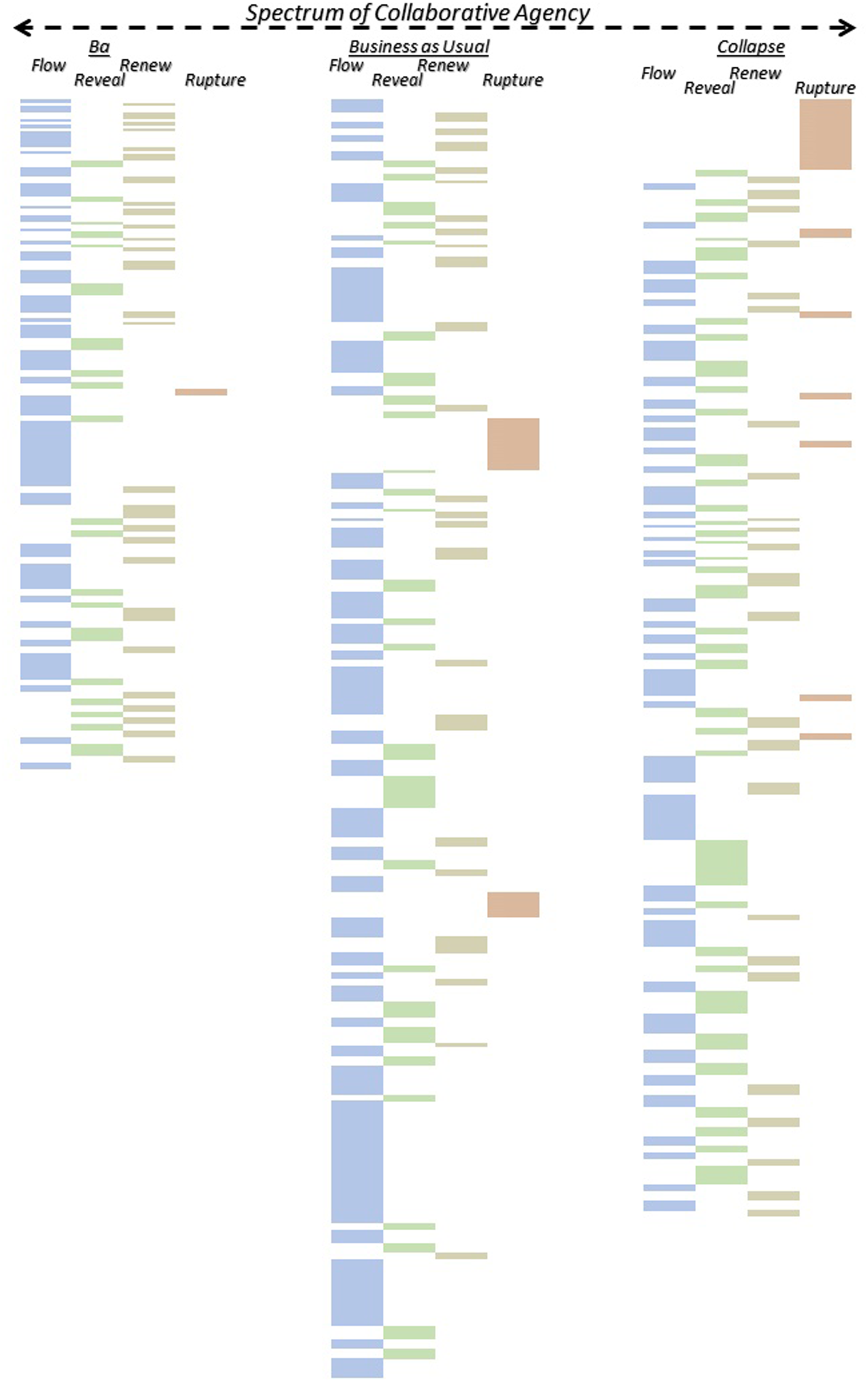
Each column works in a binary manner, making the strands discontinuous. It is not possible to be in two columns simultaneously, but instead, this way of exploring the data demonstrates how the logics of the group change moment to moment and each interrupts the other.
The left chart shows the weaving of Ba where the group extends across Flow, Reveal and Renew. Across the strands, there is mostly equal criss-crossing with one Rupture and one extended period of Flow. The vertical and horizontal strands provide a weaving of Ba, creating an array where warp and weft are balanced.
In Business as Usual, the most notable feature is that the Flow sometimes continues unabated and without adjustments. Other times, the warp and weft are balanced across Flow, Reveal and Renew consistent with the Ba chart. However, there are structural imbalances created by too much Flow. Hence, this suggests that the group fails to achieve Ba because they are failing to re-orient the flow of practice. Equally, holes are rent in the fabric of the group with two notable Ruptures. Nonetheless, consistent with our earlier point that Ba is not present, had there been fewer interruptions or had there been, for example, the use of Reveal, then maybe higher collaborative agency could have arisen. The patchy nature of the tapestry aligns with the inconsistent lived experiences of the group. As they report, parts of this meeting were collaborative but other parts were disappointing, this is seen in the tapestries in secondary coding.
Collapse still appears to show that weaving – down and across the columns – is strong in places. However, the fabric is being ripped by too many Ruptures occurring in the early phases. Whilst there are two significant periods of Rupture in Business as Usual, this does not seem to have the same impact as they are spaced out with Flow–Reveal–Renew building strength in between. Discontinuities such as technical failure or brainstorming (examples of Ruptures) are unaccounted for in any theorising in pluralised leadership. Our findings demonstrate that in Collapse there are seven instances in 35 min. The weaving unravels and people fail to exhibit a ‘willingness to subsume their own efforts and benefits within the collective effort’ (Drath et al., 2008: p. 647) in order to repair it.
In summary, we build on the metaphor of ‘weaving’ the place of Ba to interpret these diagrams. When one column subsists, the other columns are subdued. Weaving strong tapestries requires an evenness of both warp and weft, down each column and across each column. The criss-crossing of the threads of patterns across the four columns provides a way to see how the activity strengthens to weave together a place of Ba or unravels to create a group that collapses collaborative agency and fails to weave Ba.
Discussion
Despite all having the title ‘leader’, it was not a foregone conclusion that participants would work to produce leadership through collaborative agency. Without participants finding a sense of ‘we-ness’ (Gronn, 2015) to reconcile business agendas, stalemate was likely. Our research questions set out to understand the group process of collaborative agency and how individuals transcend their embeddedness in a place of Ba. These findings suggest several important issues.
Ba and the trans-subjectivity of collaborative agency
Ba draws attention to the importance of looking not just at the activity between the participants, but also across and around them. As such, we are drawn to processes beyond the inter-subjective, echoing indigenous and naturalistic writings (Marion and Uhl-Bien, 2003; Spiller et al., 2020; Sveiby, 2011). Our findings reflect this as the group describes how they ‘move up a level’ and there are ‘times of uplift’. Ba’s underpinning Japanese and Buddhist philosophical positions of mutual dependence, impermanence and non-separation (Hanks et al., 2019) highlight the need to shift our gaze from inter-subjective to trans-subjective practice.
Fujii (2012) suggests that in Ba, the outer regions of individualism can dissolve to allow the re-making of a fresh entity (see Figure 4 taken from page 657/8). Resonance is established in Ba.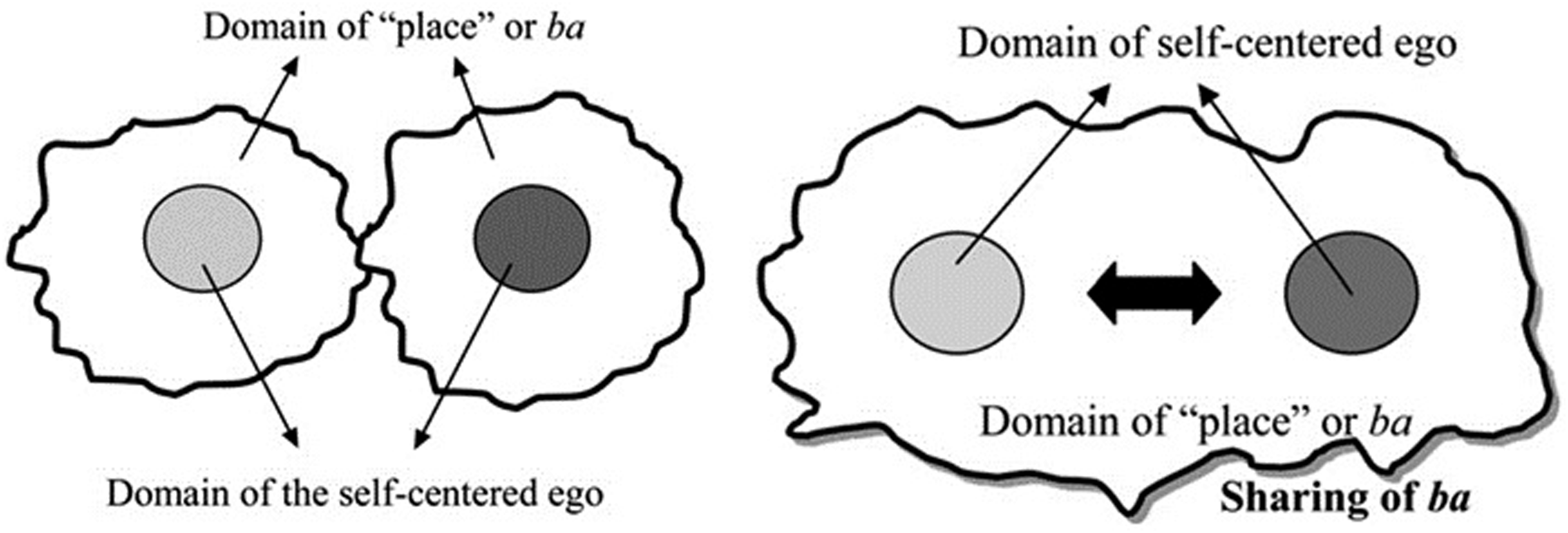
Our research question invited us to explore lived experience. Our participants’ descriptions at key points fitted with the principles of Ba. Theoretically, when in Ba, a person does not continue individualising but experiences ever-changing intimacies. Empirically, we found that the group reported having a felt-sense of themselves dynamically arising from the social weaving that is of their creation and which creates them too: ‘all pinging off each other’. Further, they ‘can all be different but still build and reinforce each other’. Our findings point to a place of Ba in which an inter-actional view of collaborative agency is insufficient to properly represent the processes that allow actants to ‘transcend’ their embeddedness.
Furthermore, consistent with Raelin’s (2011, p. 16) ‘humming along’ and Fujii’s (2012) ‘resonance’, both of which must be experiential, these are processes that occur across the group. In combination, our findings suggest the term trans-subjectivity is more appropriate to describe the practice, drawing on the etymology of ‘trans’, that is, beyond, not just the within and between of ‘intra’ or ‘inter’. Trans-subjectivity helps us understand better the lived experience of the self-transcendence within collaborative agency.
Ba and the collaborative agency spectrum
Turning to our second research question, concerned with understanding how a group’s collaborative agency enables individuals to transcend their own embeddedness, we extend the processual view of leadership to include both a ‘becoming’ (Hernes, 2007; Tsoukas and Chia, 2002) along with a ‘subsiding’. Thus, we place the three reported lived experiences along a spectrum consistent with rising and falling. High collaborative agency emerges with the weaving of Ba. However, we suggest there is an irregular relationship between Ba and collaborative agency that is not causal nor correlational. Instead, we point to some of the most interesting and counter-intuitive findings of this study: even in Collapse, the same patterns persist in primary coding. In secondary coding, the four columns of weaving also persist.
In sum, practice does not appear to change but the volitional coherence does. We therefore rationalise that collaborative agency can persist, maybe minimally, even during Collapse and without Ba. Consistent with this, the group acknowledges that during Collapse, they became individualised: ‘We were individuals. Not harmonised as a group’, and yet they had not fractured irreparably. This may suggest that Ba remains latent, with all the processes needed to encourage its re-emergence remaining in situ ready for resonance. The tapestries show how quickly the group weaves and rips Ba; it is fleeting and fragile and therefore liminal with ongoing potentiality.
These ideas and the place of Ba allow us to identify a spectrum of collaborative agency thereby extending the work of Raelin (2016c, 2020; Raelin et al., 2018).
Maintaining collaborative agency
In understanding how a group’s collaborative agency enables individuals to transcend their own embeddedness, there is also a question of how collaborative agency may be maintained. Larsson and Lundholm (2013) suggest that an organising property of leadership is the prevention of closure, thereby enabling the reinterpretation of an issue. Premature cognitive commitment (Langer, 1989) is the tendency we have as humans to too quickly come to a conclusion on an issue and fail to seek non-confirmatory evidence. Prevention of closure is one way to overcome this tendency.
Challenging, checking and exchanging are considered in our findings as part of Reveal because they invite the group to explore underlying logics and rationales. This is consistent with the idea that the group did not hurry to close but remained open to further views. Consistent with these ideas, other authors have said that ‘being experientially open to the reality of the present moment’ (Bishop et al., 2004: p. 233) helps to ensure that the group will not be swept up by judgements. This non-judgemental, present-centred awareness may help the group keep an open mind in interactions (Arendt et al., 2019). We propose that the interweaving of the threads of Flow and Reveal are important. Remaining too long in Flow (a feature of Business as Usual) leaves the fabric unstructured, but when accompanied by Reveal, the fabric is strengthened. So, although Reveal includes ideas such as challenging and checking, they might be having the effect of preventing premature closure of an issue.
Similarly, the LAP literature suggests that a hallmark of leadership is the re-orientation of practice (Simpson, 2016). In Ba, we identified a high tempo of patterns combined with high variability (see Pulses in Figure 2) which speaks directly to Simpson’s (2016) ideas.
It is unintuitive, but it seems that collaborative agency is not simply an unhindered advancing of ideas. The beneficial effect of interrupting Flow might be that corrections can inoculate the process from the scourge of groupthink (Janis, 1982). Collaborative agency appears to rely on balance and energy too. Energy is tantamount to engagement and motivates the patterns within Reveal, providing the group with the opportunity to interrogate themselves. We also note that the interruption of Flow may be achieved successfully through Rupture and Renew provided there is sufficient tempo and variability (as happened in Ba). Also, the tapestries (Figure 3) show more than twice as many instances of Renew on a per-minute basis in Ba compared to the other segments, indicating the importance of this seemingly simple style of patterns (predominantly using ‘yes’). Unlike Csikszentmihalyi’s (Csikszentmihalyi, 2014) description of Flow, our proposition is that Ba/high collaborative agency benefits from re-orientations.
The findings of this study lead us to propose that maintaining collaborative agency is not the absence of patterns that might be discerned as disruptive, such as challenging, but may be a balancing of Flow with Reveal and Renew sufficient to overcome Ruptures.
The fragility of Ba and collaborative agency
Our findings show that Flow is also re-oriented through patterns that aggregate to Rupture. Inevitably, technology fails occasionally but the group too also causes breaks in the Flow by choosing to work on items as individuals, or someone leaves, or is late and the group awaits their arrival/return. Whilst similar patterns of variability arise in Business as Usual, Collapse and Ba, they are not sustained in the former two. Furthermore, the instances of Rupture may be too frequent in the early stages of Collapse for collaborative agency to emerge. It is possible that Business as Usual and Collapse had the potential to weave a place of Ba if Ruptures had been avoided or were infrequent, suggesting that Ba is fragile and the weaving is easily ripped.
We propose that Rupture and Renew strands interweave, making timing and proximity important too. When frequent Ruptures occur, the weaving is weakened. Renewal needs to occur quickly so that the warp and weft of the strands provide strength. By considering Ba as a weaving of patterns, it appears that intersecting strands mean that no single strand is left bare. We foreground the impact of Ruptures and seemingly minor interruptions. Ruptures are not always devastating – one occurs in Ba. However, Ruptures may become difficult with insufficient Renewal or Renewal that is too late. The weaving of Ba can fray.
Ba helps the group’s coalescing, and coalescing helps weave Ba. This process is mutually constitutive, fragile and fleeting. Across 40 h of video, it is only during a single 20-min section that we were able to capture this metamorphosis. Although patterns and tapestries are similar in other instances, the fabric is ruptured, and Ba is not woven, suggesting a fragility to the process and its longevity.
Self-transcendence
Raelin (2016a) argues that self-transcendence is a key component of collaborative agency. The construct of Ba allows us to see the role that resonance plays across the group in our findings. The language of the group when in Ba indicated the significance of resonance as the group ‘sparked off each other’ and ‘ping[ed] off each other’. Furthermore, the tapestries oscillate quickly from Flow to Reveal to Renew and vice versa. Tempo and responsiveness appear to be critical features. Hence, when experiencing high collaborative agency, there was resonance and this sequencing persists. Otherwise, when not in Ba, the patterning begins but is often abruptly foreshortened or the tapestries of one type continue for too long without interweaving from other tapestries, thus we could not see resonance. We do not propose that collaborative agency relies on resonance because the same elements of patterning exist in the group in all three places of collaborative agency and sometimes the same sequences also arise; they are simply not maintained. This suggests that resonance was possible throughout but did not come into being sufficiently during Business as Usual and Collapse. It seems then that collaborative agency can minimally occur without resonance, but high collaborative agency was experienced as resonance and hence is fundamental to the self-transcendence necessary to maximise LAP.
Limitations
Before closing we reflect on the limitations that arise from this study. The group chose to review just three instances from 40 h of video. Against the ideas proposed above, we are interested to re-visit other instances to discover how the patterns and sequencing of patterns might align with our theorising. However, this is limited by our methodology which calls for the group to discern their lived experience, not us. Since the data was collected, the group has once again been re-configured so we have no further opportunity to review with them again in the same way. We note that constant re-organising likely adds to the fragility of collaborative agency.
Allied to the above limitation is the concern that we have used a 20 min clip of video for the analysis of Ba. If we were working quantitatively, there would be concerns as to the significance of this small sample. However, we are relying not on statistics, but on the lived experience of our participants to determine impact and significance. Against this criterion, we are persuaded that this provides sufficiently strong data for our paper.
In contrast to identifying a spectrum of collaborative agency, an alternative interpretation may be that we have identified three separate states: Ba, individual agency (Collapse) and something between the two, similar to collective rather than collaborative agency. We are not persuaded by this interpretation but will continue our research journey to investigate other cases and invite others to do the same.
Conclusion
Matrixed global organisations are common because of the potential for headcount savings and coordination efficiencies this structure affords. But in-built structural tensions abound. In practical terms, we point to the importance of collaborative agency as a trans-subjective process which allows individuals to transcend their embeddedness.
This article contributes to LAP by suggesting that collaborative agency is trans-subjective and moreover that it sits on a spectrum. We have identified and described the outer reaches, one where Ba is woven and the other where there is Collapse. We suggest that collaborative agency continues to subsist all along the spectrum but the Place of self-transcendence is at or near the highest point where Ba is present. When in Ba, the group is using the widest variety of patterns, contributing to strong tapestries. The cloth is strengthened when the ratios of tapestries are balanced over time, with each of the four strands having sufficient representation to hold the fabric together: not too much of one; not too little of others. Further, we have described the warp and weft that is synonymous with the weaving of Ba and demonstrated how holes can appear in the fabric such that collaborative agency is fragile and difficult to maintain. Finally, we identify the potential role of resonance within a group which may be important if individuals are to practice trans-subjectively as anticipated in Leadership-as-Practice.
Footnotes
Declaration of conflicting interests
The author(s) declared no potential conflicts of interest with respect to the research, authorship and/or publication of this article.
Funding
The author(s) received no financial support for the research, authorship and/or publication of this article.
