




Abstract
Authentic leadership has been developed with insufficient empirical challenge to its definitional components, and alternative conceptualizations have largely been ignored. The theory remains heavily criticized and its distinctiveness from other higher-purpose leadership theories remains in doubt, leading to a circular debate as to its usefulness in practice. In response to the call to return to the definitional drawing table, this article presents the findings of an interpretative phenomenological study that reimagines authentic leadership as a two-component moral and relational model that is closer to Heidegger’s notions of ‘being true’ and ‘care’. The study inductively explores how leaders themselves make sense of authenticity in practice, when it is enacted by their own leaders within the social exchange relationship. It richly describes how managers perceive and attribute authenticity to their leaders within the lived experience of contemporary work. The study also identifies that working for a leader who is perceived as authentic feels like a friendship and is beneficial to followers’ own psychological experience of work, facilitates their own authentic expression and is worthy of retention as a distinct leadership theory that explains how performance is enabled within proximal leader relationships.
Introduction
The etymology of the word authentic as to ‘know thyself’ in Greek philosophy and the Westernised preoccupation with its common application as a marker of the ‘genuineness’, ‘reality’ and ‘truth’ of an object have been widely explained (Grayson and Martinec, 2004: 287). However, there remains an absence of shared understanding when the word is heuristically applied to another person, or more specifically in the context of this article, to a leader. This definitional confusion has led to a critical dismissal of authentic leadership as a tautological and intrinsically flawed theory (see Algera and Lips-Wiersma, 2012; Ford and Harding, 2011; Lawler and Ashman, 2012), along with more recent calls for a conceptual repositioning based on more elaborative and relationally oriented methods of enquiry (Iszatt-White and Kempster, 2019; Kempster et al., 2018). Rather than offering a refinement to theory based on yet another conceptualized set of assumptions, or further testing of existing hypotheses, I return to the drawing table (Gardner et al., 2021) and present an empirically formed definition of authentic leadership that is grounded in how its enactment is observed within the lived context of managerial relationships.
Since its conceptualization, authentic leadership has gained a seemingly unquestioning and almost evangelical following in practice and research. Alternative, relativist conceptualizations have been offered, such as humanistic (Ilies et al., 2005) and storied forms (Shamir and Eilam, 2005; Sparrowe, 2005), but these have been largely ignored, as have alternative research methodologies that could have inductively strengthened the theoretical underpinnings (Iszatt-White and Kempster, 2019). A fundamental concern with the dominant normative approach is that it has led to a deifying of authenticity as an unobtainable ideology (Algera and Lips-Wiersma, 2012), a psychometrically assessed ‘thing’ that a leader must strive to ‘be’, rather than an exposition of the idiosyncrasies of the person in role that help shape the lived experience of work for those that follow. If even Nelson Mandela and Mother Teresa (Ladkin and Spiller, 2013) are unable to fully live up to the expectations of an authentic leader, then what is the practical utility of the incumbent theory in everyday working lives? Perhaps attempts to evaluate the authenticity of famous or political leaders are, in themselves, contributing to the elusiveness of the meaning of authenticity in leadership, because such evaluations raise it beyond the grasp of the everyday and attach it to acts of heroism (Ciulla, 2013).
In this article, I enunciate the findings of a qualitative, interpretative phenomenological study that aimed to define authentic leadership as a practice-based phenomenon (Iszatt-White and Kempster, 2019). Specifically, I draw on Heidegger’s notions of being ‘true’ and ‘care’ to redefine the meaning of authentic leadership and argue that, by recentring the concept around a revisioning of the moral and relational dimensions, we can strengthen its usefulness in practice. The study detailed here inductively explores how leaders themselves make sense of authenticity through their own lived experiences of work and how they attribute it meaningfully to their own leaders across their career span. Using leaders’ own experiential narratives to surface and understand their definitions and expectations of an authentic leader is a novel approach to resolving the definitional confusion and responds to the calls for researchers to refine the definition of authentic leadership (Gardner et al., 2021) and pay more attention to relational aspects and the legitimization processes of followers (Alvesson and Einola, 2019; Gardner et al., 2011; Sidani and Rowe, 2018). Adopting an attributional perspective enables us to, in Husserl’s words, ‘get closer to the things themselves’ by circumventing issues of impression management and identity conflicts raised by self-reflective enquiry (Nyberg and Sveningsson, 2014). In short, when focusing enquiry on the lived world, it is easier for participants to authentically identify authenticity in others, because this sits within their everyday perceptual processes, than it is to identify it within themselves, because this is clouded by their own identity management processes that are tilted to fit their overarching storied lives (Neimeyer, 2009). This approach focuses on the role of sensemaking within the leadership process (Weick, 1995) and acknowledges individuals’ freedom and choice, which addresses another criticism of existing approaches raised by Lawler and Ashman (2012).
Empirically deriving the meaning of authenticity as an attribution is important to the development of the field for two reasons. First, there is an ongoing debate as to the applied usefulness of authentic leadership in its current form (Gardner et al., 2021), informed in part by a lack of distinctiveness in its outcomes. Reported positive outcomes include job satisfaction (Wong and Laschinger, 2013), job performance (Leroy et al., 2012), extra effort (Ilies et al., 2013), ethical behaviour (Cianci et al., 2014), well-being (Macik-Frey et al., 2009), transformational career experiences (Bradley-Cole, 2018) and psychological capital (Rego et al., 2012), which are not dissimilar to the suggested outcomes of other higher-purpose theories of leadership. Second, the over-reliance on self-based, positivist and reductionist methods that ideologically frame the leader’s personal qualities have contributed to the theoretical over-simplification and normative criticisms (Nichols and Erakovich, 2013) and further impede its usefulness within the lived world of organizations (Alvesson and Einola, 2019). Gardiner (2017: 468) offers the term ‘authentic otherness’ as a relational and contextual lens for exploring ‘what it means to express oneself authentically in a workplace environment’. She argues that, by starting from the position of another rather than the self, we can better understand the complexities of how authenticity is diversely expressed and developed at work, which will enable organizations to create more inclusive environments where everyone’s individual expressions of their authenticity can flourish. This study starts from the position of authentic otherness as it focuses on how authentic leadership is perceived as a received phenomenon, rather than how it feels for the leader.
Theoretical context
The greatest challenge facing authentic leadership is its lack of definitional clarity, a concern that was again highlighted in the most recent exchange of letters in Gardner et al. (2021). Until this is resolved, the distinctive outcomes of authentic leadership and its usefulness to organizational practice will continue to be contested. In this section, I explore the definitional challenges that I am seeking to reframe, namely, the question of morality in authentic leadership and the limitations of the current articulation of the authentic leader’s relational orientation. I do not explore the dimensions of self-awareness or balanced processing because they do not form part of the proposed conceptual revisioning.
The question of morality in authentic leadership
The relationship between leader authenticity and morality has been debated since the early conception of authentic leadership was offered by Bass and Steidlmeier (1999) as an ethical form of transformational leadership. It remains a contested area with a 60/40 split between definitions of authentic leadership including it as a component versus those who exclude it (Sidani and Rowe, 2018). Jackson and Parry (2011: 112) used the term ‘leadership with a higher purpose’ to group together the leadership theories that encompass a moral component, including transformational leadership (Bass, 1985; Burns, 1978), ethical leadership (Brown and Trevino, 2006), servant leadership (Greenleaf, 1977), spiritual leadership (Fry, 2003) and authentic leadership (Luthans and Avolio, 2003). Brown and Trevino (2006) identified conceptual overlaps across all these theoretical propositions, such as integrity, altruism, role modelling and empowerment, that compound the difficulties in distinguishing authentic leadership from the broader domain of moral leadership theories within which it is said to sit (Dinh, 2014). Additionally, both authentic and ethical leaders are portrayed as socially motivated and principled, but ethical leaders (Brown and Trevino, 2006; Trevino et al., 2000) are chiefly presented as caring for others, which is materially different to the notion of ‘being true to oneself’ that is the essence of authentic leadership.
The internalized moral perspective component of authentic leadership has evolved considerably over time. It was originally described by Gardner et al. (2005) as leading by example, communicating high moral standards and values through both words and actions, and being a positive role model. By the time of Walumbwa and Wernsing’s (2013) book chapter, it had developed it into the now accepted form of self-regulation that is guided by internal moral standards versus group, organizational or societal pressures, and that is also expressed in decisions that are consistent with those internal values, as well as more ethical and prosocial behaviours. The definitional obscurity of morality is potentially problematic for authentic leadership because the theory has largely been developed conceptually and the original definitions were not adequately broadened or challenged before being tested, which contributes to criticisms surrounding overall definitional clarity (Banks et al., 2016; Sidani and Rowe, 2018).
Another possible reason why the question of morality in authentic leadership has not been resolved is the lack of attention to alternative conceptualizations offered by other authors throughout its theoretical development, even though some of these different perspectives have been acknowledged, and even partly accepted, by the foundational authors (Gardner et al., 2011). Shamir and Eilam’s (2005) self-concept approach is distinctive as it stays closer to the original idea of authenticity being ‘to know thyself’ and, in separating morality from authenticity, severs the connection between authentic and transformational leadership as well, which supports Bass and Steidlmeier’s (1999) articulation of authentic and pseudo-authentic transformational leaders. Conversely, Sparrowe (2005) draws on phenomenological and hermeneutic philosophy in his narrative identity approach and defends the moral dimension because, in his view, leaders who are narcissistic or have other dysfunctional personalities cannot be authentic because achieving authenticity is dependent upon interpersonal relationships and clarification from others, who would not confer it through negative behaviours.
The relational orientation of authentic leadership
Walumbwa and Wernsing (2013: 396) define the relational component of authentic leadership as: … presenting one’s authentic self (as opposed to a fake or distorted self) to others. Such behavior promotes trust through disclosures that involve openly sharing information and expressions of one’s true thoughts and feelings, while simultaneously trying to minimize displays of inappropriate emotions.
Although the authors refer to Kernis’ conceptualization of authenticity as a foundation for their definition, Kernis (2003: 15) himself talks about a ‘selective process of self-disclosure’ rather than any form of self-imposed, or ideologically driven, emotional regulation. Both perspectives see relational transparency (within the authentic leadership definition) and relational orientation (within Kernis’ definition of self-esteem) as a conduit of the ‘true-self’, describing how an authentic leader or person reveals themselves to the world through openness and honesty in their interpersonal relationships. However, the normative view of authentic leadership has maintained Gardner et al.’s (2005) original idea that relational transparency is based on having a coherent sense of self that has been achieved through introspection and that, in turn, enables the leader to openly share their true feelings. Kernis’ (2003) view of an authentic person is predicated on a more outward relational orientation and a valuing of the relationship above valuing the self. This suggests a view of authenticity as caring, which is absent from the authentic leadership interpretations of the term.
In her evaluation of Nelson Mandela as an authentic leader, Ciulla (2013) surfaced this tension around the meaning of relational transparency that can be linked back to the conceptual confusion created by this conflation of source terms. As she points out, relational transparency is not always possible in the real-world of leadership, an issue that is magnified when the leader is representative of something larger than themselves (in Mandela’s case, symbolizing a whole movement). But, does Mandela’s lack of relational transparency render him inauthentic, or does the conceptualization of authenticity need to shift to accommodate and reflect how it manifests itself within the lived experiences of those who choose to follow and who exist on the other side of the leader relationship?
Eagly (2005) viewed the ‘true-self’ definition of authentic leadership as inadequate and one-sided, arguing that a trait approach adds little practical value to unpacking the leadership influence relationship because it does not illuminate how such self-knowledge or transparency of values is interpreted by followers. She encouraged greater focus on how authenticity is created and sustained within the leader–follower relationship and so proposed a reciprocal process whereby authenticity is conferred on leaders by followers.
Summary
Authentic leadership sits within the broader positive organizational scholarship paradigm of moral leadership theories (Dinh et al., 2014). However, its theoretical distinctiveness has been challenged (Banks et al., 2016) and its applied value questioned (Ford and Harding, 2011). In the following section, I outline the design and application of a qualitative, inductive research study that addresses the conceptual confusion concerning how authentic leadership is defined. It pays close attention to understanding the meanings attached to the linguistic labels of authentic leadership in everyday practice and in doing so offers an empirically based opportunity to redefine the concept.
Method
Adopting an interpretative phenomenological approach enables a deeper, ecologically rooted exploration of the meaning and outcomes of authenticity in leadership. The primary focus of phenomenology is on understanding the lifeworld through the ‘space of meaning’ (Roubach, 2004: 189) and the purpose of phenomenological enquiry is ‘illuminating and disclosing the meaning structures of lived experience’ without any presuppositions of those meaning structures (Spinelli, 2005: 131). Heidegger described phenomenology as an ‘interpretation of knowing’ that ‘belongs to Being-in-the-world’ (‘In-der-Welt-sein’) and, because it ‘belongs to the knower’, nullifies epistemological debates (Heidegger, 1962: 88). Heidegger’s ideas of ‘Dasein’ (existence) and intersubjectivity, referring to the situated and relational nature of being and our inability to separate ourselves from our lived experiences, are central to his phenomenological philosophy and help explain how we make our worlds meaningful through interpretation (Smith et al., 2009). Through ‘Zuhandenheit’ (ready-to-hand), Heidegger considers how we are predisposed to actively make sense of all the tangible and intangible things around us because they are intertwined with our being and have status as ‘tools’ in helping us situate ourselves within our everyday lifeworlds. Unpacking our ready-to-hand sensemaking processes and the personal usefulness of things within the world as ‘tools’ for meaning can reveal the embodied nature of our perceptual reality (Holt and Cornelissen, 2014). Thus, from a Heideggerian perspective, interpretative phenomenology is both an ontological approach underpinned by an embedded and inseparable philosophy of human existence (Horrigan-Kelly et al., 2016), as well as an epistemological approach to idiographically understand the richness and diversity of that existence (Millward, 2006).
This study is phenomenological because it is concerned with the content of participants’ idiographic perceptions of their lived experiences in relation to an attitude object, rather than trying to derive a factual account of the object itself. In other words, how managers make sense of their leaders through their perceptions of their social exchanges with them. My role as the researcher was to listen credulously to the content of their narrative accounts and, through active exploration and the surfacing of unconscious schemas, co-create a lay perspective of how the participants make sense of authenticity in leadership in practice, from their point of view (Denicolo et al., 2016).
Study design
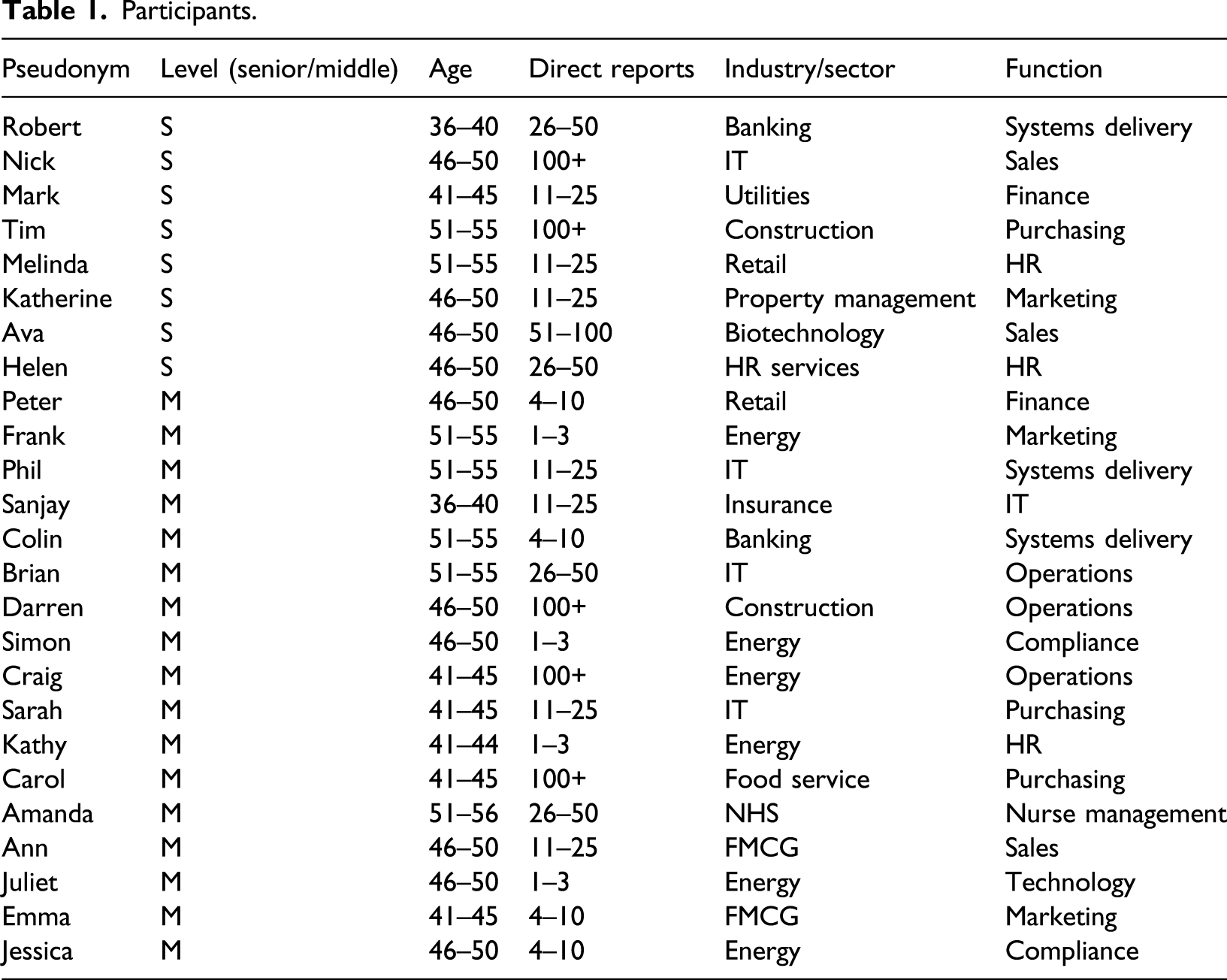
The study encompassed qualitative semi-structured interviews with 25 leaders, inductively exploring in depth the meanings and outcomes of working for an authentic leader that aimed to identify how leaders themselves experientially interpret the linguistic terms authenticity and authentic leader as a received experience and explore their perceptions and experiential outcomes of being led authentically and inauthentically during their own careers.
The study adopted an experiential story-based approach, which aligns with the idea that people live innately storied lives inherent in the hitherto marginalized life-story approaches to authentic leadership (Ilies et al., 2005; Shamir and Eilam, 2005; Sparrowe, 2005) and is a highly elaborative form of enquiry that enables the articulation of each participant’s contextualized narrative (Mair, 1988; Pope and Denicolo, 2001) as demanded by an interpretative phenomenological approach.
Sample
Participants.
The semi-structured interview
To establish a narrative landscape that mapped the range of leadership effectiveness and did not presuppose the position of authenticity in leadership within that, participants were asked to think back over their career and identify the two best leaders they had worked with, the two worst leaders and two leaders they would describe as average. To help personalize the interview conversation, the first name of each leader was written on a separate, small white card. The six leaders were then conversationally compared in triads of one ‘best’, one ‘average’ and one ‘worst’ to enable rich, inductive exploration of participants’ ‘provinces of meaning’ (Pope and Keen, 1981: 30). To focus the conversation on the influence relationship, participants were asked ‘in what ways did any of these leaders enable you to work at your best?’ This first stage of the interview generated a range of experiential events through which the perceived qualities of each leader was elaborated. To ensure I was capturing participants’ intended meanings, I asked ‘what do you mean when you say that?’ to elicit comparative articulations. To add experiential detail to their narratives, I asked ‘can you give me an example of that?’ or ‘what would they do?’ to unearth more concrete examples. Deeply held beliefs were surfaced by asking reflective questions such as ‘why is that important?’ and ‘how does that make you feel?’ Generally, these deeper beliefs are not consciously held and require the use of active reflection to move beyond socialized responses and fully understand participants’ sensemaking about how an authentic leader may affect their own psychological experiences of work.
I opened the second stage of the interview by stating ‘I would now like to ask you to think (more) about certain personal qualities that some managers bring to their working relationships. In particular, I am interested in what it means for a leader to be authentic’. The following areas were explored during this stage: Whether authenticity is a term they have personally used in relation to the evaluation of their own leaders’ capabilities? How they define authenticity in relation to another person and to another leader. Participants were asked to think about how they had previously described the relational events with all six leaders and to sort the name cards from the ‘most authentic’ to ‘least authentic’. The sorted cards were then used to elicit further experiential narratives of events where leaders were either authentic or inauthentic. Whether authenticity changed the perceptual quality of their managerial relationships (positively and/or negatively) and the additional question ‘what qualities do you feel would be more important than being authentic’ was posed.
Analysis
Interviews were anonymized and transcribed verbatim from their digital recordings. Alongside the use of pseudonyms, participants’ leadership level was identified using either ‘snr’ (for director level) or ‘mid’ (for functional head) after their name. To move beyond the basic conversation and maintain sensitivity to the range of linguistic information available, all non-lexical utterances were originally included, along with the elicitation context, and subsequently removed at the end of the analysis to not distract the reader from participants’ personal narratives. Transcripts were individually coded and explored using the CAQDAS package NVivo and themes developed using the six steps outlined in Interpretative Phenomenological Analysis (Smith et al., 2009). As the process was inductive, earlier interview transcriptions contributed to the evolution of the semi-structured interview guide in later interviews, but at no point were any a priori themes or codes introduced into the process. The analytical approach was designed to achieve ‘hermeneutic understanding, rather than on finding causal explanation’ (Butt, 2013: 218).
Findings
The final thematic map is visualized in Figure 1, showing how two main themes contribute to a leader’s attribution of authenticity to their own leader in practice. Thematic map.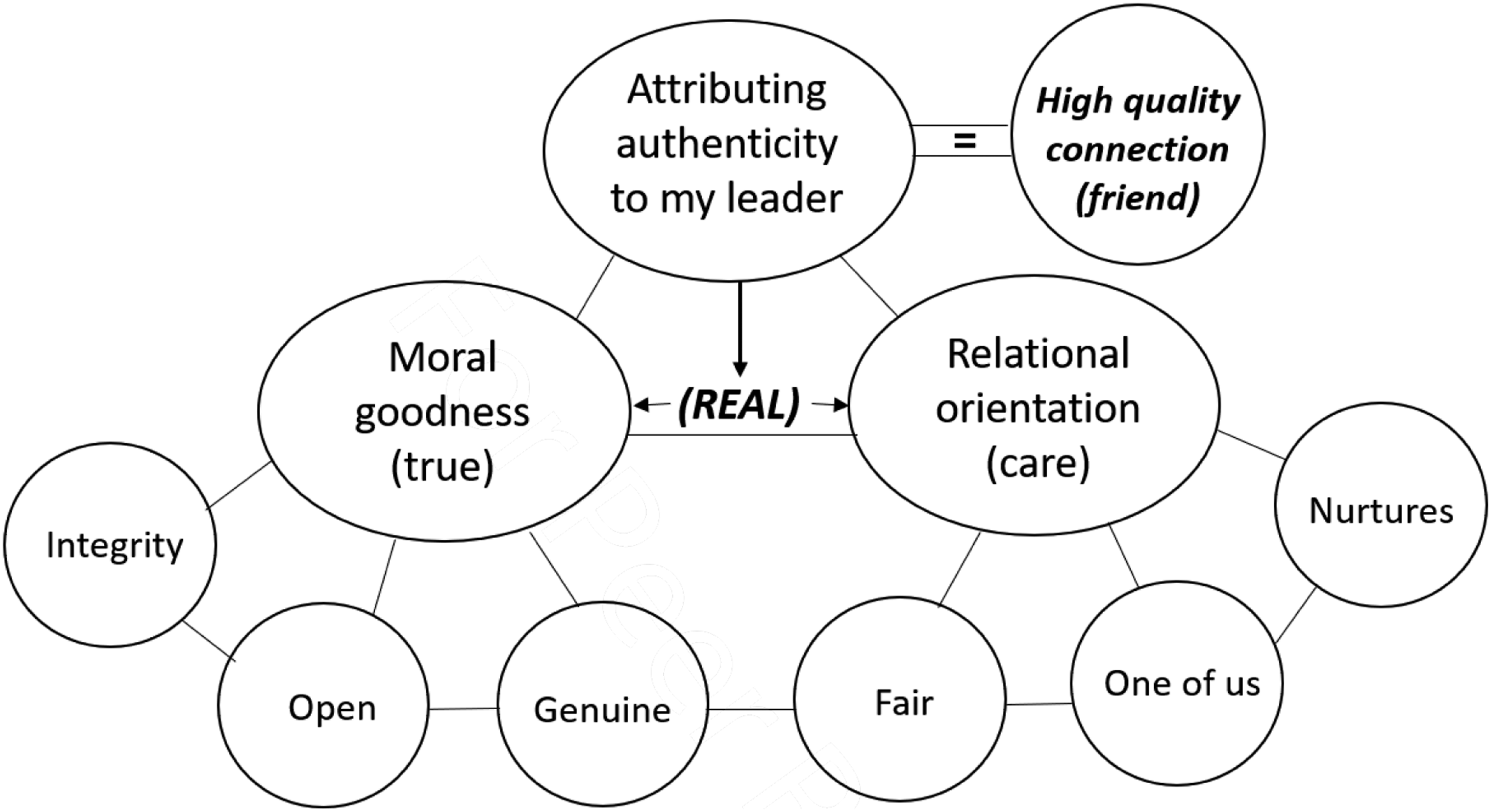
Heuristically, a leader will be ‘authenticated’ within a relational context if they are perceived as being consistently ethical and prosocial, which gives rise to a sense of engaging with the ‘real’ person at work. Perceptions of authenticity are reinforced through the leader’s ongoing behaviour and are connected to follower perceptions that their relationship with their leader is positive and individualized (nurturing), creating a sense of trust and care. In this respect, authenticity is a quality that all leaders can possess and it can fluctuate over time, so leaders are perceived as being ‘more or less authentic’ depending on the movement of their situational behaviours, rather than being dichotomously categorized as either ‘authentic’ or ‘inauthentic’. Perceptions of authenticity were performance enabling as the card sort showed that all participants sorted their name cards with at least one of their ‘best leaders’ chosen as the ‘most authentic’ and both of their worst leaders as ‘least authentic’.
For the follower, the dyadic relationship feels more like a personal friendship, where the authentic leader is felt to be genuine and open, both in terms of personal disclosure and in sharing the apparent realities of organizational constraints. Openness is connected to both transparency and consistency of behaviour, so a leader who is more predictable in their responses and who is seen to act with others in mind (one of us) will be perceived as more authentic. An authentic leader will consistently behave ethically, place the team above the wider organization and challenge authority where necessary (brave). Follower perceptions of authenticity are influenced by how the leader behaves within their proximal dyadic relationship and also how the follower perceives the quality of their relationships with others at a team, or group, level. The follower looks to their perception of these more distal relationships for confirmation of their self-related judgement. Social identification and collaboration with the leader (feeling we are in this together, as a duo and a team) is important, bringing to the fore follower perceptions of ‘having a voice’ and ‘feeling special’.
As stated in the introduction, the aim of this article is to redefine the concept of authentic leadership to strengthen the usefulness of the theory in practice. To this end, I turn my attention to the findings that elaborate the contextualized meaning of authenticity and how it exists as an attributional entity.
Defining authenticity as ‘real’
Twenty-four participants were able to provide some form of definition of authenticity in the context of another person, with only Phil (mid) struggling to define the term at all. Leaders were reasonably unified in how they construe authenticity in another leader, with attributions generally associated with perceptions of their moral character and relational orientation, as illustrated through the connected theme of ‘real’, which is exhibited through sincerity and caring about others: being loyal to your team and working alongside your team as well as being the leader, … having your own morals and sticking by them ... If you believe something is right … Um, so it’s about morals really. Yeah, it is about morals. (Amanda, mid) they mean what they say, they are not putting on an act, they are not pretending. So yes, authenticity is important to me because I think some people put on a ‘work act’ and I want to talk to the real person, not the act that they are putting on. (Frank, mid) it is the link between what you do and what you say effectively. So, if you come across authentically it is because what you say mirrors, or at least reflects, the things that you actually do on a daily basis. It’s believability. (Craig, mid)
‘Real’ is connected to ‘genuine’, but not in the same way as it is commonly connected in the dictionary definition. Phenomenologically, it is a relational construct associated with how the authentic leader orients themselves in an honest and open manner towards others. Participants perceived authenticity in leadership as ‘real’ because they associate it with the leader being emotionally present in the work relationship, free of impression management or political game playing. In a relational sense, perceiving your leader as ‘real’ creates a sense of interpersonal trust, which leads to a greater sense of psychological safety for the follower and improves the perceptual quality of the work relationship so that it feels more like a friendship.
The authentic leader as a moral being
Authenticity in leadership was interpreted by participants as ‘moral goodness’, with descriptions such as ‘do the right thing’, ‘integrity’, ‘truthful’, ‘pure’ and ‘humane’. A person’s perceived sincerity was related to judgements of their moral character, which was reflected in both Brian’s (mid) definition of ‘I would say genuine, honest, open’ and Mark’s (snr) definition of ‘integrity and credibility and consistency’. Other similar definitions included: I think it’s about being honest…, about who you are and about what you are saying … grounded is a term I’d use, … and then be able to use that base to be able to then interact with people in a way that is helpful, clear and straightforward. (Helen, snr) they would be honest and straightforward, and they would do what they believed was right, not necessarily what they thought was political or flavour of the month. They would be consistent in that. (Juliet, mid)
Genuine was also associated with being value driven in ‘unique-style’, ‘natural’ and ‘brave’ and was related to the leader’s originality and non-conformity: I would say that if you are an authentic leader you have your own original ways of managing things and that you would look at other people, but not just copy them, there would be certain ways that you decide to do things. (Amanda, mid)
Participants felt a shared sense of being value driven and having a similar moral outlook with the leaders they perceived as authentic: I guess it would be someone who is open and clear about their values and what their expectations would be of you in that environment as well. Not that you would have to have exactly the same values, but that there would be some shared values. (Peter, mid)
As such, an authentic leader will demonstrate aspirational behaviours through being sincere: someone who espouses their values and lives by them. Someone who sets high standards for himself and others. Someone who challenges and expects people to accept and deliver on those challenges. Someone who doesn’t have expectations of people that he wouldn’t have for himself … it’s very easy to get the corner office, but you’ve got to earn it and you’ve got to justify it and you can never stop doing that. So, there’s something there that I see as authentic. You live it. And I think there’s also something there about it’s a meritocracy as well, that’s quite important. (Robert, snr)
In this extract, Robert is also describing an authentic leader as someone who is transparent and free from impression management (‘you live it’) and relationally focused and fair-minded (‘meritocracy’).
The authentic leader as a prosocial being
Participants used entirely positive and mainly relationally oriented labels to describe an authentic leader, with common terms such as ‘cares’, ‘fair’, ‘honest’, ‘what you see is what you get’ and ‘emotionally expressive’. Twenty-two participants commonly described an authentic leader as a relationally competent leader, as highlighted by these two extracts: An authentic leader would have the people skills to motivate and develop the staff … you couldn’t be a bad authentic leader, because [I] have included leadership skills around honesty and openness. (Brian, mid) truly [knows] how to get the best out of people. (Ava, snr)
It involves being relationally fair and emotionally connected: You can see people believing in that person; believe why they are doing something. So absolutely, being an authentic leader, it’s a difficult one to pull off because there will always be situations where you are doing something that people won’t agree with. But I think it goes a lot with someone’s integrity. (Mark, snr) someone who is genuinely interested in you, speaks from the heart, is honest enough to say what they feel, acknowledge things they have made bad decisions on and have an emotional connection with you. (Frank, mid)
Emotional connection, or presence, is linked to a felt sense of being nurtured and cared for, which is pivotal even for senior leaders: it’s not respect, it’s support, it’s trust, it’s nurturing, it’s the belief that they have my interests at heart. (Robert, snr) I suppose he made me feel loved … he was an amazing role-model … [and] he kind of looked at you like he was concentrating on you, he had that thing, he would give you his time … if I’m working with somebody who is really engaged with something, I find it contagious. (Katherine, snr) as leaders of organizations … you walk a plank and there are hungry alligators underneath. But over here, with Paul, you walk a plank because business is precarious and risky, but there is a spongy trampoline underneath, and you know you are going to bounce back. (Melinda, snr)
Followers validate their sensemaking processes by looking beyond their own relational experiences to see how the leader behaves with others. For a leader to be perceived as authentic, they must be seen to also proactively engage in authentic behaviours at the group level, and Frank (mid) and Juliet’s (mid) discussions of their managers reflect this.
Frank perceived his manager, Bryn, to be reasonably inauthentic, placing him in fourth position in the card sort. Frank described Bryn as a ‘company man’, who is a successful senior manager and a ‘reasonably decent bloke’. He related his inauthenticity to his emotional distance from the group, specifically, placing organizational interests above the team and not being brave in standing up for ‘what is right’.
Juliet felt confident in her own relationship with her manager, Meena, but: If I hadn’t seen her do that stuff to others … It wasn’t good enough for me to just say that she was okay with me … I think you have a responsibility as a leader to be fair, and be seen to be fair, to other people, whether you like them or not.
Overall, authenticity creates leader trust, which is the relational foundation of a safe environment, as explained by Peter (mid): trust is about being able to talk to the individual about situations and work that you are dealing with and know that you can say it exactly as it is without fear that it will be used against you. And just being open and honest about how you feel about the situation, knowing that they will take it in the context and will understand your intent. So, it’s not hiding anything, not trying to sugar the pill.
The authentic leader as a friend
All participants, except for Phil (mid) and Darren (mid), offered concrete examples to demonstrate their shared belief that an authentic leader would have more personal, emotionally connected work relationships with others, as illustrated by Ann’s (mid) example: I can think of an event where I think the motivation was authentic, which was where my manager showed a degree of anger, but I think it was a really genuine reaction because it represented frustration at the situation we were in … The use of the anger in that context was highly effective because it got an instant reaction in terms of getting everyone’s undivided attention ... It really brought them on board actually … it was her willingness to use emotion, it was just intuitive of her really in that situation.
Helen (snr) explains how authenticity improved the perceived quality of her managerial relationship by bringing consistency:
I think it’s just things like trust and confidence and actually it’s taking away that worry isn’t it? If you know where you stand with somebody and you know what their views are and where they’re going, you can focus on the job, so it’s one less distraction.
Examples of authentic leadership demonstrate that participants connect it with the leader’s relational and moral orientation. Reflecting on her various HR Director roles, Melinda described the different approach that an authentic leader (Julian) brought to a large-scale redundancy programme compared to two other leaders she felt were inauthentic:
So they [Aileen and Curtis] dismantle and change whereas he [Julian] builds … all three of them do the same task, it’s just how they approached it that would be different … here [with Julian] the sensitivity to what the staff had gone through would be paramount and therefore other things would be put in to make sure that those that stayed felt good about it ... They [Aileen and Curtis] … very disciplined, very structured, clean cut, just no emotion, I guess. It was a business decision! With Julian … he would want to be fair to the people … He would know your name, he would know something about you, and he would try and relate it down to making sure you were taken care of, and you knew that. Whereas with Aileen’s way it is much more clinical … do the minimum, get everybody through, give everybody the envelopes and spend the time with the ones who bother coming back with questions, so do it by exception. Julian’s view is that these people are all human beings and they all deserve at least half an hour! Just different animals.
Katherine (snr) summarized why working for an authentic leader is perceived by followers as an eudaemonic experience:
I think people want to work for people who are authentic, and I think they probably expect a more fair and, you know, a fair deal out of people who are authentic … And they probably feel that they will have more care from people who are authentic … there is just a sense that it’s a good place to be, to be working for somebody who has a, you know, a kind of authentic way of doing things.
In essence, authenticity in leadership is linked here to the leader’s ability to create a sense of participation with each follower in a more open and caring relationship, which is expressed as a sense of psychological safety: he was team orientated. This gets quite deep … But he was really inclusive … But he did it in such a way that you felt confident about speaking up, that you were part of it … in a way that made you feel really special ... very calm, bit of humour, quite self-effacing, and so, you know, that made people … feel more confident. (Ann, mid)
Other participants expressed feelings of increased emotional and affective ties with an authentic leader, as illustrated by the following extracts: I wanted to be part of their team, therefore their leadership is good. And I never did that with these guys … I didn’t value [their] leadership. (Robert, snr) Integrity. She had really good integrity and she believed in what she was doing … She was remarkable. There were tears when she left. She really brought us together … She was definitely somebody you could aspire to be … she took us with her as a team. (Amanda, mid)
Participants also talked about how their authentic leader gave them a voice and enabled them to experiment and to stretch their personal boundaries. Descriptions such as ‘gives me space’, ‘supportive’, ‘role-model’, ‘challenges status quo’, ‘gives you a voice’, ‘holds you accountable’ and ‘helps’ were commonly used.
Discussion
This study examines how leaders themselves personally make sense of authenticity when they relate it to another leader in the everyday context of their work. From this perspective, perceptions of the leader’s moral goodness and relational orientation are the basis for attributions of authenticity, and the concept can be empirically defined around these two components. The existing four-component model has been conceptually derived from Kernis’ self-esteem model (Gardner et al., 2021), but I argue here that Heidegger’s ideas of ‘being true’ and ‘care’ offer a clearer explanation of how authentic leadership manifests itself in the lifeworld. Heidegger wrote extensively about the meaning of authenticity, and my intention here is to draw out the meaning of ‘true’ and ‘care’ as two key aspects of his ‘Being-in-the-world’ thinking, or commentary on it, that are pertinent to the focus of this study, rather than to offer a philosophical critique of his work.
Heidegger (1962) offers the word ‘Eigentlichkeit’ to describe authenticity in relation to a person’s being, or existence, which has been translated as meaning ‘real’ or ‘true’. He regards personal authenticity as the core of human existence (‘Dasein’) that itself can be understood ‘in terms of a possibility of itself’ (Heidegger, 1962: 33) ‘that reveals what it is to be human in a privileged way’ (Guignon, 2014: 8). This temporal aspect of past through to future is congruent with the humanistic perspective of authentic leadership offered by Ilies et al. (2005) who posited that the journey to authenticity is an eudaemonic endeavour encompassing the fostering of positive social exchanges that underpin the creation of high-quality leader–follower relationships. For Heidegger, ‘mineness’ is a sense of self-ownership through which both authenticity and inauthenticity are possible (Heidegger, 1962: 78). To live inauthentically is to live passively, conforming to the norms and values of others as part of the they (‘das Man’) and losing a sense of personal truth or selfhood (Horrigan-Kelly et al., 2016).
The moral dimension (being true)
The attribution of authenticity to a leader is intertwined with follower perceptions of them being a moral person (Trevino et al., 2000). I found that notions of morality are negotiated and determined contextually by the follower, based upon a perception of having some shared values. This departs from Walumbwa and Wernsing’s (2013) definition of internalized moral perspective because values are negotiated rather than self-determined, and morality relates to integrity and being conscience led rather than a form of self-regulation. It is also distinct from Gardner et al.’s (2005) descriptions of setting high moral standards, leading by example, or role modelling a pre-determined set of ethical behaviours, as the moral dimension is better explained by Heidegger’s notion of ‘being true’ that relates to taking a stand on who you are as a form of self-expression within the everyday, fluid existence of ‘Being-in-the-world’ (Heidegger, 1962: 114).
Heidegger’s view of existence as temporal and journeyed, along with the meaning of ‘being true’ and the negotiated sense of morality and value sharing identified here, offers a perspective of an authentic leader being someone who acts with perceived consistency, emotional sincerity and integrity. So, it is not so much that the leader must be seen to act in the same way in all contexts or be guided by some static and simplistic internal moral code because, in the sense that we are all active sensemakers who are motivated to story our own lives (Neimeyer, 2009), we are constantly evolving our self-narratives to help root ourselves within our lifeworlds (Varga, 2013). Instead, what matters to perceptions of authenticity is the person’s resolution (‘Entschlossenheit’) that is expressed through the judgements they make (McManus, 2019). So, to be perceived as authentic by others, the leader must demonstrate a temporally fluid consistency in their decisions and actions, with no dramatic or jarring shifts, that are, in turn, attributed to an underlying, morally grounded ‘call of conscience’ (Varga, 2011: 74) that is relationally focused. This explanation of ‘being true’ as a call of conscience is an integral aspect of Heidegger’s view of authenticity as a human capacity to discern meaning from lived experience and make responsible ‘Being-in-the-world’ choices (Paley, 2000), rather than ‘a prescriptive admonition to live by supposedly “objectively right” values’ (Garza, 2006: 255).
Newman et al. (2014) argue that people use their own positive moral code to authenticate others, and Strohminger and Nichols (2014) contend that perceptions of morality are intrinsic to our social judgement processes. This prompts two interesting connections. First, if authenticity is about being a ‘real’ person, and our self-judgements are generally positive morally, then it makes sense that we implicitly connect leader authenticity with moral goodness, across any context. Second, in their critical appraisal of authentic leadership, Ford and Harding (2011) suggest that the theory is fundamentally flawed because it subsumes followers within the leader’s values, thus rendering them inauthentic by default. I identify a reverse process, whereby followers are the negotiators of authenticity and will only attribute authenticity to a leader if they believe that the leader shares some of their own values and intends to act with others in mind (has a conscience).
The call of conscience is not prepositional or outside of the self; it is a determination of being that transcends introspection. It is a complex manifestation of how the leader chooses to exist, with resolution and conscience. As authenticity is about being rather than thinking, it relates more to how life is chosen to be conducted and the consistency of choices grounded in conscience, rather than any particular notion of feedback-seeking behaviours, self-awareness of personal strengths or weaknesses (Walumbwa et al., 2008; Walumbwa and Wernsing, 2013) or internal identity reflection processes (Avolio and Gardner, 2005). In this context, an authentic leader is ‘true’ because they are principled and morally oriented. They go beyond the transparent communication of their beliefs to others, to actively demonstrate their relational orientation through their actions. In essence, an authentic leader is perceived as ‘true’ if they are seen to live by their values (are resolute) and those values are interpreted as being beneficial to others and not just the leader (conscience led).
The relational dimension (care)
Relational orientation is the main contributor to attributions of authenticity in leadership and it overlaps substantially with beliefs relating to the leader’s personal morality or conscience. In this sense, an authentic leader is perceived as a friend and not as a fiend, with the relationally focused ‘r’ acting as an essential meaning marker. Leaders construe their own leaders as authentic if they perceive them to be relationally oriented and acting with sincerity and care for the good of others. This is manifested in behaviours that are received as inclusive, fair and open, which in turn help followers to feel more psychologically safe and so improves their psychological experience of work. This is a far broader conceptualisation of the relational component of authentic leadership than is captured in either Gardner et al.’s (2005: 358) original propositional statement of relational transparency as a communication of ‘values, identity, emotions, goals, and motives’ based on the leader’s self-awareness and self-acceptance. It also bears little resemblance to Walumbwa and Wernsing’s (2013) references to self-regulation, managing emotional displays or increasing self-knowledge through introspection. Instead, relational orientation is connected to notions of care and friendship and is not dependent on the leader’s self-awareness or emotion management.
Heidegger’s ‘Being-in-the-world’ presents authentic human existence as relational and only through care (‘Sorge’) can the person become fully engaged with the wholeness of their lifeworld. Heidegger identified two ways in which we manifest care: as advocating and empowering others and as taking on the concerns of others (McConnell-Henry et al., 2009). Tomkins and Simpson (2015) have already connected Heidegger’s philosophy of care to leadership and offer the suggestion that these two expressions of care can be grounded in Heidegger’s ideas of ‘leaping-ahead’ (into the unknown) and ‘leaping-in’ (within the known). This view of care is different from the positive organizational scholarship perspective of care as kindness and is more about an explanation of a relational authentic self through which the leader’s standpoint is grounded in a concern for others (McManus, 2019). Tomkins and Simpson’s (2015) commentary helps reveal the links between caring and authenticity in Heidegger’s work. How we live life through the interwoven nature of everyday existence relates to three vectors of care: to be both absorbed (‘Verfallen’) and situated (‘Befindlichkeit’) in our lifeworld and to understand (‘Verstehen’) the possibilities of it as both a ‘Being-in-the-world’ and a ‘Being-alongside’ entities encountered within it. These three vectors show how ‘care’ is connected to ‘being true’.
As such, an authentic leader fits with Macann’s (1993) description of the two manifestations of leaping as ‘standing in for’ and ‘standing up for’ others. They will be prepared to ‘stand in for’ others through collaboration and task sharing rather than substitution, and ‘stand up for others’ by acting as an advocate, empowering others and championing team interests over organizational expectations, because their conscience leads them to pursue what is the right thing to do for others and not just for themselves. Participants recounted stories and descriptions of leaders who demonstrated a caring approach through nurturing and protective acts and who were empowering and brave in standing up for others. Authentic leadership as a vehicle for representing and harnessing collective agency fits with the central premise of the social identity approach (Steffens et al., 2014). Collective agency is facilitated by the leader’s capacity to create a sense of commonality through acts that represent, embed and advance the shared interests of the group (Haslam et al., 2011). This collective perspective quashes the criticisms directed towards the existing normative theory by Ford and Harding (2011) because, in this sense, the authentic leader is a liberator of followers’ voices, someone who unleashes their authentic potential, rather than rendering them as inauthentic by subsuming them within their own values.
In summary, the enactment of authentic leadership can be defined in relational terms as providing social value by acting in a caring manner within dyadic relationships, championing group interests and demonstrating integrity and fairness in all interpersonal and group interactions.
Conclusion
The key criticisms of authentic leadership theory to date relate to its over-reliance on self-based conceptualizations and idealized leader prototypes that fail to adequately account for the diverse enactment of leadership in practice and have been said to entice researchers to simply re-dress ideologies within the enduring mythological and heroic cloak of leadership theory (Shaw, 2010). By using a phenomenological approach focused on the personal meanings of leaders themselves, this study reimagines authentic leadership from the position of authentic otherness (Gardiner, 2017), so how it manifests itself through the complexity of different work situations and behaviours. It offers a new, empirically derived two-component definition that is grounded in the real-world of work across a broad range of contexts and recognizes the constructed and observed nature of authenticity. Drawing on Heidegger’s unified philosophy of ‘Being-in-the-world’ overcomes the criticism of Cartesian dualism inherent in most leadership scholarship, including existing conceptualizations of authenticity (Kaufer, 2012) and authentic leadership (Shaw, 2010). It provides an opportunity to describe how authentic leadership is perceived as a social exchange outcome, based on the leader’s observed actions, rather than providing yet another ‘recipe’ of ideological constructs. Heidegger’s writing has relevance to the attribution of authenticity in leadership, particularly in relation to his ideas of ‘being true’ and ‘care’ that help illuminate the perception of an authentic leader as a moral and relationally oriented person.
Moral goodness is a conduit of a ‘true self’ that is a multifaceted and evolving manifestation of conscience and concern for others, rather than a singular and fixed entity. Conscience is the resolution to ‘take a standpoint’ and concern is valuing relationships as well as valuing the self. Authentic otherness (Gardiner, 2017) helps explain why being authentic is seen as being ‘brave’ (because my expression of authentic may not be the same as yours and may not fit the organizational culture) and why the idealized descriptions of authentic leadership fail to capture the differences in its enactment.
Heidegger’s three vectors of care as a template for intuitively living a life of possibilities, as both a ‘Being-in-the-world’ and a ‘Being-alongside’ entities encountered within it, helps explain the articulation of relational orientation. Notwithstanding my earlier point on the fallibility of using everyday leadership theories to appraise heroic or exceptional leaders, if we return to Ciulla’s (2013) evaluation of Nelson Mandela’s authenticity, he would better fit the description offered here than he is able to do with the current ideological frame. He championed collective agency, demonstrated integrity and concern for others, was conscience led and resolute and owned a standpoint.
In summary, an authentic leader can more simply be defined as a friend, someone that you feel you know and trust. They do not have to be self-aware or balanced in their decision processes; they just need to be a person who you believe is conscience led and caring, a person that you like and value rather than admire. As a friend, they put people above the organization and are emotionally present in the work relationship.
This definition helps differentiate authentic leadership from other higher-purpose theories. As a practice-based theory, authentic leadership helps illuminate the content of close, high-quality social exchanges between leader and follower that are collectively akin to friendship. To this end, it may not be theoretically suited to appraising distal political and famous leaders but is an important construct in everyday leadership practice because it enables followers to identify leaders they believe are compassionate and principled people who make them feel psychologically safe. In short, leaders who they could work with as friends, which improves their own lived experience of work and inspires them to behave authentically in their own leadership roles. For organizations to develop environments where authentic otherness (Gardiner, 2017) can flourish, they need to create and maintain a climate of friendship, where everyone feels they can be their real self above their mandated role expectations and organizational practices do not stifle individuality. As such, authentic leadership is a valuable and unique concept for understanding proximal leader relationships and warrants continued challenge and exploration.
Footnotes
Declaration of Conflicting Interests
The author declared no potential conflicts of interest with respect to the research, authorship and/or publication of this article.
Funding
The author disclosed receipt of the following financial support for the research, authorship and/or publication of this article: This research was supported by a studentship from the Economic and Social Research Council, UK.
