




Abstract
Research presented in this article advances existing work on shared leadership and organizational sensemaking by an empirical demonstration of the organizing properties of leadership in daily instances of uncertainty. Drawing on conversation analysis combined with ethnographic data collected during 12-month fieldwork, this article spells out the conversational mechanisms and discursive practices used by leadership actors in the process of sensemaking directed towards organizationally relevant goals. Through a fine-grain analysis of an extended troubles-telling sequence in a particular meeting encounter, this study shows how conversation analysis–inspired research can be used to add a more nuanced understanding of a substantive area of social life, such as shared leadership which is achieved in interaction and which involves various leadership actors, regardless of their hierarchical positions and organizational roles.
Introduction
In the 21st century, unknowability, unpredictability, and uncertainty are becoming more noticeable hallmarks within organizational life. Unsurprisingly, a lot of existing sensemaking studies explore dramatic events triggered by the breakdown, collapse, or disruption of meaning due to unusual organizational or environmental events (Cornelissen, 2012; Maitlis and Sonenshein, 2010; Quinn and Worline, 2008; Weick, 2010; Weick, 2005). Obviously, life in organizations is not only about crises, disasters, and other extreme events. Ambiguity and uncertainty are equally inherent features of daily mundane organizational events. Despite a wealth of studies in the field of organizational sensemaking, current research offers limited understanding of the mechanisms that support the ongoing practice of sensemaking activities in daily instances of uncertainty.
Recently, there has been an increasing interest in the role of leadership in organizational sensemaking (e.g. Whittle et al., 2015). Setting the lens on the process of sensemaking has also enhanced the understanding of leadership as meaning management (Fairhurst and Connaughton, 2014; Shotter and Cunliffe, 2003; Smircich and Morgan, 1982). As Fairhurst (2007) convincingly argues, leadership as the management of meaning ‘…is a sensemaking, reality-defining activity in which leaders define what is important, communicate about the meaning of events, and seek consensus’. This understanding of leadership as the management of meaning differs from traditional ‘mainstream’ approaches to leadership by shifting the analytical focus to ‘what leadership actors do (emphasis added) when confronted with the uncertain and unexpected’ (Fairhurst and Connaughton, 2014: 11). Exploring ways in which leadership emerges as a situated practice allows capturing messy, ambiguous, and often unglamorous leadership as it unfolds in the organization of everyday life (Alvesson and Spicer, 2011; Iszatt-White, 2011; Kelly et al., 2006).
To explore leadership as meaning management through an emic (rather than an a priori etic) stance, this study applies an analytical lens to its discursive side (Clifton et al., 2020; Fairhurst, 2007). By focusing on the constructed and contestable features of the practice of leading, the discursive perspective has the potential to add ‘much-needed’ specificity to the research conversation about leadership (Fairhurst, 2005: 165). By using a microdiscursive approach in discourse analysis, or a lower case ‘d’ discourse in Alvesson and Kärreman (2000) terms, this study contributes to that research conversation (Clifton, 2017; Larsson and Lundholm, 2013; Schnurr and Chan, 2011; Schnurr and Zayts, 2011; Svennevig, 2008; Whittle et al., 2015; Wodak et al., 2011). A research approach informed by conversation analysis (CA) and organizational ethnography makes possible the observation of leadership from the endogenous orientation of participants. In other words, it enables an analysis of data illuminating ‘what the participants show us’ rather than focusing on ‘what the researcher knows first’ (Stokoe, 2012; Wooffitt, 2005). Following the direction indicated, this study also shifts away from traditional perspectives on leadership which emphasize the ability of an individual to influence the behaviour of others, towards an understanding of leadership as a process which involves multiple individuals, regardless of their hierarchical positions and organizational roles. Although there is an extensive body of work exploring and examining a variety of forms of plural leadership (e.g. Denis et al., 2012; Yammarino et al., 2012), it is still not well understood how such forms emerge as a situated social practice. Proposing that the plural side of leadership is an important, but poorly understood, area of research, this study offers an empirical investigation of the actual emergence of shared leadership as it unfolds as in situ social practice in meeting interaction. By doing so, this study extends our understanding of the mundane aspects of ‘doing leadership’ as meaning management which is collaboratively constructed by various leadership actors, regardless of their hierarchical positions and organizational roles.
This leads to the following research question:
How is shared leadership as meaning management collaboratively constructed by various leadership actors in meeting interaction in daily instances of uncertainty?
In answering this question, this study seeks to advance the fields of discursive leadership and sensemaking by the systematic scrutiny of sensemaking processes of leadership actors who construct a shared meaning in an authentic workplace interaction in situ and in real time. The main analytical challenge of this study is to capture the actual ongoing ‘processes’ of making sense rather than the ‘products’ of sensemaking (e.g. stories and rhetorical strategies). Therefore, a particular empirical focus is given to instances of uncertainty in a meeting interaction. These are instances where leadership actors ‘have to do extra sensemaking work’ to produce or repair a shared meaning, and by doing so, they make the working of their constitutive methods visible for systematic analysis (Ten Have, 2004: 53).
Literature review
Leadership as sensemaking in action
Weick (2009: 263) observes that leading in the uncertain and unpredictable environment lies ‘less in thrall of decision-making—and more in thrall of sensemaking’ (emphasis added). Therefore, it is not surprising that in recent years, the academic literature addressing the sensemaking phenomenon has grown exponentially, challenging the orthodoxy of the decision-making perspective (e.g. ‘garbage can’ concept) that has comfortably dominated organization studies in the 20th century. Now, sensemaking as a distinct field of research is encompassing a variety of theoretical and empirical works (Cornelissen, 2012; Gioia and Chittipeddi, 1991; Hernes and Maitlis, 2010; Maitlis and Christianson, 2014; Stigliani and Ravasi, 2012; Weick et al., 2005; Whittle et al., 2015).
Since the 1990s, research on sensemaking has shown an increasing interest in the role of leaders in shaping sensemaking in organizations. According to Taylor (1999), leaders should understand the general patterns of how organizational members make sense of organizational events if they are to manage organizational change. Gioia and Chittipeddi (1991: 442) observe how leaders influence the meaning construction of others ‘towards a preferred redefinition of organization reality’ through sensegiving, which is according to Gephart et al. (2010) is a form of sensemaking. Furthermore, to encourage a more informed appreciation of the daily doing of leading, Pye (2005) suggests reframing leadership as ‘sensemaking in action’ to encourage a more informed appreciation of the daily doing of leading which is grounded in organizing. The argument that leadership might have organizing functions has been supported by a number of studies (e.g. Hosking, 1988; Larsson and Lundholm, 2013; Pye, 2005; Uhl-Bien, 2006). For example Kelly et al. (2006) suggest that leadership might be better understood as ‘a process of organization’. Similarly, Pye (2005:32) argues that leadership is ‘not dissimilar to that of organizing’ as it is ‘intimately allied’ to organizing through the capacity to shape future actions and outcomes. Organizing, in turn, is commonly related to sensemaking which enables various important organizational processes and outcomes (Maitlis and Christianson, 2014; Weick, 1995). Collectively these studies deepen our understanding of leadership as meaning management. However, sensemaking, as it is discussed in these studies, does not go beyond ‘pure’ cognitive interpretation processes. Therefore, if we are to develop a more nuanced understanding of leadership as meaning management, we need to locate sensemaking in the talk of leadership actors.
A discursive view on leadership departs from leadership psychology on both ontological and epistemological grounds (Fairhurst, 2007). Following the ‘linguistic turn’ in social sciences (Alvesson and Kärreman, 2000), discursive leadership locates the leadership phenomenon in communication and discourse. The discursive perspective makes a significant contribution to understanding the leadership phenomenon by providing opportunities to map out and examine some of the most fundamental questions that are not easily approached with more traditional perspectives. For example a discursive orientation to leadership assumes that leaders manage and provide meaning through language (e.g. Fairhurst, 2007; Fairhurst and Sarr, 1996; Gioia and Chittipeddi, 1991), and leadership as the management of meaning ‘may shift and distribute itself among several organizational members’ (Zoller and Fairhurst, 2007: 1339). There is a growing number of studies of leadership-in-interaction which explore the role of leaders and discursive processes in shaping organizational sensemaking (e.g. Clifton, 2012; Larsson and Lundholm, 2013; Whittle et al., 2015). However, it is noteworthy that research on leadership as sensemaking-in-action as it unfolds in everyday work interactions is still gaining momentum (Larsson, 2017).
Shared leadership
Growing interest in viewing leadership as a much more dispersed phenomenon has resulted in an abundance of terms and labels that have appeared in the research literature describing various forms of the plural leadership phenomenon including democratic (Woods, 2004), distributive (Brown and Gioia, 2002), dispersed (Gordon, 2010; Ray et al., 2004), collaborative (Huxham and Vangen, 2000), co-leadership (Vine et al., 2008), collective (Denis et al., 2001), shared (Carson et al., 2007), and distributed (Gronn, 2002; Spillane, 2006). The most important contribution of this diverse scholarship is in challenging the notion of leadership as an attribute assigned to one individual and changing the focus towards leadership as a collective, relational, and socially defined process (Crevani et al., 2007; Fitzsimons et al., 2011). However, despite extensive research on plural forms of leadership, our knowledge about how various leadership arrangements emerge in real life and in situ remains quite limited.
A particular challenge for scholars of shared leadership, as Holm and Fairhurst (2018: 694) argue, lies in examining ‘the fluid, contingent, and deeply intertwined dynamics’ and ‘co-evolving nature’ of shared and hierarchical leadership which has been underplayed in the current leadership research. To address this challenge, this study opts for the idea of leadership configurations as a conceptual term which shifts the level of analysis from an individual to a group of individuals who enact leadership (Chreim, 2015; Gronn, 2011, 2015). Thus, it could help uncover a variety of leadership arrangements; in other words, ‘configurations of practice’ (Gronn, 2009) that are constructed in organizations.
It is argued that communication is an essential process of sensemaking (Weick et al., 2005) in which people collectively make sense of the circumstances and the events that affect them (Taylor and Van Every, 2000). Looking more specifically, if we are to follow Bargiela-Chiappini and Harris’s view (1997: 4) assuming that ‘no organization exists prior to communication’ and ‘organizations are talked into being and maintained by means of the talk of the people within and around them’, then people should keep talking in the process of organizing, particularly when things do not make sense. Therefore, it can be argued that to explore and explicate the organizing properties of leadership as sensemaking, an analytical lens should be set on the analysis of the naturally occurring talk of leadership actors.
A considerable body of work in the leadership field is overwhelmingly depicting leadership as a blend of knowledge, skills, and artistry (Iszatt-White and Saunders, 2014). It is widely assumed that a leader is someone who should know the answer (Smolovic-Jones and Jackson, 2015: 267, emphasis in the original). Thayer (1988, cited in Weick (1995: 10)) recognizes that ‘knowing in the world’ is one of the important features which allows leaders to alter or guide the manner in which their followers ‘mind’ the world. Schnurr (2009) demonstrates how leaders portray themselves as competent professionals (i.e. having necessary abilities, skills, and knowledge) in their particular working context. Conversely, Weick (2009) points out that the effective leader is someone who is deeply aware of personal ignorance. If we assume that change is continuous and knowledge possessed in such circumstances is constantly ‘dated’, then to construct transient meaning in the unknowable world, one should balance between knowledge and doubt (Meacham, 1990; Weick, 2009). Kramer (2007: 17) highlights the importance for organizations to be able to organize their ability to doubt in the complex and dynamic environment where ‘it is impossible to know and understand everything in advance’. Similarly, Weick (2009: 270) explains that organizing doubt means engaging in meaningful argumentation in an ongoing, unknowable, unpredictable streaming of experience because ‘knowledge is not something people possess in their heads but rather something people do together’. However, to date, leadership scholars have paid limited attention to situations where routine sensemaking procedures fail and where leadership actors collectively engage with multiple ways of organizing doubt when mastering a difficult and unknown task.
Applying a microdiscursive lens to study leadership as a situated practice
To explicate the social organizational properties of leadership as sensemaking, this study presents what Larsson and Lundholm (2013: 1103) called an ‘advantageous’ study of leadership as an interpersonal accomplishment. This study moves away from an etic analysis which is based on a conceptual frame of reference imposed by a researcher and adopts an emic stance to understand the participants’ frames of reference (Morris et al., 1999; Clifton, 2006; Cox and Hassard, 2005), thus treating participants (i.e. members) as actors with ‘knowledgeability of their own actions’ (Boden, 1994: 74). Following the methodological commitment of the study in exploring the first-order practices of members, leadership is seen not as a predetermined social fact but as an ongoing, practical accomplishment which is ‘brought off’ as leadership on a minute-by-minute basis’ (Iszatt-White, 2011: 125) as members (i.e. leadership actors) of the setting ‘engage in the reproductive work of producing an intelligible shared social world’ (Mueller et al., 2013: 25). To explore how leadership interaction unfolds ‘moment by moment’ (Hindmarsh and Llewellyn, 2010: 25) in situ and in real time, a research approach informed by CA and organizational ethnography is used in the framework of this study.
By illuminating the micro-level aspects of the sequential properties of action, CA directs attention to a range of discursive resources that people use to make sense of their world (Greatbatch and Clark, 2018; Sacks, 1992; Schegloff, 1997, 2007). The growing significance of CA as an approach which allows exploring the ‘unnoticed machinery of talk’ with which leadership is enacted (Clifton, 2006: 202) is convincingly demonstrated in research of leadership scholars including Clifton (2019), Nielsen (2009) and Svennevig (2011). For example Nielsen (2009) examines authentic verbal communication between middle managers and employees using CA methodology to show important ways in which middle managers ‘do leadership’. Clifton (2019) offers the analysis of routine and mundane decision-making activity, thus enabling scholars to gain an insight into how leadership is achieved in and through the gentle art of persuasion.
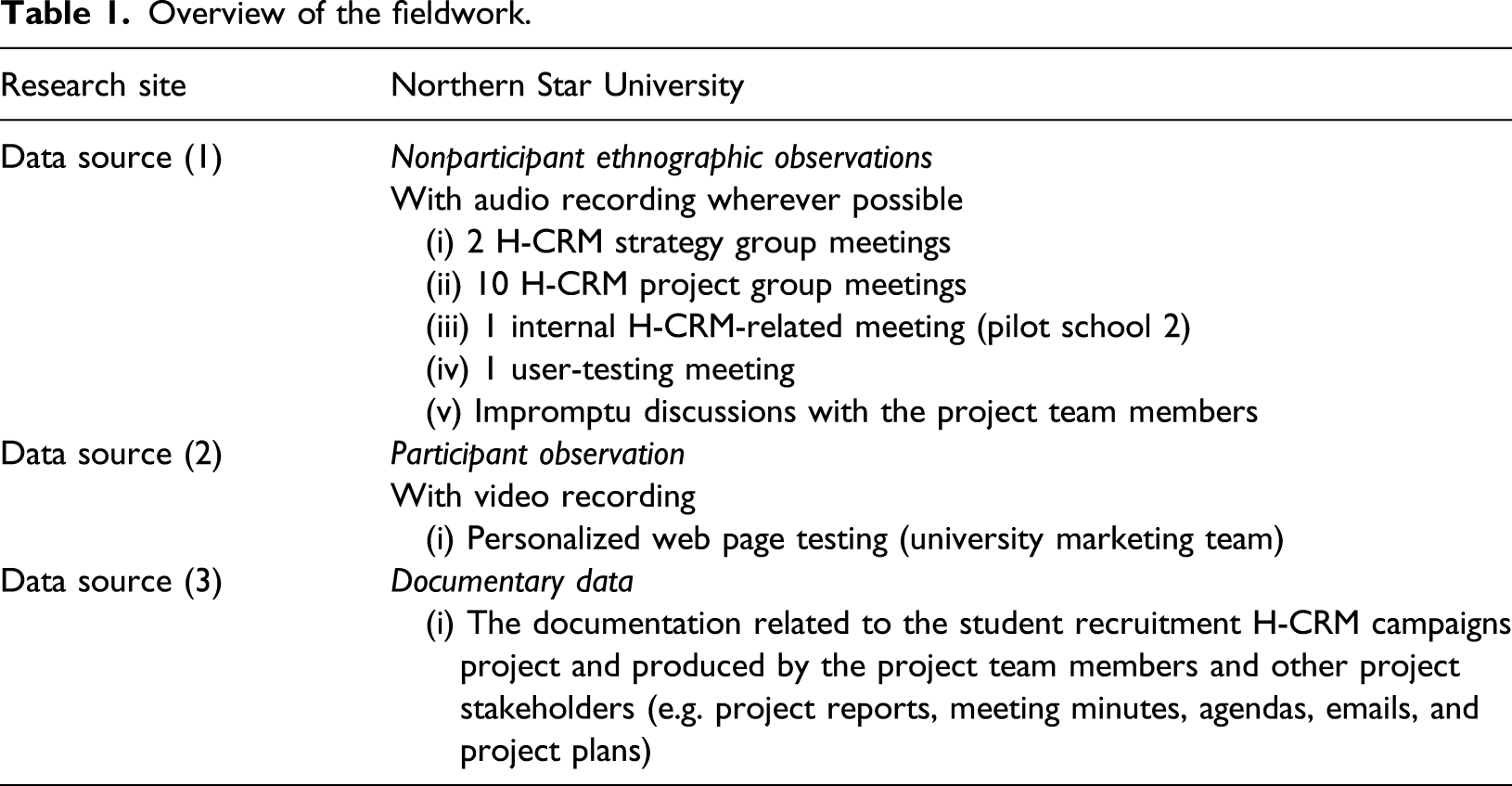
Overview of the fieldwork.
Considering that ethnography and the detailed analysis of naturally occurring talk are ‘not competing but complementary methodologies’, their combination can enhance the process of analysis (Samra-Fredericks, 2000: 251). In keeping with this position, ethnography has been introduced in this study as a useful complementary research method for gaining access to participants’ shared knowledge, contexts (including personal, historical, cultural, and other contexts), and other things such as experiences, interests, intentions, and expectancies that have been left unsaid but known by speakers (Garfinkel, 1967; Samra-Fredericks, 2004). Within the framework of this study, a ‘longitudinal tracking of key organizational events and outcomes’ is seen as ‘methodological advantage’ (Whittle et al., 2015: 386) which provides valuable transcript-extrinsic information and, thus, substantially advances the interpretation of the linguistic data by enhancing contextually informed readings of members’ interactions (Nelson, 1994; Schnurr, 2009). In what follows next, a research approach informed by CA and organizational ethnography will be used to develop understanding of a substantive area of social life such as shared leadership beyond the ‘mechanics’ of meeting interactions per se. Although the ethnographic comments in this article are kept to a minimum, the broader ethnographic understanding that has been gained through prolonged engagement with an organization provides the necessary analytical sensitivity for recognizing important moments in the ongoing stream of interactions (Larsson and Lundholm, 2013).
Data collection
The study presented in the article is developed using an episode of naturally occurring talk from a corpus of meeting interaction (Table 1) collected by the author as a part of larger longitudinal data collection during the 12-month field work in Northern Star University (a pseudonym). This corpus consists of 10 project team meetings. In the framework of this study, meetings are considered as the interpersonal occasions for sensemaking in which organizations are socially constructed by their members (Bargiela-Chiappini and Harris, 1997; Huisman, 2001; Schwartzman, 1986). According to Asmuß and Svennevig (2009: 16), meetings constitute a ‘fundamental site’ where the participants enact various institutional roles and relationships such as formal and informal leaders, experts, employees, and so on. Furthermore, meetings are recognized as a crucial site where identity construction takes place (Schnurr, 2009) and where leadership is enacted and negotiated (Asmuß and Oshima, 2012). There is a growing body of literature in organization studies exploring meeting interactions through the microdiscursive lens (Asmuß and Svennevig, 2009; Choi and Schnurr, 2014; Larsson and Lundholm, 2010; Samra-Fredericks, 2000; Svennevig, 2011).
Using CA terminology, meeting interaction can be regarded as a form of ‘institutional talk’ (Drew and Heritage, 1992) which can be defined in a broader sense as goal-oriented talk which locates and grounds participants’ orientation to institutional realities (Drew et al., 2006). Examples of institutional talks include medical encounters, classroom interaction, court hearings, counselling sessions, and so on. Heritage and Clayman (2010) acknowledge that the boundaries between ordinary and institutional talk are difficult to define. For the purpose of this study, it is important to recognize that institutional talk is different from ordinary conversation in terms of the turn-taking conventions which are usually prescribed by the asymmetry of the institutional relationship. Furthermore, institutional interaction generally involves a reduction in a range of interactional practices deployed by participants (Drew and Heritage, 1992; Heritage and Clayman, 2010).
The transcribed recorded data are over 20 h long, giving a combined dataset of nearly 150,000 words. Transcription is used as a tool to slow down the continuous stream of naturally occurring talk and to ‘repeatedly inspect’ (Schegloff, 2003: 39) interactionally consequential and analytically useful features of recorded interactions that are used for making sense of past actions and for producing next actions (Potter, 1997; Whittle et al., 2015). Thus, the analytical claims discussed in this study are empirically grounded in the transcript of naturally occurring talk and can be systematically analyzed and re-analyzed by referring to the particular data in a transcript. The chosen interaction is transcribed using Jefferson’s system (Jefferson, 2004). An overview of transcription symbols is provided in Appendix 1. The transcript of a chosen episode is divided into three short fragments to make it more reader friendly. Line numbers in these fragments reflect their position in the transcription of the meeting. References to ethnographic notes are added where necessary in the body of the discussion to indicate that these observations have been taken into consideration for data interpretation.
Extended sequence
Overwhelmingly, CA studies examine orderliness in interaction through building collections of ‘very small, crystalline bits of the conversational machinery’ (Jefferson, 1988: 418) across varieties of naturally occurring conversations to arrive at significant generalization in which talk-in-interaction is organized. Rather than showing some general patterns of usage of the interactional phenomena in a collection of instances, this study is inspired by the Jefferson (1988) approach to the exploration and description of large-scale conversational sequences. Given that the main analytical challenge of capturing the actual ongoing ‘processes’ of making sense rather than ‘products’ of sensemaking and sensegiving (e.g. stories and rhetorical strategies), choosing an extended interactional episode seems a natural choice.
The detailed analyses of single instances of larger talk fragments are not a brand new endeavour in the CA field (Schegloff, 1987). For example Berger et al. (2016) used a single-case analysis in their study of a recorded emergency call related to Michael Jackson’s death. They argue that a single-case analysis is particularly useful ‘for explicating analytical nuances that are uncommon or may be obscured by larger-scale studies’ (Berger et al., 2016: 564). Similarly, Toerien and Kitzinger (2007) used a fine-grained single-case analysis to demonstrate interactional competences required for beauty therapists to do emotional labour. In the field of organization studies, Larsson and Lundholm (2013) used a single work episode in their analysis of organizing properties of leadership. Whittle et al. (2015) draw on a single, extended extract from the strategy meeting in their study on how organizational structure categories are made sense of within the sensegiving practices of leaders. Preget (2013) focuses on a single case when examining the interactional competences of managers enabling them to make sense of organizational change. Collectively, these studies demonstrate how knowledge of various conversational activities can be relevant to an analysis of a relatively long sequence of talk to illuminate previously unnoticed orderly processes and practices in one localized and time-bound occasion of interaction (Ten Have, 2004).
From an ethnomethodological point of view, there is no time out (emphasis added) for sensemaking as it is always taking place, without beginning and end (Gephart et al., 2010; Leiter, 1980; Maitlis and Christianson, 2014). As Ten Have (2004: 52) warns us, ordinary members’ sensemaking practices are hard to notice because of ‘the invisibility of common sense’. In other words, when sensemaking practices are undisturbed, then ‘the facticity of social world is taken for granted’ (Leiter, 1980: 171). Therefore, to address this methodological problem, this study is sensitive to situations where sensemaking practices are interrupted or problematic for local participants, and thus, they are a fruitful resource for noticing and developing insights about how people construct a sense of shared social reality. Rather than focusing on the usual and routine meeting interactions, the focus of this study is set on finding and identifying interactions where project participants ‘have to do extra sensemaking work’ (Ten Have, 2004: 53) to produce or repair a sense of shared meaning and thus make the working of their constitutive methods visible for analysis.
The selected episode for analysis unfolds during one of the project meetings when the participants are dealing with a reported ‘trouble’ with an email campaign. Troubles-talk according to Jefferson (1988) is a discrete organizational domain, shaping interaction in distinctive ways. The selected episode shows the trajectory of the conversation which is characterized by ‘a tension between attending to the trouble and attending to business as usual’ (Jefferson, 1988: 419). By bringing in the analytical insights informed by a wealth of CA literature, this article shows how attention to orderly practices of talk in localized and time-bound occasions in interaction can be used to extend our understanding of emergence of various leadership configurations in the situation of uncertainty.
Analysis
At this juncture, it is useful to refer to the ethnographic notes collected during the fieldwork in Northern Star University. Addressing an increasing trend to personalized information in the higher education sector, many universities in the United Kingdom have started implementing tailored Customer Relationship Management (CRM) marketing campaigns which enable them to provide a professional and coordinated approach to communications with undergraduate and postgraduate enquires and applicants. In Northern Star University, which has been chosen as a research site for this study, implementation of a new student recruitment CRM campaigns system has been conceived as a part of the university CRM strategic framework. The aim of the student recruitment CRM campaigns project, as it is stated in the project documents, is to purchase an external CRM system—a bespoke global market-leading CRM product (H-CRM) to support university marketing campaigns to optimize the recruitment, conversion, and admission of high-quality students.
The analysis which follows is based on the data collected during ethnographic observations of the student recruitment CRM campaigns project team meetings that have taken place over the period of 12 months. The longitudinal engagement with the research site allowed the author to observe regular project team meetings which took place on a monthly basis. These meetings are particularly interesting empirical settings as they represent the unique mix of strategists, middle managers, and other project stakeholders. The project team consisted of a core group of CRM users (as defined in the project documents), who had to attend every meeting, and other members representing a heterogeneous group of project stakeholders across the university. Some of these stakeholders attended meetings only when they had specific expertise relating to the meeting’s agenda; others attended meetings when they could add value to the work being discussed. Therefore, the number of participants varied from meeting to meeting.
According to the project documents, it was essential that the data from the current university CRM system can be populated in the new H-CRM system on a daily basis to ensure that integrations and campaigns are based on up-to-date information. This required support from the IT department in terms of ensuring appropriate data feeds. However, the introduction of the H-CRM system in the university was not a straightforward process, and it was complicated by the fact that there were certain technical problems with transferring data from one system to another. Many project members highlighted that the experience of data integration was a difficult and challenging one in the project.
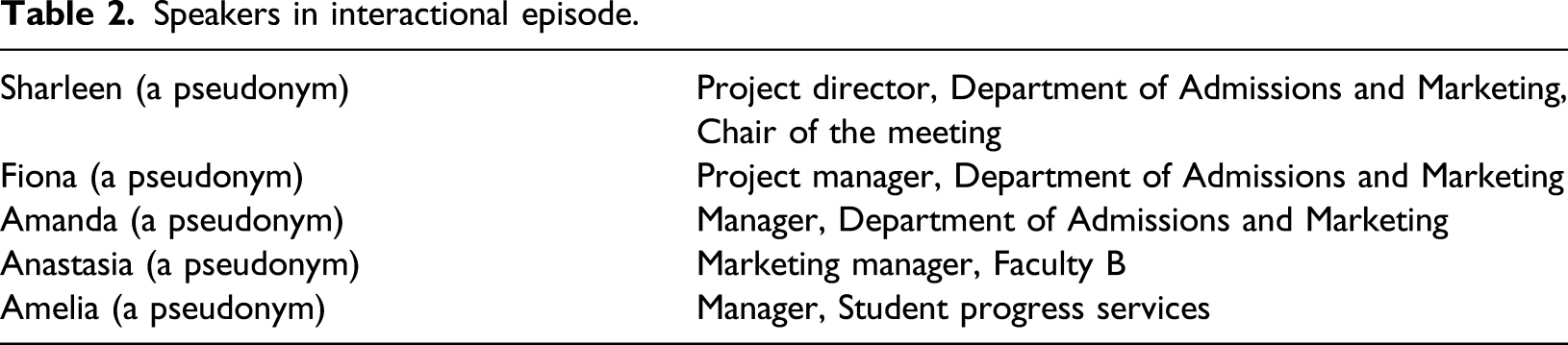
Speakers in interactional episode.
Extract 1 from the project team meeting.
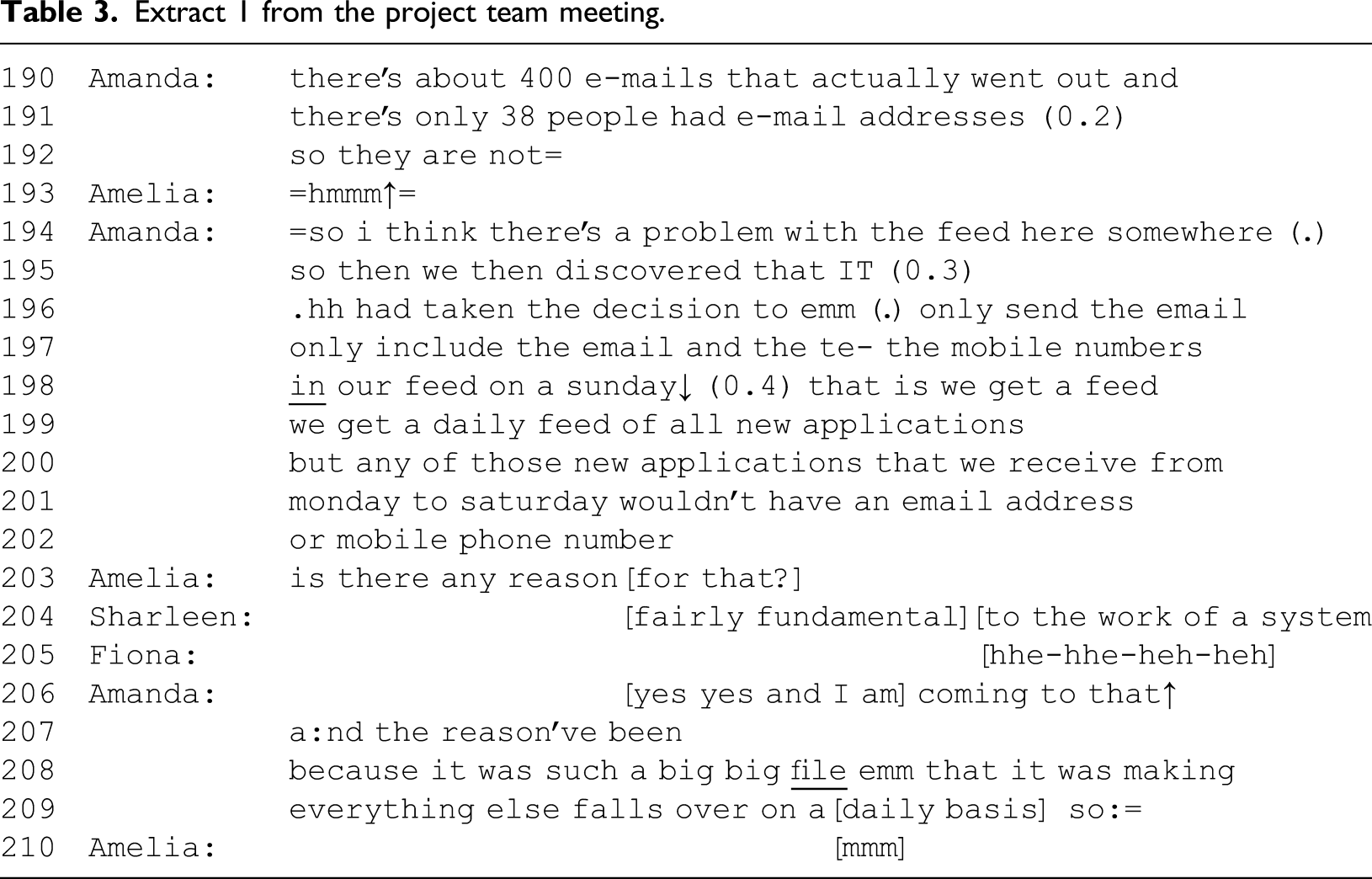
In this repair sequence, Amanda selects the word problem which has ‘a discourse prosody of difficulty’, framing the situation as an obstacle that should be solved, and by doing so, she opens the floor to the creative process of problem-solving (Handford, 2010). However, nobody steps in a transition-relevance place (TRP)—a micropause in line 194, and Amanda continues her turn in lines 194–202 by enacting her interpretation of a problem. Her change of pronoun from singular ‘I’ to plural ‘we’ in line 195 is also significant, as she is lending the collaborative weight of ‘we’ to her attempt of problem investigation. In this sequence, Amanda is the sole provider of information, although she offers a possibility for other participants to join her as a 0.4-s micropause in a transition-relevance place in line 198 suggests. Amanda displays her epistemic advantage by referring to first-hand experience and epistemic access to a territory of knowledge related to a problem with the email campaign. Thus, Amanda positions herself as a more knowledgeable member of the team who frames the situation with the email campaign in a particular way, that is by assigning blame to a nonpresent (IT) department. By managing the meaning of the unclear situation around the email campaign, Amanda gives sense to project team members on a turn-by-turn basis, and so, she does leadership.
Amelia marks the arrival of the trouble by launching her turn in a transition-relevance place in line 203 by asking an information-seeking question which indicates that there is the epistemic imbalance related to knowledge about what is causing a problem with the email campaign. Sharleen and Amanda are bidding for the turn space by starting their turns simultaneously at the point where Amelia’s utterance is going to be possibly complete. However, their utterances offer different actions and different trajectories of the conversation which are shaped by the basic issue of ‘who knows what’ (Clift, 2016: 212).
On the one hand, Amanda (line 206) treats this space as an opportunity for ‘doing understanding’ (Mondada, 2011) by responding to Amelia’s question with an affirmative token yes. Amanda continues her turn by saying I am coming to that which is heard as her awareness of the epistemic imbalance flagged up in Amelia’s question and an attempt to equalize it by providing necessary information stepwise. By doing so, Amanda does leadership driving the conversation forward. On the other hand, Sharleen joins the conversation upgrading Amelia’s question with an assessment of the problem as fairly fundamental to the work of a system (line 204). Thus, Sharleen displays independent knowledge about an issue and claims her epistemic rights to manage the meaning of the situation by occupying a first slot in the assessment of a reason for a reported problem with the email campaign. This constitutes a challenge to Amanda’s leadership, as Sharleen contests Amanda’s claim to superior knowledge and indicates equality of epistemic access to a knowledge domain. Sharleen as meeting chair interrupts the normal flow of interaction in her attempt to influence the management of meaning and, thus, to do leadership. However, she drops off after her quick comment and ‘interactionally surrenders’ (Clifton, 2012: 158) her power to manage meaning to Amanda who continues leading the conversation.
Fiona joins the conversation with a laugh token hhe-hhe-heh-heh (line 205). She launches it in the middle of Sharleen’s turn, treating her assessment ‘fairly fundamental’ as laughable. As nobody else laughs, Fiona’s one-sided laughter can be interpreted as her affiliative response to what has been said by Sharleen. In other words, she knows what Sharleen is talking about, and she understands the ironic nature of Sharleen’s utterance. What is more, Fiona displays acceptance of Sharleen’s right to claim epistemic primacy, and thus, Fiona does followership which is made interactionally visible in this ‘collective unit of participation’ (Kangasharju, 1996).
In lines 207–209, Amanda informs the team about a reason behind the identified problem associated with the email campaign. Here, the declarative form of Amanda’s turn is congruent with its content and clearly shows that this information is in her epistemic domain, which gives her epistemic primacy to drive interpretation of the problem forward. For example she is ‘translating’ (Whittle et al., 2010) some technological terms into lay language (it was such a big big file—line 298) that is more understandable for the project team members most of whom are not IT specialists. Thus, Amanda does leadership by inferring meaning in technical terminology, making it more understandable for colleagues and positioning herself as a more knowledgeable member of the team.
Extract 1 (Table 3) illustrates how a shared sense of what is going on (i.e. a problem with an email campaign) is produced intersubjectively by the meeting participants through the sequential properties of talk. The project team members monitor one another on a turn-by-turn basis in terms of satisfying and fulfilling their responsibilities with respect to knowledge. Leadership is enacted by several individuals (Sharleen and Amanda) who occupy different hierarchical organizational roles and negotiate epistemic rights to gain primacy in the management of meaning.
Extract 2 from the project team meeting.
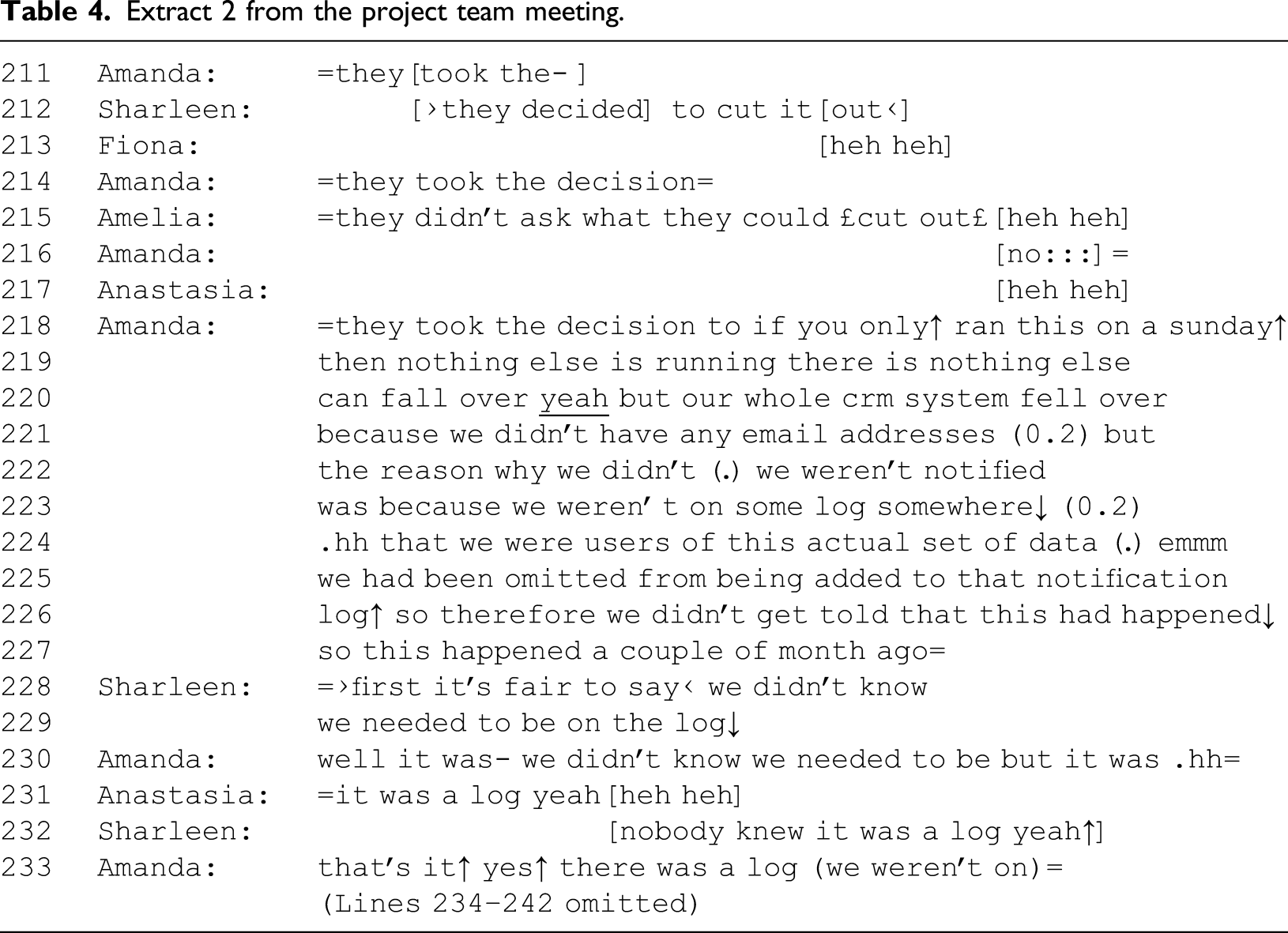
Amanda launches a complaint starting her turn by distancing the project team from the IT department using they (line 211). Amanda’s right to manage meaning has been challenged by Sharleen in line 212 who joins the conversation at a very high speed to ensure that she gets the floor. Sharleen displays her first-hand knowledge by offering her own description of the problem and claims equal rights to Amanda to manage meaning and so to do leadership. She also claims joint authorship of the turn borrowing they from Amanda’s utterance which she included in her turn they decided to cut it out (line 212). Sharleen’s utterance has been accompanied by Fiona’s overlapping giggle (line 213) which is not taken up by anybody in the project team. This one-sided laughter shows Fiona’s affiliation with Sharleen and displays Fiona’s followership which is made interactionally visible by Fiona’s acceptance of Sharleen’s right to manage meaning.
Amelia and Amanda launch their turns in a transition-relevance place following Sharleen’s turn in line 212. Amanda ignores Sharleen’s interruption and attempts to restart her turn (line 214), offering alternative framing of a problem, whereas Amelia asks a question in response to Sharleen’s turn (line 215). Amelia’s question in line 215 is negative interrogative and, being in a second position, according to Heritage and Raymond (2005), it challenges Sharleen’s claim of epistemic primacy. By answering Amelia’s question instead of Sharleen in line 216, Amanda re-establishes her right to manage meaning by displaying her knowledge about the situation.
In line 218, Amanda makes another attempt to deliver a complaint. She shows commitment to drive the conversation forward, although her account appears vulnerable to various interruptions in lines 212 and 215. Thus, Amanda contributes to the progression of the meeting displaying her strong task orientation which is traditionally associated with hierarchical leadership. In what follows next, Amanda uses the pronoun we which refers to the project team members saying we didn’t have any email addresses (lines 207–208), we weren’t notified (lines 208–210), we weren’t on some log somewhere (line 209), we had been omitted from being added to that notification log (lines 210–211), we didn’t get told (lines 211–212). This category predication work (Whittle et al., 2015) enables Amanda to enact leadership by determining the direction of sensemaking. She frames a problem with the email campaign as an open complaint about the IT department’s incompetence. She also portrays the project team somewhat metaphorically speaking as a ‘passive victim’ of IT department actions.
Sharleen launches her turn in line 228 correcting the trajectory of discussion, offered by Amanda, by saying first, it is fair to say. This is heard as an attempt of escalating the complaint further by claiming Sharleen’s own first-hand access to the knowledge domain. However, then, Sharleen demonstrates her solidarity with the project team in this situation using the pronoun we and displays the project team’s insufficient knowledge regarding a notification log by saying we didn’t know we needed to be on the log (lines 214–215). Thus, Sharleen opens negotiations about who is responsible for the existing problem. Attribution of knowledge we didn’t know is based on local assumptions about category-bound (i.e. project team members) rights and obligations.
Amanda’s response to this formulation is not fully affiliative. She constructs her well-prefaced turn in which she does not quite go along with Sharleen (line 230). Well as one of the ways of indicating disagreement is indexing what follows as both responsive to its prior and also counter-positional to it. However, a self-repair follows next, and Amanda replaces it was—by we didn’t know we needed to be on the log. This self-repair allows Amanda to modify the emergent meaning of utterance and display her alignment with Sharleen by repeating part of her utterance we didn’t know we needed to be (line 230). Thus, Amanda avoids unnecessary interpersonal friction showing again her commitment to driving the conversation forward.
Anastasia launches her turn in line 231 in a so-called ‘opportunity space’ (Kangasharju, 1996) (Amanda’s in-breath .hh in line 230) and completes a not-yet-completed utterance started by Amanda in line 230 it was a log yeah claiming joint authorship of the turn. Sharleen’s declarative statement nobody knew there was a log (line 232) suggests further escalation of a complaint, as we which is used by previous speakers has been upgraded to nobody. This is reaffirmed by Amanda’s declarative statement that’s it yes (line 233) which is supported by an intonation contour of rising pitch. It is followed by the reformulation of previous speakers’ utterances which succinctly frames the problem there was a log we weren’t on (line 233).
Lines 228–223 in this sequence suggest intensification of interactionally visible solidarity between the project team members in their joint orientation towards the identified problem of ‘being excluded from the notification log’ and complaining about the nonpresent third party (IT department). Amanda, Sharleen, and Anastasia jointly manage the meaning through various discursive resources. ‘Team work’ (Kangasharju, 1996) in this sequence is achieved interactionally in various observable ways produced in collaboration with others, including anticipatory completion of a turn by another member of the team (Amanda–Anastasia in lines 230–231), repetition of parts of another’s turn (Anastasia it was a log yeah in line 231 – Sharleen it was a log yeah in line 232), and upgrading assertions of agreement (Amanda that’s it yes in line 231). Thus, in this sequence, leadership is jointly held and negotiated in a step-by-step fashion between Amanda, Sharleen, and Anastasia who claim equal rights to manage the meaning.
Extract 3 from the project team meeting.
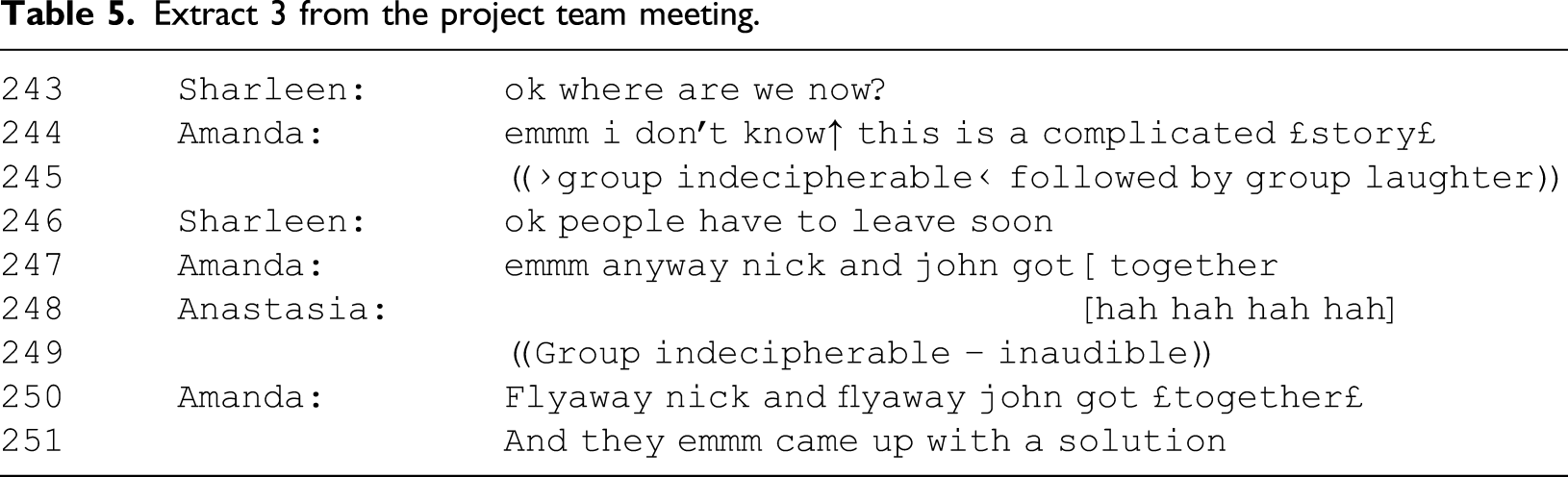
However, Amanda’s turn indicates that interaction may not yet have achieved a point where closure seems relevant. Amanda takes the floor in line 244 self-selecting herself and launching a turn with a dispreferred delay emmm in response to Sharleen’s question. In what follows, she positions herself as the speaker who is unable to supply the requested information, with regard to Sharleen’s information-seeking inquiry by saying I don’t know (line 244). By marking an ‘unknowing’ epistemic stance, Amanda appears less knowledgeable than she really is. Importantly, I don’t know in this instance arises out of the interactional sequence within which it is embedded, and, here it indicates that the ‘unknowing’ epistemic stance encoded in Amanda’s turn is not congruent with her epistemic status as a knowledgeable member of the team. Moreover, Amanda positions herself as the speaker who is unable to supply the requested information. To remedy the situation, Amanda provides additional information and offers the real reason for not supplying the information (line 244). Utterance I don’t know is grammatically complete, but Amanda continues her turn beyond the point of possible grammatical completion claiming the first slot in an assessment sequence this is a complicated £story£ and, by doing so, she claims primary rights to manage the meaning. Amanda produces formulation by ‘fixing’ (Clifton, 2006) the meaning of the talk-so-far and eliminating the possibility of multiple understandings. She ends her turn with a laughing voice which is followed by an outburst of the group’s indecipherable overlapping talk and group laughter (line 245). This mutual laughter here is heard as a means of affiliation (Glenn, 1995; Greatbatch and Clark, 2003; Jefferson, 1979).
Amanda’s indignation about a problem, caused by the IT department, is articulated by making the matter laughable. This allows Amanda to summarize the complaint in a way as to enhance its legitimacy. Amanda has achieved this in the episode when the project team members join the laughter indicating their sympathy to Amanda. This emotional ‘flooding out’ interactionally contributes to informal leader identity construction (Schnurr, 2009). In this excerpt, Amanda does leadership by claiming and displaying a privileged position for defining the social reality for the project team members (by first assessment position) (Clifton, 2012) and soliciting affiliative laughter from most of the meeting participants [ethnographic notes]. By laughing in unison, the co-participants arrive ‘at an intense intimacy’ (Jefferson, 1988: 419) and they are ‘fully tuned for sensemaking’ (Weick, 2009) before they re-engage with business as usual. They ratify Amanda’s construction of a problem as laughable and complainable, displaying shared negative knowledge about the nonpresent department [ethnographic notes] and a sense of solidarity and camaraderie.
Interestingly, although the collective laughter in line 245 is tied to a ‘laughable’ element in the immediately preceding Amanda’s turn in line 244, this emotional ‘flooding out’ is built by, what might be called, a conversational ‘prelude’. In other words, it is built on a complex interactional work of project team members which unfolds over many turns in their attempt to make sense of a problem reported by Amanda. This prelude, in a way, could explain why the laughing event occurs in this particular moment of the interaction in the first place and what role Amanda plays in the creation of this laughable situation. As Du Bois (2007: 147) points out, ‘participants remember interactionally salient information about co-participants, and so may factor into their stance interpretation, in addition to what the speaker is saying right now…’. Therefore, the laughter here is heard firstly, as a response to a ‘category anomaly’ (Hester, 1996) where the category-bound activity of ‘not knowing’ does not match the category ‘most knowledgeable member of the team’ or ‘expert’ displayed by Amanda in her previous turns. Secondly, this shared laughter indicates the conjoined participation of the team members in the response to Amanda’s assessment of the situation (Lerner, 1993) and thus, situated collective identity (i.e. knowledgeable team members) is constructed. Finally, the interactional upshot of this laughter is heard as an upgraded version of Amanda’s smiling voice, indicating that Amanda creates a laughable situation (safe space for other members of the team to join) when uncertainty in the situation seemed to have reached its peak. Here, Amanda exerts her conversational dominance by providing the project team members with an opportunity to participate meaningfully in the conversation by using the transformative capacity of humour (Osvaldsson, 2004, italics in original) to break the ordinary interactional frame, and so she does leadership.
The meeting interaction becomes interactionally problematic in line 245 as multiple speakers talk simultaneously and then laugh together. Sharleen displays her understanding of this problem by trying to restore the ‘one-speaker-at-a-time’ rule and reminding participants that the meeting should be finished soon (line 246). Thus, she displays a certain amount of social control as a chair of a meeting and does leadership in her attempt to repair the broken ordinary interactional frame and bring the meeting discussion back on track. Amanda is using the conversation restart device in line 247 not only to exit from the trouble-talk but also to exit conversation with interactional troubles to continue ‘business as usual’ (i.e. reporting).
The obvious question is what happened next? Clearly, there have been both short-term and long-term leadership effects within and beyond this meeting interaction. In terms of the short-term effect, the solution to the problem has been announced jointly by Amanda, Fiona, and Sharleen in the same meeting after the interaction discussed in the article. Amanda reported that the problem with the email campaign ‘was fixed quite speedily… it was fixed within about a week’. Fiona confirmed that she knew about this problem (this fact could probably explain her affiliative laughter in lines 205 and 213) and explained that she was waiting for confirmation that it ‘is ironed out’. Sharleen praised the speedy solution of the situation by saying ‘Well done’. After that, the topic was closed, and the project team moved to the discussion of other items on the agenda. In terms of the long-term effects of leadership, the interaction presented in this article unveils the existing misunderstandings in communication between the project team and IT department. Thus, it contributes to the discussion of the bigger ‘thorny’ issue, namely, relationship between these two project stakeholders [ethnographic notes]. This issue was addressed by the project team during their regular meetings, as it overshadowed the successful implementation of the H-CRM system across Northern Star University.
Discussion
Inviting the reader to think about what it means to lead when one is thrown into the situation of uncertainty, this article explores how leadership actors are dealing with uncertainty in their interaction in a socially meaningful way. In doing so, the study contributes to the existing research which recognizes the ability to shape the views of others by shaping and directing their sensemaking through discursive practices in the form of talk-in-interaction as a key leadership skill. The overarching aim of this study is to examine how shared leadership as meaning management is collaboratively constructed by various leadership actors in meeting interaction in daily instances of uncertainty. By addressing this aim, this study sought to unmask fine-grained struggles over meaning in a troubles-telling sequence (Jefferson, 1988) in a multiparty meeting interaction. An empirical case discussed in this article shows how the process of sensemaking is managed by various participants along with the emergent, incremental, sequential organization of turns moment by moment. By bringing in analytical insights informed by a wealth of the CA literature, this study explicates ‘an elegant and effective conversational machinery’ (Jefferson, 1988: 438) which makes visible the process of ‘permanent tinkering’ (Coulon, 1995: 17) through which the social fact of leadership is established in daily interactions of leadership actors. Pye (2005: 35) points out that ‘conceptualizing leadership presents a challenge which is akin to capturing the ethereal qualities of ‘the moon on the water’: you know it when you see it, but it absolutely defies capture.’ The CA-inspired research presented in this article allows us to respond to this challenge.
Firstly, according to Weick (2009: 265), ‘sensemaking is about how to stay in touch with context’. In the chosen episode, leadership is interactionally achieved in a variety of observable ways: by displaying work-related epistemic authority, by avoiding tensions, by committing to talk progression, by advancing the task, by producing formulations, by making first assessments, and by creating a laughable situation. Thus, all participants who speak in this episode actively contribute to an ongoing sensemaking process discursively by staying in touch with the interactional context through delicate balancing between their attention to the problem and attention to business as usual. Sensemaking activities of the meeting participants are directed towards an organizationally relevant goal, namely, solving a problem with an email campaign reported by Amanda. Therefore, leadership is enacted in this episode as a shared activity of mobilizing diverse organizational actors around a common ‘definition of situation’ (Whittle et al., 2015). Thus, leadership is displayed not as a possession of a particular individual and not as the cognitive product of social interaction but rather as a continuous discursive accomplishment which is produced and reproduced collectively in the ongoing interaction by various leadership actors. Analytical sensitivity of this study in exploring how meaning is collaboratively constructed in naturally occurring talk reveals that shared leadership as it happens in situ does not necessarily represent a concerted effort by individuals involved in the sensemaking process. It can also be challenged (e.g. Sharleen’s interruption in line 204) or rejected (e.g. Amanda’s dispreferred response to Sharleen’s information-seeking question and her display of insufficient knowledge in lines 244).
Secondly, by focusing on the microprocesses of identity construction, we could observe what Choi and Schnurr (2014: 20) call ‘the more inclusive picture of a mosaic of leadership activities’ performed on a micro level by various members of the team. In the analyzed sequence, leadership is enacted by several team members with various levels of seniority and status in the organization by using the specific conversational mechanisms and discursive processes for steering through various stages of a troubles-talk. Based on the analysis which is anchored in the details of the transcript of naturally occurring talk, this study demonstrates a range of hybrid leadership configurations which participants of the meeting construct and negotiate within their turn-taking. With a particular empirical focus on how shared meaning is achieved in orderly and mutually intelligible talk, a CA-inspired analysis makes visible a delicate interplay between both top-down and bottom-up leadership suggesting a hybrid leadership configuration in play (Gronn, 2011, Holm and Fairhurst, 2018). Interestingly, top-down or formal leadership, which is based on hierarchical authority, seems minimal in this meeting interaction. A chair of the meeting (Sharleen), although being more institutionally senior, relinquishes some of her authority to a project team member (Amanda) who displays the expert knowledge using a range of interactional resources.
This study also shows how the sensemaking activities that enable middle managers’ interpretations of the problem contribute to the discussion of the identified problem. Responding to Balogun and Johnson (2004) who highlight little recognition of the role of middle managers’ sensemaking in the management literature, this study reveals the true complexity of the nature of middle managers’ roles when they are leading the project team towards achieving organizational goals. In this sense, this study demonstrates empirically that sensemaking among middle managers plays an important role in shaping organizational processes and outcomes (Whittle et al., 2015). This study also provides additional evidence that ‘lateral interactions between the middle managers as the part of sensemaking process merit as much attention as the top-down interactions’ (Balogun, 2003: 81). Furthermore, analysis of a lengthy troubles-telling sequence occurring in a situation of uncertainty allows for observing leadership not as a static attribute of a particular individual (i.e. a chair of the meeting) but rather as a dynamic activity which is enacted by both formal and informal leaders. Thus, leadership as a social fact is enacted as a great interpersonal effort of various leadership actors in a micro-level talk ‘across time’ rather than ‘one-off’ moment of great oratory (Samra-Fredericks, 2004: 1108).
Finally, although the analyzed interaction may not have dramatic organizational outcomes and consequences, it nevertheless offers useful insights for academic and practitioners by empirical demonstration of mundane acts that constitute leadership practice (Alvesson and Sveningsson, 2003). For example, verbal contributions indicating interruptions (Sharleen – lines 204, 212), a self-repair (Amanda – line 230) and alignment (Anastasia – lines 231) could be considered important for leadership practice. Although, they do not lead to anything substantive in this episode, they enable project team members to contribute to the construction of shared meanings in the situation of uncertainty. Furthermore, as empirical evidence suggests, one of the common markers of the epistemic stance in English I don’t know has performed ‘a highly sensitive act’ in the analyzed sequence (Keevallik, 2011: 184). Taking the dialogic context into account (Du Bois, 2007), the analysis shows that I don’t know has been displayed as a nonstereotypical and a truthful response of a meeting participant. Therefore, similar to observation made by Weick (2009), it can be seen as a strong act of leadership in a daily situation of doubt and uncertainty because it positions a leadership actor for the sensemaking that needs to be done and establishes the leader’s credibility in an unknowable world.
Some opponents might argue that the terms ‘leadership’ and ‘leader’ are not actually used by the speakers in the chosen episode; therefore, participants in the episode do not visibly orient to such labels. However, it is important to point out that speakers display a sustained orientation to colleagues’ occupancy of the category ‘leader’ through their positioning in turn-taking with respect to each other as it has been demonstrated in the analysis section. What is more, the author of this article attended this meeting as part of her longitudinal ethnographic data collection. Therefore, she has access to the participants’ shared knowledge, contexts, and experiences that have been left unsaid but known by speakers in this episode. Based on an ethnographic understanding informed by the author’s closeness to the field, the chosen interaction is indeed an example of leadership that unfolds in the situation of uncertainty during the project team meeting.
Conclusion
This article presents a nuanced fine-grained account of leadership practice as it unfolds in a meeting interaction in daily instances of uncertainty. By offering a research approach informed by CA and organizational ethnography, this study reveals conversational mechanisms and discursive resources which contribute to the emergence of a variety of leadership arrangements that are constructed collectively by various leadership actors on a turn-by-turn basis. However, there are certain limitations to this study that can suggest new avenues for future research in exploring shared leadership as an interactional accomplishment. Firstly, data analysis presented in this article is based on audio-recorded data. Therefore, some of the significant features in talk-in-interaction such as gazes, gestures, and body movements are not captured by the transcription, leaving nonverbal forms of participation in conversation largely unexplored. Further research could use video-recorded data to explore the emergence of shared leadership in interaction and, thus, enhance analytical discussion about leadership by a detailed analysis of multimodal resources used by leadership actors. Secondly, project team members who participated in the meetings that were observed during the fieldwork have been predominantly represented by women. In the episode chosen for analysis, all five participants are women; however, this study does not focus specifically on how women are ‘doing leadership’. Therefore, a possible direction for future research might be related to the intersection of gender and leadership reflecting on the overwhelming dominance of masculine discourses in the leadership literature. Furthermore, the emotional display of shared laughter discussed in this article paves the way to further discussion of authentic leadership. Although other directed emotions are recognized as important determinants of authentic leadership, the management of emotions as a tool of authentic leadership in diverse organizational settings is an area of inquiry in its infancy. The question of how emotional displays are woven into the fabric of daily institutional interactions and their role in construction of authentic leaders’ identities opens some intriguing directions for future leadership research. There is clearly room for further empirical work, as this study is based on one single episode which is taken from a longer meeting interaction in one particular organizational setting (i.e. university), and therefore, conclusions that are drawn from this episode should be treated cautiously. Therefore, it is suggested that further studies of larger collections of meeting interactions in various organizational settings may deepen our understanding of leadership as sensemaking in action. These studies could sharpen their focus on a range of discursive practices which contribute to a variety of leadership activities that are involved to produce and sustain an intersubjective sense of shared meaning in daily instances of uncertainty in different organizational contexts.
Footnotes
Acknowledgements
I am thankful to Professor Andrea Whittle for her invaluable feedback. I am also grateful to Professor Stewart Clegg for his comments on the early version of this paper and to Professor Gene Lerner for our discussion about collectivities in action during the CA Summer School at York University. My special thanks to CA researchers from Multimodal Analysis Research Group—MARG (Newcastle University), who helped me at the early stages of my data analysis and two anonymous reviewers whose comments helped me improve the quality of this paper.
Declaration of Conflicting Interests
The author(s) declared no potential conflicts of interest with respect to the research, authorship, and/or publication of this article.
Funding
The author(s) received no financial support for the research, authorship, and/or publication of this article.

Author biography
Appendix 1. Key to transcript symbols (adapted from Jefferson,2004 and Clift,2016 ).
[
Left square brackets indicate a point of overlap onset, whether at the start of an utterance or later
]
Right square brackets indicate a point at which two overlapping utterances both end
=
If two words are connected by equal signs then the two words sound ‘latched’ or run together
(0.5)
Numbers in parentheses indicate silence, represented in seconds. Silence is standardly represented in tenths of a second. A pause occurs after a speaker has come to a point at which the talk is possibly complete
(.)
A micropause of less than 200 ms
::
Colons are used to indicate the prolongation or stretching of the sound just preceding them. The more colons, the longer the stretch
> <
The combination of ‘more than’ and ‘less than’ symbols indicates that the talk between is compressed and rushed
.hh
Inbreaths are shown as ‘hh’s with a dot before it
↑↓
The up and down arrows mark sharper rises or falls in pitch
-
A hyphen after a word or part of a word indicates a cut-off or self-interruption
££
This symbol indicates ‘smile voice’
Underlining is used to indicate some form of stress or emphasis, either by increased loudness or higher pitch
.
A period after word or syllable indicates a falling or final intonation contour
,
A comma indicates ‘continuing’ intonation, not necessarily a clause boundary
?
A question mark indicates rising intonation, not necessarily a question
(( ))
Double parentheses are used to mark the transcriber’s description of events
( )
These parentheses indicate uncertainty on the transcriber’s part but represents a likely possibility