




Abstract
This paper critiques the empirically supported normative argument that distributed leadership allows for shared accountability and responsibility. Through the means of cognitive mapping and semi-structured interviews, we engaged in understanding how practices and structural conditions of distributed leadership within two English state primary school settings were established and accepted and where the inseparable connections between leadership, agency, power and collaboration positioned some members less well to participate and exercise influence than others. Our study utilises Foucault’s critical concepts of power as an interaction of social relations and his concept of ‘technologies of self’ whereby individuals undertake practices in order to shape themselves in particular ways to be accepted. Furthermore, drawing upon Bourdieu’s concepts of capital, habitus and field, findings indicate how within a distributed model of leadership individuals can be disconnected from the collective but enabled to feel good about this. We conclude by discussing the implications of these findings for distributed leadership and the necessity to problematise power more generally within a distributed model of leadership.
Introduction
This paper explores aspects of the inseparable connection between leadership, agency, power, and collaboration in a primary educational context. We consider how the contemporary D/discourses of distributed leadership are fabricated and organised in education and explore how the distributed leadership approach ‘naturalises oppressive power relationships within an organisation’ (Tourish, 2014: 79). The focus for our study is on the D/discourse of individuals as they talk about their ‘figured worlds’ of inseparable connections between leadership, agency, power and collaboration. We make use of Gee’s (1999) well-known distinction between little ‘d’ discourse and capital ‘D’ Discourse where a capital ‘D’ represents an individual’s way of thinking, believing, acting, interacting, speaking, listening and valuing, while little ‘d’ discourse refers to what is said or written. Following Fairhurst (2011: 503), using capital ‘D’ enables use to ask ‘the ‘What’ questions as in ‘What kind of leadership are we talking about?’.
Drawing on empirical data from two state primary educational settings within England, where the government-mandated model of leadership within the sector is one of a transformational distributed model, we offer critical insights into power dynamics within the interplay of a collective and constrained context. This study stemmed from our interest, experiences and professional involvement in the field of education. During our professional careers, distributed leadership (DL), has been instrumental in shaping how leadership has been regarded and investigated. Official rhetoric presents DL as a means of leading with impact and is the preferred model of leadership within state-funded primary schools placing the headteacher as pivotal in influencing others (Department for Education, 2017). It is a model which multiple studies have professed distributes responsibility and accountability throughout a setting to improve performance with the leader at the centre (Day et al., 2010; Harris, 2014). We would argue that a crucial missing element is agency – the practices that individuals undertake in order to shape themselves in particular ways in relation to Discourse. They could be acts of compliance or resistance of the self in order to be discursively included what Foucault refers to as ‘technologies of the self’ (Gillies, 2013). A question that drove our study, therefore, was what are the connections between agency, collaboration and power within a distributed model of leadership? Rather than viewing DL as an effective means of distributing responsibility and accountability where schools as Harris (2003: 321) posits, ‘build a climate of collaboration premised upon communication, sharing and opportunities for teachers to work together’ and seeing leadership under this guise as ‘effective’, we set out to problematise and critique DL as a Discourse and practice. As a result, we sought to explore the dynamics of power and influence within the settings and drew on Foucault’s explanation of power as something which is carried out within different aspects of human activity, between different individuals or groups.
We make two contributions within this paper. Firstly, theoretically, our findings show that individuals may co-create and buy into the Discourse of distributed leadership practice, but they are a creation of that practice through a self-delusion so as to be included. Additionally they seek professional capital so as not to be excluded. What individuals within school see as relevant or important is shaped by them engaging in what discourse produces and generates, in other words, meaningful work amidst a taken-for-granted collaborative environment of mutual commitment and trust. Thus, we augment the proposition made by Tourish (2014: 80) that leadership is ‘a fluid process’ that participants shape themselves in particular ways in relation to the Discourse of distributed leadership and build through their language-in-use, socially situated identifiers. Further that those in positions of leadership within the settings dominate and perpetuate dominant realities of new ways of doing things in order to transform their schools. Our findings show that a DL structure influences an individual’s own agency and stifles dissent and conflict. This echoes Gunter et al.’s (2001: 570) insight that ‘the self is disconnected from the collective through distributed leadership, yet enabled to feel good about this’ – in Bourdieu’s (2000) terms they ‘misrecognize’ working together as strategic empowerment.
Our second contribution is a creative methodological one utilising cognitive mapping. The study draws on empirical material comprising ‘talk’ as individuals drew cognitive maps (henceforth referred to as cognitive models), and voiced their thoughts about the activities they undertook within their practice providing us with a means ‘to explore emergent realities within their temporal unfolding’ (Raelin et al., 2018: 380). The participants were left to ‘free associate’ (Mason, 2002: 64) around their specific experiences of activities and each spoken thought as they drew their cognitive models was captured through the recording process.
The paper begins with an exploration of the theoretical underpinning of distributed leadership, including the connections of agency and power. We then explain our critical theorist position in relation to this empirical study. Following this, we introduce D/discourses a means of studying how language is used on site to enact specific social activities and social identities before expanding upon the connections in terms of the participants’ discourse, identifying the constructive process and the organisational outcomes.
Theory of distributed leadership
In the first instance what follows is a lens of the significant aspects of distributed leadership activity and how it might be understood for the purposes of investigating leadership practice.
DL is not a new idea. It has been traced back to the mid-1920s and earlier by ‘Gibb (1954) in the Handbook of Social Psychology and further back by Benne and Sheats (1948)’ (cited in Edwards, 2011: 302). It is a term often used interchangeably with shared, team, collective and democratic leadership (Spillane, 2005b). Part of its attraction is ‘its chameleon-like quality, it means different things to different people’ (Harris et al., 2007: 338). Spillane, according to Harris et al. (2007), has developed the most complete theoretical model of distributed leadership. Spillane (2005b) argues that distributed leadership is dependent on the situation, and it is possible that a distributed perspective allows for shared leadership. Harris (2004: 13), in support of Spillane, suggests that the best way to think of distributed leadership is as ‘a way of thinking about “leadership”’. For her, ‘distributed leadership concentrates on engaging expertise wherever it exists within the organisation rather than seeking this only through formal position or role’. However, Harris (2004) also warns of the danger of distributed leadership becoming a catch-all for any attempt to share leadership or delegate. In addition, Youngs (2009: 387) warns when considering DL, ‘(the) issue here is where the locus of power is situated in educational contexts and whose interest are being served or minimised’.
Spillane and Diamond (2007: 2) pose the question, ‘does a distributed perspective offer a substantively different way of thinking about leadership or is it simply another case of the emperor having no (new) clothes?’ They warn that ‘loose constructs’ may result in difficulties for researchers, but more importantly, although they may provide a structure for exchanges within organisations, ‘they often give a false sense of agreement and understanding among people as they talk past one another’ Spillane and Diamond (2007: 2). They further argue that DL is not a model but a conceptual lens or diagnostic tool for understanding practice, ‘without prescribing steps for how one should lead or manage’ (Spillane and Diamond 2007: 148). Harris (2014: 14) agrees, postulating that, ‘a great deal of the writing about distributed leadership, including my own, has focused upon definitional, methodological and empirical issues’. Our study tackles this by contributing to the ‘how’ of DL, thereby addressing the gap identified by Harris (2014).
Distributed leadership within education
In their distributed perspective on leadership, Spillane and Diamond (2007) identify three essential elements: leadership practice is central; leadership practice is a result of interactions among leaders and followers and finally, the situation both defines leadership practice and is defined through that practice. For Spillane (2005b: 384), ‘leadership refers to activities tied to the core work of the organization that are designed by organizational members to influence the motivation, knowledge, affect and practices of other organisational members.’ In his leader-plus approach (meaning the work of multiple leaders), he bases his ideas on empirical research into how staff worked on various organizational functions, such as developing a vision, building teacher knowledge, managing resources and building a professional community. For Spillane (2006: 7), the ‘leader-plus approach recognises that such routines and structures play an integral role in leadership’. However, he also warns, ‘leadership can influence people and organizations in directions that most of us would find neither ‘beneficial’ nor ‘desirable’ (Spillane, 2005b: 384).
In our study, a leadership routine may involve up to four leaders, for example: headteacher, Key Stage leader, literacy coordinator and the Link Literacy Governor. At times, these leaders’ actions overlap and at others they do not. The headteacher will keep the relevant goals and standards to the fore, ensuring everyone is on task and reminding them of the expectations for the school. The literacy coordinator will identify the issues within the school, suggest solutions and resources and present literacy teaching strategies that will be implemented throughout the Key Stages. Actions of subsequent teachers within the Key Stage will define the leadership practice they are experiencing. They, in turn, will feed back and provide knowledge about that particular teaching strategy. The headteacher will then use this information when discussing the development of the school’s literacy initiatives with the literacy link governor and the governing body as a whole. Leadership practice is demonstrated, therefore, in the interactions between leaders and followers, rather than as the function of one or more leaders’ actions (Spillane, 2005b).
In schools, which vary greatly in size, teachers may have multiple responsibilities, and therefore, the role of a mid-level leader is somewhat different from the norm. Furthermore, as will be expanded upon later in the paper, schools are still very dependent on the leadership philosophy of the headteacher, who still exercises enormous power even if this functions to ‘allow’ others to take responsibility (Hammersely-Fletcher, 2007) ‘but continues to enjoy the same powers, privileges and godlike popularity as the heroic leader’ (Norholm et al., 2018). As a result, the behaviour of the headteacher still has a great influence on how leaders in a school are enabled to act as leaders. Schools then favour communities within which delegation and collaboration are the norm and where they know each other very well. Additionally, Cullingford (1997) believed that teachers take on responsibility not only for the curriculum but also for the social, moral and emotional welfare of their pupils. Therefore, it is inherent within individuals that the ethos of any school avoids friction because of the close working conditions of teachers. This has led schools to adopt models of working relationships that involve collaboration. The prevalence of collaboration and connecting with one another within the community of school around the distributed leadership’s ability to include everyone therefore, remains, as we will illustrate, an important organizing force. With this thought, we turn next to a discussion of working collaboratively and interdependently by offering a way of understanding and interpreting leadership activity within the research settings through exploring issues of agency and power within a self-delusion of working collaboratively.
Issues of agency and power in collective activity
It is through collective activity that, according to Spillane, individuals play off one another, creating a ‘reciprocal interdependency between their actions to define a collective practice’ (2005a: 146). In a primary school setting, this leadership practice is spread across four or more leaders who work separately yet interdependently to monitor and evaluate teaching at different times and through different methods. ‘Pooling their interdependency’, their separate actions define a collective practice (Spillane, 2005b; Gronn, 2002, 2009). Gronn (2002: 429) refers to this as an ‘emergent property’ of a group or a network of interacting individuals – ‘distributed leadership as concertive action’. As part of this conjoint activity, Gronn advocates that power and leadership are separate entities and work independently (Hatcher, 2005). For Gronn (2000: 333), the ‘key component in the activity system which accounts for organisational leadership taking a distributed form … is the division of labour’, in that ‘the actions of each individual only make sense in the context of collective activity of the inter-dependent participants’ (Hatcher, 2005: 256). This view suggests a move away from structures of command and control, instead viewing the school as a ‘community’ concerned with maximizing the capacities of all those within the organization. In support of this, Gronn (2009:381) further argues for viewing the notion of distributed leadership as ‘a configuration of influence-based relationships’.
Gronn identifies that there are two aspects of this activity: power exists in terms of structural authority and influence, which, according to Hatcher (2005), he uses synonymously with leadership. For Gronn, there are five sub-elements of structural relations: authority, values, interests, personal factors and resources. For him, the most important of these is ‘authority because it is always the locus of overall organisational responsibility and legitimacy, and anchors the role system of an organisation’ (2000: 322). Leadership, on the other hand, is evident ‘when ideas expressed in talk or action are recognised by others as capable of progressing tasks or problems which are important to them’ (Gronn, 2000: 320). These two aspects of activity can, for Gronn, work independently. Whilst the headteacher holds the reins and has the authority, leadership can reside with any individual who is able, through their ideas, to influence others, and ‘suddenly, [the] possibility opens up of all organisation members becoming managers … and all followers becoming autonomous leaders’ (Gronn, 2000: 330).
This view is problematic on both theoretical and empirical levels. Gronn’s theoretical approach draws on an application of activity theory that has been identified as growing out of the ideas of Mintzberg, who observed managers doing what they do. This work, however, was incomplete as it did not explain how management was actually carried out nor explain leadership effectiveness. Gronn’s work also draws on Engestrom’s ‘Structure of Human Activity’ approach, which is a model of an activity system that conceptualised activity as a collective labour system comprising six inter-mediating components: tools, object(ive)–outcome, division of labour, community (of practice), rules and subject(s). Within an activity system, Vygotsky argues an individual internalises the use of language and tools during socialization by participating in shared activities with humans and through engaging in shared activities is reconstructed as a result (Vygotsky, 1986).
Through an activity theory lens, it is possible to see how agency and structure interrelate and mutually create each other at the micro-social level. However, as Hatcher summarizes, ‘contemporary versions such as Gronn’s, having disassociated themselves from their origins in Russian Marxist psychology, do not have an adequate theory of power’ (2005: 256). Authority, which is power, is not just another aspect of activity because it is a different type of phenomenon, it permeates all things. Bourdieu, introducing his concept of field, suggests that ‘fields present themselves systematically as structured spaces of positions (or posts) whose properties depend on their position within these spaces and … can be analysed independently of the characteristics of their occupants’ (Bourdieu, 1993:72). It is also, as Holland et al. (1998: 58) state, that field is a ‘peopled world, its positions, which are producers as well as products, are also social personages’. For them ‘field’ closely parallels their notion and Gee’s (2005, 2011) of ‘figured world’, a picture of a simplified world that captures what is taken to be normal or typical of people’s lived worlds, their practices, activites and interactions. Thus, individuals within school all hold collective ways of construing what is typical. All aspire to what Bourdieu refers to as illusio, whereby an individual is absorbed by the social and becomes driven by what gives their being meaning within their social field. For individuals within school accrual of the recognition of becoming an ‘effective practitioner’ constitutes the accumulation of professional ‘capital’ (Bourdieu), accrues in the form. It is the fusion of ‘having’ and ‘being’. ‘Having’ is the possession of it, and therefore, the capabilities of it, ‘a habitual and ongoing having’ so inseparable ‘it becomes them’ Hage (2013: 81).
However, figured worlds are not just in individuals’ heads, they are reflected in text, policy and media of varous sorts (Gee, 1999). Therefore, by definition, a field ‘is simultaneously a space of conflict and competition … in which participants vie to establish monopoly over the … effective capital within it’ (Bourdieu and Wacquant, 1992: 17). With regard to a school, it is the head who is in the overall position in the power structure and therefore occupies the privileged site of influence: Leadership ‘from below’ can only be translated from the sphere of ideas to that of action when it is sanctioned by the authority of the headteacher … thus, officially sanctioned ‘distributed leadership’ is always delegated, licensed, exercised on behalf of and revocable by authority – the headteacher. (Hatcher, 2005: 256)
Furthermore, it is not possible to alienate the power of the headteacher and isolate it from the state. Activity theory should conceptualise activity systems not as independent units of analysis, but as ‘subsumed in wider social structures of power’ (Hatcher, 2005: 256). As demonstrated by Bourdieu when he theorised the relationship between field and the ‘field of power’, ‘[t]he field of power is that arena of struggle among the different power fields … for the right to dominate throughout the social order’ (Swartz, 2010: 47). Central for Bourdieu is the role of the state, which is ‘not synonymous with the field of power … [but] assumes the key role of regulating the struggle within the field of power’ (Swartz, 2010). Teachers and educational establishments are being more intensively managed than at any other time in the past 30 years and so it is inappropriate to separate the two functions of leadership and power without exploring ‘the principles of their articulation’ (Hatcher, 2005: 257). Therefore, take issue with Robinson (2008: 254) when she describes ‘leadership as distributed influence’ and argue that the impact on staff is equally as important as the impact on student outcomes. What follows is a discussion on the changing focus of leadership in education and the policy context.
Changing focus of leadership and the infiltration of managerial values within education
School effectiveness research developed from the 1980’s rise in managerialism in England. Quantitative methods were adopted to analyse what led to an effective school. However, this school of thought was widely criticised for issues of inaccuracy of data and measurement as well as widespread disagreement about agreed definitions, such as what exactly was meant by ‘effective leader’ (Riley and MacBeath, 2003). Disillusionment with the positivist approach of school effectiveness research was countered by the growth of the school improvement movement. This approach has the organization at the core and a rationale to develop strategies that will lead to improvement. It calls upon a wide variety of approaches to data collection, sees each school as a community and recognizes both the importance of involving those with a ‘stake’ in the findings in the research and, more importantly, the significance of leadership of these communities.
Under the ‘New Labour Government’1 of the late 1990s, the emphasis for education research remained on school improvement, but with an underlying belief that this agenda depended on teachers developing their classroom skills and reflective practice. Hence, the term ‘practitioner research’ came to be more widely used, not just in education but also in a wide variety of contexts such as social work, police work and health care. The different contexts result in different approaches, but each share what Dadds and Hart (2001: 7) refer to as a ‘study of one’s own professional practice with a view to improving that practice’. However, as in other areas of the public sector, practitioner research in education can be carried out for a variety of reasons and take many forms, and in the main has been driven by policy and political agendas. Within this shift in focus, like other areas of the public sector, leadership as a theme also emerged strongly. In England it was a means of transforming schools.
As part of the ‘school improvement’ agenda, initated by the UK’s Conservative administrations of the late 1980s and early 1990s, and legislated for with the 1988 Education Reform Act, moves were made to remodel schools, focusing on effective and efficient management of schools as part of wider educational reforms. This involved centralising the curriculum and linking assessment to a new National Curriculum, while at the same time devolving financial responsibilities to schools in support of growth in their marketization and an expansion of managerialism within the school educational sector (Gerwirtz, 2002). This drive was subsequently taken up by the New Labour government of 1997, with their school improvement agenda, focusing on educational standards within schools, with the headteacher as the single leader in the institution who would be the key influencer in driving this forward. This all formed part of the drive for the centralization of education with educational leadership seen as transforming schools. This nucleus has initiated site-based management within schools, changing from local authority administration to management led initiatives, and from strategic and development planning to performance accountability leadership, all positioned within a policy D/discourse of implementing workforce reform which has at its heart, in part, the headteacher recruitment and teacher retention crisis, but above all progressing the school improvement agenda (Gunter, 2012b).
It was New Labour that invested in, developed and ‘sought to structure knowledge production, ways of knowing and who are regarded as knowers in the field of school leadership’ (Gunter, 2012a: 346). An extensive analysis of the leadership literature (Bennett et al., 2003) led to transformational and distributed leadership as the preferred model of school leadership, and establishment in 2000 of a National College for School Leadership (NCSL) as an executive agency of the UK’s Department for Education (DfE) to offer leadership development to headteachers and other leaders of schools across the age range. Through this college and its activities, New Labour was instrumental in ‘constructing and communicating a D/discourse about what can be said and who can say it’ (Gunter, 2012a: 346). This has resulted in new identities, particular ideologies and particular relations of power. At the heart of this D/discourse is the expectation that headteachers, when particular paradigms were ‘presented as common sense statements about what works, underpinned by beliefs in the power of the single person’, would drive them home (Gunter, 2012a: 346). This single individual would become involved in policy implementation through these new managerialist approaches with a political agenda of bringing about improvements in schools and the curriculum. It is this D/discourse that provides the policy context for this study.
Fitzgerald and Gunter (2008: 334) question whether it is possible for ‘distributed leadership to occur in a policy climate that affords authority and responsibility for leadership and management to those labelled according to an established hierarachy’. Harris et al. (2007: 341) concur and question whether the hierarchical school structure actually ‘mediates against distributed leadership practice and (whether) this type of informal influence and agency’ is actually possible in such a structure. Furthermore, Codd (2005: 200) cogently argues that, as a result of the 1988 Education Act and the consequent reforms of centralized control over ‘critical political areas such as the curriculum, the assessment of learning and the teaching profession itself’ teachers themselves are monitored and appraised against pre-determined standards of performance and evaluated in terms of ‘value-added’. As a result of these moves, a set of managerial values have infiltrated the D/discourses of leadership within school communities and become the frames of reference, the ‘figured worlds’ for individuals within schools, in direct contrast to traditional democratic educational values (Codd, 2005). The preferred model of leadership for headteachers has become a distributed model, so understanding leadership activity within this framework will aid an understanding of the patterns of influence and enable a closer exploration of actual leadership practice, its impact and the inseperable connection of agency, power and collaboration.
Methodology
Paradigmatic assumptions
In this study we adopted a critical perspective, aligning ourselves with theorists who engage in understanding how practices and structural conditions of management are established and are accepted within relations of power and authority, in other words probing into the every day social practices within organisations. At the heart of this paradigm is the belief that systems or stuctural conditions can be changed to enable ‘emancipation’ and hence self-reflection and therefore change (Prasad and Caproni, 1997).
Most practice in schools reflects a non-critical stance (Grogan and Simmons, 2007: 47) and what is downplayed therefore are issues of power, control and inequality. ‘Critical leadership studies (CLS)’ provide this lens, researchers with this focus ‘prioritize and critically examine power and control dynamics, identity, constructions and inequalities, and the contested nature of leader-follower relations’ (Collinson, 2018: 364). Although critical research is interpreted in a number of overlapping ways, Kincheloe and McLaren (1998) identify a number of assumptions that are shared by most critical researchers and which are pertinent to our study, namely that ideas are embedded within historical power relations, knowledge is value laden, and some groups are privileged over others. For them, context and ideology, and power and language are significant. As we seek to explore how different ‘talk’ merged so as to form connections between collaboration, agency and power within the settings we were very mindful of the influence of DL and what part power had to play.
Applying Gee’s (1999) distinction between little ‘d’ discourse and capital ‘D’ Discourse, as defined earlier, the focus within this study therefore was on how discourse was put together, and what was gained by its construction, in terms of ways of being in schools. This highlights how language not only describes things, but builds things and has implications in terms of individual identity and social practice, and also politically in terms of the distribution of power (Gee, 2005, 2011). This study therefore shares the assumption ‘that because language is a social practice and because all social practices are not treated equally, all analyses of language are therefore inherently critical’ (Rogers, 2011: 2). It was pertinent for the purposes of this study to introduce the distinction between ‘little ‘d’ and ‘D’ discourse to stress our interest in ‘analyzing language as it is fully integrated with all the other elements that go into social practices (ways of thinking or feeling, ways of manipulating objects or tools, ways of using non-linguistic symbol systems, etc)’ (Gee, 1999: 9).
Identity and context
The case study schools have social orders and particular orders of D/discourse with their own situations and structures where D/discourse occurs; for example, classrooms, staff meetings, and lesson observations. As well as sets of recognisable ‘social roles’ in which individuals engage in discourse, for example: headteacher, teacher; there are also particular purposes for discourse – teaching, learning, monitoring, evaluating, etc. Taking social roles as an example, Fairclough (2015: 68) refers to headteacher and teacher as ‘subject positions … are what they do’. The D/discourses of the staff room, class room, or headteacher’s office will create these social roles and deem them either to be headteacher or teacher. By taking up a social role, the headteacher or teacher will do or not do particular things, in line with the ‘discoursal rights and obligations’ of a headteacher or teacher, and this also determines what each is permitted and required to say or not within that discourse type (Fairclough, 2015: 68). Hence the social structure of school with its D/discourse conventions determines the discourse and, in turn, reproduces the social structure of school.
As discursive conventions construct the social structure of school, so too they construct an individual’s identity and that of a leader. There are nominally two strands of leadership studies that focus on identity construction in leadership. The first perspective is drawn from a psychology perspective and considers an individual’s identity to be constructed through ‘a unitary coherent construction produced by the individual’ (Sinclair, 2011: 508) where an identity is a singular one and developed over time.
The second, more recent view of leader identities is that derived from a sociological and cultural theorist perspective. This view explores the increasing organisational pressures on individuals to perform to the dominant leadership discourses and become the ideal leader depicted in this discourse (Ford, 2010).
Some of the dominant identities promoted within the wider leadership discourse problematize this notion of the leader as ‘heroic’. Ford (2010), in her research on female senior managers in a UK local authority, identified how these managers complied, through self-regulatory means, with the ‘ideal’ leader identity in their organizations: ‘these managers adopted the language of dominant discourses of leadership’ (Ford, 2010: 62). In her findings, Ford identified that the perception of self is ‘not only entwined within the context and the situations in which they are performed, but also within the hegemonic discourses and culturally shaped narrative conventions’ (Ford, 2010: 47), often resulting in anxiety for individuals as they suppress their preferred leader identity in order to conform to the dominant leader identity exemplified in the organisation D/discourse. This ideal identity is often a masculine, competitive, heroic one. In these scenarios, Grint (2010: 100) argues that within an unstable world leaders, especially ‘charismatics’ step forward offering ‘certainty, identity’… and the leadership therefore, ‘silences the anxiety of followers’.
Wenger (1998) understood this perspective to be framed by an individual’s community and the experiences they have of what leading looks like and means within the context of that community. Within our study as a result of the remodelling of the school workforce, 2003 – national accountability; national testing; inspection by Ofsted and intervention at both school and local education authority (LEA) level, anxiety and uncertainty are ever present. The objective of the remodelling was to break with the past and for headteachers and teachers alike to embrace a future vision. These experiences will not only shape individuals own identity and that of the identity of a leader, but also influence the wider community’s shared view of what their self identity and leadership practice look like. This view of shared identity has key implications for teacher leadership within schools and for our study.
Discourse, Foucault believed, constructs the topic, as ‘it defines and produces the objects of our knowledge’ (Hall, 1997). In this sense, it controls the way we talk and reason about topics . It also influences how we put ideas into practice, as well as regulate the conduct of others. By definition, then, just as Discourse gives us ‘rules’ of how we talk, reason, write about a topic etc. at any one time – what Foucault refers to as ‘episteme’ – so too, by definition, it limits or rules out ways we talk about topics or how we conduct ourselves in relation to the topic, or even construct knowledge of that topic (Hall, 1997). When the same topic is ‘talked’ of in the same way across different sources, for example in texts, discussions or policies, they are then said by Foucault to belong to the same ‘discursive formation’ (Hall, 1997).
In addition, for Foucault, power does not ‘function in the form of a chain – it circulates. It is never monopolised by one centre. It is deployed and exercised through a net-like organisation (Foucault, 1980: 98). In other words, we are all complicit in the power and it operates at every level: ‘Power is not only, (therefore) negative, repressing what it seeks to control. It is also productive’ (Hall, 1997: 77). However, Foucault (1972) argues that power is diffuse and visible through Discourse. He sees power as something that is exercised within different spheres of human activity, between different parties. In this study therefore, we were interested in exploring the ‘practices’, the ‘rules’, how the ‘knowledge’ about the topic acquires authority, and how ways of ‘talking’ about the subject (and not other ways), were revealed when participants ‘thought aloud’ and their thoughts were captured through a cognitive mapping process. We analyse the privileges associated with becoming an ‘effective’ participant in their field of school. We analyse the connections in terms of the participants’ D/discourse, identifying both the constructive process and the organisational outcome, and how these connections interacted in framing an individual’s understanding.
The study
A case study approach was chosen because of its specific interest to us and ‘the particularity and complexity of (the) single case’ (Stake, 1995: xi). The case was a headteacher who led two primary schools in England. He and the particular schools were chosen for a number of reasons: The schools were considered by the UK government’s Office for Standards in Education, Children’s Services and Skills (Ofsted) as ‘effective’ with regard to leadership. Both schools had been transformed from ones that were struggling to be good or outstanding. The Head was non-teaching, meaning he devoted most of his time to leadership and management. The Head had been in the school for a period of time sufficient for school procedures and leadership processes to be well established.
The choice of a single study (the headteacher being head of both schools) was to gain ‘thick description’ Merriam (1988) over a four year period. This is further endorsed by Southworth’s (1995) study of a primary school headteacher, which demonstrated how case studies could enable the researcher to study school leadership in context and in sufficient depth, to illustrate understanding of its complex and embedded nature. The schools were further chosen since the new headteacher’s drive and determination have been key factors in the recent improvements. They have quickly won the respect and confidence of staff, pupils and parents alike and successfully created a common sense of purpose and teamwork. (Ofsted, 2009) (school one)
With regards to school two, the most recent Ofsted inspection report (2014) stated that, the school has an accurate view of itself and school development planning is a model of excellent practice … the outstanding leadership by the headteacher and other leaders has resulted in rising standards.
Following ethical approval and being mindful of Cunliffe’s (2014) relational understanding of ethics we were conscious to remain vigilant of how we related to our participants and were ever conscious not to assume there is only one meaning (for example, ours). We were also sensitive that our enquiry might be disruptive for some participants in that we were exploring ‘taken-for-granted relationship between language and [their] experience of the world’ (Cunliffe, 2014: xvii). The study comprised 18 semi-structured interviews and 18 cognitive mapping exercises with teachers, the headteacher, deputy headteachers and teaching assistants, as we now describe.
Cognitive mapping as a method
We used cognitive mapping as a tool for investigating the ‘figured worlds’ of individuals within school, or in other words their conscious or unconscious micro-practices. Cognitive mapping helped encapsulate the way respondents specified their ‘schemas, frames and perceptual codes’ (Huff, 1990) as they drew and thought aloud their maps to reveal their lived understanding of experiencing activities within their schools. In her seminal text, Huff (1990: 15) places cognitive maps on a continuum with a five-fold classification dependent on the level of interpretation required by the researcher. They are, firstly, maps that assess attention, association and importance of concepts, whereby the map-maker might look for frequent use of related concepts; secondly, maps that show dimensions of categories, whereby map-makers may wish to explore complex relationships between concepts; thirdly, maps that show causality and system dynamics, where map makers are searching for causal relationships; fourthly, maps that show the structure of argument and conclusion, whereby maps attempt to show the logic behind conclusions and fifthly maps that specify schemas and frames. It is her fifth category, containing methods that are designed to explore value and meaning systems that we used for this study. For Huff (1990), the reason why a particular map classification is chosen is the purpose of mapping and the subject of inquiry. In her view, this fifth category requires ‘the greatest leap from text to map … if the map maker wants to understand the link between thought and action’ (Huff, 1990: 16). She argues that in order to describe conscious or unconscious concepts in the minds of participants and to help them to understand everyday life without really having to think about it ‘understanding this deeper structure is essential’ (Huff, 1990: 16). These understandings are simplified in view of individuals’ own local context and situated meaning. They rely on this understanding to normalize their behaviour.
We began our data gathering with posing a question, ‘what does effective leadership look like within your school?’ This question was placed on a large sheet of A3 paper on which they then drew cognitive models and, as they did so, voiced their thoughts about the activities they undertook within their practice on a daily basis. Simultaneously, each thought spoken as they drew their ‘figured worlds’ was captured through the recording process. This ‘thinking-aloud’ allowed us valuable insight into how participants’ thoughts and participation within activities have influenced the development of their concepts of the leadership practices they were experiencing. Eden (1992: 261) advocates the use of the method as ‘an artefact’ to represent subjective data more meaningfully than other models. For him they may be seen as pictures of mappers’ understandings of paricular thoughts, group or organisation. Novak and Gowin (1984:15) believe the intention behind cognitive mapping is ‘to represent meaningful relationships between concepts in the form of proprositions’. In other words, it is a technique for externalizing concepts. Describing and understanding leaders and leadership in education is about knowledge production, who does it, what they do, how they do it and why they do it (Gee, 1999, 2005). What, in other words, is and not done. The emphasis is not so much on the production of knowledge in the form of a fact or theory, but rather the process by which there is ‘a selection and organization from the available knowledge at a particular time which involves conscious or unconscious choices’ (Young, 1971: 24)
Data analysis
After each session, the recorded cognitive models and interviews were transcribed verbatim, to capture participants’ answers in their own words and to maximize connections, propositions, and language-in-use. Supplementing the process of cognitive mapping with interviews to stimulate ‘talk’, we were able to question the participants on the same issues, thereby achieving a high level of comparability and ease of initial coding of the corpus. This enabled us to follow up on previous constructions to ascertain further clarifications and contradictions.
We adopted Gee’s framework (1999, 2005, 2011) to carry out our Critical Discourse Analysis (see Figure 1 Gee's framework (2011)). Gee’s framework (2011).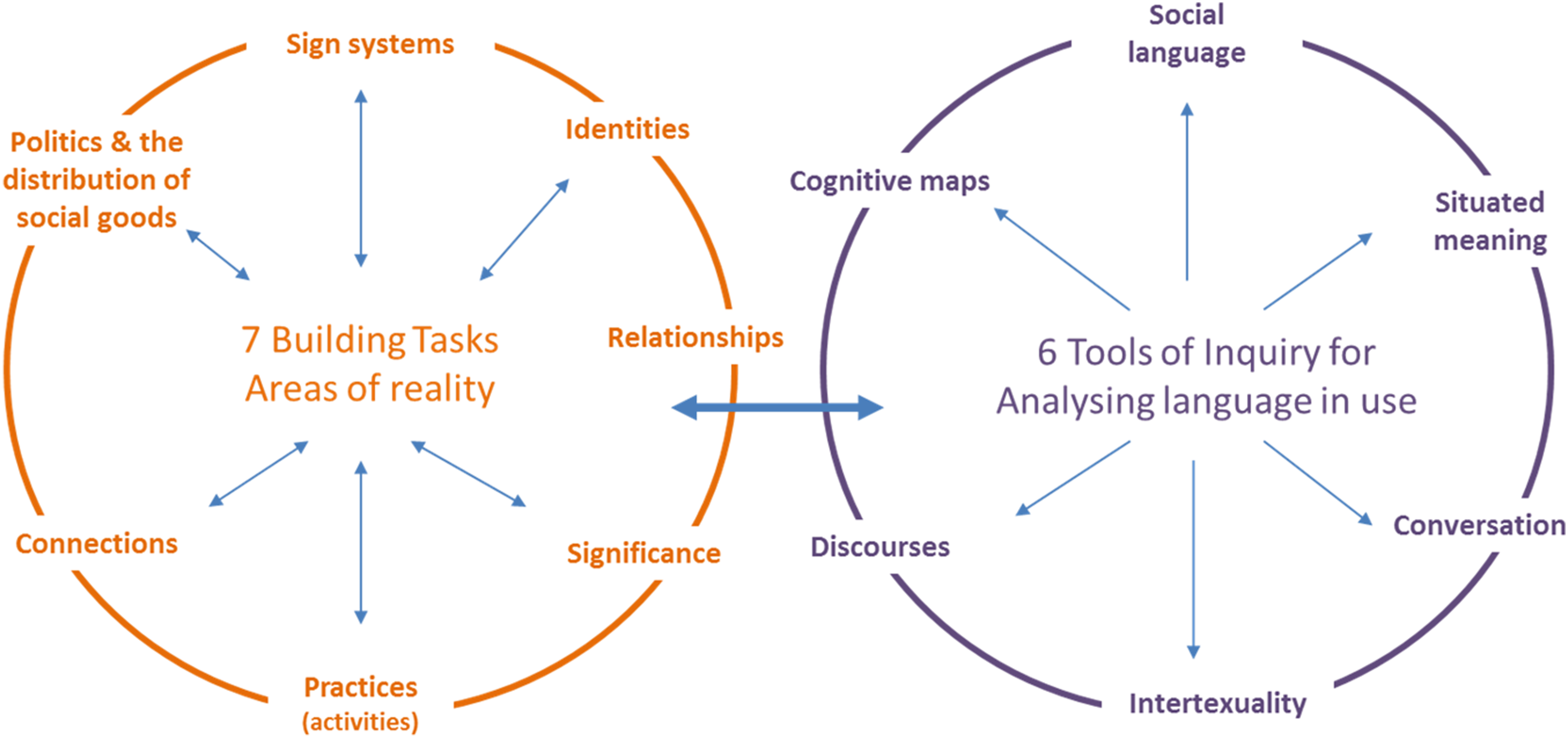
Building task – Area of reality.
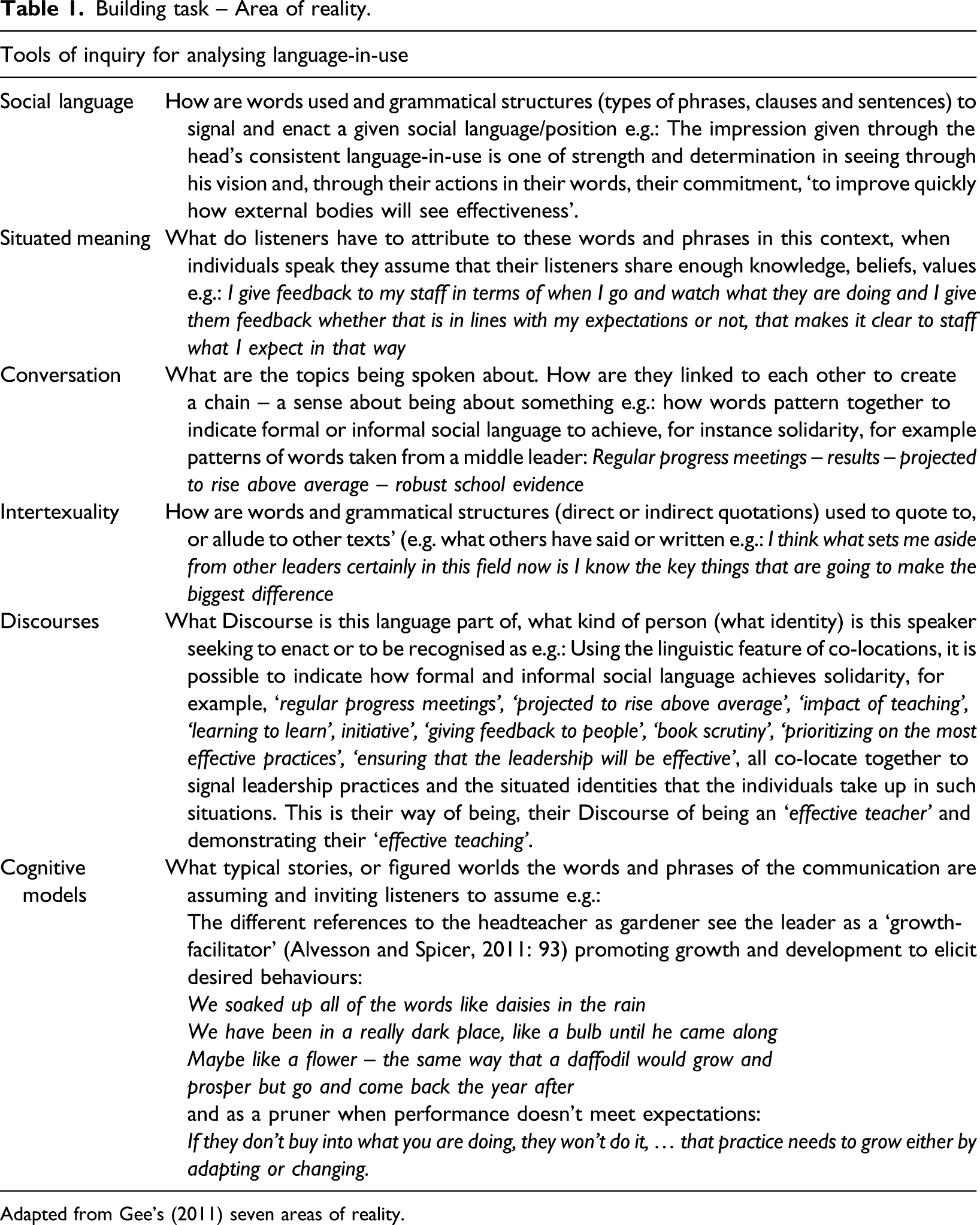
Adapted from Gee’s (2011) seven areas of reality.
The initial analysis looked for commonalities across the cognitive models and interviews, to see ‘how the signs relate(d) to one another in order to create and exclude particular meanings’ (Silverman, 2014: 363). In other words, we explored the Discourse within the participants’ D/discourses to reveal common themes that could enable us to answer the question, what are the connections and relevance between agency, collaboration and power with a distributed model of leadership?
Findings: Distributed leadership-collaboration, agency and power
What follows is an explanation of the ways in which individuals became ‘fitted to the objective condition of their position’ (Coldron et al., 2014). We consider how they used sense-making within the settings to create their identities and connections within school in the context of status and therefore the privileges of becoming an ‘effective’ participant in their field of school. We begin by discussing how DL shaped an individual’s participation and identity within activities.
Distributed leadership activity
Through our interpretation of the data we illustrate how participants constructed leadership in situ (Kelly, 2008). Individuals within the schools aligned themselves with providing ‘good educational opportunities’ (participant b) and developing pupils to ‘achieve their full potential’ (participant k). The focus was a collective purpose driven by the headteacher through DL, making sense for participants not only of the present, but of the future, shaping their values and attitudes. The headteachers positioned themself as a determined character, the main character, where the D/discourse was that the group held norms of hard work with a taken-for-granted assumption of achieving the vision and outcomes. The respondents were unambiguous that the headteacher’s actions emulated that of the school vision of ‘nurturing, caring, approachable’, ‘listening ear’, ‘it is quite important that we live not just show family values’. The D/discourses of expectation and success were connected together with family values and relationships to achieve a value set that was shared by all.
The analysis shows us that their identity construction as part of this process was demonstrated by the D/discourse of a practitioner who sets high standards where professional practice is valued, where a community of practice is a contributing factor for ensuring the school’s success. Therefore, having a collective purpose where ‘expectations and outcomes are high for everyone’ (participant c), is strongly associated with being and acting as an outstanding teacher or an ‘excellent practitioner’ (one who leads from the front and influences teaching) (participant l). Thus we found, by contrast, not ‘buying into the vision’ (participant d), or not sharing ‘the collective purpose’ (participant h), was strongly associated with not being and not acting as an effective practitioner. Respondents therefore took up or had enacted upon them different subject positions, such as outstanding and good, equating to success and achievement, versus weak and a failure, resulting in being unsuccessful as practitioners.
Moreover, both schools were committed to a distributed perspective of leadership whilst also sharing the D/discourse that the headteacher was the pivotal source of leadership and at whose bequest individuals could be empowered. In both schools, this agreed commitment to a distributed perspective was as a result of a top down initiative resulting from an ‘inspirational’ (participant j) and charismatic leader (Weber, 1864–1920) who often used expressive language to communicate (Kirkpatrick and Locke, 1996) and who commanded respect through their charisma. This resulted in commitment from staff, who sometimes went beyond the norm, demonstrating, in Yukl’s (1999: 294) phrase, ‘self-sacrifice’ as they ‘imitate[d] the leader’s behaviour’: A timetable of classroom observations and book/planning scrutiny ensured people aimed to up their game especially when it was combined with a number of staff leaving to avoid undergoing capability procedures. They were always followed by face-to-face feedback sessions with (…). On more than one occasion I witnessed staff in tears following them. (participant a)
The analysis of the data further illustrates that the headteacher was able to rationalize the need to take not only a distributed perspective, but also a strategic lead in executing a range of processes and values in order to fulfil their vision for the schools. This they achieved through multifaceted relationships and interactions with staff (Harris, 2014; Spillane et al., 2003) which suggested interdependency as teachers were ‘collectively guiding and shaping instructional and institutional development’ (Harris, 2004: 20). Moreover, the headteacher’s reliance upon others was evident across the data. However, s/he only once referred to distributed leadership, and that was during their cognitive mapping when they were thinking aloud: ‘my take on an effective leader is how many leaders they leave behind. So I would say that distributed leadership is really important’.
As Harris (2004: 14) states that ‘the central task is to create a common culture of expectations around the use of individual skills and abilities … maximizing human capacity within the organisation’. It was this combination of patterns of influence and activity that contributed to the school being labelled ‘good’ by Her Majesty’s Inspector (Ofsted, 2014: 1). The Discourses of staff within the school community portrayed the headteacher as a source of encouragement and support, ‘where (…) has it right is developing teams’ (Ofsted, 2014), therefore the reliance was on individuals to take responsibility for school outcomes. Ironically, their ways of being, their D/discourse, suggested a model of distributed leadership and the illusion of empowerment, but the reality was a ‘top-down’ model (Harris, 2014). With this in mind let us turn to how they built connections to achieve the common good.
Building connections through ‘illusio’ to achieve the common good
Staff were very clear about the direction that the headteacher wished the schools to follow and how they were going to get there. Solidarity towards this end was achieved through staff pulling together and focussing on teaching and learning, and ‘effective teaching’ was the taken-for-granted assumption: ‘really working on those things that will … make the biggest difference’ (participant j). The social world of school with a teaching ‘illusio’ where teachers acquire a teaching habitus and accumulate varieties of ‘teaching capital’ (including expertise, productive use of assessment and managing behaviour effectively) were then all reinforced through staff meetings, continual professional development (CPD), professional development targets from the review process and relentless adherence to the school improvement plan. This resulted in a narrow focus upon efficiency and effectiveness (Gunter, 2012a), with no room for dissent: (…) is very good at the motivational talk, ‘I know you’re all working really hard but.’ the ‘we’re all in it together’ sort of thing. A programme of staff meetings was organized to help staff to implement the best practice initiatives in literacy and numeracy. All good, but too much in too short a time. (participant k)
The corroborated version when merging the data was explicit about what it meant to be part of the school community. It was evident that they saw being treated with respect and considered good enough to be ‘one of the team’ (participant f), by those who were viewed as ‘effective’ (participant b) and role models within the school as a goal worth aiming for, something of value within the community, leading to them valuing some practices over others, and some individuals over others (Winkle-Wagner, 2010). It was the accepted norm that the distribution of the social good of being ‘good enough’ (participant g) was ultimately in the gift of the headteacher by ‘allowing’ them to participate: I think it encourages us to do well I think someone strong at the top encourages us to do a good job. It inspires us to do it. I don’t think you would value yourself as much and want to develop and progress yourself as much if you didn’t. (participant f)
Furthermore, it was the accepted norm that certain staff were earmarked for CPD to support and reinforce the school’s goals and processes. By utilising this form of influence, CPD as a distribution of a social good was used in order to achieve results, and was also felt to have implications for the school’s culture and ethos.
As a result success really mattered and was celebrated frequently. The figured world was one that if an individual acted in line with what the headteacher or those responsible professed was the correct course of action for their practice, then that would result in success both for the individual, the community and for the children. Respondents considered being part of the group of outstanding leaders or teachers to be a status symbol – ‘you use them’, ‘it is nice for staff to be recognized in that way’ (participant l). These beliefs were based on the assumption that by ‘belonging’, by ‘experiencing being part of the community’ (participant e) where others are mutually supportive of one another in becoming a better practitioner, by building mutually supportive relationships, by sharing good practice for quality teaching, individuals will be equipping themselves with ‘what works well’ for ‘achieving effective teaching and learning’ in school (participant q). Equipping themselves with what makes them effective either as a leader or teacher will ensure the school receives a ‘good’ or ‘outstanding’ (respondents ‘talk’) in their assessment from Ofsted. The headteacher will want to increase the value of the schools’ cultural capital and be proactive in the actions for achieving it.
Building engagement and commitment through professional capital
Being ‘effective’ and successful was stock in professional capital for staff within the schools, and the ‘skills, abilities, norms’ in the field of the practitioner were of value and therefore sought after (Winkel-Wagner, 2010: 8). Bourdieu uses the metaphor of a card game in which ‘cultural (professional) capital would be the cards that one could play in the game’ (Winkel-Wagner, 2010: 8). In this instance, being ‘well trained and well informed’ (participant m) and a successful part of the community were cards that individuals could play in school. These ways of being within school are embedded in new Discourses that align other Discourses of professional capital in new ways, creating new hybrids: ‘Discourses … often influence each other in positive and negative ways, and … sometimes breed with each other to create new hybrids’ (Gee, 2005: 7). It was striking this desire for professional capital and how many voices became one, built on the foundations of power and influence of the few. By engagement with and commitment to the community, and by investing in the group (as professional capital), they are achieving and fulfilling their roles as professionals, as good teachers ‘who educate children well’ (participant j).
What has been presented above is how the participants drew on Discourses of the awareness of themselves in relation to others striving towards the common good – which is an ‘effective teacher’, an ‘effective school’ through the distribution of the social good that is CPD. Their talk relayed building connections which gave them a sense of belonging and a commitment and engagement to the community of practice within school, all working towards the common good in order to gain ‘professional capital’ (Bourdieu, 1993). However, we found a contradiction in the data for the benefits claimed for DL of all working towards the common good and gaining professional capital through agency by the constraints imposed by an hierarchical DL team with the headteacher at the top. What follows is how individuals constantly drew on the language of power and influence in their D/discourses of what was accepted as the norm to carry out their roles: I think the head is also very good at allowing us to carry out our roles. (participant a)
Power and episodic agency
Participants drew on figurative language to demonstrate strength and illustrate how opposition was dealt with in school so as to elicit desired behaviours: ‘sort of trail blazing’, ‘ahead of the game’, ‘I could have headed for the hills’, ‘present the evidence to say, this is why I have to do it, it is the right thing to do and the evidence shows that’ (respondent’s talk). The inference here is that the outcome is inevitable and necessary because the evidence says so, and to suggest otherwise would be counter-intuitive to good practice. Being ahead of the game is a means to an end.
Through this collectiveness one way in which to engage with the practices of DL was to focus the staff and to communicate a clear sense of what the schools should aim for and to gain commitment to a vision and distribute the power to act, capitalising on ‘episodic agency … where sovereign agents overcome the wishes and resistance of others in order to achieve their will’ (Halford and Leonard, 2001: 27–28). This is illustrated below from respondents’ talk: It is like a politician, Prime Minister, it’s the face and person that you buy into, …leadership is about getting through the good and hard times and if they do not Buy into you they are not going to go with us…. (participant b) So if (…) brings in something you know maybe even if I wasn’t sure it would work with (my year group) I would say but I always have to try because s/he wants it that way. (participant l)
The accepted and unconscious deference to the headteacher was made visible not only in the use of figurative language by referring to them as ‘Prime Minister’, but furthermore by the use of the informal ‘you know’, which signals solidarity and acceptance: You know you need to move forward and s/he gives you the confidence to do that. (participant m)
Connected together these utterances signify a taken-for-granted assumption that it is a conferral from the head to ‘give confidence’, ‘to recognize’, ‘to (bestow) confidence’. It was apparent that the dominant group held the overview that demarcates clear restrictions and that it is their accepted norm, their figured world, their ‘way of being’ within school that influences the many: This is what they as leaders need to do, to inspire coping with change, inspire loyalty and they need to inspire the healthy fear, ultimate respect, always to be mindful that this is your job. (participant h)
In addition, staff willingly commit to this figured world of ever increasing workloads: Adapt to the times as well for instance when new initiatives are thrown at us and new frameworks for learning and things like that…. (participant p)
In the study we found that formally appointed leaders worked with colleagues to contribute to making things work, putting into practice school strategies and policies as identified in the school improvement plan. As a result, the D/discourse of a focused and collective effort ‘prioritising on the most effective practices’ (headteacher) was a common-sense assumption resulting in developing a common purpose where staff took ownership, leading them to take more shared responsibility for school priorities. Evident from the data were the consistent connections of influence through distributed leadership of negotiated meanings that were socially constructed by all individuals and made visible through team working, collegiality and collaboration.
Participants’ talk was one of continual repetition of a shared understanding of a situation along with persuasive talk that would lead to action. For instance, the deputy head’s rhetoric was of an upstanding individual who believed in what they were doing, had strong morals and was willing to stand up for them. S/he supported the headteacher’s high status and moral ground and believed them worthy of respect, and as a result believed they warranted the reprimands s/he received from the head. As a result, s/he was prepared to change their actions in order to live up to the prevalent high standards: I have seen what has happened to someone who hasn’t put their heart and soul in and haven’t been prepared to change. (participant d)
Within the schools, the single voice of authority was one of a pre-established view. This was the Discourse of being good enough to share best practice, committed to the shared vision: because (headteacher) had the strength and steel to say to people you know this is what you need to do and you know if you aren’t doing it you will have to go. (participant k)
This connection between individuals within school was perceived as a ‘healthy fear’ but could equally be construed as a ‘manipulation of employees’ (Cunliffe, 2014: 42): I have seen what can happen to the people that don’t engage with others’, ‘a healthy fear’, ‘you have to be on your toes. (participant d)
It was also evident to us that the different references to the headteacher as gardener see the leader as a ‘growth-facilitator’ (Huzzard and Spoelstra, 2011: 93) promoting growth and development to elicit desired behaviours: We soaked up all of the words like daisies in the rain We have been in a really dark place, like a bulb until he came along. (participant o) Maybe like a flower – the same way that a daffodil would grow and prosper but go and come back the year after. (participant f)
but also as a pruner when performance doesn’t meet expectations: If they don’t buy into what you are doing, they won’t do it, … that practice needs to grow either by adapting or changing. (participant k)
What is apparent from the above ‘talk’ is that connections can be made between a desire to be seen to be offering autonomy while in reality maintaining control, and between success and empowerment: ‘expectations remain and stay high’ (headteacher) and achievement is the norm. Through repetition it is evident what the objective is and that adopting that Discourse will empower individuals to realize their potential and the potential of the school and as a result enhance their professional capital.
Thus, by making visible the D/discourses of sharing ‘good practice’ and ‘what works well’; by looking at what was hailed as ‘achieving effective teaching and learning’, it is possible to see what was communicated regarding what is taken to be an effective individual. The ways individuals talked about engagement and commitment to the community made apparent the sense in which they saw being part of the community as stock in professional capital.
Discussion: the normalization of compliance
Following Raelin’s (2018: 148) call that ‘we need to know more about how collective action is legitimized and how actors predetermine their room to manoeuvre’, this paper studies the ‘talk’ of those engaged in the practices and structural conditions of distributed leadership in two English primary schools. We have explored how educational leadership D/discourses create a number of objects around which theory and research is centred. The first is models and justifications for practitioners to improve their practice as a result of adopting managerialist studies to meet the rise of the school effectiveness agenda, what Gunter et al. (2013: 563) refer to as ‘normative work’. The second is staff, where ‘the rationales are about how the individualization of the person is the object and objective of reform’ (Gunter et al. 2013: 570). What is evident from the D/discourse is that connections can be made between a desire to be seen to be offering autonomy through DL while in reality maintaining control through accountability and empowerment. The leadership team adopt empowerment as a means for getting ‘followers to carry out the goals of the organisation’ (Gee and Lankshear, 1995: 15), using tools such as demonstrative reinforcement and celebrating success. In both settings success was celebrated as a matter of course, whether that be in a school-wide assembly for the children or championing staff as experts within their subject: ‘headteacher … can see people’s strength and use them you know and put them up there’ (participant l). The parenthetical device ‘you know’ is used together with the taken-for-granted assertion that the leadership team develop key staff they have identified and then ‘use them’ to drive forward everyone else to ‘up their game’ (participant a) to achieve desired school outcomes.
Day et al. (2010: 16), in their review for the UK’s NCSL, claimed that ‘heads nurture success in schools through sustained articulation, communication and the application of core values with a range of internal and external stakeholders’. This was evident in this study whereby individuals, in addition to engaging with their pedagogic roles, also collaborated through school-wide practices and assumed collective responsibility for the achievement of the school vision and goals. Examples include their concern for longevity within the community: ‘Woodfield Primary2 around the corner has a waiting list, we used to have that’ (participant d) – and as effective practitioners themselves: ‘I think that would be very difficult wouldn’t it, if you were not an effective teacher because our expectations are very high’ (participant d).
Throughout the study, the headteacher talks about relationships and activities outside the school environment. Their shifting position in this instance is expressing alignment with family, trust, adult and school in terms of the D/discourse of norms, values and goals of what any good parent would want for their children. Their discourse is one where families and schools create trajectories of achievement starting in the home through to a successful school (this one) and therefore, by association, successful lives. Their D/discourses of family are a means of sharing ownership, developing a common purpose, leading staff to take more collaborative responsibility. Furthermore, their ability to shift positions comes naturally to them. The continuous move by individuals throughout the study to personal pronouns also indicates agreement with this shared discourse: ‘I think someone at the top encourages you to do a good job, inspires you to do it’, (‘I felt as Head of Key Stage X valued by XX … I felt valued in that structure’ (respondents’ talk). Buying into the vision symbolizes acceptance that the individual as object and objective is reformed but ultimately feeling good about their success and deluded empowerment. Through repetition it is evident what the objective is and that by adopting the D/discourse individuals will be empowered to realize their potential and the vision as directed. However, it is questionable what sort of agency individuals have if they cannot question the vision, values, end result and goals of the organisation. The contradictions in DL make it susceptible to exploitations of power and the manipulation of individuals and values through collaborative practice.
The narrative of DL within the case study sites was on the connections, the collaborations between individuals and the accumulation of professional capital. The habitual ongoing illusion of ‘having’, whereby what is outside them becomes an inseparable part of them was the norm: ‘we have teachers who do way above what they have to do because they have to do it if for the children’ (participant i). Issues of exclusion were not challenged because the habitus was one of attainment of inclusion. Distributed leadership perpetuated the unequal distribution of ‘capitals’ such as professional capital and created a ‘figured world’ (Gee, 1999: 76) of collaboration, ‘one for all’ and perceived equality. Gee and Lankshear (1995) terms this ‘an enchanted workplace’ – workplace that could be fulfilling and meaningful or the paradox where enchantment can mean being under a spell.
Our study shows that to achieve the desired outcomes, the D/discourses of collaboration, empowerment and achievement were commonplace within the settings. There was an illusion of agency, although the reality was one of the headteacher maintaining power through distributed leadership (Hatcher, 2005). To the individuals in both schools the outcome was inevitable because the evidence presented to them was ‘this is why I have to do it, it is the right thing to do and the evidence shows that’ (headteacher). To do otherwise would be counter to good practice. Performance was monitored regularly through grading of lessons where, through performance management, the headteacher enabled individuals to move up the pay scale. On achieving the performance threshold, it was at the headteacher’s discretion whether staff had progressed professionally over the academic year: ‘a government-driven headteacher managerialism’ (Hatcher, 2005: 255).
Framing individuals’ discourses in this way aided and contributed to an understanding of the pre-formed leadership activities. For the senior leadership team, couched in the national college of school leadership rhetoric, it was a matter of ensuring that there was no deviation from policy and external monitoring accountability. It was a way of being, a discourse, within both schools in this study that epitomized a neo-liberal version of a performing school (Gunter, 2001): a political rationality that saw school improvement as part of a school competitive market that could be measured, compared and held accountable (Gillies, 2013). Individuals’ discourses and, as a result, activities were nominalizations of market rationalities – ‘bums on seats’, intertwined with an understanding of their schools in market terms. Being ‘effective’, or in other words ‘outstanding’, was a thing therefore to strive for; it was part of individuals’ identity-work (Cunliffe, 2014), it had value within the community and was distributed as a social good by the headteacher and their senior leadership team. Graded lesson observations; regular book scrutinies to see if teacher marking came up to the prescribed (pre-formed) standard and if children were achieving the national standards for their age group; and teacher performance management: all are pre-formed, not co-created or emerging activities. These activities reveal the anxiety and tension between the ‘subjective experience of being led and the recognition of (possible) mutual engagement’ (Fairhurst, 2011: 502). Through opening up a discursive space it would be possible to talk about the dominance and privileging of certain leadership activities and the marginalization of others. The objective would be ‘to enthuse management education with a sense of ethics, moral responsibility, reflexivity and relational responsibility’ (Cunliffe, 2014; Fairhurst, 2011: 502), or as Grint (2010: 103) advocates we must learn, ‘how to bind those individuals closer to the communities they lead without requiring the community to strangle individualism’.
D/discourses establish what is acceptable, true and legitimate, and therefore become norms within an organisation. This allows for what Foucault terms as ‘dividing practices’ where what is abnormal is rejected. It is through this D/discourse that ‘individuals become normalized so that they see themselves and others (solely) in the light of that discursive perspective’ (Gillies, 2013: 16). Participants’ talk illustrated how through relations of power it was decided who would participate within activities and who would be listened to; whose was the one best way to do things. Their D/discourse elicited a desire on the headteacher’s part to be seen to be offering agency whilst at the same time maintaining control. As Huzzard and Spoelstra (2011: 94) state, ‘plants, like those led, are seen as infinitely malleable and expendable’ the respondents were very precise in how opposition was dealt with in the case study schools and how being part of the community was a desired ‘social good’ (Gee, 2011). However, our analysis shows that within the schools not only did participants build connections between their reasoning, but they also built connections between the community of practice within school and a self-delusion of being seen as a member of it as a desired commodity, something to strive for, all working towards the common good.
What is evident from our study was the ubiquitous presence and influence of the headteacher and their distributed leaders. Their vision and focus for the school was clearly understood by all. Their determination in achieving this was a message of a clear social influence within school. Distributed leadership was a result of careful purposeful planning and their expectations were set by them, modelled by their senior leadership team, as this quote illustrates: and you know you get the success when the flower is in full bloom and you get the success of it being a happy bright sunny day enlightening that to the end of a school year when we get a good set of results and everyone has done well and that sort of celebration, then that sort of dies away a little bit. It comes back and that sort of reborn sees me as giving life into the future – that sort of cycle of new leaders being created and of effective teaching being embedded and moving on and moving on and moving on … . (headteacher)
The headteacher provided direction and, alongside those who had responsibility to influence others, the ability to achieve goals as identified in the school improvement plan to secure chosen ends. The means by which these ends were achieved were through implementing changes with regard to individuals’ performance. By presenting opportunities for individuals to develop their teaching practice, s/he was positioning themselves as an authoritative figure, who had an individual’s professional development as a means to an end to achieve required school outcomes. The individual, therefore, is disconnected from the collective but enabled to feel good about it.
Conclusion
This study set out to present a critical analysis of the normative argument that DL allows for shared accountability and responsibility. We found that the model of DL is less about the distribution of leadership and more about the power relations, the interactions of individuals and the normalization of compliance, ‘replete with the issues and abuses of power’ (Lumby, 2013: 592). As a result, some are positioned less well to participate and exercise influence than others and yet through this self-delusion of still belonging they accept the exclusion but still feel good about it. As Tourish (2014) postulates many studies still tend to diminish the contribution of organisational actors. If we are to understand leadership as ‘constituted by meaning-making, discourse and Discourse’ (Sutherland, 2018: 281), then it is important to understand ‘how’ DL is perpetuated and maintained and unravel how individuals co-construct goals and strategies for the benefit of the organisation.
Moving away from seeing leadership as residing within the individual and focussing on the connections between agency, power and collaboration within a mandated model of distributed leadership, we do not deny individual agency, but offer a means of understanding how individuals shape themselves in particular ways; how the structure and DL influence their agency. Making visible the talk of these management activities ‘opens up the (organisation) population to greater scrutiny, who is doing well, who is not…who is ‘cost effective’, who is expensive, who is to be cherished and who is not’ (Gillies, 2013: 74). By doing so we highlight these differences and centre stage issues for debate among these D/discourses so as to reveal the values and ideological assumptions in particular constructions of agency. This may be achieved by opening up the processes and discursive parameters for achieving empowerment in a distributed model of leadership.
This study also contributes methodologically by offering cognitive mapping as a means of uncovering how participants encapsulate their ‘schemas, frames and perceptual codes’ as they draw and think aloud their cognitive models to reveal their lived understanding of experiencing leadership activities within their settings. Moreover, combining cognitive mapping with a critical discusive lens, we have shown how it is possible to probe participants’ accounts of the leadership activities and relationships they are experiencing through their taken-for-granted knowledge that reveals the ‘inseparability of language, meaning and action’ (Fairhurst, 2011: 498).
It is not just the educational sector however, that is preoccupied with DL. There is growing interest from the management and health care literature too (Gunzel-Jensen et al., 2018; Novicevic et al., 2017; Thorpe et al., 2011). As some argue (Hatcher, 2005; Lumby, 2013), many accounts and investigations of DL lack a critical, questioning approach to the dynamics of power and influence. This paper has sought to explore the inseparable connection between leadership, agency, power and collaboration through what D/discourse produces and generates for individuals in so doing has also revealed how transformational leadership is used as a tool for compliance. A greater understanding therefore, of the practice and power of DL would assist organisations more widely.
Notes
1. New Labour refers to a period in the history of the British Labour Party government from the mid-1990s until 2010 under the leadership of Tony Blair and Gordon Brown.
2. Woodfield Primary is a pseudonym.
Footnotes
Declaration of conflicting interests
The author(s) declared no potential conflicts of interest with respect to the research, authorship, and/or publication of this article.
Funding
The author(s) received no financial support for the research, authorship, and/or publication of this article.