




Abstract
Objectives
To develop and optimise a primary care-based complex intervention (CARE Plus) to enhance the quality of life of patients with multimorbidity in the deprived areas.
Methods
Six co-design discussion groups involving 32 participants were held separately with multimorbid patients from the deprived areas, voluntary organisations, general practitioners and practice nurses working in the deprived areas. This was followed by piloting in two practices and further optimisation based on interviews with 11 general practitioners, 2 practice nurses and 6 participating multimorbid patients.
Results
Participants endorsed the need for longer consultations, relational continuity and a holistic approach. All felt that training and support of the health care staff was important. Most participants welcomed the idea of additional self-management support, though some practitioners were dubious about whether patients would use it. The pilot study led to changes including a revised care plan, the inclusion of mindfulness-based stress reduction techniques in the support of practitioners and patients, and the stream-lining of the written self-management support material for patients.
Discussion
We have co-designed and optimised an augmented primary care intervention involving a whole-system approach to enhance quality of life in multimorbid patients living in the deprived areas. CARE Plus will next be tested in a phase 2 cluster randomised controlled trial.
Introduction
Multimorbidity is usually defined as the coexistence of two or more long-term conditions within an individual, and is increasing common in populations across the world. 1 In a large nationally representative study of the epidemiology of multimorbidity in Scotland, we found that multimorbidity was present in almost 25% of the population. 2 In the 10% most deprived areas, multimorbidity occurred 10–15 years earlier than in the 10% least deprived areas. 2 A similar social gradient has also been found in several other studies.1,3 The burden of multimorbidity is higher in those living in more deprived areas in terms of effect on quality of life. 4 The combination of mental and physical conditions (mental–physical multimorbidity) is 2–3 fold higher in the most deprived compared with the least deprived areas 2 and this is most pronounced in younger patients. 5 Mental–physical multimorbidity is associated with high levels of unplanned hospital admissions in the deprived areas. 6 Primary care staff recognise the ‘endless struggle’ that multimorbid patients living in the deprived areas face in terms of managing daily life. 7 Patients have described in detail the burdens that managing the ‘everyday life work’ and living with complex social, psychological and physical problems can create. 8
The evidence-base for how best to manage patients with multimorbidity in primary care is
very limited, especially in the context of deprivation.
9
In view of this, we established the ‘Living
Well with Multimorbidity’ research programme in Scotland to develop a primary care-based
complex intervention for patients with multimorbidity in areas of high deprivation, using
the MRC guidance on developing complex interventions.
10
We defined the scale of the problem and
the target population
2
and carried out qualitative research with primary care practitioners working in the deprived
areas and with multimorbid patients living in such areas7,8 in order to explore the challenges of ‘living well’ and how primary care
might better respond. From this baseline work, plus consideration of the wider literature on
patient-centred care and self-management support, and input and discussion with an
international advisory panel consisting of experts in the field of complex intervention
design, we identified the possible components of a whole systems approach. These were:
System changes to allow longer consultations and relational continuity (seeing the same
practitioner each time) Practitioner training and support to deliver structured care in those longer
consultations including care-planning and Additional self-management support for patients.
This paper describes the further development and co-design of the intervention based on qualitative focus group discussions with patients, patient representatives and primary care providers working in areas of very high deprivation, and its optimisation following piloting in two practices located in the high deprivation areas.
Methods
Separate approvals were obtained from the NHS Local Research Ethics Committee and NHS Research & Development for each phase of the study. Written informed consent was obtained from all the study participants before data collection commenced.
Defining and developing the intervention
Possible components of the proposed intervention were identified from the literature and by expert consensus, and provided material for six group discussions with 32 participants in all. These took the form of interactive workshops in which participants were first given a summary of what was already known by SWM, and then took part in a group discussion which provided the data reported in this paper. Two of the workshops were with patients; one with 5 participants and the other with 3 participants, each from one of two different practices in the deprived areas of Glasgow. Four of the patients had taken part in previous interviews 8 and had consented to future interviews, and four were recruited by the practices based on eligibility criteria (two or more long-term conditions, and aged 30–65 years). The ages of those who took part ranged from 42 to 65 years (mean 54 years), and six out of the eight were female. All had multimorbidity including conditions such as stroke, heart disease, chronic back pain, arthritis, depression, asthma, cancer and hypertension.
Two of the workshops were with general practitioners (GPs) working in the deprived areas; one with 3 participants and the other with 9 participants, all representing different practices. One workshop was with practice nurses (PNs) working in the deprived areas; 4 participants representing different practices. The remaining workshop was with members of different third sector organisations; 8 participants representing charitable organisations concerned with a range of long-term conditions brought together by the Alliance for Health and Social Care (formerly the Long-Term Conditions Alliance Scotland).
In each workshop, SWM presented the background to the study and the evidence to date, including the epidemiological 2 and qualitative ‘baseline’ studies7,8 completed in the first phase of the Living Well with Multimorbidity Programme. He then outlined the proposed intervention and its components. This information was conveyed by means of a power-point talk lasting 15–20 min at the start of each group together with printed hand-outs of the slides. In the GP and PN focus groups, he also presented two models that could be used in the longer consultations to help structure them; the 5 A’s approach, 11 which is a tool to support practitioners in delivering self-management support, and the CARE Approach12,13 which is a holistic approach to empathic, patient-centred care.
One qualitative researcher attended the meetings in addition to SWM and observed responses to the presentations, took field notes and led the subsequent group discussions; RO attended one meeting, and MH attended the others. The discussions were audio recorded with permission and transcribed verbatim. The transcripts were subsequently coded and analysed by BF using the framework approach. 14 Coding focused on participants’ views on each component of the whole-system intervention: time and relational continuity, practitioner training and support and self-management support. A sub-sample of the transcripts was double coded and discrepancies were settled following discussion between the two coders (BF and SWM). Findings were then discussed by the research team and formed the basis of the second iteration of the intervention.
Piloting and optimising the intervention
The second iteration of the proposed intervention was then piloted in two high deprivation practices over a 3-month period. Practice A had 3500 patients registered, with 7 GP Partners (most working part-time) and 2 PNs. Practice B had 4000 patients, 4 GP partners and 1 PN. In Practice A, all the GP Partners and PNs participated in the study and in Practice B, 3 GPs and the PN participated. Each participating practitioner was asked to identify 2 or 3 patients meeting the study inclusion criteria and offer them the opportunity to participate in the study. The inclusion criteria were that patients should be aged between 30 and 65 years, and have at least two long-term conditions. The type of condition was not specified and could be mental or physical. Exclusion criteria were (a) unable to give informed consent including those with severe learning disability, severe active mental health problems (active psychosis, schizophrenia, bipolar illness, psychotic depression, severe depression including active suicidal ideation), severe dementia or other severe cognitive impairments, (b) terminally ill or considered by their GP as likely to die within next 12 months, and (c) unable to understand spoken and written English.
The focus of the pilot study was to explore patient selection, recruitment rates, and the delivery of the intervention in relation to system changes, training and delivery of support to practitioners, and the feasibility of data collection.
Following feedback from our work to develop the intervention, participating Practices were presented with the core ‘ingredients’ of the intervention but were allowed to adopt flexible approaches as to how they operationalised it. For example, it was left to the practice to decide who (GP or PNs) should deliver the longer consultations and provide continuity. Practitioners offering longer consultations were given a bespoke CARE Plus care plan in which to record the details of the consultations in relation to the pre-defined core ingredients and as an aid to providing the CARE Approach (available from corresponding author). They were also given a range of additional tools that they could use as they saw fit in navigating the consultation (available from corresponding author). Finally, they were also provided with copies of eight different self-management booklets, developed and published by Professor Chris Williams (Glasgow University), which they could give patients as they felt was appropriate. These booklets cover self-management of low mood, anger management, low motivation, alcohol problems, smoking cessation, weight loss, and coping with illness and disability, based on a cognitive-behavioural therapy (CBT) approach (see www.llttf.com).
Qualitative data on practitioners’ views and experiences were obtained throughout the pilot study in group discussions: 5 in Practice A and 2 in practice B. Data were also collected from the Care Plan. Discussions with practice staff were often done at routine practice meetings and were conversational in tone and at times included both facilitators (usually RO, on occasion SWM) as members of the group (more closely aligned to ‘action research’ than focus group interviews). This approach, therefore, was quite distinct from facilitation of a focus group interview, although it resulted in valuable data (field notes and interviews). These were mainly conducted in Practice A, as Practice B had problems with staff shortages during the pilot period and the GPs and PNs were often unavailable to attend meetings. With participating patients, qualitative data were obtained at the end of the study in six individual face-to-face interviews conducted by RO (three patients from each practice). These six patients had agreed to interview during the initial recruitment of patients to the pilot study. The qualitative data collection, management and analysis followed the same process as above.
Quantitative data (patient completed questionnaires) were collected from all participating patients but are not reported in this paper, which focuses on the qualitative data findings. However, we do report response rates to the baseline and follow-up questionnaire.
Results
Defining and developing the intervention
System changes: Time and relational continuity
The suggested system level changes involving longer consultations and enhanced relational continuity (seeing the same practitioner) was endorsed by all participants in the patient, patient representative and PN groups and by the majority of participants in the GP groups. The importance of relational continuity and a whole person-centred approach to care was also strongly endorsed by participants in all groups.
Views differed across and within groups as to who should provide the proposed longer consultations; GPs, PNs, Health Care Assistants, Support Workers or some combination of these practitioners were all suggested. There was also a range of views regarding how long the extended consultations needed to be. Several of the GPs suggested ‘double-appointments’ (20 min rather than the usual 10 min). PNs felt that substantially longer would be required to conduct a comprehensive holistic assessment. Patients and their representatives also felt that more than 20 min would be required to let them really ‘tell their story.’ In terms of how many extended consultations would be needed per patient, participants felt this would depend entirely on the individual case.
Practitioner training and support
Practitioner support was considered important in all groups. Practitioners had mixed views on how best to deliver this; some believed that training and support should be delivered at the individual practice level for all team members, whereas others highlighted the value of training across practices. The GPs and PNs found it hard to predict exactly what would be most helpful but identified the potential value of training that focused on how best to engage and motivate patients.
Both patient groups suggested that practitioners might benefit from training in listening skills.
Support in structuring the consultation was also recognised as important by many practitioners. The 5As model suggested in the original proposal was generally not popular; indeed the use of ‘toolkits’ generally were not favoured by the GPs who saw them as a ‘tick-box’ exercise. However, the CARE Approach (Connect–Assess–Respond–Empower) was, however, deemed to be a useful and simple model which could be used to guide the consultation and structure a care plan.
Whilst all groups identified the potential value of practitioner training to help patients self manage a range of problems including stress, the patient groups also expressed the view that practitioners themselves might benefit from stress management.
Self-management support
Changes at patient level, whereby self management was promoted through the use of simple materials and community resources, were generally considered important. However some scepticism about the ability of patients to use such material in the context of their social circumstances was expressed in the GP and PN groups. The idea of using mindfulness-based approaches to stress management with patients was popular among all participants, especially in the form of a CD for patients to listen to and practice at home. It was felt important to make any material simple and accessible to those with literacy problems.
Overall
The findings of this study supported the view that the intervention should be
comprehensive and take a whole-person approach. The essential structure of the
practitioner/patient consultations to be utilised in such an approach were defined as
comprising four key elements, which we framed within the CARE Approach: Establishing and maintaining therapeutic relationships with patients
( Focusing on the ‘whole person’ in assessing health problems in terms of their
individual personal and social contexts ( Responding in an empathic and validating way to problems
( Empowering patients by helping them achieve realistic goals and improve
self-management (
To support this, the key components of the intervention were defined as system
changes to allow longer consultation time with relational continuity; training in the use
of CARE Approach and support for practitioners, and self-management support for patients.
On this basis we termed the intervention CARE Plus, which was then piloted in the two
practices in the deprived areas.
Piloting
The two practices identified 30 suitable patients for the pilot of the CARE Plus intervention, and 20 patients agreed to participate (14 from practice A and six from practice B). These comprised 12 females and 8 males, with a mean age of 50 years. From these 20, three (15%) did not attend any CARE Plus consultations, seven attended only one (35%) and ten attended two or more (50%). The mean number of CARE Plus consultations was 1.6 per patient. All patients who attended two or more CARE Plus consultations saw the same practitioner on each occasion.
Choosing the patients
Selection based on varying social and medical problems

Practitioners’ experiences of the CARE Plus consultations
In relation to length of the consultations, practitioners described how it allowed them to explore patients’ backgrounds (e.g. family history), their current circumstances (e.g. relationships, housing, etc) as well as their medical problems (physical and psychological). Practitioners generally felt that the CARE Plus consultations had provided the opportunity to gain a new perspective on patients. Most were surprised at the length of time that the first CARE Plus consultation required (30–40 min). The value of having extra time, and how it was anticipated to be of benefit to patients, was frequently contrasted with the constraints practitioners experienced within their normal consultations. Recording the details of the intervention consultations in the care plan was also perceived to be time consuming and, consequently, the CARE Plus care plans were not consistently completed by all practitioners. Nevertheless, practitioners valued them as a ‘record of progress’ that were motivating to review at follow-up consultations.
Practitioner’ experience of the CARE Plus goal setting
He’s been struggling to kind of put together an idea of how he can actually achieve
these kind of long term goals … I find it quite useful … to basically try and use
the long term goals as a target to kind of enable his ideas and then just break it
up into much more shorter term ideas to kind of take it from there.
Descriptions of goal setting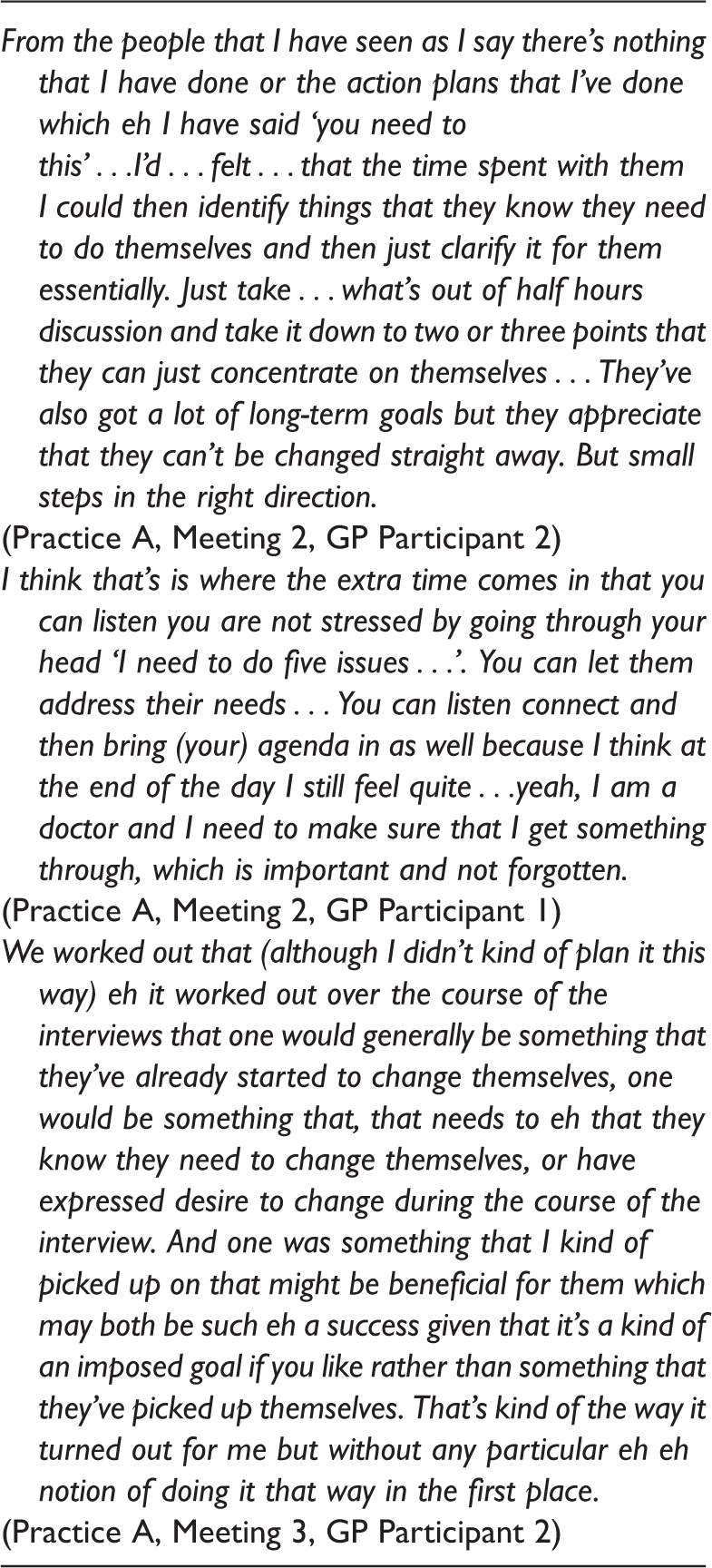
Practice A, Meeting 3, GP Participant 2
Practitioners’ experience of continuity of care
One of the most critical aspects of the intervention, from the practitioners’ point of
view, was the opportunity and importance of providing continuity to patients: Without wanting to sound too arrogant we are quite often the only person that
brings consistency and continuity and sometimes it’s this engaging, coming back, and
being proud of something and we take over this paternal role in praising them …If
you have a life where there is not a lot of positive items if you then can go to
your doctor who says ‘you have done really well you should be proud of yourself’
it’s powerful. It gets lost if you don’t have any continuity. Practice A, Meeting 2, GP Participant 1 She said ‘this is the first time in sixty years I’ve done something for myself’ and
to be quite honest I mean that has just mind blowing I find … that just puts it in a
completely different dimension and shows how worthwhile it is what we are
doing. Practice A, Meeting 2, GP Participant 1
Practitioners’ experience on the CARE Plus peer support and training meeting
Due to time constraints, only one meeting was held during the pilot study, during which peer support was provided in sharing views and experiences in relation to the implementation of the CARE Plus intervention. During the meeting two specialist consultants in mental health attended, one delivering a talk and discussion on motivational interviewing, and the other on mindfulness-based approaches. Feedback from the meeting suggested that the practitioners valued the peer support and the mindfulness stress management technique, which they thought would be helpful for themselves as well as for the patients, but were less enthusiastic about motivational interviewing as a consultation technique.
Patients’ experiences of CARE Plus consultations
The CARE Plus consultations were generally very popular with patients. Most of the
interviewed patients had no experience of being given time purely devoted to thinking
about their problems and circumstances. One patient described how she usually felt
rushed within consultations and, consequently, often forgot to raise some of her
concerns, and how relaxed she felt knowing she was being given more time: We were talking slowly. It didnae feel … See not feeling rushed that was the
best …she would ask me something else, which would lead to me asking her something
else … When I went in I took my jacket off because I knew I was there for thirty
minutes … I got comfortable, I kinda just I knew I wasn’t in a rush and I knew she
wasn’t typing out the prescription. So that’s it just made it feel more comfortable
more relaxed. Practice A, Patient Participant 4 He knows my other problems but we’ve never really had time to discuss them up until
that last visit [CARE Plus consultation] which was really good. I was in there I
think for about fifty minutes … There were things that I’m having problems with and
he’s saying ‘well look it could be this’… things that hadn’t even occurred to me
(e.g. sleep apnoea) …When you go for an emergency appointment you can only talk to
him about why you’re there. You cannae go into other detail. … That was a great
session that I had with him you know. So I was really pleased about that. Practice A, Patient Participant 1
Patients’ experiences of relational continuity in the CARE Plus consultations
Patients spontaneously raised the issue of continuity and how much they valued being able to see the same doctor each time they visited the practice for their CARE Plus consultations. All participants reported previous difficulties arranging appointments with a particular doctor of choice. By contrast, patients were able to plan their CARE Plus appointments in advance, ensuring they could return to see the same GP or PN again. The development of the relationship between doctor and patient, and what this meant in terms of supporting self management, was also highlighted within patient’s accounts. There were repeated references to the ‘mutual understanding’ developed within CARE Plus consultations, emphasising the time spent by the practitioner in getting to know them as people.
Patients’ experiences of the CARE Plus consultation goal setting
Some patients found goal setting, used during consultations to support self-management,
particularly helpful. One patient described how she had felt ‘stuck’ and that setting a goal had been a ‘push in the
right direction’ and had motivated her: The anti-depressants definitely [helped]. But I think the fact that she's working
with me …We are going to have a goal. She says ‘you need a goal. What's your goal?’
and I went ‘it’s my daughters 30th next June … we will have a big party
for her I says I want to get up and dance because I love dancing’. She went
‘right … that’s what our goal is going to be’… She's kind of going ‘ok, it will take
a long time and it’s going to be a slow process, but we will get you there’. Well
no-one has ever said that to me …She's kind of given me that push and interaction
that I think I needed from somebody. Practice B, Patient Participant 6
Patients experiences of self-help materials
Some of the patients interviewed had been given self-help booklets, written by
Professor Chris Williams, that practitioners could use to compliment the CARE Plus
Consultations. There were mixed views on the helpfulness of these: I’ve read bits and pieces of it, you know … Sometimes they are a wee bit hard to
believe … they are unrealistic … If you’ve got problems and you read though these
books and you think ‘Jeez there’s shouldn’t be anything wrong with me at all’, you
know …You’ve got to be realistic in the fact that disabilities does stop you from
doing certain things …If you go from one page to the back page you get the feeling
that ‘oh, I should be able to do all this stuff’ but you know you can’t. So I think
you’ve just got to do it em small bits at a time. Patient 1, Practice 1, GP 2
Quantitative data collection
Patients were initially sent the questionnaire by post and then phoned on up to three occasions to encourage response. Of the 20 patients who were recruited into the pilot study, baseline questionnaire data was collected on 14 (70%). Follow-up questionnaires at 3 months followed the same regimen but were returned by only four out of the 14 patients (29%). Telephone discussions suggested that many of the patients found the questionnaire excessively long.
Optimisation
Details of the final iteration CARE Plus intervention.

Discussion
Main findings
The current work was part of our programme of research called ‘Living Well with Multimorbidity,’ and was the second iteration of the development of a whole system primary care-based complex intervention for multimorbid patients living in the deprived areas. It adds to, and builds on, our earlier work-stream of the programme in which we defined the target population, 2 and gathered important ‘baseline’ views and suggestions of practitioners and patients working and living in the deprived areas in terms of living well with multimorbidity and how primary care might better respond.7,8
We have further developed and optimised the intervention in the current study, which we have named CARE Plus, which aims to enhance quality of life in multimorbid patients living in the deprived areas. CARE Plus involves system change (longer consultations with relational continuity), patient–practitioner interaction change (an empathic patient-centred structured approach), training and support for staff to deliver this and support for patient self-management. We have also revised the patient questionnaire and standard operating procedures to try to ensure higher response rates in the future. The intervention is now ready to be evaluated in a phase 2 cluster-randomised trial to establish proof of concept, establish broader feasibility, and estimate intervention impact to inform power calculations for a phase 3 cluster-randomised trial.
Strengths and weaknesses
An important feature of the intervention development was its ‘co-design’ with practitioners, patients, and patients representatives. The fact that this co-design was planned from the very start was, on reflection, a very important factor in the programme, and the duration of the programme meant that meaningful relationships and discussion could be held with all the key stakeholders. Similar to our earlier findings,7,8 participants readily recognised the complex problems associated with living with multimorbidity in the deprived areas and the challenges these raised for patients and their primary care practitioners. Patients and their representatives fully endorsed the need for longer consultations and relational continuity of care. They also recognised the pressures on health care staff and supported the case for support and training of primary care staff. The GPs and PNs also saw the need for targeted longer consultations and a holistic approach to the care of multimorbid patients, again in line with our previous findings 7 and agreed that training and support was required. Most participants also welcomed the idea of additional self-management support, though stressed the need to make such material accessible and relevant to the needs of multimorbid patients in the context of deprivation, and poor literacy.
The pilot study showed that the intervention could be implemented in practice in terms of the practices identifying eligible patients and providing them with longer consultations and using the care plan, and trying out a variety of patient self-help materials. However, due to delayed time-lines in the programme, we were only able to run the pilots for 3 months (we had originally envisaged much longer than this) and thus were not able to assess patient qualitative outcomes longitudinally. Perhaps due to this shortened time-frame, not all patients received a second CARE Plus consultation, although relational continuity was achieved for those who did. In addition, only one practice (Practice A) had a training and support session for the practitioners even though we had originally envisaged having more than this. Practice B, due to staff shortages within the practice at the time were not able to fully participate in the pilot, as it proved very difficult to arrange meetings between the GPs and the researchers. It was also not possible to arrange any training and support sessions. However, generally the intervention was well received in both practices. The pilot work was also helpful as it also highlighted the need for flexibility and led to several relatively small but important changes including a revised CARE Plan, the inclusion of mindfulness-based stress reduction techniques in the support of practitioners and patients, and the stream-lining of the written self-management support (SMS) material for patients. It was also an important opportunity to test and modify the patient CARE Plan and the patient questionnaire, and to devise a strategy to ensure higher response rates to patient questionnaires in the future phase 2 trial.
Relationship with published literature
The rationale for the components of this whole-system approach was supported by direct or indirect evidence as far as possible, as well as the views of the participants. The increased prevalence and burden of multimorbidity in the deprived populations need to be considered in the context of the ‘inverse care law,’ which states that the availability of good medical care tends to vary inversely with the need for it in the population served.16,17 Primary care has a central role in the management of multimorbidity, but the continuing existence of the ‘inverse care law’ limits this potential in the deprived areas due to the mismatch between patients needs and primary care capacity.18,19 Consultations in the deprived areas are shorter than in more affluent areas18,20 yet patients have more complex problems to discuss due to more mental, physical and social problems. 18 The GPs working in the deprived areas suffer more burn-out 21 and feel more stressed in the consultations. 18 Patients with complex problems are less enabled by these consultations compared with their counterparts in more affluent areas 18 and have worse outcomes. 22
In terms of the benefit of longer consultations, the international evidence-base is limited23,24 but in the context of high deprivation areas in Scotland we have previously found in a single practice that extended consultation length was associated with more enablement for complex patients and decreased GP stress. 25 Relational continuity is important to patients with complex needs in the deprived areas. 26 Empathic patient-centred care predicts patient enablement and better health outcomes27–29 but the GPs tend to be less patient-centred with patients of lower socioeconomic status.22,30 Finally, patients’ self-management support for managing the stress of living with long-term conditions can be helpful in improving outcomes. 31
There are few complex intervention which have been specifically developed for patients with multimorbidity, especially in the context of socioeconomic deprivation. 9 A recent large primary care-based RCT that aimed to enhance self-management in general practice in a relatively high deprivation setting with multimorbid patients failed to show any benefit. 32 However, it did not include longer consultation time with the GPs. The CARE Plus intervention, if effective, may be cost-effective (if it improves quality of life above usual care) as it does not involve the employment of new staff or therapists but builds on the generalist skills of existing primary care staff. 33
Implications
In line with guidelines on the development of complex interventions, 10 we have developed and optimised a whole system primary care-based intervention (CARE Plus) to enhance quality of life for multimorbid patients living in the very deprived areas. The likely effectiveness, cost effectiveness and feasibility of this approach is ready to be tested in an exploratory cluster randomised controlled trial.
Footnotes
Acknowledgements
We would like to thank all the NHS practices, staff, and patients and voluntary organisations who too part in the study. We would also like to thank the Health and Social Care Alliance Scotland who were a partner in the work. The study design, data collection, data analysis, interpretation and publication were the responsibility of the research team who had sole access to the data. We would like to thank the members of our intervention development expert advisory group.
Authors’ contributions
SM, BG, SW, GW, conceived the study as part of the ‘Living well with Multimorbidity’ programme of work, and obtained the funding. SM led the programme. RO conducted one focus group discussion in the development phase and led the interviews and qualitative analysis of the optimisation phase with the two pilot practices, with input from SM and SW. MH conducted five focus group discussions in the development phase, and contributed to the early analysis of emergent themes. BF led the qualitative analysis of the development phase, with input from SM. All authors contributed to the interpretation of the analysis. SWM wrote the first draft of the paper, and all authors contributed to the writing of the paper. All authors read and approved the final manuscript.
Declaration of Conflicting Interests
The author(s) declared no potential conflicts of interest with respect to the research, authorship, and/or publication of this article.
Funding
The author(s) disclosed receipt of the following financial support for the research, authorship, and/or publication of this article: This work was funded by the Chief Scientist Office of Scottish Government Health Directorates (Applied Research Programme Grant ARPG/07/1).