




Abstract
This exploratory paper uses cross-disciplinary expertise to interrogate the discourses used in a UK decommissioned prison functioning as a dark touristic destination in 2023: Shrewsbury prison. We use collective insights from media analysis, critical stylistics and criminology to ask how touristic prisons such as this construct true crime, and what place this construction has in the local/national community. In so doing, we highlight the need for spaces of this kind to make better connections between the past and the present, and raise more awareness relating to matters such as prisoner mental health, re-entry and desistance, the conditions of confinement, and its impact on families. Our findings demonstrate the value of an explicitly interdisciplinary approach to dark tourism. Approaching Shrewsbury collectively enabled us to see how narrative construction operates simultaneously at structural, cultural, and linguistic levels. It was only through shared discussion and collective documentation that the nuances of absence, framing, nostalgia, metaphor and agency became visible. Dark tourism sites such as Shrewsbury are not inert heritage spaces but active producers of meaning within contemporary debates about crime and punishment. We seek to encourage further academic involvement in order to improve the educational content that can be embedded and integrated into public-informing tourist provisions, and thus enhance such sites’ potential for visitor education and empowerment.
Introduction
This paper was borne from a stared interest in true crime tourism, and details our findings from a preliminary, yet focussed, study of a sampled decommissioned prison which now has a ‘second life’ (Barton and Brown, 2015: 245) as a dark touristic destination: Shrewsbury Prison. The data is presented here as an introduction to, and a call for further studies into, prison tourism as this sector continues to develop across the UK. Our approach is interdisciplinary, drawing from critical stylistics, media analysis, and dark tourism criminology, and we interrogate the cultural resonances of the prison space as well as the discourses used in attraction materials, and their socio-critical engagement with criminal histories.
We ask whether the prison’s current narrative elevates certain perspectives while suppressing others, effectively deciding whose voices are amplified and whose are muted; how the storytelling blends education, historical interpretation with spectacle; and if visitors are channelled towards messages that are ideologically troubling, potentially exploitative, or inconsistent.
As scholars of language, media, and criminology, we recognise the layered complexities of representing incarceration within touristic and heritage contexts. Sites like Shrewsbury Prison demand a critical, interdisciplinary approach–one that questions how justice is narrated, commodified, and consumed. We take a broad view of the concept of ‘narrative’ to include both collective and individual stories, and explore their construction regardless of where these originate and how these are mediated. By foregrounding the spectral traces of the carceral past and interrogating the narratives that shape public understanding, we argue for a more reflexive form of prison tourism: one that not only confronts the unresolved traumas of incarceration but also opens space for ethical remembrance, public education, and meaningful dialogue around justice and its futures.
Through a critical case study of Shrewsbury prison, we highlight the potential for such spaces to make stronger connections between the past and the present and to reach a broad audience. Doing so means these spaces can be used for education as well as broader cultural interest: such as to raise awareness relating to matters such as prisoner mental health, re-entry and desistance, the conditions of confinement, and its impact on families. Hence, while the findings outlined in this article are preliminary, they prove the importance and potential for a much larger project. We visited the prison with an eye to understanding what the provision is currently like, for which reason we focussed only on collecting qualitative observation data.
‘Prison tourism is an international phenomenon’ which has been ‘extensively analysed’. While it has attracted some criminological and historical academic interest in the UK (Barton and Brown, 2015: 240; see also Urquhart, 2022), there is no linguistic stylistic and media interest. Hence, it remains an area ripe for interdisciplinary analysis. We hypothesise that these spaces can be better utilised for public consumption, and that prison tourism of this kind in the UK is yet to maximise its potential to generate the public’s understanding of this institution. Indeed, work such as ours can be used towards the generation of practical guidelines for achieving that. A central debate on the ethics of dark tourism curation is whether penal tourism educates or entertains (Stone and Sharpley, 2014). Given that this billion-pound dark touristic industry has intrinsic importance that stretches beyond entertainment, our long-term goal is to enable the development of guidelines to improve the educational content that can be embedded and integrated into public-informing tourist provisions, and thus enhance such sites’ potential for visitor education and empowerment.
This study’s data was collected during the research team’s visit to Shrewsbury prison during June 2023. It was then that we discovered Shrewsbury prison’s current emphasis: as a screen location and experiential site. Our 2-hour visit was officially supported by the University of Leeds, and we secured permission from the site manager to observe the guide and collect existing data in the form of anything utilised on prison grounds, including artefact captions. As for the new data we collected, it was observational, and related to the researchers’ own visiting and collective experience; we were not observing or recording the responses of the other visitors, so an institutional review of our data-collecting process was not required. Since the management welcomed our help in broadening their impact and relevance, we used their 2-hour guided tour to collect data with which to interrogate their offering (again, data which they confirmed they are happy for us to use in research). In so doing, we collected detailed observational data in the form of a diary of our individual, and then collective, reactions, but also took photos of all artefacts encountered for subsequent critical analysis, all in line with the aforementioned research questions guiding that analysis. This article provides an exploration of that data, but first we will provide the rationale that informs our approach.
Crime-related dark tourism: context and case study rationale
‘Dark tourism’ refers to visitor attractions geared towards ‘the presentation and consumption (by visitors) of real and commodified death and disaster sites’ (Foley and Lennon, 1996: 198). These include memorials, museums, exhibitions, tours and events in which themes of violence, suffering and trauma are central (Robb, 2009). The industry of restoring, safeguarding, and showcasing sites of atrocity and conflict generates billions of pounds and provides substantial economic benefits to the surrounding communities (Lischer, 2019). Such sites are continuously reconstructed to increase profit margins or for the purpose of renovation. Braithwaite and Leiper (2010) similarly critique the commodification of dark tourism sites, arguing that locations of historical suffering, such as the River Kwai, risk being transformed into entertainment spectacles rather than spaces for reflection. Their study demonstrates how commercial interests and nationalistic narratives shape historical memory, often prioritising tourism revenue over historical accuracy. For this reason, the ‘staged authenticity’ (MacCannell, 1973) of dark tourism raises questions. Seaton (2009) extends this discussion by appraising than tourism’s ethical complexities, emphasising that sites of death and suffering exist on a spectrum between commemoration and spectacle. He argues that whether such sites foster critical engagement or exploit past trauma depends on curatorial decisions and visitor motivations. Does the visitor experience come at the expense of the lived realities of such locations, and does it result in such museum spaces being more akin to spectacles and theatricality as opposed to offering insights into the events, or topics such sites ultimately represent?
Our study is focussed on the kind of dark tourism that can be described as ‘crime-related’. Dalton (2015) uses ‘crime-related dark tourism’ to refer to touristic sites where crime is associated and/or memorialised, the visitors being invited to empathise with those connected with the crime and who suffered. We focus on crime-related dark touristic sites in the form of decommissioned prisons currently offering opportunities for ‘edutainment’ (content i.e. designed to educate/inform whilst entertaining the audience). ‘Prisons as tourist attractions are an increasing, although not new, phenomenon’, and one which represents a combination of education as well as entertainment for which reason it can be described as ethically conflicted (Barton and Brown, 2015: 238). Dark tourists have disparate motives ranging from paying homage and edification to ghoulish titillation, and it is their dark touristic drive for whom the historical prison is front-region euphemised (Wilson, 2004: 13). However, the social purpose of prison museums must not be ignored. Strange and Kempa (2003: 402) remind us of their capacity to ‘confront the ongoing challenge of interpreting incarceration, punishment, and forced isolation’. Similarly, Welch (2013) highlights the commodification of penal history, where tourism-driven storytelling often prioritises themes of redemption and rehabilitation while risking the trivialisation of suffering (on the need to avoid such sensationalisation, see also Hodgkinson and Urquhart, 2016; Turner and Peters, 2015: 52; Martini and Buda, 2020). Welch calls for more nuanced and responsible approaches to penal tourism, ensuring that historical injustices are neither misrepresented nor commodified without reflection on their broader societal implications. Clark (2014) reinforces this need by examining the ethical dilemmas inherent in trauma tourism. She warns that sites of suffering risk becoming exploitative if their narratives are curated primarily for visitor engagement rather than historical integrity. In the context of penal tourism, this highlights the challenge of maintaining educational value without veering into spectacle. There is a need for responsible curation that: balances historical authenticity, ethical representation, and the educational potential of prison museums within the framework of dark tourism (Ross, 2012), and encourages reflection on justice, rehabilitation, and systemic inequalities (Ferguson et al., 2015); a more nuanced, humanising portrayal of imprisoned individuals is needed (Ševčenko, 2016), and perhaps even one that is inclusive and empathetic (Lin, 2015). More recently, Murphy and Chang (2023) interrogate how carceral spaces are repurposed to serve contemporary ideological functions. More specifically, Murphy and Chang (2023) argue that penal tourism is deeply embedded in national identity formation, as seen in Taiwan’s prison museums, which incorporate themes of martyrdom and resilience. Their findings highlight how these institutions can reinforce state narratives while simultaneously shaping public attitudes towards justice and incarceration.
By critically engaging with the underlying ideologies of the sites’ crime narratives/experiences, we believe academic involvement can help to maximise their potential to generate morally sound, educational and stimulating visitor experiences. As Barton and Brown (2015: 240) argue, ‘the depiction of prison history in prison museums is of fundamental significance in terms of shaping understandings of contemporary penality in the minds of the spectator’, with prison spaces of the kind on offer allowing experiences and engagement with incarceration that otherwise would not be available. Even more so, ‘[p]enal museums [ . . . ] erase as much as they reveal’ (Walby and Piché, 2011: 452; on the matter of certain narratives being neglected, see Wilson, 2008b; Hodgkinson and Urquhart, 2016: 44) so what is on offer could be explored in light of what cultural narratives it is and is not compatible with. In any case, we argue that there is actual physical ‘space’ alongside intellectual space here in which to advance academic thinking around their use, hence directly and positively impacting these attractions, their communities and visitors.
We engage with prison touristic attractions to better understand the nature of the sector, the narratives and discourses it employs, and whether it presents opportunities for dark tourists’ education into criminal histories that are currently not fully explored. The sampled prison management expressed a wish to update their current provision so as to better serve visitors; Shrewsbury Prison, being relatively new (at the time of data collection 2023, it had been decommissioned for only a decade), is currently mainly serving as a space for overnight stays (for penal heritage hotels as potentially sites of conscience, see Wyatt, 2025), escape rooms, and film shoots, whereas more could be done for the attraction to find its socio-political and historical purpose, utilising its educational potential the best it can. Further to our intervention being welcome and timely, it opens up collaborative opportunities between academia and the touristic industry that would ensure that visitors’ engagement with such spaces is not only affective but also cognitive: and indeed, more ‘visitor-reflective’ of these spaces’ past and that past’s meaningfulness. It provides a unique interdisciplinary insight into the role of decommissioned prisons in UK culture in order to encourage more research in these areas.
In her study of three decommissioned prison–museums (inclusive of Shrewsbury), Urquhart (2022) found that visitors were drawn by prison’s taboo and myth whilst acknowledging the darker side within themselves. But though touristic prisons reinforced prison’s status as the primary form of UK punishment, the realities of the space allow for more utilitarian perspectives (Urquhart, 2022: 1375). Ferguson et al. (2019) suggest that such museums often construct narratives emphasising police heroism while downplaying the lived realities of detainees, while Pauls et al. (2023) propose that legitimising law enforcement obscures critiques of policing. Prisons reflect the nation’s attitude to Criminal Justice (CJ) matters, while prison attractions play an integral role in increasing public awareness of historical and contemporary issues related to crime, punishment and the experience of incarceration. Investigating the touristic use of decommissioned prisons allows us to interrogate this function and to offer guidelines designed to help improve educational content in a visitor-focussed, cost-effective manner. Studies of US prison museums have shown that interactions with the history of CJ can have a positive influence on people’s perception of current CJ issues (Knackmuhs et al., 2021). Our project provides similar opportunities in the UK, where as many as 14 other decommissioned prisons of this kind are found, the visitor experience of which could benefit from interdisciplinary analysis.
Research questions, data collection and methodology for analysis
Guided by our interdisciplinary framework, which integrates criminological, media, and critical stylistic perspectives, we formulate the following research questions to examine how penal history is constructed, mediated, and experienced within the site: What does an interdisciplinary analysis (criminological, media, and stylistic) reveal about how penal history is constructed and curated at Shrewsbury Prison? How do these intersecting narrative strategies shape public understandings of crime, punishment, and incarceration? What tensions emerge between education, spectacle, and institutional legitimacy within this interdisciplinary reading?
We begin by outlining how we collectively gathered our data, and the theories and tools that guided our analysis. Although some of the approaches are discipline-specific–for example, hauntology within the criminological framework, or metaphor and grammatical analysis within the stylistic framework–they collectively address the same research questions and engage with the same dataset.
Shrewsbury Prison is the attraction name for the former HMP Shrewsbury, located in England, UK.
According to a poster encountered at the site itself, the original Georgian Shrewsbury prison was built in 1793, at which time the ‘prisoners’ were separated depending on social class. The prison was modified in 1868 and then again 1883–88, separated prisoners depending on gender in Victorian times, and switched to a male-only prison in the 1920s. Not unlike other prisons of its time, it carried regular executions (the early ones of which were public, and the last of which was as recently as 1961), was meant to hold 350 prisoners (though was at times overcrowded with 450) and closed as a Category C prison in 2013.
Visiting the decommissioned Shrewsbury Prison in 2023 allowed us to collect rich qualitative data suitable for our interdisciplinary analysis. Our research team consisted of three academics with specialisms in criminology, stylistics, and film/media. Whereas Barton and Brown (2015) drew on website data and Urquhart (2022) on visitor interviews, we instead conducted a single site visit together, during which we each recorded detailed fieldnotes based on what we observed, heard, and experienced–including the guide’s spoken narrative and the visual materials on display. This record was supplemented by 67 photographs of artefacts, displays, and promotional texts (including captions, signage, leaflets, and exhibition booklets), which together provided a textual and visual corpus for analysis. After the visit, we compiled and corroborated our notes into a single six-page field report (for an example excerpt from this record see Field Notes Excerpt), enabling triangulation and reflexive comparison across our disciplinary lenses. Rather than relying on volume, we emphasised depth through close reading, interpretive reflection, and theory-led qualitative analysis. The data were thematically coded through a collaborative reading process, with attention paid to narrative structure, institutional voice, absence/presence, and affect. While we acknowledge that a different guide might alter the visitor experience, our aim was not to capture every variation but to interrogate the content of a ‘typical’ tour as experienced by a one-off visitor, which most dark tourists are likely to be.
“Old Victorian building smell Overview of what process inmates go through when they first arrive (with questions to include the audience/encourage interactivity ie ‘can anyone tell me. . .?’) Story of the unnamed man whose infected foot was saved Graham (ex-prison officer who usually does tours) passed down info about prisons’ duty of care, and treatment of mental health illnesses and the story of inmates who were badly matched for which reason one (a white supremacist) killed their fellow inmate cell-sharer. They needed to ensure this sort of thing didn’t happen. Armani Vs Primark clothes–noting what clothes they came in with.” (Field Notes Excerpt)
The three researchers participating in this touristic prison visit collectively was an important aspect of the study partly because we originate from three distinct disciplinary perspectives, and it is cross-disciplinary work of this kind that has the potential to help this touristic sector maximise its potential. Explanations of our differing, yet complimentary, methodologies/approach to data analysis are detailed next.
The media analysis is constructed in response to our narrative strategizing question to explain how prison exists in the cultural imagination. Most people’s understanding of the prison experience is gained from popular literature and media. Therefore, when assessing the socio-cultural value of a prison museum it is worth considering how the museum experience aligns with perceptions gained from popular culture. Crime is a popular narrative format and a fascination with true crime occupies a significant portion of current media output. Larke-Walsh’s (2021) work on documentary ethics and empathy suggests that true crime ‘entertainment’ does not necessarily undermine the potential to encourage critical engagement. It is important to consider the extent to which transmedia perceptions of prisons may affect visitor perceptions of crime, punishment and/or reform. Shrewsbury prison is noted for its ongoing commitment as a working site for media production, recent examples of such include scenes from Happy Valley (ITV, Season 3, 2022), Time (BBC, 2021) and Banged Up (Channel 4, 2008–). The architecture of Shrewsbury includes interiors that reflect the collective media memories of Porridge (BBC, 1974–77 and 2016) and/or The Italian Job (Peter Collinson, 1969). Its popularity for current productions demonstrates the continued desire to present prison spaces using this architectural form. Our experience of visiting the site is definitely influenced by an awareness of both fiction and factual media. In reference to US prisons, Festa (2022: 178) argues that films and TV shows about prisons have the capacity to depict ‘the trauma of confinement and the visual representation of the negative sociological impact of imprisonment’. In contemporary UK media, audience engagement with experiences of incarceration are mediated through mainstream texts such as television entertainment and documentary (i.e. The Secrets of UK Prisons: UNTOLD (Channel 4, 2023), Prison Life (5Star, 2023) or Britain’s Notorious Prisons (ITVX, 2023)). The taglines for each suggest they offer insights into what life inside is ‘really like’, mainly focussing on stories of violence and bigotry. The prevalence of prison documentaries within ‘true crime’ offerings highlights the topic’s current UK popularity/relevance and may well influence museum visitors. In response to mainstream media imagery, prison attractions have an opportunity to not only capitalise on such popularity, but to also offer a more informed, critical, and emotional experience; inviting visitors to escape rooms or overnight stays in a prison cell are interesting examples of affective engagement wherein the vicarious experience of incarceration may trigger feelings of empathy, for instance.
The critical stylistic analysis addresses questions surrounding such true crime themes as criminal ‘othering’ and/or criminal redemption narrativising related to the sites. As Gregoriou (2011) argued, our discourse chains advocate societal groups onto a victim-deservedness cline, which suggests that some victims, that is, the young and female, are more undeserving of crime than others. Though reflective of the priority scaling of our punitive system, this is a cline worth bringing into dispute. According to this, the more prototypical/‘undeserving’ the victim, the more punitive the community will be in response to its attacker. Consequently, we explore victim responsibilisation and/or victim heroising on the sites. The preliminary visits we undertook allowed us to ascertain that there are certain former prisoners that are highlighted for consideration by dark tourists (such as paedophiles/other sex offenders, but also general celebrity criminals), the sensationalised narratives around whom would benefit from further scrutiny. Narratives collected include those displayed in writing and those relayed by guides orally. Meriting stylistic inspection are also stories related to the history of the prison buildings, the justice system as experienced by those incarcerated there, and any exploitation or segregation that took place on the prison’s premises. Specific incidents narrated also relate to the language prisoners used, such as any lexicalisation that relates to altercation and protests, weapon creation and use. Narratives of interest also extend to those having to do with prisoner punishment, opportunities for work and reform, attempts at escape, any kinds of relationships amongst themselves/with guards, and any treatment of prisoners’ basic needs (i.e. nutrition and sanitation, education, and physical and mental health medication). The narratives are analysed in terms of what ideologies they might carry, some of which get linked to metaphor, the grammatical allocation of agency and responsibility, and schemata (meaning knowledge of what (stereo)types of people and circumstances are like).
The first subsection in our analysis section is a criminological response and accounts for ‘staged authenticity’ and performance within the remit of dark tourism studies (Lynes and Wragg, 2024); a collective approach to observational data collection allows us to examine how such notions manifest/ultimately impact visitors’ interactions and responses during visits. Specifically, five distinct yet interconnected key themes are of central importance in order to critically assess this notion of ‘staged authenticity’ (Gardiner et al., 2022; MacCannell, 1973) within such a site.
To summarise, while we visited the prison together and our conclusions highlight the benefits of interdisciplinary work, the following analytic section is disciplinarily mapped; the criminological section addresses institutional voice, absence, simulacrum; the media section addresses cultural imaginaries and mediated prison; and the stylistic section addresses micro-discursive framing. The conclusion is where our findings are then synthesised across all to identify emerging tensions.
Analysis
Criminological analysis
As theorised by Derrida (1994), hauntology provides a critical lens through which to examine how the past persists within the present, particularly in spaces where historical trauma is reconstituted rather than resolved. In the context of decommissioned prisons repurposed as dark tourist sites, hauntology reveals how these spaces function as spectral remnants of penal history–where absence and presence, reality and simulation, intertwine. As Ayres and Kerrigan (2020) illustrate in their study of Guyana’s colonial-era prisons, carceral spaces are not merely physical sites of confinement but echo chambers of historical trauma, where past injustices continue to shape contemporary narratives and experiences. While their work focuses on soundscapes–the way the echoes of past suffering persist in prison walls, architecture, and auditory environments–the same principle applies to Shrewsbury Prison, where hauntological traces are embedded in both its material decay and its curated reconstruction.
During our visit to Shrewsbury Prison, the space revealed itself not merely as a site of historical incarceration but as one that houses phantoms, a structure saturated with spectral traces of the past, neither wholly belonging to history nor fully absorbed into the present (Abraham and Torok, 1972). This haunting is not just metaphorical but embedded in the very experience of the tour, where carceral memories are selectively reanimated and restructured for public consumption. Instead of being a place where the past is fully acknowledged and understood, the prison acts like a crypt - locking away its history of suffering while also ensuring that echoes of that past continue to resurface in controlled and selective ways. As Ayres and Kerrigan (2020) suggest, the prison functions as a sensory haunt, where remnants of past suffering are both preserved and reinterpreted. This alters visitor perceptions and reinforces the institution’s legacy in ways that obscure its full historical weight.
This dual function aligns with Abraham and Torok’s (1972) notion of incorporation, where unprocessed loss does not disappear but lingers, surfacing in fragmented and distorted forms. The prison’s past is neither fully exorcised nor allowed to rest; instead, it is reanimated through selective storytelling, aestheticised decay, and commercialised narratives that blur the line between education and entertainment. Former prisoners are notably absent from these narratives, their lived realities displaced by accounts delivered by ex-officers–figures whose authority becomes central to the tour’s construction of penal history. The substitution of one voice for another, particularly in the hands of an inexperienced guide, underscores the phantomic nature of these recollections: visitors do not encounter the voices of the incarcerated but a ventriloquised version of carceral history, spoken through institutional memory rather than with those who endured it.
The prison’s material environment further complicates this staging of authenticity. Preservation efforts–fresh paint and newly installed lighting–work in tension with the desire to maintain an aura of decayed realism, exposing the prison’s transformation into a curated performance space. This paradox resonates with MacCannell’s (1973) theory of staged authenticity, where tourists seek an unmediated connexion with the past but encounter a deliberately orchestrated experience instead. However, beyond this, the prison does not merely offer a distorted past; it produces what we term a Carceral Simulacrum. Drawing explicitly on Baudrillard’s [1981] (1994) notion of simulacra–representations that no longer refer to an external reality but instead generate their own self-contained truth–the Carceral Simulacrum describes how prison tourism constructs a hyperreal version of incarceration, replacing the lived experience of imprisonment with a carefully curated and marketable substitute. This hyperreality does not simply misrepresent the past; it actively distances visitors from the pains of imprisonment, turning carceral suffering into a consumable spectacle. As Brown (2009) observes, prison tours often function in precisely this way: by dramatising and aestheticising penal spaces, they simultaneously invite fascination and displace critical reflection, framing incarceration as a theatrical rather than social phenomenon. In this sense, Shrewsbury exemplifies the staging of authenticity and its transformation into a self-referential performance of justice–one that privileges intrigue over nuance and spectacle over structural understanding.
This spectral quality was particularly pronounced in the site’s audience engagement strategies. Visitors were prompted with rhetorical questions, such as ‘Why do you think. . .?’, which subtly shaped their interpretations of penal history. While fostering interaction, this technique also imposed a preconfigured logic onto the experience, guiding visitors towards predetermined conclusions rather than inviting open reflection. The tour’s structure thus enacted what Rashkin (1992) calls texts in distress – narratives that appear to offer insight into past traumas but instead obscure their deeper significance.
The practical conditions of the tour further complicated these tensions between history and spectacle. Ongoing construction and repainting disrupted the immersive atmosphere, occasionally overpowering the guide’s voice and reminding visitors of the prison’s transformation into a functioning heritage business. These material interventions introduced moments of temporal slippage, where the decaying past and the managed present collided visibly, challenging the performance of authenticity. Accessibility was also restricted, with upper levels unreachable for wheelchair users, subtly reinforcing exclusions in who is granted full access to the prison’s narrative space. Meanwhile, the guide, though undoubtedly committed, relied heavily on borrowed stories from a former officer, missed structural elements of the tour (such as skipping and returning to a floor), and appeared unsure at times. These moments of narrative incoherence reinforced the sense that the past was not being directly conveyed but rather filtered through disjointed layers of remembrance and retelling. In line with work by Ferguson et al. (2016), who examines how different tour guiding styles impact visitor engagement and the interpretation of penal history within dark tourism settings, there is need for improved training and professional development for museum guides to ensure more nuanced, reflective interpretations of penal history. In Ferguson’s study, visitor feedback underscores the value of knowledgeable, passionate guides facilitating meaningful discussions about justice and punishment.
Nowhere was this haunting more apparent than in the prison’s explicit commodification of its ghosts. The blending of historical penal narratives with paranormal tourism–ghost tours and escape rooms–reduced the suffering of former prisoners to an eerie backdrop for contemporary thrill-seekers. The emphasis on spectral presences within the former women’s wing, in particular, risked reinforcing problematic tropes: the feminine as inherently ghostly, criminal women as both transgressive and uncanny. As Ayres and Kerrigan (2020) demonstrate in their analysis of prison hauntology, spectral narratives in carceral spaces are not neutral; they shape how visitors interpret punishment, history, and justice. The ghosts of incarceration, rather than unsettling or provoking critical engagement, are reconfigured as commercialised attractions, where past suffering is aestheticised rather than examined.
Media analysis
As stated in the previous section, former prisoners are largely absent from the creation of museum narratives, and the commodification of these spaces sells a story of incarceration that perpetuates popular perceptions of prison life. When we consider these same spaces from a media analysis perspective we can see how Shrewsbury’s popularity as a location for contemporary television narratives perpetuates Victorian era prison schemata in the modern media consciousness. This is in stark contrast to the reality of modern prison structures. The bare brick cells, high barred windows, high galleried communal areas, open walkways and metal stairs of Shrewsbury are reminiscent of the much-loved television series, Porridge. This archaic architectural imagery creates a significant separation between fictional media and the realities of modern incarceration seeing as Shrewsbury was closed primarily because of its architectural limitations. However, on visiting the site, it is evident that the recognisable architecture is a benefit to the museum in creating easily-recognisable ambience and cultural acceptance for visitors. Yet rather than reflecting true crime, Shrewsbury perpetuates fictional tropes. The facade and interior reassert the popular imagination of UK prisons by operating as a film set, and this creates an atmosphere, which as stated earlier is a self-contained archaic image of prison life perpetuated by popular media. Shrewsbury’s tour guide narrative provides anecdotes on the realities of modern prison life that contrast with most media portrayals. They describe some of the differences in structure, space and staffing between modern prisons and Shrewsbury. While this encourages visitors to consider why the old building is no longer fit for purpose and how incarceration has evolved, it ironically casts the old prison as a nostalgic space.
Having said this, it is evident that a decommissioned prison such as Shrewsbury is useful in triggering Victorian Britishness, with its focus on punishment rather than rehabilitation. It is important to consider whether this association is also the reason for its popularity as a television location. The recognisable spaces and furniture of television prison architecture are the most striking aspects of the ‘museum’ as much of the tour focuses on connecting the oral history, relayed by a tour guide, to the physical spaces. More research is needed to discover what visitors hope to experience, see and hear in a prison museum. Are they there to imagine what it might have been like to be a prisoner, hear stories and sense the brutality of such a place, or are they there to consider its history and impact on wider society? Shrewsbury certainly promotes its role in popular culture, with visual display boards and the retention of a furnished cell that housed Sean Bean’s character in Time. However, it is interesting to note how, at the time our team visited, a school trip was experiencing ‘life in prison’ on an upper floor. The echoing noise of voices and banging doors brought the place alive and certainly gave an impression of the noise level of a populated prison. The architecture, space and sound of a decommissioned prison, while exploiting its participation in popular culture, also retains the literal echoes of its past.
The continued fascination of true crime media must certainly affect the popularity of prison museums. It is the individual responsibility of each museum to decide which aspects of this popularity they wish to harness. True crime is often accused of exploiting human suffering for viewing pleasures, but it also has the opportunity to educate. Therefore, it is important to consider how the conflation of prison museums with media fact and fiction is utilised. At Shrewsbury, true crime is mostly offered through the tour guide’s narrative, a few information boards near the exit, and exhibits and narratives in the execution room. However, it does reference its connexion to television fiction. The television set for Time remains intact and is the only fully furnished cell in the museum. Time is a serious drama about imprisonment, guilt and human relationships and thus offers a unique opportunity for reflection on the effects of incarceration as punishment and/or rehabilitation. The museum would benefit from expanding this type of media connexion to encourage visitors to consider the reasons why the location was used and how it helped to encourage audience engagement with the show’s themes. The prison was also used in the final series of Happy Valley. The popularity of that series is interesting, not least because the central criminal, Tommy Lee Royce (James Norton) was presented as equally repulsive and attractive. The museum still has the opportunity to harness the popularity of that series by critiquing the role popular culture has in its presentation of criminals and prisons.
Critical stylistic analysis
It is perhaps unsurprising that sexual offenders (including paedophiles and other rapists), celebrity criminals and ex-police officer convicts are deemed more worthy of mention/consideration than the rest of the site’s comparatively and supposedly ‘unexceptional’ former prisoners; the earlier prisoner categories speak to what those reporting events might deem worthy of tellability (on the basis of celebrity, extremity and scandal) hence these meriting special attention. Indeed, in our conversation during the visit, the prison CEO argued that this kind of prisoner focus is merely one that their visitors ‘want’. It is not atypical of such tourist attractions to focus on unusual, sensational and the most dangerous of prisoners, something compatible with the description of the site prisoners being displayed as stereotypical, mono-dimensional and singular, and yet–contradictorily perhaps - as ‘collectively similar and familiar’ all the same (Barton and Brown, 2015: 247–248). What a focus of this kind also enables though is arguably an erasure of the differences between the site’s former prisoners, all of whom are grouped into categories aligned with extreme criminality, devoid of any explanation or reference to underlying factors that might have led to that criminal/offending behaviour in the first place (an example of which might be poverty). As Thurston’s (2021: 330) study also highlights, what we are seeing here are examples of the pains of imprisonment being undermined, violence getting sensationalised, and individuals getting blamed as opposed to structures.
Urquhart (2022: 1369−70) refers to such prison sites focussing on (in)famous/celebrities’ prisoners as something that distracts from the mundane reality of life in the prison. However, as this emphasis is so common in this sector (see Barton and Brown, 2015), it needs further questioning. Having huge framed photos of celebrity prisoners being captioned as ‘infamous/famous ex-prisoners who spent time at Shrewsbury Prison’ (as opposed to ‘did time’ – see Figure 1) suggests not only that their time there was willing, minimal and leisurely rather than long and disciplinary, but also that they merit focus, and that their association with Shrewsbury is face-giving and positive (much like a University might celebrate its famous alumni, for instance) rather than face-losing and condemnatory (for work that problematises the ‘killers as celebrities’ metaphor and hence the celebritization of crime, see Gregoriou, 2011; Schmid, 2005).
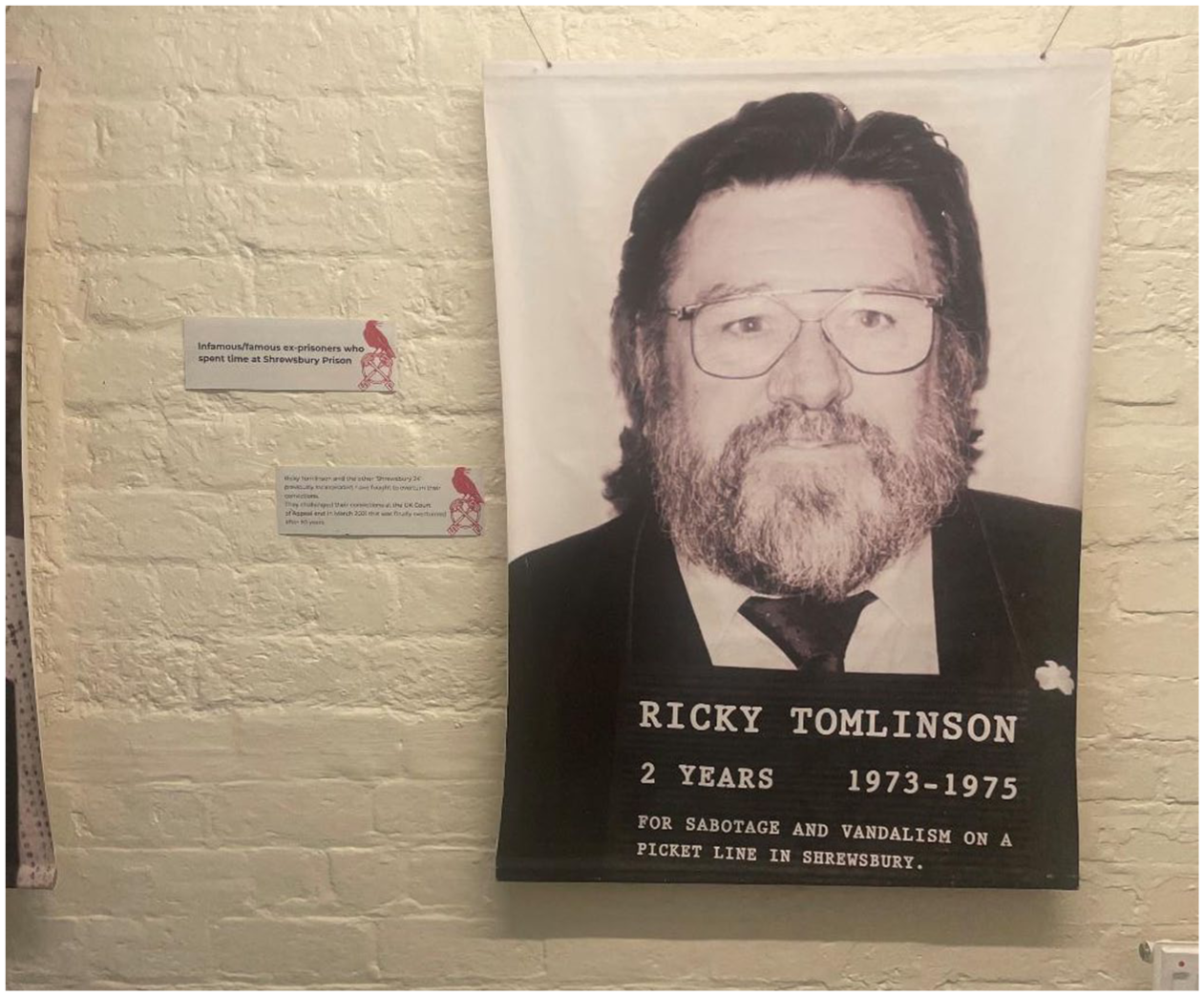
Celebrity prisoners: exhibit display featuring a large poster about Ricky Tomlinson, highlighting his two-year sentence from 1973 to 1975 for alleged sabotage and vandalism during a picket line in Shrewsbury.
This kind of prisoner attention is also helped by the guides that these sites opt to employ, them often being none other than former long-serving prison officers who once served there as guards (Urquhart, 2022), for which reason they may have engaged with these celebrities themselves. Interestingly, a Gloucester guide is seemingly quoted to have reacted against this celeb focus, something indicative of this ‘guards turned guides’ unique selling point (Urquhart, 2022: 1360) also encouraging visitors to identify with jailers (see Wilson, 2008a); when repeatedly asked to respond to tourists eager to discover what cell exactly it was that Fred West was held in and what ‘his demeanour’ in prison was like at the time, the guard quickly retreated away whilst explaining that he wished no part in fuelling ‘West’s notoriety’ (Urquhart, 2022: 1371). Indeed, this guide’s reaction nods at some of the dangers aligned with such touristic focus, even where this focus is at first glance all but seemingly inevitable and well-meaning.
Similarly sensationalising are references to aspects that might be regarded to be taboo, such as descriptions of prisoner bodily functions or inappropriate relationships. The latter are inclusive of descriptions of relationships between prisoners and guards, but also officer corruption in general, all of which is reminiscent of popular TV shows such as the female prisoner-focussed Orange is the New Black (2013–19). As previously noted, at Shrewsbury, the focus on women prisoners is interestingly linked to the prison’s ghost-touring; besides, the prison’s supposed paranormal activity appears to be taking place in the wing where only women were held. Arguably, what one encounters here is yet another problematic correlation between awe/the apparently inexplicable and prison suffering-related spaces. Similarly troubling are the tour’s references to the unlikeliest event-happenings (like encounters with so-called ghosts) alongside description of spaces where women prisoners are associated; this correlation might then be suggesting that, much like the paranormal circumstances associated with those women-dominated spaces, equally paranormal is the linking of women to criminality in the first place. Put differently, referring to women’s criminality whilst talking about other inexplicable events reinforces the schema of women supposedly being more law-abiding than men, for which reason them acting criminally is here bound to be seen just as ‘unlikely’ as the space’s ghost-encountering itself. This sort of argument seems to be supported by Barton and Brown (2015: 251) who argue that focussing on the paranormal falsely suggests how otherly these prisoners actually were.
References to Shrewsbury prison antilanguage adds to this impression of an ‘otherly’ space (see also Wilson, 2011). Originally coined by Halliday (1976, 1978), ‘antilanguage’ refers to the use of language specifically designed to exclude outsiders from a particular subculture, and one the reality of which stands in opposition to society: ‘It is the language of antisociety’ (Halliday, 1978: 171). Evidence of such a prison language is found in the naming of handmade prison weapons (such as the ‘crucifix shiv’) and the harms these cause (‘napalm’ being a burning glue-like substance generated when one mixes hot water/coffee with sugar). The fact that most prison language is violence-specific is of interest; the correlation between all kinds of criminality and violence is here implied and the stereotype of the violent criminal here reinforced, when surely not all prisoners would have been violent. Similarly, as Barton and Brown (2015: 248) argue, such a focus on extraordinary events (violence/murder, but also escapes) is common on the websites of these sites even if events of this kind were not common occurrences in reality.
Further to supposedly violent tendencies, prisoners’ otherness is linked to their supposedly poor mental health. In one cell, we witnessed a prisoner doll dressed in a straitjacket without any signage/explanation as to why that attire would have been needed (see Figure 2).
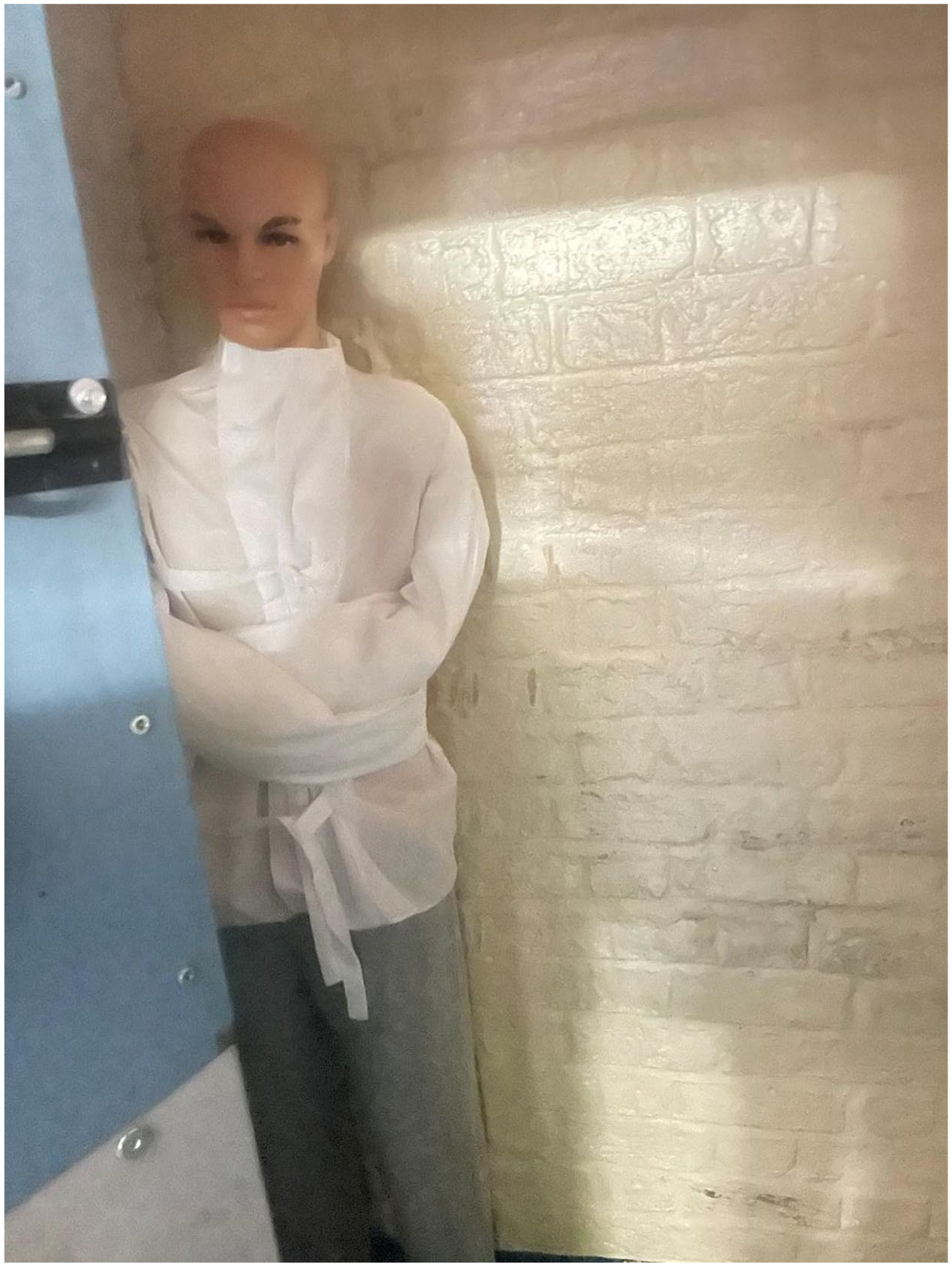
A prisoner doll in a straitjacket: a mannequin dressed in a straitjacket stands in a narrow, dimly lit brick-walled cell, partially visible through an open metal door.
Elsewhere on that floor, there is interesting reference to ‘Samaritan-trained prisoners’ as volunteer ‘Listeners’ for those prisoners who struggled ‘to speak to’ in the ‘Intervention Suite’, all of which positively connote the room in question (see Figure 3).
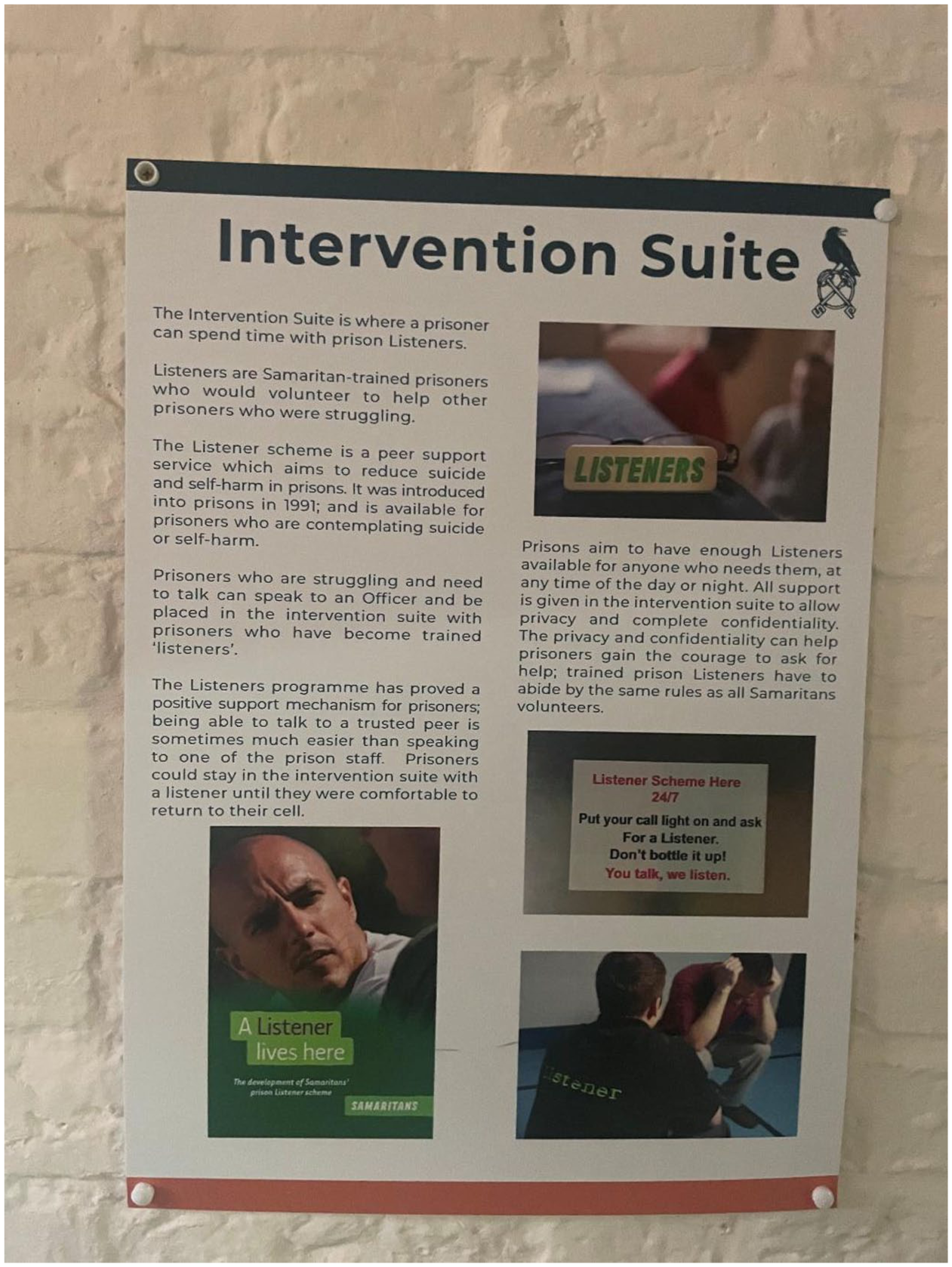
Intervention suite poster: an informational display titled ‘Intervention Suite’, explaining the prison Listener scheme with text panels and photos describing peer support, mental-health assistance, and the role of trained inmate volunteers.
The verb ‘struggling’ is interestingly vague, as is the reference to such prisoners ‘need[ing] to talk’ and there being a space for them to ‘spend time with’ helpful others, all of which are euphemisms. The ‘Listeners’ are capitalised and referred to as ‘peers’ who live alongside the prisoners (‘A Listener lives here’) and especially those struggling and who are asked, on a sign, not to ‘bottle it up’. The latter is suggestive of the common conceptual metaphor of anger/frustration as a heated liquid that can erupt, causing disruption/violence in its wake, when in actuality the ‘it’ is admittedly vague here altogether. Renaming prisoners into ‘Listeners’ affords them a positive denotation but the overall vagueness of the poor mental health circumstances described through the euphemising suggests a reactionary prison measure as opposed to one that is genuinely concerned about what underlying causes there might be, and which generate the prisoners’ poor mental health and ‘struggles’ in the first place (some of which might even be created by the prison system itself).
We ended our Shrewsbury prison tour with their indoor ‘Execution Room’, which featured a hanging rope and posters of some of the site’s execution specifics, these posters including short stories revolving around some of the Shrewsbury prisoners who were subject to that kind of capital punishment. In fact, this museum space had the most language we encountered in the prison overall, if one excludes the artefact captions in the display of museum objects encountered near the exit. Urquhart (2022: 1370) noted visitors’ openly admitted dark incentives and them being reluctantly ‘compelled’ by such capital punishment-related spaces. But looking beyond the problematic correlation between visitors’ leisurely time-spending with dark touristic sites in general, one here encounters perhaps unnecessary and inappropriate gratuity including guide puns around ‘hanging around’, the prison’s hanging being ‘efficient’ and so on. Put more simply, one is compelled to ask whether being entertained/amused − more so than reluctantly ‘compelled’ − in places of suffering is ever appropriate? Alternatively, the visitors’ elicited laughter in this space might be considered as bringing much needed respite from the room’s ‘darkness’; the dark humour-amusement might indeed be necessary, however hesitant. To stay with some stories related in, and in reference to, the execution room, some are worth inspecting closely critically and stylistically though, particularly in that these accounts often redeem the criminals of responsibility for their actions by suggesting that victims shared blame for what happened to them. Executed prisoner George Riley, for instance, is said to have broken into 62-year-old Adeline May Smith’s house to rob her ‘after a night out drinking with friends’, at which point ‘[s]he disturbed him during the robbery and was hit by a blow which killed her’ (see Figure 4).
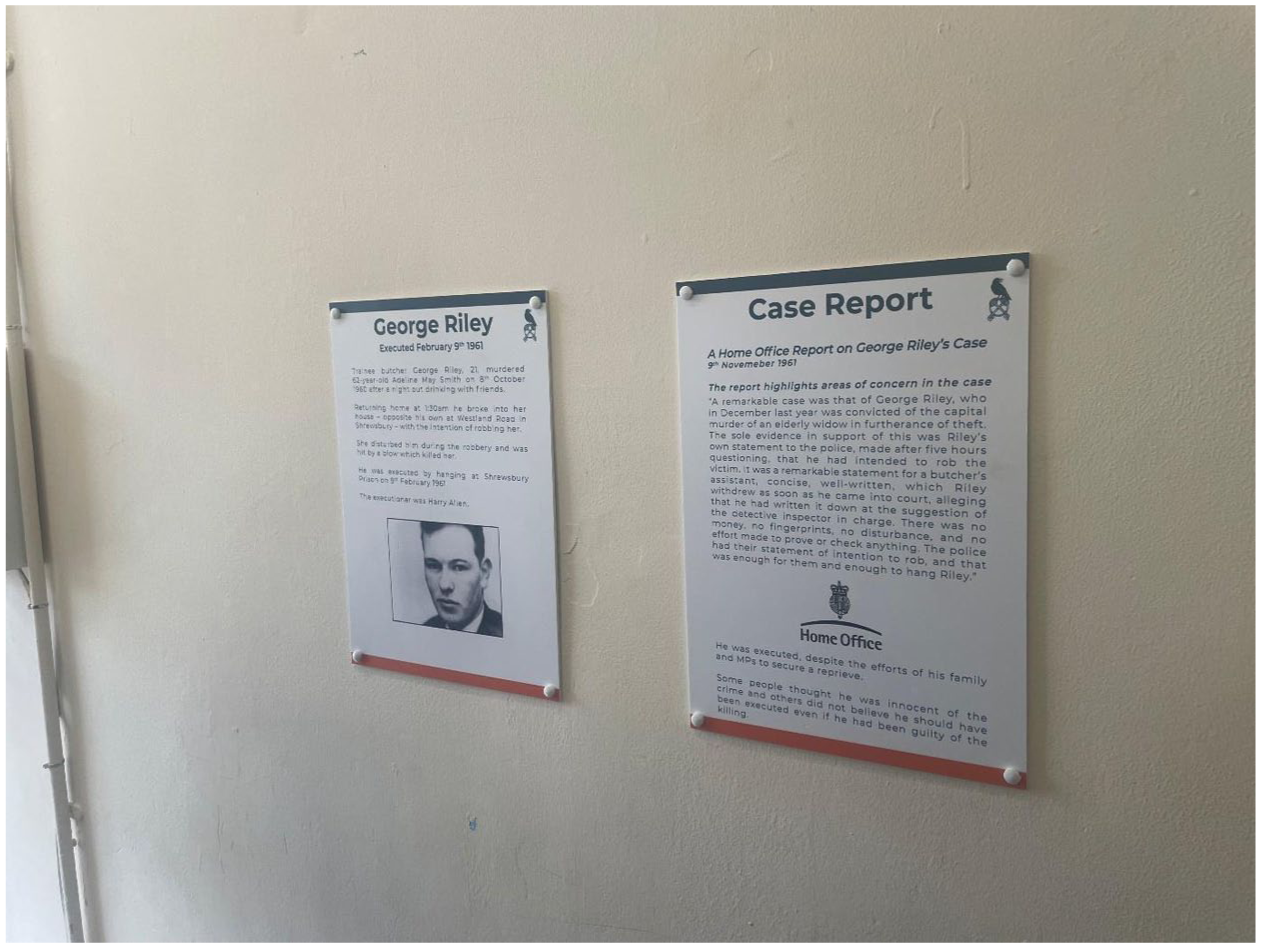
Execution room posters: two wall-mounted information boards summarise the case of George Riley, including a home office case report and background details about the conviction.
The reference to Riley’s drinking hints at alcohol affecting his judgement (something evident in William Griffiths’ story too), and that of his robbery indicates that his killing act was not premeditated (much like executed prisoner Frank Griffin’s story does too). Also, the reference to ‘friends’ humanises him further, as it implies he was nice enough to have had drinking friends in the first place. And yet the reference to Smith as agent of the verb ‘disturbing’ is clearly victim-blaming too, the verb ‘disturb’ suggesting that she invaded someone’s space (when it was hers, in fact that was invaded), with the passive voice suggesting that she was ‘hit’, the nominalised ’blow’ being the only (inanimate) ‘agent’ of the killing act she was subject to here. So, despite the language implying that Riley was responsible for the blow, him being hidden in the clause, and ‘the blow’ getting a mention only in the prepositional ‘by’ phrase at the end of the clause distances Riley from his own killing actions, if not suggests that Smith had contributed to her own death by ‘disturbing’ him. Put simply, the clause structure suggests that she is responsible for her own attack in her own home. Even more so, her being relexicalised into ‘an elderly widow’ in a subsequent poster is also of interest. Arguably, this lexicalisation suggests a woman older than Smith was (which begs the question: is 62 ‘elderly’?) and indeed one who was nearer the end of her life than she actually was at the time (hence perhaps less deserving of our pity than she otherwise would have been, supposedly?). ‘Old’ victims are less deserving of crime than the ‘young’ these kinds of narratives suggest (see Gregoriou, 2011: 172). Similarly, the language around executed Griffiths’ victim, that is, his mother Catherine, is interesting: ‘Catherine’s throat had been slashed with a razor’. The agentless passive does away with Griffiths as the agent of the slashing altogether; though implied, his involvement is not asserted for certain. Lastly, of particular interest are some of the mini stories having to do with prisoners who were executed for murdering their own partners or love interests specifically. Richard Wigley is one such prisoner who killed a woman he was courting ‘for love’: ‘I have killed that little woman. It’s all for love. I loved her and nobody else shall have her’, he is quoted as having said. Not unlike contemporary media true crime stories that make such killer-victim relationships overly explicit (like Kyle Clifford’s killing of his ex-girlfriend along with her mother and sister in the summer of 2024 in London), focussing on the perpetrator’s former/current romantic relationship with their victim can be dangerous; it potentially suggests that murder is merely an extension of passion/an expression of one’s love, the woman victim even deemed responsible for her victimhood because of that former relationship even. Victim blaming in intimate partner violence is hugely problematic and has the potential to exonerate killers from their actions altogether. A critique Thurston (2021: 330) proposes proves apt; gender violence is here trivialised. All in all, though not particularly long or numerous, these mini crime stories one encounters in these decommissioned prison spaces merit attention; looking at them stylistically can reveal some of the ways through which language is used to frame and reframe the crime depicted, apportion blame, eliminate nuance, and manipulate visitors’ understanding of all sorts of crime-related circumstances more broadly. How one addresses such controversial or difficult historical topics matters.
Findings
Barton and Brown (2015) found that visitors to such sites often encounter stereotypical depictions of prison, prisoners, punishment and related ideologies, when they could instead be reflecting upon the full range of that prison’s experiences, including testimonies from those ‘othered’ by these institutions. Similarly, Hodgkinson and Urquhart (2016: 52) suggest that one might wish to challenge the underlying assumption of these spaces that incarceration is necessary, uncontested, and unproblematic. Our interdisciplinary analysis responds directly to these concerns.
Our interdisciplinary critical analysis reveals how penal history is constructed and curated at Shrewsbury Prison. We found that the site exemplifies selective remembrance. Through a primarily criminological reading, supplemented by stylistic and media analyses, penal history emerges as carefully curated rather than fully represented. Former prisoners’ voices are largely absent, displaced by narratives delivered through former officers or institutional proxies. Certain figures, particularly celebrity or sensational offenders, are foregrounded, while structural explanations for crime and the lived realities of imprisonment are marginalised. What we have termed the Carceral Simulacrum captures this process: a representation of incarceration detached from the lived experiences it claims to portray, performed within a space where the boundaries between history and spectacle are deliberately blurred. In this sense, the prison operates not simply as a site of memory but as a space that conceals as much as it reveals, where the traumas of incarceration are filtered through scripted storytelling, visual display and atmospheric cues (see also Thurston, 2021 on non-fictional narrativity and crime gamification). At the micro-discursive level, this curation is further enacted through lexical emphasis on sensational offenders, euphemistic references to suffering, and shifts in grammatical agency within execution narratives that subtly redistribute responsibility. The interdisciplinary approach was vital here: only by combining attention to institutional voice, media framing, and these micro-linguistic choices could these inclusions and exclusions become fully visible.
These intersecting narrative strategies shape public understandings of crime, punishment and incarceration in a variety of ways. They suggest that the museum’s narrative architecture largely reinforces dominant cultural imaginaries rather than substantially unsettling them. Through media-inflected nostalgia, fictional prison schemata, and explicit associations with television drama and true crime formats, Shrewsbury operates within an already familiar representational framework. The preserved Victorian architecture, furnished media-set cell, and references to series such as Porridge, Time and Happy Valley position the prison not simply as a historical site but as a recognisable media space. In doing so, incarceration is framed through culturally embedded narratives of deviance, danger and dramatic confrontation, encouraging visitors to interpret punishment through lenses shaped by popular culture. At the micro-discursive level, stylistic choices–including lexical emphasis on violence, euphemistic references to mental health, and shifts in grammatical agency within execution narratives–further shape how responsibility, blame and victimhood are understood. The cumulative effect is that imprisonment is experienced affectively through intrigue, nostalgia, and mediated familiarity, rather than as a structurally situated social institution. Public understandings of crime and punishment, therefore, remain anchored in circulating media narratives that extend well beyond the museum walls.
The tensions between education, spectacle and institutional legitimacy found at Shrewsbury Prison embody an unresolved negotiation between remembrance and performance. The site simultaneously gestures towards historical education and participates in forms of commodified entertainment, from ghost tours to media-location branding. Visitors are left navigating conflicting invitations: to sympathise with the justice system, to fear or mythologise its subjects, or to consume incarceration as experiential spectacle. This tension underscores the complex ideological work performed by dark tourist sites more broadly. While such spaces possess the potential to confront the ‘ongoing challenge of interpreting incarceration, punishment and forced isolation’ (Strange and Kempa, 2003: 402), they also risk reaffirming institutional legitimacy by presenting imprisonment as inevitable, naturalised and narratively coherent. The educational promise of these sites, therefore, remains contingent upon how critically their stories are curated and contextualised.
Conclusions
Taken together, our findings demonstrate the value of an explicitly interdisciplinary approach to dark tourism. Approaching Shrewsbury collectively as criminologists, media scholars, and stylisticians enabled us to see how narrative construction operates simultaneously at structural, cultural, and linguistic levels. It was only through shared discussion and collective documentation that the nuances of absence, framing, nostalgia, metaphor and agency became visible. Dark tourism sites such as Shrewsbury are not inert heritage spaces but active producers of meaning within contemporary debates about crime and punishment. If such sites are to move beyond spectacle towards genuinely reflective engagement, interdisciplinary scholarship has an important role to play in interrogating how stories are told, whose voices are amplified, and what forms of understanding are being reproduced. As Thurston (2021: 330) notes, prison museums remain at the periphery of criminological debate about the media-crime relationship; it is time that we, as academics, ‘get involved in the stories and advise the storytellers’. Further critical engagement is vital if these important heritage spaces are to illuminate rather than obscure the legacies of carceral harm.
Finally, we believe our research highlights the potential for further research; this might incorporate analysis of websites and promotional materials, visitor reviews, demographic data, and visitor interviews to deepen understanding of how audiences interpret and respond to these narratives. With at least 14 other decommissioned prisons operating in the UK, there remains significant scope for comparative, collaborative and impact-oriented research that will inform criminological debates about crime and media going forward. Our analysis indicates that prison museums have the potential to provide meaningful engagement with the history and experience of incarceration, yet this potential remains under investigated. Ensuring that such engagement moves beyond affective fascination towards critical reflection will require continued interdisciplinary dialogue between academia, heritage practitioners and the communities these sites serve.
Footnotes

Funding
The authors received no financial support for the research, authorship, and/or publication of this article.
Declaration of conflicting interests
The authors declared no potential conflicts of interest with respect to the research, authorship, and/or publication of this article.