



Abstract
This paper examines the video game Star Wars: Outlaws (2024), exploring its portrayal of organised crime and associated forms of capital. The game follows Kay Vess, a young street thief seeking a fresh start, whose journey is shaped by an in-game reputation system that enhances gameplay immersion and deepens narrative complexity. Analysing data from 53 dedicated gameplay sessions, this paper explores Kay’s transition from emergence and survival to ascent, agency, and autonomy in the underworld. Critically assessing the extent to which the game encourages the accumulation and deployment of street capital and criminal capital, the paper introduces the concept of dark capital as a lens for understanding organised crime. It concludes by exploring the potential contribution of dark capital to the policing of organised crime.
Introduction
The open world action-adventure video game Star Wars: Outlaws (2024) traces the story of Kay Vess, a new character to the Star Wars universe. Kay begins the game as a young street thief trying to escape her troubled past and start anew, and her journey becomes entangled with encounters with organised crime ‘syndicates’. In an establishing cutscene Sliro Ruback, an apparently wealthy crime lord and leader of the Zerek Besh crime syndicate, meets with representatives of rival organised crime groups and declares, “It’s a golden age for the underworld. The Empire’s little Death Star gets blown to pieces and the law is distracted by a rebellion that won’t quit. It’s an opportunity to make millions.”
As an emerging outlaw in a galactic underworld riddled with illicit markets and informal forms of local governance – features typically associated with organised crime across a variety of real-world places (see Abello-Colak and Guarneros-Meza, 2014; Campana and Varese, 2018; Lambrechts, 2012; Shortland and Varese, 2016) – Vess subsequently antagonises Sliro and the Zerek Besh. Pursued by this group, Vess finds herself ‘forging alliances’ and ‘uncovering opportunities’ to secure her freedom and her future. Importantly, Kay’s journey in Star Wars: Outlaws is shaped by a ‘reputation system’ as a core gameplay component.
Following Kempshall (2023), who recognised the importance of Star Wars in contemporary popular culture and encouraged the analysis of this transmedia franchise to uncover what its stories, characters and settings have to say about the ‘real world’, this paper critically assesses the extent to which Star Wars: Outlaws promotes the accumulation and deployment of particular forms of capital as part of a career in organised crime. Analysing the gameplay and narrative of Star Wars: Outlaws, this study particularly engages the in-game reputation system as it intersects with organised crime. The paper begins by considering reputation systems and their role in video games, and the specific system used in Star Wars: Outlaws. Progressing to provide an overview of the research design of the study, the paper describes the method used to explore the given research question and the sensitising concepts of ‘criminal capital’ and ‘street capital’ used to guide the analysis. These concepts are considered in the tradition of French social theorist Pierre Bourdieu, recognising both the ‘rich complexity of Bourdieu’s conceptual world’ and how it ‘resists easy summary’ (Swartz, 1997). In a fundamental way, understanding this rich complexity demands an appreciation of the interplay between Bourdieu’s key concepts of field, habitus and, crucially, forms of capital. Building on Fowler (2003), it also requires applying these concepts empirically and innovatively to explain the dynamics of social structures, the reproduction of power relations in societies, and the ways individuals and groups navigate and influence their social environments. In doing so, this paper explores Kay’s use of street capital and criminal capital in her transition from emergence and survival to ascent, agency, and autonomy in the underworld. Additionally, it traces the limits of these forms of capital in this field, linking this to Kay’s position on the periphery of the galaxy’s organised crime groups. The paper progresses to discuss these findings, and in doing so proposes the concept of ‘dark capital’ to more fully understand success and failure in the field of organised crime. It concludes by exploring the potential contribution of dark capital to the policing of organised crime.
Reputation systems and Star Wars: Outlaws
The reputation systems within the purview of this paper are those used in video games to enhance gameplay immersion and add narrative depth. 1 These in-game reputation systems are long-standing and established in video games. Webley (2017), for example, discussed the sandbox role-playing game Wasteland, released in 1988 on the Apple II computer, and its use of an early reputation system as a unique and revolutionary development. This system allowed players the freedom to explore moral, ethical, and political viewpoints in a postapocalyptic world that operated interactively with their actions, deepening the connection between the player and the setting (Webley, 2017: 198). Reputation systems in video games developed further in the period following the release of Wasteland: from the Fallout franchise (1997–2018), which as a series can be considered in many ways as a successor to Wasteland, to the more direct sequels Wasteland 2 (2014) and Wasteland 3 (2020).
Reputation systems evolved to become a particular gameplay mechanic that tracks a player’s actions and decisions to classify a character’s standing and status in the social world in which the game’s action, exploration, and interactions occur. The levels of reputation ascribed through these systems, with status and standing shaped by moral choices made in specific circumstances or the completion (or failure) of particular missions or quests, are designed to impact on gameplay. For example, actions and decision that improve reputation may unlock areas or abilities, or influence story outcomes. Whilst reputation systems have been evident across a range of video game types and categories, Stahlke and Mirza-Babaei (2022) highlighted the prevalence of these systems in science-fiction video games. Star Wars: Outlaws presents a further example of the use of reputation systems in this genre, with the reputation system operating to dynamically classify Kay Vess’s standing with four organised crime syndicates (Ashiga Clan, Crimson Dawn, Hutt Cartel, Pyke Syndicate) across five categories (Terrible, Bad, Poor, Good, Excellent). Throughout the game, increasing Kay’s reputation with each syndicate – from good to excellent and ultimately to the maximum level – unlocks various rewards. These include upgraded clothing and equipment, access to restricted territories and districts, and discounts or exclusive items from syndicate-affiliated merchants. Kay’s reputation in Star Wars: Outlaws is shaped by three key factors: the completion of player-chosen criminal contracts, the accomplishment of mainline gameplay missions, and her routine actions, interactions, and choices as she navigates the game’s narrative arc.
Criminal contracts are bespoke tasks – such as smuggling goods, targeted killings, infiltrating areas, or the gathering of intelligence – undertaken on behalf of specific crime syndicates. Contracts are assigned via in-game interaction with ‘brokers’, who are non-playable characters (NPCs) found across the worlds of this galaxy. Within the game many contracts offer the opportunity upon their completion to ‘Honour the deal’ (which means to deliver to the crime syndicate with whom the deal was made) or ‘Break the deal’ (which means to renege on the agreed contract and deliver to an alternative crime syndicate). The outcome of this choice will have a direct effect on Kay’s reputation with each syndicate and, depending on the outcome, can unlock new opportunities or challenges. While criminal contracts directly shape Kay’s reputation, mainline missions, known as ‘Quests’, weave these decisions into the larger story, further influencing her standing. Quests in Star Wars: Outlaws are the core story missions that drive the game’s narrative forward, and their completion can directly impact on Kay’s standing with the criminal syndicates. Routine actions, interactions and choices also influence Kay’s reputation. These include whether to become entangled in direct combat with a particular organised crime syndicate or, on other occasions, whether to engage in trading activities with syndicates that involve the exchange of valuable intelligence such as schematics, surveillance data, smuggling records, or lists of informants.
Research design
A starting point for the research design of this study is that the texts of popular culture – from movies, television shows and video games to popular music, lyrics and works of literature – function as sites where criminological concepts are produced and contested, concomitantly shaping public understandings of the issues. Within criminology, Rafter and Brown’s Criminology Goes to the Movies (2011) shows how film in particular can be read as a theoretical resource, with these cultural texts both reflecting and shaping ideas and understandings of crime and justice. Similarly, in the field of cultural legal studies MacNeil’s Lex Populi (2007) recontextualises jurisprudence, arguing that texts of popular culture can be interpreted jurisprudentially, contributing to legal theory and illustrating how cultural artefacts both critique and inform academic discourse. Influenced by these traditions, this study extends the interpretive reading of cultural texts to video games, treating Star Wars: Outlaws heuristically as a site for theoretical engagement with concepts of crime and capital and for developing existing theory.
This paper recognises the intertextuality of video games within popular culture, especially when such video games are ‘licenced’ and draw upon transmedia franchises with their own, oftentimes significant, cultural power. It seeks to answer two interlinked research questions: ‘to what extent does the reputation system in Star Wars: Outlaws reflect the accumulation and use of ‘criminal capital’ and/or ‘street capital’ within the game’s underworld factions?’ and ‘what are implications of this system for player interactions with the game and its narrative outcomes?’. These questions aim to explore the interplay between both game mechanics and narrative, and the forms of capital that are represented in the game. The analytical focus, therefore, is on how reputation influences gameplay and story development. Framed as such, the study draws upon Marta Fijak’s recent account of the topography of narrative, in which she astutely described how ‘games tell stories’ in their narration through a summation of ‘static elements’ that are common to all players (including, e.g. cutscenes, written dialogue, characters and events) and ‘dynamic elements’ that emerge as result of player engagement with gameplay mechanics (Fijak, 2025). The approach, therefore, combines narratology and ludology, understanding how gameplay mechanics – particularly the reputation system – interact with narrative to shape player experiences and provide meaning to the game’s criminal underworld.
Replicating a methodology used by Atkinson (2024), this paper is informed by an extensive analysis of Star Wars: Outlaws on PlayStation 5. Gameplay sessions were undertaken in 2024 and 2025, capturing a comprehensive account of the game’s narrative arc and gameplay experience. The data generated were imported into the qualitative data analysis software package NVivo 12. Both criminal capital and street capital were identified at the outset as sensitising concepts to guide the coding process. Coding was conducted across all content, with a focus on aspects of the game (in both narrative and gameplay) related to these fields. This process produced a codebook comprising 122 nodes, nested within a hierarchical model, with three major nodes: street capital, criminal capital, and dark capital. Street capital and criminal capital each contained four subnodes, while dark capital was attributed five subnodes. Each subnode was further coded for narrative or gameplay data, as relevant. The following section details both criminal capital and street capital, and the tradition within which they are applied in this study.
Criminal capital and street capital in context
The concepts of criminal capital and street capital are understood and applied in this paper in the theoretical tradition of the French social theorist Pierre Bourdieu. Across his writing Bourdieu developed a theoretical framework with, at its base, a trinity of ‘central organising concepts’ (Wacquant, 1989): field, habitus, and capital. Capital is an important concept in Bourdieu’s framework because within a social field – or multi-dimensional space of positions – the location and distribution of individuals is determined by the volume and composition of their capital (Bourdieu, 1985). Reflecting on Bourdieu, Postone et al. (1993) considered capital as a form of power, used to exercise control over one’s own future and the future of others within a given society. In his influential work Distinction Bourdieu (1984) traced four key forms of capital: economic, cultural, social, and symbolic. Cultural capital, which is perhaps the form of capital with which Bourdieu is most firmly associated, is acquired through relational social networks and provides an individual with access to cultural knowledge, skills, and behaviours attuned to a particular field. Bourdieu further categorised cultural capital into three sub-types: embodied, objectified, and institutionalised (Bourdieu, 1997).
For Bourdieu, forms of capital constitute a resource in the ‘game’ of social life that is played out in a given field, and as such the notions of capital and field are ‘tightly interconnected’ (Bourdieu and Wacquant, 1992). As Prior argued, “Agents in a position of dominance will tactically deploy their capital in order to conserve their position, whereas agents looking to outflank, displace or over-take those in a dominant position. . . will attempt strategies of succession or subversion.” (Prior, 2000: 142–143).
Within Bourdieu’s framework, the value of capital – the extent to which it can be used for intended purposes – differs across different fields. Conversely, some forms of capital may hold their value in transfer between specific fields. Crucially for Bourdieu, therefore, field and capital are inter-constitutive, because the value of a specific form of capital hinges upon the form and limits of the field or, metaphorically, which game is being played where. Similarly, the agent – or player – can attempt to transform the field itself, thus changing the ‘rules of the game’ and therefore the value of specific forms of capital. Bourdieu extended this game metaphor in his description of habitus, which he understood as an almost instinctive ‘feel for the game’. For Bourdieu, “Having the feel for the game is having the game under the skin; it is to master in a practical way the future of the game; it is to have a sense of the history of the game. While the bad player is always off tempo, always too early or too late, the good player is the one who anticipates, who is ahead of the game. Why can she get ahead of the flow of the game? Because she has the immanent tendencies of the game in her body, in an incorporated state: she embodies the game.” (Bourdieu, 1998: 80–81).
Developing this further, Fraser (2013) introduced street habitus to ‘refer to the fusion of space and self’ that results from an enduring and deep-seated connection with a bounded locale, where space becomes a resource for identity. While Bourdieu’s framework, supplemented by the applied research of others, emphasises habitus and the relational value of capital within and across fields, criminological research has adapted this idea – albeit initially from different theoretical roots – to explore the dynamics of ‘criminal capital’.
McCarthy and Hagan (1995) first introduced the concept of ‘criminal capital’ to refer to the acquisition of criminal knowledge, technical skills and attitudes facilitated through tutelage relationships as embedded in ‘networks of deviant associations’. Despite superficial similarities with the Bourdieusian perspective, McCarthy and Hagan drew inspiration not from Bourdieu but from the work of Coleman (1990). Loughran et al. (2013) remarked that theoretical and empirical development of the concept of criminal capital in the period since its initial exposition had been limited. This is not to say, however, that that criminal capital had not previously been applied to understand criminal careers, illicit activities, and illegal enterprises. A decade after McCarthy and Hagan’s initial exposition, Steffensmeier and Ulmer (2005) remarked in an in-depth ethnographic study of a long-time thief, “Differences in criminal capital across offenders or criminal entrepreneurs and across types of crime or criminal enterprise are therefore important markers of underworld stratification and career success.” (Steffensmeier and Ulmer, 2005: 58).
Proceeding to provide a taxonomy of criminal capital they highlighted the following skills as core components that distinguish between and ‘seasoned criminal entrepreneurs’ with skills and high status in the underworld and ‘run-of-the-mill’ criminals:
Heart (‘nerve’ and ‘coolness’)
Inventiveness, scheming and ingenuity
Practical knowledge of things, language and people
Worldly-wiseness
Social skills
Larceny sense (attuned to illicit opportunities)
Business skills and knowledge
Trust, being solid.
In their study Steffensmeier and Ulmer (2005) deepen the applied understanding of criminal capital, and in doing so they explicitly tether their analysis to the theoretical framework and organising concepts of Bourdieu. The influence of Bourdieu was also crucial to the scholarly development of street capital.
The concept of street capital emerged in academic research after the introduction and application of criminal capital, particularly in the work of Sveinung Sandberg. In his analysis of ethnic minority youths on the streets of Oslo, Sandberg (2008) posited that these young people have embodied experiences of violence and criminal activities that can be transformed into forms of ‘street capital’ that prove useful in a violent street culture that exhibits its own codes, values, rewards and sanctions. As later defined, and firmly within the theoretical tradition of Bourdieu, “Street capital is knowledge, skills and objects that are given value in a street culture. The concept is used to capture the ‘cultural capital’ of a violent street culture.” (Sandberg and Pederson, 2011: 33).
Street capital was considered as a necessary construct because the distinction of the street – in the cultural rendezvous of fashion, taste, and style – and the power, status, knowledge and acumen in street culture are difficult to transfer beyond the setting in which they are formed and found (Sandberg, 2008; Sandberg and Pederson, 2011). In doing so these accounts deepen the connection between capital and field. Recognising how such conceptions of street capital may be best understood as ‘street cultural capital’, Ilan (2013) subsequently introduced a parallel concept of ‘street social capital’, understood as resources that individuals gain through social networks and that enable them to succeed on the street. In doing so, Ilan’s work further foregrounds the importance of understanding forms of capital as attuned to autonomous fields with their own unique rules, codes, norms, and, crucially, boundaries. The following sections apply the concepts of street capital and criminal capital across two distinct phases of Kay Vess’s criminal career in Star Wars: Outlaws: ‘emergence and survival’ and ‘ascent, agency, and autonomy’.
‘You’re new to this world. Come back when you’re not’: Emergence and survival
Star Wars: Outlaws opens with a cutscene (Figure 1) that discloses the opulence, wealth, power and violence of the galaxy’s various organised crime syndicates. Sliro, the leader of the Zerek Besh, hosts a feast for three rival syndicates, before ordering the slaughter of each syndicate representative as they sit at the table.
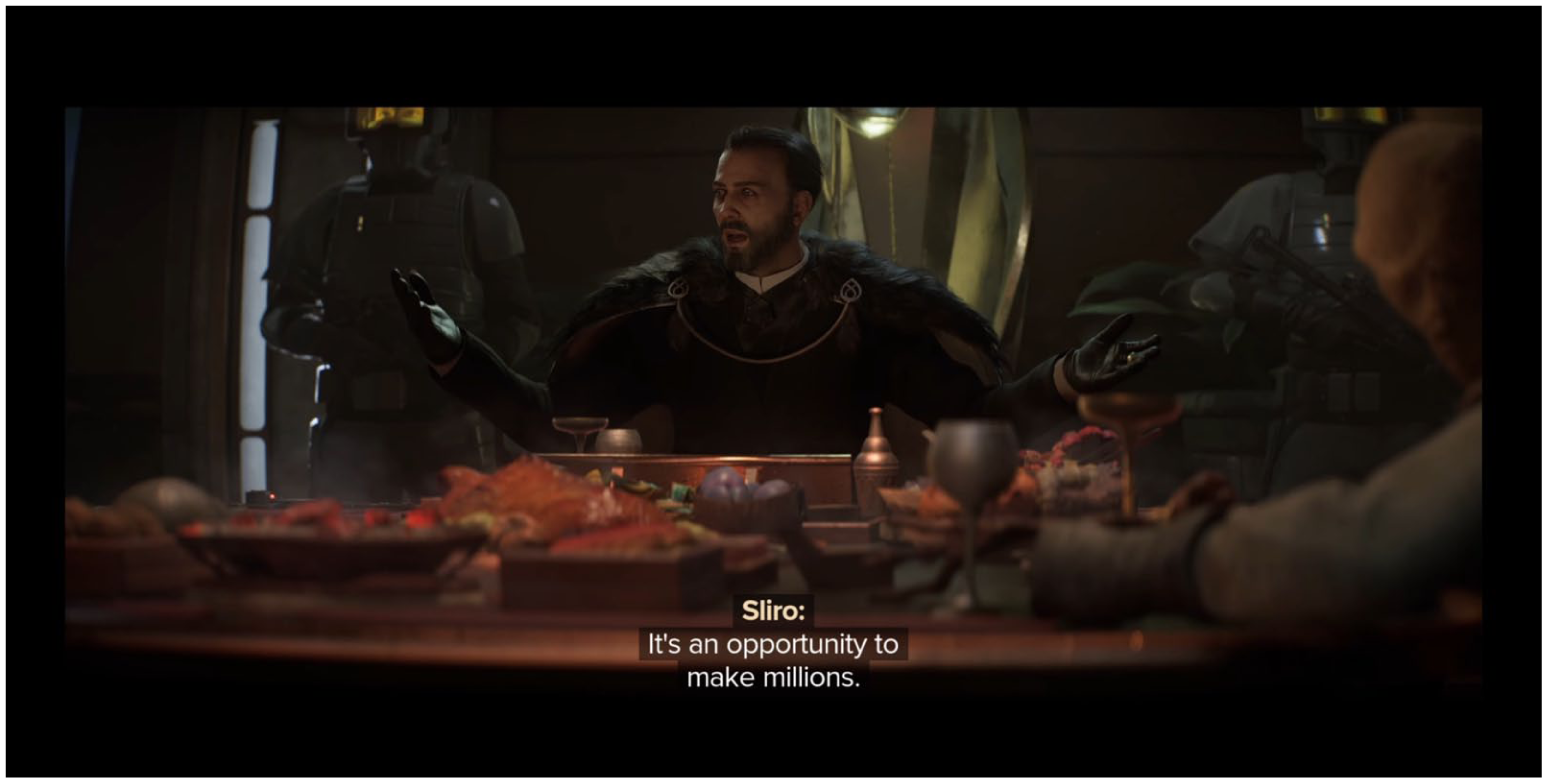
Sliro Ruback is introduced hosting lavish feast for rival syndicates.
This cutscene, which demonstrates an intertextual aesthetic of the meeting of the five families in The Godfather (1972), is immediately juxtaposed with the introduction to the game’s main protagonist, Kay Vess. 2 In contrast to the preceding cutscene of the crime syndicates, Kay is shown in her rudimentary room above a dimly-lit cantina bar (Figure 2). Kay cares for her pet companion, Nix, and looks to freeload food from the cantina’s cook.

Kay Vess is introduced caring for pet companion Nix in modest quarters.
As static elements (Fijak, 2025) these cutscenes segue into more dynamic gameplay, beginning with the guiding of Kay through the streets of the Worker’s District of Canto Bight. The streets here are impressively detailed, combining visual complexity (Atkinson and Parsayi, 2021) with layered soundscapes (Grimshaw, 2012) to produce immediate immersion in the Star Wars universe. This immersion is experiential, embedded in the ‘diverse entanglements’ (Mitchell et al., 2023) between the ludic and the narrative elements of Star Wars: Outlaws. Player agency is foregrounded in these early stages, with mechanics of movement and interaction integral to successfully navigating and negotiating the Worker’s District.
The ludic structures of these streets are apparent in the use of Kay to converse and interact with characters of species familiar to the franchise, or in learning to use a ‘scomp link’ as a central gameplay mechanic. The ease with which the player, as Kay, traverses these streets reflects both the early stage of the game, but also the biography and background of her character. Kay is a teenage convict from an under-privileged background in the highly stratified society of Canto Bight. She is a talented and resourceful thief and petty criminal, but lacks the connections and resources to realise her dreams of adventure and escape. Gameplay and narrative here work together to establish who Kay is and who she is not, at this stage of the story. It is clear that on the streets of the Worker’s District, her reputation is established and well-known.
Physical streets appear throughout Star Wars across a diverse range of forms that draw upon, but also diverge from, current, past and future visions of streets in our own world. Most recently, the street appears in the television series Star Wars: Skeleton Crew (2024–2025) as a science fictional, but nostalgic, vision of a safe American suburbia. Delving deeper into Star Wars lore, however, across multiple media the ‘streets’ of Coruscant – a layered city-planet that functions as the political, cultural, and economic hub of the galaxy – are encoded with neoliberalism and its mechanisms of security, surveillance, class, status, and economic polarisation. The streets of this ecumenopolis range from the fantastic ‘skybridges’ of the planet’s upper levels that form high-speed highways for the flying vehicles of planet’s elites to the deep, dimly-lit and dirty under-levels that are home to the dangerous classes and the vulnerable. Across the franchise, including in Star Wars: Outlaws, streets are not apolitical stages for characters, but are instead encoded, symbolic spaces where power dynamics and cultural identities are enacted and where stories unfold.
The conceptual framework that links these diverse interpretations in Star Wars – and forms the connective thread to Star Wars: Outlaws – is the street as a Bourdieusian field and the associated street habitus and forms of capital at play. These concepts are useful in explaining the emergence and survival of Kay as a petty criminal on the streets of Canto Bight and her subsequent dislocation in the city of Mirogana. The Canto Bight Worker’s District is the field in which Kay accrued and cultivated her street capital. At the outset of gameplay, on her homeworld of Canto Bight, it is immediately apparent that Kay’s feel for the game and street capital are largely attuned to, and aligned with, the Worker’s District. Quick-witted and fast-talking, Kay is highly capable and fully at ease in the street life of the Worker’s District, effortlessly navigating its intricate alleyways, backstreets, and rooftops. A first interaction with an NPC shows Kay refusing an offer of ‘honest hard work’. Instead, the player, controlling Kay, uses Nix to pickpocket credits from a corrupt police officer patrolling the streets (Figure 3). 3
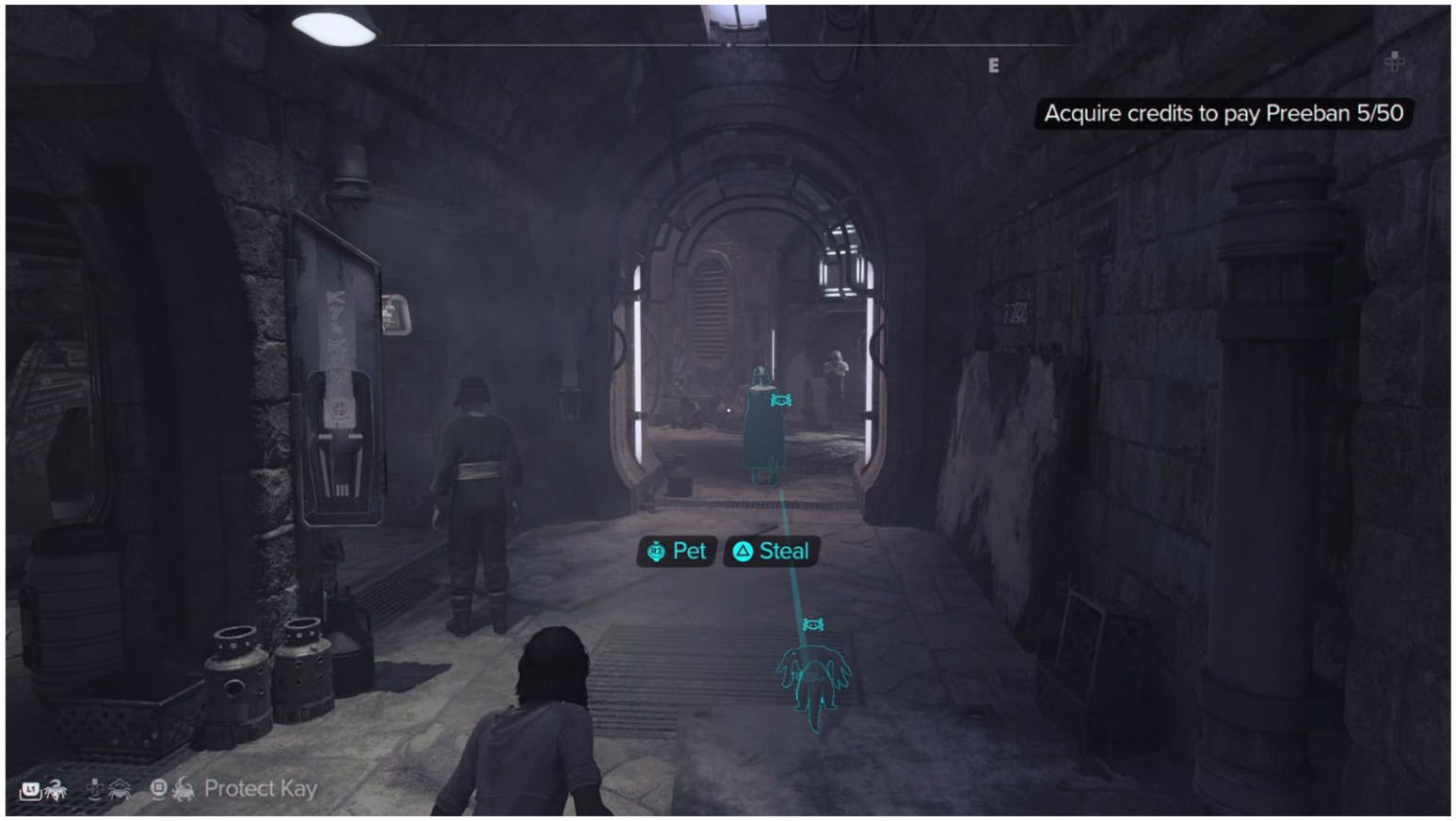
Stealing from a corrupt police officer on the streets of the Worker’s District, Canto Bight.
Gameplay also reveals at an early stage that these aspects of street capital and criminal capital – knowledge, skills, networks, and resources of value in the field – can be supplemented and enhanced, and others obtained, by locating ‘experts’ and completing associated side quests. Through engagement with experts across the game, players simulate the accumulation of criminal capital as they gain specialised knowledge and skills through mentor-like relationships, mirroring McCarthy and Hagan’s description of the tutelage of illicit knowledge and skills within deviant networks. Cutscenes that flash back to Kay’s childhood disclose how this accumulation of criminal and street capital is familiar to her, as the player learns that Kay’s mother taught her how to steal and evade capture on the streets of Canto Bight.
Following a failed robbery targeting the Zerek Besh, Kay and Nix escape Canto Bight aboard the Trailblazer, a ship stolen from Sliro Ruback. Arriving by chance on the moon Toshara, Kay encounters its capital Mirogana as a securitised walled-city ruled by a corrupt Imperial leader and marked by the presence of all major criminal syndicates. In Mirogana Kay experiences a disconnect between capital, habitus and field in her new circumstances. Kay is able to navigate through gameplay to meet Gorak – the ruthless and powerful leader of the Pyke Syndicate in Mirogana – but here the braggadocio that served her well, and for years, on the streets of Canto Bight ultimately fails her. Gorak recognises Kay as a stranger in his midst and immediately ejects her from his quarters: GORAK Smart enough to get into my suite, careless enough to use Waka’s name. You’re new to this world. Come back when you’re not.
Kay discloses herself here as a naïve newcomer; an interloper in a world to which she does not belong. Kay’s ‘feel for the game’ is experiencing a disconnect with the new field of organised crime, mirroring Bourdieu’s concept of ‘cleft’ or tormented habitus (Bourdieu, 2000). At this point Kay lacks the necessary capital – criminal, street or otherwise – to effectively position herself within the networks, hierarchies, and power structures of Mirogana’s criminal underworld. It is here, however, that the reputation system emerges in gameplay as a mechanism for accruing the forms of capital necessary for Kay’s survival and success in this new field.
‘Out here, you live and die by your reputation’: Ascent, agency, and autonomy in the underworld
Having been forcibly ejected from Gorak’s quarters, Kay instantly finds herself schooled in her new circumstances by Danka, an information broker operating freelance in the field of organised crime on Toshara. Danka functions narratively and in gameplay as a mission catalyst, connecting Kay to the activities and opportunities of the crime syndicates. The result of Kay’s first interaction with Danka is the ‘Underworld’ quest, which immediately introduces the reputation system gameplay mechanism (Figure 4).

Introduction to the reputation system.
Just as Dale Mitchell (2023) considers the video game Ace Attorney as an invitation to ‘play’ law by inhabiting an avatar in trial-based gameplay, Star Wars: Outlaws similarly offers an opportunity to playfully encounter the underworld, especially through its reputation system. This system quantifies reputation as a resource, embedding it within an entrepreneurial logic that mirrors the operations of organised crime in the real-world. This commodification of reputation regulates Kay’s ascent, agency, and autonomy in the field of organised crime. It reveals the ludologic dimension of reputation building, where rules are uncovered through play and reputation operates as a de facto juridical mechanism.
This dynamic becomes evident at the conclusion of the Underworld quest, where Kay realises that the task she agreed to – to recover data from the Pyke Syndicate – was on behalf of Crimson Dawn. The Crimson Dawn agent, Eleera, is aware of Kay’s previous criminal background and attempts to blackmail her. Eleera’s goal is to secure Kay’s future collaboration with Crimson Dawn. Kay, however, having uncovered encrypted data on her mission that disclosed a traitor in the Pyke ranks, realises that she has options. The player is then presented with a choice: to disclose this information to Eleera or to retain the information for Gorak (see Figure 5).
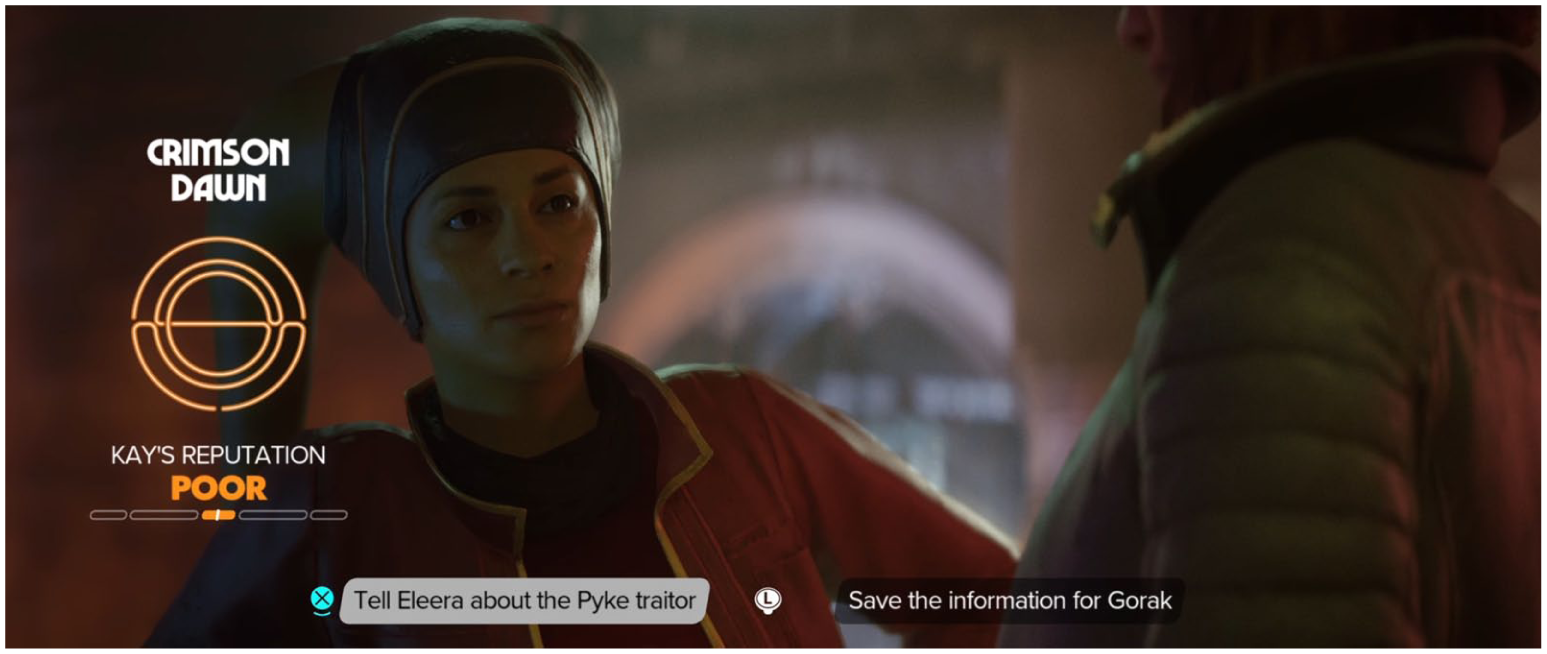
Choice in the reputation system.
Each option has consequences for Kay in terms of reputation and rewards, indicating how her agency is exercised within a gameplay mechanism that simulates the opportunities and constraints of illicit economies. For example, in the playthrough for this paper the information was disclosed to Eleera, resulting in a reputational increase with Crimson Dawn and Kay’s receipt of a gift of fuel injectors for her ship. 4 In this way, the reputation system works to enhance player-avatar identification by deepening the ‘polythetic architecture’ of the game (Downs et al., 2019), allowing players a degree of co-authorship of Kay and her journey. Across Star Wars: Outlaws the choice-driven consequences of the reputation system allow the player to connect with Kay not only through the accumulation of tangible rewards but, more importantly, through the affirmation of autonomy that emerges from her expressions of agency. The ludic elements of gameplay here allow for a personalised playthrough, whilst maintaining a mainline story that both drives and constrains Kay’s journey.
Subsequent criminal contracts and mainline quests undertaken by Kay across Star Wars: Outlaws often rely on her street capital and criminal capital; the attributes, skills and abilities she learned on Canto Bight and that she further develops and enhances as the game progresses. After making the first consequential choice as part of the reputation system – the encounter with Eleera (Figure 5) – Danka remarks to Kay, DANKA Hey, look at you, playing the game. You’re learning.
Danka’s words demonstrate Kay’s growth and resonate with a Bourdieusian account. However, Kay’s ability to ‘play the game’ is not limited to an emergent habitus – her intuitive and ingrained ‘feel for the game’, shaped within and attuned to a given field – but is also fundamentally shaped by the accumulation and strategic deployment of capital. Particularly, Kay’s relationship with Danka exemplifies McCarthy and Hagan’s conceptualisation of criminal capital, where skills, knowledge and outlook are cultivated through tutelage in networks of deviant association (McCarthy and Hagan, 1995). Kay increasingly becomes known as an effective operator who can be of use to the criminal syndicates, building her networks accordingly (see Figure 6).

The reputation system in-game (top) and its consequences (bottom).
During gameplay, the reputation system encourages the player to make choices that shape important aspects of the gameplay experience, perhaps most notably in triggering a response crime syndicates or Imperial forces as part of the wider ‘wanted system’. For example, if the player shapes Kay’s reputation with a particular syndicate to be categorised as ‘Terrible’, the affected syndicate may take retributive action: from denying Kay access to their territory to dispatching a kill squad or bounty hunters to eliminate her.
As Kay completes missions for crime syndicates, Danka discloses that Kay is ‘starting to get a rep’ that will result in her accruing ‘more work’. Just as Bourdieu sought to bridge structure and agency in his development of theory, so the reputation system allows the player, through calculated decision-making and trial-and-error, to simulate an evolving apprenticeship in the underworld. This process reflects the Bourdieusian notion of developing a habitus as a ‘feel for the game’, with players incrementally learning and internalising the logic of the game’s criminal economy as a field of practice. As a video game in a science fiction franchise, this emerging habitus is accrued through what Newberry-Jones (2025) would consider ‘active participation’ in a game’s narrative and abstract concepts, as well as engagement with the themes, motifs and morality of the field.
The development of reputation here through play is, to some extent, reflected in the academic literature on organised crime. McLean and Densley (2020) considered reputation, and especially a track record for toughness and serious violence, as an important source of capital for those engaged in forms of organised crime. Kay’s criminal capital works in tandem with the street capital she accrued on Canto Bight. For example, in gameplay when Kay arrives at the dangerous and securitised Mos Eisley settlement on Tatooine she is warned to ‘watch yourself’, but she replies ‘Would you relax? I am from the South Stretch [Worker’s District], I know how to handle myself’. McLean (2019) considered how the criminal capital and criminal reputation of those involved in organised crime, though not exactly synonymous, are accrued simultaneously and symbiotically over time, with both remaining somewhat tethered to their histories – of people and place – even as social networks shift and criminal business increasingly moves away from the street. 5 Kay is quick-witted and fast-talking even in tense and unpredictable situations in the presence of dangerous underworld bosses; demonstrating an increasing ability to blend street capital and criminal capital. This aligns with the suggestion in the academic literature that a reputation for violence alongside extensive underworld connections and a notoriety for an ability to conduct successful negotiations in volatile situations could form the basis of a successful career in organised crime (McLean et al., 2024). The ideological implications of the reputation system are evident in the commodification and quantification of binary moral choices, situating organised crime within an instrumental, entrepreneurial framework; a dynamic that resonates with Jagoda’s (2020) wider discussion of choice in video games.
Star Wars: Outlaws invites players to participate in Kay’s hero’s journey, as she grows beyond her street capital to accumulate criminal capital. However, developing Kay’s reputation in the underworld does not result in her becoming a leader, or even a member, of a crime syndicate. A notable in-universe contrast here is with Qi’ra, who was first introduced in the 2018 movie Solo: A Star Wars Story and who features prominently in Star Wars: Outlaws. Qi’ra grew up on the streets of Coronet City, the capital of the industrial core world of Corellia, becoming romantically involved with a young Han Solo. Both Qi’ra and Han became members of a local criminal gang, with Qi’ra advancing beyond her childhood gang affiliations to become the leader of Crimson Dawn. Like Kay, Qi’ra’s story was marked by the early accumulation of street capital and the later accruing of criminal capital. Qi’ra even explicitly says to Kay ‘I used to be like you’. Both Kay and Qi’ra became known reputationally as capable operators in the underworld. However, at the conclusion of the game, Kay is offered two opportunities to become more deeply involved in organised crime – one conducting small time hustles and heists, and one establishing a new and powerful organised crime syndicate – and rejects both. 6 This refusal makes it possible to discern that, unlike Qi’ra, Kay did not develop the strategic vision and wider entrepreneurial drive that are required to reach the upper echelons of organised crime.
‘So where do we go next?’: The grounds for dark capital
The preceding analysis of Star Wars: Outlaws acknowledged the contributions and limitations of street capital and criminal capital in explaining the players journey, as Kay, through the field of organised crime in this galaxy. Building upon this analysis, this section draws inspiration from the quote posed to Kay at the end of the game, ‘So where do we go next?’. In response, this section introduces the concept of ‘dark capital’ – understood as the knowledge, networks, and strategic dispositions required to operate successfully in high-level organised crime, beyond the influence of street-based skills and reputations – as a proposed analytical construct to better explain success and failure in organised crime. McLean (2019) astutely disaggregated ‘the gang’, presenting a typology that traces a pathway from recreational youth street gangs, through youth criminal gangs, towards the illicit enterprises of organised crime groups. This pathway is not intended to be deterministic, and recognises factors around individual agency, desistance from gang activity, and late onset offending into organised crime, particularly for those individuals without a street history. Hesketh (2024) similarly examined the processes through which young people ‘climb the ladder’ from street gangs to adult organised crime groups, recognising each as ‘separate entities’. Like McLean, Hesketh unpacks the complexities of the relationships between street gangs and organised crime groups, tracing tangled relationships that are less linear and can involve collaborative practice between these distinct criminal enterprises.
Whilst such accounts present sensible typologies, the terminology used to track capital across the given categories lacks specificity. Hesketh’s account of ‘social capital’, for example, is rudimentary and focusses only on the concept as it relates to street gangs. McLean’s treatment of capital across his typology is more ambitious and extensive, but at times lacks precision. Criminal capital, for example, is treated as a malleable concept that is taken to work seamlessly across various categories and contexts. At other points criminal capital is supplemented by – or more problematically is considered as straightforwardly synonymous with – street capital. McLean’s typology does, however, provide a framework for understanding the complex and dynamic flow of capital across its forms of enterprise as distinct fields. If one accepts McLean’s assessment that a key point of contention in gang scholarship has been to understand the boundary where the street gang ends and the organised crime group begins (McLean, 2019), then an answer may be found in the diminishing utility of specific forms of capital as the field transforms. 7
Street capital, unsurprisingly, finds its fullest expression and exerts its power most acutely in the street field, and linked cultural fields such as certain music scenes (Bakkali, 2022; Stuart, 2020). Bringing this to McLean’s typology of criminal enterprises, the street field is the domain of youth street gangs and, to a still significant extent, of youth criminal gangs. However, as the street recedes as a field and organised crime plays out in increasingly different territories and spaces – with new logics and power dynamics, new codes, norms, tastes, and dispositions – street capital begins to lose some currency. Put simply, as the game moves from local streets and sidewalks to mid-level and wholesale markets, the skills and smarts of the street diminish in influence and new forms of capital are required to play and win. Many successful organised criminals have undoubtedly begun their careers on the streets; accruing skills, attributes, and forms of street capital that retain instrumental and reputational value in their field. Indeed, given that the capacity for violence remains a core feature of organised crime groups (Kotzé et al., 2022) and that the business of such groups, particularly in the supply and distribution of illicit drugs, remains still largely tethered to street markets (Clark et al., 2021) maintaining a modicum of street capital is important. However, success in organised crime beyond street-level markets requires knowledge, skills, attributes, resources and networks that cannot be obtained or acquired on the street.
At this point it may seem appealing to simply supplement street capital with criminal capital. To do so, however, would present a limited analysis and miss an opportunity to critique the concept of criminal capital. Conceptualisations of criminal capital that are not embedded in a Bourdieusian framework often overlook the full spectrum of capital, including cultural capital, and their embeddedness within a wider theoretical framework (see Nguyen, 2020). However, even those accounts of criminal capital more attuned to Bourdieu, such as the deeper conceptualisation of Steffensmeier and Ulmer (2005), do not adequately capture the diversity of criminal activities and enterprises, including in the specific field of organised crime. More broadly, perhaps the most significant weakness of criminal capital, particularly in understanding the complexities of organised crime, is its orientation towards crime. Gottschalk (2010) considered it worth thinking of organised crime groups not distinctive in their criminality, but more as ordinary in their similarity to non-criminal counterparts in the licit economy. Similarly, Hobbs (2013) regarded those involved in organised crime as ‘illegal entrepreneurs’ who often mirror legitimate business practices and who exploit opportunities across licit and illicit markets. If criminal capital is an overly general term that does not adequately address the diversity, complexities, and specific contexts of crime, and street capital is too attuned to a specific field, losing its power as the game moves to new fields, then dark capital offers an alternative analytical construct to explain success and failure in organised crime.
‘But how about something better?’: Defining and applying dark capital
At the end of Star Wars: Outlaws Kay offers an ally the prospect of ‘something better’. Reflecting this positive opportunity, the game presents the possibility of considering ‘dark capital’ as a new lens for understanding organised crime and criminal careers. As a transmedia franchise, Star Wars has demonstrated a propensity in its narrative to foreground an interplay between light and dark, as opposing sides of ‘the Force’. 8 This interplay is evident in the lighting, aesthetics, dialogue and soundscapes of Star Wars as chiaroscuro across multiple forms of media and storytelling platforms. Just as the symbolism and vocabulary emerging from this franchise has found its way into popular culture and political discourse (see Atkinson, 2024), so it has also penetrated academic accounts of capital. These accounts have been limited, however, in simply exploring the ‘dark side’ of social capital as it works to foster exclusion, reinforce inequality, and enable harmful practices (see Putnam, 2000; Putzel, 1997). Dark capital, in contrast, is effectively the mirror of the skills and attributes required for success in legitimate business, but deployed and adapted in the dark spaces of illicit markets and the grey spaces where licit and illicit economies meet.
Just as Steffensmeier and Ulmer (2005) sought to provide a taxonomy of criminal capital, so dark capital can be distilled to the following core dimensions:
Criminal expertise and reputation
Entrepreneurship
Strategic thinking and planning
Risk management
Asset management
Network and relationship cultivation/maintenance
Conflict management
Flexibility and adaptation
Operational security and technological competence
Innovation and creative problem solving.
Together, these dimensions reflect the strategic, relational, and operational competencies required for success in organised crime as complex criminal enterprises. Crucially, dark capital is increasingly accrued as players move well beyond the street. It does not supplant either street capital or criminal capital, but supplements them. It is also possible for street capital and criminal capital to be transposed into dark capital. This reflects previous analysis that has traced the possibilities for the transposition of capital from the street field into fields beyond, including the mobilisation of such capital between illicit and licit markets (Bakkali, 2022). However, strictly speaking, neither street capital nor criminal capital are prerequisites for the accumulation of dark capital. In particular, in the real world of organised crime dark capital can be accrued and expended by those with no history of the street. This reflects the significant overlap in organised crime between illicit markets and their legal counterparts.
The dynamics of reputation are an important site of overlap, but also of divergence, when considering how organised crime straddles the legitimate markets and the criminal economy. Corporate and individual reputation are undoubtedly important aspects of legitimate business, and explanations of how reputation is distributed in and maintained in legitimate enterprises – for example through the role of networking and behaviour (Décary-Hétu and Dupont, 2013) – will also apply to the criminal underworld. Nevertheless, whilst organised criminals may be viewed, or may view themselves, as entrepreneurs, they also remain criminals who continue to be embedded in distinct networks of deviance. The judicious management of reputation in such contexts remains vital in developing, maintaining and leveraging dark capital. Unlike their counterparts who operate wholly legally, however, organised criminals exercising dark capital are more likely to use threats of violence, extortion, blackmail, coercion, and corruption to obtain and maintain control of markets and maximise profits. They may also leverage illegally acquired financial capital to quickly capitalise upon economic opportunities through the rapid entry into, and control of, new markets (Murray, 2018). Just as with the reputation system in Star Wars: Outlaws, reputation in the real-world of organised crime requires constant cultivation of character and behaviour, reinforced repetitively over time.
Defining dark capital is not simply an academic exercise; the concept can be operationalised to make a valuable contribution to the policing of organised crime. Specifically, the core dimensions of dark capital have the potential to be integrated into the assessment matrices used in organised crime group (OCG) mapping. As a key element of an intelligence-led policing approach, OCG mapping has been implemented across the United Kingdom (UK) as the routine process through which policing, law enforcement, and partner agencies conduct national exercises to identify OCGs and prioritise these groups based on an assessment of the threat and harm they pose (Carr and Davies, 2025). Based on the analysis of available intelligence, identified OCGs are ‘scored’ in accordance with an agreed set of criteria. The resultant ranking is then used to prioritise the activities and resources of policing, law enforcement, and partner agencies in response to these groups (Hamilton-Smith and Mackenzie, 2010; Sullivan et al., 2020). Similar practices are known to be undertaken in other jurisdictions (Sullivan et al., 2020; Tusikov, 2012). The value of OCG mapping has been widely acknowledged (Crocker et al., 2019; Hamilton-Smith and Mackenzie, 2010), along with the need for regular reviews of its core components – including the measurement vectors in threat matrices – to ensure effectiveness (HMICS, 2015).
Incorporating the core dimensions of dark capital into the matrices of OCG mapping could significantly enhance efforts to tackle organised crime, addressing concerns that the current social science evidence base here is limited compared to that used for other forms of crime (Cavanagh et al., 2015). The core features of dark capital could be incorporated into existing matrices as new features on which to measure the threat from organised crime, or used to augment the definition and criteria of established measures. This approach supports existing claims that texts of popular culture can disclose important insights into crime and justice and serve as resources for developing concepts and theory that inform academic debate and contemporary criminal justice practice (MacNeil, 2007; Rafter and Brown, 2011). In doing so, this analysis of Star Wars: Outlaws as a cultural text – used heuristically to develop insights and refine theory – responds to Windle and Silke’s (2019) call for organised crime research to offer explanatory frameworks and to deploy a diverse range of methods.
Conclusion
Across both in-game narrative and gameplay mechanics, Star Wars: Outlaws attunes players and audiences to the importance of reputation in criminal careers; particularly in the context of organised crime, where reputation is an essential element of survival and success. The design and delivery of the in-game reputation system in Star Wars: Outlaws draws upon the previous use of such systems in video games, but also builds upon this lineage. Star Wars: Outlaws moves beyond a traditional and instrumental use of reputation as a simple mechanism for unlocking in-game rewards, instead enhancing this function by embedding reputation as a dynamic narrative resource. This reconceptualisation, interweaving gameplay mechanics with narrative complexity, foregrounds how reputation is embedded in forms of capital attuned to particular fields. At the outset of the game Kay’s street capital is attuned to the Worker’s District of Canto Bight, but her flight from her home planet exposes Kay to organised crime across the wider galaxy, encountering new characters and circumstances in this journey. Kay’s street capital remains an important resource, but she also accumulates new forms of criminal capital that become vital to her survival and success in these new fields.
Despite the possibilities raised by Kay’s journey across the galaxy, her participation in the criminal underworld is limited by the narrative constraints of her position as the main protagonist in Star Wars: Outlaws. The game succeeds in synthesising this narrative with Kay’s capital, expressed in the technical skills, abilities and attributes available to her in gameplay. Understood as such, Kay’s journey to becoming an ‘outlaw’, and her rejection of deeper criminal involvement, is not simply a moral choice but also a narrative necessity. This paper has argued that Kay does not develop the dark capital that is necessary to succeed in the upper echelons of organised crime. It contends that the concept of dark capital – understood as the mirror of the skills and attributes required for success in legitimate business, but deployed and adapted in illicit markets and the overlap of licit and illicit economies – could contribute to the policing of organised crime, particularly if it is embedded in and informs the matrices used in OCG mapping. Returning to Kempshall’s call, this analysis of Star Wars: Outlaws discloses the real-world implications of these stories of organised crime and the criminal underworld in Star Wars. In doing so, it shows how Star Wars: Outlaws not only entertains, but also invites critical reflection on the structures, strategies, and moral ambiguities that shape real-world organised crime.
Footnotes

Funding
The author received no financial support for the research, authorship, and/or publication of this article.
Declaration of conflicting interests
The author declared no potential conflicts of interest with respect to the research, authorship, and/or publication of this article.