




Abstract
Revisiting Resistance through Rituals in a very different conjuncture has made me think about some of the less dramatic threads of its analyses for their capacity to connect then and now. The first involves the idea of a repertoire of negotiations and responses (Hall and Jefferson, 2006: 36) which sketches a non-essentialist approach to thinking about the forms and practices of working-class political culture. What might the idea of ‘repertoire’ allow us to think better? The second centres of the conception of subcultures as expressing magical solutions to the problems, contradictions and conflicts that confronted particular sections of the working class. How useful is the idea of magical solutions – and the associated displacement of problems, contradictions and conflicts – for thinking about contemporary forms and practices? Finally, I have been struck by echoes of the collection’s concern with, and critique of, concepts of generation and generational consciousness. Resistance Through Rituals emerged from a critique of generational consciousness. How might we rethink generation in terms of the complex relational constitution of political subjects? None of these are about a return to subcultural studies for me, but I find them suggestive ways of thinking about contemporary formations and questions about how to study them.
Introduction
Looking back on a 50 year old work is a disconcerting experience. During those 50 years, Resistance Through Rituals (hereafter RTR) has led a life of its own, while I have led one largely separate from it as jobs and emerging intellectual and political concerns took me into other questions. I have occasionally met people who have told me how important the book was for them (mostly in good ways) and I have tended to reply that it was very important for me too, and, indeed, mostly in good ways. It still marks my entry to the Birmingham Centre for Contemporary Cultural Studies and its patterns of collective working, its preoccupation with the shifting articulations of culture, politics and power and its concern with thinking conjuncturally. It also forged long-lasting connections between me and many of the collaborators, not least as the foundation for the collective work that became Policing the Crisis (Hall et al., 1978/2013). Still, for me, the ambivalence involved in looking back was crystallized some years ago when, at a Canadian Anthropology conference, a young man looked at my name badge and said ‘Did you use to be THE John Clarke?’. Well, I was once – and it certainly feels odd to revisit the scene of the adventures of that me.
In what follows, though, I have no wish to pick over the wider arguments and controversies about the approach to ‘subcultures, cultures and class’ generated by the journal (Working Papers in Cultural Studies, Issue 7/8) which became the book. In part, that’s because I don’t think I have the knowledge base – either empirical or conceptual – to do them justice. However, as I was finalizing this article, the Journal of Youth Studies published an article by Jan Skrobanek which elegantly summarizes some of the critical debates around the concept of subculture and offers an intriguing empirical investigation into forms of subcultural formation and attachment in Switzerland (Skrobanek, 2025) .Given the centrality of subculture – and its relationships to both dominant and parent cultures – to the project of RTR, I was fascinated by this exploration of its value and potential relevance.
More structurally, though, my reluctance to engage with these debates about RTR also reflects the shifting clusters of problems and questions that have emerged as the focal concerns of my subsequent work. So, this reflection is shaped by a long and messy trajectory through questions about social policy (my job title at The Open University), encounters with the remaking of welfare states and public services (especially around consumerism and the New Public Management), explorations of emerging forms of governing (not least Inspection systems) and recurrently revisiting the challenges of thinking conjuncturally. These struggles with conjunctural analysis are the strongest framing for what follows here, not least because conjunctural approaches have always unsettled reductive and essentialist ways of thinking – and Resistance through Rituals (hereafter RTR) certainly contains clues and suggestions about the problems of essentialism.
Here, then, I return to RTR and pick up what I see as several ‘unconsidered trifles’, mainly drawn from its long introductory essay: first, the idea of a ‘repertoire’ of working class political and cultural responses; second, the conception of subcultural forms and practices as enacting ‘magical solutions’ and, third, the critique of the concept of generation that underpinned our collective examination of subcultures. All three have a bearing on my recent preoccupations and here I suggest why I continue to find them productive.
A working class repertoire?
The opening essay of the collection – Subcultures, cultures and class (Clarke et al., 1975/2006) – was preoccupied with the challenge of how to think the relationships between age/generation and class in a dynamic way. That concern inspired a long engagement with the question of what it meant to be a subordinate(d) class – a matter that preoccupied quite a lot of history and sociology writing and thinking in that period. In what I think of as a typical cultural studies strategy, the article tries to escape from positions which fixed subordination as a permanent and stable condition (as exemplified in what became known as the ‘dominant ideology thesis’, Abercrombie and Turner, 1978). The middle sections of that long chapter wrangle over how subordination is lived, resisted, accommodated to and negotiated by those who are its subjects. Re-reading it is to be reminded of how the Gramscian concern with the contingency of hegemony was being articulated in early 1970s Cultural Studies, and the strange mix of resources on which we chose to draw in the process. These ranged from EP Thompson’s imagery of the English working class ‘warrenning’ the society, through Frank Parkin’s conception of a ‘negotiated’ value system, to attention to forms of explicit resistance and struggle. All of these were pulled together in a view of subordination as a relational dynamic, rather than a fixed position: Negotiation, resistance, struggle: the relations between a subordinate and a dominant culture, wherever they fall within this spectrum, are always intensely active, always oppositional, in a structural sense (even when this opposition is latent or even experienced as the normal state of affairs . . .). Their outcome is not given but made. The subordinate class brings to this ‘theatre of struggle’ a repertoire of strategies and responses – ways of coping as well as resisting. Each strategy in the repertoire mobilises certain real material and social elements: it constructs these into the supports for the different ways the class lives and resists its continuing subordination. (Clarke et al., 1975/2006: 34: all page references to the 2006 edition; my emphasis.)
This commitment to outcomes and arrangements being made has continued to be a hallmark of work in Cultural Studies and anticipates multiple approaches to how things are made/made up across the social sciences (from Actor Network Theory to multiple approaches to the dynamics of emergence or processes of becoming). Perhaps a critical difference was the Cultural Studies focus on the constantly entangled presence of politics and power in those dynamics. For my purposes here, though, what I recurrently return to is the understanding of class as a complex and conjunctural formation. As some critics have argued, RTR was intensely focussed on class, excluding or marginalizing other social relations, notably gendered and racialised ones (but note the contributions to the collection by Chambers (1975), Hebdige (1975a/2006) [Reggae, Rastas and Rudies], Powell and Clarke (1975), and McRobbie and Garber (1975)). However, I think it is important to insist that this dominant focus was always in pursuit of an anti-essentialist conception of class. The grid mapping a ‘repertoire of negotiations and responses’ (on p.36) exemplifies this approach and may teach us two lessons (Figure 1).
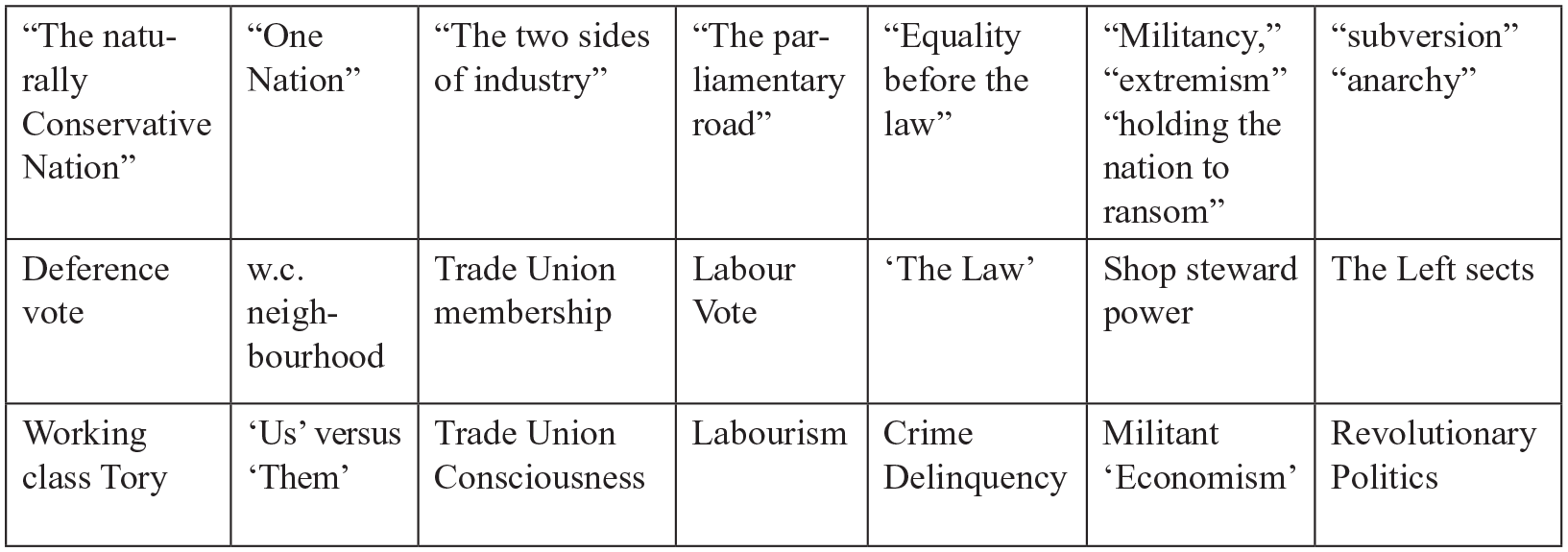
A repertoire of negotiations and responses.
The first is that the search for a singular ‘working class response’ is doomed to failure: instead, the idea of a repertoire points to multiple, co-existing possibilities that a class (or more precisely, segments of a class) might move between, or even inhabit simultaneously. This was forcibly drawn back to my attention in the arguments that have emerged around the rise of different authoritarian-nationalist-populisms in multiple locations in recent decades. At various points, the de-industrialized (or ‘left behind’) working class have been invoked as the core support for these political developments (see the discussion in Morrison, 2022). Sometimes, this entity is more precisely specified as ‘older, working- class, white voters who lack the educational qualifications, incomes and skills that are needed to adapt and thrive amid a modern post- industrial economy’ (Ford and Goodwin, 2014: 278; see also Sobolewska and Ford, 2020), set against a liberal or cosmopolitan cultural/political shift. Winlow et al. argue that in the moment of Brexit, ‘It quickly became clear that many of those who occupy the nation’s dead and decaying deindustrialized zones had voted to leave’ (2017: 198). This view of the working class suffers from a reductive view of class itself (and a tendency to collapse the working class into the ‘white working class’) and ignores the dynamic connections between shifting class formation and shifting repertoires of possible negotiations and responses.
The discovery/invention of this ‘white working class’ has been the focus of sustained and significant criticism. For example, Virdee and McGeever have explored how the category of the ‘white working class’ was deployed as a way of framing this ‘post-industrial’ period and naming racialised Others (‘migrants’) as the driving force of working- class immiseration. As a consequence, they argue, ‘the white working class – a descriptive and analytic category whose origins lay in social science research – has over the course of this decade-long crisis been brought to life as a collective social force in the Thompsonian sense, such that some working class men and women now understand and make sense of the real economic pain they suffer through such a racialized frame of white victimhood’ (Virdee and McGeever, 2023: 142; see also Bhambra, 2017, on ‘methodological whiteness’ and Shilliam, 2018).
Virdee and McGeever go on to argue that: ‘Today, working class pain – which, necessarily, is multi-ethnic pain – has come to be understood by substantial numbers of mainly older people through a racialized anti-immigrant lens. The long-term absence of any multi-ethnic class narratives and erosion of working class agency, combined with New Labour attempts to racialize class politics and its subsequent comp0liciuty in imposing austerity, helped carve open this space for the injuries of class to be recast through the politics of racist resentment’ (2023: 143).
It is significant that Virdee and McGeever identify working- class men and women, given that so much of the ‘white working class’ narrative has been centred on men. As Mondon and Winter note, ‘the postindustrial working class is not only presumed to be white, but male. White men are posited as having lost their jobs, earning power, status and ability to support and protect their family and maintain their patriarchal and masculine power’ (2019: 517). These issues – and questions about the historical making of the ‘white working class’ – are taken up at greater length in Clarke (2023; especially chapter 4).
The second thing that the grid might teach us involves the historical specificity of working class responses, shifting as the material, cultural and political conditions of possibility change. The RTR grid reflects (and condenses) a distinctive period – the long Fordist conjuncture of post war-global capitalism (and its UK variants), entwined with the longer history of working class political-cultural formations (such as the ‘warrenning’ of the larger society and the characteristic forms of situated working class community). But the large scale transformations of the British social formation since the post war settlements collapsed in the mid-1970s undermined many of the conditions for those negotiations and responses.
In the decades that followed, the peculiar Thatcherite assemblage of nationalism, authoritarianism and neoliberalism drove a fierce deindustrialization. Deindustrialization was accompanied – and not accidentally – by equally profound processes of desocialization and decollectivisation. Desocialization points to the reversal of the characteristic capitalist development of socialized relations of production. Instead, waged labour in the Global North became increasingly fragmented, as traditional manufacturing (and extractive) labour processes were abandoned, automated or exported. Conditions of employment became increasingly contingent (Leach and Winson, 2002) and individualized as non-unionized labour expanded, not least in the form of the compulsory ‘self-employed’ status that accompanied much work in the so-called ‘gig economy’. Many of these changes were accompanied by a tendential shift in the gendering of waged work, with an increasing proportion of women in paid employment (albeit often part time and precarious). These changes were linked to the expansion of service sector employment, including the commodification of (highly gendered) care work and the transnational flows of migrant care workers associated with it (see, e.g. Raghuram, 2012; Williams, 2010, 2021).
These processes of desocialization went hand in hand with decollectivisation: the dissolution of a variety of forms, practices, institutional sites and organizations that had provided local and national infrastructures for forms of working-class consciousness and solidarity (from WEA classes, trades unions, local councils and councillors to public services (housing, education, libraries, the NHS). Such infrastructures were always profoundly contradictory, not least as sites for the reproduction of forms of subordination, including varieties of patriarchal, heteronormative and racialised domination. But they were both a connective tissue that underpinned what are often called ‘working-class communities’ and the sites for struggles against such oppressive tendencies as new conceptions of solidarity were (sometimes) forged. These entangled changes elicited – of course – new negotiations and responses as the forms in which subordination was lived created new demands and possibilities. In the figure 2 below, I have tried to offer a preliminary sketch of some of these as a way of marking the conjunctural dynamics of class formation – but a sketch is all it is. I have tried to catch a sense of the shifting forms and formation of a working class in transition and subjected to fragmenting pressures. Politics and culture form the organizing concerns as in the RTR version but, despite some overlaps, the mixture of emergent and residual forms and practices does not map directly on to the older version.
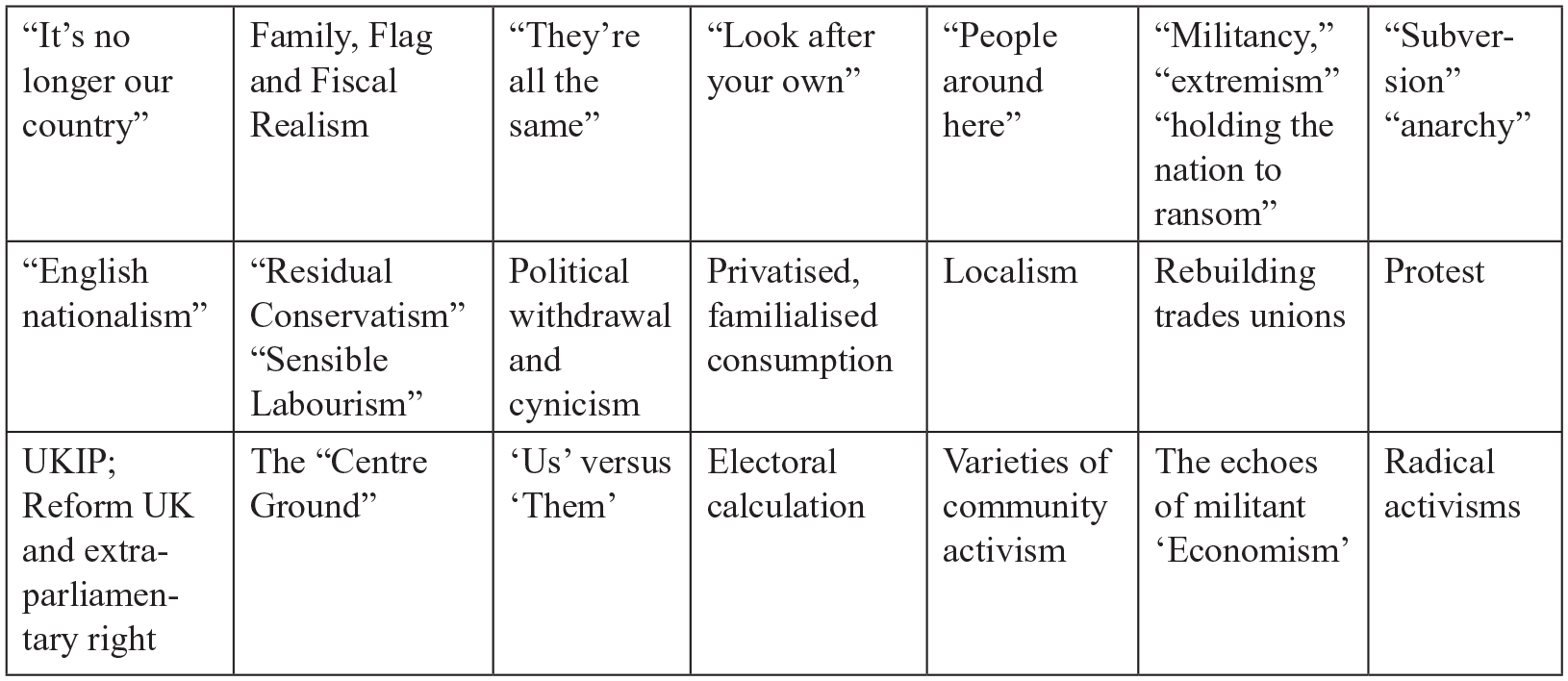
A possible repertoire of negotiations and responses, circa 2025.
My main concern here has been to recover RTR’s insistence on thinking about class formation as a historically specific and active process, one in which the working class – in all its complexity – is understood as generating multiple ways of living its subordination, even as the material and cultural conditions of that subordination change. There are parallel arguments to be had about the changing formation and practices of the middle classes – but not here. Equally, there are arguments about the articulation of class and other forms of social division and inequality. On all of these fronts, the concept of ‘repertoire’ seems to me to be a powerfully productive way of thinking about the ways in which social groups live their subordination – negotiating, resisting, accommodating and refusing.
Magical solutions
The second issue that I want to return to involves the way RTR talked about subcultures as producing ‘magical solutions’ to the material conditions that different groups of working class youth encountered in the 1960s and 1970s. For example, Dick Hebdige argued that, in the stylistic performances of the Mods, The magical transformations of commodities had been mysterious and were often invisible to the neutral observer and no amount of stylistic incantation could possibly affect the oppressive economic mode by which they had been produced. The state continued to function perfectly no matter how many of Her Majesty’s colours were defiled and draped around the shoulders of skinny pill-heads in the form of sharply cut jackets. (Hebdige, 1975b/2006: 77)
Meanwhile, my own essay on the Skinheads in the collection explored their practices as performing ‘the magical recovery of community’ – magical in part because ‘it was created without the material and organizational basis of that community and consequently was less subject to the informal mechanisms of social control characteristic of such communities’ (Clarke et al., 1975/2006: 83). The persistent use of ‘magical’ was inspired (as was so much else of this work) by the late Phil Cohen’s (who died as I was revising this article) formative work on youth subcultures in which he argued that: The latent function of subculture is this—to express and resolve, albeit magically, the contradictions which remain hidden or unresolved in the parent culture. The succession of subcultures which this parent culture generated can thus all be considered as so many variations on a central theme—the contradiction at an ideological level, between traditional working class puritanism, and the new ideology of consumption: at an economic level between a part of the socially mobile elite, or a part of the new lumpen. Mods, parkers, skinheads, crombies, all represent in their different ways, an attempt to retrieve some of the socially cohesive elements destroyed in the parent culture, and to combine these with elements selected from other class fractions, symbolising one or other of the options confronting it. (Cohen, 1972:23)
At the core of this argument is a view of the symbolic realm as a site of displacement – a domain in which material processes and emergent contradictions can be worked on by appropriating diverse cultural resources and remaking them in new forms and combinations (what RTR called ‘bricolage’, following Levi-Strauss). But to the extent that these displacements cannot, so to speak, generate ways of working on the material conditions of the contradictions, the ‘resolutions’ are doomed to remain magical (or merely symbolic).
Some years later, Policing the Crisis (Hall et al., 1978; trailed in RTR in a reflection on the making of a law and order campaign, CCCS Mugging Group, 1975) engaged with processes of displacement in a rather different way in its exploration of the multiplying crises of the post war settlements (economic, political, social, and the crisis of authority itself). This was a rather different project but was linked by both the people working on them both and a deepening engagement with a Gramscian examination of the conjuncture (see Jefferson, 2021, chapters 2 and 3 for a fuller discussion). In Policing the Crisis, attention focussed on how the dynamics of the intersecting crises were ideologically displaced into the proclaimed crisis of ‘law and order’: When such discrepancies appear between threat and reaction, between what is perceived and what that is a perception of, we have good evidence to suggest we are in the presence of an ideological displacement. We call this displacement a moral panic. This is the critical transition point in the whole argument. (Hall et al., 1978: 29) . . . The actual ideological passage into a '‘law-and-order’ society entails a process of a quite specific kind. Crucially, in the early years of our period, it is sustained by what we call a displacement effect: the connection between the crisis and the way it is appropriated in the social experience of the majority - social anxiety - passes through a series of false ‘resolutions’, primarily taking the shape of a succession of moral panics. It is as if each surge of social anxiety finds a temporary respite in the projection of fears on to and into certain compellingly anxiety-laden themes: in the discovery of demons, the identification of folk-devils, the mounting of moral campaigns, the expiation of prosecution and control - in the moral-panic cycle (1978: 322).
The political-cultural dynamic of displacement – and the associated promise of ‘resolutions’ which take magical form precisely because of the process of displacement – persist into the present, possibly on an even larger scale. It is difficult to view the accumulating crises of recent years – in the UK and elsewhere – without seeing such practices of displacement. The financial crash (itself the result of certain types of magical solutions in economic form) was multiply displaced – from financial crisis of the global economy into fiscal crises of nation-states as they spent public resources to stabilize economies, and from fiscal crises to the promise of Austerity as resolution – what Janet Newman and I described as ‘the alchemy of austerity’ (2012).
Subsequently, deepening crises of authority have been met by further displacement strategies, many of them variants on all too familiar themes. So, we encounter recurring moral panics about the behaviour of the young; the recurring crises of law and order (drugs, knife crime and the new kid on the block, historically speaking, terrorism); the dangers of protest (especially around climate crisis protests) which require new police powers, new legislation and extended state reach; and, of course, about the ‘culture wars’. In each case, we have to trace the displacement of material relations, practices and conflicts into new framings that typically aim to de-politicize and de-socialize these specific conditions and transmute them into the domains of the moral and the legal. Across these different domains, the trajectory remains grimly familiar: only a restoration of Authority can resolve these problems.
The work of displacement – in political cultures as much as in cultural politics – creates the condition for the crafting of ‘magical resolutions’ which work to shift the accumulated contradictions, tensions and antagonisms of the present moment to other terrains. I do not think that they are exactly the same: the practices of stylistic displacement in subcultural styles were grounded in subordinated social locations and relations, where the ideological displacements of the present conjuncture are located in efforts to shore up power blocs and to secure forms of rule (if not hegemonies). Nonetheless, the attention to displacement in the creation of magical solutions is, I think, a process that is different from what has been called ‘magical thinking’ – a term taken from psychology to describe the dynamic in which people believe that their thoughts can change reality. As the magazine Psychology Today puts it: ‘Magical thinking—the need to believe that one’s hopes and desires can have an effect on how the world turns—is everywhere’ (https://www.psychologytoday.com/gb/basics/magical-thinking). I have chosen to cite Psychology Today here precisely because the psychologization of magical thinking compounds and conceals multiple possibilities of how the relation between thought and outcomes might be imagined, as well as universalizing the phenomenon in question. In contrast, I think there is a more concrete – and more conjunctural – question about the multiple ways in which the idea of ‘magical thinking’ has entered the landscape of social and political analysis in recent years to account for the dynamics of political discourse in (loosely put) authoritarian-nationalist-populist times.
Illiberalism, the far right and government by performative declaration are among the developments that have been addressed and analysed through the frame of ‘magical thinking’ (see, e.g. Barrett, 2019; Taguieff, 2024; White, 2024). The distinction that the concept of magical thinking often invokes is expressly articulated in a study of US politics (Oliver and Wood, 2018) which is structured around a comparison between ‘Intuitionists’ and ‘Rationalists’ (you can probably guess the political distribution of these categories). This fits with the liberal academic tendency to dismiss populism as irrational and defend the rationality of liberalism (see Rancière’s critique, 2016). There are a few problems with such distinctions, both about the presumed superiority of liberalism(s) and about the varieties of magical thinking concealed within liberalism as a political rationality: from eternal growth to the hidden hand of the market; from reasoned debate to the sovereign individual – that nominally unmarked embodiment of possessive individualism.
Two points flow from this for me. The first is that ‘magical thinking’ is an empty signifier, capable of being deployed against almost any form of thinking that we might disagree with and is itself a de-politicizing discursive strategy (we are realists, they are magical thinkers). The second is that it tends to individualize (and de-historicize) what are historically grounded social practices of thinking and acting – whether that be subcultural styles or political-cultural strategies for addressing crises of authority. In those forms, the practices of displacement involve collective forms of (limited, historically specific) agency that generate magical solutions to collective problems. And I think that the dynamics of such processes are worth returning to in the current conjuncture while attempts continue to be made to magically resolve the massive accumulation of contradictions and conflicts in which we are enmeshed. If that involves distinguishing carefully between different forms of magic (superstitious thinking by wrong-headed people vs collective practices of cultural transformation) then so be it.
Talkin’ ‘bout my generation (again)
The analysis of subcultures in RTR focussed on the shifting relations between the parent culture and the subcultures of young working class people. It addressed the articulation of class and generation in contrast to the more common analysis of youth culture as a purely generational phenomenon. In brief, we argued that the post-war phenomenon of Youth and Youth Culture was taken to symbolize a shifting national (and international, or at least, US-centric) culture, in which Youth both embodied and expressed key dynamics of social change. Whereas previous generations were shaped by the experience of either the Depression years or the War, young people were seen as the product of the new: But ‘youth’ was wholly and exclusively in and of the new post-war world. And what, principally, made the difference was, precisely, their age. Generation defined them as the group most in the forefront of every aspect of social change in the post-war period. Youth was ‘the vanguard’ of social change. Thus, the simple fact of when you were born displaced the more traditional category of class as a more potent index of social position; and the pre-war chasm between the classes was translated into a mere ‘gap’ between the generations. (Clarke et al., 1975/2006: 14)
In the emergence of Youth as a category, larger social dynamics were condensed. RTR suggest that there were three critical dynamics at stake: affluence (new patterns of consumer spending), consensus (new political alignments around a mixed economy, state intervention and welfarism), and embourgeoisement (the projected disappearance of class differences that followed from working class affluence). I am not going to revisit the detailed arguments about the framing of Youth as a generational phenomenon, but want to turn our attention to the way in which RTR’s commitment to analysing the articulations of class and generation: Here we begin to see how forces, working right across a class, but differentially experienced as between the generations, may have formed the basis for generating an outlook—a kind of consciousness—specific to age position: a generational consciousness. We can also see exactly why this ‘consciousness’, though formed by class situation and the forces working in it, may nevertheless have taken the form of a consciousness apparently separate from, unrelated to, indeed, able to be set over against, its class content and context. Though we can see how and why this specific kind of ‘generational consciousness’ might arise, the problem is not resolved by simply reading it once again out of existence—that is, by re-assigning to youth a clear and simple class-based identity and consciousness. This would be simply to over-react against ‘generational consciousness’. (Clarke et al., 1975/2006: 39)
For me, this is a classic Cultural Studies argument – critiquing generation as a category and arguing for the centrality of class, while refusing a simple replacement of one by the other. Instead, we insisted on thinking about the (complex) relationships between class location and age specific experiences that might generate a sort of ‘generational consciousness’ to whose specificities we must attend. I have these issues at the forefront of my mind now because of the scale at which the idea (both image and concept) of generation has come to command so much current political, cultural and social analysis in the UK. For example, writing for the right wing thinktank the Institute for Economic Affairs, Niemietz warned his audience that a generational shift from right to left was under way – one that does not conform to the projected cycle of youthful radicalism’s transformation into conservatism with age: We therefore cannot dismiss these people’s opinions with phrases like ‘they are just going through a phase’ or ‘They will grow out of it’, as if we were talking about a teenager in a Che Guevara-shirt. It is true that socialist ideas are most popular among the young, but that is ‘the young’ in its broadest sense – the ‘young’ in the sense of ‘people up to their early 40s’, not the young in the sense of ‘recent school leavers’. (Niemietz, 2021, p. 19).
The problem which the Right has failed to take seriously, according to Niemietz, is that the young are not ‘growing out of it’ as they get older and supporters of capitalism need to ‘get their head out of the sand’ and ‘stop pretending’ that this is not happening (Niemietz, 2021, p. 69).
Others have noticed similar trends. Sobolewska and Ford’s analysis of ‘Brexit Britain’ (2020) points to ageing and ‘left behind’ working class voters as the core of the Brexit vote and with affinities to parties to the right of the Conservatives (UKIP, Reform, etc). In contrast, younger voters are more culturally liberal. There are, however, complications in the process of mapping such age/generation formations onto a complex and contradictory social formation. There are significant material conditions at stake in these generational differences as The Resolution Foundation and LSE’s Centre for Economic Performance’s study, Stagnation Nation, demonstrates. The study argues that growing inequalities of income and wealth have a distinctive generational dynamic, affecting life chances, intergenerational mobility and resilience in the face of the UK’s pattern of decline: The UK’s combination of relative decline over the past 15 years and high inequality for the past four decades is a dangerous combination. If sustained, they risk the UK entering a prolonged period of stagnation, posing serious risks to not just our economy but to our society and democracy too. The poor and the young are especially hard hit. Those on low incomes are left with no resilience in the face of today’s fast price rises, while younger workers increasingly find themselves concentrated in lower-paying work without the compensation of benefiting from surging house prices enjoyed by old generations.
In this process, the ‘Baby Boomers’ (the generation born 1946 to 1964 who benefitted from the post war settlements) have emerged as economic winners, accruing wealth (investments, pensions and housing wealth), whilst subsequent generations (Gen X, Millennials, Gen Z) have fared less well (see the overview by Martin and Roberts, 2021). Indeed, ‘Generation Rent’ (those aged between 18 and 40 in 2020) have, it is argued, lowest chance of owning their own home since the 1950s (Timperley, 2020). Such outcomes are not, of course, the simple result of economic processes. Rather they reflect strategic and calculated political decision-making in taxation policies, in subsidies for home owners and other housing policies (e.g. Thatcher’s Right to Buy scheme in the 1980s) and in pension policies.
William Davies has analysed the Conservative coalition that emerged between the 2016 Brexit vote and the 2019 General Election as what he terms ‘an alliance of rentiers’ However, he suggests that: ‘The “no deal” supporters are not classic rentiers. . . . However, they are at a point in life where they have paid off their mortgages, and are living off the assets held by pension funds’. He went on to argue that: What this group shares with the Johnson/ Farage backers is a lack of any immediate interest in labour markets or productive capitalism. What’s the worst that could happen from the perspective of these interests? Inflation or a stock market slump would certainly harm them, but they may have forgotten that these things are even possible. Jeremy Corbyn terrifies them even more than Remain, as they believe he will tax capital, gifts and inheritance into oblivion (they are less concerned with income tax as they don’t pay it). Where productivity gains are no longer sought, the goal becomes defending private wealth and keeping it in the family. This is a logic that unites the international oligarch and the comfortable Telegraph-reading retiree in Hampshire (Davies, 2019).
Following the 2008 financial crash, this coalition and the Conservative Party dominated the shape and direction of British politics (up until 2023/4). The question of wealth – how it is imagined, possessed, protected and transmitted – has been central to the conjuncture dominated by the fantasies and failures of neoliberalism’s many varieties. This imaginary of wealth, articulated in a nexus of individualizing and familializing framings, has also been a powerful force in forming and fixing the centrality of generational categorization in material and symbolic forms.
So, the return of generation and generational consciousness to political-cultural life is hardly accidental. But the attempt to formulate simple generational differences – and indeed antagonisms – risks erasing the questions that preoccupied us in the 1970s: how are generations and class (and one might add, all those other social relations that bear on both material circumstances and dynamics of identification) articulated? For example, an article in the Independent newspaper begins with a warning about how images of generations oversimplify things yet proceeds unerringly to generational conflict: Despite obviously not being a totally watertight metric, it is undeniable that generational divides are reflected in responses to real-world issues and in cultural conversations. Unsurprisingly, two of the biggest issues to affect modern society – Brexit and the pandemic – are frequent sources of generational conflict. While older people are more vulnerable to Covid in terms of their health (the latest ONS stats show that even though more young people have been infected, hospital admissions and deaths are highest among those aged over 65), research from Ipsos MORI suggests that younger people have struggled more economically. A survey in April last year found that 35 per cent of Gen Z were worried about whether they would still have a job in a month’s time and 30 per cent were worried about paying bills, compared to eight and 10 percent of baby boomers, respectively. These tensions along generational lines also surfaced in the 2016 Brexit referendum, too – 75 per cent of 18-24 year olds voted to remain, while 66 per cent of those aged 65-74 voted to leave. Lib Dem Vince Cable told a reporter: ‘The older generation shafted the young’. (Aron, 2021)
The voting distribution for Brexit was indeed dramatically skewed by age but there are dangers in either reifying age/generational differences or in refusing them as a political strategy for concealing or distracting from other material divisions (such as class; see Bristow, 2019). The ‘generation’ that voted for Brexit contained strikingly different material conditions and motivations for voting, combining fractions of the ‘left behind’ working class of England and Wales and the post-colonially anxious traditional middle classes (see Clarke, 2023 and Cochrane, 2020).
Some of these questions have been explored in a paper by Crisp and Pearce (2021). They examine differences in voting choices between generations (with an increasing inclination to vote Conservative among those over 54) and differences in propensity to vote (with older age groups significantly more likely to vote than younger ones). For example, in the 2019 General Election, 53.6% of those aged 18–34 voted, while 77% of those aged 65 and over did so (Crisp and Pearce, 2021: Table 1). But they also demonstrate that wealth, home ownership and other material conditions play a strong role in shaping both the propensity to vote and the direction of voting. In particular, they draw on work by Green and Pahontu examining how wealthy home owners were inclined to vote Leave in the EU referendum, being cushioned by their wealth against possible risks of voting to leave the EU. Green and Pahontu argue that: We provide evidence that the mechanism linking wealth and higher Leave support is via wealthy voters’ expectation that Brexit would not impact their personal finances, and we show that an increase in wealth lowers risk-aversion. . .Wealth insures against the risks associated with a change to the status quo. This means that while many poorer individuals may have held a preference for Leave, they were less likely to vote for Brexit given their lack of economic insurance. (2021, p.22)
The significance of such Brexit voters has been much debated in the aftermath of the referendum, with claims about a ‘working class revolt’ being countered by scholars such as Dorling (2016) and Kim Moody who argued that ‘In short, the so- called “Revolt Against the Rich” came heavily from the “Upper” and richer social stratum itself, reinforced by much of the “Middle” class. Together, those from the upper half of society composed almost 60% of the Leave vote’ (Moody, 2016; see also the discussion in Virdee and McGeever, 2018: 139–141).
Crisp and Pearce conclude that ‘we cannot account for the age divide in political preferences simply by reference to values divides between the generations. Whilst such divides undoubtedly exist, it is important to examine the inter-relationship of identities and values with economic and social class formations’ (2021: no page number). Indeed, in the context of Brexit and later political realignments, we should conclude that neither a single generation, nor a single class ‘won it’. Rather, we are reminded once again that politics is precisely conducted through the assembling and articulation of coalitions, alliances and blocs. Perhaps more tellingly, Newman’s critique of static conceptions of generation that emerged during a study of feminist politics insists on its mutable and contested character: ‘these three concerns – with generation as multifaceted, dynamic and recursive – challenge static notions of identity. But they point to theoretical and empirical questions inherent in the politics of intersectionality’ (2014: 468). Many of these same challenges appear in recent approaches to rethinking the conceptual and political value of ‘generation’. Martin and Roberts argue that: public discourse on the topic recently has tended toward increased ‘generationalism’, described by White (2013, p. 216) as ‘the systematic appeal to the concept of generation in narrating the social and political’. Moreover, although White observed such an approach was ‘in vogue’ in 2013, it has become more than a passing fashion, with debates surrounding ‘generation wars’ continuing apace in popular culture and news media throughout the English-speaking world and much of the global North (2021: 730).
Meanwhile, Pina-Cabral and Theodossopoulos (2022) have also warned against the reification of ‘generationalism’ and in favour of an understanding that treats generations as both coeval (sharing time and space in differentiated ways) and conjunctural. They argue that: The underdetermination of generation is a function of the complex interaction between coevalness and contemporaneity in everyday social life. Rather than being an insurmountable problem, the complexity allowed by the underdetermination of generations opens analytical space for intersectional referents of personal experience (inter alia, gender, class, race/ethnicity), without closing them within singular, overdetermined explanatory frameworks. As emergent entities within social life, generations invite critical attention to the inexhaustible, layered nature of sociation out of which emerge constellations of meaning and power. (2021, p.15)
Their analysis creates a return to thinking the articulated specificity of generations and generational consciousness in place of the dominant framings that separate, reify and essentialize the generations (from boomers onwards). It returns the argument to the conditions in which forms of generational awareness may emerge (Pina-Cabral and Theodossopoulos turn to Raymond Williams’ ‘structure of feeling’ here). They point to a way of thinking about generations that avoids the essentializing of generation itself or its displacement by another master category (class, e.g.). Rather they illuminate the anti-essentialist view of RTR – which we might now rewrite as: social relations of all kinds are articulated formations in which material and symbolic differences combine to produce both distinct experiences and distinctive responses. Substituting generation for class (or indeed any other social relation) is no solution for doing the analytic work of understanding conjunctural formations – and how they are lived.
Conclusion
The Birmingham subcultures group – and the work that went into Resistance Through Rituals – was a profoundly formative experience for me. It taught me much about the problems of thinking, especially about the concrete phenomena at issue, whether subcultural styles or the construction of mugging – whose emerging significance was traced within RTR. More significantly, it introduced me to the possibilities – and challenges – of working collectively to engage with such matters. The search for such collaborative possibilities has continued to shape my working life.
More substantively, the three themes that I have sketched here have threaded themselves through different aspects of my work, even as they have been developed, adapted and revised through ‘critical dialogues’ (Clarke, 2019). I have been inspired by the view developed in RTR of class (and generation) as lived relations in which subordination is both inhabited and responded to, and not simply a fixed position in a structure. The challenges to our formative focus on class have over the years made me think about the intersections of different forms of subordination that are in play within a specific social formation. By the time I came to write about the current conjuncture in the UK, I was arguing that: the social is a field characterised by shifting and contested ‘mappings’ (Catherine Hall’s phrase [2002: 20]) of difference through which inequality and power are ordered – and challenged. As a result, social reproduction is also always complex (and contested) given that it involves the reproduction of heterogeneous social relations, even as they are being contested. This matters because it is in the field of the social that people live their lives, imbue them with meanings and affects, come to adapt, succumb, refuse and resist – all in unsettled combinations of material and imaginary relations. (2023: 110)
Secondly, our use of Phil Cohen’s notion of ‘magical resolutions’ as a way of understanding both the potency and limits of subcultural practices has come back to haunt me on a regular basis, most often as I watch/listen to the most recent attempt by political actors (of many kinds) to displace antagonisms, conflicts and contradictions from their formative conditions to a different domain. This has been most visible in the endless efforts to transpose the current flows of migrating people into other – more advantageous – terms: a ‘migrant crisis’, a question of ‘sovereignty’ or, most perniciously, a ‘crisis of illegality’ (as the UK invented and legislated into existence the ‘illegal immigrant’). Such political-cultural work is profoundly performative (this is discussed more fully in Clarke, 2025). I do not mean this in any shallow sense: for example, much UK discourse and legislation has been condemned for its ‘performative cruelty’. This is certainly true but the work of the state – and the political-cultural practices through which it is materialized – that ‘make things political’ in determinate ways demand attention to the symbolic labour of forming and fixing meanings.
Thirdly, the attention to social and historical specificity that lies at the heart of the subcultures work at CCCS and was later more explicitly developed in Policing the Crisis as the engagement with the conjuncture, has continued to be an organizing theme for me – and for many others. It emerged from a distinctively Hallian encounter with Antonio Gramsci, tied to Stuart Hall’s search for a non-reductive Marxism and continues to inspire new work – from UK-centric analyses (like my own) to encounters with the ‘global conjuncture’ in the work of Gillian Hart (e.g. 2019, 2024). The challenge of thinking conjuncturally remains one of the most urgent pressures, in both analytical and political terms as ‘authoritarian populism’ mingles with varieties of nationalism in new and explosive forms and as the liberal forms of neoliberalism exhaust their capacity to command consent. In these moments, the willingness to look beyond the conventional ‘theatre of politics’ to less-recognized forms and practices of resistance, refusal and recalcitrance remains vital. RTR was born out of the belief that domination and subordination were not fixed and solid arrangements but were enacted – and remade – in practice.
Finally, I have tried to escape the risks of binary thinking that constantly shadow efforts to theorize the social (and the political). RTR was a process of refusing the reductions demanded by such binary thinking, insisting that subcultures were an articulation of class and generation. Subsequently, feminists demonstrated that binary thinking was a distinctive – and hegemonic – modality with a wide reach and those lessons have stuck with me as a demand that I should do better at thinking both complexly and contingently. Even if I am a ‘baby boomer’, I do not have to behave like one (or at least its stereotype), not least because my formation is (like everyone else’s) neither simple nor singular. Generationally speaking, I was both a ‘baby boomer’ and a ‘68-er’ (or ‘soixante-huitard’ in the elegant French formulation) and, in the process, I was exposed to a series of contradictory, collectivist and emancipatory influences that also have something to do with the other positions I have come to occupy. But most of all, I am a child of Cultural Studies...
Footnotes
Acknowledgements
My thanks to Greg Martin for the idea and to Janet Newman and Gil Rodman for comments on earlier drafts.
Data availability statement
Not applicable.
Declaration of conflicting interests
The author declared no potential conflicts of interest with respect to the research, authorship, and/or publication of this article.
Funding
The author received no financial support for the research, authorship, and/or publication of this article.
Ethical approval and informed consent statements
Not applicable.
