



Abstract
Told in schools across the US for decades, Officer Friendly is a story about policing. Through the literal reading of books like Miss Frances’ 1953 Your Friend the Policeman, visits from McGruff the Crime Dog, and even the ever-expanding TikTok world of dancing SROs, the story remains the same: police keep us safe from the bad guys. In this paper, we draw on data from school and police social media accounts in a community in Alabama to expose the bad faith underpinnings of this story, and how it functions through ‘friendly’ police-youth programming in schools. This story relies on at least three narrative devices to move the plot forward: humanising the violent equipment/tools that police use to harass, maim, and wage death; legitimising the authority of the police through mentorship and education; and naturalising surveillance and suspicion by deputising a naughty pair of Elves on a Shelf. We conclude by proposing that the ultimate function of what we’ve detailed here – the rationale behind deploying these three narrative devices – is to construct a story through which, by the end, we’ve all been recruited into the ‘pig majority’.
Pigs and peacemakers
In a 1971 conversation with James Baldwin, Nikki Giovanni (WNET TV, Soul! 1971) describes a billboard campaign in upstate New York: an image of a tall, white policeman stooping over to give a flower to a small blond child, captioned with “And some people call him ‘pig’.” She counters that she’d like to buy a billboard portraying a ‘big cop with a 14-year-old’, riddled with bullets, captioned: “And some people call him ‘peacemaker’.” The billboard Giovanni references attempts to present two stories–one that is ‘real’ (the policeman bringing joy and safety to a child), and one which the viewer is made to believe must be fiction, as it would cause someone to call that obviously well-meaning officer a ‘pig’ (an ill-natured ‘beast’ that engages in violence regardless of provocation, Seale, 1970). Giovanni’s retort presents a counterstory that engages with this implicit ‘fictionalised’ one. In her imagined billboard, the real story of policing and its ever-violent plot is laid bare through satire, as the mere notion that the same officer who riddles a 14-year-old with bullets could keep anyone safe, is made to feel ridiculous, fantastical even. This type of public counterstory, however, is rare, especially regarding the relationship between police and youth.
Told in schools across the US for decades, Officer Friendly, much like that NY billboard, is a story about policing. Through the literal reading of books like Miss Frances’ 1953 Your Friend the Policeman, visits from McGruff the Crime Dog, and even the ever-expanding TikTok world of dancing SROs, 1 the story remains the same: police keep us safe from the bad guys. Whether by their mere presence that functions as a protective deterrent, their ideological socialisation of students into law-abiding and ‘normative’ behaviours, or their direct surveillance, identification, and neutralisation of potential threats, police defend the thin blue line (Wall, 2020), or so the story goes.
In this paper, we use images from school and police websites and social media accounts in a community in Alabama to interrogate this storytelling. In doing so, we expose the bad faith underpinnings of ‘friendly’ police-youth programming, including that which happens in public schools. This story relies on at least three narrative devices to move the plot forward: humanising the violent equipment/tools that police use to harass, maim, and wage death; legitimising the authority of the police through mentorship and education; and naturalising surveillance and suspicion by deputising a naughty pair of Elves on a Shelf. This storytelling ‘actively counters attempts to hold police malfeasance accountable by reinforcing the ideas that the police are generally fair and hard-working’ (Neal, 2020), and that those who find themselves with a department-issued Glock aimed at their back undeniably deserve it. But it also brings to all who consume it the normalisation of the ‘power, presence, and violent practices of the police. . . the state’s monopoly over violence. . . [and] the social order of racial capitalism’ (Hatrick and Gonzalez, 2022). In what follows, we contextualise a range of Officer Friendly programming in schools, in addition to theorising about Copaganda. We then outline our methods, including ideas about how the stories we captured work as contemporary Copaganda.
Good morning, officer friendly
The Officer Friendly program was first instituted by the Chicago Police Department in 1966. By 1979, under the guidance of the Sears-Roebuck foundation, it had expanded to 233 communities (National School Resource Network, 1979). The aim of the program was ‘to humanise children’s perceptions of police officers and their work, improve rapport between children and police, increase awareness of safety and civic responsibility, and reduce crime involving children’ (National School Resource Network, 1979: 1). The timing of the program’s development was not a coincidence. According to a Sears-Roebuck representative, ‘In the 1960s, it was a very turbulent time. Police were called names and we felt there was a need for the children to see police officers as human beings’ (Bass, 1986). Beyond the violence towards Civil Rights and anti-war activists, the kids of working-class parents and grandparents were also likely to have heard stories of police acting as strikebreakers, protecting business interests and property, not people (Myers, 2019). At the same time, television shows portrayed police as ‘shoot-em-up’ characters, making it ‘difficult for a child to identify with the proper role of a police officer’ (Derlega et al., 1978: 4).
The school, as a primary site for socialisation, was the most logical space for children to have their ‘misguided’ perceptions of police corrected, or countered, through exposure to a different narrative. In its original form, the Officer Friendly program involved police conducting classroom visits and providing educational sessions, while students worked through activity workbooks that they were encouraged to take home and ‘share with family and friends, in order to better acquaint the child’s community with the positive efforts and contributions afforded the child as part of his classroom experiences’ (Derlega et al., 1978: 11). While the style and structure of lessons, workbooks, and visits varied, the Norfolk, Virginia Public Schools’ Officer Friendly program (Derlega et al., 1979) provides an illuminating example. In 1976, Norfolk Public Schools and the Norfolk Police Department partnered with Sears-Roebuck and the FBI to design and implement an Officer Friendly Program from kindergarten to second grade. Two policemen were selected as ‘Officer Friendlies’ and worked with members of the programme committee to develop lesson plans, audio-visuals, and workbooks. After being trained, the Officers visited classrooms three different times. The first visit attempted to establish the humanity of the officer by showing slides of him engaging in off-duty activities, like spending time with his family. This visit also clarified the various duties of officers, such as traffic management and working with K-9s. The second visit focused on teaching the kids about ‘safety’, most notably how to identify dangerous household items and intervene if they witnessed a peer engaging in problematic behaviours. The final visit emphasised strategies to avoid becoming a victim, such as locking up one’s bike and alerting authority figures to suspicious people. After each visit, the classroom teachers led activities reinforcing the ideas presented by the Officer (Derlega et al., 1979).
As the National School Resource Network (1979) admitted, this programme sought to perform multiple functions: by having positive interactions with police, children would come to not only respect police and the laws they enforce but would also see policing as an institution of care and protection. Indeed, an evaluation of the Norfolk programme concluded that ‘participation in the Officer Friendly Programme may improve children’s attitudes about a police officer’s role and increase their degree of comfort interacting with an unfamiliar police officer’ (Derlega et al., 1979: 226). However, Officer Friendly had, quite literally, nothing to do with confronting or addressing the reality of policing that many students and their families faced. This isn’t much of a surprise if we consider Correia and Wall’s (2018: 141) assertion that Officer Friendly is: an agent of pacification. His ‘friendship’ comes at a price: accept the police definition of reality and mold yourself and your family into ideal police subjects – polite, polished, obedient workers and snitches, who never question the racial order of capitalist property relations.
The bad faith of Copaganda
While ‘Officer Friendly’ names a specific school-based program, it can also be used to describe a capacious set of efforts to both counter negative perceptions of police and normalise the presence and practicing of policing – a form of Copaganda, or ‘propaganda favuorable to law enforcement’ (Kaba and Ritchie, 2022: 183). Encompassing everything that props up the ‘police definition of reality’ that ‘there is no civilisation without police, because police is civilisation and civilisation is police’ (Wall, 2020: 322), the form police-driven Copaganda takes depends on the particular image or narrative policing is trying to counter (see Petersen, 2024). If public admiration is waning, Police Departments might employ ‘trophy shots’, or pictures of officers proudly posing with seized materials like illicit substances or even stolen diapers and baby formula (Linnemann, 2017). If the public needs to be reminded of the ‘dangers’ 2 of policing, a three-acre national memorial for officers who died in the line of duty 3 might do the trick. Or, to counter images that show the brutality of policing, officers initiating traffic stops need only give drivers ice cream cones (Nelson, 2016) to bring their attention back to the ‘good apples’. In essence, Copaganda props up ‘[t]he idea that life itself, or at least a life worth living, is impossible without police’ because, the story goes, without those heroic defenders of the thin blue line, ‘savagery and predation would prevail’ (Wall, 2020: 319, emphasis theirs).
This story is, of course, a myth – one of ‘bad faith’, wherein the consumer of it (or even the characters themselves) can flee a ‘displeasing truth for a pleasing falsehood’ (Gordon, 1995: 8). Instead of seeing the violence of drug raids and the criminalisation of poverty or feeling the quickening of someone’s heartbeat as the red and blues flash in their rearview, we deceive ourselves and others to maintain a worldview (Tichavakunda, 2021) that is firmly planted in that police definition of reality. Put another way, Copaganda allows us to believe that policing is good and necessary – despite so much evidence to the contrary.
Methods
Replacing the billboards of days past, contemporary police-driven Copaganda often takes the shape of storytelling via social media posts. As Wood and McGovern (2021: 309) argue, police are now ‘media content producers in their own right’ and:
have come to acknowledge how important managing and controlling their public image is, and how such activities are a significant step towards (re)building legitimacy in a landscape where police are at the same time less and more ‘visible’ to the public than ever before.
Through social media, police have direct access to communities, where they might communicate information about crime, threats, and warnings, ‘but also messages with a more image management flavour, such as stories about the newest litter of police puppies, or the latest batch of police recruits’. (ibid). School and community social media accounts also both share police posts and craft their own, reinforcing, circulating, and perpetuating these narratives that are so friendly to policing. This storytelling via social media works towards legitimising certain perspectives wherein different types of ‘tales’ serve to reinforce different aims. As Van Leeuwen (2007: 105–106) explains: In moral tales, protagonists are rewarded for engaging in legitimate social practices, or restoring the legitimate order. . .Cautionary tales, on the other hand, convey what will happen if you do not conform to the norms of social practices. Their protagonists engage in deviant activities that lead to unhappy endings.
For example, social media posts depicting smiling children in classrooms as police give them stickers serve to signal how ‘good behaviour’ is rewarded, thus working to normalise and even stoke the desire to comply and obey, embodying the desired moral, ‘good guy’ image. In a police social media feed, these ‘moral tales’ are juxtaposed with images of ‘wanted criminals’ and requests for the community to share information, asking ‘Have you seen this suspect?’ or even mug shots of folks who were recently arrested. These posts serve as ‘cautionary tales’, reinforcing ideas about ‘bad guys’ so integral to bad faith narratives about policing and instilling in those who read them “the feeling of protection and benevolence, until. ‘I’ll protect you, as long as you’re on the right side’” (Onion, 2020). For our purposes, we hone in on the posts and images 4 that work to tell pro-police stories in one educational community context in Alabama.
Context
Alabama, home to some of the most violent historical images of police, brandishing batons, directing firehoses, and siccing dogs on Black protestors, for example, is also now home to the headquarters of the National Association of School Resource Officers (NASRO), and even small communities often have well-funded youth-police programming. The community at the centre of our analysis has an extensive, financially robust, and award-winning School Resource Officer program. The programme is a collaborative effort that spans the county sheriff’s department, the municipal Police Department, and the city and county school systems. The approved municipal budgets each year include funding for the SRO programme in addition to community ‘outreach’ programming that is a regular feature of students’ schooling and extracurricular experiences in the area. The local city school system is composed of just under 60% Black students according to the latest data from the Office for Civil Rights; the county school system, by contrast, is overwhelmingly white (70%).
Data and methods
The first author had been regularly following local social media accounts to explore linkages between and among policing and local school systems. Once we collaborated on ideas for the current study, we began to search social media sites of the school system, the Police Department, and the sheriff’s department for key ideas related to police dogs, surveillance, curricular interventions about and by police, and other posts relevant to the technologies of police and schools. We screenshotted all relevant posts from the last 2 years into folders and labelled them by event and content. As we reviewed the images we had collected, our analysis began to coalesce around three interrelated bad faith narratives that comprised this Copaganda: efforts to humanise and ‘friendify’ police technologies; educative efforts to legitimate police authority; and efforts to normalise discipline and surveillance. 5 In the following sections, we interweave images from social media, interpretive commentary, and theorising about policing to argue that in school communities, police-youth programming and the PR campaigns devoted to bolstering its Copagandist logics function to not only legitimate police and socialise students into the inevitably of police, but also to trivialise and desensitise students to the horror that is policing (Linnemann, 2022).
Humanising violent technologies
A wink, a nod, and a smile
Officer Friendly, Correia and Wall (2018: 143) write, ‘hails his subject with a wink, a nod, a smile’, and much like the original Officer Friendly programming, many of the social media posts we reviewed captured this salutation. These posts tell a story of police as ‘nice, everyday people’, humanising them to community. For example, one collection of posts documented an outreach event at an elementary school, including photos of smiling and laughing officers, posed with arms around students (see Figure 1). Students held drawn pictures of the officers they’d met during the session, captioned ‘A few of our Hispanic officers and SROs talked to parents and students about our mobile app, text 9-1-1. . . and answered lots of questions’; images were hash tagged for social media with #Together and #Juntos. Here, officers did not just ‘protect and serve’; they were positioned as members of a particular community. In another set of posts, a group of grinning SROs were also captured handing out gift bags to school staff for ‘Media Specialists Day’. And on ‘National School Breakfast Day’, 6 an officer was shown dressed in full body armored uniform, complete with gun and taser on his holster, smiling next to a student who was actively eating his breakfast.
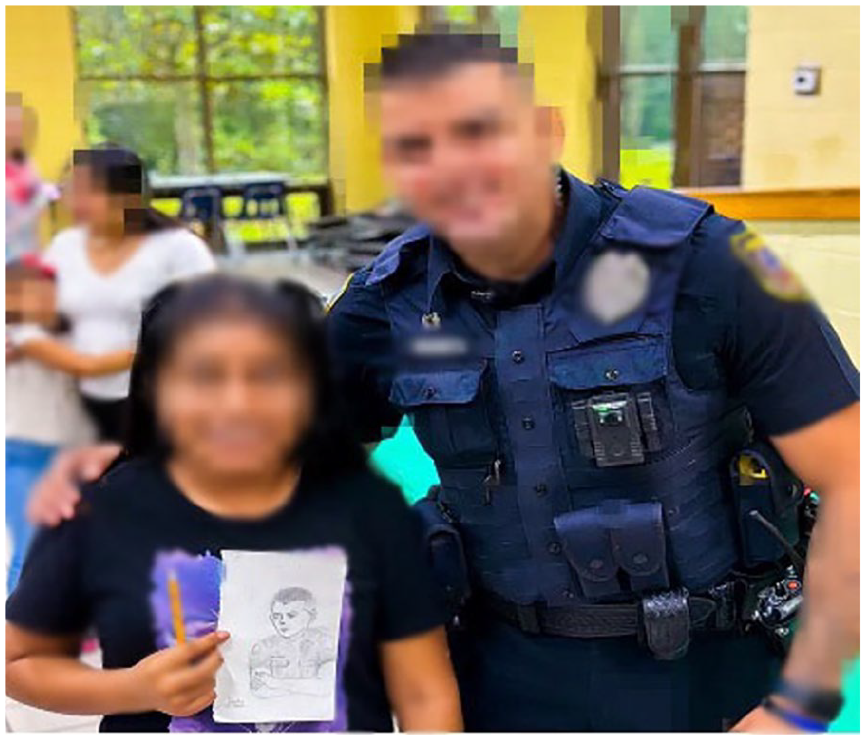
An officer stands with his arm around a student as the student holds a picture they drew.
Humanising policing serves myriad functions, including ‘getting children accustomed to obeying and respecting the commands of state authority’ (Correia and Wall, 2018: 143). More than just encouraging compliance, however, the posts we reviewed often humanised the profession of policing itself, presenting children who imagined themselves as future police. For example, in a ‘Career Day’ post, students appeared seated in the grass under the awning at the school entrance, dressed as their aspirational career choices: some firefighters, doctors, baseball players, and of course, a few police. In a similar event at another elementary school, two children were posed next to a law enforcement officer, dressed up in Sheriff’s garb, complete with six-pointed badges affixed to their shirts, captioned “Sheriff Jane is having a great time at ‘Dress Like Who You Want to be When You Grow Up Day’” (see Figure 2).
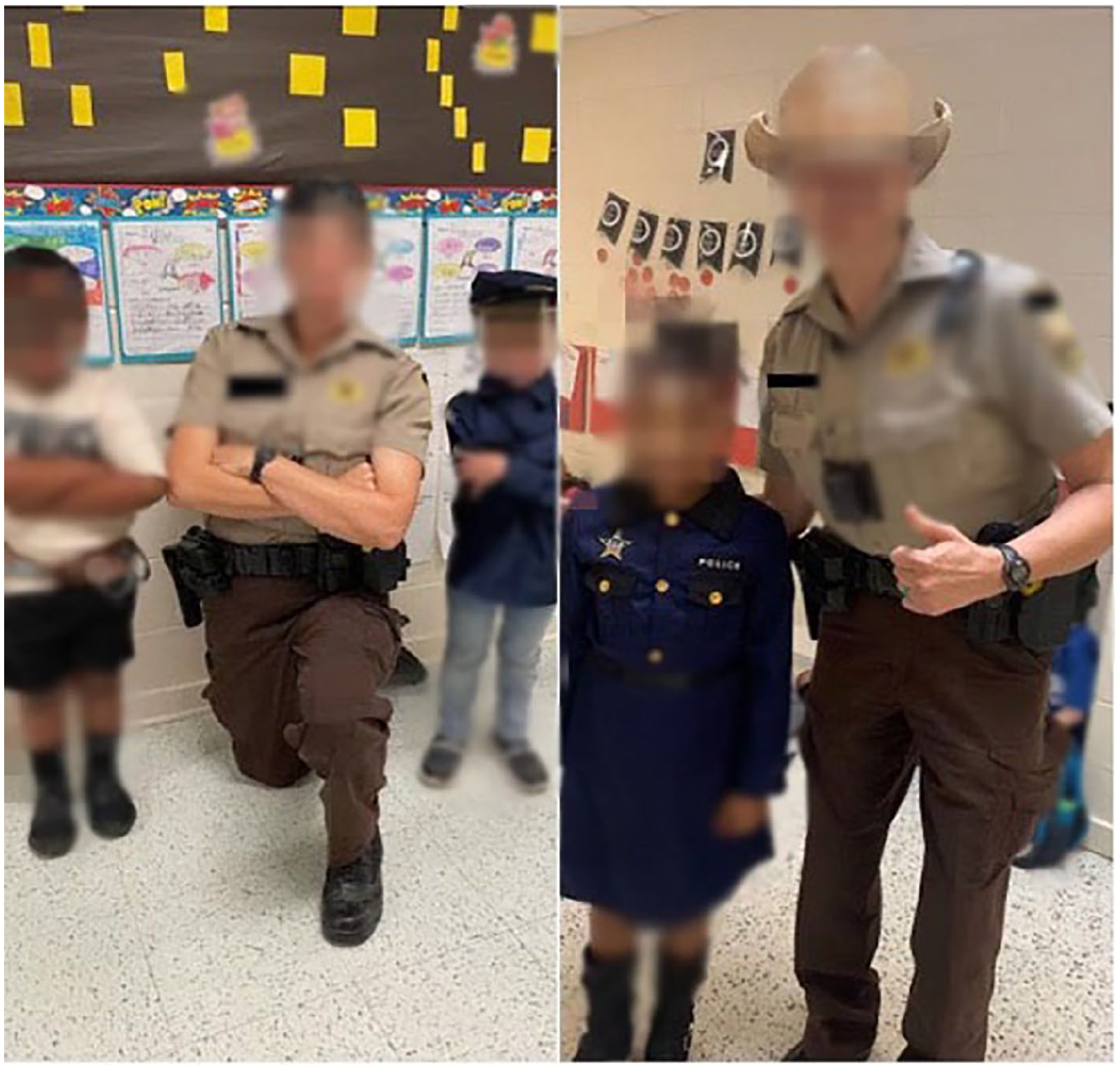
An officer poses with three children, all dressed as police officers.
This juxtaposition of children and police, in addition to images where children are dressed as police, makes the reality of police violence difficult to imagine – how could this innocent child grow up to become a racial profiler, a domestic abuser, even capable of murder? As Meiners (2016) argues though, ideas about children’s innocence are integral to the expansion of the carceral state, where the supposed police protection of (white, middle class, cishet) children and students must be funded at any cost (see also Selman et al., 2024). But, the potential for those who become police to enact violence on the job or interpersonally is real, a potential violence also inherent to the animals that are routinely integrated to the work of policing: K-9s.
Softening canine violence
A counterpoint to ideas about ‘man’s best friend’, the story of K-9s is also a gruesome one. One need only conjure the images of the ‘handler-hound’ dynamic of chattel slavery, the use of canine power in Nazi concentration camps, or Bull Connor’s police dogs in Birmingham to get a sense for how dogs have been used as both state-sponsored and everyday weapons of terror (Cepeda Gallo and Taylor, 2021; Parker, 2019). That use continues; in Alabama, as in many places in the U.S., police dogs are common both on the beat and in public schools. Just as Officer Friendly renders police violence difficult to imagine, K-9 Copaganda in schools softens the potential of canine violence.
Take, for example, an image of a child trying on a heavy dog handling coat used by an SRO in a K9 ‘bite demonstration’, where moments earlier the dog had been hanging off the officer’s forearm (see Figure 3). The huge sleeves of the coat dangle past the child’s arms and it hangs down to mid-calf, a disturbing sight given the use of canine force and the potential for police dogs to disobey commands from officers.
7
After these images appeared on Facebook, feeds became rife with imagery about K-9 visits to schools and events in the community. For example, an album of images titled ‘Field Day’, posted by the Police Department, portrayed elementary children sitting on the sidewalk next to the school parking lot, while the SRO conducted a K-9 demonstration; the next photos documented children petting the dog. These K-9 sessions portray police officers as ‘good guys’ who love animals and give children a vehicle for imagining their own policework, much like the aforementioned ‘Career Day’ activities, but with an added benefit: working with and alongside dogs. As Cepeda Gallo and Taylor (2021: 266) describe: . . .police dog visits to schools, and competitions that allow children to name police dogs are each used to teach youth to like, respect, trust, and even aspire to become police officers, because of the love of animals they share with children. This love is purportedly evidenced in the work handlers do with police dogs, which is presented to kids as vocational labour that honors dogs in ways that are meaningful to them, when it is not. Children are thus indoctrinated to understand police as ‘good guys’, and to see policing as an attractive career in which they can grow up to not only catch ‘bad guys’ but also work closely with animals.
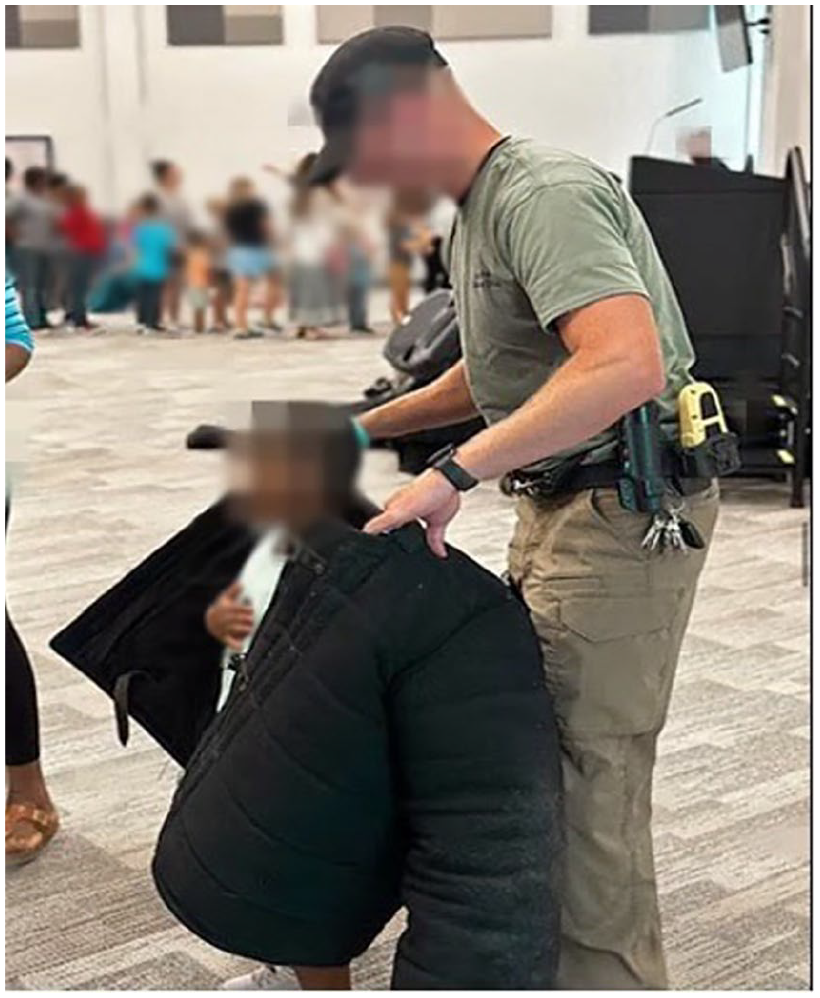
An officer helps a student put on a large K9 bite coat.
Costumed characters also did the work of eschewing potential violence by police K-9s. In another ‘Breakfast Day’ post, a bloodhound with a khaki trench coat posed next to an officer and two elementary school children, students smiling broadly as ‘McGruff, the Crime Dog’ held up his pawed fingers, captioned ‘SRO Johnny and McGruff visiting students for National School Breakfast Week’. Given life in 1979 during a national anti-crime campaign, McGruff recruits citizens into the work of policing by commanding them to ‘Take a Bite Out of Crime’, or, as Wall (2014) describes, “Here law-abiders are recast, interpellated, as something beastly as they are commanded to metaphorically bite what we can only assume is a ‘crimanimal’ – half human criminal, half beastly brute.” The police dog itself, whether a vested K-9 or costumed dog walking on two legs, spreads the message that dogs will only ever bite you if you deserve it, and if you want to be one of the good guys, you must also be willing to ‘bite’ the bad ones. This K-9 Copaganda is in especially bad faith: ‘given the long-standing weaponisation of dogs in the service of white supremacy, it is paradoxical that these same dogs would be used as propaganda to counter the negative publicity police receive due to their brutalisation and execution of people of colour’ (Cepeda Gallo and Taylor, 2021: 266). 8
Further, police dogs, especially drug-sniffing dogs, are routinely brought into schools across the U.S. and Alabama, security measures that are more pronounced and concentrated in schools with more students of Color and low-income students (Kupchik and Ward, 2014). The ACLU, in lawsuits filed across the U.S., has argued that the use of these dogs makes ‘every student a suspect’ (Sullivan, 2011), though legal doctrine holds that police dog searches in schools do not impinge on rights guaranteed by the Fourth Amendment because students do not have a ‘reasonable expectation of privacy’ at school. Thus, K-9 programming, especially in early grades, serves to socialise students into feelings of comfort and even affection towards animals that may, in later years, be used to search them at school, or attack them in the streets (see Figure 4). Puppies and dogs, however, are not the only technologies that students interface and play with; other technologies include handcuffs, tactical vests, and even police vehicles, all rendered toys as part of Officer Friendly programming.
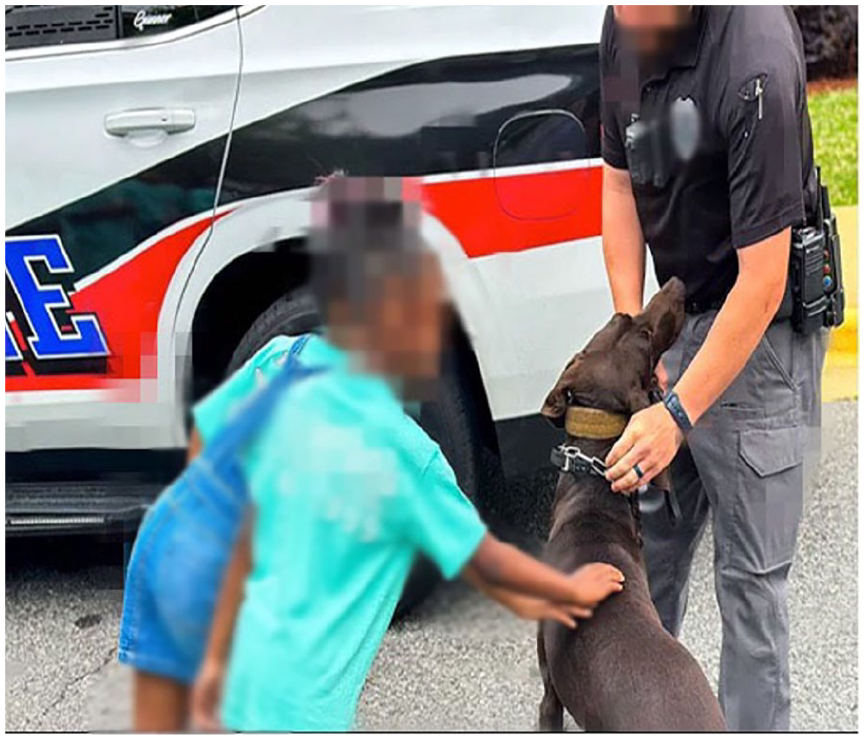
Two students pet a police K9.
The toyification of violent police technology
The role of play in children’s development cannot be overstated. It has been described and theorised, for example, as part of language and literacy practice (Souto-Manning and Martell, 2017) and as rooted in racial, gender, sexual identities and cultural norms and groups (Bryan, 2018, 2021; Dumas and Nelson, 2017). ‘Pretend’ and ‘fantasy’ aspects of play are also integral to development (Bergen, 2002), especially in how children ‘practice all sorts of social and cognitive activities, such as exercising self-control, testing and developing what they already know, cooperating and socialising, symbolising and/or using objects in ways that are meaningful and thrilling to them’ (Pinto and Nemorin, 2015: 54–55). And, as anyone who works with children knows, toys are an integral part of that play.
Police co-option of this play, then, works as a strategic maneuver to both position police technology as ‘toys’ and the police themselves as the purveyors of those toys, garnering admiration and awe from the children who are so fortunate to play with them. Many of the posts we reviewed documented this play with youth, rendering the violent technologies that police use to capture, arrest, and neutralise as ‘toylike’, including the aforementioned play sessions with K-9s. For example, one image documented an SRO at the front of a middle school classroom, holding a pair of handcuffs up for seated students to see (see Figure 5). The caption reads ‘Officers and Dispatchers visited the students at school today for #CareerDay! Officer Johnny and Officer Jim, along with K9 Gunner, talked about the equipment they carry, police canines and Gunner’s role in the schools’. Posts also detailed the annual ‘Sheriff for the Day’ programme, where two local youths were engaged in roleplaying as law enforcement, touring the local jail, participating in shooting simulations, and ‘trying on’ police tactical gear. In two other posts, two small Black children are pictured wearing police tactical vests, captioned with a description that students ‘had the chance to meet a few canines, try on equipment, and check out a K9 Tahoe’.
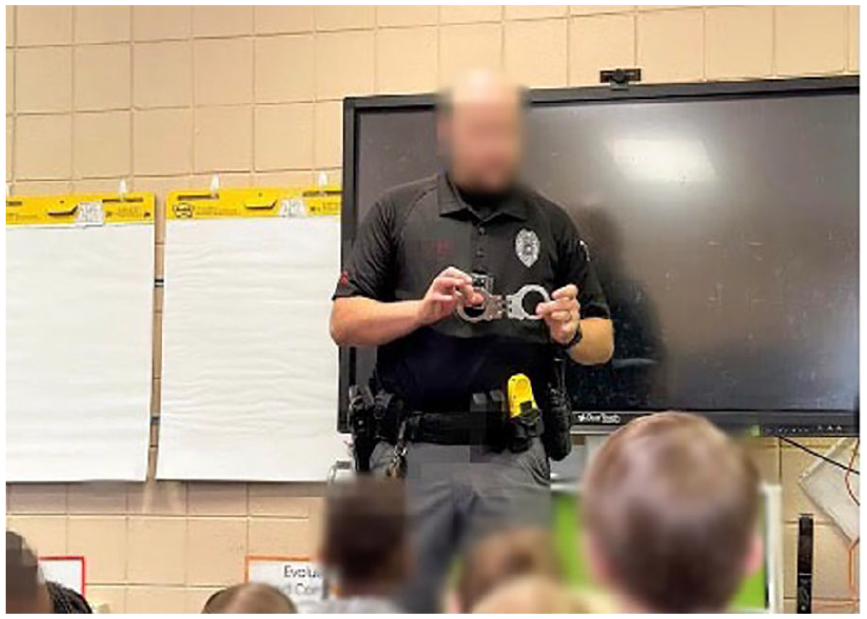
An officer stands at the front of a classroom, holding up a pair of handcuffs.
These renderings on social media promote the idea that there is nothing inherently dangerous about the tools used by police. How they are deployed, and on whom, however, sends a moral message: if they happen to be used on you by police, it’s because you are a threat. Take for example, the ‘Touch a Truck’ events, publicised on social media accounts by the municipality and the local Police Department, advertising that the ‘downtown will be filled with police cruisers, fire trucks, ambulances and much more at Saturday’s event!’ Images portraying children posing outside police vehicles filled one Facebook album; in one particular image, two small Black boys were playing, seated, in the back of a police wagon. This copification of play, and the toyification of violent technology, is obscene when we consider how ideas about who gets to play, with which toys, and in what contexts, are racialised and gendered, rooted in anti-Blackness and misandry (Dumas and Nelson, 2016). As Bryan (2021) explains, ideas about play for Black children in particular can be contextualised beginning with the period of enslavement, where play was denied by white slaveowners. Opportunities for fantasy and play were also positioned as a mechanism by which Black children could work towards their own freedom, as ‘African children often played with White children to learn White mainstream American English and to take the linguistic skills back to enslaved African adults’ (Baker-Bell, 2017: 18)’.
Contemporaneously, toy gun play is also a racialised activity; toy gun play is ‘mediated by stereotypes of Black masculinity as an imagined threat with potentially real consequences in moments of play’ (Howard, 2021: 11–12). Consequences might include school disciplinary proceedings, such as when school administrators suspended Isaiah Elliot, a Black 12-year-old when he was reported for having a neon green plastic gun during virtual class. Consequences might also be fatal: police murdered Tamir Rice because he was playing with a toy gun. Taken together, we see that play, then, has always only been white property (Bryan, 2021: 18). Given this contextualisation, images of Black children posed and playing with police technology serve the dual purposes of tokenisation of ‘good Black childhood’ and as a way to insulate police from critique that they might deny play to a Black child, like Tamir Rice – another bad faith narrative that if people simply ‘act right’, they will be spared the violence of police and their technologies.
Educative contexts and legitimation of police authority
Police pedagogues
In 1983, the Los Angeles County School District and L.A. Police Department joined forces to thwart ‘Public Enemy No. 1’. The Drug Abuse Resistance Education (D.A.R.E.) programme performed multiple functions: expanding police power into schools, normalising and legitimising police as part of the school environment, and improving the overall perception of police (Felker-Kantor, 2022). When they entered the classroom, they were still officers, but they also became teachers, and ‘as teachers, police could influence the next generation’ (Myers, 2019: 168). They educated students not only about the harm of various substances, but also socialised them into the white, cishet middle-class Christian constructions of morality, responsibility, and safety propping up the racial capitalist regime (Felker-Kantor, 2022). Through this programming, ‘teacher-cops’ worked to create law-abiding citizens who never question the legitimacy, virtue, and value of the police. But of course, ‘the pro-police image was imagined by D.A.R.E. leaders to be especially beneficial for kids who had a historically antagonistic relationship with law enforcement’ (Felker-Kantor, 2022: 320). James Stewart of the National Institute of Justice explained that police officers were seen by children ‘in some neighbourhoods’ as an “anonymous, uniformed ‘enemy’, viewed with suspicion,” but thanks to D.A.R.E., were able to see them as ‘positive role models who want to help them protect their future’ (Stewart in DeJong, 1987: iv). As Felker-Kantor (2022: 320) interprets, “While not mentioning race, Stewart’s reference to negative views of the police ‘in some neighbourhoods’ was no doubt a reference to the tension between African American communities and the police, which had accelerated following the urban uprisings of the 1960s.”
Despite the highly contested efficacy of D.A.R.E. as a drug abuse prevention programme, both the programme and the legacy of the teacher-cop live on. Many of the posts we reviewed documented police officers in various teaching roles in schools. For example, officers stood at the front of classrooms, positioned alongside screens with PowerPoint slides, engaged in instruction in a ‘Too Good for Drugs’ programme. In this programme, much like D.A.R.E., students learned about ‘setting goals, achieving those goals, identify and manage emotions [sic], build positive relationships, and use those skills to avoid peer pressure and potential drug use’. Other posts documented SROs using reading to establish their educational authority, a particularly strategic tactic when we consider the turmoil over ‘woke indoctrination’ and book bans. In a set of posts about the beginning of the school year, an SRO wore sweat bands and posed as if reading to students, with the caption ‘New School Year? Our School Resource Officers are READY!’, suggesting that the SROs were gearing up for their various roles, including reading to students. Other posts showed SROs celebrating ‘National Reading Day’, images depicting a jovial, smiling officer reading to the students on the classroom reading rug (see Figure 6). Although not all the books featured in these posts were about policing, these activities harken back to the original Officer Friendly programme, as officers would develop rapport and establish their role as an educator by reading to the students.
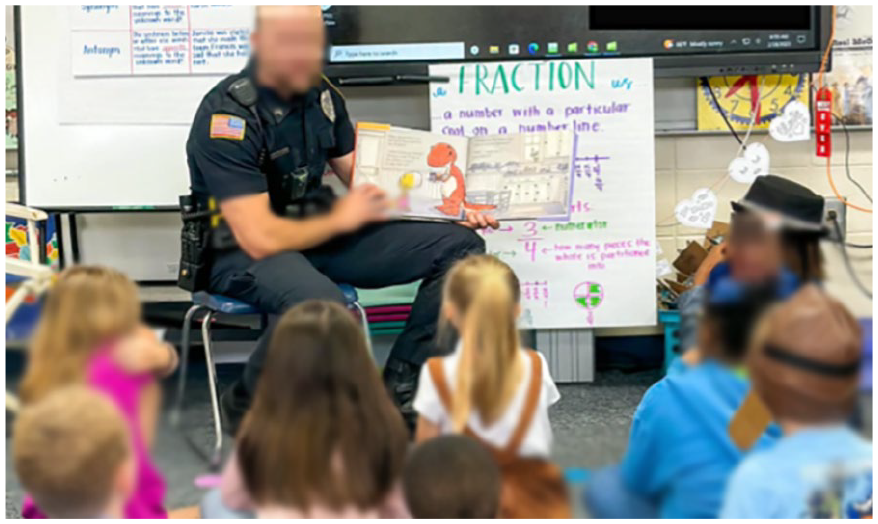
An officer sits in the front of the classroom and reads a book to a group of students sitting on the floor.
But beyond formal educational content, these teacher-cops also educated students on life skills that would supposedly set them up for future success. One officer led a mentoring programme for boys in grades 4–6, focused on teaching the boys ‘life skills that will help them to mature into the upstanding young men they’re becoming’. Social media posts detailed that these skills included learning how to dress for success, ‘express their feelings in a positive way’, and use social media responsibly. It must be noted that none of these topics fall in the formal realm of policing or criminal justice; but, just like D.A.R.E. was less about drugs and more about state-defined morality, the activities we’ve highlighted here gave SROs the opportunity to act as teachers, imbued with the power to educate (or indoctrinate) students into the police definition of reality.
Cop coaches and camps
D.A.R.E. drew on the long tradition of police public relations programmes like Officer Friendly, but also seemingly unrelated community relations efforts, like ‘constructive’ leisure programmes for youth, including Police Athletic Leagues (PALs). The most commonly told origin story of PALs starts in the 1930s, when a ‘concerned’ officer started a twilight baseball league for kids in New York City (Myers, 2019). Showing ‘how big-hearted and creative the ordinary patrolmen could be’ and demonstrating ‘how police (as opposed to sociologists, church leaders, and social reformers) could effect positive community change’ (Myers, 2019: 119), PALs offered cops up as coaches to young people. In this role, officers could, much like the D.A.R.E. officers that would follow 70 years later, assist in developing young people’s sense of morality, conceptions of citizenship, and perspectives of the police. While PALs (unlike D.A.R.E.) were/are not directly affiliated with schools, they too embody the teacher-cop orientation, socialising youth into pro-police perspectives through the friendly paternalism of a coach. In our community of interest, the Sheriff’s Office and city Police Department sponsored an annual all-day flag football game for kids. The officers acted as coaches and all attendees received a free lunch, positioning the Police Department to provide a multitude of resources beyond the scope of ‘safety’ (demonstrating their ‘big-heartedness’), and build positive relationships with kids. According to the community relations administrator for the department: We know how important it is for officers to connect with our youth to build relationships. Through those relationships we can build trust, which will hopefully have a positive impact on the child and give them the courage to do what is right as they get older. They see officers at events, at school and out in the community, so this is just one more way to bring them together in a more casual setting (Crews, 2023).
Drawing on the same logic, the Police Department also sponsored a three-day summer camp for fourth grade students. The week after school ended, officers taught children how to play various sports and games, provided materials for crafts, and even took them on daily trips to the community pool. Never missing a chance to fold kids into the police definition of reality, the department also brought in guest speakers who talked ‘about the importance of staying in school, building character and making the right decisions in life’, and hosted demonstrations from various divisions across the Police Department – accompanied by lunch and snacks throughout the day.
In a series of posts that documented this ‘Youth Camp’, the multidimensional Copagandist nature of the programme becomes clear: at one moment children played volleyball with police, swam in the pool, and ate snow cones, and at another they observed SWAT team demonstrations and tried on K-9 vests, jackets, and tactical helmets (see Figure 7). Ultimately this signals that not only can these cops be your ‘friend’, hanging at the pool and eating treats, they can also keep you ‘safe’ via the vast tactical power they have been granted, and they can provide you with an abundance of resources. In the words of the department, children ‘who might not otherwise get to participate in a summer activity’ are able to turn to the police for such opportunities. Recall, too, that a primary goal of the various forms of Officer Friendly we’ve detailed has been to (re)educate kids from families who, likely due to their racialised and classed marginalisation, had negative experiences with the police. So, the focus on providing resources – especially fun ones like sports and crafts, and necessary ones like lunch and snacks 9 – for students who might otherwise be blocked from accessing those resources, is an intentional one. With the welfare state stripped bare and the safety net it provided withered away, the carceral state is more than willing to step in and fill the void (Kohler-Hausmann, 2015). In this ‘child friendly policing’, departments define their ability to address the needs of disadvantaged children as expanding their surveillance and influence over youth. And perhaps more importantly, as Correia and Wall (2018: 143–144) explain, ‘The tactics of smiling cops reading to school children, coaching baseball teams, or giving out colouring books to youth exist on a continuum with arrest powers, Tasers, K-9s, guns, and even SWAT’. Put another way, the same Officer Friendly who taught a kid how to play kickball could be the one who ends their life, because whether a coach, camp counsellor, or life skills teacher, ‘Officer Friendly is an officer whose very authority is premised on the state’s monopoly of violence’ (Correia and Wall, 2018: 144).
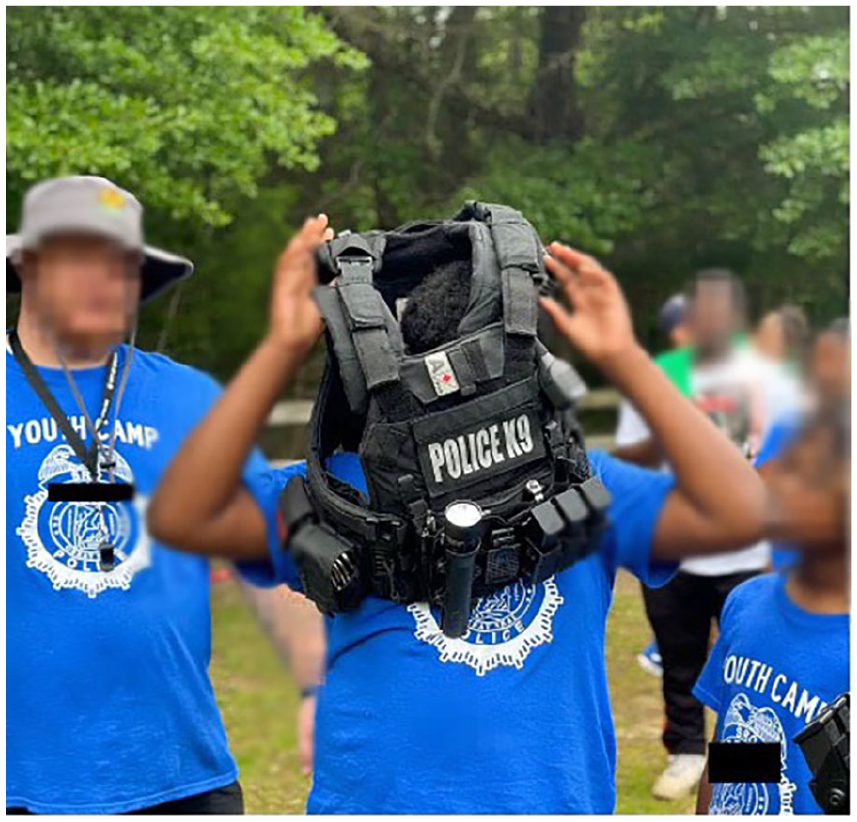
A participant in a summer youth camp puts on a police K9 vest.
Naturalising surveillance and discipline
The salvation and deputisation of tinsel and twinkle
In December, the local Sheriff’s office shared a WANTED poster on their Facebook page of two mischievous elves (of the Elf on the Shelf brand) named Tinsel and Twinkle (see Figure 8). The poster asked for any information about these elves or their whereabouts, stating that they were ‘last seen at the Sheriff’s Office on December 3, causing all sorts of chaos’. A few days later, the Sheriff’s office provided an update for concerned citizens: ‘We got them!’ the post began, ‘Now we know what we’ve been dealing with. These little scout elves came all the way from the North Pole to find a family to visit for the holiday season’. Demonstrating more compassion and concern for how the elves found themselves ‘causing chaos’ than they likely ever would for marginalised people, the Officers learned that the elves’ sleigh crashed in transit and ‘they were scared’. But, ‘when they saw all of the Deputies around our building, they knew they were safe and decided to stick around’ . . .and cause the chaos that landed them on a WANTED poster. It’s unclear how the elves were caught, but after their apprehension, they were made to reckon with their misdeeds. In the post, the elves were pictured sitting atop a table across from the Sheriff as he gives them ‘a stern talking to’. Apparently in this conversation, the Sheriff and Tinsel and Twinkle agreed that to make up for their mischief, they would help out around the Sheriff’s Office as Honorary Deputies. And thus marked the salvation of two naughty elves, now imbued with the powers of the police.
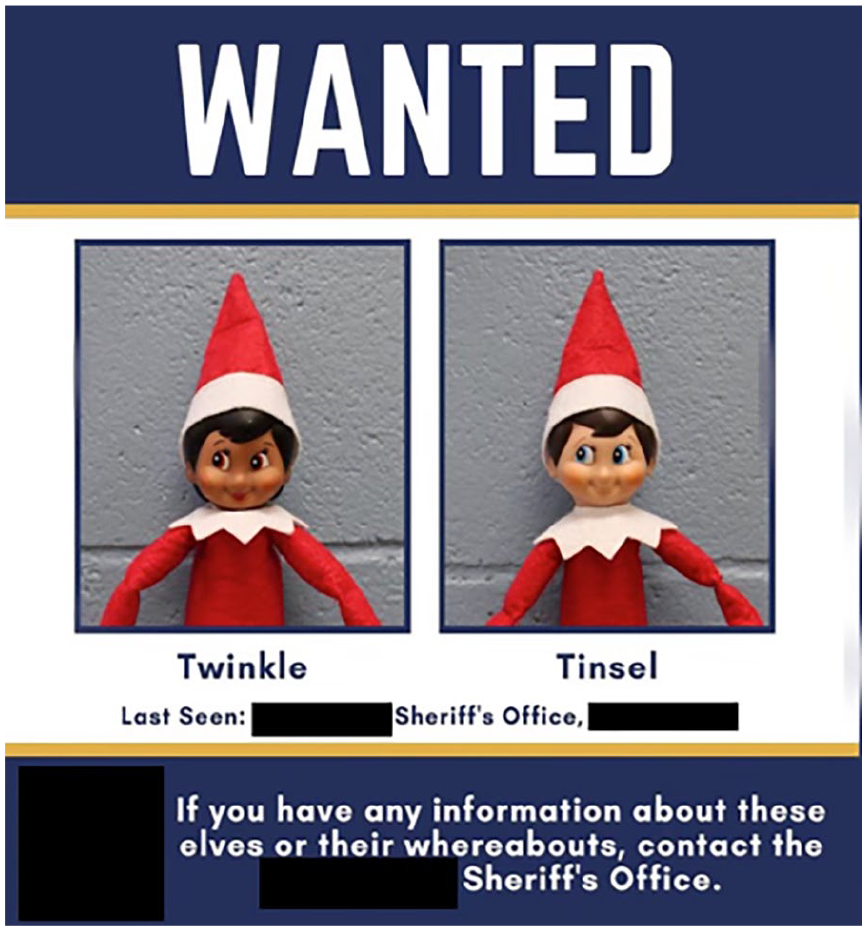
The mugshots of two ‘Elves on the Shelf’ are displayed on a WANTED poster.
Formally merchandised in 2005, The Elf on the Shelf tells the story of ‘a special scout elf sent from the North Pole to help Santa Claus manage his naughty and nice lists’. After being named by their ‘adoptive family’, the elf flies to the North Pole each night to tell Santa Claus about all the day’s adventures (CCA and B LLC, 2013). Their primary role is to ‘watch and listen’, reporting all deeds, both good and bad, back to Santa (‘the Boss’) – and whether children receive gifts from Santa on Christmas morning is dependent on the elf’s reports. The Elf on the Shelf and its creators have received a fair amount of backlash, with scholars and parents alike pointing out the disciplinary power dispensed via the creepy panopticism of the doll (Pinto and Nemorin, 2015; Tuttle, 2012). As Cousineau et al. (2023: 9) argue: The elf is a form of parent-endorsed surveillance with the primary goal of disciplining children to behave – the reward for that discipline is the consumptive event of receiving presents. A secondary and more insidious goal is to normalise surveillance, preparing children to accept life in a hyper-surveilled police state.
But the elves’ duties are not limited to surveilling the home. Santa’s gaze, via his scout elves, extends into schools, too. The creators of the Elf on the Shelf designed an accompanying Teacher Resource Centre where teachers can find classroom activities and lesson plans aligned with the K-5th grade Common Core State Standards. One lesson for Kindergartners focuses on teaching kids to listen. Students make their own ‘elf listening ears’ which they use to signify, when they are listening (ears on) and when they can speak (ears off). In this lesson, teachers are instructed: As children raise their hand, call on them one at a time to answer the questions you have asked. When it is their turn to speak – because you have called on them – then they may take off their ears. But they should put them back on quickly when it is time for them to listen again (CCA and B, LLC, 2014: 1).
The lesson explains that teachers can put students into pairs to practice listening to each other, ‘a habit that is sure to get them on the nice list’ as ‘the classroom elf will be pleased to tell such nice things to Santa’ (ibid). Once the students have demonstrated their listening skills, they are rewarded with the Honorary Elf on the Shelf ‘Good Listener’ badge.
In this particular community, it is unclear whether Tinsel and Twinkle were integrated into the classroom setting in this way. However, social media posts documented them accompanying the SROs on various classroom visits, adorned with Sheriff’s badges of their own. The Honorary Deputies joined the pre-K students for story time and can be seen peeking their heads around the corner of the school hallway. The post depicting the latter offered a reflection from Tinsel and Twinkle, as they apparently struggled with the duties of an SRO: ‘Being a School Resource Officer is hard for Twinkle and Tinsel. They want to tell all of the kids that they see what they’re getting for Christmas, but scout elves aren’t allowed to talk to kids’. This caption suggests, perhaps, that Tinsel and Twinkle were conflicted with their roles: they wanted to bring joy to the children by telling them about their gifts, but were aware that this would involve disobeying The Boss. Here, Tinsel and Twinkle demonstrated their own subjectification to discipline as the fear of disobeying the orders of Santa – the Top Cop – kept them in line, too.
The deputisation of two toy elves is merely another example of policing’s expansive and amorphous character. In recruiting Tinsel and Twinkle to ‘watch and listen’, the Sheriff’s office (and by extension, Santa) is able to surveil and discipline the students, without actually needing to get their hands dirty. There is a long history of recruiting people, animals, even toys, into this work, and children have been particularly vulnerable to the practice. In the 1920s, for instance, the NYPD implemented the ‘Junior Police’, which “functioned as a parallel police force for juveniles, with a hierarchy for aspirational youth, whereby junior ‘patrolmen’ could work their way up to junior ‘chief inspector’” (Myers, 2019: 35). These deputised children were tasked with observing their peers in ‘plague spots’ and reporting their observations to the police, much like these scout elves. Around the same time and in response to the increasing prevalence of children getting killed by cars as they walked home from school, students found themselves deputised once again – this time as safety patrols, or what we might think of today as junior traffic cops. Older students, 10 adorned with arm bands and uniforms, were ‘sworn in’ and charged with getting their peers safely across the streets. However, their role quickly expanded to ‘surveilling and administering discipline further into neighbourhoods, particularly for specific student populations believed to be inherently disorderly’ (Smilie, 2022: 2). For example, safety patrollers were asked to keep their peers from gambling, selling, and smoking cigarettes, even using profanity and sneaking into movie theaters, thereby not only ‘providing surveillance for immoral and disorderly behaviour’ but also ‘help[ing] school officials in ensuring orderly and disciplined behaviour in students’ (Smilie, 2022: 10). Or consider the aforementioned D.A.R.E. programme through this framework of extending police power: Felker-Kantor (2022: 331) notes that ‘D.A.R.E., in effect, deputised students to alert the police of friends and family members who engaged in drug use. By the late 1980s and early 1990s, examples of D.A.R.E. students turning in their own parents to the police for drug use became national news’. Put simply, whether it’s the students who are deputised or a pair of elves, peer-policing extends the pacification and discipline that comes with surveillance beyond the formal policing apparatus, and prepares kids to ‘accept life in a hyper-surveilled police state’ (Cousineau et al., 2023: 9).
But it is not only peer-policing that performs this function. As many critics of The Elf on the Shelf have argued, the all-seeing and all-hearing capability of the elf induces the internalisation of panopticism. Drawing on Bentham’s (2020) panopticon and Foucault’s (1975) disciplinary society, the Elf, like the prison guard in the central tower or the ever-present policeman can be anywhere, observing anything. ‘Like the prisoners in the cells, the children can see the elf, but cannot see Santa (read: prison guards)’ (Cousineau et al., 2023: 9). Or in our case, the students do not need to see school police or SROs to feel their gaze and adjust their behaviour accordingly, because Tinsel and Twinkle are there, acting as the SRO’s (and Santa’s) eyes and ears. As such, students are conditioned to police themselves, while policing can continue its project of self-concealment and maintain its representation as “in the words of Emile Gaboriau’s fictional detective Monsieur Lecoq, ‘that mysterious power whose hand was everywhere, which one could not see or hear, but which heard and saw everything’” (Moore, 2022: 7).
All in all, we agree with Pinto and Nemorin’s (2015: 55) claim that ‘integrating the brand into both home and school, The Elf on the Shelf embeds itself into the foundations of formal and informal education’s tacit acceptance of being monitored and always being on one’s best behaviour without question’. But we would add that in merging the covert policing function of The Elf on the Shelf with the formal policing apparatus via School Resource Officers and deputies, this department/district is working to both pacify (Neocleous, 2011) children and humanise policing in general. While an analysis of all of Tinsel and Twinkle’s activities are beyond the scope of this article, it’s important to note that they are shown having an absolute blast touring the medical office, training with the SWAT team, and driving on patrol. 11 Presenting both a moral and a cautionary tale, their initial hijinks and later ‘salvation’ cast Tinsel and Twinkle agents of copaganda – mini Christmas-themed Officer Friendlies – spreading the bad faith narratives of policing with every adventure they take.
Recruiting us all to the ‘Pig Majority’
While this paper focuses on modern and localised examples of school Copaganda, the connections with tactics of the ‘past’ remain clear: despite the claim that we have, for example, disentangled ourselves from the ropes, dogs, and shiny badges of slave patrollers (Linnemann and Turner, 2022), the strategies we expose here are deeply inspired by and responsive to that legacy. As Gilmore (2022: 264) argues, ‘Racist ideological and material practices are infrastructure that needs to be updated, upgraded, and modernised periodically’ and the school, as a primary site for socialisation, is perfect for experimenting in and deploying such upgrades. Officer Friendly thus operates at the nexus of the distinction between the discrete institution of police, with its uniforms, professional organisations, and technologies; and policing, or the ways that we all surveil one another, and particularly Black and Brown folks, with suspicion and imagined criminality (Maher, 2021) – working to both humanise police and socialise children into policing. If ‘[c]hildren are learning the order of the world every day, from interactions with the people and world around them, through peer play, and through the TV and books they read’ (Greenham, n.d. para. 23), what, then, does it mean ‘to have friendly neighbourhood police as a natural presence in our everyday lives?’ Whether enrolling students in a Junior Deputy Academy or acting as Sheriff for a Day, contemporary police-youth programming serves to “naturalise and normalise the police as an institution that ‘must exist’ for order to be maintained and preserved” (Moore, 2022: 7). And right before our eyes, kids are outfitted with construction paper service caps and positioned in front of a cruiser, while they proudly hold hand-painted signs declaring that they ‘Back the Blue’ (see Figure 9).
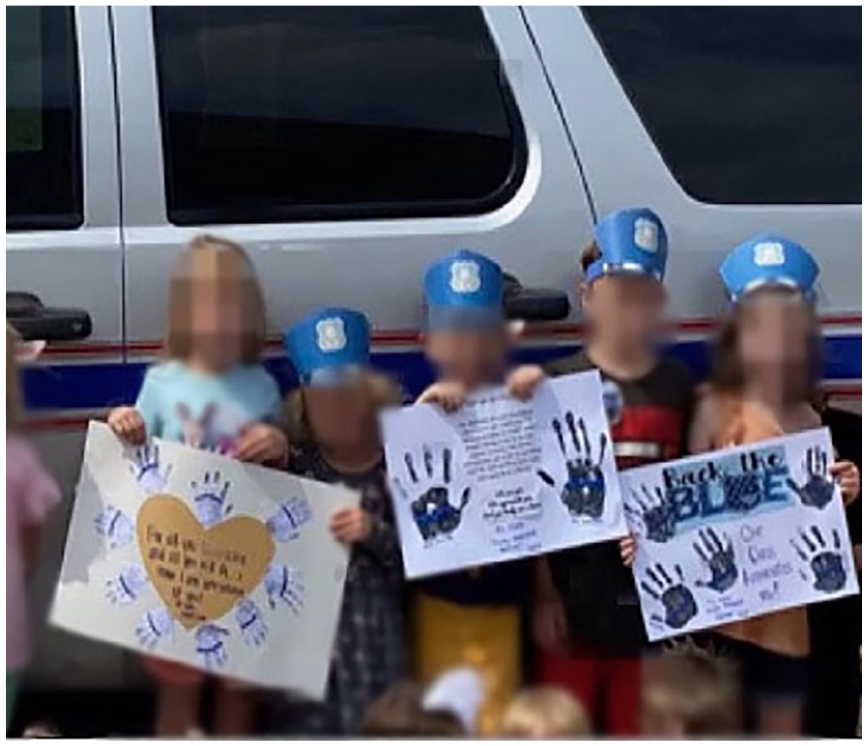
A group of children wearing paper service caps stand in front of a police cruiser, holding signs that say ‘Back the Blue’.
The ultimate function of what we’ve detailed here then – the rationale behind deploying these three narrative devices – is to construct a story through which, by the end, we’ve all been recruited into the ‘pig majority’. ‘The pig majority includes the police, but it exceeds them as well’, Maher (2021: 22) argues: It comprises all those volunteer deputies eagerly doing their violent work alongside them. . . It is the mayors and the district attorneys who demand ‘law and order’ and denounce those who protest police brutality as ‘mindless rioters and looters’. It is the racist media apparatus that bends over backward to turn victims into aggressors and – above all when the former are Black and the latter white – killers into saints. It is the same pig media that selects innocent-looking photos for white aggressors while their victims are painted as violent, that breathlessly reports drugs in the victim’s bloodstream, previous encounters with the law, and scandalous social media posts.
It is also those School Resource Officers, K-9s, and Scout Elves, whose humanity, authority, value, and valour, is made ‘real’ when it is splashed all over social media. But as Maher (2021: 22) also points out, ‘[t]his expansive, amorphous pig majority comes into being long before violence occurs and continues to coalesce and expand after the body is cold’ and it comes into being, in large part, through the telling and retelling of Copagandist narratives. Stories of cops who abuse their wives are quickly replaced by those of cops, who teach young boys to be men, K-9s ordered to maul their targets become cuddly companions, and the Elf on the Shelf is no longer a snitch working for the Top Cop.
And as much as school Copaganda works as mythmaking, perpetuating false narratives about police violence and their technologies in order to capture new ‘recruits’, it simultaneously ‘attempts to make Black liberation irrational and Black subjugation, its logical converse, commonsensical’ (Sojoyner, 2013: 242). Abolition, the project of dismantling ‘institutions that advance the dominance of any one group over any other’ (Mendieta, 2005: 14) and ‘building a new world where we work together to meet one another’s needs’ (Hill, 2021) without the police, is made to feel impossible. Indeed, when the summer flag football game at the high school is sponsored by the local Police Department, police routinely participate in games and fundraising in ‘dunk tanks’ at school events, and even sponsor a summer camp for kids, how could we imagine a community without their presence?
But Maher (2021: 23) also notes that the pig majority is a population that ‘might include you, too. But it doesn’t have to’ (emphasis ours). Therefore, we end by highlighting resistance efforts in communities across the U.S. aimed at countering the bad faith narratives of police-youth programming and Officer Friendly Copaganda. These efforts align with an abolitionist vision of a safe society, one in which ‘we have everything we need: food, shelter, education, health, art, beauty, clean water, and more’ (Kaba, 2021: 2) and where we are all equipped with ‘a set of resources, relationships, skills, and tools that can be developed, disseminated, and deployed to prevent, interrupt, and heal from harm’ (Kaba and Ritchie, 2022). For example, the Chicago Torture Justice Memorial has worked to integrate a history of police violence into the curriculum in Chicago Public Schools, a heroic effort considering the origin of Officer Friendly programming there (Feely and Loew, 2022). In Tennessee, scholars, university students, and community partners have organised to develop a curriculum for high school students in Knox County Public Schools rooted in community defense, education, and liberation. The curriculum they have devised both counters local efforts to institute a criminal justice curriculum there and centres alternatives to punitive discipline such as mediation and conflict resolution. They hope to soon introduce the curriculum via a public-facing website and to fund and facilitate a community training effort (M. Brown, 2023, personal communication). There also exist more global resources for educators and community members, such as the Woke Kindergarten (2024) series of 60 second texts – big concepts for little people in 60 seconds featuring videos about community safety and police violence, political education sessions and resources via the Abolitionist Teaching Network (2024) , and Lessons for Liberation (Education for Liberation Network and Critical Resistance Editorial Collective, 2021), which includes instructional activities for both classroom teachers and community leaders. These resistance efforts, and so many others like them, show us what is possible beyond the police definition of reality, inspiring us to imagine – and thus bring into being – an abolitionist future.
Footnotes
Funding
The author(s) received no financial support for the research, authorship, and/or publication of this article.
