



Abstract
Misogynist incels have been at the fore of academic, professional and mainstream discussions in recent years. Drawing on a systematic review of 47 studies, as well as my own experience with researching current misogynist and exit-curious incels, this paper explores the strengths and weaknesses of the contemporary incel-focused literature. It summarises and critiques the foundational knowledge that underpins our understanding of the current incel community, conceptualised into themes of incels as oppressors, incels as oppressed and incels as threat. Importantly, this paper interrogates the usefulness of our working definition of the term ‘incel’, calling for greater specificity in the language we use to define, theorise and explain the subsets of the incel community under study. In line with a call for more precise language in empirical works, I explore several areas for future research that will help broaden our understanding of the complexities and contradictions within the broader incelosphere.
Introduction
Over the past 5 years, online communities of incels – a portmanteau of the term ‘involuntary celibate’ – have been thrust into the spotlight of both academic and professional discussions and the wider cultural imagination. In the wake of two high-profile attacks carried out by self-proclaimed incels in Toronto, Canada and Plymouth, England, increasing attempts have been made to understand, theorise and respond to the misogynistic discussions and violence found within incel forums. Journalists and academics have examined misogynist incels’ discussions within online spaces, with some calling for incels to be designated as a terrorist threat (Bates, 2020; Beauchamp, 2019; Ging, 2019; Hoffman et al., 2020; Nagle, 2017; Tolentino, 2018; Tomkinson et al., 2020). The term incel has also become prolific in mainstream discussions, where it has been used to describe and explain everything from awkward or uncomfortable dating encounters to instances of everyday misogyny and sexism. Dedicated accounts such as @incelReplies and @incel_stories on Twitter share user-submitted screenshots of awkward, offensive and blatantly misogynistic messages from men across social media and dating apps (incel moments and rants, n.d.; incel pickup lines, n.d.). Similarly, a recent Guardian article tied a rise in misogyny in UK schools to the incel community, which has been said to influence a culture of sexual harassment (Weale, 2022).
The prevalence of the term incel and its recent focus in academic and professional circles, mainstream media and the wider cultural imagination calls for an analysis of our empirical conceptualisation and use of the term. Drawing on a systematic review of 47 empirical studies published between 2019 and early 2022, as well as my own experiences with conducting ethnographic studies of misogynist and exit-curious incel forums, this article assesses the strengths and weaknesses of the current incel-focused literature. I first trace the background of the modern incel community and briefly discuss the black pill ideology that separates incels from other manosphere spaces. I then provide an overview of the studies analysed, the findings of which are discussed within three distinct but intertwined themes: incels as oppressors, which highlights the community’s discussions of women through misogyny, dehumanisation and violence; incels as oppressed, which speaks to community members’ experiences with masculinity, loneliness and hopelessness; and incels as threat, which traces evolving discussions around radicalisation and incel-related violence.
While this breadth of academic work has been important in providing a foundational understanding of the misogynist incel community, I highlight some areas of concern, particularly around our conceptualisations of what falls within the scope of our definitions of incel. Building on DeCook and Kelly’s (2022) critique of framing misogynistic violence as incel violence, I work to interrogate the working definition of incel within the growing body of incel-focused literature and question its ability to conceptualise the nuances within the broader incelosphere. I call for additional specificity in the language we use to define, discuss and theorise the broader community to better distinguish misogynist incels and their associated ideologies from the spectrum of individuals and communities that use incel or involuntary celibate as a personal identifier (Kelly et al., 2021). Finally, I end on a discussion of important, but thus far, under-researched aspects of inceldom that are needed to fully understand the nuances of community members and extend our current knowledgebase.
Background
While the idea of involuntary celibacy is certainly not a new phenomenon, the formation of an identity and subsequent community around this concept is relatively recent (Squirrell, 2018). The contemporary iteration of the term can be traced back to an early web forum, Alana’s Involuntary Celibacy Project, created in 1997 by a queer Canadian woman. Originally, the forum acted as a peer support network for those who identified as invcels – later shortened to incels for ease of pronunciation – to discuss their experiences and seek support from others, regardless of their gender identity or sexual orientation (DeCook and Kelly, 2022; Squirrell, 2018). Alana’s conceptualisation of the term was sensitive to multiple barriers that influence being single well into adulthood, including the fear around approaching someone for a date, not understanding how to communicate feelings, or being too depressed to look after yourself (Love, Not Anger, 2019). Alana’s forum, and a later site called IncelSupport, stood in stark contrast to contemporary misogynistic forums: both spaces acted as peer-to-peer support communities open to people of multiple genders and sexual orientations, as well as non-virgins and were heavily moderated to prevent overtly misogynistic and apathetic responses (DeCook and Kelly, 2022; Squirrell, 2018). Early support communities also identified inceldom as a temporary life circumstance, rather than an identity promoting entitlement and anger towards women.
Over time, additional incel-related forums popped up across the web that began to stray from the initial inclusivity of Alana’s forum and IncelSupport, often housed within spaces that had more permissive attitudes towards violent and misogynistic content. This shift away from a focus on support to edgy and extremist content coincided with platforms like Reddit and 4chan gaining popularity in the early 2000s (Beauchamp, 2019; Squirrell, 2018). As content on incel forums became increasingly extremist and aggressively misogynist, the community’s guiding ethos shifted from inceldom as a temporary life circumstance to a fixed identity characteristic that was no longer amenable to change.
In line with this shift, early misogynist incel forums blended chan culture with language borrowed from Men’s Rights Activists and Pick-Up Artist communities to build their own worldviews and terminologies. One such worldview adopted by some members of the incel community is the black pill, which serves as an extension of the red pill philosophy that underpins many of the male-centric communities housed within the manosphere, a loosely connected network of blogs, forums and websites that discuss issues related to masculinity and often veer towards misogyny and male supremacism (Ironwood, 2013; Marwick and Lewis, 2017). The manosphere’s various coloured-pill philosophies stem from a scene in The Matrix where Neo is given a choice between taking the blue pill, which ‘means switching off and living a life of delusion’, and taking the red pill, which ‘means becoming enlightened to life’s ugly truths’ (Ging, 2019: 640). Borrowing from The Matrix‘s conceptualisation, the manosphere’s red pill is a euphemism that opens men’s eyes to the true nature of women, said to be inherently promiscuous, manipulative and dishonest and encourages men to use self-improvement techniques and confidence to succeed in the dating world.
While the red pill emphasises that romantic success is largely amenable to change by gaming the system through self-improvement, negging and approaching women more frequently, the black pill offers an overtly nihilistic approach. It stresses that physical attractiveness is the ultimate factor in achieving dating success, and women hold the power over determining which men, based on their looks alone, will achieve romantic or sexual fulfilment (Menzie, 2022). Building off this initial argument, black-pilled incels organise society into a heteronormative and cisgendered hierarchy where a person’s romantic and social success is tied to their level of physical attractiveness (Lindsay, 2022). Idealised versions of cisgendered men and women, ‘Chad’ and ‘Stacy’, sit atop the hierarchy. Both are stereotypically attractive, implicitly coded as white and are successful in both sexual and romantic relationships. Below this are ‘Brads’ and ‘Beckys’, who are notably less attractive but still outrank the average person. ‘Normies’ make up the following tier, which encompasses most average-looking, ‘normal’ people. As incels typically view themselves as outside conventional standards of attractiveness due to fixed genetic characteristics, such as their physical stature, race or neurodiversity, they populate the bottom level. While not all incels subscribe to black pill beliefs, most incels believe that their inceldom is due to immutable physical characteristics that disadvantage them in dating.
Methodology
Following the PRISMA guidelines for conducting a systematic review (Liberati et al., 2009), a thorough search of online databases to identify relevant literature on incels was conducted between October 2021 and April 2022, with no date restrictions to account for a wide breadth of literature. Key word searches were conducted using ProQuest, Web of Science, SCOPUS, APA PsycNet, Google Scholar and the University of Manchester library databases. Additional studies and grey literature were identified through forwards and backwards reference list searches as well as through web engine searches. Database searching yielded a total of 1381 records, with an additional 18 records identified through forward/backward reference searches and grey literature searches on Google Scholar. After screening, 95 full-text articles were assessed for eligibility according to specific inclusion and exclusion criteria. Studies were included if they focused on the contemporary incel community and its members, included an empirical analysis of primary or secondary data and/or expanded on current theories as they relate to the incel community, and provided an original interpretation of findings. All academic work identified in literature searches – and thus, included in the final review – was written in English. Following the approaches taken in other reviews, student papers and dissertations, book reviews, summary reports published by organisations or committees, as well as the work of journalists and writers where clear methodology could not be determined have been excluded from analysis (Allely et al., 2014; Broyd et al., 2023). Written works that mentioned but did not significantly focus on the incel community were also excluded. After a thorough reading of the 95 works initially identified, a final sample of 47 studies were selected.
While my search accounted for articles published at any time, all included studies were published between 2019 and early 2022, with most published in 2020 and 2021.These works span disciplines of computer science, linguistics, gender studies, criminology, sociology, military studies and terrorism studies. The methodological approaches across these works are also broad, ranging from quantitative analyses utilising natural language processing and machine learning techniques to identify and assess misogyny, hateful speech and toxicity within the community’s online spaces; to qualitative analyses including virtual ethnographic observation, thematic analyses of discussion posts from subreddits and independent forums and close readings of news reports, written manifestos and personal documents of mass killers. Others have combined quantitative data mining with qualitative thematic or content analysis for added rigour. Further, a handful of authors have been able to administer surveys to or acquire interviews with current and former members of the incel community. This is a notable feat, as many members of the community are hesitant to speak to – and are often hostile towards – academics. Much of the current research has focused on analysing the most popular English-speaking incel spaces, including the defunct subreddits r/Braincels, r/incels, r/shortcels, r/Incelistan, r/TheIncelPill, r/IncelsWithoutHate and r/IncelDense; currently active watchdog subreddits r/IncelsInAction and r/IncelTear; the defunct women-only subreddit r/Trufemcels; and independent platforms including incels.is (and its previous iterations of incels.me and incels.co), SlutHate.net, incel.net, looksmax.org, looksmax.me, 4chan, YouTube and Twitter. The studies included in this review are listed in Supplemental Table 1 and denoted in the reference list with an asterisk (Figure 1).
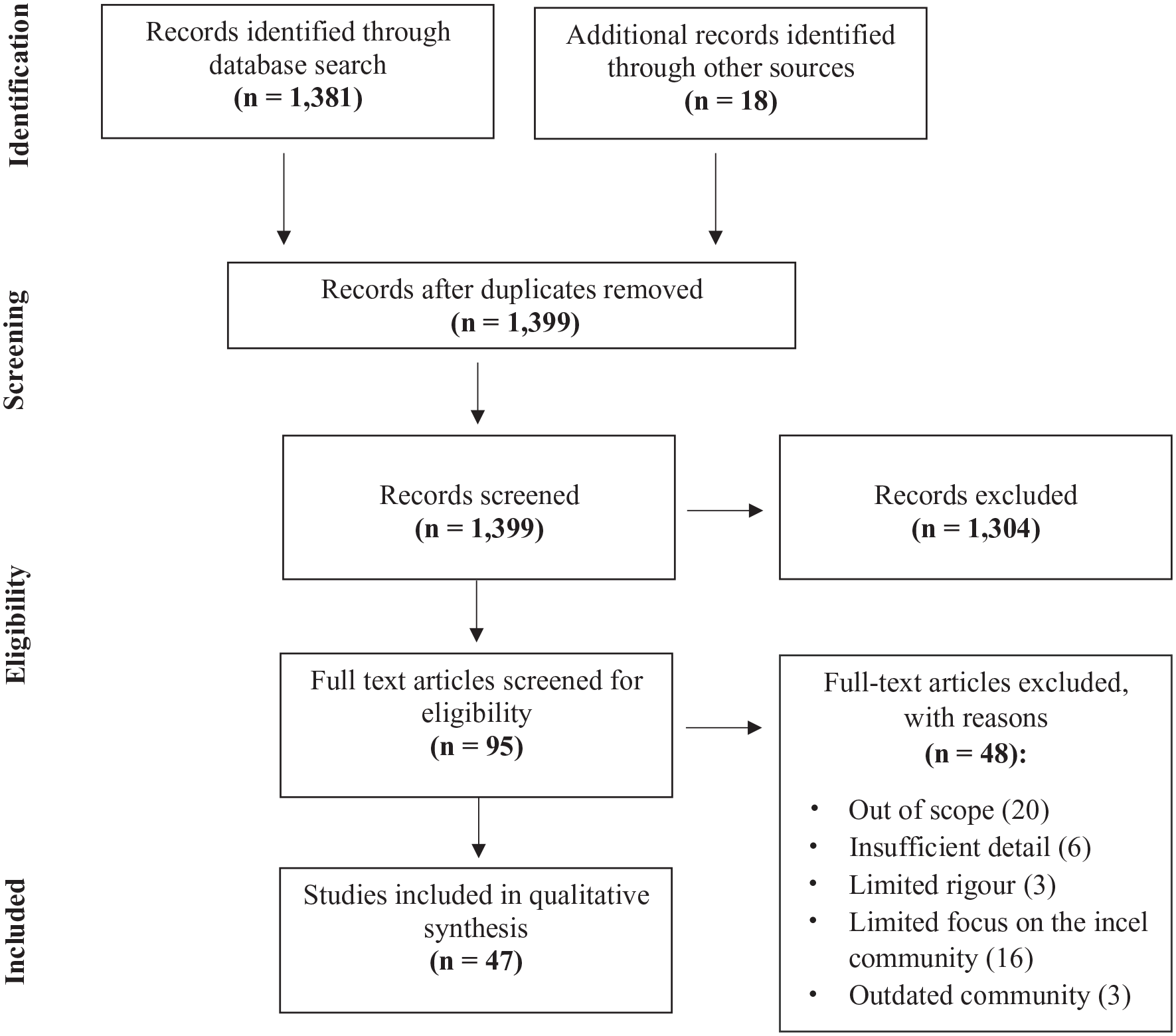
Search and screening process of the identification of relevant studies to include in the systematic review.
Incels as oppressor: Misogyny, dehumanisation and violence
Given the current discussions around the community, it comes as no surprise that much of the academic literature thus far has focused on understanding and theorising how the language used within incel spaces impacts women. The studies reviewed for this article have continually pointed to the male supremacism upheld within incel spaces, tracing misogynistic and violent speech across a myriad of forums. Misogynist incels oppress women in their online spaces through both the black pill worldview itself and the language used to refer to women and feminists. Authors have repeatedly found that the logic underpinning the black pill philosophy helps incels legitimise and justify the subjugation of women (Baele et al., 2019; Hoffman et al., 2020; Lindsay, 2022). In addition to promoting a nihilistic view of life circumstances based on a sexual hierarchy, the black pill also touts the inevitability of female hypergamy, a concept arguing that women will consistently ‘date up’ in terms of attractiveness, with 80% of women vying for the top 20% of men (Gothard et al., 2021). This leaves 80% of men competing for the bottom 20% of women, resulting in an inability for bottom-tier incels to secure a romantic or sexual partner due to their perceived physical unattractiveness. Incels believe that hypergamy has also been amplified by dating apps, where women are given access to a larger pool of potential men that facilitates their ‘ability to “upgrade” their partner’ (Preston et al., 2021: 835). However, several authors have noted the irony in incels’ logic: while incels consistently argue that hypergamy and the current online dating culture has left them without enough women to pursue, they are quick to degrade all women, regardless of attractiveness. Incels are eager to set standards for themselves that are at odds with their place on the societal hierarchy, and discuss their refusal to sleep with women who are overweight, who wear too much makeup or who are classified as less attractive than themselves (Glace et al., 2021; Sugiura, 2021a).
Beyond the black pill, researchers have examined other ideological pillars of the community that influence misogynistic abuse and violence. O’Malley et al. (2022) found that the community itself was structured around four normative orders that allow incels to justify violence against women, including a sexual market that is stacked against involuntary celibate men; women being seen as ‘naturally evil’ and responsible for incels’ suffering; legitimising harmful masculinity through supporting aggression, a preference for younger women and delegitimising women; and male oppression at the hands of women. These ideologies converge to legitimise and justify calls for violence and violent speech, both of which were actively observed within their sample of discussion posts. Menzie (2022) argues that the conceptions of Stacy and Becky act as objectified stand-ins for the women who refuse incels’ advances, and are subsequently used to help degrade women within incel forums. She notes that incels’ devaluation of women and femininity through Stacy and Becky is a ‘strategic way to explain their lack of romantic prospects and perceived lack of social value’ (p. 31).
As the incel worldview helps legitimise both general negativity about and targeted violence towards women, misogynistic, violent and hateful language are incredibly common within incel spaces. Research has consistently found misogynistic language within popular incel subreddits and independent forums, with users presenting women as dishonest and immoral, shaming their appearances, degrading women for having sex and arguing that women make false claims of rape and discrimination (Farrell et al., 2020; Glace et al., 2021; Heritage and Koller, 2020; Jaki et al., 2019; Lindsay, 2022; Ribeiro et al., 2021). Incels’ use of language works to dehumanise women in calculated ways, most commonly through specific terms that overtly sexualise women as cumdumpsters, roasties, holes, bitches, whores and sluts, denoting their promiscuity and subordinate status (Chang, 2022; Gothard et al., 2021; Jaki et al., 2019; Pelzer, et al., 2021; Preston et al., 2021). In-depth explorations of the dehumanising nature of the term foid, short for female humanoid, have been conducted by both Chang (2022) and Prażmo (2020). Chang connects incels’ use of foid to historical conceptions of the monstrous-feminine, wherein women are discursively framed as an ‘other’, something ‘less than’, to justify additional dehumanisation, subjugation and violence. She notes that incels accomplish this through targeted uses of language, including describing women with terms such as degenerate, vile and disgusting, tacitly used to invoke feelings of revulsion and further subjugate women as subhuman and secondary to men. Women are also likened to dogs, pigs, vipers and pests to emphasise their perceived animalistic qualities and a lack of intelligence (Chang, 2022; Prażmo, 2020). Prażmo’s analysis argues that misogynistic metaphors help accomplish this dehumanisation – using foid as an example, she notes that through this combination of female and android, incels convey values of ‘heartlessness, soullessness, a lack of human qualities and, by extension, a lack of human rights’ (p. 24). These qualities are generalised to women as an entire gender, making it easier to justify misogynistic abuse and violence against them.
Beyond community-specific slurs, incels actively dehumanise women through stereotypes about their biological inferiority. Incels often paint women as shallow, manipulative, irrational, overly emotional and promiscuous within their discussion forums, a tactic that works to invalidate women’s opinions and creates an effective ‘othering’ narrative to further legitimise misogynistic abuse and violence (Heritage and Koller, 2020; Jaki et al., 2019; Maxwell et al., 2020; Prażmo, 2020; Vallerga and Zurbriggen, 2022). Several authors have also argued that incels’ misogynistic speech mimics misogyny in other domains: most notably, in historical depictions of women as ‘other’ meant to control women’s agency (Chang, 2022), in mainstream pornography (Tranchese and Sugiura, 2021) and in instances of gendered trolling, harassment and violence (Jaki et al., 2019; Sugiura, 2021a, 2021b).
While incel-focused research has repeatedly flagged the presence of misogynist and violent speech targeting women within incel forums, there is a significant lack of intersectional analysis exploring how subjectivities influence misogynist incels’ use of abusive language. Some authors make quick references to women being targeted for their ethnicities or race – ‘Both noodle and curry whores are self-hating scum’ (Baele et al., 2019: 9), ‘Ethnik Indian noodlewhores are the worse of the worst’ (Jaki et al., 2019: 12) – however, these instances are rarely expanded upon. Instead, discussion posts with clear racial undertones are often used as illustrative examples of the general nature of incels’ hatred of women, rather than a critical analysis of why some women are more frequently targeted and how. Others have stated that ableism, transphobia and homophobia are present in incels’ discussions about women, but fail to elaborate further (Byerly, 2020; Jaki et al., 2019; Sugiura, 2021b). In most papers analysed, misogynistic abuse at the hands of incels is discussed as a single lived experience of women as a monolithic category, rather than explored across multiple axes of oppression. Crenshaw (1991) notes the importance of taking an intersectional approach to the study of personal experiences, arguing that discrimination can occur across multiple social positions at once and in quantifiably different ways. Potter (2013) expands on this, noting the importance of an intersectional approach in addressing criminological topics such as crime and victimisation, of which the latter is particularly salient when examining misogynistic abuse in the online sphere. Misogynist incels can – and often do – victimise women using targeted language that attacks their gender, their sexual orientation, their race or ethnicity or their disability status (among other subjectivities) simultaneously. While the intersectional nature of harm is not a new phenomenon within studies of gender-based harassment and violence within the online sphere, these discussions have yet to be expanded into the incelosphere. Critical analyses of targeted language used by misogynist incels to specifically target BIPOC women, queer women and disabled women, among others, are notably absent within contemporary incel-focused research. By presenting the victimisation of women as a homogenous category and failing to account for intersections of harm, we lack a considerable understanding of how misogynistic incels’ speech impacts some women more than others.
Incels as oppressed: Masculinity, hopelessness and victimhood
As incels’ guiding worldview is inherently gendered, their discussions of masculinity are an important part of inceldom. Empirical analyses thus far have focused on displays of masculinity within the incelosphere, with authors observing that elements of hybrid, hegemonic, fascist and marginalised masculinities are all present in community members’ discussions (Daly and Reed, 2022; Kelly and Aunspach, 2020; Lindsay, 2021; Menzie, 2022; Witt, 2020). Witt (2020) argues that incels often perform a hybrid masculinity that blends toxic elements of hegemonic masculinity, including subjugating women and asserting male dominance, with elements that have previously been associated with beta masculinities, such as intelligence and technological prowess. Extending this argument, Glace et al. (2021) found users of r/Braincels employed hybrid masculinities in strategic ways, including by distancing themselves from traditional masculinity, using social justice language and generating social boundaries against non-incel men. Daly and Reed (2022) found that incels display both marginalised masculinity and hegemonic masculinity. In interviews with eight self-identified incels recruited via Twitter, the authors found that participants often discussed masculinity challenges, conceptualised as struggles with inadequate physical appearance, mental health issues and personality shortcomings. Interviewees represented themselves as marginalised through the standards set for physical attractiveness in society, noting that their oppression stems from the physically attractive, sexually successful people around them. These masculinity challenges can sometimes lead incels to engage in practices that support hegemonically masculine ideals, including developing romantic relationships with women in countries that have different standards of attractiveness or through plastic surgery to conform to hegemonic beauty standards. Both Menzie (2022) and Lindsay (2021) note that incels often discuss their own marginalised masculinity in reference to Chad, who acts as a stand-in for hegemonic ideals that incels feel they can never live up to. As such, feelings of hopelessness have been consistently found within the literature and are often related to incels’ perceived failure to live up to the hegemonically masculine ideals that would help them secure romantic or sexual relationships (Daly and Reed, 2022; Lindsay, 2021; Williams and Arntfield, 2020; Williams et al., 2021).
Other authors have highlighted experiences of victimhood within the incel community, with incels reporting being mocked or discriminated against for their appearance, being bullied in childhood and being overlooked or ignored in public (Daly and Reed, 2022; Speckhard et al., 2021). Victimhood is an important aspect of portrayals of masculinity within the incel community, as it serves as a badge of honour that bonds men together, allowing them to create a form of masculinity based around shared experiences of rejection and victimisation (Daly and Reed, 2022). While victimhood can create a sense of belonging and understanding amongst community members, Lindsay (2021) argues that this victimhood has the potential to lead to violence. He notes that incels attempt to address their inferior status – and fix their fractured sense of masculinity – through violence against themselves, against each other and against women in the digital space. O’Donnell and Shor (2022) make a similar argument, noting that discussion posts on incels.is containing support for violence after Alek Minassian’s attack demonstrate that incels use violence to reaffirm their sense of masculinity. Fantasising about violence and discussing it with other users allows them to ‘strike fear’, thus gaining the respect as men that they are unable to earn through sexual conquests. Further, Kelly and Aunspach (2020) argue that incels’ marginalisation and victimhood are a strategic form of fascist masculinity that helps the community legitimise gendered hierarchies, dehumanise women and other men and return to social arrangements that would guarantee their own dominance and sexual fulfilment.
While the current studies assessing issues of masculinity and victimhood within misogynistic incel spaces have highlighted incels’ own portrayals of masculinity, there is a notable lack of attention paid to how their discussions of masculinity impact – and often harm – other men. Incels’ online discussions and offline attacks have victimised men as well, particularly those who are sexually successful or who fail to conform to acceptable standards of masculinity. Drawing on direct quotes from Elliot Rodger’s manifesto and Alek Minassian’s interview with Toronto Police, van der Veer (2020) highlights that both men expressed a desire to punish everyone who is sexually active, including men. This is especially evident in the facts of each case, as both attacks claimed the lives of several men in addition to women: Rodger killed his three male roommates before attempting to attack a sorority house, while Minassian’s attack killed two men (BBC News, 2018; DeCook and Kelly, 2022). Similarly, Tomkinson et al. (2020) note that the incel community ‘targets men and women indiscriminately’ with violence (p. 157). While these authors are certainly correct in stating that incels target men as well, the nuances of how men are targeted in incel discussions and in offline acts of violence are lost without a gender-inclusive, intersectional approach. The ways in which men are targeted across multiple social positions – including their race and ethnicity, sexual orientation, disability status, class, among other subjectivities – has yet to be adequately explored in incel-focused research and would add additional understanding to our knowledgebase.
Incels as threat: Radicalisation and mass murder
A significant amount of incel-focused literature examines the threat posed by the incel community and its members, often focussing on routes to radicalisation, incels’ connections to terrorism and investigating the profiles of mass murderers with ‘incel traits’. Research has highlighted the role of digital technologies in supporting the radicalisation and indoctrination efforts of misogynist community spaces, though a consensus about the exact mechanisms of radicalisation has yet to be reached. Several authors have noted that the structure of popular incel forums creates an echo-chamber effect: as participation is only allowed via self-identification as an incel, and these spaces are often moderated by community members themselves, they present users with ‘a very one-sided, obsessive perception of the social environment and similarly simplistic appraisals of everyday situations’ that are not open to debate from outsiders (Baele et al., 2019: 20). Regehr (2022) expands on this, proposing that men who are susceptible to indoctrination seek out incel forums due to a genuine desire for belonging and a sense of community with other men who have experienced similar struggles, where they then work to transform their loneliness into misogynistic anger through adopting incel ideologies and edgy humour that helps fill a need to belong. Both Papadamou et al. (2021) and Champion and Franks (2021) have found that incel-related activity is increasing on YouTube, noting that the platform’s algorithm plays an active role in steering users towards extreme content and facilitating engagement with incel-related videos. Similarly, interviews with current and former incels by Maxwell et al. (2020) and Sugiura (2021a) highlight that participating in online forums was an important factor in adopting the community’s guiding ideologies, paving the way for further radicalisation.
Current academic and public discussion also focusses on classifying perpetrators of mass violence who are said to have ‘incel traits’ or a connection to incel ideologies. This growing interest in classification is particularly prevalent in arguments calling for the designation of incels as a terrorist threat, as well as in the immediate aftermath of cases of mass violence (Hoffman et al., 2020; Hunter and Jounne, 2021; Morton et al., 2021; Tomkinson et al., 2020). Recently, legal commentator Nancy Grace and two former FBI agents have theorised that Bryan Kohberger, the suspect in the stabbings of four university students in Moscow, Idaho, possibly had an ‘incel complex’, linking his attack to previous instances of incel violence against young women in sororities (James, 2022; Koenig, 2023; Land, 2023). However, discussions about which perpetrators can be neatly classified as incels report mixed results, as there appears to be little consensus within the literature. Much of the classification in empirical studies occurs by assessing personal writings, social media accounts, law enforcement reports and custodial interviews for any signs of ‘incel traits’ or references to incel ideologies, which often encompass a variety of factors including misogynistic views; feelings of isolation, hopelessness, entitlement or jealousy; and self-reported experiences of sexual and romantic rejection (Hoffman et al., 2020; Van Brunt et al., 2021; Williams and Arntfield, 2020; Williams et al., 2021; Wood et al., 2022).
Both the vagueness of the term ‘incel traits’ and the unevenness in its application in the literature makes it difficult to truly understand the prevalence of incel-related violence. For instance, Hoffman et al. (2020) identify 15 cases of incel violence, some of which are said to show evidence of ‘incel ideological influence’ or predate the contemporary incel community but ‘nonetheless conform to patterns of social isolation generally, and rejection by women specifically’ (p. 8). They also include four European far-right attackers said to have ‘displayed incel tendencies, whether in public statements or in their online profiles’ (p. 9). Van Brunt and colleagues identified 50 cases ‘in which the attacker either self-identified as an incel or otherwise displayed incel-like beliefs and motivations’ (p. 165), though out of the 15 prominent cases highlighted in their article, only seven align with Hoffman and colleagues. Wood et al. (2022) also identify 15 cases, but only 7 align with Hoffman and colleagues, and 6 align with Van Brunt and colleagues. While there is a consensus that mass murderers who were active on incel forums and who self-identified incels – namely Elliot Rodger, Alek Minassian and Scott Beierle – can be confidently classified as violent incels, relying on judgments of whether an attacker supported ‘incel-related ideology’ or displayed ‘incel traits’ creates complexities for truly understanding the scope of incel-related violence.
This classification issue has been excellently highlighted by DeCook and Kelly (2022), who offer an extensive critique of the directions in the terrorism literature. My own review of the literature mirrors their concerns regarding the retroactive classification of perpetrators of mass violence as incels or incel-related due to supposed incel traits and ideologies. The wide scope of these traits, encompassing broad factors such as histories of sexual rejection, feelings of loneliness and resentment, misogyny, and a hatred of women – all of which are then loosely tied back to the black pill ideology – has led to erroneous categorisations of several mass killers as incels or incel-inspired. For instance, George Sodini, Marc Lépine, Seung-Hui Cho, Adam Lanza, Eric Harris and Dylan Klebold have been retroactively tied to the incel community across studies, despite neither self-identifying as an incel or explicitly referencing incel ideologies within their writings (DeCook and Kelly, 2022). Similarly, authors have classified attacks that predate the contemporary incel community as incel-inspired. Van Brunt et al. (2021) classify four attacks as incel-related that predate Alana’s first use of the term in 1997, with the earliest dating back to 1938. While they note that several cases do predate the term incel, they argue that this ‘clearly demonstrates that the dangers of the incel belief system have long been apparent’ (p. 165). Five studies in this review have also classified Marc Lépine’s 1989 attack at Montreal’s Ecole Polytechnique as one of the first acts of incel-related violence (Hoffman et al., 2020; Van Brunt et al., 2021; Williams and Arntfield, 2020; Williams et al., 2021; Wood et al., 2022), despite Lépine never identifying as an incel or adopting contemporary incel-related views. Rather than expressing a clear dissatisfaction with his relationship status or lack of sexual intimacy, Lépine was ‘explicitly motivated by anti-feminist sentiment [and] targeted female engineering students in his attack, as he believed that feminists had “always ruined [his] life”’ (DeCook and Kelly, 2022: 6).
These retroactive classifications fail to account for the wider political and social factors that have influenced mass violence that targets women, including structural misogyny and male supremacism. It is important to note that misogyny and violent extremism are intricately linked, with perpetrators of terrorist attacks and lone-wolf mass shootings often having documented histories of intimate partner violence and misogynistic abuse (DeCook and Kelly, 2022; Johnston and True, 2019; Manne, 2017; Marganski, 2019; McCulloch et al., 2019). Reframing misogynist violence as incel-related is troubling, as it treats instances of incel violence as distinct and separate from the systematic issues that underpin these actions. Rather than recognising the inherent connections between mass acts of violence, misogyny and male supremacy, our retroactive classifications create a concerning narrative wherein ‘mass acts of misogynist violence can only occur within the framework of the incel movement’ (DeCook and Kelly, 2021: 7). This reframing of systemic misogyny as incel-specific was seen in two studies that were ultimately excluded from my review, as they assessed levels of ‘incel traits’ within general samples of young men from Australia (Blake et al., 2020) and the United States (Scaptura and Boyle, 2020). Concerningly, some of the incel-specific traits assessed by both studies are characteristic of broader misogynistic beliefs in a patriarchal society, such as an endorsement of rape myths and trolling the use of pronouns by self-identifying as attack helicopters. Instances of extreme misogynist views towards women, including expressions of resentment, hatred and violent fantasies, are not unique to the incel community. Feminist digital scholars have extensively documented the misogynistic speech and threats of violence levied at women in online platforms (Banet-Weiser and Miltner, 2016; Jane, 2014a, 2014b; Lumsden, 2019; Megarry, 2014; Poland, 2016; Schmitz and Kazyak, 2016). Presenting certain traits or misogynistic viewpoints as incel-specific obscures the structural realities of misogynistic violence that are a fundamental aspect of all misogynistic acts of extremism.
Defining inceldom: A call for specificity
Building on the concerns about the classification of ‘incel traits’ within the terrorism literature, there is a need to interrogate how we define and apply the term incel within our research more generally. Despite the explosion of academic and journalistic interest in the incel community over the past few years, contemporary literature adopts a loosely agreed upon definition of the term, though this does vary across disciplines and approaches. Definitions tend to highlight the key facets of incel identities that relate to certain disciplinary or theoretical approaches. For instance, definitions of the term incel in the gender studies literature often focus on the community’s penchant for misogyny and entitlement (Chang, 2022; Lindsay, 2021; Prażmo, 2020; Tranchese and Sugiura, 2021), whereas several terrorism scholars and criminologists tie their definitions to acts of violence by community members (Champion and Frank, 2021; Fowler, 2022; Hunter and Jouenne, 2021). A subset of works also adopt the definition of the term posted to incels.co by former moderator Alexander Ash, who defined an incel as a person ‘who wishes to be in a romantic relationship, but is unable to despite numerous attempts and a significant amount of time trying’ (Incels, 2017). While Ash’s early definition makes no reference to gender, his subsequent posts to the site’s FAQ page make it clear that incel is a male-only identity and that heterosexual male incels are the only true incels (Kelly and Aunspach, 2020). As such, studies that adopt this definition explicitly define incels as men. A handful of authors have also referred to the definition provided in Donnelly et al.’s (2001) pioneering study of a support-based incel community in the early 2000s, which defines incels as people who have gone at least six months without sexual activity despite their desire to be in a sexual relationship (O’Malley et al., 2022; Williams and Arntfield, 2020). At present, the definitions given by authors included in this review point towards a narrow working definition of the term across disciplines: an incel is a misogynistic, heterosexual, cisgendered man who is unable to secure a sexual or romantic relationship with a heterosexual, cisgendered woman.
While this working definition does cover some of the most prolific incel forums, using the general term incel to describe a specific subset of the community – namely, its misogynist members – obscures the nuances within and across communities that make up the broader incelosphere. As diversity in beliefs and identities are common in incel forums, a narrow definition fails to capture the spectrum of identities that are present in these spaces. For instance, not all men within misogynist incel spaces hold misogynistic views or even identify as incels – incels.is previously afforded conditional membership to black-pilled men who did not identify as incels, though this rule was ended after a community poll. Peripheral communities also exist beyond popular misogynistic forums, many of which actively distance themselves from the term incel and its associated hatred and misogyny, but still discuss issues related to involuntary celibacy and singlehood. The Incel Wiki, a community-run resource that collates information about incel culture and the incelosphere more broadly, highlights several communities that are centred around experiences of involuntary celibacy and singlehood, including r/ForeverAlone and its counterpart for those over 30, r/FA30plus. While both actively distance themselves from the contemporary incel identity and ban incel-related content, they nevertheless offer a space for men to vent about their personal experiences of involuntary celibacy and receive advice and support from others. The support forum r/IncelExit also occupies an interesting space within the broader incelosphere, as it offers a space for exit-curious and former community members to discuss their experiences of inceldom. Users are often quick to identify themselves as incel-adjacent or non-misogynistic before asking for advice or support, but their discussion posts recount experiences with involuntary celibacy and singlehood that connect them back to the broader incelosphere. Our focus on incels as only misogynistic men precludes more peripheral spaces that discuss issues of involuntary celibacy from our analyses, creating a misrepresentation of the broader incelosphere and masking the experiences of those who may identify as involuntary celibate, but who may not adopt the worldviews tied to misogynist incels.
The working definition within the literature also fails to acknowledge the gender diversity among spaces within the incelosphere. Out of the 47 studies analysed, only two explicitly state that a myriad of genders and sexual orientations can – and still do – self-identify as involuntary celibates (Hintz and Baker, 2021; Kelly and Aunspach, 2020). The Incel Wiki highlights a myriad of -cel identities that exist beyond those adopted by heterosexual men, including women incels (femcels) and a variety of LGBTQIA+ identities that intersect with inceldom, including transcels, gaycels, incelbians/lesbocels and queercels, among others. While specific spaces for LGBTQIA+ incels are difficult to find, the wider incel community is home to a variety of women-only and women-centred spaces, each with their own coloured-pill ideologies and terminologies. Femcels, arguably the most known women counterpart to incel men, have created various spaces across the web for women incels to receive support, including the early 2000s Yahoo! group Loveshy women; Facebook’s Femcel Support Group; subreddits r/Trufemcel, r/Femcels and r/FemaleIncels; and ThePinkPill.co. While many of these spaces are now defunct, there are a few active communities on Reddit that fall within the remit of a broader femcelosphere. r/FemaleDatingStrategy offers femcels and other women a place to discuss issues related to dating and singlehood, while its private support group r/AskFDS offers members a chance to receive support and advice from others. Other peripheral femcel spaces include the women-only counterpart of r/ForeverAlone, r/ForeverAloneWomen, which provides a space for women experiencing involuntary celibacy and singlehood to receive advice and support. Like its male counterpart, FAW distances itself from both incel and femcel ideologies, but its focus on involuntary celibacy still connects it to the broader femcelosphere. Without actively acknowledging that our research has prioritised the male subset of a larger community of diverse people who personally identify as incels or involuntary celibate, we risk presenting inceldom as a uniquely heterosexual male experience, erasing the existence and experiences of those who fall beyond the borders of our definition.
At present, the term incel has gone too far past its original meaning for it to be divorced from its contemporary ties to misogyny, male supremacism, terrorism and violence (Love, Not Anger, 2019; Squirrell, 2018). This link between inceldom and misogyny underpins many of the studies examined in this review, and it comes at the cost of precluding important analyses of incelosphere spaces that exist on the margins of, or in opposition to, misogynist incel spaces. There is a need for academics and professionals to adopt language that distinguishes specific parts of the incel community and its ideologies – specifically those that are linked to misogyny and male supremacism – from the personal identification of being involuntary celibate. Using terms such as misogynist incel(s), non-violent incel(s) or self-identified incel(s) are important in helping create nuance within our understanding of the broader incel community, as they tie empirical findings and discussions to a specific facet of the incelosphere without speaking for or obscuring members whose experiences fall beyond those terms (Kelly et al., 2021). The wealth of research into the community’s online spaces has shown how much language matters: both the language used within individual discussion posts and within wider community ideologies shapes whether certain individuals and groups are viewed as authentic incels or potential targets. As such, the language we use to refer to this community and its members is important, and ensuring specificity is a key part of adequately and accurately defining the parameters of who our work is talking about and attempting to understand.
Widening the scope: Directions for future research
Recent scholarship has created an important foundational knowledge of misogynistic men within the incel community, tracing their use of misogynistic speech, discussions about masculinity, and potential connections to broader issues of misogynist violence. In line with the need for increased specificity in our language when discussing community members, there is a related need to extend our research focus to account for the breadth of discussions about and experiences of inceldom. In this section, I explore promising areas of incel-focused research that have emerged within this review that will help us expand our understandings and analyses of incel communities more broadly.
Race and racism in the incelosphere
Perhaps the most understudied area of the contemporary incel community is its discussions about – and users’ experiences of – race, racism and self-reported discrimination. Race is inherently intertwined with both the community’s guiding ideology and incels’ own experiences of inceldom. It is an integral aspect of the black pill, as the hierarchies of attractiveness that underpin incels’ worldview are deeply informed by racial and class dynamics around standards of beauty and attractiveness (DeCook and Kelly, 2022). Stacies and Chads are almost always portrayed as white in both text posts and image-based memes on incel forums. Though conceptualisations of Chad exist across different racial identities – Tyrone (Black), Chadriguez (Latino), Chadpreet (South Asian), Chang (East Asian), Chaddam (Arabic) – white Chad is the default depiction. White superiority in dating and sexual scenarios is often discussed across incel forums, with the refrain of ‘just be white’ presented as sardonic solution to incels’ inferiority (DeCook and Kelly, 2022; Jaki et al, 2019; Menzie, 2022; Sugiura, 2021a).
While studies have pointed to the presence of white supremacist and anti-Semitic ideas within incel spaces (Hoffman et al., 2020; Jaki et al., 2019; Pelzer et al., 2021), these findings are often discussed without an acknowledgement of the community’s own racial and ethnic diversity. Despite common perceptions that incels are young, white men, a sizeable minority of users on incels.co identify as non-white: in a survey of 665 users posted by the forums’ moderators in March of 2020, just over half of respondents (55%) identified as White or Caucasian, whereas 45% of respondents identified as Black, Latino, Asian, Indian, Middle Eastern or Other/Not Sure (Anti-Defamation League, 2023). An additional survey of 272 users in December of 2020 found similar figures, with 53.3% identifying as White/Caucasian, 9.6% identifying as Black or African American, 7% identifying as Middle Eastern, 7% identifying as Hispanic, 5.1% identifying as Asian, 5.1% identifying as Indian and 12.9% identified as another ethnicity or reported that they were unsure (Speckhard et al., 2021). Non-white incels will often self-identify as certain subtypes of ethnicels within their posts, such as currycels (South Asian), ricecels (East Asian), Blackcels, Arabcels, along with other community-specific terms that denote their ethnicity and race to other users (Baele et al., 2019; DeCook and Kelly, 2022; Glace et al., 2021).
As race is an immutable factor in their incel identities, some incels’ preoccupation with race that has been highlighted in other studies may be, at least in part, due to their own experiences with racial prejudice and racism. The decoupling of race from analyses of incel discussions obscures how both incels’ rhetoric and their experiences of inceldom are inherently shaped by broader issues of white supremacy and racism. While references to users’ ethnicities and instances of racist speech have been made in a handful of studies, additional analyses of how incels discuss and experience race within their online spaces are needed. Moreover, there is a significant lack of analysis on how men who self-identify as ethnicels experience their inceldom and navigate their identities within a space that is increasingly diverse, but still overwhelmingly white. As race is an important aspect in both incels’ ideology and users’ personal lives, additional research is needed to fully recognise and understand how race intersects with the experience of inceldom.
Mental health challenges and neurodiversity
Several authors have flagged the existence of mental health challenges experienced by community members, including anxiety, depression and suicidal ideation. In interviews conducted by Regehr (2022) and Daly and Reed (2022), incels discussed feelings of social anxiety, loneliness, depression and disclosed experiences of past trauma and bullying. Survey responses from users of incels.is showed higher instances of self-reported and formal diagnoses of mental health issues, including depression, anxiety, autism, bipolar disorder, and post-traumatic stress disorder (Speckhard and Ellenberg 2022; Moskalenko et al., 2022). Moreover, former incels on Reddit have also discussed that mental health issues, abuse and personality disorders played a role in choosing to identify as an incel (Hintz and Baker, 2021). Incorporating mental health variables into analyses of radicalisation and radicalisation risk adds more nuance to understanding the threat incels may pose: Baele et al. (2019) note that the nihilistic nature of the black pill might be more likely to make its members self-harm than to undertake violent action in response to their feelings of anger, hopelessness or isolation. Other authors have highlighted that community discussions around suicide are increasingly common: Glace et al. (2021) note that users on r/Braincels reported suicidal thoughts, feelings and intentions that were related to their incel status, with one user posting a list of forum users who were said to have died by suicide. Sugiura (2021a) also found that users on incel forums are quick to egg on others who post about suicidal ideation, often jumping in with ideas on how to help a user end their life. In the first dedicated study examining suicide within the incel community, Daly and Laskovtsov (2021) collected a sample of 80 suicide posts from Reddit user u/IncelGraveyard. The authors found that most suicide posts referred to the companionship and connections that users had found in within the incel community, and several posts detailed the user’s gratitude towards other community members. While studies of depression and suicide in the incel community are still few and far between, additional research examining users’ self-disclosures of mental health challenges in incel forums can allow insight into coping strategies and potential supports and interventions, as well as how the community responds to genuine instances of distress from its members.
An additional area that has yet to be fully explored in the literature is the intersection between neurodiversity and inceldom. Discussions of neurodiversity, particularly relating to autism, are common within incel discussion forums, participant interviews and survey responses (Daly and Reed, 2022; Speckhard and Ellenberg, 2022; Sugiura, 2021a). Williams et al. (2021) found that over half of their sample of seven ‘incel-related’ mass murderers potentially demonstrated characteristics of autism spectrum disorder (ASD), though they note that the reports they analysed did not include valid psychiatric assessments for ASD. With increased attention on the supposed link between neurodiversity and participation in the incel community due to Alek Minassian’s unsuccessful attempt to use a formal ASD diagnosis as a defence during his criminal trial (Cecco, 2020; Gollom, 2021), additional research is needed to understand how neurodiversity factors into the experience of inceldom. It is possible that difficulties interacting with the opposite sex, or difficulties with social interactions more generally, may be heightened for neurodiverse individuals, and further research is needed to understand how this may play a role in users’ pathways to identifying as an incel. Moreover, it is common practice for incels (and forum users in general) to use ‘autistic’ as a synonym for content deemed low-IQ, dumb or stupid, which creates an interesting dynamic for incels who participate in online communities and self-identify as being on the spectrum.
Beyond the English-speaking incelosphere
To date, much of our understanding of incels – and the incelosphere more generally – is informed by research into English-speaking forums that are frequented by a large proportion of North American (and to a lesser extent, European) incels. Though little discussion has been focused on the conceptualisations of involuntary celibacy outside of the English incelosphere, there are a wealth of country-specific incel forums that exist across the Internet. The Incel Wiki lists several incel and incel-adjacent forums in France, Italy, Germany, Japan, Taiwan, Turkey, Russia and Poland, and notes that many of these international communities hold beliefs and terminologies that differ from those found within the English incelosphere.
While research on global incel forums is still in its infancy, some authors have taken to analysing the forums beyond the English-speaking incelosphere. Brzuszkiewicz’s (2020) research attempts to move beyond a focus on North American incels by assessing discussion posts from several English, French and Italian forums. In addition to capturing posts from incels.co, her work includes the English Facebook page Incel Liberation Army, the French Facebook page Code d’Incels (‘Incels’ Code’), the French forum Virginité Tardive (‘Late-in-life Virginity’) and the Italian forum Il Forum degli Incel (‘Incels’ Forum’) (Brzuszkiewicz, 2020: 3). While much of Brzuszkiewicz’ work found similarities across the ideologies of English, French and Italian-speaking incel communities, her inclusion of discussion posts written in French and Italian marks an important step away from a focus on exclusively North American and English content.
Similarly, Voroshilova and Pesterev’s (2021) analysis of Russian incel forums highlights some key differences between Russian and Western spaces, most notably that the incel communities found on Vkontakte, the Russian equivalent of Facebook, were found to be less hostile and more accepting towards women than other incel spaces. While the forums in the Russian incelosphere are mostly frequented by men, groups such as Incel, The incel girls, and Women Incel Public | The Incel Women were found to have a subset of women users or were exclusively focused on discussing women’s experiences of involuntary celibacy. While Russian incels adopt similar derogatory views towards women, their discussions also had a greater focus on requesting and providing support to others than English-speaking incel forums. While additional studies are needed to generate further knowledge about non-English subsets of the incel community, this work highlights that the experiences of and discussions about inceldom differ between communities and platforms, prompting a need for additional analyses of country-specific and non-English-speaking incel spaces.
Conclusion
This review presents a summary and critique of the current incel-focused literature. Empirical work over the last 3 years has built an important foundation of knowledge to guide future research on the misogynist incel community, highlighting the misogynistic underpinnings of the community’s guiding ideology and its use of specific language to harm women; the complexities in incels’ navigation of masculinity and their associated feelings of marginalisation and victimhood; and community members’ pathways to radicalisation and violence. Though significant strides have been made towards understanding multiple facets of the misogynist incel community across disciplines, our knowledgebase is not without flaws. My review points to a lack of intersectional approaches to assessing how misogynist incels’ language targets both women and men along multiple axes of oppression, including sexual orientation, class, race and ethnicity, disability status and other social positions that coalesce to create both quantifiably and qualitatively distinct experiences of harm and victimisation.
Building on DeCook and Kelly’s (2022) critique, I discuss the uneven application of the vague concept of ‘incel traits’ in the terrorism literature, and voice concerns with retroactively framing cases of misogynist violence as incel-related. By touting incels’ brand of misogyny as unique and distinct from other aspects of misogynist violence (both online and off), we fail to acknowledge that incels’ misogyny is another manifestation of structural forms of male supremacy that are long-standing. While the exact ideology of the incel community differs slightly from previous iterations, and is certainly exacerbated by new technologies, similar targeted attacks against women and feminists can be traced throughout history (Bates, 2020; DeCook and Kelly, 2022; Manne, 2017; Sugiura, 2021b). Stemming from this critique, I argue that our narrow definition of inceldom as inherently misogynistic and male in empirical studies has severely limited our understanding of the nuances within the broader incel community. While it is certainly the case that many prolific incel forums are overtly misogynistic, a failure to recognise the breadth of the incelosphere significantly limits our understandings of the incel community and the experience of inceldom. Using specific terms that identify the facet of the community under study – misogynist incel(s), non-violent incel(s) – helps us differentiate misogynist incels from those who personally identify as involuntary celibate, adding nuance to our understanding of incels as a broader community. In addition to incorporating specific language to refer to subsets of the incel community, there is a need to expand our research focus beyond issues of misogyny, masculinity and violence to account for additional aspects that shape the experience of inceldom. I trace several growing areas of incel-focused research, including the intersections of race, mental health challenges and neurodiversity on the experience of inceldom, as well as global incel community that exist beyond the English-speaking incelosphere. While these areas are certainly not exhaustive, and numerous pathways to extending our knowledge of inceldom exist, they nevertheless provide exciting directions for additional research that will further our understanding of the incel community as a whole.
Supplemental Material
sj-docx-1-cmc-10.1177_17416590231196125 – Supplemental material for Misogynist incels gone mainstream: A critical review of the current directions in incel-focused research
Supplemental material, sj-docx-1-cmc-10.1177_17416590231196125 for Misogynist incels gone mainstream: A critical review of the current directions in incel-focused research by Allysa Czerwinsky in Crime, Media, Culture
Footnotes
Acknowledgements
Thank you to Emma Barrett and David Gadd for your comments and feedback on this article, as well as your support and guidance throughout.
Funding
The author(s) disclosed receipt of the following financial support for the research, authorship, and/or publication of this article: This research was funded by the University of Manchester.

Supplemental material
Supplemental material for this article is available online.
Author biography
References
Supplementary Material
Please find the following supplemental material available below.
For Open Access articles published under a Creative Commons License, all supplemental material carries the same license as the article it is associated with.
For non-Open Access articles published, all supplemental material carries a non-exclusive license, and permission requests for re-use of supplemental material or any part of supplemental material shall be sent directly to the copyright owner as specified in the copyright notice associated with the article.
