




Abstract
10 Rillington Place names the site of temporally extensive practices of murder (1943–1953), and offers an empirical entry point for critically advancing the conceptual innovations of relational approaches to the criminological study of ‘home’. In so doing, the paper, firstly, (re)conceptualises serial homicide as practice, more specifically as a mode of domestic labour which materialises in and is enacted through the relational dynamics of everyday residential life; and secondly, rejects the notion of ‘home’ and argues for the concept of dwelling to better capture the active, generative and fluid dynamics of domestic life. This subtle shift in conceptual approach acknowledges how domus horribilis is etched from, and woven through the topological entanglements of everyday and extreme practices, and moves us toward an alternative set of conceptual commitments in our research of domestic space. Drawing from a mixed portfolio of cultural media (including archival, epistolary, journalistic, photographic, filmic, architectural, museological and dramaturgical data), the paper takes forward Schatzki’s site ontology as an organising framework for practice-based analytics, and advances the critical insights of an embryonic criminology of the domestic.
Introduction: Discoveries
On 24 March 1953, Beresford Dubois Brown, a jazz musician from Jamaica, had made a start on some minor DIY repairs to the kitchen in the ground floor flat of 10 Rillington Place, a rundown residential street located in Kensington, London W11. Beresford had been living at the multiple occupancy property since 1951 (Kensington North Electoral Register, 1951–1953), renting a room on one of the upper floors. John Reginald Halliday Christie, a tenant since 1937, had vacated the three ground floor rooms 4 days earlier, paving the way for Beresford to improve his living conditions by moving into the more spacious apartment. Both he and the property owner, Charles Brown (no relation), had cleared the ground floor living space of its residual clutter, and had dumped the discarded bric-a-brac in the small back garden. Everything was set for Beresford to put his own stamp on the flat and reconfigure its fixtures and fittings to match his lifestyle and preferences. Trying to locate a suitable place to fix shelf brackets for his wireless, Beresford detected a hollowness to the kitchen wall and peeled back a corner of the wallpaper to check out its contours. In his statement to the Metropolitan Police, he recalled: I was going to fix some shelves in the kitchen and knocked the wall, first above what appeared to be a door and then, just at the top of it, it appeared to be hollow. I then took a torch and tore the top corner of the paper away . . . I shone my torch through the hole I made and saw the back of somebody’s body. I called another tenant (Ivan Williams) and we fetched the police (National Archives [NA] MEPO2/9535 cited in Oates, 2012: 128).
1
Arriving in the early evening, police discovered the corpses of Hectorina Maclellan, Kathleen Maloney and Rita Nelson, secreted in the papered-over alcove cupboard, partially wrapped in blankets, tied with wire, socks and a brassière and covered in earth and ashes. Later that night, in their continuing search of the ground floor rooms, the decomposing body of Ethel Christie was located beneath the floorboards of the sitting room, wrapped in a blanket and entombed in rubble. Three days on, a search of the garden and its débris uncovered the dispersed skeletal remains of Ruth Fuerst and Muriel Eady, a home-made rope deckchair, a pastilles tin containing a collection of pubic hairs, a square glass jar with tubing attached, soiled sheeting and lengths of rope, amongst other things.
It was not the first occasion that the Metropolitan Police had cause to search the premises of 10 Rillington Place. Acting on information received, in December 1949, a police search of the outbuildings had uncovered the bodies of Beryl Evans and her 13 month old daughter, Geraldine, in the wash house; Beryl Evans’ body had been wrapped in a tablecloth, tied into a bundle and stashed underneath the sink unit; Geraldine’s unswathed body had been concealed behind the wash house door, hidden by a loose covering of timber shores and firewood. Between 1943 and 1953 eight murders were committed at this drab, dilapidated end-terrace property; and one of its tenants, Timothy John Evans, was hung for a murder he did not commit. 2 Renamed as Ruston Close 14 months after John Christie’s arrest at Putney Bridge on 31 March 1953, demolished in 1970, flattened, and then built over in 1978 as part of a regeneration scheme, this house of horrors has been physically erased and cartographically deleted from the urban fabric of west London.
Beresford Brown’s discovery of the concealed alcove cupboard and its grisly contents has been dramatised (immortalised) in both the 1971 film, 10 Rillington Place, and the 2016 BBC mini-series, Rillington Place. It is a scene which theatricalises an abject moment of exposure, an ‘event of place’ (Massey, 2005: 141) which shatters normative (and idealised) assumptions of ‘a place called home’ (Massey, 1992). 3 There is certainly a rhetorical simplicity and seductiveness in experiencing this dramaturgical punctum as Unheimlich, but this glosses over the complexities and ambiguities of what we mean by, and how we make sense of the concept of ‘home’. For Bammer (1992), the idea of ‘home’ is semantically, referentially, conceptually, temporally and spatially indeterminate and fluid. At a consensual best, we can regard ‘home’ ‘(a)s a space of belonging and alienation, intimacy and violence, desire and fear . . . . (T)he home is invested with meanings, emotions, experiences and relationships that lie at the heart of human life’ (Blunt and Varley, 2004: 3). As a relational space of connection and flow which takes shape within a shifting constellation of socio-spatial, cultural and material relations, ‘home’ is both a medium and a mode for nurturing, practising and forging identities, articulated through intersecting geometries of (gendered, racialised, sexualised, able-ist, classed) power.
Relational thinking in criminological research of the ‘home’ has been recently taken forward by Davies and Rowe (2020) who argue for a criminology of the domestic, and call for the recognition of the ‘home’ as a ‘zone of entanglement’ (Ingold, 2008: 1797) which enfolds and unfolds as a dense and rhizomatic network of harms and comforts, abuses and healings, conflicts and calms. Following Campbell’s (2016) injunction to take space seriously, and informed by Schatzki’s (2002) site ontology, these authors challenge the notion of ‘home’ as a static, bounded spatial entity, and embrace the idea of domestic worlds which are dynamic, nonlinear and processual. They enjoin us to question the dualistic thinking which has underpinned much of the criminological scholarship on domestic space, and reject a wide range of binary terms – private/public, safe/unsafe, feminine/masculine – which position the ‘home’ in an ideological ghetto of socio-spatial isolation, disconnected from structural shifts in political economy and changing modes of production, consumption and leisure. In so doing, they acknowledge the porosity and open-endedness of the concept of ‘home’, and re-imagine it as a site of multiple forms of offending and victimisation in which the boundaries between inside and outside, online and offline, familial and civic worlds are blurred and rendered ‘ever more fuzzy’ (Davies and Rowe, 2020: 154). Facilitated in large part by an exponential growth in technological infrastructures, cyber-investments and digital innovation, Davies and Rowe carefully delineate how variegated forms of online abuse and virtual violences, identity thefts, scamming and phishing frauds, computer hacking and trades in illicit, unsafe and dangerous goods, open up and expand the criminogenic (and victimogenic) propensities of domestic space. In their call for further research, they argue for a more thoroughgoing analysis of the techniques and practices through which spatially-relational criminalities and victimisations are sustained, normalised and neutralised, such that they still remain hidden and obscured, and largely escape criminal justice scrutiny and effective policing interventions. It is this focus on practices which provides an important entry point for making sense of 10 Rillington Place as the site of temporally extensive practices of murder, and the ‘home’ of one of the most notorious British serial killers of the 20th century (Honeycombe, 2011).
My point of departure is to revisit the Schatzkian site, drawn upon by both Campbell (2016) and Davies and Rowe (2020), with a particular emphasis on its practice analytics. Relational theorists, such as Schatzki, 4 bring into view the centrality of practices, ontologised as the ‘primary generic social thing’ (Schatzki, 2001: 1) and the origin and locus of meaning-making, social analysis and critical exposition. In the next section, I outline the key tenets of practice-thinking and use this to argue for conceptual innovation which will build on and advance the insights of a criminology of the domestic. Firstly, I (re)conceptualise serial homicide as practice, more specifically as a mode of domestic labour which materialises in and is enacted through the relational dynamics of everyday residential life. Secondly, I problematise the organising concept of ‘home’, and argue for the notion of dwelling to better capture the active, generative and motile dynamics of domestic life. This lays the important groundwork for a richly detailed and nuanced reading of a mixed portfolio of cultural media (including archival, epistolary, journalistic, photographic, filmic, architectural, museological and dramaturgical data), which underpins a critical exploration of 10 Rillington Place as dwelling.
From ‘home’ to dwelling
Reckwitz (2002) refers to practices as: consist(ing) of several elements, interconnected to one other: forms of bodily activities, forms of mental activities, ‘things’ and their use, a background knowledge in the form of understanding, know-how, states of emotion and motivational knowledge’ (p. 249).
‘Home’, then, is something which is accomplished, performed, and dis/assembled through interwoven and interacting webs of material and symbolic practices which involve human and nonhuman ‘bodies-in-action’. A practice orientation is well established within ‘home studies’ (Hand and Shove, 2004; Pink, 2004; Shove et al., 2007) with practices ranging from sleeping to shopping all making an appearance within this vibrant literature. 5 This broad coverage confirms a commitment to an ontological prospectus attentive to a social world which is always-already provisional, motile and in-the-making, and prone to dynamic forces of stability and transformation. Linked to this, and pivotal to the epistemological and methodological innovation of practice (and relational) theory and research, is Schatzki’s (2002) concept of ‘the site’, figured as an articulated moment of co-presence and social connectivity in conditions of flux and fluidity; the Schatzkian site perfectly captures the spatio-temporal convergences of a myriad of situated, material-cultural practices and their contingent effects.
Using serial killing as a prism for critically exploring domestic life is not a conventional choice for sociologically-led, practice-based approaches to ‘home’, of the type discussed above (see Footnote 5). But from the perspective of a criminology of the domestic, ‘home’ is always-already figured as a (potentially) volatile site of violence, abuse, pain and privation. Indeed, there is a limited but influential (and growing) portfolio of studies which focus exclusively on ‘extreme’ domestic spaces – for example, those appropriated for sex trafficking and exploitation (Russell, 2017); those reduced to rubble in the context of war and conflict (Porteous and Smith, 2001); those abandoned in the wake of forced migration, ethnic cleansing and natural disasters (Jansen and Löfving, 2009); and those consumed by fire in conditions of state-corporate violence (Tombs, 2020) – see also: Special Issue of The Howard Journal (2020: 59[2]). 6 Where I depart from these studies, and make a conceptual contribution to the criminology of the domestic, is to reject any approach which considers ‘home’ as ‘extreme’ a priori of its socio-spatial materialisation. Rather, and in keeping with Schatzkian site ontology, I focus on the processual and aleatory dynamics of becoming ‘extreme’ – that is, how domus horribilis is contingently and relationally assembled through situated practices. In the case study analysis which follows, 10 Rillington Place is not presupposed as a ‘house of death’, made notorious by its dark history of necrophiliac murders, but as an organising milieu, a socio-spatial site in which a series of situated practices – such as making a cup of tea, mending a broken fence, answering the door, sprinkling disinfectant, wearing plimsolls and burying a body – not only articulate the convergences and alignments of a heterogeneity of interacting bodies-in-action, but also enfold everyday practices of living with and through extreme practices of killing.
A common feature in work which attends to the ‘home’ as a site of criminogenic/victimogenic practices, is the compulsion to place the concept in parentheses – a stylistic device which reminds us of the ambivalence and equivocality of the term. In this paper, I want to jettison altogether the notion of ‘home’. This follows Jacobs’ and Smith’s (2008) critique of the concept as an over-used, expansive, and exhausted signifier. They argue for a ‘rematerialisation of home’, and advance the idea of ‘dwelling’ as a way of dismantling binary distinctions between ‘home’ (as an affective, socio-cultural space) and ‘house’ (as a material and technological space); as they note: (I)f we did away with the home/housing binary and attended instead to an assemblage of dwelling then we would capture the dispersed and variant logics of value and valuation that actively constitute not only the field of meaning, experience and practice that is called ‘home’ but also the house that is the locus of its performance (2008: 518, original emphasis).
Moreover, there is an actancy to dwelling which I want to capture through the case study presented here; as McFarlane (2011) points out, dwelling (as both verb and noun) denotes ‘a doing’ which binds people and things in time and space, and names a process of assembling – of gathering, composing, aligning a sociality through a myriad of relational practices. Embracing McFarlane’s active reading of dwelling, and Jacobs’ and Smith’s material-cultural/techno-affective focus, better fits an analysis of 10 Rillington Place as an ephemeral, fluid and unstable space which, though temporarily coalescing as a ‘house of horrors’, endures as an unfinished project in a spectral afterlife of unresolved mysteries and unrealised ambitions.
Our access to ‘other times’ is always-already relational, and mobilised through imaginative practices of reconstruction. Put another way, we encounter ‘the past’ in the present, and configure it into a recognisable chronological and periodised form only through inventive practices of material-cultural origami (Dodgshon, 2008). This is important for the case study because the practices of dwelling which assemble 10 Rillington Place as domus horribilis are knowable and traceable only through the epistemological space of a ‘specious present’ (Dodgshon, 2008: 300) which, in this instance, is filled with the material-cultural bricolage of library and archival records; true crime novels and biographies; newspaper coverage and trial transcripts; stage plays, film and television drama; personal correspondences and memoirs; court and museum exhibits; and photographic collections and repositories. In the remaining sections of the paper, I offer a diffractive reading (Barad, 2007; Kaiser and Thiele, 2014) of these diverse media, experiencing this reading as a discontinuous, relational space of encounter with practices of dwelling which enact the phenomenon of 10 Rillington Place. As Barad (2007) notes, ‘unlike methods of reading one text or set of ideas against another where one serves as a fixed frame of reference, diffraction involves reading insights through one another in ways that help illuminate differences as they emerge’ (p. 30). At the empirical level, I take forward Schatzki’s (1996, 2002) site ontology as an organising framework for practice-based analytics, and unpack 10 Rillington Place as a Schatzkian site, ‘a nexus of practices and material arrangements’ (Schatzki, 2005: 471) which hang together, overlap and enfold as an open-ended, ‘spatial-temporal manifold of actions’ (Schatzki, 1997: 285). Of particular interest are the ‘concrete goings on’ (Schatzki, 2002: 222) which not only weave the everyday and the extreme in and through entangled practices of living and killing, but also delineate a space of becoming, a mode of dwelling which organises the socio-material and socio-cultural transformation (and stabilisation) of a ground floor flat into a domestic mortuary. The analysis proceeds by way of four scenes which, cumulatively and singularly, map the configurational dynamics which assemble domus horribilis.
Assembling domus horribilis
Scene 1: Visualising dwelling
John Christie poses for a family snapshot in the garden of 10 Rillington Place (Figure 1); his pet dog sits loyally at his feet, and his black and white cat is perched precariously on his shoulder. Standing amidst a display of hollyhocks in full bloom, he is wearing round, horn-rimmed spectacles and is smartly dressed in a pin-striped, double-breasted suit, tartan tie, white shirt with button-down collar, accessorised with braces and a handkerchief in his top pocket. Archival images of Christie, prior to his arrest, are few and far between, and only three images are routinely reproduced in true crime accounts and media coverage of the Christie case. Each of them pictures Christie in his garden, attired in a suit and tie (Figure 1), casual trousers and open-necked workshirt and wearing his war time Police Reserve uniform – a photograph which Christie’s mother treasured and kept on her dressing table in Halifax (Oates, 2012: 19). As a material artefact, the family snapshot is not only transportable, durable, reproducible and can be digitalised, but it also extends, stretches, bends and twists domestic space through different times and locations and for multiple audiences (Rose, 2003). At the same time, this commonplace domestic object performs an ‘event of space’ (Strohmayer, 1998) – the posing for and taking of photographs, triangulates bodies, spaces and things, memorialises identities and freezes specific moments of ‘being-at-home-in-the world’ (Harrison, 2007: 625) in a (this) particular dwelling place. Moreover, domestic photography mobilises a space of representation; it is a cultural text which visualises ‘figured bodies in fictive spaces’ (Pollock, 1994: 13).
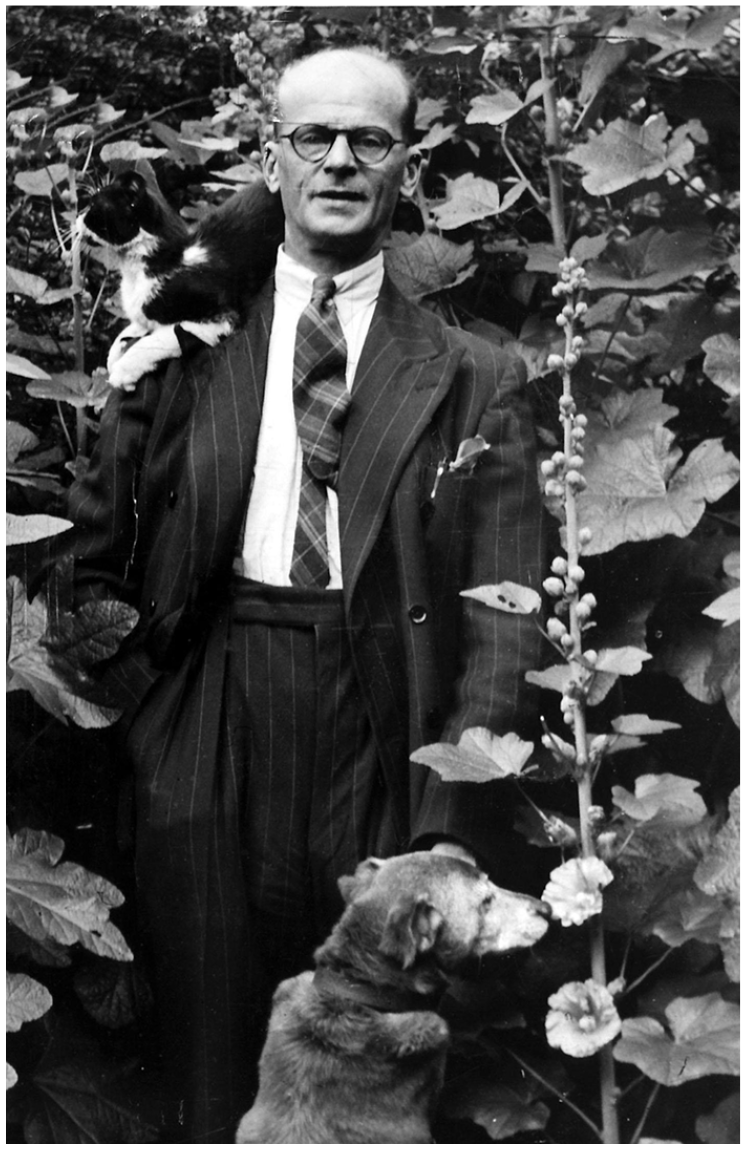
John Reginald Halliday Christie and pets, in the back garden of 10 Rillington Place.
In this triptych of family snaps, we encounter an upstanding man who bears ‘the very stamp of respectability’ (NA CAB143/22 cited in Oates, 2012: 90), a keen gardener, and the goodly neighbour who volunteers for unpaid police service in dangerous times. Periodised in the grayscale of monochrome photography, Christie is visually coded and semiotically entangled within discourses and practices of loyalty and care (the pets), of safeguarding authority and trustworthiness (police uniform), respectability (suit and tie), and of horticultural competence and pride (a flowering herbaceous border). Despite their humdrum quality, these grainy images nonetheless conjure a fictive and theatricalised space in which this subject is figured through a teleoaffective lens of belonging, ethicality and sociality. Yet these visual texts also signal an elsewhere and an otherwise and constitute heterotopias of 10 Rillington Place and the dwelling therein; that is, they amount to ‘counter sites, a kind of effectively enacted utopia, in which the real sites, all the other real sites that can be found within the culture, are simultaneously represented, contested and inverted’ (Foucault, 1986: 24). In other words, they serve to diffract and deflect practices of dwelling which, like ghosts, are cast from the shadows of other timespaces and alternatively configured socio-cultural and socio-material relations, identities and meanings. It is to these spectral present-absences that I now turn.
Scene 2: On the threshold of dwelling
It is October 1944 in wartime London; an air-raid siren signals the all-clear as Muriel Eady, using a torch to light her way, arrives at 10 Rillington Place. She rings the doorbell. A bespectacled face peers through the curtains in the bay window of the ground floor flat. The door is opened by John Christie, dressed in a police war reserve uniform 7 : ‘Come in, do’, he whispers. Miss Eady enters, and he turns up the wall-fixed gas lamp, complaining of the ‘blessed blackout’. In a comforting voice he reassures her: ‘Well, we’ll have a nice cup of tea first. Come into the kitchen, it’s cosier in there’. This is the opening scene of the 1971 film, 10 Rillington Place, and it is the prelude to a murder scene in which, having settled his visitor with a cup of tea, and under the pretext of administering a cure for her bronchial catarrh, Christie hoodwinked Miss Eady into breathing in coal gas which rendered her unconscious; he rapes Miss Eady whilst strangling her with a length of rope. Miss Eady’s lifeless and clothed body is then dragged out to the back garden for burial. In the film, the shodden foot of a corpse (that of Ruth Fuerst) is exposed as he digs down into the garden soil. The cinematic dramatisation of Christie’s necrophilia theatricalises the site of murder and renders visible his methodology for killing; but it also lays bare the mundane materialities, competences and symbolisms which co-constitute his homicidal practices and anchor them within the humdrum rhythms, exigencies and relational spaces of everyday residential life.
Consider, for example, the rather prosaic practice of ringing a doorbell. The activation of this uncomplicated domestic technology – a ‘threshold device’ (Michael and Gaver, 2009) – reminds us not only that the doorbell – as much as doors, windows, fences, walls, gates – mediates the privatised world of ‘home’ and the wider socio-physical environment beyond, but also that dwelling is undertaken in ambiguous spaces of partition and flow, of detachment and connectivity and of stasis and movement. Monitoring and managing the putative boundaries of dwelling and world, whether through a wide array of high-/low-tech devices (from biometric security systems to bells), or through vigilance at the window, foregrounds dwelling as a regime of governance and control over the unpredictability, porosity and messiness of multiple occupancy, residential life.
In December 1939, Christie had moved from the two rooms on the second floor into the three-roomed, ground floor flat of 10 Rillington Place (Curnow, 2017: 21). It was a relocation which afforded him a particularly enhanced vantage point to not only gatekeep who (and what) crossed the threshold of the house, but also to make social and ethical judgements on the propriety of entry. In numerous scenes in both the 1971 film, 10 Rillington Place, and the 2016 television mini-series, Rillington Place, we repeatedly encounter a man who is cagey with visitors, evasive in his responses to them, including when the Metropolitan Police call in November 1949, with a warrant to search the house for (the missing/assumed murdered) Beryl Evans. Indeed, in their character testimonies to the media 2 weeks before his execution, neighbours and tenants of 10 Rillington Place commented that: ‘He never answered the door except to those few callers who were expected’ (News of the World, 28 June 1953). However, Michael and Gaver (2009: 369) refer to ‘threshold devices’ as ‘poetical interventions’ which animate ethical practices of care rather than those of governance and control. There is merit in this perspective when Christie himself recalled his routine of greeting his wife, Ethel, after her hard day’s work; interviewed in HMP Brixton while awaiting trial, he recollected: ‘She (Ethel) had sore feet and so . . . . . . I used to sit at the window watching for her so as to have the tea ready as soon as she came in’ (NA TS58/565 cited in Oates, 2012: 25). The promise of a nice cup of tea and sympathy was certainly offered to Miss Eady (Marston, 2007; Oates, 2012), but as Michael and Gaver (2009) caution, ‘there is (also) bad poetry in the world’ (p. 369). In this sense, the threshold and threshold devices are not solely spatio-material technologies which mark and perform dwelling as a ‘standing reserve’ (Heidegger, 1977); they also mediate the tension between privatised desire and public civility, the individual and the collective body, and enact a heterogeneity of socio-ethical relations through which different kinds of ‘poetry’ are navigated, experienced and (potentially) recalibrated.
Scene 3: Dwelling in a community
In personal correspondence with true crime author, John Curnow, Patricia Pichler (née Sussams) shares her memories of living at 3 Rillington Place as a child. Writing of the street celebrations which marked the end of the war, she reminisces: Everywhere in England was celebrating – red, white and blue flags, parties, and Mr Christie was doing the photography. He was the most respected person in the street . . . . . . . Where the rest of us were really poor, what a nice man he was – always into photography, very upstanding character, always dressed in a suit and tie (cited in Curnow, 2017: 128).
‘Doing’ dwelling as a dialectical practice which requires both an ‘openness to what exceeds its grasp’ (Harrison, 2007: 642) and the shoring up of privatised space as enclosure and autarchy, relies on the pivotal figure of the ‘honest broker’ which, in this instance, takes the form of an admixture of visual and performative tropes. The serving police officer, skilful gardener and well-turned out, white collar worker, diffracted through the domestic photography noted above, enfold with Christie’s other persona – the workplace first aider, the trades union representative, the war veteran (first world war), the amateur photographer, the dutiful husband, the football referee and the hypochondriac (Curnow, 2017; Eddowes, 1994; Kennedy, 1961; Oates, 2012). To put this another way, the ‘neighbourhood monster’ is camouflaged by an allegorical shroud of different embodiments, competences, skills, knowledgeabilities, sartorial choices, biographies and, to some extent, embodied vulnerabilities, articulated through a range of actions, interactions, encounters and lived experiences.
Of critical interest, then, are the testimonies of those who knew or had come into contact with Christie, largely procured by journalists and investigators after his arrest on Putney Bridge in March 1953. For example, Mrs Jessie Hide, a neighbour living at 216 Lancaster Road, recalled how she regularly sought gardening advice from Christie, and shared planting tips with him (Curnow, 2017: 78); and in her witness statement to the Metropolitan Police, Ethel’s friend, Louisa Gregg of 9 Rillington Place, spoke warmly of a man, ‘unlike many husbands’, who shared responsibility for running errands, and daily brought home a fresh loaf of bread from the local bakery (NA MEPO2/9535 cited in Oates, 2012: 100). Others, such as neighbour, William Swann, regarded him as the epitome of humdrum routine, noting that, ‘(h)e would go off to work, neatly dressed, carrying a rolled up umbrella’ (Belfast Telegraph, 26 March 1953) – even as others commented that ‘(h)e always looked as if he had just stepped from a cold shower – shivering and weak’ (Belfast Telegraph, 26 March 1953). Locally he was known by shopkeepers as ‘Gentleman Johnnie’, a polite man always raising his hat in greeting (Maxwell, 1953: 20). At his trial, Dr Matthew Odess, who had treated Christie throughout the 1940s for numerous ailments – including enteritis, fibrositis, insomnia, amnesia, headaches, giddiness and nervous debility – testified that ‘(H)e is a very decent, quiet living man, hard working and very conscientious’ (Jesse, 1957: 169).
Patricia Pichler referred to Rillington Place as ‘our scruffy street’ (cited in Curnow, 2017: 130) and it should be acknowledged that at this time, the capital was a bleak, smog-ridden and cheerless place, riven by bomb damage and unrelenting austerity, with food rationing and fuel shortages being the norm (Mass-Observation, 1943). Marston (2007) writes that ‘(t)he city had a jaded unhealthy air: houses were dirty and unpainted, streets were dimly lit at night and in the world of rented accommodation, there was a strong whiff of poverty’ (p. 22). Against this backdrop, signifiers of relative affluence, common decency, social status and a work ethic, coalesce as a surface aesthetics which communicates and underwrites certain attributes and traits – such as propriety, integrity, public service, expertise, community reputation; but, and importantly, these same qualities can be deployed in many different ways and are also permissive and enabling of a less honourable mode of sociality. Consider these testimonies from work colleagues and neighbours; in turn, they attest to his pomposity, fussiness, anti-social habits, quarrelsomeness, cowardice, pretensions to having medical expertise, overtures to clandestine involvements, penchant for sex workers, petty authoritarianism and curmudgeonly disposition.
Work colleague at British Road Services (talking of Christie’s refereeing techniques): ‘When he refereed British Road Services’ football matches he would trot about the pitch very much in command of the game’ (News of the World, 28 June 1953). Work colleague at the Post Office Savings Bank at Kew (talking of Christie’s first aid practice): ‘He always made a terrific fuss over just a scratch. I’ve gone to him with only a little cut on my thumb and came away with a huge bandage over it’ (Post Office Archives GPO 120/170 cited in Oates, 2012: 93). John Girandot, neighbour, living at 220 Lancaster Road, 1940-41: ‘I have had quite a lot of disagreements with him over various matters . . . . . . (chiefly Christie’s habit of throwing stones over the garden fence) . . . . . . Whilst he was serving in the Police War Reserve, he offered to fight me, but when I went round to his address, he failed to open the door’ (NA MEPO2/9535 cited in Oates, 2012: 32–33). Clifford Spurling, work colleague and fellow First Aider, at the Post Office Savings Bank, Kew, 1947: ‘He told me that if I should get a girl into trouble he could perform an abortion operation. He said he had done so before’ (NA MEPO2/3147 cited in Oates, 2012: 42). George Outram, Police War Reserve colleague: ‘He used to go out picking up prostitutes’ (NA MEPO3/3147 cited in Oates, 2012: 31). Tom Jarrett, Police War Reserve Colleague: ‘It gave him a certain status and a sense of power over ordinary people. He liked to flash his warrant card and boast about the number of people he had “knocked off”’(NA PIN26/16679 cited in Oates, 2012: 32) Mrs McFadden of 3 Rillington Place (grandmother of Patricia Pichler), 1941: ‘Often he tried to use his police authority to tell us to do what he wanted. He threatened to report practically everybody in the street for some lighting or other supposed irregularity’ (NA PIN26/16679 cited in Oates, 2012: 32).
Bessie Styles at 11 Rillington Place, remembered Christie as a ‘grumpy man’ who habitually told the children to clear off when playing at his end of the street; and, notoriously, he had refused to contribute threepence to the children’s Coronation Street Party Fund (Kensington Post, 17 July, 1953). It would be fair to suggest that because of, rather than despite the erstwhile esteem in which Christie was locally held, his less attractive traits, as expressed by those knew him, were certainly remarked upon but largely left unchallenged and unquestioned. Practices of dwelling beyond the threshold are etched, then, from multiple ways of being, saying and acting in the world; in the warp and weft of peccadilloes and politenesses, vices and virtues, and in the dialectical interplay of situated practices – such as shopping, commuting, giving first aid, refereeing, dressing for work, gardening and photography – the ‘killer among us’ (Fisher, 1997) is woven seamlessly into the material-discursive fabric of everyday community life.
Scene 4: Dwelling as domus horribilis
At the Crime Museum Uncovered exhibition, hosted by the Museum of London (October 2015–April 2016), visitors peer inquisitively into a glass cabinet dedicated to the Christie case. 8 From the paraphernalia of displayed artefacts, images and documents, two items attract visitors’ gaze – a photograph of a philadelphus root growing through Ruth Fuerst’s thoracic vertebrae; and a framed diagram of the reconstructed skeletons of Miss Fuerst and Muriel Eady, colour coded to indicate the location of each bone recovered from the garden at 10 Rillington Place. Muriel Eady’s skull was missing. Lost from view at the exhibition is any semblance of an aesthetically pleasing garden in full bloom; rather, visitors encounter a dystopian space of death and horror where the materialities of bone and shrub, of skeletonisation and organic growth, of archaeological excavation and forensic matching, are re-constituted as photographic evidence and visualised as a spectral cartography of reassembled human fragments. Here, though, is not the absence of a well-tended garden which (once) staged performances of domesticity and belonging, but the presence of its inverted other which was always-already there. The heterotopic dynamics of dwelling are certainly materially grasped and viscerally experienced in the discovery (in March 1953) of Ruth Fuerst’s femur bone; inadvertently unearthed when digging over the flower bed, Christie had re-purposed the bone as a strut to hold up the broken trellis fence which bordered the garden – an improvisation which went completely unnoticed in the police search of the outbuildings and garden in 1949 (Jesse, 1957: 158). Representationally, these dynamics are captured by Mrs Jessie Hide and cat (Figure 2), posing for the press photographers and looking out in contemplation from the first floor window of 216 Lancaster Road, to the back garden of 10 Rillington Place.
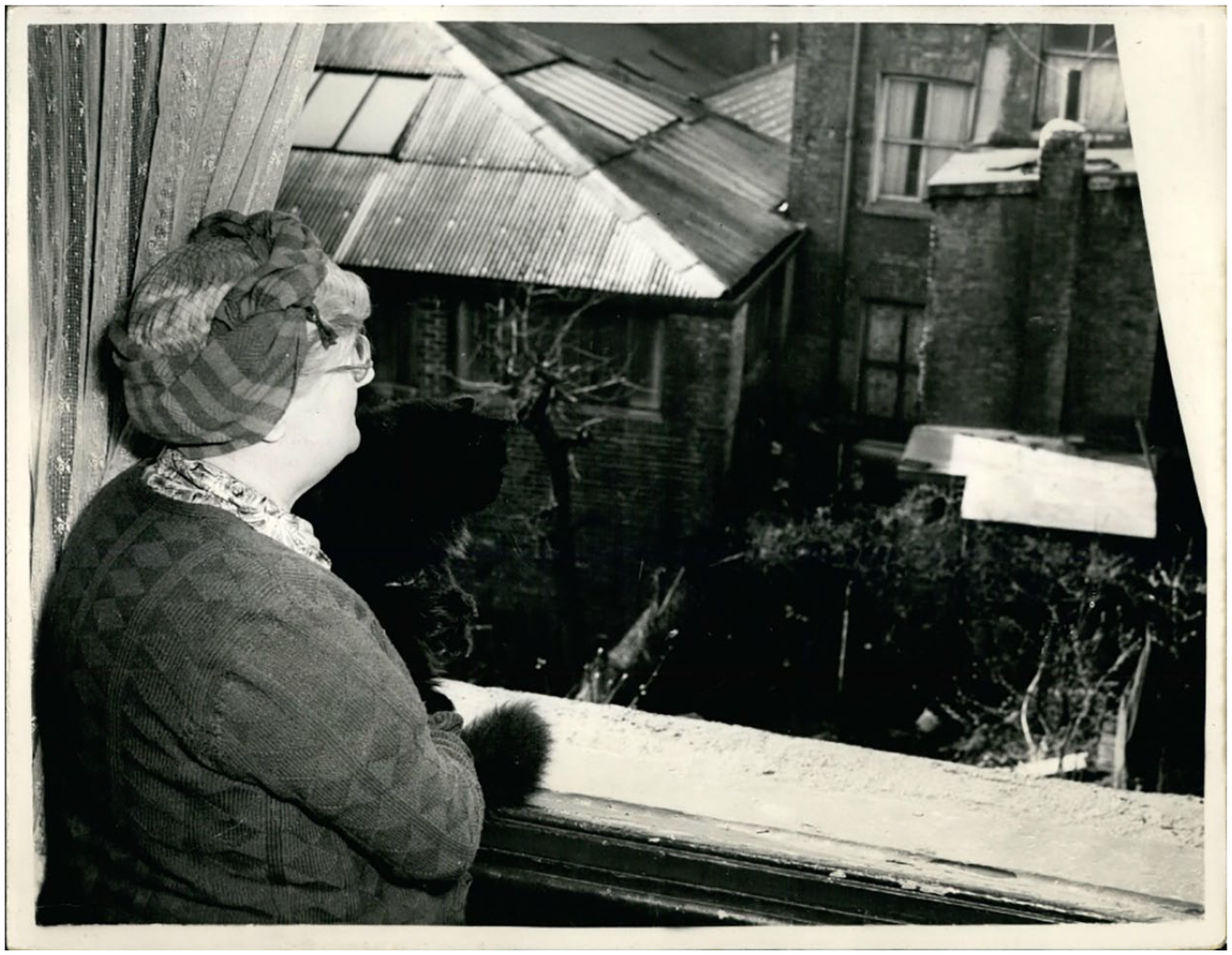
Mrs Jessie Hide and cat.
Now abandoned to the cats and weeds, over the years Mrs Hide had observed the transformation of this small patch of earth into an organic haven, just as she had also had a bird’s eye view of the recovery of Beryl and Geraldine Evans’ bodies from the wash house in November 1949. The commonplace sight of Christie weeding, raking and digging in his garden, at all hours, in all seasons, come rain or shine, provided the perfect cover for his more nefarious activities. However, this was not something that could be safely assumed but had to be continually worked at, carefully managed, and regularly updated to accommodate changing times and the ebb and flow of household demographics. In such a situation, dwelling pivots on a myriad of policing practices such as the control and monitoring of access, the surveillance of domestic movement, the assertion and reinforcement of governmental authority, and the proscription of certain activities – all of which, as with policing proper, needed to be anchored in relations of consent and trust.
The abstract grid of an architectural plan (Figure 3) cannot, of course, capture the aesthetics and atmospherics of dwelling; but in both the 1971 film (10 Rillington Place) and the 2016 BBC mini-series (Rillington Place), the interior spaces of the property are recreated as a sensorium of visceral and suspenseful effects which generate a tense and brooding atmosphere of lingering, dark possibilities. As Mangan (2016) comments of Rillington Place: The sheer menace of the thing is extraordinary. The interiors are tiny, dark, oppressive. The script is minimal, elliptical. . . . . the limning of the manipulation, the entrapment, the complicity without blame, the forced compromises, and the black misery spreading from one man’s evil has surely rarely been better done.
9
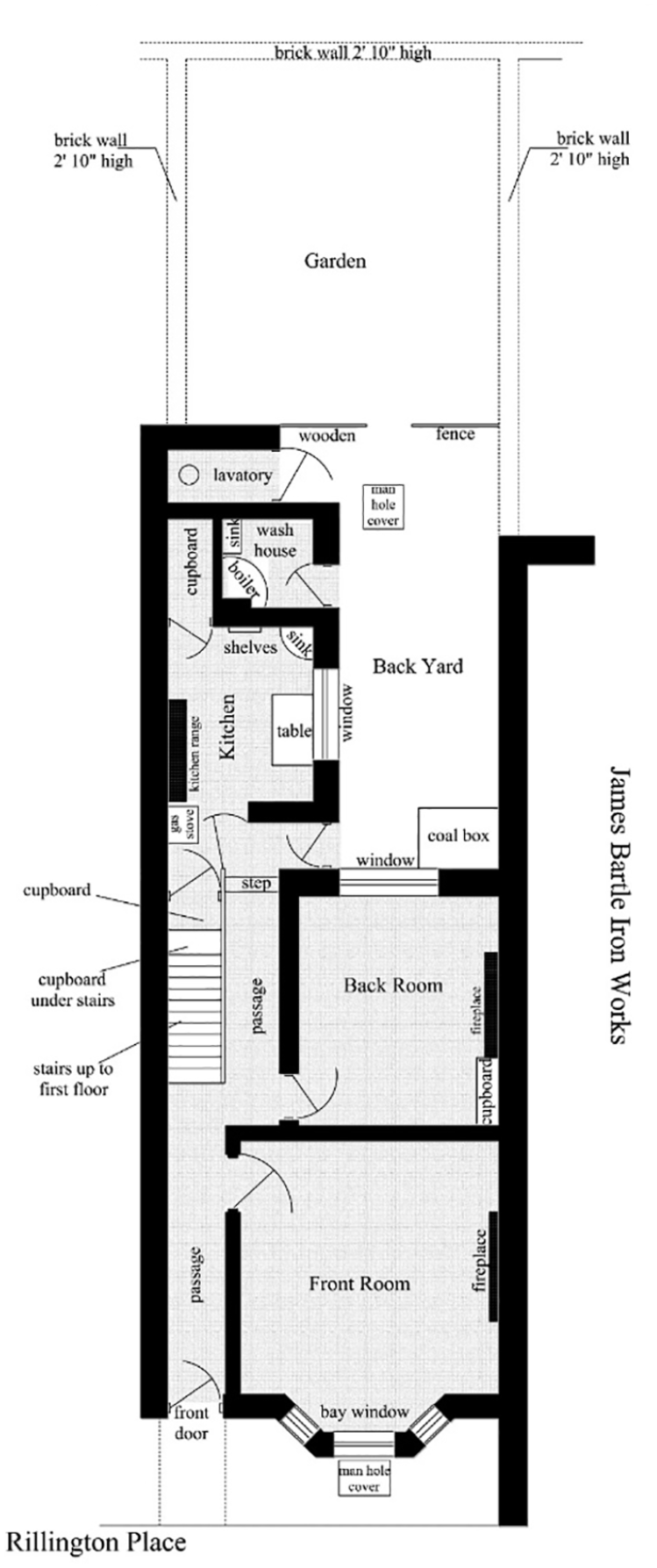
Redrawn plans of the ground floor, outbuildings and garden of 10 Rillington Place.1
First-hand accounts of those who visited or lived in the property attest to this sense of unease. For example, Maureen Probert, sister of Timothy Evans, recalled that Christie always moved silently through the house in his plimsolls – ‘one of the worst things about (him) was that you could never hear him coming’ (Kennedy, 1961: 65); while Joan Howard, a tenant in 1953, testified under oath that ‘Christie used to peer around the door and as I went up the stairs he used to come out and shine a torch on me’ (NA HO291/227 cited in Oates, 2012: 101). These observations suggest a mode of spatial control which allowed for the concealment and monitoring of movement through sound, a policing technique made possible by the thinness of the interior walls; as Jesse (1957) points out, ‘it (was) impossible for anybody to do much about the house without the other inhabitants hearing’ (p. iii) – unsurprising given the jerry-built quality of the house’s fixtures and fittings, sloping floors (Eddowes, 1994: 12), and (slowly) sinking foundations (Jesse, 1957: ii).
Moreover, Eddowes (1994: 4) describes Christie as ‘lurking in the gloom of his ground floor rooms’, and draws attention to the peep-hole which Christie had drilled into the kitchen door so he could keep tabs on when and who entered and exited the building (1994: 7) – a fail-safe when he was not able to keep watch at the bay window in the front room (see Figure 3). Equally, Christie’s bedroom – marked ‘back room’ on the plan (Figure 3) – and kitchen, had windows which overlooked the yard and garden, affording him multiple opportunities to gauge others’ movements to and from the shared lavatory and communal wash house. In many ways, then, the materialities and physical layout of the ground floor flat, with almost no need for adaptation, provided the requisite spatial technology for effective surveillance. Even so, Christie’s regime of vigilance required more than co-present watchfulness; as we will see below, visual governance is never continuous and is always prone to disruption, the unexpected and breach. Shoring up a social site where dwelling enfolds extreme practices of killing with everyday practices of living, relied not solely on the material arrangements of 10 Rillington Place, but also on performative and discursive strategies which maintained their effectiveness.
Developing character through action and movement, screenplay and dialogue, the depiction of Christie in both 10 Rillington Place (1971), and Rillington Place (2016) is of a man who is on constant alert, officious, authoritarian, but also superficially avuncular in his dealings with other tenants – ‘I thought you might like a little cup of tea’, he says to Beryl Evans, entering her kitchen uninvited (10 Rillington Place, 1971). In multiple scenes throughout both dramatisations, Christie eavesdrops on conversations, listens out for movement on the stairs, is alert to the opening and closing of doors, times his appearance in the hallway in order to confront visitors and fellow tenants, and stands vigil at the windows, the peep-hole and at the bottom of the stairs. These performative techniques of control and governance are further buttressed by interactions and ‘polite’ exchanges which he exploits to assert his self-styled status as ‘head tenant’, lay down the ground rules of living in the property, and reinforce his authority as a knowledgeable expert on matters of law, regulations and rights. In 10 Rillington Place (1971), the following three conversations with Timothy and Beryl Evans make the point. Asking about the use of the garden ‘just to put the baby out’, Beryl is told, ‘I’d like to help you but it’s a question of the lease. Once you surrender the right of way, well, it can take an act of parliament in these cases’. Intervening in a row between Timothy and Beryl Evans, regarding a friend who was staying in their flat overnight, Christie reminded them: ‘This is an apartment for two persons, that’s quite clear on the lease – the statutory regulations. I know the law. You cannot be guaranteed security of tenure if you’re overcrowded. That’s a regulation’. Remonstrating with Tim about getting into arrears with the local furniture dealer, Christie cautions him, ‘I gave him 10 shillings out of my own pocket. I don’t want this house getting a name, Tim’. Notwithstanding the artistic freedom of film-makers to script and direct the main protagonist’s words and deeds, this characterisation of Christie squares with the accounts of fellow tenants, and is consistent across dramatic forms; for example, in Howard Brenton’s play, Christie in Love (1969), the Police Inspector figure mocks Christie for his grandiosity regarding his self-appointed household position – ‘You fancy yourself as the landlord? . . . . . . You’re not are you? . . . . . . . You’re just a grubby rent payer . . . . (and) 3 weeks behind’ (Scene 4).
Even so, choreographing the socio-spatial governance of a transient and ever-shifting household population was always-already prone to challenge and transformation. In August 1950, the house was purchased by Charles Brown, a Jamaican who converted the two upper floor flats into five single room lets, accommodating five different African-Caribbean family groups. The cultural contours of everyday residential life at 10 Rillington Place moved from authoritarian tranquillity to a vibrant, dynamic and busy milieu which, according to some sources, Brown also used as an illegal drinking club (Zelland, 1986). In these changed circumstances, Christie’s authority and capacity to regulate and manage movement around the house, and to restrict access to the garden, was severely diminished, even as his panoptic view of everyone’s comings and goings continued unimpeded. One route to regain governmental control of the household was to outsource it to an array of external authorities; the council’s sanitary inspector and housing officer, the Metropolitan Police, the Poor Man’s Law Centre in North Kensington, the family doctor (Dr Matthew Odess), the constituency Member of Parliament (George Rogers), Councillor Gough, and a psychiatrist at St Charles’ Hospital (Dr Charles Howell), were all enrolled in Christie’s attempts to re-establish ‘normal’ domestic relations at 10 Rillington Place (Eddowes, 1994; Jesse, 1957; Oates, 2012). Woven through this strategy was a racist, anti-immigrant stance, not only embedded within/shared by an institutional matrix of governmental actors, but very much in keeping with the sentiments of the time (Lowenthal, 1972; Zelland, 1986). Complaining of his fellow tenants’ poor sanitary regimes, spitting habits, threatening behaviour, entertainment of prostitutes, keeping the front door open, drunkenness, rowdiness, loud music and cooking odours, Christie claimed that ‘our lives here have been and still are made intolerable by the persecution of Brown and the coloured people (sic) who are certainly doing all possible to make it impossible for us’ (NA CAB 143/21 cited in Oates, 2012: 96). In the event, Christie’s efforts to reinstate his hitherto status as a (quasi-) head tenant, fell on deaf ears and in the process the (ideal) conditions of possibility for acting out his clandestine proclivities evaporated.
On the 14th December 1952, Ethel Christie was strangled by her husband, and buried beneath the floorboards in the front room. Oates (2012: 109) refers to this event as heralding an intense period of ‘slaughter’; while Eddowes (1994: 84) talks of the months from January to March 1953 as a ‘rampage’. Now living rather unhappily, disempowered, emasculated, fearful and resentful of the new tenants on the upper floors of 10 Rillington Place, the social, material and cultural arrangements which sustained Christie’s embroiled mode of dwelling, had been hollowed out. So, to continue to lure six women back to the house (Oates, 2012: 123–125), gas, rape and strangle three of them (Kathleen Maloney, Rita Nelson and Hectorina Maclennan), then conceal their bodies within indoor recesses and crevices, was a precarious and risky strategy which, amongst other things, called for the containment of the foul-smelling odours of decomposing matter and organic waste. In the early months of 1953, fellow tenant, Cyril Edwards, complained of a ‘nasty smell about the house’ (Jesse, 1957: 139); while a visitor, Beatrice Short, recalled, ‘I asked Mr Christie if there were coloured (sic) men in the house and he said there were and I put the smell down to this’ (Jesse, 1957: 139). It was noted that at this time, Christie began to lock and unlock the interior doors as he went from room to room; that he obstructed access to the outbuildings, yard and garden (NA MEPO2/9535 cited in Oates, 2012: 126); and that he was sprinkling copious amounts of disinfectant around the hall and backyard, pouring it down drains and on the street-facing underside of the bay window (Jesse, 1957: 143–144). Broke, unemployed, and living under threat of imminent exposure, Christie abandoned the property on 20th March 1953. With the loss of his discursive, technological, spatial and performative jurisdiction over entry into, and movement within and through the house and garden, and lacking any reputational wherewithal to recover a regime of dwelling as practiced, domus horribilis was disassembling as a new configuration of social practices, cultural markers and spatio-temporal motilities took hold of the prosaic rhythms and routines of daily life in a multiple-occupancy residence.
Conclusion: Embedding a criminology of the domestic
Dwelling in extremis is a rare and unusual mode of ‘home-making’, and even in criminological terms, such practices are exceptional. Yet, they are not unheard of. Notorious cases such as the Cromwell Street murders (1967–1992), Dennis Nilsen of Muswell Hill (1978–1983), the Fritzl cellar (1977–2008), Marc Dutroux’s basement lair (no known date–1996), and many of the world’s most sinister serial killers (Geoffrey Dahmer, Ed Gein and John Wayne Gacy, for example) are predicated on temporally extensive practices of murder, rape, torture, kidnap, false imprisonment and sexual brutalities within domestic settings. This paper has questioned the binary logic which separates the normal from the pathological ‘home’, and which regards extreme acts of killing as exceptional events which violently disrupt the humdrum of everyday residential life. I have argued, instead, for a relational reading of domus horribilis which acknowledges how entanglements of everyday and extreme practices are cast from and woven through dense and complex webs of socio-affective, socio-material and socio-cultural alignments, interactions and interdependencies. Jettisoning the concept of ‘home’, the paper has proposed the notion of dwelling to better capture the constitutive and active processes of assembling a spatialised/-ising sociality which takes shape in practices and actions which are discursive, material, performative, aesthetic, visual, embodied and affective. Moreover, since dwelling emerges from conditions of contingency and flux, and is continually being re-made, adapted and transformed, it dispenses with the ontological baggage of ‘home’ and the idea of a bounded, located and stable domestic space. This subtle shift in conceptual approach, and the foregrounding of a relational, practice-centred analytical focus undertaken here, signal the ontological, methodological, epistemological and ethical priorities for a criminology of the domestic.
Dwelling denotes an emergent, nonlinear and fluid space of (inter)action which is continually in-the-making. Schatzkian site ontology perfectly captures the complexities of dwelling, and from this ontological premise, rather than set out with a series of pre-stated socio-spatial categories – such as the ‘family home’ – populated with precoded subjectivities and technologies – such as the ‘goodly neighbour’, ‘the respectable tenant’, ‘the threshold’, ‘the wash house’, or ‘the back garden’ – analysis traces the movements and dynamics of a relational field, and nurtures an openness to the situated, material-discursive practices and contingencies which (dis)assemble entangled modes of emplaced living and encode bodies and things with a specific socio-ethicality and functionality. Through the prism of the Schatzkian site, 10 Rillington Place names an unfolding singularity, a coalition of fluid subjectivities, protean materialities and disparate, extensive practices which come together and bring intensive coherence and stability to a problematic, ever-changing but self-conditioning site.
Importantly, specification of the site cannot be known in advance but calls for a speculative eye and an immersive, inductive sensibility alive to the contingencies and labours of dwelling. In this sense, methodological choices concerning where to look, and who or what to look for, are also active, generative elements of the site, and are co-productive of the socio-spatialities of dwelling. This reminds us that dwelling is assembled as much through practices of research as it is through direct, unmediated experience. Woodward et al. (2010) talk of this as ‘methodological bricolage’ and ‘working with what is at hand’ (p. 276); they advocate an orientation which ‘worm(s) around by way of experimentation, testing the various pressures and intensities that go into the site’s composition’ (2010: 276). Drawing from a mixed portfolio of material-cultural resources and media, this paper has wormed its way through a myriad of archival, epistolary, journalistic, photographic, filmic, museological and dramaturgical data. In so doing, through the lens of a specious present, the time-spaces of 10 Rillington Place as dwelling are flattened, folded, stretched and diffracted through a discontinuous and dispersed array of situated practices (Woodward et al.’s ‘intensities’), each an entanglement of bodies, doings, sayings, affects and things which signpost a rhizomatic and topological route – though only one of many possible routes – through which the tensions and contradictions of diverse socio-culturo-spatial projects are filtered and aligned. Inductive methodological experimentation helps to operationalise the contours of the site of dwelling, but it is their relationalities which assemble a particular kind of dwelling – domus horribilis in this instance – and embed a heterogeneity of disparate goings-on within ever-widening circuits of sociality.
The myriad of situated practices detailed throughout this paper opens up an epistemological space to expose the dense bundle of relations which infuse and emerge from daily life at 10 Rillington Place. At a very basic level, the repetition and regularity of, for example, gardening, commuting, leisure and shopping activities, and the humdrum of casual encounters on the street, at the threshold, and inside the house, underwrite the spatio-temporal relations of the site and sustain the mundane rhythms and routines of dwelling. This foregrounds Shove et al.’s (2012) analytic distinction between practices-as-performances and practices-as-entities; that is to say, the entangled micro-contingencies of living (offering neighbourly advice, shoo-ing the children away, preparing a meal) and killing (sprinkling disinfectant in the hallway, wallpapering an alcove, standing vigil at the window, drilling a peep-hole) are elements of dwelling which circulate within and feed into an assembling (and disassembling) nexus of wider socio-material and socio-cultural relations which have transactional, connective, ordering, governmental, (de)stabilising and transformative power.
To describe 10 Rillington Place darkly, as a macabre and gruesome ‘house of death’, befits its entry into the annals of British criminal history. Perennially revisited through different popular cultural media, it is an address which endures as a spectral signifier of unfinished business, and is the watchword for a domestic environment which harbours sinister secrets and conceals extraordinary acts of violence, murder and sexual predation behind closed doors. In criminological terms, this caricature ignores the complexities of residential life, and sidesteps the plethora of dynamic practices which constitute a site of dwelling. Put another way, the gassing, strangulation and necrophiliac rape of women does not take place in a domestic vacuum, but is woven into and through a myriad of everyday practices of neighbourliness and trust, as well as the cut and thrust of humdrum disputes and petty quarrels. Dwelling, then, emerges from a relational field which enacts cross-cutting, competing and contradictory socio-ethical commitments. There is nothing especially bold or controversial in this assertion, but it does move beyond the criminological convention of positing an organising socio-ethical principle – such as care, austerity, unsafe, negligent, abusive or violent – and then to critically examine ‘home-making practices’ in these singular terms. In eschewing this kind of ethical reductionism, this paper has argued for an analytic which acknowledges the multiplicities of social and ethical ambitions that percolate modes of dwelling and the heterogeneity of practices which sustain them.
Footnotes
Funding
The author received no financial support for the research, authorship, and/or publication of this article.
