




Abstract
This study addresses the challenge of sustaining effective primary school leadership in contexts of high accountability, limited resources, and staff turnover. The research examines how cultural intelligence, structured team dynamics, and strategic talent management can enhance leadership effectiveness and support school improvement. Drawing on a qualitative case study of a two-form entry primary school in Surrey, England, data were collected from performance management records, appraisal documentation, strategic planning documents, and leadership reflections. Thematic analysis identified how cultural alignment, collaborative structures, and internal talent pipelines improved staff engagement, retention, and professional growth. Findings show that leadership practices grounded in cultural intelligence and distributed responsibility fostered resilience, creativity, and collective efficacy among staff. The study contributes to the literature by demonstrating how these frameworks can be operationalized in primary schools. Practical implications include reevaluating inspection frameworks and leadership standards so they value cultural work, collaborative practice, and leadership-pipeline development as drivers of sustained school improvement.
Keywords
Introduction
Leadership in primary education is under unprecedented strain. Across England and comparable systems, high teacher mobility, recruitment shortfalls, and escalating accountability demands have intensified pressure on principals to sustain staff morale and continuity (Heenan et al., 2023; Ismail, 2024). Reports by the Department for Education (2022) highlight that more than one in four headteachers plan to leave the profession within five years, citing workload and resource fatigue. At the same time, growing cultural and linguistic diversity among both students and staff demands more adaptive, inclusive approaches to leadership (Banwo et al., 2021; Jamali et al., 2022). These overlapping tensions, retention, accountability, and cultural heterogeneity, create an urgent need to understand how school leaders can build resilient organizational cultures under constraint (Hofstede, 2021; Trompenaars and Hampden-Turner, 1997).
Despite growing scholarly interest in school leadership, little empirical research has examined how cultural intelligence and talent management intersect to shape practice in primary schools. The quality of leadership in primary schools significantly influences both organizational effectiveness and pupil achievement (Ismail, 2024).
School leaders today face growing demands to raise standards, manage diverse teams, and maintain inclusive environments under increasing financial and regulatory pressures. As Hofstede (2001, 2021) and Trompenaars and Hampden-Turner (1997) observe, cultural intelligence and systematic talent management are now essential for long-term school improvement and staff engagement. Emerging approaches, such as culturally responsive leadership (Banwo et al., 2021), distributed leadership (Benoliel, 2021), and talent stewardship (Mugwaze and Smith, 2024), emphasize cultural intelligence and systematic talent management as essential tools because schools now operate in increasingly diverse environments, face heightened staff turnover, and must balance accountability with inclusion (Heenan et al., 2023; Jamali et al., 2022). Addressing cultural dynamics and staff development is therefore not optional but central to sustainable leadership effectiveness. This article specifically examines three interrelated variables, cultural intelligence, team dynamics, and talent management, as mechanisms that enhance primary school leadership. While each has been studied in isolation, few studies have combined them to explore their collective impact on school culture and performance. By integrating these variables into a single analytical framework, this research extends the educational leadership literature and offers practical insights into how schools can strengthen capacity under real-world constraints.
In England, these challenges have been intensified by policy shifts prioritizing Ofsted inspections, competition for enrollment, and limited funding (Department for Education, 2022).
Traditional leadership models, often driven by numeric targets and narrow appraisal systems, frequently fall short in building cohesive teams or developing internal leadership capacity (Chen and Cheng, 2021; Thunnissen and Boselie, 2024).
This article presents a case study of a two-form entry primary school in Surrey that has undergone strategic leadership transformation since joining a Multi-Academy Trust (MAT) in 2019. Using Hall's Cultural Iceberg Model (1959) alongside frameworks for team development and talent management, the case offers practical insights into how schools can develop inclusive, high-performing cultures by focusing on values, motivation, and distributed leadership. Although first articulated in 1959, Hall's Iceberg Model remains a valuable diagnostic tool because it highlights the often-overlooked role of hidden assumptions in shaping practice. When paired with Hofstede's cultural dimensions (2001a, 2021b) and Trompenaars’ and Hampden-Turner (1997) relational frameworks, the Iceberg model provides a useful foundation for analyzing school culture in today's complex environments. This theoretical synthesis provides the groundwork for the following review of literature on team dynamics and talent management, ensuring continuity between cultural theory and organizational practice.
The article has three objectives:
To examine how cultural values and implicit assumptions shape staff motivation and leadership practice in primary schools. To investigate in what ways structured team development strategies enhance collaboration and professional performance. To evaluate how talent management strategies influence staff development, retention, and leadership succession within the school context.
Following this introduction, the article reviews relevant theoretical literature, outlines the case study methodology, presents findings structured around three strategic frameworks, and discusses implications for leadership development and policy. The conclusion summarizes key lessons for educational leaders seeking to align organizational strategy with inclusive, people-centered leadership practices.
Literature review
Cultural intelligence and organizational culture
Understanding organizational culture is fundamental to effective leadership, particularly in diverse educational environments where cultural expectations, values, and behaviors vary widely (Jamali et al., 2022; Torres, 2022). Hall's (1959) Cultural Iceberg Model remains influential in illustrating the difference between visible behaviors (such as dress codes or classroom routines) and deeper, often unconscious values, beliefs, and assumptions that shape institutional life. Without attention to these hidden layers, leaders risk misinterpreting staff behavior and applying surface-level solutions that fail to address root causes (Latta, 2020). Taken together, Hall's Iceberg (hidden assumptions), Hofstede's cultural dimensions (institutionalized value systems), and Trompenaars’ relational tensions (universalism vs particularism) form a layered framework for understanding school culture. Cultural intelligence operates across these layers, enabling leaders to interpret and manage both visible practices and deeper value orientations.
Cultural intelligence: the capacity to function effectively in culturally diverse contexts, has become increasingly essential in school leadership (Hofstede, 2001, 2021; Khemakhem, 2023). Hofstede's cultural dimensions, including power distance, individualism versus collectivism, and uncertainty avoidance, help explain how staff members interpret authority, risk, and collaboration. Trompenaars and Hampden-Turner (1997) similarly highlight the tension between universalism and particularism—how standard rules or personalized relationships drive decision-making. These models collectively support the idea that culturally aware leadership can foster more inclusive, cohesive school teams (Chun et al., 2021; Minkov and Kaasa, 2022).
However, critics argue that models like the Cultural Iceberg risk oversimplifying culture as homogenous or static (Wang and Chin, 2020). Educational leaders must move beyond national or organizational generalizations to recognize intraschool cultural variation shaped by staff members’ socioeconomic status, prior experiences, and professional identity (Banwo et al., 2021; Dhingra et al., 2024; Heenan et al., 2023). This nuanced understanding is crucial for building inclusive practices that promote deep staff engagement.
While Hall's Iceberg Model and Hofstede's cultural-dimension framework are often used independently, a small but growing body of research demonstrates the value of integrating micro- and macro-cultural lenses to explain leadership behavior. For example, Latta (2020) used both constructs to analyze power and value systems in higher-education governance, and Torres (2022) highlighted their complementarity in examining school organizational culture. Building on this precedent, our study deliberately combines Hall's focus on implicit, situational meanings with Hofstede's quantifiable value dimensions to generate a multilevel analytic view of how school culture operates, from tacit staff assumptions to institutionalized norms. This integration offers a clearer map of the “invisible architecture” of leadership practice in primary education.
Cultural intelligence is not only a theoretical concept but also a leadership capability that supports the alignment of values, expectations, and practices within schools. Effective school leadership depends on a deep understanding of both the visible and invisible elements of school culture and the ability to manage these dynamics with empathy and intentionality. Together, Hall's Iceberg Model, Hofstede's cultural dimensions, and Trompenaars’ relational tensions form the theoretical spine of this study. These three frameworks collectively underpin the analysis, providing a lens for interpreting cultural assumptions, team practice, and talent management as interrelated dimensions of leadership.
Team dynamics and leadership development
Building on this cultural lens, the next dimension concerns how leadership translates into collaborative team practice. Team dynamics act as the mechanism through which cultural intelligence and values are enacted in daily school life. Recent educational research increasingly emphasizes the value of collaborative leadership models. Rather than relying solely on the competencies of individual leaders, high-performing schools invest in cultivating cohesive leadership teams (Byrne and Eddy, 2022; Klinck et al., 2023). Shared cognition and mutual respect among team members enhance decision-making, drive innovation, and foster organizational learning. In early years’ education, Downs et al. (2025) found that instructional effectiveness in literacy improved substantially when teaching teams engaged in high-quality collaboration.
Programs such as the High Performing Schools initiative demonstrate that structured leadership development and distributed leadership practices improve both staff capacity and pupil outcomes (Ağirdağ and Muijs, 2023). These findings support a shift away from hierarchical leadership models toward more inclusive and dynamic team-based approaches.
Effective team dynamics depend on key mechanisms such as transparent communication, clearly defined roles, and conflict resolution systems. Ilavarasi (2024) identifies communication as a foundational enabler of team cohesion, particularly in managing disagreements constructively. Adham (2023) further outlines that school leaders must develop interpersonal skills to address conflict without undermining trust or morale.
Trust is central to team effectiveness. Culturally responsive leadership, which recognizes the diverse identities and values of school staff, supports the development of trust-based working relationships (Banwo et al., 2021). Polatcan et al. (2024) argue that transformational leadership—when underpinned by mutual trust—can stimulate teacher creativity and innovation. Yu and Chen (2023) found that organizational trust is especially important for middle leaders, influencing their emotional wellbeing and performance.
Gómez-Leal et al. (2021) add that emotional intelligence among school leaders plays a critical role in fostering trust, managing interpersonal dynamics, and promoting psychologically safe environments. A psychologically safe climate, where staff feel free to express ideas, admit mistakes, and ask for help, has been directly linked to improved team performance, especially under high pressure (Fyhn et al., 2022; Remtulla et al., 2021).
Despite the benefits, formal team dynamics planning can face resistance. Long-standing appraisal systems, which focus on individual accountability, often hinder team cohesion and distributed responsibility (Wolfson et al., 2021). Leaders must navigate challenges such as entrenched roles, time constraints, and skepticism towards new models of collaboration. These barriers require sensitive, adaptive leadership capable of modeling new norms and aligning team structures with school values (Glasgow, 2023).
Talent management in educational leadership
Although widely studied in business contexts, the strategic management of human capital, commonly referred to as talent management, has received less attention in primary education. Yet it is increasingly relevant, particularly in schools facing resource limitations, retention challenges, and leadership succession pressures (Mugwaze and Smith, 2024).
Talent management encompasses recruitment, development, retention, and succession planning. In schools, this includes creating clear career pathways, mentoring, leadership shadowing, and development aligned with strategic priorities (Sullivan, 2017). Research indicates that structured talent strategies improve organizational performance, particularly when tailored to the school's culture and goals (Ali and Khaled, 2022; Manolescu and Danaiata, 2020).
Recent work by Pikuła (2024) and Bratko (2024) reframes talent management not merely as an administrative process but as a leadership responsibility that demands strategic foresight and cultural sensitivity. Schools that develop leadership pipelines internally are better equipped to manage turnover, reduce external hiring costs, and ensure alignment with their vision and values (Chen and Cheng, 2021; Thunnissen and Boselie, 2024).
Nonetheless, talent management faces significant barriers in the education sector. Budgetary constraints, insufficient training time, and rigid staffing structures make it difficult to implement comprehensive frameworks (Musakuro and De Klerk, 2021). Moreover, inclusive talent management requires leaders to address equity concerns, ensuring fair access to leadership opportunities for underrepresented staff (Bratko, 2024).
Talent management in education is most effective when it is strategic, inclusive, and embedded within school improvement planning. Educational leaders who align staff development with institutional goals can enhance morale, reduce attrition, and strengthen long-term performance.
Methodology
Research design
This study employed a qualitative case study approach to explore how cultural intelligence, team dynamics planning, and talent management strategies were operationalized within a primary school context. Case study methodology was selected for its strength in capturing complex, context-specific phenomena (Yin, 2018). Rather than aiming for broad generalizability, the research sought to produce rich, detailed insights into leadership practices and their impact on school culture and improvement.
The site was a two-form entry primary school in Surrey, England. Since joining a MAT in 2019, the school had embarked on a strategic transformation process focused on staff development, leadership capacity building, and achieving an Outstanding rating from Ofsted. This case provided a compelling and timely context in which to examine how leadership frameworks could be embedded in a school's day-to-day practices. The Surrey context is significant. Schools in this region face acute competition for enrollment, strong pressure to secure Ofsted “Outstanding” ratings, and high staff mobility linked to cost-of-living challenges. The school's recent transition into a MAT provided both an opportunity for strategic renewal and a source of added accountability pressure. These contextual features shaped the leadership responses described in this study. While findings are context-specific, the processes described offer transferable insights for comparable primary school settings facing similar accountability and resource constraints.
Although this study employed a purely qualitative case study design, alternative approaches such as mixed-methods, including staff surveys, interviews, or focus groups, could have added further depth. Given the study's focus on institutional processes and leadership practices, priority was placed on documentary analysis to capture longitudinal patterns while minimizing social desirability bias. This choice is acknowledged as a limitation, and future research should incorporate mixed-method strategies to broaden perspectives and validate findings.
Data collection
Data were gathered through document analysis. Sources included internal performance management records, appraisal documentation, school development plans, strategic planning documents, and teaching quality reviews. These records offered insight into how leadership decisions were implemented, tracked, and evaluated over time. Performance appraisal documents were authored by line managers and reviewed by senior leaders under the school's appraisal policy. Leadership reflections were written contemporaneously by senior staff. While these sources provide insight into leadership perspectives, they also carry the potential bias of institutional framing. At the same time, leadership-authored reflections offered longitudinal insight into how practices evolved across two academic years, capturing institutional memory that may not have surfaced in one-off interviews. This continuity provided a valuable perspective on change processes, even while acknowledging the partiality of leadership voices.
To enrich this data, reflective observations written by senior leaders were also analyzed. These narratives offered first-hand accounts of leadership challenges, staff reactions, and evolving cultural dynamics within the school. The use of both formal documentation and reflective material enabled triangulation of perspectives, enhancing the depth and credibility of the analysis.
No direct interviews or surveys were conducted, as the study prioritized institutional documentation and reflective commentary. This approach aligned with the objective of understanding leadership practices from within the institutional perspective, rather than through external self-reporting.
Data analysis
Thematic analysis was used to identify recurring patterns and concepts within the data. Initial coding focused on the three strategic frameworks underpinning the study, cultural intelligence, team dynamics, and talent management. A second level of coding then examined cross-cutting themes such as staff engagement, leadership behavior, professional development, and organizational alignment.
This dual-layered strategy allowed for both deductive analysis, grounded in theoretical constructs, and inductive insight, responsive to the case-specific nuances of the school environment. Codes were compared across data types to assess consistency and to ensure that themes were rooted in evidence from multiple sources. Particular attention was given to the interplay between strategic planning and staff-level implementation.
Throughout, care was taken to preserve the contextual richness of the data. Rather than reducing complexity, the analysis aimed to understand how leadership practices evolved over time and interacted with institutional culture.
To enhance validity, themes were triangulated across multiple data sources (appraisal records, development plans, reflective logs, and meeting minutes). While the absence of staff interviews limits direct participant voice, the longitudinal and multisource nature of the documents allowed for a consistent picture of leadership practices over two years. This approach also reduced social desirability bias that can arise in interviews.
Ethical considerations
Although the study did not involve direct engagement with human participants, ethical principles were strictly followed. All school documents were anonymized to protect staff identity and institutional confidentiality. Reflective observations were used only with permission from the senior leadership team and were presented in a manner that safeguarded individual privacy.
Because the research involved only internal data and no human subjects, formal ethical approval was not required. Nonetheless, the study adhered to best practices for ethical case study research, ensuring transparency, respect, and data security throughout the process.
Findings
This section presents the core findings from the case study, organized around three strategic themes, cultural intelligence, team dynamics, and talent management. Drawing on internal documentation and leadership reflections, the findings demonstrate how each framework contributed to staff engagement, organizational alignment, and school improvement.
The school's ethos, “Growing Learners for Life,” emphasizing resilience, curiosity, independence, and inclusion, exemplifies how cultural values are embedded in everyday practice. These ethos statements act as a micro-level expression of the deeper assumptions described by Hall's (1959) Iceberg Model. Linking ethos, curriculum design, and leadership behavior illustrates how visible organizational culture can reveal, or conceal, underlying value systems, a central concern of this study.
Cultural intelligence and organizational alignment
Analysis of internal appraisal data and leadership reflections highlighted a significant discrepancy between visible behaviors and deeper engagement with school culture. Most staff delivered strong teaching in core areas such as phonics and literacy, but fewer exhibited intrinsic alignment with the school's ethos of “Growing Learners for Life.” This was particularly evident in how staff approached risk-taking, creative teaching, and child-led learning. This contrast between surface-level compliance and deeper cultural engagement is illustrated in Table 1, which synthesizes performance outcomes alongside leadership reflections.
Performance appraisal outcomes by focus area.
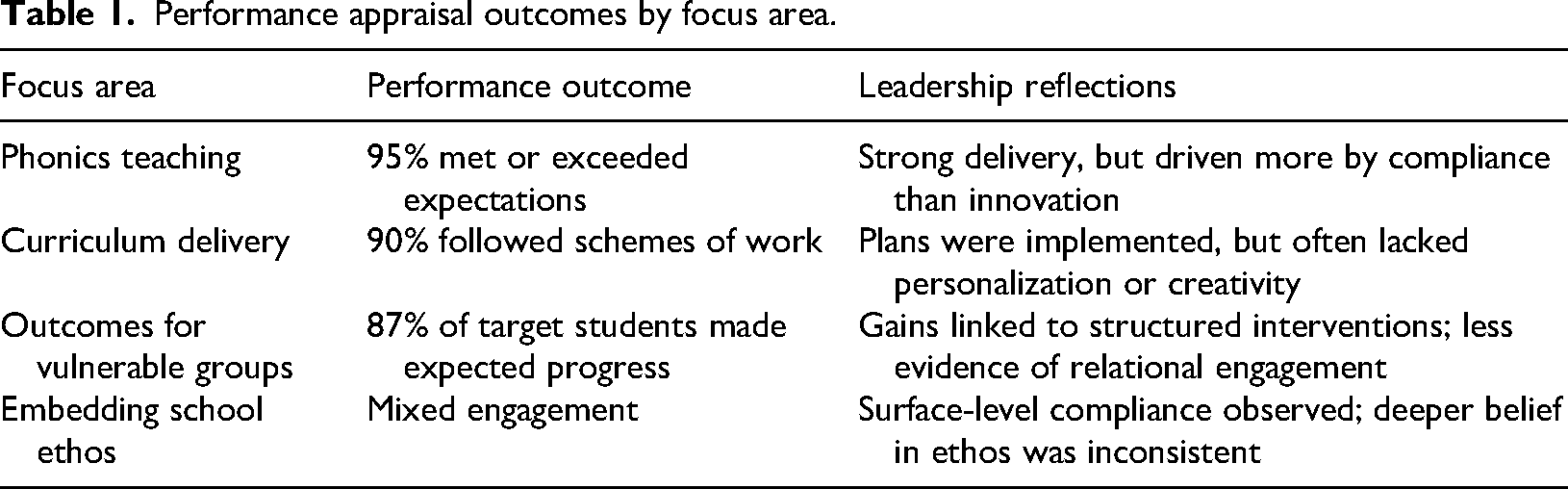
Leadership noted that some staff excelled in formal lesson delivery but demonstrated limited investment in the school's broader values. For example, in continuous provision environments (classroom areas where students independently choose from structured activities that foster self-directed learning and exploration), primarily in the Early Years, though also extending into Year 1, certain teaching assistants followed protocols rigidly without facilitating independent exploration, which conflicted with the school's strategic emphasis on creativity and student agency. This confirmed Hall's (1959) assertion that invisible cultural assumptions powerfully influence behavior, even when performance metrics are being met. In this case, teaching assistants’ underlying assumptions about their role as enforcers of compliance (i.e. ensuring strict adherence to rules and routines rather than promoting student autonomy) limited opportunities for child-led exploration, exemplifying Hall's (1959) assertion that deep cultural assumptions shape visible actions.
The coding process explicitly distinguished between visible behaviors (e.g. adherence to phonics schemes, lesson pacing) and invisible assumptions inferred from reflective journals and meeting notes. Repeated statements such as “I worry that if I let children lead, we lose control” or “Our role is to maintain order first, creativity second” revealed an underlying belief that compliance equated to professionalism. These extracts, triangulated across multiple records, represent the “submerged” portion of the cultural iceberg, reflecting assumptions about authority and risk that shaped classroom practice despite formal alignment with school policy. Identifying and naming these assumptions was a key step in applying Hall's framework systematically rather than impressionistically.
To address this, the school implemented a culturally intelligent recruitment process. Instead of relying solely on experience or formal qualifications, hiring panels emphasized ethos alignment. Candidates completed scenario-based tasks such as designing creative, open-ended activities that reflected the values of resilience, curiosity, and independence.
Once onboarded, new staff engaged in mentoring cycles with experienced colleagues who modeled ethos-aligned practices. Induction materials included cultural expectations, reflective prompts, and storytelling about the school's evolution, deepening new hires’ connection to shared values. Staff were also encouraged to contribute to visual displays, newsletters, and school events that reinforced ethos themes.
Over the course of two academic years (2019–2021), this investment in cultural onboarding yielded observable change. Staff became more reflective and began adapting lessons to prioritize learner independence and real-world relevance. One reflective journal described this change, “I used to focus on ticking off curriculum boxes, but now I try to ask, ‘How does this activity build resilience?’ This shift changed how I planned lessons.” Another noted, “Children's independence was once something I worried about losing control over, but our ethos made me see it as an achievement rather than a risk.”
Another example, Year 1 educators redesigned a unit on storytelling to include student-created outdoor narratives, showcasing both curricular mastery and deep ethos engagement. As one reflective log noted, “I felt more able to take risks after culture check meetings showed that curiosity was valued over perfection.” Another senior leader wrote, “Seeing staff create outdoor story spaces told us they weren’t just following instructions, they believed in the ethos.”
Leadership also initiated regular “culture checks” (brief reflective dialogs within staff meetings) where teams discussed how recent activities reflected school values. These sessions helped surface latent biases and sparked open conversations about leadership potential, inclusion, and fairness in staff development. This approach echoes Coldron et al. (2014), who emphasize the complexity of school culture and the role of relational leadership in navigating identity-driven dynamics.
In essence, the school moved from a model of rule-bound compliance to one of values-led professionalism, where staff performance was increasingly shaped by internalized beliefs rather than external mandates.
Team dynamics and collaboration
Prior to the introduction of a formal Team Dynamics Plan, the school experienced noticeable fragmentation between teaching and support staff. Although both groups worked diligently, they operated in silos. Teaching assistants reported limited involvement in planning, while teachers expressed frustration over inconsistent execution of intervention strategies.
Initial surveys and performance reviews revealed that:
Support staff were unclear about their roles during lesson delivery. Weekly planning meetings often excluded nonteaching staff. There was little recognition of collaborative efforts.
To address this, school leaders introduced a structured Team Dynamics Plan. To operationalize collaborative practice, leadership implemented four core interventions (detailed in Table 2) which collectively shaped the school's evolving team dynamics.
Core elements of the team dynamics plan and their impact.
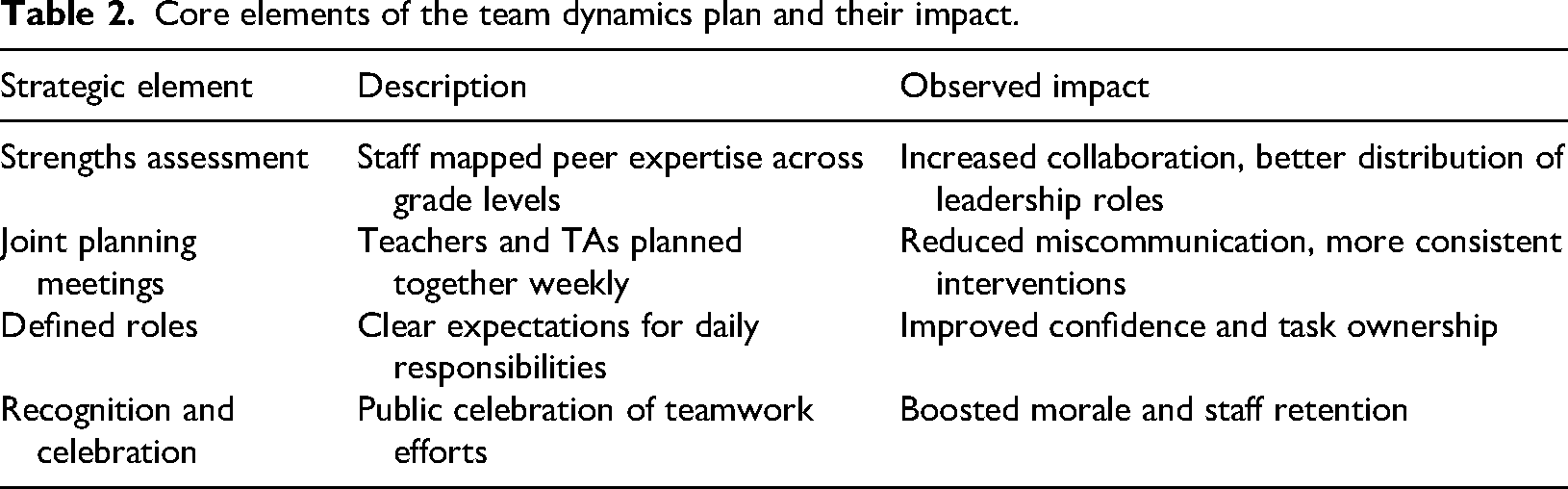
Meeting minutes from spring term 2020 recorded staff comments such as, “Planning together saves me time and makes my teaching sharper,” and “I feel listened to in a way that never happened before.” Reflective notes from a teacher further captured this transition, “Before, I saw TAs as extra pairs of hands, now, they are genuine partners in learning.” These data illustrate how structural changes reshaped professional identity and trust.
An example, in Year 2, coplanning sessions between the lead teacher and two support staff led to the introduction of a differentiated phonics station tailored for EAL learners. This innovation not only raised engagement but also increased reading fluency scores among targeted students.
Another successful intervention involved assigning “team leads” among teaching assistants, informal roles that empowered experienced TAs to support peers, liaise with teachers, and share resources. This distributed leadership model gave support staff a stronger voice in shaping school practice and addressed historic power imbalances.
Trust-building was another critical component. Leadership emphasized psychological safety, encouraging staff to share concerns and experiment with new approaches without fear of blame. Mistakes were treated as learning opportunities, and feedback loops were built into performance reviews. Peer observation became part of professional development, and coaching conversations focused on reflective growth rather than deficit correction.
These efforts led to a culture of mutual accountability. Teachers increasingly consulted support staff in curriculum decisions, and teaching assistants reported feeling “valued, not just used.” Morale rose, turnover decreased, and internal surveys showed marked improvements in team satisfaction.
However, implementing these changes required sensitive handling. Several long-tenured staff initially resisted the new team structures, seeing them as an erosion of traditional hierarchies. Leadership addressed this by providing historical context, inviting feedback on new roles, and publicly recognizing early adopters. Informal coffee mornings and “peer shout-outs” during staff briefings also helped create a sense of shared mission.
Ultimately, team cohesion became a cornerstone of the school's identity. As one leader reflected, “We moved from parallel practitioners to a professional learning community, everyone has a part to play.”
Talent management strategy and leadership development
Historically, professional development in the school had been reactive, focused on filling gaps or preparing staff for Ofsted inspection cycles. The shift toward a Talent Management Plan marked a strategic pivot in which development became proactive, aspirational, and tightly linked to school improvement goals.
The new system was structured around three pillars:
Identification: Performance appraisals now included questions about staff interests, long-term goals, and leadership potential. Pathway design: Based on these insights, personalized growth plans were co-constructed between staff and line managers. Execution and review: Staff engaged in high-impact experiences such as mentoring, curriculum redesign, and CPD leadership, followed by reflective evaluation.
These tailored pathways supported measurable career advancement across staff groups. Table 3 presents illustrative examples of development activities and their resulting outcomes.
Talent development pathways and outcomes.
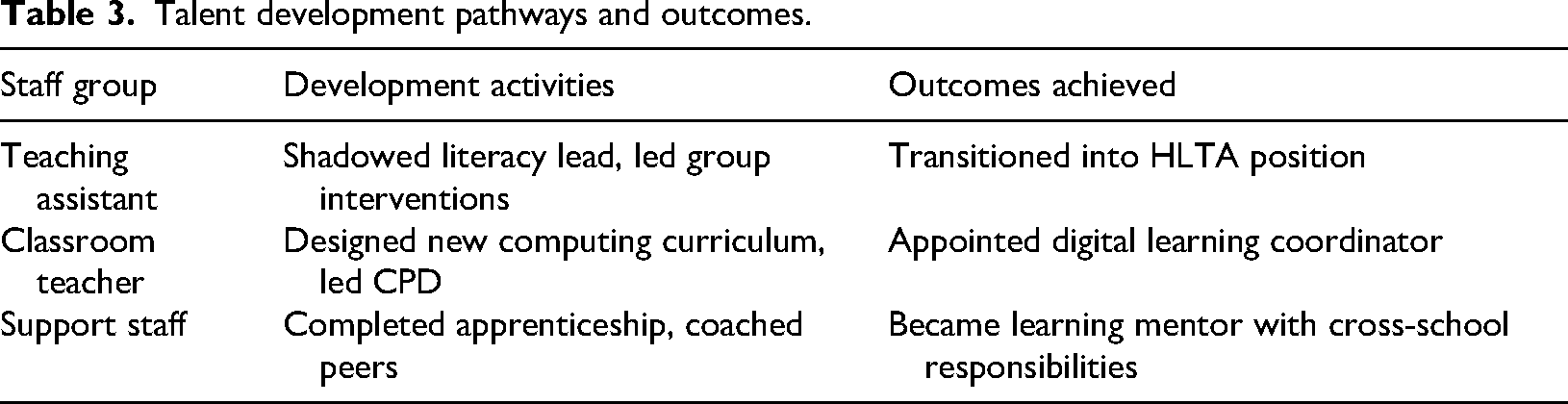
Leadership reflections documented how staff perceived these opportunities, “When I was asked to shadow the literacy lead, it felt like the school believed in me,” wrote one teaching assistant. Another reflection emphasized, “Designing the computing curriculum was daunting, but it gave me the confidence to apply for the coordinator role.” These examples show how developmental experiences not only advanced careers but also deepened staff morale and sense of belonging. These developmental experiences had a ripple effect. Staff reported feeling more invested in their roles, while students benefited from more consistent instruction and better access to support. Importantly, leadership ensured that opportunities were distributed equitably across the team, taking care not to privilege only extroverted or senior staff.
The recruitment process was also overhauled. New applicants were assessed on cultural fit, growth mindset, and leadership potential, not just technical skills. One successful candidate shared that the values-based interview gave them confidence that the school would invest in their development, not just their performance.
Crucially, these talent strategies were achieved within existing resources. CPD was largely internal, supported by a coaching model in which experienced staff mentored peers. Instead of expensive external training, the school created a knowledge-sharing culture where expertise flowed across grade levels and roles. As Musakuro and De Klerk (2021) note, sustainable talent development is often less about financial investment and more about cultural commitment.
Staff feedback confirmed the value of this approach. End-of-year surveys showed a 30% increase in positive responses to statements like “I understand how I can progress here” and “My professional goals align with school priorities.” Retention improved, and when vacancies did arise, internal promotion was frequently possible, reducing recruitment costs and preserving institutional knowledge.
Discussion
This study examined how leadership practices rooted in cultural intelligence, structured team dynamics, and strategic talent development contributed to measurable improvements in a primary school undergoing organizational change. The findings support the argument that sustainable leadership extends beyond technical or operational competence. Instead, it relies on aligning professional culture, fostering psychological safety, and embedding talent development within the broader vision and values of the school.
The discussion is organized into three interconnected themes, (1) cultural intelligence and authentic engagement, (2) collaborative structures and distributed leadership, and (3) talent alignment and leadership pipeline development.
Cultural intelligence and authentic engagement
The case study confirms that surface-level compliance with organizational norms does not guarantee cultural alignment. Performance data revealed that most staff met teaching expectations, particularly in phonics and outcomes for targeted student groups. However, leadership reflections uncovered variation in staff engagement with the school's ethos, indicating that some performance achievements were driven by extrinsic factors such as accountability pressure or procedural mandates, rather than genuine alignment with school values.
Hall's (1959) Cultural Iceberg Model helped interpret this discrepancy. While behaviors and routines (the visible tip of the iceberg) were often consistent, deeper assumptions about student agency, creativity, and independence were less universally shared. As Hofstede (2001, 2021) and Chun et al. (2021) argue, authentic culture work involves addressing the invisible layers of beliefs, motivations, and values that guide action when oversight is absent.
In this study, those invisible layers were operationalized through coded patterns in staff reflections and meeting minutes, where recurring metaphors of “control,” “permission,” and “risk” indicated tacit cultural logics. Connecting these micro-level patterns to Hofstede's dimensions of power distance and uncertainty avoidance provided a coherent explanatory bridge between everyday staff discourse and broader institutional norms, demonstrating the practical value of combining Hall's and Hofstede's perspectives.
This insight had practical consequences. Leadership introduced new recruitment practices that evaluated candidates’ alignment with the school's vision, using scenario-based tasks and reflective discussions to assess cultural fit. Mentoring, storytelling, and reflective practices during induction helped socialize new staff into the values and aspirations underpinning the school's mission.
This emphasis on cultural onboarding echoes findings from Dhingra et al. (2024) and Heenan et al. (2023), who argue that leadership effectiveness depends on emotional intelligence and the ability to shape relational, value-driven environments. In this case, cultural intelligence became a foundational leadership skill, critical not only for managing diversity but also for inspiring commitment and fostering professional identity. This aligns with Khemakhem's (2023) findings that culturally intelligent leaders are more effective at sustaining engagement in diverse educational settings. Similarly, Heenan et al. (2023) showed that transformational leadership grounded in relational culture fosters both teacher motivation and school-wide improvement, reinforcing the outcomes seen in this case.
Moreover, staff contributions to ethos-related projects, such as the creation of literacy-rich outdoor learning zones, signaled a shift from acting out of compliance with leadership expectations to acting from internal conviction. Staff described these projects as “what we want for our learners,” indicating that values were being internalized rather than externally imposed (Minkov and Kaasa, 2022; Wei, 2024).
These developments highlight the need for school leaders to engage in continuous cultural sensemaking. Culture is not a static backdrop but an evolving context that shapes and is shaped by leadership. Therefore, strategic leadership requires the ability to diagnose cultural misalignments, engage in cultural storytelling, and create rituals that reinforce shared meaning over time.
Collaborative structures and distributed leadership
The findings also underscore the central role of structured collaboration in driving school improvement. Before implementing the Team Dynamics Plan, leadership identified widespread fragmentation, including miscommunication between teachers and support staff, unclear expectations, and a lack of shared ownership for student outcomes. These dynamics inhibited staff cohesion and contributed to inconsistent support for vulnerable learners.
The introduction of weekly joint planning meetings, team role definitions, and recognition systems fundamentally altered these patterns. These interventions aligned with research by Byrne and Eddy (2022) and Klinck et al. (2023), who emphasize that high-performing teams rely on shared cognition, clarity of purpose, and mutual respect. The school's team structures created space for staff to co-create curriculum experiences, solve problems collaboratively, and recognize one another's contributions.
Fyhn et al. (2022) and Remtulla et al. (2021) have demonstrated that psychological safety, defined as the belief that one can speak up without fear of punishment or humiliation, is a key driver of team performance. This was evident in the school's environment, where staff began to take more initiative, experiment with new approaches, and provide candid feedback. Leadership strategies such as public celebration of collaboration, informal team-building events, and “culture check-ins” further enhanced this climate.
While some resistance emerged, particularly from veteran staff accustomed to more hierarchical models, leadership addressed this by modeling desired behaviors and framing change as evolutionary. This approach reflects Benoliel's (2021) and Wolfson et al.'s (2021) findings that cultural transformation requires patient, relational work rather than top-down mandates.
The resulting culture of shared ownership supported distributed leadership, where teaching assistants, support staff, and less-experienced teachers began taking on project leadership roles and contributing to strategic initiatives. This aligns with Polatcan et al. (2024), who found that leadership practices built on trust and distributed agency promote staff innovation and sustained engagement. Comparable results were reported by Klinck et al. (2023), who demonstrated that well-structured management teams enhance service delivery in schools, and by Byrne and Eddy (2022), who found that shared cognition within leadership teams strengthens collective decision-making. These studies support the conclusion that team planning and distributed agency are essential for organizational resilience.
Crucially, the team dynamics work helped reframe professional relationships within the school. Staff moved from siloed, role-specific thinking toward a systems perspective, in which every team member contributed to student outcomes. This shift strengthened collective efficacy, a factor linked in the literature to improved pupil learning, staff satisfaction, and organizational resilience.
Talent alignment and leadership pipeline development
The third major insight from the case study concerns talent management and the intentional development of internal leadership capacity. Previously, staff development was fragmented, opportunistic, and largely reactive. The new Talent Management Plan marked a strategic departure, emphasizing the systematic identification and nurturing of talent across all staff groups.
Staff were no longer seen solely as employees delivering lessons, they became future leaders, curriculum designers, mentors, and contributors to institutional strategy. This aligns with Sullivan (2017), Chen and Cheng (2021), Thunnissen and Boselie, (2024), and Mugwaze and Smith (2024), who argue that talent stewardship is a core responsibility of modern educational leadership.
By linking development activities to school-wide goals, such as outdoor literacy innovation, online safety curriculum redesign, and inclusion policy updates, leadership ensured that individual growth was meaningful, applied, and measurable. Staff were more motivated to engage with professional learning when they could see its relevance to both their own ambitions and the school's strategic direction.
In-house coaching, mentoring, and peer-led CPD replaced more costly external training. This resource-conscious approach not only saved money but reinforced a culture of mutual development and peer accountability. As Pikuła (2024) note, sustainable talent systems often emerge from distributed expertise and creative reallocation of existing resources rather than top-down investment.
Outcomes included successful internal promotions, increased staff retention, and enhanced morale. More importantly, the school reduced its dependency on external hires and built institutional memory. Each new leader promoted from within understood the school's culture, strategic priorities, and operational context—shortening the learning curve and minimizing disruption. These outcomes are consistent with Chen and Cheng (2021), Thunnissen and Boselie (2024) and Pikuła (2024), who emphasize that internal succession planning reduces reliance on external hires and strengthens institutional continuity. Bratko (2024) similarly highlights that talent management in education requires both cultural alignment and equity, principles demonstrated in the school's inclusive recruitment and mentoring practices.
Recruitment also evolved to reflect this strategy. Cultural alignment, growth mindset, and potential for leadership were weighted equally with qualifications and experience. Scenario-based interview tasks provided early insights into applicants’ values and thinking processes. This mirrored global best practices in talent acquisition and onboarding (Ali and Khaled, 2022; Bratko, 2024; Manolescu and Danaiata, 2020).
Finally, feedback from staff confirmed the value of this approach. Many expressed that they felt “seen” as professionals with potential and that the school “believed in their growth.” These perceptions are powerful drivers of engagement and retention, and are central to the creation of a learning organization capable of continuous improvement.
Limitations
While the study relied on documentary and reflective sources, these data offered rich access to staff thinking over time, capturing authentic voices that might not have surfaced in interviews. Nevertheless, the absence of direct staff interviews or classroom observations limits triangulation. Reliance on leadership-authored documents also introduces potential bias, as institutional narratives may emphasize successes. Future research should combine documentary analysis with semistructured interviews or ethnography to provide fuller insight into cultural dynamics.
Conclusion
This study addressed its three objectives as follows, (1) It demonstrated how implicit cultural values shape staff motivation and leadership practice, (2) It showed that structured team-development strategies enhance collaboration and professional performance, and (3) It evaluated how talent-management strategies strengthen staff development, retention, and leadership succession within the school context. In addressing these objectives, the study contributes an empirically grounded demonstration of how integrating cultural-intelligence and talent-management frameworks can help retain and motivate educators amid ongoing resource and retention crises in primary education. This case study highlights how integrating cultural intelligence, structured team dynamics, and strategic talent management can drive sustainable school improvement and leadership development within primary education.
First, the findings underscore that authentic cultural alignment, not just compliance with protocols, is vital for long-term success. Staff must internalize the ethos of the organization if they are to consistently embody its values in their everyday practice. Recruitment, induction, and professional development must therefore be intentionally designed to surface and reinforce cultural expectations. Leaders who actively manage the “hidden layers” of culture, as described by Hall (1959) and Hofstede (2001), are better equipped to foster commitment, resilience, and innovation among staff.
Second, the study illustrates the critical role of team dynamics in transforming individual competence into collective efficacy. Collaborative structures, transparent communication, role clarity, and recognition mechanisms were shown to improve morale, support professional growth, and enhance student outcomes. Schools that prioritize psychological safety, mutual trust, and distributed leadership are more likely to foster environments where risk-taking, creativity, and professional learning flourish.
Third, strategic talent management emerged as an underutilized but highly effective lever for organizational improvement. By embedding leadership development opportunities within daily school life, through coaching, peer mentoring, and project leadership, schools can build resilient leadership pipelines while retaining top talent. Importantly, this study shows that effective talent management does not necessarily require significant financial investment. Rather, it depends on visionary leadership, intentional planning, and a deep commitment to unlocking the potential of all staff members.
The case study also reinforces broader lessons for educational leadership practice and policy:
Strategic alignment is essential: Staff development, cultural engagement, and team building should all point toward the school's strategic vision. Relational leadership matters: Staff are more likely to engage deeply with change initiatives when they feel valued, trusted, and understood as individuals. Internal capacity building pays dividends: Developing leadership talent from within strengthens organizational memory, reduces turnover costs, and improves continuity during times of change. Cultural intelligence must be dynamic: Leaders must continually read, interpret, and respond to evolving cultural dynamics within their schools, rather than assuming culture is static.
For policymakers and school system leaders, these findings underscore the need for inspection frameworks and leadership standards to move beyond narrow accountability metrics and recognize the importance of cultural work, collaborative structures, and leadership pipeline development. Aligning policy expectations with the practices that genuinely sustain improvement, such as cultural intelligence, team development, and strategic talent management, would better reflect the realities of effective school leadership and long-term success.
Finally, for practicing school leaders this case offers a hopeful message that strategic, culturally intelligent leadership rooted in people-centered practices can produce transformative results even under resource constraints. By investing in culture, collaboration, and talent, leaders can create schools that not only perform well on inspections but also serve as vibrant, inclusive communities of learning and growth. Future research could test this model across multiple schools to explore how cultural intelligence and talent management interact under differing governance structures.
Footnotes

Funding
The authors received no financial support for the research, authorship, and/or publication of this article.
Declaration of conflicting interests
The authors declared no potential conflicts of interest with respect to the research, authorship, and/or publication of this article.
Data availability statement
Due to the nature of this research, participants of this study did not agree for their data to be shared publicly, so supporting data are not available.