




Abstract
In the competitive world of academia, maintaining a productive and healthy life as a researcher is a significant challenge. This paper argues that identity leadership that focuses on fostering shared social identity (a sense of “we” and “us”) contributes meaningfully to researchers’ well-being and productivity. In a field study of 481 early and mid-career researchers (PhD researchers and postdocs) in Germany, academic supervisors’ identity leadership significantly contributed to better team performance (number of publications, reviews, successful funding proposals, presentations), as well as individuals’ OCB, innovation, and well-being (job satisfaction, reduced burnout). As hypothesized, supervisors played a central role, but identity leadership from senior administrators (head of unit, dean, university president) also contributed to these outcomes. Mediation analyses revealed that supervisors’ identity leadership exerted indirect effects through team identification, and to a lesser extent through trust in the leader. These findings show that academic leaders who cultivate shared identity can not only protect researchers’ well-being but also promote their productivity and innovation.
Since the 1960s, universities have undergone significant transformation, whereby initial student-led democratic reforms were taken over by neoliberal pressures in the 1980s emphasizing privatization and market incentives amid declining public funding (Lorenz, 2012). Increasing neoliberalism in academia has led to an increasing focus on commercialization and performance metrics, and intensified competitive cultures (Fleming, 2020). The associated introduction of audit systems and accountability measures has fundamentally changed how academic work is organized, serving as means to redefine professional identities (Shore and Wright, 2000). As a result, researchers today face significant challenges including job and financial insecurity, a highly competitive job market, and difficulty in maintaining work-life balance (Afonja et al., 2021). While job satisfaction is an important indicator of subjective career success, research productivity and excellence are key objective criteria of success in academia (Sutherland, 2017). In this regard, publications are critical factors of successful scientific careers because “papers are the currency of research” (Afonja et al., 2021: 13). This challenging environment has significant bearing on early-and-mid-career researchers (EMCRs) comprising PhD and postdoctoral researchers, where insufficient job control, insufficient supervisor support, and high job demands make them vulnerable to mental ill-health such as burnout and depression (Levecque et al., 2017). In the words of a postdoc scientist: “Anyone who pursues a research career has to be [prepared to] work in a high-pressure environment that consumes your life” (Afonja et al., 2021: 7). There are multiple reasons why researchers choose career paths outside academia, including toxic managerial cultures and academic leadership that fails to adequately support their needs and development (Watermeyer et al., 2025).
We argue that leadership and social identity are central to tackle challenges that threaten both researcher productivity and mental health for two reasons. First, leadership by academic supervisors and leaders of research teams more generally has been recognized by most researchers as key to performance and success (Rehbock et al., 2021). When EMCRs feel supported by and are satisfied with the supervision they receive, they are more likely to be satisfied with their own academic skill development (Le et al., 2021). Second, the sense of belonging in a research team is a protective factor against burnout, highlighting the importance of group life and associated social identity for mental health (Kusurkar et al., 2021).
In this paper, we propose (social) identity leadership that entails leaders’ creation and promotion of a sense of “us” among those they lead, as an important approach to lead research teams in a way that supports both researcher productivity and well-being. This study makes three key contributions. First, it extends leadership research in higher education by introducing identity leadership, grounded in the social identity approach (SIA; Haslam, 2004; Hornsey, 2008), as a theoretical framework that has been largely absent from the field (cf. Black, 2015). Over the past decade, research on leadership styles in higher education has grown significantly and has focused mainly on transformational, ethical, transactional, and laissez-faire leadership (Maheshwari and Kha, 2023), while identity leadership remains underexplored despite encapsulating effective leadership behaviors such as fostering a collegial atmosphere, advancing the group's cause, acting as a role model (Bryman, 2007), or protecting staff (Bryman and Lilley, 2009). Evidence of identity leadership's benefits in higher education has so far been limited to administrative staff, where it has been linked to enhanced knowledge sharing (Lyu and Sun, 2025), highlighting the need to investigate its relevance for academic leaders. Second, the study demonstrates identity leadership's utility in addressing the distinctive challenges of academia. Building on existing findings in- and outside academia, it examines team identification and trust in the leader as mediators of leadership effectiveness and incorporates well-being variables that have rarely been considered in higher education leadership research (cf. Maheshwari and Kha, 2023). The focus on quasi-objective performance measures offers a more robust evaluation of outcomes than the prevalent use of subjective measures in prior research (e.g., Hou et al., 2021). Finally, the article introduces a novel comparative analysis of leadership across multiple hierarchical levels, highlighting the relevance of different leadership levels (head of unit 1 , dean, and university president) in influencing individual and team outcomes, while emphasizing the critical role of immediate academic supervisors in shaping the performance and well-being of EMCRs.
The social identity approach
Researcher identity can be understood in various ways—individually or socially constructed, stable or dynamic, singular or multiple (Castelló et al., 2021). Within academia, two key frameworks for understanding identity are the social identity approach and role identity theory. Both examine how social structures shape self-concept and influence affect, behavior, and cognition, sharing concepts such as identity salience and multiple coexisting identities (Sluss et al., 2011), but differ in origin, structure, and motivational focus. Although role identity theory is widely applied in higher education research (e.g., Song and Yang, 2023; Zou et al., 2019), this study adopts the social identity approach, explained in detail below, which conceptualizes the identity of researchers as socially shaped, dynamic, and composed of multiple, context-dependent facets (Castelló et al., 2021).
The social identity approach posits a distinction between personal and social identity (e.g., Haslam, 2004). The concept of personal identity (a sense of “I” or “me”) encompasses the ways in which individuals perceive themselves in unique, idiosyncratic ways (e.g., seeing oneself as particularly extraverted or as having a good sense of humor). In contrast, shared social identity (a sense of “we” and “us”) refers to the definition of oneself in terms of attributes that one shared with other members of a group such as “us academics” or “us, members of research team X” (Haslam et al., 2019).
The theory further asserts that social identities shape people's attitudes and behaviors, such that people are motivated to align their behavior with the norms and goals of groups that they identify with (Haslam, 2004). A shared social identity enables psychological resources, including connection, meaning, and social support (Haslam et al., 2019). Moreover, research indicates that identification with a group is associated with a range of important work outcomes such as work satisfaction (Haslam et al., 2009) and innovative behavior (Zhang and Wang, 2021). Because group identification has been identified as an important contributor to physical and mental health (Lee et al., 2021; Steffens et al., 2017), groups have been regarded as a “social cure” to health challenges (Haslam et al., 2018).
Haslam (2017) emphasizes that social identity is highly relevant in educational contexts, shaping processes and outcomes such as creativity and knowledge co-production. As Haslam (2017) highlights, shared social identity between instructor and learner underpins leadership and mutual influence, enabling students to see instructors as a member of their group and as supporting shared goals. Building on this, Cárdenas et al. (2024) show that school leaders who actively foster shared social identity create more positive, supportive work environments that enhance well-being and engagement among staff. Despite some growth in identity research within higher education over the past two decades (Castelló et al., 2021), there remains significant potential for applying social identity theory to higher education (Haslam, 2017). Identity plays a critical role contributing to student well-being and academic achievement (Andreadis and Marshall, 2025; Bliuc et al., 2011) and in shaping experiences of academic retirement, where strong work-related identities are common (Miron et al., 2022). In higher education, various resources can shape professional identities of EMCRs, including the essential support provided by supervisors, their role as aspirational prototypes, and the perceived compatibility between supervisors’ identities and the EMCRs’ envisioned future selves (Bentley et al., 2019).
Identity leadership
The topic of effective leadership is becoming of increasing interest to both academic researchers and organizational leaders (Montano et al., 2017). Importantly, leadership is not about achieving power over others (Haslam et al., 2022), but rather about achieving power through others so that those other people are motivated to contribute to group goals (Haslam et al., 2020). This shared social identity has been argued to be key to social influence, which is crucial to effective leadership (Haslam et al., 2020). The social identity approach to leadership builds on these ideas by conceptualizing leadership not as a set of individual traits but as a process of social identity management and mobilization (Haslam et al., 2020), whereby individuals influence group members’ behavior by creating and shaping shared social identity (Reicher et al., 2018). More specifically, identity leadership (IL) can be seen as a process of cultivating a sense of “we” and “us” that involves representing, advancing, creating, and embedding “a shared sense of social identity for group members” (Steffens et al., 2014: 1002). IL is not limited to one role and can occur at multiple levels, including through shared leadership practices (Fransen et al., 2020a).
IL was initially developed in social and organizational contexts, but has since been applied to a range of additional contexts, including the field of sports (Stevens et al., 2021), politics and crisis management (Frenzel et al., 2022), military operations (White, 2020), societal change (Khumalo et al., 2022), psychotherapy (Lee et al., 2021), and education (Simonsen and Rundmo, 2020). IL has relevance to different settings in part because it is context-sensitive, as leaders are tasked with leading a specific group, such as a country, sports team, or work team (Haslam et al., 2020). In this article, we posit that IL also plays an important role in contributing to academic well-being and achievement. This assertion is predicated on the premise that researchers ultimately also function within the context of teams and that collaboration constitutes a central component of research endeavors. Although there are many similarities, the role of academic supervisors are significantly different to that of business leaders (Vilkinas, 2002) and in this paper we argue they play a key role in reducing the “leadership deficit” in higher education (cf. Morris, 2012).
Identity leadership, performance, and well-being
IL has been argued to be crucial for the formation of effective teams (Fransen et al., 2020b) and has been linked to diverse forms of performance (Hou et al., 2021; van Dick and Kerschreiter, 2016). For example, leaders’ crafting of shared identity through use of “we” pronouns in CEO letters was positively related to sales per employee and return on assets (Fladerer et al., 2021). Furthermore, identity leadership has been positively linked to well-being outcomes such as job satisfaction, work engagement, and (reduced) burnout (Steffens et al., 2018; van Dick et al., 2018), as well as enabling greater resilience in facing and dealing with crises (Muldoon et al., 2019).
Researchers have proposed multiple mechanisms that underpin the effects of identity leadership on well-being and performance outcomes. For example, IL has been shown to enhance team identification and trust in the leader (van Dick et al., 2018), both of which are important within higher education (Bryman and Lilley, 2009). Both have empirically been shown to function as mediators between IL and several important outcomes in organizational (Krug et al., 2021) and in sport settings (Figgins et al., 2025) which suggests the possibility of transferability across contexts. Based on this reasoning, trust in the leader and team identification are expected to ameliorate the exhaustive and performance-oriented nature of EMRCs jobs by positively influencing well-being as well as academic (in role and extra role) performance. Publications, presentations, successful funding, and reviewing articles can be seen as indicators of in-role performance, which in turn has been shown to be positively related to organizational identification (Riketta, 2005; van Dick et al., 2006).
Identity leadership across university hierarchy levels
Whilst choosing the right leadership approach is pivotal to outcomes of all kinds, the hierarchical leadership level also plays a role, influencing how leadership in academia is understood (Grajfoner et al., 2024). This underscores the importance of adopting a more nuanced perspective on the impact of varying leadership levels on their employees.
In academia, the leader of a research team or lab serves as the formal leader in the group and immediate supervisor of EMCRs. While in some research contexts and countries, the team structure is relatively dynamic, in Germany, where the present study was conducted, group boundaries are typically clearly defined and relatively stable. One reason for this is that Assistant and Associate Professorship positions are less prevalent. Instead, academic research teams are typically constituted as fixed groups around a full professor. This creates a relationship of significant dependency between EMCRs and their leader. Even when individual team members depart and new ones join, the professor's role as team leader and academic supervisor remains relatively stable. This structure allows for the formation of a self-contained group within the university.
Nevertheless, beyond this group, organizations typically have various hierarchy levels and are organized in terms of multiple groups offering additional potential identification foci (van Knippenberg, 2000), such as organizational, departmental, and sub-group identification (Sidorenkov et al., 2022). Here, leaders play a pivotal role in motivating employees to engage in behaviors that support goals of a particular group (Ullrich et al., 2007).
We build on the argument that a leader's behavior can influence various outcomes and that multiple leaders can influence the same criterion. In universities, the importance of leadership at different levels is noticeable given the prevalence of distributed leadership practices that operate through top-down delegation rather than collaborative emergence (Bolden et al., 2009). It can be assumed that leaders at higher levels can influence followers by appealing to the social identity of their specific reference group. Therefore, it is argued that identity leadership of leaders at multiple levels of the university hierarchy (supervisor, head of unit, dean, university president) all strengthen members’ sense of connection to their respective group and through this contribute to their well-being and behavioral outcomes. This means that even at the highest level, the university president can create a sense of “us, members of this university” and through this positively influence individuals and teams. However, lower-level groups such as working groups tend to offer an especially important identification focus (Riketta and van Dick, 2005) because they balance the need for inclusiveness and distinctiveness and so smaller groups can be expected to be more salient and have a more pronounced impact on outcomes. Consequently, it can be assumed that academic supervisors are of particular significance. An additional reason for the particular importance of the immediate supervisor for the achievement of lower-level group outcomes is explained by the identity-matching principle (IMP; Ullrich et al., 2007), which states that when identification is addressed at a particular level, outcomes at the same level of categorization are likely to be stronger. This suggests that contributions to team-level productivity should be most sensitive to the leadership of the team leader (rather than, for example, the head of unit).
The current research
The present study sought to test the proposed relations between identity leadership and EMCRs’ productivity and well-being. It also aimed to examine the mechanisms of team identification and trust in the leader as mediators of these links. In the study, we employ a quasi-objective performance measure to minimize bias and enhance the robustness of the findings. Another existing literature gap that this paper addresses is the possibility of multiple identification foci by examining the leadership of not only the direct leader (the academic supervisor) but also of hierarchically more distant leaders, including the head of unit, the dean, and the university president.
In light of the aforementioned findings and the subsequent rationale, we propose and test the following hypotheses:
Methods
Research design
To test our hypotheses, we ran a preregistered 2 cross-sectional online study, inviting doctoral researchers and postdocs who worked at a university or comparable institution who had a direct supervisor. Data collection took place between 06/29/2022 and 10/09/2022. This survey was conducted in compliance with the ethical regulations of the first author's institution, which did not require prior ethical approval. Informed written consent was obtained from all participants prior to the commencement of the study. Participation was not incentivized in any way. Participants were recruited via snowball sampling: Contacts from German universities and various doctoral and postdoctoral associations were invited via email and personally. Questionnaires were available in German and English.
Sample
In total, 490 participants working in academia completed the questionnaire. Three participants were removed because of straightlining and 6 participants because they took less than half of the median completion time (Kaluza et al., 2021). This resulted in a total of 481 participants. Answering each item was mandatory, resulting in no missing data. The dataset used in this study can be accessed via https://osf.io/hm4g7/?view_only = f09fb4ad059b415fadf00ce4cdd7c8ae. Of the participants, 66.32% were female, 32.85% male, and 0.83% indicated “other.” Most (80.25%) were aged 25–35, with smaller groups in other age ranges. PhD researchers made up 83.78% of the sample. Disciplines included natural sciences (61.12%), social sciences (11.43%), humanities (9.56%), economics (8.94%), and other, not further specified disciplines (8.94%).
Procedure
The email sent to the respective individuals or via group distribution list contained the link to the questionnaire. After clicking on the link, participants received information about the study including voluntary participation, anonymized use of data, and data protection. After providing their informed consent, participants were asked whether they worked at a university or similar institution and whether they had a direct supervisor. If this resulted in a negative answer, participation was automatically terminated. Accordingly, only individuals who also met the inclusion criteria were able to participate. Next, participants completed the questionnaire including questions about demographics.
Measures
Identity leadership
To assess identity leadership of leaders at the four hierarchical levels (supervisor, head of unit, dean, and university president), we used the Visual Identity Leadership Scale (VILS; Steffens et al., 2024), which is a pictorial single-item scale, and which is particularly useful for studies investigating multiple leaders. It uses seven Venn diagrams that display different levels of convergence between the leader and the values and goals of a particular group that participants choose from (ranging from no convergence at all to complete convergence). In this study, the VILS was adapted for use at four leadership levels, with the aim of querying the identity leadership of different leaders and the respective group that each leader was required to lead.
Team identification
Team identification was assessed following Doosje et al. (1995) using a 4-item and 7-point Likert scale (1 = “completely disagree”; 7 = “completely agree”; α = .93). Items included, for example, “I identify with my team.”
Trust in the leader
Trust in the leader was measured using the 3-item Trust in the Leader Scale (Podsakoff et al., 1990). Participants responded on a 7-point Likert scale from 1 = “Does not apply” to 7 = “Applies completely” (α = .94). One of the items was “I have complete faith in the integrity of my leader.”
Scientific performance
Scientific performance was measured quasi-objectively by quantitatively assessing the number of scientific contributions at work group level in the last twelve months, in the form of number of peer-reviewed publications, number of articles reviewed, number of successful third-party funding applications, and number of presentations at congresses and symposia. A 7-point scale was used for each of the 4 types of scientific contributions (i.e., publications, reviews, funding proposals, and presentations) which ranged from 0 scientific contributions to 10 or more (with the anchors 0, 1–2, 3–4, 5–6, 7–8, 9–10, and >10). Internal consistency was α = .82.
Organizational citizenship behavior
OCB was assessed with five items based on van Dick et al. (2006) using a 7-point Likert scale reaching from 1 = “completely disagree” to 7 = “completely agree” with an example item being “I help colleagues who have heavy workloads.” Internal consistency in this study was α = .73.
Innovation
Innovation was measured using a 7-point Likert Scale with 1 = “never” and 7 = “always” with the nine items developed by Janssen (2000). This questionnaire is based on the Innovation Workspace Scale by Scott and Bruce (1994) and three items each measure the innovation stages idea generation, idea promotion, and idea realization (cf. Kanter, 1996). The reliability in the present study was α = .89. An example item is “How often do you generate original solutions for problems?”
Job satisfaction
Job satisfaction was measured with two items from the Job Diagnostic Survey (Hackman and Oldham, 1975), using a 7-point Likert scale from 1 = “does not apply” to 7 = “applies completely” (α = .82; rSpearman−Brown = .82). A sample item is “I am generally satisfied with the kind of work I do in this job.”
Burnout
Burnout was measured with a 9-item scale using a 7-point Likert scale with 1 = “never” and 7 = “every day” (α = .91) using the emotional exhaustion subscale of the scale of van Dick et al. (2018) based on the Maslach Burnout Inventory (MBI; Maslach and Jackson, 1981). “I feel emotionally drained from my work” was one of the items.
Results
Data analysis
All statistical calculations and visualizations were performed using version 4.4.2 of the statistical software R (R Core Team, 2024), with the RStudio extension (Version 2024.12.0 Build 467, Posit Team, 2024) and were carried out at the individual level. To test the first three mentioned hypotheses, correlational analyses were used. In addition, Fisher's z-test was used for the third hypothesis. For the fourth hypothesis, an integrated analysis was carried out using structural equation modeling (SEM) which was run with the lavaan package (Rosseel, 2012). The model (see Figure 1) includes the paths of academic supervisors’ IL via team identification and trust in the leader on the latent variables performance (number of publications, reviewed papers, funding grants, and presentations), OCB, innovation, job satisfaction, and burnout. Item parceling was done for the three innovation dimensions: idea generation, idea promotion, idea realization. To more effectively capture the complexity of the data while preserving the theoretical coherence of the model, selected error correlations for individual variables were permitted based on modification indices. Some error correlations were allowed within groups of related latent mediators and within related latent outcomes, in line with theoretical and empirical evidence suggesting the interdependence of these constructs.
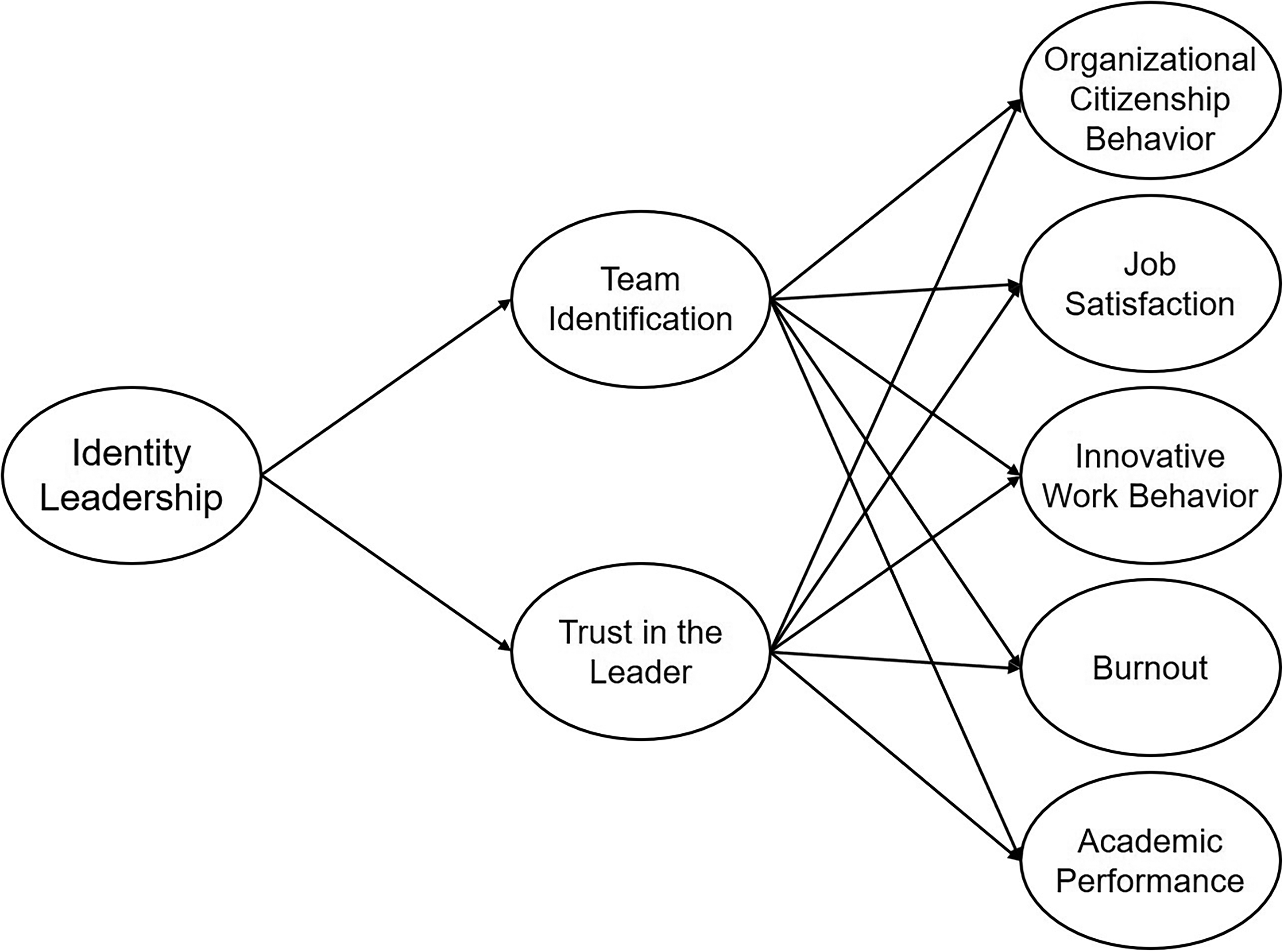
Proposed SEM illustrating the mediation pathways of identity leadership on well-being and performance outcomes.
Performance and well-being outcomes at different leadership levels
As expected, supervisor IL 3 was significantly and positively associated with all academic performance outcomes. The correlations ranged from r = .12 (in the case of reviews and funding) to r = .21 (regarding presentations). Regarding other leadership levels nearly all correlations were as expected positive but some of them were not statistically significant — identity leadership of the head of unit and dean was associated with 3 of the 4 performance indicators, while the identity leadership of the university president was associated with 2 of the 4 performance indicators (see Table 1). Because we measured the performance at the team level, we ran additional partial correlation analyses controlling for group size. The results varied only slightly with correlational differences between .00 and .03 which is why the raw correlations are reported here.
Correlations of identity leadership at different university hierarchy levels with mediators and outcome variables.
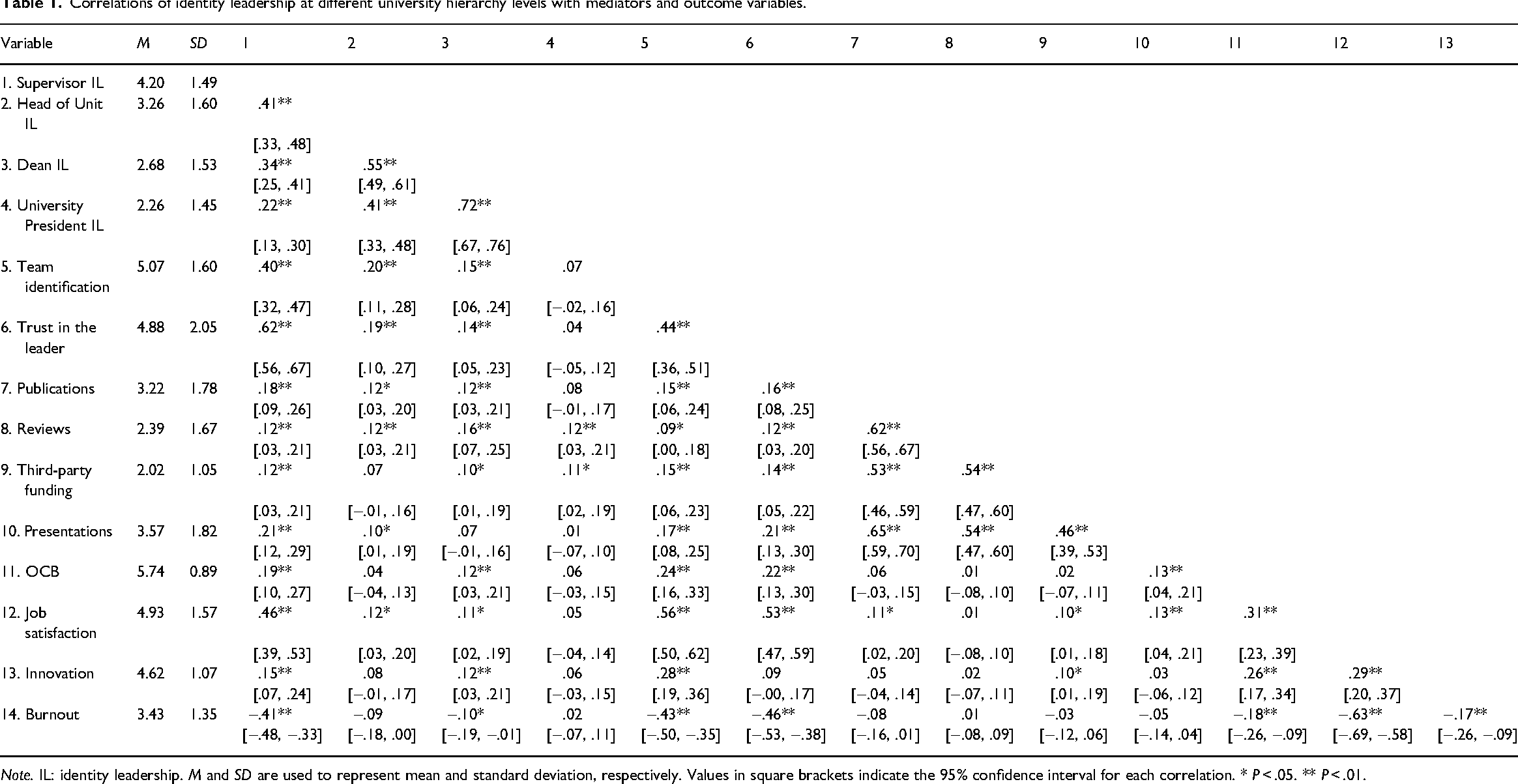
Note. IL: identity leadership. M and SD are used to represent mean and standard deviation, respectively. Values in square brackets indicate the 95% confidence interval for each correlation. * P < .05. ** P < .01.
Analogous to the performance outcomes, academic supervisors’ IL was significantly associated with all individual behavioral (OCB and innovation) and well-being outcomes (job satisfaction and burnout) in the proposed directions. The size of the correlations spanned from r = .15 in case of innovation to r = .46 regarding job satisfaction. While dean's IL was significantly associated with all outcomes, head of unit's IL was only significantly correlated with job satisfaction, while university president's IL was not significantly associated with outcomes even though the relationship with all outcomes (other than burnout) were in the expected direction (see Table 1 which additionally displays correlations with team identification and trust in the leader). All in all, these results provide partial support for Hypotheses 1 and 2.
Descriptively, all outcomes, except for the number of reviews, correlated more strongly with IL of the academic supervisor than with the head of unit, the dean, or the university president (see Table 1). Providing partial support for Hypothesis 3, academic supervisor–outcome correlations were significantly stronger in 12 of the 24 comparisons (see Supplementary Materials for full results). Significant differences were found for presentations, job satisfaction, and burnout, where in all cases the academic supervisor's IL showed stronger associations than that of the head of unit, dean, or university president. No significant differences were observed for reviews, third-party funding, or innovation. For publications, a significant difference emerged only between the academic supervisor and the university president (z = 1.77, P = .04), and for OCB, significant differences were found between the academic supervisor and both the head of unit (z = 3.05, P = .001) and the university president (z = 2.30, P = .01). Controlling for gender of the participant and leader did not change the overall pattern of the results.
Mediators of the relationship between IL and performance and well-being outcomes
The model in Figure 1 showed a good fit (cf. Hu and Bentler, 1999) to the data (χ2 = 810.936; df = 401; χ2/df = 2.0223; CFI = .959; TLI = .952; RMSEA = .046; SRMR = .049). In this model, number of publications, reviews, grants, and talks were subsumed in a latent variable academic performance. The indirect effects were tested using Bootstrapping. Six of 10 indirect effects were significant, two were marginally significant, two were non-significant (see Table 2). Both trust in the leader and team identification mediated the well-being outcomes of job satisfaction and burnout, with trust showing a stronger indirect effect for these outcomes. For performance, innovation, and OCB, team identification emerged as the more consistent and influential mediator, highlighting its greater overall importance. These results provide partial support for Hypothesis 4.
Indirect effects of supervisors’ identity leadership on various outcomes via trust in the leader and team identification.
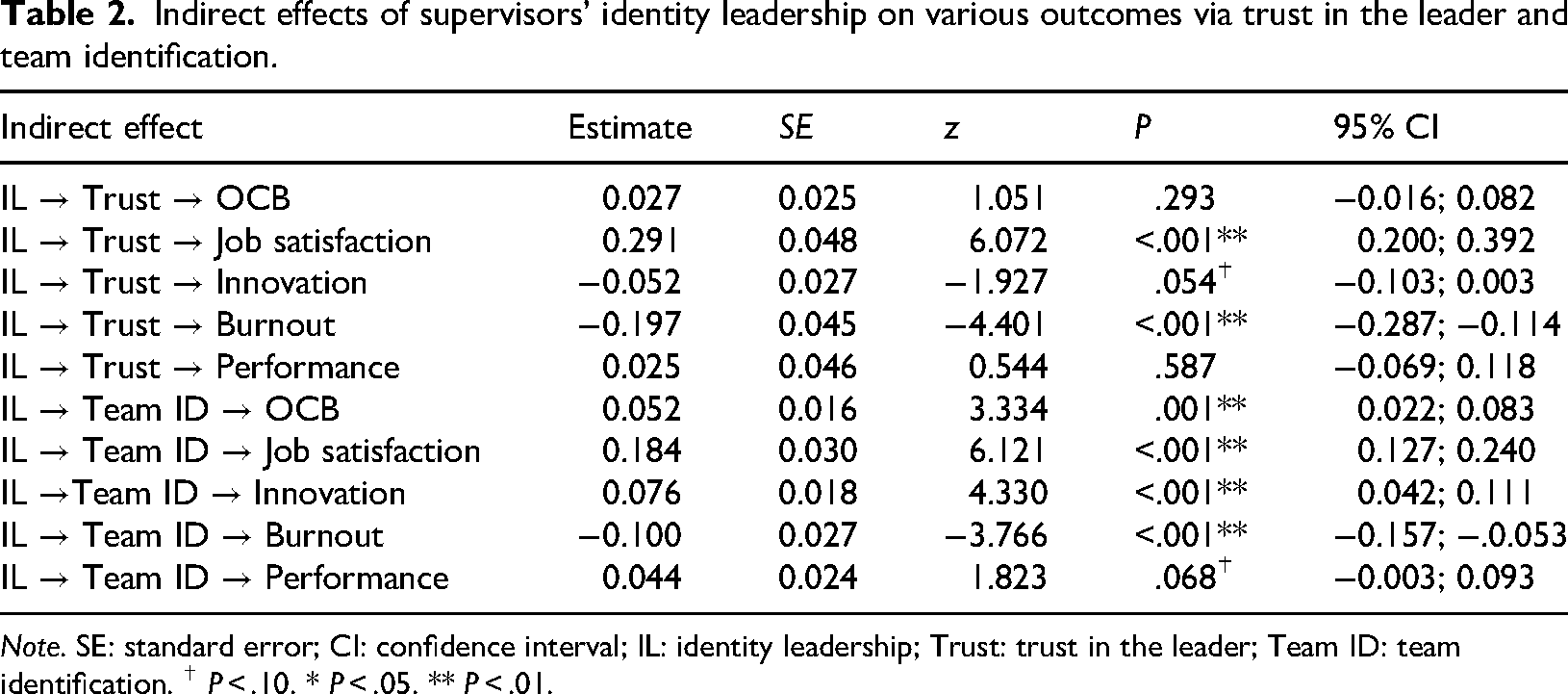
Note. SE: standard error; CI: confidence interval; IL: identity leadership; Trust: trust in the leader; Team ID: team identification. ✝ P < .10. * P < .05. ** P < .01.
Discussion
In this research, we explored the link between identity leadership of various academic leaders and early and mid-career researchers’ performance and well-being. Results show that identity leadership of not only the academic supervisor but also of leaders at higher levels of the organizational hierarchy had a meaningful impact on researchers and their teams. As hypothesized, in nearly all cases, the academic supervisor played at least descriptively the most important role in shaping (for better or worse) researchers’ well-being and performance outcomes.
We also explored the mediating role of team identification and trust in these relationships. Results showed that particularly team identification and to a lesser extent trust in the leader mediated the associations between IL of the academic supervisor and behavioral and well-being outcomes. While trust mediated the links to greater job satisfaction and marginally to innovation, as well as lower burnout (but not OCB or performance), team identification mediated the links with all outcomes including OCB (and marginally with performance).
Theoretical implications
Group-focused leadership approaches such as IL remain underrepresented in the higher education literature 4 , despite strong evidence for the importance of social identity processes in effective leadership. This study demonstrates that identity leadership is applicable to academia and enriches leadership theory by incorporating behaviors missing from dominant frameworks (cf. Black, 2015), many of which insufficiently address the team-based nature of academic work. By evidencing IL's relevance for fostering well-being and productivity in academia, the study fills a critical conceptual and practical gap in higher education leadership research. The findings also extend IL theory by confirming its effectiveness in academia. In this academic setting, IL was associated with significant performance and well-being outcomes at individual and team level, further underscoring its value, and enriching the limited evidence on well-being in higher education leadership research. Incorporating quasi-objective performance data is a strength which sets this study apart from the majority of studies on IL and performance that employ subjective, overall performance evaluations (e.g., Hou et al., 2021). While trust in the leader has been confirmed as a relevant variable in higher education and IL research in this study, team identification seems to be a particularly important mechanisms underpinning the effects of identity leadership. The notion that team identification serves as a more consistent mediator than trust in the leader is partly attributable to the nature of outcomes examined here: OCB and performance rely heavily on mutual emotional and instrumental support often performed by fellow team members, highlighting the central role of team processes. In contrast, trust in the leader appeared to play a somewhat stronger role in the well-being outcomes, possibly due to their greater sensitivity to interpersonal relationship quality, although team identification also contributed to shaping well-being.
It is important to note that while these findings emphasize that IL is an effective form of leadership, IL is not necessarily moral (for a discussion see Kratzer and van Dick, 2025), as people align their behavior with shared group norms and goals (Haslam, 2004), which are not inherently good or bad. Group dynamics are shaped by social identity content—shared beliefs, assumptions, and values which define intra- and inter-group relations (Haslam, 2017). Key questions shaping group outcomes include: “What does it mean to be a member of the group?” and “What type of group do we want to become?” As leadership and identity are socially and culturally embedded, it is important to note that in many countries, academic IL operates within neoliberal structures and should not obscure poor working conditions. Consistent with this, neoliberalism has been shown to reduce well-being by fostering social disconnection, competitive orientations, and loneliness (Becker et al., 2021). While academic supervisors’ IL may help protect members’ well-being within neoliberal, individualistic academic systems, the social identity perspective emphasizes the importance of building shared identity and collective structures, aligned with traditional academic values such as collaboration, collegial governance, and intellectual community (Haslam, 2004). Researchers have argued that neoliberalism has reshaped academic endeavor and identity by putting the responsibility on individuals, prioritizing research over teaching, encouraging questionable practices, and harming well-being through pressures linked to promotion and job security (Mula et al., 2022; Shore and Wright, 2000). Despite this, the growing misalignment between institutional demands and what some academics genuinely value highlights the need to shift academic endeavor away from efficiency toward values such as collegiality, curiosity, and intrinsically motivated research (Fleming, 2020). In this regard, social identities are also a tool of social power, providing a basis for collective resistance that can challenge and transform dominant institutional dynamics (Haslam and Reicher, 2012; Reicher, 2004). IL in particular may be a mechanism through which to counter neoliberal pressures by reshaping institutional narratives, reinforcing shared values, and reorienting leadership toward social support, cohesion, and collective purpose over compliance and efficiency. This aligns with movements like slow scholarship, which challenge fast-paced, metric-driven academia through collective care, slow strategies, and mutual support (Mountz et al., 2015). Through such social identity work, leaders can mobilize collective action, support EMCRs, and challenge dominant narratives of competition and productivity—though this remains a significant challenge (cf. Burrows, 2012; Shore and Wright, 2000).
The present research also expands upon research on multiple identities. The majority of research on organizational identification focused on the organization as a unified entity so far, rather than as a collection of multiple entities (Bartels et al., 2007). This study demonstrates the novel approach of comparing multiple leaders on different hierarchical levels regarding IL and is, to our knowledge, the first study to do so. In the present case, we found that participants’ immediate supervisor at the team level was the most impactful leader in shaping their team-level performance. While these results are consistent with the assumptions of the identity-matching principle and the notion of the direct leader's significance, they also underscore the potential impact of leaders at other levels in academia.
Practical implications
The present study demonstrates that academic leaders exert a substantial influence on ECMRs to engender positive outcomes at both the individual and team level by developing shared identity in the team. However, the impact of academic supervisors on team functioning and researchers’ well-being is not exclusive to supervisors. Individuals in other leadership roles must also recognize their influence and assume responsibility in conjunction with other leadership levels and associated identities. Research has shown that employees’ group identification is interconnected with identification at broader organizational levels (Bartels et al., 2007). Therefore, leaders must shape an identity that aligns with other work-related identities and, when needed, compensate for supervisors’ lack of engagement in IL practices. For example, dual identifications can be promoted, and intergroup relation identities can be shaped (Fladerer et al., 2020). This is important because identification with multiple foci (e.g., scholarly and entrepreneurial) can cause role conflict (Zou et al., 2019), making identity centrality (Wang et al., 2022) and compatibility of group identities crucial for academic behavior (cf. identity complexity, Roccas and Brewer, 2002). This knowledge should be integrated not only into future research endeavors but also into practices and establish it as a training objective. Like IL itself, interventions need to be group- and context-specific, aiming to (re)define group norms. Examples include reflective practices to strengthen identity leadership in coaching (Hoult et al., 2024) and the 5R program, a five-phase IL development program comprising modules focusing on Readying (Why does “we” matter?), Reflecting (Who are we?), Representing (What do we want to be?), Realizing (How do we become what we want to be?), and Reinforcing (Are we becoming what we want to be?) (Haslam et al., 2017; Haslam et al., 2023). 5R is adaptable across settings, including psychotherapy (Haslam, 2024), with a variation tailored to develop shared forms of identity leadership (5RS; Fransen et al., 2020a).
A shared sense of “us” can be created rhetorically, performatively, and materially (for a discussion of the first two, see Kratzer and van Dick, 2025), though material expressions of identity can be challenging in academia. Haslam (2017) emphasizes that identity in education is shaped more by everyday societal practices than by formal policies. These practices reflect the shared understandings and ongoing processes through which groups define themselves and negotiate their identity. Building on this, initiatives such as EMCR representation in committees, mentoring programs, and cross-level identity co-creation workshops play a vital role in fostering group identity from within. At the same time, supportive policies, such as embedding early-career concerns in governance documents or giving EMCRs influence over budgets, can provide formal structures that help enable and sustain these practices.
While these results also have potential implications for the selection of academic leaders, it should not be restricted to identity-related factors. A multitude of factors, including scientific background, skills and abilities, and leadership experience, must also be considered (Alholiby, 2024).
Limitations and future research
Despite its indisputable value, this study has some important limitations. While Germany's academic system has unique features, such as the absence of assistant or associate professors, professorships as chairs, and specific regulations like the German law to limit the maximum contract duration for non-permanent staff that may influence our findings, its similarities with other countries prevail. Given the global competitiveness and neoliberal influences in academia (Mula et al., 2022), we believe our findings on IL, well-being, performance, and the relevance of multiple leadership levels are largely transferable internationally. However, as the study is limited to a single national context, future cross-cultural research is needed to assess the generalizability of these results.
Although performance indicators like peer-reviewed publications are objective outputs, they were self-reported, making them quasi-objective. Using objective performance data could offer further insights and would help overcome common method bias. Additionally, using data from the same individuals for independent and dependent variables introduces same-source bias, potentially strengthening the relationships. Future studies could mitigate these issues by obtaining variables from different sources, such as asking leaders about their identity-related leadership behavior.
People typically have several work-related identities, including those linked to informal subgroups that potentially provide particularly intensive social support. While this study focused on formal identification foci, subgroup identification (Sidorenkov et al., 2022) may also play a key role in IL and its outcomes. Furthermore, the scientific success of PhD researchers is contingent upon more than merely formal leadership or mentorship positions, such as that of the supervisor. In future studies, identity leadership of informal leaders and shared identity leadership needs to be examined in academic contexts.
Conclusion
This study highlights the pivotal role of academic identity leaders in enhancing researchers’ well-being and productivity. The extent to which supervisors foster and emphasize a sense of shared social identity within their research teams is significantly associated with EMCRs’ well-being and team performance, including publications and funding success. Identity leadership at higher institutional levels, including head of units, deans and university presidents, also contributes positively to these outcomes, albeit less consistently and less strongly than the identity leadership of supervisors. Furthermore, results show that team identification seems to be a key mechanism through which identity leadership exerts its effects, while trust in the leader plays a secondary role. These findings underscore the need for institutions to develop leaders across multiple levels who inspire a sense of “we” among researchers, creating healthy and high-performing teams in the sometimes exhausting and overwhelming context of academia. In a manner consistent with the prevailing wisdom in the domain of athletics, the following maxim, attributed to Michael Jordan, finds applicability in academia: “Talent wins games, but teamwork and intelligence win championships.”
Supplemental Material
sj-jpg-1-ema-10.1177_17411432251396677 - Supplemental material for How identity leadership at various university hierarchy levels shapes researchers’ well-being and performance
Supplemental material, sj-jpg-1-ema-10.1177_17411432251396677 for How identity leadership at various university hierarchy levels shapes researchers’ well-being and performance by Benedikt E Kratzer, Sebastian Bänfer, Niklas K Steffens and Rolf van Dick in Educational Management Administration & Leadership
Supplemental Material
sj-docx-2-ema-10.1177_17411432251396677 - Supplemental material for How identity leadership at various university hierarchy levels shapes researchers’ well-being and performance
Supplemental material, sj-docx-2-ema-10.1177_17411432251396677 for How identity leadership at various university hierarchy levels shapes researchers’ well-being and performance by Benedikt E Kratzer, Sebastian Bänfer, Niklas K Steffens and Rolf van Dick in Educational Management Administration & Leadership
Supplemental Material
sj-sav-4-ema-10.1177_17411432251396677 - Supplemental material for How identity leadership at various university hierarchy levels shapes researchers’ well-being and performance
Supplemental material, sj-sav-4-ema-10.1177_17411432251396677 for How identity leadership at various university hierarchy levels shapes researchers’ well-being and performance by Benedikt E Kratzer, Sebastian Bänfer, Niklas K Steffens and Rolf van Dick in Educational Management Administration & Leadership
Footnotes

Ethical considerations
In compliance with the ethical regulations of our university, this study did not require ethical approval as it involved an anonymous online survey with no collection of personally identifiable information, posing no risk to participants.
Consent to participate
Participants provided informed consent prior to participation by voluntarily completing the online survey and confirming their consent through an opt-in checkbox. No personally identifiable information was collected, ensuring participant anonymity and data protection.
Funding
The authors disclosed receipt of the following financial support for the research, authorship, and/or publication of this article: This work was supported by the ConTrust research cluster at Goethe University.
Declaration of conflicting interests
The authors declared no potential conflicts of interest with respect to the research, authorship, and/or publication of this article.
Supplemental material
Supplemental material for this article is available online.
Notes
Author biographies
References
Supplementary Material
Please find the following supplemental material available below.
For Open Access articles published under a Creative Commons License, all supplemental material carries the same license as the article it is associated with.
For non-Open Access articles published, all supplemental material carries a non-exclusive license, and permission requests for re-use of supplemental material or any part of supplemental material shall be sent directly to the copyright owner as specified in the copyright notice associated with the article.

