



Abstract
This study examines how faculty members in Arab higher education institutions experience and interpret destructive middle leadership within the context of Education 5.0. While this reform agenda emphasizes innovation, equity, and human-centered learning, participants described leadership practices that undermine collaboration, trust, and pedagogical creativity. Drawing on semi-structured interviews with ten faculty members (20 interviews across two iterative rounds) and analyzed through an interpretive qualitative approach, the study is guided by an integrated framework of destructive leadership, transformative learning, and distributed leadership. The analysis identifies three themes: (1) the weaponization of authority, (2) hierarchical entrenchment and institutional inertia, and (3) silencing dissent and erasing voice. Together, these patterns show that harmful leadership is not merely interpersonal but structurally embedded—sustained by performative reform discourse, bureaucratic saturation, and the routinization of exclusion. The study argues for re-conceptualizing middle leadership as an ethical, relational practice aligned with the humanistic commitments of Education 5.0, and outlines implications for leadership development, evaluative criteria, and shared governance.
Introduction
The advent of Education 5.0 marks a radical reconfiguration of higher education's purpose and praxis, closely intertwined with the broader societal vision encapsulated in Society 5.0. First articulated in Japan, Society 5.0 envisions a super-intelligent civilization in which the convergence of digital and physical domains serves a human-centric agenda—advancing well-being, sustainability, and socio-economic resilience (Shahidi Hamedani et al., 2024). Building upon and moving beyond the automation and efficiency focus of Education 4.0 (Ghamrawi et al., 2024h), Education 5.0 repositions higher education institutions as dynamic, ethically grounded ecosystems. These institutions are tasked not merely with the dissemination of knowledge but with cultivating digitally fluent, socially responsible, and globally engaged learners through pedagogical innovation, community co-creation, and inclusive development (Babu, 2024). In doing so, Education 5.0 affirms the imperative for academic transformation rooted in both technological sophistication and moral accountability, thereby aligning the future of learning with the broader aspirations of societal evolution.
While the vision of Education 5.0 holds promise for reconfiguring higher education institutions (HEIs) into agile, values-driven, and innovation-rich environments, its realization is far from guaranteed. One of the most insidious and underexamined obstacles to any educational transformation is the persistence of destructive leadership behaviors within the academic leadership echelons (Fischer and Sitkin, 2023). Destructive leadership, in this context, refers to a pattern of behavior by those in formal leadership roles that actively or passively undermines the institution's mission, degrades faculty and staff wellbeing, and suppresses innovation and dissent (Ghamrawi et al., 2024a). These behaviors manifest in varied forms—ranging from narcissistic self-promotion and authoritarian micromanagement to ethical disengagement, emotional abuse, and punitive silencing of alternative perspectives.
In higher education, where collegiality, academic freedom, and shared governance are critical to institutional advancement, the effects of destructive leadership can be disproportionately damaging (Spannagel, 2024). Not only do such leadership patterns create toxic organizational climates, but they also corrode the very relational and ethical foundations upon which Education 5.0 must be built (Afriyani and Soeratin, 2023). Despite mounting scholarship on positive leadership paradigms in academia—transformational, servant, distributed (Ghamrawi et al., 2023a, 2023b, 2024b, 2024c, 2024d, 2024e, 2024g)—there remains a profound silence around the darker, yet prevalent, underside of academic leadership, particularly in the contexts where hierarchical norms are deeply entrenched (Mincu, 2022).
While existing research has documented the adverse effects of destructive leadership on job satisfaction, staff retention, and organizational climate (Schyns and Schilling, 2013), little empirical work has examined how such leadership practices interact with the structural and ideological commitments of Education 5.0. This gap is particularly pronounced in HEIs across Arab states, where reform agendas shaped by Education 5.0 are frequently implemented within leadership cultures marked by hierarchical control, limited transparency, and political insulation (Hammad et al., 2023). In such settings, destructive leadership may do more than erode individual well-being—it may actively undermine institutional efforts toward innovation, collaboration, and educational transformation. This study addresses this gap by investigating how faculty interpret and navigate destructive middle leadership within the evolving demands of Education 5.0. Accordingly, this study was guided by the following research question: How do faculty members in Arab higher education institutions experience and interpret destructive leadership behaviors enacted by academic middle leaders in the context of realizing Education 5.0?
Through this inquiry, the study aims to foreground the human costs and institutional risks posed by destructive leadership and contribute to a critical rethinking of leadership practices necessary for ushering in a truly transformative era of Education 5.0. The article begins by outlining the theoretical and conceptual foundations that frame the study, followed by a description of the methodological approach. It then presents the findings thematically, leading into a critical discussion and concluding with implications for policy, practice, and future research.
Literature review
Education 5.0
Educational thinking is undergoing a fundamental shift in response to the complexities of the postdigital era—an age shaped not by the novelty of technology but by its widespread presence, deep integration, and influence on values and ideologies (Ahmad et al., 2023). Within this context, Education 5.0 has emerged not simply as a policy trend but as a philosophical and systemic rethinking of education's role in shaping the human experience (Babu, 2024). Unlike earlier models that emphasized efficiency, digital advancement, or alignment with industrial needs, Education 5.0 proposes a balanced integration of technological tools with humanistic goals (Shahidi Hamedani et al., 2024). It positions education as a space for moral reflection, cultural renewal, and ethical responsibility—rather than just preparation for the labor market.
This vision builds on the concept of Society 5.0, which was originally introduced in Japan to connect digital innovation with social wellbeing. Education 5.0 takes this idea further by embedding emotional, ecological, and justice-oriented values into teaching and learning (Ahmad et al., 2023). It challenges the transactional mindset of Education 4.0, which—though technologically advanced—was still largely influenced by neoliberal ideas focused on productivity and marketability. In contrast, Education 5.0 promotes emotional intelligence, empathy, and interconnectedness as key skills for addressing global challenges and ensuring sustainable futures (Alharbi, 2023).
The technological foundation of Education 5.0 is not just a support tool; it plays a central role in reshaping how learning occurs. Tools such as artificial intelligence, extended reality (XR), and blockchain are used to support more personalized, decentralized, and learner-driven experiences (Khang et al., 2023). AI, in particular, is employed to tailor learning pathways, enhance feedback systems, and support the development of higher-order thinking skills, while also respecting the diverse ways students learn (George et al., 2025). At the same time, scholars caution against overly optimistic or uncritical approaches to these technologies. There is growing concern about issues such as algorithmic bias, digital colonialism, and lack of transparency in data use—highlighting the need for ethical frameworks grounded in fairness, inclusion, and shared decision-making (Mavuso and Olaitan, 2024).
A core principle of Education 5.0 is its deep commitment to learner-centeredness—not just as a teaching strategy, but as a way of understanding the learner's role in shaping knowledge. Learning is viewed as a dynamic, situated, and collaborative process that prioritizes meaning-making and community knowledge over standardized content delivery (Babu, 2024). Curricula are redesigned to include interdisciplinary inquiry, systems thinking, and global citizenship education—reflecting the growing need for students to navigate complexity and build resilience (Shahidi Hamedani et al., 2024). This transformation also requires a redefinition of teacher roles—from content deliverers to co-creators of innovative and responsive learning environments (George et al., 2025).
Despite its progressive vision, putting Education 5.0 into practice is not without challenges. Many institutions, especially in resource-constrained settings, face difficulties related to digital infrastructure, rigid organizational cultures, and the absence of scalable professional learning systems (Mavuso and Olaitan, 2024). Implementing this model requires more than curriculum redesign—it demands structural change through policies that decentralize authority, increase flexibility, and promote collaboration across education systems, government, and civil society. As the literature notes, such a transformation depends on adaptive leadership and systems-level thinking to succeed (Bakir and Dahlan, 2023).
Academic middle leadership and Education 5.0
The rise of Education 5.0 marks a turning point in higher education, shaped by the merging of advanced technologies with a strong focus on human values in learning. This shift calls for a fresh look at leadership structures in universities, especially the role of academic middle leaders who play a crucial part in turning institutional visions into practical actions (Ghamrawi et al., 2024a, 2024g).
Academic middle leaders—such as department chairs and program coordinators—hold positions between senior administrators and faculty members (Maddock, 2023). This unique placement allows them to directly influence teaching and learning practices. As such, they are essential to putting Education 5.0 into practice by helping embed technologies like artificial intelligence and virtual reality into curricula while promoting core values like empathy, creativity, and ethical thinking (Bakir and Dahlan, 2023).
However, these roles are not without challenges. Many middle leaders must work within systems that are not yet designed to support the innovative goals of Education 5.0. Research shows they often struggle with unclear responsibilities, limited decision-making power, and a lack of targeted professional development (Bystydzienski et al., 2017). These barriers can limit their capacity to lead change effectively and support staff in adopting new teaching approaches.
To respond to these challenges, middle leaders need to adapt their leadership styles to align with the evolving values and goals of Education 5.0. This involves moving away from rigid, top-down approaches and embracing leadership that is more flexible, inclusive, and shared (Abu-Shawish, 2025; Sahito et al., 2023). Leadership should not be seen as tied only to formal authority, but as a shared responsibility—where all members of the academic community are invited to contribute to decision-making and innovation (Al-Jammal and Ghamrawi, 2013a, 2013b, 2013c; Ghamrawi, 2013a, 2013b).
Such leadership requires a relational approach—one that values dialogue over commands, collaboration over control, and influence over formal power (Ghamrawi et al., 2024f; Shal et al., 2018a, 2018b, 2019, 2024a, 2024b). When middle leaders adopt leadership styles that are responsive to context and grounded in shared purpose, they can act as change agents. In doing so, they help create academic environments that reflect the cooperative spirit, creative energy, and ethical focus that Education 5.0 aims to achieve.
While the literature provides valuable insights into the evolving landscape of middle leadership and its challenges in higher education, a deeper analytical lens is needed to interrogate the underlying dynamics of authority, agency, and organizational learning—hence the adoption of the following theoretical framework.
Theoretical framework
This study is guided by three intersecting theoretical perspectives: destructive leadership (Einarsen et al., 2007), transformative learning (Mezirow, 1991), and distributed leadership (Spillane, 2006). These frameworks together provide a strong foundation for examining the contradictions between harmful leadership behaviors and the progressive goals of Higher Education 5.0. Each lens contributes a different, yet complementary, angle for analyzing how middle leadership is experienced and enacted in higher education institutions.
First of all, destructive leadership (Einarsen et al., 2007) offers a framework to examine how leadership can damage institutional culture and relationships. Rather than assuming that leadership is always constructive, this perspective highlights how leaders may act in harmful ways—through excessive control, ethical disregard, or strategic withdrawal of support. These behaviors, whether intentional or not, can weaken trust, diminish morale, and prevent innovation. In this study, this lens was used to analyze data related to faculty experiences of toxicity, demotivation, and structural exclusion, particularly when enacted by middle leaders positioned close to academic staff but with limited accountability.
Moreover, transformative Learning Theory (Mezirow, 1991) adds another dimension by focusing on how individuals respond to disruptive experiences. It frames learning not simply as acquiring knowledge, but as a deep, personal process triggered by moments of challenge or confusion. In this study, destructive leadership is seen as one such trigger—an experience that prompts faculty to question established beliefs about their roles, institutions, and values. This framework helped make sense of how some participants moved from disillusionment to greater self-awareness and a desire for change, suggesting that even harmful conditions can become opportunities for transformation.
Furthermore, distributed leadership (Spillane, 2006) complements these perspectives by offering a constructive vision of leadership that is shared, collaborative, and rooted in practice rather than position. This theory challenges the idea that leadership belongs only to those in formal roles. Instead, it views leadership as emerging through the everyday interactions among people, tools, and structures. In this study, this lens was used to interpret how faculty envisioned or enacted alternative forms of leadership—emphasizing teamwork, shared decision-making, and relational trust—as more aligned with the humanistic and participatory goals of Education 5.0.
Together, these three theories formed an integrated analytical framework that helped the study move beyond description toward deeper interpretation. They enabled the exploration of leadership not only as a site of dysfunction, but also as a space for learning, resistance, and reimagination. This theoretical constellation guided the coding and analysis of interview data, revealing how faculty navigated the tensions between hierarchical practices and transformative educational futures.
Building on these intersecting theoretical lenses, the study adopts a qualitative interpretive methodology to explore how faculty members make sense of destructive leadership practices within their institutional contexts.
Methodology
Research design
This study is situated within the qualitative research tradition, employing interpretive phenomenological analysis (IPA) as both methodological orientation and epistemological stance. Rooted in hermeneutic phenomenology, IPA privileges the interpretation of how individuals make sense of personally significant phenomena (Smith et al., 2014). In the context of this inquiry, where the phenomenon under investigation—destructive leadership enacted by academic middle leaders within the evolving landscape of Higher Education 5.0—is at once affectively charged and structurally embedded, IPA provides the conceptual and methodological apparatus necessary to explore experience as lived, storied, and meaning-laden.
The selection of IPA is not merely technical but ontological, reflecting the study's commitment to co-constructed meaning and embodied subjectivity. IPA's interpretive sensibility enables a textured analysis of the ways faculty navigate, endure, and resist leadership dysfunction within systems ostensibly designed for humanistic innovation. Moreover, the IPA framework aligns with the transformative ambition of Education 5.0, allowing for a reading of participants’ experiences not as isolated complaints but as rich epistemic artifacts that illuminate the tensions between institutional aspiration and organizational reality (Eatough and Smith, 2017).
Participants
In line with IPA's idiographic orientation, a small sample was deliberately selected to allow for rich, layered engagement with each individual's lived experience. Smith et al. (2014) note that sample sizes in IPA typically range from four to 10 participants, balancing depth with analytical feasibility. The sample size of ten was deemed sufficient for saturation at the level of interpretive insight while honoring the diversity of perspectives.
The ten participants in this study were faculty members who had previously attended a webinar series on Education 5.0, led by the primary researcher within a well-regarded virtual professional learning community widely recognized across the Arab States for its intellectual rigor and collaborative engagement. Among the recurring threads of participant dialogue was the problematic role of academic middle leaders—figures who, rather than enabling the enactment of Education 5.0, were often described as obstructing it through various forms of destructive leadership. In response, the researcher shared her interest in initiating a formal study on this precise issue. Participants expressed strong preliminary interest and endorsed the idea of participating in a more structured research endeavor.
To formally operationalize the study, the researcher liaised with the administrative team overseeing the online platform to obtain ethical clearance and logistical access to potential participants. The platform facilitated this process by disseminating individualized invitations and informed consent forms to all fifteen faculty members who had attended the webinar series. Ultimately, 10 faculty members—yielding a 67% response rate—consented to and participated in the study. The characteristics of participants are presented in Table 1.
Below provides an overview of key participant characteristics.
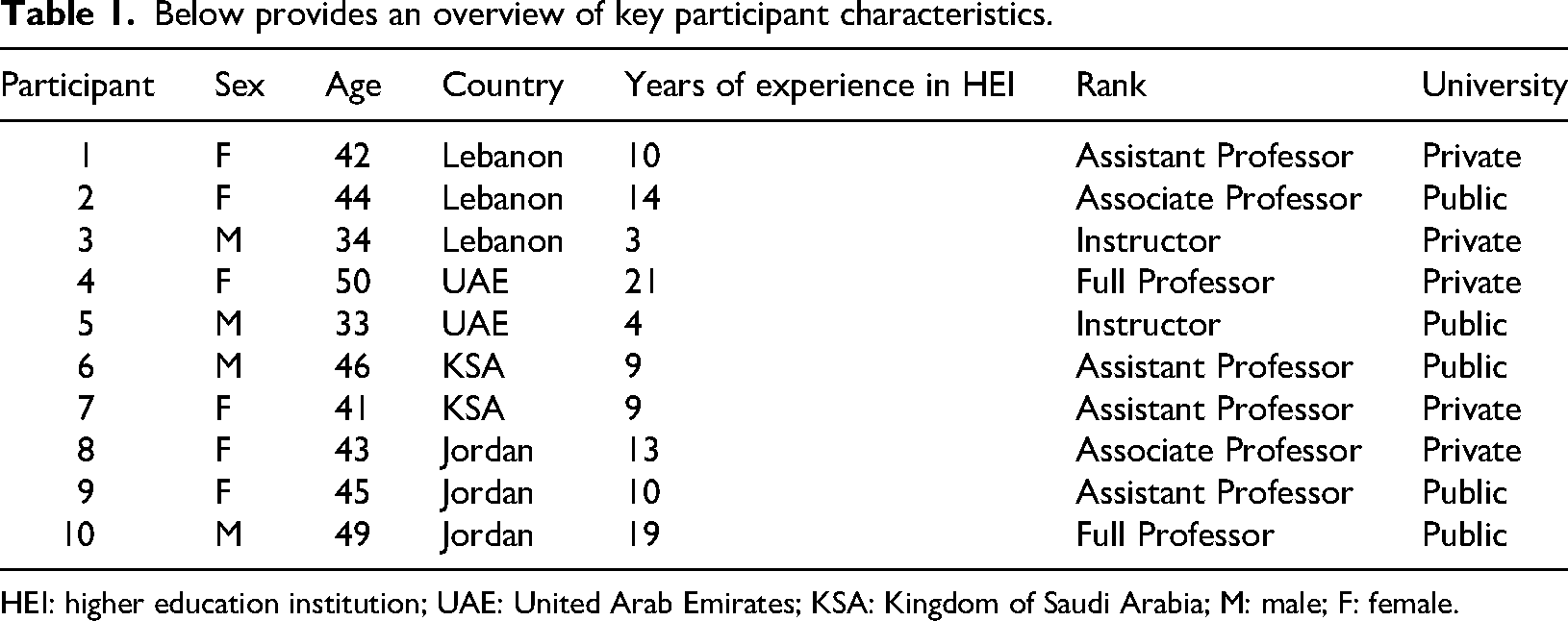
HEI: higher education institution; UAE: United Arab Emirates; KSA: Kingdom of Saudi Arabia; M: male; F: female.
Data collection
Data were generated through two iterative rounds of semi-structured, in-depth interviews with each of the 10 participants. The participant group included five male and five female faculty members drawn from diverse disciplinary backgrounds and institutional roles, ensuring variation in experience while maintaining coherence within the phenomenon of interest. This size was consistent with the idiographic orientation of IPA, which prioritizes depth over breadth, allowing for a sustained, dialogic engagement with each participant's lived experience (Smith et al., 2014). To support personal sense-making and enhance preparedness for subsequent conversations, participants were invited to keep reflective journals between rounds. These journals served as private, introspective spaces for elaborating on emergent themes, recounting critical incidents in greater narrative detail, and engaging in temporal distancing to deepen reflection. The integration of dialogic and written data enabled a rich interplay between immediacy and introspection, thereby enhancing the phenomenological density and interpretive complexity of the dataset.
The semi-structured interview schedules were carefully crafted to elicit rich, interpretive accounts of how faculty members experience and make sense of destructive leadership practices enacted by academic middle leaders, particularly as these practices relate to, resist, or distort the institutional implementation of Education 5.0. Rather than imposing rigid categories, the interviews were guided by open-ended prompts that encouraged participants to narrate their own meanings, tensions, and affective responses. Core guiding questions included (a) Can you describe an instance where an academic middle leader acted in ways you considered obstructive or destructive to your work? (b) How did you interpret their behavior at the time, and has your interpretation shifted since? (c) In what ways, if any, did these behaviors affect your engagement with institutional reforms tied to Education 5.0? and (d) What emotional, relational, or professional impact did these interactions have on your role within the university?
To deepen the phenomenological and interpretive texture of the data, follow-up questions were adapted across the two rounds of interviews to reflect participants’ evolving narratives. This recursive structure allowed for deeper exploration of personally salient themes. For example, one participant who discussed chronic micromanagement was later asked to reflect on how such leadership practices constrained their ability to innovate pedagogically, a key tenet of Education 5.0. Another participant, who recounted public invalidation during strategic meetings, was invited to elaborate on how such incidents shaped their willingness to contribute to institutional dialogue and change. This responsive and individualized approach ensured that interviews remained both grounded in participants’ lived realities and conceptually tethered to the broader tensions between leadership dysfunction and the aspirations of educational transformation.
All interviews were conducted by the lead researcher via Zoom, with cameras intentionally turned off to foster psychological safety and facilitate candid, unguarded dialogue. Otter.ai was employed to generate immediate, AI-assisted transcriptions, ensuring accurate capture of participants’ narratives in real time. This transcription approach maintained a high level of precision while also respecting participant comfort—mitigating concerns around surveillance and visual exposure, which were particularly salient given the emotionally charged and sensitive nature of the topic.
While the concept of saturation in IPA differs from that used in other qualitative traditions, the sample was deemed sufficient as it enabled rich, deep insight into participants’ lived experiences without compromising interpretative depth. Saturation was understood in terms of theoretical sufficiency rather than numerical completion: data collection concluded once interpretive depth was achieved, meaning structures were recurrent across cases, and no substantively new experiential patterns emerged in the second interview round or reflective journals. The analytic process involved continuous movement between the part and the whole—what Smith et al. (2014) describe as the hermeneutic circle—ensuring that interpretations were grounded in both individual particularities and cross-case convergence. Moreover, investigator triangulation and peer debriefing were employed to test interpretive robustness, confirming that saturation reflected analytic completeness rather than premature closure.
Data analysis
Data analysis adhered to the iterative, non-linear analytic procedures prescribed by IPA, underpinned by the hermeneutic principle of oscillating between parts and wholes in the pursuit of meaning (Smith and Fieldsend, 2021; Smith et al., 2014). The analytic process commenced with a deep, immersive reading of individual transcripts, followed by multi-layered annotation capturing descriptive, linguistic, and conceptual nuances. Emergent themes were developed ideographically—within each case—before being cautiously examined across cases for patterns of convergence, divergence, and resonance.
The analysis unfolded through five recursive and interdependent stages, as delineated by Smith et al. (2014): (1) holistic engagement with each case to grasp its narrative architecture; (2) fine-grained, micro-level annotation of meaning-making processes; (3) the development of emergent and superordinate themes grounded in the participants’ own idioms; (4) abstraction and synthesis across the corpus to craft a composite interpretive schema; and (5) critical re-engagement with raw data to test coherence, depth, and thematic integrity. Throughout this process, reflexive memos were written systematically to bracket researcher assumptions, track conceptual movement, and surface ethical tensions inherent in interpretive labor.
To enhance the analytic rigor and interpretive credibility of the findings, investigator triangulation was employed. A second researcher—trained in IPA and familiar with the cultural and institutional context—independently analyzed a subset of the transcripts. Each researcher developed initial themes separately before engaging in analytic dialogue to compare interpretations, negotiate differences, and co-construct thematic coherence. This process was not aimed at achieving statistical reliability but at deepening reflexivity, broadening perspective, and disrupting potential interpretive closure—all of which are congruent with IPA's epistemological commitments (Smith and Osborn, 2015; Yardley, 2000).
The analytic process was further strengthened through member reflections, whereby participants were invited to engage with preliminary themes and offer commentary, clarification, or critique. This participatory analytic gesture reinforced epistemic humility and methodological transparency, positioning participants not as passive sources of data but as co-interpreters of meaning. Taken together, these strategies ensured that the findings were not only interpretively rich but ethically grounded and contextually faithful.
The following section presents findings derived from the interpretive analysis, reflecting participants’ lived experiences and perspectives on destructive middle leadership in the context of Education 5.0.
Findings
The interpretive analysis of faculty narratives revealed a powerful convergence around the ways academic middle leaders actively undermine the transformative agenda of Education 5.0. Rather than cultivating innovation, collaboration, and ethical leadership—hallmarks of Education 5.0—participants reported pervasive patterns of leadership behaviors characterized by authority misuse, suppression of dialogue, and structural rigidity. Three superordinate themes emerged from the data: (1) the weaponization of authority, (2) hierarchical entrenchment and institutional inertia, and (3) silencing dissent and erasing voice.
The weaponization of authority
Participants described consistent and layered experiences of authority being exercised not as support or empowerment, but as a mechanism of constraint, obstruction, and dominance. Across narratives, middle leaders were seen to weaponize their institutional positions in ways that hindered professional agency, constrained pedagogical creativity, and neutralized reform-oriented engagement. This weaponization surfaced through three distinct, recurrent patterns.
The rhetoric of reform as control
Participants repeatedly noted how middle leaders used institutional reform discourse—particularly that of Education 5.0—as a mechanism to appear progressive while stifling actual innovation. One participant lamented that middle leaders ‘talk about transformation in every meeting—transforming mindsets, transforming classrooms—but you try to introduce a small change and suddenly there are ten excuses’ (P1). Another reflected the same dissonance between rhetoric and practice: ‘She tells us ‘think like designers,’ but if I try something new in my course, it gets flagged in my evaluation. So I’ve stopped trying’ (P5). As another summarized, ‘The discourse is hollow. It's polished, performative, and completely detached from what we live. We are told we are empowered while being tightly managed’ (P8). Collectively, these reflections highlight how reform language was repurposed as an instrument of control rather than transformation.
Bureaucratic gatekeeping and procedural domination
Many participants described persistent experiences of being subjected to excessive procedures, rigid approval systems, and layers of micromanagement that stalled creativity and diluted faculty autonomy. As one faculty member explained, ‘I proposed a course that integrated AI tools for critical thinking. The approval process was so long and confusing, I had to abandon it’ (P4). Similarly, another described how ‘every syllabus change, every guest speaker—there's a form, a review, a sign-off, another form. It's designed to wear you down’ (P6). Even research initiatives were constrained by managerial logic, with one participant recounting, ‘When I submitted a research idea connected to Education 5.0, my middle leader asked, Is this aligned with the ministry's KPIs? That's not a question of relevance—it's a control tactic’ (P10). These testimonies reveal a bureaucratic culture where compliance and surveillance replaced trust and intellectual freedom.
Strategic invisibility and leadership abdication
A final, equally significant pattern involved the strategic invisibility of middle leaders, who often abdicated responsibility in moments requiring advocacy, mediation, or decisive support. Faculty described how their leaders ‘barely spoke’ during curriculum reform committees and ‘simply deferred to higher levels’ when decisions became difficult (P2). This disengagement extended to ethical and interpersonal challenges: one participant recalled a bullying incident where, upon seeking help, ‘the answer was, Let's not get involved. I was stunned’ (P3). Others described leaders who appeared only for ceremonial visibility—‘She shows up when there are awards to hand out. But when we need advocacy, mediation, or a clear stance, she disappears’ (P7). Such accounts expose a pervasive vacuum of moral and professional leadership, where silence and absence functioned as political strategies for self-preservation.
Hierarchical entrenchment and institutional inertia
Participants across the sample consistently described an organizational culture steeped in rigid hierarchies and institutional conservatism. Academic middle leaders were portrayed as defenders of entrenched norms—prioritizing compliance over creativity and alignment over innovation. Despite institutional rhetoric endorsing agility and transformation under Education 5.0, participants encountered leadership behaviors that upheld traditional power structures and discouraged bottom-up initiative. This theme manifested through three recurring patterns.
Top-down obedience and chain-of-command mentality
Faculty described academic middle leaders as loyal executors of upper management directives, rarely engaging in critical questioning or adaptive leadership. Participants perceived a leadership culture that equated obedience with effectiveness and discouraged any deviation from vertical command structures. One participant remarked that their middle leader ‘starts every meeting by quoting the dean or the ministry. He doesn’t have an opinion of his own—he's just a mouthpiece’ (P4). Another observed that ‘if a policy comes down, it's followed blindly. There's no room for contextualization or discussion—it's just implemented as-is’ (P9). As one participant summarized, ‘She once said, my job is not to argue, it's to execute. That was the end of any conversation’ (P2). Together, these reflections illustrate a culture of compliance where leadership is conflated with submission, and critical thought is perceived as dissent.
Ritualized meetings and symbolic participation
Participants also noted a pattern of ritualized participatory structures—councils, committees, and feedback forums—that projected an illusion of shared governance but rarely produced substantive outcomes. As one participant described, ‘We attend the same committee meetings year after year, and nothing ever changes. They take notes and pictures, and then thank us, but the outcomes are already predetermined’ (P5). Others expressed similar frustration: ‘I stopped contributing. It's all theater. You speak, they smile, they say noted, and then move on with their agenda’ (P8). Another added that ‘one of the leaders said, faculty involvement is crucial, right after ignoring our report entirely’ (P1). These accounts expose participation as a carefully managed performance—an institutional ritual designed to absorb criticism rather than enable influence.
Promotion of compliance over competence
Several participants recounted instances in which academic middle leaders advanced not because of pedagogical excellence or vision but because of their willingness to comply with authority. This perception fueled disillusionment and resignation among faculty, who felt that innovation and criticality were penalized rather than rewarded. One participant observed that ‘the ones who get promoted are not the most capable—they’re the most obedient’ (P10). Another explained that ‘he's a yes-man. That's why he's where he is. He doesn’t rock the boat. He survives by staying invisible and agreeable’ (P3). Echoing this sentiment, one faculty member concluded, ‘I realized that having a strong pedagogical stance was a liability. They want silence, not leadership’ (P6). Such testimonies suggest a system where loyalty eclipses merit, and institutional advancement depends more on acquiescence than expertise.
Silencing dissent and erasing voice
Participants articulated a profound sense of disempowerment rooted in an institutional culture where critique was unwelcome, dissent was penalized, and expression was tightly policed. Middle leaders were described not only as failing to foster inclusive dialogue but as actively suppressing alternative views through social, procedural, and psychological means. This silencing occurred across different registers—public, interpersonal, emotional, and symbolic—and was deeply incompatible with the participatory ethos of Education 5.0. Four dominant patterns emerged, and are presented in what follows.
Public shaming as a tool of control
Participants recounted moments when faculty were publicly undermined or embarrassed by middle leaders, often during meetings or in front of colleagues. These incidents functioned as cautionary displays, signaling to others the risks of dissent. One faculty member recalled that ‘she shut me down mid-sentence in a staff meeting and said, this isn’t the time for idealism. Everyone went silent. I felt exposed’ (P3). Another described being mocked for critical engagement: ‘When I questioned a decision, she laughed and said, you always want to complicate things. It was humiliating’ (P7). Similarly, one participant who presented evidence of flawed assessment practices explained that ‘he dismissed it as unhelpful negativity in front of the whole committee’ (P6). Collectively, such episodes reveal how public reprimand was used to police boundaries of acceptable discourse and reinforce hierarchical authority.
Emotional sanctioning and withdrawal of recognition
Beyond overt humiliation, participants also experienced subtler forms of retribution when expressing disagreement. Dissent often triggered the withdrawal of professional recognition, collegial support, or access to opportunities. As one faculty member put it, ‘After I disagreed with our coordinator on an equity issue, I was left off the leadership workshop list. No explanation. Just disappeared’ (P9). Another shared, ‘She stopped acknowledging my work. No emails, no thanks, no feedback. Just silence. It was isolating’ (P2). Over time, this created a pervasive atmosphere of self-censorship, as captured in one participant's reflection that ‘once you raise your voice, you become invisible. They freeze you out, professionally and socially’ (P10). Emotional sanctioning thus became a mechanism of control—quiet but deeply corrosive to trust and belonging.
Delegitimization of voice through discursive policing
Participants further described how their contributions were delegitimized through subtle rhetorical framing that cast their views as naive, emotional, or irrelevant. As one participant explained, ‘Whenever I speak about student-centered learning, I’m told I’m being too emotional. But when my male colleague says the same, it's visionary’ (P5). Another noted how appreciation was weaponized: ‘They say, we appreciate your passion, which is code for: we’re not taking this seriously’ (P4). A third added, ‘Raising questions is seen as a personality flaw here—you’re too intense, or too critical. It's personal, not professional’ (P8). These discursive maneuvers disarmed critique by pathologizing it, framing resistance as temperament rather than thought.
Institutional forgetting and erasure of contributions
A final, more symbolic form of silencing involved the erasure or appropriation of faculty contributions. Participants reported that their intellectual labor was often absorbed into institutional outputs without acknowledgment. One faculty member observed, ‘I wrote a position paper on curriculum reform. Months later, parts of it appeared in our strategic plan. No citation, no mention. Just disappeared’ (P1). Another recalled, ‘My project proposal was not aligned. Then a month later, something very similar was launched—under someone else's name’ (P4). As one put it starkly, ‘Ideas are not rejected—they’re erased, slowly and politely. That's even worse than a no’ (P6). Through such acts of institutional forgetting, participants’ intellectual presence was simultaneously utilized and denied, leaving them alienated from their own work.
Together, these findings surface complex patterns of perception and experience that warrant deeper interpretation through the study's theoretical lenses—an undertaking pursued in the following discussion.
Discussion
The study set out to explore how faculty members in Arab higher education institutions experience and interpret destructive leadership behaviors enacted by academic middle leaders within the broader context of Education 5.0. The findings revealed three overarching themes: the weaponization of authority, hierarchical entrenchment and institutional inertia, and the silencing of dissent and erasure of faculty voice. Framed against Education 5.0's pillars—innovation, equity, and human-centered learning—the discussion seeks to connect these lived experiences to the systemic contradictions and leadership pathologies that distort educational transformation. Drawing on the interpretive phenomenological accounts of ten faculty members, the findings expose not merely a catalog of harmful behaviors but a deeper structural pathology—a misalignment between the aspirational grammar of Education 5.0 and the inertial weight of legacy leadership paradigms.
Anchored in the introduction's emphasis on innovation as a defining pillar of Education 5.0, the first theme—the weaponization of authority—details how reform language is redeployed as a performative mechanism of control, converting “transformation” into evaluation, surveillance, and procedural overreach that dampen pedagogical experimentation. The data underscore that destructive leadership, as theorized by Einarsen et al. (2007), is not always overtly aggressive or pathologically deviant; rather, it may be rendered through subtler enactments—bureaucratic saturation, performative reform discourse, strategic silence, and symbolic exclusion—that collectively erode trust, nullify voice, and foreclose professional agency. These forms of harm, while less theatrical than toxic charisma or overt authoritarianism, are no less corrosive; indeed, they are more difficult to contest because they are often cloaked in the legitimacy of managerial rationality or the affective language of ‘institutional alignment’. In this sense, the study affirms Fischer and Sitkin's (2023) reframing of destructive leadership as a processual and systemic phenomenon, embedded not merely in individual pathology but in structural configurations that reward compliance and penalize criticality. These findings resonate closely with those of Ghamrawi et al. (2024a), whose study on academic middle leaders in higher education highlights how destructive leadership often manifests not through grand gestures of control, but through everyday bureaucratic complicity, institutional avoidance, and the routinization of silencing—practices which collectively stall educational transformation while remaining difficult to name or resist.
From the standpoint of transformative learning theory (Mezirow, 1991), participants’ experiences can be understood as disorienting dilemmas that call into question their assumptions about academic leadership, professional purpose, and the possibilities of institutional change. However, rather than culminating in emancipatory learning or perspective transformation, many of these dilemmas appeared to give rise to a kind of ontological fatigue—a slow erosion of critical engagement, a retreat into silence, or a strategic recalibration of one's pedagogical vision in order to survive. This finding complicates the linear optimism often associated with transformative learning, particularly in environments where institutional structures do not support critical reflection, authentic dialogue, or psychological safety, as suggested by Shields (2017). In such climates, reflection becomes not a tool for empowerment but a private coping strategy, disconnected from collective change. This aligns with critiques that argue transformative learning is too often theorized in isolation from its organizational and political contexts, where power asymmetries, fear of reprisal, and institutional inertia constrain the very processes that the theory valorizes (Boström et al., 2018; Singer-Brodowski, 2023). Within authoritarian or technocratically managed academic environments—such as those described by participants—transformative potential may not be actualized but instead absorbed, neutralized, or rechanneled into compliance, emotional withdrawal, or institutional disengagement.
Moreover, the narratives reveal a persistent and troubling disconnect between the normative ideals of Education 5.0 and the leadership behaviors that regulate its institutional realization. With its foundations in ethical futurity, collaborative intelligence, and distributed agency, Education 5.0 envisions leadership as a moral and adaptive force—one that nurtures co-agency, embraces uncertainty, and centers humanistic responsiveness within digitally integrated ecosystems (Shahidi Hamedani et al., 2024). Yet participants consistently described middle leaders as administrative custodians of hierarchy—figures who weaponize authority not to enact transformation but to insulate the institution from discomfort, critique, and epistemic plurality. Reform language was frequently deployed not as a catalyst for action but as a discursive veneer—evoking innovation while enshrining institutional inertia. This performative alignment with change discourse echoes broader critiques in the literature that warn against the symbolic use of transformational rhetoric to reproduce existing power relations under the guise of modernity (Boström et al., 2018; Westman and Castán Broto, 2022). As such, the dissonance between what Education 5.0 demands and what middle leaders deliver exposes not only a crisis of implementation but a deeper failure of leadership imagination.
The study's findings also compel a critical reflection on the limits of distributed leadership as both theory and practice. While Spillane (2006) conceptualizes leadership as a fluid, socially distributed process, the participants’ experiences suggest that in the absence of enabling structures, distribution may become a euphemism for abdication. When middle leaders disengage strategically or defer upward under the guise of role boundaries, they simulate diffusion while consolidating control. Thus, this study complicates the normative discourse of distributed leadership by demonstrating how it can be co-opted or hollowed out in authoritarian institutional climates.
Furthermore, what emerges from this study is a portrait of a system in epistemic contradiction: where the future-facing language of Education 5.0 collides with the backward-facing behaviors of middle leaders who are structurally, culturally, or psychologically unprepared—or unwilling—to inhabit the role of ethical stewards and pedagogical facilitators. The weaponization of reform discourse, the ritualization of participation, and the erasure of dissent all function as mechanisms of institutional immunity, allowing the system to project change without enduring its discomfort.
Taken together, these findings resolve the tension between Education 5.0's promises and institutional practice: innovation is blunted when authority is weaponized; equity and shared agency stall under hierarchical entrenchment; and human-centered learning recedes when dissent is silenced. Our integrated framework clarifies mechanism: destructive leadership (Einarsen et al., 2007) operates through performative reform and bureaucratic saturation; transformative learning (Mezirow, 1991) is displaced by risk-averse climates that suppress dialogic inquiry; and distributed leadership (Spillane, 2006) is hollowed out by compliance logics and ritualized participation. Re-aligning middle leadership with Education 5.0, therefore, requires structural changes that protect dialogic voice, redesign participation beyond symbolism, and evaluate leadership on relational and pedagogical outcomes—not merely procedural adherence (Boström et al., 2018; Fischer and Sitkin, 2023; Westman and Castán Broto, 2022).
Implications, future directions, and limitations
If higher education institutions in the Arab region are to meaningfully advance the agenda of Education 5.0, academic middle leadership must be reconfigured as a space of ethical stewardship, collaborative agency, and pedagogical imagination. This necessitates a shift away from hierarchical, compliance-based leadership models toward more dialogic, relational, and distributed forms of leadership practice. Institutions must recognize that middle leaders are not merely conduits for policy implementation but cultural actors who mediate—often unconsciously—the values and tensions embedded within institutional reform agendas. Education 5.0's aspirations toward human-centric innovation, interdependence, and inclusivity can only be realized if middle leaders are both empowered and expected to enact leadership as a reflective, facilitative, and justice-oriented practice.
The findings of this study suggest several implications for institutional policy and practice. Leadership development programs should prioritize ethical reflexivity, emotional literacy, and critical systems thinking—capabilities essential for navigating complexity without defaulting to managerial control. Evaluation frameworks for academic leadership should evolve to include indicators of relational trust, co-creation, and inclusive engagement. Furthermore, governance structures must move beyond symbolic consultation toward genuine shared decision-making. This may include confidential 360-degree feedback mechanisms, rotating leadership models, and participatory reform initiatives that enable faculty to co-author pedagogical and organizational direction. Additionally, institutional cultures should safeguard protected time and reflective space for middle leaders to engage in the inner work required for transformative leadership. Without such structural and cultural shifts, Education 5.0 risks being reduced to a technocratic aspiration rather than an emancipatory practice.
In terms of future research, there is a need to explore the longitudinal dimensions of leadership identity transformation and to integrate institutional policy analysis with faculty narratives. Research should also center the voices of middle leaders themselves, capturing how they interpret, embody, and potentially resist the structural logics that sustain destructive leadership cultures. Comparative work across regional and global contexts may further illuminate the systemic conditions under which destructive tendencies become normalized or disrupted.
This study, while offering complex insights into faculty interpretations of destructive middle leadership, is bound by several limitations. First, the sample was drawn from a network of faculty already engaged in critical dialogue around reform, which may skew perspectives toward more reflective or dissenting viewpoints. Second, the regional focus on Arab higher education institutions constrains generalizability, though the depth of contextual specificity enhances theoretical transferability. Third, the decision to forgo audiovisual recording in favor of real-time transcription, while ethically responsive, may have limited the capture of subtle affective cues. Addressing these limitations in future work can support a more holistic understanding of leadership dynamics in transitional academic landscapes.
Conclusion
This study has revealed how destructive middle leadership operates as a persistent and systemic feature within higher education institutions—often sustained beneath reform agendas that promote innovation, inclusivity, and transformation. Drawing from faculty perspectives and framed through three intersecting theoretical lenses, the analysis illustrated how patterns of control, exclusion, and the erosion of trust become embedded in daily leadership practices. Destructive leadership did not appear as a marginal or isolated phenomenon, but rather as a normalized response to institutional pressures, shaped by the performance-driven demands of Education 5.0. Moments of ethical dissonance and subtle resistance in participants’ narratives point to the possibility of interrupting these harmful patterns. Reframing middle leadership as a site of cultural negotiation and moral agency allows for a deeper understanding of its role in either reinforcing or challenging institutional norms. This approach calls on policymakers, scholars, and academic leaders to move beyond technical reforms and confront the cultural and structural conditions that enable dysfunction—advancing a vision of leadership that is relational, reflective, and justice-oriented.
Footnotes

Funding
The author(s) disclosed receipt of the following financial support for the research, authorship, and/or publication of this article: Open Access Funding provided by the Qatar National Library.
Declaration of conflicting interests
The author(s) declared no potential conflicts of interest with respect to the research, authorship, and/or publication of this article.