




Abstract
Principal turnover is known for contributing to decreased student performance, increased teacher mobility, and disrupted school improvement work. However, the linking mechanisms remain insufficiently understood, especially beyond statistical analysis, making it difficult for practitioners to address these issues. This study contributes to a deeper contextual understanding of principal turnover and its impact on schools’ middle leaders and their school improvement work. The study uses semi-structured interviews with middle leaders and principals from two Swedish schools with different principal turnover rates. The interviews are analysed using cultural–historical activity theory. The finding suggests that principal continuity fosters an expanding middle-leadership role, contributing to coherent school improvement work, whereas principal discontinuity generates multiple ideas of middle leadership but prevents deeper development, contributing to repeated restarts regarding school improvement work. A long-term relationship between principals and middle leaders appears to be a prerequisite for effective and sustainable school improvement work. This study highlights the need for robust support structures that enable principals to remain in their positions long enough to build sustainable distributed leadership and for middle leaders to maintain consistency in school improvement work despite principal turnover. Additionally, policy measures must address the structural conditions contributing to high leadership turnover.
Introduction
In recent decades, research has increasingly recognised that school leadership cannot be understood merely as an individual phenomenon but as a collective process involving multiple actors (Diamond and Spillane, 2016; Grootenboer, 2018; Hallinger, 2011; Håkansson and Sundberg, 2018). This shift aligns with broader societal concerns about the effectiveness and sustainability of educational leadership, particularly in times when schools are expected to meet complex demands. A central issue is schools’ capacity to navigate the complexity through a distributed leadership model, where responsibility is shared among various stakeholders, including principals, teachers, and middle leaders. In this context, leadership becomes a relational practice, emerging from interactions among these actors (Brooks and Normore, 2018; Ludvigsson, 2009).
This study, carried out in Sweden, examines the impact of principal leadership on middle leaders – specifically first teachers – and their involvement in school improvement work, following the introduction of a teacher career step reform in 2013. The reform, financed through targeted government grants, allows local school providers to designate first teacher positions as either time-limited or permanent, and to offer them to particularly skilled teachers with at least four years of positively evaluated teaching experience (SFS, 2019:1288). First teachers receive a salary increase of SEK 5000–10,000 and often take on new responsibilities, contributing to school improvement work by leading development processes among teachers (Adolfsson and Alvunger, 2017; Alvunger, 2015). The role requires first teachers to engage in leadership for school improvement that is distinct from their teaching peers (Hardy and Rönnerman, 2019). Principals, in turn, are encouraged to distribute leadership more widely (Alvunger, 2015). Thus, first teachers have approached principals’ domains regarding educational leadership in school improvement work (Alvehus et al., 2020).
However, the effectiveness of this role is contingent upon the broader context of school leadership, including the continuity of principal leadership within the school. Research suggests that stability in leadership is crucial for successful school improvement (Hallinger and Heck, 2011; Jarl et al., 2021). From an international perspective, Sweden experiences high principal turnover (OECD, 2019); only 20% remain at the same school for more than five years (Skolverket, 2024). In Sweden, both public schools and independent school providers financed by public funds determine their hiring practices and salaries. Swedish principals operate within this free school market.
Research has demonstrated that high principal turnover can lead to decreased student performance and increased teacher mobility (e.g. Bartanen et al., 2019; DeMatthews et al., 2022; Miller, 2013). Principal turnover also impacts the success of school improvement work. Mascall and Leithwood (2010: 371) argue that leadership turnover every two or three years makes it unlikely for a principal to advance any school improvement work beyond the initiation and early implementation stages. Jerdborg (2024) indicates that changing workplaces may hinder principals from developing a professional agency, posing obstacles to school improvement processes. However, few studies have examined principal turnover and its consequences (Snodgrass Rangel, 2018), making it difficult for practitioners to address these issues. Thelin and Lund (2023: 17) highlight this gap, stating that the lack of studies on what happens in schools following principal turnover is problematic. It is not the mobility itself that is the issue, but the discontinuity it creates within the organisation, affecting various practices essential for school quality and results.
The study aims to contribute to a deeper contextual understanding of principal turnover and the impact of continuity and discontinuity in principal leadership on (1) the first teachers’ school improvement work and (2) the first teacher role. The study investigates two schools with differing degrees of leadership continuity/discontinuity to address the following research questions (RQs):
RQ1: How does first teachers’ local school improvement work develop in light of continuity and discontinuity in principal leadership? RQ2: How do continuity and discontinuity in principal leadership impact the first teacher role, particularly concerning conditions for expansive learning?
The study contributes to the academic discourse on distributed leadership by addressing the broader societal challenge of ensuring effective and sustainable leadership practices in schools, where responsibility for the school does not rest solely on the principal.
Background
Distributed leadership
Unlike traditional leadership research that focuses on individuals and their abilities, this study conceptualises school leadership as a distribution of leading responsibilities, where influence extends beyond formal leaders. Thus, leadership is viewed as a collective phenomenon involving multiple actors concentrating on their shared practice rather than an individual endeavour carried out by actors such as principals (Spillane, 2006). Contrary to common assumptions, there is no opposition between distributed and formal leadership (Håkansson and Sundberg, 2018; Liljenberg, 2015). Research shows that principals can facilitate others’ leadership initiatives (Harris, 2007, 2013; Leithwood et al., 2007; Liljenberg, 2015). Lárusdóttir and O’Connor (2017) even suggest that distributed leadership should be regarded as a gift by the principal rather than something emerging from reciprocity. Principals are crucial in “building support structures and an organisational climate for distributed leadership” (Harris, 2007: 322). Nevertheless, it is not certain that principals know how to make distributed leadership work (Liljenberg, 2015). Conceptualising and practising distributed leadership may require leadership education (Lárusdóttir and O’Connor, 2017). Distributed leadership is sometimes mistaken for delegated leadership, as responsibilities and workload are transferred from principals to, for example, teachers (Liljenberg, 2015).
From a distributed leadership perspective, the context in which leadership exists, including routines, tools, and organisational structure – what Spillane (2006) refers to as ‘the situation’ – is also central. The situation defines how leaders and followers can enact their roles, but the relationship is reciprocal; leaders and followers also constitute the situation (Spillane et al., 2004). Research shows that the organisation of distributed leadership emerges from interacting with local conditions and local history (Liljenberg, 2015). Likewise, norms and values are situated. Liljenberg’s (2016) research indicates that the leadership perspective, whether individual or systemic, influences how distributed leadership is formed and expressed. Thus, research shows that context, or ‘the situation’, is central to understanding how distributed leadership is enacted. However, distributed leadership should not be regarded as a one-size-fits-all solution across all school contexts. In a school characterised by a high degree of disorder, implementing distributed leadership may prove counterproductive (Hargreaves and Fink, 2008).
Middle leaders
When principals create opportunities for distributed leadership, middle leaders ‘are highly likely to be the people to whom leadership is distributed’ (Lárusdóttir and O’Connor, 2017: 423). The term middle leader encompasses various roles and responsibilities (Adams et al., 2024; De Nobile, 2018; Farchi and Tubin, 2019; Gurr and Drysdale, 2013; Lipscombe et al., 2023), making it challenging to establish a universal definition of what middle leaders can be (Grootenboer et al., 2015). Several researchers emphasise the dual nature of middle leaders: on the one hand, they occupy a position between school management and colleagues; on the other hand, they function as classroom teachers and leaders of initiatives such as colleagues’ professional learning (e.g. De Nobile, 2018; Grootenboer et al., 2015; Helstad and Abrahamsen, 2020) who have dual accountability: ‘What seems evident is that MLs are commonly accountable to their principals for the responsibilities they lead while also being mutually accountable with colleagues for teacher quality and development’ (Lipscombe et al., 2023: 276). Following a systematic review of school middle leadership, this study adopts the definition of Lipscombe et al. (2023: 283): ‘School middle leaders are formally appointed leaders, with accountable responsibilities, who operate between senior leaders and teachers, and lead in order to positively impact teaching and student learning’. The middle leaders in this study are teachers responsible for classroom teaching.
Variations in middle leaders’ assignments make contextual conditions particularly important to consider (De Nobile, 2018; Grootenboer et al., 2015; Lipscombe et al., 2023). The contextual circumstances examined in this study relate to the continuity and discontinuity of principal leadership and their impact on middle leaders and their school improvement work. Research has shown that middle leaders’ actions vary depending on contextual conditions (De Nobile, 2018; Lipscombe et al., 2023). For example, in a comparative study, Farchi and Tubin (2019) found that middle leaders had greater opportunities to perform instructional leadership in effective schools than in less effective ones in which they primarily needed to strengthen the school's administrative work due to a lack of structure. Another contextual factor is principals’ support for middle leaders, as emphasised by several researchers (i.e. De Nobile, 2018; Grootenboer et al., 2015). A trust-based relationship between principals and middle leaders is essential for middle leaders to exert meaningful influence (Lárusdóttir and O’Connor, 2017). Principals influence middle leaders’ roles through expectations, attitudes, and selection (Gurr and Drysdale, 2013; Shaked, 2024) and by positioning middle leaders within a hierarchical structure (Shaked, 2024).
Previous research has highlighted the role of first teachers in school improvement work (Adolfsson and Alvunger, 2017; Alvunger, 2015), the implementation of first teachers in a market-oriented Swedish school system (e.g. Erlandsson and Karlsson, 2018; Hardy et al., 2019; Hardy and Rönnerman, 2019) and how the introduction of first teachers affects the teaching profession (especially Alvehus et al., 2019, 2020). Additionally, some researchers focus on the teacher leadership of first teachers (e.g. Grimm, 2020, 2023, 2024; Hirsh and Segolsson, 2019), which aligns with other Scandinavian research on middle leaders as teacher leaders (e.g. Neerland Abrahamsen and Helstad, 2025) and on the middle leaders’ knowledge base (Lillejord and Børte, 2020). However, research on the impact of continuity and discontinuity in principal leadership on middle leaders and their school improvement work in a Swedish context remains limited.
Principal turnover
As mentioned above, this study examines the consequences of principal turnover on first teachers and their school improvement work. The term principal turnover, along with related concepts such as principal mobility and principal attrition, is commonly defined as principals not returning to the same school from one year to the next. However, this definition does not capture the complexity of the phenomenon (Snodgrass Rangel, 2018). Research has primarily focused on the extent (e.g. Fink and Brayman, 2006; Thelin, 2020) and causes of principal turnover (e.g. Arvidsson et al., 2021; Richard, 2024) while its consequences remain less explored.
Nevertheless, several studies have demonstrated that principal turnover can lead to declining student achievement and increased teacher mobility (e.g. Bartanen et al., 2019; DeMatthews et al., 2022; Miller, 2013). Other studies highlight its negative effects on school culture (e.g. Mascall and Leithwood, 2010). Sudden and unplanned transitions between principals often disrupt ongoing school improvement work (Fink and Brayman, 2006), and repairing these effects can take several years (Bartanen et al., 2019; Miller, 2013). However, if an experienced successor replaces a departing principal, the negative impacts can be mitigated (Bartanen et al., 2019). Similarly, planned approaches to distributed leadership (Mascall and Leithwood, 2010) or shared leadership (Pietsch et al., 2020) can mitigate at least some of the adverse effects. Research suggests that the negative consequences of principal turnover tend to subside after approximately five years, at which point schools generally stabilise and return to previous performance levels (Miller, 2013).
Despite these findings, the mechanisms linking principal turnover to student achievement remain insufficiently understood (Snodgrass Rangel, 2018). Since principal turnover leads to increased teacher turnover, it has been hypothesised that declining student results may stem from this factor, although research indicates that teacher turnover alone accounts for only a small portion of declining student results (Bartanen et al., 2019). A large-scale quantitative study conducted in Germany examined how principal turnover influenced the quality of teaching and found no significant correlation between the two. However, the study indicated that less privileged schools were slightly more affected (Pietsch et al., 2020). These findings suggest that, at least in the German context, teaching quality appears to be relatively resilient to change in leadership. Given these research gaps, there is a need for qualitative studies examining the consequences of principal turnover in greater depth. Specifically, more research is needed to explore the local contextual and relational dynamics at play, moving beyond broad statistical analyses (Bartanen et al., 2019; Thelin, 2020). This study aims to gain a more nuanced understanding of how principal turnover impacts middle leaders and their school improvement work.
Cultural–historical activity theory (CHAT) as a theoretical point of departure
The study applies CHAT to examine leadership actions beyond individuals, considering the broader organisational, historical, and cultural contexts in which they operate (Engeström and Sannino, 2021). Specifically, CHAT provides a framework, which encompasses tools, rules and norms, and community (Ho et al., 2016), for analysing the context – Spillane's (2006) ‘situation’. Additionally, the division of labour is a particularly useful concept in contexts with distributed leadership, where several actors are involved (Ho et al., 2016), as is the case in this study.
CHAT is summarised in five principles (Engeström, 2001: 136–137):
The activity system is used as a unit of analysis. Activity systems are collective, object-oriented, tool-mediated, and related to other activity systems. Activity systems are multi-voiced and filled with different opinions, traditions, and interests. Activity systems are created and reshaped over time and need to be understood in the light of their history. Contradictions in activity systems are a source of change and development. In activity systems, there is an opportunity for expansive learning. Expansive learning is seen as a movement through the zone of proximal development (see further in Engeström and Sannino, 2010).
The activity system is typically illustrated through a set of interrelated nodes (Figure 1).
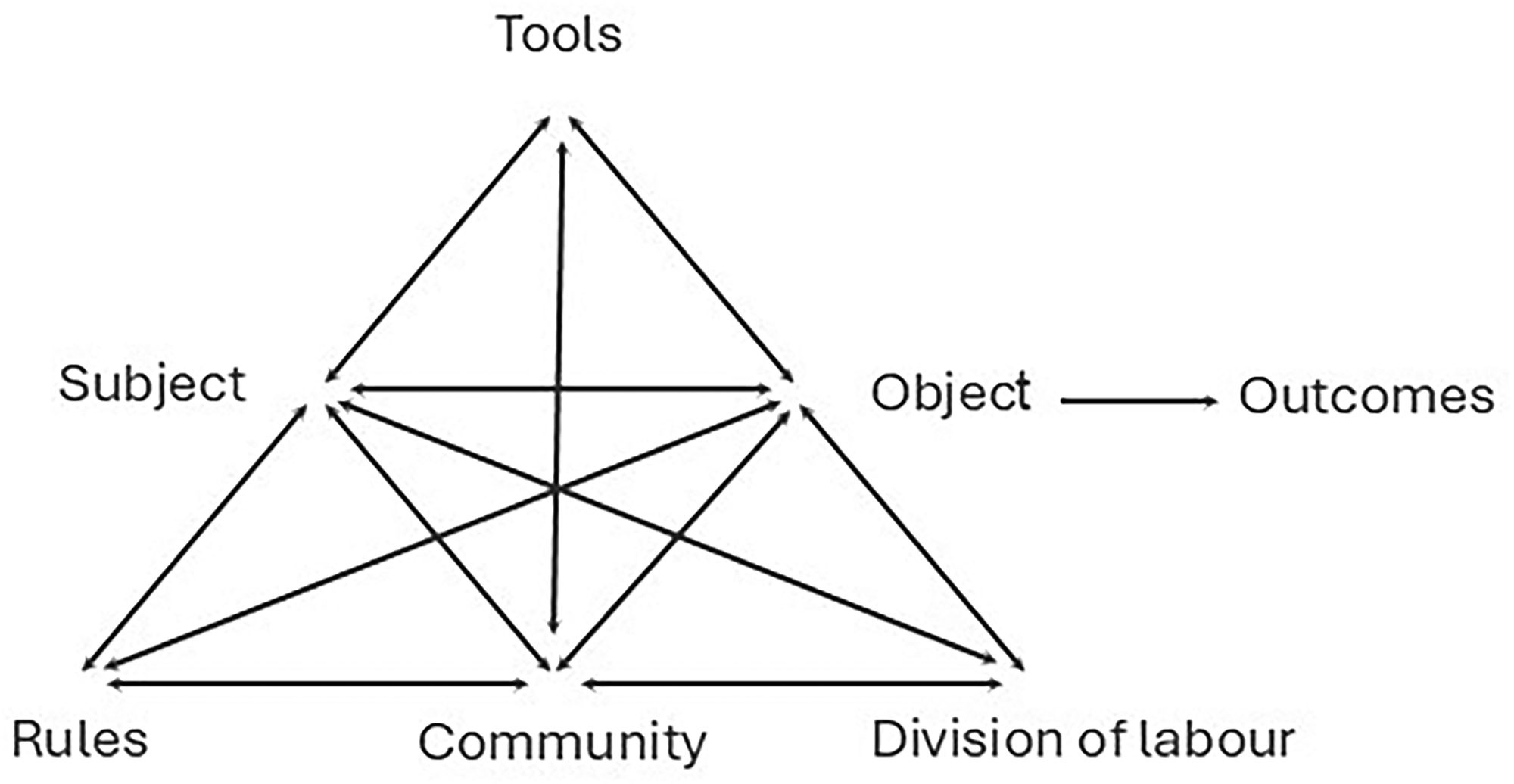
Activity system by Engeström (2001).
In this study, the activity corresponds to the school improvement work taking place in the two schools. The subjects of the activity system include the principal, first teachers, and teachers, while the community consists of those working for the same school provider. The object signifies what the activity is geared towards – both in a broader societal sense and in the immediate context (Engeström and Sannino, 2010). Tools represent the instruments and symbolic resources (e.g. language) needed to transform the object into an outcome (Engeström and Sannino, 2010). The division of labour reflects both horizontal task distribution and vertical structures of power and status, making it particularly relevant when leadership is distributed or shared among multiple actors (Ho et al., 2016). Rules refer to explicit and implicit norms that regulate actions within the activity system. The empirical analysis examines how these nodes interact in practice.
In CHAT, contradictions refer to systemic tensions that emerge over time, creating obstacles within and between nodes in an activity system. However, these contradictions also drive change and development, as resolving them can lead to new structures and ways of working (Engeström and Sannino, 2011). Identifying systemic contradictions within their historical context is particularly important in this study. When systemic contradictions are resolved, they can give rise to what Engeström and Sannino (2011) describe as ‘a new thirdness’ – a previously unanticipated approach that transcends opposing forces and pushes the system into a new development phase. According to Engeström and Sannino (2010), systemic contradictions can occur
within a single node (primary contradiction), between different nodes (secondary contradiction), between earlier and later forms of an activity system (tertiary contradiction), or between the focal activity system and other activities (quaternary contradiction).
Crucially, contradictions cannot be directly observed but must be inferred from their manifestations. These may appear discursively or in actions (Engeström and Sannino, 2011).
Expansive learning
The framework of expansive learning is particularly relevant to this study. While it is often used in interventions designed to transform complex problems identified as systemic contradictions (cf. Augustsson, 2021; Virkkunen and Newnham, 2013), this study applies expansive learning as an analytical instrument to understand naturally occurring (unplanned) learning processes, where no explicit learning goal is present but change is still needed (Engeström and Sannino, 2010). This distinction is important, as it differentiates expansive learning from traditional learning models based on acquisition or participation (Engeström and Sannino, 2010).
Because the study examines changes over time, the historical dimension of the expansive learning process is particularly interesting. The analysis follows the seven phases of an expansive learning cycle as outlined by Engeström (2001):
Questioning the status quo. Analysing the underlying causes of existing problems. Developing a new solution/model. Examining the new model. Implementing the new model. Reflecting on the new model. Consolidating the new model.
To clarify, the phases outlined above refer to a naturally occurring learning process and, in the context of this study, do not involve any form of intervention or action research. By applying CHAT as a theoretical framework, the study analyses how continuity and discontinuity in principal leadership impact the first teacher role and first teachers’ school improvement work.
Design and method
This study investigates the impact of continuity and discontinuity in principal leadership on the first teacher role and first teachers’ school improvement work by examining two large upper secondary schools, School Spruce and School Birch, both with approximately 800 to 1000 students. Operating under the same school provider, these schools offer vocational, university preparatory, and introductory programmes. In both schools, first teachers hold permanent positions, and changes in these positions have been relatively small over the years. School Birch has consistently had a slightly larger group of first teachers than School Spruce. The school provider expects first teachers to take broad responsibility for school improvement, extending beyond their teaching subjects. Compared to other teachers, first teachers have reduced teaching hours to carry out school improvement work, and, if desired, to study in university master's degree programmes. Additionally, first teachers and some principals participate in a first teacher network for internal training on first-teacher-related issues. Since autumn 2021, the school provider has also implemented research cycles for principals. Thus, school improvement work occurs within multiple interconnected subsystems. At both schools, the principal organises regular weekly meetings with first teachers.
Despite these similarities, key differences exist. The 2023 quality report showed that School Spruce's student results remained stable, whereas School Birch showed a slight decline. A notable distinction lies in principal turnover: School Spruce has experienced low principal turnover, with only two principals over 10 years. When the first principal retired in 2021, the deputy principal took over, ensuring continuity. School Birch, in contrast, has had high principal turnover, with at least seven principals in the past 10 years due to management-level reorganisations and principals leaving for other positions. Using Hargreaves and Fink's (2008) concepts of succession planning and continuity, School Spruce's leadership transition can be described as planned continuity, while School Birch has experienced both planned and unplanned discontinuity. These contrasting conditions, combined with the similar conditions for first teachers at both schools, served as the guiding principles for case selection.
Data collection
The study primarily relies on interview data from first teachers and principals at both schools, although meeting observations have also been conducted. In School Spruce, all first teachers were interviewed. In School Birch, six out of nine first teachers, selected to represent a range of experience levels, were interviewed. The principals of both schools were interviewed. Notably, the current principal of School Birch was previously the principal of School Spruce. A former principal from School Birch was also interviewed (Table 1).
Interviews.

The interviews were conducted in spring 2023, except for one in spring 2024. A semi-structured interview format designed around the five principles of activity theory was used, focusing on the historical perspective of first teachers’ school improvement work. Interviews lasted an average of 85 min and were conducted at locations chosen by the interviewees. Three interviews took place remotely via Google Meet due to health concerns during the final phase of the pandemic. All interviews were audio recorded and transcribed verbatim.
The interviews were conducted by the author, who, in addition to being a researcher, also works at the school provider as a school developer. The dual role provided familiarity with the school culture, which reduced the cultural distance (Westlund, 2015) between the researcher and the participants, facilitating rich and nuanced insights. However, there is a risk of over-familiarity, which could lead to bias or unexamined assumptions. To mitigate this risk, a robust theoretical framework has been applied to critically analyse the data and avoid taking established practices for granted. Additionally, the researcher ensured that interview participation was entirely voluntary, and all confidentiality considerations were carefully discussed with the interviewees. Formal consent was obtained from all participants.
Furthermore, the research process was designed to minimise subjectivity. Despite prior professional relationships with some participants, efforts were made to encourage open and reflective conversations. To guard against unintended biases, follow-up questions such as ‘Do you mean that…?’ or ‘Can you give an example of this?’ were used to prompt further development and ensure clarity of meaning. All interview quotes have been translated into English, and gender-neutral pseudonyms have been used to protect participant confidentiality.
During the observations, the researcher did not actively participate in the meetings but remained a non-participant observer. On a few occasions, participants directed questions to the researcher. These interactions were deliberately avoided, so as not to influence the course of the meeting. All observations were conducted prior to the interviews in spring 2023.
Analysis
The analysis was conducted in three stages, following an abductive approach, with both the interview data and CHAT as a theoretical framework jointly driving the analytical process forward. After initial overview readings, a search for manifestations of contradictions from a historical perspective was conducted. This historical lens covered the period from 2013, when first teachers were introduced in Swedish schools, until 2023, the year when the interviews were conducted. The primary analytical question was, ‘What crucial changes for the school improvement work of the first teachers are described?’ Using this guiding question in the analysis of the interview transcripts, instances in which work had somehow changed significantly were identified, as they could indicate past or present contradictions within the activity system. A key assumption in this phase of the analysis is that such changes may take on different meanings when viewed through the lens of continuity and discontinuity in principal leadership.
Next, the identified crucial changes were interpreted as systemic contradictions, guided by the question, ‘Within or between which nodes have the contradictions emerged?’ Several crucial changes were identified at both schools over time, related to the first teachers’ school improvement work. When the activity system was applied as an analytical tool to these changes, a systemic contradiction between the subject and the division of labour was identified. This systemic contradiction served as a point of departure for the next phase of the analysis, as the problem area had now been localised.
Finally, drawing on the identified contradiction, the interview transcripts were analysed using the framework of expansive learning (Engeström, 2001), with a focus on how the first teachers’ school improvement work and the first teacher role had evolved over time. The following analytical questions, inspired by the seven phases of expansive learning, guided this phase:
How is the first teacher role problematised? How is the problem situation understood? What new ideas about the first teacher role emerge? How are these ideas tested and implemented? Does the new solution hold over time or not?
The questions captured various conceptions of first teachers’ school improvement work and their role over time (corresponding to the first phase in the expansive learning cycle), as well as how these conceptions had been tested and replaced by new ones. Through the use of the framework, traces of expansive learning could be identified in the data.
Results
This section presents the study's results in three analytical steps. First, it addresses the question ‘What crucial changes for the school improvement work of the first teachers are described?’ with the aim of deepening the contextual understanding of how principal turnover has influenced first teachers’ local school improvement work. Second, the identified changes are examined through the lens of the activity system to uncover systemic contradictions, that is, underlying tensions within the activity that point to a problem area requiring resolution. Third, the framework of expansive learning is applied to understand how first teachers’ school improvement work has developed over time, and how such development has shaped the first teacher role in the two schools, particularly in relation to continuity and discontinuity in principal leadership. The section concludes with a summary of the results in relation to the research questions.
Crucial changes in first teachers’ school improvement work
At School Spruce, the first teachers were initially selected following the 2013 teacher career step reform based on their teaching skills, but their school improvement work was not defined. Over time, their role developed as they became supervisors for their colleagues in collegial projects administered by the Swedish National Agency for Education. However, when these projects faded, their school improvement work lacked continuity.
A crucial change came in 2020 when the principal decided to organise first teachers into a working team separate from their teaching colleagues to focus on school improvement work. This provided a more structured approach to school improvement processes throughout the school. The team meets every two weeks for approximately 75 min. The principal attends but does not lead the meetings. The group discusses school improvement work, how first teachers can support the teacher teams, the challenges first teachers face, and what to read to learn more about these obstacles: We have been disconnected from the other programmes that we belonged to before. And that we meet regularly and support each other and try to learn in our group how to take care of the other groups … It's very difficult to do it well. And then the idea was that we would get support from each other in this group and be able to address difficulties … We have been leaders or conversation leaders for a long time, but now we are on a deeper level because we meet and discuss … We read more literature. We have didactic pedagogical discussions together. We try. We have a kind of collegial learning in our first teacher group. And that's probably a change because we probably didn’t have that a few years ago. (Alexis, first teacher)
This shift allowed first teachers to develop a shared professional learning community and engage more deeply in their leading roles.
At School Birch, the first teachers’ role has continuously evolved since the implementation of the 2013 career step reform, largely as a result of frequent principal turnover. Initially, the first teachers formed a working group independent of the principal, addressing issues such as school safety: Then we worked together, the first teachers. Not so much towards the other colleagues either, but it became like a working group that could fill functions that were missing. (Ariel, first teacher)
When a new principal, Andrea, was brought in, the first teachers’ role shifted from independent problem-solvers to serving as a sounding board for the principal. Andrea actively participated in meetings and set the agenda: When Andrea was principal… we were a sounding board for the principal. This meeting every week – the principal made the agenda. From the time they weren’t present, they made the agenda. And then it became more of ‘Actually, I had thought that we would plan this and do this, but now I have to check this thing because I’m going to do this presentation next week. What do you say about this?’… (Ariel, first teacher)
Subsequent leadership changes led to further role shifts, including coaching teacher teams, conducting independent investigations based on student data, and later returning to being the principal's sounding board. However, each shift was marked by discontinuity, with little time for role development. The ambiguity about the first teachers’ school improvement work remained.
From crucial changes to systemic contradiction
When the career step reform introduced the first teacher position in Sweden, it changed the nature of school improvement work. First teachers were expected to take on leadership responsibilities beyond their teaching duties. From an activity theory perspective, this reform altered the division of labour, creating tensions between first teachers’ responsibilities and traditional teacher roles. This change resulted in a secondary systemic contradiction between the subject and the division of labour that was identified in both School Spruce and School Birch (Figure 2).
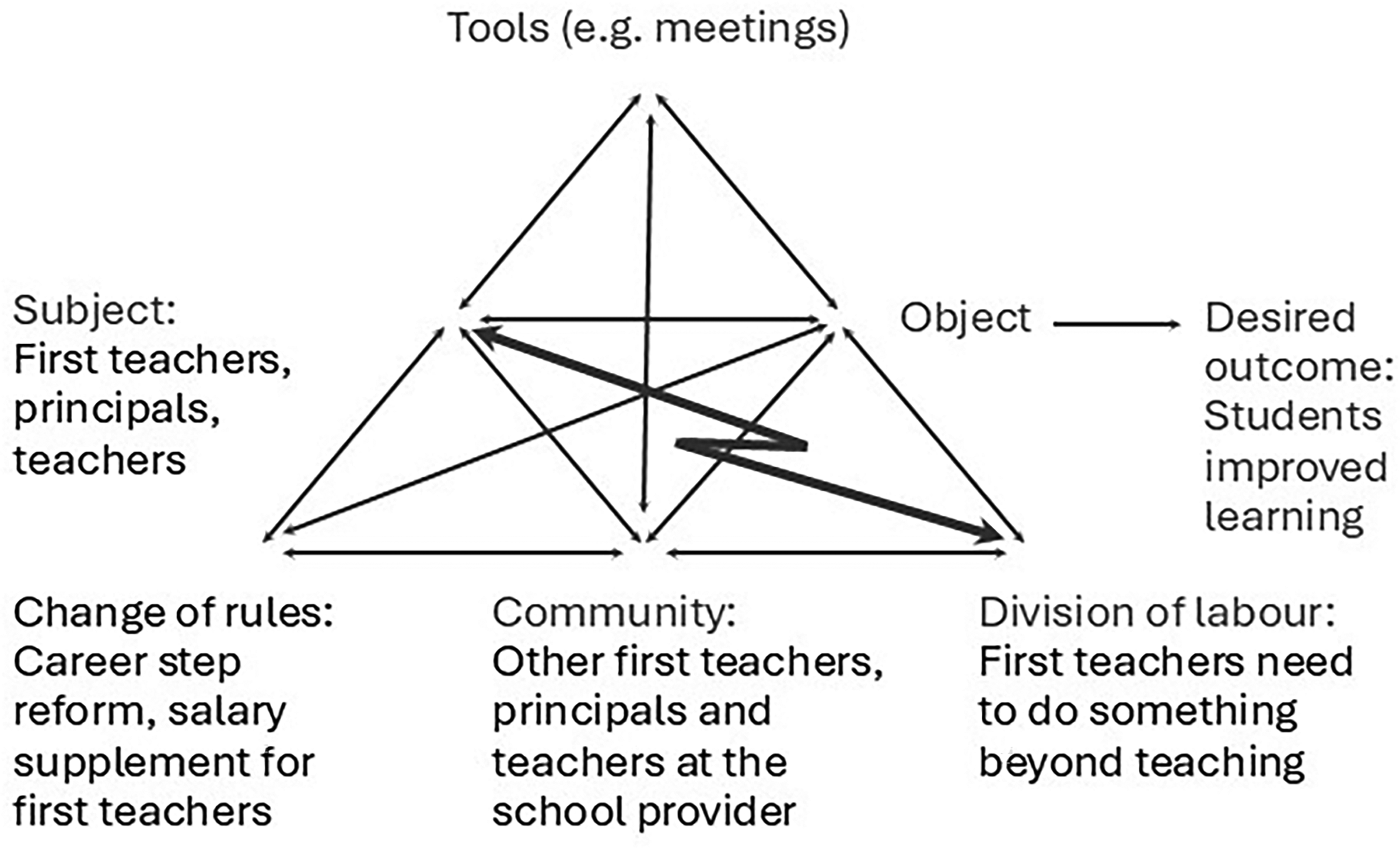
Secondary contradiction in the initial phase of the career step reform at School Spruce and School Birch.
First teachers’ school improvement work and the first teacher role through the framework of expansive learning
At School Spruce, the contradiction between subject and division of labour, as described above, was addressed through trial and adjustment. Initially, the first teacher role was undefined, and the supervisor role was seen as not permanent. Several teachers took on supervisory assignments, including some who were not first teachers, and the contradiction remained. Additionally, well-educated first teachers engaged in many school improvement processes but lacked the time to focus on them. This situation manifested as another secondary contradiction that occurred between the subject and the rules. The old rules, where teachers gathered in teaching teams to discuss students’ learning and well-being, did not meet the first teachers’ need to discuss how to facilitate teachers’ professional learning. A solution emerged addressing this problem when a separate first teacher team was established. However, this led to new secondary contradictions between subject and rules, such as scheduling conflicts and first teachers missing student-related discussions in their previous teams. Adjustments in the meeting organisation were made, and first teachers were removed from mentoring duties. As a result, the first teacher role evolved from being loosely defined into one that could lead school-wide improvement work: It feels like now they are at the helm together and driving the ship. Before, several small boats went into a joint squad and helped each other. (Charlie, principal)
Thus, the understanding of the first teacher role has changed, and expansive learning has taken place (Figure 3).
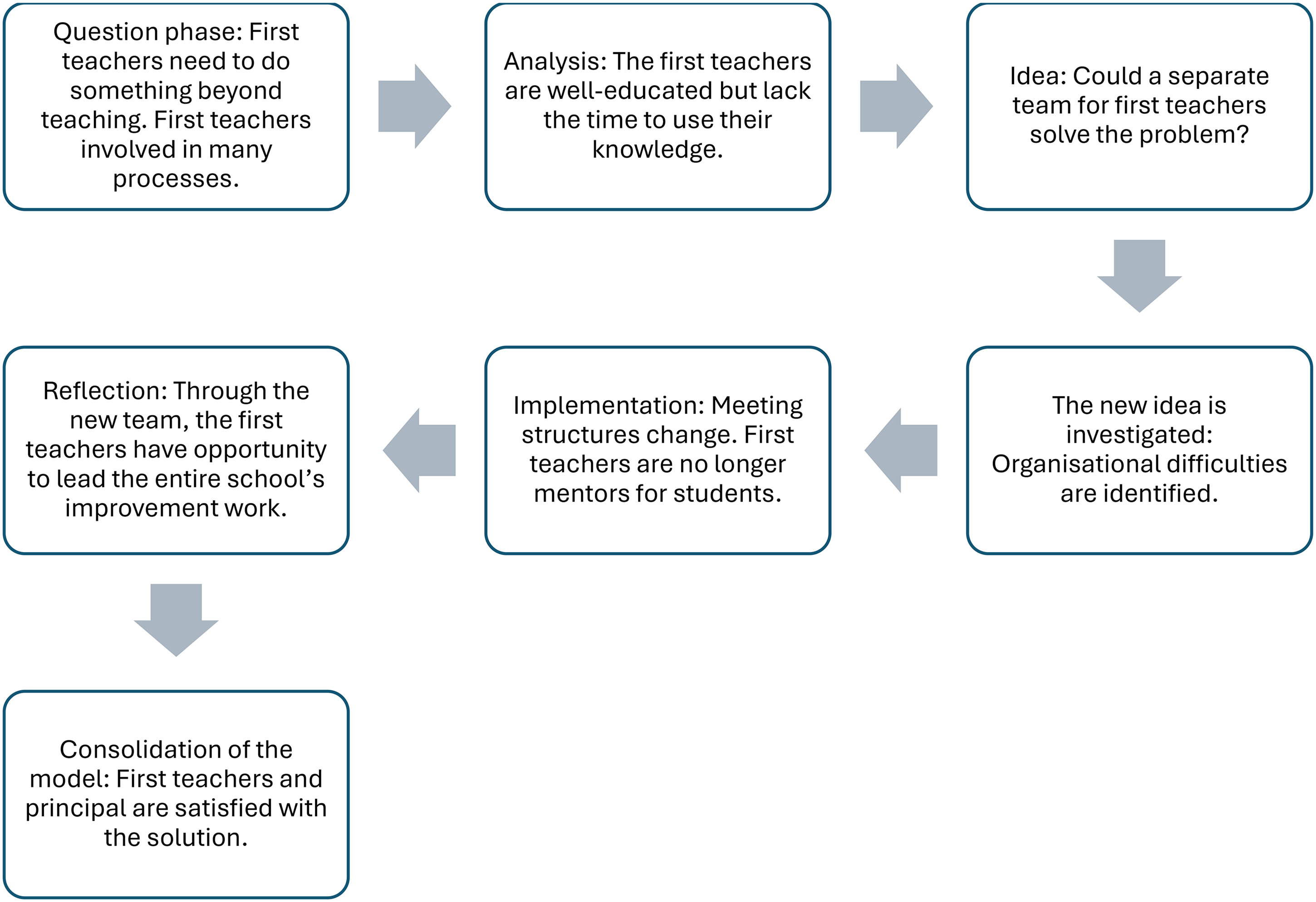
The development of School Spruce's first teacher role through the framework of expansive learning.
In School Birch, the systemic contradiction between subject and division of labour was the same as in School Spruce – first teachers needed to do something beyond teaching. However, the first teachers’ school improvement work at School Birch was characterised by discontinuity and many (re)starts. In the initial stage, the first teachers’ school improvement work addressed school safety, a problem that no one else had the time for. Thus, the first teacher role served as a resource for the principal. This idea, using the first teacher role for special assignments, has not been further investigated (Figure 4).
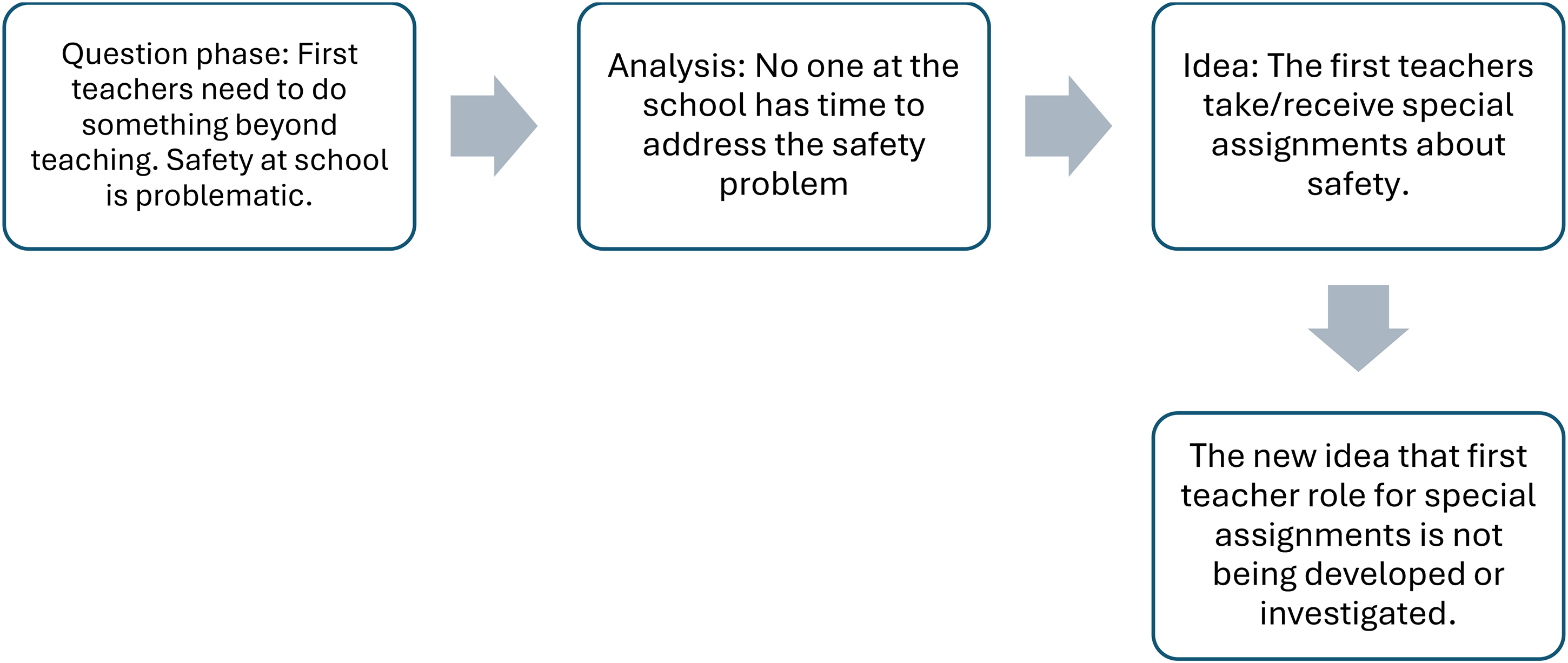
School Birch's first teacher role addresses a special assignment.
After a change of principal, the first teachers and the new principal examined the first teacher role by reading literature about middle leadership and professional learning, after which the first teachers became supervisors for teacher teams in school improvement work. However, this idea was abandoned after mixed reactions from both teams and first teachers (Figure 5).
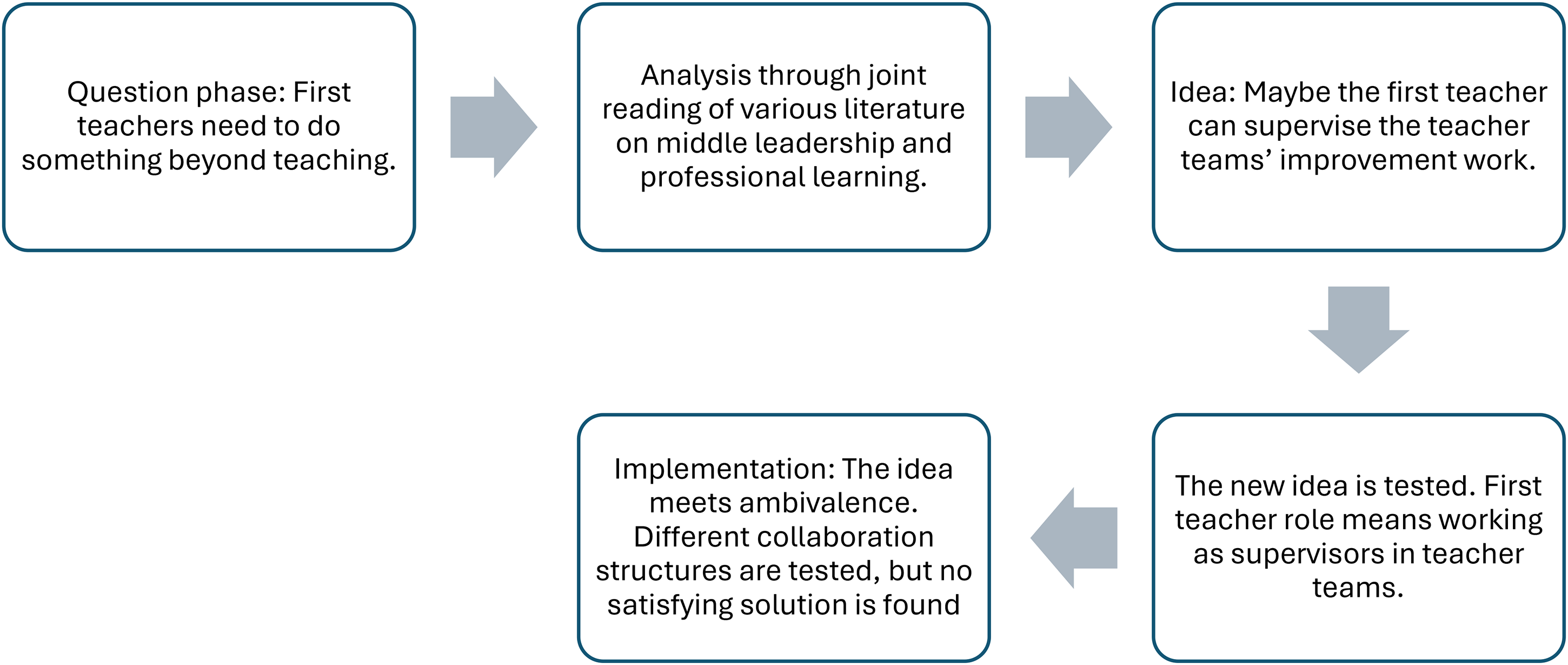
The first teacher role as supervising teacher team is tested.
After the next principal turnover, supervising the teacher teams was no longer considered a viable path for first teachers. Instead, their motivation became a key concern. Several first teachers found it problematic that their work remained largely invisible to their colleagues. Additionally, the school was now expected to take a more compensatory approach to supporting students. In response, a new idea emerged: first teachers, in consultation with the principal, should select areas of focus based on students’ well-being surveys and grade results. They formed small groups to investigate these issues, shifting their role towards inquiry and analysis. However, the results of the investigations were met with mixed interest from their teacher colleagues, and efforts to disseminate the findings faced significant obstacles (Figure 6).
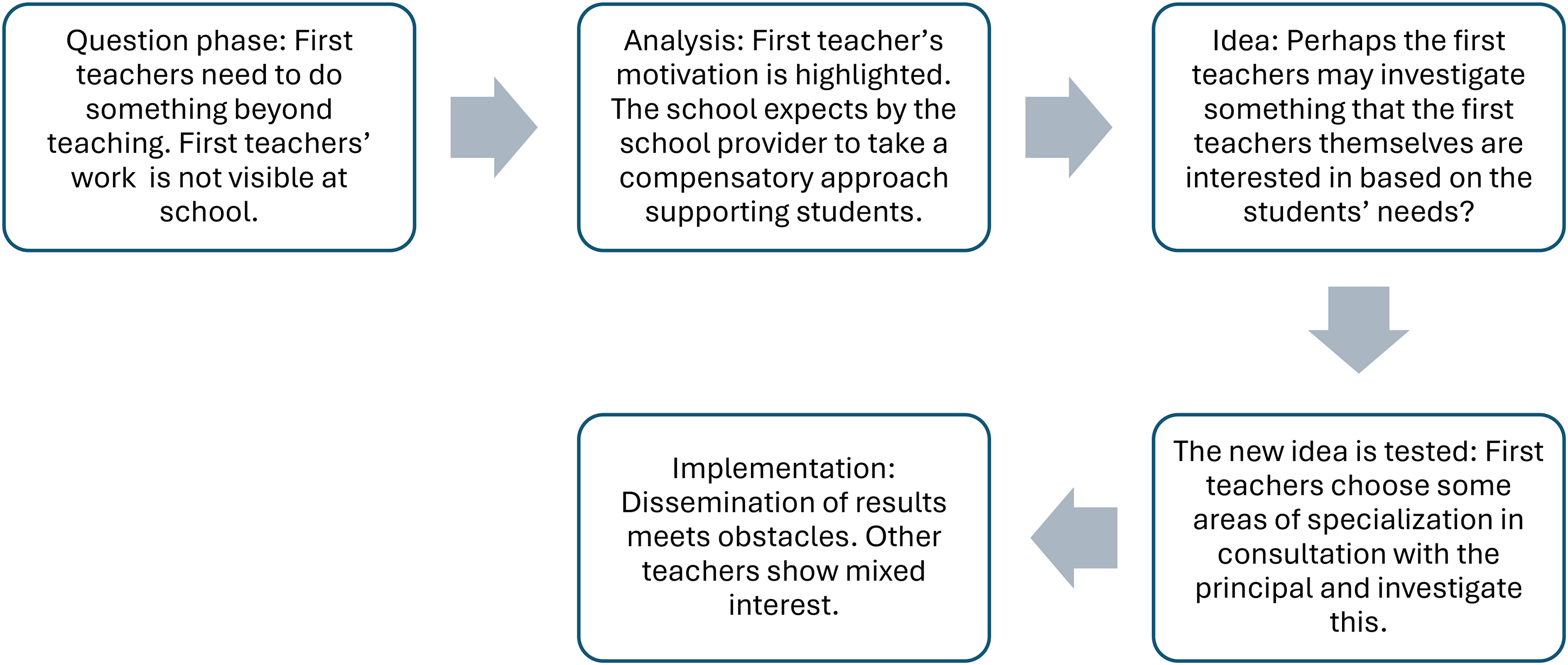
School Birch's first teachers investigate students’ needs by their own choice.
With the last principal turnover, the question of what first teachers should focus on was revisited. While first teachers continued their investigation projects, the new temporary principal also sought to involve the first teachers in gaining a better understanding of the school's overall situation. As a result, first teachers once again took on the role of the principal's sounding board (Figure 7).

School Birch's first teachers as the principal's sounding board.
Overall, the first teacher role at School Birch shifted through multiple iterations – from serving as the principal's resource, acting as the principal's sounding board, supervising teacher teams, and conducting investigative work – only to revert to being the principal's sounding board. While these shifts were closely tied to principal turnover, the role itself did not develop in depth: It shows a little bit of the difficulty of dealing with this because you reorganise all the time. First, they will … lead a development group, and then they should be resources or something, or they should develop something special that a few people are interested in. (Ellis, principal)
Theoretically, the systemic contradiction between the subject and the division of labour remains unresolved. Each principal turnover altered the object of the activity, meaning that first teachers’ actions within school improvement work were repeatedly directed towards different tasks. Over time, the question of what first teachers should do became an object itself. Despite multiple attempts to resolve the contradiction, no new third way has emerged. Instead, the process reflects initiated-but-interrupted cycles of expansive learning, preventing the role from stabilising or deepening.
Summary
The study contributes to a deeper contextual understanding of principal turnover by demonstrating that:
Continuity in principal leadership fosters coherent and sustained school improvement work among first teachers, whereas discontinuity leads to repeated restarts of such work (RQ1).
At School Spruce, where principal leadership remained stable, first teachers developed a structured and evolving leadership role that contributed to long-term school improvement through processes of expansive learning. In contrast, at School Birch, frequent changes in principal leadership resulted in repeated shifts in the first teacher role, generating multiple ideas but hindering deeper development due to interrupted cycles of expansive learning (RQ2).
Discussion
The interview analysis demonstrated that continuity and discontinuity in principal leadership significantly influence both the first teachers’ school improvement work and the development of their role. These results are discussed in relation to the broader societal challenge of ensuring effective and sustainable leadership practices in schools.
Effectiveness of educational leadership
The results indicate that principal continuity enables first teachers to conduct a coherent and effective school improvement work, whereas principal discontinuity disrupts school improvement work and causes repeated restarts. This result aligns with Jarl et al.'s (2021) study, which found that successful schools tend to have stable leadership, whereas frequent leadership changes and continuous reorganisation characterise less successful schools.
The results also support the argument that discontinuity is costly, particularly for students, who are affected by the disruptions in first teachers’ school improvement work. Previous research has shown that neither teaching quality (Pietsch et al., 2020) nor teacher mobility (Bartanen et al., 2019) fully explains why principal turnover results in student decline. However, this study suggests that disrupting school improvement work could be a key factor (cf. Mascall and Leithwood, 2010). A long-term relationship between principals and middle leaders appears to be a prerequisite for effective school improvement work.
From a CHAT perspective, the study illustrates how systemic contradictions shape the conditions for school improvement work. In both schools, introducing first teachers as middle leaders created a contradiction between the subject (first teachers) and the division of labour, as their responsibilities in relation to those of other teachers or the principal were not clearly defined. In School Spruce, this contradiction was gradually resolved, allowing the first teacher role to evolve into a collective leadership function by expansively reconceptualising the first teacher role. This enabled a transformation where first teachers became drivers of school improvement work rather than just working on separate tasks. In contrast, the same contradiction remained unresolved at School Birch due to frequent restarts caused by principal turnover. No approach to first-teacher leadership was sustained long enough for deeper learning or structural changes to occur. From an expansive learning perspective, frequent principal turnover prevented first teachers from developing a common collective agency, as their role was under negotiation for each principal change. Based on this result, identifying and working with systemic contradictions to find a new third way stands out as an essential practice.
This pattern aligns with Virkkunen and Newnham's (2013) reasoning about problem-solving in activities. While School Spruce analysed and addressed contradictions at a systemic level, School Birch engaged in surface-level problem-solving, repeatedly jumping from identifying problems to implementing solutions without fully tackling the underlying contradictions. Their efforts became reactive rather than strategic and sustainable. This scenario also resonates with Augustsson's (2021) concept of interrupted learning cycles, where learning actions remain finite episodes rather than triggering further development. The results underscore the importance of stability for expansive learning: Long-term leadership structures provide the conditions necessary for deeper learning and problem-solving and thus for transformation.
Distributed leadership for sustainability?
One potential way to mitigate the effects of principal turnover is through distributed leadership. Previous research has highlighted its potential to reduce the negative consequences of principal leadership discontinuity (i.e. declining student performance and school improvement work; Mascall and Leithwood, 2010). However, this study suggests that distributed leadership is not automatically a stabilising factor – its effectiveness depends on contextual conditions such as principal leadership continuity. Middle leaders are expected to develop and carry out ideas for school improvement, but doing so requires practice (Lárusdóttir and O’Connor, 2017) and is likely more difficult in a fragmented structure. Perhaps this obligation was extra difficult for the first teachers in this study as they were expected to take broader responsibility for school development beyond their teaching subjects. In this respect, the first teachers may become more dependent on the principal.
From an expansive learning perspective, the differences between School Spruce and School Birch reflect varying degrees of agency (Engeström and Sannino, 2010). In School Spruce, the first teachers developed collective agency, enabling them to take ownership of improvement work throughout the school. In contrast, the first teachers at School Birch lacked this agency, as their roles remained in flux due to constant restructuring. Once again, this finding highlights the importance of stability as a contextual condition for sustainable distributed leadership.
Implications
As this study is small-scale and focuses on only two schools, its results cannot be generalised broadly. Nevertheless, some generalisations may still be made, as it is likely that the two schools are not unique. The study contributes to a deeper, contextually grounded understanding of principal turnover and its impact on middle leaders and their school improvement work.
Although there are hardly any ‘silver-bullet solutions’ for achieving school success (Arora-Jonsson et al., 2024), this study's results underscore the critical importance of leadership continuity and long-term perspectives in fostering sustainable school improvement. It highlights the need for school providers to establish robust support structures (following Arvidsson et al., 2021; Richard, 2024) that enable principals to remain in their positions long enough to lead meaningful school improvement work. Such support could include mentorship, professional development, and organisational structures that ensure continuity when individuals leave. Without such support, schools risk being trapped in cycles of leadership instability in which each new principal resets strategic priorities.
For principals, the study reinforces the importance of building sustainable and inclusive distributed leadership, whereby various stakeholders take responsibility for school improvement work. For middle leaders, the study highlights the challenges of maintaining consistency in school improvement work despite principal turnover. The study raises important questions about professional agency in dynamic leadership contexts. If middle leaders are to sustain meaningful school improvement work, they must be given structural support that enables their leadership to persist beyond individual principals. A clearly defined and delimited middle leader role may increase the role's resilience to principal turnover, although such clarity also carries the risk of reinforcing hierarchical structures within the school organisation.
At the societal level, this study contributes to a broader discussion about the tensions between market-driven education policies and the need for leadership stability. Sweden's free-market school system, designed to promote competition and school choice, also incentivises principal turnover, as school leaders navigate a competitive job market with salary disparities. While a free market may drive innovation and enable freedom of choice for the individual, it may also contribute to high turnover and, hence, short-term processes. Thus, at the policy level, it is essential to reconsider how school leadership structures are designed to balance flexibility with stability. If leadership continuity is key for long-term school improvement and enhanced student outcomes, policy measures must address the structural conditions contributing to high leadership turnover. This could include policy frameworks that emphasise leadership stability as a fundamental aspect of educational quality.
Despite increasing attention to the impact of principal turnover on school performance, research in this area is still limited (Snodgrass Rangel, 2018; Thelin and Lund, 2023). In this regard, more qualitative case studies could provide deeper insights into how leadership transitions affect school culture, middle leadership, and professional learning over time. Additionally, quantitative studies are needed to establish stronger empirical links between principal turnover and student outcomes.
Footnotes

Funding
The author received no financial support for the research, authorship, and/or publication of this article.
Declaration of conflicting interests
The author declared no potential conflicts of interest with respect to the research, authorship, and/or publication of this article.