




Abstract
This study seeks to understand how school unit leaders’ people management and communication of school goals impact school unit performance through a cognitive path, drawing on theoretical insights from both human resource management (HRM) and educational leadership literature. Utilizing data from a sample of 5769 teachers across 559 units, this paper empirically studies the mediating role of teachers’ line of sight in the relationship between school unit leaders’ activities (i.e. people management and communication of school goals) and school unit performance. The findings provide robust evidence supporting the significant impact of school unit leaders’ activities on both teachers’ line of sight and school unit performance. This underscores the pivotal role of school unit leaders in shaping educational outcomes, extending beyond influencing teachers’ motivation to their cognitive understanding of how they can contribute to school goals.
Introduction
Educational leadership research has established that school leaders impact student learning in a variety of ways (e.g. Hallinger, 2011; Leithwood et al., 2020; Özdemir et al., 2024; Robinson et al., 2008; Sun and Leithwood, 2015). Setting directions is regarded as school leaders’ primary activity but review studies also list, for instance, contingent reward and staffing (Leithwood and Jantzi, 2005: 181), involving teachers in the process of establishing goals and providing feedback to teachers (Robinson et al., 2008: 656) as activities through which school leaders improve teaching and learning (Hallinger, 2011; Leithwood et al., 2020). Educational leadership studies refer to these latter activities indiscriminately as ‘leadership activities’, and tend to examine these in a fragmented manner. By doing so, they do not acknowledge that these activities together constitute school leaders’ people management, the quality of which is strongly associated with student outcomes according to Bloom et al.'s (2015) study of over 1800 schools across eight countries. Educational leadership research reflects school leaders’ practice, which Runhaar and Tuytens et al. characterize as including a ‘limited range of disconnected [HRM] practices’ (Tuytens et al., 2023a: 714) and ‘lacking a systematic and comprehensive viewpoint on HRM’ (Runhaar, 2017: 640). Both Runhaar (2017) and Tuytens et al. (2023a) call for more research on strategic HRM in the education sector to better understand the conditions under which school leaders’ people management practices contribute to student outcomes. This introduction shows how this paper responds to their call.
While Runhaar (2017) and Tuytens et al. (2023a) concentrate on HRM practices, this paper focuses on ‘people management’ which is defined as ‘line managers’ implementation of HR practices and their leadership behaviour in supporting the employees they supervise at work’ (Knies et al., 2020: 8). HRM research has shown that line managers’ people management activities are an essential link in the causal chain through which organizations’ HRM policies contribute to achieving organizational outcomes, including employee well-being and organizational performance (Katou et al., 2021; Purcell and Hutchinson, 2007). However, a focus on people management alone would mean that our study misses out on setting directions. Therefore, this study combines the concept of people management with school unit leaders’ communication of school goals. The assumption of setting directions is that an educational vision (explaining the broad, long-term direction for learning) will inspire teachers to contribute, while setting a narrower range of specific short-term goals will enable them to understand the goals and focus their attention and activities (Murphy and Torre, 2015).
School leaders’ communication of school goals and people management activities impact teaching and learning indirectly through their influence on staff (Hallinger, 2011; Leithwood et al., 2020). Leithwood et al. (2020) elaborate on four paths along which the influence of leadership flows. This includes the ‘rational path’ which consists of mediators that ‘reflect the knowledge and skills of school staff members about curriculum, teaching and learning – the technical core of schooling – along with features of the school culture which directly support the technical core’ (Leithwood et al., 2020: 11). Taking teachers’ knowledge and skills as referring to ‘the technical core of schooling’ emphasizes their professional competence. Although Leithwood et al. (2020: 9) recognize that the enactment of leadership practices needs to be responsive to the school context, a situated contextual understanding is absent in their elaboration of the knowledge and skills of teachers about the curriculum, teaching and learning. However, schools, at least in the Netherlands, have the autonomy to conceptualize and prioritize aspects of the curriculum, teaching and learning in their own way (for instance, by understanding students’ personal development in a specific way or favouring a specific pedagogical approach). Therefore, a professionally competent teacher will not fit per se in any school. Knowledge and skills of teachers should include their understanding of the school's specific objectives and of the professional behaviours through which teachers can contribute to achieving those objectives. This is what the concept ‘line of sight’ refers to (Boswell and Boudreau, 2001), which HRM research includes in the ‘cognitive path’, which involves employees’ abilities through which management can impact various outcomes (Jiang et al., 2012; Runhaar, 2017; Vandenberg et al., 1999). The relevance of teachers’ line of sight for educational leadership research appears from the finding that less than half of all secondary school teachers in the Netherlands report that their school unit leader regularly discusses with them what their school goals mean for their unit's teaching and that on average teachers assess their line of sight as ‘not enough but not insufficient’ (Knies et al., 2023).
This paper capitalizes on the value of combining HRM and educational leadership research. From educational leadership research, the notion of school leaders’ communication of school goals is taken. Two relevant HRM research insights are added. First, insights into people management activities and their impact on organizational performance are utilized. In their role as people managers, school unit leaders implement HR practices and provide leadership support that aligns more or less strongly with the school's goals to enable teachers to improve school unit performance. These people management activities facilitate conditions which Leithwood et al. (2020) label as ‘organizational path’ but also feature in their ‘rational path’ as these activities communicate to employees which behaviours they are expected to prioritize, as argued by Bowen and Ostroff (2004). Secondly, this paper adds the concept of teachers’ line of sight (Boswell and Boudreau, 2001) and examines to what extent school unit leaders’ people management activities and communication of school goals contribute through this rational/cognitive path to school unit performance. In doing so, this paper addresses the following research question: To what extent do school unit leaders’ people management activities and communication of school goals contribute to school units’ performance through teachers’ line of sight?
This paper makes two contributions to extant educational leadership research. First, the theoretical explanation of school unit leaders’ impact on student learning is strengthened by the adoption of an integrated leadership perspective, called for by Özdemir et al. (2024). This involves the validated people management concept and the insights of HRM research about the ways in which school unit leaders’ people management activities impact school unit performance. Second, insights from educational leadership studies into the rational path through which school leaders impact student outcomes are supplemented by the concept of teachers’ line of sight which recognizes the contextualized nature of schools’ goals.
The empirical context of this study is schools for secondary education in the Netherlands. This context is elaborated on in the Materials and Methods section. Here, it is important to mention that the school unit leaders that are central in this study are not school principals, but school unit leaders who are responsible for the provision of education in their school unit and the direct supervision of teachers.
Theoretical framework
This section reviews the literature on what school unit leaders’ people management and communication of school goals involve and why these are important for achieving organizational outcomes. Then, the concept ‘line of sight’ is elaborated on, resulting in hypotheses regarding the relationship between school unit leaders’ activities and teachers’ line of sight. Finally, this section discusses school unit performance and hypothesizes how school unit leaders’ people management and communication of school goals impact school unit performance both directly and indirectly.
School unit leaders’ people management
People management is defined as ‘line managers’ implementation of HR practices and their leadership behaviour in supporting the employees they supervise at work’ (Knies et al., 2020: 8; see the Supplemental material for the full operationalization). The managerial activities that are subsumed under the people management concept cover the isolated people management activities that feature in various educational leadership review studies (e.g. Leithwood and Jantzi, 2005; Robinson et al., 2008). The people management activities that build the people management concept are based on the HRM and leadership literatures and on the pivotal role of line managers in the HRM process model (Wright and Nishii, 2013). This makes the people management concept a suitable response to the call by Özdemir et al. (2024: 1039) to employ integrated leadership perspectives to increase our understanding of how school leadership influences student learning.
The strategic HRM literature postulates that HRM will contribute to organizational outcomes when the HRM practices support the employees’ professional behaviours that are required to achieve those outcomes (Gratton and Truss, 2003). Strategic HRM research theorizes the effect of HRM practices based on two theories: (1) the resource based view, which emphasizes the resource potential of employees’ abilities, and (2) social exchange theory, which posits that employees who feel valued and supported by their organization will in turn feel obliged to reciprocate by their willingness to exert extra effort on behalf of their organization's goals (Jiang et al., 2012; Vandenberg et al., 1999; for the school context: Runhaar, 2017). Importantly, the HRM-performance relationship involves an essential role for line managers because it is their implementation of the intended HRM policy that impacts how employees perceive their organization's support, which in turn impacts their job performance and ultimately the organization's performance (Wright and Nishii, 2013). The role theoretically attributed to line managers’ people management has received empirical support (e.g. Katou et al., 2021). Thus, by implementing HRM practices and providing leadership support that enhance teachers’ professional behaviours, school leaders contribute to student outcomes in line with the school's goals.
A well-established notion in the HRM literature, put forward by Bowen and Ostroff (2004: 206), holds that HRM has a ‘symbolic or signalling function by sending messages that employees use to make sense of and to define the psychological meaning of their work situation’. Direct managers particularly are seen as important ‘sense-givers’ because they play a major role in the implementation of HRM (Den Hartog et al., 2013; Nishii and Paluch, 2018). The signals that HRM policy and its implementation by managers send can vary in strength (depending on their frequency and consistency). Bowen and Ostroff (2004: 207) argue that the stronger HRM signals which goals are important, the more employees’ behaviours are directed towards these goals, which increases the likelihood that these goals are achieved. Penning de Vries (2021) has extended this argument to the people management concept. By implementing HR practices, such as recruitment or appraisal, managers communicate to employees what behaviour is considered to be aligned with the organization's goals. For example, when a school has the goal for more diversity-sensitive teaching, this may be highlighted on the website, and in vacancies, potential new recruits will be interviewed about this topic, and the topic will be discussed in the appraisal interview with teachers. The same mechanism holds for supportive leadership behaviour aimed at stimulating employees’ commitment and development. So, through people management, line managers communicate the school's goals by emphasizing what behaviour and attitudes are expected and rewarded.
School unit leaders’ communication of school goals
Transformational school leadership research features specific leadership practices for setting directions, such as building a shared vision and communicating the vision and goals (Leithwood and Jantzi, 2005; Leithwood et al., 2020). Transformational leaders motivate their followers to pursue the larger goals of the organization (Leithwood and Jantzi, 2005; Sun and Leithwood, 2015). Vision building, according to Geijsel et al. (2003: 232–233), theoretically has the greatest potential to influence teacher motivation by impacting teachers’ personal goals. Likewise, Robinson et al. (2008) see goal setting as central to establishing goals and expectations and emphasize that this requires leadership through face-to-face relationships. Their explanation for the effect of establishing goals and expectancies combines Latham and Locke's (2006) theory of the goal setting process with the importance of goal content and of school leaders’ focus on the core business of teaching and learning as shown by instructional leadership studies (Robinson et al., 2008: 660–661).
Setting directions is also assumed to impact teachers’ knowledge. As discussed in the Introduction, Leithwood et al. (2020: 11) regard the knowledge and skills of school staff members about the curriculum, teaching, and learning as a ‘rational path’ through which vision building by school leaders impacts students’ outcomes. Studies on school leaders’ activities, such as goal setting (Robinson and Gray, 2018; Tan, 2018), argue that setting concrete short-term goals and performance expectations promotes information sharing about effective behaviours, leading to clearer knowledge of goals and corresponding activities. However, to what extent teachers have such knowledge is not examined. This gap in educational leadership research can be filled by the HRM concept ‘line of sight’.
Line of sight
Boswell and Boudreau (2001: 851) define line of sight as ‘employee understanding of the organization's objectives and how to contribute to those objectives’. They ground its importance on the premise that if employees have line of sight, their behaviours are likely to align with the organization's strategic objectives and thereby contribute to organizational success (Boswell, 2006: 1491). Aligned behaviours depend not only on employees’ line of sight, which is an aspect of their ability. 1 HRM research proposes the AMO model which entails that employees’ performance depends on their ability, motivation and opportunity to perform (Combs et al., 2006; Jiang et al., 2012; Runhaar, 2017). This paper concentrates on line of sight because this determinant of aligned behaviour has been largely neglected in educational leadership research.
Boswell and Boudreau (2001) regard line of sight especially important for organizations with broad goals or situations in which employees have much autonomy. This makes line of sight a relevant concept to study in a school context. Schools are known for their adherence to multiple goals (Murphy and Torre, 2015). Multiple goals can result in a lack of clarity of how and when an employee can contribute to organizational objectives, resulting in lower levels of employee commitment and effort (Jung and Ritz, 2014). In addition, teachers have considerable autonomy in their teaching, particularly in decisions over the content and the pedagogical approach to how to teach their subject (Wermke et al., 2019). Because of this autonomy, high-quality education is dependent on teachers not only being willing to align their own behaviours with the organizational objectives but also on them having a comprehensive understanding of the organization's objectives and how to contribute to these (Colvin and Boswell, 2007).
In this study, teachers’ line of sight concerns the school goals that provide tangible meaning to the school mission and give direction to their behaviours. School unit leaders’ people management activities, such as stimulating teacher learning and providing job feedback, signal expectations about appropriate professional behaviours that are derived from school goals (Bowen and Ostroff, 2004). These people management activities send signals that are implicit and embedded and do not usually go along with an explicit discussion of the school goals. Therefore, school unit leaders’ communication is also important for teachers’ line of sight. School vision and goals are characterized by a certain degree of equivocality, meaning that they may evoke multiple meanings and understandings (Murphy and Torre, 2015). School unit leaders’ communication of school goals combined with face-to-face dialogue can address the equivocality of goals. School unit leader and teacher(s) can discuss how they make sense of these goals and arrive at a shared and meaningful understanding (Jensen et al., 2018). This view resonates with the argument of line of sight studies that communication is essential for employees to understand and act on the organization's strategic goals and that for leaders ‘having the conversation with employees is key’ (Boswell and Boudreau, 2001: 856).
These insights from HRM and educational leadership research result in the following hypotheses:
H1. There is a positive relationship between school unit leaders’ people management, i.e. implementation of general HR practices (H1a), implementation of tailor-made arrangements (H1b), support for teachers’ commitment (H1c), and support for teachers’ development (H1d), and teachers’ line of sight. H2. School unit leaders’ communication of school goals is positively related to teachers’ line of sight.
School unit performance
One important condition for student learning that school unit leaders can impact is the teachers’ teaching performance (Robinson and Gray, 2018: 173). A school unit's performance is the result of a team effort, with ‘team’ referring to the teachers who are collectively responsible for the teaching in a specific school unit. Although teacher teams are not ‘teams’ in the strict sense of individuals who interact interdependently to achieve a common objective, they have a moderate level of interdependence (Bell, 2007). This is related to teachers’ professional autonomy (Wermke et al., 2019). On the one hand, teachers have considerable autonomy in how they teach their classes. On the other hand, school units also aim to achieve outcomes that involve a certain degree of interdependence between teachers. This holds, for instance, for schools’ goals to provide a safe climate and a stimulating learning culture and to contribute to students’ personal development. The attainment of such goals depends on the coordination and cooperation of all teachers, for instance, by aligning their teaching methods with the school's vision on student learning and by their joint participation in designated professional development activities. Thus, school unit performance can be seen as a result of individual teachers’ performance in their teaching domain and their joint performance in the school unit's collective goal domains.
In research of school leaders’ impact on student learning, school unit performance is a proximal outcome while, for instance, pass rates and exam scores represent distal outcomes. Recognizing that distal outcomes are influenced by many factors and processes, HRM researchers like Jiang et al. (2012) suggest that proximal performance outcomes better reflect the impact of managers’ activities. Applying this reasoning to the school context, this study focuses on school unit performance as a proximal type of outcome that is relevant to assessing the impact of school unit leaders’ activities.
The direct and indirect impact of school unit leaders’ people management and communication of school goals
Research of the HRM-performance relationship (Jiang et al., 2012; Vandenberg et al.,1999; Wright and Nishii, 2013) as discussed above provides the theoretical basis (resource-based view, social exchange theory, AMO model) for (1) the impact of people management activities on school unit performance and (2) the mediating role of teachers’ line of sight in the relationship between school unit leaders’ people management and school unit performance. Through their people management activities, school unit leaders send signals about desired behaviours to teachers that inform their line of sight and support teachers’ professional behaviours to achieve unit performance.
Educational leadership studies highlight a variety of school leaders’ activities that contribute to student outcomes (e.g. Hallinger, 2011; Leithwood et al., 2020; Özdemir et al., 2024; Robinson et al., 2008). School unit leaders’ communication of school goals, this study's approximation of direction and goal setting, is seen as creating knowledge of the school's vision on teaching and learning, and of corresponding effective teaching activities. Such knowledge, i.e. teachers’ line of sight, thus mediates the impact of school unit leaders’ communication of school goals on school unit performance.
These insights from HRM and school leadership research inform the following hypotheses:
H3. There is a positive relationship between school unit leaders’ people management, i.e. their implementation of general HR practices (H3a), implementation of tailor-made arrangements (H3b), support for teachers’ commitment (H3c), and support for teachers’ development (H3d) and school unit performance. H4. There is a positive relationship between school unit leaders’ communication of school goals and school unit performance. H5. The relationship between school unit leaders’ people management, i.e. their implementation of general HR practices (H5a), implementation of tailor-made arrangements (H5b), support for teachers’ commitment (H5c), and support for teachers’ development (H5d) and school unit performance is mediated by teachers’ line of sight. H6. The relationship between school unit leaders’ communication of school goals and school unit performance is mediated by teachers’ line of sight.
All hypotheses are graphically presented in Figure 1.
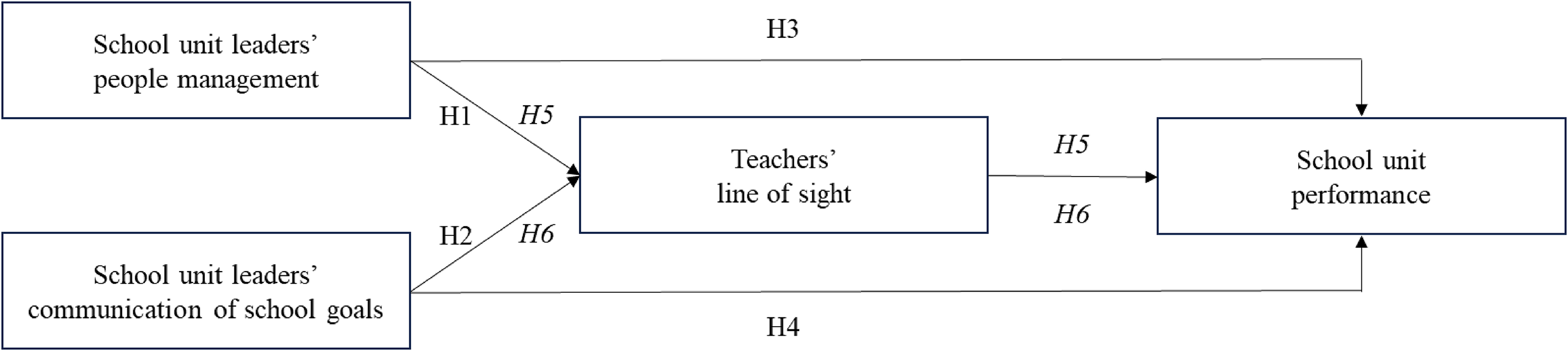
This study's conceptual model.
Materials and methods
Context
The empirical context of this study is schools for secondary education in the Netherlands. These are comparatively large and often consist of several school units. Their hierarchy typically involves the school principal and several school unit leaders. School unit leaders that are central in this study are responsible for the provision of education in their school unit and the direct supervision of the unit's teachers. In the Netherlands, school boards have a fair amount of autonomy. School boards are legally required every 4 years to produce a school plan which is vital for the state's inspection of the quality of education. A school plan sets directions and describes how the school(s) that fall(s) under the board's authority will work to achieve their goals. In practice, the school principal is responsible for producing their school plan. In most schools this involves a collaborative process with many stakeholders (e.g. school unit leaders, teachers, students, parents). The school unit leaders in this study have an important role in the process of preparing the school plan and even more in the phase of implementing it. The school plan usually sets directions in general terms which give school unit leaders the responsibility and discretion to make it concrete together with their team of teachers.
Data
This study's hypotheses are tested using survey data from teachers (n = 5769) and school unit leaders (n = 559) nested in units in secondary schools in the Netherlands. The data is collected through an online tool (‘Spiegel Personeel en School’ [‘Mirror Personnel and School’]), which secondary schools can use for free to gain insights into employees’ and school unit leaders’ perceptions of various elements of the work context. The Mirror is provided as an optional self-evaluation tool to schools by the Council for Secondary Education; the tool is not part of the statutory inspection of education. Once a school signs up to use this tool, they need to provide the contact information of the target population of their school. Subsequently, an invitation to fill in the survey is sent to this target population. Once the data collection is completed, schools receive an automated report with the school's results. All data of participating schools are also stored and used for research purposes. Because schools are responsible for setting out the survey themselves, it was not possible to determine exactly how many teachers were invited to fill in the survey and consequently to calculate a response rate. However, usually more than half of a school's teachers’ population participates.
Measures
All items and standardized factor loadings are presented in the Supplemental material.
School unit leaders’ people management activities. Following Knies et al. (2020), people management activities consist of four components: the application of general HR practices, the application of tailor-made arrangements, support for commitment, and support for development, measured from an employee's perspective. This study includes these components as separate independent variables. The model fit indices indicated a good fit (RMSEA = .064, SRMR = .040, CFI = .947, TLI = .938). The standardized factor loadings for the components were above .72, except for application of general HR practices (.62).
School unit leaders’ communication of school goals. This construct is measured by four items in the teachers’ questionnaire. Three items were taken from the ‘communicate the school goals’ component of the teacher form of Hallinger's Principal Instructional Management Rating Scale (PIMRS). Drawing on school leadership research (Geijsel et al., 2003; Murphy and Torre, 2015; Tan, 2018) and the pilot testing of our measure, one item was added, namely, ‘My school unit leader involves teachers in the formulation of school goals’ because Hallinger's operationalization was perceived as representing a rather directive top-down communication. Cronbach's alpha of this measure was .89, indicating its reliability. Standardized factor loadings from confirmatory factor analysis (CFA) were all above .75.
Line of sight. There is no validated generic scale for measuring line of sight. Therefore, as an approximation in the school context, the construct is measured in the teacher questionnaire by four items from the component ‘frame the goals’ of the teacher form of Hallinger's PIMRS. A sample item is ‘In my school there is a focused set of school goals that provide me guidance in my tasks’. Cronbach's alpha of this measure was .83, indicating reliability. One measurement model was estimated which included line of sight, communication of school goals and school unit performance, since the number of items of some of these measures is too small to estimate separate measurement models. The model fit indices indicate that this measurement model has a good fit (RMSEA = .039; SRMR = .027; CFI = .985; TLI = .981). Standardized factor loadings from CFA for line of sight were above .71, except for one item ‘The needs of teachers are assessed to secure their input on goal development’, which had a standardized factor loading of .62.
School unit performance. This measure was adapted from a scale of municipal units’ performance developed by Gould-Williams (2003). The original scale provides a generic measure of unit service performance in order to deal with the heterogeneity of municipal units’ services. Similarly, school unit performance involves a generic measure, i.e. it does not assume a specific teaching approach which might invalidate the measure in schools that adopt other approaches. School unit performance is measured as perceived by school unit leaders and by teachers. An example item of school unit leaders’ perception of school unit performance is ‘The quality of education provided by my team is excellent’. Cronbach's alpha of the measure for school unit leaders’ perceptions was .90 and for the measure of employees’ perceptions was .89. Standardized factors loadings were all above .82.
Control variables. Teachers’ gender, age and tenure and school unit leaders’ gender, tenure, span of control and amount of time spent on people management were included as control variables in the model since these variables were expected to potentially be confounding factors in the hypothesized relationships.
Analytical strategy
Our analytical strategy consisted of various stages. First, the data from teachers were paired with the data from the school unit leader that oversees them. Teachers’ perceptions of the items of the independent variables (people management and leadership communication) were aggregated to the unit level, resulting in a mean score of each item on the unit level. The reason for using aggregated measures on the unit level is that this is expected to decrease the risk of common source bias. For the dependent variable, school unit leaders’ perception of school unit performance was included. By using multiple raters for the dependent and independent variables, the risk of common source bias is decreased (Podsakoff et al., 2012). In addition, as a robustness check, an aggregated measure of teachers’ perceptions of their school unit performance was included. Structural equation models (SEM) with robust standard errors to account for nonindependence of observations were estimated in Mplus 8.9. First, SEM models were estimated in which school unit leaders’ perceptions of their school unit performance were included as dependent variable. The direct relationship between line of sight and school unit performance was estimated first, followed by the indirect relationships between communication of school goals and people management and school unit performance, through line of sight. Second, SEM models were estimated in which both the independent and dependent variables were aggregated to the unit level.
Results
Descriptive statistics and correlations
In Table 1, the descriptive statistics and correlations of the variables included in the study are presented. First, the descriptive statistics show that the application of tailor-made arrangements is rated highest (M = 4.02), followed by school unit leaders’ support for commitment (M = 3.81), communication of goals (M = 3.38), the implementation of general HR practices (M = 3.33) and school unit leaders’ support for development (M = 3.32). Line of sight is rated relatively low compared to the other key variables in our model (M = 3.06). School unit leaders’ perceptions of school unit performance is rated quite similar (M = 3.71) as teachers’ perceptions of school unit performance (M = 3.67). Correlations indicate that all leadership behaviours are significantly correlated, as well as with our mediating variable line of sight and the dependent variable school unit performance.
Descriptive statistics and correlation.
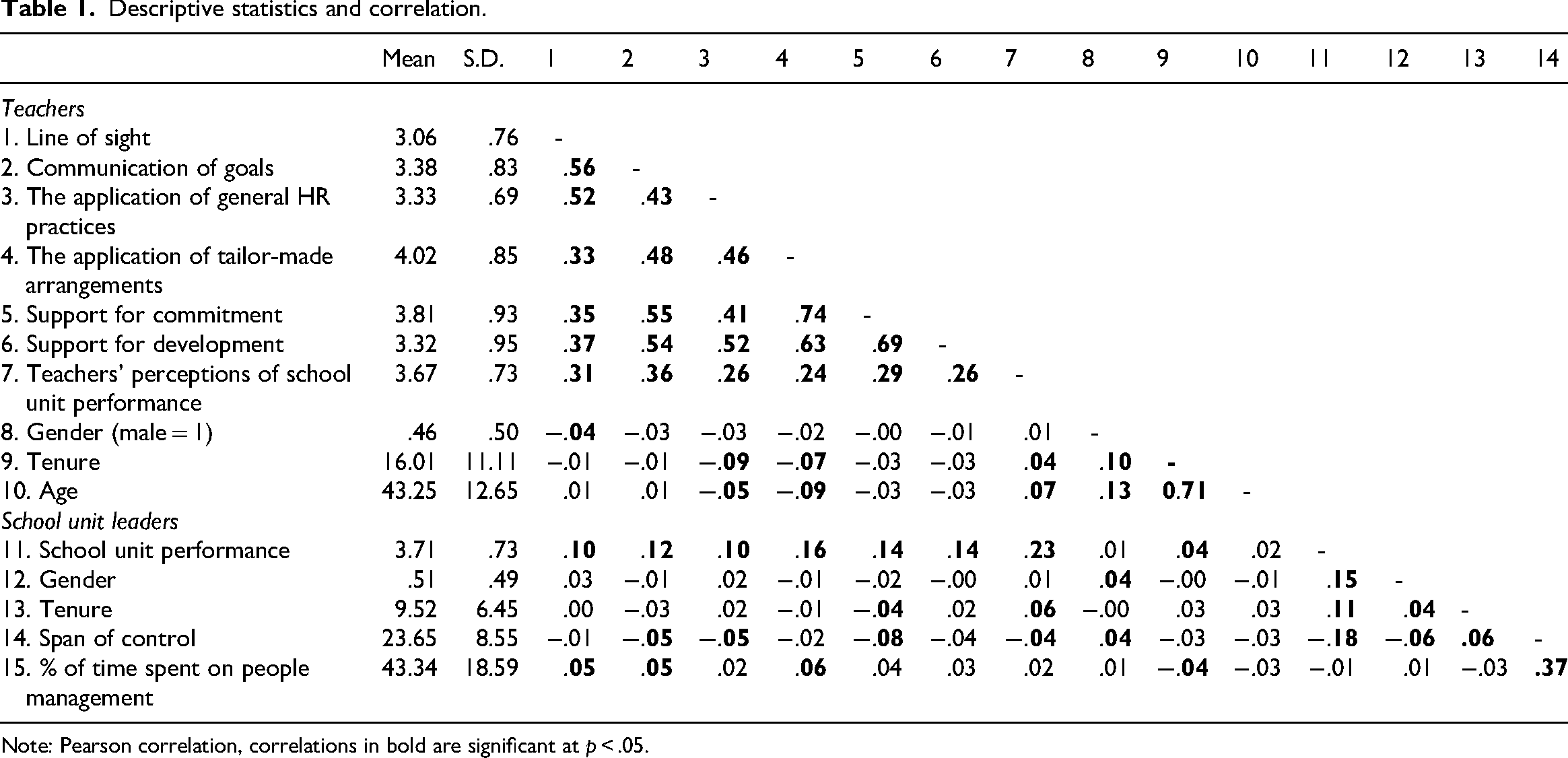
Note: Pearson correlation, correlations in bold are significant at p < .05.
SEM analyses
People management (H1, H3, H5)
First, our results illustrate that the implementation of general HR practices is positively related to teachers’ line of sight (β=.297, p < .001) and to school unit performance (β=.229, p < .001) (Figure 2), which supports hypothesis 1a and hypothesis 3a. However, in this model there was no support for the mediated relationship between implementation of general HR practices and school unit performance through teachers’ line of sight. The robustness analysis showed similar findings (Supplemental material, Figure 1). Therefore, hypothesis 5a is rejected.
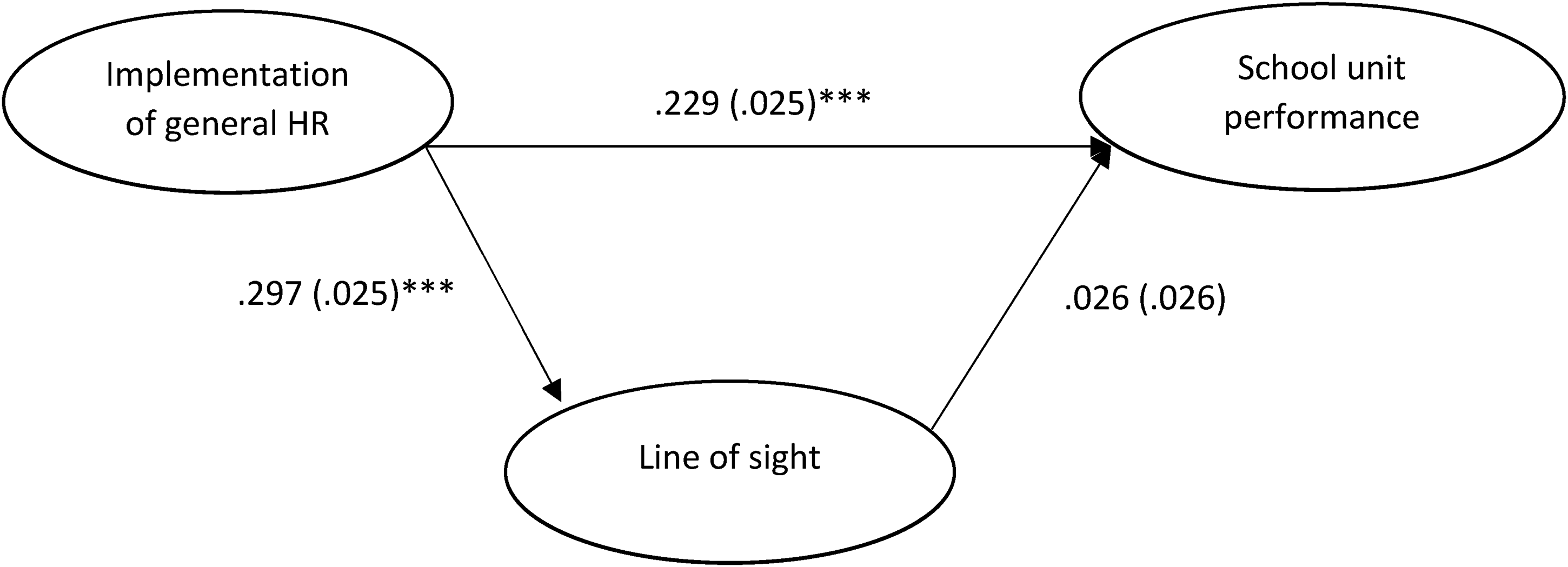
Effects of the implementation of general HR practices (IV) through line of sight (M) on teachers’ and school unit leaders’ perceptions of school unit performance (DV).
Second, our results show that the implementation of tailor-made arrangements is positively related to teachers’ line of sight (β=.175, p < .001) and school unit performance (β=.342, p < .001) (Figure 3). However, like the previous models, no evidence was found for a mediating effect of the implementation of tailor-made arrangements and school unit performance through teachers’ line of sight. The robustness analysis, in which teachers’ perceptions of school unit performance was included as the dependent variable, did show evidence for this mediating effect (Supplemental material, Figure 2). More specifically, in this model teachers’ line of sight was significantly related to school unit performance (β=.063, p < .01), and a significant mediating relationship was found (β=.011, p < .05). Based on these results, hypothesis 1b and 3b are supported, but hypothesis 5b is rejected.
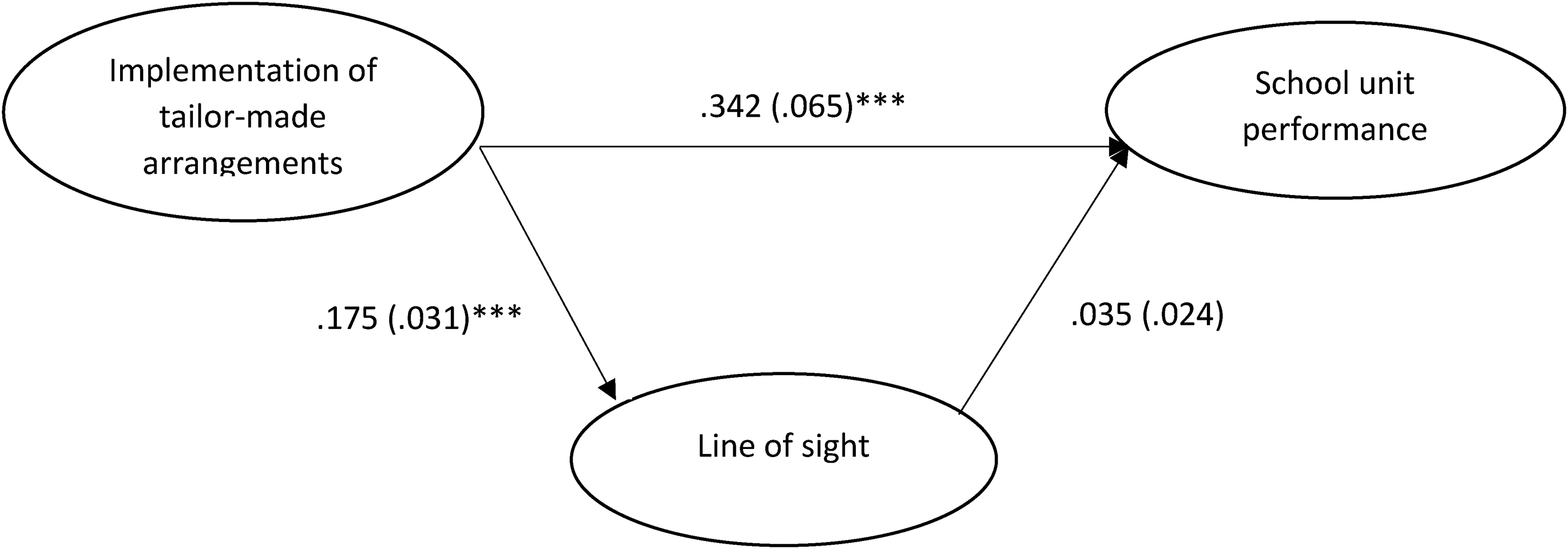
Effects of the implementation of tailor-made arrangements (IV) through line of sight (M) on teachers’ and school unit leaders’ perceptions of school unit performance (DV).
Third, our results show that school unit leaders’ support for commitment was positively related to teacher's line of sight (β=.159, p < .001) and school unit performance (β=.297, p < .001) (Figure 4). In addition, some moderate support was found for the mediating relationship between support for commitment and school unit performance through teachers’ line of sight. That is, results indicate a moderately significant relationship between teachers’ line of sight and school unit performance (β=.049, p < .10) and a moderately significant mediating relationship (β=.049, p < .10). Robustness analyses show similar results, with somewhat more convincing evidence for the mediating relationship (Supplemental material, Figure 3). In this model teachers’ line of sight was significantly related to school unit performance (β=.065, p < .05), and a significant mediation relationship was found (β=.010, p < .05). Based on these findings, hypothesis 1c and 2c are supported. In addition, hypothesis 5c is also supported; however, it should be noted that the evidence for hypothesis 5c is moderate.
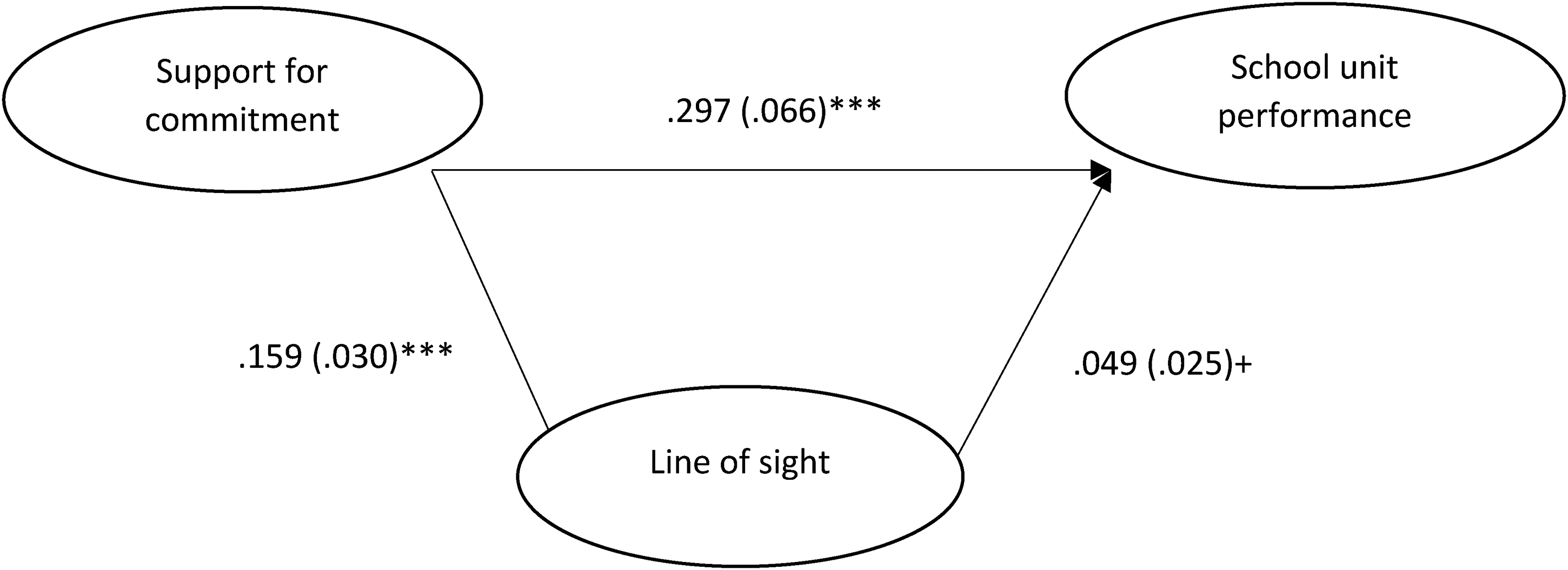
Effects of school unit leaders’ support for commitment (IV) through line of sight (M) on teachers’ and school unit leaders’ perceptions of school unit performance (DV).
Fourth, the results for school unit leaders’ support for development are similar to the results for support for commitment. Figure 5 shows that school unit leaders’ support for development is significantly related to teachers’ line of sight (β=.188, p < .001) and school unit performance (β=.260, p < .001). In addition, moderate support was found for the relationship between teachers’ line of sight and school unit performance (β=.045, p < .10) and the mediated relationship between support for development and school unit performance through teachers’ line of sight (β=.008, p < .10). The robustness analysis showed more convincing evidence, with a significant relationship between teachers’ line of sight and school unit performance (β=.057, p < .05) and a significant mediating relationship between support for development and teachers’ perceptions of school unit performance through line of sight (β=.011, p < .05) (Supplemental material, Figure 4). Based on these findings, hypothesis 1d and 3d are supported. In addition, hypothesis 5d is supported; however, the evidence for hypothesis 5d is moderate.
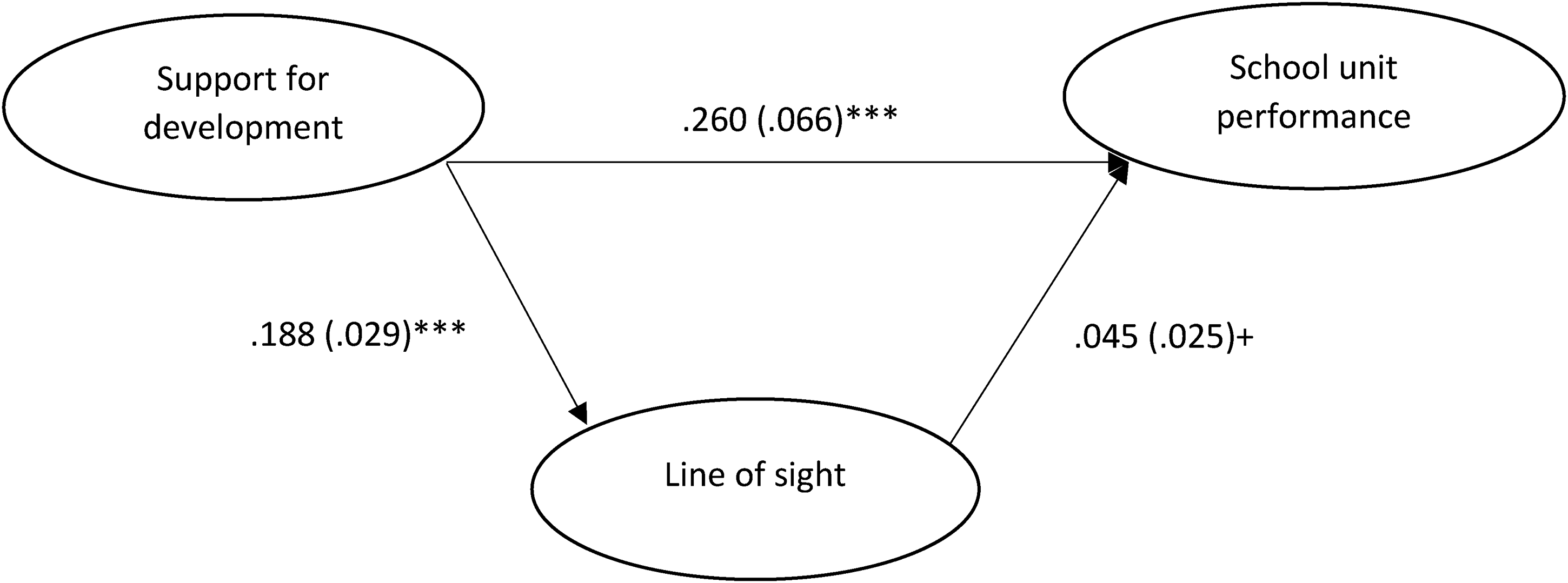
Effects of school unit leaders’ support for development (IV) through line of sight (M) on teachers’ and school unit leaders’ perceptions of school unit performance (DV).
Communication of school goals (H2, H4, H6)
Results show that communication of goals by school unit leaders is positively related to line of sight (β=.266, p < .001) and is directly positively related to school unit performance (β=.23, p < .001) (Figure 6). However, there is no support for the mediated relationship between communication of school goals, line of sight and school unit performance. The robustness analysis with teachers’ perceptions of school unit performance as the dependent variable shows similar findings (Supplemental material, Figure 5). Based on these findings, there is support for hypothesis 2 and hypothesis 4. However, hypothesis 6 must be rejected.
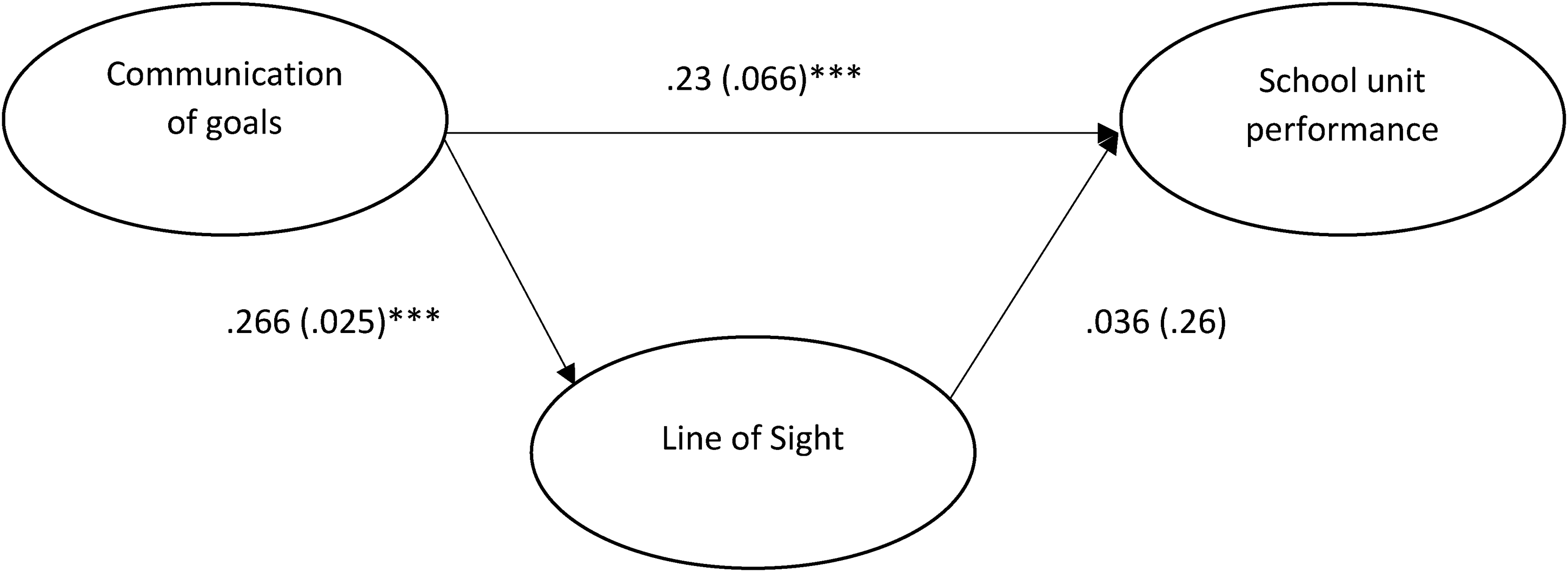
Effects of communication of school goals (IV) through line of sight (M) on school unit leaders’ perceptions of school unit performance (DV).
Discussion and conclusion
This study explored the relationships between school unit leaders’ people management and communication of school goals, teachers’ line of sight and school unit performance. The HRM and educational leadership literature provided the theoretical explanation for hypotheses on how school unit leaders impact school unit performance through a cognitive path represented by teachers’ line of sight. The hypotheses were tested on data from 5769 teachers across 559 units.
Theoretical implications
The findings provide robust evidence supporting the significant impact of school unit leaders on both teachers’ line of sight and school unit performance through their people management activities and communication of school goals. This underscores the pivotal role of school unit leaders’ activities in shaping educational outcomes, extending beyond influencing teachers’ motivation to teachers’ cognitive understanding of their school's goals and how they can contribute to their achievement.
This research highlights the strategic importance of people management activities in fostering school unit performance while such activities tend to be considered as less strategic than educational leadership (Connolly et al., 2019). School unit leaders are in the position through their people management activities to signal and reinforce desired behaviours aligned with their school's goals and thus contribute to achieving these goals (Bowen and Ostroff, 2004). School unit leaders’ people management activities also provide functional support for teachers’ professional behaviours aligned with their school's goals. The school unit leader's role in providing people management support and in communicating school goals can result in a powerful combination when the two reinforce each other (Tuytens et al., 2023b). Moreover, the school unit leader's position enables them to adapt their people management activities to the context of their own unit. For instance, when teaching in their unit consists of a combination of individual autonomy with teacher cooperation, school unit leaders can use HRM practices regarding professional development and unit autonomy to stimulate and facilitate their teachers to elaborate the school goals in terms of a unit teaching plan.
Our results also show that several dimensions of people management (i.e. support for commitment and development and partly the implementation of tailor-made arrangements) are moderately but significantly related to school unit performance through teachers’ line of sight. This provides support for the notion that a cognitive understanding of their school's goals and one's individual contribution to realizing those is an important antecedent of school unit performance. It is relevant to notice that particularly those people management activities that are relatively strongly dependent on school unit leaders’ own discretionary actions (support for commitment and development) (Knies et al., 2020) show the hypothesized mediated effect. This implies that school unit leaders make more of a difference compared to organizational HR practices as such.
The relationship between teachers’ line of sight and school unit performance varied in the different models that were estimated. Intuitively, this may sound illogical, particularly since the correlation table shows a rather high correlation between teachers’ line of sight and school unit performance. A possible explanation for this is that in the models in which there is no significant relationship between teachers’ line of sight and school unit performance, the relationship between the independent and the mediating variables is highly strong, and the beta coefficients are fairly high. This may indicate that because these variables correlate so strongly, the effect of one of these variables on school unit performance vanishes due to multicollinearity.
While the educational leadership literature has emphasized the motivational effects of leaders’ vision building and communication (Geijsel et al., 2003; Murphy and Torre, 2015), this study demonstrates that school unit leaders’ goal communication also shapes teachers’ cognitive alignment with their school's goals, thereby impacting school unit performance (Boswell and Boudreau, 2001). Hallinger and Lu (2014) have demonstrated the importance of shared vision within the school management team for school improvement. This research departs from the related assumption that school unit leaders themselves have a good understanding of their school's goals and that they are able to communicate about these explicitly and implicitly (via people management). For this communication to be effective in creating a shared understanding and a sense of ownership of the goals among teachers, it is important that school unit leaders engage in face-to-face dialogue with teachers and empower them to translate school goals into classroom and unit objectives (Jensen et al., 2018; Murphy and Torre, 2015; Tan, 2018). Teacher leadership will likely be fostered by teachers having line of sight and trusting their school unit leader's people management support, which will contribute to school improvement by school unit leaders and teachers jointly (Muijs and Harris, 2003).
Study limitations
While this investigation provides important insights, it is essential to acknowledge several limitations inherent in this study. First, this research has been conducted within a specific organizational context (Dutch schools for secondary education), and the findings may not be readily applicable to other parts of the educational sector (e.g. primary or higher education) or to schools in other countries. Leadership communication of school vision and goals, people management activities and their alignment with school goals may vary across different organizational settings, for example, as a result of the size of schools and the people management responsibilities that are assigned to school unit leaders. Second, no previously validated generic scale for measuring line of sight was available. Therefore, Hallinger's Principal Instructional Management Rating Scale was used to contextualize this concept to the school context. Future research would benefit from the development and validation of a comprehensive scale for assessing line of sight. Third, this study uses cross-sectional data. This implies that strong claims cannot be made about the causal relationships between school unit leaders’ people management, communication of school goals, line of sight and school unit performance. While there are strong theoretical arguments to model the variables in the proposed way, longitudinal and/or experimental research would be helpful to ascertain causation. Recognizing these limitations, this study lays the groundwork for future research that can address these constraints, fostering an even more comprehensive and nuanced understanding of the effects of school unit leaders’ activities in various school contexts.
Practical implications
Beyond the theoretical implications, our findings highlight important practical considerations for school unit leaders, particularly in their role as people managers. School unit leaders play a crucial role not only in motivating teachers to contribute to the school's mission but also in ensuring that teachers clearly understand their school's goals and how they can contribute to these goals in their daily work. Often, school goals remain abstract, creating a disconnect between institutional ambitions and teachers’ everyday practices. School unit leaders must bridge this gap by actively starting the conversation with teachers about these goals and supporting teachers in translating them into actionable steps.
To effectively fulfil this role, school unit leaders themselves require the necessary knowledge and skills to implement people management and communicate school goals effectively. This underscores the importance of professional development opportunities aimed at strengthening school unit leaders’ competencies in leadership and management. Given that many school unit leaders transition into leadership roles from teaching positions without formal training in management, structured leadership development programs are essential. These programs should focus on equipping school unit leaders with the skills needed to engage with teachers, provide people management support and foster a shared understanding of school goals.
Additionally, school unit leaders must have sufficient time to support teachers and engage in regular, meaningful conversations. Time constraints often limit school unit leaders’ ability to fulfil their people management role effectively. Ensuring that leadership positions allow for dedicated time to interact with teachers and align their work with school objectives is critical.
Finally, school unit leaders need an appropriate level of autonomy to tailor their people management to the specific needs of their unit. This allows school unit leaders to adapt their people management and communication to the challenges and dynamics of their unit, ultimately enhancing school unit performance.
Conclusion
In conclusion, this study offers compelling evidence supporting the pivotal role of school unit leaders’ people management and communication of school goals in shaping teachers’ line of sight towards their school's educational goals and the resulting school unit performance. These findings support this paper's theoretical suggestion that combining insights from educational leadership and strategic HRM research benefits studies of how school unit leaders contribute to student learning.
Supplemental Material
sj-docx-1-ema-10.1177_17411432251364641 - Supplemental material for School unit leaders’ people management: Impact on teachers’ line of sight and school unit performance
Supplemental material, sj-docx-1-ema-10.1177_17411432251364641 for School unit leaders’ people management: Impact on teachers’ line of sight and school unit performance by Eva Knies, Peter Leisink, Julia Penning de Vries and Roos Mulder in Educational Management Administration & Leadership
Footnotes

Ethical considerations
The participants provided written (digital) informed consent. They provided consent to conduct the study and publish the results.
Funding
The authors received no financial support for the research, authorship, and/or publication of this article.
Declaration of conflicting interests
The authors declared no potential conflicts of interest with respect to the research, authorship, and/or publication of this article.
Data availability
The data that support the findings of this study are available from the corresponding author upon reasonable request.
Supplemental material
Supplemental material for this article is available online.
Notes
Author biographies
References
Supplementary Material
Please find the following supplemental material available below.
For Open Access articles published under a Creative Commons License, all supplemental material carries the same license as the article it is associated with.
For non-Open Access articles published, all supplemental material carries a non-exclusive license, and permission requests for re-use of supplemental material or any part of supplemental material shall be sent directly to the copyright owner as specified in the copyright notice associated with the article.
