




Abstract
Distributed leadership has been associated with enhanced teacher job satisfaction, particularly through school climate of mutual collaboration and trust, and teacher empowerment. Other school-level conditions have received less research attention. Using data from 2517 lower secondary teachers across 175 schools in Czechia, collected as part of the 2018 Teaching and Learning International Survey, this study employs structural equation modeling to examine the mediating effect of the school feedback environment on two dimensions of teacher job satisfaction. The results suggest that distributed leadership has a significant direct effect (β = .404, p < .001) on teacher workplace satisfaction, as well as an indirect effect via supportive school climate (β = .181, p < .001). Additionally, a small but significant indirect effect through formative feedback environment was found (β = .017, p < .001). In contrast, teacher satisfaction with the profession is only weakly related to distributed leadership (β = .205, p < .001), and the indirect path through formative feedback environment was not supported. These patterns hold irrespective of school size, suggesting that all school leaders may benefit from implementing formative feedback practices to support teacher workplace satisfaction. However, their options to enhance teacher satisfaction with the profession are limited.
Keywords
Introduction
Teacher job satisfaction is an important research topic. Satisfied teachers tend to be less susceptible to stress and burnout, demonstrate stronger work commitment, and are less likely to leave the profession (Klassen and Chiu, 2011; Skaalvik and Skaalvik, 2011, 2017). Teacher job satisfaction is also related to classroom teaching and student outcomes (Wartenberg et al., 2023). Significant determinants of teacher job satisfaction are school principal's leadership behavior and workplace conditions (Dutta and Sahney, 2016; Liu et al., 2021; Liu and Werblow, 2019; Sims, 2017). It has been argued that distributed leadership is successful in establishing a school culture of mutual collaboration and trust (Bellibas and Liu, 2016; Lin, 2022), which in turn translates into increased teacher job satisfaction (Ahn et al., 2023).
Most research so far has focused on the mediating role of teacher collaboration and supportive school climate (Ahn et al., 2023; Liu et al., 2021), and teacher self-efficacy (Sun and Xia, 2018), but a wider array of variables should be considered to better understand how distributed leadership is related to teacher job satisfaction. In particular, feedback provided to teachers has received little attention from scholars, although it may be relevant based on prior studies (Blömeke and Klein, 2013; Ford et al., 2018; Liu et al., 2018; Sims, 2017). Furthermore, little research was devoted to leadership practices within specific contexts, such as small schools, and findings concerning leadership distribution in schools of different sizes are inconclusive (ETUCE, 2012; OECD, 2016).
In this study, we explore the mediating role of formative feedback provided to teachers by multiple actors within the school as a specific leadership practice that might explain part of the relationship between distributed leadership and teacher job satisfaction. We use the 2018 Teaching and Learning International Survey (TALIS) data from Czechia, a country where new forms of collegial feedback have been introduced to complement traditional teacher evaluation by the school principal (Michek, 2024). Differential adoption of new approaches to teacher evaluation (CSI, 2022) offers a unique opportunity to study the contribution of the school's feedback environment to teacher job satisfaction. In addition, as a country with a relatively large proportion of small schools, Czechia provides a suitable context for investigating whether the mediating effects of school-level conditions in the relationship between distributed leadership and teacher job satisfaction hold irrespective of school size. We further extend previous research by considering two dimensions of teacher job satisfaction to gain a deeper insight into what a school principal should focus on to foster desired outcomes.
Theoretical background
This study assumes that school leadership is crucial for shaping school organization, culture, and conditions (Day et al., 2016). Having in mind that leadership roles and responsibilities are being increasingly spread over multiple leaders (Bolden, 2011; Harris et al., 2022), we examine the interplay between distributed leadership, school-level conditions, and teacher job satisfaction as an important teacher outcome, while specifically focusing on the distribution of teacher evaluation within the school. The key theoretical concepts of teacher job satisfaction, distributed leadership, and teacher evaluation are discussed in this section.
Teacher job satisfaction
Job satisfaction refers to an employee's evaluative judgments about their job (Weiss, 2002). It involves an emotional component resulting from an appraisal of the job experience (Locke, 1976), and a cognitive component consisting of the employee's perception of how well their occupation provides valuable things to them (Høigaard et al., 2012). In the teaching context, job satisfaction was defined as a “sense of fulfilment and gratification resulting from being a teacher and from working in a particular teaching job” (Mostafa and Pál, 2018: 15). Teacher job satisfaction is related to many teacher-level outcomes, such as work commitment (Klassen and Chiu, 2011), job retention (Skaalvik and Skaalvik, 2011; Toropova et al., 2021), and teacher–student interactions (Wartenberg et al., 2023).
Teacher job satisfaction is a multifaceted construct reflecting the presence or absence of factors that influence individual job experience (Dicke et al., 2020; Skaalvik and Skaalvik, 2017). Research shows that teachers are generally satisfied with aspects intrinsic to the teaching role but dissatisfied with factors surrounding the job performance when perceived as detracting from their professional mission (Collie et al., 2012). From a variety of school-based factors, principal's leadership behavior is strongly related to teacher job satisfaction (Diagne, 2023; Liu et al., 2021; Liu and Werblow, 2019; Sims, 2017), but this relationship may be mediated by favorable workplace conditions (Dutta and Sahney, 2016), such as supportive school climate (Aldridge and Fraser, 2016) and teacher collaboration (Ahn et al., 2023; Liu et al., 2021; Tang et al., 2020). On the other hand, teacher job satisfaction is lowered by demands stemming from high workload or student misbehavior (Diagne, 2023; Toropova et al., 2021).
Teacher personal characteristics may explain additional part of their job satisfaction, with self-efficacy beliefs, i.e., perceived capability to bring about desired outcomes of student engagement and learning (Tschannen-Moran and Woolfolk Hoy, 2001) being a prominent teacher-level predictor (Ahn et al., 2023; Collie et al., 2012; Klassen and Chiu, 2011; Skaalvik and Skaalvik, 2017; Tang et al., 2020). Other personal factors, such as participation in professional development, work experience, or gender (Tang et al., 2020; Toropova et al., 2021), play a less important role. Literature suggests that teacher self-efficacy shares common variance with a range of school-based conditions including principal's leadership behavior (Ahn et al., 2023), teacher collaboration (Collie et al., 2012), and supportive school climate (Aldridge and Fraser, 2016).
Distributed leadership
As a “post-heroic” approach to school leadership practice (Bolden, 2011), distributed leadership implies active involvement of multiple actors in the leadership process, utilizing their expertise to better meet the school's educational goals (Gumus et al., 2018; Spillane, 2005). From a distributed perspective, the focus shifts from attributes and actions of individual leaders to situated leadership practice with an emphasis on collaborative decision making (Harris, 2014) and interactions between leaders, followers, and their situation (Spillane, 2005). Research has provided ample evidence that distributed leadership has positive effects on many school, teacher, and student outcomes (Leithwood et al., 2020), but the findings are often singular without building up a coherent picture (Harris et al., 2022).
In schools where leadership is distributed, teachers tend to demonstrate higher levels of professional collaboration (Lin, 2022) and an enhanced commitment to their school (Devos et al., 2014). Such “relational” factors of school climate have been associated with higher job satisfaction among teachers (Ahn et al., 2023; Aldridge and Fraser, 2016), demonstrating stronger effects than organizational factors (Tang et al., 2020). In addition, a significant direct effect of distributed leadership on teacher job satisfaction has been reported (Liu et al., 2021), which can be explained by feelings of recognition when teachers’ expertise is utilized and valued (Amels et al., 2020). Another line of research suggests that distributed leadership empowers teachers (Devos et al., 2014; O'Shea, 2021), thus increasing their self-efficacy (Sun and Xia, 2018; Tian et al., 2016). The argument goes that when distribution of leadership roles is aligned with teachers’ expertise, they are given chance to successfully accomplish a wider range of professional tasks, which strengthens their self-efficacy beliefs (Cai et al., 2023; Tian et al., 2016). However, research exploring the “relational” and “empowering” paths simultaneously is rare and their interplay remains open. Their parallel investigation could advance our understanding how distributed leadership relates to teacher job satisfaction although both processes are probably interconnected in practice.
In addition, school context and organizational specifics have been found to shape principals’ leadership behavior (Leithwood et al., 2020). From a variety of context variables, school size is an important factor that determines the daily tasks of school leaders (ETUCE, 2012) and influences the composition of the leadership team. With growing school size, leadership teams tend to larger but accounting for a smaller share of teachers (Stokes et al., 2019). Middle leaders in large schools may take over more responsibilities from the principal but at the risk of being remote from the rest of school staff (Bush and Glover, 2012). In contrast, smaller schools tend to be led by a small leadership group where the principal deals with most tasks (ETUCE, 2012). Formalized leadership distribution may be perceived as unnecessary because everyday staff interactions provide opportunities to regular sharing and discussing issues on an ad hoc basis.
Teacher evaluation and feedback to teachers
Teacher evaluation supports self-reflection on previous professional experience and growth and also serves as an assurance mechanism to guarantee satisfactory teacher performance (Lillejord and Børte, 2020; Papay, 2012). It has been implemented in many countries to enhance the quality of classroom teaching and learning. Scholars recognize the double function (formative and summative) of teacher evaluation (Tuytens et al., 2020), and trust in its potential to support teachers’ professional learning (Delvaux et al., 2013).
School leadership is a key factor in shaping the context of teacher evaluation (Tuytens et al., 2020). When the process of teacher evaluation is distributed, regular summative evaluation by the school principal may be complemented by more frequent classroom visits and feedback sessions conducted by teacher colleagues (Spillane, 2005), often perceived as effective and immediately applicable as compared to evaluation by the school principal (Thien et al., 2024). Distributed leadership may therefore contribute to creating a feedback environment characterized by positive aspects of feedback availability, usefulness, and source credibility (Steelman et al., 2004).
Besides supporting the improvement of professional skills, performance feedback conveys a message how the employee is valued within the organization. Formative feedback environment that provides sufficient, timely, useful, growth-oriented, and trustworthy information about one's job performance helps employees feel appreciated and carefully treated, offers acceptance and reassurance, and evokes positive job-related affect (Sommer and Kulkarni, 2012). These perceptions in turn strengthen the employee's personal control over information and work decisions, leading to greater job satisfaction (Sparr and Sonnentag, 2008). In the context of teaching profession, studies showed a positive effect of frequent feedback (Sims, 2017) provided by multiple actors (Blömeke and Klein, 2013) on teacher job satisfaction. Higher job satisfaction was further associated with clarity, perceived justice, and developmental purpose of teacher evaluation (Dal Corso et al., 2019; Deneire et al., 2014). A study by Ford et al. (2018) reported higher job satisfaction for teachers who perceived their evaluation as leading to positive changes in their teaching and those evaluated primarily by fellow teachers.
Teacher evaluation in Czechia
Teachers in Czechia are not subject to performance evaluation against standards defined at the national level. Teacher evaluation is a process internal to the school and has traditionally been conducted by the school principal (Eurydice, 2021). Schools have full autonomy in selecting methods used in teacher evaluation, but classroom observations by the school principal and follow-up interviews are the most common ways (Shewbridge et al., 2016). As declared by the Czech School Inspectorate (CSI, 2024), teacher evaluation should be intended to help teachers improve their teaching skills, but the same process is used to inform decisions on financial bonuses awarded to teachers at the discretion of the school principal (Eurydice, 2021). Consequently, many teachers in Czechia tend to perceive their evaluation by the school principal as a performance check (Santiago et al., 2012).
Recently, new forms of teacher evaluation, such as peer-to-peer classroom observation and feedback, teacher self-assessment, or student surveys, have been increasingly applied to complement traditional evaluation by the school principal (CSI, 2022; Michek, 2024). With these practices, decision-making on teachers’ performance is no longer owned and enacted by a single leader, but shared by multiple actors, utilizing their expertise (Leithwood et al., 2020). While distributed leadership may happen through both informal and formal processes (Harris et al., 2022), explicit delegation of responsibilities for teacher evaluation is needed to incorporate the new evaluation forms in teacher appraisal and bonus system. This is why systematic implementation of collegial feedback and other distributed practices is increasingly promoted by the Czech School Inspectorate and assessed during inspection school visits (CSI, 2022), in line with international research evidence that only purposeful leadership distribution has the potential to impact positively on school development (Cai et al., 2023; Harris et al., 2022). As noted in the Czech School Inspectorate's (2022) report, informal collegial feedback most likely reflects school climate of mutual collaboration and trust rather than genuine distribution of teacher evaluation, which is still a challenge to many schools.
The present study
Based on previous research evidence, we assume that distributed leadership will be positively associated with both supportive school climate and teacher self-efficacy, which, in turn, will be both positively related to teacher job satisfaction. Besides that, we expect a positive relationship between distributed leadership and formative feedback environment, operationalized as a complex structure of growth-oriented feedback provided to teachers by different staff members using different information sources. While recognizing that leadership distribution concerns many areas of the school's life, including curriculum development, inclusive education, forming the school's physical environment and many more, we specifically focus on teacher evaluation which is currently subject to change in Czechia. We expect that the school's feedback environment will explain some variance in teacher job satisfaction in addition to parts explained by school climate and self-efficacy beliefs.
In our conceptual framework (Figure 1), distributed leadership is the primary independent variable with a hypothesized direct effect on teacher satisfaction. Furthermore, three indirect paths through supportive school climate, formative feedback environment, and teacher self-efficacy are modelled. Given that most empirical studies used a single job satisfaction measure, we add to previous research a more nuanced examination of the relationships between distributed leadership and two facets of teacher job satisfaction. We expect to explain more variance in satisfaction with the workplace than in satisfaction with the teaching profession which is more dependent upon societal and system-level factors not included in this study. We further extend previous research by comparing the structural relationships between study variables for small and large schools. We suppose that all three mediators will be related to teacher job satisfaction irrespective of school size, but the effect of distributed leadership on supportive school climate will be stronger in large schools where relationships between school community members may be more distant when not purposefully cultivated by the principal's leadership activity.
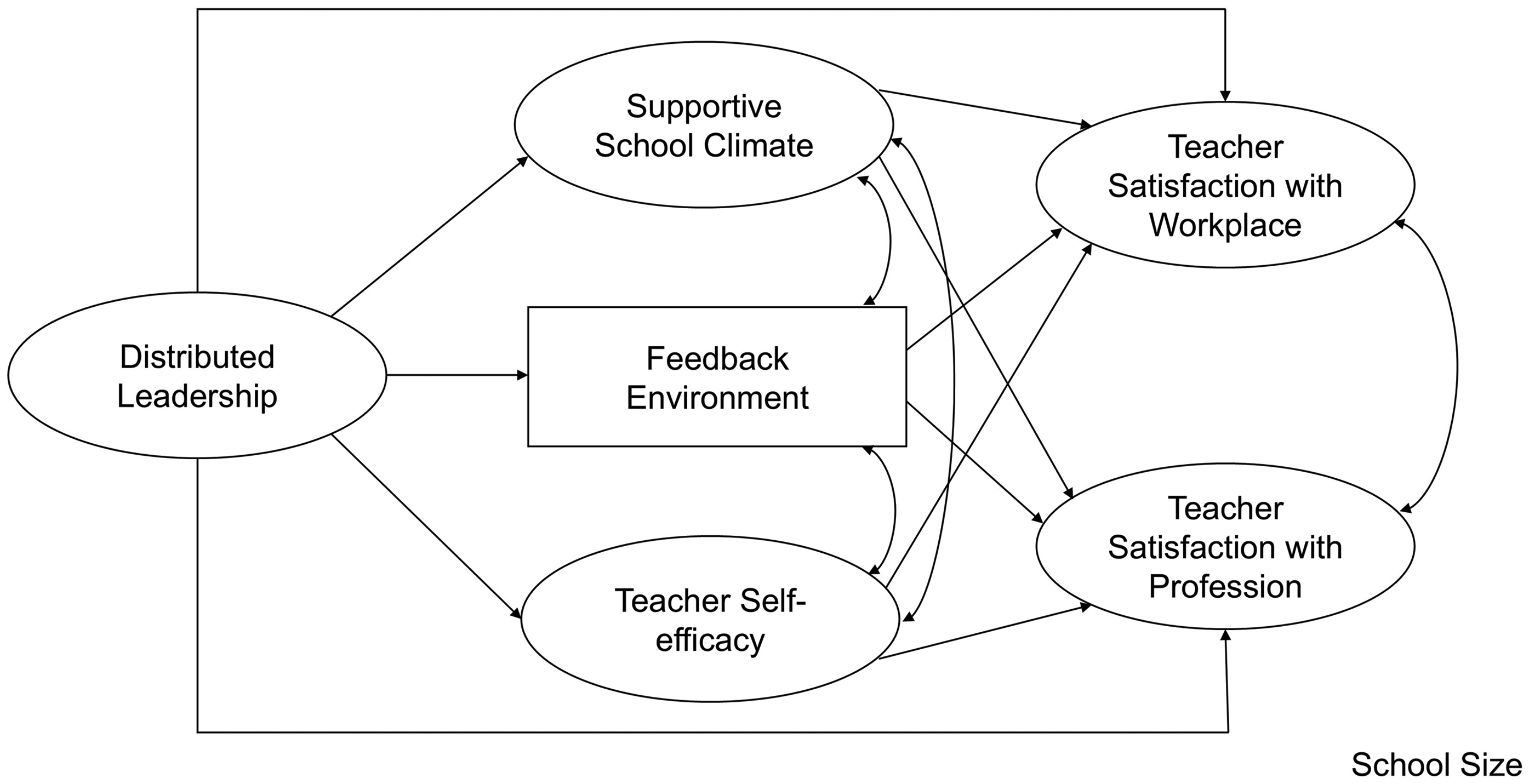
Conceptual framework.
We ask the following research questions:
To what extent is distributed school leadership associated with teacher satisfaction with the workplace and the teaching profession, respectively? To what extent are the associations between distributed school leadership and the two facets of teacher job satisfaction mediated by supportive school climate, the school's feedback environment, and teacher self-efficacy? Do the estimated relationships between distributed school leadership and teacher job satisfaction differ for small and large schools?
Methods
Data source and sample
This study uses 2018 TALIS data for Czechia. TALIS 2018, administered by the Organisation for Economic Co-operation and Development, employed online or paper-based questionnaires to survey teachers’ and school principals’ perceptions of their working conditions and work experience in 48 countries and economies. In each participating country, a two-stage stratified cluster sampling was applied to select a nationally representative sample of lower secondary (ISCED 2) schools and a random sample of teachers from each selected school (OECD, 2019). The Czech TALIS sample includes lower secondary schools of two types: mainstream track schools and long academic track schools. We intentionally limit this study to a subset of teachers working in mainstream track schools to ensure comparability of the schools’ organizational contexts. The final analytical sample includes N = 2517 lower secondary teachers (77.5% females) nested in 175 schools. 1 The average number of teachers per school in the sample is 14.4 (SD = 5.9).
Variables
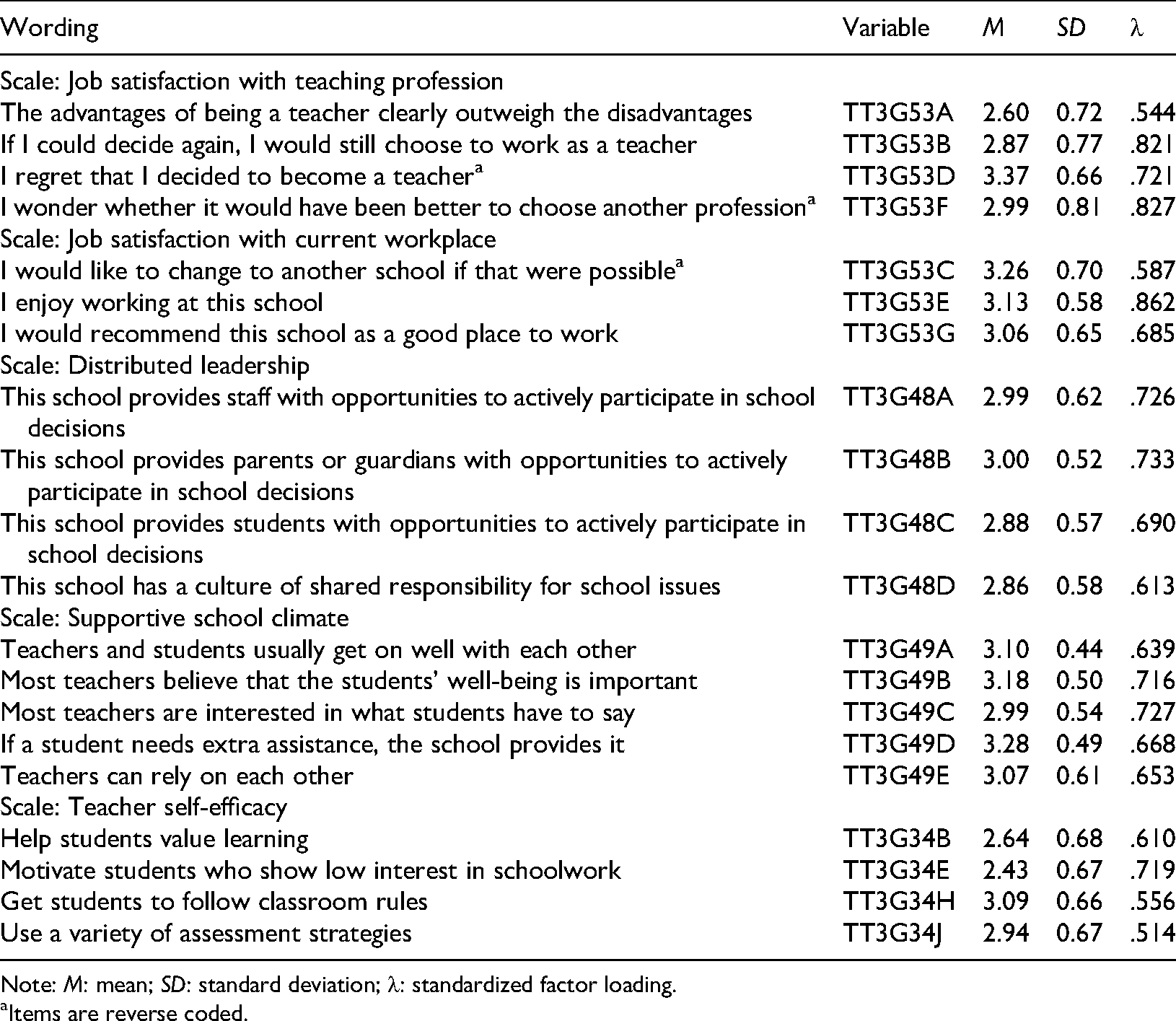
TALIS adopts a latent trait approach to measure constructs related to teachers’ attitudes to instructional practice, motivational outcomes, or perceptions of the school environment. Latent traits, while not directly observable, are assumed to cause a person's reactions to manifest indicators (e.g. questionnaire items), which can be used to construct measurement scales for the underlying latent variable (Bartholomew, 2001). We follow the latent trait approach in measuring all key variables except the feedback environment. Item wording, descriptive statistics, and factor loadings are given in Appendix A.
Dependent variables. The outcome variables are teacher job satisfaction with the teaching profession (JSP) and teacher job satisfaction with the current workplace (JSW). JSP scale is composed of four items (two of them reverse-coded), such as “If I could decide again, I would still choose to work as a teacher.” JSW scale consists of three items (one of them reverse-coded), such as “I enjoy working at this school.” All items were measured on a four-point Likert-type scale ranging from 1 (“strongly disagree”) to 4 (“strongly agree”).
Independent variables. The independent variable is distributed school leadership (DL). We use teacher-reported DL to take advantage of a larger sample size and to avoid inflated ratings for social desirability reasons (Liu et al., 2021). The scale of distributed school leadership as perceived by teachers consists of four items measuring the opportunities to actively participate in school decisions provided to the staff, parents and students, and an overall culture of shared responsibility for school issues on a four-point Likert-type scale from 1 (“strongly disagree”) to 4 (“strongly agree”).
Mediating variables. While our main research interest is in the mediating role of formative feedback environment (FE), we also consider supportive school climate (SC) and teacher self-efficacy (TSE) as mediators. SC scale includes five items capturing the relational aspects of school climate as perceived by teachers, such as relationships between teachers and students and trust in other staff members. All items were rated on a four-point Likert-type scale from 1 (“strongly disagree”) to 4 (“strongly agree”).
TSE is operationalized as a broad construct capturing teachers’ beliefs to master different tasks related to the teaching profession. In the TALIS questionnaire, teachers rated their capability to handle 13 tasks using a four-point Likert-type scale from 1 (“not at all”) to 4 (“a lot”). To keep the model simple, we selected four items for this study.
FE is measured by a manifest variable derived from the teachers’ responses to items asking about feedback provided to them by (a) the school principal or other members of the school management team and (b) other colleagues within the school, drawing from different information sources. We consider four possible information sources: classroom observation, student surveys, student results in external tests, and classroom-based student results. We handle FE as a manifest variable to reflect explicit and planned distribution of responsibilities for teacher evaluation within the school rather than implicit patterns of collegial feedback in an environment of mutual collaboration and trust. Combining the two dimensions of who provides feedback based on what source, FE can vary between 0 and 8, with higher values representing more types of feedback provided by a more diverse group of actors. For example, 1 would typically represent the most traditional type of feedback provided by the school principal based on classroom observation, while higher values would indicate a more complex feedback environment. To highlight the formative role of FE, we assigned value 0 not only to respondents who did not report any of the eight feedback types but also to those who admitted that none of the feedback they received had a positive impact on their teaching.
Analytical approach
We employ structural equation modeling (SEM) to investigate the direct and indirect effects of distributed school leadership on teacher job satisfaction. Before analyzing the structural relationships, we validated the latent constructs using confirmatory factor analysis (CFA). For reliability analysis, we use McDonald's omega as an estimate of composite reliability of scales that are not strictly tau-equivalent and/or measured by items with less than five categories (Viladrich et al., 2017). We fitted a series of SEMs to examine the relationships between the variables. We first ran a full mediation model in which the indirect paths between DL and two dimensions of teacher job satisfaction mediated through SC, FE, and TSE were hypothesized, along with two direct paths. After examination of parameter estimates we removed non-significant paths to achieve a parsimonious final model. In the next step, we tested whether this model holds equally for subgroups of teachers working in differently sized schools (1 = under 500 students, N = 1246 teachers; 2 = 500 or more students, N = 1239 teachers). 2 Note that schools with more than 750 students are rare in the Czech education system (4.3% schools in the sample). To gain a deeper insight into the between-group differences, we applied a global chi-square difference test and a Wald chi-square test to evaluate the equality of individual parameters of interest.
We use approximate fit indices and common cut-off criteria to assess the quality of the models. RMSEA values of less than .08 indicate a good model fit and values lower than .10 represent reasonable errors of approximation. SRMR smaller than .08, and CFI/TLI greater than .90 provide additional indications of a good model fit. While we also report the chi-square statistics, we do not use it to assess the fit of our models, given its sensitivity to the sample size (Byrne, 2001).
We employed IBM SPSS Statistics, Version 25 to pre-process the data and Mplus 8 to fit CFA models and SEMs. To account for a complex sampling design, we applied teacher weights available in the TALIS database and a sandwich estimator robust to non-independence of observations due to clustered data structure by specifying Mplus command TYPE = complex. We estimated the model parameters using a maximum likelihood estimator with robust standard errors (Li, 2016) and a full information maximum likelihood (FIML) approach to handle missing data. Missing data rates in the observed variables ranged from 1.6% to 3.0%.
Results
Measurement models of the latent constructs
Teacher job satisfaction was modeled as a two-dimensional construct including JSP and JSW as distinct but correlated reactions to the job. The items loaded significantly on their respective factors with loadings ranging from .544 to .862 (mean factor loadings .728 and .711 for JSP and JSW, respectively). The two factors were correlated with r = .57. The model fit was good (χ2(13) = 222.02 (p < .001), CFI = .95, TLI = .92, RMSEA = .08, SRMR = .04), as well as scale reliabilities (ω = .828 for JSP, ω = .745 for JSW).
A one-factor model of distributed school leadership was partly supported by the data (χ2(2) = 44.13 (p < .001), CFI = .97, TLI = .89, RMSEA = .09, SRMR = .03). Although RMSEA and TLI values did not reach the conventional cut-off values, the error of approximation can still be considered reasonable. TLI, which generally tends to run lower than CFI (Wang and Wang, 2020), was very closely below the recommended threshold. The remaining fit indices indicated a very good model fit. Item factor loadings ranged from .613 to .726 with a mean value of .691 and the proportion of composite score variance attributable to the latent factor was relatively high (ω = .784). Considering all these results, we decided to accept the measurement model.
A one-factor model of supportive school climate fitted very well to the data (χ2(5) = 28.61 (p < .001), CFI = .99, TLI = .98, RMSEA = .04, SRMR = .02). Item factor loadings varied from .639 to .727 around a mean value of .681. Estimated composite reliability was ω = .811.
Teacher self-efficacy was captured by one factor with four indicators. The overall model fit was very good (χ2(2) = 12.32 (p = .002), CFI = .99, TLI = .97, RMSEA = .05, SRMR = .02). However, item factor loadings were slightly lower than those for the other latent constructs (ranging from .514 to .719 with a mean value of .600), which translated into lower composite reliability (ω = .69). This can be attributed to the fact that teacher self-efficacy was operationalized as a broad construct involving different facets that are not necessarily closely related. Given that a single measure of TSE was preferred to obtain a more parsimonious SEM, we decided to retain the scale as a useful measure of general teacher self-efficacy (Peters, 2014) despite its lower reliability.
Descriptive results for feedback environment
From eight considered feedback sources, classroom observation by members of the school management (SM) team was the most frequently reported practice (89.3%), followed by feedback by SM based on student classroom results (63.2%). Furthermore, feedback by peer colleagues (PC) based on student surveys and feedback by SM based on student results in external tests were mentioned by a half of the teachers. The least frequent was feedback by PC based on the students’ external results (15.3%). The mean number of feedback sources for the whole teacher sample was 2.8 (SD = 2.3), but 27.8% teachers reported not having received any feedback with positive impact on their teaching and were given value 0. When considering only participants who received at least one type of feedback with positive impact on their teaching, FE approximately followed a normal distribution with a mean of 3.9 (SD = 1.7).
As shown in Figure 2, if feedback given to a teacher was based on just one source, it was most likely feedback by SM based on classroom observation, which was the most common type of feedback in almost all situations, followed by feedback by SM based on student classroom results. However, a more differentiated picture came out with a growing number of feedback sources. For example, four types of feedback would typically consist of feedback by SM based on classroom observation, student classroom results, student external results, and feedback from student surveys given by either SM or PC, while in some cases the feedback might involve more input from PC. With five or more types of feedback, PC are, by definition, an integral part of the school's feedback environment.
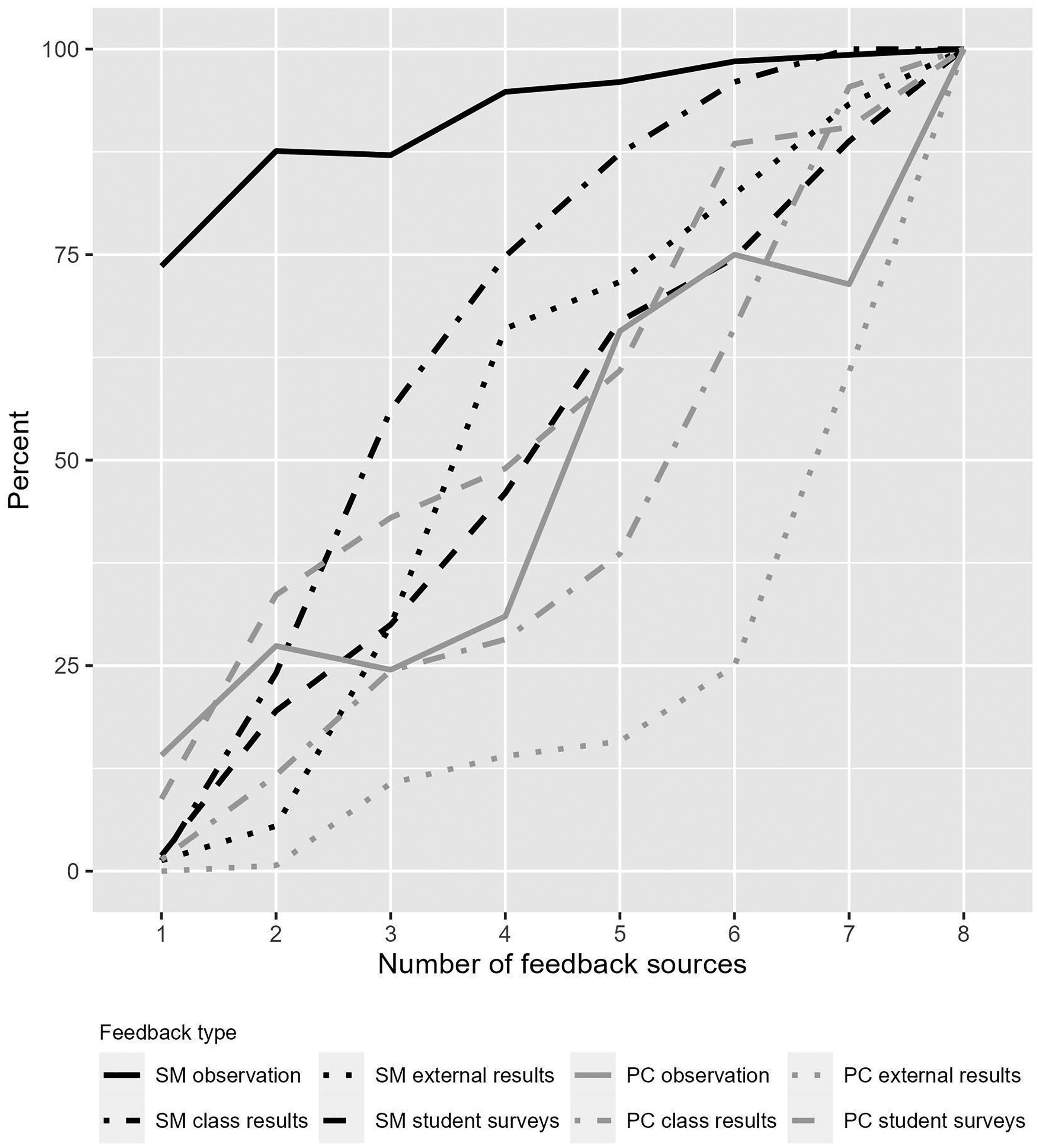
Percentage of teachers receiving each type of feedback, by number of feedback sources.
Structural equation model results
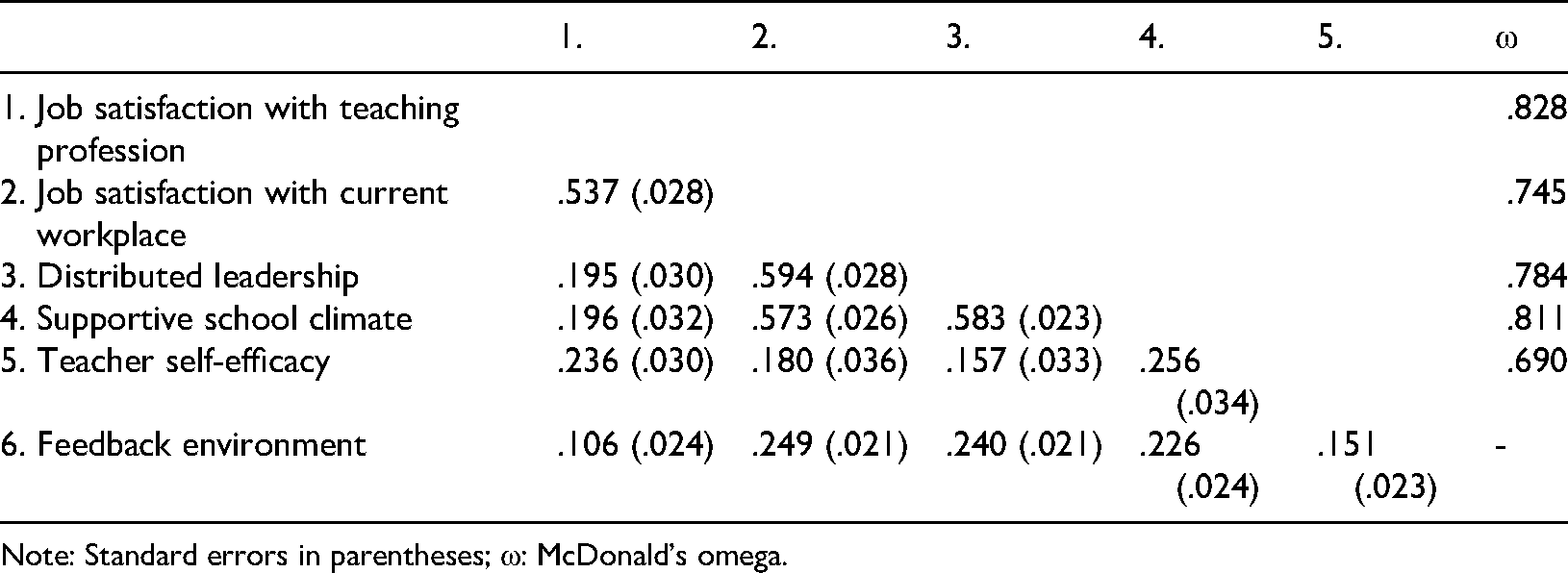
Before fitting the SEMs, we calculated correlations between the variables (Appendix B). All correlations were significant and positive, supporting the theoretically assumed associations between the constructs included in the study. At the same time, none of the correlation coefficients exceeded .60, indicating that there is no multicollinearity in the data.
The relationships between DL and two dimensions of teacher job satisfaction were estimated by a mediation model assuming that principal's leadership behavior predicts teacher job satisfaction with the profession and with the workplace both directly and indirectly via SC, FE, and TSE (Figure 1). The model fitted to data well, but three of the hypothesized paths were not significant. They were fixed to zero without a significant drop in the fit criteria. The global fit of the simplified final mediation model was acceptable (χ2(178) = 1064.78 (p < .001), CFI = .93, TLI = .91, RMSEA = .05, SRMR = .04).
The estimates of direct and indirect effects (Table 1) indicate that school conditions operate differently with respect to the two dimensions of teacher job satisfaction. DL had a significant positive indirect effect on JSW through SC (β = .181, SE = .021) and FE (β = .017, SE = .005), summing up to a total indirect effect of .198 (SE = .022). The indirect path through TSE was not significant and the direct effect of DL on JSW remained substantial (β = .404, SE = .038). Model variables explained 43.4% of variance in JSW. In contrast, the effect of DL on JSP was much lower and neither SC nor FE were found to mediate the relationship. JSP was positively related to TSE (β = .202, SE = .026), but TSE was only weakly predicted by DL (β = .159, SE = .034). Model variables accounted for 8.2% of variance in JSP.
Mediation model effects.
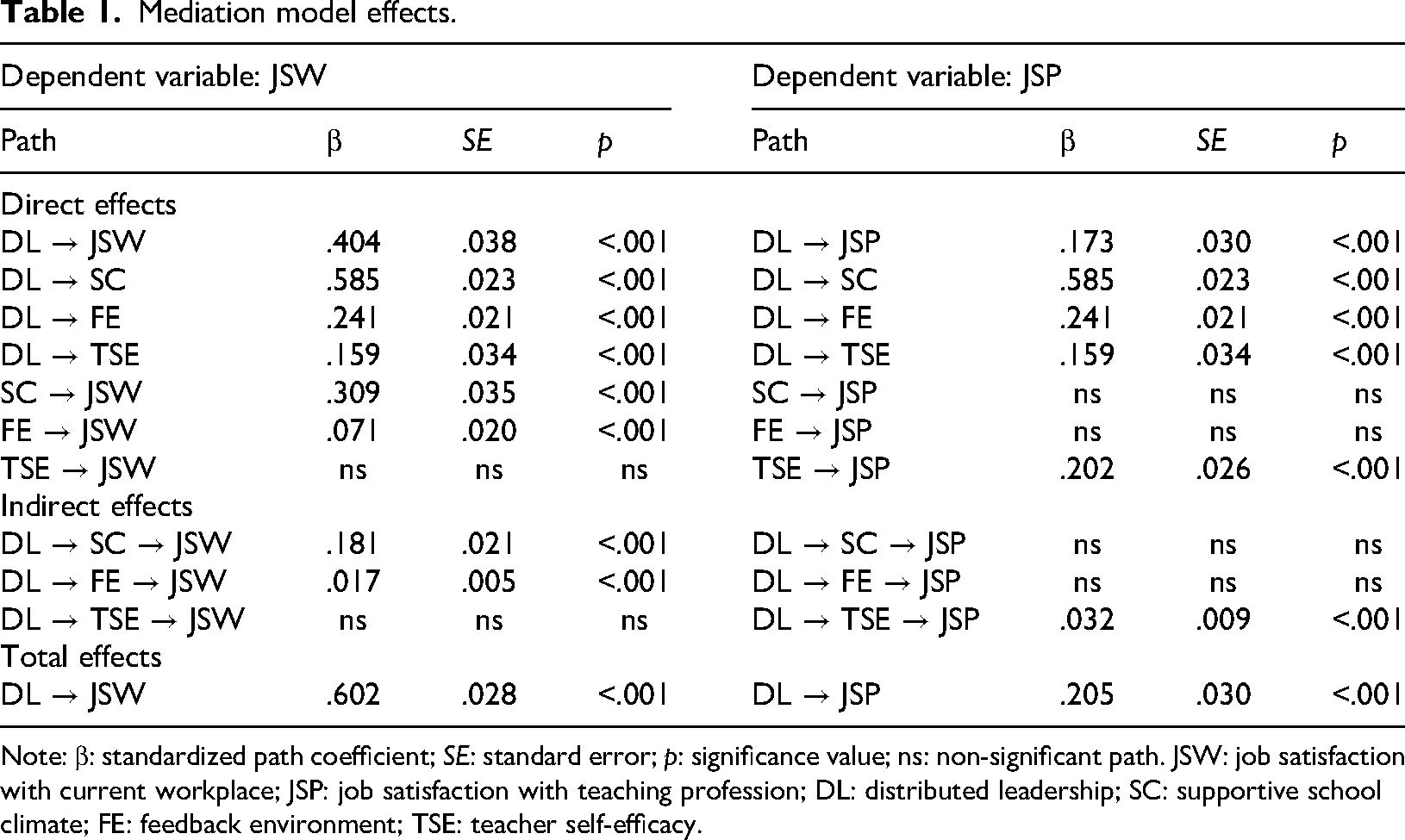
Note: β: standardized path coefficient; SE: standard error; p: significance value; ns: non-significant path. JSW: job satisfaction with current workplace; JSP: job satisfaction with teaching profession; DL: distributed leadership; SC: supportive school climate; FE: feedback environment; TSE: teacher self-efficacy.
Structural relationships by school size
Before comparing the structural relationships between the study variables for small and large schools, we evaluated factorial invariance of the measurement models using multi-group CFA. The model fit decrease for a model with factor loadings set to equal values across groups compared to a model with freely estimated factor loadings was not significant (Δχ2(20) = 25.46, p = .184; ΔCFI < .01; ΔRMSEA < .01), implying that measurement models can be considered equal across groups and path coefficients can be compared.
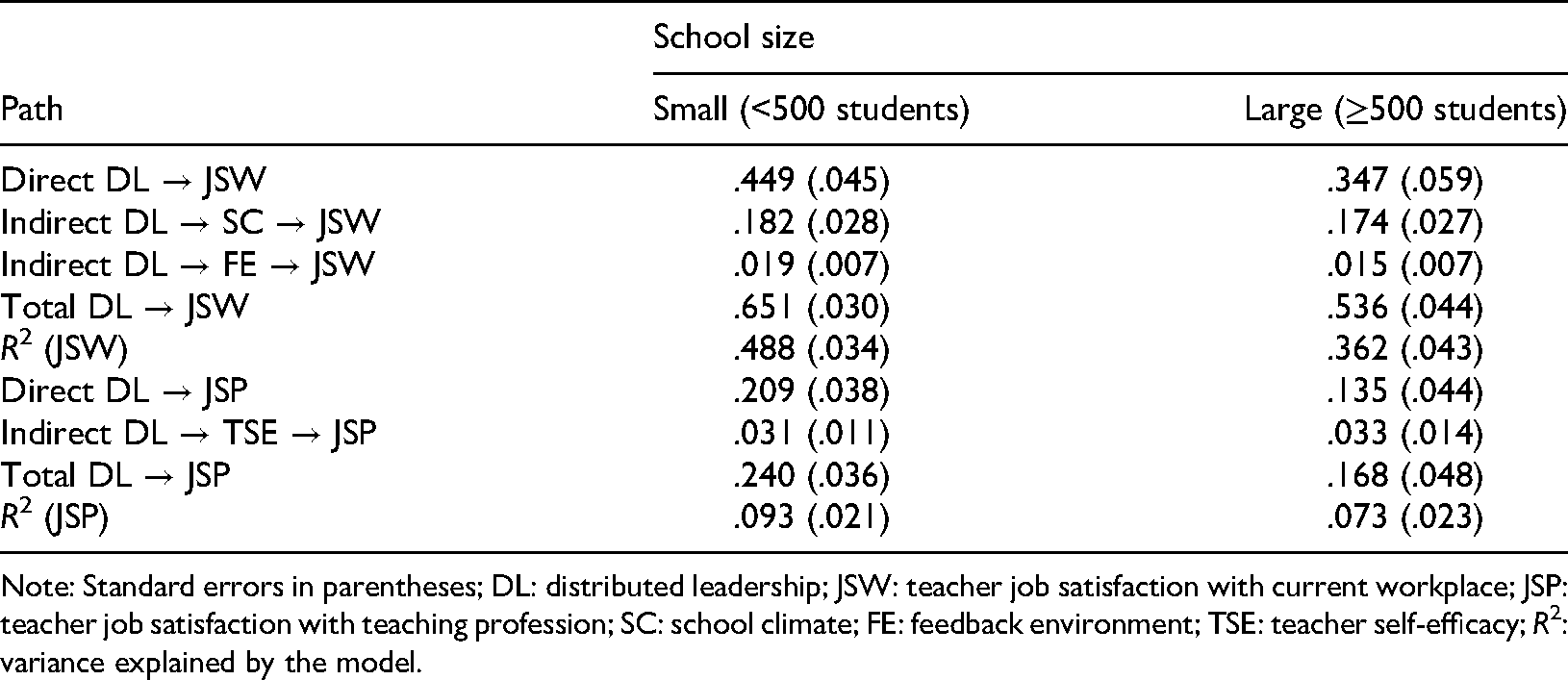
When freely estimated, the standardized total effects of DL on both JSW and JSP appeared slightly larger for teachers in small schools than in large schools. As shown in Appendix C, the differences in total effects for the two groups were primarily due to direct relationships. The fit of the two-group model was acceptable (χ2(391) = 1274.99 (p < .001), CFI = .93, TLI = .92, RMSEA = .04, SRMR = .05), with both groups contributing equally to the overall χ2 value. However, the model fit decrease was minimal with path coefficients constrained to equal values (Δ χ2(8) = 12.22, p = .142; ΔCFI < .01; ΔRMSEA < .01), indicating that globally, the data did not allow to reject the null hypothesis of equal structural relationships. Local comparison of model parameters using a Wald chi-square test showed a significant difference in the total effect of DL on JSW (χ2(1) = 7.296, p = .007) and a nearly significant difference in the direct effect of DL on JSW (χ2(1) = 3.588, p = .058). The remaining path coefficients did not significantly differ between the groups.
Discussion
Distributed leadership has gained popularity as a promising concept to describe how leadership functions are enacted in increasingly complex educational contexts. While research has mainly focused on the application of distributed leadership within schools (Tian et al., 2016), a growing body of literature explores its impact on school performance and school community members (Harris et al., 2022). The current study, which aimed at investigating the effect of distributed leadership on teacher job satisfaction, is part of this strand.
Building on studies that showed both direct and indirect effects mediated through relational aspects of school climate (Liu et al., 2021) and teacher self-efficacy (Sun and Xia, 2018), this work used SEM and 2018 TALIS data from Czechia to test a model that involved the two above pathways simultaneously, along with formative feedback environment as a third mediating variable. To the best of our knowledge, the mediating role of formative feedback provided to teachers has not been examined with respect to distributed leadership, although frequent appraisal by a variety of actors was found to mediate the relationship between administrative leadership and teacher job satisfaction (Blömeke and Klein, 2013). The inclusion of both supportive school climate and teacher self-efficacy, which tend to share common variance (Aldridge and Fraser, 2016; Collie et al., 2012), allowed us to better differentiate the “relational” and “empowering” paths in explaining how distributed leadership affects teacher job satisfaction even though both processes are interconnected in practice. Finally, we extended prior research by distinguishing two dimensions of teacher job satisfaction. Although we did not consider the relative importance attached to them by individual teachers (Skaalvik and Skaalvik, 2011), we believe that both deserve research attention as both have specific validity over and above a general evaluative judgment of the job experience (Dicke et al., 2020). Main findings of the current study are summarized as follows.
First, the results confirmed previous research evidence (Ahn et al., 2023; Liu et al., 2021; Liu and Werblow, 2019; Sims, 2017) of positive relationship between distributed leadership and teacher job satisfaction. However, by separating two dimensions of job satisfaction, we revealed a differential effect on each of them. While distributed leadership, in total, accounted for 36% of the variance in teacher workplace satisfaction, its power to explain their professional satisfaction was much lower. Given that teachers tend to be satisfied with aspects intrinsic to the core business of teaching, such as working with students and seeing them develop (Collie et al., 2012; Skaalvik and Skaalvik, 2011), our findings show that by distributing the leadership roles among a wider range of actors within the school community, the principal can effectively address school-based aspects that might provoke dissatisfaction. Satisfaction with the workplace environment plays a major role in preventing teacher turnover, which has disruptive effects on building school-specific human capital and even on student outcomes (Gibbons et al., 2021). Distributed leadership enhances teachers’ engagement at the workplace by embedding their professional practice within the school community network, but the principal needs to ensure that teachers who are given leadership responsibilities have the required knowledge and skills (Cai et al., 2023; Leithwood et al., 2020) and that everyone can participate in shared decision making (Devos et al., 2014). While distributed leadership is more loosely related to teacher professional satisfaction, an eight percent variance explanation is still a valuable contribution as teacher satisfaction with the profession is largely affected by long-run conditions beyond school principal's control, such as salary level relative to the national average, occupational prestige, curricular or educational policy changes.
Second, we found that distributed leadership was related to teacher workplace satisfaction both directly and indirectly, with a dominant direct effect. This aligns with previous studies highlighting the central importance of school leaders in improving teacher satisfaction (Liu et al., 2021; Sims, 2017). However, an empirically established direct effect may involve mediation by variables not included in the model as suggested by a study in which the effects of transformational and instructional leadership on teacher job satisfaction were completely mediated by different aspects of school climate (Dutta and Sahney, 2016). Further research is needed to better understand if distributing leadership functions as such suffice to improve teachers’ reactions to the workplace. Distribution of leadership roles and responsibilities does not necessarily imply distribution of power (Tian et al., 2016) and there is evidence that not every individual's expertise gets valued or even noticed within distributed leadership contexts (Bolden, 2011).
Third, the mediation analysis showed that the indirect relationship between distributed leadership and teacher satisfaction with the workplace was mediated solely by relational aspects of the school environment, especially by supportive school climate. This contradicts the results by Liu et al. (2021) who, using pooled international 2013 TALIS data, found that the mediation through supportive school culture did not reach statistical significance, in contrast to the mediation through teacher collaboration, and neither a detailed analysis for individual countries showed positive association between supportive school culture and teacher job satisfaction for Czechia. One possible explanation of the inconsistency between our and Liu et al. (2021) findings could be that our model, which did not include teacher collaboration, overestimated the mediating role of supportive school climate. However, given that neither supportive school culture nor teacher collaboration were significantly related to teacher job satisfaction in Czechia (Liu et al., 2021), we argue that by distinguishing two dimensions of teacher job satisfaction we were able to provide evidence of an existing relationship that would be blurred if we used an overall job satisfaction measure. Indeed, the total effect of distributed school leadership on teacher satisfaction with the workplace, as estimated in our study, was stronger than the total effect on overall job satisfaction reported for Czechia by Liu et al. (2021). The two studies also differed in the operationalization of supportive school climate. While both scales captured good teacher–student relationships, mutual respect and trust among teachers, our scale specifically focused on teacher responsiveness to students’ needs. Such aspects are prerequisite for a safe environment (Bellibas and Liu, 2016), which may be closely linked to workplace satisfaction. Nevertheless, quality workplace environment is a broader construct that encompasses not only relational factors, but also adequate material resources, feasible workload or opportunities for professional development (Toropova et al., 2021).
Fourth, in addition to supportive school climate, our findings confirm the importance of feedback as a mediating variable for workplace satisfaction. Numerous authors have called for incorporating multiple measures and multiple actors in the teacher evaluation process to make it more informative and growth-oriented (Liu et al., 2018). This study provides evidence that distribution of leadership functions contributes to the creation of school environment where feedback to teachers is given by a diverse group of school team members using a variety of information sources, which aligns with Spillane's (2005) observations. However, not only organizational redesign of the evaluation routines but also proactive endorsement of the redefined roles by the school staff is needed (Tian et al., 2016) to benefit from distributed leadership practice. The principal should therefore ensure that new distributed forms of teacher evaluation are effectively used for improvement and growth to convince the staff of their value. In addition, the feedback given to teachers must be perceived as fair and useful to promote job satisfaction (Dal Corso et al., 2019; Deneire et al., 2014; Ford et al., 2018). Continuous teacher training might help develop staff skills of giving constructive feedback which tends to be perceived as fair and providing greater opportunities for advancement (Sommer and Kulkarni, 2012).
Fifth, the expected mediation path through teacher self-efficacy was only weakly supported by the data. While distributed leadership might empower teachers by encouraging them to take a lead in the school (Devos et al., 2014), our study does not provide much evidence that this translates into increased teacher self-efficacy. A possible explanation could be that distribution of leadership roles is not necessarily linked to any of four sources of self-efficacy, as described by Bandura (2009). Research repeatedly confirms enactive mastery experience as the most effective way of developing self-efficacy, as also shown by a recent study among primary teachers in Czechia (Gavora et al., 2024). Alignment between distributed roles and teacher expertise is needed to strengthen self-efficacy whereas misaligned distribution may discourage teachers because they are unable to successfully complete their expected leadership tasks (Cai et al., 2023). Our study further revealed that teachers’ self-efficacy was related to their satisfaction with the profession, but it did not predict satisfaction with the workplace. While this finding seems obvious given that teacher self-efficacy refers to a teacher's belief in their ability to master tasks and challenges related to their professional role (Tschannen-Moran and Woolfolk Hoy, 2001), it is yet another example that a multidimensional conceptualization of teacher job satisfaction is valuable for both research and practice.
Sixth, the results of multi-group SEM suggest that school environment characterized by positive relationships, social support, mutual trust, and active engagement of different actors in the process of teacher evaluation mediate the effect of distributed leadership irrespective of school size. Even small school leaders who usually have everyday contact with the teaching staff may, therefore, benefit from distributing leadership roles to enhance teacher job satisfaction and prevent their turnover. In particular, distributing teacher evaluation routines seems promising with respect to providing feedback that is perceived as useful and leading to positive changes in the teaching practice. The important thing is not just to formally delegate tasks or impose more workload on teachers, but to develop a carefully designed system where everyone's expertise is effectively utilized and valued. A major challenge in Czechia is a lack of knowledge and nonexistent training in distributed leadership for school principals. Previous research among Czech principals has shown that in the initial stage in the school leader position, they tend to exercise all leadership activities themselves to reinforce their self-confidence and satisfy the expectations of others. Only after gaining professional certainty, they “dare” to delegate powers and share some decision-making (Pol et al., 2013). Focused initial and in-service training for school principals could help them adopt distributed leadership practices purposefully and in earlier stages of their career. This is also an appeal to universities and providers of in-service teacher education to offer such focused courses and training programs.
Limitations and future research
This study is not without limitations. First, we used teacher-perceived distributed leadership, which tends to be more closely related to their job satisfaction than the principal's self-assessment of leadership distribution (Ahn et al., 2023). As using a teacher-reported measure might have inflated the estimates of effect sizes, more research comparing different measures of distributed leadership is needed to better understand its relationships with desired outcomes including teacher job satisfaction. Further, due to limited availability of items in 2018 TALIS data, this study focused on distributed leadership without examining its interactions with other leadership styles, such as instructional or transformational leadership. A concentrated focus on distributed leadership might have attributed more variance in teacher job satisfaction to this specific style, disregarding other possible leadership behaviors. Combining elements from a broader repertoire of leadership strategies based on specific needs and phases of the school's development is typical for effective school leaders (Day et al., 2016; Leithwood et al., 2020) and a more complex model could provide deeper insights into how different leadership styles affect teacher job satisfaction. The analysis was further limited by the fact that TALIS indicators of teacher collaboration overlapped with collegial feedback, a specific topic of our research. We therefore excluded teacher collaboration from the model although it proved to be a relevant predictor (Liu et al., 2021; Tang et al., 2020). As discussed above, excluding teacher collaboration might have overestimated the mediating role of supportive school climate and feedback environment, as well as the direct effect of distributed leadership. We also did not address criteria such as fairness, clarity, and competence of actors providing feedback (Deneire et al., 2014), which presents a simplified view of the feedback environment. Further research should pay attention to a multidimensional operationalization of a growth-oriented feedback environment in accordance with theoretical conceptualizations (Steelman et al., 2004). Qualitative and mixed-methods research could shed light on specific ways how teacher evaluation is distributed. Previous research has highlighted the importance of leadership distribution along patterns of expertise (Leithwood et al., 2020) which may differ for different aspects of a school's life. Due to the cross-sectional nature of TALIS data, the present study could only provide evidence of statistical associations. Longitudinal studies would advance our understanding of causal effects and evolution of leadership distribution over time. Regarding the role of school size, studies from countries with a similar school size structure can show if our results have general validity.
Footnotes
Acknowledgments
The authors thank Martin Chvál for discussions on the methodology of this article.
Ethical approval and informed consent
Not applicable. The research was a secondary analysis of publicly available anonymized data. The authors did not have access to any information that could identify the study participants.
Funding
This work was supported by the NPO “Systemic Risk Institute” number LX22NPO5101, funded by European Union––Next Generation EU.
Declaration of conflicting interests
The authors declared no potential conflicts of interest with respect to the research, authorship, and/or publication of this article.
Data availability
The international TALIS 2018 database is available at https://www.oecd.org/en/data/datasets/talis-2018-database.html. Czech data including a school type identifier can be downloaded as a zip file from  . Mainstream track school teachers are coded 1 in the IDSTRATE variable.
Notes
Author biographies
Appendix A. Descriptive statistics and standardized factor loadings of the study latent construct indicators
| Wording | Variable | M | SD | λ |
|---|---|---|---|---|
| Scale: Job satisfaction with teaching profession | ||||
| The advantages of being a teacher clearly outweigh the disadvantages | TT3G53A | 2.60 | 0.72 | .544 |
| If I could decide again, I would still choose to work as a teacher | TT3G53B | 2.87 | 0.77 | .821 |
| I regret that I decided to become a teacher a | TT3G53D | 3.37 | 0.66 | .721 |
| I wonder whether it would have been better to choose another profession a | TT3G53F | 2.99 | 0.81 | .827 |
| Scale: Job satisfaction with current workplace | ||||
| I would like to change to another school if that were possible a | TT3G53C | 3.26 | 0.70 | .587 |
| I enjoy working at this school | TT3G53E | 3.13 | 0.58 | .862 |
| I would recommend this school as a good place to work | TT3G53G | 3.06 | 0.65 | .685 |
| Scale: Distributed leadership | ||||
| This school provides staff with opportunities to actively participate in school decisions | TT3G48A | 2.99 | 0.62 | .726 |
| This school provides parents or guardians with opportunities to actively participate in school decisions | TT3G48B | 3.00 | 0.52 | .733 |
| This school provides students with opportunities to actively participate in school decisions | TT3G48C | 2.88 | 0.57 | .690 |
| This school has a culture of shared responsibility for school issues | TT3G48D | 2.86 | 0.58 | .613 |
| Scale: Supportive school climate | ||||
| Teachers and students usually get on well with each other | TT3G49A | 3.10 | 0.44 | .639 |
| Most teachers believe that the students’ well-being is important | TT3G49B | 3.18 | 0.50 | .716 |
| Most teachers are interested in what students have to say | TT3G49C | 2.99 | 0.54 | .727 |
| If a student needs extra assistance, the school provides it | TT3G49D | 3.28 | 0.49 | .668 |
| Teachers can rely on each other | TT3G49E | 3.07 | 0.61 | .653 |
| Scale: Teacher self-efficacy | ||||
| Help students value learning | TT3G34B | 2.64 | 0.68 | .610 |
| Motivate students who show low interest in schoolwork | TT3G34E | 2.43 | 0.67 | .719 |
| Get students to follow classroom rules | TT3G34H | 3.09 | 0.66 | .556 |
| Use a variety of assessment strategies | TT3G34J | 2.94 | 0.67 | .514 |
Note: M: mean; SD: standard deviation; λ: standardized factor loading.
Items are reverse coded.
Appendix B. Scale intercorrelations and reliabilities
| 1. | 2. | 3. | 4. | 5. | ω | |
|---|---|---|---|---|---|---|
| 1. Job satisfaction with teaching profession | .828 | |||||
| 2. Job satisfaction with current workplace | .537 (.028) | .745 | ||||
| 3. Distributed leadership | .195 (.030) | .594 (.028) | .784 | |||
| 4. Supportive school climate | .196 (.032) | .573 (.026) | .583 (.023) | .811 | ||
| 5. Teacher self-efficacy | .236 (.030) | .180 (.036) | .157 (.033) | .256 (.034) | .690 | |
| 6. Feedback environment | .106 (.024) | .249 (.021) | .240 (.021) | .226 (.024) | .151 (.023) | - |
Note: Standard errors in parentheses; ω: McDonald's omega.
Appendix C. Standardized direct,indirect,and total effects by school size
| Path | School size | |
|---|---|---|
| Small (<500 students) | Large (≥500 students) | |
| Direct DL → JSW | .449 (.045) | .347 (.059) |
| Indirect DL → SC → JSW | .182 (.028) | .174 (.027) |
| Indirect DL → FE → JSW | .019 (.007) | .015 (.007) |
| Total DL → JSW | .651 (.030) | .536 (.044) |
| R2 (JSW) | .488 (.034) | .362 (.043) |
| Direct DL → JSP | .209 (.038) | .135 (.044) |
| Indirect DL → TSE → JSP | .031 (.011) | .033 (.014) |
| Total DL → JSP | .240 (.036) | .168 (.048) |
| R2 (JSP) | .093 (.021) | .073 (.023) |
Note: Standard errors in parentheses; DL: distributed leadership; JSW: teacher job satisfaction with current workplace; JSP: teacher job satisfaction with teaching profession; SC: school climate; FE: feedback environment; TSE: teacher self-efficacy; R2: variance explained by the model.