




Abstract
This study examines the role of school inspections in driving improvement within an initially a low-performing secondary school in Ireland over a 15-year period. Through a longitudinal case study, the research investigates the impact of three inspection cycles on school development. The study draws on a thematic review of literature to contextualise the evolving functions, roles, and frameworks of the Irish Inspectorate from 1996 to the present, a period marked by significant changes in inspection practices. Nineteen semi-structured interviews with stakeholders provide qualitative insights, which are analysed alongside the literature to understand the dynamics at play in the school's improvement journey. Findings suggest that despite Ireland's low-stakes inspection system, strong trust in the expertise of inspectors, the respected position of the inspectorate, and alignment between the inspection findings and the school's internal self-evaluation were instrumental in fostering acceptance of the initial critical report. This acceptance by school leadership, extended gradually to the entire school and underscores inspection as a potent catalyst for sustainable school improvement. The study concludes that, under specific conditions, school inspection can indeed serve as a highly effective mechanism for long-term educational improvement.
Keywords
Introduction
The Department of Education in Ireland employs a suite of inspection modalities to evaluate the quality of educational provision in secondary schools. Whole-School Evaluations (WSE), in particular, aim to monitor and assess facets of the whole school, in terms of the ‘economy, efficiency and effectiveness of the education system provided by the State by recognised schools and centres for education’ (Education Act 1998, Section 7 (2) (b)).
This study focuses on a single school which underwent three inspections over a period of 15 years (Department of Education [DoE], 2022a). It begins by analysing the three inspection reports to clarify the concerns raised by the inspection teams and the demands for reform set out in each report. It proceeds to hear directly from past pupils, teachers, ancillary staff and parents, as to whether, from their perspectives, the recommendations arising from the three whole school inspection reports provided a blueprint for improvement and educational change in the school and whether the school successfully responded to the requirements of the inspectorate. The purpose is to evaluate the extent to which the power and influence of inspection as conceived and conducted in Ireland is capable of encouraging and enabling significant improvement.
The researchers conducted a thematic review of relevant peer-reviewed literature on the changing functions, roles, and responsibilities of the Irish Inspectorate from 1996 to the present as well as on the evolving frameworks of inspection that were developed during this seminal period for the Irish Inspectorate. Semi-structured interviews were carried out with 19 participants and the findings are analysed within the context of the literature review. The concluding sections argues that in this single case, it is reasonable to conclude, that inspection proved to be a very effective driver of sustained improvement.
Inspection in post primary schools in Ireland
The school inspection system in Ireland dates to British rule in the 19th century and continued to be a significant element of the education system into the middle of the last century. Gradually, inspection, certainly in post primary schools, largely fell into abeyance and was not visible in schools to any extent by 1980 (McNamara and O’Hara, 2012). As an example, three of the authors of this paper served as post-primary school teachers for varying periods across the 1970s, 1980s and 1990s and none experienced either a school or an individual inspection in that time.
However, in the later 1990s, a concerted effort was made to re-establish a working inspection system. By 2003, a new inspection model designated WSE was being implemented in schools (Brown et al., 2017, 2018; DoE, 2003; McNamara et al., 2022). The causes of this shift in policy and practice have been widely written and spoken about and need not detain us now as our concern in this paper is to evaluate the impact of this new inspection regime on one school over an extended period (Hislop, 2012; Ruairc and Haford, 2011). However, it is important to note that the revival of inspection in schools in Ireland was (see, for example, Baxter, 2017; Baxter and Hult, 2017; Brown et al., 2016; Brown et al., 2018; Clarke, 2017; Gardezi et al., 2023a) part of a much wider European or even worldwide trend and that the model and philosophy of school inspection adopted here while similar to that in many jurisdictions was very different to that in others, including England (Bokhove et al., 2023; Gustafsson et al., 2015; Hofer et al., 2020; Penninckx et al., 2016).
Comparative studies by Simeonova et al. (2020) and Perry (2013) refer to specific structural and implementation measures that categorise inspections as either high-stakes and sanctions-oriented or low-stakes and advisory. Altrichter (2017) and Penninckx and Vanhoof (2017) define school inspections as either low-stake and soft governance, or high-stake and hard governance. The latter places significant emphasis on accountability, measurement, and consequences for schools that fail to meet specified standards, while the former is designed to support schools in improving their practices. In low-stakes school inspections, inspectors often collaborate with school leaders and teachers, taking a consultative and supportive approach to governance. The inspection philosophy adopted and implemented in Ireland falls squarely into the low-stakes category (McNamara et al., 2022; O’Brien et al., 2019). An ongoing debate concerning inspection revolves around which approach is more effective and beneficial to schools in terms of driving change and improvement. A key question is whether a low-stakes system lacking significant coercive powers can lead to sustained improvement (Altrichter, 2017; Gardezi et al., 2024; Hult and Segerholm, 2017; Penninckx and Vanhoof, 2017). This paper hopes to add something to this debate since, quite uniquely, as far as we are aware, it examines the impact a series of ‘low-stakes’ inspections had on one school over a period of some 15 years.
The experience of inspection in one school
WSE was introduced into schools in Ireland in 2004, following a pilot project which took place from 1996 to 1999 (McNamara and O’Hara, 2002). A report on the pilot project was prepared by the Evaluation Support and Research Unit (ESRU) of the Department of Education and was circulated to all post-primary schools in the country in December 1999. (Since, over the course of the period covered in this paper the Department of Education was renamed on a number of occasions, it has been decided for the sake of clarity, to refer to it as the Department of Education (DoE) in the reminder of this paper and to designate departmental publications similarly. According to the Department's Annual Report of 1999: The report confirmed the potential of the WSE model of evaluation to successfully combine school self-review with external inspection, using common criteria of evaluation. The WSE pilot project experience in 1999 was a landmark in the development of a new model of school evaluation and a milestone in the preparation of the Inspectorate for its evolving role in school and system quality assurance (DoE, 1999, p. 41).
Subsequent to this pilot phase, the Inspectorate, under the auspices of the ESRU, did some further work before WSE was established as a national system. WSE became the established model of whole school evaluation in 2004. WSE was first carried out by the inspectors in the school under study in 2005. It is noteworthy that all WSE reports were published online on the Department of Education's website from 2006.
Although there have been ongoing modifications in the wording of the documents that inform inspections since the WSE carried out in 2005 (see for example, DoE, 2006, 2010, 2018, 2022b), the key principles that continue to inform inspections are to be found in A Guide to Inspection in Post-Primary Schools, published in 2022 (2006, 2011, 2022c) and have remained largely constant, as a comparison with the document from 2006 will illustrate. The key principles that continue to inform inspections are. The Inspectorate is focused on ensuring that students in schools receive the best possible education in light of their potential and their learning needs. High standards in teaching and in the learning outcomes and experiences of students are promoted by the Inspectorate as it strives to enable learning organisations to improve the quality of the education they provide. Inspectors are committed to carrying out inspections in ways that provide real opportunities to affirm good practice and to provide practical advice to individual teachers, to principals and to boards of management with the ultimate aim of improving learning experiences and outcomes for students.
The work of the Inspectorate is underpinned by four key principles
1
:
A focus on learners Development and improvement Respectful engagement Responsibility and accountability
The inspection models that are relevant to this study are: WSE, Whole School Evaluation – Management, Leadership and Learning (WSE-MLL) and Follow Through Inspection (FTI) (DoE, 2010). As indicated above, WSE was the original model, but proved very resource intensive and was replaced by scaled back models involving fewer inspectors per team and shorter, more direct evaluation reports. These inspections were carried out in the school under study from 2005 to 2018. The WSE was carried out in 2005, the WSE-MLL in 2015 and the FTI in 2018. Whole School Evaluation in each of its iterations examines the work of the school as an entity, identifying and commending best practice, while also making recommendations on areas for improvement. In later years School Self-Evaluation (SSE) became an important part of school evaluation, and the inspection reports fed into that process and the connected process of School Development Planning (DoE, 2016b).
Whole School Evaluation – 2005
The Whole School Evaluation conducted in Spring 2005 culminated in a report finalised in May 2005. When it was made public in the school, the report was deemed to be negative overall, but it was perceived by most staff, on balance, to be a fair evaluation of school at that time as the recently appointed principal gathered by interacting with staff. It highlighted the urgent need for change to secure the school's future. Key focus areas were leadership and management, and teaching and learning.
The report recommended overhauling senior and middle-management structures, abolishing streaming, 2 introducing a school plan, expanding subject choice, and implementing transition year for all students. It emphasised fostering collaboration, improving school climate, and integrating student voice into decision-making. For teaching and learning, inspectors called for uninterrupted class sessions, heightened teacher expectations, varied methodologies, active learning, and consistent homework with feedback. The overarching concern of the inspectors was the breakdown in the discipline code, which negatively impacted many of the aforementioned issues.
The report served as a pivotal roadmap for reform, offering comprehensive recommendations that catalysed significant changes. Its emphasis on a team-based approach to planning and improvement fostered collaboration and consultation, leading to marked progress in school improvement efforts. The clarity and direction provided by the WSE 2005 report were instrumental in driving meaningful transformation within the school.
Whole school evaluation – Management, leadership and learning – 2015
A WSE-MLL was conducted in January and February 2015, 10 years 3 after the 2005 WSE (DoE, 2013). The interval allowed time for implementing the earlier recommendations. Inspectors engaged with the school's board of management, in-school management, teachers, parents, and students, reviewed school documentation and survey responses, and observed lessons across various subjects.
Key findings highlighted the board of management's diligent execution of its statutory responsibilities, supported by the trustees. School management was commended for its focus on student learning through staff training and professional development. The principal, it confirmed, provided strong educational leadership, driving significant improvements and positive change. Student-care strategies were effectively coordinated, supporting development and well-being, while the school climate was described as exemplary.
The quality of teaching and learning in observed lessons ranged from good to very good, with exemplary practices noted in some cases. Teachers were receptive to change and actively engaged with curricular initiatives. The broad, balanced curriculum offered at both Junior and Senior Cycles was praised for its progressive nature.
The 2015 WSE-MLL report emphasised teaching and learning as a central element of school improvement, contrasting with the narrower focus of the 2005 report, which evaluated only four subjects. This broader approach aligns with the Inspectorate's updated model, prioritising teaching and learning as a whole-school concern.
Comparing the two reports reveals substantial progress over the decade. The 2015 report reflects a marked shift in tone and content, with a focus on achievements rather than crisis, demonstrating the school's significant strides in improvement since the 2005 evaluation.
Follow through inspection, 2018
In 2018, a Follow Through Inspection 4 evaluated the progress made by the school since the WSE-MLL -- 2015. The inspection assessed the implementation of previous recommendations, categorising progress as very good, good, partial, or none. The findings highlighted notable advancements and ongoing commitment to improvement.
Key achievements noted in the FTI included the ratification of all major school policies by the board, with a clear focus on academic excellence, pastoral care, student voice, and parental involvement. The school demonstrated a strong commitment to whole-school professional planning teams and promoted valuable in-school professional development through teacher collaboration.
Significant policy updates addressed ethos, instructional leadership, well-being, numeracy, literacy, special educational needs (SEN), planning, and assessment. The principal actively supported continuous professional development (CPD), with collaborative practices fostering school-wide improvement. The Instructional Leadership programme led by an external consultant, Barrie Bennett was described as particularly effective in enhancing teaching and learning.
The report praised the improved school climate, citing enhanced student voice through the Student Council and surveys. Pastoral care initiatives and a commitment to academic excellence were reflected in improved State examination results. Overall, the FTI featured the school's substantial progress, highlighting an exemplary climate and a sustained focus on high standards and best practices.
Overview of the three inspection reports
The 2005 WSE report provided the school with a detailed roadmap for improvement, grounded in a thorough evaluation. The recommendations, deemed robust yet fair by the principal and staff, offered a comprehensive checklist for change. Staff were more receptive to these changes since they originated from the Inspectorate, positioning the principal as an implementer rather than an author. While the evaluation template has evolved since 2005, but it might be argued that this type of evaluation (WSE, 2005) may well be appropriate when a school is failing or in decline (DoE, 2016a).
The WSE-MLL–2015 report, though more concise, built on the 2005 report by offering cohesive recommendations that supported the school's continued improvement. These included affirmations of progress and clear guidance for the next steps.
The 2018 FTI inspection highlighted positive changes, such as an improved school climate, higher academic achievements evidenced by increased progression rates to higher education, and distributed leadership through active SSE teams. Inspectors noted strong student voice, extensive CPD in teaching practices, and a committed senior management team fostering ongoing educational change, affirming the school's significant progress on its journey of transformation.
Research methodology
The key question posed by this research is whether the three inspections and their respective reports provided a blueprint for change and improvement in the school, and whether they exerted sufficient influence – potentially including a form of institutional authority or perceived legitimacy – to drive the implementation of the recommended reforms. To answer this question, we now turn to the research that was conducted with key stakeholders.
The research was conducted with past students, current and previous teaching staff, ancillary staff and past parents and members of the Board of Management. These respondents were chosen from among a relatively small pool of people who met the research criteria, namely those who had been involved in the school for a significant proportion of the 15 years covered by the three inspections and their aftermath.
As demonstrated earlier, the inspection reports were extensive and called for a broad range of reforms. Due to constraints of length, it is not possible to examine how the school attempted to meet each and every one of these requirements. Instead, we have chosen to focus on a number of the key issues raised in the 2005 inspection report and to report the efforts that the school made to respond to the inspection findings over the following years and how the school community perceived these changes and their impact.
The data for this study were gathered in a series of in-depth interviews conducted on a face-to-face basis and recorded. The sample outlined in the table below was purposeful and chosen by the researchers based on two criteria. Firstly, each person approached for the interview had played the role in the school as indicated over a significant period of time between the first inspection in 2005 and 2020. Secondly, each person, with the exception of the former pupils, had served on the school improvement working group set up in response to the 2005 inspection and described in the next section. The interview questions were derived from the detailed study of the inspection reports.
The Principal of the school from 2005 to 2020 was one of the researchers and identified possible interviewees, but the team is satisfied that no conflict of interest or power issue arose since the researcher had retired from the school, none of those interviewed with the exception of two teachers were still involved in the school and of course anyone approached was free to decline or withdraw at any time. Ethical approval for this research was granted by the DCU Research Ethics Committee.
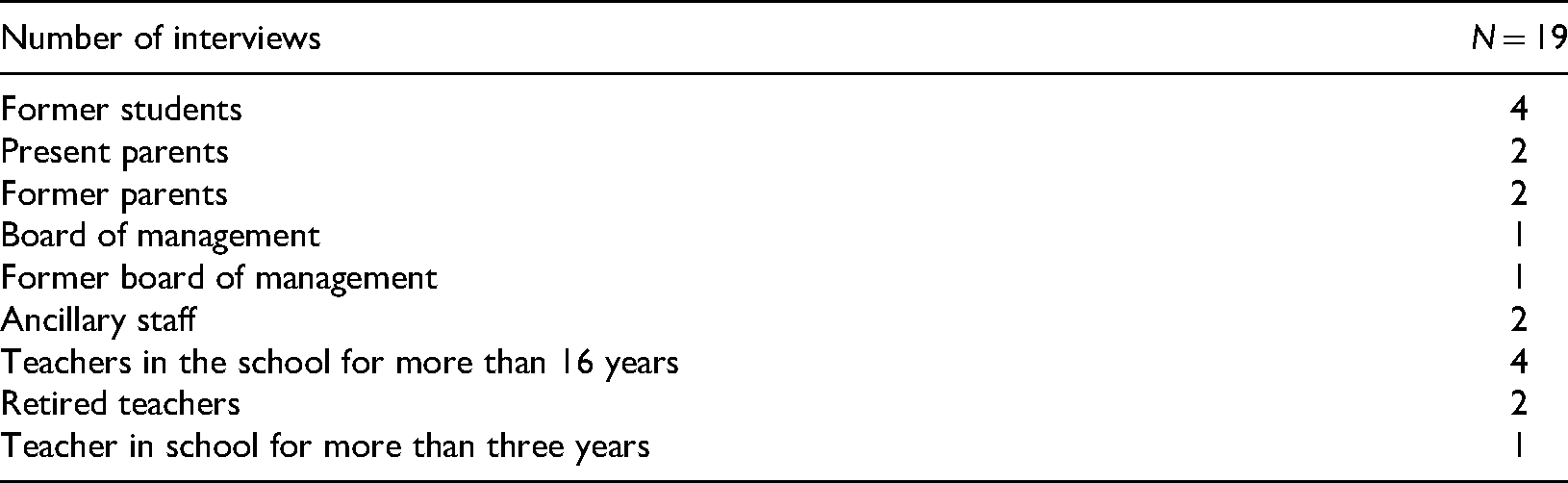
The interviews were digitally recorded, fully transcribed, and analysed both manually and using NVivo software for thematic analysis. while inductive codes were identified based on the participants’ verbal responses using the open coding technique (Ahlin, 2019). The main areas for school improvement identified in the WSE 2005 report served as the deductive themes. The interview transcripts were meticulously reviewed to identify codes. The codes were organised according to the deductive themes, which were then further examined and linked to relevant text excerpts in order to develop an analytical narrative, following the process of thematic analysis as explained by Braun and Clarke (2021). Quotations from the data are anonymised to the greatest extent possible by assigning a code to each interviewee – Former Teacher (1–5), Former Student (1–4), Ancillary Staff (1–2), Former Board of Management Member (1–2), Former Parents (1–4), Former Deputy Principal (1–2).
In addition to in-depth interviews, this study incorporates memos as a source of data. The school principal maintained a diary throughout her tenure, documenting key observations during the three inspections. This diary served as a reflective tool, capturing the evolution of school improvement efforts from conceptualisation to implementation. It includes her insights on what worked well, the effectiveness of various strategies, potential areas for improvement, and future steps to improve children's learning. Extracts from the principal's diary, in the form of memos, are included in this study to support and clarify key findings. These reflective notes not only enrich the data but also facilitate deeper interpretation, aligning with the principles outlined by Birks et al. (2008) on the role of memos in enhancing analytical rigour.
The school responds to inspection
As indicated, the range of interventions and reforms required by the inspection team was formidable and cannot all be considered in-depth here. To ensure a focused and meaningful discussion, this paper prioritises themes that were most frequently highlighted in the interview data, as they reflect the school community's strongest concerns and areas of perceived urgency. These selected themes include staff cooperation and collaboration in teams, improved teaching and learning (including the issue of discipline), streaming and student academic attainment, and the infrastructure and facilities of the school.
The formation of the school improvement working group
The 2005 WSE report emphasised a collective approach to school leadership, requiring the cooperation of all stakeholders to achieve meaningful school improvement. Diverse opinions were vital in crafting a coherent plan for implementation. At the time, declining student numbers and the school's future viability were major concerns highlighted in the inspectors’ report.
In response, a school improvement working group (which was a volunteer group of staff) was established to address the most pressing issues identified in the report. Guided by core principles, the group prioritised stakeholder partnership, ensuring every voice was heard, and used research and evidence to tackle challenges in methodologies, discipline, academic outcomes, and inadequate infrastructure. Leadership opportunities and staff professional development were central to the group's approach, with a focus on reciprocity, long-term collaboration, and capacity building.
A realistic, incremental School Improvement Plan was formulated to meet the inspectors’ requirements, using research methods to evaluate progress. Initially, the group, comprising voluntary staff members, identified three priority areas: improving learning and teaching (including discipline), enhancing student attainment, and addressing infrastructure deficiencies.
Chaired by the principal, the working group evolved over time to become the primary vehicle for implementing and monitoring the inspectorate's recommendations. This collaborative initiative played a pivotal role in driving sustained improvements across key areas in the school.
Principal's Reflection: The task of turning our school around is going to be immense. I need allies from each constituency of the school community, students, staff and parents to enact the recommendations.
Former Teacher 6
The inspection report threw up very difficult, stark issues, like the end of streaming, improvement in teaching and learning, improved discipline and academic achievement. The future of the school was at stake.
Membership of the sub-group was open to all staff, making it a crucial platform for collective decision-making and engagement. While the implementation of inspection recommendations was non-negotiable, discussions often led to disagreements. However, these debates also sparked new initiatives and opened up opportunities to foster a culture of continuous evaluation and planning. With solutions needing to be agreed upon swiftly, there was little time to prolong the process, ensuring a focused and proactive approach to school improvement.
Teaching and learning
In the WSE 2005 report, the inspectors strongly urged that innovative teaching and learning methodologies should form the basis of improving student outcomes in the school, as the inspectors noticed that such methodologies were absent in most cases. They also noted that the poor student outcomes in comparison with the national average in State Examinations should be addressed as a matter of urgency.
There was widespread agreement among the stakeholders that this indeed was the case. The working group took the controversial decision that no student could do an ordinary or foundation-level
5
examination in any subject without the express approval of the principal.
Former Teacher 1
These changes were seen as an extreme action by many staff, but they were eventually accepted, within the timeline.
Principal's Reflection: In sum, the entire culture of teaching and learning in the school had to be transformed. The poor outcomes of the students in State examinations were a ‘bitter pill to swallow’.
The findings of the inspector's report strongly indicated the urgent need to change independent practices of teaching to teamwork, thus building leadership capacity, and promoting a positive and safe school learning environment. The inspectors advised that a work environment that promotes effective teamwork, which facilitates social relationships and knowledge exchange among staff, can provide an effective mechanism to create norms of teamwork that would greatly benefit the effectiveness of the school.
The 2005 WSE report emphasised the need to expand teaching methodologies, achieved incrementally through management and staff attendance at CPD funded by the Department of Education for all schools and by hiring the services of outside consultants (who acted as critical friends) to address the issues pertaining to the school. Previously, staff had limited access to in-service training, making the opportunity to enhance professional skills both popular and successful. This tradition of valuing CPD remains integral to the school.
A Department of Education inspector (who did not conduct this school's inspection) recommended a consultant to advance the school's improvement agenda through instructional leadership, which became a transformative initiative. Widely embraced by students and teachers, it led to conscious adjustments in teaching practices to maximise student outcomes. The school actively supported staff in becoming trainers in instructional leadership, with a strong focus on enhancing teaching and learning for all students. The approach emphasised collaboration with teachers to develop and implement effective instructional practices, establish clear goals, and promote ongoing professional development, thereby embedding instructional leadership more deeply into the school's culture.
As stated in the inspection report, the focus on instructional leadership has remained a cornerstone of the school's success, driving sustained improvement and aligning teaching strategies with best practice. The initiative marked a turning point, fostering collaboration and significantly enhancing the learning environment as recognised by students and teachers alike.
Former Student 4
Before we had textbooks that were assigned, and … we’d read a portion of that textbook, and then the teacher would stop and say, any questions. That changed a lot.
Former Teacher 7
After the inspection, there was a lot of collaborative practice, we were given time to discuss best practices together, that process improved the learning outcomes for students.
Former Student 2
Across the board, the teachers were very good. We always got homework, it would be checked, the classrooms were well-managed.
Teacher collaboration transformed the teacher-learner dynamic within the school. The culture of joint work proved highly successful. While assigned goals and tasks were useful in promoting productivity, the time for ‘off topic discussions’ was invaluable in promoting professional dialogue.
Principal's Reflection: I need to work on encouraging students to do better. Supervised study free of charge, open to all, seems to be a good option.
Another significant initiative introduced was the provision of free supervised study sessions in the evenings, on weekends, and during holidays, which was highly welcomed by both parents and students.
Former Parent 1 commented It is a great facility for everyone, it does not happen anywhere else, to my knowledge and it is free.
Former Student 1 also mentioned the importance of supervised study: The study was supervised by parents and our principal, this helped us a lot to do well in our exams, it set us up for university.
The supervised study was a success, as it provided a quiet space, dedicated to study, with clear rules in place, to complete work. While it started slowly, it gradually gathered momentum. Student surveys overwhelmingly indicated that the initiative was valuable and worthwhile.
Student attainment
WSE 2005 revealed deficits in student learning, evidenced by the disproportionately high number of students sitting ordinary-level papers in the State examinations. In response, a school-wide consensus was reached to encourage all students to attempt higher-level papers. This shift was made possible by the introduction of mixed-ability classes, which aimed to raise expectations and provide equal access to higher-level content for all students. Mixed-ability teaching encouraged differentiated instruction and peer support, helping to raise the overall standard of classroom engagement and learning. As a result, students were better prepared for the academic demands of higher-level examinations. This, in turn, contributed to improved student outcomes, including a marked increase in progression rates to third-level institutions. These developments are reflected in teachers’ views, such as the following:
Former Teacher 3
Now, the students did higher level subjects, the teachers were under pressure to get good results. Big changes were happening.
The decision was made to require all students to sit higher-level papers, except for those unable to manage the more advanced curriculum. This change was implemented due to the high number of students previously taking ordinary-level papers, which had placed the school well below the national average.
Discipline
The poor level of discipline in the school was stated overtly in the WSE 2005 report. This view was widely shared.
Former Teacher 5
I do remember it being a difficult teaching environment … I mean, there wasn’t respect for the teacher, teachers were exhausted, it was like a battle zone.
Former Parent 1
The perception of the school in the town was that discipline was poor.
To address discipline issues, a sub-committee called the school improvement team was formed, including staff, students, and parents, to foster positive relationships and resolve conflicts. Key principles included affirming interpersonal relationships, preserving personal dignity, valuing every individual, and ensuring fair treatment for all.
Restoring discipline proved challenging, with significant progress only visible midway through the first academic year post-inspection. Stakeholders recognised that teacher characteristics and behaviour management skills play a key role in addressing discipline disparities. The working group encouraged the staff to reflect on their tolerance levels and judgments about student behaviour.
Extensive CPD was undertaken to promote consistent practices among staff, resulting in greater uniformity in handling discipline. A comprehensive and non-negotiable Code of Conduct for students was implemented, creating a foundation for improved behaviour. Despite initial difficulties, as anticipated by the principal, the collaborative approach laid the groundwork for a more harmonious school environment and sustainable improvements in discipline.
Former Parent 4
… it seemed to all of us that there was zero tolerance of poor behaviour and the non-wearing of the uniform … The principal had to change the culture, it took time, it was perceived that she had succeeded … . poor behaviour was not tolerated anymore, nor was the shouting or roaring … the children were going to be taught.
Former Student 2
We are taught to be kind, respectful, fair people in school. There is mutual respect in this school. There is a nice calm atmosphere … we have fun.
Former Teacher 5
We initially thought, O God, this is going to be oppressive, and then actually the tide very quickly changed, I think within half a year, within kind of one semester, it was actually no, this is actually right, this is how things should be … it was like a sea change.
The breakdown of discipline in the school was noted by the principal on day one. A clear message had to come from the principal that this type of indiscipline had to cease. A zero-tolerance policy was introduced, which was never compromised. This stringent approach to school discipline, acknowledged by the entire school community, proved highly effective, fostering a structured and orderly environment conducive to learning and overall institutional stability.
The infrastructure of the school
During consultative meetings with the principal, the working group conveyed that they – along with the wider staff and parents – believed that delivering quality education required adequate infrastructure. In their view, the school's existing facilities did not meet this standard. The poor state of the infrastructure in the school was also noted in the inspector's report of 2005. They noted that the poor physical state of the school did not lend itself to the students respecting the building. The principal also observed that the school was an old building, which had not been maintained over many years. The toilets were in such a very serious state of disrepair, due to age, the signs of smoke from cigarettes and vandalism, that most students did not use them. Vandalism and graffiti were widespread throughout the school, which did not make for a pleasant environment for students, teachers and ancillary staff to work.
The students did not respect the building,
Ancillary Staff 2
No matter how many times, I cleaned the building; it was dirty again within minutes.
There was widespread vandalism reported by Ancillary Staff 1 Windows broken, toilets wrecked, I’d say there was constant vandalism … wild … a bit like the wild west … over one Christmas, there were sixteen or seventeen large windows broken.
Principal's Reflection: It was soul-destroying for all of the school community, that the level of respect among a significant majority of students for the building and those who were in the building was, to say the least, poor. It was embarrassing for us all.
The stakeholders concluded that a solution must be sought.
The school is a state school, totally funded by taxpayers, so, armed with the inspection report and the views of all the stakeholders in the school, the principal approached the Department of Education to repair the toilets This was achieved and was followed over the subsequent years by the upgrading of science laboratories and home economics rooms. All these initiatives were quickly followed by more modernisation. An extensive infrastructural project began in 2020, which consisted of a large extension and major refurbishment, costing twenty million euros, as reported by the principal. Following on from all the improvements, both academic and infrastructural, the school reached a stage of being over-subscribed.
Principal's Reflection: I am amazed that as soon as the plant improvements were completed, toilets, science laboratories and the home economics rooms, that the students have respect for the building. This building is now an extremely clean place.
As highlighted in the school inspection report, the renovation of the school building fostered a sense of respect and consideration from the school management toward the students. This improvement in the physical environment not only provided a clean and orderly space but also encouraged students to take personal responsibility for maintaining its cleanliness and upkeep.
Discussion: The Irish inspection approach, driving change through ‘soft power’?
The literature (Brown, 2013; Dillon, 2011; Griffin, 2010; Mathews, 2010) suggests that WSE in Ireland provides a blueprint for future action. This concurs with the major finding of this present study. Dillon (2011: 114) argued that principals found that ‘inspection enhanced their role as educational leaders in their schools and thus served their interests’. Dillon's (2011) finding concurs with the overwhelming finding in the present study, which indicate that the principal became a more effective agent of change when, as Former Deputy Principal 1 puts it, ‘cloaked in the armour of external evaluation’. This outcome raises the question as to how the mechanisms of inspection achieve this result and it is to this, the key question tackled in this paper that we now turn (De Wolf and Janssens, 2007).
According to Brown (2013), there is a correlation between power and influence, where individuals in positions of power can exert influence, and the extent of their power can be measured by their ability to modify the actions of others. In another study, Brown et al. (2024) analysed inspectorates across the globe using French and Raven's (Erchul and Raven, 1997) extended framework ‘the Bases of Social Powers’ (Reward, Coercive, Legitimate, Referent, Expert, and Informational power), (further developed in Raven, 2008) to establish a link between these powers and their influence on school practices. The conjoined inspection and school self-evaluation system in Ireland can reasonably be described as low stakes since there are no direct consequences for schools for poor performance (McNamara et al., 2022). However, ‘soft power’ in the form of the influence and prestige of the inspectorate, publicly available reports on schools and school professional pride combine to encourage schools and teachers to engage with inspection advice.
As mentioned earlier, in the academic literature, school inspections are often categorised as low-stakes and ‘soft governance’ or high-stakes and ‘hard governance’ (Altrichter, 2017; Gustafsson et al., 2015; Penninckx and Vanhoof, 2017). A low-stakes or soft governance type of school inspection involves a less formal and more supportive approach to evaluating schools and promoting school improvement (Gardezi et al., 2023b). It results in facilitative measures if non-compliance is observed or if a school fails to meet expectations. Such inspections offer valuable information to schools, providing school leaders with fresh perspectives that they can use to enhance the quality of the school and classroom (Altrichter, 2017: 212). In low-stakes systems, according to Gustafsson et al. (2015), schools are inspected regularly without any rewards or sanctions. Ireland is the example used in that research project.
In contrast, high-stakes and hard governance type inspections imply a more formal and rigorous approach with stricter rules and serious consequences for schools that do not meet expectations or where non-compliance is observed (Moreton et al., 2017). According to Altrichter (2017), ‘inspections are “hard governance” models if they operate through target-setting, indicators, benchmarks, and evaluations’ (p. 212). The consequences of non-compliance can include funding cuts, school closure, or the dismissal of staff (Altrichter and Kemethofer, 2018). The results of the inspection may be used to determine the school's rating, which can have potentially far-reaching consequences for the school's image, pupil intake, and financing (Hult and Segerholm, 2017; Penninckx and Vanhoof, 2017: 254).
Either way, as demonstrated in this case, school inspectors, it appears, wield significant power over schools. This seems to be regardless of whether the school inspection is deemed high-stakes or low-stakes, and perhaps depends more on the fact the inspectorate establishes the criteria by which effective school practices are evaluated (Brown, 2013; Perryman et al., 2018). Perryman et al. (2018) argue that school inspectors’ power has increasingly accrued through implementing the ‘panoptic performativity’ strategy in school inspections. That is, instead of being a single, intimidating presence, inspectors now exert pervasive and continuous influence on schools, making them feel constantly monitored and pressured to conform to inspection standards to avoid negative consequences. Clapham (2015) concurs with this notion of ‘panoptic performativity’ and argues that the implementation of short or no notice periods for inspections has given rise to a phenomenon known as ‘post-fabrication’. This implies that schools are consistently maintained in a state of ‘inspection readiness’, where preparedness for inspections becomes an ever-present reality rather than a fabricated representation of events.
Perryman (2009) draws a connection between Foucault's concepts of power-knowledge and school inspectors because inspectors collect knowledge about schools through inspections, thereby possessing power. School inspectors also possess knowledge of the inspection criteria and standards, which empowers them to assess schools and inform them how they should function (Ehren et al., 2016). A vital aspect of the exercise of school inspectors’ power and influence is feedback, and the way in which feedback is communicated is crucial. According to previous studies (e.g. Behnke and Steins, 2017; Dobbelaer et al., 2017; Perryman et al., 2023; Quintelier et al., 2020), the acceptance of critical feedback depends on several factors, such as the credibility of the feedback provider and the perceived quality and value of the feedback.
The findings of this research suggest that the professional expertise and credibility of individual inspectors, combined with the institutional authority of the Inspectorate, played a pivotal role in minimising resistance to reform initiatives. The inspectors’ ability to provide clear, well-founded judgements, coupled with the respect they commanded, fostered a school environment receptive to change. This aligns with the findings of Gardezi et al. (2024), who identified that Irish inspectors exert significant expert, informational, and referent power – forms of influence that are particularly effective in driving transformation, in contrast to reward, coercive, or legitimate power. In this study, the school's confidence in the inspectors’ expertise and professional judgment was a key factor in ensuring that their recommendations were carefully considered and diligently implemented.
Former Board of Management 2
The report 2005 was bad but not that surprising … . But when it came from the Inspectorate it was clear that urgent action was vital.
Former Teacher 4
Even though there were many who did not like aspects of the reports, it was accepted, if grudgingly at times, that the inspectors were capable, thorough and knew what they wanted.
Former Teacher 6
In sum, we had faith in the professionalism, expertise and credibility of the inspection teams and therefore we took their recommendations on board, implemented and enacted them, which resulted in an improving school.
Principal's Concluding Reflections: Although the inspection report 2005 is difficult to read, it speaks to the truth. It provides all of us with a roadmap to redemption. We owe it to the students; they deserve the best education that we can give them.
The measures undertaken resulted in substantive growth and improvement in school numbers. In 2005, the school population amounted to approximately three hundred. In 2021 the figure was 690. The school has been oversubscribed since 2015, as many in the community favour this school. As a result, teacher allocation has grown every year. The school has undergone an extensive refurbishment and extension, with capacity for eight hundred and fifty students. Academic results based on State examination results have improved three-fold. It is noteworthy that the Inspectorate has had a keen interest in the fortunes of the school since the inspection of 2005.
The primary drivers of school improvement and educational change in this context were the strategic leadership of the school principal, the sustained support of the Inspectorate, and the collaborative efforts of the boards of management. The principal demonstrated a proactive and inspirational approach by viewing the initial inspection report as a catalyst for change, effectively gaining the trust and cooperation of the school community. Additionally, the ongoing guidance and oversight provided by the Inspectorate over several years played a crucial role in fostering continuous improvement, a contribution that was highly valued by the principal. Furthermore, since Autumn 2005, successive boards of management have worked in close partnership with the principal to reestablish order and stability within the school. This collective effort significantly enhanced the overall school climate, creating a more positive and supportive learning environment, particularly for the students.
Conclusion
The findings suggest that the school's journey of improvement and educational transformation was notably successful, driven largely by the comprehensive 2005 inspection report, which served as a pivotal roadmap for change. This report acted as a catalyst (Gustafsson et al., 2015), facilitating significant progress in part due to the trust the school community placed in the inspectors’ expertise and the respected role of the inspectorate within the Irish educational system. Quintelier et al. (2020) highlight two key prerequisites for effective feedback implementation: trust in the inspectorate's knowledge and the prestige associated with their recommendations. These conditions were present, enabling the school community to fully accept and act on the 2005 report's recommendations.
Crucially, the areas identified for improvement aligned with the new principal's initial self-evaluation, bolstering the leadership's willingness to implement changes and fostering a collaborative atmosphere throughout the school in line with Gardezi (2024). This alignment allowed the school leadership to secure broad buy-in from all stakeholders, leading to the full enactment of the recommendations. Subsequent inspection reports in 2015 and 2018 further validated the substantial progress made, demonstrating the school's steady advancement along its path to improvement and sustainable change.
From the beginning of the journey in September 2005, all stakeholders helped one another. They sought a means to overcome obstacles, which resulted in great improvement. This partnership has sustained. Students were consulted during the entire process and their contribution made a difference. The students worked with staff and parents toward a shared goal of students’ learning and their contribution was immense and continues to be so.
With regard to the bigger picture of the theory and practice of inspection this research confirms that, as Gustafsson et al. (2015) suggest, inspection can achieve positive results with ‘indirect methods’ of influencing and encouraging change, linked closely to a sustained and consistent approach over time. Of course, much more research than a single case study would be required to make this claim in a generalised way, and it is to be hoped that further studies on the process and impact of inspection on individual schools will be undertaken.
Footnotes

Ethical approval statement
This study was approved by the Research Ethics Committee of Dublin City University, Ireland.
Informed consent statement
Informed consent was received in writing from all the participants before conducting the research.
Funding
The authors received no financial support for the research, authorship, and/or publication of this article.
Declaration of conflicting interests
The authors declared no potential conflicts of interest with respect to the research, authorship, and/or publication of this article.
Data availability statement
The data associated with this study has not been deposited into a publicly available repository due to the presence of confidential information.