




Abstract
Academic optimism has been one of the important study subjects of researchers in recent years due to its impact on organizational variables and schools, especially in the field of educational management and leadership. This study aims to examine the mediating role of collaborative teacher professional learning and the moderating role of enabling school structure in the relationship between leadership team coherence and academic optimism. Therefore, the study was designed as a cross-sectional study in quantitative research method. And 1204 teachers working in 1204 public schools in 52 provinces in the west, middle, east, north, and south of Türkiye, determined by stratified random sampling method, participated in the research. Results showed that collaborative teacher professional learning mediated the relationship between leadership team coherence and teachers’ academic optimism. Additionally, the effect of leadership team coherence on collaborative teacher professional learning, and through collaborative teacher professional learning on academic optimism, was stronger when the enabling school structure was moderate and high. Our results provide evidence that in the Turkish school context, enabling school structure moderates the effect of leadership team cohesion on teachers’ academic optimism through collaborative learning. Our research also provides valuable insights that can provide a framework for promoting collaboration and an enabling structure in schools.
Keywords
Introduction
In recent years, educational research has developed various strategies to improve students’ learning processes and outcomes (Boonen et al., 2013; Hong, 2016). Among these strategies, academic optimism stands out as one of the key components of positive learning processes in schools (Song, 2022). Academic optimism is important because it determines teachers’ and students’ beliefs in success, their determination to achieve their goals, and their attitudes toward the learning climate (Straková et al., 2018). In addition, academic optimism has attracted the attention of researchers in literature as it contributes not only to the improvement of students but also to the collective effectiveness in schools (Bevel and Mitchell, 2012; Lu, 2021). On the other hand, the efforts of researchers in the field of educational management and leadership (EMML) to explore the relationship between school leadership and student learning have resulted in the knowledge that the way school leaders influence student learning is through influencing teachers (Leithwood et al., 2010; Ozdemir et al., 2022; Thoonen et al., 2011). When teachers are united around a common goal of achieving a higher level of learning, it has a positive impact on the teaching process and promotes student achievement (McGuigan and Hoy, 2006; Rezaei et al., 2023). Therefore, it is understood that the impact of principal leadership on student learning is mostly indirect through the development of positive beliefs and attitudes in teachers (Bellibas and Liu, 2017; Duyar et al., 2013; Er, 2021; Hulpia et al., 2009b). One of the positive beliefs and attitudes that teachers have is academic optimism (Hoy et al., 2006). There is a consensus that academic optimism is crucial for student success and school effectiveness (Chang, 2011; Hoy et al., 2006; Hoy et al., 2008; McGuigan and Hoy, 2006). Therefore, there is a significant demand for empirical research on determining the factors that encourage academic optimism in schools (Boru and Bellibas, 2021; Oldac and Kondakci, 2020). An important factor that contributes to the development of teachers’ academic optimism is school leadership (Allen, 2011; Chang, 2011; Rutledge, 2010).
Leadership team coherence is an important variable in educational environments. Coherence among leadership team members creates a positive learning climate by increasing professional collaborations in educational environments (Koeslag-Kreunen et al., 2018). Similarly, coherence among leadership team members reinforces teachers’ beliefs about their own abilities and students’ achievement (Hulpia et al., 2009c). Research in the literature (e.g. Mascall et al., 2008; Mathieu et al., 2015) proves that leadership team coherence increases teachers’ academic optimism. A successful distributed leadership requires leadership team coherence, which requires a high level of collaboration between principals and teachers (Hulpia et al., 2012). In a study conducted in Türkiye, Boru and Bellibas (2021) found that distributed leadership was significantly related to academic optimism. In addition, in the same study, it was recommended to conduct studies investigating other organizational and personal factors related to academic optimism with a larger dataset collected from various provinces of Türkiye. In order to better understand the link between school leadership and academic optimism, the literature needs to benefit from the findings of a wide range of studies conducted in non-Western educational contexts. Therefore, a study examining the interaction of leadership team coherence with school and teacher level factors in increasing academic optimism in the context of Turkish schools may reveal a more comprehensive result (Boru and Bellibas, 2021).
Research emphasizes that collaborative teacher professional learning is a crucial component in improving teacher quality, improving instructional practices, and achieving better student outcomes (Goddard et al., 2007; Opfer and Pedder, 2011). Implementing leadership in the form of teamwork in schools supports teacher learning by creating a collaborative professional learning environment for teachers (Kwakman, 2003). If teacher learning is considered a prerequisite for sustainable school improvement, it becomes imperative to understand the role that leaders play in developing productive, collaborative learning-oriented school cultures (Heck and Hallinger, 2010; Wang, 2016). When teachers engage in professional learning, changes occur in both their beliefs and behaviors (Vanlommel et al., 2023). The literature has revealed that the distributed leadership on which leadership team coherence is based has a positive impact on academic optimism (Akyurek and Bulbul, 2024; Boru and Bellibas, 2021; Mascall et al., 2008). In summary, leadership team coherence supports collaborative learning and teacher academic optimism. However, the existing literature has not explored how this relationship can be shaped through collaborative teacher professional learning, particularly in diverse educational contexts. In this context, the study aims to address this gap by examining the impact of leadership team coherence on teacher academic optimism through collaborative teacher professional learning.
Effective schools draw attention to the development of an optimistic outlook in teachers by creating a collaborative culture as well as enabling structures to promote organizational success (Scott et al., 2009). Enabling school structures play an important role in promoting academic optimism, which significantly increases student achievement (Boz and Saylik, 2021). Enabling school structures create an environment conducive to academic achievement with flexible rules, collaborative leadership, and supportive teacher behaviors (Mitchell et al., 2016). Enabling structures facilitate teachers’ efforts through policies and procedures specified in a school (McGuigan and Hoy, 2006) and create a positive culture that fosters a sense of support and optimism (Wu et al., 2013). While teachers fulfill their individual responsibilities, they also collaborate (Sweetland, 2001). In some studies, enabling school structure has been found to be a factor affecting teachers’ academic optimism (McGuigan and Hoy 2006; Wu et al., 2013). There is also evidence in the literature that enabling school structure plays a mediating role between academic optimism and student achievement (Anderson et al., 2018), contributes to the formation of leadership team coherence (Orhan and Ozdemir, 2024) and teacher collaboration (Coban and Atasoy, 2020). These results were associated with enabling school structure transforming hierarchy and procedures in schools into mechanisms that support collaboration between administrators and teachers (Wu et al., 2013).
Leadership and team coherence in schools directly affect teachers’ collaborative professional learning and academic optimism (Hoy et al., 2006; Moolenaar et al., 2012). However, although the contribution of leadership team coherence to collaborative learning is frequently emphasized in the literature (Day et al., 2016), there is uncertainty about how this effect occurs in centralized education systems such as Türkiye. Our study aims to address this uncertainty by revealing how leadership team coherence affects teacher collaborative professional learning and academic optimism according to enabling school structure. On the other hand, by focusing on the enabling school structure, our study seeks to answer the question of how the concept of “enabling structure” (Leithwood et al., 2010; Spillane et al., 2004), which has been addressed to a limited extent in the existing literature, can be used more effectively, especially in centralized systems. Similarly, despite the research results in previous studies (e.g. Bektaş et al., 2020; Coban and Atasoy, 2020) showing that the enabling school structure supports team spirit and collaboration at school, the research on the moderator role between leadership team coherence and collaborative teacher learning remains insufficient in the literature. In addition, despite studies proving that enabling school structure improves teacher and student performance (Anderson et al., 2018; Gray et al., 2016; Mitchell, 2018), examining the moderating role of leadership team coherence on the contribution of teachers’ academic optimism through collaborative learning opportunities offered to teachers has been ignored. To address these research gaps, the current study aims to examine the relationships between leadership team coherence and teachers’ academic optimism by focusing on the mediating role of collaborative teacher learning and the moderating role of enabling school structure. In fact, an enabling structure goes beyond rigid bureaucratic barriers and allows school leadership to create an environment of flexibility, support, and sharing. At the same time, an enabling school structure can also enable the leadership team to work more coherently and effectively to increase academic optimism. This is because the presence of an enabling structure in schools allows leaders to use resources more effectively and encourage teachers’ professional development (Louis and Lee, 2016). Centralized and bureaucratic structures in the Turkish education system may be insufficient to create a flexible and supportive environment that encourages teachers’ professional development. In the context of centralized Turkish schools, examining the moderating role of the enabling school structure in these relationships is important and can make a unique contribution to the literature. Therefore, our research may shed light on the leadership approach and teacher learning for academic optimism in similar countries with centralized education systems and contribute to the understanding of the supportive dynamics of structure in such systems.
In this study, Social Capital Theory (Bourdieu, 1986; Coleman, 1988) and Complex Systems Theory (Keshavarz et al., 2010; Morin, 2008) were taken as the theoretical basis for understanding the relationship between leadership team coherence and collaborative learning and teacher academic optimism. Social capital theory emphasizes the importance of strong leadership alignment for positive organizational outcomes such as collaborative learning and trust (Coleman, 1988). Coherence in the leadership team, as an enabling feature of the school structure, is a source of social capital that encourages teachers’ collaborative behaviors. In addition, complex systems theory suggests that organizations such as schools are composed of various subsystems and the functioning of factors such as leadership coherence may vary depending on the external environment and the nature of the school structure (Kershner and McQuillan, 2016; Keshavarz et al., 2010). In this framework, we propose that enabling school structure may play a moderating role in strengthening the effect of leadership team coherence on collaborative learning and academic optimism. Based on this theoretical framework, our model provides a more comprehensive examination of the effects of leadership and organizational structures on teachers’ professional behaviors in the context of the Turkish education system. In addition, the data we present in the context of Türkiye in our research model has an important potential for international comparisons in centralized education systems. In this context, our research aims to identify the moderating effect of enabling school structure on the indirect effect of leadership team cohesion in schools on academic optimism through teachers’ collaborative professional learning.
The context of school leadership in Türkiye and current study
The literature shows that the importance given to leadership team coherence, enabling school structure and collaborative teacher professional learning is insufficient in research on the manifestations of academic optimism in eastern societies (Oldac and Kondakci, 2020; Thien et al., 2021; Wu et al., 2013). Türkiye has a highly centralized and hierarchical education system where the Ministry of National Education (MoNE) is responsible for the planning and control of all tools and processes (Duyar et al., 2013). Therefore, it is possible to find administrators and teachers in Türkiye who think that it is not their duty to improve school outcomes and may expect the central authority to reform. However, Creemers and Kyriakides (2012) emphasized that this approach is incorrect, and that teachers and school leaders should have the belief that they can make a difference if they want to, regardless of whether the education system is centralized or not. In addition to this negative reflection of the centralized structure in Türkiye, school principalship is not considered a profession. Instead, it is perceived as a temporary assignment where teaching experience is considered a basic requirement (Beycioglu et al., 2018). According to the results of the Teaching and Learning International Survey (TALIS), Turkish principals tend toward an administrative/bureaucratic leadership style rather than a distributive leadership style (Organisation for Economic Co-Operation and Development [OECD], 2009). Distributed leadership, on the other hand, encourages greater teacher involvement in decision making and strengthens the culture of collaboration within schools (Spillane et al., 2004). However, bureaucratic and centralized structures in Türkiye make it difficult for leaders to develop strategies that support such collaboration. This leads to the reduction of school leaders to a position where they only perform administrative tasks and have a limited impact on improving the teaching and learning process. Because in centralized structures, principals are always concerned about having their decisions filtered through the opinions of their superiors. The current structure reduces the power and authority of principals by making them dependent on legislation and the opinions of their superiors. Principals also feel obliged to supervise the responsibilities they delegate to teachers and parents and to check the compliance of demands with the legislation. This prevents them from creating a communicative, democratic, and collaborative school culture (Kondakci et al., 2019). In this context, the school culture that develops over time within the centralized education system may limit the impact of principals’ practices as a coherent team by distributing leadership. Therefore, structures that rely on principals to exercise leadership as a teamwork with their colleagues are lacking. MoNE's “2023 Education Vision” document (2018) emphasized that strengthening school leadership supports school improvement efforts (MoNE, 2018). Kilinc et al. (2024) assessed these policy initiatives as a strategic intention to enable distributed leadership as a mechanism to improve the quality of teaching and learning. Recent studies reveal that these policy efforts for school leadership in Türkiye contribute to teachers’ academic optimism, which represents teachers’ trust in students and parents, collective efficacy, and academic emphasis (Akyurek and Bulbul, 2024; Boru and Bellibas, 2021). Overall, promoting collaborative professional learning initiatives may be a critical strategy for academic optimism as limitations on principals’ autonomy in centralized education systems such as Türkiye may also restrict teachers’ optimistic approaches.
Despite various learning activities such as sharing teaching practices among teachers and seeking help from colleagues, the centralized system in Türkiye suggests that principals face a wide range of barriers in facilitating teacher development. Karacabey (2021) found that only 25.5% of school principals in Türkiye were able to support teachers’ professional development. However, in Türkiye, it is desirable for the principal to be perceived as “approachable” and to strive to create supportive conditions for teachers (Gumus et al., 2021). The centralized system often neglects the real needs of teachers at the school level (Hur, 2019). This includes limited collaboration time, insufficient in-house development programs, and bureaucratic barriers (Cansoy and Turkoglu, 2022). However, some regulations have been made in Türkiye to increase collaborative teacher professional learning. The first major reform initiative was MoNE's transfer of teacher performance evaluation duties from national inspectors to school principals in 2014 (Aslanargun and Tarku, 2014). This policy change, which decentralized instructional supervision, led principals to provide feedback to teachers and support their professional development. Therewithal, in the General Competencies Document for the Teaching Profession, teachers’ collaboration with colleagues is included as a competency area, and it is aimed to increase professional learning in collaboration with “Professional Development Communities” through the Teacher Information Network (MoNE, 2017, 2022). After these policy initiatives, teacher professional learning has been the focus of attention of Turkish researchers and has been studied with many variables at school and teacher level. The results suggest that professional learning interacts with school leadership, leads to positive attitudes in teachers, and contributes to student achievement (Bektas et al., 2020; Gumus et al., 2022; Karacabey et al., 2020; Oldac and Kondakci, 2020). Furthermore, TALIS findings for Türkiye suggest that teachers who engage in collaborative learning use more creative pedagogies, achieve greater job satisfaction, and exhibit more self-efficacy behaviors (Ceylan et al. 2020). Despite policymakers’ increased focus on the changing roles of school principals and teachers’ collaborative learning, empirical evidence on the impact of principal leadership practices on teacher academic optimism in Türkiye is too limited to inform and guide this policy trend (Boru and Bellibas, 2021). In line with recent reform movements, the current study aims to demonstrate how collaborative teacher learning in the Turkish school context can mediate leadership's aligned teamwork and teachers’ optimism, which represents their positive beliefs about student learning.
In countries like Türkiye, school improvement activities are directly related to the dominant bureaucratic structure in the country. Since Türkiye has a centralized and hierarchical system, schools are under the bureaucracy of the MoNE (Celik et al., 2017). Laws, statutes, and regulations issued by the MoNE affect organizational life by determining the structure in schools. Studies conducted in the context of Türkiye have revealed that bureaucratic structure prevents collaborative culture in schools, teachers’ professional development and optimistic attitudes (Yilmaz, 2022; Yirci, 2017). Studies of enabling school structure in the Turkish context suggest that school leadership supports team coherence and collaboration among teachers (Coban and Atasoy, 2020; Oldac and Kondakci, 2020). However, the moderating effect of the effective functioning of the bureaucratic structures of Turkish schools between the teamwork of school administrators and teachers’ collaborative learning has not been examined. In this study, the moderating effect of making school structures more flexible and supportive is very valuable for Turkish schools with a centralized structure.
In parallel, Türkiye has been reported to perform poorly in large-scale assessments such as the Programme for International Student Assessment (PISA) and Trends in International Mathematics and Science Study (TIMSS), remaining below the international average (OECD, 2023; TIMSS, 2019). On the other hand, the demand for education increased. This has shown that the Turkish education system has some shortcomings (Er, 2021). The “2023 Education Vision” document aims to translate school reform policies into effective classroom practices, making important links between teacher capacity, school leadership processes, teacher learning, and teaching improvement (MoNE, 2018). Although MoNE has recently taken some serious steps to implement school-based development programs (MoNE, 2018), it is clear that policymakers and practitioners need to create better conditions to improve teachers’ attitudes and beliefs that affect student performance. The dynamics of school leadership and teachers’ academic optimism in Türkiye must be understood through the lens of the country's unique educational context and recent reform movements. In this context, understanding the conditions that support teachers’ academic optimism is particularly important in the context of Türkiye as a developing country. Policymakers can encourage teachers’ participation in decision-making processes by increasing delegation of authority in schools. This allows school administrations to engage in decision-making processes in collaboration with teachers. Such an approach can increase teachers’ sense of responsibility and academic optimism. On the other hand, reducing bureaucratic barriers in the centralized management structure helps school leaders to create a school environment that supports collaboration and academic achievement. Therefore, we believe that the evidence from the current study can provide direct guidance to school principals in Türkiye and other countries on the school environments they can organize and the leadership practices they can adopt to influence teacher practice.
Based on the empirical and theoretical frame, this quantitative study argues that the effect of leadership team coherence on academic optimism through collaborative teacher professional learning varies due to the moderating effect of enabling school structure. Figure 1 presents the conceptual (hypothesis) model tested in the study. The conceptual model at the center of the study argues that leadership team coherence has an impact on academic optimism through collaborative teacher learning. Specifically, it argues that enabling school structure moderates the direct relationship between leadership team coherence and collaborative professional learning and the indirect relationship between leadership team coherence and academic optimism. Examining the relationships between these variables together with their mediating and moderating effects may contribute empirically to a better understanding of academic optimism in the literature. This team coherence and collaboration approach may contribute to a more dynamic, effective, and successful educational environment as well as increasing teachers’ academic optimism. It can also serve as a reference point for policymakers interested in improving educational processes to have a positive impact on student learning and achievement.
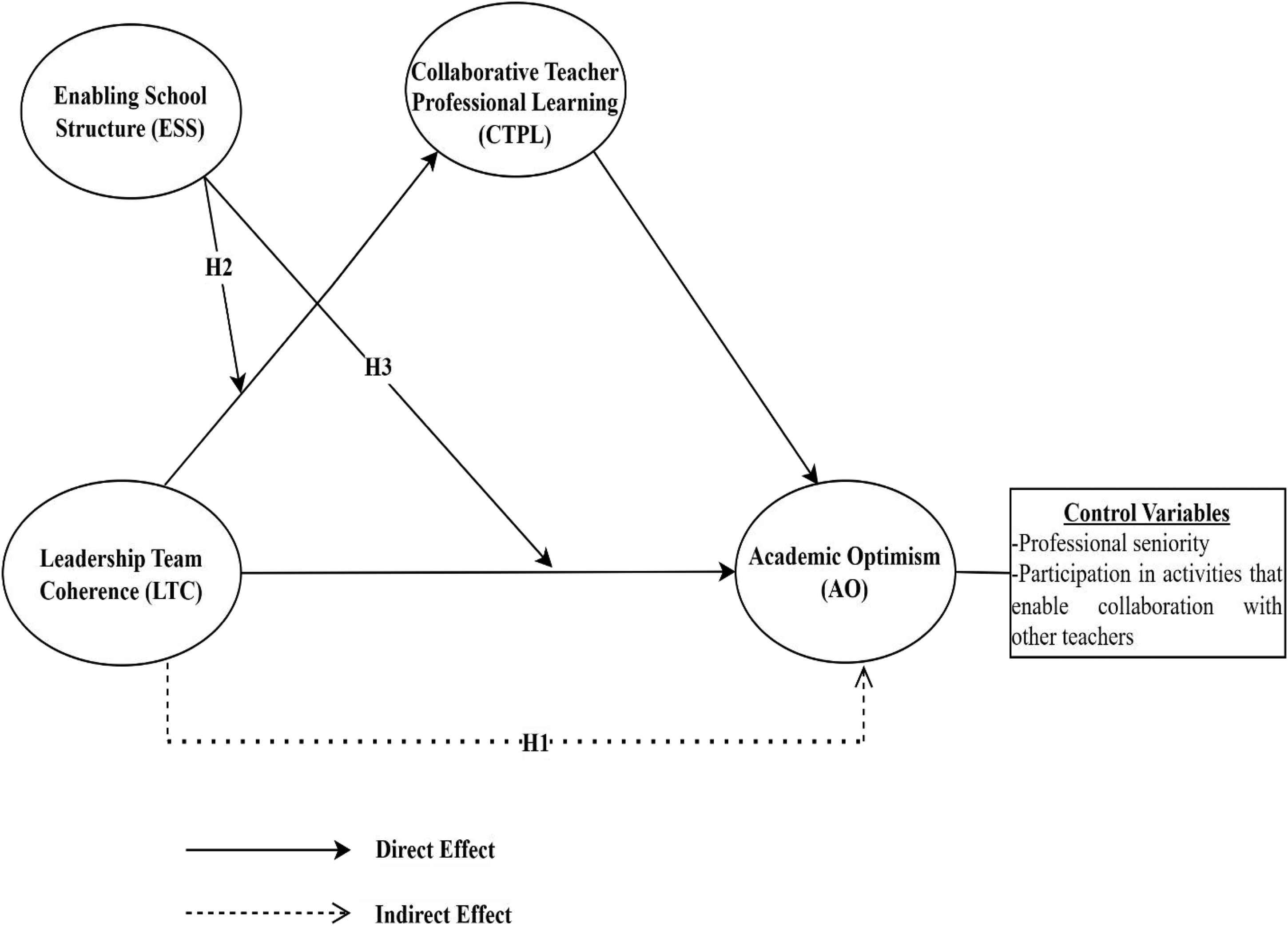
Conceptual model.
Literature review
Academic optimism
Optimism is a structure emerging from positive psychology research that is the basis of positive thinking that will lead to positive outcomes and actions (Beard et al., 2010). Academic optimism is teachers’ positive beliefs that they can positively influence their students’ academic performance through their teaching practices (Hoy et al., 2008). There is empirical evidence and widespread acceptance that academic optimism is a pre-requisite for school improvement, student achievement, and teacher performance (Hoy et al., 2006; McGuigan and Hoy, 2006). Therefore, academic optimism was chosen as the dependent variable of the study. In this study, we adopted the academic optimism model conceptualized by Hoy et al. (2006) as a combination of trust in students and parents, collective efficacy, and academic emphasis beliefs. When the origins of the components are analyzed, the origins of the concept of trust date back to the Cold War period, when it was examined in connection with the events that occurred between nations and then began to be widely studied in the field of education (Tschannen-Moran, 1999). Trust in students and parents refers to teachers’ ability to establish positive bonds with parents and students. Adapted from Bandura's (1997) social cognitive theory, collective efficacy is the belief in how one understands one's task and how well one can do it. For teachers, it represents their belief in their ability to achieve desired outcomes in student engagement and learning. Finally, Hoy et al. (1991) emphasized that academic emphasis as part of the organizational climate model significantly predicts student achievement. Academic emphasis refers to teachers’ belief in the importance of academic achievement and their planning and execution of learning activities to achieve the goal.
School leadership team coherence
Hulpia et al. (2009a) state that leadership behaviors in schools are exhibited by all those in various managerial positions such as principals, vice principals, assistant principals, and department heads. This approach, which has been put forward in the literature, points to a break in the leadership literature by some authors. According to this approach, leadership is a process distributed throughout the school. In other words, the mainstream leadership paradigm, which is based on the idea of “one man” and conceives the leader as a hero, is gradually being replaced by the distributed leadership paradigm. With this paradigm shift observed in the educational leadership literature, leadership has begun to be conceptualized as a process that emerges as a result of the interaction of managerial actors such as principals, vice principals, and department heads (Ozdemir, 2012). Distributed leadership function based on a holistic and team approach creates a synergy in the school by causing a greater impact than the arithmetic average of the leadership behaviors exhibited by individual administrators (Baloglu, 2011). Leadership team coherence is an approach that views leadership as a process distributed throughout the school organization in which members of the school management team perform the leadership function as a whole (Hulpia et al., 2009a). As an important dimension of distributed leadership, the leadership team coherence adopted in the current study is conceptualized as a coherent group in which feelings and disagreements are openly expressed and there is mutual trust and open communication among team members (Holtz, 2004). This dimension, which emphasizes the interaction between school administrators and teachers, claims that improvement in organizational outcomes is related to the degree to which the leadership team shares information, collaborates, and makes decisions together (Friederich et al., 2009).
Collaborative teacher professional learning
In times of educational reform and innovation, professional learning is a crucial factor for school improvement (Opfer and Pedder, 2011). Inspired by cognitive perspectives on learning and situational and adult learning theories (Thoonen et al., 2012), teacher professional learning has recently undergone a significant shift in its nature and form as a new practice that posits that teachers learn through socially constructed, collaborative, and shared learning with colleagues (Liu and Hallinger, 2018). This represents a shift from teacher development based on in-service seminars designed with isolated activities (Kwakman 2003) to interactive and collaborative learning that takes place in school settings (Opfer and Pedder 2011). Little (2012) emphasizes that teacher learning flourishes when it is supported by a school culture that fosters collegiality and collaboration. Collaborative teacher professional learning, which has a positive impact on teacher professional learning (Hubers et al., 2017), involves teachers sharing experiences with colleagues, exchanging views on curriculum and teaching methods, and committing to solve problems together, with an emphasis on student outcomes (Liu et al., 2016). The collaborative teacher professional learning included in this study is mainly drawn from the teacher learning framework conceptualized by Liu et al. (2016), which refers to a school-based learning process. The collaborative dimension of teacher learning refers to a school-based learning process in which teachers play an active role and work in close collaboration with colleagues, possibly resulting in improved classroom practices (Anderson et al., 2018; Kwakman, 2003; Liu and Hallinger, 2018).
Enabling school structure
Organizational structure is the ongoing functioning and formal characteristics of the organization. It refers to the relationship that the organization establishes between different roles to achieve its goals (Miskel et al., 1979). The bureaucratic structure of the organization was examined by Adler and Borys (1996) in two dimensions: enabling and coercive. These two dimensions have two characteristics: formalization and centralization. Coercive formalization refers to rules and procedures that focus on punishing subordinates, while enabling formalization refers to rules and procedures that enable employees to solve problems and complete their tasks. In addition, inhibitory centralization represents a structure that creates obstacles for employees to complete their tasks and solve problems, while enabling centralization represents a structure and management approach that enables problems to be solved effectively (Hoy and Sweetland, 2000).
Schools need enabling rather than coercive structures. Enabling structures characterize structures that involve two-way communication, supporting and encouraging differences, trust, cooperation, open-mindedness, seeing problems as educational opportunities and solving them through cooperation and innovation (Hoy and Miskel, 2013). Enabling school structure is considered as “the extent to which school structures, hierarchies, rules, and procedures enable teachers in their work” (McGuigan and Hoy, 2006). In this study, Hoy and Sweetland's (2000) conceptual framework of enabling school structure within the scope of “Bureaucratic organizational structure” was adopted.
The mediating effect of collaborative teacher professional learning in the relationship between leadership team coherence and academic optimism
Previous studies in the field of educational administration and leadership confirm the positive effect of distributive leadership including leadership team coherence on academic optimism (Boru and Bellibas, 2021; Chang, 2011; Mascall et al., 2008; Thien and Chan, 2022; Thien et al., 2021). In addition, research suggests that there may be mediating mechanisms such as professional learning community or teacher attitude that link leadership and academic optimism (Kulophas and Hallinger, 2020; Srivastava and Dhar, 2016). Ozdemir et al. (2023) tested the positive impact of distributed leadership on teachers’ teaching practices through teacher collaboration. There is also empirical evidence of positive organizational outcomes of leadership team coherence such as teacher efficacy (Thien and Chan, 2022), teacher commitment, and job satisfaction (Devos et al., 2014; Devos and Hulpia, 2009; Hulpia et al., 2009b). These findings explain the role of leadership team coherence in setting the stage for collaborative teacher professional learning. In addition, Vanlommel et al. (2023) found that the collective efficacy dimension of academic optimism is positively related to teacher learning. Given this empirical evidence that collaborative teacher professional learning may be related to both leadership team coherence and academic optimism in schools, it is expected that collaborative teacher professional learning plays a mediating role between leadership team coherence and academic optimism. Hypothesis 1 regarding this mediating effect of teachers’ collaborative teacher professional learning is presented below.
Moderating effect of enabling school structure
Although leadership's coherent team practices contribute to teachers’ creating collaborative learning opportunities with their colleagues (Bektas et al., 2020), the literature agrees that structural problems hinder professional collaboration in schools (Kwakman, 2003; Opfer and Pedder, 2011; Yilmaz, 2022). In this context, enabling the school structure may have a significant impact on teachers’ collaborative learning practices through the leadership team coherence to be established by leaders. Existing literature shows that enabling school structure increases collective efficacy among teachers (Gray and Summers, 2015), supports professional learning community (Gray et al., 2016), and teacher collaboration (Coban and Atasoy, 2020). In addition, there are also research findings showing that enabling school structure has a positive relationship with various leadership characteristics (Mitchell, 2018; Sinden et al., 2004). Based on the previous literature, we hypothesize that enabling school structure may play a moderator role in the relationship between leadership team coherence and collaborative teacher professional learning. Hypothesis 2 regarding the moderating effect of enabling school structure is presented below.
Although leadership team coherence can be associated with academic optimism through collaborative teacher professional learning, leadership's team coherence, and teachers’ collaborative environments may not always result in a culture of optimism. Anderson et al. (2018) found that school structures designed to support teacher achievement can result in collaborative culture and academic optimism. Research has shown that enabling school structure is a predictor of academic optimism (Anderson et al., 2018; Mcguigan and Hoy, 2006; Wu et al., 2013). In addition, enabling school structure is also associated with professional learning communities (Gray, 2016; Gray et al., 2016; Mitchell, 2018) and teacher collaboration (Coban and Atasoy, 2020). Moreover, the structure also influences leadership's coherent teamwork (Mayrowetz et al., 2007). Based on the related literature, we hypothesize that enabling school structure may play a moderator role in the indirect effect of leadership team coherence on academic optimism through collaborative teacher professional learning. Hypothesis 3 based on this claim is presented below.
Methods
This research is designed as a cross-sectional study in quantitative research method. In this section of the study, sampling and data collection process, variables and data collection tools, and data analysis steps are explained.
Sampling and data collection process
A total of 1246 teachers working in public schools in 52 provinces located in the west, center, east, north, and south of Türkiye participated in our study by stratified random sampling method. In order to ensure the representativeness of our research, we used the stratified random sampling method. We made sure that the schools were particularly accessible to ensure adequate teacher participation. This method allowed us to represent the sociocultural and economic differences in different regions of Türkiye. Each data set belongs to a teacher working in a different school. In this context, the measurement tool was delivered to 1593 teachers, 1246 of whom responded to the questionnaire and a 78% return rate was achieved. This is a very good return rate. We made sure that the provinces in which we conducted the research were provinces that reflect the sociocultural and economic characteristics of the regions in which they are located. The number of participants was initially 1246 teachers; however, after the data was cleaned, 42 teachers’ data were deleted and thus the analyses were conducted with 1204 teachers’ data. Research data were collected via Google Forms through email or WhatsApp. The data collection period was approximately 12 weeks and the average time to respond to the scales was 10 minutes. Although collecting data online increases the number of participants, there are also several limitations that affect participants’ motivation. For example, technological problems, user-unfriendly forms, or participants’ safety concerns in the online environment may negatively affect the participants of the study (Latkovikj and Popovska, 2019). On the other hand, in order to reduce social desirability and method bias, the scales were presented in a clear and understandable way in the order of dependent, mediator, moderator, and independent variables and the principle of anonymity was followed throughout the research (MacKenzie and Podsakoff, 2012). The ordering of the variables in the scales as dependent, mediator, moderator, and independent provides an understandable structure for the participants. In addition, the principle of anonymity reinforces the sense of trust among the participants. When participants know that their identities will remain confidential, they tend to give more honest and open responses (McCabe and Trevino, 1993). Thanks to these two measures, participants feel less social pressure and provide more realistic data. Thus, the overall validity of the research increases, and more reliable results are obtained. Of the sample, 361 (30%) were male, 843 (70%) were female, 1012 (84.1%) were married, and 192 (15.9%) were single. Of the teachers, 88 (7.3%) work in preschool, 296 (24.6%) in primary school, 379 (31.5%) in secondary school, 390 (32.4%) in high school, and 51 (4.2%) in other education levels. Among the teachers, 839 (69.7%) had undergraduate degrees and 365 (30.3%) had postgraduate degrees. The number of teachers who had previously participated in collaborative professional learning activities was 973 (80.8%), while 231 (19.2%) had not participated in any collaborative professional learning activities before. In addition, the average age of the teachers was 41.56 (SD = 8.05) and the average professional seniority was 17.62 (SD = 8.49). This age and seniority profile is consistent with the general profile of teachers working in public schools in Türkiye (OECD, 2019). However, schools in Türkiye are managed according to the standards set by the MoNE and educational policies, curricula, teacher appointments, and evaluation processes are centrally determined. Therefore, the fact that the schools in the study had common characteristics that did not differ across levels ensured that all participants of the study were considered as a homogenous group.
Variables and data collection tools
Independent (Predictor) variable: Leadership Team Coherence Subscale (LTCS)
In the study, the Leadership Team Coherence Subscale of the Distributed Leadership Inventory, originally developed by Hulpia et al. (2009a), was used to measure the leadership coherence of school administrators (principals, vice principals, and assistant principals) as a whole. The LTCS is a 5-point Likert-type 10-item subscale ranging from 1 (strongly disagree) to 5 (strongly agree). In this study, the one-factor structure of the scale, which was adapted into Turkish by Ozdemir (2012), was used. The scale items of the LTCS include statements such as “The members of the leadership team at the school where I work know which tasks to do” and “There is a well-functioning leadership team at the school where I work.” The reliability and validity analysis of the LTCS was rechecked for the current study. Accordingly, both Cronbach's alpha and combined reliability (CR) coefficient of the LTCS were calculated as 0.96 and the average variance explained (AVE) value was calculated as 0.71. Confirmatory factor analysis (CFA) fit indices for the construct validity of the LTCS (Root Mean Square Error of Approximation [RMSEA]= 0.103, Standardized Root Mean Square Residual [SRMR] = 0.024, Comparative Fit Index [CFI] = 0.97, Tucker-Lewis Index [TLI] = 0.95) were also found to be acceptable (Browne and Cudeck, 1992; Hu and Bentler, 1999; MacCallum et al., 1996; Steiger, 2007). Although an RMSEA value above 0.08 is generally accepted as an indicator of poor fit for this scale, some scholars argue that a slightly higher RMSEA value can be tolerated when the SRMR is within acceptable limits (Browne and Cudeck, 1992; Chen et al., 2008).
Moderator variable: Enabling School Structure Subscale (ESSS)
In this study, the Enabling School Structure Subscale of the six-item Effectiveness of School Bureaucratic Structure Scale developed by Hoy and Sweetland (2000) and adapted into Turkish by Buluc (2009) was used to determine whether schools have a facilitative structure. ESSS is a 5-point Likert-type subscale ranging from 1 (never) to 5 (always). The ESSS has statements such as “Administrative rules are helpful rather than hindering” and “Administrative hierarchy enables the realization of the school's mission.” In line with the research data, the reliability and validity analyses of the ESSS were recalculated. In this context, it was found that the Cronbach's alpha and CR coefficient of the ESSS were 0.91 and the AVE value was 0.64. In addition, the fit values of the ESSS as a result of CFA (RMSEA = 0.048, SRMR = 0.011, CFI = 0.99, TLI = 0.99) were found to be within the appropriate ranges (Browne and Cudeck, 1992; Hu and Bentler, 1999; MacCallum et al., 1996; Steiger, 2007).
Mediator variable: Collaborative Teacher Professional Learning Subscale (CTPLS)
The six-item Collaborative Teacher Professional Learning Subscale of the Teacher Learning Scale, which was developed by Liu et al. (2016) and adapted into Turkish by Gumus et al. (2018), was used to determine the level of collaborative teacher professional learning realized by teachers. The Teacher Learning Scale consists of 27 items and four dimensions (collaboration, reflection, experimentation, and reaching out to the knowledge base). The CTPLS is a 5-point Likert-type subscale ranging from 1 (strongly disagree) to 5 (strongly agree). The CTPLS includes sample statements such as “I work with colleagues to plan instructional activities” and “I attend meetings with colleagues to discuss student achievement.” Reliability and validity studies were re-examined for the current study. Accordingly, Cronbach's alpha coefficient of CTPLS was calculated as 0.87, CR coefficient as 0.86, and AVE value as 0.52. The results of the CFA analysis of the CTPLS (RMSEA = 0.099, SRMR = 0.025, CFI = 0.97, TLI = 0.95) showed that the fit indices were within the appropriate ranges (Browne and Cudeck, 1992; Hu and Bentler, 1999; MacCallum et al., 1996; Steiger, 2007). Although the RMSEA value is above 0.80 in this subscale, it does not pose a problem for the model since the SRMR value is acceptable (Browne and Cudeck, 1992; Chen et al., 2008).
Dependent (Predicted) variable: Academic Optimism Scale (AOS)
The AOS, which was originally developed by Hoy et al. (2006) and adapted into Turkish by Sezgin and Erdogan (2015), was used to measure teachers’ school-related academic optimism levels. The original scale consists of three subscales (teacher's sense of efficacy, teacher's trust, and academic emphasis) and 11 items. The AOS is a five-point Likert-type scale ranging from 1 (never) to 5 (always). The teacher's sense of efficacy subscale of the AES includes statements such as “How much can you make students believe that they can be successful in schoolwork?”, the teacher's trust subscale includes statements such as “I can trust my students’ families,” and the academic emphasis subscale includes statements such as “I give students tasks that will make them make an effort.” Sezgin and Erdogan (2015) decided to remove two items (items 9 and 11) from the scale in their reliability and validity studies on the AOS and to collect the scale in a single subscale. For our study, we rechecked the reliability and validity values of the scale. Accordingly, we determined the Cronbach's alpha and CR coefficient of the AOS as 0.82. We also found that the fit indices of the CFA analysis results of the AOS (RMSEA = 0.082, SRMR = 0.046, CFI = 0.94, TLI = 0.91) were statistically appropriate (Browne and Cudeck, 1992; Hu and Bentler, 1999; MacCallum et al., 1996; Steiger, 2007).
Control variables
In our study, we found that teachers’ professional seniority and participation in activities that enable collaboration with other teachers had statistically significant effects on academic optimism. Therefore, we analyzed teachers’ professional seniority and participation in activities that enable collaboration with other teachers as control variables.
Analysis of data
We analyzed our research data using statistical package programs with Mplus 8.3 and SPSS PROCESS Macro 3.5.3. We tested hypothesis H1 with model 4 from PROCESS Macro models, and hypotheses H2 and H3 with model 8. With model 4, we aimed to determine the mediating effect of collaborative professional learning on the relationship between leadership team coherence and academic optimism (H1); with model 8, we aimed to determine the moderating effect of enabling school structure on the indirect effect between leadership team coherence and collaborative professional learning (H2 and H3). We started our analysis by calculating descriptive statistics and correlation values between variables. In order to determine the direct and indirect effects of the exogenous variable on the endogenous variable, we preferred the bootstrapping method. The bootstrap method was preferred because it provides reliable results obtained by repeatedly sampling the data. In addition, the bootstrap method is recommended in terms of statistical reliability and validity due to its flexibility, ability to provide results specific to the structure of the data, and the fact that it requires fewer assumptions compared to classical methods (Chernick, 1999). With the bootstrapping method, we estimated the indirect effects based on repeated random sampling. In our analyses, we also examined the confidence intervals (CI) of the effects estimated by repeating 5000 times. Indirect effects are considered statistically significant when the confidence intervals do not contain zero (0) value (Preacher and Hayes, 2008). Accordingly, we adopted the 95% CI level to calculate the effects of leadership team coherence in schools on academic optimism through collaborative teacher professional learning.
The fact that the data in the studies are cross-sectional and collected only from teachers may cause common method bias. Therefore, we applied Harman's one-factor test to reduce common method bias in our study (Harman, 1967; Podsakoff et al., 2003). We performed factor analysis with varimax rotation with a total of 31 scale items for the four variables of our research and found that the results were not collected under a single factor. The five subdimensions with eigenvalues above 1.0 explained 66.64% of the total variance in the variables. This result means that the common method bias of our study is low. Harman's single factor test is a frequently used analysis method to measure common method bias. This test enables the assessment of method bias by examining whether all variables are aggregated in a single factor and how much of the total variance this factor can explain (Podsakoff et al., 2003). In this study, 66.64% of the total variance was explained by the one-factor Harman test, indicating that the variables were sufficiently differentiated. In other words, the fact that the data cannot be collected under a single factor and the variance explained remains at this rate means that the difference between the independent variables is preserved (Fuller et al., 2016). According to Siemsen et al. (2009), adding additional independent variables to latent structural equations reduces the effect of method bias in measurements and allows for a more accurate presentation of the relationships between variables. This approach is effective as it increases the reliability of the results in the original context of the study. Therefore, we reduced the common method bias by adding the enabling school structure variable as a moderator variable to our mediation model. On the other hand, we ensured that the sample size was adequate by including 1204 teachers in our study. Since the data was filled in via an online form, we did not encounter any missing values. Outlier values of the variables were examined by calculating Z scores. We decided to exclude 42 data which were outliers whose Z scores were not within the range of −3 and +3 and whose answers were not the same or did not show diversity. Detection of outliers using the Z-score increases the accuracy of the analysis results by identifying values in the data that deviate significantly from the normal distribution (Leys et al., 2013). The detection of outliers contributes to preventing misleading effects in the analysis results and maintaining the overall reliability of the model (Barnett and Lewis, 1994). We checked the univariate normal distribution of the data by looking at the skewness and kurtosis values. In this context, we found that the skewness and kurtosis of the research data were in the range of −1.5 and +1.5 and the univariate normality assumption was met (Tabachnick and Fidell, 2013). However, these values alone may not be sufficient to verify normality. In particular, visualizations such as Q–Q plots enable visual assessment of how well the data fit the normal distribution curve, which increases the reliability of the analysis results (Field, 2005). In this context, we determined that the points in the Q–Q graphs were close to the 45-degree reference line. On the other hand, we also examined the scatter plot for the linearity assumption and found that the data fit the linear model well. We also checked the homoskedasticity assumption with the residual plot and found that the variance of the error terms of the variables remained constant for all independent variable values.
We also checked the Pearson Product Moment Correlation coefficients, VIF (variance inflation factor), tolerance and CI (condition index) values to determine whether there is a multicollinearity problem among the independent variables of the research. Accordingly, in our study, correlation values among the independent variables were less than 0.90 (see Table 1), VIF values were between 1.168 and 1.777 and less than 5, CI values were between 1.00 and 23.592 and were less than 30; the fact that the tolerance values are between 0.56 and 0.85 and greater than 0.10 and the Durbin-Watson value is 1.854 between 1.5 and 2.5 show that there is no collinearity problem in our research. (Field, 2005; Green and Salkind, 2010). These results also show that there is no high correlation between the independent variables and the regression results are reliable. Finally, we examined moderator mediation effects by estimating the conditional indirect effect of leadership team coherence on academic optimism mediated by collaborative teacher professional learning at low (−1 SD), medium (average), and high (+1 SD) moderator levels. Moderator variables show how the effect of one independent variable is modified by another variable. Moderation is important for understanding how the effects on a relationship vary at different levels. Analyses using moderator levels (low, medium, and high) reveal how the relationship between the independent variable and the dependent variable differs according to the circumstances of a particular situation or group (Hayes, 2013).
Descriptive analysis and correlation analysis findings (n = 1204).
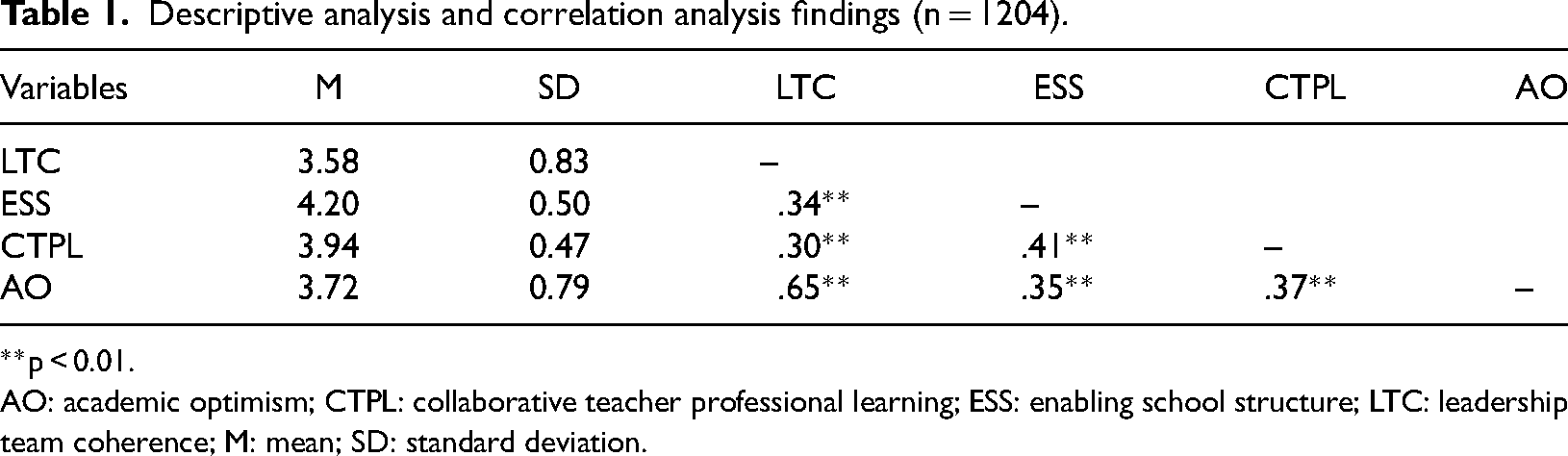
**p < 0.01.
AO: academic optimism; CTPL: collaborative teacher professional learning; ESS: enabling school structure; LTC: leadership team coherence; M: mean; SD: standard deviation.
Findings
Descriptive statistics and correlation analysis findings
Descriptive statistics and correlation analysis findings of the study are given in Table 1. We determined that teachers’ leadership team coherence (M = 3.58, SD = 0.83), enabling school structure (M = 4.20, SD = 0.50), collaborative teacher professional learning (M = 3.94, SD = 0.47), and academic optimism (M = 3.72, SD = 0.79) levels were all above the average. In other words, it is understood that all the variables have high average values in general. On the other hand, SD values indicate that there is a greater deviation in teachers’ perceptions of leadership team coherence and enabling school structure than other variables. In addition, positive significant relationships were found between leadership team coherence and enabling school structure (r = 0.34; p < 0.01), leadership team coherence and collaborative teacher professional learning (r = 0.30; p < 0.01), leadership team coherence and academic optimism (r = 0.65; p < 0.01), enabling school structure and collaborative teacher professional learning (r = 0.41; p < 0.01), enabling school structure and academic optimism (r = 0.35; p < 0.01) and collaborative teacher professional learning and academic optimism (r = 0.37; p < 0.01). These results are consistent with our hypotheses.
Findings regarding hypothesis tests
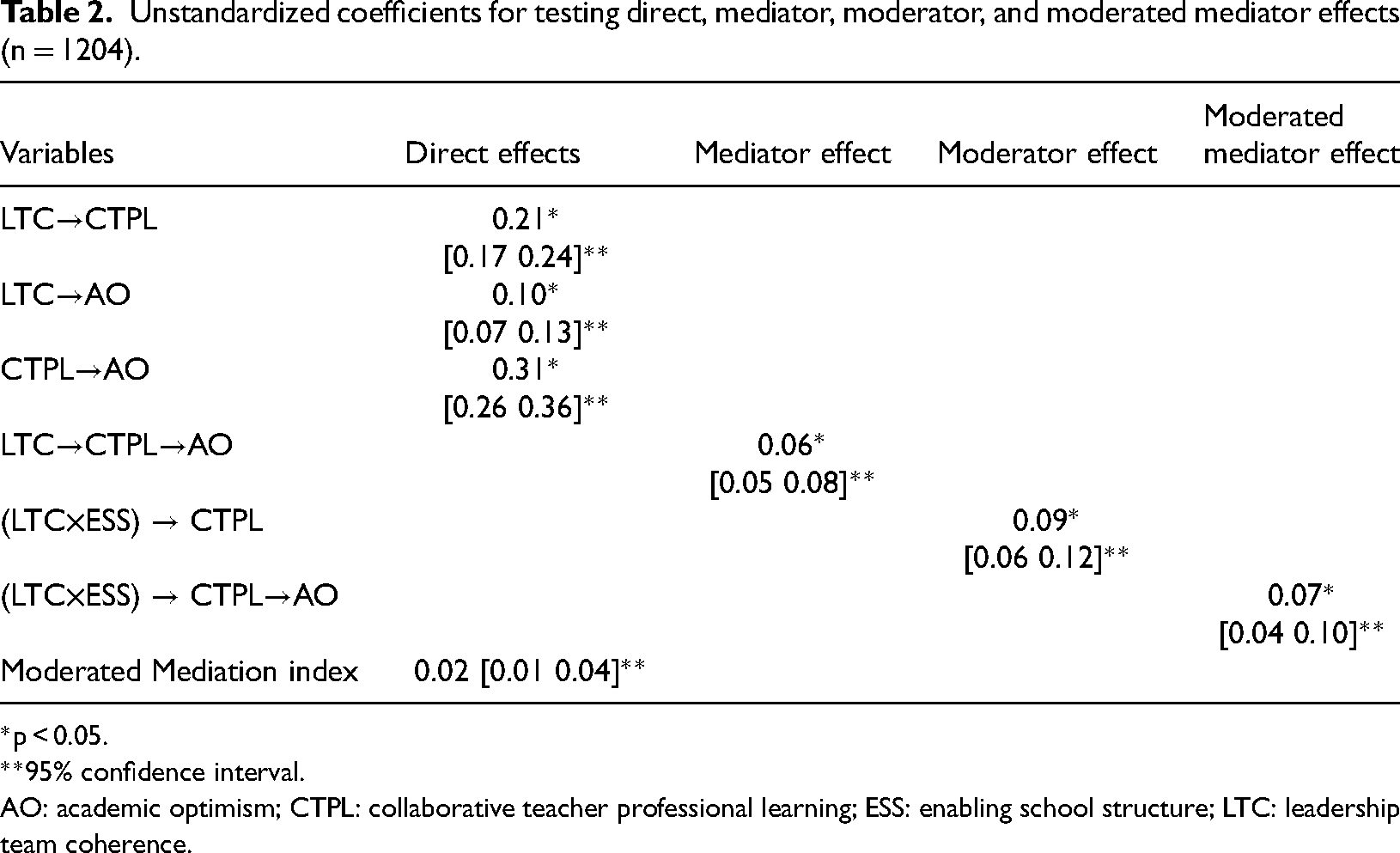
We tested our research hypotheses step by step. In this context, we used the (H1) bootstrapping method (Preacher and Hayes, 2008) to determine whether teachers’ collaborative teacher professional learning levels mediate the relationship between leadership team coherence in schools and teachers’ academic optimism. We calculated the indirect effects using 5000 bootstrapped samples with 95% confidence intervals. As shown in Table 2, the bootstrap analysis showed that the indirect effect of leadership team coherence on academic optimism through collaborative teacher professional learning was statistically significant (b = 0.06, 95% CI [0.05 0.08]). In addition, the effect of leadership team coherence on collaborative teacher professional learning (b = 0.21, 95% CI [0.17 0.24] and academic optimism (b = 0.10, 95% CI [0.07 0.13]); the effect of collaborative teacher professional learning on academic optimism is also significant (b = 0.31, 95% CI [0.26 0.36]). Similarly, the control variables of teachers’ professional seniority (b = 0.01, 95% CI [0.003 0.01]) and participation in activities that enable collaboration with other teachers (b = −0.09, 95% CI [−0.15 −0.03]) were also found to have a significant relationship with academic optimism in the mediation model. Thus, in the present study, we found that collaborative teacher professional learning mediates the relationship between leadership team coherence and academic optimism (see Table 2) and this result proves that the H1 hypothesis of our study is confirmed.
Unstandardized coefficients for testing direct, mediator, moderator, and moderated mediator effects (n = 1204).
*p < 0.05.
**95% confidence interval.
AO: academic optimism; CTPL: collaborative teacher professional learning; ESS: enabling school structure; LTC: leadership team coherence.
The H2 hypothesis of the study was whether enabling school structure has a moderating effect on the relationship between leadership team coherence and collaborative teacher professional learning in schools. In support of hypothesis H2, we found that enabling school structure has a positive significant moderating effect (b = 0.09, 95% CI [0.06 0.12]) between leadership team coherence and collaborative teacher professional learning (see Table 2). Accordingly, the effect of leadership team coherence on collaborative teacher professional learning is stronger when the enabling school structure level is medium and high (see Table 3 and Figure 2). Therefore, hypothesis H2 is confirmed.
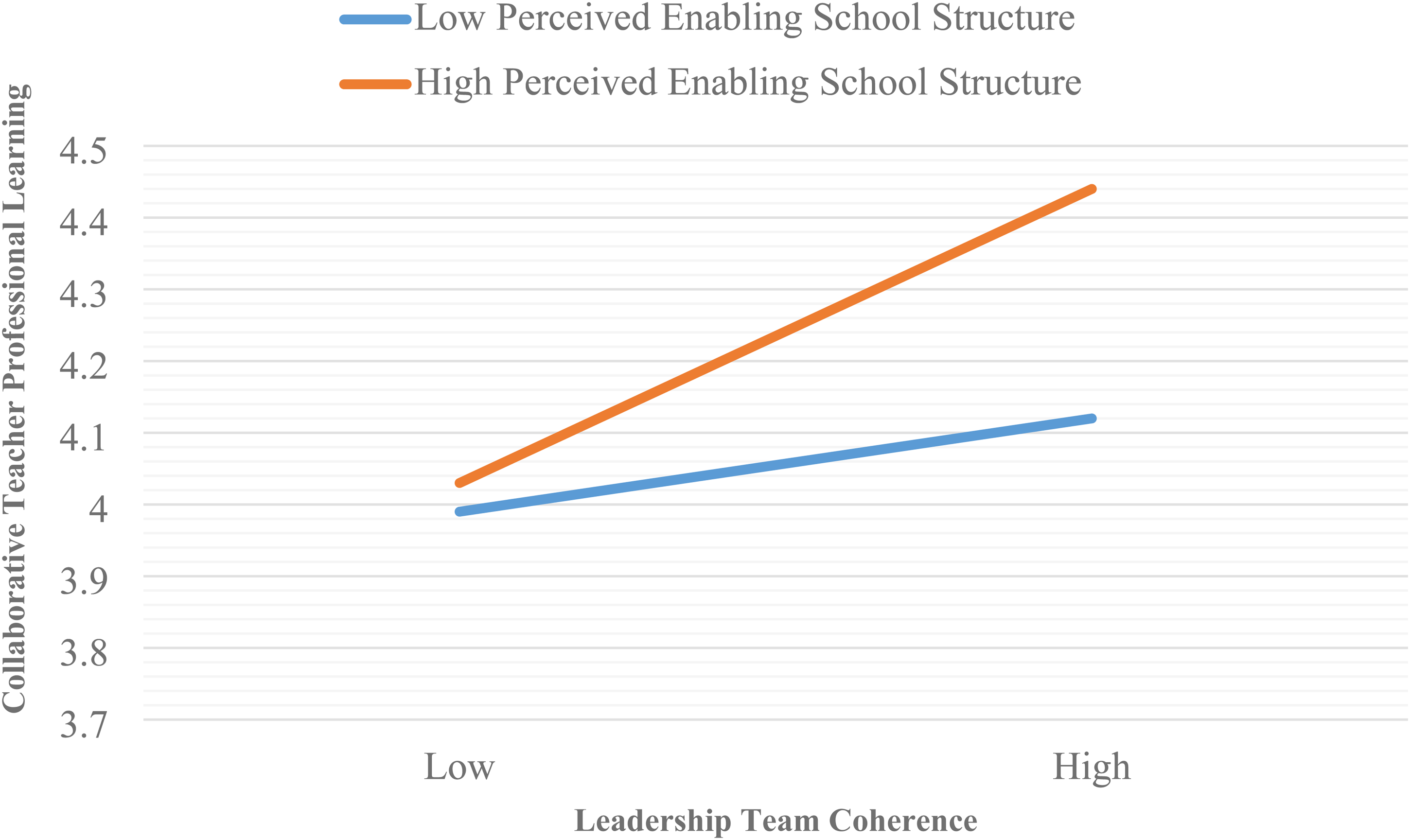
Graph on the moderating effect of enabling school structure on the relationship between leadership team coherence and collaborative teacher professional learning.
Impact of leadership team coherence on collaborative teacher professional learning relative to enabling school structure levels.
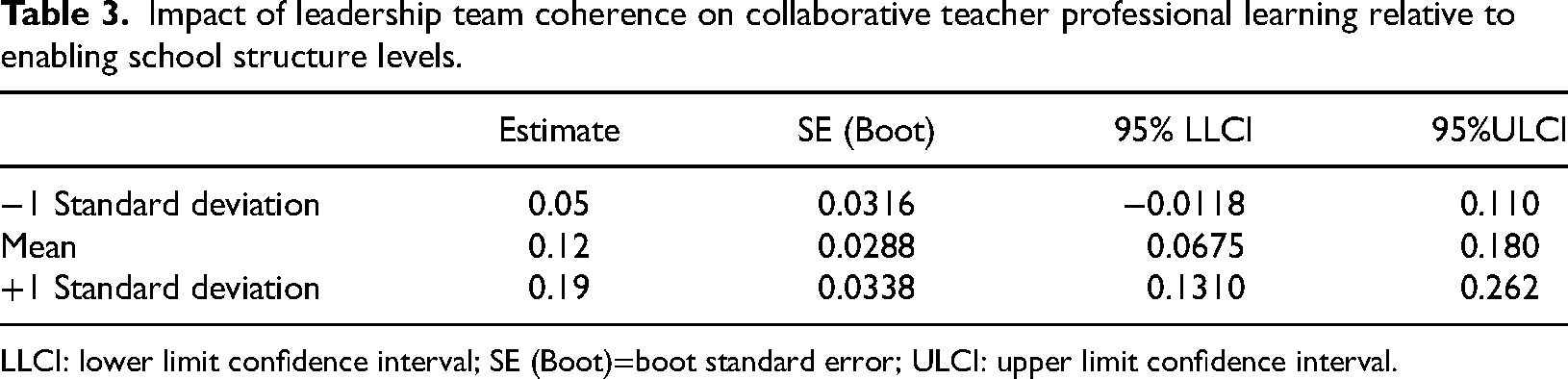
LLCI: lower limit confidence interval; SE (Boot)=boot standard error; ULCI: upper limit confidence interval.
In our study, we tested hypothesis H3 to determine the moderating role of enabling school structure in the indirect effect of leadership team coherence on academic optimism through collaborative teacher professional learning. As can be seen in Table 2, we found that enabling school structure has a moderating role in the effect of leadership team coherence on academic optimism through collaborative teacher professional learning (b = 0.07, 95% CI [0.04 0.10]) and the moderated mediation index was statistically significant (Moderated Mediation Index = 0.02 [0.01 0.04]). In this context, our findings suggest that the effect of leadership team coherence on academic optimism through collaborative teacher professional learning is stronger when the enabling school structure level is medium and high (see Table 4 and Figure 3). Thus, hypothesis H3 is also supported.
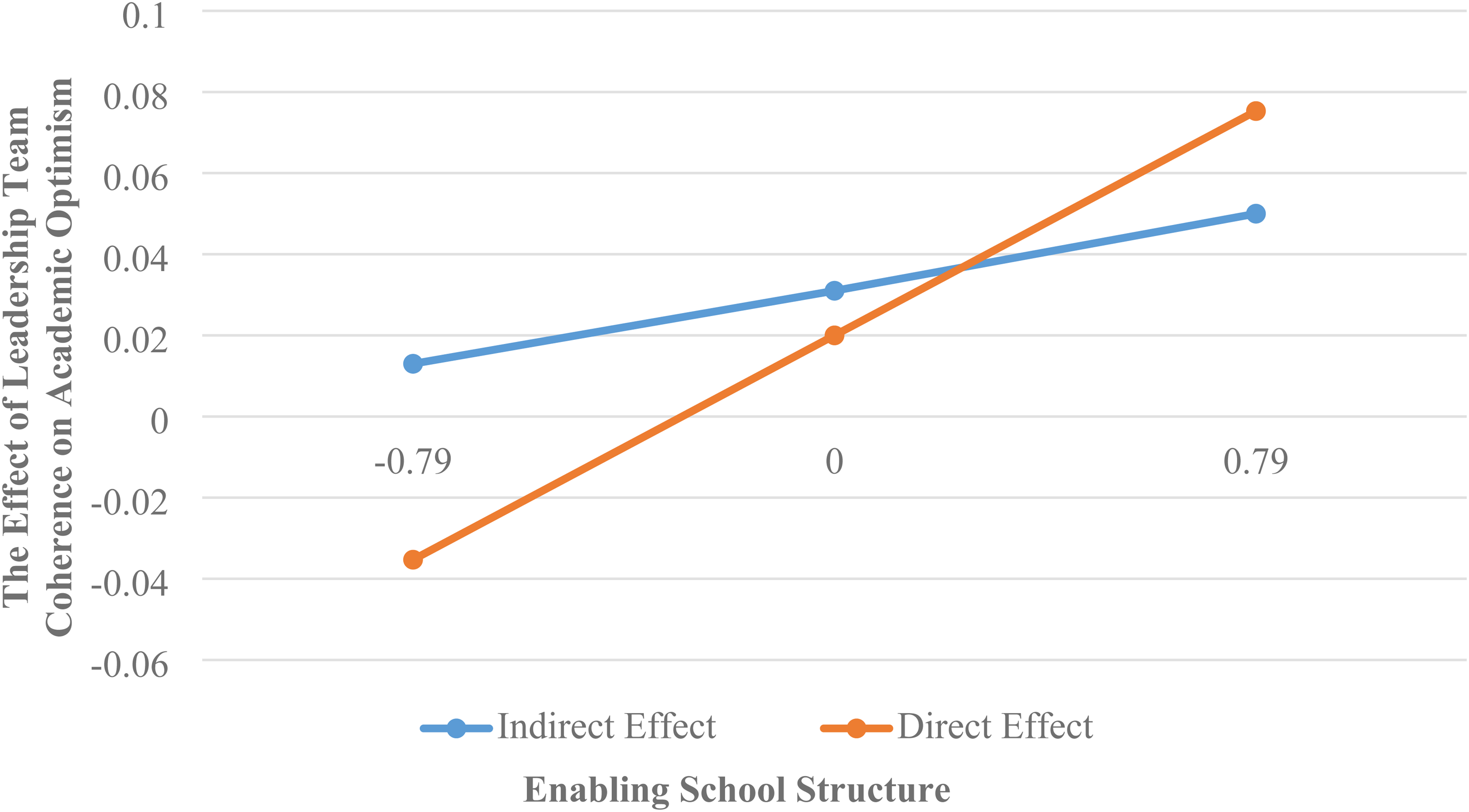
Graph on the impact of leadership team coherence on academic optimism through collaborative teacher professional learning relative to enabling school structure levels.
Impact of leadership team coherence on academic optimism through collaborative teacher professional learning relative to enabling school structure levels.
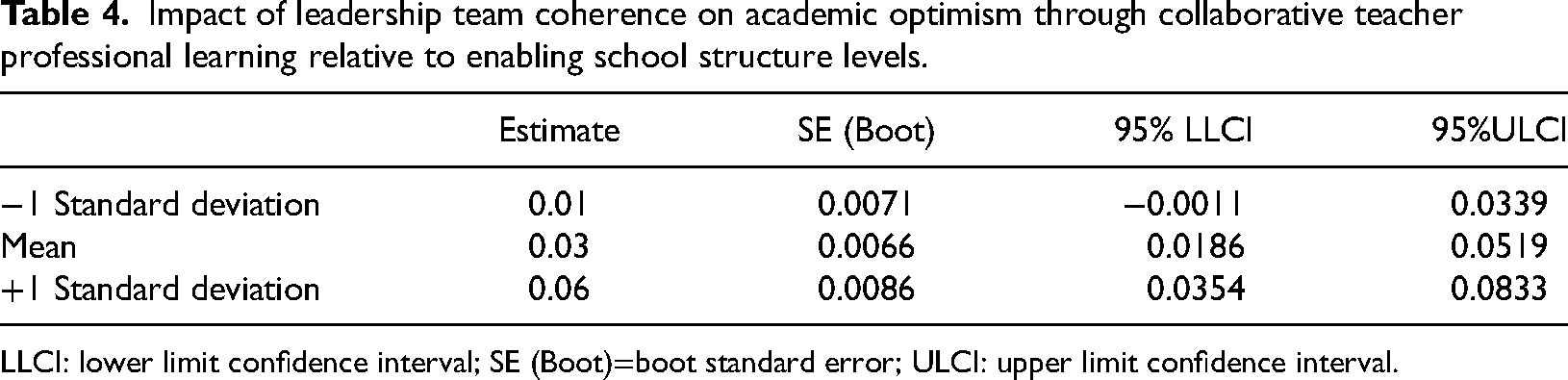
LLCI: lower limit confidence interval; SE (Boot)=boot standard error; ULCI: upper limit confidence interval.
Discussion
In this study, we used a cross-sectional data analysis covering 1204 teachers across Türkiye. We tested the mediating effect of collaborative teacher professional learning on the relationship between leadership team coherence in schools and teachers’ academic optimism and the moderating effect of enabling school structure on these relationships. In this way, our study showed that the effect of leadership team coherence on academic optimism in the context of Turkish schools can be explained through the mediation of collaborative teacher professional learning and the moderating effect of enabling school structure. We believe that our results will shed light on the educational systems of countries with similar sociocultural structures (such as Azerbaijan, Iran, Iraq, Jordan) and high-power distance cultures (such as Italy, Spain, Venezuela).
Interpretation of key findings
In our study, we first found that collaborative teacher professional learning played a mediating role between leadership team coherence and academic optimisim. We theoretically determined and empirically confirmed that leadership's creation of a coherent team positively affects teacher attitudes and performances and paves the way for collaborative teacher practices (Devos and Hulpia, 2009; Devos et al., 2014; Hulpia et al., 2009b) and that it may be related to the collective efficacy dimension of academic optimism, which includes the positive belief that teachers as a whole can improve student outcomes. Teachers who benefit from the collaborative learning environment provided by leadership team coherence are likely to believe that their students can achieve academic success. Friederich et al. (2009) argued that increases in organizational outcomes are associated with the degree to which the leadership team shares knowledge, collaborates, and makes decisions together. Our research suggests that teachers’ perception of collaboration among themselves and at the leadership team level will increase academic optimism behaviors, including trust in students and parents, beliefs about student learning and coping with challenges. Our findings are consistent with previous research (Hargreaves and O'Connor, 2018; Hughes and Kritsonis, 2007) that school principals who want to create a more productive learning environment for both teachers and students in their schools should create a collaborative learning environment. Social identity theory also emphasizes the role of group processes in shaping individual attitudes and behaviors. Therefore, we contribute to social identity theory in the context of the EDML literature. Moreover, Türkiye is among the countries with high power distance shaping social interactions (Hofstede, 1980). Accordingly, the social distance between school leaders and teachers in Türkiye is high (Sezgin-Nartgun and Cakmak 2012). Therefore, school leaders’ actions that show a focus on collaboration can gain great importance in supporting teachers’ attitudes and performance. Therefore, it can be said that our study contributes to the literature showing that school leaders affect teacher performance and attitudes through professional development opportunities they offer to teachers (Hallinger and Kulophas, 2020; Hendawy Al-Mahdy et al., 2024; Sleegers et al., 2014). Finally, our finding also supports the principal leadership role emphasized in the “2023 Education Vision” policy document that school leadership, through its support of teacher learning and practice, will translate into effective classroom practices and thus enhanced student learning. We therefore believe that our research aligns particularly well with the goals of these recent reform initiatives and deserves close consideration by policymakers and practitioners charged with improving the quality of education.
Another result of the study is that enabling school structure strengthens the relationship between leadership team coherence and collaborative teacher professional learning, thus supporting H2. It is a positive progress to see school principals in Türkiye emphasizing more on the collaborative roles of the school bureaucracy to support teachers, acting in a team spirit. Schools where principals create a sense of “we-ness” among the members of the leadership team and where the school structure provides ease and flexibility for teachers’ work will foster collaborative learning among teachers. In previous studies, the relationship between leadership and teacher professional learning has been explained through variables related to teacher attitudes and performance such as teacher work motivation and trust in the principal (Bektas et al., 2020), teacher agency (Polatcan, 2021), trust and collective teacher efficacy (Karacabey et al., 2020), and teacher self-efficacy (Liu and Hallinger, 2018). In another study, transformational leadership played a moderating role between instructional leadership and teacher learning (Bellibas et al., 2021). Our study, on the other hand, showed that enabling school structure, a school-level variable, had a moderating effect between leadership team coherence and collaborative teacher professional learning. In this respect, our study has made a unique contribution to the literature.
Third, our results show that enabling school structure regulates the relationships between leadership team coherence and academic optimism through collaborative teacher professional learning. In practical terms, this could mean that when teachers perceive that the bureaucracy supports them, they will be able to interact with their colleagues to create a more productive learning environment and try to do their best for their students. These findings are particularly important in the Turkish context. Thien (2019) stated that it is difficult for schools to achieve their goals in rigid centralized education systems where bureaucracy operates from top to bottom. Therefore, in these systems, the opportunities for administrators to act as a team among themselves and to create positive beliefs and attitudes among teachers regarding student outcomes are limited. In order for administrators to form a harmonious team and increase teachers’ academic optimism, the bureaucratic functioning in the organizational structure should be transformed into an enabling structure to support teachers. Otherwise, only the implementation of rules and regulations will come to the fore. Accordingly, this study will contribute to the literature on enabling school structure by showing that in countries like Türkiye, which have centralized school systems dominated by bureaucratic structure and hierarchical authorization, school principals can influence teachers’ academic optimism by implementing leadership as a cohesive team and facilitating the school structure. The moderating effect of enabling school structure revealed in this study demonstrated how the antecedents and consequences of leadership emerge in various sociocultural and institutional contexts. The positive findings of this study in the context of Türkiye make a unique contribution to the literature on how facilitative school structure supports team spirit and collaborative practices leading to positive teacher attitudes (Gray, 2016; Gray and Summers, 2015; Gray et al., 2016; Sinden et al., 2004; Wu et al., 2013).
Practical implications
The current education reform movement in Türkiye, consistent with other developing countries, aims to promote school-based professional learning. Our research supports the reform movement by providing supportive evidence that leadership team coherence through collaborative professional learning has significant potential to increase teachers’ academic optimism practices. Moreover, the enabling structure supports the relationship between leadership team coherence and collaborative learning. This is not an easy task in the Turkish context, as the formal and standardized nature of policy-making and educational administration in the country, together with the characteristic high-power distance, limits the distribution of leadership in teams. As Lee and Hallinger (2012) note, principals in centralized education systems tend to adopt a “more traditional school principal role.” It is important for policymakers to recognize that the main challenge for educational leadership in Türkiye is to move from more traditional practices to collaborative practices that enhance professional learning. However, implementing a bureaucratic structure in a centralized context with enabling bureaucratic arrangements requires addressing normative and organizational challenges. It requires transforming the system and schools from a bureaucratic culture to a professional one. This will be a profound change, driven by and resulting in the development of collaborative practices of structural arrangements across the system. Therefore, there is a need for policymakers, teachers and school administrators in Türkiye to gradually introduce structural changes at the school level in order to foster a collaborative working environment. We also expect that the results of this study will be used to design professional development programs for school leaders in Türkiye to develop leadership qualities that will enable them to act in a team spirit and support teachers’ collaborative professional learning skills. In addition we recommend school leaders to create school environments where teachers can work collaboratively and increase their academic optimism. Finally, in countries with centralized education systems such as Türkiye, we recommend that schools and principals be given more autonomy and discretion. In this way, principals can ease the bureaucratic culture, foster collaboration among teachers and thus positively influence learning and teaching activities.
Theoretical implications
Although the relationship between the concepts of leadership team coherence and academic optimism with each other or with different variables has been examined, it is important to empirically confirm that collaborative teacher professional learning supports the relationship between leadership team coherence and academic optimism as a mediator and enabling school structure as a regulator. Since collaborative endeavors, group coherence, shared responsibilities and strong social ties are prominent in the sociocultural context of collectivist Turkish society, in this study, enabling school structure moderated the relationship between leadership involving team cohesion in school and collaborative learning. The model can provide a starting point for developing and researching school-based development models in relation to teachers’ academic optimism and student achievement. Another important theoretical implication of our study is that it highlights the strong influence of enabling school structure in both collaborative teacher professional learning and teacher academic optimism development. This result will shed light on future work on school reforms and make an important contribution to the literature on improving teacher performance.
Limitations of the study and suggestions for future research
The results of our research should be interpreted within the frame of some limitations. In this scope, the limitation of our research is that it was conducted based on teacher self-report. Personal approach and social desirability concerns about teachers may have negatively affected the objectivity of the research data (Ham et al., 2015). However, the fact that the leadership team coherence and enabling school structure scales were evaluated according to teachers’ perceptions in our study can also be considered important in ensuring objectivity. In this context, we recommend that leadership and school-related variables should be assessed according to both leaders’ and teachers’ evaluations (Leithwood et al., 2020). The fact that our study was designed with a cross-sectional survey model in a single time period (Thoonen et al., 2011) can be seen as another limitation. Therefore, our study cannot fully prove the causal relationships between variables. Longitudinal or experimental studies involving different time periods are needed to determine causal relationships. On the other hand, there is also a limitation arising from the data analysis method we used. For example, since we collected the data online by reaching one teacher from each school, we could not determine the distribution of the teachers participating in the study according to schools for multilevel analyses. This situation prevented us from making comments and inferences about the school level in our study. However, there are many examples in the literature where single-level analyses are used when multilevel analyses cannot be conducted due to the nature of the data (Bellibas et al., 2022; Kilinc et al., 2024; Liu et al., 2016; Ozdemir et al., 2022; Sebastian et al., 2016). Therefore, using multilevel data collection methods and sampling strategies in future studies will increase the depth of the research. In other words, collecting data from participants at individual and organizational levels may help to better understand the effects of multilevel structures. Conducting future studies with multilevel analyses may contribute to more accurate interpretation of the data. Similarly, we only utilized scales in our study. More in-depth results can be obtained by using different data collection tools such as observations and interviews in accordance with qualitative or mixed methods. In addition, we examined the moderating effect of enabling school structure in our study. In other studies, the moderating effect of different variables such as school climate, leader-member interaction, organizational citizenship, organizational justice, and organizational support can be investigated. These variables appear to be important factors affecting teacher collaboration and leadership relationships (Runhaar et al., 2013; Vermeulen et al., 2022). For example, it can be thought that a positive school climate can increase the effect of teachers’ collaboration and leader–member interaction can strengthen teachers’ participation in collaboration. Finally, the participation of teachers in activities that increase collaboration (such as courses, seminars, in-service training, professional learning communities), which we included in the analysis as a control variable, can be analyzed by asking the number of days or frequency.
Footnotes
Author contributions
YD was involved in conceptualization; MSÇ in methodology; ED in formal analysis and investigation; and YD, ED, and MSÇ in writing-original draft preparation. In addition, all authors read, edited and finalized the manuscript.
Data availability
The data can be obtained by contacting the corresponding author.
Declaration of conflicting interests
The authors declared no potential conflicts of interest with respect to the research, authorship, and/or publication of this article.
Funding
The authors received no financial support for the research, authorship, and/or publication of this article.
Informed consent
Informed consent was obtained from all participants before the data was collected. We informed each participant of their rights, the purpose of the study, and to safeguard their personal information.
