




Abstract
More collaboration between primary schools and childcare providers is increasingly considered a crucial factor to optimally support children's development. However, due to disparities between these two sectors, fostering collaboration proves problematic in practice. Inclusive leadership is seen as a promising approach in contexts with strong fault lines, but whether school leaders and childcare leaders apply this leadership approach is not clear. To fill this gap, our qualitative study aimed to explore whether a recent theoretical model for inclusive leadership can be used to identify inclusive leadership behaviours of school and childcare leaders who work together in child centres. Data was collected through in-depth interviews with 12 school leaders and 12 childcare leaders. Our results showed that the theoretical model of inclusive leadership used is suitable for interpreting inclusive leadership behaviours in interprofessional educational settings. Based on the data, adding non-positive behaviours to the model was appropriate, to account for behaviours that may discourage experiences of belongingness and valuing uniqueness. The theoretical contribution of this study lies in refinement of this model and its application in the education sector. We also make practical recommendations based on our findings, and advocate professional development for school and childcare leaders in child centres, not only because of the non-positive behaviours taking place in practice but also because inclusive leadership behaviours valuing uniqueness appeared to be less common.
Introduction
More collaboration between primary schools and childcare providers is increasingly seen as a crucial factor to optimally support children's development in several countries (Fukkink and Van Verseveld, 2019). Consequently, during the past decade, a growing number of what are known as ‘child centres for education and care’ (hereafter, child centres) have been established in the Netherlands. These child centres combine school-based education (ages 4–12) with out-of-school care (OSC) (ages 4–12), provided by child care organisations, coupled with preschool (ages 2.5–4) and day-care (ages 0–4) services, provided by organisations from two different sectors, thus offering all-day school and care for children from 0 to 12 years old. Figure 1 depicts a graphic representation of a child centre that offers day care, early childhood education (provided both in preschool settings and within primary schools), primary education and OSC services in a shared building, involving multiple organisations.
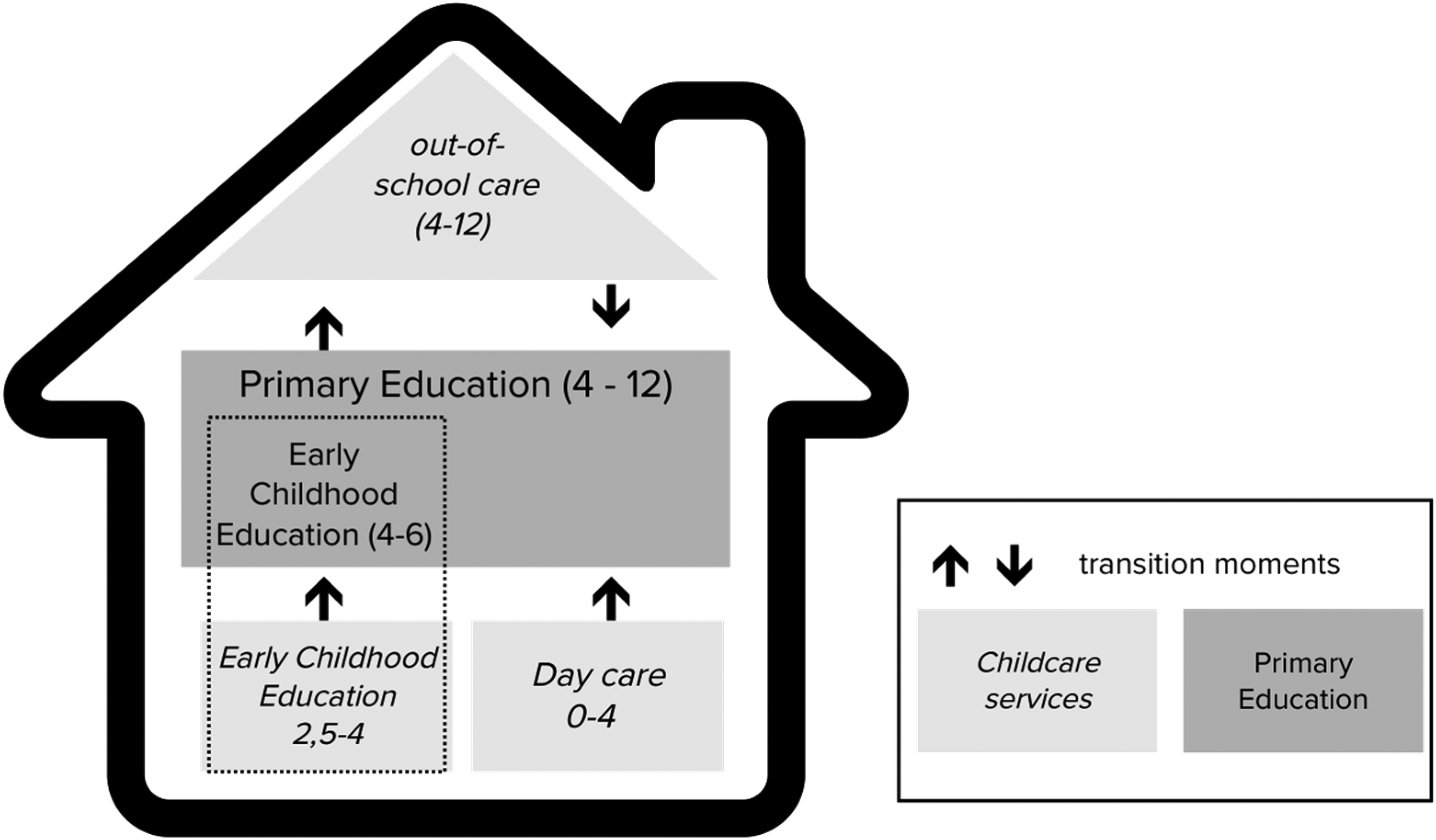
Graphic representation of a child centre that offers day care, early childhood education, primary education and out-of-school care services.
In this setting, school and childcare leaders together face the complex task of shaping the high-quality interprofessional collaboration (IPC) that is required within these child centres. These innovative forms of collaboration may require a wider repertoire of leadership practices than leaders’ current practices (de Jong et al., 2022), especially for collaboration between public and private parties regarding school-based extended services, because of different governance mechanisms and interests (Fuller et al., 2013). In spite of high ambitions, attempts to intensify school-to-childcare collaboration proceed slowly and ‘us and them’ distinctions between the collaborating partners seem apparent which could indicate non-inclusion (Keuning et al., 2022). Keuning et al. (2022) argue that within primary education, there are higher budgets allocated for collaborative learning and that primary school teachers generally possess higher levels of education compared to childcare workers.
Within educational research, the concept of inclusion is usually understood as UN Sustainable Development Goal 4, ‘ensuring inclusive and equitable quality education’, with the aim that, regardless of their background, all pupils are guaranteed high-quality educational opportunities with peers from their neighbourhood (Ganon-Shilon et al., 2022; Oskarsdottir et al., 2020; Vassallo, 2021). Rather than focusing on inclusion of all pupils, our study places emphasis on the comprehensive inclusion of all staff collaboratively engaged in delivering education and care to children. For that reason, in this paper, we primarily draw on insights from general management and leadership literature to further understand inclusive leadership.
Inclusive leadership is one of the most important predictors of work group inclusion and can be viewed as the ‘gold standard’ concerning a high-yield leadership approach (Chung et al., 2020; Shore and Chung, 2021). Inclusive leadership is considered an appropriate leadership approach, particularly in contexts where team members are diverse and status differences (caused by differences, e.g., in age, education and tenure) among team members occur, as found by Nembhard and Edmondson (2006) in the context of health care. Because the professional cultures in health care and education have similarities, for example, with regards to hierarchical status differences that may present barriers to IPC (Edmondson et al., 2016), a setting requiring IPC between schools and childcare services seems a highly relevant context for studying inclusive leadership behaviour (ILB). However, not much is known about how leaders can foster employees’ perception of inclusion (Brimhall, 2019; Shore et al., 2021). In a recent theoretical model of inclusive leadership, Randel et al. (2018) proposed several behaviours that may lead to increased experiences of inclusion, but these have not yet been empirically studied in an interprofessional context. Thus, the intended contribution of our research is twofold. We aim to fill this knowledge gap by empirically exploring the identification of ILBs in the specific context of school and childcare leaders working together in child centres. And, concurrently, by doing so, we study the applicability of the recent theoretical model of inclusive leadership (Randel et al., 2018) in a new context, in which IPC is a goal. In addition, we also respond to the call made by Shore et al. (2018), for more empirical research on this topic.
Given those intended contributions, our research question is: How well can school and childcare leaders’ leadership practices be understood based on the proposed model of inclusive leadership?
Establishing IPC
Interprofessional collaboration is characterised by the fact that people with different professional backgrounds (e.g., differences in expertise and education level) share information, resources, activities and expertise with the aim of achieving a common result (Bryson et al., 2015; Page et al., 2015). This aim is underpinned by the conviction that diversity of expertise provides more knowledge and perspectives, which can thereby enhance performance (Shemla and Wegge, 2019; Van Knippenberg et al., 2004). However, bringing together professionals with diverse expertise does not automatically lead to better performance, due to professional fault lines (Harrison and Klein, 2007; Huq et al., 2017; Mitchell et al., 2015). Employees are more likely to share knowledge with colleagues they consider similar to them and share less knowledge with colleagues who have different backgrounds (Van Knippenberg et al., 2004). Bridging these differences requires an inclusive organisational climate (Nishii and Rich, 2014).
Creating an inclusive organisational climate
An organisational climate can be considered inclusive to the extent that its policies, practices and procedures demonstrate that all individuals in the organisation perceive themselves to be valued members of the workplace, through experiencing treatment that satisfies their needs for belongingness and uniqueness, without pressure to assimilate in order to be accepted (Shore et al., 2011). Leaders play an important role in creating such an inclusive organisational climate (Ashikali et al., 2020; Roberson and Perry, 2021). As a link between employees’ behaviour and the achievement of goals, leaders are in a position to exert considerable influence, as their role includes both direct and indirect mechanisms (Grojean et al., 2004; Homan et al., 2020; Wright and Nishii, 2013). They encourage, reward or disapprove not only directly through their actions but also indirectly by influencing employees’ perceptions, with their own everyday behaviours leading to norms for appropriate conduct (Boekhorst, 2015; Mor Barak et al., 2021).
Inclusive leadership approaches
Although on the increase, research identifying how leadership facilitates an inclusive climate is still in its infancy (Shore et al., 2011, 2018). Overall, approaches in this field build upon the work of Nembhard and Edmondson (2006), who defined leader inclusiveness as ‘words and deeds by a leader that indicate an invitation and appreciation for others’ contributions’ (947).
The concept of leader inclusiveness has been explored in two ways: an early approach by Carmeli et al. (2010) considered inclusive leadership as a specific form of relational leadership that may foster employee creativity, and more recently, the model by Randel et al. (2018) that considers inclusive leadership as a key approach to enable the functioning of diverse work groups. Whereas Carmeli et al. (2010) focused on leaders’ openness, availability and accessibility to their team in general, Randel et al. (2018) paid particular attention to making low (professional) status team members also feel a sense of belonging and feel valued for their uniqueness. This is reflected in their definition of ILB as a ‘set of positive leader behaviours that collectively facilitate all group members perceiving belongingness in the work group while maintaining their uniqueness within the group as they fully contribute to group processes and outcomes’ (Randel et al., 2018: 190).
The context of our study, with the potential for hierarchical status differences that need to be addressed when fostering IPC, seems well-suited for investigation of the model that includes consideration of this (Randel et al., 2018), and therefore, our study builds on that theoretical model of inclusive leadership.
Theoretical model of inclusive leadership
The comprehensive model used (Randel et al. (2018) has two dimensions: facilitating belongingness – the need to develop and maintain robust and stable interpersonal relationships, and valuing uniqueness – supporting group members to retain their sense of individuality while contributing to group processes and outcomes. This is an extension of earlier work by Shore et al. (2011), who in their turn elaborated on Brewer's optimal distinctiveness theory. Instead of the assumed balance between belongingness and uniqueness proposed in optimal distinctiveness theory, Shore et al. (2011) stated that uniqueness and belongingness are both necessary to create inclusion. Following up on that idea, Randel et al. (2018) assumed that leaders will probably give less attention to valuing uniqueness, since they are usually more focused on the collective, for example, realising collective goals. In their model, they described several aspects of ILB that are likely to facilitate belongingness and value uniqueness, which will be explained below.
Facilitating belongingness
Rather than treating group membership as a privilege, belongingness means that all group members are connected and accepted (Ferdman, 2013). This premise has three aspects in terms of ILB (Randel et al., 2018). Firstly, perceived equal status must be guaranteed (Huq et al., 2017; Nishii and Rich, 2014). Inclusive leaders can ensure justice and equity by indicating respect for all individual group members, by considering all group members’ backgrounds in their decisions and by explicitly describing the boundaries and rules for suitable behaviour (Ferdman, 2017; Gallegos, 2014; Shore et al., 2011). Secondly, leaders should focus on supporting individuals as group members and creating a sense of community, as people need to have frequent and positive interactions to feel accepted in a group (Chung et al., 2020; Shore et al., 2011). This is important since Shore and Chung (2021) describe that the absence of positive interactions can be considered as a form of ostracism, the situation where an action that would be socially appropriate to do, is omitted, which can make group members feel excluded from the group. Thirdly, fostering team members to contribute to decision-making and gain access to information is important, since these are considered critical organisational processes and being included in these processes enhance a sense of belonging (Minehart et al., 2020; Mor Barak, 2000; Randel et al., 2016).
Valuing uniqueness
Uniqueness is in general defined as maintaining a distinct and differentiated sense of self (Shore et al., 2011). Leadership behaviours focusing on valuing uniqueness aim to acknowledge employees’ belief that they can be safe, heard, engaged and fully present without leaving valuable parts of themselves outside as a condition for membership (Ferdman, 2017). Two aspects of valuing uniqueness can be distinguished: empowering individual members to fully contribute to the work group and encouraging diverse contributions (Randel et al., 2018). Helping employees to fully contribute may imply strengthening employees who are lower in the status hierarchy and avoiding the domination of discussions by people with higher status (Huq et al., 2017; Randel et al., 2018). In general, people with higher status perceive lesser interpersonal risks than those with lower status (Edmondson et al., 2016). Thus, people from lower status professions are more likely to withhold their contributions, as they are concerned that their remarks might harm themselves (Mitchell and Boyle, 2020; Nembhard and Edmondson, 2006). A leader can encourage diverse contributions by inviting diverse input and encouraging dialogue and integration of various perspectives within a group's discussion (Roberson and Perry, 2021).
Role modelling
Although serving as a role model was not present as a separate aspect in the theoretical model used (Randel et al., 2018), attention was drawn to the importance of leading by example. The importance of being a role model has also been endorsed by other researchers (Buengeler et al., 2018; Booysen, 2014; Mitchell and Boyle, 2020). Nishii and Rich (2014) even stated that the greater the discrepancy between what leaders claim and what employees actually experience, the worse the outcomes. If leaders do not practice what they preach, they are implicitly communicating to employees that their messages are merely symbolic (Nishii and Paluch, 2018). Words and deeds should thus be consistent and similar. For this reason, we have included being a role model in the theoretical model as a distinct aspect of both belongingness and uniqueness.
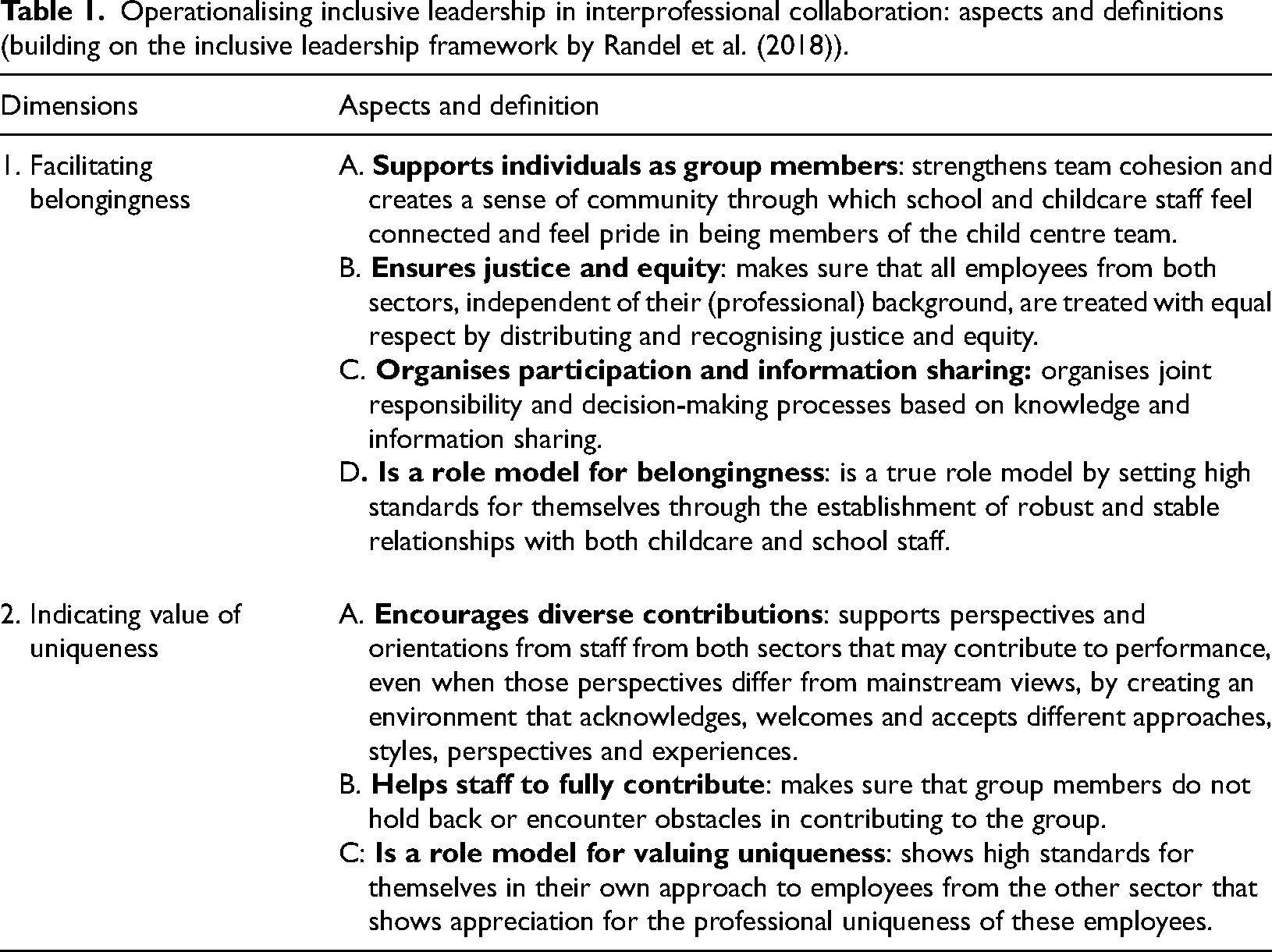
Table 1 provides an overview of the key aspects of the two dimensions of ILB in the theoretical model used here, as fitted to the context of fostering IPC in child centres.
Operationalising inclusive leadership in interprofessional collaboration: aspects and definitions (building on the inclusive leadership framework by Randel et al. (2018)).
From the literature discussed above, it may be concluded that inclusive leadership is a distinct leadership approach that responds to group members’ needs for belongingness and uniqueness. This is particularly important when interprofessional teams are diverse and status differences are present, as in health care and educational organisations (Edmondson et al., 2016).
Method
Design
Based on our research questions, a multiple case study design was adopted, as this type of qualitative research offers the possibility of collecting rich data on the research topic (Bernard 2013). Data was gathered through in-depth interviews with 24 school and childcare leaders in 12 child centres from two different regions located in the southern part of the Netherlands. Research by Guest et al. (2006) revealed that data saturation typically occurs after six to 12 interviews, so 12 interviews per leader type seemed adequate.
Sample
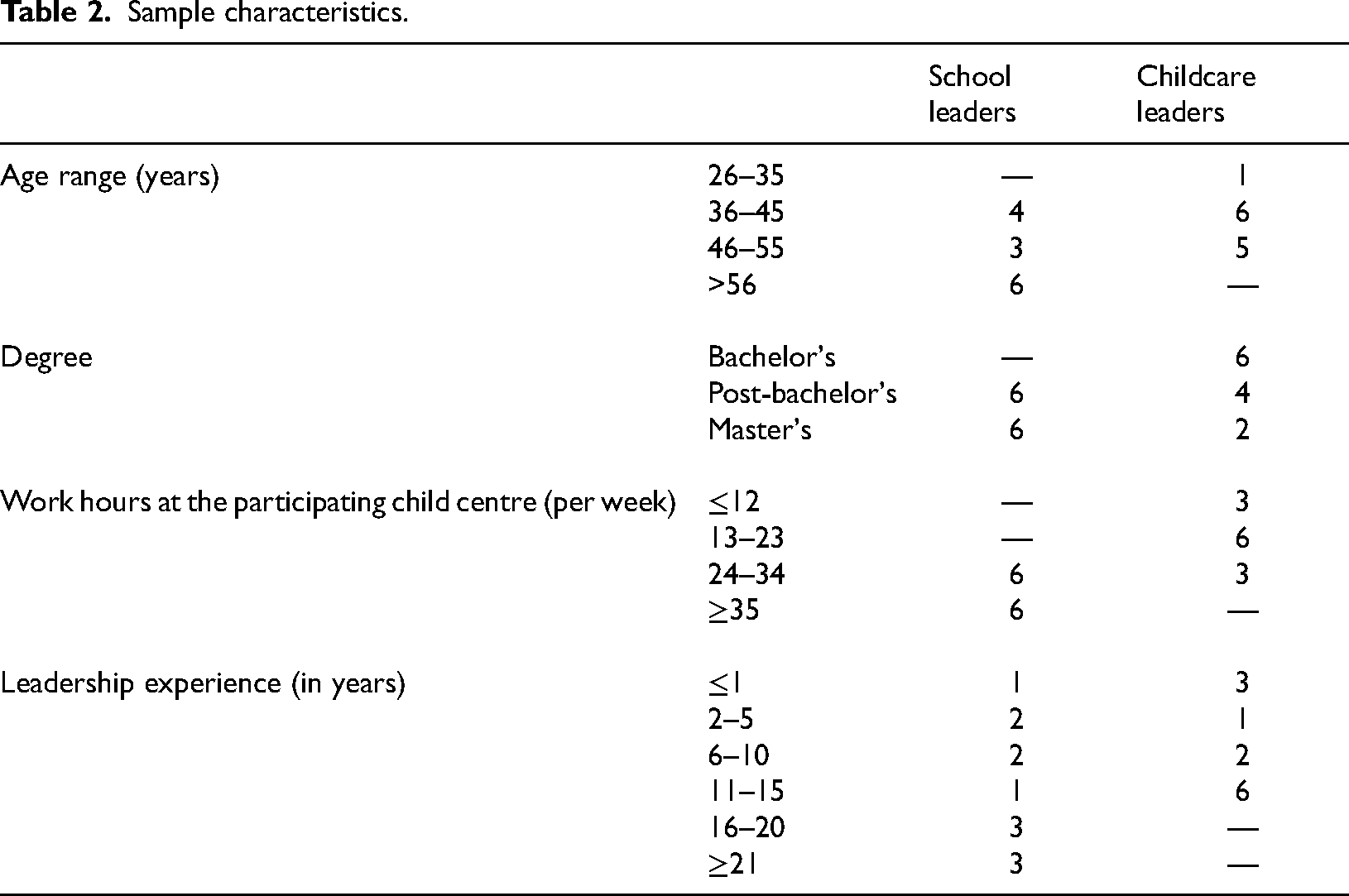
The first phase of the sampling involved convenience sampling based on the geographic location of the child centres, followed by purposeful variation sampling aiming to achieve deeper understanding (Robinson, 2014), for example, by seeking variety in the size of the child centres. To take this heterogeneity into account, as proposed by Hill et al. (2005), we decided to include 12 child centres in all, where interviews were conducted with both the leader in charge of the school and the leader in charge of childcare. Participation was voluntary: participants joined because they wished to intensify collaboration between the childcare and education staff within their own child centre. At each participating child centre, individual interviews took place with both the leader in charge of the school and the leader in charge of childcare. The 12 school leaders’ average age was 52.3 years (SD = 7.8) and six were female. The 12 childcare leaders’ average age was 44.8 years (SD = 5.8) and all 12 were female. The average tenure in the profession was 14.8 years for school leaders (SD = 11.1) and 8.2 years for childcare leaders (SD = 5.7). On average, school leaders worked 35.7 h (SD = 3.9) per week, in which they were responsible for one school, while childcare leaders had on average 16.0 (SD = 7.0) hours per week available for this childcare centre and – in the case of small child centres – often combined this with managing another child centre. Table 2 shows an overview of the characteristics of both samples.
Sample characteristics.
Procedure
Interview guidelines were developed in which leaders were asked to describe their actual behaviour aiming to enhance IPC between employees from both sectors and to give examples of these leadership behaviours. Key questions were pre-planned, but the interviews were also conversational, which means that topics were discussed in various orders. Two strategies were used to reduce the influence of social desirability, which is the tendency to respond in a way that participants think will make them look good according to prevailing standards (Bernard, 2013). Instead of questioning participants directly about ILB, we asked them to tell us about how they act in order to enhance IPC and asked for specific examples. The other strategy was to provide leaders with only a brief overview of the interview topics, since this helps avoid priming participants to answer in particular socially acceptable ways (Bernard, 2013). Therefore, participants were informed that ‘leadership’ and ‘enhancing interprofessional collaboration’ were interview topics, but inclusive leadership and the underpinning constructs of belongingness and uniqueness were not mentioned. These were addressed through further questions during the interview. During the interview, the researcher regularly recapitulated the interviewee's answers and inquired whether these recapitulations were correct. The interviews were conducted in Dutch and each interview lasted for 45–60 min. Interviews were recorded using a voice recorder and were fully transcribed afterwards. Quotes used in this article were translated into English.
Analysis
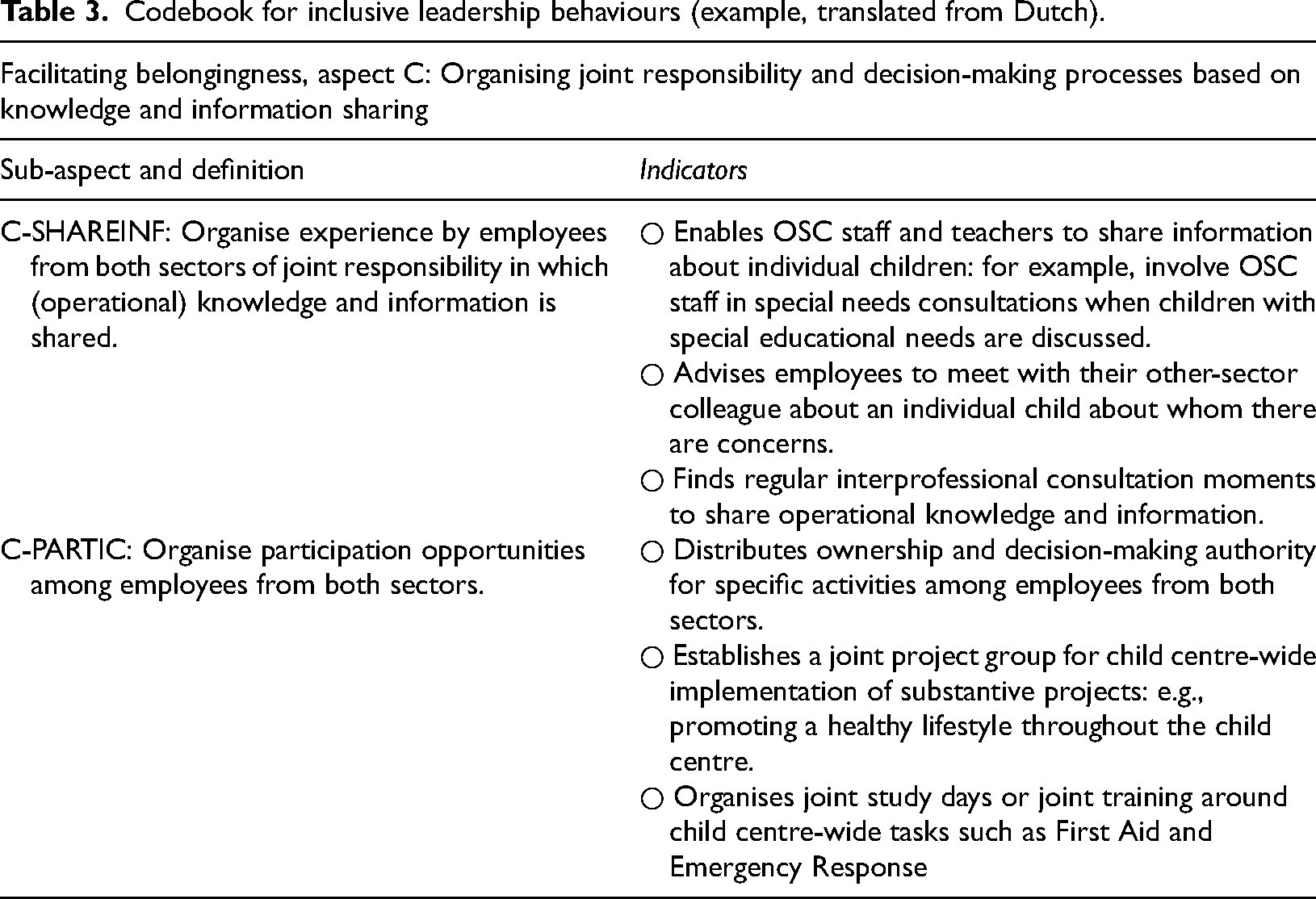
Qualitative content analysis was conducted, divided into inductive and deductive approaches as described by Elo and Kyngäs (2008). In the deductive approach, codes were theory-driven, based on the version of the theoretical model (Randel et al., 2018) shown in Table 1. All fragments from the 24 transcripts referring to ILB, mostly comprising one or two sentences, were selected as being meaningful and subsequently coded using Atlas.ti. Whenever a new issue was touched upon, a new fragment was started. This deductive approach was then accompanied by an inductive analysis aiming to further refine and operationalise the model based on the empirical data. Thus, during the process of coding, analytical memos were added, and based on these, the following adjustments were made at the level of aspects. The theory-driven aspect ‘Organises participation and information sharing’ in the original theoretical model (Randel et al., 2018) was split into two aspects, because some leaders described behaviours that enabled participation, while others tended to focus more on information sharing only. Table 3 shows an example from our codebook, which illustrates aspects, sub-aspects and indicators grounded in our qualitative content analysis.
Codebook for inclusive leadership behaviours (example, translated from Dutch).
In the original model, Randel et al. (2018) inclusive leadership was explicitly defined as positive leadership behaviours; however, our data revealed that leaders also described behaviours that showed being a negative role model or described behaviours that could not be considered positive in terms of ILB. Therefore, this distinction was included in the codebook, and fragments were scored as indicating either positive behaviour ( + ) or non-positive behaviour (-). For instance, the following text fragment was coded Justice and equity, positive behaviour: A day-care worker wondered how we could have come up with this time [for a joint meeting], because at that time all the young children are put to bed. I had chosen the time because it seemed convenient for the teaching colleagues. But for them only, so now I have reversed it so everyone can participate. (school leader 2)
And the following text fragment was likewise coded Justice and equity, but indicated non-positive behaviour: I have organised project group structures in our child centre, with quite a few meetings throughout the year. These meetings are usually scheduled outside of school hours – between a quarter past 3 and a quarter past 5 – but as a result, the ladies from [name of childcare organisation] cannot participate because they are responsible for OSC. (school leader 11)
To answer our first research question, we used multiple-label classification (Hill et al., 2005) based on data from eight participants and up, with the categories general, typical, variant and rare. We adopted these categories with minor adjustments so that they better reflected our research. This meant that we changed the label ‘variant’ to ‘occasional’ to avoid connotations that may arise when using the word ‘variant’. We also specifically identified the number of participants per category to make it meaningful for the 12 interviews per sample in our context. This led to a classification of ‘general’ for behaviours identified by 11 or 12 participants, ‘typical’ for those mentioned by 6–10 participants, ‘occasional’ for 3–5 participants and the label ‘rare’ for behaviours mentioned by only one or two participants. When a specific behaviour was not mentioned by any participant, a dash was used.
Results
Before presenting our results in detail, our first finding is that the theoretical model appeared to be appropriate for interpreting ILBs of school leaders and childcare leaders and that all aspects of ILB were noted. Presentation of the results is organised by our research question, aiming to understand how school and childcare leaders describe their leadership behaviours in terms of ILB as captured by the model.
Research question 1: ILBs
In total, 368 text fragments were coded, 303 indicating facilitating belongingness and 65 indicating valuing uniqueness. When grouped into positive and non-positive behaviours, 278 fragments were coded as positive and 90 fragments were coded as non-positive. Table 4 shows the frequency counts for ILBs by aspect and sector.
Frequency categories (counts) per aspect of inclusive leadership behaviour.
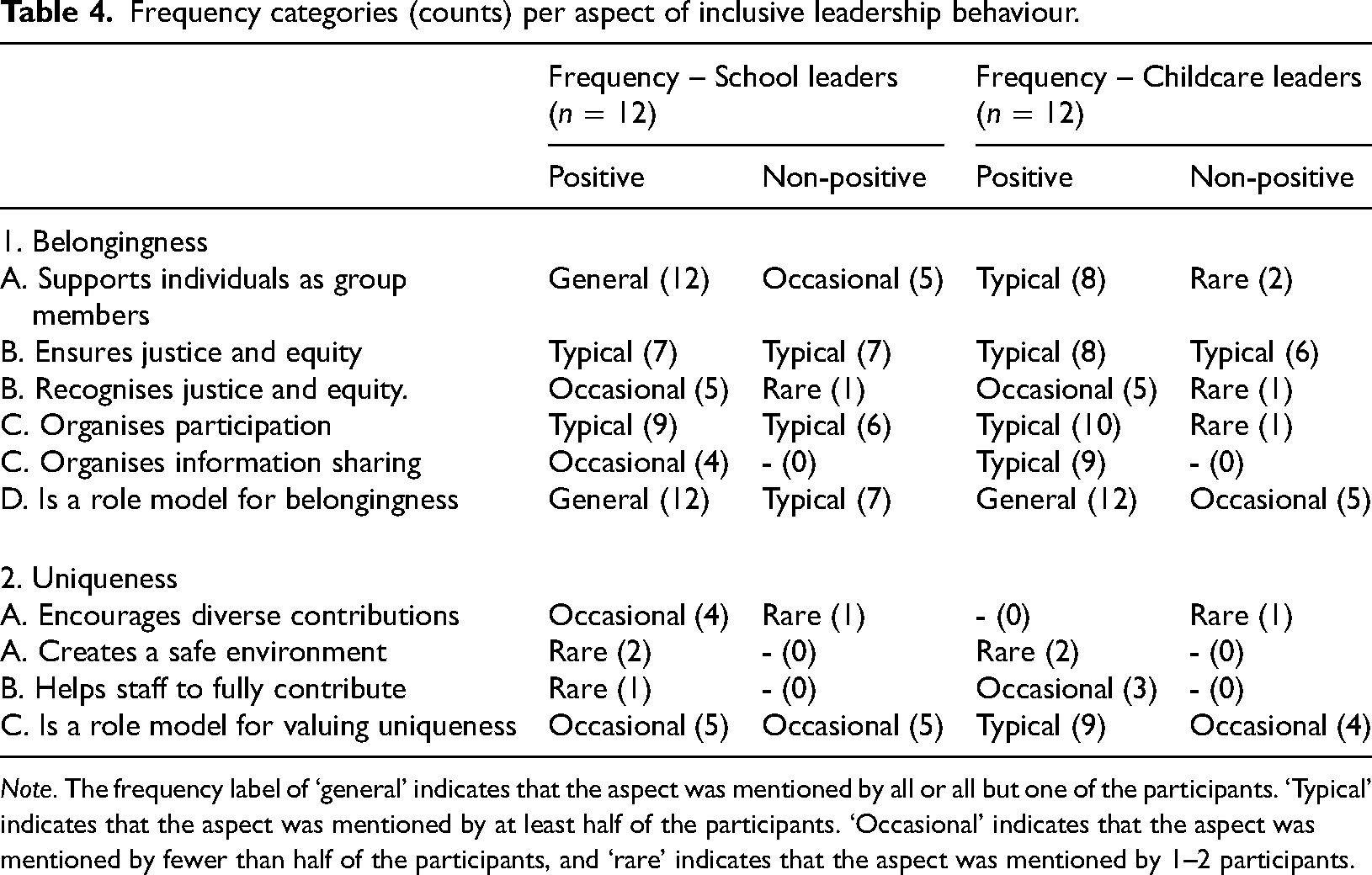
Note. The frequency label of ‘general’ indicates that the aspect was mentioned by all or all but one of the participants. ‘Typical’ indicates that the aspect was mentioned by at least half of the participants. ‘Occasional’ indicates that the aspect was mentioned by fewer than half of the participants, and ‘rare’ indicates that the aspect was mentioned by 1–2 participants.
In the remainder of this section, results for ILB behaviours will be presented using the four frequency categories: generally, typical, occasional and rarely found among our participants.
General occurrences of ILB
Of all ILB in our model, only positive ILB related to being a positive role model for belongingness was mentioned by all participants, both school and childcare leaders. The data for this aspect illustrated how school and childcare leaders showed interest in employees from the other sector, for example, by greeting them at the beginning and end of the workday and having brief informal conversations. Sometimes participants adjusted their lunch breaks to meet staff from the other sector. School leader 2 shared: ‘What I always do, is spend at least 15 min of lunch time in the shared break room. That's where you meet’. Additionally, positive ILB regarding supporting individuals as group member occurred generally among school leaders. This involved creating opportunities for education and childcare staff to meet informally or taking opportunities to have joint activities so that a sense of community might begin to emerge. School leader 7 described: ‘The past year I have invested a lot of time in getting to know each other, so I invested mainly in creating informal moments together’.
Typical occurrences of ILB
As Table 4 shows, typically occurring ILB was observed for six types of behaviours among childcare leaders and for five types of behaviour among school leaders. Worth mentioning is the fact that both positive and non-positive behaviours regarding ensuring justice and equity were mentioned on a typical basis among both school and childcare leaders. Positive ILB regarding organising participation was also mentioned on a basis among school and childcare leaders, for instance, in relation to establishing joint project groups or joint study days. However, among school leaders non-positive ILB regarding organising participation was also categorised as typical. In some cases, school leaders seemed to miss opportunities for organising participation, due to a lack of awareness regarding the inclusion of staff from the other sector, as evident from the quotation provided by school leader 11: We’ve got the study afternoon on pedagogical practices scheduled for June. In the afternoon, when it's just for us, we’ll set the rules for the child centre, and in the evening, when the childcare workers join us, we’ll take a look at how these rules can actually be put into practice.
Positive behaviours categorised as typical only among childcare leaders were supporting individuals as group members, organising information sharing and being a role model for valuing uniqueness. That last finding is particularly of interest, given that it was the only aspect of valuing uniqueness that occurred on a typical basis. Positive role-model behaviour valuing uniqueness was apparent, for example, when leaders acquainted themselves with the unique characteristics of the other sector, as mentioned by childcare leader 8: ‘Seen from the child care sector viewpoint, we focus on the well-being of children, whereas at school, people are much more working in a result-oriented way. We could learn something from that’.
Occasional occurrences of ILB
Occasional mentions of ILB occurred for six types of ILB behaviour among school leaders and for four types among childcare leaders. In particular, being a role model for valuing uniqueness stands out here: in its non-positive sense, both childcare leaders and school leaders mentioned this behaviour on an occasional level, while school leaders also mentioned its positive sense on an occasional level. Non-positive behaviour related to being a role model, for instance, could include an implicit assumption about childcare workers, as this quote shows: I told the teachers not to worry when childcare workers pass on copy for the information bulletin for parents. I said: ‘They can write as many mistakes in it as they want because I will revise their text’. (school leader 8)
The aspect recognising justice and equity in a positive sense was categorised as occurring occasionally for both school leaders and childcare leaders. This could involve clarifying that speaking in negative stereotypes about colleagues from the other sector was unacceptable behaviour, but it also involved fostering understanding for the ways employees from the other sector act, as explained by school leader 2: When my employees notice that childcare workers do things differently, they don't always understand it. The only thing I can do as a school leader, is to always explain why they do as they do, that it has to do with stricter regulations in childcare. I have noticed that my staff sometimes find it difficult to engage in a consultation with a teacher. My approach then is to practice such a conversation with them and help them with how to bring up their message.
Rare occurrences of ILB
An ILB was mentioned at the rare level of frequency nine times in Table 4, mostly within the dimension of valuing uniqueness, indicating that these behaviours were mentioned very little among our participants. Among both school and childcare leaders, these behaviours concerned creating a safe environment, and only among school leaders they were related to helping their staff to fully contribute. Non-positive ILB that was categorised as rare among both school and childcare leaders was related to encouraging diverse contributions and to recognising justice and equity within the belongingness dimension. A final non-positive behaviour mentioned rarely by childcare leaders concerned supporting individuals as group members.
Discussion
This study aimed to operationalise a recent theoretical model of inclusive leadership (Randel et al. (2018) in the context of IPC, to explore the extent to which this model can be useful to interpret leadership behaviours of school and childcare leaders striving to enhance IPC. A qualitative approach offered us rich data about how 24 leaders in child centres fulfil their leadership roles related to IPC. Based on the results, four conclusions can be drawn.
Firstly, we operationalised the theoretical model of inclusive leadership and applied it successfully to interpreting leadership behaviours of school and childcare leaders striving to enhance IPC.
Secondly, our study revealed that in our sample, more leaders described ILBs facilitating belongingness, such as role-model behaviour and organising participation, than leadership behaviours valuing uniqueness. This confirm the assumption that behaviours valuing uniqueness are less evident and require more effort (Randel et al., 2018). Creating a psychologically safe environment, an aspect of ILB valuing uniqueness, was mentioned only rarely by our participants. And this may be problematic, given the instances of professional hierarchy found in previous research (Basford, 2019; Keuning et al., 2022). Psychological safety is a necessary requirement for inclusion, especially for employees with lower (professional) status, as is generally applicable to childcare workers in their collaboration with primary school teachers.
Thirdly, we found that non-positive behaviours were mentioned concerning nearly all aspects for both dimensions, including role-model behaviour, although with varying frequencies. Showing both positive and non-positive inclusive behaviours is dysfunctional, because leaders disrupt an unambiguous message to employees about norms and expectations regarding what behaviour is expected of them (Boekhorst, 2015; Nishii and Paluch, 2018; Ostroff and Bowen, 2016). In our study, 19 of 24 leaders sent such conflicting messages to their employees. It is also salient that such positive and non-positive behaviours related to ensuring justice and equity were found to be mentioned typically by both childcare and school leaders. Taken into consideration that justice and equity are required in the first place in diverse teams (Nishii and Rich, 2014), non-positive behaviours will undermine positive behaviours within this aspect.
While we did not investigate antecedents of behaving like a role model, leaders’ personal beliefs could be influential. In our sample, school leaders were all male, were on average older, more often held a master's degree, had longer job tenure and worked more hours a week. Therefore, it could be that school leaders perceived themselves to have higher status compared with their collaborating childcare partner. As a consequence, school leaders could perceive greater psychological safety when speaking up and could show less consideration towards colleagues with a different professional background compared to childcare leaders.
In conclusion, our study shows that the theoretical model of inclusive leadership investigated (Randel et al., 2018) is appropriate for interpreting ILBs in interprofessional educational settings. Apart from the empirical findings of our study, the study also makes theoretical contributions to the literature on inclusive leadership by operationalising and refining that theoretical model. We added role-model behaviour explicitly as a separate aspect to the theoretical model. Furthermore we added non-positive behaviours to account for leaders’ descriptions indicating that they were missing opportunities in situations where ILB would be essential, by not showing any expressions of ILB, or (possibly unintentionally) showing negative expressions of ILB.
Implications for further research and practice
Despite the limitations, such as the fact that the data came from a small sample of child centres and that, due to practical limitations, data was collected via self-reported behaviours (interviews), whereas in an ideal situation, one would also want to study behaviour through observations and by adding the employee perspective, the results have the following implications.
Based on our findings, it appears that ILB is a promising and complementary approach for leaders who are striving for an inclusive climate and aim to achieve high-quality IPC. We gained knowledge of specific behaviours that may be helpful to intensify IPC between primary schools and childcare services, thus supporting the current tendency in which collaboration between schools and their partners is a crucial component.
We also gained insight into non-positive behaviours that are unhelpful in creating an inclusive organisational climate and could rather be categorised as what Shore and Chung (2021) considered ‘leadership emphasising exclusion’ (p. 16). In the same vein, it is also notable that ILB valuing uniqueness was still far from common in our sample. As a result, leaders may (unintentionally) foster an organisational climate for assimilation (Shore and Chung, 2021), where acceptance takes place ‘conditionally’, by adaptation to the dominant party. This is not problematic for employees who identify with the ‘dominant’ party, (in our research: the education sector) but for other employees, non-inclusion then remains.
Our study also provides focal points for further research. For instance, we would suggest a validation study of the operationalisation of this model. It could also be relevant to conduct similar research in contexts where primary schools collaborate with other partners, such as youth care or health. And finally, longitudinal research could be relevant to gain insight into how ILB develops over time and what effects of ILB on IPC can be studied. Additionally, within the context of strategic HRM, research into how ILBs can contribute to outcomes at the individual level (such as perceived feelings of inclusion), the organisational level (for instance more IPC) and societal level (e.g., children's learning and wellbeing) would contribute to this emerging research field.
Practical recommendations based on our findings focus in particular on more attention to using ILB valuing uniqueness and to avoiding non-positive ILB. Both policymakers and management could use our operationalisation of the theoretical model of inclusive leadership to pay attention to this issue. Professional development for school and childcare leaders in child centres is also advocated; not only because of the non-positive behaviours we found but also because ILB valuing uniqueness was still far from common. From a practical as well as a scientific perspective, this would provide fruitful knowledge about how such a professional development program could contribute to the improvement of ILB and, ultimately, achieve the benefits of high-quality IPC in educational contexts. It is time for educational research to broaden the concept of inclusion, as formulated in the UN Sustainable Development Goal 4, which strives for ‘ensuring inclusive and equitable quality education’. It should encompass the importance of inclusivity among all staff that is involved in providing education and care to children, as reflected in this study. To achieve this, it is paramount to recognise the value of diverse perspectives and emphasise the contribution of these perspectives makes to achieving inclusive and equitable quality education. Inclusive leadership has the potential to make a greater contribution to improving educational outcomes that benefit children and, more broadly, the community, than is currently the case.
Footnotes
Declaration of conflicting interests
The author(s) declared no potential conflicts of interest with respect to the research, authorship, and/or publication of this article.
Funding
The author(s) disclosed receipt of the following financial support for the research, authorship, and/or publication of this article: This work was supported by the Nederlandse Organisatie voor Wetenschappelijk Onderzoek, (grant number 023.013.021).
