



Abstract
In England, a new Education Inspection Framework (EIF) was launched in 2019. The Office for Standards in Education, Children's Services and Skills (OfSTED) describes it as evolutionary in bringing out education improvement. Others criticise its methodology and detrimental impact on schools. This study compares the foci, evidence-collecting methods and inspection decision-making processes between the 2015 Common Inspection Framework and the 2019 EIF. Eight headteachers were interviewed about their inspection experiences. Findings show that the headteachers purposefully employed micropolitical strategies such as acquiring the support of others, creating a favourable impression, shaping discussion and decisions, weakening opposition, and hyper-enacting policy to advance organisational interests. Six out of the eight schools in this study were rated ‘Good’ under EIF. However, the EIF left the power imbalance between OfSTED and schools and fear-induced performativity unchallenged. Headteachers and teachers were forced to engage in a new game at the cost of their physical and emotional well-being. This study aims to advance knowledge of the ongoing inspection reform in England. When other countries use OfSTED frameworks as a benchmark for designing their own inspection systems, it is crucial to carefully examine the potential detrimental impact associated with the inspector-school power imbalance and fear-induced performativity.
Introduction
In September 2019, the Office for Standards in Education, Children's Services and Skills (OfSTED) introduced a new Education Inspection Framework (EIF) to inspect education providers in England under section 5 of the Education Act 2005 (OfSTED, 2019). Shortly after its implementation, COVID-19 disrupted school daily operations, leading to the suspension of routine inspections in March 2020 (OfSTED, 2020). Roughly 1.5 years later, OfSTED resumed inspections, including targeted inspections of formerly exempt ‘Outstanding’ schools. By summer 2025, all schools and further education providers will undergo inspection at least once under the new framework.
A joint statement from the National Association of Head Teachers (NAHT) and the law firm Browne Jacobson declares that many schools were seeking inspection advice, with many expressing dissatisfaction over OfSTED's lack of genuine consideration regarding the impact of COVID-19 on schools (Browne Jacobson, 2022). The NAHT, Association of School and College Leaders and the National Education Union, criticise this new wave of inspections for lacking ‘understanding of the exhaustion and stress felt by teachers and leaders’ and promoting ‘strange ideas about the priority for education recovery’ (Henshaw, 2021).
Tensions between schools and OfSTED escalated when primary school headteacher Ruth Perry tragically took her own life in January 2023 while awaiting OfSTED results, fearing her school's downgrade from ‘Outstanding’ to ‘Inadequate’ (Weale, 2023). Following her death, a parliamentary petition was initiated to review the EIF and associated methodology, including the elimination of one-word ratings (UK Government and Parliament, 2023). Additionally, a YouGov Teacher Track Survey from May 2023 revealed that 90% of teachers held a very or somewhat unfavourable view of OfSTED. The poll also indicated discontent with the Department for Education (81% of teachers) and the Education Secretary (69%) (Callery, 2023; Smith, 2023). Despite unpopularity among teachers, both His Majesty's Chief Inspector (HMCI) Amanda Spielman and Education Secretary Gillian Keegan defended the one-word inspection rating system for aiding parents’ school selection (Callery, 2023).
To address schools’ resistance, HMCI Amanda Spielman asserted, ‘In fact, inspection results this term are very much in line with what we saw before the pandemic began, if not slightly improved. That will be a reassurance to parents and to schools as well’ (OfSTED, 2021). Data demonstrate that between September 2019 and November 2021, 87% of schools were rated ‘Good’ or ‘Outstanding’, similar to the 86% reported in August 2019 prior to EIF and COVID-19 (OfSTED, 2021). In June 2023, a re-inspection of Ruth Perry's school resulted in a ‘Good’ judgement, a few months after the initial downgrade, raising questions about the validity of inspections (Adams, 2023).
So, is the 2019 EIF a better framework for inspectors to fairly judge school performance or is it a new game in town perpetuating the powerful inspection regime? Drawing on previous studies and new evidence, this paper examines eight headteachers’ interpretations and experiences of EIF from the perspective of micropolitical strategies. The reason for choosing this angle is that micropolitical strategies can explain the existence of performativity during inspections and illustrate how power dynamics influence inspection results. According to Hoyle (1982), micropolitics is an underworld that we all recognise and participate in but rarely speak about. Micropolitics enables individuals and groups to utilise resources and exercise agency for the purpose of sustaining or furthering their own interests (Colman, 2021; Foucault, 1988; Hoyle, 1982; Lumby, 2015). This article answers the following questions:
How does the 2019 EIF differ from the 2015 Common Inspection Framework (CIF)?
What micropolitical strategies and tactics do headteachers employ in response to EIF?
Policy review: Comparing the 2015 CIF and the 2019 EIF
To understand the background of this study, a comparison of the 2015 CIF and the 2019 EIF can shed light on their different foci, evidence-collecting methods and inspection decision-making processes. The two frameworks diverge in four areas.
Firstly, the EIF introduces a new ‘quality of education’ domain by merging the previous ‘teaching, learning & assessment’ and ‘outcomes’ domains in the CIF. To evaluate ‘quality of education’, EIF has a sharper focus on the ‘intent, implementation and impact’ of the school curriculum. The OfSTED defines ‘intent’ as how the ‘school curriculum sets out the knowledge and skills that pupils will gain at each stage’; ‘implementation’ means how the curriculum is developed, adopted, taught and assessed by the school ‘in order to support pupils to build their knowledge and apply that knowledge as skills’; and ‘impact’ refers to ‘the outcomes that pupils achieve as a result of the education they have received’ (OfSTED, 2019, sec. 195).
The 2019 School Inspection Handbook (OfSTED, 2019, sec. 218) underlines that ‘there need be no conflict between teaching a broad, rich curriculum and achieving success in examinations and tests’. This confirms that curriculum constitutes the core of inspection and test results should partially reflect the curriculum impact. When designing and piloting the EIF, OfSTED carried out in-house research and produced 25 indicators to help inspectors look beyond student test scores when examining curriculum quality. For example, ‘reading is prioritised to allow pupils to access the full curriculum offer’ and ‘leaders enable curriculum expertise to develop across the school’ (Henshaw, 2019, para. 13). By comparison, the CIF was more data-driven and outcome-oriented. Inspectors used to take account of ‘current standards and progress, including the provider's own data, and make a relevant judgement on academic and other learning outcomes for children and learners’ (OfSTED, 2015, sec. 32).
The second change in the EIF involves dividing the previous ‘personal development, behaviour and welfare’ domain into ‘behaviour & attitudes’ and ‘personal development’. Inspectors are expected to provide a more accurate and nuanced judgement on school's short and long impact on students. The ‘behaviour & attitude’ domain measures how schools ‘create a safe, calm, orderly and positive environment’ that ‘contribute(s) most strongly to pupils’ positive behaviour and attitudes’ (OfSTED, 2019, secs 226–227). The ‘personal development’ domain evaluates ‘the school's intent to provide for the personal development of all pupils, and the quality with which the school implements this work’ (OfSTED, 2019, sec 241). Acknowledging the influence from home, community and elsewhere, the EIF recognises that schools are not solely responsible for students’ personal development (OfSTED, 2019, sec 242). The policy wording also changed from developing learners’ ‘self-confidence, self-awareness and understanding of how to be a successful learner’ (OfSTED, 2015, sec Personal development, behaviour and welfare) to a broader definition of developing learners’ ‘resilience, confidence and independence’ and helping them ‘keep physically and mentally healthy’ (OfSTED, 2019, sec Personal development). This change implies that the long-term welfare of learners, rather than their short-term cognitive, physical and mental development, has become the new focus in EIF. More importantly, schools are no longer treated as isolated environments that influence students’ behaviour and understanding of the world; instead, they are regarded as an integral part of a larger society.
The third change manifests in extending inspection days for evidence collection (Spencer, 2019). Under the 2015 CIF, OfSTED undertook one-day short inspections in schools that were previously judged ‘Good’ and the short inspection cycle ran approximately every three years (Harford, 2015; OfSTED, 2015, sec. 25). Since 2019, short inspections of ‘Good’ or ‘Outstanding’ schools last for two days with the exception of small-sized primary schools and nurseries (OfSTED, 2021). Prior to the inspection, the lead inspector calls the school headteacher to have a 90-min conversation about the school context, progress made since the last inspection and the practical arrangement of the inspection (OfSTED, 2021). Early evidence shows that this 90-min dialogue was regarded as ‘most helpful and constructive’ by headteachers and inspectors (OfSTED, 2021, sec 114). It is expected that by spending more time in schools, inspectors will better appreciate individual school context and judge school performance in its entirety.
The fourth change involves utilising in-depth dialogues to solicit insights into how schools address and resolve challenges within their specific contexts. EIF guides inspectors to examine how schools lead the process of identifying, addressing and improving performance using curriculum, leadership, management and school policies as tools. Headteachers and teachers are given the opportunity to articulate how they have applied existing knowledge and experience in less-developed areas that can yield tangible improvements in the near future (Russell 2022). It is argued that the EIF gives all schools, regardless of the level of deprivation, a fair chance to present their context and achievements (Henshaw, 2019).
In conclusion, the 2019 EIF has shifted its focus and measures to account for diverse school contexts and the progress of individual schools. On paper, these changes are expected to enhance inspection fairness, transparency and consistency. The OfSTED has also increased the amount of training to prepare inspectors for curriculum inspection and reporting (Henshaw, 2019). Meanwhile, schools are not passive recipients of the new inspection framework. Translating policies into practice heavily relies on local actors (Sausman et al., 2016). One way for headteachers to engage with and influence inspections is by using micropolitical strategies during their interactions with inspectors.
Analytical framework: Five micropolitical strategies
Micropolitics refers to using covert influence, savvy social skills or vast interpersonal networks to mobilise resources and affect decision-making in order to benefit individuals, small groups or organisations (Colman, 2021; Hoyle, 1982; Lumby, 2015). One key aspect of micropolitics is the exercise of power. Adopting a Foucauldian definition of discursive power, this study views power as flowing in different directions and manifesting itself in a broad spectrum of negotiation, persuasion and influence (Foucault, 1988).
Micropolitics is ubiquitous during high-stakes inspections (Constantinides, 2022). The inspection result has a profound impact on school's daily operation, reputation, student recruitment, parents’ choice, teacher retention, financial resources and future development (Colman, 2022; Elton and Male, 2015). Although OfSTED presents itself as a critical friend to schools, previous studies show that the OfSTED regime has left a legacy of distrust. Schools’ honest disclosures of challenges are often taken out of context and judged negatively against the school (Colman, 2021; Swaffield and MacBeath, 2005). Perryman (2006, p. 148) coined the concept ‘panoptic performativity’ to describe headteachers’ and teachers’ orchestrated performance dictated by the rigid inspection regime. To successfully navigate the inspection process, headteachers and teachers often internalise OfSTED's expectations. This involves aligning their behaviour with the descriptors outlined in the inspection handbook and parroting accepted discourses of effectiveness prescribed by OfSTED (Perryman et al., 2018). This self-imposed regulation persists even after the inspectors have left the school. Schools that are rated ‘Requires improvement’ or ‘Inadequate’ are subject to heightened monitoring and have to be ‘inspection ready’ all the time (OfSTED, 2019).
To attain a satisfactory result in high-stakes inspections, headteachers might use micropolitical strategies to subtly shape the perspectives of inspectors. Studying micropolitics in the higher education context, Lumby (2015) argues that organisational goals are often used to justify the use of micropolitical strategies. Instead of negating micropolitics for its illegitimacy, leaders should recognise that ‘micropolitics is the air of organisations and a fundamental engine of organisational change’ (Lumby, 2015, p. 8). Micropolitical strategies can be used in a helpful way to help headteachers navigate uncertainty and further organisational outcomes (Milliken, 2001).
Lumby (2015, 11) synthesises four micropolitical strategies: acquiring the support of others, creating a favourable impression, shaping discussion and decisions and weakening opposition. Each strategy comprises several tactics used by organisational members to negotiate, persuade and influence others. To acquire the support of others, the following tactics can be used: building coalitions and networks, trading, co-option, incentives, aligning with more powerful players and citing support from external experts or upward appeal (Blase and Anderson, 1995; Eden, 2001; Hoyle, 1999; Lumby, 2015). Creating a favourable impression can be achieved by using inspirational appeal, rationality, assertiveness, self-promotion and ingratiation (Ahlquist and Levi, 2011; Charbonneau, 2004; Curtis, 2003; Higgins et al., 2003; Lumby, 2015; Pfeffer, 1981). Shaping discussion and decisions entails tactics such as consultation, shaping selection, presentation and circulation of information, shaping committee/meeting membership, shaping meeting agendas and shaping criteria for decision-making (Hancock and Hellawell, 2003; Higgins et al., 2003; Lumby, 2015; Samier, 2014). Lastly, weakening opposition comprises tactics such as surveillance, blaming/attacking and imposing penalties (Lumby, 2015; Samier, 2014). Colman's (2021) study on micropolitics in school inspection proposes a fifth micropolitical strategy: hyper-enactment of policy. According to Colman (2021), hyper-enactment of policy entails tactics of vigilant policy compliance, decontextualised policy response, policy resistance and policy evasion. The above five micropolitical strategies constitute the analytical framework of the study.
Methodology
This qualitative study collected data from semi-structured interviews with six headteachers who underwent school inspections under both 2015 CIF and 2019 EIF and two leaders who led schools through their first inspections under 2019 EIF. The snowball sampling strategy was employed to recruit headteachers (Parker et al., 2019). Despite the small number of headteachers interviewed in this study, this sample represented different education levels (i.e., primary, lower secondary and secondary comprehensive) and types of schools (i.e., two Multi-Academy Trust (MAT) schools, two local authority-maintained schools, two independent single gender schools, one academy converter school and one independent special school). Moreover, these schools were chosen based on their varying inspection result trajectories: two schools received their first inspection outcomes, two improved their results, two maintained the same results and two experienced downgrades. Table 1 summarises the participant demographics and their school inspection results.
Research participants and school inspection results.
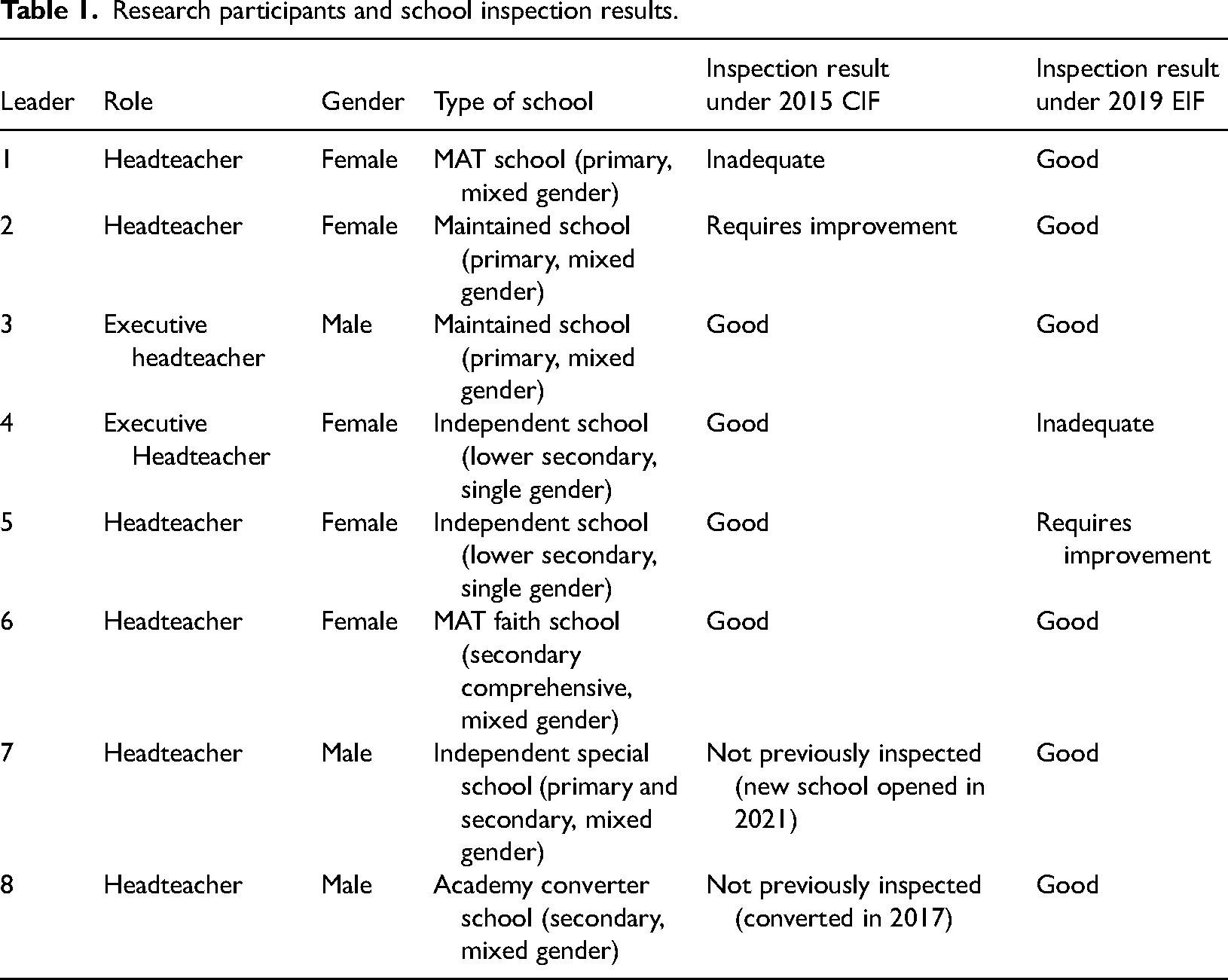
Ethical approval was obtained from the author's university. During the interviews, each headteacher was asked to recall their interaction with inspectors in their most recent inspection under the 2019 EIF. Those who led schools through inspection under the previous framework were also asked to draw comparisons with their previous inspection experiences under the 2015 CIF. The interview questions comprise three parts. The first part explores headteachers’ interpretations of the EIF and how their schools prepared for inspection. The second part probes into the discourses and interactions during the inspection. The third part examines the headteachers’ views on the inspection results and implications. Each interview lasted for 40–50 min and was audio recorded with a written permission from each interviewee. All the interviewees and their schools were anonymised during data analysis and reporting.
The interview data were transcribed and analysed using combined theory and data-driven approaches (Robson, 2023). The analytical framework of micropolitical strategies presented above was used to code the data. Different from Lumby's (2015) and Colman's (2021) list of tactics under each micropolitical strategy, interview data from this study suggested a list of different tactics pertinent to inspection experiences. Figure 1 synthesises these strategies and tactics.
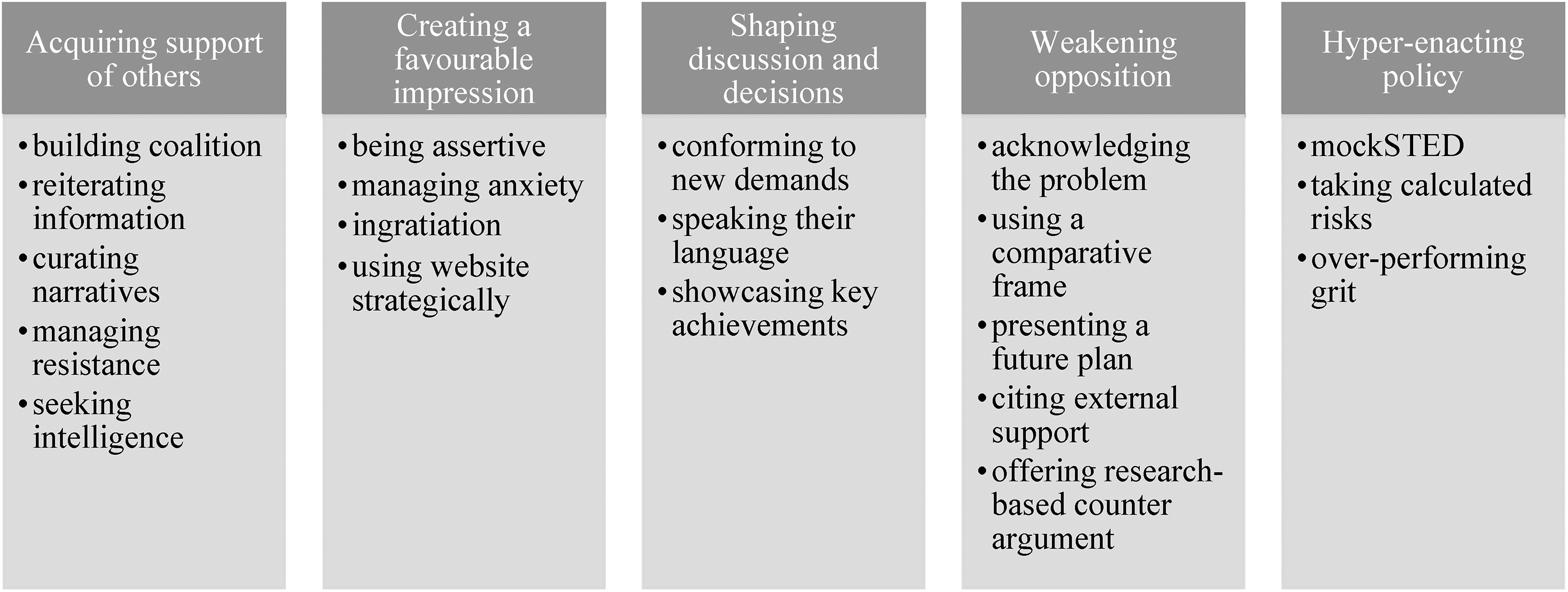
Micropolitical strategies and tactics used by headteachers during OfSTED inspection.
Findings
Acquiring support of others
The first employed micropolitical strategy was acquiring support of others at the preparation stage. To ensure inspectors receive consistent information about the school, the headteachers carefully built coalitions with governors, middle leaders, teachers and students by highlighting the importance of information triangulation. They (Inspectors) normally solicit information from leaders, governors, teachers and students and then triangulate it. It is vital to have everyone on the same page. You know you have to tell a coherent story about the school. (Leader 8)
We are a small school, so everyone takes responsibilities when OfSTED visits. We make sure everyone knows the strengths written in our SEF (self-evaluation form) and improvement plan. We knew OfSTED would come and had prepared for nearly two years. We have built two folders with all the inspection materials and will continue to add more to the folders. (Leader 2)
Importantly, preparing teachers and students for the inspection is not a ‘last-minute exam cramming’ but ‘a buy-in process’ (Leader 1) that required reiteration. Drip feeding key information about the school and school curriculum takes several months. It is more like a buy-in process. It takes a lot of repetition. (Leader 1)
Another tactic used by the headteacher was curating coherent narratives with staff. Concrete curriculum descriptors lent headteachers and teachers tools to align their practices with the accepted behaviour outlined in the EIF. I mean I’m lucky with staff, because I’ve got a very open and honest approach with them. They all want the school to do well. Can staff talk about the curriculum? Hum…I think we’ve got to a place where we are really confident. This is how we talk about the children and the curriculum. Because that is very specific in the framework (referring to EIF). (Leader 6)
In schools that got unfavourable inspection results in the past, managing resistance to inspection became a leadership priority. Some headteachers reserved time for teachers to vent their anxiety during the preparation. Overwhelming teachers (with inspection preparation) will only lead to resistance. People are frustrated during COVID. They need to talk about it and then we do whatever we are required to do. (Leader 1) Teachers say we are here for the children, not for people who hold power but know nothing about our circumstances. Last time, we got ‘Requires improvement’ and teachers were upset…We did a lot of work to emotionally bring teachers back to it (inspection). (Leader 2)
Several schools sought intelligence from NAHT and other schools during the preparation. Intelligence on the inspection questions, procedures and the even the perceived personalities of the inspectors was acquired. Definitely ask other schools for advice. It was incredibly useful. (Leader 1) By talking to other schools, we know what questions to expect. It is reassuring. (Leader 6) This (referring to EIF) is something new to them (OfSTED) and to us. We all have to make sense of the new framework. It is still very stressful. It was helpful to knowing (from other schools) that our lead inspector was friendly. (Leader 5)
Additional resources, such as articles on the OfSTED website, served as resources to keep headteachers updated on the latest inspection procedures. The NAHT's advice on how to present school curriculum, safeguarding and attendance data was deemed valuable by the headteachers. Notable guidance included recommendations against presenting school's internal data for the 2020–21 and 2021–22 academic years. Instead, it suggested using previously published external data to demonstrate initial starting points and address attainment gaps during inspections.
Creating a favourable impression
To create a favourable impression, the interviewees underscored the importance of being assertive during the 90-min phone call with the lead inspector. Headteachers tried to ‘speak coherently and confidently’ (Leader 3), ‘have all key data at hand’ (Leader 1) and ‘say we are well-prepared’ (Leader 8). One used the opportunity to highlight school's safeguarding work. I told them we were pleased that they called…I went through the COVID policies we had in the school so they knew we took safety seriously and they should follow these protocols when they visited us. (Leader 6)
You don’t have to hold all the information in your head. If you need data when you are stressed, the information is listed on a piece of paper. I kept on telling myself ‘you are prepared. You are going to lead them through your school and show them what you want them to see, well, not in a pushy way’. (Leader 3)
This time, we know we are good. We just need to convey that message…It is important that we have facts to back up. (Leader 2)
A psychological technique called ingratiation was used by the headteachers to intentionally make inspectors like them. For instance, they called OfSTED their critical friend, displayed conformity and performed a degree of measured honesty. I told them we wanted to be very honest with them (OfSTED). And let them know they are our critical friend. (Leader 8) You want them to be on your side really, like a critical friend. And listen very carefully to what they ask for. (Leader 7) We are upfront about our inadequacies and ask them for improvement advice as our critical friend. They are smart. If the school puts on a show, they can tell. (Leader 4)
An up-to-date website served as a portal to strategically demonstrate school's adherence to policies. Besides informing parents, using website to appease inspectors’ scrutiny was deemed crucial. We make sure the safeguarding policy reflects the latest government requirements. In the OfSTED report, they praised us for publishing the safeguarding policy on the website. (Leader 7) We are commended for publishing our safeguarding policy and complaints procedure on our website. They also noted that we made independent school standards available to parents online. (Leader 4)
The published OfSTED reports responses validated the efficacy of this tactic and shed light on what key information these inspectors sought under the new EIF.
Shaping discussion and decisions
According to the headteachers whose schools upgraded from ‘Inadequate’ or ‘Requires improvement’ to ‘Good’, the new framework afforded them a better tool to conform to the new inspection demands. Especially, school's socioeconomic context and its impact on students were given due consideration. I told them (OfSTED) that we had a lot of pupils on PP (Pupil Premium grant to improve education outcomes for disadvantaged pupils) and the school was located in one of the most deprived areas in the country…They took that into consideration in the report…Under old frameworks, this would have never been a ‘Good’ school. (Leader 1) Compared to previous inspections, the biggest difference I feel is that this time, they (OfSTED) got us. They understood the difficulties this type of school was facing and listened to our responses. (Leader 2)
You have to let them know that you speak their language, and the school is well prepared. You want the message to land. So, you have to give them what they look for. (Leader 8)
Some headteachers felt more anxious because EIF allowed inspectors to choose students for interviews. Students you can’t control because this time they (OfSTED) chose students. Earlier we could select. Now they just say, right, give us a list and we will choose. And you just hope the students (with a pause) say the right thing… (Leader 5)
Showcasing key achievements was another tactic used by the headteachers to shape discussion and decisions. For example, when introducing school's broad curriculum and support for pupils with musical talents, Leader 6 showcased pupils who participated in the musical festival. Using artefacts to teach behaviour and attitudes also had a convincing effect on inspectors. Leader 3 demonstrated how pupils wore wristbands to learn about bullying. We use wristbands to teach pupils the concepts of bullying, tolerance and diversity. Pupils like wearing them. When they look at their wrists, they learn that bullying means repeated, intended behaviour to hurt someone physically or emotionally. OfSTED gave positive comments on our ‘behaviour and attitudes’. (Leader 3) Learning maps are stuck to students’ workbooks as visual stimuli to help teachers and students talk about what we’re learning, and this is the journey we go through… (Leader 1)
Schools 4 and 5 were previously rated ‘Good’ and now received ‘Inadequate’ and ‘Requires improvement’. Some new leaders got unfavourable comments because they downplayed their achievements or failed to highlight the curriculum consistency across the school. They (OfSTED) say we have many leaders new to post. Some lack training to understand how to design and evaluate the impact of curriculum. Maybe we did not convince them how we helped pupils build knowledge over time. We do check pupils’ progress I mean…But they want to hear how we do that CONSISTENTLY (emphasised by the interviewee). (Leader 4)
Failing to justify variations in teaching also pushed the school to a lower grade under the EIF. The report says many of our teachers do not check students’ understanding, errors and misconceptions regularly. Some teachers lack resources to teach effectively. Some lack subject knowledge. Students’ learning is slowed. We have resource problems here. But you know…luck also plays a role. We did not convince them that we had a plan to address these problems. Maybe it is not strong enough. (Leader 5)
While in some instances, headteachers steered discussions to underscore the contextual nuances and accomplishments of their schools, the majority of interviewees recognised the existing power imbalance between OfSTED and schools. The criteria-making and decision-making power rested with OfSTED, whilst schools were made to ‘jump through hoops’ (Leader 3) and ‘do what OfSTED wants’ (Leader 7). The performative nature of inspection persisted, albeit certain school-specific characteristics were recognised by inspectors.
Weakening opposition
When presenting school's challenges and inadequacies, the headteachers used three tactics in combination to shield potential criticism from OfSTED.
Step 1 Acknowledging the problem. ‘We have a student attendance problem during COVID’. According to Leader 1, pointing out this problem gave her a chance to present a solution without appearing defensive. ‘It would not be helpful to hide or deny this because they can see the data. Don’t say it is a new problem. Say we know this and we have a solution’. (Leader 1) Step 2 Using a comparative frame. ‘Then I said our attendance rate was still above the national average. And I told them that our school was in a disadvantaged area. Many families are not well resourced to support every child to study online during the pandemic’. (Leader 1) Step 3 Presenting a future plan. ‘I told them we had arranged home visits to understand and combat student absenteeism. We have added student engagement to our curriculum’. (Leader 1) Step 1 Acknowledging the problem. ‘We were very honest with them because they can unpick things. We had some concerns about one subject. Our Geography lead had left the school. So, we told them honestly’. (Leader 2) Step 2 Using a comparative frame. ‘Our last inspection was in November 2018. It took us by surprise, and we were not prepared. This time, we had two years to prepare. I told them (OfSTED) that our SLT (senior leadership team) was more established compared to last time and each member received 1:1 coaching from Teach First’. (Leader 2) Step 3 Presenting a future plan. ‘The SLT has set up a contingency plan to cover teaching and recruit new teachers. We made sure that the governors said the same thing’. (Leader 2) In the report, they (OfSTED) noted that some staff did not tailor work carefully enough to serve students with additional needs in our school. Because we are a special school, we must show that safeguarding is taken seriously by the leadership. We keep all the records. How we responded to these cases and what training we provided. Which agencies we involved. How many specialists we hired to work with children. (Leader 7) Quite a lot of micro-management of staff. Observations, data scrutiny, curriculum and so on. Because you need evidence to show them (OfSTED). One of the reasons why many teachers left the school. (Leader 4)
Leader 2 also succeeded in weakening OfSTED's opposition using these tactics combined with an additional tactic of citing external support from leadership CPD training and governors.
To withstand harsh scrutiny, meticulously recording evidence helped schools pass inspections but it also drove some teachers to leave the profession.
In English, maths and music, some pupils grasp ideas quickly and want more. Some are happy with routine exercises. When having the deep-dive (into subjects), we explained why and how we used different activities to incentivise pupils’ curiosity. There is research evidence to back it up. (Leader 8)
Subject deep-dive was considered the most stress-inducing exercise during inspection. Some deep-dive questions raised by inspectors were impossible to answer and consequently led to negative inspection results. The deep-dive experience is too much. Some questions are not realistic for subject leaders to answer. There is too much pressure on them. Some were in tears because they felt they had let our school down. (Leader 4) Some of our experienced teachers felt ridiculed during the deep-dive. These questions are not deep. They are trivial and not possible to answer. (Leader 5)
Hyper-enacting policy
Hyper-enacting policy is a micropolitical strategy underpinning the above-mentioned strategies. The headteachers highlighted that when OfSTED told them ‘not to prepare anything in particular for the inspection, it should not be taken literally’ (Leader 3). Because inspection is ‘high-stakes and extremely stressful’ (Leader 6), ‘nobody feels relaxed before we receive a good result’ (Leader 8). The EIF and COVID-19 imposed additional challenges; being ‘inspection-ready’ meant school leaders and teachers had to excessively prepare for inspection using mock practices, mockSTED. We went through the inspection framework and handbook with ‘a fine-tooth comb’ multiple times. We feel they (OfSTED) are constantly testing our knowledge about the school and the framework. (Leader 3). We prepared for a deep-dive in every subject. Staff from another school came and observed lessons and MockSTED subject leaders. Our SLT talked about nothing but OfSTED for 18 months. We tried to guess what questions they might ask us and how to respond. (Leader 5) The MAT has its own quality assurance system and we do regular learning walks. Then we reviewed everything during MockSTED and prepared another version (of school performance) for OfSTED. (Leader 6)
I did not want to leave the impression that COVID was an excuse for not meeting the standards. We were ready and well-prepared. I just wanted them (OfSTED) to see that. (Leader 2)
This was carefully balanced by taking calculated risks to expose some school-specific challenges such as staff shortage, poor student attendance and behavioural problems, and more importantly, how schools went above and beyond to overcome these challenges. For example, School 8 is an Academy converter school. The headteacher used policy hyper-enactment to change the negative image left by their predecessor. We go above and beyond when it comes to safeguarding. Our teachers made sure that pupils were safe on campus. Not just that, pupils also learned to mitigate risks and stay safe when using the internet and social media. Our staff discussed mental health and emotional well-being with pupils. We got commendations for this in the report. (Leader 8)
School 7 is an independent special school that received its first inspection in 2021. To gain an overall judgement of ‘Good’, the headteacher and teachers designed an ambitious curriculum to give pupils, including the those with complex needs, a variety of activities. We take EHC (education, health and care) plans very seriously. We looked into each learner's past experiences, abilities and special needs. Case by case, each pupil sets his or her start point in the curriculum. It is complex and time-consuming. For example, managing disruptive behaviour is very difficult in our school. So our staff broke a big task into bite-sized activities. We wanted OfSTED to see that we made a huge effort to serve individual learners. (Leader 7)
The two-day inspection only provided a snapshot of the school. To present their schools in the best possible light, headteachers adopted this ‘better safe than sorry’ (Leader 5) mentality, and sometimes over-performed grit. The 90-min phone call was intense. Kate (pseudonym, lead inspector) was great. She said if I wanted to take a break or invited others to join the discussion, I could. But then I was thinking maybe she was testing me. So, I said no, I did not need that. I can manage. (Leader 1) The SLT spent evenings and weekends preparing for inspection. You have to make tough choices sometimes. Now we received ‘Good’. We can go home after work. (Leader 2)
Discussion
Colman (2021) reveals that OfSTED rewards schools that conform to inspection criteria and places less emphasis on how schools navigate their complex sociocultural contexts. The 2019 EIF is anticipated to offer schools equal opportunities to explain how they tailor practices to best serve learners’ diverse needs. This empirical study unveils how school headteachers strategically employed micropolitical strategies to shape inspectors’ perceptions of the school during the ongoing inspection reform.
Translating EIF into practice is a sensemaking process. For instance, the new framework acknowledges that ‘performance data may lag behind’, and thus, inspectors should ‘view national data in this context’ and look for qualitative evidence that supports school's ‘significant and sustained improvement’ (OfSTED 2019, sec. 224). To account for the impact of COVID-19, ‘attendance between March 2020 and March 2021 will not impact inspector's judgement of the school’ (OfSTED 2019, sec. 288). In practice, which evidence holds substantial weight and how to interpret it remains ambiguous, necessitating an extensive process of sensemaking. This sensemaking process resulted in different interpretations of and advice on the framework, and in some cases, disparities in inspection experiences and results. As headteachers in this study pointed out, certain inspectors demonstrated a greater understanding of and respect for school's unique context and curriculum, while others upheld an authoritative attitude, seeking compliance and conformity. Some headteachers successfully applied micropolitical strategies to gain favourable impressions and weaken oppositions that eventually advanced organisational goals (Lumby, 2015; Milliken, 2001).
This study demonstrates that the inspection system characterised by dominance, compliance and panoptic surveillance continues to direct schools’ performative acts in front of inspectors (Clapham et al., 2016; Colman, 2021; Perryman, 2006). Perryman (2009, p. 617) defines performativity as ‘a disciplinary technology that uses judgements and comparisons against what is seen as efficient as a means of control’. For instance, all the schools in this study shifted their narratives from student performance data to school curriculum to comply with EIF. Through meticulous examination of the School Inspection Handbook (OfSTED, 2019, sec. 225), some headteachers found that the new framework stipulated that inspectors should evaluate the curriculum ‘intent’ favourably when ‘leaders demonstrate an accurate, evaluative comprehension of current curriculum practices within their school and have identified appropriate future steps’. As a result, certain headteachers took calculated risks by highlighting internal challenges and subsequently presenting curriculum practices and action plans designed to address these challenges, understanding that this narrative would be regarded positively. Interestingly, the latest news suggests that OfSTED will revert to using 2022–23 exam results in inspection in response to concerns about the discrepancy between academic performance and inspection results (Walker, 2023a). Curriculum or performance, which should be the focus of inspection, will continue to steer the sensemaking process and micropolitical strategies employed by schools.
The fear of being constantly tested by inspectors or penalised for telling too much truth also accompanied the headteachers throughout the inspection process. Pressure and stress were experienced by all the interviewees regardless of the inspection results. A 2023 Twitter survey with 3237 anonymous entries reveals school leaders and teachers’ shared feelings about OfSTED: pressure (mentioned 621 times), stress (607), tears (253), fear (252) and anxiety (244) (Ofsted Experiences (Responses), 2023). Despite their fear, all the headteachers in this study complied with the EIF and attempted to present their schools in the best possible light. However, Ruth Perry's suicide underscores the dark side of this fear-induced conformity. Taking the risk of obstructing inspection, some headteachers now refused OfSTED entry and called other headteachers to boycott inspection (Walker, 2023b). Over 52,000 teachers, school leaders, parents and pupils have signed a Replace OfSTED petition, accusing OfSTED of delivering unreliable judgements, being biased against schools in disadvantaged areas, undermining the ability of school leaders, lacking relevant frontline experience, skills or qualifications and creating unnecessary workload, pressure and stress (National Education Union, 2023).
Two schools got downgraded from ‘Good’ attributed part of their failure to the lack of confidence and strategies in justifying school's performance. In contrast, the remaining six schools effectively persuaded inspectors of their adherence to policies and their alignment with inspection requirements. Because of shared interests, leaders, teachers, students and governors collaborated and curated their narratives to appease their ‘critical friend’, OfSTED. These findings suggest that the EIF does not necessarily elicit more authentic information about the school; instead, it resets certain parameters for schools to perform in a new manner and tick new boxes.
The design and implementation of an inspection framework is a practice of power (Levinson et al., 2009). From a micropolitical perspective, the inspection framework serves as a modality of domination (Flyvbjerg, 2011). Looking into the history of inspection in England, numerous inspection frameworks have been devised to regulate school performance even prior to the establishment of OfSTED in 1992. These frameworks serve a dual purpose – not only as tools for inspectors to assess educational quality but also as instruments for schools to engage in self-assessment. Perryman (2009) calls it school self-policing. Courtney (2016) describes this mode of inspection as post-panopticism, characterised by ambiguous norms and an excessive reliance on external accountability, which consequently leads to what Colman (2021) calls schools’ hyper-enactment of inspection policy. This ambiguity compels headteachers to engage in excessive preparation for inspections, utilising tools such as seeking intelligence from other schools, MockSTED and maintaining meticulous documentation. Unfortunately, this often comes at the expense of staff well-being and contributes to the high turnover rate among teachers.
Strategically, headteachers in this study called OfSTED their critical friend. Tactically, they experienced inspection as if there was a sword of Damocles hanging above their heads. This inspection process takes a toll on the physical and emotional well-being of headteachers. In England, a diminishing number of middle leaders aspire to become headteachers. Headteachers have reported a range of chronic stress-induced health issues, including sleep deprivation, migraines, panic attacks and more. The 2022 annual school staff wellbeing survey alerts ‘87% of senior leaders had experienced poor mental health as a result of their work, and 58% said they had actively sought to change or leave their jobs in the past year’ (Fazackerley, 2022, para. 5).
Compared to the robust inspection regime, headteacher support systems appear sporadic. Education Support is the only UK charity that supports teachers and education staff's mental health and well-being (Education Support, 2023). In this study, even those headteachers who achieved ‘Good’ results in their latest inspections have found the stress and workload overwhelming. This direct evidence raises concerns about the sustainability of current practices based on the EIF. Adopting a more school-centric framework does not effectively alleviate leaders’ job-related anxiety. It remains commonplace for school senior leadership teams to sacrifice their leisure time for inspection-related duties.
None of the headteachers in this study reported using external consultants to prepare for the inspection. In practice, the high-stakes nature of inspections and the evolving requirements have led to the emergence of many quality audit and inspection consultation firms. These consultants, many of whom boast to have worked as OfSTED inspectors, teachers and educational specialists, help schools develop action plans and strategies, craft Self-Assessment Review and Quality Improvement Plan, interview safeguarding and SEND leads, scrutinise evidence and offer mock inspections (Best for Training, 2017; BKR Care Consultancy, 2023). Some firms bluntly declare that ‘we will help you plan for and implement strategies to help you achieve a “Good” – we all know this is essential for your business operations’ (CDP Inspections, 2023). Inspection has created a blooming market that sells inspection solutions with a price tag.
Over time, it appears that inspection has become less focused on education itself and more concerned with performativity. This shift is evident in various aspects, including the wording of school documents, the narratives of headteachers, as well as the content of school websites and learning materials. All of these elements can be carefully curated to align with every aspect of the inspection framework. Moreover, accumulated best practices and micropolitical strategies that withstand the intense scrutiny of OfSTED can be packed and sold by consultants to more education providers. Even though the inspection framework itself may undergo changes, these alterations do not fundamentally challenge the performative nature of inspection or the power imbalance between OfSTED and schools.
Conclusion
This study first compared the 2019 EIF with the 2015 CIF. Following that, it critically analysed how eight headteachers utilised micropolitical strategies during inspection. It is crucial to emphasise that the primary objective of this paper is to gain insight into how headteachers responded to the new inspection requirements rather than advocating for the adoption of these micropolitical strategies. These strategies are rooted in deep-seated fear and a deliberate focus on performativity.
This study has a few limitations. The sample size of interviewees is relatively small, and perspectives from teachers, students, parents or governors were not collected. Readers should exercise caution when generalising the findings. Additionally, it is worth noting that the interviews were conducted prior to the Ruth Perry case and the subsequent anti-inspection campaign in England. Therefore, none of the interviewees discussed these two incidents.
Other countries that are considering reforming their inspection frameworks and practices may take some lessons from this study. An inspection system that privileges the inspector's authority over that of school leaders and teachers can foster fear-induced performativity. Ambiguous inspection requirements can force schools to hyper-enact policies at the cost of staff wellbeing and retention. The inherent power imbalance may prevent schools from seeing how inspection results are determined, making it challenging to contest the decisions made (Jeffreys, 2023).
Footnotes
Declaration of conflicting interests
The author declared no potential conflicts of interest with respect to the research, authorship, and/or publication of this article.
Funding
The author received no financial support for the research, authorship, and/or publication of this article.
