



Abstract
This paper considers wellbeing in the context of those working in the further education (FE) sector in England and how this has been affected by the Covid pandemic. There has been a growth of research into the impact of the pandemic on the workforce in the higher education sector and some considerations for schools. However, research that examines the FE sector's workforce, an education sector which is often considered under-resourced, can be lacking. Our empirical research seeks to begin to address this gap and provide a unique contribution through the replication of a pre-pandemic national FE workforce wellbeing study commissioned by the Education and Training Foundation. The current study uses the same scale framework as the 2019 study to assess the wellbeing of FE sector employees. The results from 347 responses show that the pandemic had a negative impact on the wellbeing of employees, but employees drew upon their resilience to cope with increasing demands in the sector.
Introduction
The further education (FE) sector in England comprises of educational providers whose key funding source is from the Education and Skills Funding Agency. These providers include general FE, sixth form and specialist colleges as well as independent training providers and adult community learning. The sector experiences frequent policy change (Orr, 2020) as well as other challenges such as fiscal constraints and structural change (Corbett, 2017). These factors individually could be considered significant enough to impact on workforce wellbeing. It is therefore understandable that it was deemed necessary for the Education and Training Foundation (ETF), one of the FE sectors support bodies, to research workforce wellbeing. The national study, undertaken in 2019, surveyed those working across the FE sector using the Warwick-Edinburgh Mental Wellbeing Scale (WEMWS) as a framework for gauging wellbeing of the FE workforce. The published findings of the study (ETF, 2019b) put forward the following recommendations to improve the wellbeing of staff working in the sector: The need for professional-type supervision for teachers to share experiences, student engagement and help work/life balance…. Senior management to review workload content to reduce the number of hours needed to fulfil the job role and agree strategies with staff to effect this…. To offer flexible working opportunities, especially being able to work at home during half-term holiday periods when there is no interaction with students and on ‘admin days’ (ETF, 2019b: 8)
Unfortunately, the publication of the study (in November 2019) meant that little time elapsed before the onset of the pandemic which resulted in the first national lockdown in England in March 2020. Any actions that could have been taken in response to the recommendations would have likely been curtailed by the mass disruption to working practices felt by all sectors, not least education. In this paper, we wished to determine if changes in working practices, some required and some developed, impacted the wellbeing of staff working in the FE sector. We drew upon the ETF's 2019 study and replicated its method to collect data during the pandemic. This provided an opportunity to compare workforce wellbeing responses pre- and during the pandemic. Our study, we believe, provides a unique contribution to the emerging field of knowledge regarding the impact of Covid, as well as seeking to provide tangible suggestions on how to enhance practice that could improve workforce wellbeing in the FE sector.
After the initial response to Covid it became apparent that there were concerns, not only regarding the health crisis, but also the societal and social impact of the pandemic to society more generally (Wellcome, 2020). One such consequence was the impact on employees’ wellbeing. Living and working through a pandemic meant employees were physically disconnected from each other and experienced a disruption to working patterns. In addition, there were concerns about job security, encroachment of work into homes both physically and psychologically, responsibilities of home schooling and/or caring for friends and relatives (CIPD, 2020; Wellcome, 2020). These challenges affected us all in different ways, which created an inherent limitation to any study into the impact of the pandemic, as it was global, multifaceted and complex. Therefore, our research focuses on the impact of the pandemic on workforce wellbeing in those working in the FE sector in England. While there have been several new studies into the impact of the pandemic on the education workforce to date (Fotheringham et al., 2022; Hadjisolomou et al., 2021; Wray and Kinman, 2021), none of these have considered the FE sector; an area which is often under-researched. Furthermore, our empirical research has the added value of pre-pandemic data comparison as it utilises and replicates a pre-pandemic FE workforce wellbeing study (ETF, 2019b). This provides a unique opportunity to compare FE workforce wellbeing before and during the pandemic.
Our paper begins by setting the context of this study, considering wellbeing in the education sector broadly and then honing into the FE sector. We note prior considerations and assessments with regard to measures taken to address employee wellbeing more generally within the field of human resource management and organisational studies. These include issues such as ineffective policy development, implementation and take up and/or engagement. We then discuss prior research in the FE sector that set out recommendations for enhancing wellbeing in the FE workforce before the pandemic.
We adopt the method and framework of the 2019 study to administer a study one year after the first national lockdown in England with the aim to consider the potential impact of the pandemic on workforce wellbeing. Our data suggests that the pandemic has had a polarising effect on the FE workforce's wellbeing, with respondents less likely to give ‘neutral’ responses to wellbeing statements. Furthermore, this polarisation has led to greater levels of negativity in the responses of participants. We explore the recommendations set out in 2019 to address issues of FE workforce wellbeing at that time and acknowledge that those pre-pandemic recommendations may not have been enacted due to the disruption caused by the pandemic. We conclude that while the previous recommendations do still have validity they require further nuance to enable a more effective strategy in supporting wellbeing. We suggest updating the recommendations to include a collaborative approach to policy reform, as well as a need to go beyond structural changes to enable an organisational and sector-level cultural change with regard to FE workforce wellbeing.
Workforce wellbeing and the further education sector
Wellbeing is an area of research explored extensively within academic literature prior to the pandemic. Scholars approach the subject from a multitude of perspectives including policy, management performance, organisational culture and individuals’ resilience. However, an often-common thread, highlighted by Veld and Alfes (2017), is that sustaining employee well-being is a challenging task for many organisations. We argue that first we need to understand what aspects of wellbeing are within the ‘gift’ of an organisation and which are outside of its influence. That is, which elements of employees’ wellbeing can an organisation truly have a positive effect on and how? To approach this question, it is necessary to determine which aspects of workforce well-being an organisation should hold accountability for. As this research is framed in the FE sector it will focus its discussion within this context.
Educational institutions’ policies create their governance framework aligned to national legislation. Some policies are legally required and others are designed to improve understanding and organisational effectiveness. It is not unexpected for institutions to have policies drafted by their human resource department related to workplace and/or workforce wellbeing. These policies, intended to address work-life issues in a positive interventionist way, can cause greater harm if implemented poorly or when the interpretation differs from person to person. There is a further danger that they can become a bureaucratic solution to a non-bureaucratic issue as there can be an overreliance on following organisational process and filling in forms rather than listening and responding to the employee's need. This bureaucratic system-led approach can, in turn, create problems of its own. As highlighted by Straub et al. (2018) a manager who implements policy in a non-genuine or non-supportive way will undermine the perceived value of the intervention by their subordinates. Added to this, an inconsistent approach to implementation can have negative consequences on psychological wellbeing (Loon et al., 2019). It should be acknowledged that this may not be intentional. It can be difficult for a manager to implement a policy that they were not involved in developing, or, have not received adequate training in; the latter being a likely scenario in the FE manager context (Corbett, 2020; Thompson and Wolstencroft, 2015). Signposting managers to policies can create a conceptual understanding, but training, development and involvement in intervention design can lead to more genuine and therefore more effective support for staff, increasing positive perception of the support by the workforce (Straub et al., 2018). However, training and awareness alone will not address engagement with organisational initiatives designed to support positive wellbeing. It requires both a structural and cultural perspective approach by the organisation. The structural components such as policies, training and other support initiatives for example, to improve work life balance and in turn wellbeing, are reliant on a working culture where these initiatives are seen as accessible and beneficial (Daverth et al., 2016). This underlines the importance of cultural factors in addition to the influence managers may have on enabling positive workforce wellbeing. Unfortunately, where a culture of poor working practices exists, it will likely exacerbate negative workforce wellbeing as there are clear interdependencies between the structural and cultural elements that affect the resultant take up of work-life balance initiatives (Daverth et al., 2016).
Seeking to address cultural challenges is additionally complicated within the FE sector as a result of the frequent policy changes (Orr, 2020) which are not derived from or informed by those working in the sector and thus lead to a diminishment of their professionalism (Foster and Wilding, 2000). A further by-product is an ever-increasing divide between the values of the workforce, which motivated them to work in the sector, and the operational activities of their organisation, which are necessary for its survival. This in itself creates an internal conflict for the workforce. They enter the profession of education with an expectation that their employers’ values and actions will align with their own. This can create a disrupt in ‘emotional labour’, as defined by Rayner and Espinoza (2016), from a workforce being intrinsically motivated to work and support their organisation to a workforce who is disenfranchised and potentially only have a superficial or surface level motivation. However, it should be noted that contrary to this there is an indication that teachers’ values remain strong in the context of supporting students (Rayner and Espinoza, 2016), a signifier of their resilience. This internal conflict experienced by those working in the FE sector is likely to be detrimental to the workforces’ wellbeing. Staff may not agree with the actions of their organisations, but feel they have no choice but to compromise their own wellbeing to ensure students do not suffer. This has the potential to lead to a longer-term issue of burnout.
It may also be that the issue of wellbeing within the FE (and wider education sectors) workforce is more widely known than some may wish to acknowledge. As highlighted by Jerrim et al. (2020) it may even cause teachers to question if they would be better off in another job or sector. The issue of workforce wellbeing might not only unsettle those working in FE but could also create significant issues for recruitment of new staff. Ofsted's report into teacher wellbeing confirmed that teachers’ ‘satisfaction with life is lower than that of the general public’ (Ofsted, 2019: 5), a point echoed in the ETF’s report into wellbeing of the whole FE workforce in 2019 (ETF, 2019b). More recently (2021), a House of Commons briefing paper confirmed that since 2011 the number of teaching staff entering the education workforce was not meeting capacity needs (Foster et al., 2021). While the same report suggests there are indications that those entering the teaching profession have increased during the Covid pandemic there is still a backlog resulting in teacher supply deficits. Unfortunately, issues of the reducing workforce are not limited to teachers. The ETF annual workforce data shows a negative in-year employment trend for three consecutive years (from 2016 to 2019) for roles including, middle managers, senior leaders and some support staff (ETF, 2018, 2019a, 2020). These statistics, though likely to be unsurprising for many working in education, are a serious cause for concern, especially for those who have experienced the quality of workforce wellbeing in education.
Research method
Our research sought to replicate the national survey commissioned by the ETF which used the WEMWS via a national survey of the whole FE workforce; academic and non-academic. The present study administered the survey one year after the beginning of the first national lockdown. This would allow for the data we collected to be compared with that of the original 2019 study, offering a comparative analysis of workforce wellbeing pre- and during the pandemic. This could help to establish how wellbeing was affected by the pandemic and changing working practices.
The ETF data from 2019 provided quantitative data on survey demographics and responses to the WEMWS. Based on 2019/2020 Association of Colleges (AoC) workforce data (AoC, 2021), there were approximately 119,000 people employed in the FE sector during the academic year 2019 data collection period. The response rate for the 2019 study was n = 1028 providing 95% confidence at 3.04% margin of error. The ETF report highlighted that 20% (203) of responses were from schools which may not feature in AoC workforce data. Removing this element from the survey confidence calculation would alter the margin of error to 3.40% and therefore have limited impact for the purposes of the study.
The present study was a national survey of the FE workforce that took place in the academic year 2021/2022. Based on 2021/2022 AoC workforce data (AoC, 2022), there were approximately 105,000 people employed in the FE sector during the 2021 data collection period. The response rate for 2021 was n = 347 providing 95% confidence at 5.25% margin of error. There were no responses from those working in schools.
The research involved an online electronic survey, disseminated to the FE workforce through the ETF network of members, as well as being promoted through a series of media stories via FE Week, Society of Education & Training Blog, ETF news, email newsletters to FE providers and the researchers’ institutional social media feeds with a link to the survey. The survey was disseminated between March to April 2021 during the pandemic.
The first section of the survey set out the aims of the study, ethical assurances (per the researchers’ institution) and participant consent question. The next section included 14 questions from WEMWS so to replicate the questions asked in the prior study commissioned by the ETF in 2019. Although WEMWS is validated for the context of this study, the survey used was also validated; Cronbach's α shows a high reliability score of 0.931. The final section of the survey included demographic and employment questions, namely: the type of FE institution in which participants were employed; the region of their institution; their role; contract type (e.g. part-time, full-time etc.); duration of employment, self-identified gender, age, ethnicity, disability, marital status and the number of dependent children.
Analysis of data
Descriptive data analysis shows the differential in demographic data for respondents to both 2019 and 2021 studies. The demographic data for respondents includes, provider type, region, job role, length of service, gender, age, ethnicity and disability. As would be expected there were differences in the respondent profile between the two studies. There were high levels of alignment between both studies for region, length of service, age, ethnicity and disability. Whereas there was greater digression for provider type, job role and gender.
Provider type Job role Gender
This categorisation refers to the designation of provider, that is, general FE college, sixth form college, independent training provider and so on. This category showed the highest level of variance between the two studies. This is likely due to different strategies used in the distribution of the surveys. As the two studies were conducted by different teams it is probable that differing methods were used. A clear example of this is the number of respondents from schools which is present in the 2019 study.
The vast majority of respondents’ roles were comparable between the two studies. The majority of respondents for both studies were teachers/tutors/trainers/lecturers. However, the 2021 study had a greater proportion of responses distributed across other roles in comparison to the 2019 study. This led to a greater concentration of respondents who were teachers in the 2019 study.
Both studies had a higher proportion of female respondents (compared with male or unidentified). This is in line with AoC sector demographics (AoC, 2021, 2022) that show 64% of those working in FE are female. However, the percentage of female respondents to the 2021 study was 9% higher than in 2019 showing a slightly disproportionate response rate from those employed in FE who identify as female.
As the 2019 and 2021 studies sought to investigate FE workforce wellbeing they utilised the WEMWS scale. The framework requires responses to 14 statements related to wellbeing. Both studies used a five-point Likert scale. To enable comparison, responses were coded as 1 = Strongly agree/agree/none/rarely, 2 = Neutral/some and 3 = Strongly disagree/disagree/often/all to ensure consistency of scale measures between the studies.
The percentage data for both studies is presented in Table 1.
2019/2021 data comparison.
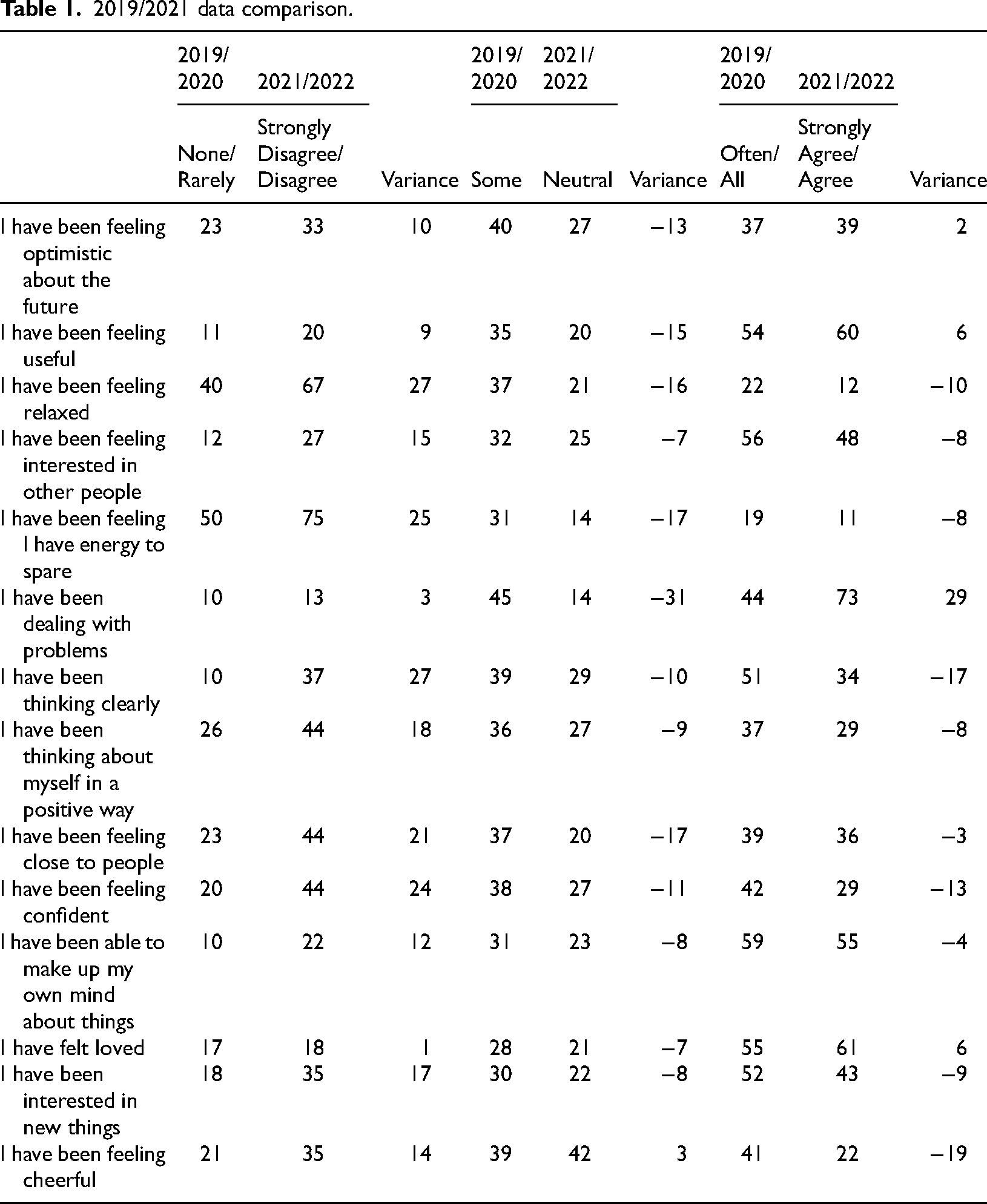
Data analysis shows a shift in the pattern of distribution in responses between 2019 and 2021. Respondents of the 2021 study are less likely to provide a middle ground response such as ‘neutral/some’ instead their responses are more polarised. In addition, there is an increase in ‘strongly disagree/disagree’ by respondents in 2021 compared to the equivalent ‘rarely/none’ for respondents in 2019.
The total responses to each statement can be collated and characterised based on respondents’ predominant opinion which would be either, negative (none/rarely or strongly disagree/disagree), neutral (some or neutral) or positive (often/all or strongly agree/agree). Analysis of questions based on predominant characteristic is shown in Table 2.
Response predominance.

Further analysis of the predominant response shows that for four statements there was no overall change. Two remained positive and two remained negative, these were:
I have been feeling useful (positive) I have been feeling interested in other people (positive) I have been feeling relaxed (negative) I have been feeling I have energy to spare (negative) I have been thinking clearly I have been thinking about myself in a positive way I have been feeling close to people I have been feeling confident I have been feeling optimistic about the future I have been dealing with problems I have been feeling cheerful
The predominant response for statements that moved from positive to negative response include:
The predominant response for statements that moved from neutral to positive response include:
The predominant response for one statement moved from positive to neutral and was the only neutral response for 2021 was:
Discussion
Over time the FE sector has tested the resolve of its workforce. The dynamic and somewhat turbulent nature of the FE sector seems to continually test its workforce's resilience. Liu et al. (2019: 1229) define resilience as ‘bouncing back from setbacks combined with remaining effective in the face of tough demands and difficult circumstances, and moreover, growing stronger in the process’. Their research considers resilience at both individual and organisational level. They explain that resilience is not a unique trait but something that is more commonly present because whenever we encounter risk in our work or personal environment we will need resilience to respond. Corbett's (2020) study of FE middle managers highlighted the expectation and need for resilience to undertake the role. We would agree that a sector that faces so much change and challenge require resilience. Previous studies have found that academic staff have higher than anticipated levels of resilience, in particular when responding to the ‘call of duty’ (Diedericks et al., 2019). However, our concern with the definition presented by Liu et al. (2019: 1229) is the final point ‘growing stronger in the process’. We do not doubt the resilience of the FE workforce, but we would question if the continued change and tough demands have made the FE sector stronger or weaker. While the quality of provision according to the number of good and outstanding providers has enhanced, the number of providers, staff employed and students has decreased. We were/are concerned that a key element of recruiting and retaining a stable FE workforce is reliant on the sector implementing effective strategies for workforce wellbeing. While recommendations were put forward by the ETF in 2019 these were disrupted by the global pandemic and so the research needed to be renewed to ensure that the recommendations were still valid.
It is often cited that a key motivation for working in education is the intrinsic motivation to support, help and develop others (Corbett, 2017; Page, 2013). Many practitioners would suggest this is a further degree of motivation for those working in the FE sector as the terms and conditions of employment are less attractive compared to other education sectors as well as private industry. For example, mean FE salaries are 9.4% lower than those working in secondary education (AoC, 2022). Furthermore, as Page (2013) highlights high levels of stress can be experienced by those working in the FE sector which is also demonstrated by the sectors higher sickness absence rates compared to the rest of the country. On average there were 5.1 days sickness absence per employee in FE during 2019/2020 (AoC, 2021) compared with 1.45 days for all occupations across the country (HSE, 2022). Overall, the HSE identifies Education as the third highest ranked industry for statistically significantly higher work-related ill health after Health/Social Work and Public Administration/Defence.
Responses to the 2021 survey highlight that, despite the apparent lack of financial or health-related enticements to work in the FE sector, its workforce continues to demonstrate commitment to their work and positivity in supporting others as suggested by the overall positive agreement with the following statements:
I have been feeling useful I have been feeling interested in other people I have been dealing with problems I have been feeling optimistic about the future
This is perhaps unsurprising when considering Rayner and Espinoza's (2016) perspective on emotional labour and those working in education being intrinsically motivated in their role. Our study not only reinforces this point, but highlights the commitment of the FE workforce through extraneous circumstances, despite which their commitment to the sector and their students held firm. They continued to focus on being useful, being interested in others and dealing with problems with a belief that things will improve.
In contrast to the commitment of the workforce to supporting others, our research has a significant cause for concern. Not only has the overall number of negative responses to elements of wellbeing increased, but the statements to which this relates has a theme of individualised struggle, personal conflict and isolation. These include:
I have been feeling relaxed I have been feeling I have energy to spare I have been thinking clearly I have been thinking about myself in a positive way I have been feeling close to people I have been feeling confident
These points are further compounded by the move from positive to neutral response for the statement ‘I have been feeling cheerful’. Overall, it appears the FE workforce has been negatively affected by the pandemic. Prior to the pandemic, as demonstrated by the 2019 study, the FE workforce felt tired and stressed. Our study shows not only has this increased, it now has the added burden of having a lack of: clarity, positivity about themselves and confidence, demonstrating a significant change, and shift, in mood and wellbeing.
Revisiting recommendations
The original recommendations put forward by the ETF's report into wellbeing included: The need for professional-type supervision for teachers to share experiences, student engagement and help work/life balance….
Senior management to review workload content to reduce the number of hours needed to fulfil the job role and agree strategies with staff to effect this….
To offer flexible working opportunities, especially being able to work at home during half-term holiday periods when there is no interaction with students and on ‘admin days’ (ETF, 2019b: 8)
These recommendations resonated with the Ofsted's report on teacher wellbeing (Ofsted, 2019), which put forward structural changes that would impact support and workload. This aligns with points raised by scholars that managers and leaders need to take a genuine approach to implement such policies and provide support to their staff (Corbett, 2020; Straub et al., 2018; Veld and Alfes., 2017). Our 2021 study highlights that this need is increasing and we would suggest an urgent requirement for the original recommendations to be acted upon. Our study indicates lower energy levels and greater amounts of stress within the FE workforce compared with data from the 2019 study; which informed the above recommendations.
However, we also believe that the original recommendations now fall short of addressing the shift in wellbeing demonstrated by comparing responses from 2019 and 2021 studies. We agree with Strauba et al’s (2018) findings that HR policies designed to address issues in a proactive way can be highly effective in improving wellbeing. As well as the findings of Ollo-Lopez and Goni-Legaz (2017) who recommend organisations should seek to alleviate work-family conflict. That is to prevent one aspect (work or family) from encroaching on the other. Given the pandemic has affected both work and family life it could reasonably result in a greater threat of work-family conflict. This, in turn, will heighten levels of stress and be detrimental to workforce wellbeing. Given the need to rebuild workforce confidence, enable clarity and redress feelings of isolation, we believe a nuanced approach to drafting and implementing policy is required. We suggest FE institutions should redevelop their work-family policies in collaboration with all staff in their organisation not only HR, managers and senior leaders but the organisation's wider workforce too. This would begin to rebuild a sense of community and belonging within each organisation, something that has been eroded by the pandemic. Furthermore, it provides the opportunity for a greater level of understanding and fewer opportunities for inconsistent implementation, which can mitigate a potential negative impact on the psychological wellbeing of staff (Loon et al., 2019). Overall, taking a collaborative approach that seeks to enable family-friendly policies, which address issues of work-life balance and work-life conflict, could prevent opportunities for wellbeing to be impacted negatively.
There does remain the challenge of an organisation knowing the limits of what it can do to support its workforce wellbeing. It is important to remember that an organisation cannot assume full responsibility for each member of staff's wellbeing. There is also a responsibility on the individual to engage in practices that can support their own wellbeing. Daverth, et al. (2016) remind us that an organisation can put all of the components in place to facilitate wellbeing, but this does not mean that staff will make use of them. However, we should also be cautious not to use this point as mitigation of the organisation's responsibility. Instead we propose that while an organisation cannot mandate each member of staff to engage in positive wellbeing practices, it can create a culture where engagement in such practices is the norm rather than the exception. As highlighted by Daverth et al. (2016), there are clear interdependencies between the structural and cultural factors that affect the resultant take up of initiatives offered by an organisation. Therefore, the development of policies and opportunities alone is not sufficient and instead there needs to be a cultural shift towards practices that facilitate improved wellbeing within the workforce. However, changing the culture needs to be undertaken supportively and time provided to the workforce to spend on wellbeing activities. If not, it will add to the feelings of ‘guilt’ where staff do not have time to engage with wellbeing initiatives thus exacerbating rather than addressing the issues highlighted. It should be emphasised that this is not the responsibility of individual organisations, rather we suggest that it should be a call to action for the FE sector as a whole; an awakening and building of unity for all who work in the FE sector to embrace their common values and intrinsic motivation to be used as a force for positive change.
Conclusion
For too long the FE sector has been negatively impacted by continuous policy reform, real-term cuts in funding and a perception of being of lower status compared with other education sectors. It is for these reasons that many refer to it as the Cinderella sector.
Our study has highlighted the impact of the pandemic on wellbeing in the FE sector, however, many of the issues were present before the pandemic. We suggest the pandemic has polarised and potentially accelerated issues around workforce wellbeing. We agree and support the original recommendations put forward by the ETF in 2019 and appreciate that the disruption caused by the pandemic may have halted progress. However, we also wish to highlight the urgency and need for structural and cultural change. This change is needed at both organisational and sector level. The value the FE sector gives to its students, employers and the economy is significant. Now it is time that it remembers its staff and seeks to re-establish itself as a sector of choice for employment. It's time to find the glass slipper.
Footnotes
Declaration of conflicting interests
The author(s) declared no potential conflicts of interest with respect to the research, authorship, and/or publication of this article.
Funding
The author(s) received no financial support for the research, authorship, and/or publication of this article.
