



Abstract
In many studies, school leaders’ self-efficacy has been shown to be relevant for the successful development of schools, as well as indirectly for student learning. The current study examines the extent to which leaders’ self-efficacy prior to the COVID-19 crisis affected their schools’ innovative coping during the first pandemic-related school closure in 2020. To explore this, we used quantitative data from a repeated measurement survey of a representative sample of 493 school leaders in Germany, here with two measurement time points before and during the school closure phase. The results of structural equation analyses indicate that school leaders’ self-efficacy had a significant impact on both the width and depth of the innovations introduced at schools during the crisis. Other control variables, such as school leaders’ leadership experience or school size, showed no significant effects. This emphasises the importance of school leaders’ self-efficacy experiences for crisis management and leadership. Implications for school leadership training and support, as well as for further research, are discussed.
In the literature on school leadership, several studies point to the relevance of school leaders’ self-efficacy for student achievement, as well as for organisational learning and innovation (e.g. Hesbol, 2019; Leithwood and Jantzi, 2008; Wahlstrom and Louis, 2008). In innovation situations specifically, school leaders need to have a strong belief that they can motivate the necessary engagement among staff and overcome unexpected challenges and setbacks (Gerber et al., 2012). For schools across the world, a unique situation requiring innovative solutions emerged in the COVID-19-induced school closures in March 2020, by which more than 90% of the world's students were affected (UNESCO, 2020). School leaders had to lead their schools through (extremely) challenging times and ensure that even under these difficult circumstances, student learning could happen. Therefore, school leaders had to enable their teachers to apply new and innovative forms of teaching while also reorganising their schools (Harris and Jones, 2020). Numerous demands that did not normally occur were suddenly imposed on school leaders (McLeod and Dulsky, 2021). Meanwhile, school leaders had to promote a sense of self- and community efficacy, hope and connectedness (Dückers et al., 2017) while creating psychological safety for their teachers to enable organisational learning (Weiner et al., 2021). The findings from previous research on crises at schools emphasise the central role of school leaders in these situations, showing leaders’ tenacity and ability to remain optimistic (Smith and Riley, 2012) and to make decisions during times of uncertainty (Boin et al., 2013).
So far, there is a lack of findings examining the role of school leaders’ self-efficacy for innovative management and leadership under normal and crisis conditions. This latent personal characteristic is conceptualised as school leaders’ perception of their capabilities to effect change in their schools (Bandura, 1997; Tschannen-Moran and Gareis, 2004). Concerning the research gap, we follow the assumption that the characteristics of school leaders (here, in particular, their self-efficacy) can have an influence on their innovativeness in the context of the school, especially under the challenging circumstances of the unexpected school closure. We proceed with the epistemological premise that this can be operationalised with a quantitative empirical approach and explored based on probability statements (Bandura, 1996), using data from a repeated measurement study. Hence, the current article tests the hypothesis that school leaders’ pre-pandemic innovation-related self-efficacy affected their innovative management of these new challenges during the first nationwide school closure in Germany in the first half of 2020, where school leaders have faced decidedly high challenges. For instance, there is no tradition of distance learning or home schooling due to the legal situation (Spiegler, 2009) and the digital competencies of teachers were very underdeveloped in international comparison (Eickelmann et al., 2019). In addition, many decisions were handed over to the responsibility of the school leaders by the school administrations (e.g. BSB, 2020), which was rather unusual in Germany prior to the pandemic.
Therefore, this paper provides insights into the general relevance of school leaders’ self-efficacy for school innovation through their leadership and especially for crisis management. In addition, for the first time in Germany, it investigates the relevance of innovation-related self-efficacy of school leaders. The findings can provide indications of how school leaders in Germany, but also globally, can be made more empowered to act under normal conditions, but especially also in times of crisis and turbulent times in school.
Theoretical background
Self-efficacy and school leadership
Recent research on self-efficacy dates back to Bandura (1997) and his social cognitive theory of action, according to which an individual's beliefs control a wide range of mental processes and actions. Bandura defines self-efficacy as the degree of a person's belief in being able to mobilise the cognitive resources and methods of action to function properly and perform successfully. In the context of the research on school leaders, Tschannen-Moran and Gareis (2004: 573) define self-efficacy as follows: ‘Self-efficacy is a perceived judgement of one's ability to effect change, which may be viewed as a foundational characteristic of an effective school leader’. This means that self-efficient school leaders are those who have the cognitive and behavioural capability to lead schools according to their defined goals (McCormick, 2001). In the context of the present study, professional self-efficacy in the field of teaching and schools in Germany is considered the subjective certainty of being able to cope with new or challenging situations based on one's own competence (Schwarzer and Warner, 2014). The perceptions of one's own possibilities for acting and believing in one's own abilities to be successful – even against barriers or under challenging circumstances – are characteristic of a self-efficient teacher and of a school leader as well.
As a concept, self-efficacy has been specified in a wide range of research on teachers (Jerusalem and Schwarzer, 1992; Putman, 2012). Thereby, self-efficacy is considered a fundamentally positive variable that indicates work-related performance (Klassen and Tze, 2014; Stajkovic and Luthans, 1998). For example, it predicts the productive acceptance of challenges, the setting of ambitious goals, motivation, perseverance, effective time management, the search for solutions to problems, flexibility and a high level and quality of performance; in addition, teachers prove to be more positive towards students, teach more innovatively, are more reflective, are more loyal to their job and make more accurate diagnoses that positively affect student behaviour, such as achievement, motivation and self-efficacy (Schwarzer and Warner, 2014). Fisher (2020) notes that self-efficacy is not synonymous with self-esteem or self-concept, both of which focus on the affective aspects in a more general way. Empirical evidence for high levels of self-efficacy exists, particularly regarding the positive prediction of teacher health (Brown, 2012; Skaalvik and Skaalvik, 2010). Self-efficacy tends to be lower among less experienced teachers (Hoy and Spero, 2005; Tschannen-Moran et al., 1998). A study by Tschannen-Moran and Hoy (2007) suggests that teachers with professional experience may draw self-efficacy from being successful at their job, while novices also rely on other sources to build self-efficacy (e.g. verbal encouragement and school resources). Research points to a broad spectrum of self-efficacy building among career novices (Clifford, 1999; Putman, 2012). Experiences of success that are based on positive student feedback, mentors functioning as behavioural models and verbal support all appear relevant here. In addition, teacher efficacy plays a relevant role in the implementation of instructional innovation (Nie et al., 2013).
However, little is known about the role that self-efficacy plays among school leaders. Although the issue regarding the effectiveness of school leadership and leadership efficacy, in general, has been repeatedly written about and the high relevance of effective school leadership for student achievement has been discussed (Gümüş et al., 2021; Hannah et al., 2008; Imants and De Brabander, 1996; Leithwood et al., 2019; Leithwood and Jantzi, 2008), less research has been conducted on the psychological construct of self-efficacy. One of the few studies on the subject conducted by Fisher (2014) shows that the levels of a school leader's self-efficacy are relatively high at the beginning of their careers before decreasing from years 2 to 10 of their work experience and then increasing again after year 10. Regarding leadership styles, McBrayer et al. (2020) reveal that the characteristics of instructional leadership are significantly positive predictors of school leaders’ self-efficacy. In contrast, the study by Cobanoglu and Yurek (2018) shows that the high self-efficacy of school leaders predicts stronger transformational leadership behaviours. There is empirical evidence that a school leader's self-efficacy affects the effectiveness of teaching and learning in the school environment (Smith et al., 2006). As in many other studies in the case of teachers, Federici and Skaalvik (2012) show the positive effect of school leaders’ self-efficacy on their own health aspects. Although self-efficacy has also been shown to be empirically relevant for school leadership, little is known about whether and how self-efficacy is part of the professionalisation process of school leaders (Versland, 2015).
Beyond the effects on students’ achievement in schools, school leaders’ self-efficacy has been found to have relevance regarding organisational learning (e.g. Hesbol, 2019; Leithwood and Jantzi, 2008; Liu and Hallinger, 2018; Wahlstrom and Louis, 2008; Weiner et al., 2021). In this context, the collective dimension of self-efficacy is particularly relevant. Collective self-efficacy deals with the beliefs of a whole group in its conjoint ability to act successfully and attain their goals. Thus, within a group of teachers, there can be a shared vision of being able to overcome particular challenges or manage crises together in a good way (Zaccaro et al., 1995). Collective self-efficacy can influence a group's ability to innovate and can cushion setbacks in the implementation process. There is not only the claim that school leadership should focus on the development of collective efficacy, but there are also numerous studies that point out its positive outcomes (Hoogsteen, 2020).
Additionally, in organisational research, the entrepreneurial self-efficacy (ESE) of leaders has long been discussed in terms of its significance for the successful implementation of innovations and economic success in firms (for an overview, see Newman et al., 2019). For example, a meta-analysis by Miao et al. (2017) points to a correlation of r = .309 between ESE and the financial growth of firms. Other studies have shown significant relationships between ESE and innovation behaviour (Ahlin et al., 2014; Wei et al., 2020). Furthermore, several studies indicate that ESE positively influences organisational resilience and the ability to cope with crises and disasters (e.g. Miles et al., 2016; for an overview, see Korber and McNaughton, 2018).
(School) leadership in crisis
Grissom and Condon (2021) see crisis situations in schools as being caused predominantly by several external forces acting on the school system; these include terrorist attacks, school shootings and natural disasters such as hurricanes, tornadoes and wildfires. According to a broader definition, crises in organisations consist of the five components of threat, uncertainty, urgency, the impact of many stakeholders and little to no warning (Reyes-Guerra et al., 2021). The often-cited classification of crisis situations in schools by Smith and Riley (2012: 59–60) presents five types of crises: short-term crises, cathartic crises, long-term crises, on-off crises and infectious crises.
The school crisis triggered by the COVID-19 pandemic began in March 2020 when the governments in many countries decided to close all or part of their schools at short notice. As an international comparison, openings occurred very differently. For example, in some countries, partial or even full openings began as early as mid-April 2020, while other countries did not start the opening process until June (Blum and Dobrotić, 2021). According to Smith and Riley's (2012) scheme, the COVID-19 pandemic is both a on-off crisis that is quite unique and would probably not be expected to recur exactly in this manner and an infectious crisis that occurs and is seemingly resolved quickly after the pandemic but will presumably leave behind significant other issues to be addressed. For example, the numerous consequences regarding the academic and psychosocial development of children will continue to affect schools for a long time, and some consequences may subsequently develop into their own crises (e.g. the deficits in the digitisation of the school system). Thus, the current situation is an unprecedented form of crisis that is also occurring on a global scale and has a long-term impact on schools and their necessary innovations.
In their literature review, Smith and Riley (2012) emphasise the crucial role of leadership in managing a crisis at schools, identifying the nine key attributes of leadership: decisive decision making, creativity/lateral thinking, empathy and respect, intuition, flexibility, procedural intelligence, synthesising skills and optimism/tenacity. Additionally, Mutch (2015) states that school leaders’ dispositional factors, such as values, beliefs, skills, expertise and conceptions of leadership, are relevant for successful crisis management. Furthermore, emotional stability and intelligence seem to be necessary characteristics (Fernandez and Shaw, 2020).
Increasingly, empirical studies that look at school leadership and/or school leaders in the wake of the COVID-19 pandemic can be found; however, it is notable that they are mostly small-scale qualitative studies (Beauchamp et al., 2021; Longmuir, 2021; McLeod and Dulsky, 2021; Thornton, 2021) or are based on convenience samples (Huber and Helm, 2020). Studies using larger random samples do not seem to exist. Interestingly, it seems that a lot of data have been collected retrospectively, not during the initial school closures when the pandemic first hit school systems worldwide. Studies with multiple measurement points, especially those that have already collected data on school leaders before the pandemic, also do not seem to exist.
The first empirical findings from the research on the school system coping with the first school closures in spring 2020 confirmed the relevance of school leaders’ characteristics and behaviour in successfully dealing with the new challenges. The qualitative findings of McLeod and Dulsky (2021) point to the need for leaders’ willingness and courage to take risks because they had to be ‘brave enough to try new approaches and create new structures, even when they weren’t sure what would work’ (11). The findings from an interview study reveal the importance of school leaders’ capacity for being a ‘(1) personalized and pragmatic communicator, (2) leading with flexibility, creativity and care, (3) bending rules and shifting priorities and (4) resilience under pressure’ (Reyes-Guerra et al., 2021: 12). An interview study with 54 school leaders reveals their crucial role in creating psychological safety for their staff to enable creative processes in organisational learning (Weiner et al., 2021). Leaders from schools with high levels of psychological safety have reported that they felt especially empowered to engage in decision making. Furthermore, quantitative findings point to the importance of teacher support from school leadership in reducing the risk of burnout during and after the first pandemic school closure (Pressley, 2021). The findings from an exploratory study in Germany, Austria and Switzerland conducted during the first school closure phase indicate that the school leaders felt more stressed by the challenging situation than the teachers did (Huber and Helm, 2020). Furthermore, German school leaders saw their schools as significantly less equipped when it came to internet-based distance learning than the school leaders in the other two countries.
Conceptual framework and hypotheses
Although there are already some findings on the effects of school leaders’ self-efficacy on the functioning and effectiveness of schools in normal operations (e.g. Hallinger et al., 2018; Smith et al., 2006), studies on the role of this characteristic in managing school crisis situations have been lacking. However, the described findings from organisational research (e.g. Miles et al., 2016; Korber and McNaughton, 2018) and the effects on the organisational learning of schools (e.g. Hesbol, 2019; Leithwood and Jantzi, 2008) suggest that this characteristic has relevant effects in crisis management. The findings on the concepts of resilience and the ability to make courageous decisions under uncertain conditions, both of which are related to self-efficacy, also correspond to this. Therefore, we hypothesise that (H1) school leaders’ self-efficacy before the pandemic has a positive effect on innovative coping with pandemic-related school closures.
Because longer professional experience has been proven to have a positive impact on crisis management (Smith and Riley, 2012) and on the implementation of innovations in schools (Navaridas-Nalda et al., 2020), we assume that this characteristic could also influence leaders’ innovative crisis management. Additionally, some studies have demonstrated significant positive correlations of professional experience with school leaders’ self-efficacy (for an overview, see Leithwood and Jantzi, 2008). Furthermore, school size might be associated with its innovation capacity (Preston et al., 2012), and this may affect a leader's choice of management and leadership practices during crises because it influences interpersonal distance and organisational structures (Bush, 2011). In addition, there are different demands on the instructional supply of primary and secondary school students (Booth et al., 2021). Therefore, the challenges to innovative instructional design during the school closure phase could differ depending on the type of school. We expect that the innovative management of a crisis might also be influenced by these individual and school characteristics. However, because of its central role, we hypothesise that the effect of school leaders’ self-efficacy proves to be stable, even when controlling for the individual and school characteristics presented here (H2).
Methods
Study context
In Germany, the responsibility for the education system – hence its detailed organisation – lies primarily with the federal states (the Länder; Pietsch and Tulowitzki, 2017), where accountability and school autonomy are less pronounced than in Anglo-Saxon countries (Klein, 2017). Decisions are predominantly made at the system or local level. In almost all federal states, school leaders do not have a supervisor function and can also only make personnel decisions to a very limited extent (Brauckmann & Schwarz, 2015). Only the responsibility for the organisation and management of teaching and instruction primarily lies at the individual school level (OECD, 2016). Even though, as a result, the autonomy of school leaders is less pronounced than in Anglo-Saxon countries, they nevertheless carry out similar activities and function as instructional leaders (Hancock et al., 2019). However, because teachers in Germany are far more autonomous than their Anglo-Saxon counterparts, the influence of school leaders on teaching is nevertheless less as ‘principals in Germany serve more as buffers for teachers against disruptions and as mediators and administrative managers’ (Tulowitzki et al., 2021, p. 73). Additionally, before the pandemic, they focused more on exploitative than on explorative activities (Pietsch et al., 2022). Therefore, school leaders had less experience with searching for new alternatives and experimenting.
Like almost every nation in the world, Germany was more or less surprised by the COVID-19 pandemic. School closures were a novelty, and schools were unprepared for distance learning. This was also because there is no tradition of distance learning or home-schooling in Germany, specifically because home schooling is prohibited by law (Spiegler, 2009). In addition, the technical equipment and teachers’ knowledge of how to use digital media in the classroom are almost non-existent. For example, according to the International Computer and Information Literacy Study 2018 (Eickelmann et al., 2019), before the pandemic began, only about 3.2% of schools in Germany had all their teachers equipped with mobile devices (for comparison, the international mean was 24.1% and the EU mean was 25.9%; Eickelmann et al., 2019). Beyond that, students in Germany had very low computer-related and information-related skills in international comparison. Because education is the responsibility of the 16 federal states (Länder), school policy reactions to the pandemic varied among the individual states, both in terms of content and timing. However, as of mid-March 2020, the public schools in all states were closed on short notice (mostly within 3 days). Starting from mid-April, there were partially limited on-site classes at secondary schools, and from early May, limited classes began at elementary schools. However, this was generally only for final-year classes. In many federal states, face-to-face classroom instruction remained suspended for large parts of the student body until summer vacation, which began in the first states in June 2020 (Blum and Dobrotić, 2021; Im Otte Kampe et al., 2020).
During this time, school leaders were required by various decrees to ensure the organisation of distance learning, the accessibility of the school regarding contact between the school and students and the organisation of work and teachers. For example, on 14 March 2020, the Ministry of Education of the federal state of Mecklenburg-Vorpommern adopted a plan of action for school closures and assigned corresponding tasks to school leaders: The remaining teachers leave school and work from home. They are called upon to provide learning content for the students, the majority of whom are at home. They also complete conceptual tasks that do not necessarily involve a presence in the school. Long-term lesson preparations should also be done during this time. Details will be arranged by the school leader (BMMV, 2020). All secondary schools use the communication channels and platforms established at the respective institution for lessons at home. […]. The location-specific design of the communication channels and times at all schools is the responsibility of the respective leader. […] For elementary schools: The school leaders are responsible for passing on the material and for checking the results of the work (BSB, 2020).
Similar task assignments to school leaders were made in most states. Therefore, school leaders were almost left on their own with relatively little support from the school administration and they had to make decisions to an unusual extent for the German school system. However, unlike most other school stakeholders, attendance was mandatory for most leaders in the school.
Research design, sampling and data collection procedure
The basic idea of our empirical study is to predict the width and depth of school leaders’ innovations during the nationwide school closures due to the COVID-19 pandemic in Germany using variables of school leaders and schools that were collected before the pandemic began. In this way, evidence is obtained on which variables may be relevant for dealing with unforeseen occurrences in school. Particular attention will be paid to school administrators’ self-efficacy. In this context, self-efficacy is a widely studied empirical construct that is theoretically very well grounded due to its long research tradition and can be soundly assessed in terms of its construct validity (e.g. Fisher, 2020; Tschannen-Moran & Gareis, 2004). Furthermore, we checked for internal consistency of the self-efficacy scale as a specific measure for reliability (see section ‘instruments’ below).
In the current study, we use data from the Leadership in German Schools (LineS) project. LineS is a longitudinal study in which a random sample of German school leaders is repeatedly surveyed by the German research institute forsa, which specialises in conducting representative surveys in Germany. Every working day, forsa interviews around 1000 randomly selected people by telephone in Germany on various topics, including their occupation. Using this information, a large and representative sample of German school leaders could be identified, from which a randomly selected subsample representative of the German education system was surveyed by applying online questionnaires. The participants were informed about the voluntary nature of the survey, anonymisation of data and their data privacy rights. So far, two waves have been surveyed – the first in fall 2019 and the second in spring 2020 – both within a single school year. What is special about the second measurement point is that it was conducted during the first COVID-19 wave in Germany, specifically when all schools in Germany were closed for the first time because of the pandemic and when all students moved to distance education. During the first wave (primary sample), which took place between August and November 2019, 650 leaders were sampled at random from the whole population of school leaders of general education schools (public and private) in Germany, of whom N = 405 participated (response rate 62%). The second wave was carried out between mid-April and mid-May 2020, which is when all schools in Germany were closed because of the pandemic. This second survey was conducted on short notice and was not originally included in the study design. Because of panel attrition from the short-term nature of the survey, as well as the special COVID-19 circumstances, a refreshment sample of n = 88 school leaders were surveyed in the second wave, in addition to the school leaders from the first wave. This refreshment sample was sampled using the same criteria and procedure as in wave one. In total, n = 218 leaders participated in both waves of the survey: n = 187 in the first wave only and n = 88 (refreshment sample) in the second wave only.
Of the total N = 493 school leaders surveyed, 275 (55.8%) were male. Their age ranged from 30 to 67 years, with a mean of 53.5 (SD = 7.7). Professional experience as a school leader varied from 0 to 33 years (M = 9.9, SD = 7.3). About 4% reported having an immigrant background, and almost all the respondents had worked as teachers for several years before taking on the school leadership position. The participating leaders’ size of school ranged from 25 to 2000 students, here with an average of 360.83 (SD = 299.64). The schools belonged to primary (51.3%), secondary (38.9%) and other school types (9.7%, mainly special educational needs and schools with both primary and secondary tracks).
Instruments
For our analyses, we draw on the items and scales from both LineS measurement points (e.g. pre-COVID-19 and during COVID-19). We are particularly interested in connecting the information collected before the pandemic with that collected during it. The central question is the following: To what extent do the self-efficacy beliefs of school leaders surveyed before the outbreak of the pandemic being able to implement innovations at their school, even under challenging conditions, have an effect on whether this was actually achieved during the nationwide school closures?
School leaders’ self-efficacy related to innovation was measured during the first wave of the study, in autumn 2019 (pre-COVID-19), here adapting four items provided by Schmitz and Schwarzer (2002). These items intend to capture the individual and collective self-efficacy of school leaders regarding innovation. An example item for measuring innovation-related individual self-efficacy is as follows: ‘I can push through innovations even in the face of sceptical teachers'. Regarding collective self-efficacy, an example item is the following: ‘I believe in the strong innovation potential in my school, which enables us to implement innovations even under adverse circumstances’. All items were measured on a 4-point Likert scale, ranging from 1 (do not agree at all) to 4 (totally agree). In our sample, the internal consistency of the scale is ω = .803.
Innovation was measured in the spring of 2020 during the nationwide school closure in Germany by adapting items from the European Community Innovation Survey (CIS; Behrens et al., 2017), which is based on the OECD's (2018) Oslo guidelines for collecting, reporting and using data on innovation. According to the Oslo guidelines, innovations must be new to the organisation, but they must not be a sector novelty. In the context of the LineS study, a distinction is made between four classical types (Kotsemir et al., 2013) of innovations: (a) process innovations, (b) organisational innovations, (c) social innovations and (d) service innovations. In the first step, these innovation types were explained to school leaders as follows:
Process innovations comprise new or noticeably changed processes regarding the pedagogical work of the school (e.g. instruction and/or teaching); Organisational innovations include the structural development or redesign of the school's internal work processes or work organisation (e.g. regarding conferences and staff meetings); Social innovations include the creation of new or improved conditions or measures for school employees (e.g. with a view to cooperation within the teaching staff); and Service innovations include the provision of new and/or optimised services (e.g. changed contact options for students and parents regarding questions).
In the second step, the school leaders were asked to provide information on whether the innovations in these areas were introduced at their school during the school closure or not (item: ‘Did your school introduce new or significantly improved processes since the school closed?’, coding: 0 = no, 1 = yes). In the third step, the leaders were asked to assess the radicalness of the innovation(s) and the degree of newness or novelty of innovations (Golder et al., 2009; Johannessen et al., 2001), here on a 10-point scale (item: ‘Are these changes incremental (improving and/or supplementing and/or adapting what already exists) or radical (introducing something completely new) for your school?’, scoring: 1 = very incremental to 10 = very radical).
Based on this information, we calculated two measures for providing evidence on the extent of innovations introduced at schools in Germany during COVID-19-related school closures. Thus, on the one hand, we calculated the average of the areas in which innovations had been introduced, hence creating a measure reflecting innovation width. This construct can take a value between 0 and 1 while providing information on whether innovation has only occurred in a few or many areas of the school. On the other hand, we averaged the radicalness across all four types of innovation, thus creating an innovation depth construct, whereby we valued missing innovations in the types with zero. This measure, which can take values between 0 and 10, provides information about how profound or radical the innovations that were implemented at the school as a whole over the course of the school closure.
Additional control variables surveyed were school leaders’ gender and their years of professional experience as a school leader. In addition, we measured school size using the number of students enrolled, here as reported by the school leaders. School type applies the International Standard Classification of Education (ISCED; UNESCO Institute for Statistics, 2012), which distinguishes education systems according to uniform criteria: ISCED 1 refers to ‘primary education’ and covers the first to fourth school years in Germany, ISCED 2 refers to ‘lower secondary education’ and covers the 5th to the 10th years, and ISCED 3 refers to ‘higher secondary education’ and covers the 11th to 13th years. Because the tracked German school system does not include a change in school between lower and upper secondary schools, we have differentiated between primary schools, secondary schools and other schools (mainly special educational needs and schools with both primary and secondary branches) in our study. We constructed two dummy-coded variables (coded 0 and 1), here with primary schools as the reference group.
Data analysis
For our analyses, structural equation models with latent and manifest variables were specified in MPlus 8.4 (Muthen and Muthen, 2012–2019) using a restricted maximum likelihood estimation. Following the suggestion of Kline (2016), model fit was tested using model χ2 statistics, Steiger–Lind root mean square error of approximation (RMSEA), Bentler comparative fit index (CFI) and standardised root mean square residuals (SRMR), whereby an acceptable model fit is assumed for CFI ≥ .95, SRMR ≤ .08 and RMSEA ≤ .10.
To assess the power of the possible effects, we used the simulation approach for power analyses of structural equation models, as proposed by Wang and Rhemtulla (2021). Power should ideally reach a value of a least .80 (Cohen, 1988), which implies that the null hypothesis is correctly rejected 80% of the time and that a false negative result (type II error) will be reported for the remaining 20%.
Unit non-response or panel attrition (i.e. school leaders who participated in wave one but not wave two) between waves was 46.2%; item non-response during wave one was 0.70% and 3.60% during wave two. To handle unit non-response and cross-sectional missing data (item non-response), we used a multiple imputation approach (Enders and Baraldi, 2018) with 100 imputed datasets.
To analyse to what extent individual cases with particularly high or low variable expressions were affecting the imputation and analysis of the models, we analysed the influential cases for the complete model. For this purpose, we used generalised Cook's distance (gCDi, Pek and MacCallum, 2011) as a measure in which the influence of a case on the estimated model parameters is estimated by exclusion. Because there is no clear cut-off value when using this test variable (Pek and MacCallum, 2011), we followed the graphical approach (see Figure 1) suggested by Aguinis et al. (2013). Here, four cases were remarkable, showing gCDi ≥ 1, which is given by Cook and Weisberg (1982) as a rule of thumb for the cut-off in linear regression analysis. The four cases were classified individually based on the terminology presented by Aguinis et al. (2013). As a result, one error outlier was identified, here showing the non-differentiating response behaviour. Two other cases represented the two largest schools in the dataset but had missing values for the measurement time point during the COVID-19 crisis. The imputation of these values could lead to errors because of scalability. The fourth case emerged as a potentially interesting outlier characterised by school leader's particularly high self-efficacy without the introduction of innovations during the pandemic. For imputation and further analysis, the four cases were excluded, with additional model parameters reported for the full dataset (Aguinis et al., 2013).
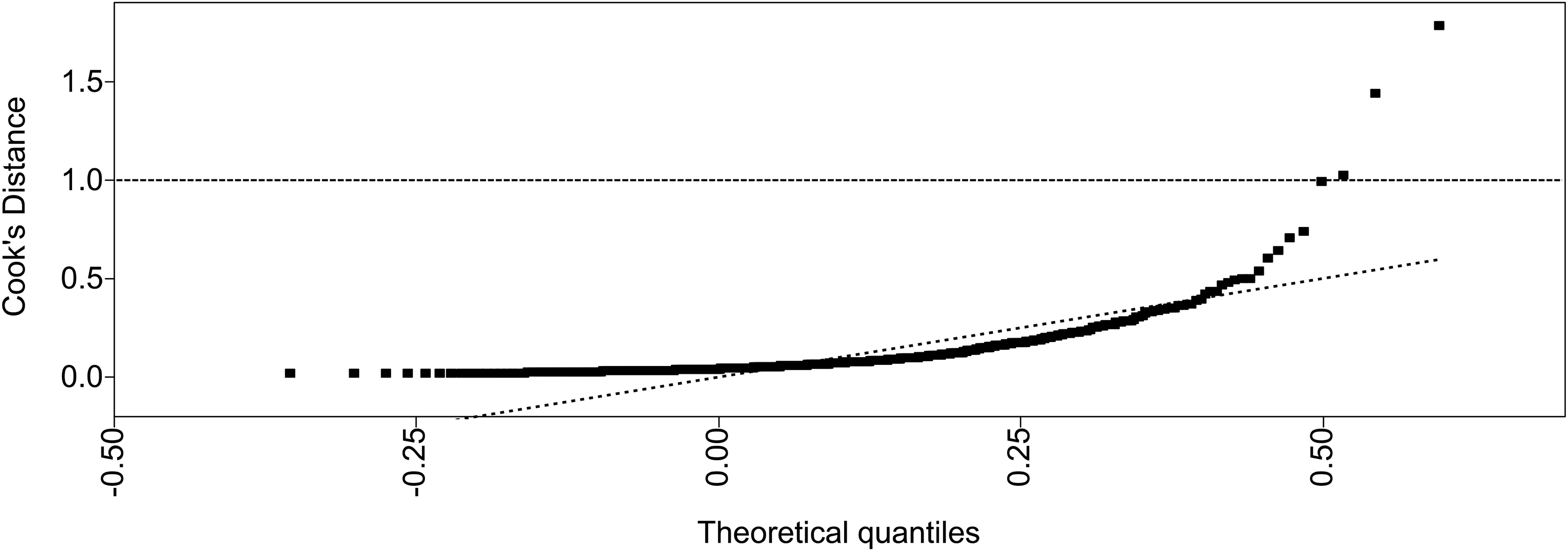
Q–Q plot of generalised Cook's distance (gCD) of the full model using the non-imputed dataset.
Results
Descriptive and correlative analysis
The participating school leaders reported a very different width and depth of innovation during the initial school closure period. For example, some participants reported not innovating in any of the four areas (width = 0), whereas others innovated in all of them (width = 1). However, during the school closures, no innovations were implemented at only 1.63% of the schools in Germany, and the average width of the innovations was M = 0.80 (SD = 0.27). Also, for the depth of innovations, the responses spanned the entire possible range (0 to 10), with an average of M = 4.53 (SD = 2.28). The width and depth of innovations were strongly correlated (r = .74, p < .001; see Table 1), which means that at those schools where far-reaching changes took place, the innovations were also particularly radical.
Correlations between model variables.
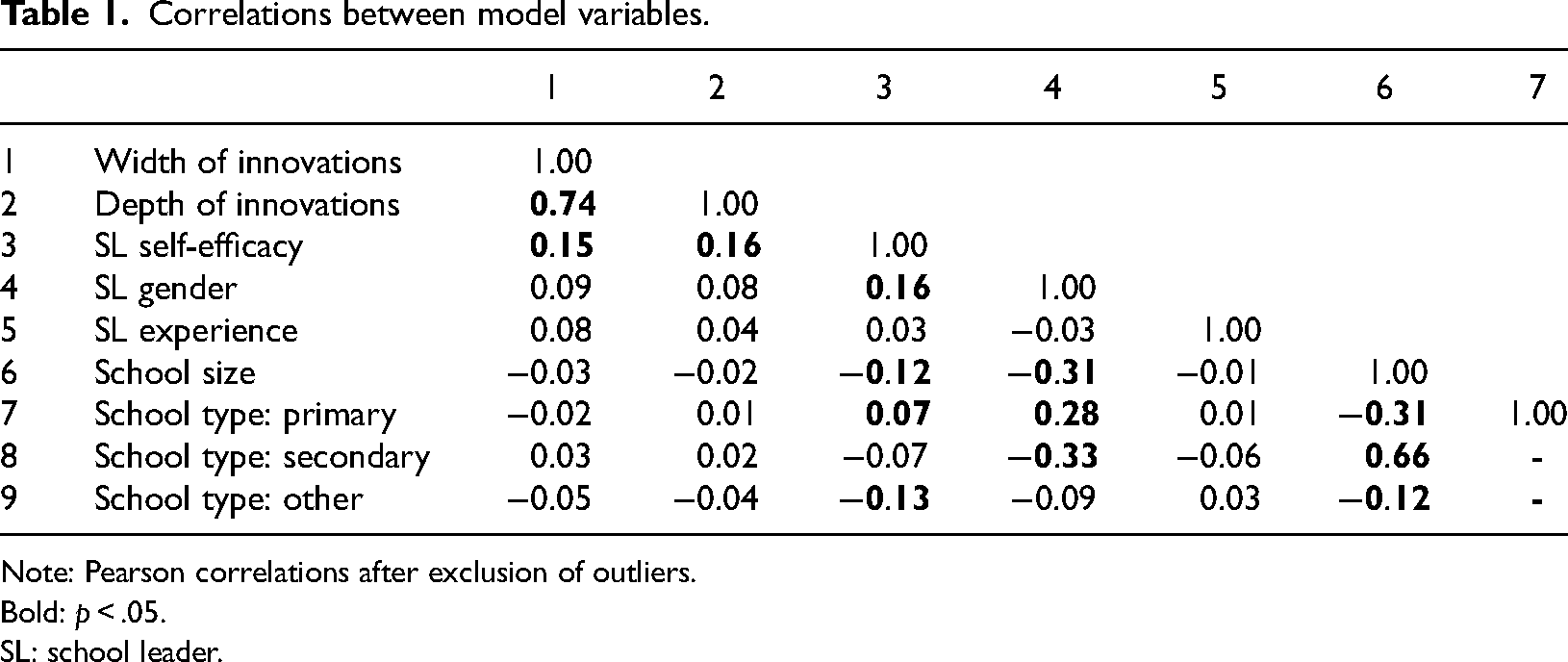
Note: Pearson correlations after exclusion of outliers.
Bold: p < .05.
SL: school leader.
School leaders’ self-efficacy ranged from 1.75 to 4.00, with an average of M = 3.19 (SD = 0.47). As expected, school leaders’ self-efficacy was positively associated with the width and depth of innovations (r = .149, p = .030 and r = .163, p = .033). Female school leaders tended to have a slightly higher self-efficacy (r = .161, p = .004) and worked less often at larger (r = -.306, p < .001) and secondary schools (r = -.325, p < .001). In addition, school leaders’ self-efficacy was negatively associated with school size (r = -.121, p = .025) and with schools from the non-primary and non-secondary type (r = -.126, p = .022).
Structural equation analyses
Two structural equation models were estimated to test our main hypotheses, here using the sample without the outliers (N = 489). In Model 1, the width and depth of innovations during the initial school closure period were predicted by school leaders’ self-efficacy. In Model 2, we additionally controlled for individual leader and school characteristics, allowing for correlations among all the predictive variables (Figure 2).
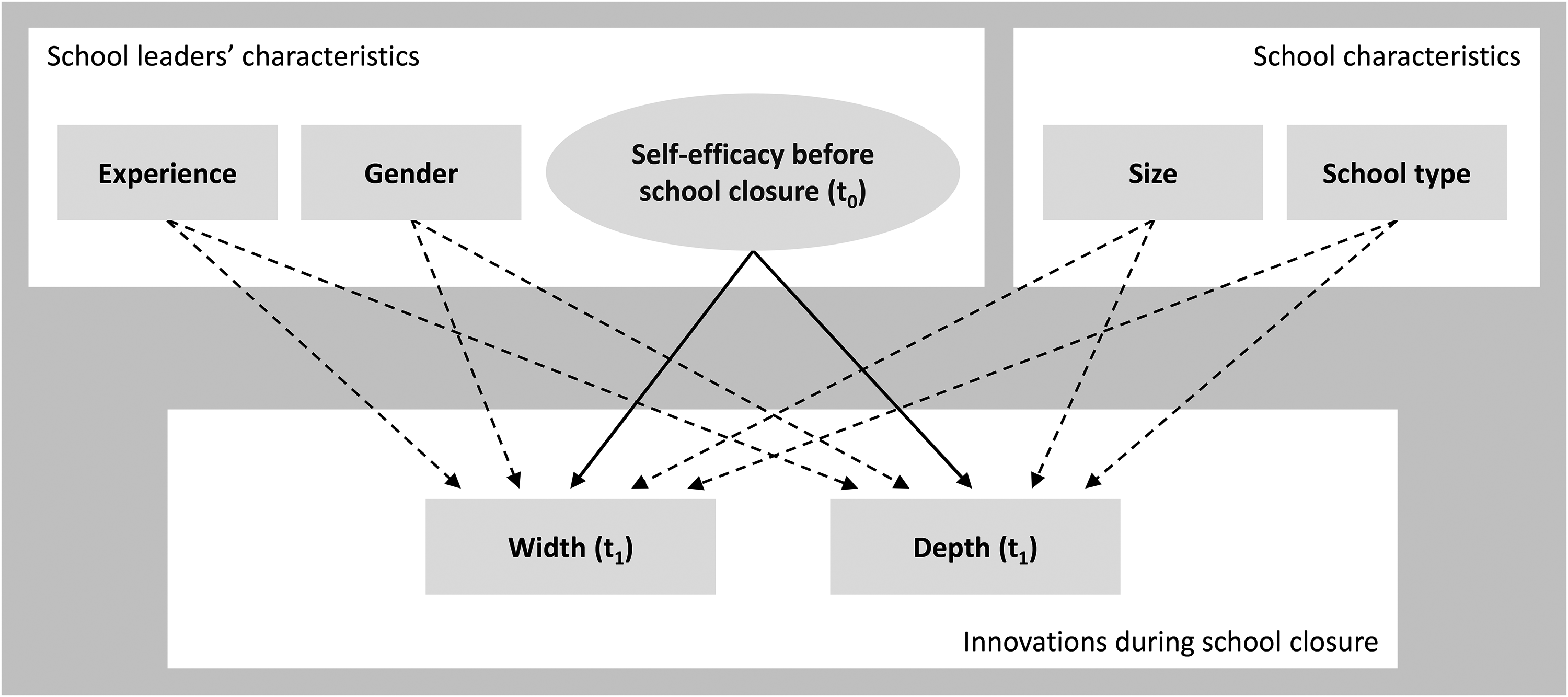
Schematic representation of Model 2
The results are reported in Table 2. Both Model 1 (χ2(8) = 6.82, p = .556, RMSEA < .001, CFI = 1.000, SRMR = .015) and Model 2 (χ2(23) = 27.86, p = .221, RMSEA = .021, CFI = .993, SRMR = .023) showed a good fit. In Model 1, school leaders’ self-efficacy predicted innovations’ width (β = .149, p = .015) and depth (β = .163, p = .017) significantly, though these effects were small (R2 = .024 and R2 = .030). These effects remained statistically significant (β = .132, p = .033 and β = .153, p = .030) when controlling for the leader's and school characteristics, which all showed no significant direct effect on innovation width and depth. SEM power analysis with 5000 simulations of the effects examined in Model 2 yielded satisfactory values of .83 for the effect of self-efficacy on the width and .87 for the depth of innovations.
Parameter estimates, explained variance and fit of structural equation models predicting the width and depth of innovations during COVID-19-related school closures in the spring of 2020.
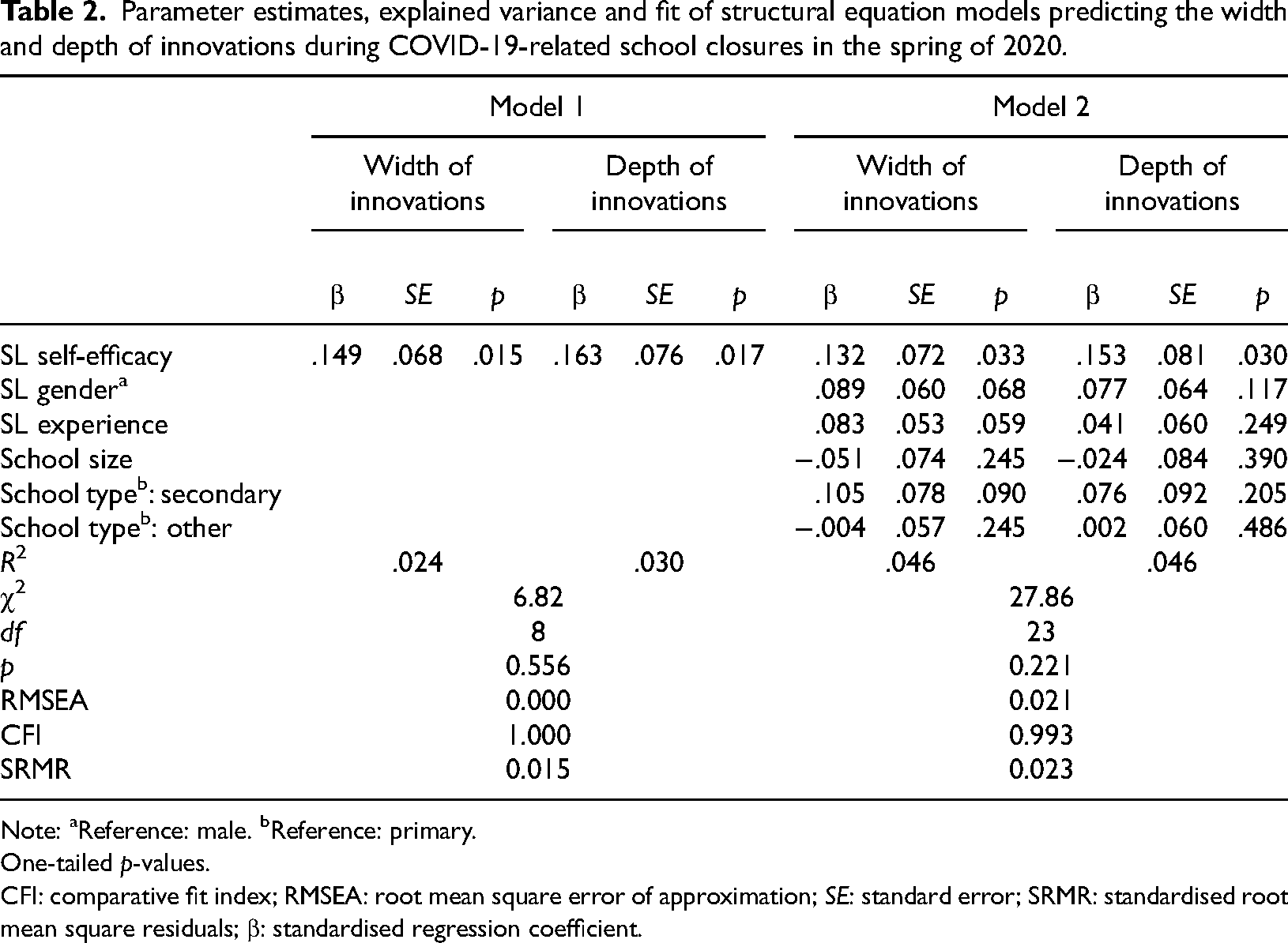
Note: aReference: male. bReference: primary.
One-tailed p-values.
CFI: comparative fit index; RMSEA: root mean square error of approximation; SE: standard error; SRMR: standardised root mean square residuals; β: standardised regression coefficient.
Testing the influences of the excluded outliers, both models were also analysed using the whole sample (N = 493). The results pointed to a slight decrease of model fit in both models (χ2(8) = 8.90, p = .351, RMSEA = .015, CFI = .998, SRMR = .018 and χ2(23) = 30.23, p = .143, RMSEA = .025, CFI = .990, SRMR = .023) and a small increase of the effects of school leaders’ self-efficacy on the width and depth of innovations (Model 1: β = .163, p = .007 and β = .166, p = .009, R2 = .046; Model 2: β = .147, p = .017 and β = .156, p = .016, R2 = .046).
Thus, our analyses confirmed the hypothesised relationship between pre-crisis leader self-efficacy on innovation width and depth, both without (H1) and with (H2) controlling for other relevant characteristics of school leadership. Further, the effects demonstrated a satisfactory power and proved robust to outliers.
Discussion
The current study aimed to examine the extent to which school leaders’ innovation-related self-efficacy prior to the COVID-19 crisis had an effect on their innovative way of dealing with the pandemic's challenges. To explore this, we used a sample representative of school leaders of general education schools (public and private) in Germany who was surveyed in late 2019 and during the first COVID-19-related school closures in spring 2020.
The results confirm the hypothesised positive effects of self-efficacy regarding both the width and depth of innovation during the first phase of the pandemic-related school closures. Although rather small, these effects are significant and show a sufficient power and robustness against outliers. The role of self-efficacy is particularly noteworthy because its effects remain constant when controlling for other variables such as gender, experience as a school leader, school size and school type. Self-efficacy is by far the strongest and only significant predictor of the width and depth of innovation in German schools during the pandemic. Thus, it is obviously of great importance that school leaders trust their own abilities regarding being able to contribute to an adequate handling of school closures, even in the face of the unexpected, particularly adverse conditions. Hence, in line with the literature (e.g. Hesbol, 2019), self-efficacy is an important predictor of innovation in the context of school leadership, especially during the COVID-19 pandemic. Contrary to the findings from studies of other school crisis situations (e.g. Mutch, 2015), our sample does not show significant effects of professional leadership experience on innovation during the crisis, nor does it show significant correlations of this characteristic with self-efficacy. Our study exemplifies the relevance of research on innovation-related self-efficacy in the context of research on educational leadership. As has been shown many times within the research on teachers (Tschannen-Moran and Hoy, 2007; Schwarzer and Warner, 2014), self-efficacy proves to be a variable with high predictive power in relation to school leadership, and its positive expression can be regarded as widely desirable for the field of leadership as well.
Despite the strengths of our study, ours is a repeated measurement study that is representative of Germany and, because of the timely survey during the pandemic-related school closures, minimises the potential recall bias of the respondents (Coughlin, 1990); it should be noted as a limiting factor that the innovations introduced during the COVID-19 school closures and their radicalness were surveyed only from the school leaders’ perspective. Thus, smaller innovations may be judged to be much larger from the teachers’ perspectives and vice versa. Moreover, it can be assumed that this perception also depends on the innovativeness of the school before the school closures.
The findings have several theoretical implications. First, the self-efficacy of leaders seems to show comparable effects regarding innovations emerging from teachers or managers in the economy. On the one hand, this points to the central role of this individual characteristic, yet on the other hand, it confirms the transferability of the findings from other areas to the situation and field of action of school leaders. Second, several new demands for research have arisen. For instance, the question is largely unanswered regarding whether the self-efficacy of school leaders alone is a sufficient driver of innovation under particularly difficult conditions. According to research, the individual self-efficacy of management staff (i.e. school leaders) can positively influence the collective self-efficacy within a working group (i.e. the teaching staff) and, thus, also might have a mediating effect on innovations via the teachers (Leithwood & Jantzi, 2008). In addition, the pandemic is a challenge to the school system of such magnitude that radical innovations may seem almost inevitable, so school leaders must unavoidably innovate because of this special circumstance (Longmuir, 2021). Furthermore, whether completely unexpected demands from outside like the pandemic can also have a positive (or negative) effect on the variable of the self-efficacy of school leaders has not yet been investigated. Given these contextual conditions, the specific role of self-efficacy in this complex system needs to be further explored. Particularly for the school system in Germany, where school leaders usually have little decision-making power regarding structural decisions and personnel issues, more research should be conducted to identify which individual and organisational factors can foster the development of school leaders’ self-efficacy under these circumstances.
In addition, as practical implications for innovation management and leadership at schools under normal and crisis conditions, the findings indicate that school leaders should experience themselves as self-efficacious regarding innovations, especially in times without extraordinary challenges. Further, indications emerge that leaders’ innovation self-efficacy is not related to leadership experience and, thus, cannot be acquired through job tenure alone. Therefore, school leaders should receive support for innovation projects at schools to experience successful process control on the one hand and to consciously reflect on their own effectiveness on the other hand. For school authorities and supervisors of the school leaders, these findings mean that school leaders should be intensively supported and accompanied in the introduction of innovations. Following Bandura's theory, self-efficacy can be strengthened primarily by others but also by oneself. This can happen, for example, through professional coaching and supervision as well as through mentoring programs or professional networks of more experienced and novice school leaders. Especially for the situation in countries such as Germany, where school leaders have only limited leadership authority over their teachers on the one hand and receive little support from their superior authorities (such as the beginning of the nationwide school closures) on the other hand, an important question remains: To what extent do school leaders need a stronger leadership position in times of crises to be able to react effectively and innovatively?
Conclusions
The results reveal the special role of self-efficacy regarding innovative school leadership during the COVID-19 pandemic. Although findings were obtained in a crisis, they fit into other existing studies conducted in regular times and therefore they also provide important contributions to research on school leadership and self-efficacy in general. Using a representative sample of German school leaders, these data offer rarely found insights into how school leaders and their schools are managing crises because a measurement point immediately prior to the onset of a crisis is rarely available by chance. This also clearly shows how important it is to collect reliable data on school leaders on a regular, longitudinal basis to evaluate the effects of (e.g. unexpected) interventions (Goff & Finch, 2015). Even though the present findings are limited because only the school leaders’ perspectives were surveyed, they still provide important contributions both to research on the self-efficacy of school leaders and on crisis management in schools. In this way, they complement findings on the role of school leaders in the COVID-19 pandemic, as well as on the relationship between self-efficacy and innovation, thus establishing a unique link between these two aspects. Furthermore, the findings implicate that more research should be done on factors that contribute to this important belief to promote effective school management and leadership in normal and crisis times.
Footnotes
Declaration of conflicting interests
The author(s) declared no potential conflicts of interest with respect to the research, authorship, and/or publication of this article.
Funding
The author(s) disclosed receipt of the following financial support for the research, authorship, and/or publication of this article: Sebastian Röhl and Colin Cramer are supported by the German Federal Ministry of Education and Research (BMBF, grant number: 01JA1911). Marcus Pietsch is supported by a Heisenberg professorship of the German Research Association (DFG, Project ID: 451458391, PI 618/4-1).
