




Abstract
This study explores how Norwegian school leaders develop their capacity for instructional leadership, a leadership style that is strongly related to school effectiveness and school improvement across a range of national school systems. The concept captures important aspects of Norwegian school leaders’ task preferences. To gain further insight into the process of developing the capacity for instructional leadership, this study links instructional leadership to school leaders’ core practices. The multidimensional concept of core practices views school leaders as goal oriented and actively involved in teachers’ collaboration and professional development, observation, and supervision. Moreover, the concept covers school leaders’ efforts to redesign and improve their schools’ instructional programs. In this study, school leaders assessed instructional leadership related to three distinctive core practices: observation and supervision, collaborative learning engagement, and time allocation for data use. Multiple regression analyses were conducted, and overall, the regression model, with all the predictors included as a set, was significant. 28.5% of the variance in school leader's capacity for instructional leadership is explained by the three distinct factors. The results indicate that when school leaders adapt core practices of leadership to their work context, their capacity as instructional leaders increases. The findings and implications will be discussed.
Introduction
Over the last 25 years, a considerable body of research has provided evidence of the various ways in which instructional leadership exerted by principals is directly and indirectly related to students’ achievement (Hallinger and Kovacevic, 2021; Robinson et al., 2008). Large-scale empirical studies and meta-analyses have shown that instructional leadership is strongly related to school effectiveness and school improvement across a range of national school systems. Bellibas et al. (2020) found that instructional leadership had positive but weak direct and indirect effects on teachers’ instructional quality, implying that instructional leadership had only a modest impact on the quality of instruction. They also found that the direct effect was larger than the indirect effect, which supports previous research suggesting an association between principals’ instructional leadership and teachers’ practices (Bellibas et al., 2020: 401).
Despite researchers’ and practitioners’ agreement regarding the importance of instructional leadership, how instructional leadership can be developed as a distinct set of capabilities remains unclear. For example, a Norwegian study indicated a noticeable gap between the school principals expectations to demonstrate their instructional leadership behaviors and their actual daily practice (Aas and Brandmo, 2016). Furthermore, other studies have shown that while some school leaders do see instructional leadership practices as integral to the performance of their role, other principals see it as a secondary element (Goldring et al., 2019), indicating that instructional leadership still occupies only a margin of principals’ work (Camburn et al., 2010). In a critical review of how the instructional leadership concept has been interrogated by the literature, Neumerski (2012) argued for the need to elucidate the process that fosters growth in school leader's capacity for instructional leadership: “Although these recent conceptualizations of instructional leadership moved beyond a trait approach, they offer lists of behaviors and actions, not an understanding of the process behind enacting those behaviors” (Neumerski, 2012: 319). The current study supports this argument by seeking to determine conditions that enable the growth of school leaders’ capacity to engage in instructional leadership by linking the latter construct to the notion of core practices as elaborated by Leithwood et al. (2020a). The empirical context of the study is a Norwegian region that has traditionally been low-performing in student outcomes in primary and secondary education.
In their review of successful school leaders, Leithwood et al. (2020a) suggested four distinct core practices in which instructional leaders engage:
Set directions Build relationships and develop people Develop the organization to support desired practices Improve instructional programs
Notably, as underscored by Leithwood et al. (2020a), it is not the practices per se that contribute to the desired outcomes; rather, it is the many ways through which school leaders adapt them to the context in which their work is situated. Specifically, “Evidence indicates that the most productive patterns of distribution inevitably differ from school to school, as contexts vary” (Leithwood et al., 2020a: 13). Their argument was illuminated further by an empirical study in the Arabic context that demonstrated the core practices with obvious context-specific nuances, such as “Setting achievement goals, developing teachers, building strong relationships with parents, focusing on academic excellence and developing school climate” (Alqahtani et al., 2021: 321). Furthermore, “the principals enacted these core practices in a variety of ways” (Alqahtani et al., 2021: 321). Additionally, as noted by Klar and Brewer (2013), based on a study within the International Study of Successful Principal Project (ISSPP), “the practical wisdom these principals demonstrated by employing the core strategies in concert with their unique contexts suggests that simply knowing what the core strategies are is a necessary but insufficient precondition to school improvement. Rather, our findings would suggest that it is the understanding of how to lead in concert with one's local context that determines the success of principals’ leadership efforts” (Klar and Brewer, 2013: 801).
In this study, we treat core practices and the capacity for instructional leadership as distinct concepts, despite, to our knowledge, not many studies having linked them together, regardless of their interdependence. However, both concepts are closely related to the collaborative leadership style exerted by school leaders who involve teachers in instructional leadership tasks. For example, in their seminal study, Marks and Printy (2003) showed how principals and teachers mutually contribute to increasing the level of instructional leadership in high-performing schools by sharing leadership tasks and involving teachers in pedagogical decision-making processes. Moreover, Qadach et al. (2020) suggested that instructional leaders contribute to improved outcomes for students through organizational mechanisms that involve teachers’ participation in instructional leadership tasks. The argument has been further supported by a Scandinavian study on how to enhance school leaders’ capacity for instructional leadership “by sharing leadership tasks on instructional issues with teachers and other non-leaders” (Aas and Paulsen, 2019: 540). Regarding core practices, developing the school organization for the purpose of distributing leadership roles to teachers is one of the core practices in the “Developing organization” domain (Leithwood et al., 2020a: 8). Taken together, distributed leadership and shared leadership intersect with both instructional leadership and core practices.
There are several reasons to investigate the Norwegian school leadership context through the lens of instructional leadership. For example, findings from two recent studies on Norwegian school principals established a direct link between the capacity for instructional leadership and principals’ self-efficacy (Skaalvik, 2020). Further, a study on Norwegian heads of departments revealed a similar pattern; a capacity for instructional leadership was positively related to job satisfaction and negatively related to turnover intention (Brandmo et al., 2019). Our study follows this line of reasoning and formulates the following research question:
To what extent do school leaders’ core practices predict their capacity for instructional leadership?
To respond to this research question, we investigated the capacity for instructional leadership using a model that links instructional leadership to the following three distinct core practices: observation and supervision, collaborative learning engagement with teachers, and time allocation for data use. To test the asserted relationships between core practices and capacity for instructional leadership, we conducted a theory-based quantitative field study. Our data consisted of a sample of 221 Norwegian school leaders who responded to a web-based survey. The survey was conducted in the autumn of 2016 as a key part of a larger research and development project involving all schools in Hedmark County, Norway. The survey used in our study was the first of three data collection points during the project period and was conducted at the beginning of the project.
The context of the study: The culture for learning project
This current study is part of a research and development project titled Culture for Learning in Hedmark County, Norway. Consisting of 22 municipalities, Hedmark County is one of the less urbanized areas in Norway, with about half of its inhabitants living on rural land (Ministry of Local Government and Modernisation, 2018). Over the last decades, the county has consistently performed below national standards across a range of educational outcomes, such as student achievements in core subjects and student progression to and completion of upper secondary education. Moreover, the region has faced high dropout rates for students aged 16–19 years. For decades, local students’ socioeconomic statuses in relation to parental education have been in the lower quadrant, and primary school results, such as primary school credits and national tests, have been significantly different across various municipalities (Directorate for Education and Training, 2020). To improve educational outcomes within the region, in 2016, the Hedmark County governor established the Culture for Learning research project based on a network structure. The glue that binds the various elements is the actors’ shared perceptions of the severe educational problems that must be dealt with, as well as the shared commitment to a distinct learning strategy based on (1) user-oriented research, (2) the active use of school performance data that enables school leaders and teachers to follow the schools’ progression cycle in real time, and (3) a series of forums set up to support the professional development of education staff (Paulsen, 2019). Moreover, the regional context enables school leaders and teachers to work and meet in close geographical proximity, and “the superintendent's frequent meetings and face-to-face interaction with the principals may increase the opportunity for sharing knowledge and experience between the municipal level and the principals” (Forfang, 2020: 12).
Over the last two decades, student cohort analyses have revealed that, second only to socioeconomic status, school achievements in lower secondary schools are the most significant factor in explaining the variance in completion and dropout rates in upper secondary education (Markussen et al., 2012); therefore, integrating the lower and upper secondary education systems has been high on the policy agenda. Engaging all professional actors within the county in a closely-knit learning and innovation system would make it possible to address schooling-related problems more rapidly and directly.
Theoretical framework
Instructional leadership
Instructional leadership, one of the most studied leadership models in educational research over the last three decades (Gumus et al., 2016), is considered a universal empirical model demonstrating effective leadership practices. The model emphasizes that school leaders should establish a shared, schoolwide sense of purpose by communicating and pursuing educational goals (Hallinger, 2005). Initially, the concept of instructional leadership encompassed the following three broad dimensions: (1) defining a school's mission and establishing a shared schoolwide sense of purpose by framing and communicating educational goals; (2) managing the school's instructional program by monitoring, evaluating, and supervising instruction; and (3) motivating teachers and contributing to a positive work climate (Hallinger and Heck, 2010). According to Robinson (2011), contemporary instructional leadership builds on the following five dimensions: (a) clarifying educational goals and expectations, (b) strategic resourcing, (c) planning and evaluating teaching and curriculum, (d) promoting teacher learning, and (e) ensuring an orderly and supportive environment. In a recent study on Norwegian school principals’ capacity to engage in instructional leadership, Skaalvik (2020) adapted Robinson’s (2011) model into five dimensions of instructional leadership: “(a) developing educational goals and visions, (b) creating a collective culture among the staff, (c) motivating teachers, (d) classroom observation and guidance of teachers, and (e) creating a positive and safe learning environment for the students.” (483)
Thus, instructional leadership has conceptually shifted from a top-down leadership style, with the principal acting as the leading expert, toward the modus operandi of leading professional learning. This line of research merges instructional leadership into “integrated models of school leadership” in which instructional leadership is enacted in concert with dimensions drawn from complementary leadership approaches (Hallinger and Kovacevic, 2021; Shaked, 2020). More specifically, Ylimaki and Jacobson (2013) argued that contemporary conceptualizations of instructional leadership have evolved from a strong, directive leadership style focused on curriculum and instruction to a more collaborative style that emphasizes various forms of teamwork while centered on teacher instruction and student learning.
Core practices of effective school leadership
Core practices of school leadership views school leaders as goal oriented and actively involved in teachers’ collaboration and professional development and other pedagogical matters (Hallinger, 2005; Robinson, 2011). Moreover, the concept covers school leaders’ efforts to redesign and improve schools’ instructional programs. The notion of certain core practices being universally employed by effective or successful school leaders across a range of national educational systems was developed by Leithwood et al. (2020a) after a systematic review of the techniques employed by effective school leaders to raise school standards, close achievement gaps, or revamp negative development cycles.
Leithwood (2012) distinguished practice from competence by stating that competencies depend on the individual leader's knowledge, attitudes, and skills, whereas practice takes into account the context in which these skills are activated and adapted: A “practice,” in other words, is a bundle of activities exercised by a person or group of persons which reflect the particular circumstances in which they find themselves and with some shared outcome(s) in mind. Conceptualizing leadership as a set of practices reflects both the adaptive qualities and expert problem-solving processes emphasized in some previous accounts of effective leadership. (5)
The review concluded that the main core practices are (1) setting the school direction, (2) developing people, (3) redesigning the school organization, and (4) improving the school's instructional program. Leithwood (2012) added a fifth dimension, namely, developing internal accountability, to the Ontario Leadership Framework. In this fifth dimension, the constructive use of performance data plays an important role. However, Leithwood et al. (2020a) underscored that it is not the core practices per se that matter most, but the ways in which the individual school leader adapts these practices to the various contexts in which their work is situated to ensure desirable outcomes. The underlying theoretical argument is that employing core practices boils down to adapting general principles to a range of internal contingencies, and moreover, employing this adaptive expertise to deal with the complexities that result from external factors—that is, the political and socioeconomic environments surrounding the school. Through the adaptation of core practices to the school's situational, material, and socioeconomic contexts, school leaders must diagnose the status of key features that require improvement in their schools and decide on which to focus their efforts. Providing guidelines to assist with such diagnosis would require a research and development project of considerable practical value (Leithwood et al., 2020b: 590).
Observation and supervision
As noted by Klette and Blikstad-Balas (2018), observation is widely used both as a research methodology and as a practical framework for assessing and improving teachers’ instructional practices—that is, as a tool for continuous learning and professional development: Teachers might observe each other, principals might observe their teachers and teacher educators and teacher mentors might observe student teachers. Observation also has a longstanding tradition as a central part of the educational researchers’ methodological repertoire for understanding instructional practices within and across different subjects and learning sites, and it thus provides a toolkit for comparative classroom studies. (130)
Moreover, observation can also be regarded as a tool for school leaders and teachers that allows for the mapping of various aspects of the school climate, such as the learning environment in classes (Zullig et al., 2015). Bell et al. (2019: 7) recommended using an observation system to cover a wider range of important dimensions of teaching and classroom instruction, in particular: safe and stimulating classroom climate, teachers’ quality of subject matter representation, classroom management, and clear strategies for teaching, such as differentiated instruction, teachers’ focus on learning strategies and student self-regulation, and cognitive activation of students’ deep thinking.
In Robinson’s (2011) student-centered framework, the concept of leadership content knowledge is central for understanding how school leaders can employ observation and supervision to strengthen their capacity for instructional leadership: “The concept of leadership content knowledge captures the integration of pedagogical and curricular knowledge with administrative decision-making in areas such as teacher evaluation, student grouping, and the selection of teaching resources” (Robinson, 2020: 7). Similarly, Spillane and Louis (2002) argued that: Without an understanding of the knowledge necessary for teachers to teach well—content knowledge, general pedagogical knowledge, content-specific pedagogical knowledge, curricular knowledge and knowledge of learners—school leaders will be unable to perform essential school improvement functions such as monitoring instruction and supporting teacher development. (97)
Taken together, the reviewed studies underscored the need for school leaders to acquire leadership content knowledge to use their teachers’ classroom observations to strengthen these leaders’ own capacity for instructional leadership. Second, as demonstrated by Bell et al. (2019), a systemic approach to instructional observation and supervision is valuable in strengthening school leaders’ capacity for instructional leadership.
Time allocation for data use
Datnow and Park (2018) conceptualized data use as “part of a cycle of instructional improvement in which individuals engage in a process of defining a problem or setting goals, gathering data, analyzing data, followed by action planning and evaluating outcomes” (Datnow and Park, 2018: 132). There is an extant body of research on the use of data for decision-making in schools, and as highlighted by Coburn and Turner (2012), many studies have encouraged data use in schools and showcased examples of strategies for data-driven decision-making systems. In this context, the focus was on the effects of data use and the how-to guides for handling data to achieve educational improvements. However, researchers have argued that the process of data use is more complex, contextual, and irrational than the linear model might suggest. This inference has been largely supported by several decades of research on decision-making in organizations, which has shown that the drawing of valid inferences from complex social systems based on quantitative indicators and prior performances is often hindered by a range of learning barriers, such as time pressures (Levinthal and March, 1993). Therefore, in our study, data use was limited to time allocation and examined in an exploratory manner.
Professional learning engagement
The term learning engagement is central to the theory of the community of practice, as Wenger (1998) elaborated: Engagement is basically the work of forming communities of practice. As such, it requires the ability to take part in meaningful activities and interactions, the production of sharable artifacts, in community-building conversation, and the negotiation of new situations. This implies a sustained intensity and relations of mutuality. (184)
From a school leader's perspective, learning engagement includes a range of activities meant to support teachers’ professional development via active participation in learning activities and within-group negotiations about the meaning, purpose, and sharing of expertise. Learning engagement corresponds with Robinson et al.’s (2009) fourth dimension, namely, the promotion of and participation in teachers’ learning development, as Robinson et al. highlighted the importance of “leadership that not only promotes but directly participates with teachers in formal or informal professional learning” (Robinson et al., 2009: 95).
The study’s conceptual model
Although there is a considerable body of evidence indirectly linking instructional leadership practices to student learning through a range of mediating organizational variables, such as student-centered climate and professional learning culture, there is less knowledge on how to develop school leaders’ capacity for instructional leadership, given the evidence that only a moderate portion of school leaders’ working time, ranging from approximately 10–20%, is devoted to instructional leadership practices (Shaked, 2021). Shaked’s (2021) results “suggest[ed] that principals are not strongly involved in improving the quality of instruction or developing the skills of their school staff” (Shaked, 2021: 11). As such, there are several reasons to study instructional leadership as the dependent variable linked to the enabling of practices. Furthermore, whereas some studies from the Scandinavian context have linked instructional leadership to professional development in leadership training (Aas and Paulsen, 2019; Liljenberg, 2021), the current study instead focuses on internal capacity building through distinctive core practices, specifically observation and supervision, collaborative learning engagement, and time allocation for data use as independent variables. The conceptual model is illustrated in Figure 1.
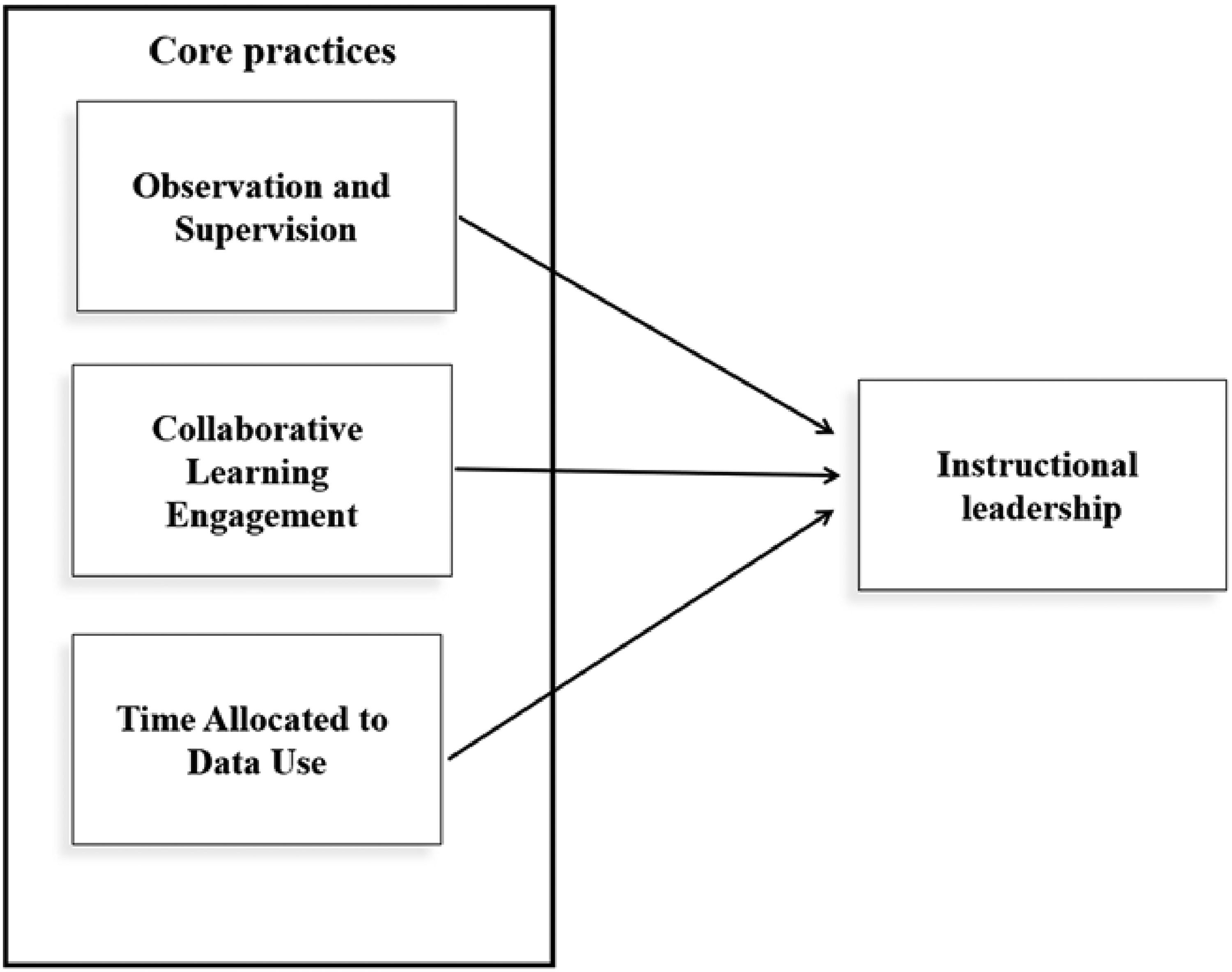
The study’s conceptual model.
Building on empirical work on school leaders’ task preferences and core practices in various Scandinavian contexts (Aas and Brandmo, 2016; Grosin, 2004; Jarl et al., 2021), the proposed model employed three independent variables related to school leaders’ capacity for engaging in instructional leadership. First, school leaders are uniquely positioned to decide the overall conditions for teachers to work together to construct new knowledge and share prior experiences, and implicitly, the core practices of collaborative learning engagement are suggested to be related to instructional leadership. Moreover, this work assumed that establishing and maintaining productive interactions with teachers through observation and supervision promotes school leaders’ capacity for instructional leadership. The underlying argument suggests that by aligning academic standards with observed instructional leadership practices in interactions with teachers, school leaders may play out their role as instructional leaders (Juma et al., 2021). Finally, to strengthen leader–teacher relationships and improve the standards of the delivery of student academics, school leaders need to be able to suggest and supervise corrective actions based on the analysis of students’ learning outcomes. In these endeavors, a certain amount of time allocated to data analysis together with teachers is suggested as a key factor for creating a shared sense of preferred instructional practices, as derived from the model. As noted by several authors, monitoring classroom standards, comparing actual practice with preferred standards, and supervising the classroom involve the managerial side of instructional leadership (Hallinger, 2005). This implies that increasing the capacity for instructional leadership among school leaders also includes improving their managerial competencies, which can improve instruction.
Method
Participants, procedure, and ethics
As part of the main Culture for Learning project, all school leaders (principals and assistant principals) in primary and lower secondary schools in Hedmark County were invited to participate in a web-based questionnaire. The questionnaire was developed by the Centre for Studies of Educational Practice at the Inland Norway University of Applied Sciences and adapted from Robinsons’ (2011) dimensions of instructional leadership.
A total of 221 (97%) educators participated in the survey. They represented both schools from urban and rural areas, and the number of teachers at their schools varied from 2 to 62. The participants were assured of their anonymity, and we emphasized that participation was voluntary. The survey was registered with the Norwegian Data Inspectorate in accordance with Norwegian law.
Instrument
School leaders answered 12 questions about their leadership practices based on the following four subscales: (1) instructional leadership, (2) observation and supervision, (3) collaborative learning engagement, and (4) time allocated to data use. In addition, our analysis included background variables about school size and school leaders’ experiences. School size was measured by the number of students in the school (1 = up to 70 students, 2 = 71–150 students, 3 = 151–300 students, 4 = 301–500 students, and 5 = more than 500 students). School leaders’ experience was measured by the time spent (1) as a leader at the current school and (2) as a former leader at other schools. These two questions were combined into one variable as total experience and reshaped into a scale from 1 to 5: 1 = 0–2 years, 2 = 3–5 years, 3 = 6–9 years, 4 = 10–15 years, and 5 = more than 15 years.
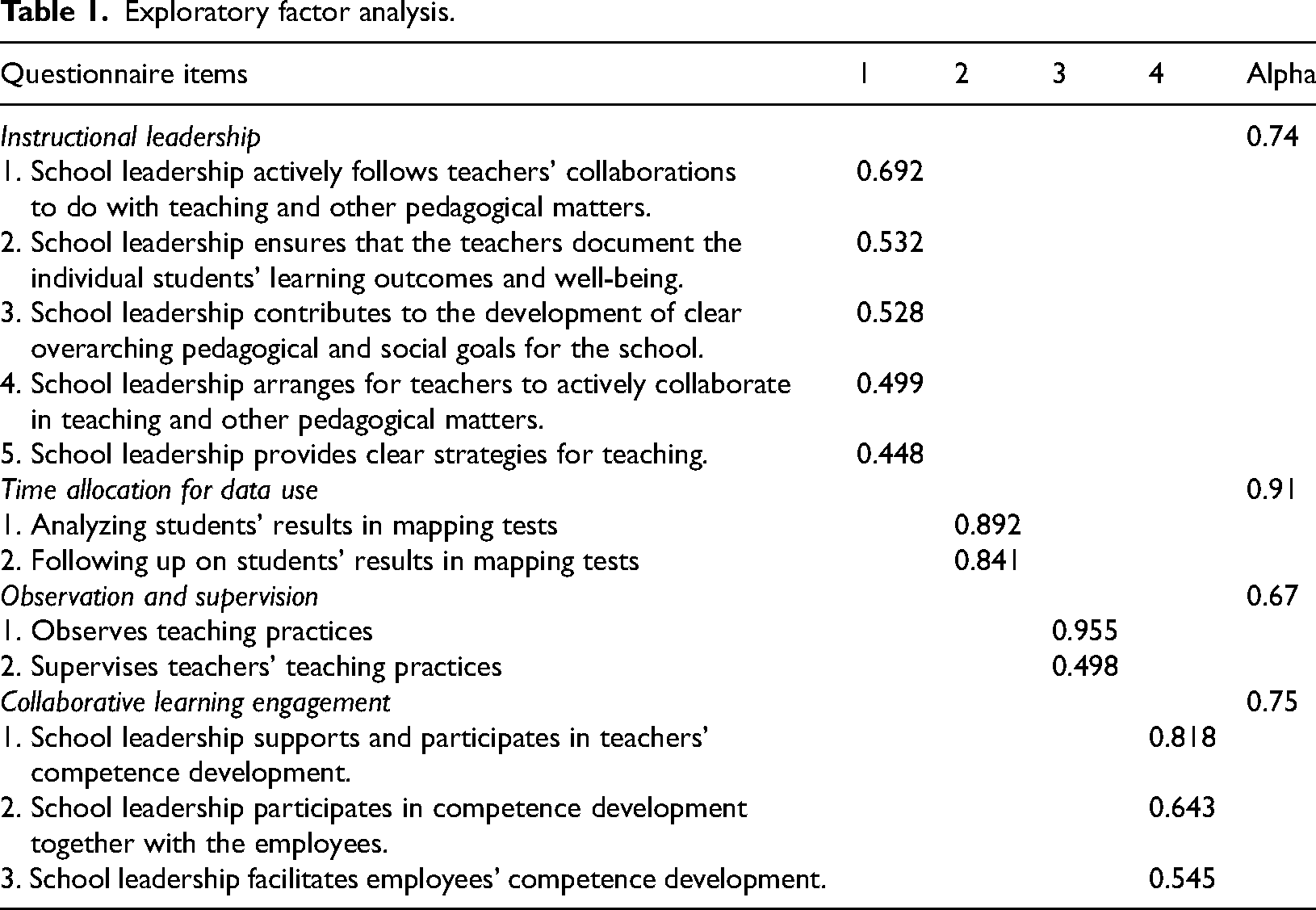
The questionnaire was developed by the Centre for Studies of Educational Practice adapted from Robinson’s (2011) theory of school leadership. The variables were rated using a 5-point Likert scale (1 = never, 2 = seldom, 3 = sometimes, 4 = often, and 5 = very often) for all variables with the exception of the variable Time Allocation for Data Use (1 = very little time, 2 = little time, 3 = some time, 4 = a lot of time, and 5 = very much time). We conducted an exploratory factor analysis to study the factor structure of the items (see Table 1). The reliability analysis indicated that the factors could be considered reliable, as all alpha values were above or close to 0.70.
Exploratory factor analysis.
Instructional leadership
We measured instructional leadership via five questions about the extent to which school leaders (1) contribute to the development of clear, overarching pedagogical and social goals for the school; (2) provide clear strategies for teaching; (3) ensure that the teachers document individual students’ learning outcomes and well-being; (4) arrange for teachers to actively collaborate in teaching and other pedagogical matters; and (5) actively follow teachers’ collaboration in teaching and other pedagogical matters. A high score indicated a high degree of instructional leadership.
Observation and supervision
Observation and supervision were measured via two questions about the extent to which school leaders (1) observe teaching practices and (2) supervise teachers’ teaching practices. A high score indicated a high degree of observation and supervision.
Collaborative learning engagement
We measured collaborative learning engagement via three questions about the extent to which school leaders (1) support and participate in teachers’ competence development, (2) participate in competence development together with the employees, and (3) facilitate employees’ competence development. A high score indicated a high degree of collaborative learning engagement.
Time allocation for data use
Time allocation for data use was measured via two questions about how much time school leaders spent (1) analyzing students’ results in mapping tests and (2) following up on students’ results in mapping tests. A high score indicated that a lot of time was allocated to data use.
Missing data
The amount of missing data in the four subscales was low (0–0.9% at the item level), and Little's MCAR test showed that data were missing completely at random. We replaced missing data using the expectation maximization procedure, meaning that missing values were replaced by the current best guess of the value within the subscale (Graham, 2009).
Statistical analyses
The study can be considered a theory-based quantitative field study, and the statistical analyses were conducted using IBM SPSS 26. Descriptive analyses were conducted to get an overview of the data and material, and correlation analyses were conducted to examine the systematic correlations between the variables.
Further, we conducted multiple regression analyses, including all the variables, with instructional leadership as an outcome variable. The purpose of the regression analyses was to examine the extent to which school leaders’ assessment of core practices could predict their assessment of their capacity for instructional leadership.
Results
Descriptive statistics
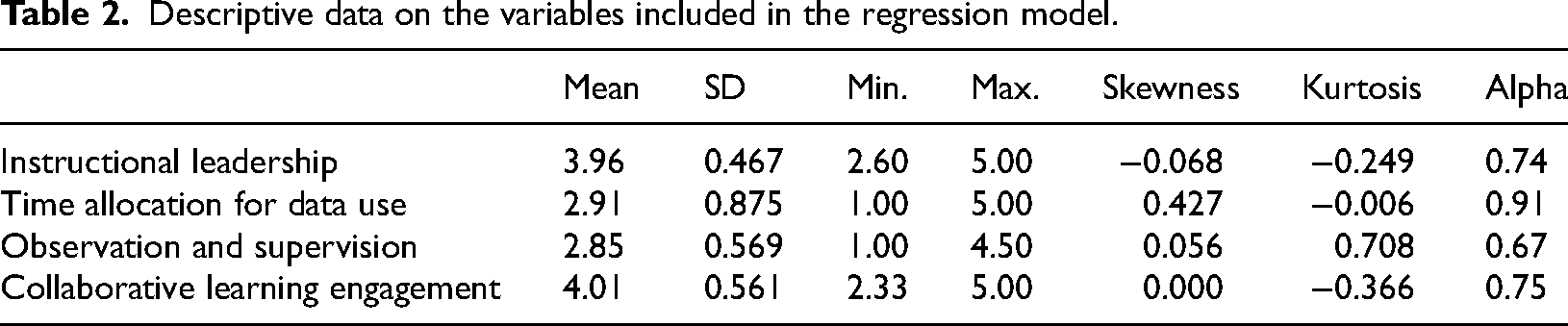
Descriptive data showed relatively high average scores for the variables instructional leadership and collaborative learning engagement and somewhat lower scores for time allocation for data use and observation and supervision (see Table 2). The distribution of school leaders’ assessments was normal, and skewness and kurtosis were within acceptable limits of between −2 and 2 (George and Mallery, 2011).
Descriptive data on the variables included in the regression model.
About 55% of the school leaders had more than 10 years of experience as school leaders, and 26% had less than 5 years of experience (Table 3).
Total experience as a school leader.

Correlation analysis
The correlations between the variables are reported in Table 4. We found a systematic correlation between the outcome variable and collaborative learning engagement (0.466), observation and supervision (0.347), and time allocation for data use (0.239). We found no significant correlation between the outcome variable and school size or leadership experience. However, leadership experience was significantly correlated with the other independent variables.
Correlation between the variables included in the regression model.
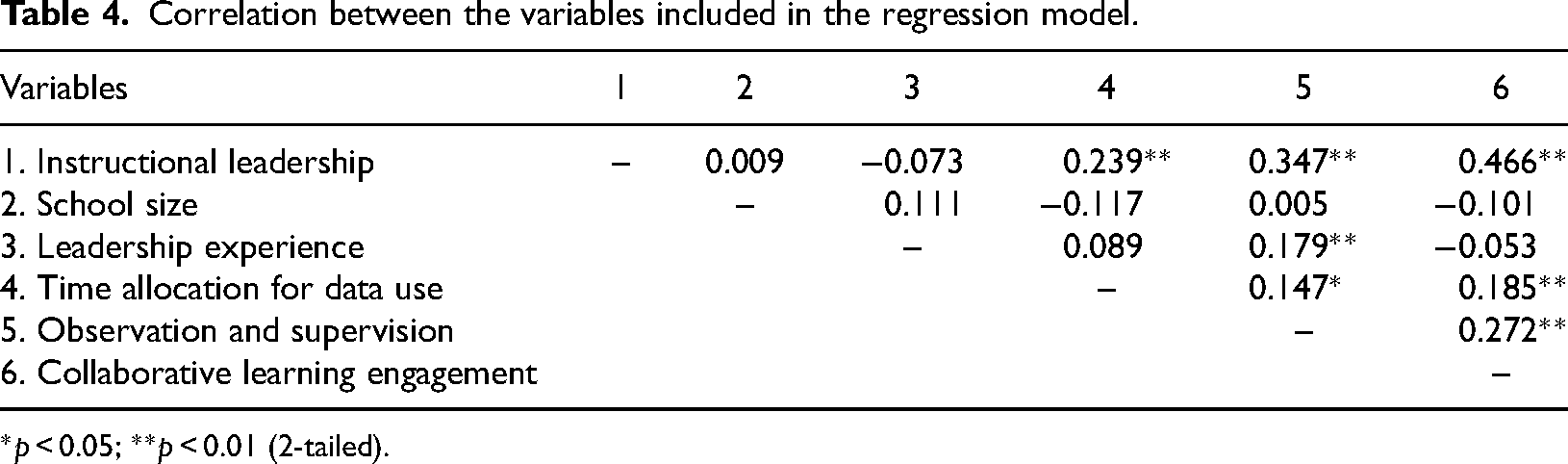
*p < 0.05; **p < 0.01 (2-tailed).
Multiple regression analysis
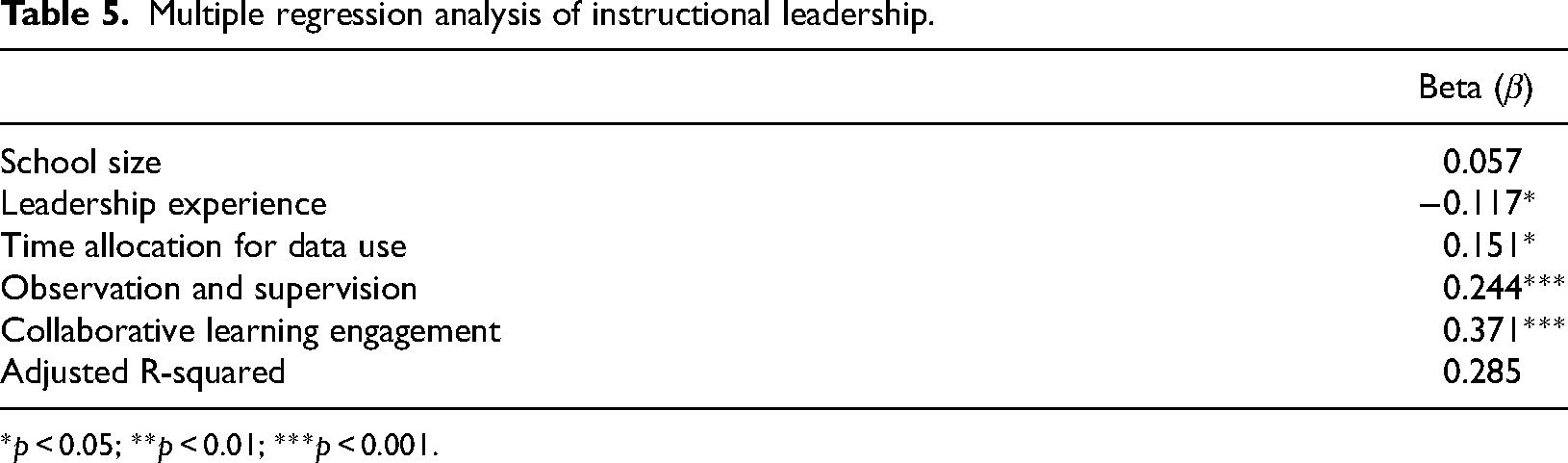
The results of the multiple regression analysis are reported in Table 5. Overall, the regression model, with all the predictors included as a set, was significant F(5, 215) = 18.58, p > 0.001, R2 = 28.5. Time allocation for data use (beta = 0.15), observation and supervision (beta = 0.25), and collaborative learning engagement (beta = 0.37), controlled for school size and leadership experience, accounted for a significant amount of unique variance in instructional leadership corresponding to 28.5%. At the individual level, school size was not a significant predictor of instructional leadership. Leadership experience (negatively related, beta = −0.12) accounted for a significant amount of unique variance.
Multiple regression analysis of instructional leadership.
*p < 0.05; **p < 0.01; ***p < 0.001.
Two other multiple regression analyses were performed to investigate whether the variables for school leaders with high and low self-assessed instructional leadership had different explanatory powers. The analyses showed little difference between the two groups, and the regression model's explanatory power was greatly reduced. This may be explained by the small number of samples. In these two analyses, most of the variables did not significantly predict instructional leadership. This likely means that the variation in the independent variable differed between the two groups.
Discussion
The results showed that, overall, 28.5% of the variance in school leader's capacity for engaging in instructional leadership was explained by the three distinct factors observation and supervision, collaborative learning engagement with teachers, and time allocation for data use. Although this is a significant amount of variance, it also confirmed the complexity involved in the multi-faceted model of instructional leadership, as more than 70% of the variance was unexplained. The results concur with a significant number of prior studies from different educational systems (e.g. Jarl et al., 2021; Leithwood et al., 2020b) by suggesting that school leaders’ active participation in professional learning engagements with teachers is one of the most effective practices for building capacity for instructional leadership (beta = 0.37; see Table 5). Similarly, the core practices refer to the school leaders’ high degree of observation and the supervision of their teachers, with school leaders participating in systematic observation, making inferences based on what is observed, and engaging in supervisory dialogue with individual teachers to create an improvement cycle. The results indicate that this core practice accounts for a significant amount of unique variance in instructional leadership (beta = 0.25), while its contribution increases when it is grouped together with the other predictors of instructional leadership as a set. This can be explained by the fact that the benefit of observation and supervision is greater if school leaders integrate this core practice with active engagement in teachers’ collaboration and professional development. The third core practice in our model focused on data use, a factor that, to our knowledge, has seldom been modeled and studied empirically as a distinct core leadership practice. While time allocation for data use accounted for a limited amount of unique variance in instructional leadership, it was significant, and together with other core practices, was found to play an important role in the variance of school leaders’ capacity for instructional leadership, indicating that this specific core practice deserves more attention. Taken together, the asserted model showed that a combined set of core practices of school leadership that includes active learning participation—often referred to a “learning-centered leadership” (Hallinger and Heck, 2010)—paired with managerial roles, such as aligning actual student results to classroom behavior through joint sessions of data analysis with teachers backed by supervision and classroom observation, would yield the greatest effect on education leaders’ capacities for engaging in instructional leadership.
Implications for theory development and future research
The context-sensitive nature of core practices
As noted by Leithwood (2012), conceptualizing leadership as a set of core practices reflects both the adaptive qualities and the expert problem-solving processes involved in effective leadership: What most successful leaders do in many different contexts, their practical value depends on leaders enacting them in ways that are sensitive to the specific features of the circumstances and settings in which they work and the people with whom they are working. For example, how a leader goes about ‘developing people’ is likely to be very different in a school filled with largely new and inexperienced (albeit eager) teachers than it is in a school mostly staffed by a group of experienced and highly skilled teachers (13).
Shaked (2020) followed this argument by demonstrating a group of core leadership practices that also contain context-sensitive aspects affected by the following: building and maintaining a school vision that establishes clear learning goals and establishing commitment to these goals, sharing leadership by counting on the expertise of teacher leaders, leading a learning community, gathering data for utilization in instructional decision-making, and monitoring and encouraging curriculum implementation and quality teaching methods by spending time in classrooms.
The larger point showed that general core practices that transcend national and cultural boundaries are also contextually influenced by the material, political, and socioeconomic environments of a given school, given that the “local context will affect the type of leadership that is required for a specific educational system to improve, and therefore the definition of principals’ effective practices (Marfan and Pascual, 2018: 279).
In our study, context-specific properties in a high-need region put some core practices at the forefront. The demographical context was Hedmark County in Norway, in which about half of the inhabitants live in small communities. Over the last few decades, the county has consistently performed below national standards in a range of educational outcomes, such as student achievements in core subjects and student progression to and completion of upper secondary education. A great portion of the primary and lower secondary schools situated in this area is rural schools with limited access to professional development resources. Situated in this context, our findings put emphasis on three distinct core practices of school leadership: (1) observation and supervision, (2) collaborative learning engagement with teachers, and (3) time allocation for data use. According to our study, contextual factors, such as school size, do not predict school leaders’ capacity for engaging in instructional leadership. This finding is a relevant contribution to educational policy discussions.
Instructional leadership as a learning endeavor
The findings of our study underscore the significance of school leaders’ active participation in teachers’ professional learning. The emphasis on active participation and mutual engagement means that school leaders and teachers form various communities of practice that can be defined as a unique combination of the following three fundamental elements: “a domain of knowledge, which defines a set of issues; a community of people who care about this domain; and the shared practice that they are developing to be effective in their domain” (Wenger et al., 2002: 27). The core practices analyzed in our study cluster and cohere around social learning in communities of practice, and prior studies from the Nordic context have shown that this form of mutual learning engagement predicts important social-cognitive outcomes, such as teachers’ sense of efficacy, organizational commitment, and the enhancement of classroom skills (e.g. Hjertø et al., 2014). Our study contributes to this body of knowledge by demonstrating that school leaders’ and teachers’ engagement in mutual learning not only contributes to the growth of teachers’ competence but also predicts school leaders’ capacity to perform effective instructional leadership practices. This conclusion concurs with Robinson et al.’s (2008) notion of “leadership for learning,” highlighting that school leaders’ strongest avenue of influence on teaching and student learning involves engagement in teachers’ professional learning. By linking instructional leadership to our three distinctive core practices, we have indicated a promising path for conceptual development in relation to developing school leaders’ capacity for instructional leadership. More specifically, we recommend that future studies consider the unique combination of mutual engagement in professional learning, trust-based observation and supervision, and the development of internal accountability through data use.
Implications for school leadership in practice
Working in an observation system
Observation as a learning tool emphasizes systematic methodology because the quality of observations can vary in terms of validity and reliability, and researchers recommend employing a systemic framework for classroom observation (Bell et al., 2019). While all teaching dimensions are fundamental to students’ learning and development, each dimension can be operationalized differently in specific observation systems. Furthermore, observation systems vary in the degree to which they capture all dimensions or target specific dimensions, such as the important dimensions of teaching as explicated by Bell et al. (2019). A system's grain size may be related to the number of scale points (e.g. a continuous vs dichotomous scale of present or absent dimensions). The sampling of the observed lesson can be specified even further: Whether the observer should walk around, talk with students or not during an observation, which part of the lesson should be observed, how many observation cycles should be conducted, and when the observation should be conducted across days, weeks, or the school year. (Bell et al., 2019: 10)
Time for data use as a vehicle for internal accountability
In the Ontario Leadership Framework, Leithwood (2012) expanded their leadership model by adding the building of internal accountability as a new factor in which data use is one of the most important core practices for school leaders to develop. The process of internal accountability was described as follows: “While school and district leaders have become the face of public-school accountability, they depend on the capacities and senses of responsibility of their colleagues to accomplish the goals for which they are being held accountable” (Leithwood, 2012: 30). Internal accountability can be strengthened by the following practices:
Promoting collective responsibility and accountability to improve student achievement and well-being Insisting on the use of “high-quality” evidence Regularly engaging the staff in the analysis of such evidence about everyone's learning progress
At this point, school leaders’ time allocation for designing and processing data to engage with teachers emerges as a crucial capability. This also brings the more managerial side of school leadership to the fore in terms of individuals’ capacity to manage personal time resources efficiently.
Limitations of the study
The study has several possible limitations. Although some variables in the study were exploratory and lacked pre-validated measure models, we saw these variables as pointing to a possible direction for further research on the development of leadership practices. A limited range of core practices was included, and the variables consist of relatively few items. Although statistical analyses show satisfactory reliability, this may be a substantial limitation. Moreover, our data were based on school leaders’ self-reports, which could have allowed bias or subjectiveness to harm the validity of the study (Grissom and Loeb, 2011). Future research may address this limitation by examining teachers’ perceptions of their school leaders’ practices or by conducting observational studies at schools.
Concluding remarks
Taken together, our model's independent variables concur with Leithwood et al. (2020a)'s framework that highlights two central core practices: developing peoples’ skills and improving schools’ instructional programs. However, as noted by the mentioned studies, the core practices of effective school leadership do not influence student learning unless they are adapted to the socioeconomic, micro-political, and cultural context in which school leaders’ work is situated. Our findings support this inference by revealing three distinct core leadership practices employed by school leaders. When school leaders adapt core practices of leadership to their work context, their capacity as instructional leaders increases.
Footnotes
Declaration of conflicting interests
The authors declared no potential conflicts of interest with respect to the research, authorship, and/or publication of this article.
Funding
The authors received no financial support for the research, authorship, and/or publication of this article.
