




Abstract
The rationale for the principles of effective school governance in England, as set out in government regulations, has never been made explicit. This article addresses that issue and develops and proposes such principles. We argue that effective school governance secures the legitimacy of schools as institutions. Such institutional legitimacy is achieved through the institutionalization processes in which the institutional primary task is central. Effective governance is therefore concerned with overseeing and ensuring the processes of institutionalization. We identify two general principles that relate to ensuring the school's legitimacy and ensuring that the school's institutionalization processes enable it to be a legitimate institution. We also distinguish six specific principles that relate to: the school's work on the institutional primary task, the resources required and deployed for work on the institutional primary task; the school's compliance with the rules and regulations that apply to the institution; the school's conformance to the norms expected of a school; the way the school operates on a day-to-day basis in relation to wider society's expectations; calling the headteacher or principal (HT/P) to account for the functioning of the school; and ensuring the HT/P's development. Our analysis is relevant to school governance in other countries.
Keywords
Introduction
The effectiveness of school governance undertaken by school governors is central to the proper functioning of schools in England. The principles, as set out in government guidance, which underpins effective governance, are therefore crucial. They need to be rational – based on appropriate and well-grounded reasoning, and valid – relevant and meaningful. Effective school governing processes and practices should be based on and have a direct link to such principles.
The principles of effective school governance in England have been defined in school governing handbooks in broadly similar ways over the last 10 years or so. However, the rationale for them has never been made clear in any of the documents (DfE, 2013; 2014; 2015; 2017a; 2019; 2020b).
The intention of this article is to develop and propose rational and valid principles for the effective governance of schools in England. We first critique the current principles set out for effective school governing in England and then draw on valid, relevant and well-established theoretical concepts and models to synthesize a new set of principles. We use the notions of institutional legitimacy, the institutional primary task, institutionalization theory and the responsibility delegated to the school headteacher or principal (HT/P) by the school's board of governors. We then propose a set of principles for the effective governing of schools in England. Our argument is in essence a simple one. The effective governance of schools is centrally concerned with securing the legitimacy of schools as institutions. Such institutional legitimacy is achieved through the institutionalization processes. Effective governance is therefore concerned with overseeing and enabling the processes of institutionalization. The principles of effective governance for school governing boards set out what governing boards should do and make clear the criteria against which their effectiveness as a governing board will be judged.
Following this introduction, we discuss the school system in England, the notion of governance and the governing arrangements for the schools in the English school system. We then explore institutional legitimacy, the institutional primary task, institutionalization theory and the management responsibility delegated to the HT/P by those governing the school. Based on that analysis, we set out principles for effective governance that are rational and valid. The article ends with some concluding comments.
Schools in England
In 2021, there were 5267 publicly funded secondary schools for students aged 11 years and above and 19,736 publicly funded primary schools for students aged 5–11 years in England (DfE, 2021). There were also 1806 special schools for students with special learning needs. Over half the schools in England are maintained by the local authority (DfE, 2021). The remainder, numbering approximately 9278 schools, have academy status and are funded directly by central government. Such schools are usually part of multi-academy trusts (MATs), which are groups of academies.
MATs typically have structural features that are relevant to their governance and, hence, are of particular interest from a governance standpoint. First, their structure is hierarchical, with the MAT board monitoring the governance work of the individual academy governing bodies. Second, MATs can be geographically widespread crossing regional and county boundaries. Third, they vary considerably in size and, in theory, there is no limit to their size. Finally, MATs may comprise different school types: primary; secondary; post-sixteen; and special or alternative provision (Greany and Higham, 2018; Simon et al., 2019). This issue is significant for governing practice in such diverse MATs, particularly as the governing of primary and secondary schools has been shown to be different (James et al., 2010; James, et al., 2014). Nonetheless, it was made clear in 2015 that the guidance on effective governance applied to all schools regardless of their status and the way they are funded (DfE, 2015). The article is thus relevant to both local authority-maintained schools and academies.
The notion of governance
The notion of governance typically means the processes of governing a social entity of some kind. Governance is not the same as government because governance entails a wider range of actors engaged in a range of social activities and practices than just the state and its institutions (Bevir, 2011). Governance is typically construed as a network of interactions of a range of kinds and at various levels (Rhodes, 1997; Kooiman and Jentoft, 2009). To quote Bevir (2011: 2) Governance draws attention to the complex processes and interactions that constitute patterns of rule … Governance as theory, practice and dilemma highlights phenomena that are hybrid, and multijurisdictional with plural stakeholders who come together in networks (emphases as in the original).
In such a scenario, where a number of organizations are involved, some of which are complementary, some competitive and some both, and with different agendas and resources (legal, economic, political and social), relationships within those networks will be complex and fluid. In turn, the resulting management and leadership challenges are likely to be substantial.
Members of the school governance network are various, and the network is extensive, largely because of the school system's wide-ranging and significant responsibilities. Actors in the school governance network in England include government departments and agencies such as Ofsted; teachers; headteachers; politicians; unions and professional associations; local authorities; a range of organizations, public, private and voluntary; parents; employers; and of course, school governors.
Governance networks are therefore typically very complex and understanding them requires an analytical perspective different from the simple view that ‘governance’ is solely the province of those with the title ‘governors’. Such a perspective is provided by Kooiman (2003) in his interactive governance framework. James et al. (2010) have applied this framework to school governing in England. Despite the complexity of the school governance network in England, school governors play a significant role in overseeing the conduct of schools.
School governing in England
Despite the varied arrangements for the organization of schools in England, for example, whether they are academies or local authority-maintained schools, schools in England typically have a governing board. In MATs, the governing powers that are delegated to the local governing boards of schools in a MAT by the trust board are specified in a scheme of delegation and may vary which has implications for the governing role of local governing boards. In some MATs, the governing role of the local governing boards has been reduced to an advisory role only, and therefore, they may be excluded from important governing practices such as headteacher performance management. Regardless, in the guidance given to school governors (DfE, 2020b), all schools are considered to have governing bodies, and they have specific functions.
Governing bodies vary in size (James et al., 2010) but they should have at least seven members and there is no upper size limit. Regulations (DfE, 2017b) state that the membership must include: at least two parent governors; one staff governor, and for those schools that are maintained by the local authority, ‘one and only one’ (DfE, 2017a, p. 18) local authority governor. The governing board may co-opt additional governors. The headteacher is a member unless they resign from the board, and they have a crucial role in school governance (James et al., 2010). All school governing boards are required to have a chair who ‘is responsible for ensuring the effective functioning of the board’ (DfE, 2020b, p. 19), and the relationship between the chair and the headteacher is significant for the operation of the board (James et al., 2013). Importantly, members of school governing boards in England are not remunerated for their governing work (Forrest Hill and James, 2021). They are volunteers. In recent years, a number of authors have published research-based articles on aspects of school governing in England including Young (2017), Connolly et al. (2017), Eddy-Spicer et al. (2017) and Baxter (2017).
Interestingly, in 2015, what had previously been called school governing bodies began to be referred to by the central government's Department for Education (DfE), as governing boards (DfE, 2015). The justification for the change was given by Lord Nash, the then Parliamentary Under Secretary of State for Schools, to emphasise that the guidance applies equally to the governing body of a small, maintained school as it does to the board of a large MAT (DfE, 2015).
The defined essentials of effective governance are described as core functions of school governing boards. They are set out in the Governors Handbook, which is published by the DfE, typically annually. Between 2013 and 2020, successive editions of the Governors Handbook (DfE, 2013; 2014; 2015; 2017a; 2019; 2020b) have specified very similar functions for school governors. Three functions are described. The first ‘Ensuring clarity of vision, ethos and strategic direction’ has not changed during that period (DfE, 2013: 6; DfE, 2020a: 12). The second function has changed over that time. In 2013, it was ‘Holding the headteacher to account for the educational performance of the school and its pupils’ (DfE, 2013: 7). In 2015, ‘and the performance management of staff’ was added and ‘school’ was replaced by ‘organisation’ (DfE, 2015: 7). The third function ‘Overseeing the financial performance of the school and making sure its money is well spent’ (DfE, 2013: 7) has not changed except that ‘school’ has been replaced by ‘organisation’. Thus the 2020 edition of the Governors Handbook (DfE, 2020b: 12) sets out effective governance as:
‘Ensuring clarity of vision, ethos and strategic direction; Holding executive leaders to account for the educational performance of the organisation and its pupils, and the effective and efficient performance management of staff; and Overseeing the financial performance of the organisation and making sure its money is well spent’. Ensure your charity is carrying out its purposes for the public benefit; Comply with your charity's governing document and the law; Act in your charity's best interests; Manage your charity's resources responsibly; Act with reasonable care and skill; and Ensure your charity is accountable.
No explanation is given for the basis of these dimensions of effective governance, which are in essence what governors of schools in England should do. The Handbook does make clear that the aspects of effective governance ‘are common across the education sector and share their fundamental principles with governance in the charity and business sectors’ (DfE, 2020b: 13). Such commonality is not, however, immediately apparent. As academies and MATs are charities, the Charity Commission for England and Wales is involved. The duties of the trustees of charities set out by the Charity Commission for England and Wales (2018: 4) are:
Similarly, common ground with the duties of a company director is limited. Under the duties of company directors specified by the UK government (Gov.uk, 2019), which are set out under the Companies Act 2006, company directors are principally required ‘to follow the company's constitution and its articles of association’ and to ‘promote the success of the company’ (Gov.uk, 2019: 1). To carry out these duties, company directors are required to exercise independent judgement and reasonable care, skill and diligence, avoid conflicts of interest, not accept benefits from a third party, tell the other directors and members if they might personally benefit from a transaction the company makes, not misuse the company's property, and apply confidentiality about the company's affairs.
For school governors, the current Governors Handbook (DfE, 2020b) enlarges on the three elements of effective governance, identifying ‘six key features:
Strategic leadership that sets and champions vision, ethos and strategy. Accountability that drives up educational standards and financial performance. People with the right skills, experience, qualities and capacity. Structures that reinforce clearly defined roles and responsibilities. Compliance with statutory and contractual requirements. Evaluation to monitor and improve the quality and impact of governance’ (DfE, 2020b: 13).
The Handbook makes clear that the features ‘Strategic Leadership’ and ‘Accountability’ ‘are the core pillars of the board's role and purpose’ (DfE, 2020b: 14). ‘People’ and ‘Structures’ refer to the organisation of governance and ‘Compliance’ and ‘Evaluation’ are ‘about ensuring and improving the quality of governance’ (DfE, 2020b: 14). The exact relationship between these features and the elements of effective governance initially set out is not made clear.
Importantly, the Handbook states that: Regardless of the scale or nature of the (school) organisation being governed, the features of what makes for effective governance remain the same (DfE, 2020b: 13).
The DfE thus makes clear that regardless of whether ‘school’ governors are governing a local authority-maintained school, a special school (for students with learning difficulties), a primary or a secondary school, a stand-alone single academy, a local governing body in a MAT or a trustee of a MAT board, the features of effective governance of every institution are all the same.
Institutional legitimacy
Institutional legitimacy is important to our argument because we consider that effective school governance of a school is centrally concerned with ensuring the school's legitimacy as an organisation. In this section, we discuss the notion of institutional legitimacy and explain its significance.
The legitimacy of a social entity of some kind is secured when the entity's actions ‘are desirable, proper, or appropriate within some socially constructed system of norms, values, beliefs and definitions’ (Suchman, 1995: 574). Legitimacy communicates a recognition that an entity's values, principles and practices are aligned with the expectations of those in its environment (Bunnell et al., 2017). Institutional legitimacy is concerned with organisations as a particular form of social entity.
Institutional legitimacy centres on the relationship between an organisation and its environment. It concerns the congruence between an organisation's values and principles, as evidenced by its activities, and the norms of appropriate behaviour expected by the wider social system. By demonstrating this congruence and similarity, the organisation will be deemed to be legitimate (Dowling and Pfeffer, 1975). Thus, institutional legitimation ‘is the process whereby an organisation justifies to a peer or superordinate system its right to exist’ (Maurer, 1971: 361). For Drori and Honig (2013), the way the internal processes and practices of individuals who constitute the institution relate to the ability of the institution's wider environment to legitimise them is significant. These two processes, the internal processes of the organisation and the environment's ability to legitimise them or not, are interdependent. Achieving institutional legitimacy requires an understanding of what is right appropriate and proper, and the actions that will mobilize and secure wider society's approval (Drori and Honig, 2013).
The key point here is that the processes of achieving the congruence between an organisation's values and principles as indicated by what it does, and what wider society expects is crucial to achieving institutional legitimacy. We argue that effective governance has a pivotal role in ensuring this congruence. Put very simply, the effective governance of a school is central in ensuring that what the school does is right in terms of what wider society expects a school to do. It enhances the status of schools from being (simply) organisations to being institutions. In the next section, we consider the activities that achieve that legitimacy and institutional status.
The nature of institutions
Institutions are significant social structures that give a sense of constancy, stability and significance to social life (Scott, 2014). They can both empower and limit action (Giddens, 1979; 1984). Social institutions are understandably wide-ranging and include for example hospitals, stock markets, marriage, law courts and of course, schools. They are all multifaceted, have many different aspects and are complex. The idea that institutions give stability and meaning draws attention to their durability. They give society a sense of solidity over time and across space (Giddens, 1984). Institutions can be, and typically are, reproduced and conveyed through generations, which brings about their continuation (Zucker, 1977). Consequently, they are resistant to change (Jepperson, 1991). Scott (2014) accepts the durability of institutions but also suggests that they can and do change. In that regard, institutions, as with organisations, stay the same but also change over time (Hatch, 2004).
Despite the obvious similarities between organisations and institutions, there are also key differences. Legitimacy is the important distinguishing feature. Organisations, such as criminal gangs, people-trafficking groups, or drug cartels, would not have widespread social legitimacy and would not be viewed as institutions. There is no alignment between their practices and the values and principles that guide those practices, and those of the wider society in which they exist. However, many organisations are institutions, and they become so through institutionalisation.
The notion of institutionalisation
In essence, institutionalisation is the term used to describe the activities that bring about the legitimacy of organisations (Lawrence and Suddaby, 2006). In this section, we discuss institutionalisation processes, the oversight of which we argue is central to effective governance.
Institutionalisation processes
In this section, we draw on the seminal work of Scott (2014) on institutionalisation, and in particular, his analytical framework for understanding institutionalisation processes. These processes are the purposeful actions of individuals undertaken to create and maintain their organisation's institutional status (Lawrence, Suddaby and Leca, 2006). In Scott's framework, institutionalisation processes have three distinct dimensions, which he calls pillars because of their role in supporting and upholding institutionalisation. Bunnell et al. (2017) argue that purposeful institutionalisation practices, and the values and principles that underpin them, cannot be fully understood without a clear understanding of what the institution is there to do. This is the central feature of the institution, and it conditions all aspects of institutionalisation. Bunnell et al. (2017) develop the notion of the institutional primary task to frame what the institution exists to accomplish. In the next section, we discuss the institutional primary task and its significance.
The institutional primary task
The idea of the ‘primary task’ was first developed by Rice (1963), who defined it as the task an organisation must perform to survive. It is what the organisation feels, consciously or unconsciously, it must do if it is to continue and to carry on. Here, we see a connection between legitimacy and institutional survival (Meyer and Rowan, 1977). An institution, like an organisation, will only survive if its task performance enables it to do so. However, for an institution to survive as such, its task performance must be deemed legitimate by key players within its governance network. Thus, we argue that defining an institution's primary task is crucial in establishing institutional legitimacy.
The way the organisational primary task relates to organisational goals is of interest and the significance of organisational goals for institutional legitimacy features in the institutionalisation literature. Parsons (1956) argues that goals legitimise the main working patterns of an organisation and that these patterns are central to the way values are applied. For Scott (2014: 28), schools acquire legitimacy in a society if ‘their goals are connected to wider cultural values … and to the degree that they conform in their structures and procedures to established ‘patterns of operation’ specified for educational organisations’. Although the nature of organisational goals is important in institutionalisation, the organisational (primary) task has a more pre-eminent place (Bunnell et al., 2017). Put simply, ‘The task defines what the institution is there to do; the goal is the outcome of that doing’ (Bunnell et al., 2017: 306). The task, therefore, has primacy in considerations of institutionalisation and institutional legitimacy. Moreover, the primary task conditions institutionalising processes, the pillars of institutionalisation. Similarly, the primary task is not the purpose of the organisation. Dictionary definitions of ‘purpose’ typically stress that purpose is the reason why something is done, see for example, Collins (2021). The purpose provides a rationale for the organisation's primary task.
A discussion of the institutional primary task calls up the question: ‘What is the primary task of a school?’ In a study of very effective primary schools in disadvantaged settings, James et al. (2006:152) define the primary task of the schools they studied as: ensuring effective and enriched teaching for learning for all pupils and improving and further enriching teaching for learning for all pupils.
This definition is helpful – it sets out what the school is there to do. However, it is also unhelpful in that the definition is in essence two primary tasks – ensuring and improving teaching. Setting two primary tasks always entails the setting of a third task that of determining and managing the balance between the two primary tasks. However, drawing attention to the notion of improvement does bring in the idea of continuous improvement. In this instance, no matter how good the teaching is, it can still be improved. Importantly, the institutional primary task of these schools had widespread legitimacy. The schools ‘received high levels of support, validation and valuing from their communities’; there was ‘mutuality in the relationships between schools and their communities’; and the ‘schools actively sought the support of their communities in their work’ endeavouring ‘to establish positive relationships with all those connected with them’ (James et al., 2007: 582).
For the purposes of our argument here, we suggest a valid primary task of schools is ‘The provision of education for the students attending the school’. Of course, the process of working on that task requires resources of various kinds, such as teachers, learning spaces – classrooms, for example, and learning resources. The funding of those resources is a significant matter. Work on that primary task will achieve outcomes of various kinds, such as improved student capability and motivation, and outputs – tangible ‘end products’ such as certificates, examination grades and places at university. Those outcomes and outputs are important as they can signal the quality of the work on the primary task.
As stated above, the notion of the primary task has implications for considerations of institutionalisation. It conditions all institutionalisation processes, including establishing and communicating an institution's legitimacy to the wider environment. The institutional primary task of schools, which in the example we have used is ‘the provision of education for the students who attend the school’, is central in securing schools as institutions. Governing boards have an important role in overseeing the school's work on that task. They also have a role in overseeing the resources required for that work and the funding of those resources, and the outcomes and outputs of the school's work on the primary task. In terms of practical applications of these implications for school governing boards, clearly clarifying the institutional primary task is an important first step. Asking the question ‘What is the school here to do?’ can be important, although answering it may not be particularly easy (James et al., 2006). However, it will provide a basis for considerations of the resources needed to undertake that task such as teachers, teaching resources and physical spaces. In exploring the resources required for work on the institutional primary task and the outcomes and outputs of such work, we are highlighting important limitations to this aspect of the theory we are using to develop and propose the elements of effective governance in schools.
The pillars of institutionalisation
Scott (2014) identifies three pillars that support and bring about institutionalisation. In this section, we discuss the nature of those pillars and the implications of each of them for governing boards.
The regulative pillar of institutionalisation
The regulative pillar comprises those practices associated with rule-setting, monitoring and sanctioning activities (Scott, 2014). Rule-setting is the key aspect with monitoring and sanctioning being subsequent practices (Bunnell, Fertig, and James, 2016; 2017). Complying with the rules is a matter of expediency; compliance is more advantageous regardless of whether the rule is reasonable. Regulations and rules are coercive; there is a compulsion to comply regardless of what those subject to the rules might think. Regulative rules are legally sanctioned, which is the basis for their legitimacy. The regulative pillar is evident in institutions as laws, rules and sanctions.
School governors have an important role in ensuring that the school conforms to the rules and regulations that are set by external authorities and apply to the school. In practice, ensuring compliance with those legal requirements may entail establishing policies that frame the work of the school, such as policies on the recruitment and selection of staff and child protection.
The normative pillar of institutionalisation
The normative pillar of institutionalisation encompasses those aspects of institutional life that prescribe practices that have obligatory compliance and that provide a basis for evaluating activities. It comprises norms and values. Norms specify those practices that are considered to be legitimate in the pursuit of valued outcomes. For Blake and Davis (1964), normative systems delineate goals and how they should be achieved. They thus have a role in framing the nature of the work on the institutional primary task. Values are notions of what is preferable and desired along with the setting of standards against which structures and practices can be evaluated (Scott, 2014).
Norms are very significant in the processes of institutionalisation (March and Olsen, 1989) as they influence the moral basis of many institutions (Stinchcombe, 1997), including schools (Glatter, 2015). The moral agency of social actors in such institutions is important (Heclo, 2008). Social obligation, a duty and a commitment and responsibility to others, provides the basis for the conformance to norms. Individuals are obliged and expected to behave appropriately according to institutional norms.
Governors of schools have an important role in ensuring that the school conforms to the norms expected of a school by the wider society, including the specific societal elements with which the school is especially concerned. Thus, governors may bring to the school governing board matters that reflect the concerns of the parents or other interested individuals and organizations. In practical terms, governors will want to consider the practices in their school, for example, the management of student behaviour, attendance and well-being, to ensure that they conform to those expected of a school. They may also want to consider the values that underpin practices in the school such as student exclusions. The outcomes of inspections by Ofsted, the school inspection service in England (Ofsted, 2021) and the implementation of any post-inspection requirements will be important for governors in ensuring the school conforms to expected norms. The governing board may well want to hear from key stakeholders, such as parents, students, staff and other interested individuals and organisations, to gain insights in the way the school conforms to expected norms.
The cultural–cognitive pillar of institutionalisation
The cultural–cognitive pillar of institutionalisation comprises the collective sense-making schema that enable meaning-making and interpretation and the shared understandings of the nature of reality (Scott, 2014, Connolly, James, and Beales, 2011, Connolly and Kruse, 2019). It is grounded in cultural theory, a perspective that enables an understanding of the way organisational practices generate their own social dynamics (Douglas, 1982). In cultural theory, the agency of individuals is given an explicit role in the joint development of social environments while emphasising the social reasons for behaviour (Douglas, 1986). Through their cultures, institutions cultivate a particular mindset, which is focused on specific ways of reflecting and acting (Douglas, 1986).
Once an institutional mindset or thought style has been established, it influences individuals to think and behave in similar ways. It creates a collective consciousness (Douglas, 1982), which includes ‘rules’ of various kinds. Failure to comply with these rules incurs some form of penalty. These collective cognitive frames have an important role in shaping how information in its widest sense is processed, remembered and recalled. Importantly, it shapes what members of the institution attend to.
The role of compliance with the cultural–cognitive pillar in institutionalisation is based on a shared understanding of matters those members of the institution take for granted. These assumptions constitute the schemes for understanding, interpretation and action that are widely shared amongst institutional actors. The contribution of the cultural–cognitive pillar to institutionalisation is through copying or imitation. Individuals are expected to behave in a manner that complies with the conventional, accepted and established way. The validity of this pillar is grounded in it being: rational – there is a logic to it; comprehensible – members of the institution understand it; customary – it is expected and familiar; and endorsed both by those within the institution and those in its environment (Scott, 2014). The significance of organisational culture, in all its interpretations, is acknowledged in the wider literature and in relation to schools. ‘Getting the culture right’ is deemed to be important (Connolly et al., 2011).
School governors need to ensure that the cognitive–cultural processes – particular ways of thinking and doing things, the way matters are interpreted, and the organisational culture – are in line with what would be expected of a school as an institution by the wider society. As regards governing board practice, gaining insights into the way the school staff, in particular, make sense of events – both everyday occurrences and more substantial incidents – and how they act/react is important. Understanding ‘how the school works’ as an organisation and the reasons for those operational practices is similarly significant. Here, the notion of ‘knowing your school’ is highly relevant and the guidance provided by the National Governance Association (NGA 2021) is, in our view, very helpful.
Despite that justification of the use of culture as a dimension of institutionalisation and our assertion of its value as a heuristic for understanding a particular aspect of institutionalisation, we are conscious of its limitations. The notion of culture is open to a range of interpretations (Connolly et al., 2011), which could usefully be considered in gaining a greater understanding this particular aspect of the institutionalisation theory we are using in this study. Further we are conscious that this dimension emphasises the ‘cognitive’ whilst appearing to ignore the affective aspects of experience. The processes of meaning-making and interpretation and the development of shared understandings of the nature of organisational reality will be influence by individuals’ affective experience.
The way institutionalisation processes are communicated
The three pillars of institutionalisation are communicated in various ways, which Jepperson (1991) refers to as carriers. Scott (2014) identifies four types of carrier: symbolic systems, relational systems, activities and artefacts. They are described in Table 1. Bunnell et al. (2016) use this framework of carriers of the pillars of institutionalisation to establish what is international about International Schools from an institutional legitimacy standpoint.
The institutional pillars and carriers of institutionalisation. Taken from Bunnell et al. (2016) adapted from Scott (2014).
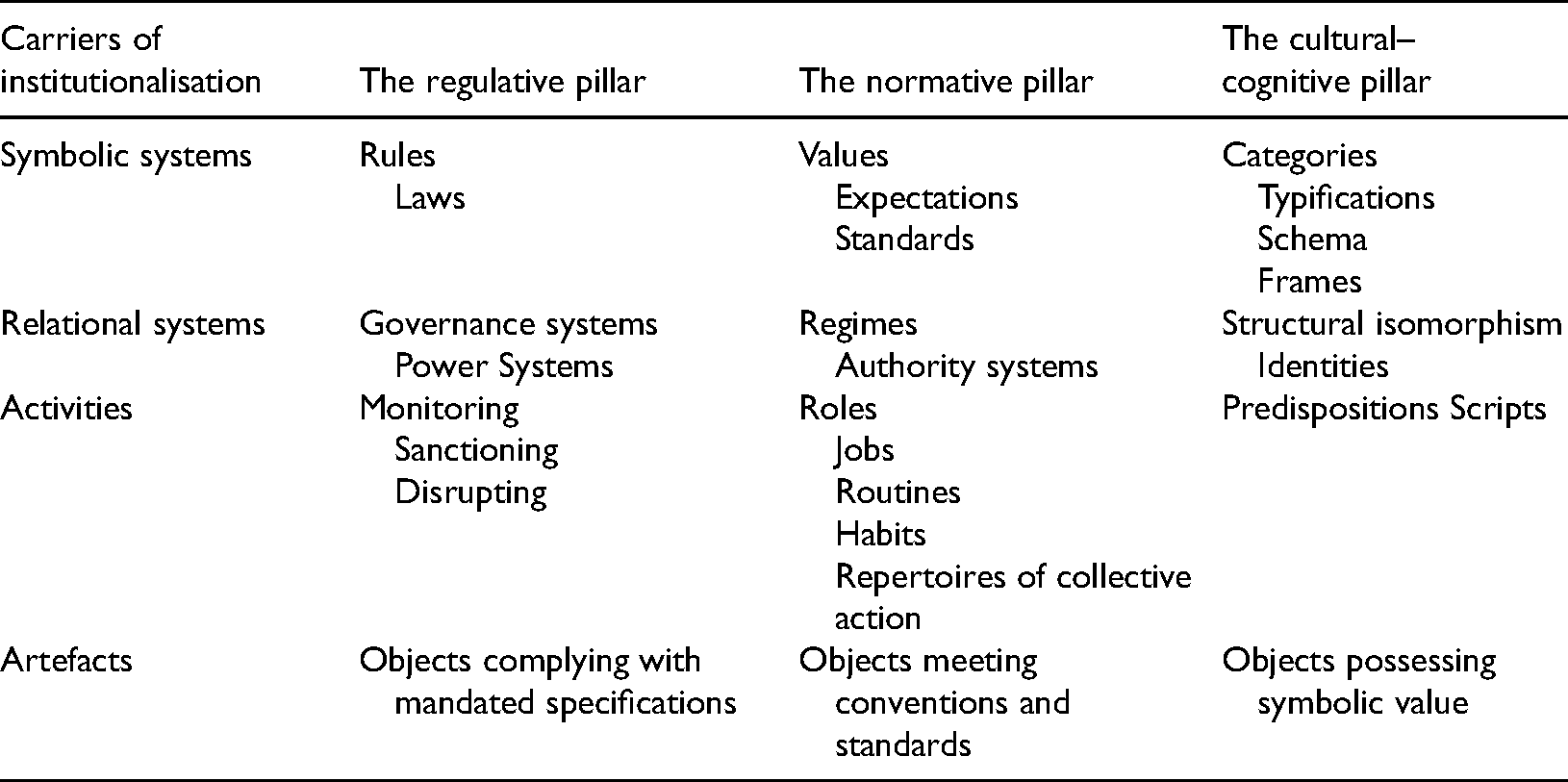
The carriers can be used by school governing boards as a source of evidence for evaluating institutionalisation practices and their role in contributing to institutional legitimacy. In the section that follows, we give some examples of the kinds of evidence school governing boards could use.
The regulative pillar: evidence of institutionalisation processes
Symbolic systems. The school's conformance to: the ‘law of the land’, for example, employment law; the requirements of inspection bodies such as Ofsted; and their own policies, codes of practice and procedures will provide evidence of institutionalisation that relate to aspects of practice requiring legal conformance.
Relational systems. Evidence would be seen in the management structure of the school, secure governance and appropriate relationships with external organisations and agencies such as the local authority and funding bodies.
Activities. Those activities that provide evidence of institutionalisation processes in the regulative pillar would include ‘checking processes’ and as a result authorising correct processes or stopping inappropriate processes. Essentially, evidence comes from monitoring procedures and ensuring that they are properly carried out and appropriate action taken as a result.
Artefacts. These material objects are those that comply with and/or show compliance with legal/regulatory requirements. These would include policy documents and certificates and documents on display that conformed with and showed conformance with legal constraints.
The normative pillar: evidence of institutionalisation processes
Symbolic systems. Evidence available to governing boards of this kind would include: the school's mission statement that sets out the purpose of the institution and the values and principles that underpin everyday practice; expectations of student behaviour; and standards of dress for both the staff and students.
Relational systems. Evidence from the school's relational systems that communicate normative institutionalisation processes would include the way authority-based relationships function in the school and the legitimacy of the power deployed in those relationships. It could include disciplinary processes for both staff and students and the ways inappropriate behaviour is sanctioned, and appropriate behaviour is rewarded.
Activities. The various activities that carry the normative pillar of institutionalisation and provide evidence for school governing boards include roles, tasks and habitual and routine ways of working. The practices of those holding organisational positions, such as the work of the heads of department in a secondary school, could also provide evidence; the undertaking of legitimate tasks, for example, parents’ evenings; and habitual shared pedagogic practices.
Artefacts. Objects that meet conventions and standards communicate the normative pillar institutionalisation processes would include: the information about the school in the school's prospectus and the statement of the school's curricular provision on the school website. Such artefacts demonstrate that legitimate norms have been complied with.
The cultural–cognitive pillar: evidence of institutionalisation processes
Symbolic systems. Carriers of the cultural–cognitive pillar of a symbolic nature that provide evidence for school governing boards would include: models of pedagogical practice developed by the special needs department that meet diverse learning needs; a document that sets out the principles underpinning differentiation of curricular provision in mathematics teaching in a primary school; and a document that sets out procedures for organising school trips.
Relational systems. These carriers relate to the way in which the relational systems in the school are broadly in line with those in other similar schools. They convey a sense that the identity of the school is broadly similar to the identity of other comparable schools. A scrutinising question for a governing board may ask how the school's practice compares to other similar schools.
Activities. Carriers in this category that can provide evidence for school governing boards ‘relate to tendencies, inclinations and dominant modes, logics and discourse’ (Bunnell et al., 2016: 12). For a school, examples would include the HT/P describing the school's mission to parents of prospective students; the way the school communicates students’ progress to their parents in reports; the significance attached to the school council where representatives of the student body can discuss school matters that are important to them.
Artefacts. These carriers of the cultural–cognitive pillar, which relate to the shared understandings and interpretive schema, are those objects that have emblematic or representational significance. In a school, they might include: subject department handbooks setting out approaches to teaching that subject for department members; displays of students work on a particular topic in a primary school staffroom; and prizes for student achievement and what those prizes are awarded for.
The role of the school headteacher/principal in the effective governance of schools in England
HT/Ps, who are referred to as executive leaders in statutory guidance (DfE, 2020b), ‘are responsible for the internal organisation, management and control of schools’ (DfE, 2020b: p.23). The guidance makes clear: Every board must have a single executive leader at the head of the line management chain of the whole organisation. It is their job to implement the strategic framework established by the board (DfE, 2020a: 23)
The board appoints the headteacher (Fellows et al., 2019) and manages their performance (Eddy Spicer et al., 2017). It is the board's responsibility to ‘hold them to account for the day-to-day running of their school(s)’ (DfE 2020b: 23) and for the proper management of the school's staff. It is a delegated management relationship (Connolly, James, and Fertig, 2019). The HT/P-governing board relationship also conforms to the principal-agent model of governance. The HT/P is the agent of the governors, who are the principals. Such models have a long history, and the term ‘Principal-Agent Framework’ can be traced at least to the work of Berle and Means (1932). James et al. (2010) have explored the application of this model to the governing of schools in England.
Although this accountability/line management relationship between the board and the HT/P is made clear in the guidance, it is somewhat confused in practice as the HT/P is a member of the board ‘unless the headteacher resigns as a governor’ (DfE, 2017b: 18). Here, we see the application of the stewardship model of governance (Davis, Schoorman, and Donaldson, 1997) where the ‘principal’ and the ‘agent’ work together in a collaborative manner for the good of the organisation. In practice, there is a dynamic movement between the principal-agent and stewardship models in school governing (James et al., 2010). Nonetheless, the HT/P has a clear responsibility to ensure the school operates in a manner that is legitimate and conforms to the features expected of a school as an institution. Indeed, given their role and responsibility and their (typical) membership of the school governing board, they have a crucial role in ensuring effective governance.
Given the responsibility the governing board delegates to the HT/P in an educational management sense (Connolly, James, and Fertig, 2019), it should call the HT/P to account to ensure the proper fulfilment of those responsibilities. The governing board should manage the performance of the HT/P ensuring that their performance is proper, and that the HT/P develops their practice appropriately (Eddy-Spicer et al., 2017). In terms of governing practice, a well-structured appraisal process is important and, again, guidance provided by the NGA (Barton, 2020) is helpful. Although an annual process is suggested, given the complexity of schools as organisations (Hawkins and James, 2017), frequent reviews to reflect on the appropriateness of any targets set and progress towards meeting them are likely to be helpful (Hawkins and James, 2018).
So, what rational and valid principles should underpin the effective governance of schools in England?
Thus far we have explored the notion of institutional legitimacy and established its importance in relation to school governing. We have considered the notion of the institutionalisation and established the importance of the institutional primary task in institutionalisation. To illustrate the notion, we have used a working definition of the institutional primary task for schools, which is: ‘The provision of education for the students attending the school’. We have also analysed the notion of institutionalisation, which is those processes intended to bring about and sustain institutional legitimacy. In this section, we extend the argument to set out the principles that should underpin the effective governance of schools in England based on the preceding argument. We first state the two main principles and then describe specific principles.
The main principles
Main principle 1: To ensure that what the school does is right in terms of what wider society expects a school to do. Here, we see the importance of effective governance in ensuring the school's legitimacy.
Main principle 2: To ensure that the institutionalisation processes enable the school to be a legitimate institution. This principle secures a connection between institutionalisation and legitimacy.
The specific principles
Specific principle 1. To oversee the school's work on the institutional primary task. In our discussion, we have used ‘The provision of education for the students attending the school’ as an example of the institutional primary task of schools. This specific principle ensures that the institution's work on the institutional primary task is central in effective governance. School governing boards will use the information on curricular provision and the outcomes and outputs of the work on the primary task as discussed above in their work on this principle.
Specific principle 2. To oversee the resources required and deployed for the school's work on the institutional primary task. This principle ensures that the resources required and deployed by the school for its provision of education (in the institutional primary task example we have used) are appropriate. As discussed above, these resources will include teachers, the performance of whom will need to be managed properly; learning spaces/classrooms; the school building and site generally; and learning resources. A key part of this principle of effective governance is the oversight of the funding of the resources for the provision of education for the students – the institutional primary task.
Specific principle 3. To ensure that the school conforms to the laws, rules and regulations that apply to the institution. Here, we see the importance of the regulative pillar of institutionalisation coming to the fore.
Specific principle 4. To ensure that the school conforms to the norms expected of a school by wider society. This principle relates to the normative principle of institutionalisation. It is a question of ensuring that the school's ‘ways of working’ – the values, expectations, standards, the management systems, people's roles and the school's routines – are as would be expected of a school.
Specific principle 5. To ensure that the way the school operates in practice on a day-to-day basis aligns with what would be expected of a school as an institution by wider society. Here, we see the third pillar of institutionalisation, the cultural–cognitive pillar featuring in the principles of effective governance. It is a question of ensuring that meaning-making processes, ways of thinking and reflecting, and the everyday discourse in the school are appropriate and as would be expected of a school.
Specific principle 6. To oversee the way the HT/P fulfils their delegated responsibility for the operation of the school. This principle is grounded in the management relationship between the HT/P and the school governing body. It entails both calling the HT/P to account for the way the school functions and ensuring the HT/P develops their practice.
To ensure that each of the principles are complied with, school governing boards will need to put in place and monitor the implementation of plans for improvement, such as school improvement plans and strategic development plans.
Concluding comments
This article was prompted by the notion that the rationale for the principles of effective school governance in England, as set out on government regulations, which have been in place in effect for the last 10 years or so, has never been made explicit. In the article, we have attempted to remedy that by identifying rational and valid principles that should underpin the effective governance of schools in England. In doing so, we have drawn on notions of institutional legitimacy, institutionalization theory, the institutional primary task and the responsibility carried by the HT/P in relation to that carried by the governing board. We consider that the principles are valid in that they ensure the institutional legitimacy of the school. Further, they are rational in that they are based on secure theoretical ideas. The principles thus provide a sound foundation on which to base practice.
Although we have focused our attention on developing and proposing principles for effective school governance in England, we consider that the principles apply to the governance of schools in other countries. Fundamentally, we are concerned with what Kooiman (2003) refers to as the first order of governance – the practice of governing. Thus, the outcomes of our analysis will have application in those settings where schools are governed by school governing bodies/boards such as South Africa, New Zealand and Australia. They will also have application in countries where schools do not have governing bodies, for example, in Iceland, but where municipalities carry the school governing responsibility. In MATs in England where academy boards ‘govern their school under the oversight of the MAT board’, the principles we have developed and are proposing will be relevant. Our analysis is grounded in abstract theoretical ideas, which are relevant in other contexts. We have simply sought to illustrate the principles we have developed using our experience of schools in England as teachers, researchers in educational leadership and management and governors.
Our overall intention has been to inform school governing policy and practice, which remains a crucial but underplayed aspect of the school system in England, and to open up debate. Our analysis reported here will be available to members of the British Educational Leadership, Management and Administration Society, the membership of which comprises academics, practitioners and policymakers. In addition, we intend to disseminate the outcome of our analysis directly to practitioners, especially governance practitioners via relevant school governance groups such as the National Governance Association, and to policymakers in the DfE. We welcome views on the ideas we have proposed.
Footnotes
Acknowledgements
The authors wish to acknowledge contribution of the reviewers to this article. The reviewers’ insightful suggestions enabled us to considerably improve the article's overall quality.
Declaration of conflicting interests
The author(s) declared no potential conflicts of interest with respect to the research, authorship, and/or publication of this article.
Funding
The author(s) received no financial support for the research, authorship and/or publication of this article.
