




Abstract
Despite the growing scholarly interest in the effects of principal leadership on student achievement, empirical evidence concerning how principal qualifications might be related to student learning outcomes has been limited. This study investigates the relationship between different principal qualifications (prior experience in teaching, principalship and other school management roles, formal education, principal training, and professional development) and student achievement by analyzing cross-national teaching and learning international survey and program on international student assessment data from seven countries. The results showed that experience in principalship and other school management positions, principal training, and participation in networking activities and teaching/pedagogy-focused seminars had small but statistically significant associations with student achievement, though the results were not consistent across different subjects. Level of education and years of teaching experience did not, however, predict student achievement. Implications of the findings are offered for policy and further research.
Keywords
Introduction
Global pressures for education accountability have resulted in increased research on how schooling contributes to student achievement. Within this body of research, school leadership consistently features among school-level factors that have been shown to influence student achievement (Grissom and Loeb, 2011). While this general result has gained widespread acceptance, scholars have also been challenged to develop a better understanding of the nature of effective leadership practices as well as how they vary in different national contexts (e.g. Agasisti et al., 2019; Goddard et al., 2020; Ozdemir, 2019; Wu et al., 2020). The results of this research have been mixed, but promising. Summarizing the early findings, Leithwood et al. (2008: 28) stated that, “the combined direct and indirect effects of school leadership on pupil outcomes are small but educationally significant.” Grissom et al. (2021) more recently concluded that the effects of principals on student achievement could be almost as large as the average contribution of teachers.
Nonetheless, limitations have also been identified in the literature on school leadership and student learning. For example, the emphasis on “leadership enactment” has overshadowed the potential influence of other factors related to school leadership and administration that may also influence student learning. For instance, Fuller et al. (2011) found that principals who participated in more professional development tended to select more qualified teachers with positive carry-on effects on student achievement. Similarly, a few other studies have identified a relationship between the qualifications of school principals and some aspects of principal performance and student achievement (Bastian and Henry, 2015; Bowers and White, 2014; Clark et al., 2009; Strauss, 2003; Valentine and Prater, 2011).
Second, the global literature on school leadership is comprised of a patchwork of studies conducted in particular contexts such as cities, states, or countries. The reliance on narrowly drawn samples is important when we consider contextualized variations in both school leadership practices and effects (Chin, 2007; Hallinger and Wang, 2015; Scheerens, 2012). Thus, we suggest that the field has not taken advantage of natural variations in school leadership policies and practices that occur internationally (Hallinger and Huber, 2012; Huber, 2004). This is particularly important with respect to principal qualifications, which vary widely across national contexts (Bush, 2018; Huber, 2004; Huber and Hiltmann, 2010).
Against this backdrop, the present study examines cross-national evidence of the relationship between principal qualifications and student achievement. More specifically, the research questions include:
Are principals’ years of experience in the principalship, other school management positions, or teaching significantly related to student achievement? Are principals’ level of education and participation in formal training significantly related to student achievement? Is principal involvement in professional development activities significantly related to student achievement?
The research utilized teaching and learning international survey (TALIS) and program on international student assessment (PISA) data collected by the Organization for Economic Cooperation and Development (OECD). The data were collected in Australia, the Czech Republic, Colombia, Denmark, Georgia, Malta, and Turkey. We analyzed a three-level hierarchical linear model (HLM) with control variables at the student, school, and country levels. The research aims to contribute to the literature on the characteristics of principals that make a difference in teaching and learning.
Literature review: Principal qualifications and student achievement
Despite the increased adoption of shared and distributed perspectives in analyses of school leadership (Gümüş et al., 2018; Spillane, 2005), the role that school principals play in school improvement is highly relevant. Unfortunately, research on school principals has become heavily weighted towards studies of principal “leadership” to the detriment of other qualifications that may also influence teaching and learning (Fuller et al., 2007, 2011; Hallinger and Kovačević, 2019). In this section, we review the literature on principal qualifications including experience in teaching and school management, formal education, and training as well as professional learning activities. Due to the nature of our focus, the literature reviewed in this section is limited to quantitative studies.
Experience
Literature often describes the experience as a crucial element for the effectiveness of educators (Grissom et al., 2019; Hallinger and Wang, 2015; Hitt and Player, 2019). In many educational systems, educators accumulate experience as teachers, department heads, and vice-principals prior to assuming the principalship (Bush, 2018). Then, over the course of an administrative career, principals go through stages of learning and development that are unique to this particular role (Béteille et al., 2012; Oplatka, 2004). Yet, the contribution these different kinds of experience make to leadership and its effects on student achievement remain largely unexplored (Bastian and Henry, 2015). In this section, we discuss the literature on three types of relevant experience: teaching, other management, and principal experience.
Prior teaching experience
Teaching experience is possibly the most common criterion in the recruitment of principals across the globe (Hitt and Player, 2019). Indeed, in some contexts, it is the sole required criterion to qualify for the position (Bush, 2018). Teaching experience has been proposed as a potentially powerful antecedent of instructional leadership based on the proposition that principals with “deep experience as successful teachers” will be more qualified and confident to undertake the role of instructional leader (Hallinger and Murphy, 1985). Unfortunately, research conducted to date has been unable to empirically verify this proposition.
Research that has examined the relationship between prior teaching experience and ratings of principal performance (e.g. instructional leadership) yields an inconsistent pattern of “no effects” or, at best, occasional “weak effects” (Ballou and Podgursky, 1995; Hallinger and Wang, 2015; Hitt and Player, 2019; Mannan et al., 2017). In addition, empirical studies of the relationship between the prior teaching experience of principals and their students’ achievement find no consistent significant relationship (Clark et al., 2009; Gieselmann, 2009; Hallinger et al., 1996).
Prior school management experience
In many societies, it is common for educators to develop their leadership and management capabilities in one or more administrative positions such as grade leader, department head, and/or assistant principal prior to becoming a principal (Bastian and Henry, 2015; Walker and Stevenson, 2006). This practice is based on the belief that these positions prepare future principals with experience and practice in addressing the problems and decisions typically faced by school leaders (Rintoul and Goulais, 2010). The weakness of this rationale lies in the assumption that individuals occupying these administrative support roles are given the opportunities and authority to perform “leadership.”
The results of studies that examined the effects of prior administrative experience on both principal performance and student achievement outcomes offer only occasional support for this theorized relationship (Bastian and Henry, 2015; Bowers and White, 2014; Kwan, 2020). This lack of efficacy in these results should be interpreted with caution. For example, in many contexts, an assistant principal may spend the greater part of the day performing duties unrelated to instructional leadership. Or, as reported by Bastian and Henry (2015), qualities of the school where a future principal serves as an assistant principal may act as a moderator of the broader “prior management experience” variable.
Years of experience as a principal
Numerous studies have examined if and how to experience accumulated in the principalship is associated with leadership practices and student achievement (Corcoran et al., 2012; Hallinger and Heck, 2011; Hallinger and Wang, 2015). This relationship has been studied by examining the relationship between the average years of experience of principals in a sample as well as by grouping them into categories based on years of principalship experience (e.g. early, mid, and advanced).
While occasional findings are reported linking experience as a principal to specific leadership capabilities such as articulating a vision (Hitt and Player, 2019), there is no consistent evidence that years of experience as a principal carries over into enhanced achievement among students (Bastian and Henry, 2015; Carson, 2013; Huff et al., 2011; Schoch, 1992; Valentine and Prater, 2011).
Formal education and training
With the increasing global emphasis on accountability over the past two decades, principals’ roles and responsibilities have become intensified and more diversified (Reagan, 2015). In concert with research evidence that supports the role that principals play in delivering quality education, this has led many nations to reexamine the education and training requirements for this position. As a result, more and more nations are establishing professional standards as well as formal educational preparation and training requirements for the position (Browne-Ferrigno, 2003; Bush, 2018).
The relevant literature indicates that principals need to establish professional knowledge that promotes higher-order thinking in developing strategies for improved teaching and learning (Stein and Nelson, 2003). University graduate programs designed based on “the integration of practical and problem-based experiences and research-based knowledge” can, therefore, play an important role in equipping principal candidates with the knowledge and competencies required for effective school and student outcomes (Davis and Darling-Hammond, 2012: 41). On the other hand, training programs before or after the appointment to the position are quite common in many countries in the absence of relevant educational programs or to support such educational programs (Bush, 2018).
Formal education
Formal education refers to the highest educational degree attained by the principal, Bachelor, Master, or Doctorate. In many societies, as the level of economic development increases, so does the educational level of role occupants in the educational system. This often results in a gradual rise in the normative and institutional requirements with respect to education for school principals. Scholars have, therefore, examined if and to what extent formal educational attainment of principals is related to their performance as well as to student achievement. These studies have yielded a pattern of weakly positive (e.g. Bastian and Henry, 2015; Valentine and Prater, 2011), and no significant results (Clark et al., 2009; Kwan, 2020) related to either principal performance or student achievement results that yield no firm conclusions. The lack of consistent findings could be due to the fact that the general educational level neither accounts for the quality of the educational experience nor the disciplinary focus of the educational program.
Training programs
In addition to the graduate education programs specializing in educational leadership and management offered by universities, preparation experiences may also be offered as training/certificate programs by higher education institutions and/or government institutions such as the Ministry of Education (Huber, 2004). When considering the effects of “training programs” on principal performance and student achievement, it should be noted that the diversity of foci, curriculum content, and learning methods makes comparisons difficult (Grissom et al., 2019). Moreover, the sound execution of research designs capable of detecting the “lagged effects” of preparation programs has hindered research in this domain (Donmoyer et al., 2012).
In one of the most rigorous studies, Gates et al. (2014) studied the effects of a specific certificate program, “New Leaders,” on student achievement across a large number of school districts. They found that “Although New Leaders showed a modestly positive impact on student performance, effects varied considerably” (Gates et al., 2014: 1) with small effects in some contexts and no significant effects in others. Thus, we conclude that the broad trend is one of the mixed results concerning the effects of principal training programs on principal performance and student achievement (Corcoran et al., 2012; Donmoyer et al., 2012; Fuller et al., 2011; Gates et al., 2014; Gieselmann, 2009; Grissom and Harrington, 2010; Grissom et al., 2019; Strauss, 2003).
Professional development
As professionals engaged in a dynamic field of practice, it has been increasingly recognized that principals should engage in continuous professional learning throughout their careers (Browne-Ferrigno, 2003; Darling-Hammond et al., 2009; Davis and Darling-Hammond, 2012). Professional development opportunities allow practicing principals to reflect on their roles in school, enhance their skills, and develop professional networks that can become a source of continuing support (Barth, 2002; Browne-Ferrigno, 2003; Huber, 2004; Leithwood et al., 2003; Simkins et al., 2009).
Professional development programs for principals increasingly employ a combination of formal and job-embedded learning. The latter refers to learner-centered approaches that involve practices such as coaching (Marcks, 2017), peer observations (Breiman, 2019), and mentoring (Hayes, 2020). Relevant studies show a pattern of reasonably strong evidence of positive impact on principals’ self-efficacy and practices (Goff et al., 2014; Grissom and Harrington, 2010; Leithwood et al., 2003; Simkins et al., 2009), but inconsistent evidence of change in school conditions and student achievement (Amsterdam, 2001; Jacob et al., 2015; Leithwood et al., 2003).
Conceptual model
The above review suggests that research has yet to develop a clear picture of which qualifications for the principalship make a difference either with respect to principal performance or student achievement. Based on the above-discussed literature on the principal qualifications, we focus on several qualifications of principals, including experience in different positions at school, formal education, training, and participation in various professional development activities, and examine their relationship with student achievement. We also included various control variables into our analysis at the student, school, and national levels that might be important for the differences in student achievement. We present the conceptual model employed in this study below (see Figure 1).
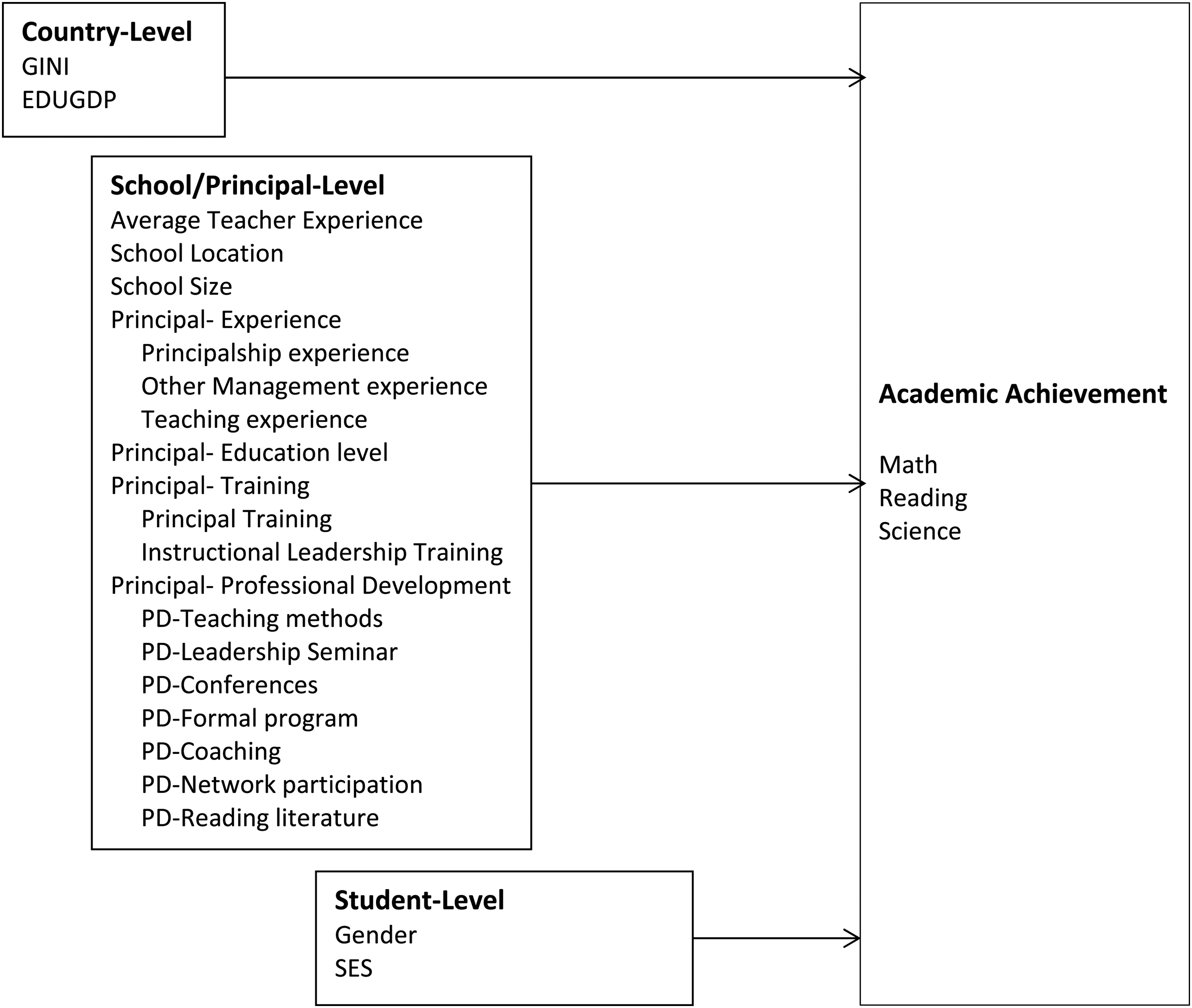
A conceptual framework of the present study.
Method
The present research employed a cross-sectional survey design using quantitative secondary data analysis. In this section, we describe data sources, sampling, and variables as well as the analytical strategy.
Data sources
The 2018 cycles of two international datasets—TALIS and PISA—were combined as the data source.
PISA
PISA is a joint endeavor organized by OECD members and other countries to assess the extent to which 15-year-old students are prepared for the challenges of living and working in a knowledge society. The test employs measures of students’ ability in three cognitive areas: reading, math, and science. The most recent cycle of PISA, carried out in 2018, included 79 participating countries or regions. PISA seeks to achieve stratified, representative samples of students within each participating country. Overall, 150 schools from each country and 20 students from each school are selected. Stratification concerns school type, location, size, and composition of students’ socioeconomic backgrounds.
Teaching and learning international survey
TALIS is the first international survey to provide a large set of information regarding the teaching and learning environment and working conditions in schools from the teachers’ and principal's perspectives. The most recent cycle was conducted in 2018 and included 48 countries or regions. The primary sampling strategy for TALIS is to select 200 schools from each participating country and sample 20 teachers from each. While this is the main strategy, the probability proportionate to size sampling approach was also used so that the actual sample size may differ across countries and schools. OECD, therefore, assigns survey weights to create a more representative sample structure.
PISA-TALIS link
While many countries participated in both TALIS and PISA, the link between TALIS and PISA is provided only for nine countries/regions: Australia, Buenos Aires/Argentina, Colombia, Czech Republic, Denmark, Georgia, Malta, Turkey, and Vietnam (OECD, 2019a). For this research, PISA was treated as the host dataset. TALIS data were, therefore, transferred into the PISA dataset. To carry out this, first, teacher-level variables were aggregated to the school-level and combined with the school-level dataset. Then the PISA-TALIS link identifier provided by OECD was used to combine two datasets. The school and teacher data were combined with student data maintained at the individual student-level, thereby enabling a more reliable assessment of variation in individual student achievement.
A total number of 32,032 student data points was reached after combining the data. Then, Buenos Aires and Vietnam were removed from the data. Buenos Aires was dropped since it did not represent the entire country and Vietnam was deleted because its data do not include student achievement information. In addition, we only kept schools where the principal had been located in the school for at least two years. Private schools were dropped from the data set, as we were primarily interested in public education systems. In the end, a total of 15,265 students from 497 schools from seven countries were retained in the sample.
Data analysis
Variables
This study employed student-, school-, and country-level variables based on the proposed conceptual framework above. The impact of the predictor variables on student achievement was examined using a hierarchical linear modeling approach (Raudenbush and Bryk, 2002). In this study, students (level-1) were nested in schools (level-2), and schools were nested in countries (level-3). Level-1 variables included student achievement scores in reading, science, and math as outcome variables in addition to two control variables: student gender and socioeconomic status (SES). Level-2 variables included teachers’ average years of experience, school location, school size as control variables and principal educational attainment level, principal years of experience in teaching, principal years of experience in the principalship, and principal years of experience in other school management positions, principals’ participation in professional development activities, and principals’ participation in formal training programs for the principal qualification. To check the nonlinear effect of experience in principalship identified in some of the previous studies, we also used a quadratic form of principalship experience. However, the quadratic effect was not significant, so we removed it from the final model as suggested (Faraway, 2014).
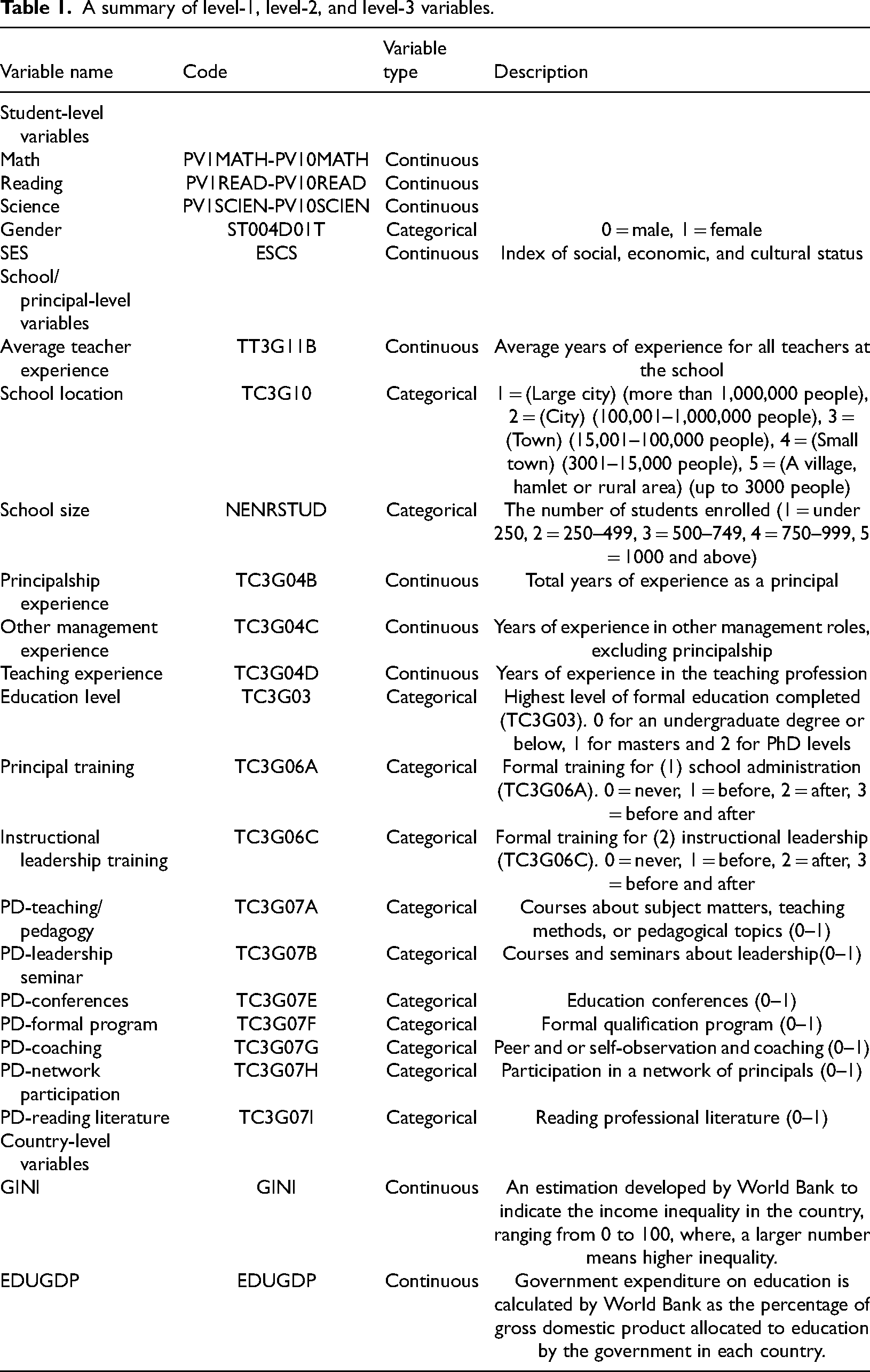
Finally, the GINI index and the percentage of gross national product allocated to education (EDUGDP) variables provided by the World Bank were included at level-3 to control for the country effect. A summary of level-1, level-2, and level-3 variables is presented in Table 1. Most of the categorical variables were dummy coded as 0 and 1. Categorical variables with more than two categories were also dummy coded by creating additional variables.
A summary of level-1, level-2, and level-3 variables.
Data analysis
As recommended by Hox (2010), a step-by-step exploratory model building strategy was employed to build models with the variables of interest for each subject. To this end, four models were built and compared using deviance statistics in this study. Following the tradition in HLM, we started model building steps with an unconditional, or null model—so that we have a baseline from which to compare the deviance statistic to for subsequent nested models.
We started by examining the deviance statistic from the null model and predictors are then entered at level-1. Then the deviance for these conditional models is compared relative to the null model. Once the level-1 model was found to have better than the unconditional model then we proceeded to enter predictors at level-2. Deviance statistics of these two conditional models were compared again. Once the level-2 model was found to be better than the level-1 model then we proceeded to enter predictors at level-3. Finally, deviance statistics of level-2 and level-3 models were compared to determine the best fitting model. HLM results for math, reading, and science were reported separately.
For each subject, a three-level unconditional HLM was formulated, followed by three-level conditional HLMs specifying predictor variables at the student, school, and country levels. Intraclass correlation (ICC) was also calculated for each model to evaluate the proportion of the between-group variance to the sum of the between-group and the within-group variance in the outcome variable (Raudenbush and Bryk, 2002). A higher ICC indicates that most of the variations in the outcome variable is due to the characteristics of group levels rather than the characteristics of individuals (Snijders and Bosker, 1999).
The equation for the unconditional model (Model 0) can be written as

In this equation, Yijk is the outcome variable corresponding to the plausible value (i.e., test score) of student i in jth school from country k obtained on the math, science, or reading test.
Second, explanatory predictors were included in sequential sets: the first set was comprised of two student-level variables (gender and SES). Student-level predictors were included in the null model based on the theoretical framework (Model 1). Then, school-level variables were added to the model built above (Model 2). Finally, country-level variables were added to build the final model (Model 3).
The combined equation for Model 3 can be written as below:

Here πujk represents the slopes of level-1 predictors, β0vk represents the slope of level-2 predictors, γ00w represents the slope of level-3 predictors. Equations of Model 2 and Model 1 can be obtained from the equation of Model 3 by removing level-2 and level-1 variables, respectively.
Sampling weights and plausible values are two issues that should be considered during the analyses of large-scale assessments. To properly conduct HLM with complex survey data and design weights, analyses were conducted with Mplus Version 8 (Muthén and Muthén, 2017). Variables labeled as final school weight in the TALIS and W_FSTUWT (student final weights) in PISA data sets were used to weight the data set for multistage sampling design.
PISA reports test scores as plausible values. The single data set cannot be used for the analyses as the outcome variable in the models presented above corresponds to the plausible values (Martin and Mullis, 2012). Again, the Mplus software package along with TYPE=IMPUTATION; option was used to correctly handle plausible values (multiple imputations). All parameters were estimated using MLR option in Mplus that can produce maximum likelihood parameter estimates with robust standard errors computed using a sandwich estimator.
Results
Preliminary analyses
Descriptive statistics for the variables are presented in Tables 2 and 3. The univariate histograms and bivariate scatterplots of all variables were examined to identify potential threats to the assumptions of normality and linearity of predictor variables. A correlation matrix was also created to check for multicollinearity among the variables (see Appendix). Only correlations between plausible values of math, reading, and science were greater than .80. As these variables were not used in the same model, multicollinearity was not an issue.
Descriptive statistics for categorical variables used in HLM analyses.
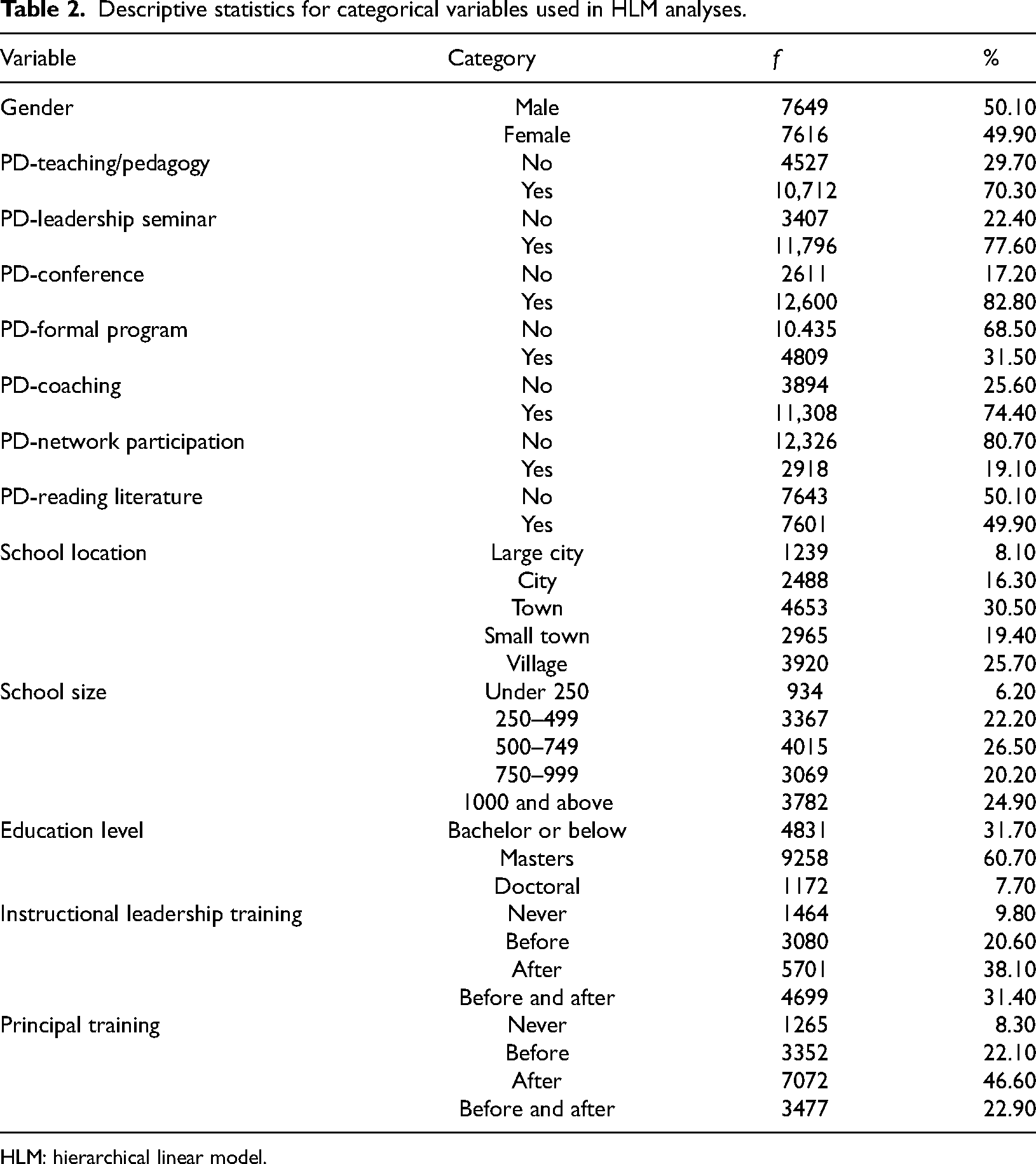
HLM: hierarchical linear model.
Descriptive statistics for continuous variables used in HLM analyses.
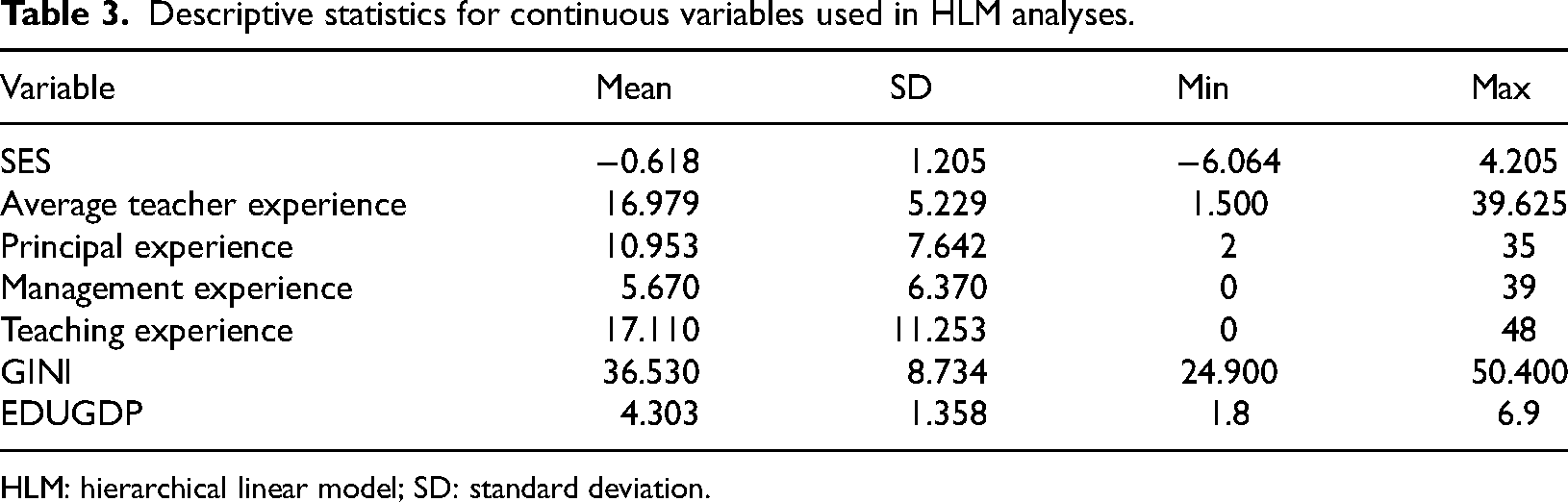
HLM: hierarchical linear model; SD: standard deviation.
Several three-level HLM analyses were conducted following the model building strategy mentioned above. Parameter estimates were obtained using one fully unconditional and three conditional models, on math, reading, and science achievement. Both unconditional and conditional models successfully converged. Model fit statistics for each model in each subject are presented in Table 4.
Model fit indices of HLM analyses.
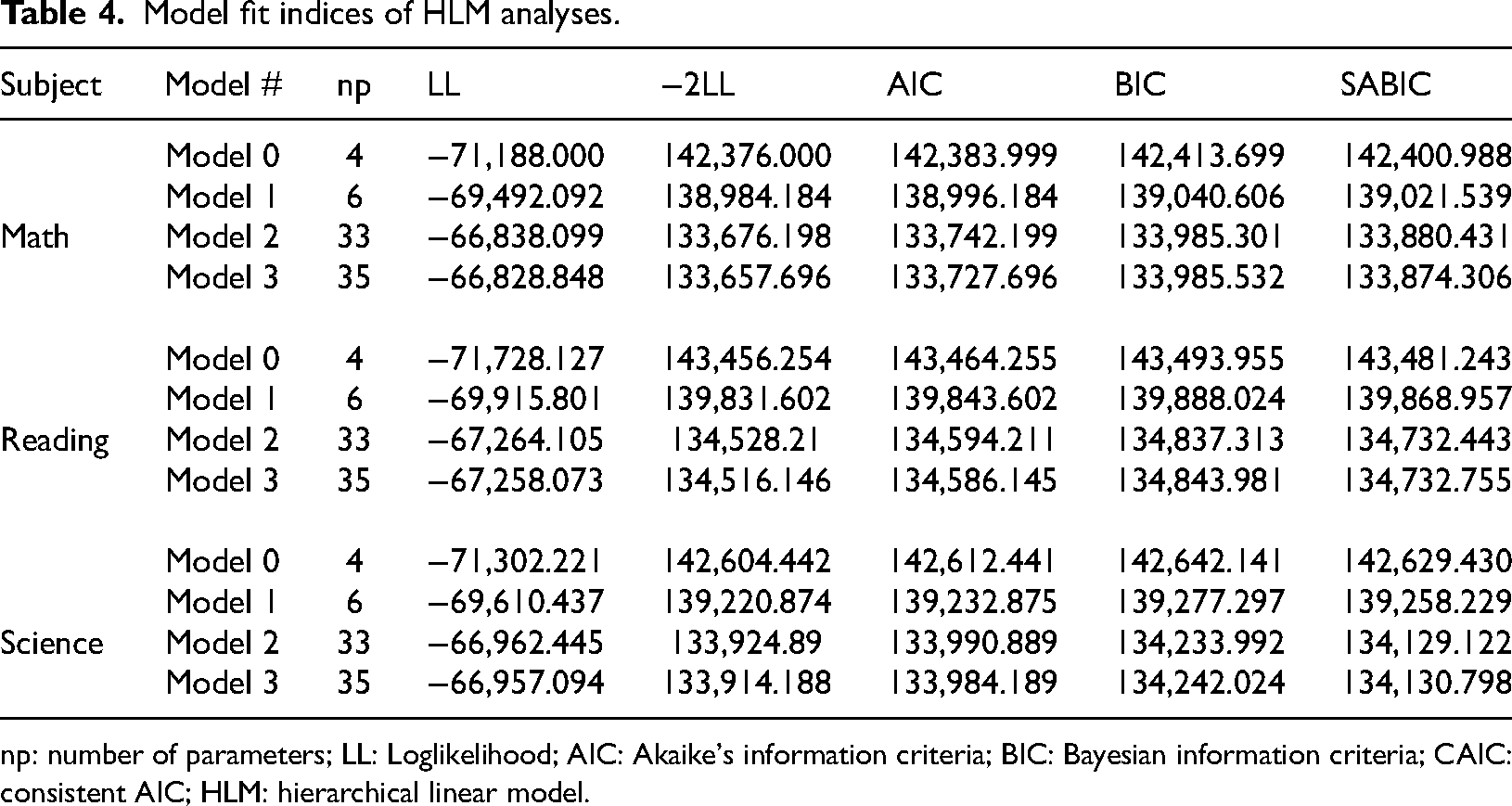
np: number of parameters; LL: Loglikelihood; AIC: Akaike's information criteria; BIC: Bayesian information criteria; CAIC: consistent AIC; HLM: hierarchical linear model.
Model comparisons across four models for each subject were conducted using deviance statistics (-2LL) reported in Table 4. Based on model comparisons, Model 3 was found to be the best fitting model for three subjects. The chi-square values were significant. This shows that models with smaller deviance statistics (i.e. Model 3) were significantly better than other models (i.e. Model 0, Model 1, and Model 2). While the results for fit indices were reported for four models (Table 4), due to space limitations, the results for the effects of predictor variables on student achievement were reported for only the final model (see Table 6).
Total variances, ICCs, and explained variances.
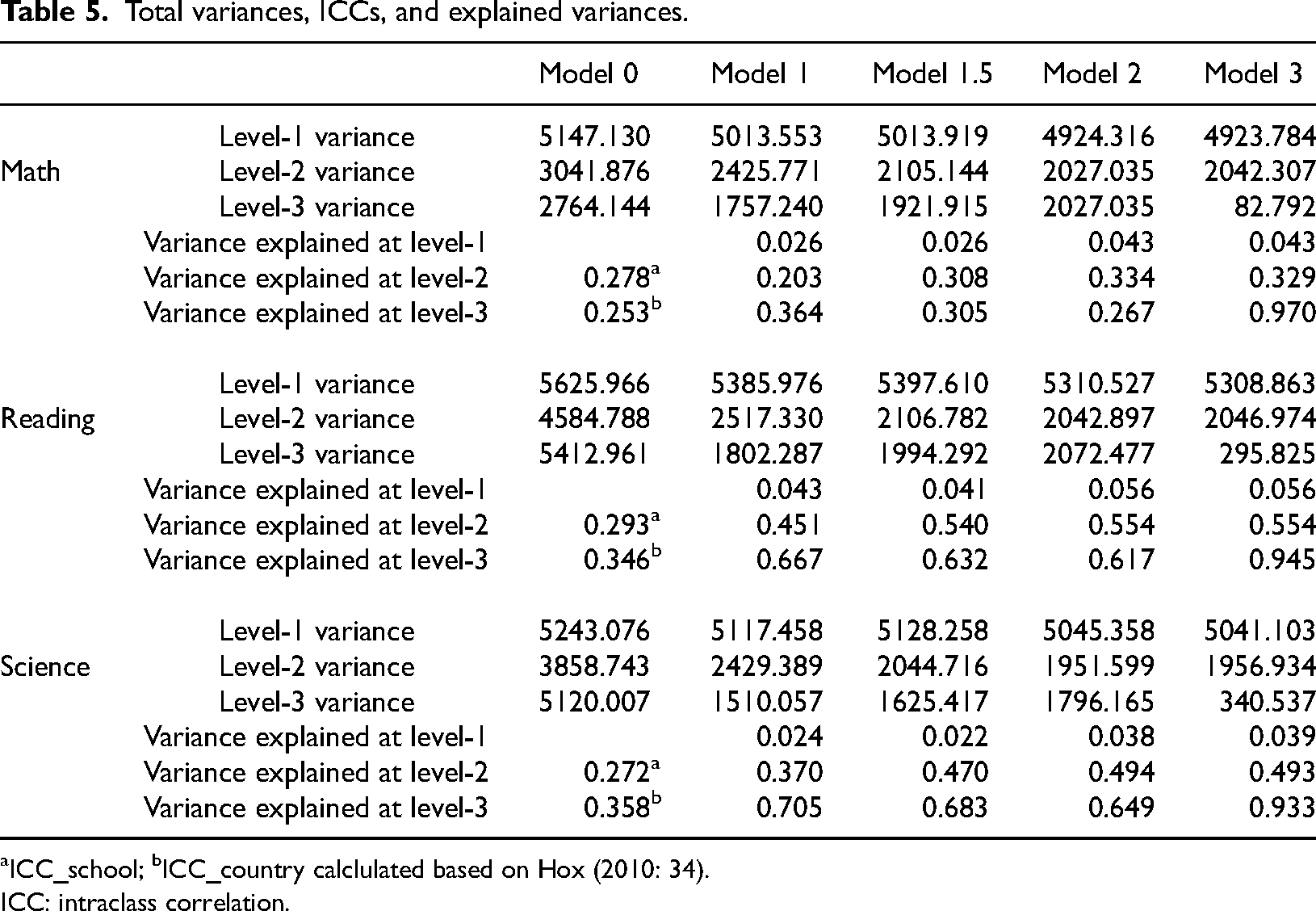
ICC_school; bICC_country calclulated based on Hox (2010: 34).
ICC: intraclass correlation.
Three independent variance components at the three different levels of the unconditional model were estimated to capture the variability existing within schools (σ2), between schools (τ2), and between countries (v2), respectively. The results of the unconditional models suggest that significant variation existed among students within schools, across schools within countries, and across countries in the three models.
Intra-class correlation values estimated from the three unconditional models indicated that 27–29% of the total variance in student achievement was due to the between-school differences (see Table 5). Country-level differences accounted for 25–36% of the total variation in student achievement. The remaining variation can be attributed to the between student differences (36–47%). These results pointed to evidence of substantial achievement gaps between countries as well as between schools within countries.
Results of final models for math, reading, and science.
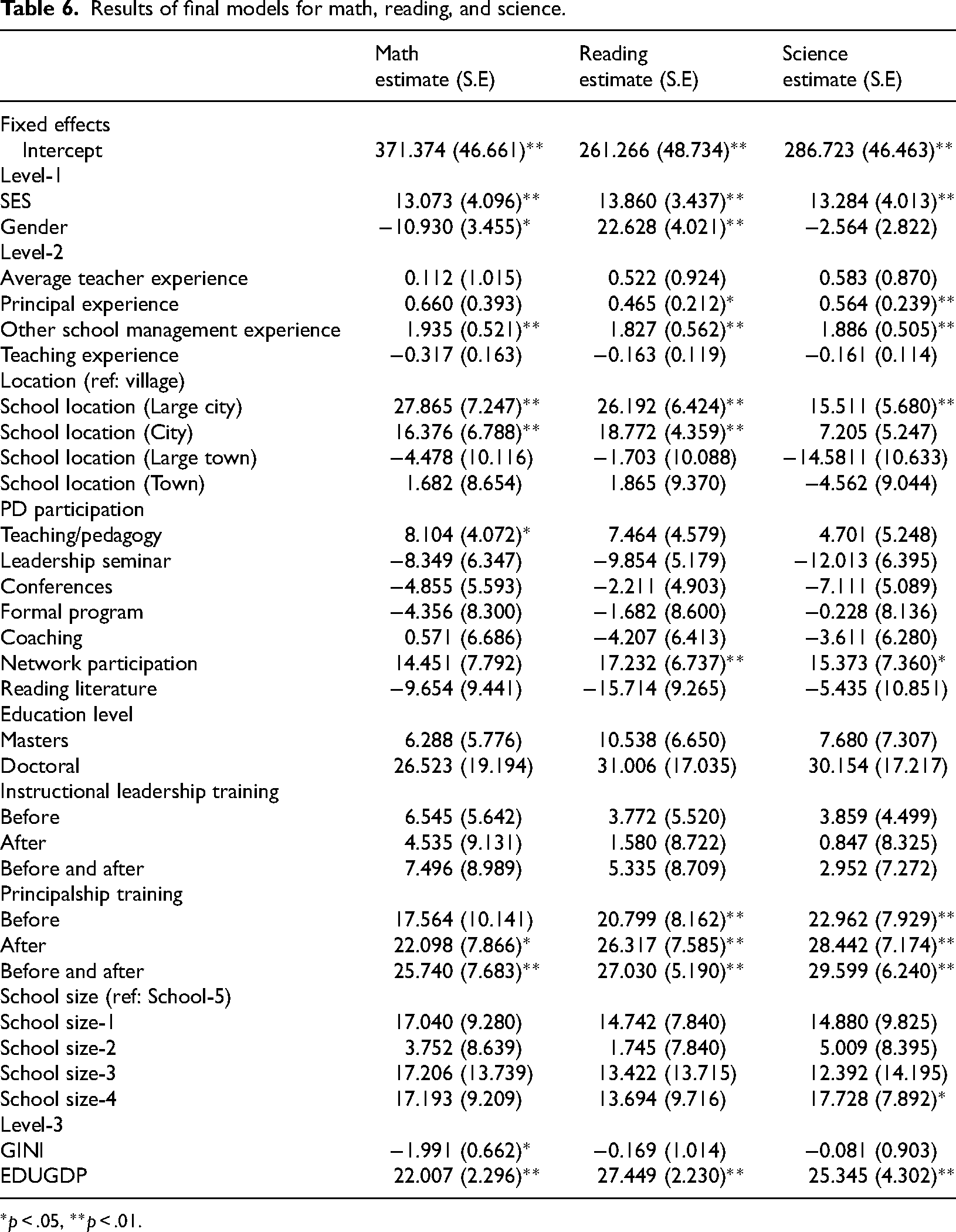
*p < .05, **p < .01.
We also estimated the total variance explained by our models. Our final models for the three subjects explained 33–55% of the total school-level variation in student achievement (Table 5). To estimate the true role of our main variables, we created another model (Model 1.5) that included only the principal qualification variables at level-2 and level-1 control variables. We subtracted the R2 value of Model 1 from the R2 value of this new model (Rights and Sterba, 2020). This shows that principal qualifications alone explained 9–10.5% of the total between-school variations.
Effects of level-1 variables
Consistent with prior studies, the three-level HLM analyses found that SES was a positive significant predictor of student achievement in math (π = 13.073, S.E. = 4.096, p < .01), reading (π = 13.860, S.E. = 3.437, p < .01), and science (π = 13.284, S.E. = 4.013, p < .01). Gender was significantly related to student achievement in math (π = −10.930, S.E. = 3.455, p < .05) and reading (π = 22.628, S.E. = 4.021, p < .01), but not in science (π = −2.564, S.E. = 2.822, p > .05). Females appeared to be less successful in math but more successful in reading compared to males.
Effects of level-2 variables
Our first research question asked whether different aspects of a principals’ experience were related to student achievement. After controlling for the effect of other variables, the three-level model found that years of experience in the principalship was significantly related to student test scores in reading (β = 0.465, S.E. = 0.212, p < .05) and science (β = 0.564, S.E. = 0.239, p < .05). The regression coefficients here mean that one-point increase in the years of experience as principal is associated with around a half-point increase in achievement scores for reading and science. Principals’ “other management experience” was significantly related to student achievement in all subjects: math (β = 1.935, S.E. = 0.163, p < .01), reading (β = 1.827, S.E. = 0.562, p < .01), and science (β = 1.886, S.E. = 0.505, p < .01). According to these results, one year more experience in other school management roles is associated with from 1.83 to 1.94-point increase in achievement scores for different subjects. Principals’ teaching experience was not, however, significantly related to student achievement in any of the subjects.
Our second research question concerned whether principals’ level of education and participation in formal principal preparation were predictors of student achievement. We found that a principal's level of educational attainment (i.e., possession of a Bachelor, Master or PhD degree) was not significantly related to student achievement in any subject. However, principals who had received principal training before being assigned to the position led schools with better student achievement in reading (β = 20.799, S.E. = 8.162, p < .01) and science (β = 22.962, S.E. = 7.929, p < .01) compared with those who had no preparation at all. The related coefficients mean that principals’ participation in preservice preparation is associated with a 20.8 and 22.97-point increase in achievement scores for reading and science, respectively. Principals who had received training after being assigned to the position led schools with stronger student achievement scores in math (β = 22.098, S.E. = 7.866, p < .05), reading (β = 26.317, S.E. = 7.585, p < .01), and science (β = 28.442, S.E. = 7.174, p < .01). Similarly, those who had received preparation both before and after being assigned to the position led to schools with stronger student achievement in math (β = 25.740, S.E. = 7.683, p < .01), reading (β = 27.030, S.E. = 5.190, p < .01), and science (β = 29.599, S.E. = 6.240, p < .01).
The third research question concerned the relationship between principals’ participation in professional development activities and student achievement. The results showed that principal participation in professional development related to teaching and learning was positively related to student test scores in math (β = 8.104, S.E. = 4.072, p < .05), but not in reading or science. Principal participation in support networks was significantly related to student test scores in both readings (β = 17.232, S.E. = 6.737, p < .01) and science (β = 15.373, S.E. = 7.360, p < .05), but not in math. The regression coefficients for network participation were the highest compared to the coefficients of other professional development programs. The related coefficients indicate that principals’ participation in networks is associated with a 15.38 and 17.23-point increase in achievement scores for science and reading, respectively. Participation in other types of professional development programs (e.g. conferences) did not predict student achievement.
Finally, among the level-2 control variables, school location and size yielded significant relationships with student achievement. More specifically, schools located in large cities performed better than schools in rural areas in math (β = 27.865, S.E. = 7.247, p < .01), reading (β = 26.192, S.E. = 6.424, p < .01), and science (β = 15.511, S.E. = 5.680, p < .01). Similarly, schools in cities outperformed rural schools in math (β = 16.376, S.E. = 6.788, p < .01) and reading (β = 18.772, S.E. = 4.359, p < .01). Large schools (>1000 students) performed better than small schools (<250 students) in science (β = 17.728, S.E. = 7.892, p < .05).
Effects of level-3 variables
As seen in Table 6, the results indicated that both GINI (γ = −1.991, S.E. = 0.662, p < .05) and EDUGDP (γ = 22.007, S.E. = 2.296, p < .01) were statistically significant predictors of math achievement. However, only the EDUGDP variable was significantly (p < 0.01) related to student achievement in reading (γ = 27.449) and science (γ = 25.345). This suggests that student achievement across all three subjects is related to national education expenditures. The results concerning GINI suggest that student achievement in math is positively related to the level of income equality within a country.
Discussion
In this research, we aim to provide an understanding of how different kinds of principal qualifications might be associated with student learning outcomes in schools. We employed three-level multilevel analyses to examine the relationship of a principal's experience, formal education, preservice and in-service preparation, and participation in professional development with student test scores in math, reading, and science. In this section, we highlight the limitations of our research, interpret the main findings, and suggest implications for policymakers and practitioners.
Limitations and future research
Firstly, despite the size and scope of the dataset analyzed in this study, the cross-sectional nature of the research limits the ability to establish causal links between the principal qualification variables and student achievement. Large experimental and longitudinal studies, though difficult to execute, offer a stronger approach to examining the effects of principal qualification factors (Goff et al., 2014; Jacob et al., 2015; Leithwood et al., 2003).
Secondly, the use of secondary measures collected in these assessments may hide important variations within any given qualifications. For example, “other school management experience” could mean as an assistant principal for one participant, but department head for another. Moreover, the data do not take into account the quality of the educational experiences or the settings in which they occurred (Bastian and Henry, 2015). This leads to ambiguity when interpreting some of the results.
Thirdly, this research focused only on the qualifications of principals. While principals remain one important potential source of leadership for learning in the school (Spillane, 2005; Tan et al., 2020), future research should also explore the qualifications of others such as assistant principals, and teacher leaders.
Fourth, in this research student achievement has been defined as student test scores on the PISA test. We acknowledge that PISA may not provide a comprehensive measure of student learning as it has been criticized in terms of having biased sampling and statistical approaches, narrowing the focus of learning, and prioritizing the competitiveness in the global economy (Zhao, 2020). It continues, however, to shape the educational policy and practices in many nations (Kuramoto and Koizumi, 2018). As such, it offers one policy-relevant perspective on the efficacy of national investments in education. Yet, we also encourage researchers to use other, and possibly more comprehensive, measures of student outcomes in future research when investigating the relationship between principal qualifications and student learning.
Finally, there is an important limitation imposed by the conceptual model employed in this analysis of the relationship between principal qualifications and student achievement. The model includes a kind of “black box” whereby the educational processes that unfold between the independent and dependent variables are absent. More specifically, the qualifications studied in this research are quite distant from the educational processes that produce learning in classrooms and schools. Nonetheless, along with other scholars (Clark et al., 2009; Fuller et al., 2007; Osborne-Lampkin et al., 2015), we assert that developing our understanding of how different principal characteristics are associated with student learning is a worthy long-term goal. Indeed, it is analogous to research on principal leadership effects on learning which began with “bi-variate studies” (e.g. Andrews and Soder, 1987; Brewer, 1993) and, over time, proceeded to employ more sophisticated multivariate conceptual models (Goddard et al., 2020; Grissom et al., 2021; Hallinger et al., 1996; Hallinger and Heck, 2011). The current study represents a step forward in that process regarding the research on principal qualifications and student achievement.
Interpretation and implications
Prior research has shown that management experience can help principals to better enact leadership practices such as staff hiring, development, and retention (Fuller et al., 2007), as well as deal more efficiently with the complexity of school management (Leithwood and Stager, 1989). Our results suggest that experience as a principal can make a small but potentially meaningful contribution to student learning in some subjects. This highlights the potential importance of the knowledge that accumulates while enacting principalship tasks over time. While our own results were not consistent across all subjects, the broad finding reinforces findings reported by Clark et al. (2009), Bowers and White (2014), and Huff et al. (2011). The “value added” from this study lies, in part, from our analysis of a multicountry data set outside the United States.
Similarly, we found that a principal's prior experience in other school management positions was associated with student achievement. The coefficients associated with the effects of this variable were substantially higher (three to four times) than the coefficients for principalship experience. This result is consistent with findings reported in a few, though not all prior studies (Bastian and Henry, 2015; Bowers and White, 2014; Strauss, 2003). This finding suggests that experience gained while enacting other management roles in schools can provide principals with a foundation of knowledge and problem-solving skills. Principals who possess experience in other administrative and/or leadership roles may enter the principalship with a shorter learning curve and better preparation for many of the tasks they will face (Bastian and Henry, 2015; Kwan, 2009; Price, 2012).
Nonetheless, how and under what conditions prior experience translates into superior performance in the principalship remains unclear. Several limitations in our data hinder the ability to interpret fully the meaning of this finding. First, our data did not allow for separately assessing the unique effects of experience in different roles (e.g. assistant principal vs. department head) on a principal's subsequent capacity to influence student learning. Moreover, the reliance on “years of experience” as a unitary measure of this variable does not take into account the “quality” of prior experience. For example, one assistant principal could spend eight years performing administrative tasks (e.g. arranging bus schedules, ordering books, managing student discipline), while another might spend three years performing a balanced set of leadership (e.g. monitoring student progress, leading the professional development of teachers, working with teachers to improve classroom management, scheduling) and administrative tasks. While we hypothesize that the nature of these “prior experiences” could have different effects on performance as a principal, our data did not allow for this level of analysis. Future research should seek to identify the nature of prior experiences in other school management positions that makes a difference in principal performance related to student learning.
In this study, we found no significant relationship between a principal's prior teaching experience and student learning outcomes. While this is consistent with the broad trend of prior research (Clark et al., 2009; Gieselmann, 2009), it remains a counterintuitive finding. Scholars have proposed that a deep knowledge of teaching and learning would better prepare principals for the instructional leadership tasks that appear to be associated with improving the quality of teaching and student learning (Murphy, 1998; Stein and Nelson, 2003). It could be that we are again hampered by an inadequate measure. A simple measure such as “years of experience as a teacher” may not capture the nature of prior teaching experience that makes a difference when one becomes a principal. For example, was the principal a strong, mediocre, or weak teacher? Or it could be that prior teaching experience only makes a difference in interaction with another factor such as an opportunity to develop and practice skills in coaching colleagues while a teacher.
Nonetheless, these findings together reinforce the assertion that school administration should be treated as a profession with a knowledge base that goes beyond the ability to teach. We, therefore, recommend that policymakers should reconsider the practice of giving undue weight to “teaching experience” when making selection decisions for the principalship (Bush, 2018). While some “teaching experience” may provide a useful foundation of knowledge for the principalship, more and more of the same may not provide added value. Thus, selection committees may gain better results by seeking evidence of teaching quality as well as how the knowledge gained from a candidate's prior teaching experience has been shared with others through other management experiences. These may offer more meaningful measures.
Our results did not find a statistically significant relationship between the educational attainment of principals and student achievement in their schools. This finding suggests that “more education” (e.g. requiring principals to hold a Master degree) does not necessarily add value towards gaining the kinds of perspectives and skills that contribute directly to student achievement. This does not mean that formal education is unimportant. Thus, for example, higher levels of educational attainment can enhance the higher-order thinking of school leaders, develop positive social norms, contribute to the professionalization of educational administrators, and assist school systems in attracting higher caliber applicants. Notably, all of these potentially significant outcomes could be achieved without necessarily producing a measurable impact on student achievement scores. Thus, readers are urged to interpret this finding carefully and avoid drawing unwarranted conclusions.
Moreover, we note that educational attainment is a very broad measure that fails to take into account the focal area of study or program quality (Bush, 2018). Thus, overall educational attainment, in the absence of measures of subject focus and quality, maybe too blunt a tool for gaining insight into how principals will carry out their role and the subsequent effects on teachers and pupils. These results entail more attention and suggest future research that should examine the relationship between the features of formal education programs (e.g. focus, delivery method, content) and student learning.
Evidence presented in this study found that preservice training of school principals was positively related to student achievement in both reading and science, though not in math. However, the measures of preservice training used in our data did not provide insights into how the content, delivery, or duration of the training programs factored into this results. Future research should consider these qualities when investigating the effect of preservice preparation of school principals on their performance and student achievement.
Providing formal training to principals after their appointment to the position is also a common practice in some countries. Our results show that receiving formal training after an appointment is positively related to student achievement in all subject matters. Moreover, the coefficients associated with this variable were slightly higher compared with those associated with preservice training. This might be because principals make better sense of their training when they are actively practicing their administrative as well as instructional tasks. As expected, our results also indicate a positive and statistically significant relationship between the combination of preservice and in-service principal training and student achievement in all subjects. This means that the predicted associations with student achievement are even higher when principals attain both preservice and in-service training programs.
Our results showed that principal participation in professional development programs with a focus on the subject matter, teaching methods, or pedagogical topics was positively associated with student achievement in math, though not in reading or science. The reason behind the inconsistency in results is unclear. Therefore, this should be treated as a very tentative finding. It does, however, highlight the importance of content-relevant leadership development, specifically for math (Carver, 2010; Stein and Nelson, 2003).
Similarly, connecting principals with other school leaders through networking was also associated with student achievement. It should be noted, however, that this relationship was only statistically significant for reading and science. Nonetheless, the statistically significant coefficients for this type of professional development had the highest values when compared with all of the professional development variables. The importance of networking and collaboration with peers for the development of principals was also reported by previous research (Chapman, 2008; Gümüş and Bellibaş, 2016; Leithwood, 2019; Walker and Dimmock, 2006). Networking activities provide active learning opportunities for principals by focusing learning on relevant school problems and challenges through the development of an informal peer support. Such job-embedded learning opportunities, therefore, might further a principal's knowledge and skills, which can positively influence the teaching and learning environment at school.
Conclusion
Over the past 40 years, research on educational leadership and management has sought to make sense of whether and to what extent principals make difference in pupil learning outcomes. The bulk of this research has been devoted to exploring the impact of leadership practices, with most relevant studies conducted in the United States. In contrast, relatively few studies have examined the potential contribution of principal qualifications to student achievement. Using a comprehensive international dataset, the present study shed some light on the contribution of specific principal qualifications to student learning.
This study found that principal qualifications together could explain as much as 10% of the total between-school variations. This might be considered small. However, it should not be overlooked given that previous research suggests that around 25% of the between-school variation in student achievement outcomes can be attributed to principal leadership (Leithwood et al., 2008). Thus, we contend that qualifications for the principalship deserve more attention from researchers going forward.
Moreover, future research in this domain should seek to shed light on the black box, which represents the educational processes, that link “principal qualifications” to student learning. This will require more refined conceptual models that take into account more differentiated measures of “qualifications” as well as measures of principal performance that these qualifications are hypothesized to impact. Indeed, a comprehensive model would also include measures of teaching quality as well as learning. Longitudinal research designs that are capable of monitoring changes in performance and outcomes over time will be especially useful in this program of research (Goff et al., 2014; Grissom et al., 2019; Leithwood et al., 2003; May et al., 2012).
Footnotes
Declaration of conflicting interests
The authors declared no potential conflicts of interest with respect to the research, authorship, and/or publication of this article.
Funding
The authors disclosed receipt of the following financial support for the research, authorship, and/or publication of this article: This work was supported by the Carlsbergfondet (grant number CF19-0751).
