




Abstract
This paper contributes to method development in educational leadership research. The focus is on a visual method and the inclusion of visual material in data collection and analysis. Core concepts in this paper are educational leadership, power and authority. The method was used in face-to-face interviews in a research project that studied the steering and governing in, and of, Swedish schools. The method enhances verbal narratives when informants reason and motivate their understandings of positions, relations and hierarchies within the organisations. We found that using visual material encouraged informants to reason and problematise formalised leader positions, their relations and the hierarchies that appear. The method helps to visualise the informants’ understandings of the power distribution within the organisation depending on whether positions are described as distant or close, horizontal or vertical. The method made the informants take a stand on complex matters, reflect, and gain insights about their organisations. It provided us, as researchers, with rich data material. By making subjective understandings visual, implicit assumptions were made explicit. This could challenge the knowledge on existing leadership and power norms within educational organisations, and most likely in other forms of organisations as well.
Introduction
The educational leadership research field relies on traditional research methods such as interviews and surveys. This paper may not break new ground, but it attempts to inspire researchers in the field to reflect more on, and to scrutinise our choices of, method and approaches. Our interest in method development started during field work in a project about steering and governing in, and of, Swedish schools. The objective was to gain deeper knowledge of actors’ subjective understandings of leadership and governing within local school organisations. From conducting interviews in a pilot study, we learned that we had to develop our interview protocol to accomplish this. We wanted the informants to not only describe, but also reflect on their own position and those of others. Thus, we decided to add visual material to the otherwise traditional face-to-face interview. The visual material, which was co-created with the informants, visualised their verbal narratives, and stimulated them both to reason and motivate their understandings of positions and relations within the local education organisation.
We are mainly interested in sharing our experiences of including visual elements in qualitative interviews. We achieve this by describing passages from some of the interviews. In addition, we present an analysis, which is more tentative than conclusive. From the beginning of the process, it was not clear which theoretical concepts we were going to use. As our interest lies in understanding the prerequisites of governing, in and of, local school organisations, authority becomes a core concept. An organisational scheme shows who has the formal authority to exercise leadership at specific levels. However, it rarely tells the full story of the distribution of power as authority is a construct, derived from different sources, not only position. We saw that the visual material enabled the informants to problematise formal authority linked to position, and to reason on other authority sources.
In this paper we will describe the research process and our lessons learned from using visual material in qualitative face-to-face interviews. By describing and reflecting on the merits and problems, we aim to contribute to method development within the field of educational leadership. The research questions are as follows: What can the inclusion of visual material imply for qualitative face-to-face interviews? How can the inclusion of visual material influence the research process? How can the visual method facilitate and constrain the analysis of authority and leadership in school organisations?
Applied methods within the research field of educational leadership
The research field of educational leadership is interdisciplinary and broad, and research within the field implies handling complexity (Showunmi and Fox, 2018). How educational leadership research is conducted is an important but often overlooked question. Methodological papers are unusual in the field. Previous research shows that many papers lack methodological references, and that the most common reference is textbooks (Moran Jackson, 2019). A rather limited number of methods and approaches are employed. Surveys and interviews are most common (Moran Jackson, 2019; Thomson, 2017; Tian et al., 2016). Different traditions for methods and approaches dominate in different countries and contexts (Ärlestig et al., 2015). Qualitative methods are predominant, although quantitative approaches are increasing in number (Gumus et al., 2018). The lion’s share of articles within the field are empirically oriented (Castillo and Hallinger, 2018; Hallinger, 2018; Hallinger and Bryant, 2013; Moran Jackson, 2019). Few studies make use of alternative data sources, such as videos, blogs and photos (Moran Jackson, 2019). In an interdisciplinary and complex research field such as educational leadership, this could imply that important perspectives are missed.
Methodological diversity has indeed increased within the field in the past decades (Gumus et al., 2018). There is a growing awareness of the need for method development in educational leadership research. An example of this increased interest is a special issue in one of the leading international journals, which is devoted to the exploration of ‘non-traditional’ approaches to educational leadership (Showunmi and Fox, 2018). This short summary shows there is still room for improvement.
Visual methods in qualitative face-to-face interviews
Visual methods for data collection originate from anthropology (Banks, 2001; Banks and Zeitlyn, 2015), but are now also successfully applied in social sciences more generally (Glegg, 2019; Pain, 2012). By visual methods we mean ‘the use of visual materials…employed by a social researcher during the course of an investigation’ (Banks, 2001: ix). Visual material can be pre-existing material, the material informants have created, or co-created material. These types of materials can be included as the main object of study or as a means to achieve something else (Pain, 2012: 304).
The most common motive for using visual material in the data collection process is an ambition to access rich data – not just verbal data. Another argument is that visual material facilitates communication between researchers and informants, for example to express abstract ideas. Visual methods promote reflection as words and pictures can work in synergy to enhance meaning (Pain, 2012). The approach is built on the idea that we communicate and understand things differently when using visual techniques (Pink, 2013). When performing visual activities, such as drawing diagrams, ranking pictures and creating new arrangements, other parts of the brain are used, which can trigger new insights and combinations of ideas (Glegg, 2019). Thus, visual materials integrated into verbal face-to-face interviews can work as catalysts in the research process. The cognitive stimulus may trigger reflections and wider thoughts, encourage articulation, build structure, focus attention and stimulate richer narratives. Visual methods can facilitate the exploration of deeper questions and comments on findings, and can be used when asking probing questions, which may support the validation process. These methods can also help the researcher and informant to keep attention on the interview themes and to form an organisational framework in the succeeding analysis (Comi et al., 2014). Hence, visual methods can contribute with projective and facilitative techniques in the research process (Clark et al., 2013; Comi et al., 2014; Reid and Koglbauer, 2018).
In this study, we used co-created visual material as a means to facilitate the dialogue between the researcher and the participant, and as a means to make implicit knowledges about the distribution of power and authority within the organisation more explicit by visualising the informants’ narratives.
Theoretical concepts
We understand leadership as a social practice constructed in the interactions between leaders, followers and situations (Hughes et al., 2008; Spillane, 2006). Studying leaders and leadership in organisations implies studying power (Woods, 2016), as both leadership and power are relational constructs. A traditional way of understanding power is from a top-down perspective, as power over (Dahl, 1957). Weber (1978) problematised this by identifying three sources of power: coercion, discipline and authority. The first implies using threats of violence or sanctions, and the second implies an unconscious adaptation. Authority means that the subjects perceive the use of power as just, deserved and appropriate (Haaugard, 2018), as being legitimate. By legitimate, we mean ‘a state in which a leader’s position over others is seen as deserved and justified’ (Vial et al., 2016: 402). Subordinates accept and comply with the system of rule, not because they are subjects of force or oppression, but because of choice. Rational, or legal, authority rests on a belief in the legality of rules. Traditional authority is associated with long-term practices and deeply rooted beliefs that come with tradition. Charismatic authority is associated with individuals who are perceived as legitimate leaders because of personal characteristics (Weber, 1978).
This ideal typology was developed in relation to power in society in general, but can also be used to analyse power within organisations. ‘Legal-rational authority provides a formal legitimacy for the hierarchy of institutional roles and associated rights and powers within organizations’ (Woods, 2016: 158). However, authority is constructed in several ways. A charismatic personality, professional knowledge and expertise, and/or lived experience can also legitimate the use of power. Whereas rational authority is associated with a formal position in the organisational hierarchy, anyone can possess personal traits and competencies (Woods, 2016). Alongside the sources already mentioned above, personal traits and feelings can also affect the process of legitimising authority (Vial et al., 2016).
Considering power as a means of coordinating activities within an organisation (Woods, 2003) differs from the top-down perspective of domination described above. Power is not necessarily consensual, but authority must be (Sorm and Gunbayi, 2018). Thus, there is a conceptual difference between a person in authority, and an authority (Haaugard, 2018). Being in a position, having the formal mandate, does not in itself ensure authority. An organisation’s members will accept and respect the use of power if they perceive this arrangement as legitimate.
The sample of informants will be presented further down, but we should note that all our selected informants are leaders and/or exert leadership in some way. Many of them have formal leadership positions. Thus, they should perceive themselves, and others should perceive them, as being in authority. The question of whether they see themselves, and are seen by others, as an authority is open ended. Our ambition was to explore whether we could identify other sources of authority in our informants’ expression and narratives. Most likely they are aware of who has formal powers, for example bureaucratic authority, to lead through their position. However, we are interested in various sources of authority that generate leadership and that might produce implicit hierarchies. It is not easy to ask questions about power and how actors perceive power.
Our way of working shares similarities with some forms of qualitative network analysis (cf. Ahrens, 2018). However, our intention is not to conduct a network analysis. We are primarily interested in understanding how actors describe their own positions and those of others as a way of understanding how leadership and authority is perceived and constructed. We are not studying networks within the local education organisation per se.
Context of the study
The Swedish school system is complex, involving many types of actors who attempt to influence policy on different levels in- and outside of the political system (Ärlestig and Johansson, 2020). On a national level, the parliament and government issue national laws and regulations, curriculums, and syllabuses. National authorities also conduct evaluation and controls. However, the local government conducts the operative responsibility and day-to-day business. In addition, national legislation allows private actors to organise independent schools. Sweden has 290 municipalities, which have substantial autonomy to adapt national policy according to local needs and interests. In addition to state subsidies, local governments collect taxes and allocate financial resources autonomously. Local government thus has substantial power over schools, and how this governing is organised has a significant impact on actors in schools. Each municipality has a political organisation and an apolitical administration, coordinating the governing and managing of schools in the municipal area.
Method
Data collection – visualising material
We conducted the initial phase of the project in 2019, in two Swedish municipalities (50,000 to 150,000 inhabitants). The sampling was conducted purposefully (Cohen et al., 2011). The two municipalities share the same levels of student results, student welfare and final grades, including the qualification for further studies. Two schools were selected in each municipality by contact persons in the municipalities (convenience sampling; Bryman, 2012). Research within the field of educational leadership tends to focus on a limited selection of functions in the formalised hierarchy of school organisations. However, understanding steering and governing in, and of, schools requires an understanding of the relations between actors on different levels. Thus, we conducted interviews with superintendents (n = 2), deputy superintendents (area managers; n = 5), politicians related to the governance of education at the municipal level (n = 4), quality assurance coordinators (n = 4), principals (n = 4), assistant principals (n = 5), school secretaries (n = 2), first teachers (teacher leaders; n = 11) and teachers (n = 29). Two researchers conducted each interview. One researcher oversaw asking questions, while the other researcher took notes. Of the interviews, 41 were conducted as individual interviews and nine were organised as group interviews (66 informants in total).
First, the informant(s) and the researchers were introduced to each other, and the researchers described the project and the research ethics concerning the project. The visual material was a sheet of paper. We drew two simple lines, separating the sheet into three levels. The paper was placed in front of the informant(s). Figure 1 presents a photo of the paper at the beginning of the interview.
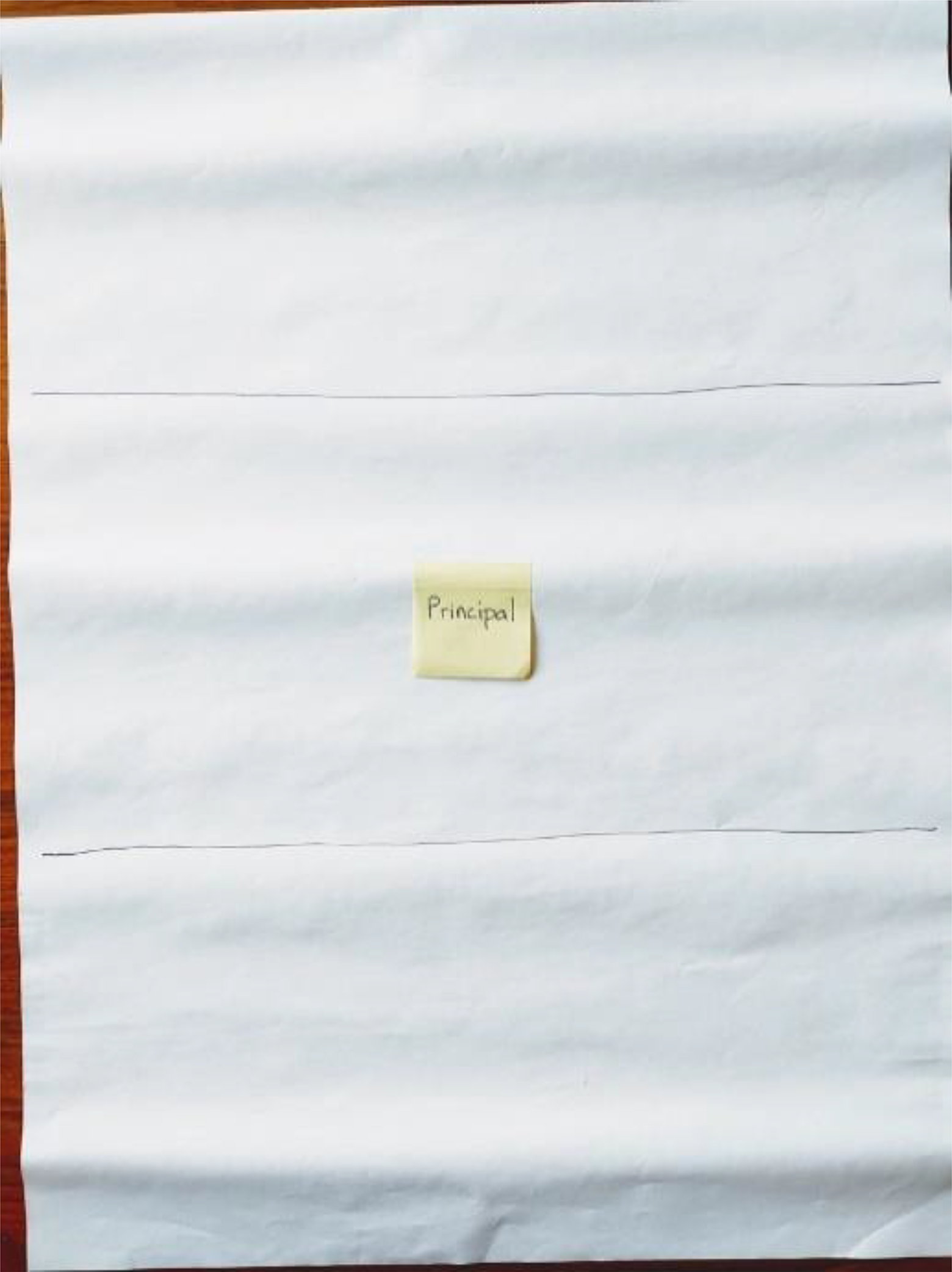
Paper at the beginning of an interview with a principal (replica, translated from Swedish to English).
We used a semi-structured interview guide (Cohen et al., 2011; Kvale and Brinkmann, 2009), which focused on several topics: competence and knowledge; roles, tasks, loyalty and trust; communication; and quality assurance work.
The head interviewer wrote the informant’s function on a sticky note and placed it in the middle of the paper. The assumption was that most actors in the educational organisation have functions below, above and horizontal to themselves. Then, the researcher began by saying: ‘Let us consider that this is you, in the middle of the sheet of paper. This is the level above you [pointing to the area above the line] and this is the level below you [pointing to the area below the second line]. This is the level where you are [pointing to the middle area]. Please describe to whom you are most closely related in your work. Please write their names or positions on sticky notes and place them on the sheet of paper where you find it suitable’. The informant(s) placed sticky notes with function and/or names on the paper (Figure 2). During this process, the informant(s) simultaneously reflected orally, motivating who was mentioned, and where to place the notes. The informant(s) identified the most important positions from their personal perspective, explored their own position in relation to others, and motivated and reflected on their choices.
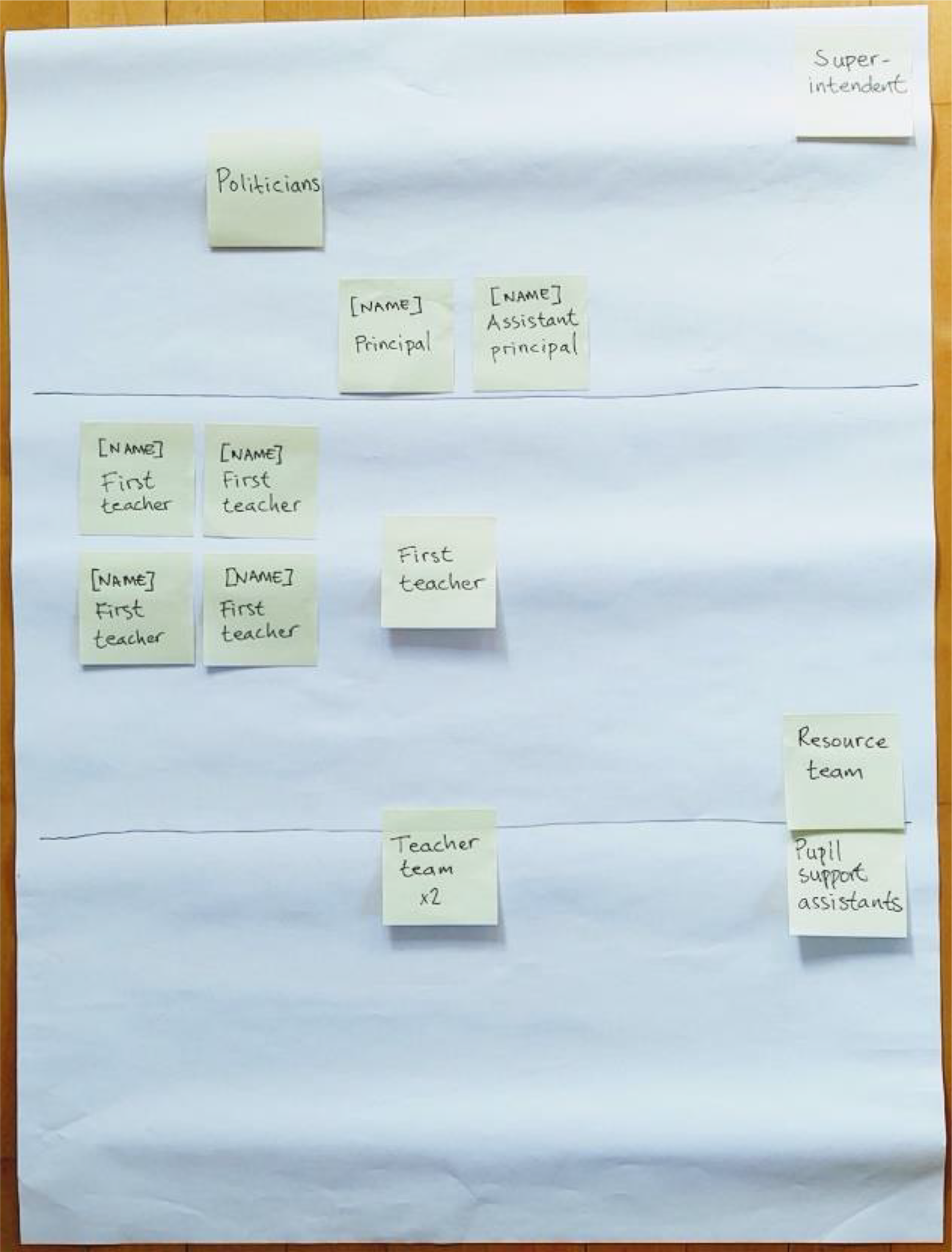
An example of the co-created visual material from an interview with a first teacher (replica, translated from Swedish to English).
Several media devices were used to document the data. It was important to schedule time to set up the equipment before the interviews and to transfer data to safe and secure storage afterwards. We used tablets for filming the actions on the sheet of paper (to capture audio and video), including a stand and extension cord to secure power, cell phones and recorders (back-up for audio and to use files for transcription), an A2 sheet of paper (marked with three levels), sticky notes, pens, an interview guide and a computer (for notetaking).
Data analysis – understanding visual materials in qualitative interviews
The audio files were used to transcribe the oral communication in the interviews. The videos were used in the first analysis and in preparing the data for further analysis. It became very clear that the co-created still images could not be used on their own. The physical material was digitalised, and functions and/or names were replaced by anonymous codes. Each recording was used to identify who said what, when and in relation to which question and sticky note. This was documented in the digital picture, creating a timeline showing how the images changed and evolved during each interview. Relevant parts of the transcripts were included as written comments. The video recordings were also used to document non-verbal expressions in the digital material, such as if the informant(s) seemed to be very sure of, hesitant, or indecisive where to put down certain sticky notes.
Ethical considerations
Visual methods may require adding ethical considerations to the research process (Glegg, 2019; Showunmi and Fox, 2018). Ethical considerations are based on good research practice concerning, for example, demands on information (about purpose of research), agreements (of participation), confidentiality (to protect informants) and use (of research data) (Swedish Research Council, 2017). Handling the video recording was a crucial ethical aspect in our study. We video recorded the sheets of paper with sticky notes, the hands of the informants and researchers, and their voices. These recordings were handled in a respectful and responsible way. They were anonymised and coded. The key to the coded material was stored separately from the recordings. We do not present the videos in any way that can reveal who participated in the interviews. Only the research team will use the research data for the purpose of research and the data are treated in a way that protects the individuals’ confidentiality following the General Data Protection Regulation (GDPR). The informants were informed about the research procedure and gave their consent in writing.
When the informants visualised their subjective understandings of positions, and relations between those, they constructed hierarchies that reflect how leadership power is perceived within the organisation. In a way, the method made the informants reveal power structures within the organisation. This could have produced discomfort for the informants, which is an important ethical issue to raise in this matter. However, only a few expressed this. The vast majority did not.
Results
The following examples illustrate how we used the visual material in the face-to-face interviews to stimulate dialogue. Every example contains a description of how the material was used.
First example
The method encourages standpoints
The first example describes how the visual method was used to make one of the informants take a stand regarding her own position in relation to others. Figure 3 shows the image First teacher 1 made during the interview. Each sticky note has a number, which is equivalent to the order in which the informant placed them on the paper. The three sticky notes that are marked with a dashed line show where the informant initially placed them before being moved in the direction indicated by the arrow.
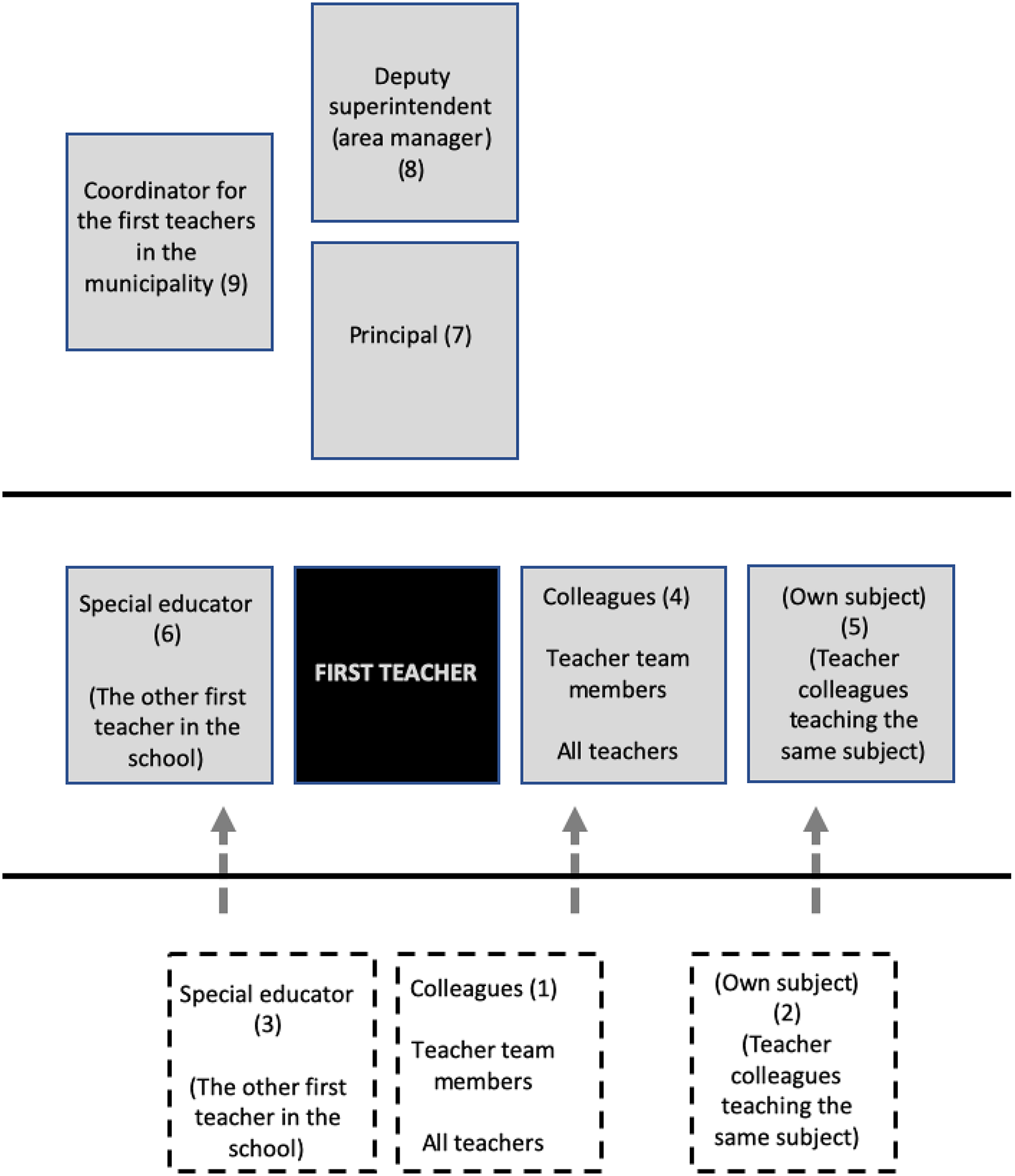
Image from an interview with a first teacher.
As Figure 3 illustrates, First teacher 1 initially positioned herself as middle leader by putting her teacher peers below herself. The first sticky note was the one with colleagues and teacher team members, followed by one with the teacher colleagues teaching the same subject. The third note, ‘the special educator’, was placed just to the left of the other colleagues. The informant placed the notes on the level below herself without expressing hesitation and without motivating the placement orally. To clarify, the interviewer asked if the special educator, who is also a first teacher, should be placed on the level below as well. The informant then paused, as she became aware of how she had positioned herself in relation to the others. She then changed her mind and placed all of the sticky notes horizontal to herself.
Is the special educator also on the level below?
No, we are all the same. Do you mean from my point of view, as a first teacher?
Yes.
Hmm, I think…I don’t know if I would say there are any levels…no, I wouldn’t. [asking herself] Do we think that? Hmm…
So, you would rather want these sticky notes here next to you? [pointing at the mid-level]
No, I would like to have all the sticky notes next to me. [informant’s emphasis]
Then we move them. [They move the sticky notes to the mid-level next to the first teacher.] Now they are in the right place, from your point of view.
Yes, that’s good. Everyone should be next to each other.
Why is no one here? [points to the lower level]
Well, I don’t know. It should, no one is there…it’s not…it’s not what I think. It’s like, everyone’s equal.
What would it take for someone to be down here? [pointing to the lower level] What do you think?
No, well…I don’t know really…then…then maybe you’re not working in this school.
In this interview, the first teacher started off by positioning herself on the level above her colleagues and other first teachers by placing them below, while describing their collaborations, meetings, functions, etc. The question the interviewer posed made her aware of how she had positioned herself in relation to others, as a middle leader, leading her fellow peers. What really made the informant pause and subsequently rearrange the sticky notes was that the original arrangement visualised her way of reasoning. From the oral conversation transcripts, it became apparent that this was not a position she was comfortable in. At least this was not an image (or a position) that she was prepared to defend publicly. The visual material ‘forced’ the informant to consider and reconsider how she wished to describe her position vis a vis those of others. This would most likely have been more difficult to achieve in a traditional interview, without the support of visual material.
Second example
The method visualises what is missing
The visual method facilitated identifying functions that were left out in the informants’ narratives. In Figure 4, the political and administrative functions at the very top of the local education organisation are left out from the images.
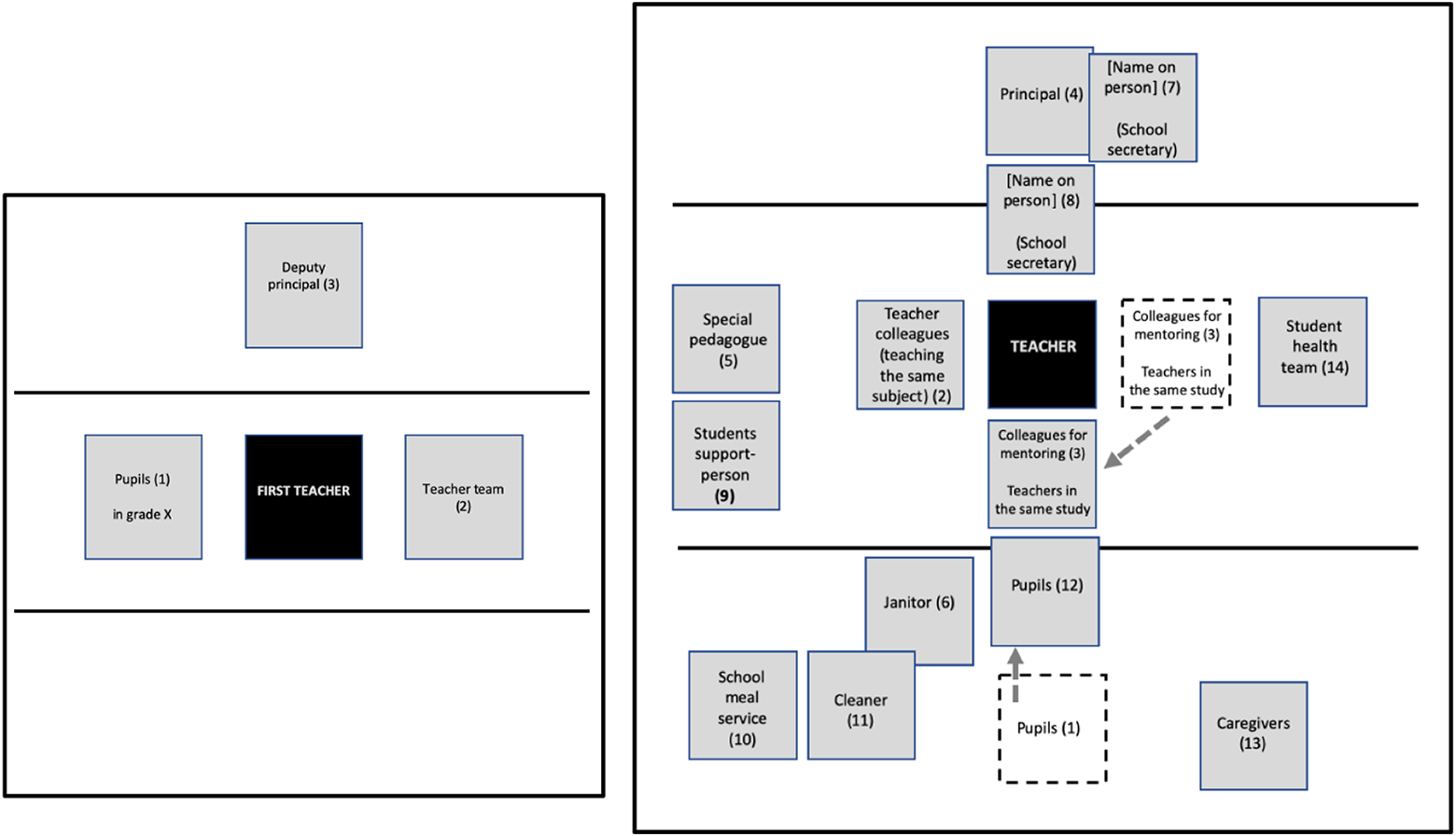
Missing political and administrative functions in two images.
The image on the left is from an interview with one of the first teachers. The informant only put a few sticky notes on the paper: pupils, teacher teams and the deputy principal. Several functions were left out, such as the principal. During the interview, the informant mentioned the principal by name a few times, but he deliberately decided not to add a sticky note saying ‘principal’. The political and administrative functions at the higher level are also missing in the image on the right.
Since the informant did not mention the political and administrative functions, the interviewer asked about those.
There are also levels above the school level. What are your thoughts about these [functions], not being present in your image?
It’s simple, I think it’s obvious. We work in a political organisation where decisions come from above, and that’s nothing I’ve got an opinion about, it’s just something I’ve got to follow. It’s my employer and I have a task. So I think it’s obvious that I should just follow instructions [from them]. If I don’t want to, or if I think it’s something I can’t follow, then I think, as a teacher, you should change jobs. I shall follow the instructions I get from the educational board and the politicians, there’s no question about that. But that’s nothing I think about when I think about leading. I’m here [pointing at positions on the school level], not up there. But, yes, maybe I should think about that.
I don’t know. I’m just curious about what you think.
Yes, but we never meet them, just sporadically.
Who are you thinking about when you say ‘them’?
Well…it’s the principal’s boss, so to say, and what’s decided there, and then there’re also politicians. They steer the municipality, regarding economy, and what should be prioritised and so on. But that’s not something I notice. Nothing I think about really, to be honest.
The method visualised which positions and relations spontaneously appeared for the first teacher when describing his day-to-day life, but also facilitated the possibility to identify the positions that did not.
The image on the right is from a group interview with teachers. The informants put many sticky notes on the paper, identifying several functions in the local school organisation, for example principal, school secretary, janitor and the student health team. The diversity of functions could be hard to handle in a more traditional face-to-face interview, but the visual method created a valuable structure and visualised how the informants perceived functions and how they related. None of the sticky notes acknowledged the political and administrative functions.
I’m curious…I was expecting some notes to show up, but they didn’t. One of these is the educational administration. What are your thoughts about them?
We never meet them, or sometimes they visit to introduce new people. But we never meet them again. Mostly, it’s the principal [who does].
But you get the impression that things drop down from above, that she [the principal] can’t do anything about. There’s a lot [the principal] doesn’t want to change but has to.
[…]
How do you notice, that [the principal] doesn’t want to?
That’s something you hear, when talking [to the principal].
And then you say that they have made the decisions, something like that. [informant’s emphasis]
The examples above illustrate the importance of asking questions about not only the positions and relations that spontaneously appear in the informants’ narratives, but also the ones that do not. The informants focused on those who were most important or closest to themselves. However, that did not mean they were indifferent to the positions that were left out. They may have even been left out for a reason. The selected transcripts from the interviews illustrate that the informants did have opinions and thoughts about those who had been left out of the image. However, they were for different reasons not considered relevant to include in the image.
Third example
The method visualises the perceived distance between actors in the organisation
The method enables us to explore how actors in the local education organisation perceive distance between functions. Figure 5 is from an interview with two school secretaries. The informants used the visual material by drawing on the paper, as a means of clarifying and reinforcing their arguments. The school secretaries drew a cloud around the municipal administrative functions at the level above them. The cloud encloses the functions and separates them from the rest of the organisation. Furthermore, it emphasises the perceived distance between the informants and those who they identify as being inside of the cloud, which essentially is the same as being far from ‘reality’. The two school secretaries also described the distance in terms of a ‘gap’.
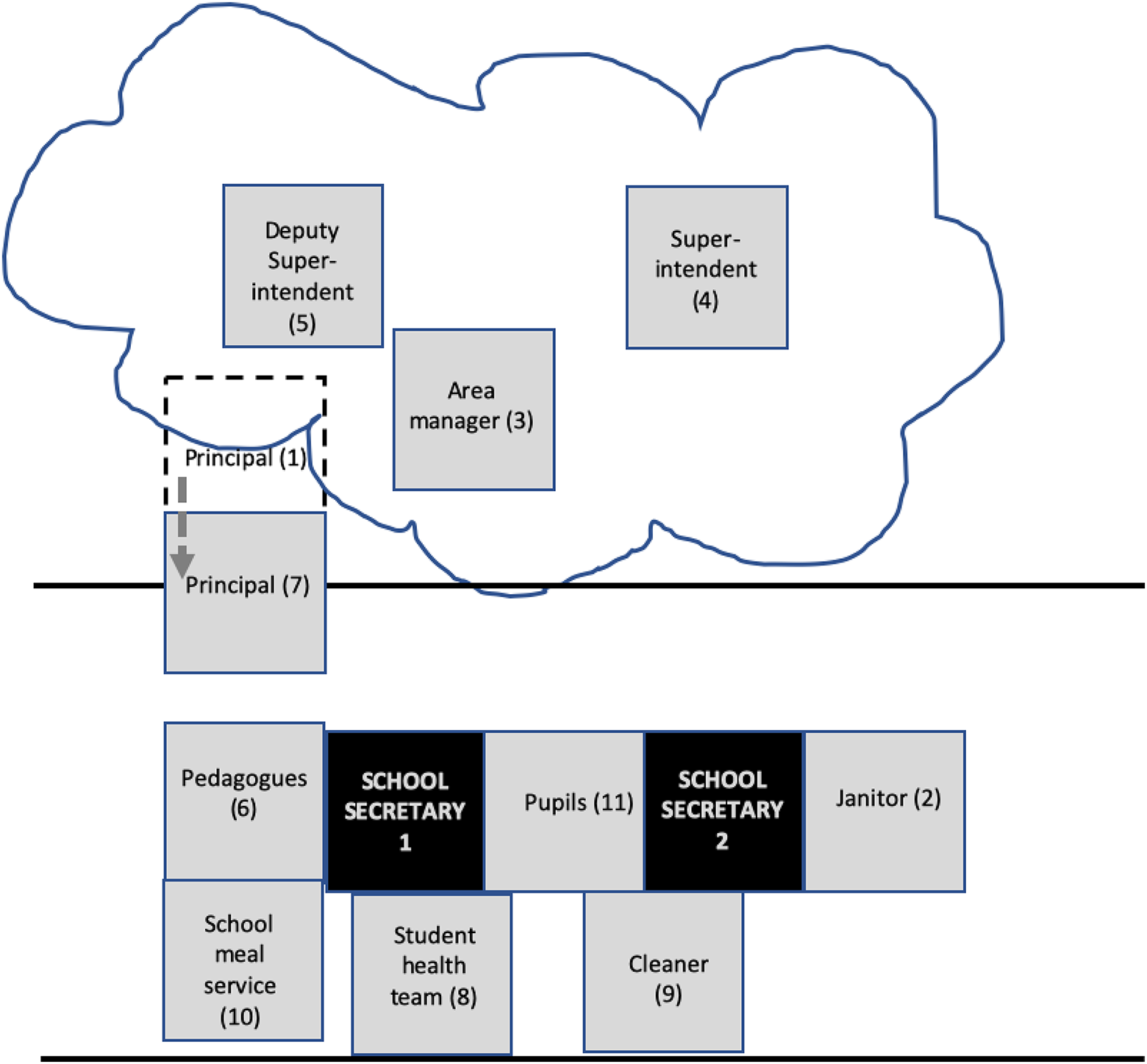
Distant relations with the municipal administration visualised through a cloud.
When asked about the communication with the municipal administration, the two secretaries said the following:
I think it’s a big gap here [between administrative functions and the school]. I’m not sure [the municipal administration] thinks so, but I do. Or maybe they don’t want to know, I have no clue.
I also think so, from my experience as a teacher. You never see them in a school. They work for schools, they are intendents and superintendents for schools, but they’re never in schools. Teachers never know who they are. Students, definitely not.
And definitely not what they do. They are up in the cloud somewhere, I think. [informant’s emphasis]
The informants described distant relations. According to the informants, educational administration in the municipality lacked insight, knowledge and understanding of the day-to-day work in schools. This also illustrates how the visual material gave informants the opportunity to communicate not only in spoken words, but also by making use of the paper and a pen. In this example, the school secretaries rather simply sketched, clarified and reinforced their oral arguments.
Analysis and discussion
In the following section, we will discuss the implications of including visual material in qualitative face-to-face interviews and for the research process by discussing the merits and challenges that we experienced. We also discuss how visual method can facilitate and constrain the analysis of authority and leadership in school organisations.
Including visual material in qualitative face-to-face interviews
The visual material supported the whole interview. Sometimes the images took form early and remained intact during the interview. The informant(s) could use the image to support and clarify what had been said. In other cases, the sticky notes were placed and replaced on the sheet, and the image changed and evolved during the interview. Since we used video recordings, all visual actions on the paper were captured and could be analysed at a later stage of the research process, together with the transcripts from the audio files. Capturing changes was considered a strength in the mapping exercise.
The visual material offered several communicative advantages. By combining qualitative face-to-face interviews with the visual material, we managed to create reflections and dialogues about leadership and power within school organisations, which otherwise can be difficult to achieve. This gave us rich material to analyse. As Pain (2012) described, visual methods can facilitate communication between the researcher and the interviewer, and stimulate reflections, which produce rich narratives. This is our experience as well. Our informants often expressed that the process of co-creating visual material provided new insights. They also expressed that they were intrigued by discussing and reflecting on such important matters with relevance for their work and organisation, which they seldom do. The results indicated that the visual material helped trigger new insights, an advantage Glegg (2019) highlighted. The structure also provoked the informants to take a stand (Comi et al., 2014). They had to not only describe in words, but also visualise their subjective understandings of their own position and those of others, and how they were associated. By doing so, they visualised their implicit understandings of how leadership and power was distributed within the organisation.
The images created a valuable structure for the interviews, and we could use them to ask clarifying questions. This brought us closer to a shared understanding of how the informants understand and construct leadership and power within the organisation. One of the challenges was how to benefit from the structure that visual methods usually give (see Comi et al., 2014), but without restricting the informants’ narratives. Drawing two simple lines on a blank piece of paper most likely influenced the informants’ narratives. Some of them made use of the paper, making it their own, for example, by drawing on it (Figure 5). Others were more unsure of how to use the material, and were more reluctant to use it, maybe because they were uncomfortable with visualising their reasoning.
A suggestion for further refinement regards group interviews. In the group interviews, it was sometimes complicated to perceive all informants’ understandings. We suggest starting group interviews by asking the informants to individually put down sticky notes on separate papers first (in silence), before having a group discussion about the individual images. In our experience, the narratives became richer when the group interviews were transformed into focus group interviews as they triggered interaction and common reflections. The end goal is not necessarily to get the group to agree on a single, final image, but to stimulate discussion and reflection by using the (individual) image(s).
Merits and challenges with adding visual material to the research process
The research project deals with governing in, and of, schools in local (municipal) education systems in Sweden. How actors understand and perceive this system that they are part of is key as it is associated with the prerequisites for governing. What do they perceive as the organisation? The entire school or only parts of it? The entire municipal education organisation or only parts of it? Which are the inner and outer boundaries according to the actors? However, it was not entirely clear which theoretical concepts we were going to use in this method paper. During the process of analysing the images, we identified leadership and authority as core concepts. The informants are leaders on different levels in the local education system; some have formal leadership positions (in authority) and/or are recognised as leaders (an authority).
Being a group of five researchers during this process proved to be a strength. It gave us the opportunity to discuss different ways of constructing and using the visual material and became a process of building literacy collectively. We had to construct a common language between us, but also be aware of our individual interpretations. This required a high degree of coordination and sometimes the data collection was inconsistent. For example, different researchers used the characteristics of the group interviews in different ways. This was valuable knowledge in evaluating the method and determining the implications for future use. By exploring the method and reflecting on different opportunities for actions and interpretations collectively, we created professional learning.
In retrospect, we were more focused on how to use the visual material during the interview process and less focused on how to analyse the resulting multitude of material. The multitude of material is really one of the great advantages, but it is also one of the challenges. We soon discovered that to use only the co-created images would have yielded invalid results. The images cannot be treated as end products. Instead, we had to focus on the interviews as processes, and to combine the different data sources to generate a timeline and create a digital material for each interview that then could be analysed. This structural framework (see Comi et al., 2014) worked rather well. Despite having this, we still had to move back and forth between the different data materials in the process of analysis to validate our observations and interpretations. Compiling the various data sources into a material that was manageable was also a time-consuming process.
The video recordings were valuable in the analysis. They enabled us to both see how images evolved and transformed as informants arranged, rearranged, changed and moved around the sticky notes, and also hear the informants describing and motivating their actions. From this, we could approach the informants’ understandings through both visual and verbal reflections, which enabled methodological triangulation (Cohen et al., 2011).
Another challenge we did not consider at the beginning of the process was that of translating the rich material into a condensed text that fits the journal format. A more suitable way of presenting the data would be to combine text with moving images and clickable audio files. This brings to the fore the question of presentation. If we, as a research community, are sincere about developing methods, we must also consider other and perhaps non-traditional ways of presenting and publishing results.
How visual method can facilitate and constrain the analysis of leadership and authority in local school organisations
Our intention was to make the informants describe orally and visually how they perceive their own position in the organisation, by asking them to describe other actors and functions they consider relevant, and how they perceive others’ positions. By doing so we attempted to see how leadership and authority is perceived to be distributed in the local school education. The example from the interview with the first teacher is especially relevant. These positions were established through a career reform in Sweden in 2013. One intention was to establish first teachers as middle leaders between the teacher collective and the principal (Grimm, 2020). First teachers are supposed to enjoy both legal authority (by position) and professional authority. However, as previously described, the first teacher refrained from positioning herself as a middle leader, despite having done so in the first image (Figure 3). At first, she almost intuitively acknowledged the authority that the formal position yielded, or at least should yield. However, soon she rearranged the image so that all teachers were positioned on the same level, horizontally. Did that mean that she thought that she lacked the professional or the charismatic authority to lead her peers? Since we conducted interviews with her colleagues, we could compare their narratives. If they had acknowledged the legal authority of the two first teachers, they would have done so describing the first teachers as having middle leader positions, and by arranging the sticky notes accordingly. If they had acknowledged them as professional authorities, they would have described the first teachers as skilled and/or renowned. Neither of these actions happened. Instead, the first teacher positions were not even included in their images, neither as functions nor as individuals. Having the formal authority to lead is not equivalent to being perceived as an authority to lead.
All three examples in the results section show how informants used the paper to describe the character of relations and the distance between different functions in the local education organisation. They all sought to minimise the described distance between themselves and those they are supposed to lead (Figures 3, 4 and 5). Like the first teachers in the first example (Figure 3), the school secretaries were reluctant to position themselves ‘above’ the teachers as middle leaders in a vertical hierarchy. They preferred to describe themselves as one among the teachers (Figure 5). Perhaps they sought recognition based on competence, and expert knowledge in administrative queries (professional authority), rather than based only on position. Another common feature in the images in the first and second examples (e.g. Figure 4), is that the political and administrative functions at the top of the local school organisation were missing. They were mentioned and discussed in oral narratives. Thus, they were acknowledged as being in authority, legitimised to lead by position only. By leaving them outside the image, the informants maximised the perceived distance between themselves and these functions.
Including visual material in the otherwise traditional face-to-face interview enabled us to problematise perceptions of leadership and authority in local school organisations.
Limitations of the study
Our study was not originally designed as a method study. Thus, we cannot make conclusions about whether the visual material was crucial for the result. Also, the narrow sample does not allow for generalisations. However, we do not attempt to evaluate the method applied, but to describe and reflect on implications by including visual material in qualitative face-to-face interviews and for the research process.
A second limitation concerns our own biases. Our questions were designed to fit bureaucratic authority associated with formal positions. We would have liked to explore and distinguish between other sources of authority (professional, charismatic and traditional) that may legitimate leadership, but our follow-up questions were not directed to do that. Thereby we missed the opportunity to conduct a more profound analysis of authority in relation to leadership.
Our study covers actors and functions on all formal levels in the local education system. However, like many researchers, we did not include pupils as informants in our interviews. They are the most important actors. Without them there would be no need for local education systems. As a future improvement, we suggest including the pupils. Visual methods can be particularly suitable for interviews with young people (Pain, 2012).
Conclusions
We started this paper by claiming that researchers in the field of educational leadership need to engage more in method development. Including visual material in qualitative face-to-face interviews proved to be both valuable and challenging in the process of data collection as well as analysis. By using visual material, we established a creative and active interview environment. The co-creation of images during the interviews elicited dialogues about complex matters. This made the informants reflect in different ways, gaining new insights about their organisations. The informants could use the images to clarify and emphasise certain aspects of the spoken narrative. The visual material helped to make implicit assumptions and representations explicit and researchable. This way of working provided us as researchers with rich data material, which implied both possibilities and advantages in the analysis process.
We used authority as a concept to explore the rich data material. Including visual material worked well as a means to problematise how actors in the organisation described and perceived leadership and authority. How authority is constructed in relation to leadership is essential knowledge as leadership requires authority of some sorts. This work has resulted in new questions for further inquiry. How do leaders in local education systems construct authority in their daily leadership practices? How is authority negotiated in everyday leadership practices? Which sources of authority legitimise positions in different parts of the local educational organisations? How does the construction of authority influence the purpose and mission of the organisation; for example, how do various positions at different levels (parts) interrelate with the ambitions of the educational organisation (the whole)?
Our study has its limitations, which we have discussed above. However, by sharing our experiences from our attempts to explore visual material in qualitative interviews, we hope to inspire others and to contribute to the ongoing discussions on the need for method development within our field of research.
Footnotes
Declaration of conflicting interests
The author(s) declared no potential conflicts of interest with respect to the research, authorship, and/or publication of this article.
Funding
The author(s) received no financial support for the research, authorship, and/or publication of this article.
Acknowledgements
We would like to show our gratitude to our colleagues at the Centre for Principal Development, Umeå University, who supported us in the research and writing process. Thank you for fruitful discussions and your most appreciated comments. Special thanks to the other members of the STAR project, professor Helene Ärlestig and senior professor Olof Johansson, who participated in the data collection and analysis process. Finally, we would like to thank Umeå School of Education for supporting our project.
