



Abstract
Despite the popularity of distributed leadership theory, the investigation of the micro-political aspects of such models have scarcely been explored, and insights on the cultural variety of distributed practices in schools are limited. The present study aimed to explore what micro-political aspects emerge in participative decision making in collectivist and individualist cultures. To this end, a multiple case study method was adopted, focusing on four Israeli public high schools. Schools were chosen to represent an ‘extreme’ case selection rationale: two non-religious urban schools representing individualist cases, and two communal schools in religious kibbutzim representing communal schools. The analysis shed light on three micro-political points of comparison between the prototypes of participative decision making in collectivist and individualist cultures related to control, actors, and stage crafting. The findings and implications are discussed.
Keywords
Introduction
Since the start of the 21st century, interest in distributed leadership as an ideal model for promoting outcomes in schools has grown significantly (Gronn, 2002; Hallinger and Heck, 2009; Harris, 2011; Harris and DeFlaminis, 2016; Ho and Ng, 2017; Lumby, 2019; Spillane, 2005; Torres, 2019). This vast body of literature on distributed leadership in education largely adopts an apolitical outlook, with a functionalist approach to the model (Tian et al., 2016), and only a small portion of the literature takes a critical approach to the utopian framing of the model (Bush, 2016). Whereas the apolitical outlook on distributed leadership is concerned mainly with its meticulous implementation and consequences (e.g. Harris and DeFlaminis, 2016), the political outlook is concerned mostly with uncovering its imperfect and non-idealised application, which is considered to be associated with politics, power, and the interests of actors (e.g. Flessa, 2009; Lumby, 2013).
The present study adopts the latter outlook and a micro-political lens to examine participative decision making. Micro-politics is defined as the intra-organisational use of formal and informal power by individual actors and groups to attain their objectives (Berkovich, 2011, Berkovich and Avigur-Eshel, 2019; Blase, 1991). The present study sheds light on a variety of micro-political aspects of participative decision making in collectivist and individualist cultural contexts. Triandis (2018) suggested that in individualist environments, people have an independent self-concept, goals that are independent from others, behaviours driven by self-belief, and social interactions based on rationality. By contrast, in collectivist environments, people have an interdependent self-concept, goals that are dependent on others, norm-driven behaviours, and social interactions based on relationships (Bhawuk, 2018).
At present, empirical exploration of distributed leadership based on the political outlook is rare. For instance, Flessa (2009: 332) argued that [t]he study of educational leadership at the school site would seem to provide a rich opportunity to examine conflict and to explore the ways that ideals and realities or plans and implementation diverge…Nevertheless, research into distributed leadership, a significant and mostly new body of educational research, has been much more likely to avoid micropolitical analyses than to conduct them.
The study draws on educational scholarship and organisational theory from outside education to investigate what types of micro-political features emerge in school principals’ and teachers’ views of participative decision making in collectivist and individualist cultural settings. Despite much empirical progress regarding the distributed leadership model, little research has been conducted on how contextual characteristics influence distributed leadership and participative decision making in schools (Liu et al., 2018; Woods et al., 2004). As we see it, part of this lacuna is related to a great extent to limited empirical research on political aspects of distributed leadership, as a given power structure is in many ways a reflection of socio-political context and values (Ayman and Korabik, 2010). Scholars note that cultural aspects related to the level of social cohesiveness in the group and the supremacy of either self or group goals (i.e. collectivism vs. individualism) are highly influential on the manifestation and operation of leadership (Mansur et al., 2017; Nahum-Shani and Somech, 2011). Our assumption, based on the political outlook of distributed leadership, is that in different culture types (collectivist vs. individualist) we find different micro-political dynamics that shape the ‘imperfect’ manner (from the point of view of mainstream theory) in which distributed leadership is revealed and functions in each context.
Literature background
Apolitical and political outlooks on distributed leadership in schools
Distributed leadership is a social process in which collective and shared leadership behaviours are dominant, as several individuals perform leadership-related tasks (Lester and Kezar, 2017; Lárusdóttir and O’Connor, 2017). We can find two outlooks regarding the model of distributed leadership in schools: (a) the apolitical outlook that considers the theory to be a functional, value-free approach; this approach idealises the operation and success of the model; and (b) the political outlook that suggests that distributed leadership is a political agenda, rooted in liberal ideals of fairness and inclusion, and its operation and outcomes are contingent on actors’ power and interests (Lumby, 2013; Woods, 2016). The functional apolitical outlook dominates the mainstream discourse on distributed leadership in education. According to the apolitical outlook, distributed leadership reduces the centrality of the formal leader and emphasises the development of staff leadership skills (Leithwood et al., 2009; Ross et al., 2016). Distributed leadership studies often focus on the way leadership functions are divided between formal and informal leaders, paying attention to the interactions between the multiple leaders and not to the specific actions of actors (Bolden, 2011; Bush and Ng, 2019). The inherent assumption of educational administration scholars is that distributed leadership in organisations is more attractive and rewarding to all organisational actors than non-distributed leadership forms (Day and Sammons, 2013; Ross et al., 2016). Several scholars have identified a positive correlation between distributed leadership on one hand and staff performance and school performance on the other hand (e.g. Leithwood et al., 2009; Liu et al., 2018). Scholars have noted participative decision making to be one of the key distributed leadership practices (Berkovich and Bogler, 2020; Hulpia et al., 2009).
The present study is rooted in the political outlook of distributed leadership, which argues that the ‘fantasy apolitical world in which more staff are supposedly empowered’, belittling aspects of power and politics, is not empirically supported (Lumby, 2013: 592). Some scholars regard the implementation of distributed leadership as an expression of organisational politics because ‘[i]t is motivated by a series of expectations, assumptions, and agendas which, while at face value may appear reasonable enough, may actually serve to legitimise and reinforce the domination of particular individuals and groups over others’ (Bolden, 2011: 260). Scholars suggested that the participative decision making process in organisations is an ideal site for micro-politics (Gotsis and Kortezi, 2010). For example, Ryan (2000) identifies several types of micro-political strategies applied in participative decision making, including information control (e.g. unwillingness to share information because of political motives), flexibility (e.g. creating a coalition with others to promote one’s own interest and others) and stage-craft (e.g. dramatisation, manipulation of information regarding the aim to be pursued).
Thus, key actors in participative decision making, such as managers, use politics for promoting their objectives. A manager quoted by Buchanan and Budham (1999: 610) sheds light on the political roots of individuals in managerial positions: ‘people who get to those jobs [in management] only get to that level because, first, they are reasonably good at playing these [political] games, and second, actually enjoy playing them’. Managers’ political behaviours and strategies depend on the concrete situation on the ground, because the context ascribes meaning to particular behaviours and strategies, making them legitimate in the eyes of the self and others. In this spirit, scholars argued that managers’ propensity for participative decision making is a result of their views of participation as effective, of the manager’s power, and of the organisational culture in which they operate, as well as the legal framework that regulates the organisation (Amsler, 2016; Parnell, 2001).
Distributed leadership and participative decision making in individualist and collectivist settings
In his seminal paper ‘Bringing context out of the shadows of leadership’, Hallinger (2018: 11) claimed that ‘contexts vary widely with respect to the needs, opportunities, resources and constraints they present to school leaders’. He contended further that values shape not only principals’ leadership behaviours but also stakeholders’ expectations from school leaders. Tian et al. (2016: 152), in their meta-analysis of distributed leadership in educational literature, maintained that ‘the versatile results may indicate that there are few universal answers and that how distributed leadership is interpreted and subscribed to in practice is heavily shaped by the social-cultural contexts’.
Hofstede (2011) explored organisations worldwide and characterised cultures according to six dimensions: (a) power distance (the degree of hierarchy in social relations, specifically in the relations between supervisors and subordinates); (b) uncertainty avoidance (the level of favourable orientation toward uncertain circumstances); (c) masculinity (the degree to which the stereotypical contrasting perceptions of masculinity vs. femininity are emphasised); (d) long-term orientation (the way people are willing to focus on long-term or short-term goals and needs); (e) indulgence (the extent to which free gratification of drives is allowed, as opposed to self-restraint); and (f) individualism/collectivism. The present study focuses on the last cultural dimension. Hallinger and Kantamara (2001) argued that cultural differences between Western and Asian cultures manifest in cultural differences between schools, and are associated with broad and deep differences in performance and improvement processes.
Triandis (2018) identified four key qualities that differentiate individualism from collectivism: (a) perceptions of the self – individualist cultures perceive people as autonomous entities, whereas collectivist cultures perceive people in connection with others; (b) attitudes toward goals – in individualist cultures, when there is a conflict between an individual and a collective goal, priority is given to the individual goal, whereas in collectivist cultures, it is given to the collective goal; (c) the importance of norms – in individualist cultures, individuals are motivated to maintain their values, attitudes and beliefs, whereas in collectivist cultures, individuals are motivated by the norms and obligations of the collective; and (d) the balance between tasks and relationships – in individualist cultures, tasks are more important than relationships, whereas in collectivist cultures harmonious relations are more important than task completion. In the context of education, cultural individualism and collectivism may be considered at one or more levels: the national level (e.g. Asian education systems, see Phuong-Mai et al., 2005), the community level (e.g. religious communities, see Elbih, 2012) and the school level (e.g. democratic schools, see Woods, 2005; community schools, see Ruffin and Brooks, 2010).
The managerial scholarship in business and education stresses the role of cultural individualism and collectivism in shaping distributed leadership and participative decision making. For example, Somech (2010) proposed an analytical framework to conceptualise the relations of participative decision making on outcomes in schools (e.g. teacher extra-role behaviours, job satisfaction, etc.). The author noted that culture (individualism vs. collectivism) at the environmental level is a possible moderator of the effects of participative decision making.
Other works conceptualised cultural individualism and collectivism not only as an exogenous variable but as an epistemological scheme that deeply shapes our views of distributed leadership and participative decision making. For example, Chen et al. (1998) suggested that motives for cooperation vary by cultural orientation. In collectivist cultures, goal sharing, organisational identity, complementarity, group identity, affective trust and group accountability are dominant. By contrast, in individualist cultures, goal interdependence and organisational identity help individuals self-enhance, and cognitive trust and individual accountability are dominant. Scholars contended that contextual factors, such as differences in socio-political, legal, historical and cultural aspects, shape the diverse meanings of participative decision making in various societies (Park et al., 2016; Sagie and Aycan, 2003). Among these contextual factors, the researchers stressed the centrality of cultural individualism and collectivism, which according to them affects participative decision making (Benoliel and Barth, 2017; Sagie and Aycan, 2003). Thus, ‘in individualistic cultures participation is mostly relevant to individuals, whereas in collectivistic cultures it is relevant to entire groups. Also, in collectivistic cultures, the entire group may be held responsible for the actions of its individual members’ (Sagie and Aycan, 2003: 457).
Research aim
The present work adopts the political outlook of distributed leadership. Because few empirical works embrace this outlook, this study answers a particular need. One manifestation of this lacuna is the rare exploration of distributed leadership in various socio-political contexts, as varieties of power structure and dynamics are often a reflection of contextual diversity. Based on the literature reviewed above, and the gaps noted, the present work investigates the micro-political features that emerge in school principals’ and teachers’ views of participative decision making in collectivist and individualist cultural settings.
Method
The study was approved by an institutional review board. The research adopted a case study method to examine a phenomenon in its natural circumstances in a delimited unit of analysis (individual, site, organisation, programme, etc.) (Yin, 1981). Although the phenomenon and its context are often inseparably entangled (Yin, 1994), the case study generates insights broader than the case itself about the phenomenon being explored (Seawright and Gerring, 2008). We adopted a comparative case study analysis design that compares two units (Vulliamy et al., 1997). The present study explored the following research question: What micro-political aspects reflect principals’ and teachers’ views of participative decision making in collectivist and individualist cultures?
Research context
The research was conducted in Israel. Note that in a global comparison Israel is considered to be a moderately individualist society (54), ranked above China (20) and below the UK (89) or the USA (91) (according to Hofstede indicators available at https://www.hofstede-insights.com). The two latter highly individualist countries are the sites of most research on distributed leadership. But given that the score ascribed to Israel collapses together several subgroups, it is likely that the Jewish secular population explored here is somewhat more individualist than the Hofstede score of the Israeli population.
The research included four high schools (see Table 1). High schools are much larger than elementary schools and have a more complex hierarchy. Therefore, they include a range of roles and interactions, which makes them an ideal site for exploring distributed leadership. The schools were selected based on two characteristics: (a) their dual affiliation with individualist and collectivist aspects based on level of religiosity (non-religious vs. religious) and type of organisation of population settlement (urban vs. kibbutz); and (b) informant (teacher or parent) identifying the school as characterised by distributed leadership. We used an ‘extreme’ selection rationale to sharpen differences and maximise the variance between cases (Seawright and Gerring, 2008), opting for highly individualist schools (secular and urban) and highly collectivist ones (religious and kibbutz). This a priori selection also expressed replication logic that enhances trustworthiness in multiple case studies (Pratt et al., 2020). School culture is bounded and nested in community culture (Cheong, 2000); therefore we assumed that these differences are reflected also in the educational organisations selected. To confirm our assumptions that community cultural differences exist and reflect on schooling processes, we explored the national school climate survey and indeed found that in collectivist schools (religious and kibbutz) the level of parents’ participation in schooling decisions was much higher than in individualist schools (secular and urban) (84.5 vs. 76.5). These cultural differences were also reflected in the interviews in participants’ descriptions of school values (see the Findings section).
Description of schools participating in the study.
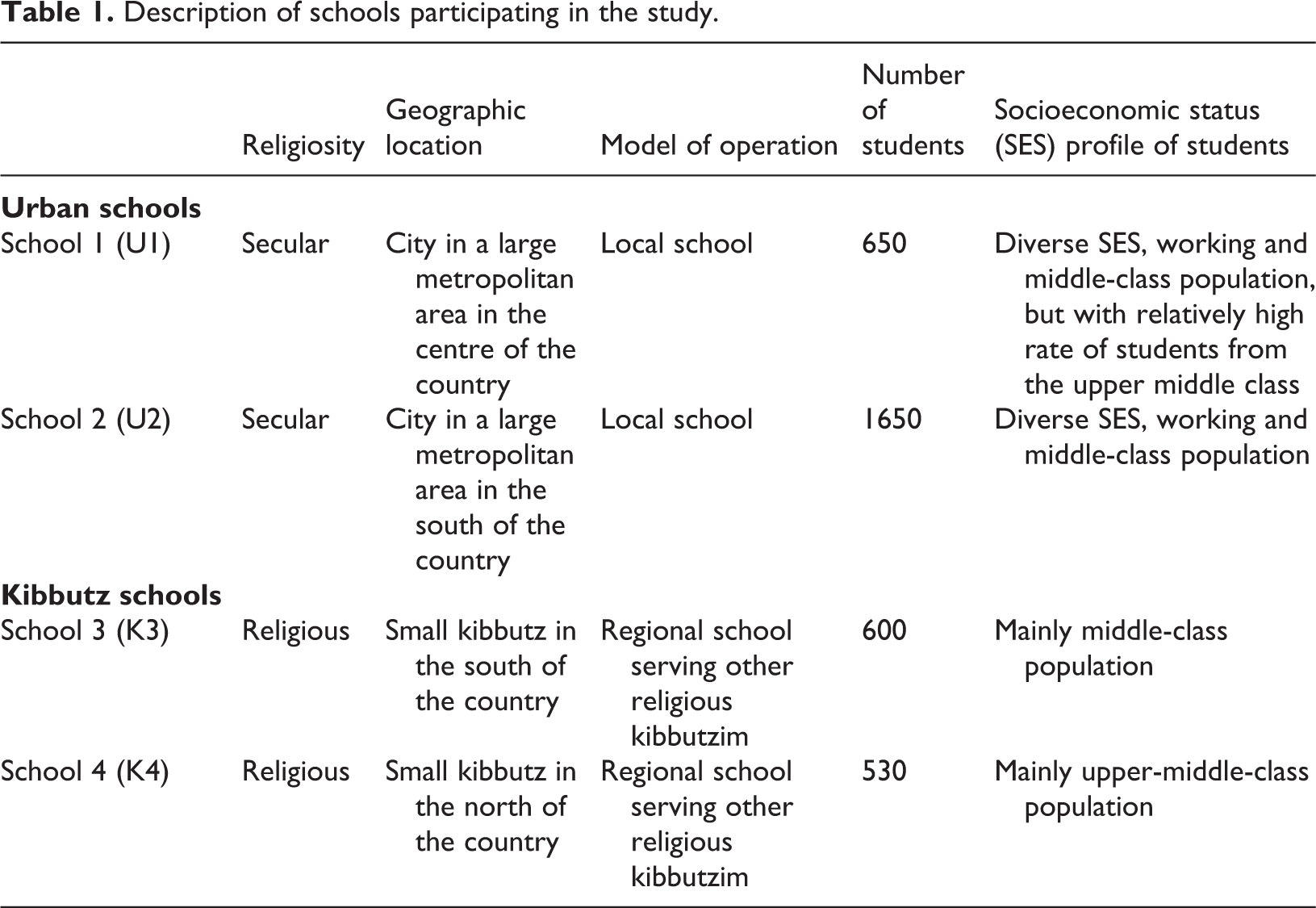
State Jewish non-religious education in Israel embodies norms of individualism and relatively low egalitarian commitment (Perry-Hazan, 2015), emphasising teacher self-reliance, autonomy, priority for personal purposes, and promoting personal interests (Oplatka and Hertz-Lazarowitz, 2011). By contrast, state Jewish religious education is committed to promoting both religious and nationalist education, actively aiming to increase the sense of identification with the community and the state (Berkovich, 2018b; Gross, 2003).
The urban settlement in Israel is viewed as representing individualism (Mittelberg and Lev Ari, 1995). People live their lives independently, mostly committed to their nuclear family, and formal laws are central in directing social interactions (Somech, 2000). A kibbutz is a form of communal settlement based on socialist ideology and collective values, in which all members own and share facilities, including the education organisations of the kibbutz. In the kibbutz, duties and decision making are communal (Abbou et al., 2017; Somech, 2000). Despite some important changes in their economic and institutional structures, some kibbutzim remain collectivist in culture to this day. Their leadership and members still espouse a cooperative, family culture and community ideals, and institutionalise them in work and social organisations (Moskovich and Achouch, 2017; Nahum-Shani and Somech, 2011).
Participants and data collection
The study included four principals and 7–8 teachers per school. The principals’ ages ranged from 42 to 57 years, with their tenure as principals in the present schools ranging from four to 10 years. About half of the teachers were in mid-level leadership positions (i.e. vice-principals, form coordinators, subject coordinators, social activity coordinators, scheduling coordinators, school counsellors, etc.) and were part of the senior management teams of the schools. See Table 2 for characteristics of participants by school.
Participants’ details by school.
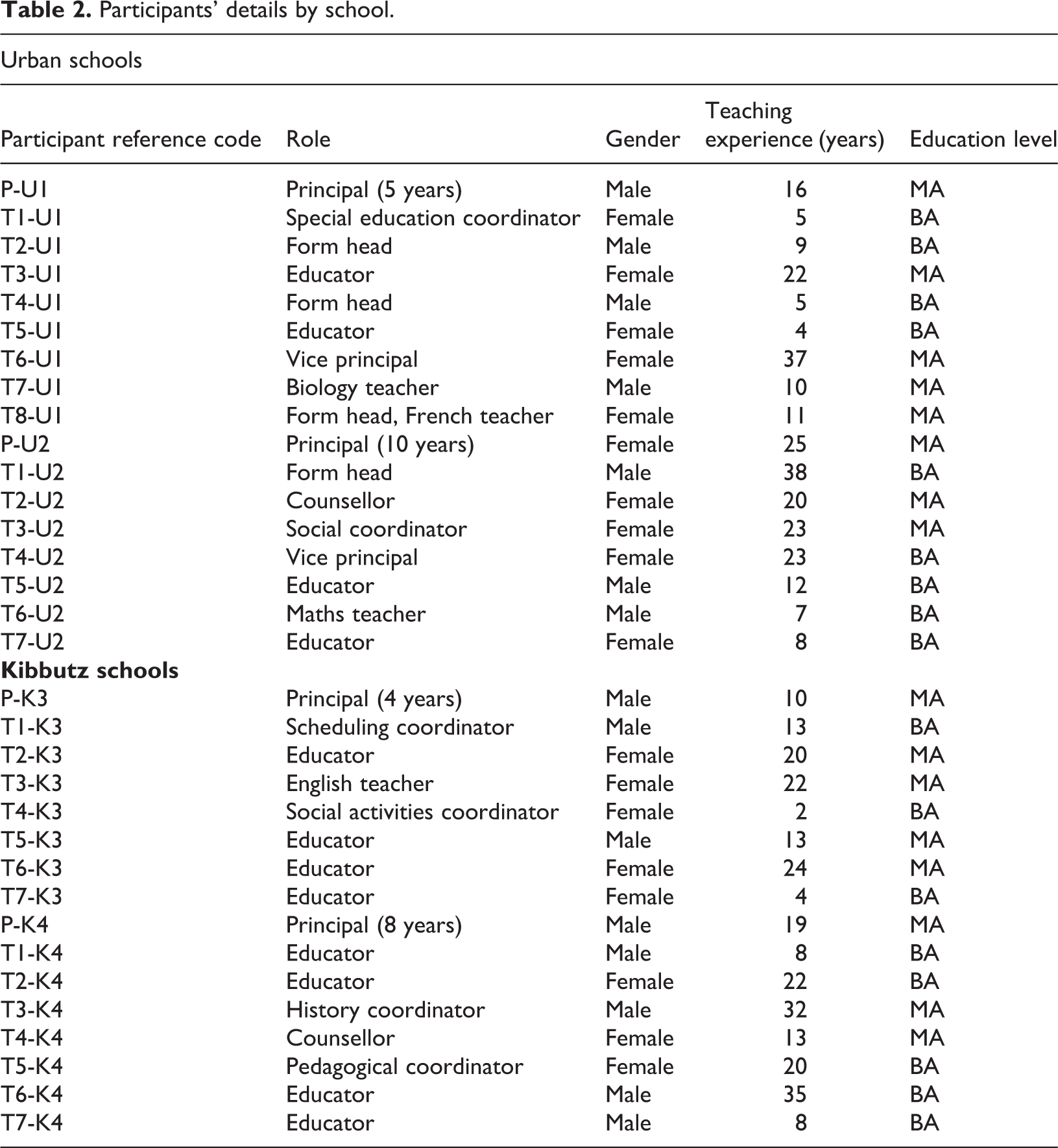
The data were collected using semi-structured interviews. Participation was voluntary. Individuals signed an informed consent form, and they were assured that identifying details would be removed from publications and that the raw data (i.e. recordings and transcripts) would be available only to the researchers. The interviews were conducted during the 2018–2019 school year on school grounds, in locations that allowed privacy. They lasted 40–90 minutes. Interviews included questions such as ‘How is the decision making process conducted at your school? Who makes the decisions?’, ‘In what areas does the school principal allow shared decision making?’, ‘What do you think are the pros and cons of this model of decision making?’. The interviews were transcribed by a professional service. The transcriptions were analysed to identify salient topics.
Data analysis
The data were analysed using thematic analysis (Ryan and Bernard, 2003), a ‘method for identifying, analysing, and reporting patterns (themes) within data’ (Braun and Clarke, 2006: 79). We analysed the interview data both inductively and deductively. We combined within-case analysis and cross-case analysis to establish the themes (Eisenhardt, 1989; Huberman and Miles, 2002). Note that our case unit was not the school but pairs of schools with the same cultural background. Our original focus was on comparison of manifestations of distributed leadership across cultures. We began the process by reading the transcripts of all the interviews and inductively searching for patterns and themes across cases, aiming to develop initial descriptive codes (Huberman and Miles, 2002). Examples of inductive codes that emerged at this stage were values and norms in school culture, the principal’s centrality in shared decision making, and conflicts in shared decision making. The quotes and themes identified directed our attention to the importance of micro-politics in understanding manifestations of distributed leadership across cultures. Therefore, we conducted an extensive review of the literature on micro-politics in organisations and schools, which emphasised the centrality of concepts such as power, conflicts, interest groups, coalitions, values and ideologies (see Ingle et al., 2012). Next, we reread the interview transcripts from a deductive perspective that used micro-politics as a conceptual framework. We searched within each case for indications and evidence of power, influence, and control dynamics. Examples of deductive themes at this stage include coping with stakeholders (for collectivist schools) and control of principal (for individualist schools). Lastly, we performed a cross-case comparison of similarities and differences (Eisenhardt, 1989; Vulliamy et al., 1997) to refine the themes and conceptualise the different indications of power, influence, and control dynamics at the two settings based on similar dimensions. The two authors reviewed the thematic analysis on a weekly basis to refine themes and resolve disagreements, until saturation was reached (Pratt et al., 2020). The final themes included (a) the ‘nature’ of distributed leadership in each cultural setting; and (b) micro-political manifestations of control, actors, and stage crafting at each cultural setting.
Findings
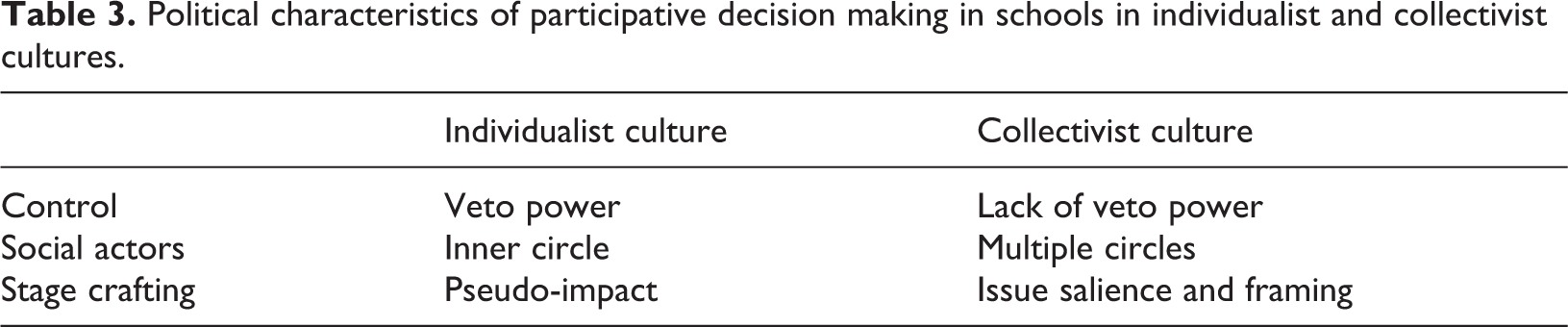
The analysis of the participative decision making in schools is presented below, separately for each type of culture. First, we present how the (imperfect) nature of distributed leadership appears in each case. Second, we report on participative decision making in urban and in kibbutz schools. We found three micro-political points of comparison between the prototypes of participative decision making in various cultures: control, actors, and stage crafting (Table 3).
Political characteristics of participative decision making in schools in individualist and collectivist cultures.
Urban schools: distributed leadership and participative decision making in an individualist culture
Portrait of distributed leadership in an individualist culture. Participants reported salient individualist values guiding the urban schools, including self-expression and liberty, acceptance of differences, social critique and scholastic excellence (P-U1, T2-U1, P-U2, T1-U2, T4-U2). In both urban schools studied, distributed leadership practices were revealed to be present at all levels of school management, not merely in the senior management team. One teacher addressed it specifically (T2-U1): When I came to this school many years ago, there was a lot of centralisation…very few people made most of the significant decisions, and they were not really inclined to share. Now things seem to me to have clearly changed here…due to the change of management. There is no central decision making here…It’s all teams, it lets everyone have a voice. In the end, a decision is made, the process allows a multiplicity of views, that lets people speak, lets people decide, lets people speak their opinions.
Micro-politics of participative decision making in an individualist culture. Regarding the first point of comparison (i.e. We make decisions together. There are times when there are arguments, and there is no agreement, I cast my veto, and this is my right. In the end, I want to lead the school to a certain place, I have a vision, I have a worldview, I have a direction, and I have a path. And that path, of course, is developed with the team, because anyone who doesn’t connect to it cannot be here on the school management team, because the whole school is run by that vision. When I took the principal’s job, there was a senior leadership team, which also didn’t exactly make the decisions but played ping-pong with the old principal.
Concerning the second point of comparison (i.e. In the last four years [since I assumed the principal’s role] I made one decision completely alone. All other decisions were made in consultation with the management team. On the other hand, it is consultation, [but] obviously, I end up making the decisions.
Concerning the third point of comparison ( Sometimes there is this thing that the people in management seem to know in advance what decisions they want to be made, and then they act as if the decision making process, which they have taken part in, is not real. (T6-U2)
Kibbutz schools: distributed leadership and participative decision making in a collectivist culture
Portrait of distributed leadership in a collectivist culture. Participants reported salient collectivist values guiding the kibbutz schools, including community, nationalism and egalitarianism (P-K3, T1-K3, T2-K3, P-K4, T1-K4, T3-K4, T7-K4). The principals in these schools stressed the distributed nature of their management style. One principal (P-K4) presented it as driven by the identity of teaching professionals: Whoever works in teaching is a person whose DNA is to be a partner, to be involved, to be active. Not to have things determined for them from above…They express their opinions. It doesn’t have to conform to my opinion. The degree of responsibility of the staff here is unique. It’s bananas. Amazing. We had quite a few crises over the years…The degree of dedication [of the staff], it’s very special and it’s very much related to values. On the other hand, the challenge is that everyone is equal in the kibbutz. Including God.
Micro-politics of participative decision making in a collectivist culture. In both kibbutz schools, the participants’ narrative on participative decision making was different from that described in the urban schools. Regarding the first point of comparison ( If I decide as most people said in the discussion, then no problem. But if I decide against the position of all the members of the senior management team, it’s a very [strong] statement. It has to be something very unusual for that to happen. (P-K3)
Concerning the second point of comparison ( When these three bodies decided to open the issue for broader discussion, we held discussion circles of educators, discussion circles of the entire school staff. We made a special evening open to anyone interested. All parents, alumni, students, anyone who wanted to come to talk, say what was on their minds, was welcome. This kind of evening shows how things are done here in terms of how we make decisions. In the end, a decision was made on having everyone heard, listening, agreeing, and making a [collective] decision. (T4-K3)
Regarding the third point of comparison (
Discussion
This qualitative study examined the micro-political characteristics revealed in principals’ and teachers’ accounts of participative decision making in collectivist and individualist cultures. In a sense, the study is a response to Woods’s (2016: 115) call for ‘greater understanding […] of power in the practice of distributed leadership’. The findings of the study help identify three points of comparison of principals’ political strategies in different cultures. The points of comparison we identified are somewhat similar to those suggested by Ryan (2000) with regard to general management, but those did not offer any differentiation based on cultural orientation (collectivism vs. individualism). The importance of the study lies in expanding the limited empirical knowledge base that is rooted in the political outlook on distributed leadership in schools and the scarce comparative research addressing the cultural aspects of distributed leadership practices.
The findings make several contributions to the knowledge base on distributed leadership in schools. First, the reports brought here are among the few empirical works drawing on the political outlook of distributed leadership, and they reflect the grounded portrayals of ‘imperfect’ distributed leadership. We found that in individualist settings, which are at the basis of most research on distributed leadership, principals reported distribution of their control because they felt the burden of being legally and publicly accountable for everything happening at their institutions. It is possible that Israeli settings, with the current neo-liberal trends of evaluation and accountability (Berkovich, 2014, 2019), which are also common in many Western individualist countries, implicitly communicate tension to principals between collaboration and competition, and drive them to collaborate with subordinates to counter the pressures of accountability (Woods, 2007). The central manifestation of control was veto power, which appeared to be available to principals in individualist settings. As noted, culture type, rooted in national or community culture, is also shaped by school actors, as in the case of democratic schools. These schools, however, are different from the situations we described in the findings, in which the type of culture was related to the community circle. Reports on democratic principals show that they can waive their veto power (Blase et al., 1995), but also reinstate it at their discretion, whereas principals in a collectivist culture do not have veto power to begin with. Note that in a national or community-based collectivist culture, all are accountable to group decisions (Sagie and Aycan, 2003), despite low individual influence on outcome decisions.
One more contribution of our research is that, contrary to the mainstream distributed leadership literature, the findings stress the inelasticity of the power structure with staff and stakeholders. Various definitions of distributed leadership address the collaborative school culture, the collaboration between stakeholders such as parents and students, and the collaboration between staff and stakeholders (Liu, 2020; Sun and Xia, 2018). Given that the participation of actors is central to distributed leadership, the mainstream distributed leadership literature tends to view the structural dimension of organisational power relations as highly elastic. As a result, it under-theorises the social aspects that shape the ‘self-reinforcing nature’ of the power structure (Magee and Galinsky, 2008: 351) and the manner in which the power structure is associated with societal culture. Our work shows that the identity of the key social actors (staff alone vs. staff and stakeholders) in the distribution process is related to the type of culture (individualist vs. collectivist). Our findings are consistent with previous research showing that in individualist cultures some principals use senior management positions (i.e. vice-principal and form head roles) to create an inner circle of yes-men – a structurally non-dynamic and uncritical political senior management group (Berkovich, 2020). Efforts to promote greater collaboration of school leaders with other circles, such as the community, have been related to granting all actors veto power (Goldring and Sims, 2005).
An additional contribution of our work to the distributed leadership knowledge base concerns the performative aspect of distributed practices. The findings on pseudo-impact in individualist culture may be regarded as an explanation of previous findings in the US, reporting that teachers’ participation in decision making does not necessarily make teachers feel more involved because it does not seem to have a significant effect on the decision (Taylor and Bogotch, 1994). In collectivist settings, issue salience and framing were central because of the complexity of managing large meetings and because of voting practices. Although voicing opinions and voting have been institutionalised as common practices in modern organisations since the mid-20th century, few works have focused on them (for a notable exception, see Olsen, 1972). In organisations operating in individualist cultures, voting is rarely used. For example, Jarzabkowski and Seidl (2008: 1411) explored 51 meetings on strategy formation at three UK universities and found use of voting on only two occasions. Yet we found it to be central in the distributed narrative of schools in collectivist cultures. In many ways, voting legitimises heterogeneity of goals, but makes status and power structure less visible (Olsen, 1972). Note, however, that voting cannot be exercised on most topics, and voicing opinions cannot touch upon all aspects of the complexity of a subject (Olsen, 1972). Therefore, in some cases (perhaps in many cases), the democratic symbolism of voicing opinions and voting remains just that: symbolic. Our insights on participative decision making in a collectivist culture may be relevant also to democratic and community schools in individualist societies, as previous research has revealed similar practices and issues (Ruffin and Brooks, 2010; Woods, 2005).
Another key contribution of our findings is that they make possible a better understanding of the international discourse on ideal models of distributed leadership, using a cultural lens. The reports and surveys of the Organisation for Economic Co-operation and Development (OECD) are quite likely the leading authority in providing cross-country data on distributed leadership. In a case study report, the OECD identified Finland, a country relatively high in national cultural individualism (63 according to Hofstede indicators available at https://www.hofstede-insights.com/), as a ‘reference society’ (i.e. a model in international policy discourse), in which distributed leadership is prevalent, and held by the organisation as an ideal school leadership model (Pont et al., 2008). We can infer from this that the ideological agenda of the OECD is to promote an individualist model of distributed leadership. Our findings also shed light on international comparisons revealing similarities and differences in distributed leadership by taking into account the cultures in which they are situated. For example, Liu’s (2020) analysis of the OECD TALIS survey items addressing distributed leadership groups together countries such as England (UK) and Singapore (89 and 20 according to Hofstede indicators of individualism available at https://www.hofstede-insights.com/). It is more than likely that the similar responses in this standardised assessment of distributed leadership in these two countries, separated by such a fundamental cultural divide, do not reflect the extreme difference in societal context. Thus, our work punctures a hole in the value of international surveys and comparisons of distributed leadership.
Limitations and future research
The present study has several shortcomings. First, because it was a naturalistic exploration of cultural factors, it was not possible to control for other possible cultural elements, such as power distance. Cultural differences may have contrasting effects. For example, the coexistence of high collectivism and high power distance can be found in countries such as Vietnam, where it has been reported that teachers have difficulty voicing their real opinions in front of the school principal (Truong et al., 2017). Further research is needed on these topics. Second, we explored the micro-politics of distributed practices as a general principalship process. It has been suggested, however, that micro-politics is more dynamic in distributed processes, where authority changes by issue (Woods, 2016). Therefore, it is likely that research will uncover a broader set of political strategies that other actors use in distributed processes, as they take the lead on the issue close to them. Additional research is recommended. This work focused on the intersection of community cultural individualism and collectivism with school cultural individualism and collectivism. Nevertheless, the findings and insights are highly relevant to future exploration of cultural individualism and collectivism at different levels, including the national (e.g. Asian vs. non-Asian countries), the community (e.g. traditional and religious groups), the school (e.g. democratic and community), and at different combinations of levels.
Practical implications
The research findings also have operative implications. First, the focus in training programmes on the universal application of generic skills is worth delimiting. Training should address diverse contextual factors and promote trainees’ understandings of several key context-specific effects on participative decision making, and familiarity with a range of political strategies. Second, the findings may stimulate acting principals to reflect on the match between the cultural environment of the school and their political actions. As noted, school culture is shaped to a great extent by community culture (individualism vs. collectivism), but principals can be proactive in creating a school culture that differs from that of the community. The insights of the present study are particularly relevant to school culture change initiatives, which, if change initiators wish to be successful, must involve the replacing of one intra-organisational politics with another. Third, we advise policymakers wishing to promote distributed leadership practices to foster context-specific supportive conditions. For example, Chen et al. (1998) suggested that explicit cooperative rules evoke more cooperation in individualist cultures, whereas face-to-face communication induces more cooperation in collectivist cultures.
Footnotes
Declaration of conflicting interests
The author(s) declared no potential conflicts of interest with respect to the research, authorship, and/or publication of this article.
Funding
The author(s) received no financial support for the research, authorship, and/or publication of this article.
