




Abstract
The COVID-19 pandemic has confronted school leaders across the four devolved nations of the United Kingdom (UK) with a period of exceptional crisis. This responsive, small-scale, but UK-wide study focuses on headteacher perspectives on leadership and management in the initial stages of this pandemic, contributing to our understanding of this crucial period. The headteacher respondents met the multiple predicaments and situational ambiguities of the pandemic with a resilience which drew heavily upon the strengths of pre-existing structures and teams. They were required to provide effective emotional and moral leadership in uncharted and rapidly shifting territory. They spoke most eloquently of how they developed pragmatic, versatile and personally reassuring approaches to communication with parents, staff, pupils, and a range of external agencies, all of which were also facing extraordinary circumstances with varying degrees of resilience. The paper concludes by conceptualising the key elements of headteachers’ leadership and management, both inside and outside of school, at in the early stages of societal crisis.
Introduction
This paper contributes to knowledge about leading and managing schools in societal crisis conditions caused by the COVID-19 pandemic, which led to protracted school closure within the United Kingdom (UK). We adopted a straightforward definition of leadership and management, where leadership is ‘identifying what it takes to be doing the right job’ and management is ‘doing that job right’ (Beauchamp and Harvey, 2006: 6). The paper uses headteachers’ individual voices and lived experience to examine the initial strategic and operational responses of school leaders in the frontline of mitigating the impact of a public health crisis in school education (primary, secondary and special schools) across the four nations – England, Northern Ireland, Scotland and Wales – which constitute the UK.
Although such a study would have enabled an examination of the impact of differing government policy, the study revealed that the responses transcended differing national strategies. It revealed common pressures, leadership responses, and practices within the extraordinary context of education provision across all four nations during the early stages of school lockdown. Thus, this is not a study of leaders, or of systems, but of leading and leadership in unprecedented times.
We approached leadership as dynamic, situated and contingent, located in times of deep uncertainty which demanded greater intra- and inter-organisational collaboration and agile decision-making under conditions of heightened public scrutiny.
This study addresses the dearth of empirical research on institution-level crisis leadership in education. We wished to know how headteachers in a variety of school settings were leading in a time of crisis. The study was facilitated by the following research questions: How do headteachers negotiate relationships in a time of crisis? How do headteachers negotiate networks (internal and external) in a time of crisis? What values and attitudes underpin their leadership practices?
Research context: School governance in the UK
When dealing with a national pandemic, the fact that education policy forms part of devolved government policy in the UK (Beauchamp et al., 2015) potentially provided additional challenges to school leaders. Headteachers are faced with sometimes contradictory policy with schools only a few miles from each other across a national border. As well as government, however, they also work with differing local support structures and organisations. In Wales, for instance, in addition to the Welsh Government (with devolved powers, including education), schools work not only with their local authority (LA), but also with four local School Improvement Consortia, who support schools in 22 LAs. They are subject to inspection by Estyn, HM Inspectorate in Wales. In Scotland, in addition to the 32 LAs, there are also six Regional Improvement Collaboratives (RIC), as well as new government-led committees on various aspects of education. Education Scotland is characterised as the executive agency of the Scottish Government (Humes, 2020) which also incorporates Her Majesty’s Inspectorate (HMI). In Northern Ireland, the Department of Education (DE), accountable to the Northern Ireland Assembly at Stormont, has overall responsibility for the implementation of educational policy. The management structure of schools in Northern Ireland is both complex and fragmented (Borooah and Knox, 2017). All schools have boards of governors, but controlled schools (de facto Protestant) report to the Education Authority (EA), whilst the employing authority for maintained schools is the Council for Catholic Maintained Schools (CCMS). The Education and Training Inspectorate (ETI) inspects all educational provision. In England, most publicly funded schools are either LA-maintained schools, academies or free schools (both the latter groups are state funded but independent of LAs and run by not-for-profit trusts). There are 152 LAs in England. In August 2020, 58% of state-funded schools were LA-maintained schools, and 42% were academies or free schools (UK Government, 2020). Trusts range in size from up to five schools to over 30 schools, with a drive to scale up the size of multi-academy trusts (MATs). Eight regional schools commissioners (appointed by the Department for Education) oversee academy performance. The Office for Standards in Education (Ofsted) inspects all schools.
Key literature
While there is an extensive literature on educational leadership and change management, there are very few studies that combine school-level educational leadership and crisis management (Gainey, 2009; Mutch, 2015; Smith and Riley, 2012). There is, as yet, negligible empirical research on the impact of pandemic-induced school lockdown (Huber and Helm, 2020). Indeed, the field of crisis management itself is shifting. Previously, attention largely focused on sudden impact crisis events, such as school violence and natural disasters, and their post-crisis recovery plans (Moerschell and Novak, 2020; Smawfield, 2013). Also, they concentrated on first responders, neglecting other professionals in the wider crisis response chain (Deverell et al., 2019). Attention is now turning from ‘fast burn’ or ‘regular’ crises toward protracted and complex ‘slow burning’ or ‘creeping’ crises (Boin et al., 2020: 120).
School leaders’ responses to the COVID-19 pandemic, and their leadership of the subsequent changes, have been guided by external factors in respect of differing national structures, mandates, support and advice. Nevertheless, as we discuss below, these did not appear to play an important role within the immediacy of the headteachers’ responses in the early weeks of the pandemic. They were, however, heavily influenced in each institution by key internal dimensions of leadership and management which came to the fore in times of crisis: pre-existing models of leadership; change leadership; resilience; and ethos of care and moral leadership, equity and social justice. We examine here the literature on these themes.
Models of leadership
The academic field of school leadership and management is under active development. Rational or scientific management approaches to educational administration co-exist with a range of normative approaches to school leadership. Bush (2020) identifies six management models clustered with ten leadership models which evidence the development of the field.
Within this dynamic field, debate has centred on the appropriate unit of analysis and focus of activity: solo or aggregate leadership; approaches that focus on how change is to be achieved (efficiency concerns and delivery); or what change is valued (core purpose and activism) (Gunter, 2016). This is discernible in a continuum from transactional (or hierarchal) modes of leadership that rely on positional authority, through transformational (charismatic) leadership with its attention to improving school outcomes through vision-building and culture work, to transformative leadership that attends closely to equity of opportunity. Early advocacy of collegiality within post-heroic distributed leadership (decentralised, open) (Woods et al., 2004) has found support in the recent articulation of collaborative leadership (Woods and Roberts, 2019) and collaborative professionalism (Hargreaves and O’Connor, 2019). Gronn’s (2009) conceptualisation of hybrid leadership helpfully reflects a nuanced appreciation of how leadership works through fluid ‘configurations’ of individual and collective leadership.
Change leadership
In the COVID-19 crisis, this fluidity required leaders to respond to dynamic shifts or changes within and beyond schools. The extensive literature on the successful leadership of change in education is often focused on schools which operate in challenging circumstances. Day (2004), for example, suggests that headteachers who lead change successfully achieve good outcomes through deep commitment to their work, sustained by passionate commitment to their students’ success. They communicate this through ‘their sense of humour, interpersonal warmth, patience, empathy and support of their staff, parents’ and pupils’ self-esteem’ (Day, 2004: 426), combined with a reflective attitude. However, neither Day nor any other previous authors were scrutinising change leadership in a time of major national crisis. There is very little empirical research into the leadership of change of the magnitude of total school lockdown. There are relevant studies into crisis-led leadership in public management, such as Schmidt and Groeneveld (2019), which noted that leadership in a crisis is usually focused on immediate decision-making processes by those at the top of organisations. However, an early pandemic publication from social psychologists (Jetten et al., 2020) indicates that effective leadership in times of crisis should focus on developing a sense of shared identity, with leaders binding people together and being seen ‘to stand with them’ (p. 30). This enables shared understanding of goals and thus of how to move forward together.
Resilience
To do this effectively, however, all members of the school, especially leaders, need to demonstrate resilience. This is often seen as a particular individual’s trait reflecting someone’s ability to ‘bounce back’ from tragic events or crises, but it can also characterise a community that can become more cohesive during these times (Hyvarinen and Vos, 2015). The broader interdisciplinary literature argues for the importance of building community resilience to help people cope with crises (Jurgens and Helgloot, 2018) at local and national levels. However, Goldstein’s (2011) research suggests that often community resilience happens naturally in response to events or issues, though it may be difficult to transition out of such a concerted effort as a crisis is resolved.
Leading during the uncertainties of a crisis requires some key elements to help communities to maintain cohesiveness and respond effectively. These are creative thinking, problem solving, improvisation when needed and, particularly importantly, communicative skills to enhance the many interactions between key groups and individuals, as a means of supporting effective collaborations (Hyvarinen and Vos, 2015). However, it is argued that those working in schools reflect what Day (2014: 641) describes as ‘everyday resilience’, when the ‘processes of teaching, learning and leading, then, require those who are engaged in them to have a resolute everyday persistence and commitment, which is much more than the ability to bounce back in adverse circumstances’. Successful leaders, he goes on to suggest, work to build a strong school community built on particular values, such as trust and fairness. Haslam et al. (2020) go further and characterise the school leader as someone who must see themselves as one of the group, sharing an identity of ‘us-ness’ in pursuit of the collective good. Within the context of a crisis such as the COVID-19 pandemic, everyday resilience has to encompass changing contextual imperatives, both political and health related, while also acknowledging the issues of fear, isolation and bereavement potentially being experienced by the wider school community.
Haslam et al. (2020) characterise successful leadership as achieving influence rather than securing compliance, where leaders and others see themselves as belonging to a coherent group or team. Here, leadership is not a quality of the individual, but is about the relationship between leaders and others where the collective good is actively sought and where leaders are seen as an integral part of the group. If there is a commitment to such leadership already in place, utilising the ongoing and dynamic ‘everyday resilience’ characterised by Day (2014), leadership in lockdown may reflect an intensive and focused resilience. This not only has to cope with new demands on teaching and learning, but also to support the enhancement of relationships across the school community as an important means of extending resilience and maintaining a sense of ‘us-ness’ (Haslam et al., 2020).
Ethos of care, moral leadership, equity and social justice
There is increasing recognition of the links between school leadership for desired educational outcomes and the set of social realities – which must include highly unusual crises such as global pandemic – that surround the educational setting (Male and Palaiologou, 2015: 214). Even while it has long been apparent that schools cannot compensate for all societal deficits, or meet all the needs of every learner every day, there is an increasing expectation that schools must focus on inclusivity, and develop egalitarian education systems that value every person equally and provide each with the opportunity to achieve their potential as a healthy, happy human being (Brown, et al. 2019: 457). Hargreaves and Fullan’s (2012) conception of teachers’ professional capital emphasises the deployment of a range of technical capacities, but also foregrounds human and social capital with their emphasis on care, morality and a critical and contextual engagement with social justice. Such an approach places an emphasis on the personal and emotional engagement of school leaders, unpacked by Crawford (2018), in respect of potentially positive impacts on self-efficacy, teamwork and resilience, and on relationships with pupils, staff and parents. Stacked against these benefits are the challenges of such leadership, particularly in relation to the emotional labour it requires.
Methods
Design and participants
The study was intended to generate initial insight into leadership strategies in a rapidly developing ‘crisis’ context. It was conducted in the early stages of crisis response following the decision to close UK schools for most students from 23 March, 2020. A small-scale, responsive design, the methodology draws on pragmatism and enactment theory to explore the ways in which school leaders – as key actors making adjustments to provision in particular contexts and settings – translate, mediate and enact policy in response to local needs and opportunities (Ball et al., 2011; Cousin, 2019; Weick, 2001).
The mode of data collection and choice of sampling technique were influenced by the context and purpose of the study. Remote technologies had to be used to maintain social distancing in the context of the COVID-19 pandemic. Observation of practice (thinking in action) was not possible under lockdown conditions.
Sample
Prospective participants – school leaders of primary, secondary and special schools and pupil referral units – were invited to take part in one in-depth interview of no more than 60 min duration. The participants were recruited using non-probabilistic convenience sampling and were known to the research team through school–university links. While acknowledging the risks of selection and volunteer bias, this approach was appropriate for the first stage of a time-sensitive exploratory enquiry with a small sample and no available secondary data sources (Rivera, 2019).
Prospective participants received an invitational email that explained the purposes of the study, how data would be collected (remotely) and managed, and a realistic indication of the time commitment required. Participation was entirely voluntary and consent could be withdrawn at any time. A total of 16 headteachers were approached and 12 accepted, a participation rate of 75%. The study design was informed by appropriate ethical guidelines (BERA, 2018; SERA, 2005) including those specific to internet-mediated research (British Psychological Society, 2017). The protocol was approved via university institutional ethical review procedures.
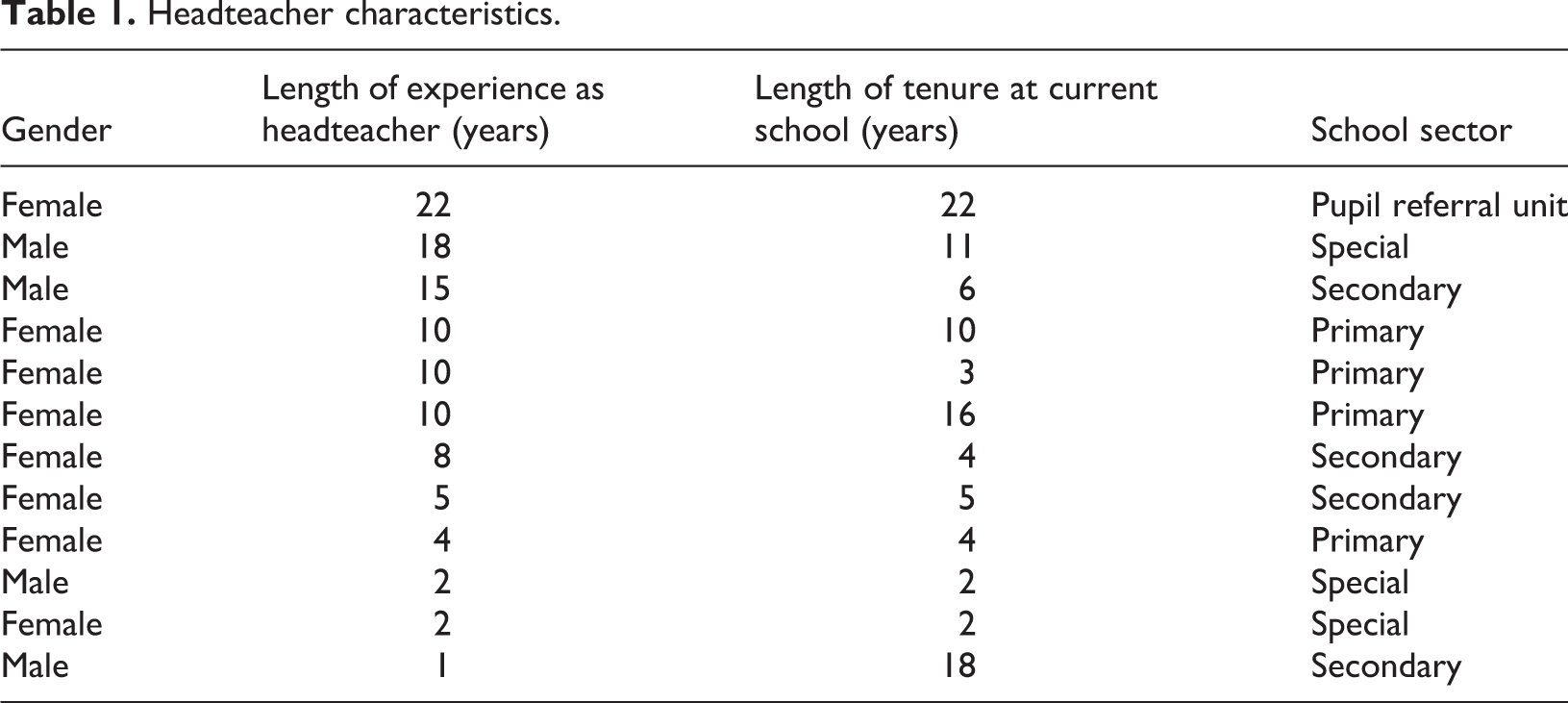
The 12 one-to-one remote interviews of between 45 and 60 min duration were conducted in May and June 2020 – primary (4), post-primary/secondary (4) and special schools/alternative provision (4), which included a pupil referral unit for young people with social, emotional and behavioural difficulties. The headteachers had a range of experience (see Table 1), and worked in different sectors and school types (such as intake demographic and size – see Table 2), hence ensuring a range of potential viewpoints.
Headteacher characteristics.
School context.
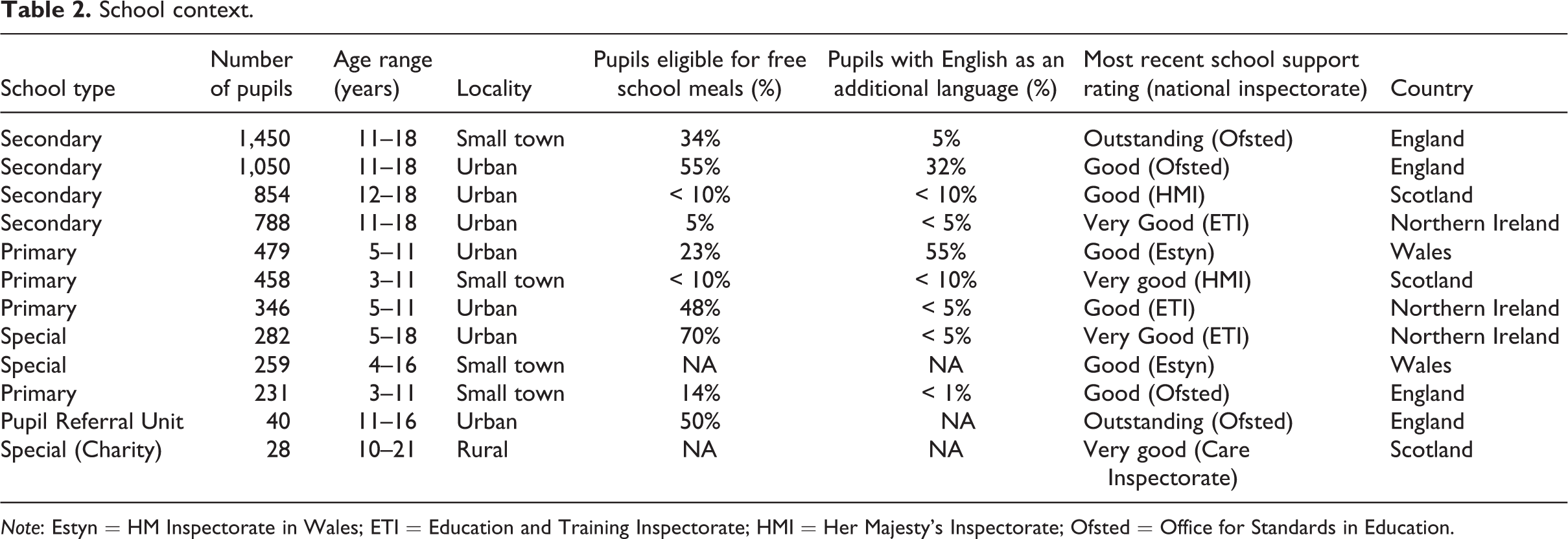
Note: Estyn = HM Inspectorate in Wales; ETI = Education and Training Inspectorate; HMI = Her Majesty’s Inspectorate; Ofsted = Office for Standards in Education.
All schools had received a positive support rating from their national inspectorate, and could thus be anticipated to have effective leadership and management processes in place.
The research team comprised experienced researchers from four universities, one from each of the four nations, who had previously collaborated on projects across UK nations, supplemented by a freelance academic who joined them at the analysis stage. Each member of the core team conducted interviews in their own national context, where they were familiar with a rapidly changing policy background. An interview guide was constructed iteratively, drawing on research literature and professional knowledge, and piloted with a headteacher outside of the study to test question order, clarity, fitness for purpose across a range of contexts, and the time required for completion. Although multiple-perspective interviews may have been helpful in exploring reported relational dimensions of leadership (Liou, 2015), there were practical and ethical challenges in requesting increased participation during the early stages of a crisis which prevented a larger study.
Due to the need to engage geographically dispersed participants in a timely manner, all interviews were conducted through video or telephone. Such interviews enable data to be gathered expeditiously over greater geographical distance, flexibility over scheduling, reduced travel time and improve cost effectiveness (Archibald et al., 2019; Iacono et al., 2016). In addition, an emerging body of research suggests that technology-mediated interviews compare favourably with in-person interviews in terms of rapport and disclosure (Jenner and Mayers, 2019). Indeed, Hanna and Mwale (2017: 260) argue that the public, yet private, space of the remote interview may ‘offer a more empowered experience for the interview participant’, reducing concerns about power imbalances. Video call technology is also now widely accessible to professionals and provides access to non-verbal visual cues to support rapport building, which are excluded in telephone interviews (Mirick and Wladkowski, 2019).
The interviews were conducted and recorded using secure and tested Voice over Internet Protocols (VoIP) dependent on interviewee preference. Informed written consent was obtained prior to interview, and reaffirmed verbally before the interview. All interviews were transcribed verbatim by transcribers who had signed up to a confidentiality protocol. The transcriptions were analysed inductively, using both descriptive and interpretative codes (Miles et al., 2014). While accepting Nowell et al.’s (2017) call for such an analysis to be rigorous and methodical, and hence ‘trustworthy’, we also accept that ‘any qualitative work is an interpretative process’ (Braun et al., 2019: 4), and that ‘there’s no one way of making sense of data’ (p. 12). We also acknowledge our own experience working within educational settings will influence our analysis, as ‘assumptions and positionings are always part of qualitative research’ (Braun and Clarke, 2019: 595). Nevertheless, to ensure rigour in an inductive analysis, one single shared transcript was analysed independently by each team member, using line-by-line and open coding to generate a provisional coding frame. After a team meeting to agree initial codes, these codes were applied independently to a set of within-country transcripts. At a subsequent team meeting, including diagramming to make sense of connections (Nowell et al., 2017), final themes were reviewed, agreed and applied across all transcripts, as reported below.
Results
For the purposes of this article, our main focus is on five key common themes which were generated (Braun, et al., 2019) from the data with regard to leadership and management in schools during a time of crisis. These themes recognise and build on Day’s (2012) model of school organisation. These will all be examined in turn: External expectations and pressures; Power and authority: adaptive leadership modelling; Values and attitudes: moral imperatives and emotional leadership. Communications – enhancing relationships Beyond everyday resilience – resilience within situational ambiguity
These findings and subsequent discussion will conclude with the development of a model of school leadership in the early stages of the COVID-19 crisis.
External expectations and pressures
Leaders highlighted the importance of versatility in managing external expectations and pressures. The fast-moving, but uncertain, external environment demanded flexibility and swift adaptation. Transnationally, ambiguity, contradiction and hyper-vigilance became day-to-day challenges arising from the sheer volume of external communications with government, other agencies and advisory bodies and information shared on social media, exemplified by a primary headteacher in England (PE), who asserted that: In the first few weeks of lockdown, there was that much stuff coming across Twitter, Face Book, all the social media…we tried not to get too wrapped up in that and keep to what we thought the children needed from us at that time. (PE1) There was just so much going on in these first two weeks. We were on the phone all the time: to professionals, to parents, to each other; a new piece of news every couple of hours and the changes to Government guidelines. (SpSc7) It is a little bit annoying that the information released seems to go to the media as quick as it comes to us. For instance, reopening of schools, parents have been asking ‘are you opening, are you not opening?’ (SNI8)
Power and authority: Adaptive leadership modelling
Concepts of power and authority were inextricably linked to their impact on the headteachers’ behaviours and relationships within their schools. The diversity of leadership models with which headteachers claimed to engage, or partially engage, ranged across forms of distributed leadership, moral leadership, collegial leadership and ambiguity/contingency approaches, as outlined by Bush (2020).
All headteachers described some form of pre-existing distributed leadership in place within their school. For some this was simply an extension of a normal way of working, for instance, drawing in a wider pool of skills when needed, such as the expertise of IT staff, or trying to use staff strengths even more effectively. A primary (P) headteacher in Wales (W) explained that: I’ve learnt to maybe trust my team more, which maybe I wouldn’t have done and they would have come to me for more decisions than they have done.…Something I’ve learnt, is to actually use the skills within the team better. And that’s not always the leadership team, it’s other people as well who we know are good at certain things…I’ve learnt to delegate more. Manage less, lead more. (PW11) I needed to let certain things go. When you are in school it is all consuming. I now have had time to think. What we have managed to do from a senior leadership perspective is that we have managed to delegate and to give people a chance to really get on with it and our staff have really responded. (SpNI10)
Values and attitudes: Moral imperatives and emotional leadership
The formidable nature of a crisis involving potential life or death situations for some within, or connected to, those in the school communities, meant that a powerful form of moral leadership was necessary to maintain a positive sense of purpose and mutual support. A strong sense of moral and emotional leadership (Crawford, 2018; Hargreaves and Fullan, 2012) was very visible in many of the headteacher narratives, such as SpW12 stating: I’ve really learnt in this climate that what people needed was reassurance from their leaders. They wanted from me certainty, they wanted me to be positive, and they wanted me to reassure them that what they were doing was good.…So, in terms of leading in this climate it’s been leading in the emotional sense I think more than in the educational sense and that’s what people I think have been looking to me for. (SpW12) The things that are massively important to you, the things that you would say, as a school, are the things that you value, you need to be making sure that you still are exemplifying them, promoting them at all times. (HT6) We always say in our school that it’s successful because of our relationships and our connections, and that has been the biggest challenge for children, for parents, for staff to maintain that.…I realise how much I miss being able to see people every day. I miss being in the room with staff. I miss collectively coming to a solution that we might not all agree on, but we’ve all had a part to play in it…(PSc6)
Communications: Enhancing relationships
Communication was key to maintaining and enhancing connections and relationships across school communities, especially in times of major crisis (Jetten et al., 2020). SNI8 was emphatic that what was needed was: …communication, communication, communication, not just always formal communication, and always, always at the end saying, at the beginning and end of anything I send it is, are you OK? And letting them know there are no cases in the school, no families have been affected, because we are a school community, and also saying your welfare comes first above everything else that we do at the minute until we are back together. (SNI8) I think leading and managing the emotional wellbeing of the children at home, I have never in my life spent so long talking to families. We identified vulnerable children and families prior to lockdown and we split those phone calls amongst the leadership team. And initially the families were quite kind of standoffish and sceptical, ‘Why are you phoning me?’ And we explained we were phoning lots of families, but we were phoning families that we thought might need a bit more support. (PW11)
Although not for everyone, such vulnerability could be seen as a means of enhancing that sense of all working for the common good. Haslam et al. (2020) highlighted the importance of maintaining this sense of collective ‘us-ness’ when trying to work toward building effective schools, and communication contributed strongly to expression of headteachers’ values and attitudes as demonstrated by SpNI10: This particular period has given me time to speak with individuals on a different level, on a much more human level. Very often in our role a lot of the things that you are doing it is at 100 miles an hour. It has allowed me to really chat to people on the phone, really talk to them and checking on people. I am not saying that I didn’t do it before but I think that personal aspect of leadership I will continue to really push on with once this is over. (SpNI10) We bought a pastoral phone just before we left school. A mobile phone that my head of pastoral care holds and the children all have that number. It is a 24-hour phone that is available to the school for the children. If they can’t get anywhere else or if they don’t want to go to gateway or they don’t want to go to counselling, school is a haven for children, we bought this phone and we have put the number out and said ‘if you are stuck, you got nobody else or you just want to chat ring this and somebody from school will ring you back’. (SNI8)
Beyond everyday resilience: Resilience within situational ambiguity
Day’s (2012) concept of everyday resilience in schools works from the premise that resilience is an essential quality already integral to those already working there. In times of crisis, or situational ambiguity, with ever-changing priorities and demands from external agencies and governments, this everyday resilience can form the foundation for the development and customisation of resources and teaching and learning approaches. This resilience became an essential element of schools as they lost real-world contacts and interactions and were forced to alter their ways of working. Headteachers spoke of staff responding very quickly to the imminent lockdown, building on and customising materials and ways of working. Nonetheless, one of the major aspects of school life that was immediately undermined by the lockdown was the normal planning and organisation underpinning school lives. As the situation changed headteachers had to adapt quickly to changing levels of control over events, as explained by SNI8: I like things planned and structured and organised and set down. In the first eight weeks, I couldn’t do that because every week something was different, and then we had to check that the new thing that we brought in was right. I have had to accept that I needed to become more flexible. (SNI8) What I’m hoping comes out of this is a different perspective on what education is actually all about and do you know the thing I’ve enjoyed, the pressure of not worrying about whether you’re going to get the Ofsted call. You walk into school on a Monday, Tuesday or a Wednesday and not having that pressure of accountability has just been like a cloud lifting. (SE4)
Discussion
According to Machiavelli (1993) nothing is more perilous or uncertain than to lead change. In this case, change took the form of national crisis in which physical connectedness was lost almost overnight, and a sense of ‘us-ness’ (Haslam et al., 2020; Jetten et al., 2020) became more difficult to maintain. This study has delved into the personal reflections of a small, but diverse, number of headteachers during the immediacy of the crisis to try to understand how they responded to these unprecedented events.
Drawing on the key components schools as dynamic organisations, as envisaged by Day et al. (1990), the data provided rich accounts of the external and internal influences, relationships and responses to such a challenging event as a lockdown of schools and the potential for lack of cohesiveness and breakdown of relationships. The external pressures and expectations themselves had the potential to undermine headteachers’ strategies, since they often received contradictory or changing advice through multiple media, as well as directly to schools. Nevertheless, despite such uncertainty and situational ambiguity, the stories of individual schools through the words of headteachers presented us with resilient responses encompassing the adaptation of leadership models in order to shape new ways of working together and sharing responsibilities around leadership teams. One headteacher characterised this as less time spent on management and more attention given to leadership. Teachers took the lead in developing new curriculum approaches and teaching materials and making innovative use of IT. Further accompanying elements were also needed to sustain headteachers’ approaches. Flatter structures emerged, encouraging or reinforcing the need for trust and positive relationships. These were supported by a focus on values and a sense of purpose, engendered by the headteachers and maintained in relationships with schools and their wider communities. In order to maintain or enhance relationships, it was essential to establish ways of communicating and interacting in such a way that the community of the school still felt both coherent and tangible.
A powerful element in this school imaginary was an emphasis on what Hargreaves and Fullan (2012) characterise as professional capital, where a moral and ethical engagement with social justice issues underpinned the schools’ perceived roles. These are also features often found in forms of distributed leadership and linked to effective forms of social change (Woods, 2011; Woods and Roberts, 2016). It is within such an environment that headteachers often shared on a personal and emotional level, making themselves vulnerable, but also perhaps helping to reinforce the relationship between headteacher and staff as well as headteacher and parents/children. The moral imperative also led to practical efforts to support children and their parents with additional teaching and learning resources, telephone hotlines and even food parcels, along with caring conversations where parental anxiety could be alleviated.
Limitations
There are some caveats to consider regarding inferences from this study. The study relies on the accuracy of self-report garnered at a particular moment in time by a small, but diverse, range of headteachers. We acknowledge that, in restricting participation to headteachers, we attribute leadership to an ascribed role, rather than to other members of leadership teams. We also recognise that leadership strategies may shift as leaders work through transitions in rebalancing organisations that are at different stages within change processes (Evans, 2001; Hannah et al., 2009). But the interviews reported here were scheduled during the initial response stage and thus present a credible snapshot of that time.
Conclusion
Having acknowledged these caveats, this study nonetheless provides empirical data on the views of headteachers, from a variety of schools and a range of backgrounds and experience, across the four nations of the UK. It represents unique data, about in-the-moment experiences of headteachers facing an unprecedented global crisis, where their school communities have been dislocated and routines abandoned. Despite the differing political and policy contexts around the UK, this resulted in a common need to build and maintain new teaching methods and content and communication systems. It required rapid further development of relationships with staff, pupils and parents, underpinned by trust and fairness, and led by moral imperatives focused on the collective good of the community. Although there remain many nuances, according to individual schools and headteachers, Figure 1 encapsulates the common findings outlined in the interview data.
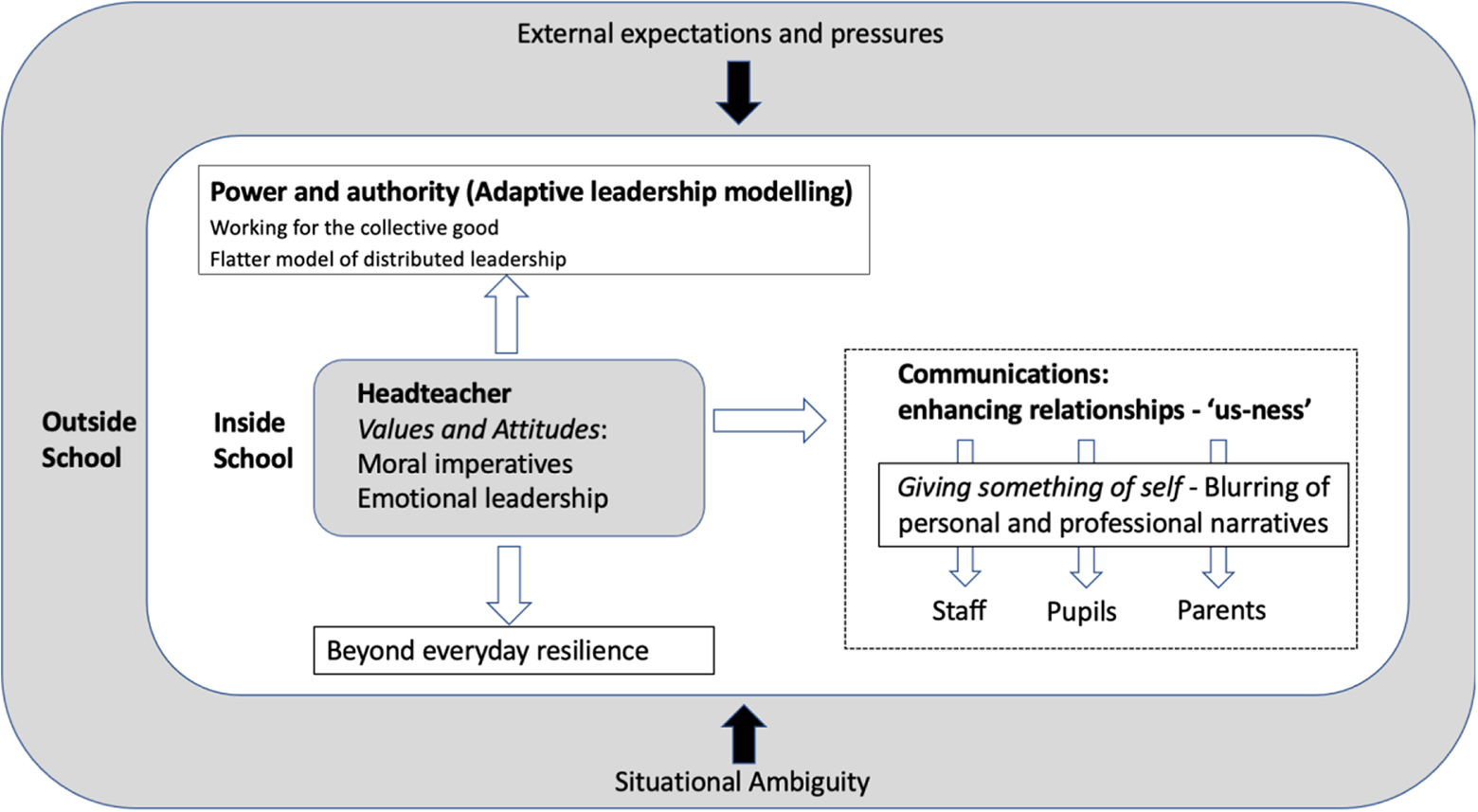
Model of school leadership in the early stages of the COVID-19 crisis.
This situates the headteacher at the centre, as it reflects their perspectives of the way they had led their schools through the crisis. It recognises the external pressures from national and local agencies, and the resultant sense of situational ambiguity, where the operational context could change overnight. Within their schools, the values, attitudes and moral imperatives of headteachers invoked a strong sense of emotional leadership of all members of the school community. The need for ‘communication, communication, communication’ and ‘commitment to a humane way of working’ (SNI8) was very evident in headteachers’ thinking. This led to a personal investment which permeated all their messaging, with a resultant blurring of personal and professional narratives. In addition, headteachers perceived a change in their perceptions of power and authority. This led to adaptive leadership modelling (Gronn, 2009), with no fixed model emerging, but rather engaging with aspects of a range of leadership models. Although all heads maintained the hierarchy inherent in their roles, some headteachers reported a flatter structure of distributed leadership, essential to manage the situation. In all these leadership activities, however, headteachers needed to maintain their own resilience as they led their schools through a period of unpredictable change. This is not without challenges, as events could take away their control. As one headteacher commented:
“I think from quite a personal point of view quite a large part of my identity is the job that I do, and I feel quite strongly that that identity has been taken away rather which has led to all sorts of levels of anxiety and worry. (PW11)”
Resilience was also called for in dealing with loss in the school community. While this has always happened, the scale and unexpectedness can present challenges. As the same headteacher reported: And I don’t see that as either leading or managing, I just see that as being human. I mean, we’ve sent lots of flowers. It would be nice at some point to stop sending people flowers for people who’ve lost people and start sending people flowers for nice reasons. (PW11)
Footnotes
Declaration of conflicting interests
The author(s) declared no potential conflicts of interest with respect to the research, authorship, and/or publication of this article.
Funding
This research received no specific grant from any funding agency in the public, commercial or not-for-profit sectors.
