



Abstract
The members of the governing boards of schools, colleges which provide vocational education and training, and universities in the UK have traditionally been volunteers. In some contexts, however, for example, colleges in Northern Ireland, governors are now paid. Whether volunteer governors in other or all settings should be remunerated is the subject of debate. This article analyses the various aspects of that debate. It considers the nature of volunteering; the socio-political context of volunteering; and the growing momentum for the remuneration of governors of all UK educational institutions. The article also considers the arguments for and against governor remuneration, which include remuneration and: the way governors and the governing of educational institutions are valued; the visibility of governing; governor recruitment; the diversity of governing board membership; the quality of governing; the remuneration of other publicly funded agencies and organisations; the accountability governors experience in their role; the market for school governors; and whether a policy which implemented governor remuneration could be reversed. The article also considers aspects that would need to be resolved in practice: who would be paid and for what; the level of remuneration; the funding of governor remuneration; and the organisation of remuneration.
Introduction
Educational institutions in the UK that are publicly funded, such as primary schools, secondary schools, sixth form colleges, colleges which primarily provide vocational education and training, and universities, typically have governing boards that oversee the institution’s current performance and shape its future. Members of such governing boards – governors – have typically been, and generally continue to be, volunteers. In some settings, however, such as the colleges in Northern Ireland, governors are now remunerated (Forrest and Hill, 2017) and there is currently a wider debate about whether to remunerate the governors of schools, colleges and universities more generally. From our experience of working in the field, interest in this notion has come from various sources including some governors, who consider that the governor’s role and responsibility as currently constituted justifies payment, and from some governing board clerks/secretaries. They deem remuneration to be justified for the effort, expertise and time commitment required of governors and because it would assist governor recruitment and retention. The pressure also comes from some policymakers, who seek to justify governor remuneration on broadly similar grounds and suggest that payment would stimulate a more ‘professional’ approach (see for example, Carmichael et al. (2015)). However, very little research has been reported that directly addresses the effects, actual or potential, of paying the governors of UK educational institutions. Our endeavours to find such accounts, using the terms ‘governor/governors’, ‘payment’, ‘remuneration’, ‘school/schools’, ‘college/colleges’ and ‘university/universities’ did not reveal any such accounts apart from the report by Forrest and Hill (2017) on the effects of the remuneration of governors in the college sector in Northern Ireland. In addition, Gleeson et al. (2010) do address the issue of the remuneration of governors of colleges in England but it is a small part of a much wider study.
Our intention in writing this article is to analyse aspects of the debate about whether governors should be remunerated and to consider the consequence of such a policy change. In the article, we first consider the nature of volunteering, and then review the current socio-political context for volunteering and for the governing of educational institutions in the UK. We then consider the factors that are contributing to the increasing impetus for governors to be remunerated. In the subsequent section, we discuss the arguments for and against remuneration and the article ends with some concluding comments.
The nature of volunteering
Typically, volunteering entails contributing time benefiting others with no financial or material benefit. So, Wilson and Musick (1999, p. 141) argue that: ‘to most people, a “volunteer” is someone who contributes time to helping others with no expectation of pay or other material benefit to herself’.
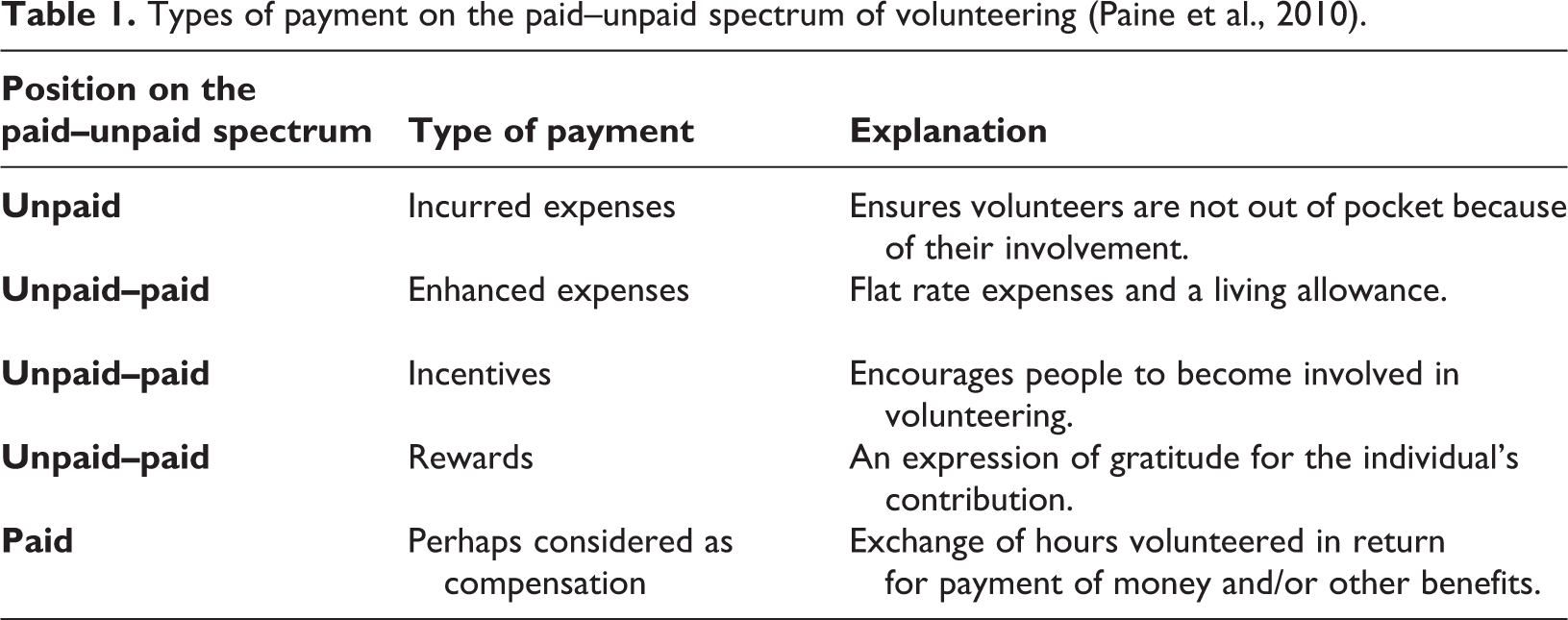
Meijs (2005) takes a similar view but focusses on the undertaking of unpaid work for others/society rather than the contribution of time. Hill et al. (2010) take a similar view and identify three defining principles of volunteering. It is: (a) unpaid; (b) undertaken as an act of free will; and (c) of benefit to others. They view these principles not as binary but as concepts at the ends of a spectrum. Hill et al. (2010) specifically explore the paid–unpaid spectrum, which enables an analysis of the types of payment within the spectrum range – see Table 1. Interestingly, for Hill et al. (2010), the payment of incentives and rewards are not forms of remuneration.
Types of payment on the paid–unpaid spectrum of volunteering (Paine et al., 2010).
Volunteering may well bring benefits to the volunteer other than remuneration. These potential benefits include: building the volunteer’s social capital; character building; fostering interpersonal trust, toleration and empathy for others, and respect for the common good; improving the individual’s physical and mental health; and improving the volunteer’s occupational achievement (Wilson and Musick, 1999). Interestingly, Ranson et al. (2005) have drawn attention to such benefits in the context of school governing in the UK. The UK government (Gov.uk, 2020a, p. 1) considers that volunteering is a ‘great way to meet new people, gain new or use existing skills, get experience, and make a difference to your community’. Whether these benefits would be available if some form of payment was introduced is not clear. However, Wilson and Musick (1999, p. 167) have little doubt that: ‘There are individual benefits to be derived from doing volunteer work that reach far beyond the volunteer act itself and may linger long after the volunteer role is relinquished.’
Importantly, they are clear that ‘there are justifiable fears that attaching rewards to altruism will undermine motivation and distort values’ (Wilson and Musick, 1999, p. 167). Sandel (2013) extends this point by arguing that payment – an extrinsic reward (Bénabou and Tirole, 2003) – may ‘crowd out’ public spirit and the intrinsic value of volunteering.
The socio-political context for volunteering
All volunteering takes place in a particular social and political context, which must be addressed in any consideration of voluntary action. A key aspect of the context for voluntary action in the UK, and, indeed, further afield, is the pervasive and dominant effect of neoliberalism and the preference for ‘bringing market-based principles’ into public policy making (see Hill and Kumar (2009) for a useful review). Dean (2015) reviews the constraining effects of neoliberalism on volunteering generally. He argues that market-based individualism may damage altruistic predispositions and the compassion that can underpin voluntary action. Dean (2015) even questions whether volunteering is compatible with a neoliberal market-based society. In the context of UK colleges, marketisation is a key feature of the dynamic in which they operate (Simmons, 2010). Employers continue to be a dominant element of the marketplace with colleges and universities expected to align curricula to meet local and national business need. Forrest and Hill (2017) report that this expectation underpins the policy to remunerate colleges in Northern Ireland.
Standing (2019), in challenging the notion of neoliberalism and the intrusion of the market into all aspects of society, argues for a ‘common society’. An important part of such a society is the recognition of volunteering, which he views as a form of social income, that can be overlooked in a market-based society. For him, work that is not paid, such as voluntary work, becomes invisible and of no value in a society operating on neoliberal principles. Sandel (2013) challenges the notion that payment for altruistic actions will bring about desired outcomes arguing that there are some things money cannot buy. He asserts that markets and market value have ‘moved into spheres of life where they don’t belong’ something he considers to be a ‘fateful change’ (p. 7).
Volunteering is very widespread in UK society generally, makes a substantial contribution and is clearly valued by policymakers. Chapman and Hunter (2018) report research into volunteering in third sector organisations in the north of England. A total of 81% of the 3,500 organisations surveyed reported that ‘they could not keep going’ (p. 5) without the contribution of volunteers. Based on the financial replacement cost at the level of the national minimum wage (Gov.uk, 2020b), volunteering in the north of England contributes £480 m a year.
In policy terms, volunteering is clearly supported by the UK government. The ‘Big Society’ policy initiative, which started in 2010, was clear that the government ‘will take a range of measures to encourage volunteering and involvement in social action’ (Cabinet Office, 2010, p. 2). It also pledged to give 15 million employees in the private and public sector the opportunity to take 3 days volunteering leave a year. The government of the UK and the jurisdictions encourages people to ‘volunteer in your local community and give your time to help others’ (Cabinet Office, 2010, p. 2).
Those critiquing the central UK governments’ enthusiasm for volunteering might argue that volunteers are being used to act for the state in support of a market-based economy and that citizens’ altruistic nature is being manipulated in that regard. Volunteering meets needs that could and perhaps should be met by remunerated provision provided by the state. The ‘Big Society’ created by volunteering is an alternative to the ‘Big State’. The volunteer governors of schools make a substantial pro bono contribution (James et al., 2014), which critics might argue should be paid for by the state.
Volunteering and the governing of educational institutions in the UK
This section summarises the regulatory and legislative frameworks for the governing of educational institutions in the UK and the current extent of governor remuneration. In so doing, it makes clear that, despite the extensive debate on the issue, currently, governors are typically volunteers.
The provision of state-funded education is a devolved policy area in the UK (Civil Service, 2020) with the governments of England, Northern Ireland, Scotland and Wales having responsibility for policies under which publicly funded schools, colleges and universities operate. Notwithstanding, all schools in the four nations have governing boards, which are responsible for the governing of their institutions, apart from schools in Scotland and a small number of schools in multi-academy trusts (MATs) in England. Colleges and universities in all four jurisdictions have governing boards.
Two sources of regulation affect the possibility of governor remuneration: charity legislation and government legislation. Educational institutions in the UK, especially colleges and universities, are typically charities or exempt charities and in relation to governor payment are subject to charity legislation. An exempt charity has charitable status and must comply with charity law but it may not be directly regulated by the relevant charity commission. Instead it may have ‘a principal regulator which ensures its compliance with charity law’ (BIS, 2019, p. 1). For example, for universities in England that are exempt charities, the principal regulator is typically the Office for Students (Wheaton, 2019).
The charitable status of educational institutions has significant implications for whether their governors, who are technically ‘charity trustees’, may be paid. In all four nations of the UK, the relevant national charity regulator makes clear that all trustees may not ordinarily be remunerated. Thus, the Charity Commission for England and Wales, the Office of the Scottish Charity Regulator and the Charity Commission for Northern Ireland all set out the conditions under which they would approve trustee remuneration. For example, the Charity Commission for England and Wales (2017) is prepared to approve trustee payment ‘where payment may be justified’ (p. 11) and makes clear it will normally only approve payment where ‘a charity’s complexity of operation has led to an unusually high burden of trusteeship’ (p. 11). The Commission also requires evidence of the difficulty of recruiting volunteers, a problem which presumably it considers remuneration will overcome (see below).
The other source of regulatory control regarding governor remuneration arises from the governments of the four jurisdictions. Their legislation either requires conformance to national policy or allows policymaking on governor remuneration at the level of the individual institution, providing it is within the institution’s established governing instrument and articles. An example of national policymaking is the college sector in Northern Ireland, where the remuneration policy and supporting guidance are set by the Northern Ireland government (Forrest and Hill, 2017). An example of institutional policymaking would be the case of some universities in England and Scotland that have determined their own governor remuneration policy on the basis that it is within each institution’s governance instruments and articles, which typically require conformance to charity legislation (Wheaton, 2019).
No database setting out the remuneration arrangements for educational institutions in the UK is publicly available. Table 2 thus summarises the current pattern of governor remuneration of the governors of education in the UK as we understand it. The table makes clear that currently the governing of educational institutions is predominantly undertaken on a voluntary basis.
The national and institutional policymaking processes that frame the remuneration of governors of educational institutions in the four jurisdictions of the UK and current practice in the remuneration of chairs and members of governing boards.

Note: * indicates that institutional policymaking must conform to the relevant charity legislation and the instrument and articles of governance.
The factors contributing to the growing impetus for paying governors
Various factors are contributing to the growing impetus for paying governors. In this section, we illustrate those factors with two case examples: academy schools in England, and the UK college sector.
Academy schools in England
The Academies Act 2010 enabled schools in England to take on academy status. Academies are funded directly by central government rather than the Local Authority (LA) and in that regard ‘are independent from the local authority’ (Gov.uk, 2020c, p. 1). They have considerable autonomy, for example, they are not required to follow the National Curriculum and can commission from any provider advice and support services that they were formerly required to take from the LA (DfE, 2019). Many academies have formed groups known as multi-academy trusts (MATs) (Simon, James and Simon, 2021), which are charitable companies limited by guarantee.
As we discuss below, MATs, secondary academies and some primary academies can be substantial and complex organisations with sizeable budgets. They may be operating in challenging market-based environments and struggling to enhance the quality of education their institution provides and without the immediate support of their LA (Simon, James and Simon, 2019). Governors of such educational institutions, who are volunteers, carry a significant responsibility and the autonomy granted to operate outside the LA is likely to heighten the sense of jeopardy they experience. In addition, academies and MATs operate in an intense accountability regime with: financial monitoring and regulation by the Education and Skills Funding Agency (ESFA, 2020); scrutiny of their educational provision by Ofsted, which inspects services that provide education and services that care for children and young people (Ofsted, 2020); and oversight by the Regional Schools Commissioner (RSC, 2020). The weight of responsibility and intense accountability requires a substantial investment of time and expertise by governors, especially chairs (NGA, 2019), to fulfil their obligations.
The Government’s Department for Education (DfE) is clearly committed to the voluntary nature of the governing of academies. Governing is ‘rooted firmly in the principle of voluntary service’ (DFE, 2019, p. 30) and ‘is subject to very specific legal restrictions’ (p. 39). Despite this commitment, a report published in 2015 (Carmichael et al., 2015), one of the authors of which was a member of parliament, argued strongly for governor remuneration, to increase board diversity and compensate those who may have to forgo paid work to give time to governing. In 2016, a ‘think-tank’ report (Finch et al., 2016) asserted that ‘the Government must make it possible for governors to be paid’ (p. 6) to address the low level of governance skills and compensate for the time commitment required.
The time commitment demanded of board members of academies and MATs, especially board chairs, can be considerable, which increases the pressure for remuneration as a means of compensation. James et al. (2014) report that 65% of chairs spent more than 17 hours per month on governance matters, with 23% committing over 36 hours per month, which is equivalent to a working week per month. The National Governance Association (NGA, 2019) report that 25% of board chairs state the time they dedicate to governance is unmanageable.
The UK college sector
Colleges in the UK can be large, multipart organisations with substantial budgets. The income of the largest colleges exceeds £100 m (Ryan, 2019), and all colleges are subject to financial oversight by state agencies or departments. UK colleges have operated in challenging and complex financial contexts for many years (Simmons, 2014).
In England, colleges are subject to financial oversight by the Education and Skills Funding Agency (ESFA, 2020) and inspection by Ofsted (Ofsted, 2020). The Further Education Commissioner (FEC, 2020), a government appointee who works with colleges ‘to improve their quality and financial resilience’ (p. 2), also oversees colleges. The Commissioner will intervene when colleges have been graded ‘Inadequate’ by Ofsted, and/or have mismanaged their finances. In such circumstances, a college may be closed or merged with other colleges. Commissioner scrutiny often focusses on governance.
In 2019, a new financial regulatory framework for English colleges was introduced (Legislation.gov.uk, 2019), which arguably enhanced the challenging nature of the context. It established a new insolvency regime, which was intended to: improve financial management; make clear to governors the implications of insolvency for them; and to set out the process of intervention in colleges in financial difficulty (DfE, 2020). As with any insolvency, governors of such colleges may face increased liabilities and disqualification from elected office or directorships. The DfE has enacted the insolvency regime (DfE, 2020) and intervened in several colleges, leading Parrett (2019) to assert that: ‘board positions come with a higher level of personal accountability than ever before’ (p. 1). In recent years, government-led area reviews have resulted in the merger of many colleges (AoC, 2020), which has increased the number of large institutions. Governors of these large colleges, though probably fewer in number overall, now carry an increased responsibility (Whieldon, 2019). Interestingly, a very recent policy announcement by the Secretary of State for Education (Williamson, 2020) has acknowledged the importance of colleges in England and elevated the status of the sector. These policy intentions are likely to increase the burden of responsibility governors carry. Taken together, recent changes in the college sector in England illustrate the emergence of ‘high stakes governing’, which in turn has increased the impetus for governor remuneration (see AoC (2016)). According to Whieldon (2019), the changes necessitate ‘professional’ governance, which he asserts will be achieved by paying governors.
Along with the increased responsibility and personal jeopardy experienced by governors, especially chairs, the necessary time commitment has increased (Whieldon, 2019). In 2016, the Association of Colleges (AoC) argued that the increased workload for chairs justified remuneration (AoC, 2016) and provided support to colleges that were seeking permission to pay chairs. Colleges mergers have increased the time governors, especially chairs, commit to their role (Whieldon, 2019). Several college groups have successfully applied for permission to remunerate their governors (Whieldon, 2019).
In Northern Ireland, the remuneration of college governors was introduced in January 2016. The intention was to improve board quality and diversity and to attract more governors from the private sector (Forrest and Hill, 2017). All board chairs are appointed by the Northern Ireland Department for the Economy, and typically receive £20 k per year. Forrest and Hill (2017) report that governors considered that remuneration provided some recompense for the considerable time commitment required to fulfil their responsibilities.
The remuneration of college governing board chairs in Scotland was introduced in 2014 (Forrest and Hill, 2017). Remuneration reflected the accountability relationship between chairs and the Scottish Funding Council and government ministers. Remuneration was also an acknowledgement of the breadth of the role, which includes wide economic and social remits. Typically, college chairs in Scotland are paid between £20 k per year and £30 k per year (Forrest and Hill, 2017).
In Wales, the 2014 Skills Implementation Plan (Gov. Wales, 2014) highlighted regional and local skills delivery models and mirrored policies for colleges in Northern Ireland. More recently, the Welsh Government has encouraged colleges to strengthen employer and community links (Gov. Wales, 2016). However, these developments have not, to date, been reflected in pressure for governor remuneration.
A summary of the factors contributing to the growing impetus for paying governors
These case studies reveal various factors contributing to the growing impetus for paying governors.
Interestingly, a recent Higher Education Policy Institute report (Wheaton, 2019) echoes similar pressures for remuneration in the university sector in the UK, where there is a developing and varied pattern of governor remuneration.
The arguments for and against the remuneration of governors of publicly funded educational institutions in the UK
In this section, we consider aspects of the arguments for and against paying governors of educational institutions in the UK, drawing on the issues raised in the previous sections. In so doing, we draw attention to some potential consequences of governor remuneration.
Remuneration and the way governors and the governing of educational institutions are valued
The issue here is whether a significant activity undertaken voluntarily equates with an amateurish approach of low quality (Finch et al., 2016). Further, voluntary activities may have little worth in the current economic and social context, dominated as it is by notions of neoliberalism and marketisation (Standing, 2019). Remuneration, therefore, would enhance the status and standing of governors and the governing of educational institutions. Remuneration would also bring the governing of educational institutions into line with the governing of other important institutions, such as hospitals and housing associations, as we discuss in more detail below.
A counter argument would be that remunerating governors would not enhance their value in wider society and that enhancing the esteem in which governors are held could be achieved in other ways. For example, more governors could be given national awards, which would indicate the value of what governors do. The importance of the governing of schools and colleges could be improved by strengthening the inspection of governance by Ofsted and by making it more central in the inspection process. Also, there are cost–benefit issues to be addressed, and the question of whether the resource used will achieve the requisite impact on the quality of educational provision. There are also opportunity cost issues, and the question of whether money allocated to governor remuneration would be better spent differently to improve educational provision.
Remuneration and the visibility of governing
The governance of educational institutions in the UK is, by its nature, not very visible to the wider public. As a result, it tends not to be understood and its importance not acknowledged, and, as a consequence, it is not valued as highly as it should be. A large-scale study of school governing boards in England by James et al. (2010, p. 3) concluded that: ‘Governors give an enormous amount to the education system in England, yet their contribution is largely hidden from public view.’ Further, governing does not feature substantively in the so-called apprenticeship of observation (Lortie, 1975), a process whereby people gain an understanding of the working of educational institutions by being a student for a long period. As Balarin et al. (2008) argued, the work and responsibilities of school governing boards can be over-loaded, over-complicated and
A counter argument might be that increasing the visibility of governance, and thereby enhancing its value, could be achieved in ways other than remuneration. For example, schools in England are now required to publish information about the members of their governing boards on their websites, which will arguably, over time, make them more visible. Also, the case that remuneration would raise the profile of the governing of educational institutions can be countered by the argument that remuneration does not enhance the visibility of the governance of public institutions where governors are remunerated. Again, there are cost–benefit and opportunity cost issues to be considered.
Remuneration and governor recruitment
There is an argument that remuneration might enhance the motivation of potential governors to take on the governing role, which would improve governor recruitment. However, whether remuneration would achieve that outcome is unclear and may have unforeseen consequences. Remuneration may generate an inappropriate motivation. For example, those with very little genuine interest could take on the role simply ‘for the money’. Providing an extrinsic motivator (Bénabou and Tirole, 2003) – payment – may undermine individuals’ altruistic tendencies and intrinsic motivation (Sandel, 2013). This effect may explain why, when the remuneration of the governors of colleges in Northern Ireland was introduced, some governors were so uncomfortable with being paid they considered resigning (Forrest and Hill, 2017). James and Sinclair (2013) argue against paying school governors on the grounds that it would undermine individuals’ natural inclination to support important institutions in their communities.
Remuneration and the diversity of governing board membership
As we have discussed above, remuneration may improve governor recruitment, and a wider pool of applicants gives an opportunity to enhance diversity. The case for enhancing the diversity of governing boards is strong. Ensuring diversity in the governing boards of educational institutions is challenging in all contexts. In schools, it is difficult, especially in disadvantaged settings (Dean et al., 2007; James, et al., 2011; 2014). In 2017, the NGA reported that only 4% of respondents to its national survey were from an ethnic minority (NGA, 2017). Nearly 15 years ago, Ranson et al. (2005) concluded that the voluntary nature of school governing in the UK had not been successful in redressing the ‘under-representation of women, ethnic minorities and disadvantaged classes’ (p. 361). Ensuring diversity is problematic in the college sector and is a matter of concern (Ellis and Brewis, 2005) as it is in the UK university sector (Advance HE, 2020; Equalities Challenge Unit, 2009). Improving diversity would: provide evidence that the governor appointment process is not discriminatory; may better reflect the diversity of the key stakeholders of the institution; and would enhance the quality of decision-making (Advance HE, 2020; Ellis and Brewis, 2005; Equalities Challenge Unit, 2009; NGA, 2017). In general, it brings what Hunt et al. (2018) refer to as the ‘diversity dividend’ in boards in the corporate sector. Whether remuneration would encourage participation in the governing of educational institutions by those in under-represented groups is not clear. And again, enhancing diversity could be achieved in other ways, simply by governing boards being more proactive and engaging with potential governors (James et al., 2010). However, engendering such a motivation may be difficult. As James et al. (2014) report, in those settings where governors are needed most, governing quality tends to decline, and, with that decline in effectiveness, the capability to recruit also declines.
Remuneration and the quality of governing
The argument here is that if remuneration improves recruitment, then it is likely that the quality of governing would improve. Remunerating college governors in Northern Ireland, improved the quality of governing in many colleges but, interestingly, not in every case (Forrest and Hill, 2017). Paying the governors of schools in England could engender a more professional approach to the work of school governors, which some have argued is required (Ganesh and MacAllum, 2012; Mourant, 2010). It could strengthen the pressure to appoint governors with appropriate skills as recommended in guidance for appointing school governors (DfE, 2019; NGA, 2020). Again, in the context of schools in England, chairs could find it easier to delegate tasks if governors were paid, something they can find challenging when dealing with volunteers (James et al., 2013). Wheaton (2019) makes a strong case for paying the governors of universities in England arguing that it would improve the recruitment of governors with the appropriate skills which would then enhance governing quality.
The relationship between remuneration and governing quality is, however, not clear cut. In colleges in Northern Ireland, where such governors are paid, some governors refuse payment, especially if it comes from the college’s budget, preferring to participate on a voluntary basis (Forrest and Hill, 2017). Further, some governors who did not want to be remunerated were considering resigning over the issue. There is thus the possibility that experienced and expert governors will resign over the issue of remuneration if it is implemented more widely. In such cases, remuneration could reduce interest and expertise in governing rather than improving governing quality. James and Sinclair (2013) also argue that paying school governors will increase inequality in the system. Those institutions with more resources for governor remuneration will be able to pay their governors more, which, logically, should improve the quality of the school. As a consequence, such schools will be able to attract more students and resources at the expense of those unable to pay their governors so handsomely.
Remuneration of governors of educational institutions and the remuneration of other publicly funded agencies and organisations
The argument here is that many ‘UK public bodies’ including National Health Service hospital trusts (NHS Improvement, 2020), the Probation Service (HM Prison and Probation Service, 2019), and housing associations (Inside Housing, 2015) all pay their governors. Therefore, paying the governors of UK educational institutions, which are broadly similar public bodies, would be appropriate and fair.
Several issues are relevant here, one of which could be the size of the institutions being governed. Moderately sized hospitals and housing associations have annual budgets that are comparable with those of larger colleges, MATs, and a typical university, at between £100 m and £250 m (Forrest et al., 2016; Harris Federation, 2020; HESA, 2019; Inside Housing, 2019; NHS Improvement, 2020). However, using data provided by the Institute for Fiscal Studies (IFS, 2019), the budget of a primary school in England of 200 students is typically much smaller at approximately £1 m per year. The responsibility in financial terms carried by primary school governors is considerably less and raises the possibility of only paying governors of larger educational institutions, or setting the level of remuneration so that it reflects the size of the institution. A not insignificant issue is the competition for those with the capacity to engage in the governing of public institutions. Educational institutions may be at a disadvantage in the competition for such governors if they do not provide remuneration when other institutions do.
Remuneration and the accountability governors experience in their role
The accountability experienced by the governors of educational institutions relates to the shared responsibility they have as members of the governing board for the proper conduct of the institution and the contribution they make to their board’s proper functioning. The argument here is that governors might feel more responsible and accountable and might make a higher quality contribution if they were paid. At the core of this argument is the difference between intrinsic motivation and extrinsic motivation (Bénabou and Tirole, 2003). Intrinsic motivation is engendered by the intrinsic value of the task, whereas extrinsic motivation is generated by the receipt of a reward – in this instance a financial reward – for engaging in a task. Providing an extrinsic reward may or may not enhance the motivation of the governors of educational institutions. Logically it should, but Sandel (2013) argues that providing an extrinsic motivation can undermine intrinsic motivation. In the context of school governing, James et al. (2010) report that school governors may have a very high level of intrinsic motivation for their governing work, with many governors referring to the love they have for their school. That deep intrinsic motivation could be significantly weakened by remuneration.
Remuneration and the market for school governors
If educational institutions could set the amount their governors were paid, then possibly a market would be created where higher pay levels would attract the ‘best’ volunteers. Those in favour of governor remuneration could argue that those well-remunerated, and logically better, governors will be able to make sure their school succeeds in the education marketplace. The educational institution would need to divert resources into paying governors but in this scenario the investment would be justified. Thus schools/colleges/universities that can attract the best governors by paying them well will thrive, while those which cannot will fail. At the core of this argument is that a clear and direct causal relationship exists between the quality of governing of an educational institution and student outcomes, which as James et al. (2010) report in schools in England, is difficult to establish. Further, inequality in the system could be increased by creating a market for governors. For example, under-performing schools typically struggle to attract students and as a result their income is reduced. They may therefore not have the resources to pay for the best governors they need.
Remuneration and whether a policy which implemented governor remuneration could be reversed
As we have referred to above, the remuneration of governors would be a turn of the policy ratchet (Ball, 2008) further locking the operation of schools into market-based and neoliberal ways of working. Reversing the policy of remunerating governors would be a ‘one-way street’ as James and Sinclair (2013) have called such a change in the context of schools in England. Reversing the policy might be difficult. It would convey a message that said: ‘Previously it was worth paying you for the responsibility you hold and the contribution you make, now it isn’t.’ The difficulty of reversing a policy whereby the governors of educational institutions are paid is very significant and is a crucial issue to consider. Those difficulties apply regardless of whether remuneration is decided at the national or local level (see above).
Remuneration: Aspects that would need to be resolved in practice
Part of the debate about the remuneration of the governors of educational institutions revolves around the practicalities of payment. We discuss those practical issues in this section.
Payment of all the members of a governing board would be one approach and it would overcome any problems related to differential contributions/responsibilities. By the same token, paying everyone the same regardless of any special contributions/responsibilities could be construed as unfair. However, working out the different contributions in the diverse contexts for governing could be difficult. In addition, whether staff governors of schools and colleges should be paid would also have to be resolved.
One option would be to pay governors based on the contribution they make, that is, providing a reward as an expression of gratitude for their contribution, which, according to Paine et al. (2010), would protect their voluntary status. Such an approach could be difficult to organise in practice and could also upset the working dynamics of the board.
The level of remuneration
The level of remuneration for governors of educational institutions is particularly problematic and could depend on various factors. To pay all the governors of educational institutions in a particular sector at a level commensurate with their contribution in terms of time would be very expensive. For example, James et al. (2014) estimate that paying the 325,000 school governors in England £20 per hour for the time they contribute, would cost in excess of £1 billion per year. In colleges in Scotland and Northern Ireland, the chair is a public appointment and chairs are paid between £20 k per year and £30 k per year. In England, paying governors would increase the pressure for smaller school governing boards (DfE, 2017), which may be problematic (James et al., 2011). It could reduce stakeholder involvement in governing, which is deemed to be important (Connolly et al., 2016).
The funding of governor remuneration
The source of the funding for governor remuneration is a problematic issue in practice. In the case of schools, for example, it could be funded out of the institution’s existing budget, or it could be funded by a ‘ring-fenced’ allocation. In all cases and in all institutions, there are cost and opportunity cost issues to be considered, as we have discussed above.
The organisation of remuneration
Arranging the payment of governors would be an additional task which would further complicate the process of organising the governing board. It could be an unnecessary and time-consuming distraction and a source of conflict. A significant issue would be the performance management of paid governors. If governors are remunerated, some form of performance monitoring and review is a reasonable requirement. This review process is currently deemed to be good practice for the (volunteer) governors of colleges in England, and guidance is available (AoC, 2014). With remuneration, the process might well change with perhaps the setting of performance criteria, for example, establishing benchmarks for attending meetings, participating in development activities, and engaging with institutional events.
The issue of who undertakes the chair’s performance review and sets the chair’s remuneration is problematic. In colleges in Scotland and Northern Ireland, the chair is a public appointment and chairs’ performance reviews are undertaken by the government, which also decides on the salary. However, who undertakes the chair’s performance management and decides on the chair’s remuneration in other settings, for example, the chairs of governing boards of universities, is less clear. To ask board members to undertake the review could unduly disrupt the operational dynamics of the board.
Concluding comments
Our intention in writing this article was to explore aspects of the debate about whether the governors of educational institutions in the UK should be paid and to consider the consequences of paying governors more widely than at present. In doing so, we have drawn attention to the many different aspects of what is a very thorny policy decision. We invite others to contribute to the debate and also to explore empirically the issues we have addressed.
Footnotes
Declaration of conflicting interests
The author(s) declared no potential conflicts of interest with respect to the research, authorship, and/or publication of this article.
Funding
This research received no specific grant from any funding agency in the public, commercial or not-for-profit sectors.
