




Abstract
This article examines the leadership of school principals who, based on the narrative case of the Blueberry School, discuss how they as principals would have responded to a similar problematic situation regarding a school change process. The study is grounded in the context of the Norwegian National School Leadership Programme. Theoretically, the study is informed by cultural–historical activity theory. The findings exemplify how the principals’ responses encompass various viewpoints and arguments through which tensions inherent in the context of the change process are provoked and displayed. This study has three implications for school leadership and change. First, when principals experience problematic change processes at their school, they should take time to identify the tensions, discuss how to understand them and think through their implications for leadership. Second, leading these types of tension-laden change processes in schools requires analytic and reflective skills and training; thus, steps to strengthen these skills should be included in leadership programmes. Finally, there is a need for research focussing on how to conduct informed analysis to reveal tensions when problematic situations occur in school change processes. This is because informed analysis may lay the groundwork for how school leaders can utilise tensions as productive driving forces in change processes.
Introduction
Leadership is required to manage and sustain school changes to improve educational outcomes (Aas, 2009; Bush, 2018; Fullan, 2015; Hargreaves and Shirley, 2012; Vennebo, 2015). Change processes cannot be accomplished without active support from leaders at all levels (Harris, 2019; Mulford and Silins, 2003; Stoll et al., 2006). This insight is supported by research and is reflected in the educational policies of several countries (Organisation for Economic Co-operation and Development (OECD), 2013). School improvement research (Vennebo, 2015) has demonstrated leadership challenges related to dealing with problematic situations that might emanate from school change processes (Aas et al., 2016; Hargreaves and O’Connor, 2018).
One leadership challenge relates to facilitating collective conditions for structured enquiry through which problem spaces can be examined and reflected upon before a solution is identified. Edwards (2009) argues that such structured enquiry is premised on informed contextual analysis, as well as on interpretations of the problem spaces that are being worked on and professionals’ capacity to make these interpretations explicit. Contextual analysis is essential in structured enquiry as contexts are considered to lay the premise, as well as any restrictions for those working for change. School effectiveness and improvement research yields useful insights into different types of school contexts and what successful school leaders need to do to meet the needs and constraints that describe different school contexts (Hallinger, 2018). However, little is known about possible emerging constraints within processes of change and how school leaders respond to such constraints.
The purpose of this study is to understand occurring tensions that might constrain change processes and the ways in which school leaders can respond to them. To fulfil this purpose, we propose the following research questions: How can tensions be identified in school change processes, and how can they be understood and responded to by school leaders?
Empirically, the study is grounded in the context of the National School Leadership Programme in Norway, which utilises case methods and problem-based learning in principal preparation. Theoretically and methodically, the study is informed by cultural–historical activity theory (CHAT).
The article is organised as follows. After the introduction, we present the context of the study and the narrative case of the Blueberry School. Next, we discuss research approaches to related research on school leadership and change before presenting the CHAT approach applied to the current study. We then describe how the research was conducted to answer the research question, before presenting the findings. The findings will be analysed and discussed within the framework of CHAT and the related research. Finally, we conclude and foreground three of the study’s implications.
Empirical context and the case narrative: Blueberry School
The Norwegian National School Leadership Programme
The Norwegian authorities, influenced by the OECD project Improving School Leadership, launched a nationwide education programme in 2009 for newly appointed principals; the goal was to improve the principals’ leadership skills and support national policies. The National School Leadership Programme was built around five curriculum themes identified by the Norwegian Minister of Education and Research: students’ learning, management and administration, cooperation and organisation building, development and change and the leadership role (Caspersen et al., 2017; Hybertsen et al., 2014).
According to Timperley (2011), having multiple opportunities to learn and apply information is one of the fundamental principles of professional learning. A process of ongoing reflection and discussion that challenges the current way of thinking is valuable in building new practices. In the National School Leadership Programme, case-based instruction and group coaching are used to influence practice and strengthen leadership skills, including developing ethical considerations (Aas, 2017b; Aas and Vavik, 2015). The evidence presented in some studies indicates that the discussion of cases and case attributes provides a potentially viable approach for leaders to increase their knowledge (Avolio et al., 2009; Yukl, 2010). In this article, we draw on data from group discussions engaged in by principals participating in the programme using a school case narrative of a fictional school called Blueberry School constructed by the program designers and instructors.
The school case narrative: ‘Blueberry School’
Blueberry School is a combined primary and secondary school with 548 students, 57 teachers and 24 assistants. The leadership team consists of the principal and three designated leaders who head the teaching teams (grades 1–4 (pupil ages 6–10), grades 5–7 (pupil ages 11–13) and grades 8–10 (pupil ages 14–16)). Three years ago, it was decided that the secondary school should merge with the new primary school. A newly appointed principal has been leading the school for two years, and the school is waiting for new buildings to be constructed, because the classrooms are located on different sites. However, due to weak local government finances, the buildings will not be completed for at least two years. Given the poor student performance, change is needed. The principal has stated that the teachers in grades 5–7 have a willingness to change, while the teachers working in grades 8-10 are satisfied with their teaching and do not want to make changes. In a meeting with the local government educational superintendent, the principal was confronted with the students’ performance results in mathematics and literacy, which were lower than expected, especially in grades 8–10. He was also informed that the superintendent had received two phone calls from parents with complaints about bullying and poor well-being among the pupils. In addition, the superintendent pointed out that the employee survey showed that satisfaction among the staff was lower than in the previous two years.
Principals in the National Leadership Programme were invited to discuss several leadership challenges related to the Blueberry School case narrative. In this article, we study the discussion related to the problematic situation that occurred when Blueberry School’s principal received a letter from the teachers’ union with criticism from the school’s teachers. After discussing a suggested plan for change with the leadership group, the teacher teams and the teachers’ union, the principal initiated two development projects: one to improve education in mathematics and one to improve teacher leadership. Project groups presented specific plans for work in public meetings where important issues were discussed before the project work started. In the letter that the principal received, the union stated that motivation for the projects had dropped, as teachers felt that the two projects were moving too quickly and that the projects’ plan needed to be revised. In the National School Leadership Programme, groups of principals were invited to discuss how they, in the position of the Blueberry School principal, would act when faced with these challenges.
School leadership and change
In the international literature on leadership and change, there are some general patterns (Hallinger, 2003). Change is seen to be facilitated by the alignment of policies and processes by stakeholders at multiple levels of a system and as system-wide reforms that require change in the behaviours of professionals (Fullan, 2015, 2018). This is identified as a challenge because school leaders and teachers tend to treat change as an ‘event’ rather than a process and, therefore, tend to underestimate the time frame required for system-wide change (Hall and Hord, 2002).
Change can be understood and analysed along two dimensions: linearity versus complexity (Gunter et al., 2007; Gunter, 2016). From the idea of linearity, approaches to change tend to disregard the variables existing within the individual school environment. Change is assumed to be rational and motivated and managed by an authority figure and should lead to visible results. From the idea of complexity, approaches to change are more ecologically sensitive, providing a better understanding of the complexity and heterogeneity of the contextual and individual factors involved. Change is a negotiation between people representing diverse interests that challenge the existing school culture and power system (Aas et al., 2019).
These approaches, which comprise both model–theoretical and practice-oriented approaches (Vennebo, 2015), assume that change is a result of human activity and demonstrate a concern for developing a capacity for change within the school situation, including leadership capacity comprising leadership competencies (Robinson, 2011), personal values and qualities (e.g. Day and Leithwood, 2007; Moos et al., 2012) and resources, practices and strategies (Day et al., 2008, 2016; Leithwood et al., 2020). These are approaches that all point in a direction compatible with the approach applied in this article, in which we are concerned with change as expansive learning (Engeström, 2001). However, expansive learning that has its origin in CHAT offers an additional approach. This approach enables investigation of evolving tensions and disturbances as driving forces of change and leadership that to date seem to have received modest attention in empirical research on school leadership and change.
Change as expansive learning within the CHAT framework
Change as expansive learning is seen as a process among communities of learners. Learning is not depicted as a one-way movement from incompetence to competence; rather, it relies on its own metaphor: expansion (Engeström and Sannino, 2010). Expansion means that learners acquire uncreated knowledge, which involves the creation of objects that do not yet exist (Engeström and Sannino, 2010: 2). Processes of expansive learning are thus processes of change in which learners are involved in constructing and implementing a radically new object and concepts for their activity. The object refers to the ‘problem space’ at which a collective activity is directed. The object of the collective activity of Blueberry School discussed by the principals in this study is teaching practices in mathematics and class leadership to facilitate the students’ learning. The intended outcome is improved student maths results.
Questioning, criticising or rejecting some aspects of an accepted practice is the critical starting point in Engeström’s (2001) sequences of action in an expansive learning process. If the questions and motivations for change come from the participants within an organisation, a leader more easily obtains commitment than if these questions and motivations originate from external sources (e.g. a superintendent). Engeström argues that both historical and current empirical analyses of the situation should be conducted before a new solution is framed (e.g. a new practice or tool) to discover origins and explanatory mechanisms.
The next step of the process is constructing an explicit, simplified model of the new object and examining its potential and limitations before implementing the corresponding practice. After implementation, the participants must reflect on the current practice before the new practice can be consolidated. New questions must be asked with regard to current methods to illustrate the constantly changing practice. An understanding of tensions and disturbances is crucial to appreciate what happens within a collective activity (Aas, 2013; Engeström, 2007; Roth and Lee, 2006) in which the expansive learning process is situated.
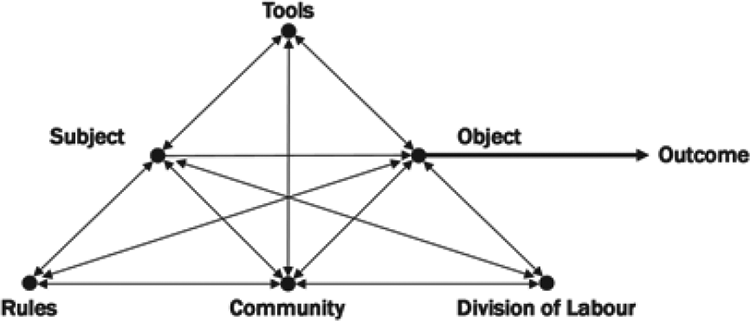
On the basis of CHAT, Engeström (1987) has developed a conceptual triangular model of a collective activity as illustrated in Figure 1. The model explicates the components of a collective activity and its inner relationships, and it assumes that expansive learning processes take shape and develop through object-oriented, tool-mediated actions performed by subjects (i.e. individuals or groups). Engeström (1999) explained that the learning process through which change manifests in the dialectic relationships of goal-directed, tool-mediated actions and interactions is motivated by the object of activity.
The systemic structure of activity (Engeström, 2005).
The particular components in the upper part of the triangular model, the triad of subject, object and mediating tools, are conceptualised as the production portion of change and development. In the Blueberry School case discussed by groups of principals in this study, the school’s principal and teachers are the subject and the projects in mathematics and class leadership are the tools. The objects worked on are teaching practices in mathematics and class leadership to facilitate the students’ learning. The intended outcome is improved student maths results.
However, according to CHAT, change processes are not reducible to situated, mediated, goal-directed actions and interactions. Actions cannot be abstracted from their contexts, which, in the model, are articulated in terms of rules, communities and the division of labour. This layer adds a socio-historical aspect to the mediations of situated actions, which may be taken into consideration for understanding collective activities in light of CHAT (cf. Edwards, 2009; Engeström, 1999). For example, rules are the guidelines, norms and conventions for actions. Community refers to the actors that may have an interest in the activity, but do not necessarily take part in the carrying out of the activity. The division of labour refers to how work is distributed horizontally, in terms of the distribution of work areas and tasks, as well as vertically, referring to the distribution of different positions and the hierarchy of rights for the work participants. Hence, the actions and interactions related to collective activities are located within the affordances and constraints of the socio-cultural contexts in which they occur. These contexts lay the premise, as well as any possible restrictions, for the subject’s goal-directed actions.
For example, in the change process at Blueberry School discussed by the groups of principals, rules refer to the norms and laws for school governance and the teachers’ right to co-determination. The community is represented by actors belonging to other activities, such as the activities of the union and the local school governance agency represented by the superintendent. The division of labour refers to how the work area and tasks, for example, are distributed between grade-level teams or between individuals or teams of teachers and to the hierarchy of rights between the principal, the designated leaders and the teachers.
In expansive learning processes situated in collective activities, tensions serve as both driving forces and obstacles since they may energise negotiation and facilitate re-orchestrating the object of change (Aas, 2017a). However, it is the extent to which such tensions are recognised and the ways in which they are addressed and acted on that affects whether changes occur (Vennebo, 2015). Tensions and disturbances that occur in collective activities are seen as manifestations of systemic contradictions, which are categorised into four different types (Engeström, 2005). Primary contradictions refer to tensions that occur within a component in one ongoing activity, whereas secondary contradictions refer to tensions that occur between components in one ongoing activity. Tertiary contradictions refer to tensions between an ongoing activity and an outside activity that are both linked to and have an interest in the object. Quarterly contradictions refer to tensions that occur between an ongoing activity and an external activity that influence the ongoing activity. CHAT argues that it is possible to approach solutions to tensions and disturbances by identifying contradictions in activities and then acting (Edwards, 2009; Engeström, 2005). To date, these kinds of tensions and actions have received modest attention in empirical research on school leadership and change.
Methodology
The study that the article builds on is part of a larger study. The larger study was conducted as a qualitative observational study of discussions among eight groups of principals based on the Blueberry School case and three different assignments to be worked on. Each group was composed of five principals representing different school levels, school sizes and geographical locations in Norway. All group members were principals participating in the National Leadership Programme from 2011–2012, and they had developed positive and trusting relationships with one another (see Aas and Vavik, 2015). In each of the eight groups, one of the principals was asked to lead the group discussion. Each group discussed for about 60–90 minutes. The eight group discussions were video-recorded, and the resulting material consisted of 12 hours of video data.
The current article is based on video data recordings from all the groups, four in sum, who, based on the case, discussed the assignment referred to in the presentation of the Blueberry case: the problematic situation that occurred when Blueberry School’s principal received a letter from the teachers’ union with criticism from the school’s teachers (four group discussions with about one hour from each discussion for a total of four hours). All participants agreed that the group discussions could be video recorded and that the video data could be used in the research. The data were analysed using the Videograph software programme and were then transcribed into text that, in sum, comprised 41 A4 pages. The dataset covers the entire discussion trajectories of the four groups. The video data recordings made it possible to go through the principal groups’ unfolding discussions repeatedly during the video analysis. This allowed us to follow the principal groups’ discussions in terms of the concerns they brought up and the various viewpoints and arguments they expressed in relation to the case narrative.
The analytical work then comprised three steps (Richards, 2014), as described below. First, we worked inductively to systematise the data through the thematic organisation of the concerns brought up by the groups of principals. The next step involved mapping concerns that attracted attention across the groups and over time and structuring them in trajectories of interactions. We then carefully read and reread the transcripts to uncover events that energised various viewpoints and arguments that indicated tensions in play. The last step consisted of an in-depth analysis of what kind of concerns energised tensions across the groups and identification of tensions that surfaced when the groups discussed tension-laden concerns. We organised the concerns that energised tensions across the groups into three analytical categories: teachers’ co-determination, expectations of the superintendents and teachers’ responsibilities and work tasks. These categories are empirically driven, and they also find resonance within CHAT. In this article, we have selected small samples of one of the principal group discussions that exemplify typical viewpoints and arguments applied in each of the three analytical categories that reflected tensions and the suggested strategies for how to deal with the tensions. Further, in the discussion, the findings will be analysed and discussed within the CHAT framework and the related research.
One limitation of the study must be noted. The study represents a cognitive approach to leadership and change and reflects the principals’ perceptions, not their actual leadership activity (Mumford et al., 2012). On the other hand, there are indications that the subject matter is recognisable to them, and that they relate their reflections to similar problematic situations and possible activities in their own practices.
Findings
In this section, we present excerpts from the conversation between the five principals (hereafter the participants) in one of the group discussions. The names of the five participants are Jane, David, Laura, Michael and Sara; Jane led the discussion. The excerpts represent the three concerns where we have identified the tensions: tensions related to the teachers’ co-determination (excerpts 1 and 2); tensions related to the expectations of the superintendents (excerpt 3) and tensions related to the teachers’ responsibilities and work tasks (excerpt 4). For each excerpt, we give a short introduction to explain in which context the discussion took place. After the excerpt, we explain the tensions we have identified in light of the Blueberry School case situated in the Norwegian school context.
Tensions related to the teachers’ co-determination
As the group discussion starts, Jane (chosen to lead the work) starts by describing the problematic situation the Blueberry School principal encountered and invites the other group participants to share their points of view on the critical situation that arises in the wake of the letter from the union. However, first, she expresses how she thinks the principal should respond, as shown in excerpt 1 below: Excerpt 1
This principal does not feel well now. He feels pressure from everybody. He is experiencing a squeeze from the superintendent’s demands and the teachers’ resistance to change. How can he resolve this situation? He has to do something. What are you thinking? It is the union that expresses the complaints, and then, if I was the principal of this school, I would team up with the union, simply because if you get the union’s take on a positive and constructive approach, then it can be a valuable change agent in the process.
This is exactly what I had in mind.
I think that I disagree when the union writes that it will not use as much time for working collectively with the project but will instead use more time for individual work. I become provoked by this statement. You just need to confront it with this. Sorry to say.
I think we have to support Jane’s suggestion about meeting with the union.
I don’t know if I totally agree. The principal must actually say, ‘Okay, I have received a letter and I will do as follows’ […]. I am very concerned that the law of the jungle should not apply here because the union is an important political force, but in this situation, the union represents a collective voice. I think I disagree when the union writes that it will not use as much time for working collectively with the project […].
Yes, the principal must not abdicate. There are 57 teachers here. They are probably organised in the union, all of them. If 40 of the teachers support the union, then the principal must do something.
The excerpt above shows that there is disagreement among the participants. One viewpoint is to accept the complaints from the union because the principal is dependent on its support in order to successfully oversee the change process. The other viewpoint is not to accept the arguments in the letter. Instead, the principal should analyse the complaints in more depth, for example, asking if the union represents every single teacher or determining if it is true that all the teachers do not accept using that much time for collective work as decided in the project plans. The participants’ different viewpoints demonstrate that there is a tension between the principal’s role and the union’s role in Norway, which is regulated by a contractual agreement between the two parties at schools. The participants’ understanding of this contractual agreement is further discussed in excerpt 2. Excerpt 2
What does the legally established co-determination mean in practice?
Teachers should have co-determination in matters that affect their work.
Another issue we may be uncertain about is the extent to which the union has discussed the project work well with its members.
Clarification is needed in relation to what the union can comment on and what it can decide. It can’t decide so much alone, right?
But the union has the right to discuss, and it is clear in the Working Environment Act that when there are significant changes in an organisation, it must be discussed with the union.
I agree that the principal should team up with the union; it is easier when you work together with it, but it is the principal’s responsibility to make decisions.
In excerpt 2, the participants investigate how they can understand the right of co-determination, which is a significant part of the Norwegian work context. David confirms that the teachers can have an influence on issues that affect their work situation, and then the participants continue to discuss what this means. One viewpoint is that the Working Environment Act regulates the union’s possibility to have an influence, but not the right to make decisions, which is reserved for the principal. Another participant questions whether the union has discussed the situation well enough with its members with regard to the possibility of claiming that the letter represents all of its members. Then, the disagreement is revealed in the argument that the principal should listen and follow the union even though he does not agree with it because he needs its support to continue the change process.
Tensions related to the expectations of the superintendents
In excerpt 3, the participants discuss how the expectations of the superintendents regarding improved student results might influence the critical situation at hand. Excerpt 3
What do you think about the relationship between the superintendent’s demands and the teachers’ motivation or the balance of demands and support? […] I wonder if the superintendent is aware of what this principal is facing right now […].
Hm. But the principal has been given opportunities to account for the school and its situation.
I know, but does the superintendent understand?
I think something needs to be done to move in the direction set by the superintendent [the other nods] […], and it must be done through dialogue with the superintendent, I think.
Yes, the principal must adhere to the demands of the superintendent. But at the same time, I wonder if the demands are realistic. Even though the principal is able to create peace and inspire the teachers to work on the projects, will the students’ results in mathematics improve?
It is this squeeze that we all feel all the time to a greater or lesser extent. We know that it is this dilemma that we must deal with as principals. As the principal in this matter, I would have focussed more on the union and held it accountable in relation to what can be done.
Yes, the project plan was discussed in a meeting that the union participated in, yet the union claims that it has not been involved in the process and that it did not agree to carry out the development projects. I believe that a project is part of an activity plan that is agreed upon, and in that process, the staff has an influence.
In excerpt 3, the discussion illustrates how the change process is affected not only by the principal and the teachers (expressed by the union) but also by the superintendent who has an interest in the projects. Jane is setting the stage for the discussion of this topic by inviting the other participants to respond to what she frames as the tension: the superintendent’s demands versus the teachers’ motivation. The other participants confirm this tension by saying: ‘It is this squeeze that we feel all the time’. The different viewpoints reflect the fact that some participants argue that the demands from the superintendent are reasonable and that the principal has to adhere to these demands, but another point relates to whether the superintendent’s requirements are reasonable and whether the superintendent knows enough about this school’s situation. Further, Jane introduces a new argument by asking if the participants can be sure that the two projects will actually improve maths education. With this viewpoint, she expands the topic being discussed by asking if the maths project and the class leadership project are the right tools that will effect change in maths education and improve the students’ maths results.
Tensions related to the teachers’ responsibilities and work tasks
In the letter from the union, one of the complaints is directed at the teachers’ workload. In excerpt 4, the participants elaborate upon this topic. Excerpt 4
In the letter, the union writes that many teachers have complained. What does this mean? Are, for example, two teachers many? Further, the teachers find that the working day has become very stressful. How does the union know that? What does it mean by going too fast? It is so difficult to do anything when it is not concrete.
I think that the principal must approach each grade and use the designated leaders for each grade to identify the challenges of the particular grades, just to minimise the collective voice of the union.
In fact, there are some positive teachers. But, at the same time, it is a challenge that some of the teachers disagree.
I think that, in this process, he must catch up with the teachers that are at the forefront of the development work, such as the teachers in grades 5–7. They are interested in changing the practices.
But it can be a bit scary, because the teachers in these grades have always been positive about changes, and then there can be a conflict between these teachers and the teachers in grades 8–10. So, what do we do now?
I think the principal must use the designated leaders. He has three designated leaders.
I agree with you, but I think he must go even further down in the organisation because there are some coordinators for each grade that the principal must talk to. I do not believe that all the teachers in grades 8–10 are negative about the projects.
Yes, unless the teachers support the project work, or feel it is meaningful, then no changes will occur. No matter how ‘strong’ the principal is.
No, that’s right, but he must do something.
In this last excerpt, the participants try to understand the complaints from the union in detail and how this affects the teachers’ work situation. We recognise one of the tensions in the earlier part of the excerpt: accepting the demands from the union versus investigating the demands in more detail. When David initiates a discussion about this topic again, several of the participants reply by suggesting possible ideas and/or solutions for the principal. One idea is to talk to the designated leaders or coordinators for each grade who are closer to the teachers. Then, the principal might obtain a more multi-voiced picture of what the teachers think, which is different from the collective voice of the union. Another disagreement that evolves is between the idea of using the teachers that already have a positive attitude to change as leaders in the further development process and the possible negative effects for the school culture when the principal only focuses on one group of teachers rather than the other.
Finally, we can see how the participants return to the viewpoint of how important the teachers’ support is for the success of the projects and change process. They express it clearly when they articulate this as a tension between a strong principal and a principal that cares more about involving the teachers in the change process. Moreover, Jane adds a new aspect to this tension when she underscores how the teachers’ support is related to their motivation, which again is connected to their work in the classroom.
Summary of the findings
The findings exemplify how the principals suggested ways of responding to the problematic situation, encompassing various viewpoints and arguments through which tensions inherent in the context of the change process became provoked and displayed. The tensions related to the following concerns about the problematic situation: the teachers’ co-determination, the expectations from the superintendent and the teachers’ responsibilities and work tasks. In the discussion section below, we will discuss the tensions revealed with the help of the four types of contradictions in CHAT to show how the tensions are related to each other and to the historical and socio-cultural context in which they occur. By doing so, we conclude the article and contribute knowledge about how revealing tensions in school change processes can help school leaders to utilise tensions as productive driving forces in such processes.
Discussion
Excerpts 1 and 2 show that there are tensions related to teachers’ co-determination, excerpt 3 shows tensions related to the expectations of the superintendent and excerpt 4 shows tensions related to the teachers’ responsibilities and work tasks.
First, the tensions related to the teachers’ co-determination refers to the rule component on the bottom line of the activity triangle (see Figure 2). In this case, it illustrates how the Working Environment Act regulates the relationship between the principal and the union. Inherent in the national Act, there is a possible tension between the union’s influence and the principal’s right to make decisions that must be negotiated at the local level. The tensions within the rule component are an example of a primary contradiction (Engeström, 2005). Second, tensions related to the expectations from the superintendent refer to the community component. The community, in our case, includes the three parties that have interests in the current activity: the principal, the union and the superintendent. The tensions that evolve within the community between the three parties are examples of a primary contradiction (Engeström, 2005). Finally, tensions related to the teachers’ responsibilities and work tasks refer to the division of labour component, which, in our case, means the distribution of work areas and work tasks and the structure for individual and collective work between the teachers. The tensions within this component are between the previous teacher practice and the new practice that evolves as part of the change process, and are an example of a primary contradiction (Engeström, 2005).
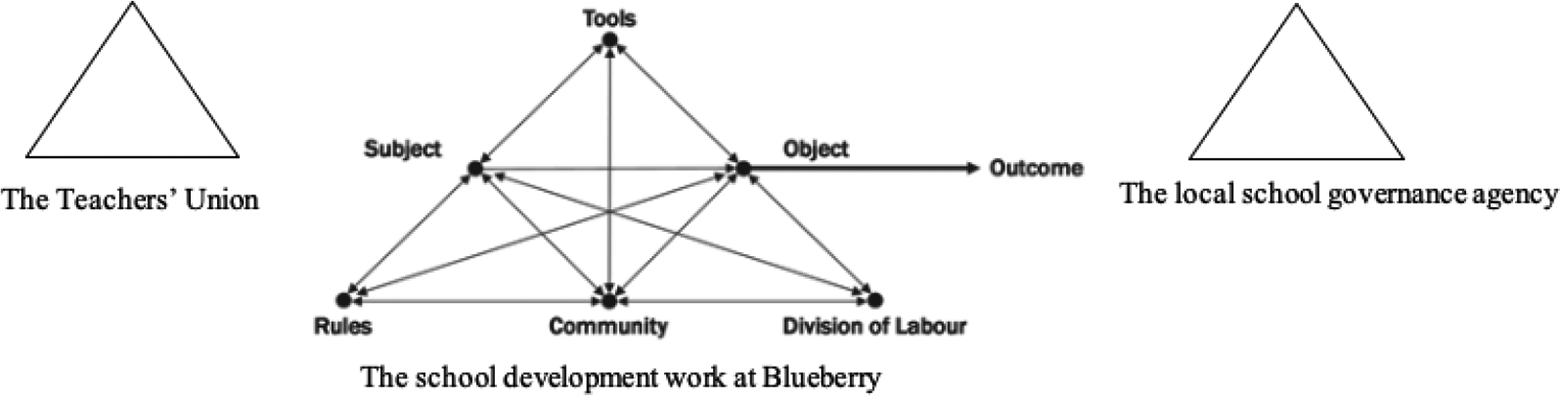
The systemic structure of the collective work activity at Blueberry in relation to the activities of the teachers’ union and the local school governance agency and the four contradictions revealed.
As we can see from the letter in this case, the primary contradiction within the division of labour is activated at the stage in the change process when the teachers start working on the new work tasks. They use the union to tell the principal that they are not satisfied. Since the role of the union is regulated by the National Working Environment Act, it is an example of how influence from an activity from outside induces tensions in an ongoing activity, which may be understood as a quarterly contradiction (Engeström, 2005), as illustrated in Figure 3. Further we can see how some of the participants in the discussion look for how they can deal with the criticism from the teachers. One suggestion is to look at the tool they have agreed on in the beginning phase of the change process: to work on a maths project and a class leader project. They discuss the possibilities of opting for only one of the projects to reduce the work tasks for the teachers. The tensions between the division of labour and the tool in the activity are an example of a secondary contradiction (Engeström, 2005). The decision to work on only one project will require a reconstruction of the object. However, such a reconstruction can provoke tensions between the interest of the school principal and the teachers working on the object and the local school governance agency, represented by the superintendent, who also have interests linked to the object in terms of improving the student results. Tensions between actors from inside and outside the ongoing activity that both have interests in the object of change are a manifestation of a tertiary contradiction (Engeström, 2005).
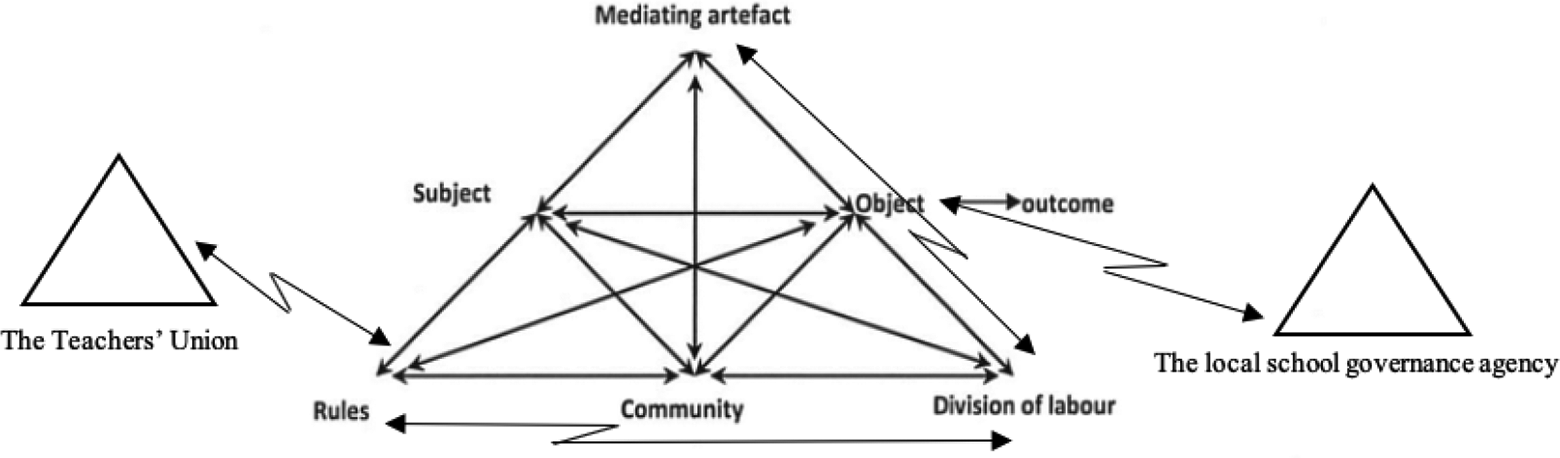
The systemic structure of the collective work activity at Blueberry in relation to the activities of the teachers’ union and the local school governance agency.
The letter from the union activates a problematic situation that, potentially, may force a breakdown in the ongoing developmental work or open up new analysis and possibilities for actions. By studying the various viewpoints and arguments expressed in the discussion between the five principals about how to respond to the letter from the union, we identified tensions within and among the contextual components of the change process at Blueberry School. The discussion above illustrates how all the components in the collective activities are closely connected and how changes in one component may mean changes in one or more of the other components (Edwards, 2009; Engeström, 2005). Teachers’ complaints about new work tasks are then more than a local leadership problem. The possibility of seeing the local problem from a socio-cultural and historical systemic perspective is important knowledge for school principals in order to understand how tensions evolving in situated work activities might be manifestations of systemic contradictions rather than solely disagreements between involved actors, as, for example, between previous and new practices, between national and local rules and between an ongoing activity and outside actors.
The in-depth examinations of school leaders’ discussions in this study contribute to expand our understanding of factors that are essential for understanding change. CHAT (Engeström, 1987) provides a framework for understanding how system-wide reforms require change in the behaviours of professionals (Fullan, 2015, 2018) by revealing how behaviours are dependent not only on the acting subject but also on the object of change, mediating tools and the socio-historical context of the school within which the behaviours are situated (Engeström, 1987) (see Figure 1). The importance of not underestimating the time frame required for system-wide change (Hall and Hord, 2002) is illustrated and made concrete by showing that change is a non-linear and contradictory multi-voiced process of expected and unexpected outcomes. In order to transform organisations (Bush, 2015), discussions at the micro level seem to be critical because new ideas cannot be copied to new contexts (Harris, 2011, 2019) but need to be seen as ‘germ cells’ to be constructed into an object of change through expansive learning processes. From the idea of change as expansive learning, the CHAT framework helps us to understand how change processes may generate tensions that can be productive driving forces if they become recognised and acted on. Detailed studies of tensions in change processes contribute to expanding our knowledge about context-sensitive strategies (Day et al., 2016) that potentially can help school leaders to utilise tensions as productive driving forces in processes of change.
Conclusion and implications
This article has presented the findings from a discussion between principals participating in a leadership programme who investigated challenges that arose in the change process at Blueberry School after receiving a critical letter from the union. The tensions that surfaced during the discussion can not only be seen as a disagreement between participants but also need to be examined and understood as systemic contradictions. As such, the study shows how change processes are historically and socially located within the contexts of intertwined complex contextual components of collective activities (Engeström, 1987).
This study has three implications for school leadership and change. First, when principals experience problematic situations in change processes at their school, they should take time to identify the tensions, discuss how to understand them and think through their implications for leadership. Second, leading such tension-laden change processes in schools requires analytical and reflective skills and training; thus, steps to strengthen these skills should be included in leadership programmes. Finally, there is a need for research focussing on how to conduct informed analysis to reveal tensions when problematic situations occur in school change processes. This is because informed analysis may lay the groundwork for how school leaders can utilise tensions as productive driving forces in processes of change.
Footnotes
Declaration of conflicting interests
The author(s) declared no potential conflicts of interest with respect to the research, authorship and/or publication of this article.
Funding
The author(s) received no financial support for the research, authorship and/or publication of this article.
